




Abstract
This article analyses the status of early childhood education in Pakistan. The education systems in place in Pakistan are mainly framed within a didactic approach to teaching and learning, which addresses certain areas of education but does not teach the child as a whole. Domains of children’s holistic development such as social, ethical, cultural, intellectual, emotional and physical well-being, and some other key academic skills, are not fully covered. In this kind of education, students are taught to follow rules without question and do as instructed, which corresponds to an autocratic view of learning. In the context of early childhood education in Pakistan, teachers occupy dominant roles, which positions them as the imparters and sources of knowledge and children as dependent and the receivers of knowledge, rather than considering them as potential, curious and powerful learners with unlimited capabilities. The literature indicates that this approach to teaching and learning does not privilege the holistic development and well-being of children. In contrast, many developed countries use research-based contemporary approaches to children’s education and development, giving children a more central role in their learning to ensure that every child has the opportunity to develop to their full potential. This kind of approach reminds teachers to view all children not as needy or deficient individuals.
Introduction and background
India remained under colonial rule from 1757 to 1947, before the creation of Pakistan in 1947. History depicts that the British rulers created effective rail and road systems in the country to transport their products and army ammunition from one place to another, but no vigorous attempts were made to school the common people (Chaudhary, 2009). A few good-quality schools were opened in the big cities of Pakistan where British army officers were deployed. In other parts of the country, the education system was less effective and predominantly Islamic-oriented in nature, and access to secular and modern education was out of reach for the common people (Whitehead, 2005). Theological education was free and was conducted either in Persian or Urdu. 1 According to the education policy of the British colonial era, Urdu was the medium of instruction for the children of the general public and English was the medium for the students of the privileged class (Coleman, 2010).
Reports suggest that the entire education sector has been the most neglected area of development even after the creation of Pakistan. No concrete and visible steps have yet been taken to transform the education sector, particularly the early education system of the country, despite Pakistan being a signatory of key international treaties such as Education for All and the Millennium Development Goals.
Pakistan’s education system
Since its creation, Pakistan has been following the traditional colonial education system, which was designed more than 80 years ago, and now the majority of Pakistanis believe that this education system does not fulfil the emerging needs of Pakistan in the 21st century. There are mainly three different education systems in place in Pakistan: (1) the national education system for the middle and lower-middle classes; (2) the elite private Cambridge system for the upper class; and (3) the Deeni Madaris or religious schools for poor families.
National educational system
The medium of instruction at public and non-elite private schools is Urdu and they follow the national curriculum of Pakistan.
Public schools
Schools run by the government of Pakistan are the largest providers of free education. Under this education system, the scope of early childhood education (ECE) is very limited and not yet mature and fully recognised (Ministry of Education, 2009).
In the public schools, the quality of teaching and learning is not encouraging due to outdated textbooks, substandard teacher training programmes, overcrowded classrooms, a lack of resources, corruption in the appointment and transfer of teachers, the misuse of the limited school budgets and the lack of an effective monitoring system (International Crisis Group, 2014).
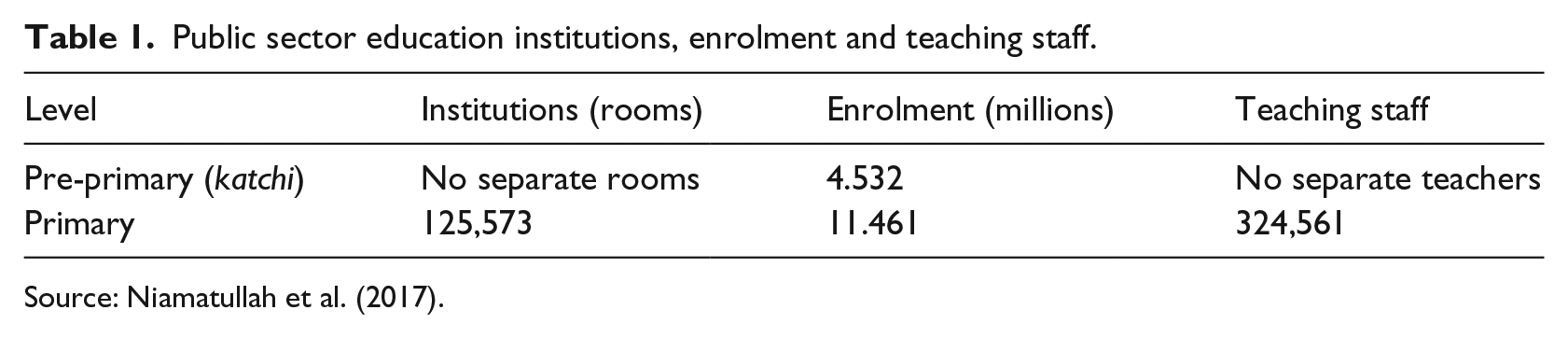
The International Crisis Group (2014: i) further states that: ‘public school students [in Pakistan] are confined to an outdated syllabus and are unable to compete in an increasingly competitive job market’. Assessment of students’ learning is summative (annual examinations), which leads to rote-oriented learning to produce high scores, and these scores determine the quality of the education. Reports further suggest that the educational achievements of primary schools are extremely poor as teachers in public schools spend less of their teaching time in the classroom (Coleman, 2010). The teacher–student ratio up to Class 5 is 1:35–40, which is not favourable. See Figure 1 below for further details.
Public sector education institutions, enrolment and teaching staff.
Source: Niamatullah et al. (2017).
For-profit, non-elite private schools
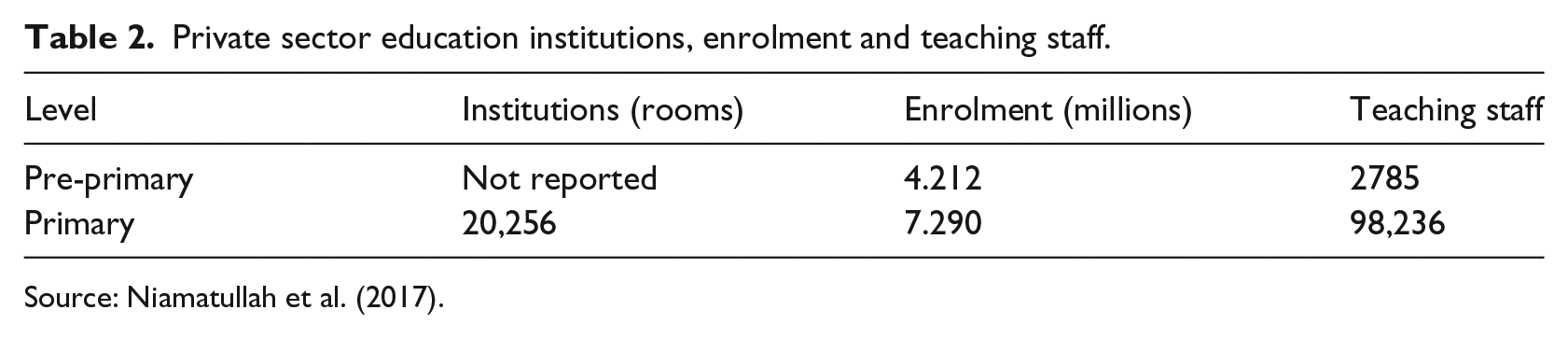
The private sector is the largest provider of organised pre-primary education in Pakistan. Establishing schooling is one of the profit-making businesses in Pakistan which has flourished enormously over the past few decades to fill the gap created by public sector education, which has deteriorated in quality. These schools serve middle- and lower-middle-class families and claim to offer quality English-language education (Coleman, 2010). Up to higher secondary level, as many as 31% of students attend private schools in Pakistan. However, the majority of these schools lack teachers and over 50% of the teachers in private schools lack professional qualifications and, as a result, are classified as untrained (Lynd, 2007). See Figure 2 for further details.
Private sector education institutions, enrolment and teaching staff.
Source: Niamatullah et al. (2017).
The majority of non-elite private schools are better equipped with furniture and other resources. They claim to use updated curriculum textbooks; however, they also offer examinations-oriented preparation to achieve good grades in public education board examinations (Malik et al., 2010). Most private preschools in Pakistan concentrate on the educational needs of children, but they often do not address their holistic needs.
Non-elite private schools are run by individuals, groups, religious persons, registered societies and political parties. Pre-primary education is an integral part of the private school system. It provides compulsory ECE to children aged three to six (Coleman, 2010). The Pakistan private sector offers care and education programmes for children under three as well (UNESCO, 2006). In most cases, the teacher–student ratio (1:30–35) is not encouraging.
Cambridge school system: elite private schools
Private schools catering for elite families existed in Pakistan before freedom during the British regime. Elite schools were opened in order to produce human resources for the running of state institutions according to the policies of the British rulers. At present, elite private schools – such as the Lahore American School, the Karachi and Lahore Grammar Schools, Aitchison School and College, Beacon House, the City Schools and the Roots School System – are few in number and provide organised pre-primary education/ECE for the children of rich families (Coleman, 2010). In principle, they follow the Cambridge education system and International Baccalaureate curriculum. These schools charge high fees and provide world-class ECE facilities, including learning resources and well-equipped classrooms. The International Crisis Group (2014: i) states that: ‘elite private schools teach in English, follow a different curriculum and have a fee structure that is unaffordable to most families’. In elite private schools, the teacher–student ratio (1:10–12) is very favourable. The children of the elite class who attend these schools are being better prepared for the best-paid job opportunities in the bureaucracy and armed forces. The teachers in these schools are better educated and better paid compared to those in non-elite private schools.
Deeni Madaris system: religious education
Deeni Madaris schools do not offer early years education in the way that ECE classes are organised by good secular schools for children’s holistic development. They provide free religious education, accommodation and food to talibaan (students) aged between 10 and 28. However, some of these Madaris have nursery classes as well, to offer Islamic and Quranic instruction (Coleman, 2010). In terms of numbers, Deeni Madaris schools are the second-largest education providers in Pakistan and cater mostly for poor rural families and the proletariat (Anjum, 2017). See Figure 3 below for further details of religious schools in Pakistan.
Religious schools, enrolment and teaching staff.

Source: Niamatullah et al. (2017).
The Deeni Madaris education system in Pakistan follows the conventional Dars-i-Nizami curriculum 2 as a base for its syllabus, which teaches religious education through rote memorisation and lacks critical thinking. This education system runs parallel to modern and secular education, and attempts to empower its followers to confront contemporary ideas (Anjum, 2017). It offers Islamic-oriented education and follows a traditional Islamic curriculum based on the teaching of five different interpretations 3 of the Islamic fiqa (‘school of thought’) (Coleman, 2010; International Crisis Group, 2014). According to Pakistan’s national education policy (Ministry of Education, 2009), education systems with different curricula cause many controversies in society.
The Deeni Madaris do not follow or offer ECE, but rather follow traditional theological teaching through rote memorisation to transfer what has been written in the holy texts. It is reported that corporal punishment is allowed in order to keep the children compliant and submissive (Akhtar et al., 2011). Assessment of the students’ learning is more conventional in religious schools as they have paper/pencil tests and require the verbal reproduction of knowledge from textbooks in order to award grades and averages. The teacher–student ratio is unknown.
Overview of ECE in Pakistan
The literature suggests that early development contributes to effective school entry, better school performance and, ultimately, visible success later in life (Morgan, 2011; Murtaza, 2011). Research has validated that early childhood is the most significant developmental period in life. ECE in Pakistani public schools is not yet a fully mature, developed or completely understood sector of education (Malik et al., 2010). Pakistan’s Ministry of Education (2009) acknowledges that ECE has not been formally recognised by the public sector in the country. In schools run by the government of Pakistan, the concept and understanding of ECE is very limited and has been largely confined to an unofficial class (katchi class) before Grade 1 (Shakil, 2002). Katchi means ‘not mature’ or ‘not enrolled’. In the public sector, there are no separate classrooms or teachers at the pre-primary stage for a total of 4.532 million children (Niamatullah et al., 2017).
In most cases, katchi-class children share a room with Class 1 and Class 2 students under the same roof, as almost all public primary schools in the country follow multigrade sitting arrangements due to a lack of classrooms and teachers. There are no specially designed classrooms for these young learners, nor do they have teachers who have been trained in early education (Khattak, 2016), therefore no proper teaching is carried out (Shakil, 2002). There are no age restrictions for admission to this particular class. Students with an age range of three to five are allowed to attend (Coleman, 2010).
The public sector uses summative approaches to assess students’ learning. Students are encouraged to embrace rote-oriented learning to reproduce the content of textbooks. Students’ learning achievements are measured based on their memorisation and fluency levels in speaking, writing and reading in all subject areas. Students are given grades and scores in order to plot their progress (Rich-Orloff et al., 2007). Teachers pay more attention to ‘book’ knowledge and the memorisation of given concepts than conceptual understanding.
The government of Pakistan announced an Education Sector Reform policy in 2001 in order to fulfil Pakistan’s commitments to the Millennium Development Goals, Education for All and the United Nations Convention on the Rights of the Child. The introduction of a formal curriculum for katchi classes and the launch of more katchi classes were the major targets of this policy. In early 2002, the Teachers’ Resource Centre in Pakistan developed learning outcomes for the national ECE curriculum, which were revised in 2007, however, due to the unavailability of teachers, classrooms and funds (in the public sector); the curriculum document alone could not reach the children. Despite the development of Acts (such as, most recently, the Right to Education Act, enshrined in article 25A of the constitution), education policies, plans, documents and targets, Pakistan was unable to achieve the Education for All target for ECE by 2015. Pakistan must come out of and go beyond the scripts, and take practical steps to introduce ECE in public sector schools.
In addition to the creation of a curriculum, no other concrete steps have yet been taken to implement the Education Sector Reform policy directives. Reports suggest that the government of Pakistan has not yet been successful in operationalising its ECE commitment in public sector schools in Pakistan due to a lack of commitment to education reform agendas and a lack of funds (International Crisis Group, 2014). Rich-Orloff et al. report that:
while the government made a commitment [in 2002] to institutionalise early childhood into the formal schooling system and to open Katchi/ECE classes in public sector primary schools, this could not be achieved due to the lack of resources and finance constraints for early childhood. (Rich-Orloff et al., 2007: 44)
The private sector, excluding religious schools, is the largest provider of organised pre-primary education in Pakistan. This school system operates pre-primary schooling in a more systematised way, using the names of various organised programmes, such as kindergarten, nursery, infant education, preschool education and ECE (Akhtar et al., 2011).
Some non-governmental organisations (NGOs), including the Aga Khan Education Service, Pakistan, offer a four-year ECE programme, combining Classes 1 and 2 with two years of pre-primary schooling for children aged five to eight. Students are encouraged to take part in learning activities through the manipulation of materials based on their own choices, with the support of teachers (Rich-Orloff et al., 2007). Unlike the public school sector, in schools run by NGOs, promotion to the next class is based on formative and shared assessment procedures. Students’ progress reports and portfolios are generated and shared with parents.
Recognition of the ECE programme as an important part of children’s holistic development is now growing rapidly in schools run by NGOs. These organisations have started policy dialogues, teacher training programmes, and parent and community awareness sessions. NGOs also run public awareness sessions to highlight the importance of ECE and to boost child-rearing and nurturing practices. However, their intervention is confined to limited regions of Pakistan and is mostly for upper-class families in urban localities or multiple classes in remote rural villages (Malik et al., 2010).
NGOs and ECE in Pakistan
The lack of government commitment and interest in education sector reforms has allowed several NGOs in Pakistan to contribute to the launch of ECE programmes, particularly in rural and the most marginalised and hard-to-reach areas. A significant number of national and international NGOs and civil society organisations have been operating ECE programmes across the country. Almost all of the programmes being implemented by NGOs are small in scale and outreach, and their intervention is limited to the defined locations (Shakil, 2002). Donor agencies and NGOs – including the Aga Khan Development Network, the World Bank, the Global Partnership for Education, the European Union, UNICEF, UNESCO, Dubai Cares, Oxfam, the Rupani Foundation, Save the Children and Plan International have been making a significant contribution to further ECE agendas and fulfil the needs of the Education for All goals. The most significant contributor and pioneer in launching ECE programmes in Pakistan is reported to be the Aga Khan Development Network. It has been providing ECE services for curriculum development, learning resource management, infrastructure development, teacher training and community development initiatives, in addition to operating good-quality schools and child-focused health education programmes across the country. Plan International has been providing limited support to a few public schools in the Punjab and, more recently, Right to Play has emerged in rural Sindh Pakistan, creating a joyful environment through play for young children. The Rupani Foundation, another key ECE contributor, has been operating well-equipped ECE centres mostly in mountainous locations for neglected poor families, focusing on children from birth to three and their parents. Most of these NGOs have been using Western philosophies and research-based approaches to child education and development, such as constructivism, child-centred education and children’s holistic development. All of these efforts by various key NGOs and generous donor agencies to promote ECE in Pakistan are but a drop in the ocean considering the growing population of ECE-aged children; at present, 22 million children are reported to be in the age bracket of zero to eight (Early Childhood Development Network of Pakistan, 2016). Unless and until the government prioritises ECE and envisions it as a multisectoral holistic business, the dream of children’s holistic development will not come true.
Some key challenges
Some of the broader challenges the country has been confronting which have an enormous impact on its education system, are political instability, the continuation of the colonial education system, a class-difference education system, a lack of funds, religious extremism and terrorism. There is a lack of political commitment, therefore ECE is not a priority area in government planning. None of the public universities in Pakistan offer degrees, graduate courses, teacher training programmes and world-class research in education for ECE teachers. The existing facilities, including human and material resources in public and private schools, are not sufficient or competent enough to run effective ECE programmes. Most importantly, an ECE framework is yet to be created which will guide the development, implementation and evaluation of ECE services across the country. A budget is needed to launch the provision of proper ECE services and to transform the existing traditional katchi classes into improved early years classes in all public schools in Pakistan (UNESCO, 2006).
Conclusion
In the public sector in Pakistan, a class before Grade 1 is called ECE and the age range for this class is three to five. In general, public schools in Pakistan have been preparing children to pass examinations and encourage students to learn concepts by memorisation, rather than developing logic reasoning and conceptual understanding. The current curriculum approaches in Pakistan underscore language and cognitive skills and ignore social, emotional, cultural, physical and secular/spiritual development. The battle for ECE has to be won in the hearts and minds of the people, as there are some indications that the government is taking action to make provision of ECE in government schools a priority as ECE has begun to gain prominence among policymakers.
Footnotes
Funding
This research received no specific grant from any funding agency in the public, commercial or not-for-profit sectors.