



Abstract
Sustainable Development Goal (SDG) 4.2 states, “By 2030, ensure that all girls and boys have access to quality early childhood development, care and pre-primary education so that they are ready for primary education”. Progress towards the goal is measured by indicators of children’s developmental status (Indicator 4.2.1) and participation in at least 1 year of pre-primary education prior to primary school (Indicator 4.2.2). A literature review and analyses of policy documents were conducted to evaluate China’s progress in achieving SDG Target 4.2. This review found that, on the one hand, national data on SDG Target Indicator 4.2.1 are unavailable. The extant data are mainly based on limited samples and collected using different methods, including direct assessment and parent report. On the other hand, data on SDG Target Indicator 4.2.2 are available on the UNESCO database. That stated differences exist between data reported to UNESCO by the government and data provided by the Ministry of Education. Efforts need to be continued to ensure that reliable data, which are the foundation of evidence-based policy-making, are collected and reported.
Introduction
Indicators Associated With SDG Target 4.2.
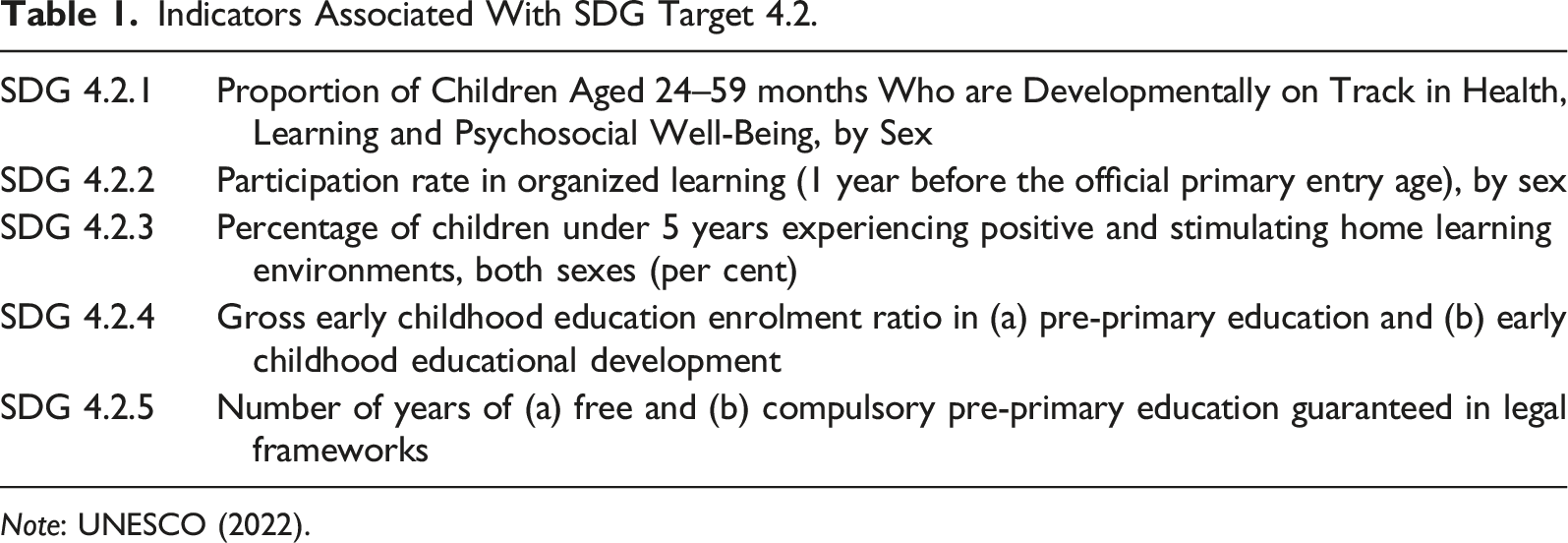
Note: UNESCO (2022).
Organised learning programmes consist of “a coherent set or sequence of educational activities designed with the intention of achieving pre-determined learning outcomes or the accomplishment of a specific set of educational tasks. Early childhood and pre-primary education programmes are examples of organised learning programmes” (UNESCO Institute for Statistics [UIS], 2023). In China, kindergartens, and the pre-primary class in primary schools are organised learning programmes. The Adjusted Net Enrolment Rate (ANER) is used to measure participation in pre-primary education (PPE) 1 year before primary school (i.e., SDG Target Indicator 4.2.2). It is used as the benchmark indicator to inform national progress towards SDG Target 4.2 (UNESCO, 2023). The ANER is different from the Gross Enrolment Rate (GER) and specifies the ratio between children enrolled in preschools before the official primary entry age and the overall population of the pre-primary age group. By contrast, the GER is the percentage of children enrolled in preschool, regardless of age, out of the total population of the pre-primary age group. The latter can therefore exceed 100% (UNICEF, 2022). Specifically, the enrolment rate 1 year before primary education needs to be disaggregated across demographic or socioeconomic factors to reflect the extent of equity in children’s participation in PPE.
Globally, the Adjusted Net Enrolment Rate (ANER) for participation in organised learning 1 year before the official primary school entry age was 75% in 2020 (UIS, 2022). However, we must be cognizant of a country’s recent enrolment rates in PPE, as evaluating a country’s progress towards SDG Target 4.2 without considering the starting point would be inappropriate (UNESCO, 2021). For example, ANER in PPE ranges from an average of 48.03% for countries in Sub-Saharan Africa to 95.54% for European countries (UIS, 2022). A country with an enrolment rate of 50% would have different issues in increasing enrolment from one that has a rate of 95%. Furthermore, the extent of equity in access to quality PPE also varies across countries. Globally, disparities in children’s participation are found to relate to their residence (e.g., rural, or urban areas) and family wealth, and there are differences in inequalities. For example, in Sub-Saharan Africa, the difference in enrolment rate for children from the richest and poorest wealth quintile can range from less than 10% to more than 70% across countries (UNESCO, 2022).
Countries are advised to link the global education agenda to their own contexts so that the monitoring process towards SDG Target 4.2 is contextualised (UNESCO, 2021). Nevertheless, setting feasible and appropriate national targets based on countries’ own educational priorities is not easy. If the national target is too ambitious or infeasible, then it is unlikely to be met. Furthermore, there can be discrepancies and inconsistencies in methodology or sources used in the data collection processes across countries, which could hinder transparency in data sharing and accountability in decision-making (UNESCO, 2023). Against this background, this paper reviews China’s progress in meeting SDG Target 4.2, summarizes the challenges and issues that it faces, and provides suggestions for future research, practice, and policies. Specifically, this article focuses on children’s equitable participation in 1 year of organised learning before primary education in terms of ANER and triangulates the figure with other data sources. In addition, collecting data about children’s developmental status, which is reflected by SDG Target Indicator 4.2.1, will also be considered in reviewing China’s progress towards SDG Target 4.2.
Meeting Sustainable Development Goal Target 4.2 in China
China has over 63 million children under the age of five, constituting approximately 4.74% of the nation’s population (National Bureau of Statistics, 2021a). In China, the terms Early Childhood Education (ECE) or preschool education are used to denote services for children between 3 and 6 years (Li et al., 2014), rather than the term PPE. There are mainly two forms of preschools in China. One is stand-alone kindergartens; the other is the 1-year pre-primary classes before Grade 1 which is typically co-located in a primary school in rural areas. Kindergartens cater for children from 3 to 6 years, while pre-primary classes serve children aged five to six or 6–7 years. In this review, PPE is used interchangeably with ECE and preschool education.
Early Childhood Development (ECD) has gained enormous policy attention and government funding in recent decades as China experienced tremendous economic growth and rapid industrialisation and urbanisation. It is important to review China’s progress in meeting SDG Target 4.2, considering the demographic and socioeconomic changes that have taken place in the country. The low and rapidly declining total fertility rate (TFR), as well as an increasing population aged above 60, have brought about challenges to China, which is transforming into an ageing nation. It is estimated that over 400 million citizens will be over 65 years by 2050 (Fang et al., 2015). Moreover, a demographic analysis of the 2015 1% sample census showed an overall TFR of 1.047, down from 1.188 in 2010 (Guo et al., 2019). The burden of elder care, medical care, and social services (Lu & Liu, 2019) for the younger generation would be aggravated by labour shortages as well as increased economic competition (Wu et al., 2012). In order to sustain economic growth and ensure a higher national standard of living, it is necessary to transform capital- and labour-intensive industries into knowledge- and innovation-driven ones. Therefore, investing in human capital and cultivating a well-educated, high-skilled labour force is critical.
Preschool education has been increasingly emphasised, as evident from government funding, educational regulations, and policies. In July 2010, the State Council of China published the Outline of China’s National Plan for Medium and Long-term Education Reform and Development (2010–2020), which established the goal of providing 1-year universal preschool for all children by 2020. Consecutive Three-Year Action Plans for ECE were also developed at the provincial and county levels to better implement the national plans (State Council, 2010). The Chinese government has shown commitment to achieving SDG Target 4.2 and submitted a national target of a 3-year ECE attendance rate of 99.5% by 2030 to UNESCO (UNESCO, 2021). This is much higher than the goal of a 1-year attendance rate specified in the relevant international SDG Target 4.2.2. That being said, no data are available to document China’s progress in the participation rate in organised learning 1 year before primary school (UNESCO, 2023). A previous review of progress towards SDG Target 4.2 in Bangladesh, China, India, and Myanmar focused on Indicator 4.2.2. It suggested that there were discrepancies in data sources, as well as variations in the availability of data across the four countries (Rao et al., 2021). However, few studies have systematically investigated China’s current progress in meeting SDG Target 4.2 and identified gaps and challenges that need to be addressed to achieve this goal. A nuanced analysis of the Chinese context, in terms of achieving SDG Target 4.2, is needed to guide policies, future research, and practices with more efficiency.
China’s Progress Towards Sustainable Development Goal Target 4.2
Children’s Participation in Early Childhood Education
Albeit variations across data sources, figures denoting preschool attendance show that China has made tremendous efforts to increase access to ECE. National governments provide data on the ANER for 1 year before the official primary entry age to the UIS. Data from China show that the ANER climbed from 70% in 2010 to 100% in 2012, but there are no ANER data on the UIS database after 2016 (UIS, 2022). This finding parallels the data inadequacy that has been described in monitoring SDG Target 4.3: “By 2030, ensure equal access for all women and men to affordable quality technical, vocational and tertiary education, including university” in China (Yuan, 2022). For ECE attendance, researchers have triangulated the UIS data with results from China Family Panel Studies (CFPS), a national longitudinal home survey conducted by the Institute of Social Science Survey (ISSS) at Peking University (Xie & Hu, 2014). The CFPS includes questions like “Has the child ever attended kindergarten?” when interviewing caregivers about their children’s early learning experiences. Su et al., (2020) found that the average preschool attendance rate for 1 year before primary school increased from 83% in 2010 to 90.84% in 2016 for five- and 6-year-olds. The difference between UIS and the CFPS data may be that the UIS data also include children in pre-primary classes in primary schools, but the question posed in the CFPS only asks about kindergarten attendance. The Ministry of Education (MoE) in China provides administrative data regarding the GER for children between 3 and 6 years annually. The GER for PPE increased from 75% in 2015 to 88.1% in 2021 (MoE, 2021a), and is slightly lower than that reported by UIS, which shows an increase from 78.66% to 93.07% over the same period (UIS, 2022). The discrepancy in data could be that UNESCO data focus on children aged 4–6 years, and the MoE data focus on the attendance of children ranging in age from 3 to 6 years (UNESCO, 2015). Figure 1 shows that despite differences in percentages, according to various sources of data, the attendance rate in PPE has generally increased. Children’s attendance rate in PPE. Sources: Su et al. (2020), UIS (2022), MoE (2010–2021)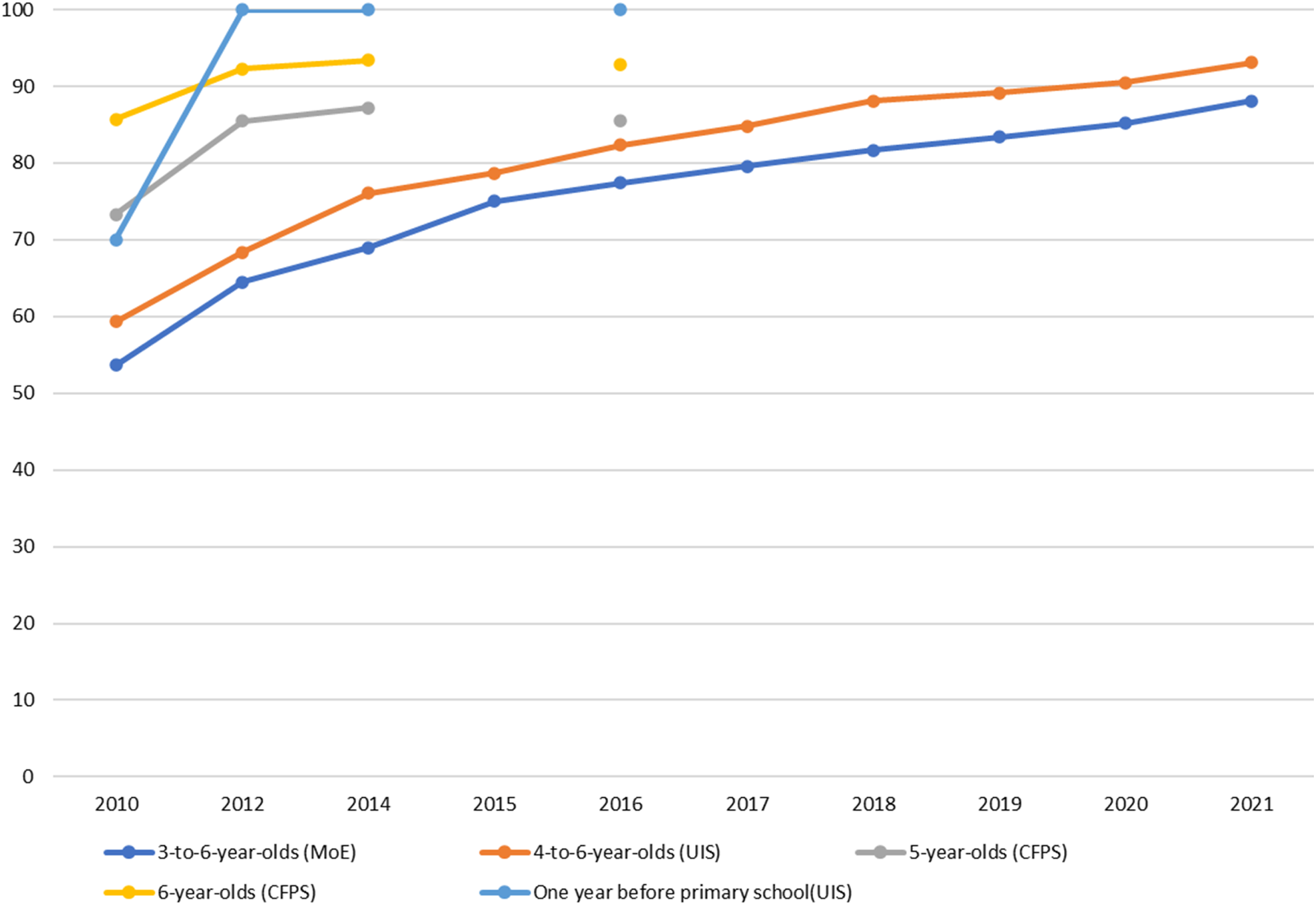
Equity in Early Childhood Education Participation
In addition to increasing access, increasing equity in ECE participation across regions, ethnicities, urbanicity, family socioeconomic status (SES) and child gender is considered a means to achieve greater social justice (Organisation for Economic Co-operation and Development [OECD], 2015). By 2021, non-profit kindergartens (Pu Hui Kindergartens) had expanded under government sponsorship and now account for 84.74% of the total, serving more than 40 million preschool children (MoE, 2021a). The ANERs reported by the UIS show equitable participation in 1 year of PPE across sex, wealth quintiles, and urbanicity between 2010 and 2016 (UIS, 2022). However, previous studies which leveraged the CFPS data have found decreasing but still significant gaps in opportunities for receiving ECE among children across urbanicity and family SES (Su et al., 2020). Also, although gender parity in preschool attendance has greatly improved, we need to bear in mind that the sex ratio at birth in China is skewed (National Bureau of Statistics, 2021a), and the base rate for a girl to receive PPE is different from that for a boy. Indeed, Alduais and Deng (2022) argued that the gender composition of the population must be taken into account when discussing gender equity in providing inclusive education as gender gaps in enrolment could be related to gender composition of the population. Figure 2 provides data from the CFPS on attendance rate in PPE across urbanicity and gender over time. Disparities in attendance rate in three-year of PPE over time (3- to 6-year-olds). Source: Su et al. (2020)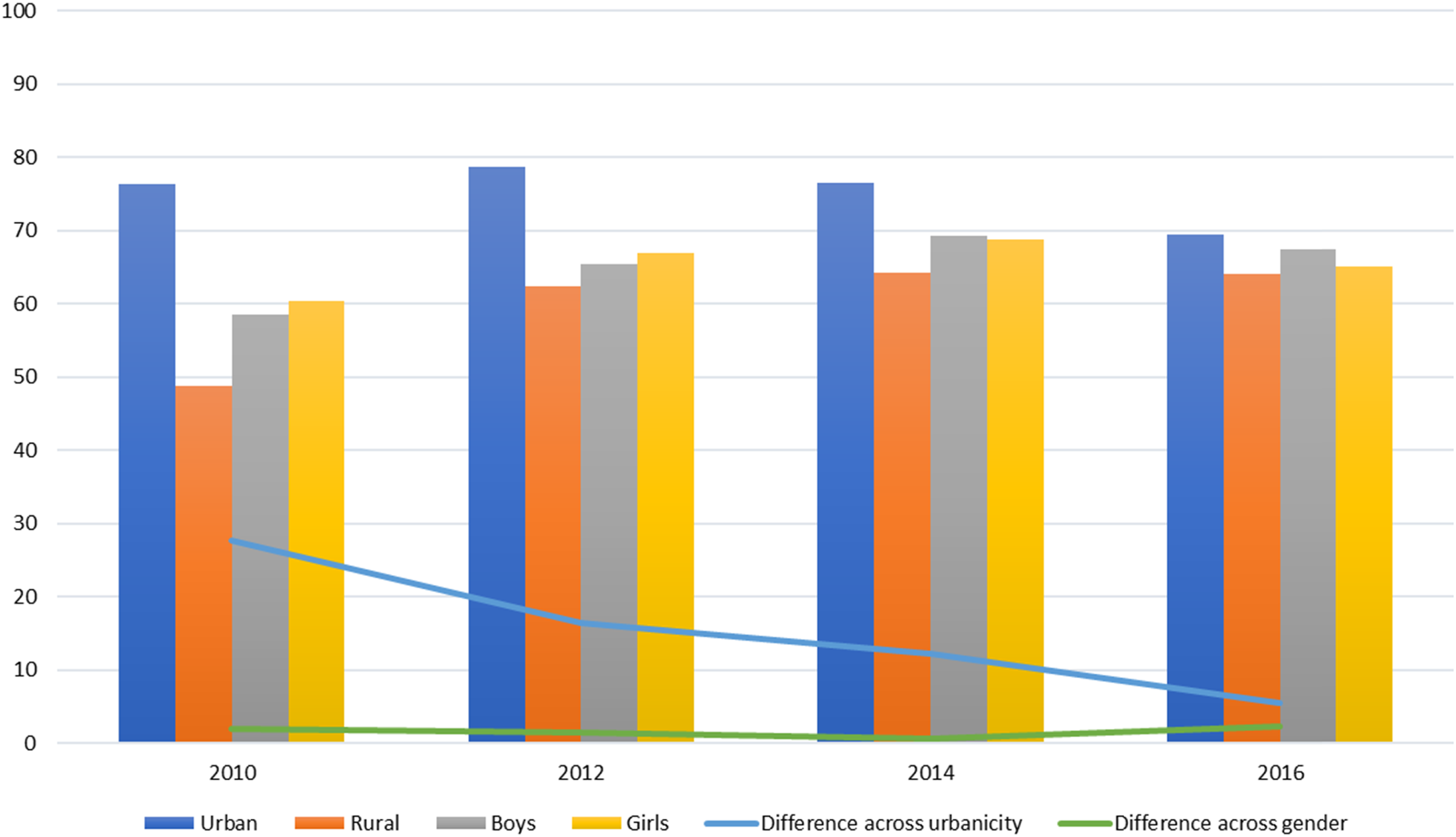
Increasing Early Childhood Education Quality
Beyond striving to achieve universal ECE provision, policies are important means of enhancing ECE quality, influencing curriculum, pedagogy, workforce development, monitoring, governance, and funding (OECD, 2020). The 14th Five-Year Action Plan for Developing and Improving Early Childhood Education (MoE, 2021b) stipulates “comprehensive improvement of ECE quality” as one of three important tasks. To better guide educational practices, the updated Kindergarten Work Regulation, released in 2016, stipulates rules and principles for learning, teaching, and staffing in kindergartens (MoE, 2016). For example, it states that preschool education practices must be developmentally appropriate and pay attention to individual differences and that teachers must create a well-prepared environment for children to learn. In terms of workforce development, the Several Suggestions on Current Development of Preschool Education require local governments to establish appropriate teacher-child ratios, review teachers' tenure in public kindergartens, set teacher recruitment criteria, guarantee teachers’ salaries and welfare, and build high-quality teacher education and in-service training programs (State Council, 2010). Furthermore, the MoE released the Guideline for Evaluating the Quality of Early Childhood Education and Care of Preschools recently (MoE, 2022), which provides detailed instructions for preschool self-evaluation and assurance of ECE quality. Notably, the Guideline emphasises instructional quality in preschool education and specifies evaluation domains, including the process of education, the creation of the environment, and workforce development. The Guideline also highlights the importance of building a stable evaluation team, promoting education quality through self-evaluation, and encouraging provincial and municipal governments to develop their own guidelines for self-evaluations of preschool quality. National guidelines are essential for promoting ECE quality at the systems level as they provide clear and operationalized standards for preschool and teachers to reflect on their own practice. Therefore, implementing these measures could be helpful in narrowing the discrepancies in ECE quality across regions. Further, since ECE process quality is positively associated with child developmental outcomes (Su et al., 2021), increasing the quality of provision has the potential to reduce developmental gaps among children from different socioeconomic backgrounds. To summarise, the above-mentioned measures have shown China’s political will to formulate national guidance to elevate, evaluate, and monitor ECE quality.
Challenges in Meeting Sustainable Development Goal Target 4.2
Despite the remarkable increases in ECE participation, concerns have been raised regarding persistent inequalities in ECE quality across regions and urbanicity. The lower ECE quality in rural areas compared to urban areas relates to uneven allocations of public ECE resources, variations in the efficiency of management systems, and a lack of supervision and evaluation (Hong et al., 2015; Zhang & Liu, 2017). Structural characteristics of ECE, such as group size, children-to-teacher ratio, and teachers' qualifications, are distal and regulatable aspects (Slot et al., 2015). Structural quality is a prerequisite for process quality, which includes children’s day-to-day experiences and interactions with teachers, peers, and materials (Howes et al., 2008).
Information about the structural and process quality of ECE in rural preschools is available from existing reports or research. An analysis of the 2015 nationwide rural education survey (Liu & Lan, 2017) indicates that the teacher-to-child ratio for rural kindergartens was 1:20.8, which falls far short of the national standard of 1:7 to 1:9 (MoE, 2013). Additionally, rural kindergarten teachers are less qualified than their urban counterparts. In 2019, the proportion of rural preschool teachers (77.2%) with a college degree or higher was 11.5% lower than that of urban teachers (MoE, 2020). While structural quality, the main factor in ECE’s macroeconomic costs, is subject to government regulations (Slot et al., 2015), process quality is difficult to measure, and nationwide data are limited. An investigation of 217 kindergarten classrooms in Hebei, a rural province in China, found poor quality across every indicator measured, including curricular and pedagogical process quality (Hu et al., 2016). Another study analysed early childhood education quality from 91 kindergartens in Zhejiang province, using the Chinese Early Childhood Environment Rating Scale, and found rural areas had lower “teaching and interaction” quality than urban areas and quality was predictive of children’s differentiated language outcomes (Li et al., 2016).
The urban-rural disparity in preschool quality is of concern as it affects the early development of socially disadvantaged children (Su et al., 2021). Under rapid urbanisation, the 2015 1% National Population Sample Survey estimated that there were 10.53 million migrant children and 28.75 million left-behind children under 5 years of age, as a result of parent migration (National Bureau of Statistics et al., 2017). Rural left-behind children are children whose parent(s) move to urban areas to meet the demand for labour, and migrant children are children who move from rural to urban arears with their families (Shen, 2017). Parental migration is negatively associated with the amount of cognitive stimulation children receive at home (Xie et al., 2021), and can impact children’s development. Research has consistently shown that rural left-behind children were more likely to exhibit behavioural problems (Hou et al., 2019), and lower levels of socialisation (Zhou & Xu, 2012), inhibitory control (Cao & Chen, 2012), as well as vocabularies (Wu et al., 2020) than their non-left-behind rural peers, and local urban children.
In recent years, the rural population is becoming more educated and more likely to move to urban areas with their spouses and children than previous migrants, and this has resulted in an increase in the number of migrant children (Zhao et al., 2018). Although migrant children are found to be more likely to have stimulating home learning environments and to attend preschools than their rural peers, they have lower quality early learning experiences than urban native children (Gong & Rao, 2023). China has a unique restrictive household registration (Hukou), and the local government allocates funding for education based on local Hukou, prioritising local children. This means that migrant children without urban Hukou are denied access to public education in destination areas (Chen & Feng, 2013). According to the National Bureau of Statistics (2021b), only 28.9% and 37.2% of migrant pre-schoolers were registered in public and low-cost private kindergartens, respectively. Although some schools enrol migrant children in city areas, they often have limited space, relatively poorly qualified teachers, and inadequate teaching facilities (Lai et al., 2014). Previous studies have found poorer psychological, behavioural, and learning outcomes of migrant children compared to their urban native counterparts (Liang, 2019).
Providing high-quality preschool education to socially disadvantaged children at the beginning of primary school is critical as it can be helpful to mitigate the negative impact of adversities in the early years (Anderson et al., 2003). It is of concern that children who would most benefit from attending ECE are less likely to attend quality preschool programs, thereby the developmental gaps between them and their advantaged peers would remain and even widen over time. To help guide government strategies and funding priorities, nationally representative data about child development, which is indeed the emphasis of SDG Target Indicator 4.2.1, should be collected.
Measuring Sustainable Development Goal Target Indicator 4.2.1
However, unlike the progress in SDG Target Indicator 4.2.2, which can be informed by the government and household survey data, national-level data on SDG Target Indicator 4.2.1 are unavailable to date.
Data Sources
Regarding children’s health status, only a few indicators of child survival and child nutritional status have been collected for children under 5 years of age. For example, the Maternal and Child Health Surveillance, a population-based maternal and child death registry system, has data on under-five mortality at the country and provincial levels (Mu et al., 2019). The CFPS data can also be used to calculate the stunting rate for children under 5 years based on height-for-age score. However, there are problems with the accuracy of these parent report data. Apart from these sources, no direct assessment data on children’s health status are available at the national level.
Compared to health status, even less nationally representative data on young children’s learning and psychosocial well-being status are available. Assessing young children’s learning competencies has mostly relied on individually-administered IQ tests. For example, the Chinese Wechsler Young Children Scale of Intelligence (C-WYCSI)—developed in the 1980s based on the Wechsler Preschool and Primary Scale of Intelligence (WPPSI) (Gong, 1988), is used by professionals to directly assess individual children’s development in different domains. Norms have been established for urban and rural children in China (Kong & Sun, 2008). The Bayley Scales of Infant Development is a widely-utilized direct assessment instrument for children under 3 years of age (Bayley, 1969). The third version (Bayley-III) contains five sub-scales tapping children’s cognitive, language, motor skills, social-emotional development, and adaptive behaviour (Hoskens et al., 2018). In 2015, Shanghai Jiao Tong University translated the Bayley-III into Chinese and validated it in Chinese contexts (Hua et al., 2019).
For psychosocial assessment, screening tools such as the Ages and Stages Questionnaires (ASQ) are normally adopted. The ASQ (translated and adapted by Bian XiaoYan et al.) was used to screen for developmental delays from early childhood to adulthood by completing questions about child development (Zhang et al., 2018a). Another example is the Warning Signs Checklist (WSC), the result of a concerted effort led by the National Health and Family Planning Commission. The WSC is a brief and effective screening tool used to screen for psychological, behavioural, and developmental problems among children from birth to 6 years. It includes 44 items related to children’s gross-motor, fine-motor, language, and social-emotional development (Zhang et al., 2018b).
Results from individually focused assessments are interpreted based on norms (Fernald et al., 2017) and deemed precise for judging children’s abilities and determining whether they have developmental delays. However, implementing individual standardised tests can be time-consuming, and resource-intensive, and assessors need to be properly trained to guarantee consistency across tests. Hence, it is costly to generate data about SDG Target Indicator 4.2.1 at the national level using individually administered tests. Furthermore, although screening tools would be applicable in large-scale assessment, they are designed to detect developmental delay and are not sensitive enough to make fine discriminations in children’s developmental skills.
Current Measures and Related Issues
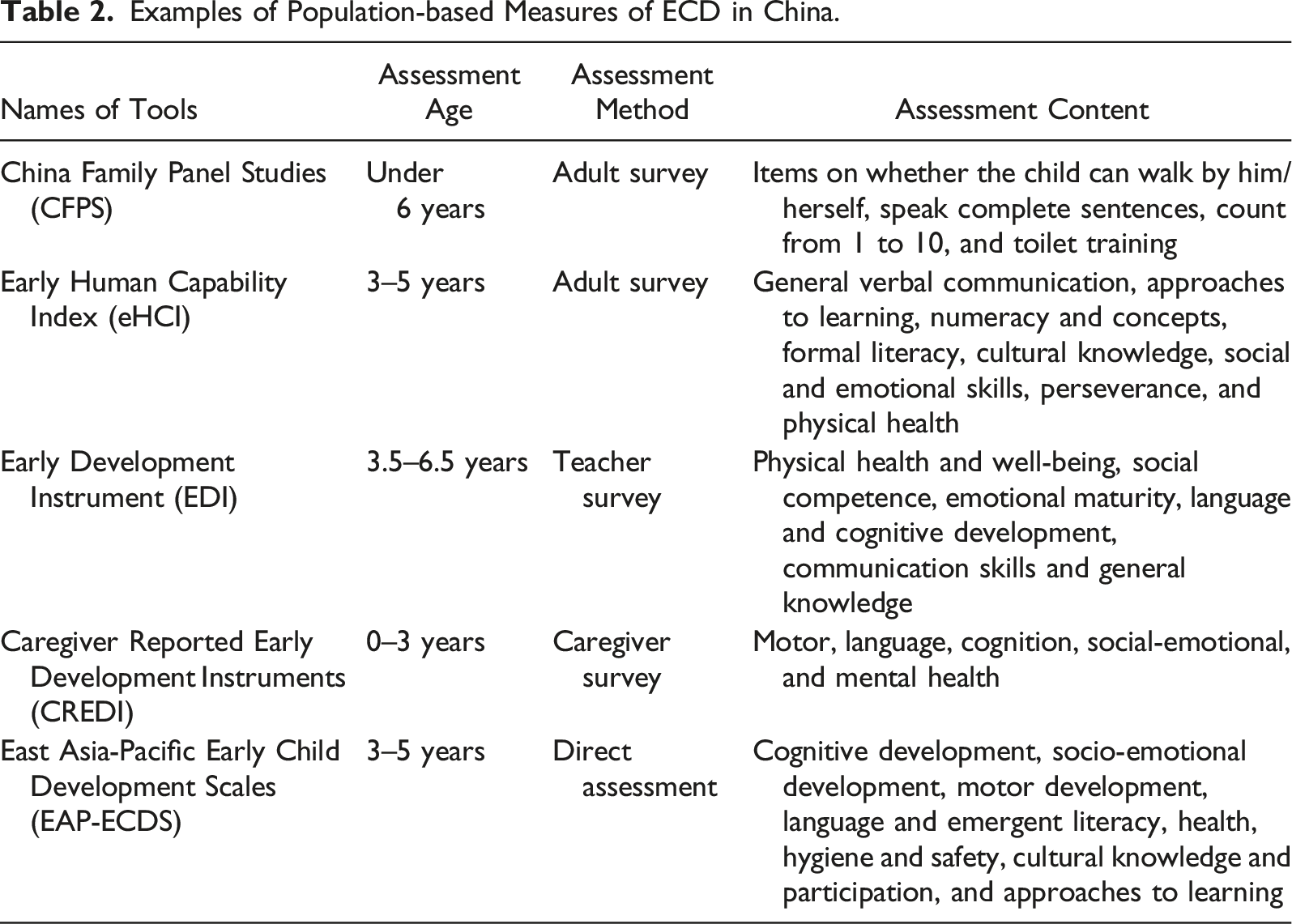
To collect data on SDG Target Indicator 4.2.1, it is necessary to develop a population-based measure of ECD, which aims at obtaining aggregated and less-specific information at the population level for accountability purposes (McCoy et al., 2018). Population-based measurement of ECD can be effectively implemented through large-scale censuses or home surveys, which provide information about the development of representative panels from time to time. Globally, UNICEF’s Multiple Indicator Cluster Surveys (MICS) have been used in over 118 low- and middle-income countries. The Early Childhood Development Index (ECDI) in the ECD module under MICS specifically provides information about child development in various domains (Loizillon et al., 2017). The latest ECDI2030 (UNICEF, 2021) has been developed to collect information on SDG Target Indicator 4.2.1 (i.e., to determine children’s developmental status). China plans to use the ECDI2030, but official reports on data collection are not available. Hence, there is a lack of evidence on children’s developmental status, at the national level, using the ECDI.
The CFPS has been collecting nationally representative data since 2010 at the individual, family, and community levels. Data on child development are acquired through caregiver interviews. These questions mainly focus on developmental milestones or basic skills, such as whether the child can walk, speak in complete sentences, count from one to 10, and urinate independently. Children’s social and behavioural development are also explored through questions about whether the child is cheerful and happy, waits their turn during activities, and gets along well with other children. These questions are easily understood and answered by parents. However, little evidence is available on whether these questions are comprehensive and sensitive enough to reflect variations in development across populations of children.
Meanwhile, studies used tools that measure different child development domains through a variety of methods, including filling out questionnaires or surveys, interviewing caregivers, and direct assessment. For example, Zhao et al. (2020) measured children’s developmental status using the Chinese version of the Early Human Capability Index (eHCI), which focuses on the development of children aged three to 6 years at the population level (Brinkman & Vu, 2016). It is implemented by asking parents or teachers to answer questions about various aspects of children’s development (Zhao et al., 2020). The Chinese version of eHCI demonstrated satisfactory reliability and validity, showing discriminant developmental levels among children across sex, parental education, and family income (Zhao et al., 2020).
Another population-based assessment tool—the Early Development Instrument (EDI)—was also adapted and translated into Chinese (Ip et al., 2013). The EDI was designed as a teacher-report measure for determining children’s readiness for primary school (Janus & Offord, 2007). The Chinese version of EDI (CEDI) has been validated in Hong Kong, showing adequate concurrent validity, internal consistency, and test-retest reliability across children in districts and families with various socioeconomic statuses (Ip et al., 2013, 2016). The CEDI has also been adopted in Shanghai to investigate the moderating effect of parenting style on the relations between parental involvement and children’s school readiness (Xia et al., 2020).
Population-based measurement of children from birth to 3 years has also been studied using the Caregiver Reported Early Development Instruments (CREDI) (McCoy et al., 2018). Li et al. (2020) translated CREDI into Chinese and examine its concurrent validity, by comparing the Chinese CREDI results with those of ASQ-3, and Bayley-III. Findings showed CREDI had high internal consistency, good concurrent validity against the Bayley-III, and high associations with key variables, including child age and home stimulations (Li et al., 2020).
Additional population-level measures implemented through direct assessment of children have also been adopted and validated in China. One example is the East-Asia Pacific Early Childhood Development Scales (EAP-ECDS), developed as a pan-cultural tool to assess the holistic development of children aged between 36 and 71 months across East-Asia Pacific countries (Rao et al., 2019). In China, the EAP-ECDS has been used to describe and compare children’s development and learning in both cross-sectional and longitudinal studies (Song et al., 2020; Zhou et al., 2018). Children from Eastern regions and cities performed better than their counterparts from Western regions and rural areas (Su et al., 2021; Zhou et al., 2018). Moreover, findings from the EAP-ECDS showed that regional disparities in the Health, Hygiene, and Safety subscale decreased over time (Song et al., 2020).
These population-based measures are generally reliable and valid for measuring ECD in Chinese contexts. However, as most of these tools were originally developed to be culturally neutral, they are unlikely to specifically consider the ECE curriculum guidelines advocated in Chinese preschools, nor the values deemed important for child development in Chinese society. Meanwhile, there is a lack of information on the predictive validity of these measures, as almost all validation studies used cross-sectional data. One exception is the EAP-ECDS (Rao et al., 2023). Furthermore, these measures vary in their assessment content, and research is needed to inform how well the assessment results generated by these measures would reflect children’s developmental levels in health, learning and psychosocial well-being domains.
Another issue concerns the assessment methods adopted by population-based measures since direct assessment and adult report both have strengths and limitations. Direct assessment is conceptualised as a standardised activity or task administered by a trained assessor to assess a child’s development (Sabanathan et al., 2015). Since direct assessment results are based on professional judgment and involve a large population of children, they are considered a less biased means to inform child development (Fernald et al., 2017). However, direct assessment’s high demands for standardised administration, assessment settings, and materials provided make it difficult to implement at scale.
Adult report can provide information about children’s behaviours in non-standardised settings by having informants answer or complete questions about children (Fernald et al., 2017). Data based on adult report are easier to collect than those from direct assessment, as parents or teachers do not require specific training to score and interpret the assessment items (Johnson & Marlow, 2006). Therefore, adult report is highly feasible, time-saving, and economical when implemented at scale.
Examples of Population-based Measures of ECD in China.
Conclusions and Implications
This review provides an overview of China’s progress in meeting SDG Target 4.2 and underscores the extent of inequity in the nation. Although ECE participation rates have improved in recent years, disparities remain in equitable access to quality ECE between urban and rural children and among urban, left-behind, and migrant children. Developmental gaps across populations of young children are likely to widen as they grow up if socially disadvantaged children do not receive high-quality ECE.
In many countries, children from more economically advantaged families are more likely to attend ECE than children from poorer families. Governments want to ensure that children from families experiencing poverty are not disadvantaged when they start primary education. They have adopted various measures to ensure ECE programmes are accessible to all children, including building community-based preschools, establishing alternative preschool modes, making ECE free, and making it compulsory. For example, In 2009, Brazil legislated 2-year compulsory preschool education (age four–6) by amending the constitution (UNESCO, 2022). In the progress towards SDG Target 4.2, legislation to make PPE free and compulsory has played an important role in increasing children’s universal participation. For countries such as Jordan, Palestine, and Armenia, adopting free PPE in legislation has increased children's participation in organised learning 1 year before primary school (UNESCO, 2023). China already has a high rate of attendance in ECE. The challenge for the country is to ensure all children, regardless of their ethnicity, family wealth or where they live, can access ECE and that the gaps in quality between eastern developed provinces and western regions are closed.
National data on the quality of ECE across the country are not available, unlike data on preschool attendance which are normally collected and reported at the administrative level. Monitoring and improving preschool quality could be challenging as it is more complex and involves dimensions such as “use of a curriculum, staff characteristics, teacher or caregiver behaviour and practices, and the staff-child interaction” (OECD, 2015, p.51). For example, OECD countries vary in their purposes, funding, and governance systems in terms of monitoring ECE quality and adopt different measures to evaluate and improve their ECE quality. Some countries, like the United States use the Quality Rating and Improvement System, which includes ratings on elements of classroom environment, teacher-child ratios, parent involvement to evaluate and improve quality of childcare centres. Other countries, for example, Norway and New Zealand rely on feedback from parent surveys to monitor the quality of ECE settings (OECD, 2015).
In monitoring China’s progress towards SDG Target 4.2, this review explicitly highlights the importance of generating population-based data about ECD. Such data can be used to reliably document inequalities in access to receiving quality ECE across the country. Furthermore, data-driven decision making has been increasingly adopted in higher education institutions in China (Kalim & Bibi, 2023) and needs to be promoted in ECE policy-making. Specifically, data will help policymakers make strategic plans, allocate funding to ECD, and monitor the effectiveness of policies that target improving children’s developmental outcomes. Although previous research has exploited population-based measurement tools in China, these measures provide limited evidence of their cultural relevance and responsiveness to the socioeconomic changes taking place in China. To build on these efforts, this review calls for developing a culturally appropriate, contextually relevant, and psychometrically robust measurement of ECD at the population level.
Specifically, several steps can be taken. First, to fill the data gaps in monitoring SDG Target 4.2, indicators of children’s development must be collected as part of the Government’s monitoring and evaluation of the ECE system. To ensure regular and consistent data collection, the government needs to illustrate its strong commitment to ECE through funding allocation and administration arrangements. Second, collaborations across departments, public and private sectors, organisations, and researchers are necessary to develop contextually appropriate tools to measure the development of Chinese preschool children. This procedure could involve consultations, development and validation of the measures, building databases, and developing guidebooks and training materials. Importantly, efforts should be exerted on how to better align the methodology and sources of national data collections with those adopted in calculating the international benchmarks that summarise and compare progress towards SDG targets across countries. By doing so, we could also gain a clearer and more comprehensive understanding of the current state of China’s progress towards international commitments, which can be compared to international and regional progress. Finally, based on the above measures, further investigations need to be conducted to explore how child assessment data is linked to preschool quality in the Chinese context. This would acquire integration and coordination among different national databases across institutions and administrative levels, which in turn offer more effective and systematic solutions to improve ECE quality that is responsive to the developmental levels of preschool children across populations.
Footnotes
Declaration of Conflicting Interests
The author(s) declared no potential conflicts of interest with respect to the research, authorship, and/or publication of this article.
Funding
The author(s) disclosed receipt of the following financial support for the research, authorship, and/or publication of this article: This work was supported by the two grants to Nirmala Rao. They are a grant from the Research Grants Council of the Hong Kong SAR, China (Project No. HKU-17602519) and a UKRI Collective Fund Award [ES/T003936/1], UKRI GCRF (PI: Alan Stein). The funders were not involved in the study design, data collection and interpretation or the decision to submit the paper for publication.
