




Abstract
This work investigates the response of a turbulent, technically premixed methane air flame to flow perturbations, with a focus on how fuel injector impedance affects system dynamics. The flame transfer function (FTF) is determined via system identification (SI) applied to time-series data from forced, high-fidelity large-eddy simulations (LES) and is validated against experimental mean flame shape and position. A Multiple Input, Single Output SI approach is used to separately identify the flame’s response to fluctuations in premixture velocity and equivalence ratio. The simulated premixture velocity FTF agrees well with the premixed experimental FTF, confirming that the simulations have a reasonable capture of flame dynamics. However, the airline fluctuation results show poorer agreement with the technically premixed measurements, indicating that injector impedance plays a significant role in those experiments. A low-order acoustic network model (LOM) is employed to evaluate the system transfer matrix, incorporating injector impedance along with the extracted transfer functions. This allows the injector impedance and the effects of fuel-line aperture and fuel-flow perturbations to be inferred. The results show that fuel injector impedance is significant even in the cold flow measurements, and that its combined effect with the flame’s response to fuel flow perturbations substantially influences the dynamics of the reacting case. These findings highlight the importance of ensuring injector acoustic stiffness across the full operating range in technically premixed systems, or alternatively, of characterizing the response to fuel flow perturbations and accounting for their influence on the measured flame dynamics.
Keywords
Introduction
The development of low-emission combustion systems for propulsion and energy is key to addressing the global climate goals. Lean premixed combustion systems offer reduced emissions, making them attractive for manufacturers to meet stringent regulations. However, these systems are highly susceptible to thermoacoustic instability. 1 Analyzed initially by Rayleigh, 2 a constructive interaction between unsteady heat release and acoustic perturbations can cause thermoacoustic instabilities. If left uncontrolled, this can lead to a poor performance and even catastrophic failure in combustion systems. As such, acoustic characterization and stability analysis are imperative for developing combustors.
A low-order network model (LOM) can be used to assess system stability, enabling the study of multiple configurations and operating conditions at a low-computational expense.3–5 Employment of these models requires knowledge of the dynamics of the flame, which is typically represented in the frequency domain by the flame transfer function (FTF) or its time-domain equivalent, the flame impulse response (FIR). Generally, the FTF relates fluctuations in global heat release to perturbations of a relevant flow variable at a position upstream of the flame. For a fully premixed (FP) combustor, where fuel and air are mixed at a distance far upstream of the burner outlet, the flame response has been studied extensively by experimental6,7 and numerical investigations.8–10 This type of flame is a single-input and single-output system, in which velocity perturbations at a reference position generate global heat release fluctuations

In typical industrial applications, achieving perfect mixing is often unfeasible, resulting in a technically premixed (TP) system where acoustic perturbations in the mixing duct cause fluctuations in the equivalence ratio, which are then transported to the flame position by the mean flow. Perturbations in the equivalence ratio affect the dynamics of the flame through multiple mechanisms,11–13 making them a significant driver of the system’s dynamics. Considering the interplay between velocity perturbations and mixing, TP flames offer a considerably more complex and richer set of dynamics than their perfectly mixed counterpart. As discussed by Huber and Polifke,14,15 the total response of a technically premixed flame in the linear regime is constituted as a superposition of the contributions from each mechanism, leading to a multiple-input single-output (MISO) FTF

A typical assumption in the study of TP combustors is that of “stiff,” or non-compliant fuel injection,16–20 where fuel mass flow rate can be considered unaffected by pressure perturbations. In such cases, only air mass flow rate fluctuations drive perturbations in equivalence ratio, which are then altered through diffusive and dispersive mechanisms; all of these processes can be quantified by a mixing transfer function. A compliant injector, on the other hand, responds to pressure perturbations, which modulate the fuel mass flow rate, leading to an additional frequency-dependent interaction between air- and fuel-line acoustics.4,21 In the case of a compliant injection scheme, characterization of the fuel-line acoustic boundary condition is necessary to accurately model a given system in a reduced-order model.
The present work aims to identify the MISO FTFs
Experimental configuration
The case studied in this work is the GE15 burner, an atmospheric, dry, low NO

Schematic of computational domain of the technically premixed GE15 burner.
Experimental results are available for various power ratings (streamwise velocity in the burner section) and global equivalence ratios. The present work investigates the operating conditions at an equivalence ratio of 0.625, summarized in Table 1. Inlet mass flows are calculated to match the burner tube velocity, assuming that both streams have the same temperature. For mean flame validation, the time-averaged line-of-sight (LOS) integrated
Summary of operating conditions and boundary information.

Measurements of the acoustic transfer matrices, and ultimately the FTF, were done using the multi-microphone method (MMM). The model employed for extracting the FTF was the burner–flame transfer matrix (BFTM) approach.3,27 This method is commonly used for the experimental measurement of FTFs and is particularly necessary for TP combustors.17,28 Initially, the MMM is used to extract the burner transfer matrix (BTM), which relates the acoustic states up and downstream of the burner under cold conditions


Finally, the FTF is directly related to one coefficient of the FTM
Methodology
System identification
We employed the well-established combination of LES and SI,10,18,20,31 specifically MISO identification. The methodology consists of the imposition of a broadband noise signal at the inlet boundary of a statistically steady-state reactive LES, extracting time series of velocity, equivalence ratio, and heat release rate. The Wiener–Hopf (WH) equation
32
relates the autocorrelation of the inputs with the cross-correlation to the output, and it is inverted to find the FIR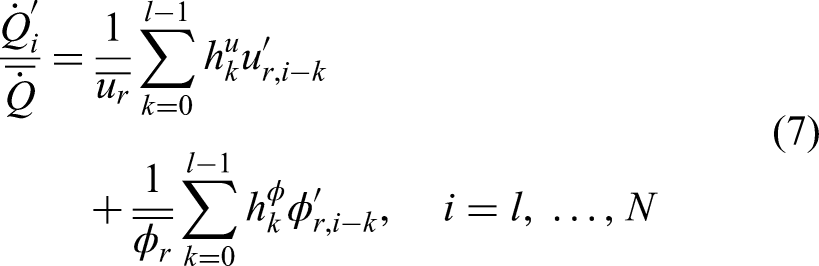
The FIR for velocity 

Numerical setup
Ansys Fluent v2024R2 was CFD software of choice to run the simulations. The LES employed the WALE
34
subgrid-scale model with no wall function. The low-Mach approximation, which treats density as a function of temperature and assumes a constant static pressure, eliminates acoustic waves and increases the degree of control over the effective excitation signal, while still capturing the relevant time lags present in flame dynamics, provided the flame is acoustically compact as demonstrated by Eder et al.
10
The flame in this study is of similar length compared to the BRS setup from Komarek and Polifke,
6
while having a high degree of preheating making the speed of sound higher and thus making the system more compact. Given the length scales present in this burner, we conserve a Helmholtz number
The BFER chemical mechanism,
35
a two-step global mechanism commonly used in methane flame simulations, is employed in this study. We implemented a user-defined function to calculate the cell-local equivalence ratio and adjust the pre-exponential factors in the Arrhenius equations. To model the interaction between turbulence and chemistry, we employed the dynamically thickened flame model36,37 with the Charlette efficiency function,
38
using eight grid cells to resolve the flame. The model utilizes a laminar flame speed and thickness that are precomputed in one-dimensional (1D) simulations over equivalence ratios ranging from 0.3 to 1.8, and then fitted with scaled hyperbolic tangent functions to estimate values based on the local composition. Other transport properties use the assumption of a constant Lewis number
An Ansys Fluent mesher generated the computational domain using the poly-hex core algorithm. The grid is composed of a total of
As we stated previously, we investigate the burner at an equivalence ratio of 0.625 while varying axial velocities in the burner tube section. Both inlet streams have an equal temperature of 573 K. Previous work on the perfectly premixed flame iteratively modified the wall temperature of the combustion chamber and the bluff-body to accurately capture the mean flame shape. This approach concluded with a value of 700 K. Given that the flame topology is similar between the two configurations, this wall temperature is a sensible choice for the technically premixed case as well. All other walls use adiabatic boundaries.
A timestep of 1
The input signal for velocity is a density- and area-weighted average of axial velocity. In contrast, the equivalence ratio is calculated as a mass-flow-rate-weighted average. Equations (10) and (11) show the corresponding expressions. In both cases, the reference position “

CFD results
Mean flame validation
After the simulations have run for a sufficiently long time, the experimental measurement of the LOS-integrated
Figure 2 shows the results of mean flame shape and position, as well as the axial distribution of heat release intensity. On both accounts, a good agreement can be observed between the numerical results and the experiments. Accurate capture of a V-shaped flame, with minimal heat release in the outer shear layer is evident, demonstrating a good agreement in position. The center of gravity of the flame differs by approximately 5 mm, which is close to 5% of the total flame length. Note that experimental figures show a clear asymmetry across the

LOS integrated mean heat release from LES (top row), LOS integrated
Perfectly premixed FTF
The forced simulations ran for a total of 330 ms of physical time under each operating condition. After removing 30 ms of initial transients, we resample the time series to a frequency fine enough to resolve the highest frequency of interest (800
Figure 3 compares LES/SI results for the premixture velocity FTF,

FTFs
Two important features of
The FTFs in Figure 3 clearly show low-pass filter behavior with a decaying gain at higher frequencies. Similarly, all numerical results at low frequency tend toward unity gain with zero phase, within the confidence intervals. Capturing both of these features provides a baseline consistency check that the numerical results accurately reflect the physical constraints observed in experiments.
Another physical trend to look out for in comparing dynamics is the scaling of results with mean conditions. Since the mean flame center of gravity stays relatively constant across all conditions studied, increasing velocity will reduce the convective time lag, scaling the FTF in the frequency domain. For higher mean velocities, the slope of the phase curve should be flatter, a physical trend that is correctly captured when comparing numerical and experimental results. The phase curves should also collapse when using the Strouhal number to scale frequency, a feature that our results have, but is not shown here for brevity.
Comparing the results over all frequencies, we observe good agreement in phase slopes across all operating conditions, thereby increasing confidence in the consistency of the numerical results. Regarding gain, we observe that local minima are not well captured for the cases with 30 and 35
Experimental measurements did not explicitly account for the influence of fuel-line acoustics on the transfer matrix, instead assuming a stiff fuel line and forcing only the air stream. As a result, a direct comparison requires extracting a BFTM from the low-order model. Additionally, constructing the TP FTF requires identifying a mixing transfer function19,41 that connects equivalence ratio perturbations at the reference position with velocity perturbations upstream. This transfer function will be addressed in the following section.
Mixing transfer function
Equivalence ratio is a convective wave, similar to entropy, in that both are convected by bulk flow toward the flame. These convective waves have the property of being transported and spatially dispersed,
42
leading to the commonly used model of 1D convection-diffusion.12,43,44 Under this model, the equivalence ratio at the reference position is a function of the global, or nominal equivalence ratio 


We expect that
As mentioned by Garcia et al.
20
and experimentally observed by Bluemner et al.,
21
the model from equation (14) fails to capture an additional hydrodynamic contribution. For this reason, a slightly more complex model for mixing was proposed,
20
and has been successfully applied to TP combustors.
19
Mixture velocity, and its transfer function are added as contributions to equation (14)
The perturbations arising from
It is also necessary to consider the contribution from each inlet to the total mixture velocity, scaling velocity fluctuations from 

The mixing transfer functions are shown in Figure 4, as well as

Mixing transfer functions
For the case of
For all cases at
Technically premixed FTF
Having identified 
The formulation shown in equation (18) is more convenient for use in an LOM than that of equation (2), since all hydrodynamic effects that are not captured by the LOM are implicitly embedded in the FTF. If experiments had a stiff injector, the TP FTF should be compared directly to

FTFs
The gain curves show slight shifts in local maxima and minima. For the case with 30
As for fuel velocity response
To further validate the consistency of numerical results, harmonic forcing is performed for the reference operating condition 35
With all this said, the clear pattern that emerges is that the numerical simulations exhibit a qualitative agreement and accurately capture physical trends, but fail to fully predict the behavior observed experimentally. This disagreement can be attributed to several uncertainties associated with the experiments. The temperature profile for the combustion chamber wall, as well as the exact temperature at which reactants reach the test section, was not explicitly measured. Additionally, fuel was not preheated to 573 K in experiments, and while this may not affect mixture temperature significantly, since fuel is only about 3% of total mass, it may affect the properties of the JICF, such as its momentum flux ratio, which in turn could affect mixing properties and the decay of
Nevertheless, as discussed earlier, a fair comparison between the experimental results and the numerical results should involve evaluating the transfer matrix in a network model, employing the extracted transfer functions, and physically superimposing their contributions.
Acoustics
Acoustic network model
To investigate the interaction between fuel and air-line acoustics, a low-order network model of the GE15 was built using the open-source code taX.
45
Experimental results for the transfer matrices are only available for the case with 35
The area jumps present in the network model use the 

Low-order acoustic network model of the technically premixed burner: contraction–duct–T-junction–duct–expansion.
We then repeat the procedure to infer the coefficients of the technically premixed version of the experiments. Since we are replacing a section of the duct with a T-junction, which is a three-dimensional element, this introduces an additional unknown: the exact position of this component. The T-junction element is also a three-port block, based on the linearized conservation of mass and the Bernoulli equation across two joining streams, but its effect can be modeled as a two-port with the frequency-dependent impedance of the fuel line as

Low-order acoustic network model of the fully premixed burner: contraction–duct–expansion.
Figures 8 and 9 show the results for the transfer matrices of the cold, premixed, and technically premixed configurations, respectively. All coefficients of the fully premixed BTM show good agreement between the LOM and experiments across all frequencies, except for

Perfectly premixed burner transfer matrix from taX (——) and experiments

Technically premixed burner transfer matrix from taX (——) and experiments
Conversely, the agreement in the technically premixed model is slightly worse across all elements. That being said,
Figure 10 shows the reflection coefficient of the fuel line for the non-reacting case. In this configuration, the fuel line was modeled as a simple duct with an arbitrary reflection coefficient at the boundary, and we infer the value of the length and the reflection coefficient by fitting the transfer matrix of the model with the transfer matrix of experiments. The inferred value of the upstream reflection of the fuel line has a value of
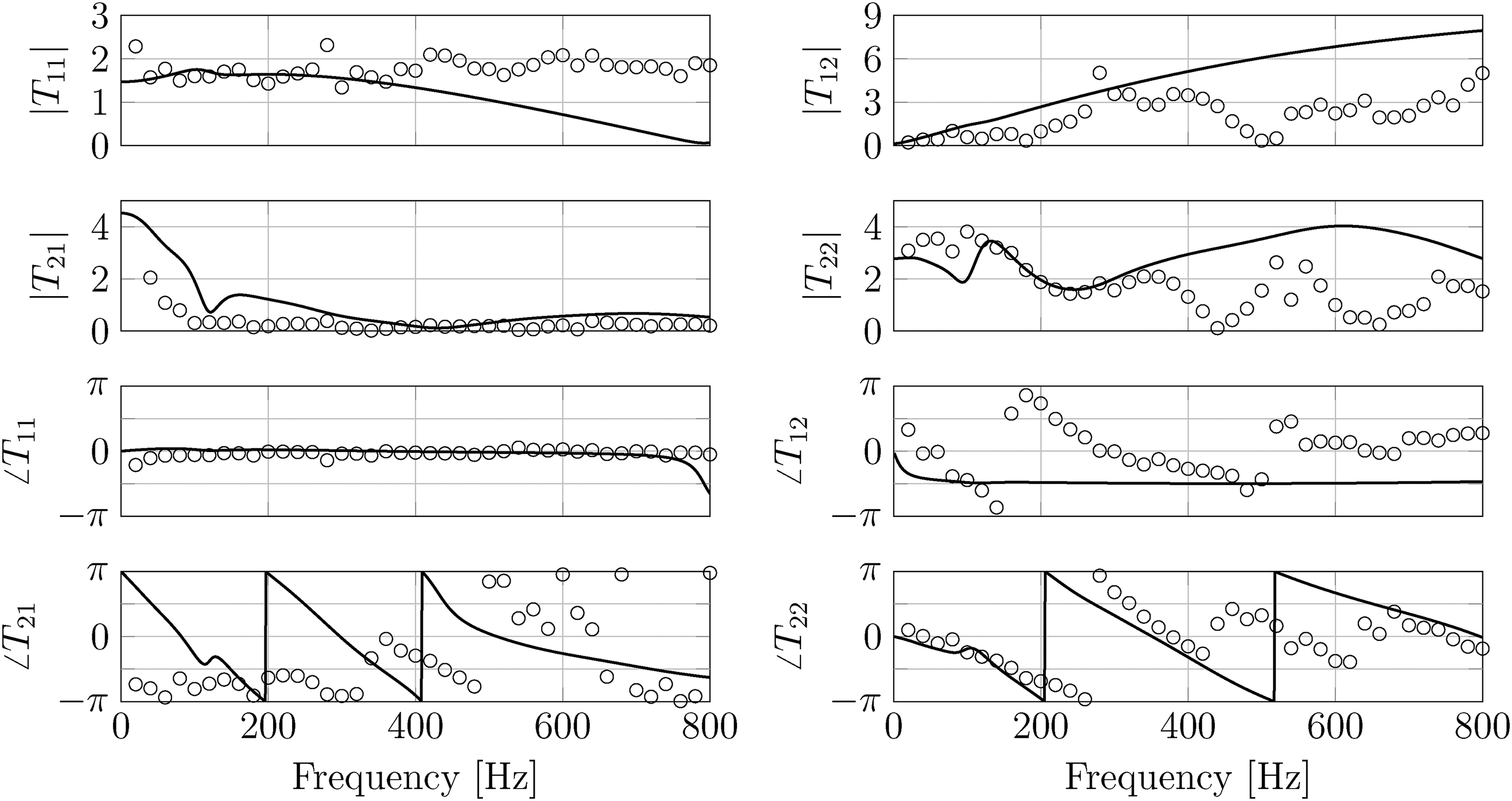
Technically premixed burner-flame transfer matrix from taX (—) and experiments (˚).
Finally, we repeat the optimization procedure for the hot, technically premixed case, as shown in Figure 11 for the resulting transfer matrix. For this case, we plug the FTFs inferred in the previous section and compute their superposition by extracting the overall transfer matrix. The reflection coefficient for this case is also shown in Figure 10.
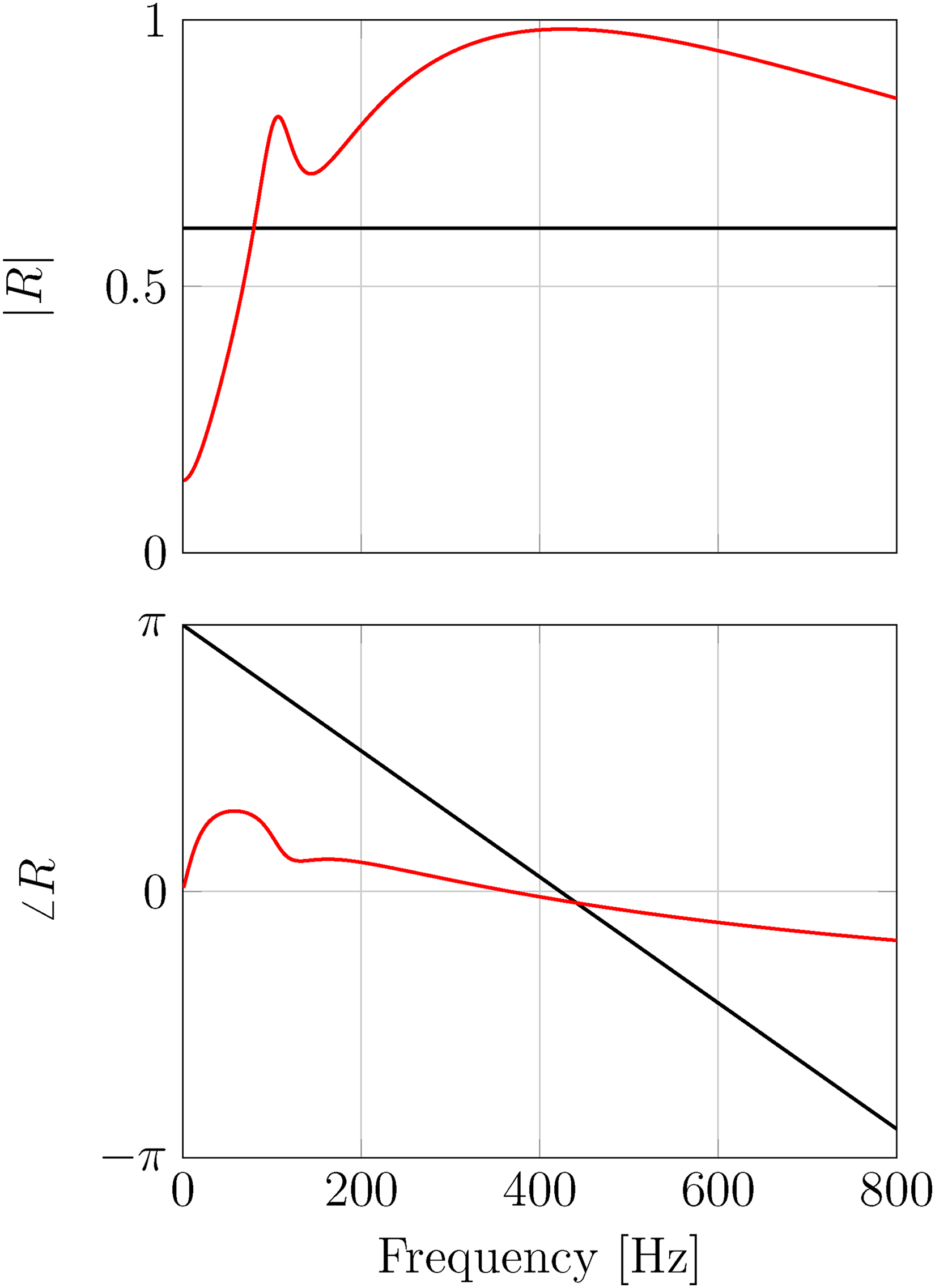
Inferred fuel-line reflection coefficient for cold (black line) and hot (red line) technically premixed burner.
The fuel-line impedance again changes significantly with respect to the non-reacting case. The significant change in behavior arises from the highly complicated acoustic and hydrodynamic behavior of the JICF. The inferred impedance implicitly captures this effect, but it can also be done by modeling the complete fuel line, adding pressure losses and further lengths that mimic this behavior. A more preferable method to model the behavior of this injector with fuel jets is to use Howe’s model of the Rayleigh conductivity 47 for an orifice with bias flow. However, this lies beyond the scope of this paper.
The fuel line in the reacting case seems to have a relatively anechoic behavior at very low frequencies, as indicated by a reflection coefficient close to 0, allowing for some additional contributions from the
Nevertheless, a qualitative agreement between the BFTMs can be observed through the superposition of the FTFs identified in the previous section, as illustrated by the coefficient
Conclusions and outlook
In this work, we studied the dynamics of a technically premixed flame to understand the effect of fuel injector impedance on the acoustic characteristics of the system. By thoroughly analyzing the total contribution of each inlet as well as the mechanisms through which they affect the flame, a deeper knowledge of industrially relevant combustion systems is achieved. Specifically, the principal novelty of this paper lies in the investigation of fuel-line velocity fluctuations and an assessment of their contribution to flame dynamics.
The GE15 combustor was thoroughly examined at multiple operating points. A high-fidelity LES was set up and validated, leading to a good prediction in the mean flame shape and position. A time series of the forced heat release rate, as well as reference velocity and equivalence ratio, was generated, demonstrating good agreement with the experimentally measured fully premixed FTF, further validating the numerical results.
Another significant novelty found in this work was the seemingly paradoxical behavior of fuel transport, where air fluctuations can cause an equivalence ratio perturbation with a gain exceeding unity. This was conceptualized as the superposition of two distinct mechanisms that affect the equivalence ratio at the reference position. Future work should be conducted to investigate the mixing section directly and understand this phenomenon, thereby linking it to a hydrodynamic interaction between a swirler and an injector.
Results for the technically premixed FTF demonstrated theoretical consistency and qualitative agreement within a limited frequency range with the experimental results. Numerical results show excess gain in the range from 160 to 700 Hz, while a steeper slope is observed in the phase in the same range. Discrepancies between numerical simulations and experiments are attributed to the modeling of acoustic behavior in the injector that is not captured by incompressible simulations. However, significant uncertainties exist in boundary conditions, such as wall temperatures in the combustion chamber and the inlet temperature of reactants, which could alter the time lag from the base to the center of gravity of the flame, resulting in a different phase slope.
Finally, LOMs for the acoustics of the cold fully premixed, cold technically premixed, and hot technically premixed burners were constructed to study the acoustic transfer behavior of the configurations. Where relevant, the effective reflection coefficient of the fuel feed line was estimated, and its influence on the transfer matrix was examined. Both experiments and LOM predictions revealed significant differences between the cold fully premixed and technically premixed configurations, indicating that the inclusion of the injector had a non-trivial acoustic effect, which would not be present in the case of a non-compliant injector. Furthermore, the fuel line’s behavior changes markedly when mean flow through the injector becomes significant, as evidenced by the contrasting impedance between the cold no-flow case and the reacting case with flow. Moving forward, studies of technically premixed flames should ensure injector stiffness across all operating conditions. If this cannot be guaranteed, a detailed acoustic characterization of the fuel line as well as the flame response to fuel flow rate perturbations is required to describe completely and accurately combustor configurations of applied interest.
Footnotes
Acknowledgments
We wish to thank Layal Hakim, Sven Bethke, Samir Risa, Stefano Orsino, and Naseem Ansari for the discussion of results and advice on the setup of simulations. The authors gratefully acknowledge Jan Kaufmann and Manuel Vogel for helpful discussions and for providing experimental data. The authors gratefully acknowledge the Gauss Centre for Supercomputing e.V. (www.gauss-centre.eu) for providing computing time on the GCS SuperMUC-NG at Leibniz Supercomputing Centre (www.lrz.de).

Funding
The authors disclosed receipt of the following financial support for the research, authorship, and/or publication of this article: This research has been funded by GE Vernova, PO Numbers 740249957 and 740251162. Funding has also been provided by the German Federal Ministry for Economics and Climate Action under the Federal Aeronautical Research Program (LuFo VI, Call 3) under grant 20M2264C within the OptTuGen project.
Declaration of conflicting interests
The authors declare no potential conflicts of interest with respect to the research, authorship, and/or publication of this article.