




Abstract
This article describes an experimental investigation of thermoacoustic flame transfer functions of the lean burnout zone of an rich–quench–lean combustion chamber. With spatial separation of the rich primary from the lean secondary dilution zone, the latter is independently examined. The multi-microphone-method was employed to characterize the combustor acoustic velocity response to acoustic forcing coming from the primary zone and the mixing ports. The lean secondary zone is then treated as a pure acoustic 3-port network element connected to a 2-port Rankine-Hugoniot flame element. Focusing only on heat release fluctuations due to velocity fluctuations, the former are described by two linear superimposed flame transfer functions as a function of the velocity fluctuations coming from the primary zone and the mixing ports, respectively. Based on a non-reacting and a reacting measurement the two flame transfer functions could be extracted from the experimental data. Within this research, flame transfer functions from the new acoustical approach are presented and compared with ones measured using chemiluminescence and a photomultiplier tube. It is found that the inverse diffusion flame in the burnout zone reacts to velocity fluctuations from the primary zone in the low frequency range and a clear low pass behavior is observed. The mixing port velocity fluctuations create a more broadband response. In the presented cases, the flame transfer functions calculated from chemiluminescence match those from the acoustic method very well.
Introduction
Ambitious and stringent goals in the aviation industry have been set by the Advisory Council for Aeronautical Research in Europe (ACARE) to reduce
The ability of RQL combustors to achieve low emissions were evaluated by Holdeman
3
and Rosfjord et al.
4
They investigated an RQL combustion chamber with a cylindrical flame tube and various quench jet-in-crossflow (JIC) configurations to reduce emissions. The results showed that
Low emission solutions for combustion chambers are limited by the occurrence of thermoacoustic instabilities, which reduce the operational flexibility. Like all high power density combustors RQL combustion is prone to thermoacoustic instabilities, which are the result of dynamic interactions between acoustic oscillations, flow and unsteady heat release in the combustion system. Therefore, the prediction of the thermoacoustic stability of the engine combustor is an important step in the design process. The understanding of the instability mechanisms may allow for greater fuel and operational flexibility. Eckstein et al. 5 was one the first to study the dynamic behavior of RQL combustors. The main objective was the low-frequency phenomenon called “rumble” or “growl,” which is observed in aero engines during idle and sub-idle conditions. The research was focused on the response of a non premixed spray flame in an RQL combustor under the influence of primary air forcing and on the entropy-wave interaction with the combustor exit nozzle. Most of the findings were related to the spray atomization and evaporation process. Missing the possibility of downstream acoustic excitation (only available in later studies e.g. Bade et al., 6 Stadlmair and Sattelmayer, 7 de Rosa et al. 8 ) the quantitative determination of the systems thermoacoustic response, for example, captured as flame-transfer-matrix (FTM) or flame-transfer-function (FTF) was not possible. The more recent results from Cai et al. 9 support the conjecture that the thermoacoustic behavior of the lean combustion zone plays a decisive role for the overall combustion dynamics of RQL burners. Cai et al. 9 was able to identify different instabilities depending on the operational mode of his RQL combustor segment. Using natural gas as fuel and operating under ambient pressure Cai et al. 9 used chemiluminescence (CL) heat release images and dynamic pressure measurements inside the chamber. As a result they showed a correlation between the acoustic emissions during the RQL operation mode and the interaction of the fuel-rich mixture with the secondary air jets, but their dynamics could not be quantified in an FTF.
In the authors’ previous research a novel test rig was presented to measure and characterize the flame dynamics of the lean secondary zone in an RQL combustion chamber. 10 Separating the rich primary zone and the lean dilution zone allows the independent investigation of the secondary zone and its contribution to the whole thermoacoustic system. With an experiment ensuring acoustically stiff mixing ports, flame dynamics in form of FTFs representing the response to primary zone velocity fluctuations were determined based on the 2-port Rankine-Hugoniot (RH) methodology.
In this article, the extension of the 2-port RH technique to a 3-port topology is presented, which results in two separated FTFs. They characterize the response of the lean secondary zone to acoustic fluctuations from either the primary zone and the secondary air velocity fluctuations. For better understanding of the considered fluctuations and the dynamic processes in the lean secondary zone the RQL topology is introduced in terms of acoustic network system elements. Based on the network system theory a pure acoustic approach is given and a formulation of the flame heat release depending on two linear superimposed FTFs is derived. In the following the experimental setup and the data processing is described. Then multiple FTFs depending on the velocity fluctuations upstream and from the mixing ports are presented and discussed.
The lean secondary zone as a thermoacoustic 3-port
The network element technique (e.g. Munjal,
11
and Schuermans et al.
12
) is a well known tool for the identification and description of the thermoacoustic properties of combustion systems. In such a network, the thermoacoustic element describes the functional relations between the acoustic variables, for example, acoustic pressure
By selecting the reference location of the ports as shown in Figure 1 on the upper left, the compact RQL combustor can be considered as a 2-port system (Ⓐ-Ⓐ). In this arrangement, the flame dynamics of the primary and secondary zones are inseparable. To identify the individual parts of flame dynamics the zones of the RQL combustor are separated as shown in Figure 1 on the upper right. The secondary zone of the separated RQL forms a
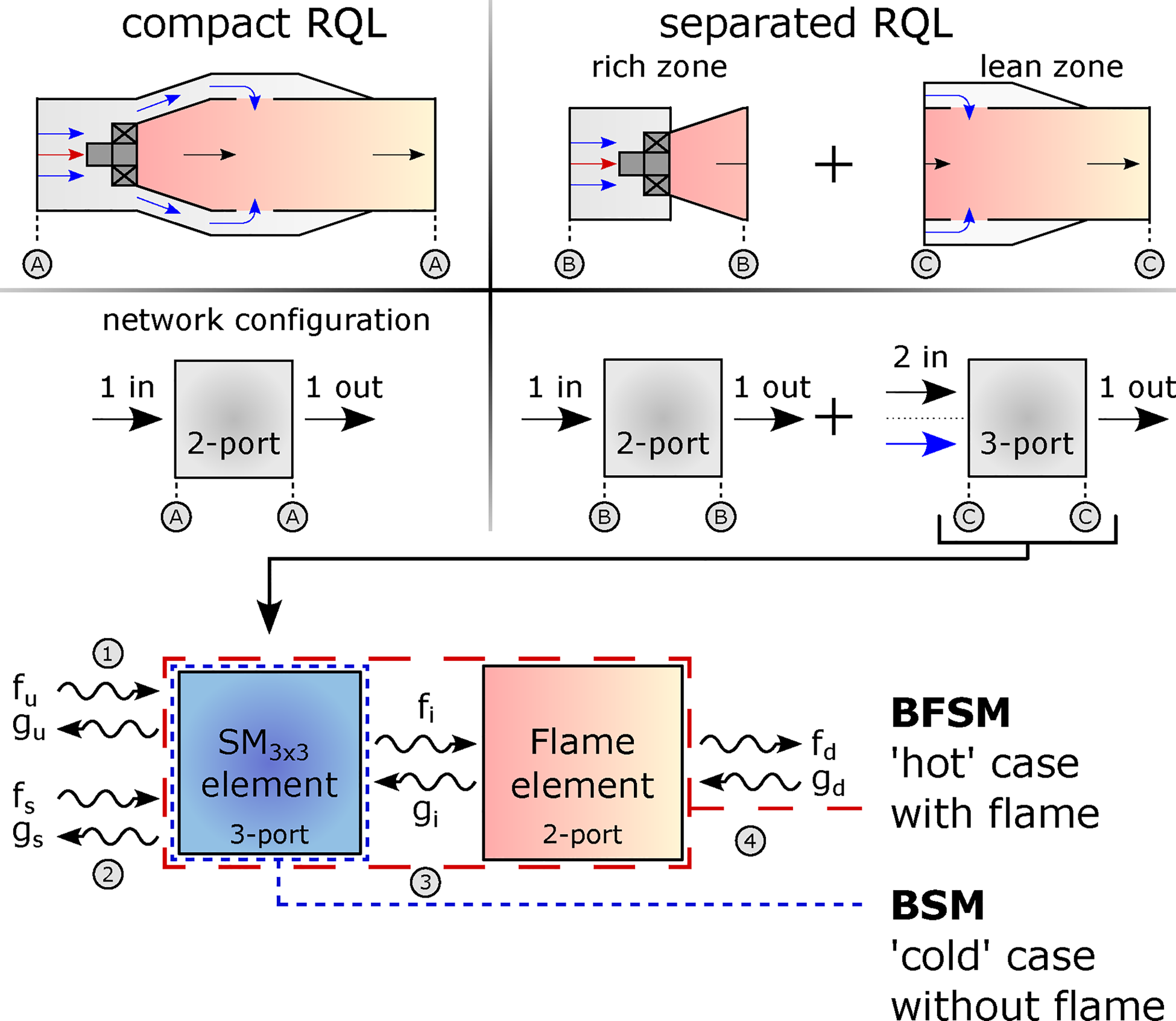
Upper: Comparison of combustion chamber topology between compact and separated arrangement in terms of a network element approach; lower: MISO (multiple input–single output) approach for the secondary zone as a network system of a
Karlsson and Åbom
14
and Holmberg et al.
15
introduced a technique, where a 3-port can be evaluated with a
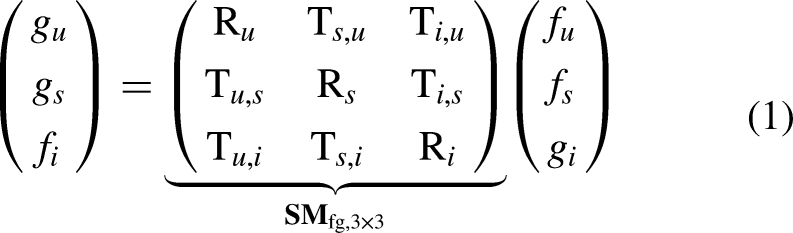
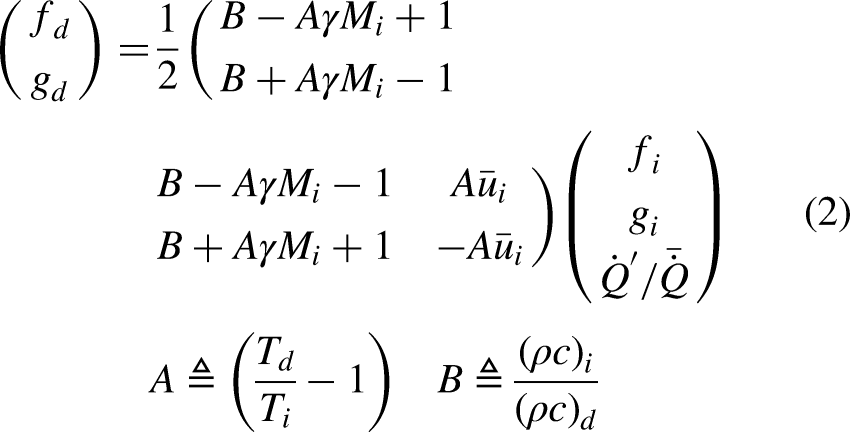


Experimental setup
The experiments were performed on the RQL test rig shown in Figure 2. The test rig is operated at atmospheric pressure in a thermal power range of
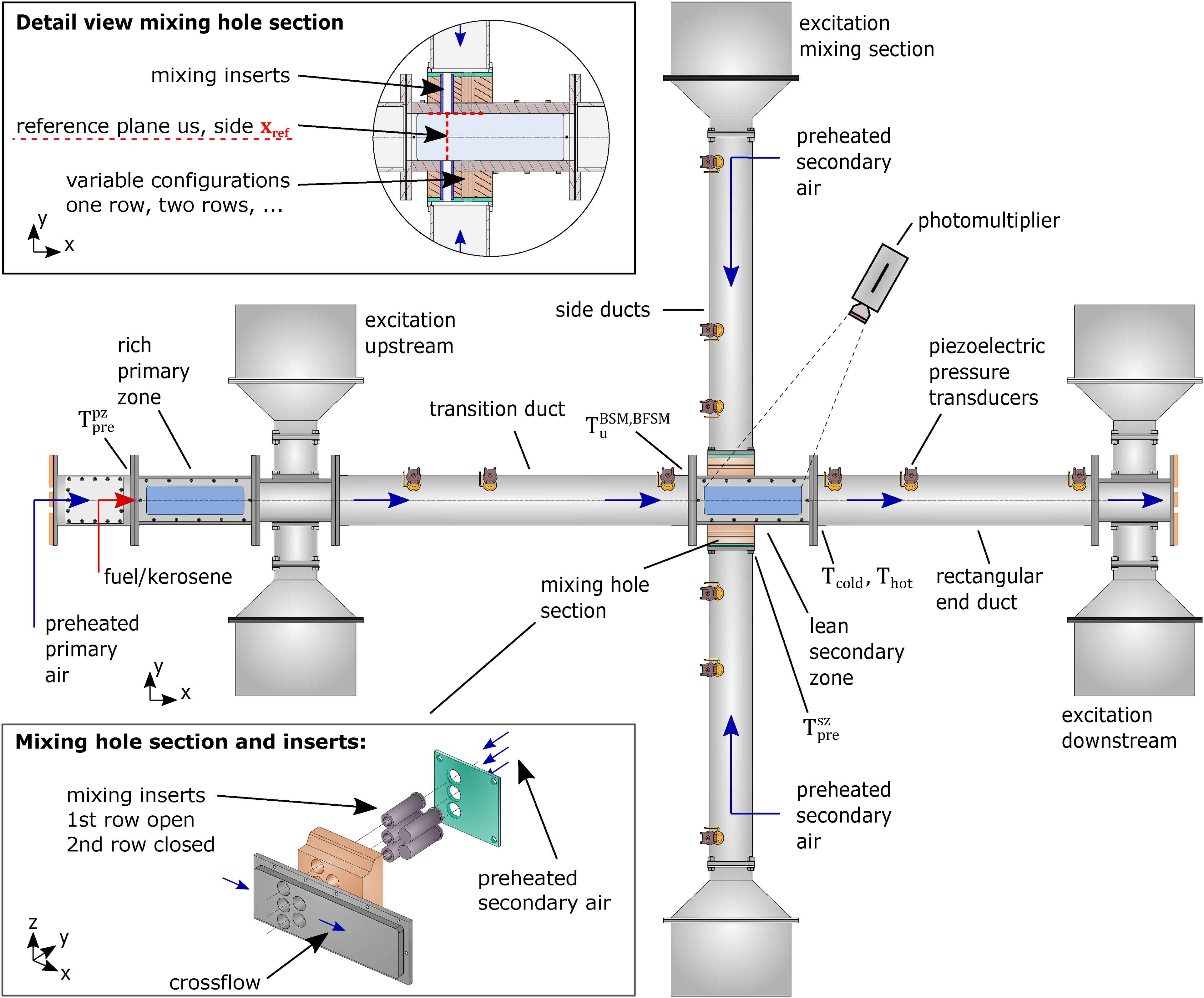
Atmospheric rich–quench–lean (RQL) test rig—top view setup for secondary zone; upper left: detailed view of mixing hole section and position of the reference plane
Operating range and mixing hole section.

Data processing
Operating modes and flame temperatures
As for the classical 2-port MMM technique the current setup also requires the characterization of the “cold” non-reacting flow first and then of the “hot” reacting flow case in order to separate the acoustic burner SM (BSM) and the flame dynamics. In the first “cold” operation mode without flame (BSM) the primary combustor is operated in the lean regime (
The flame is considered as acoustically compact such that the RH relations between the two temperatures
Heat release - chemiluminescence
In Renner et al.,
10
it was shown that in this specific case of the inverse diffusion flame the 
Optimization problem
The presented
Results
Table 1 summarizes the four operation points which are presented below. With respect to the heat release in the secondary zone OP1 has the highest and OP4 the lowest value. To keep the thermal power constant the fuel rate was fixed. The primary and secondary air flow rates are increased in order to reduce the primary zone equivalence ratio
Verification
To qualify the MISO FTF data analysis proposed above, the results were compared with results presented previously by Renner et al.
10
There, the acoustic response of the mixing ports is suppressed (
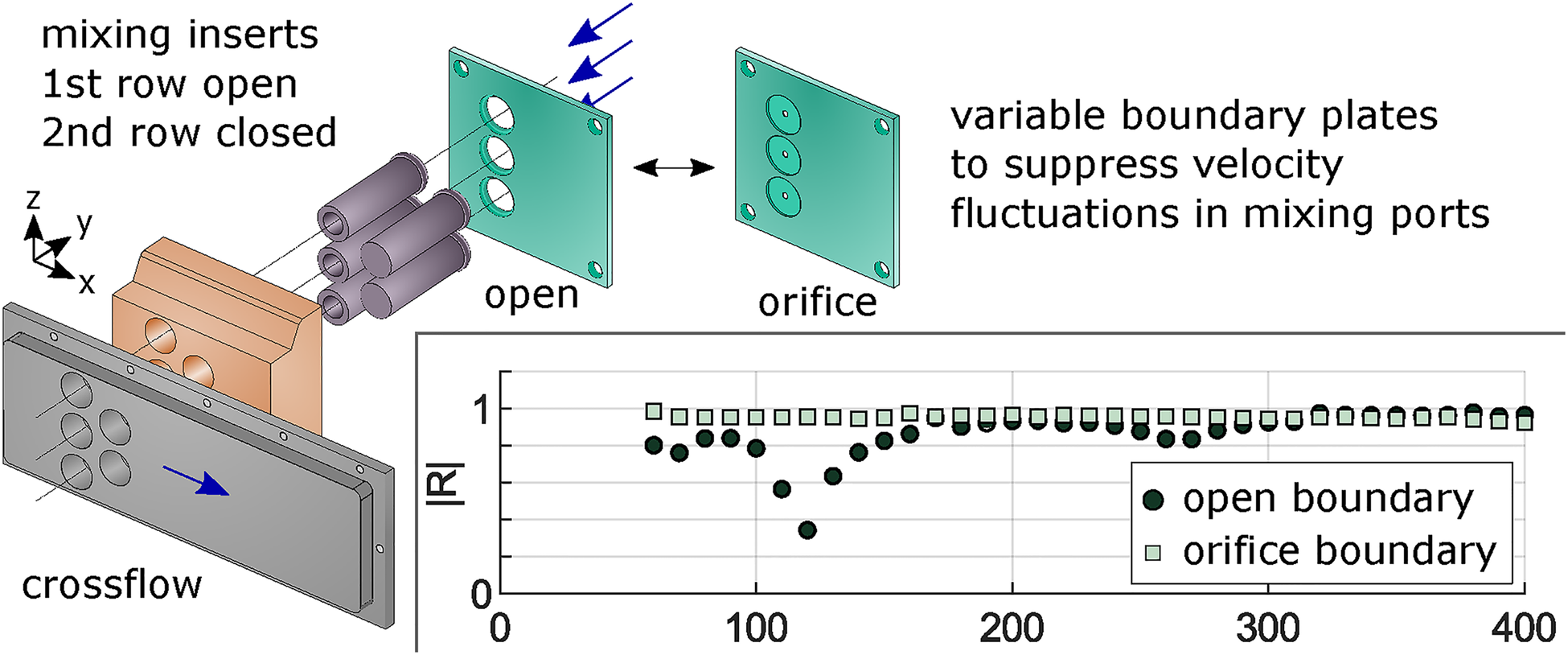
Mixing hole section setup and view of mixing inserts and variable boundary; lower right: reflection coefficient determined at simplified test section in mixing holes resulting in
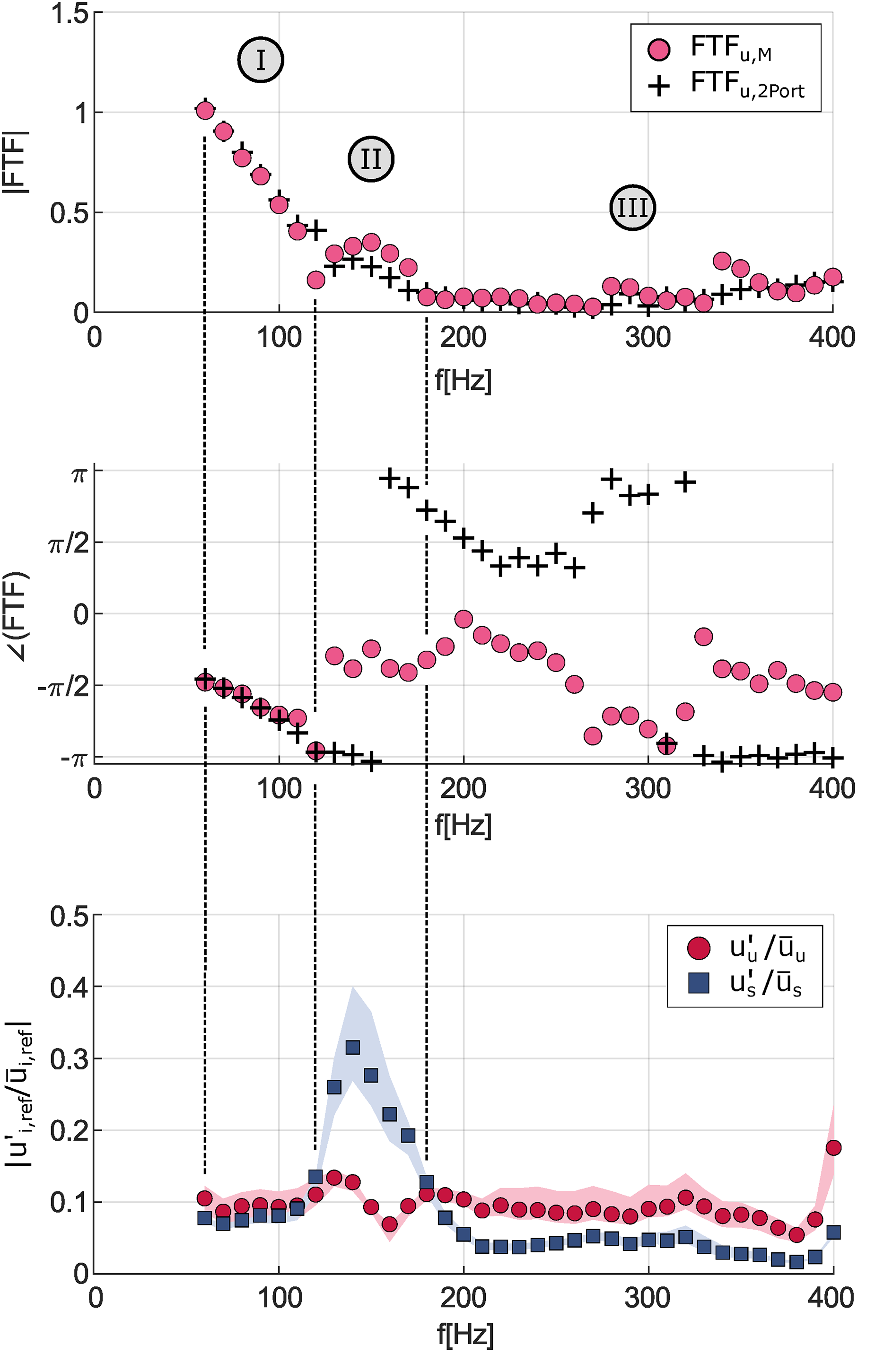
Figure 4 shows the resulting FTFs for the most reactive operation point OP1. In the upper graph, the verification FTF amplitude of  ,
,  , and
, and  can be discussed. In range , from the phase of shows amplitudes of almost zero for both FTFs. The velocity fluctuations are back in the linear regime but the flame seems unaffected by these. Due to the very low amplitudes the associated phase values are arbitrary in this frequency range and the data becomes questionable in this region.
Upper: absolute value of
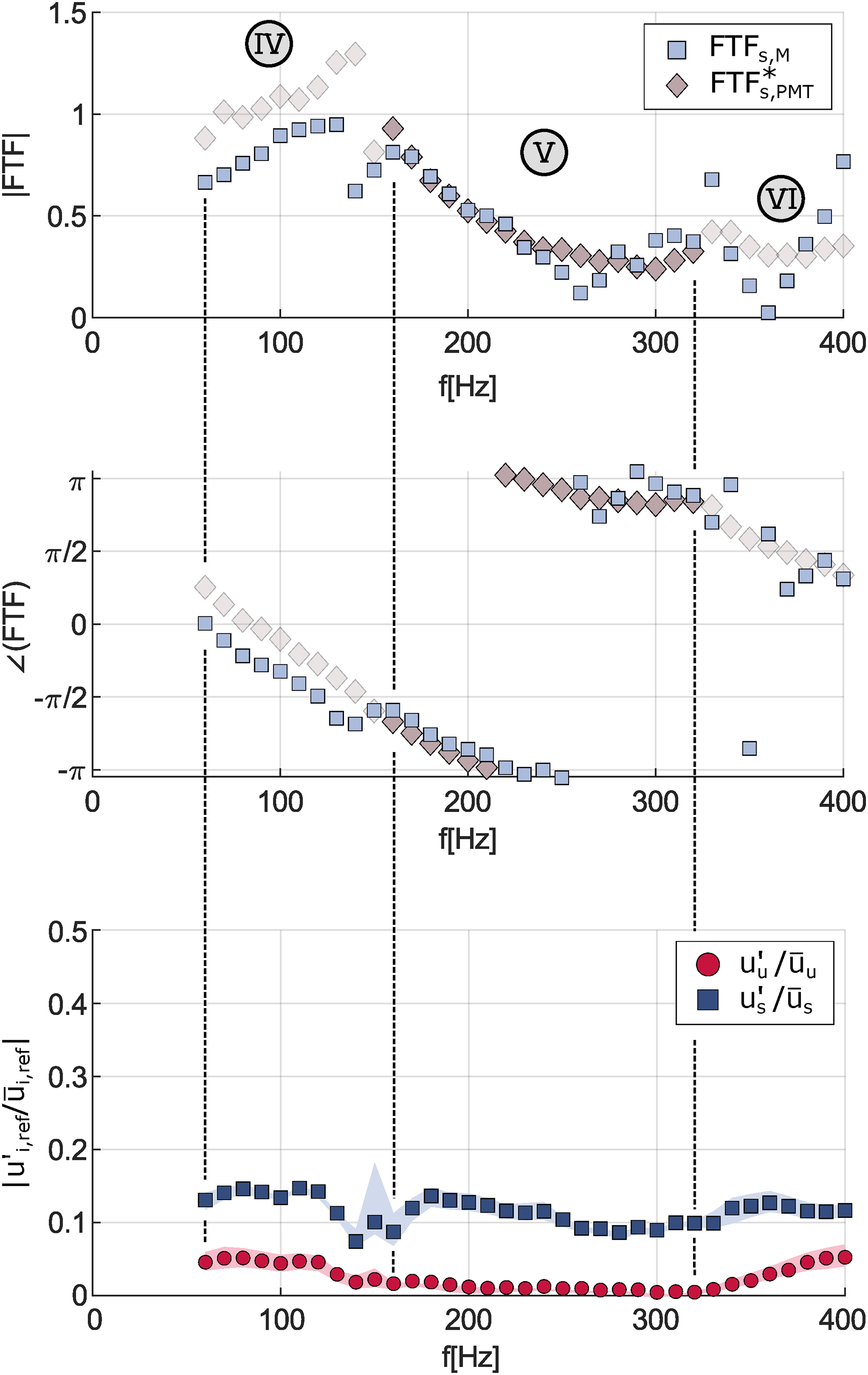
Figure 5 shows the resulting side FTFs for the most reactive operation point OP1. In the upper and middle plot of Figure 5, the amplitude and phase of  , and
, and  ,
,  can be discussed. In range and , very low upstream velocity fluctuations are observed. Here the flame only reacts to velocity fluctuations from the side. In this region, the amplitude and phase of both FTFs show a very good agreement with smaller deviations at
Upper: absolute value of
As shown in both Figures 4 and 5, the FTFs gained with the MISO approach fit the two verification’s in the ranges , , and very well. Next equation (5) is evaluated. Based on the “hot” measurements and the three-source technique , , the PMT approach is also sensitive to resonance and non-linear behavior of the side velocity fluctuations and shows the same phase-jump from , the PMT phase shows some scattering but remains the linear decreasing characteristics towards higher frequencies. The
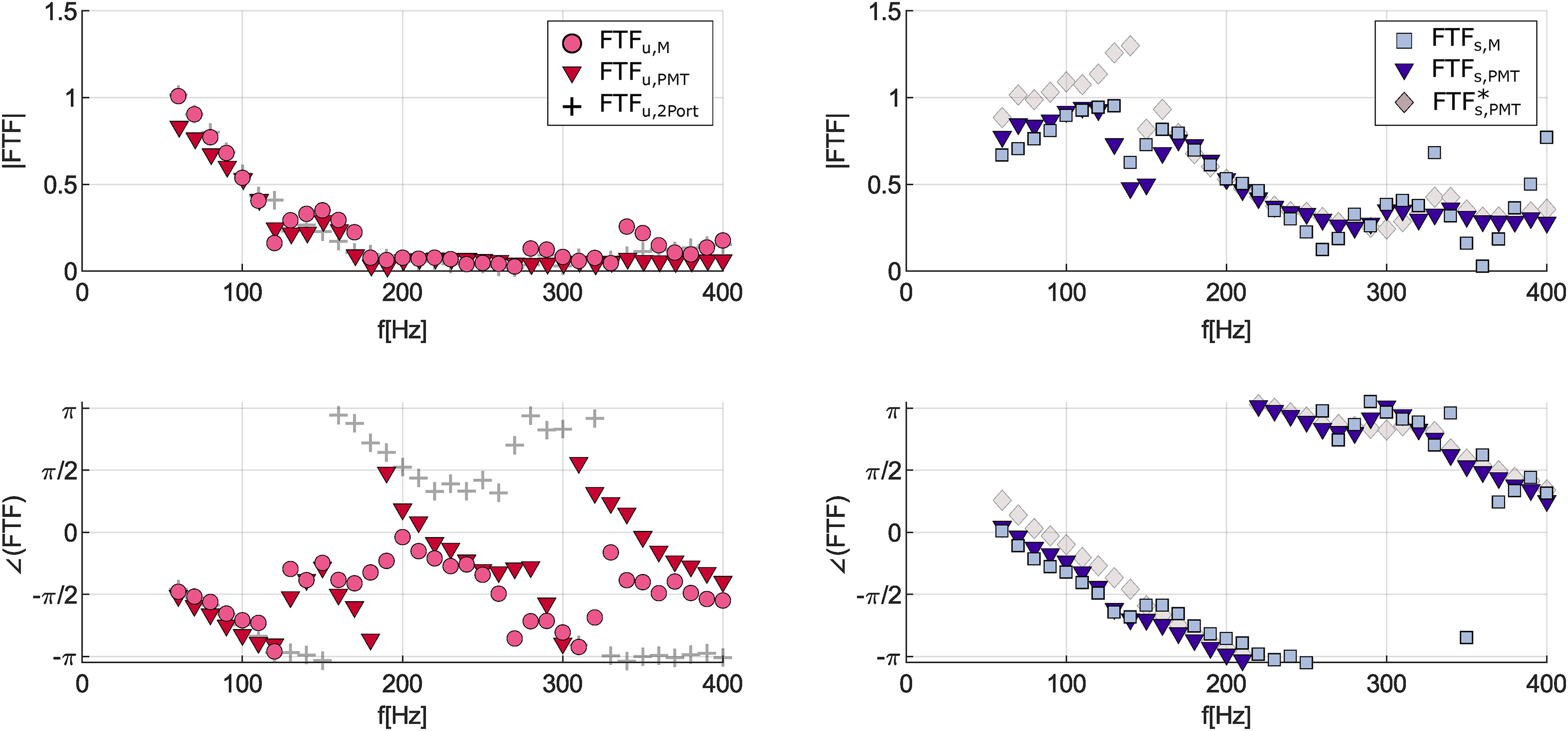
Left:
On the right hand side in Figure 6, the results for the side FTFs are compared. Hereby the , the amplitude and phase of with the very low upstream fluctuations all FTFs show a similar good agreement. For the last range , both FTFs based on the PMT show the same trend and the MISO FTF is prone to scattering in this frequency area.
Finally, the low frequency limits of both FTFs are discussed. For the low frequency limit
Influence of burnout heat release rate on flame dynamics
In Figures 7 and 8, the FTFs representing the flame response to upstream and side velocity fluctuations are displayed for the full operating range from Table 1. Above the legend in each figure the solutions from the pure acoustic MISO approach are shown. The FTFs based on the PMT
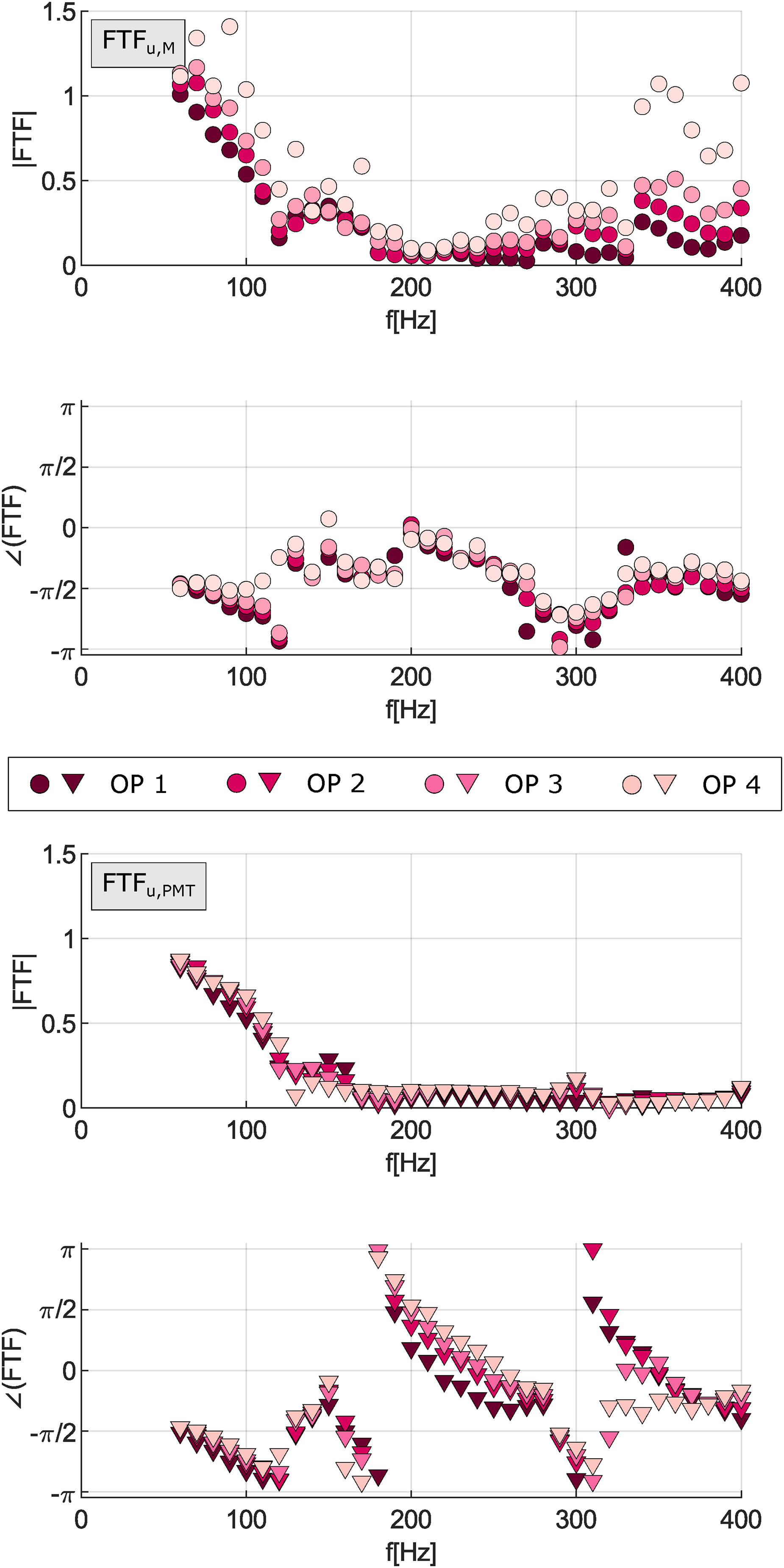
FTFs upstream for the entire operating range ordered from dark red color for the most reactive OP1 to light red color for the least reactive OP4; upper:
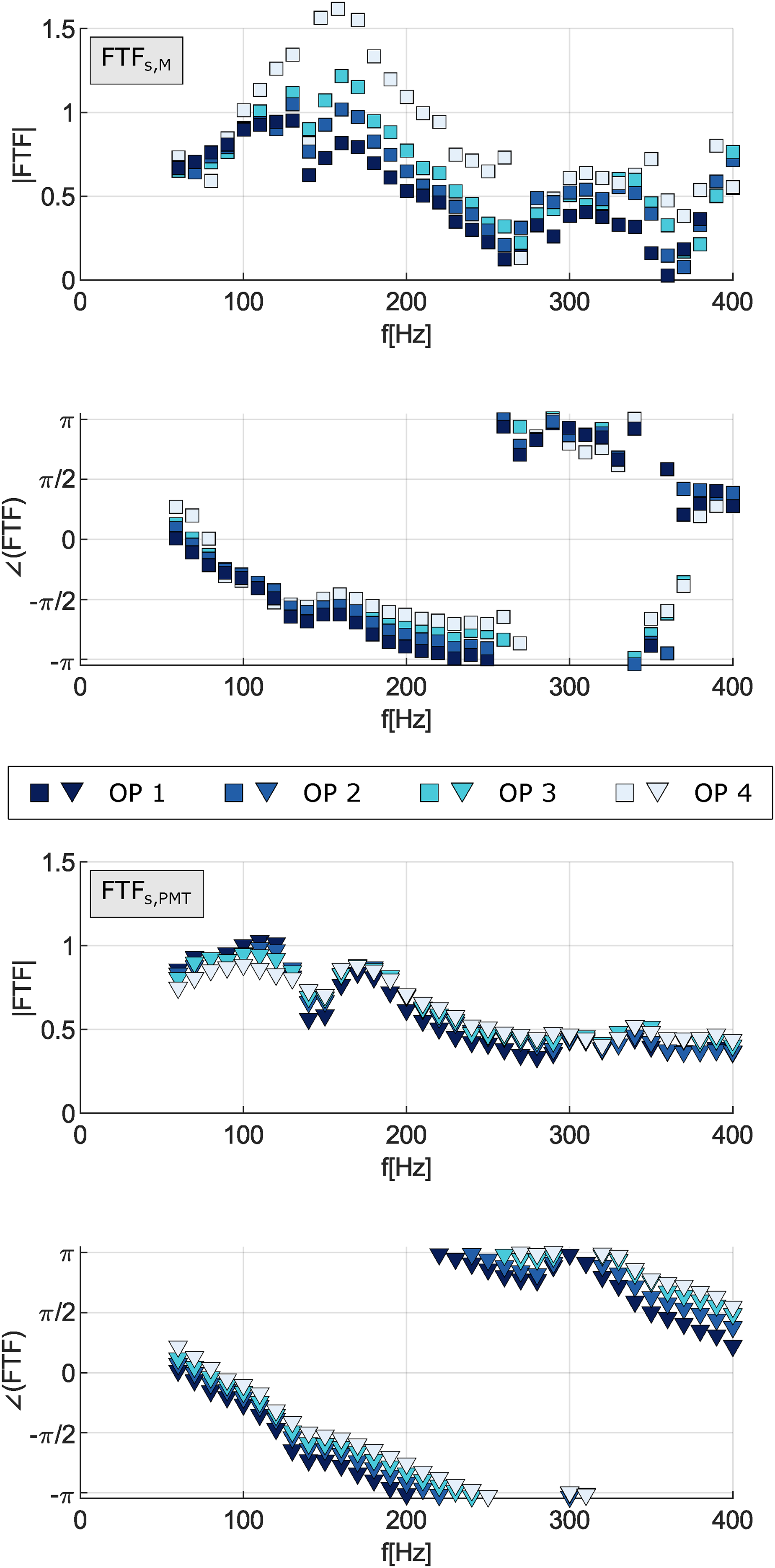
FTFs upstream for the entire operating range ordered from dark blue color for the most reactive OP1 to bright pink yellow for the least reactive OP4; upper:
In Figure 7, all
In Figure 8,
Robustness
For both pure acoustic MISO FTFs a stronger scattering towards less reactive OPs in almost the entire frequency range is observed in Figures 7 and 8. This is now discussed on the basis of OP4. After the fuel rich combustion in the primary zone, only
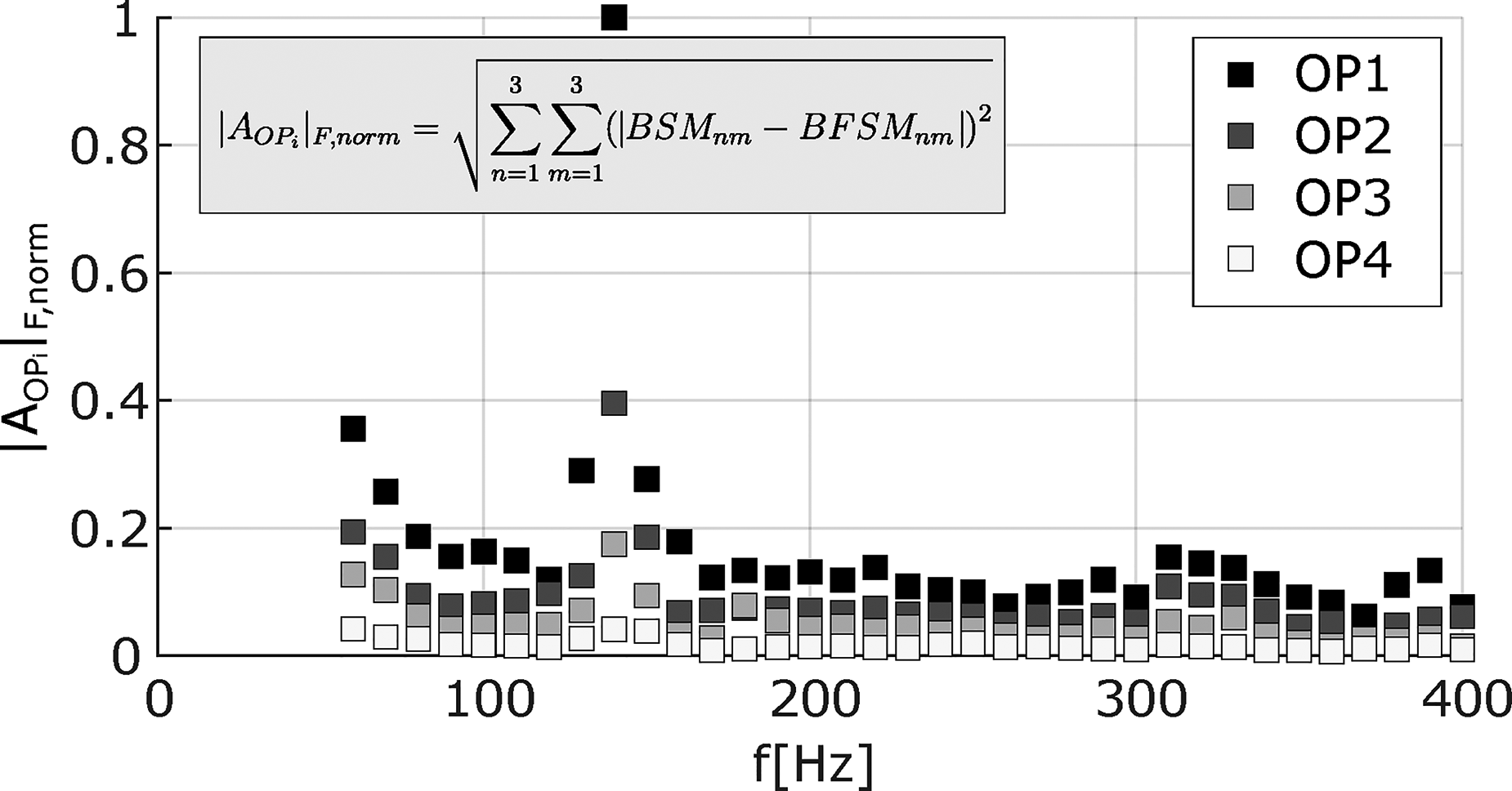
Normalized Frobenuis norm
Conclusions and outlook
In the presented article, the lean secondary zone of a separated RQL combustion chamber was investigated in terms of flame dynamics. For the first time FTFs depending on acoustic velocity fluctuations coming from the primary zone and from the mixing ports have been measured. With a new pure acoustic MISO approach the lean combustion chamber was treated as a network system by combining an acoustic 3-port and a 2-port flame element. The former was described by a The FTFs depending on upstream and side velocity fluctuations show a very good agreement with the verification data gained with distinctive experiments on the test rig. This supports the linear superposition approach of the two FTFs in the acoustic MISO model. In the investigated operating range, the flame of the lean secondary zone reacts to acoustic velocity fluctuations from upstream ( As a reaction to the velocity fluctuations from the side, In regions from The FTFs measured with the pure acoustic MISO model and the ones from the hybrid PMT match in terms of their amplitude and phase values very well. High scattering for leaner OPs were related to the low change between the underlying “cold” and “hot” measurements. Again,
In the secondary zone, the remaining
Footnotes
Acknowledgements
The authors would like to thank Dominik König for his support with the experiments.
Declaration of conflicting interests
The author(s) declared no potential conflicts of interest with respect to the research, authorship, and/or publication of this article.
Funding
The author(s) disclosed receipt of the following financial support for the research, authorship, and/or publication of this article: The work was supported by the Bundesministerium für Wirtschaft und Technologie (BMWi) as per resolution of the German Federal Parliament under grant number 20E1715, which is gratefully acknowledged.
