




Abstract
Modelling the flame response of turbulent flames via data-driven approaches is challenging due, among others, to the presence of combustion noise. Neural network methods have shown good potential to infer laminar flames’ linear and nonlinear flame response when externally forced with broadband signals. The present work extends those studies and analyses the ability of neural network models to evaluate the linear and nonlinear flame response of turbulent flames. In the first part of this work, the neural network is trained to evaluate and interpolate the linear flame response model when presented with data obtained at various thermal conditions. In the second part, the neural network is trained to infer the nonlinear flame response model when presented with time series exhibiting sufficient large amplitudes. In both cases, the data is obtained from a large eddy simulation of an academic combustor when acoustically forced by broadband signals.
Keywords
Introduction
Over the last decades, stringent emission regulations have led to the development of new clean combustion technologies, such as lean premixed combustion. This development enhances the risk of thermoacoustic instabilities, which can damage the engines severely.
1
Therefore, it is desirable to predict these instabilities during the design phase. For such a goal, a reliable model of the flame response to acoustic oscillations2–4 is generally necessary. A well-established strategy to model such linear and non-linear flame responses is using the flame transfer function (FTF) and flame describing function (FDF), respectively. These transfer functions relate the fluctuations of heat release rate,

Large eddy simulation (LES) is a widely used approach for numerical analysis of turbulent combustion systems. Many simulations may be performed over a desired range of frequencies and amplitudes in the input to obtain a corresponding flame response. 8 A conventional approach of obtaining FDF relies on harmonic excitation of the inlet velocity. Such an approach requires multiple computational fluid dynamics (CFD) simulations to calculate the flame response, which is computationally expensive. As a result, developing a methodology to compute the flame response using a single CFD simulation is advantageous.
Polifke et al.
9
proposed combining CFD and system identification (SI) to characterize the linear flame response to incoming flow perturbations. The CFD simulation is performed by exciting a flame with a low-pass filtered, broadband signal of upstream acoustic velocity perturbations. The resulting time series of fluctuating heat release rate
Neural network (NN) models can be used to capture the nonlinear relationships in the data 10 and are found to be useful in the field of fluid dynamics.11–13 Among the first works related to thermoacoustics, Förner and Polifke 14 modelled the nonlinear acoustic behaviour of Helmholtz resonators using a data-based, reduced-order model. The data coming from CFD simulation was used to train a local-linear neurofuzzy network. Jaensch and Polifke 15 proposed a NN-based approach for reacting flows, where they attempted to model the FDF of a slit laminar flame. 16 The results of that study were not satisfactory, perhaps because of the lack of regularization techniques, such as dropout or L-norms, or because of the use of shuffling in the data. 17 In subsequent work, Tathawadekar et al. 18 demonstrated the use of multi-layer perceptron (MLP), the same type of NN model used in Förner and Polifke, 15 to characterize the nonlinear flame response of a laminar flame. When combined with an acoustic solver, the trained NN model was able to predict limit-cycle amplitudes accurately. Yadav et al. 19 applied the long short-term memory (LSTM) model, a type of recurrent NN, to predict the nonlinear flame response of a laminar flame. They show that LSTM may be advantageous, as they require shorter time series if compared with the MPL counterparts. However, to this day, LSTM models have not yet been validated for predicting flame responses at amplitudes higher than 0.5, nor for estimating limit cycle oscillations when coupled with a given acoustic solver.
Following Tathawadekar et al., 18 the present work extends the applicability of NNs to model the linear and nonlinear flame response of turbulent flames. We demonstrate the flexibility of the NN model in two cases of interest. In the first case, we consider predicting the linear flame response under varying thermal conditions at a given boundary. As such, the temperature at the combustion chamber’s back plate is considered a variable. The NN model is trained on a few data-sets of broadband excited simulations with varying back plate temperatures. The trained NN model is then used to predict the flame response of the burner configuration characterized by an unseen back-plate temperature. The second case focuses on training and testing a NN model to characterize the linear and nonlinear flame response belonging to a turbulent swirled combustor.
Numerical setup
The present work investigates the flame dynamics of two turbulent, swirl-stabilized combustors: the fully premixed EM2C and ETH burners. Schematic representations of both are given in Figures 1 and 2, where the computational domains are highlighted in colour. Geometrical and numerical details of both burners are summarized in Table 1. The numerical validation of the EM2C burner was carried out by Merk et al. 23 and Kulkarni et al. 24 – for more information, the reader is referred to these works. The combustor back plate was defined as a no-slip isothermal wall. In the work of Kulkarni et al., 24 the back plate temperature of the combustor is varied in the range of 700–960 K to quantify the uncertainty in the flame response model. The respective data is used for further analysis to predict the FTF with the present NN model at unseen boundary conditions.
The LES of the ETH burner
25
is performed using the finite volume-based OpenFOAM 10 library
26
solving the reactive Navier-Stokes equations. To decouple acoustics and flame response and therefore avoid self-excited instabilities or resonances in the system,
27
a low Mach number formulation of the
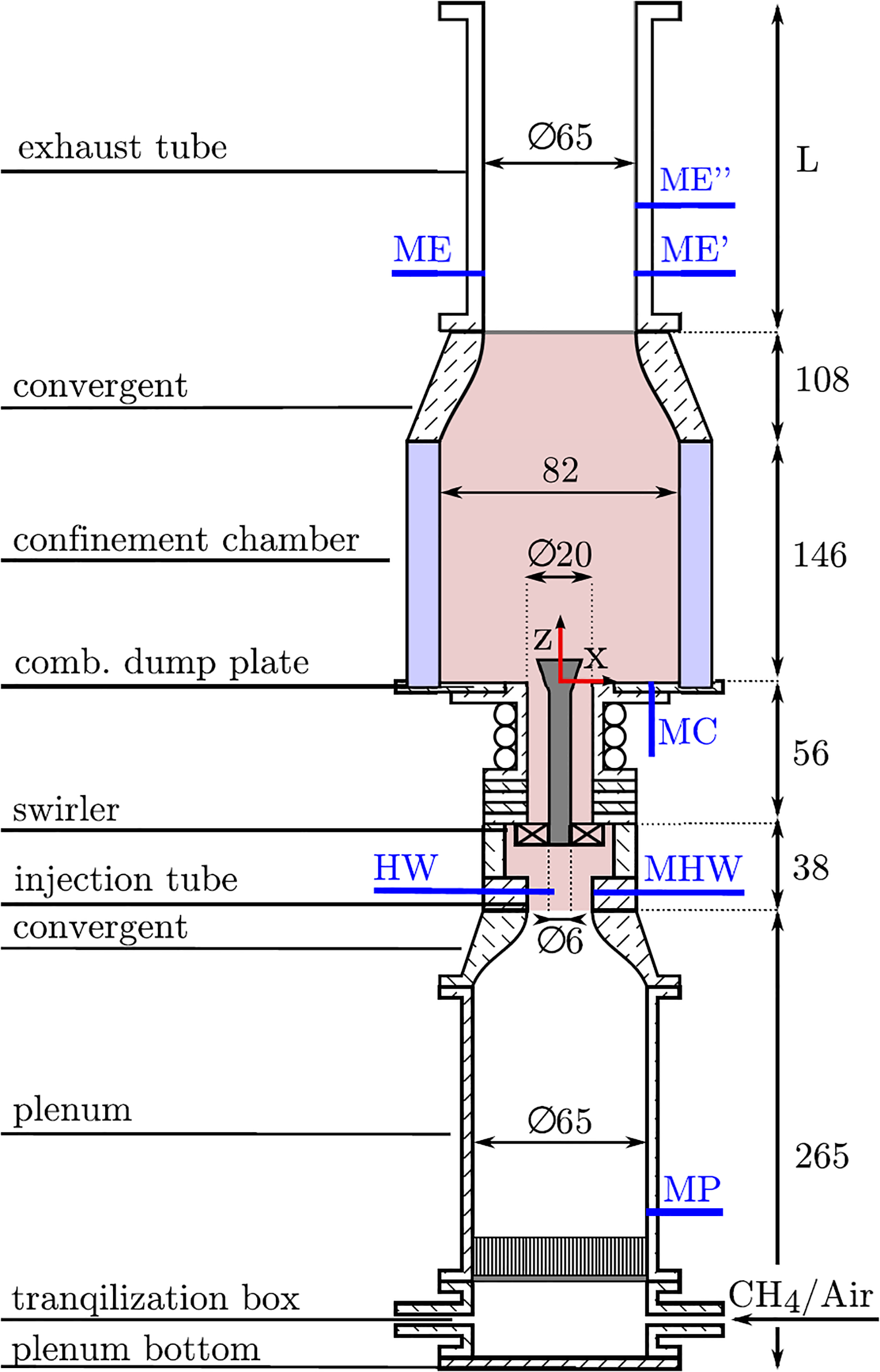
Schematic of the EM2C turbulent swirl combustor. Dimensions are given in millimeters. Figure adapted from Merk et al. 23
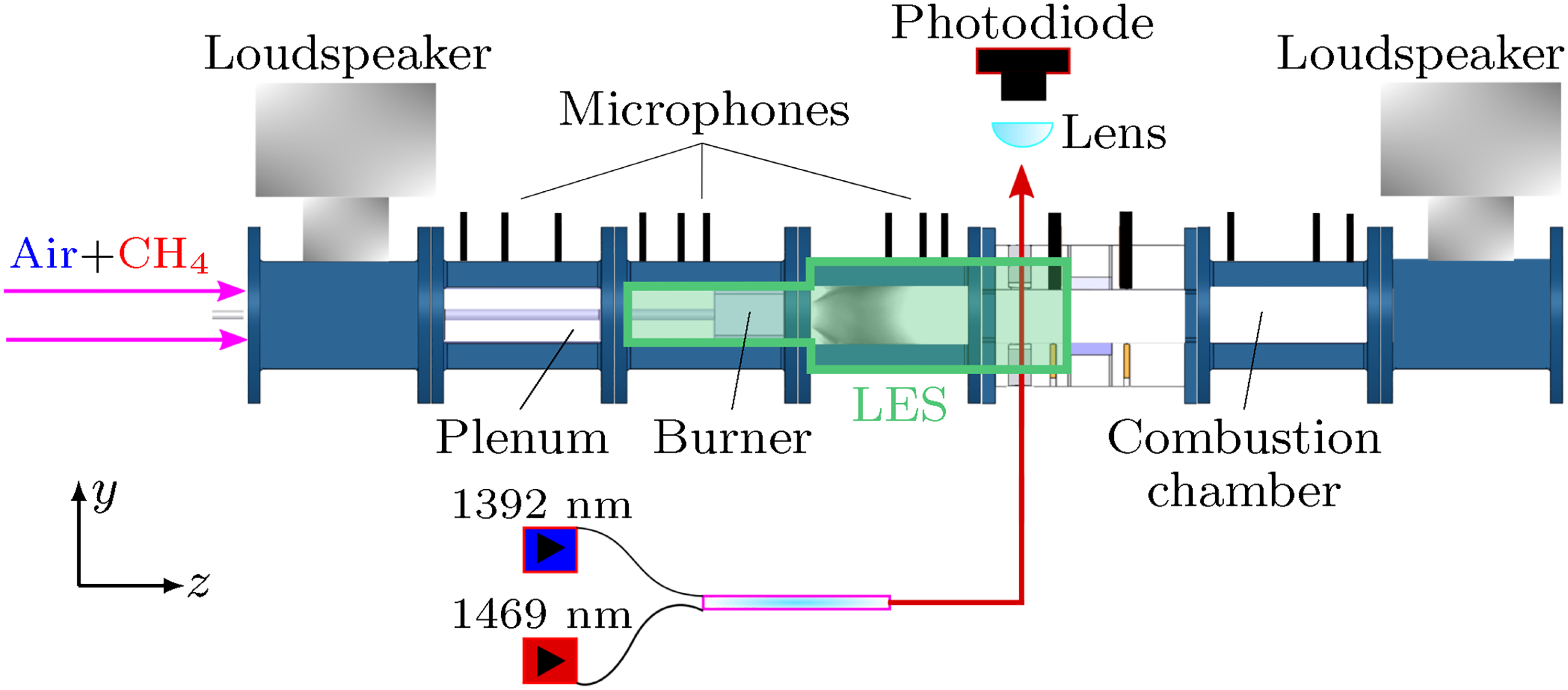
Schematic of the ETH turbulent swirl combustor. Figure adapted from Eder et al. 25
The two burners under investigation.
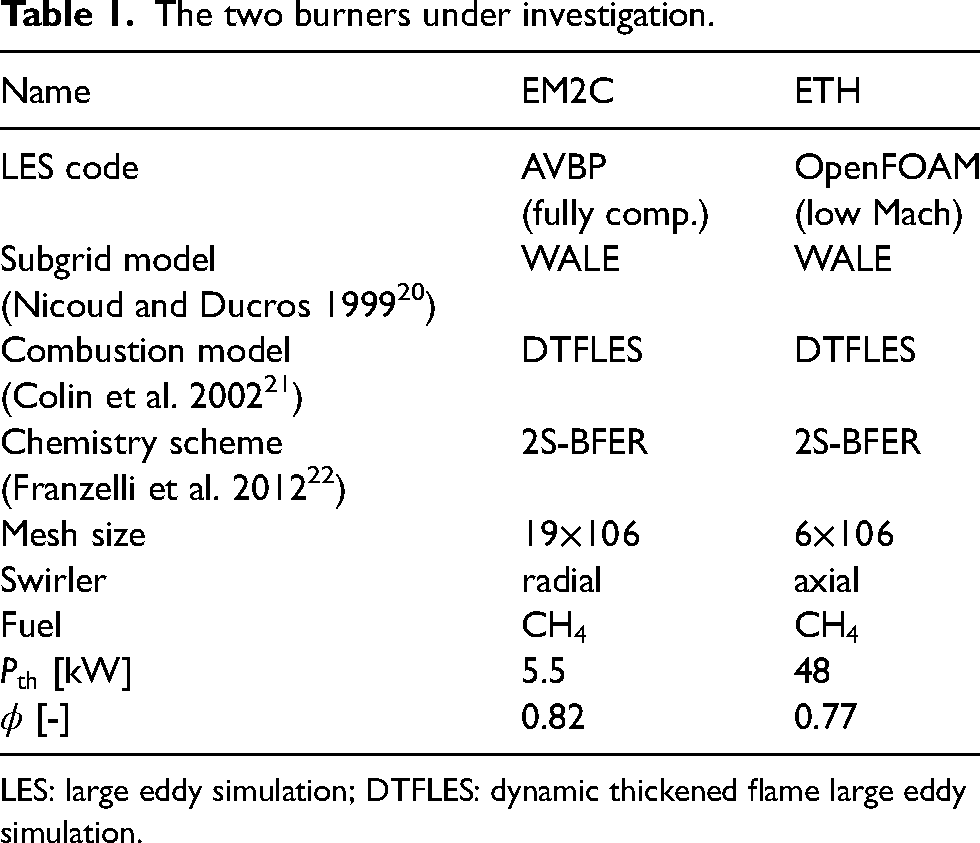
LES: large eddy simulation; DTFLES: dynamic thickened flame large eddy simulation.
Methodology
In this section, we formalize the problem statement, provide the pre-processing of data and details of the NN model.
EM2C burner: Problem formulation
Using the EM2C burner, LES simulations are carried out for 12 different back-plate temperatures in the range of 700–960K. Each simulation generates the time series of broadband, low-pass filtered velocity signal and corresponding heat release rate fluctuations. The NN model is trained to predict the heat release rate fluctuations given the data of inlet velocity and the back plate temperature (
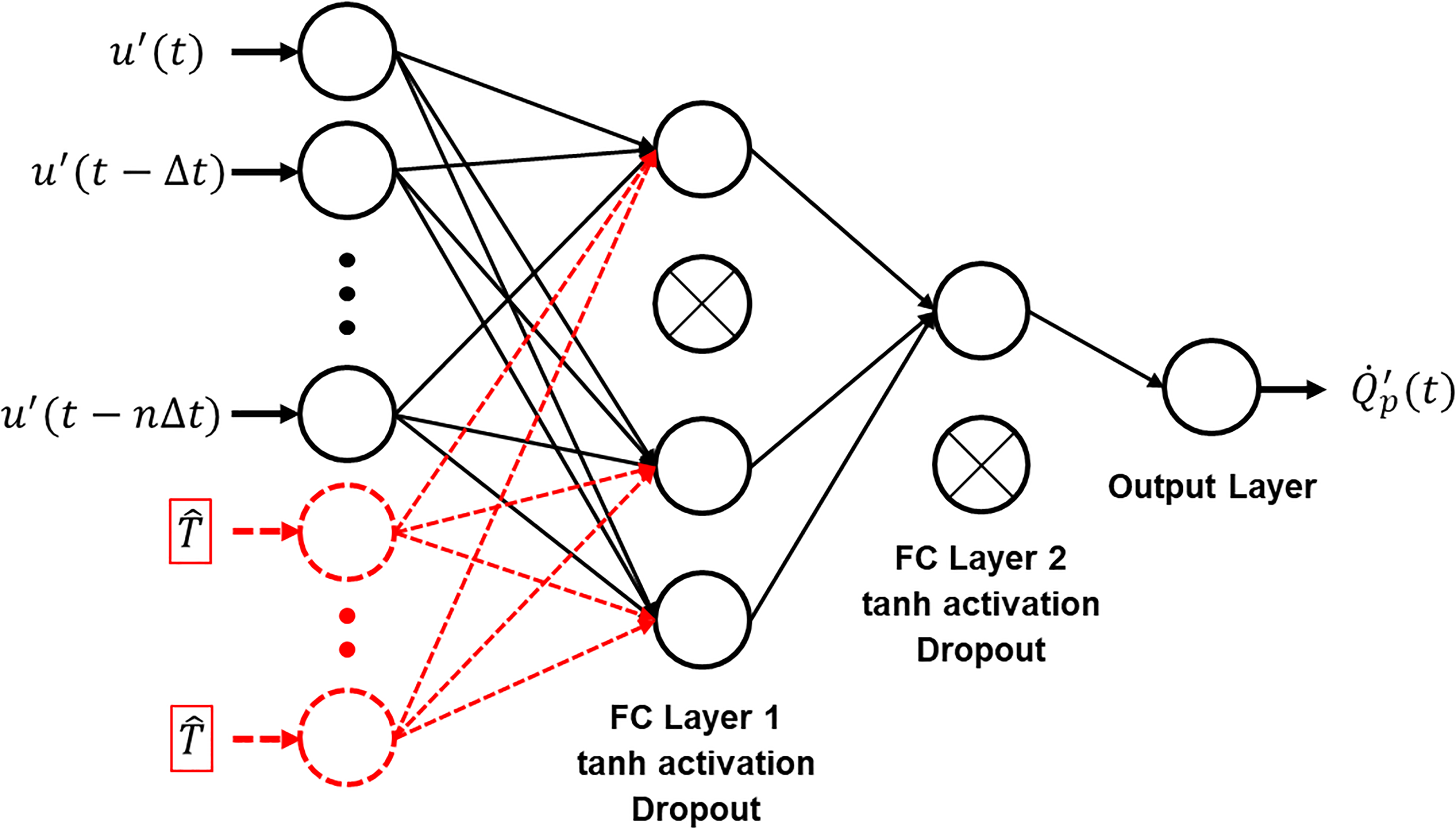
Schematic of the neural network (NN) model used for both case studies. The portion in black shows the NN used to model the formulation in equation (4) for the ETH burner case. For the EM2C case, we provide additional information on the normalized back plate temperature (
Hyper-parameters of the neural network (NN) model.

We use a MLP
10
to model the flame response of the turbulent swirl combustor. Figure 3 shows the schematic representation of a typical MLP with an input layer, two hidden layers and an output layer. The hidden layers and output layer have parameters associated with it, called as weights 
ETH burner: Problem formulation
For the ETH burner, NN models are trained using the time series of 
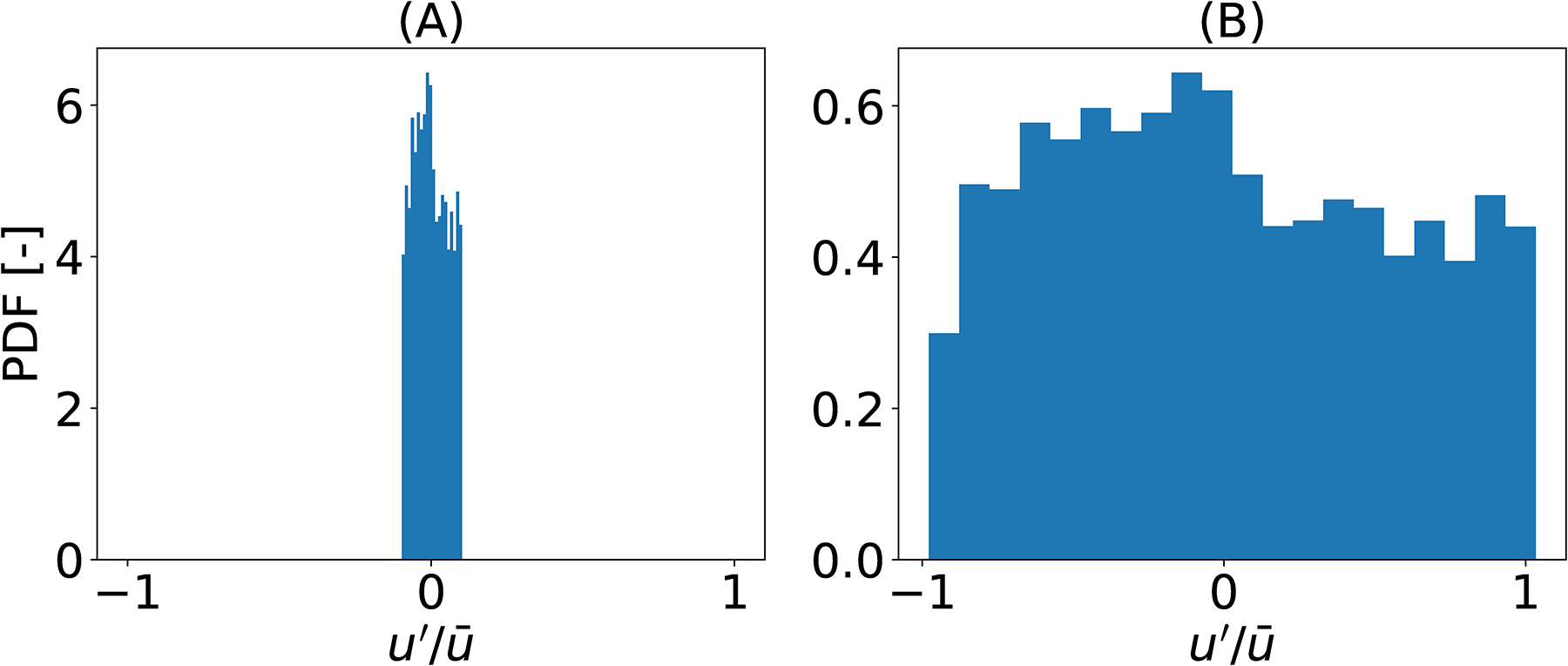
Probability density function of the input velocity signal with (A) 0.1 and (B) 1.0 amplitude fluctuations.
Model NL, which combines the data from two different amplitude levels, provides unsatisfactory results when trained with the MSE loss functions due to the amplitude imbalance problem. The MSE loss function computes the average of the squared differences between the predicted values and the true target values as seen in equation (3). However, the squared term in the loss function can lead to the problem of the model being more sensitive to large errors (associated with larger amplitudes) than to smaller errors (associated with smaller amplitudes). During back-propagation, gradients are scaled by the derivative of the loss function. The gradients can become much larger for larger errors, thus emphasizing the model’s focus on large amplitudes. This can lead the model to prioritize reducing errors for larger amplitudes, which can predict large amplitudes more accurately than smaller ones. To alleviate this issue, we tested different loss functions that do not overly amplify the errors. Such loss functions include mean absolute percentage error (MAPE), normalized MSE, normalized root MSE, and Huber loss. Taking inspiration from these loss functions, we propose a novel loss function that performs best for the underlying data. A novel loss function called mean square root error (MSQRE) is formulated as:
Results
In this section, we showcase results obtained on two tasks of flame response modelling. First, we assess the model performance on predicting the FTF of a turbulent flame at unseen thermal boundary conditions. Then, we showcase the ability of NN models to capture FTF and FDF of a turbulent flame.
Predicting FTF of a turbulent flame at unseen boundary conditions
Time series data obtained from 6 LES simulations, at different thermal boundary conditions (
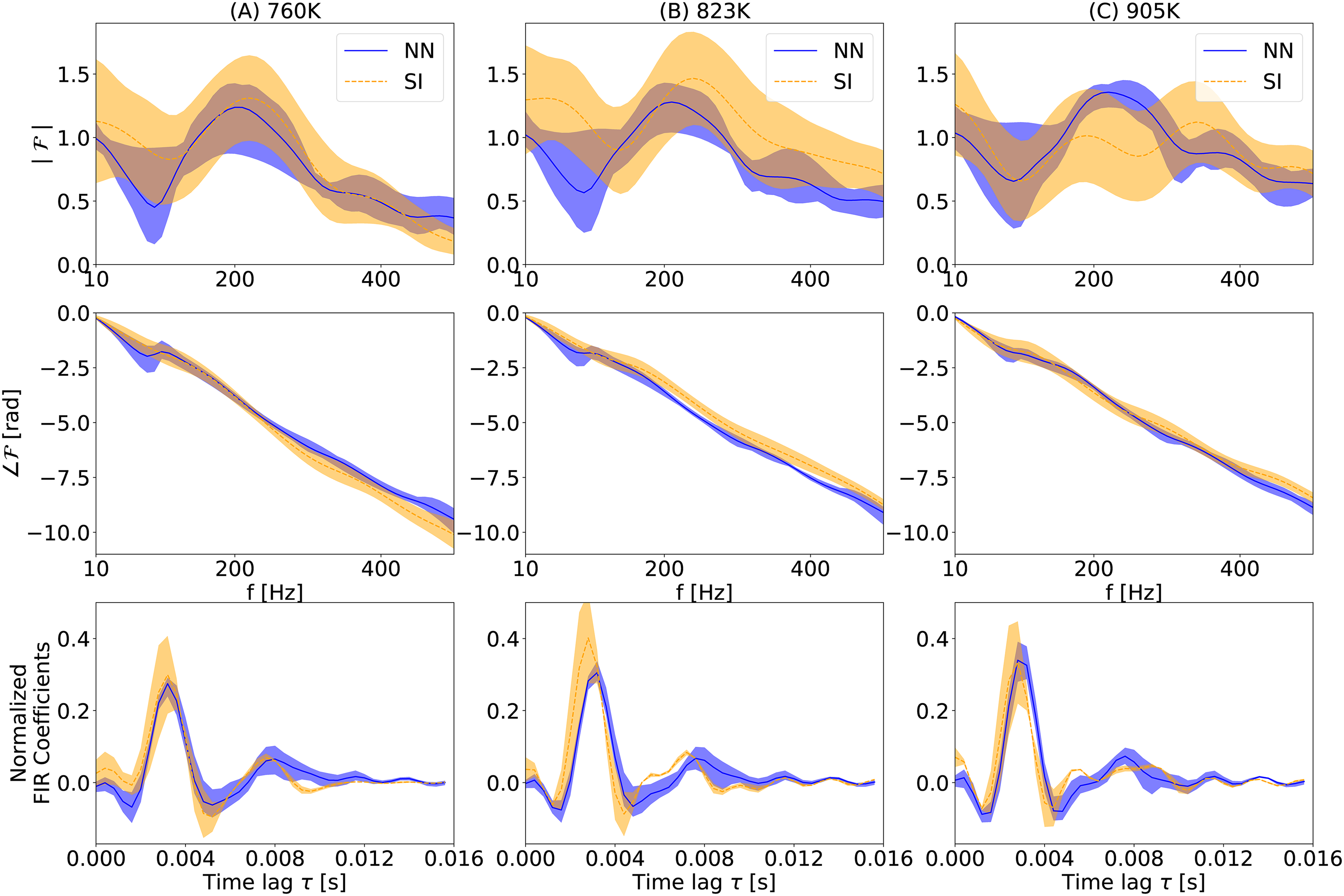
EM2C burner: Comparison of gain, phase and normalized FIR coefficients of the linear flame response predicted by CFD/SI and NN approach at unseen, interpolated back plate temperatures of (A) 760 K; (B) 823 K; (C) 905 K. The shaded region in blue shows the bounds of prediction by NN model using different realizations of the training data. FIR: finite impulse response; CFD: computational fluid dynamics; SI: system identification; NN: neural network.
In the first two rows of Figure 6, we collect the gain and phase for all 12 configurations using CFD/SI approach and NN model. The phase difference in the resulting NN predictions (Figure 6(B)) displays that increasing the back plate temperature of the EM2C burner results in a decrease in the phase difference. This finding is in good agreement with Kulkarni et al. 24 According to that study, higher back plate temperatures cause a reduction in the phase because such high temperatures promote closer stabilization of the flame to the burner mouth and, overall, a shorter flame length. Furthermore, gain curves reveal that increasing back plate temperatures of the EM2C burner shifts the flame response gain to higher frequencies slightly until 250 Hz. In addition, increased back plate temperatures of the EM2C burner amplify the flame response between 250 and 500 Hz.
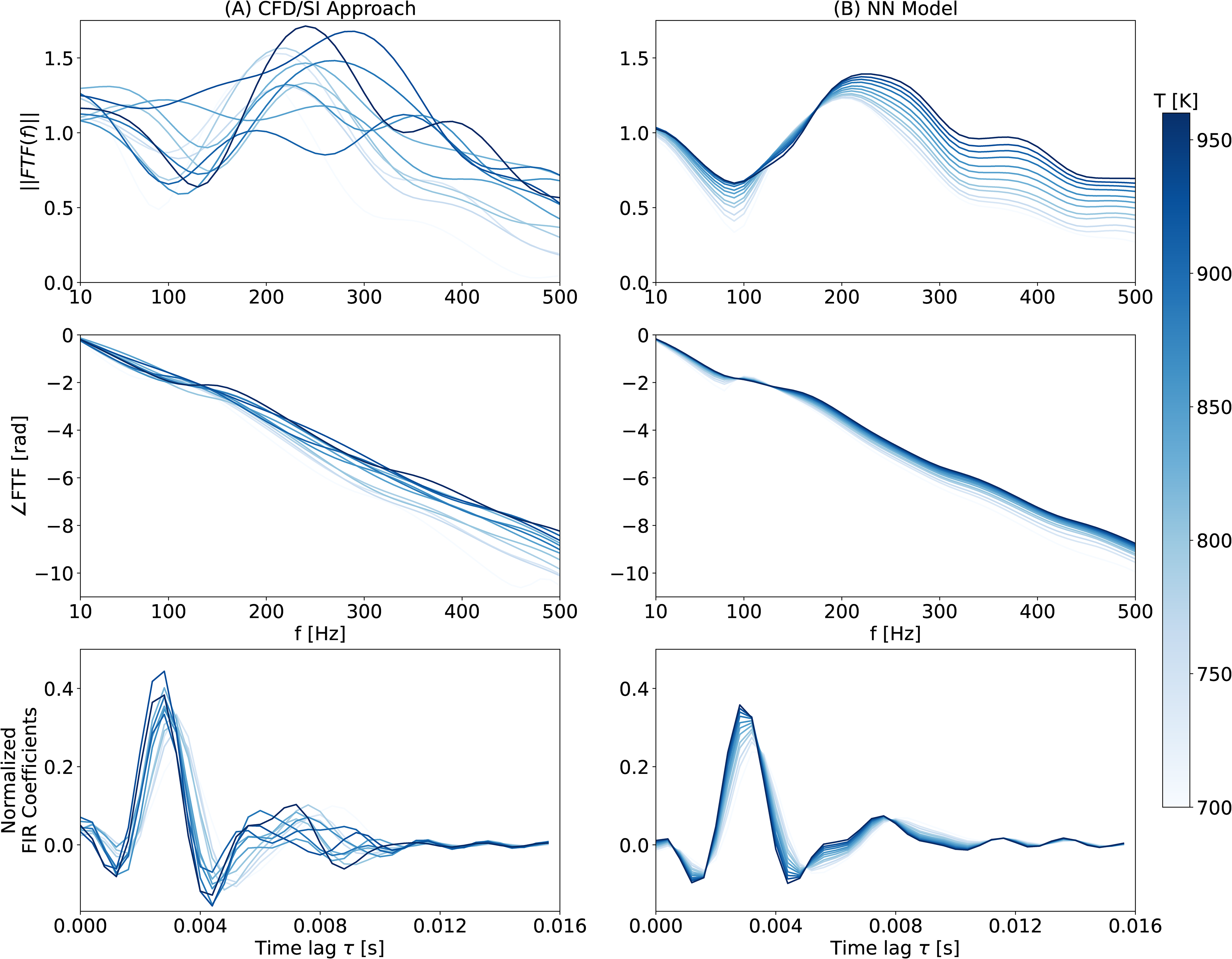
EM2C burner: Comparison between mean gain, phase and normalized FIR coefficients of the linear flame response at 12 different temperatures using CFD/SI and NN technique. CFD: computational fluid dynamics; SI: system identification; NN: neural network; FIR: finite impulse response.
A collection of impulse responses, each of them characterizing the acoustic flame response at a given temperature, is shown in the third row of Figure 6. Each of the shown impulse responses of the NN model are obtained by applying the inverse z-transform to the frequency responses shown in the first two rows of Figure 6. From the results of Figure 6, it is understood that the flame responds faster and stronger for larger temperatures T. Note also that the valleys of the impulse response are also stronger for higher plate temperatures T. This implies that the flame fluctuations – increase and decrease of the integrated flame surface area – are more preponderant in the case of higher T. For smaller plate temperatures T, crests and valleys strength decrease and are shifted to the right (larger times). Similar observations are obtained when looking at the impulse responses obtained by SI, although in this case, the gradual change of the impulse response (when shifting from larger to lower values of T) is not as apparent. The agreement of results between NN and the benchmark case (SI) – second and third row of Figure 6 – demonstrates the validity of NN results when inferring models of the flame response at temperatures that are not present in the training data.
The reader might wonder how to interpret the mistmatch betwen the CFD/SI and NN when looking at the gain of the flame response. Upon studying the first row of Figure 6, it becomes evident that any resemblance between CFD/SI and NN results is challenging to discern. It is important to note that CFD/SI cannot be considered a reference truth, as this technique can be significantly affected by noise, particularly combustion noise present in the data. This effect is especially pronounced in the EM2C burner under investigation, as demonstrated by Kulkarni et al., 24 and reflected in the high uncertainties observed (refer to the top row in Figure 5). Therefore, any comparison of flame response gain between the LES/SI and NN methods must take into account the underlying uncertainties. In contrast, the level of uncertainty is lower when investigating the phase of the flame response and the flame impulse response, allowing for a comparison between the two methods.
Modelling nonlinear flame response
For ETH burner, the time series obtained using a normalized excitation amplitude of 0.1 (Figure 4(A)) is used to model the linear flame response of the flame. 30
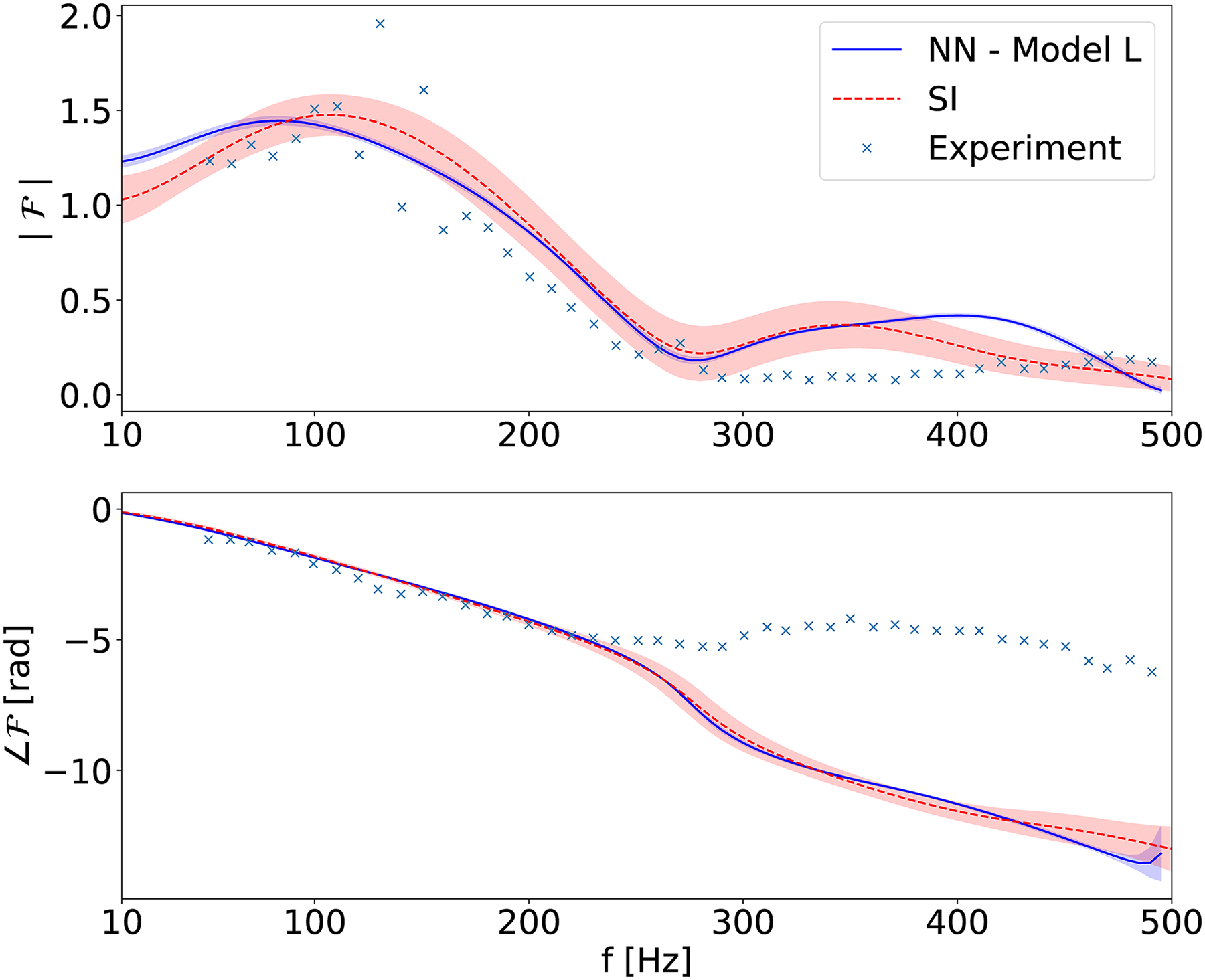
ETH burner: Comparison of the FTF predicted by the NN model (Model L) with CFD/SI and experiment. The shaded region in blue shows the bounds of prediction by the top 5 NN models. FTF: flame transfer function; CFD: computational fluid dynamics; SI: system identification; NN: neural network.
Now, we assess the ability of NNs to model the nonlinear flame response. We combine the 0.1 and 1.0 excitation amplitude data to train the NN model. Combining data of 0.1 amplitudes provides NN with more data to train on and improves its prediction at low amplitude levels. This task is more complicated than the FTF prediction due to the variation in gain and phase response to the different amplitudes. First, we study the effect of various loss functions on flame response predictions. Figure 8 compares the FDF predictions by various NN models trained using different loss functions with the LES data coming from mono-frequent excitation. We compare data from 4 different loss functions including the proposed novel loss function. First row shows the gain and phase prediction obtained by NN trained with the MSE loss function. We observe that using the MSE loss function, gains are well-predicted across all amplitude levels but NN is not able to capture the phase separation across various amplitude levels. In contrast to Model L, which was trained with the MSE loss function and able to capture the linear flame response (Figure 7) accurately, the Model NL trained with the MSE loss function is not able to capture the accurate phase for lower amplitudes due to the amplitude imbalance problem. Therefore, we train NN with the MAPE loss function which has the ability to alleviate the amplitude imbalance issue. However, FDF predictions for NN trained with the MAPE are not satisfactory as shown in the second row of Figure 8. Next, we study NN models trained with root mean squared error (RMSE). This loss function helps in improving low amplitude errors due to the square-root in the function. As seen from the third row of Figure 8, it leads to better phase predictions compared to the NN trained with MSE. Therefore, we combine the benefits of these loss functions by proposing a novel loss function MSQRE. We observe that NN models trained with this loss function provide the best performance and therefore, we will discuss these results further in detail.
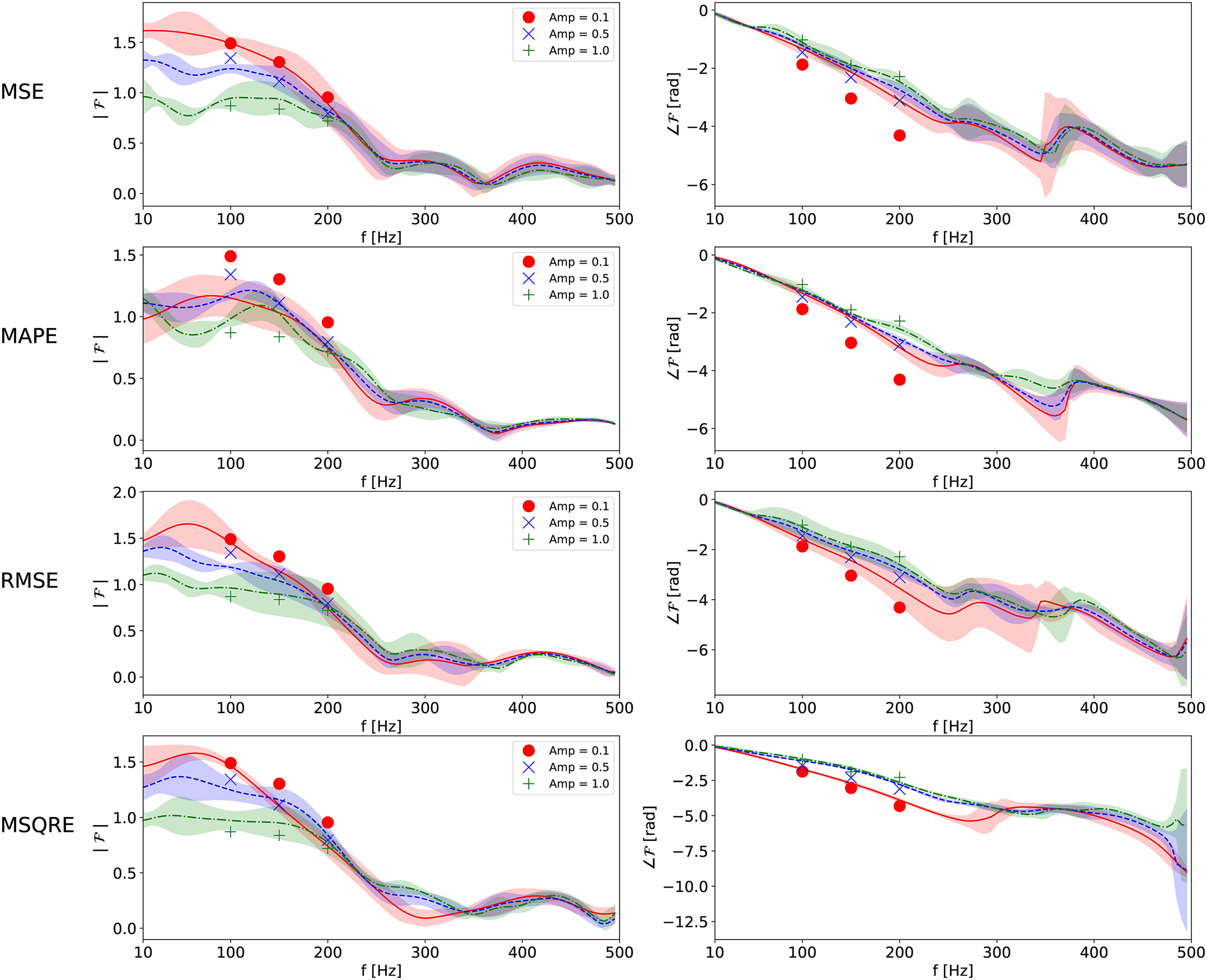
ETH burner: Comparison of effect of various loss functions on FDF prediction by NN model (Model NL) with LES. Solid lines: estimate by the NN model. Markers: ground truth from LES using mono-frequent excitation. The shaded region shows the bounds of prediction by the top 5 NN models. NN: neural network; LES: large eddy simulation; FDF: flame describing function.
The NN models are trained with the novel loss function. The model with the least validation error of 0.2608 is selected to predict the FDF. Figure 9 compares the FDF predicted by the NN model with the data from LES simulations at 0.1, 0.5, and 1.0 amplitude levels. Gains predicted by NN models match accurately with the CFD simulations. A good agreement is observed for the gain predicted by the NN model trained with the MSQRE loss function at 0.1 amplitude level with the CFD/SI approach compared to the NN models trained with MAPE loss function. Similarly, the NN model trained with the MSQRE loss function captures the variation in phase for different amplitude levels of 0.1 and 1.0. The accurate predictions in gain and phase at low amplitude levels stem from the novel MSQRT loss function used to train the NN model. Furthermore, we show the bounds of prediction by selecting the top 5 best-performing NN models from the hyper-parameter study. The predictions by these NN models are used to obtain the mean and standard deviation in gain and phase predictions shown in Figure 9. Therefore, we show that the NN model successfully predicts the linear and nonlinear flame response of the ETH burner under study.
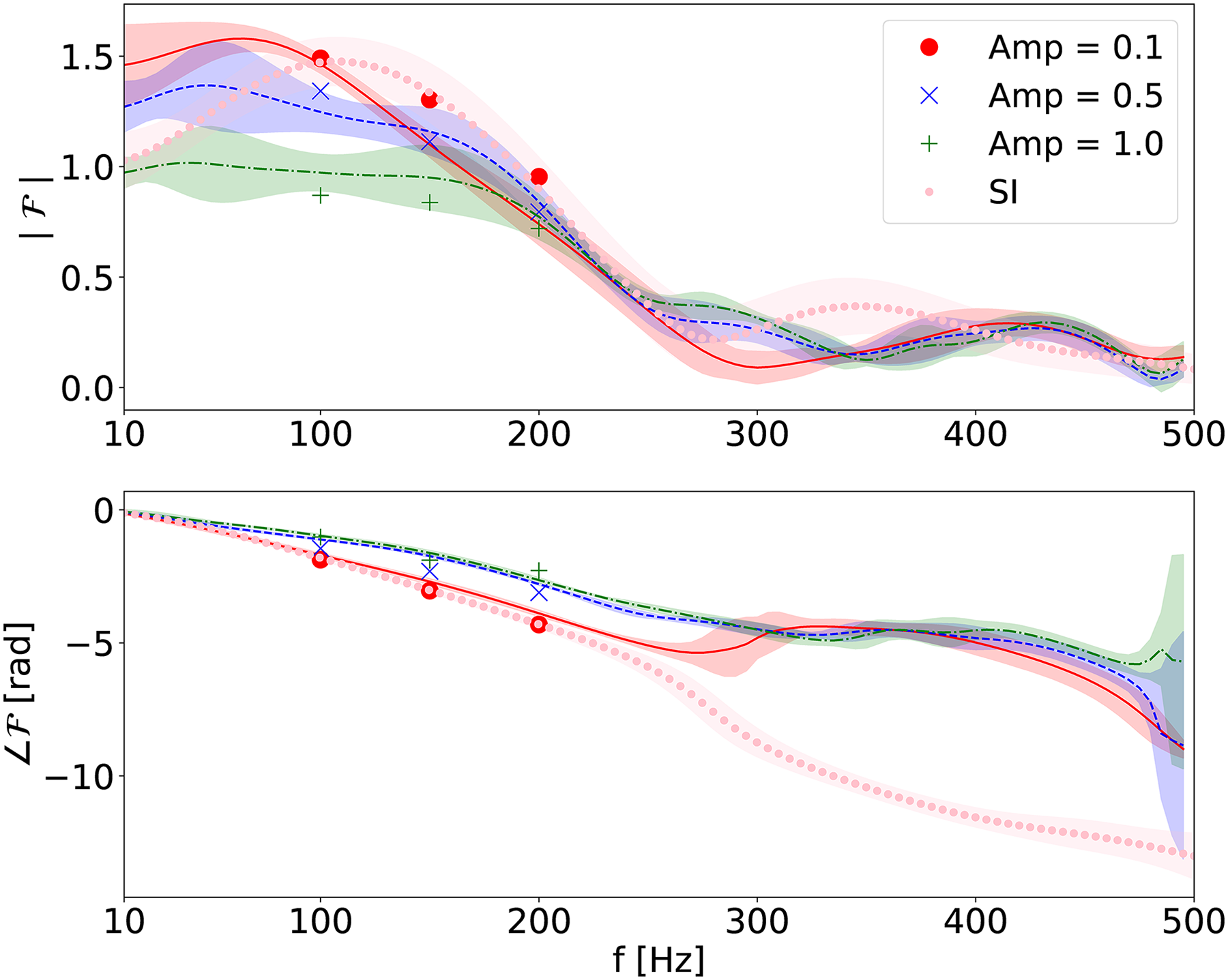
ETH burner: Comparison of the FDF computed from the NN model (Model NL) with LES. Solid lines: estimate by the NN model. Markers: ground truth from LES using mono-frequent excitation. The shaded region shows the bounds of prediction by the top 5 NN models. NN: neural network; LES: large eddy simulation; FDF: flame describing function.
Conclusions and future work
In this work, we demonstrated the ability of the NN model to predict the linear and nonlinear flame response of turbulent flames for two different burner configurations. For the EM2C burner, the NN is trained on the data from a few back plate temperature configurations. The trained NN model can predict the linear flame response at unseen burner configurations with different back plate temperatures. The NN model with sufficient training data can eliminate the need to run additional CFD simulations to capture the FTF at unseen boundary conditions, thus reducing the computational cost. For the ETH burner, the NN model is shown to capture the nonlinear flame response. Compared with the data from the mono-frequent excitations, predictions from the NN model are in good agreement. A novel loss function is shown to be useful to improve flame response predictions.
The present work demonstrates the use of feed-forward NN called MLP to model the linear and nonlinear flame response of turbulent flames. The future works can explore various other NNs such as LSTM to capture temporal relations in the data or Bayesian NN to capture the uncertainties in prediction. Another important direction of future work includes collecting more validation data for ETH case using LES approach for higher frequencies. This effort will contribute to a more comprehensive validation of the NN approach.
Supplemental Material
sj-pdf-1-scd-10.1177_17568277241262641 - Supplemental material for Linear and nonlinear flame response prediction of turbulent flames using neural network models
Supplemental material, sj-pdf-1-scd-10.1177_17568277241262641 for Linear and nonlinear flame response prediction of turbulent flames using neural network models by Nilam Tathawadekar, Alper Ösün, Alexander J. Eder, Camilo F. Silva and Nils Thuerey in International Journal of Spray and Combustion Dynamics
Footnotes
Declaration of conflicting interests
The authors declare no potential conflicts of interest with respect to the research, authorship, and/or publication of this article.
Funding
The authors disclosed receipt of the following financial support for the research, authorship, and/or publication of this article: N. Tathawadekar acknowledges the financial support of the ERC Consolidator Grant SpaTe (CoG-2019-863850) and Alexander J. Eder received financial support from the Deutsche Forschungsgemeinschaft (DFG, German Research Foundation) within the DFG transfer project NoiSI (PO 710/23-1). The authors gratefully acknowledge the Leibniz Supercomputing Centre (LRZ) for funding this project by providing computing time on its Linux-Cluster.

Supplemental material
Supplemental material for this article is available online.
References
Supplementary Material
Please find the following supplemental material available below.
For Open Access articles published under a Creative Commons License, all supplemental material carries the same license as the article it is associated with.
For non-Open Access articles published, all supplemental material carries a non-exclusive license, and permission requests for re-use of supplemental material or any part of supplemental material shall be sent directly to the copyright owner as specified in the copyright notice associated with the article.
