




Abstract
System theory methods are developed and applied to introduce a new analysis methodology based on the stability criteria of active two-ports, to the problem of thermo-acoustic instability in a combustion appliance. The analogy between thermo-acoustics of combustion and small-signal operation of microwave amplifiers is utilized. Notions of unconditional and conditional stabilities of an (active) two-port, representing a burner with flame, are introduced and analyzed. Unconditional stability of two-port means the absence of autonomous oscillation at any embedding of the given two-port by any passive network at the system's upstream (source) and downstream (load) sides. It has been shown that for velocity-sensitive compact burners in the limit of zero Mach number, the criteria of unconditional stability cannot be fulfilled. The analysis is performed in the spirit of a known criterion in microwave network theory, the so-called Edwards-Sinsky's criterion. Therefore, two methods have been applied to elucidate the necessary and sufficient conditions of a linear active two-port system to be conditionally stable. The first method is a new algebraic technique to prove and derive the conditional and unconditional stability criteria, and the second method is based on certain properties of Mobius (bilinear) transformations for combinations of reflection coefficients and scattering matrix of (active) two-ports. The developed framework allows formulating design requirements for the stabilization of operation of a combustion appliance via purposeful modifications of either the burner properties or/and of its acoustic embeddings. The analytical derivations have been examined in a case study to show the power of the methodology in the thermo-acoustics system application.
Keywords
Introduction
Thermo-acoustic combustion instability manifests itself as a high level of tonal noise, vibration, and may cause the performance deterioration or even structural damage of combustion appliance. The ability to eliminate and/or control combustion instability at the appliance design phase is one of the main goals of combustion-acoustics research. The low-order (acoustic network) modeling approach is one of the intensively developing tools which has proven its efficiency in performing problem analysis, synthesis, and eventually the appliances design tasks.
Various acoustic network models have been developed1–3 that are used to analyze combustion thermo-acoustic instabilities and the design of combustion equipment in recent studies.4–7 This modeling allows treating combustion appliance components as acoustic two-ports.4,8,9 Accordingly, the availability of a purely acoustic characterization of the burner with flame is the prerequisite of the model. This is achievable within the concept of the transfer matrix (T) or scattering matrix (S). 7 Then, a network model of the combustion system is obtained when all two-port components are combined.
The methodological similarity of approaches to and the network models equivalence of the electrical circuits and combustion acoustic systems have been shown in various papers since 1957. 10 However, the stability analysis and design methods of the two-port networks have not been developed/applied in the combustion field as much as in microwave theory. The linear two-port network theory has been an intensively developing research subject and the results have been applied ubiquitously in the practice of microwave devices’ design. The closest analogy can be established between the combustion thermo-acoustic instability problem and the problem of stability of operation of microwave amplifiers. Here, the burner with flame and the amplifier (e.g., transistor) both represent a so-called, “dependent source” or active element. Furthermore, the acoustics of the burner upstream and downstream parts in a combustion appliance are an analogy of the “source” and “load” passive network embeddings of the microwave amplifier. One of the extremely useful and well-developed concepts of the microwave amplifier's design process is the notion of unconditional stability.
In microwave theory, this means that there is no passive source and passive load combination that can cause the circuit with the given amplifier to oscillate. Correspondingly, the unconditional stability in a thermo-acoustic context means operation stability regardless of the (passive) acoustics at upstream and downstream sides of the burner/flame. The pioneering work on this subject was done by Rollett in 1962. 11 He introduced a quantity (criterion) to characterize the degree of stability. Later, it was shown that the combination of validity of certain inequality requested from the Rollett factor together with only one other auxiliary condition are necessary and sufficient to provide unconditional stability.12–15
In 1992, Edwards and Sinsky proposed a single parameter, instead of two of Rollett's conditions, to determine the necessary and sufficient unconditional stability requirements. 16 The arguments and analysis were based on a geometrical approach. Various applications and design tools based on the Edwards-Sinsky criteria were developed and discussed.17–19 Particularly, Balsi et al. extended the geometrical approach and derived the necessary and sufficient conditions for a linear active two-port to be conditionally stable. A recent work of Lombardi and Neri 20 presented the existence of a duality mapping between the input and the output of the two-port network; then by using certain properties of Mobius Transformation (MT), they demonstrated all possible cases of mapping between the input and the output of the system. MT is the bilinear rational transformation 21 as one of the mathematical concepts named after A.F. Mobius. It is well-known that the MT maps a line or circle into another line or circle. 22 Çakmak et al. derived explicit formulas relating the centers and the radii of the mapped circles. 23
On the other hand, the beginning of active development of the acoustic network modeling approach to the problem of combustion instability falls in the period after ∼1990. The main focus was on formulating thermo-acoustic network models, predicting the instability, searching for unstable frequencies, calculating/measuring the growth rate, searching methods for stabilizing systems, etc. References to most of the performed research can be found in the review paper. 24 The conventional methodology for analyzing the stability of thermo-acoustic systems consists of measuring/modeling the Flame Transfer Function (FTF). Then, a wave-based 1D linear two-port network approach is applied to provide the system matrix. The eigenfrequencies of the system (zeros of the matrix’ determinant) determine the (in)-stability frequencies and growth/decay rates. Therefore, the common practice is to create a system matrix each time when the system is altered to check the corresponding effect on the eigenfrequencies. This procedure allows resolving the dilemma of the (in-)stability of operation of a particular system and gives a reasonably accurate prediction of frequencies of oscillation. This approach has been successfully applied in numerous studies before.7,25,26 However, the conventional modeling approach does not provide a good overview of conditions and guidelines for designing the upstream and downstream sides of the flame such that the system would be stable. The crux is in the absence of specific parameters or criteria to determine the system stability and lack of tools (rules) on how to manipulate the system design as it is done in microwave theory.
A new impetus in the development of system-level analysis of thermo-acoustic network models was given by the discovery of the phenomenon of the burner intrinsic thermo-acoustic mode of instability.27,28 This and further research on the subject use system theory. Particularly, the derived system instability conditions are based on the gain and phase of the TFT for only ITA modes. 29 A review of literature on this subject can be found in the recent publication. 30
Another research direction was introduced by Kornilov and de Goey who showed the analogy between the thermo-acoustic and microwave circuits linear two-port networks
31
and use it to investigate two unconditional stability criteria, of ‘Rollett’ and ‘Edwards-Sinsky’, for the purpose of evaluation of a burner/flame figure of merit.
32
In turn, this work gave the inspiration to develop a prospective method to assess thermo-acoustic instabilities based on reflection coefficients measured only from the upstream side of the burner (cold side) by Kojourimanesh et al..
33
In this approach, two reflection coefficients,
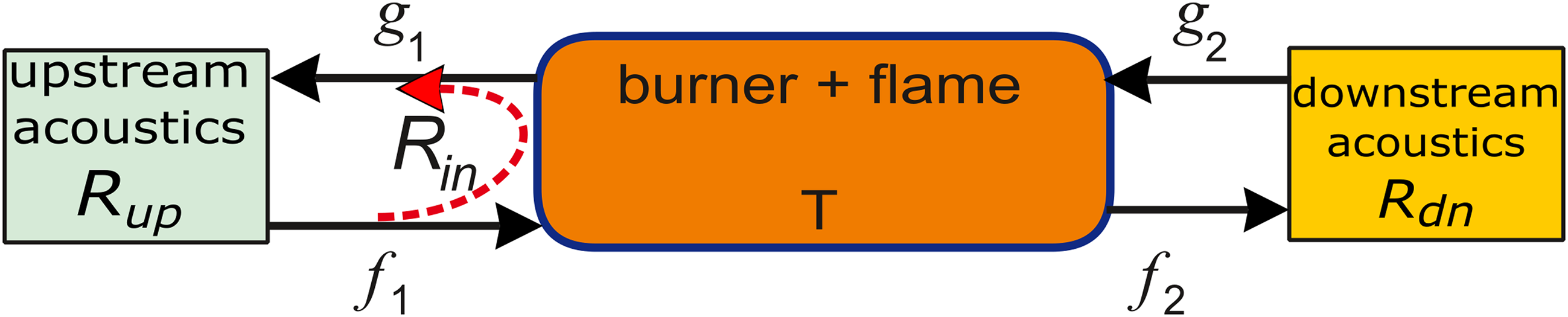
Thermo-acoustic model of a combustion system. 33
In this method, the stability of the system can be determined by inspection of the Nyquist plot of the measured
The present paper contributes to the further development of the research on the framework of the system-level analysis of thermo-acoustic instability of combustion and utilizes the close analogy with the theory of microwave networks. The particular goal of the present contribution is to introduce a new analysis methodology that is based on the stability criteria of active two-ports. The criteria will be derived using the original approach based on properties of a MT in combination with some algebraic transformations. The more general goal is to illustrate the power of the system analysis method in the application to thermo-acoustic network modeling and introduce an approach that allows designing optimal terminations at the upstream/downstream sides of the flame.
The model of a thermo-acoustic system is first written in the form of the network of a scattering matrix for power waves to show the analogy with microwave theory and derive system stability conditions. Then, new algebraic proofs of unconditional stability, namely the Edwards-Sinsky criterion, and conditional stability are proposed. Besides, an alternative approach using MT is introduced to determine the stability condition. Next, by combining the outcome of the aforementioned methods, conditional stability criteria for the thermo-acoustic systems are provided. Furthermore, the necessary condition is derived which if it is satisfied by
The results obtained and presented below can be in principle generalized to the case of an arbitrary burner with flame for which the purely acoustic representation in the form of a two-port is known and given, e.g., by the burner transfer matrix. However, here we limit the consideration to one particular type of burner, namely, an acoustic velocity-sensitive dependent source of acoustic velocity (analogy of current sensitive current source in microwave theory). In this case, we may use some internal symmetries of the transfer and scattering matrices. Physically, this type of thermo-acoustic property is appropriate to a wide class of perfectly premixed gaseous fuel burners operating in the limit of low Mach numbers for the mean flow when the heat release zone is compact with respect to the acoustic wavelength under consideration. In addition, the conditions presented below should be satisfied for all frequencies from 0 to infinity. For brevity, we may discuss all relations for a fixed frequency point but finally, all criteria and conditions should be satisfied for the whole frequency range.
Furthermore, we will work in the frequency domain, and consider only plane longitudinal waves, 1-D acoustics. The network model variables will be represented by the forward and backward traveling waves f and g and the convention for the time dependence is
Stability criteria of thermo-acoustic systems
For a compact velocity-sensitive flame in the limit of zero mean Mach number the transfer matrix takes the form of 6

In this notation,
The corresponding scattering matrix of the thermo-acoustic two-port can be defined, if one rearranges equations of the transfer matrix (

with the determinant of
The scattering matrix representation also includes the ITA mode as a special case when
Unconditional stability in thermo-acoustic systems
Unconditional stability of a given burner with flame in a thermo-acoustic context means that regardless of the acoustic reflection coefficients of passive upstream and downstream sides of the burner/flame, the combined system would be always thermo-acoustically stable. To establish whether the unconditional stability can be ensured for the thermo-acoustic two-port defined in equations (1) and (2), the evaluation of the Rollett stability condition or the Edwards-Sinsky parameter can be performed.
Lemma 1. The defined thermo-acoustic system in equation (1), cannot be unconditionally stable.
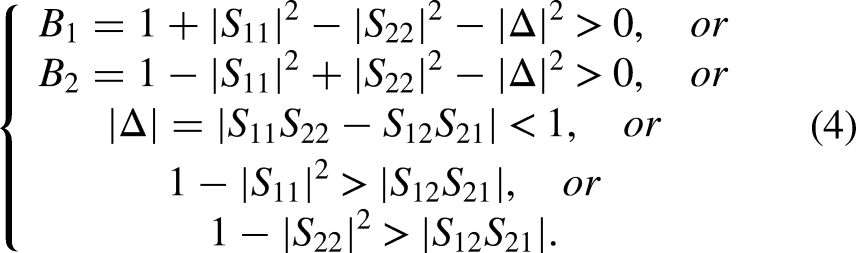
Proof. The Rollett stability condition says that the combination of Rollett stability factor

together with any one of the following auxiliary conditions given in equation (4) are necessary and sufficient for unconditional stability of an (active) two-port described by the scattering matrix S, 16
Therefore, one can simplify the Rollett stability factor for the Thermo-Acoustic system i.e.,
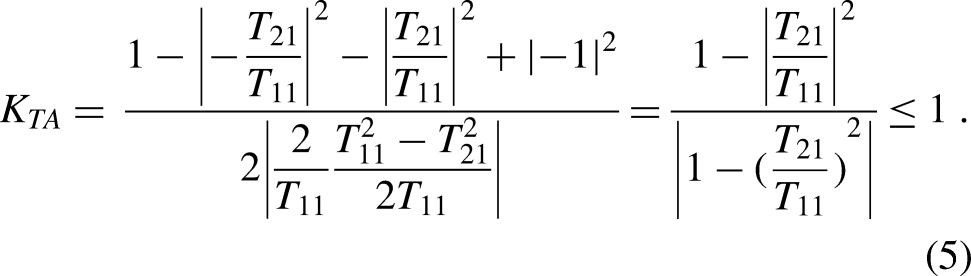
In Appendix A.1, it is made clear that for any complex number z the function
Alternately, it is also possible to prove Lemma 1 by analyzing the Edwards and Sinsky parameter,

In this notation, the bar symbol is used to denote the conjugate of a complex number.
By substituting parameters, like in Appendix A.2, one can also derive
Conditional stability in thermo-acoustic systems
When considering the notion of conditional stability of a thermo-acoustic system, the upstream and downstream acoustic boundary conditions are playing a role. One needs to search for the range of

The main idea of the Edwards-Sinsky criterion regarding the stability of a system expressed by equation (7) is that the system is unconditionally stable if the unit disk in the
Accordingly, Lemma 2 which involves requirements to the magnitudes of
Lemma 2. For the thermo-acoustic system with the active two-port defined in equation (2), conditions for the downstream and upstream terminations which are sufficient to qualify the system to be conditionally stable are



Considering equation (7) and

As shown in Appendix B.2, the discriminant,


Appendix B.3 shows that by substituting
Equations (8.b) and (8.c) are almost the same as the conditions suggested by Balsi et al. Appendix C.1 shows how their conditions can be derived using this algebraic method. Moreover, Appendix C.2 provides a new proof of the Edwards-Sinsky criterion from the mentioned algebraic technique.
Mobius transformation between
and
As stated before, the relation between
Among multiple specific properties of this transformation, one which will be used below is that the MT maps a line or a circle in the complex plane of its input Z into another line or circle in the plane of its output H. Particularly, if the mapped contour is the unit circle, then the resulting circle of the unit circle has a specified center,


Furthermore, the center of the
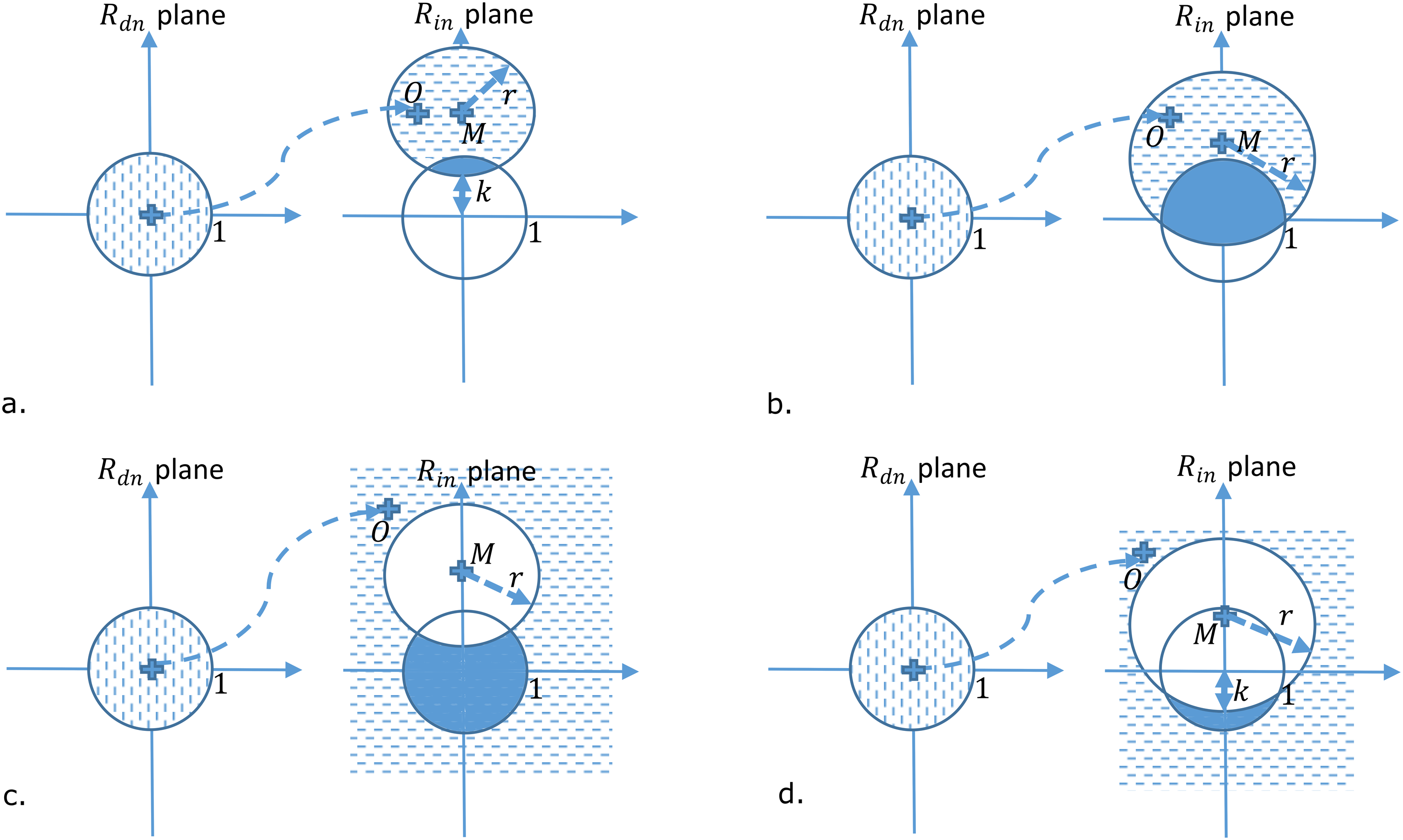
Four possible cases for the Mobius transformation of the unit circle of
For the case

Then, the unit circle in

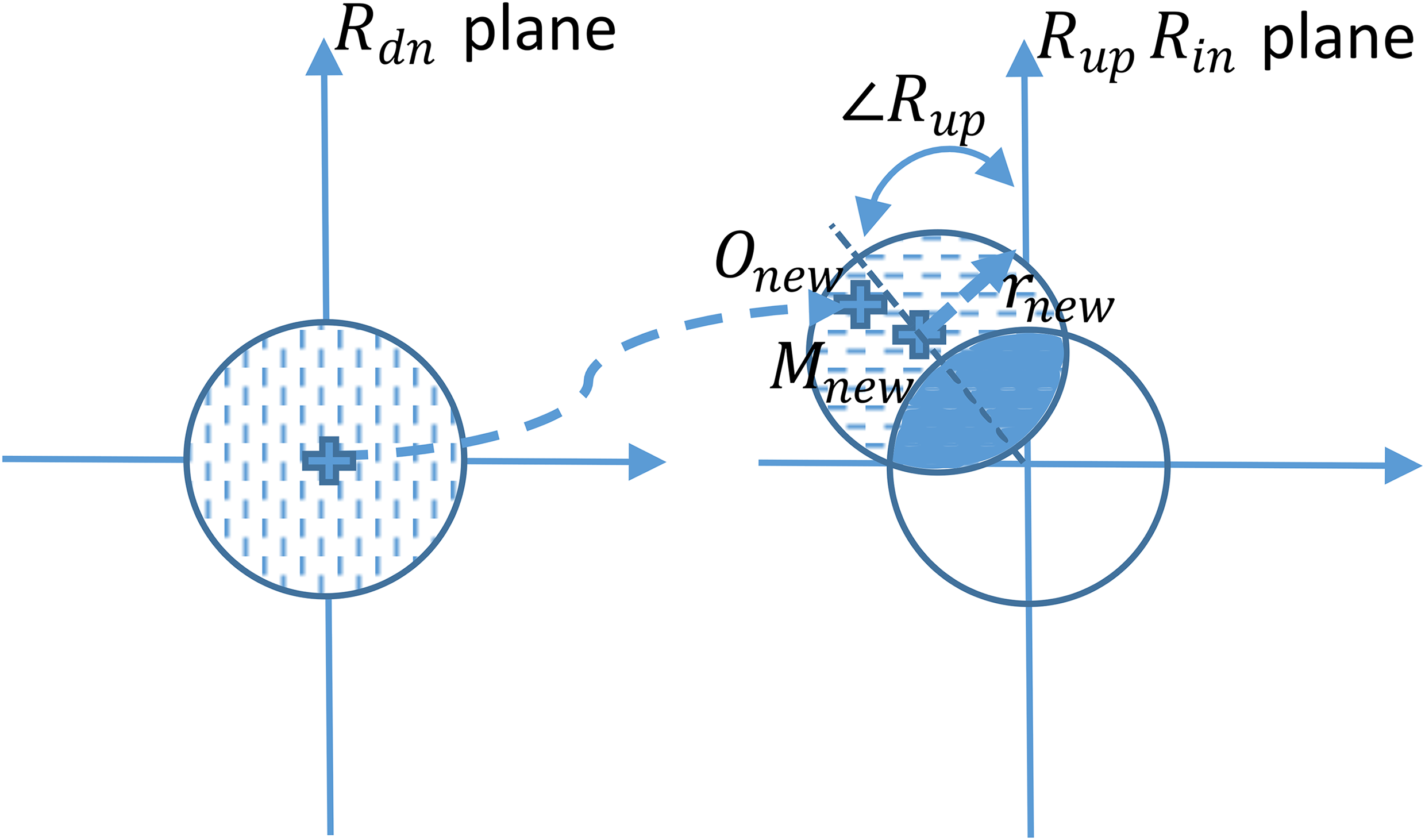
Mobius transformation of
Figure 3 depicts the MT of the unit circle in the
Besides, equation (15) suggests that by decreasing the magnitude of
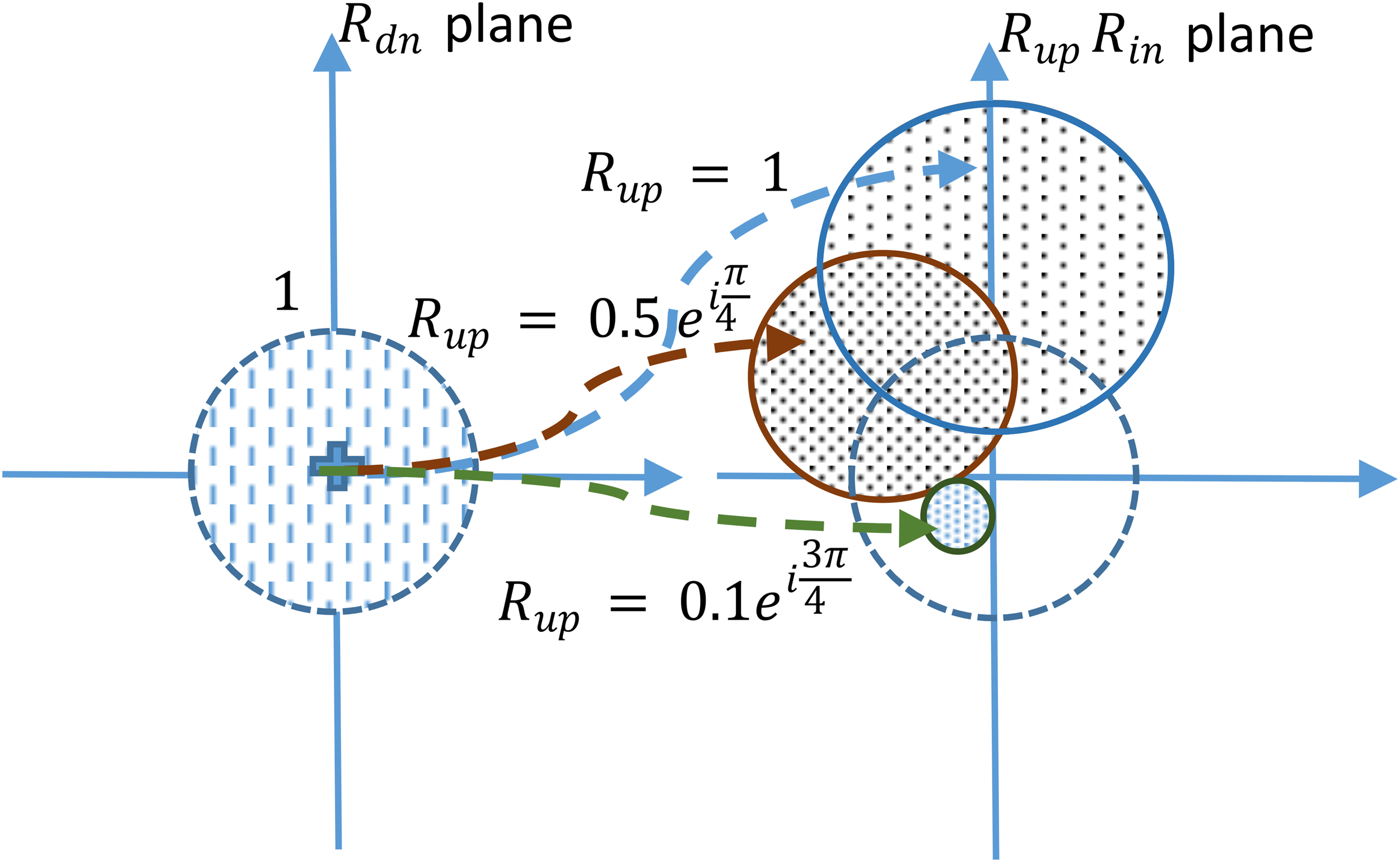
MT of
Comparing algebraic and MT methods’ results
In this section, we are aiming to search for correspondences between the results derived from the algebraic and the MT methods. In the aforementioned thermo-acoustic two-port system, i.e., obeying equation (2), the symmetry implies that

In addition, for the case
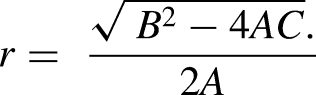
The same procedure confirms that
By comparing the expression of
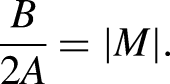
Therefore, one can relate the first root of the quadratic equation to the MT circle parameters as



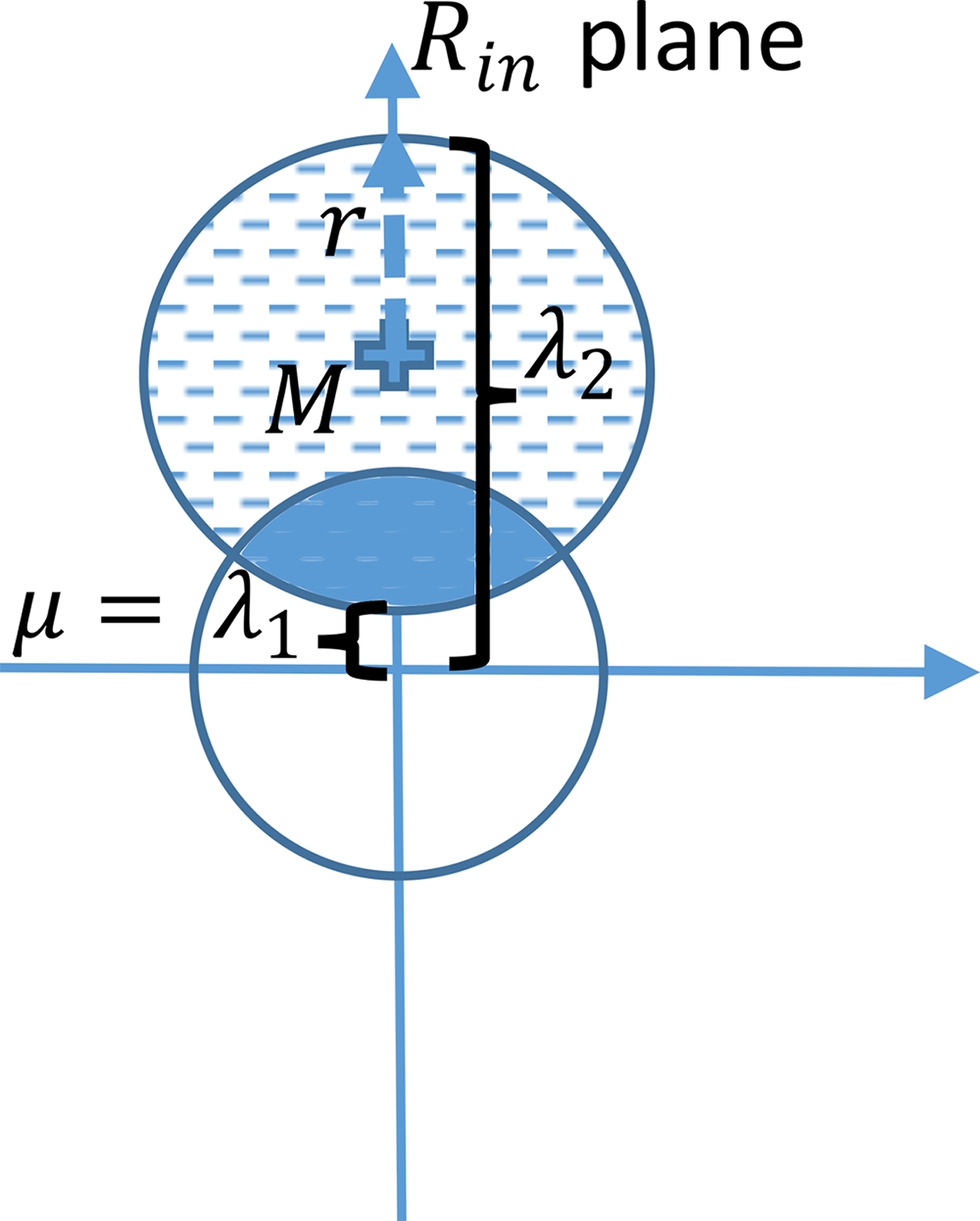
Relation of MT, algebraic equation and
Optimal value of
to obtain minimum value of
In this subsection, an optimum value of

It is obvious that for the cases b and c the optimum value of
Possible range of
to obtain a passive stable system
The practical motivation of the considerations presented below stems from the fact that many producers of burners for industrial or domestic applications tend to combine the burner with the downstream part of an appliance as a unified product. A typical example is the combination of a burner and heat-exchanger as the “power module”. Accordingly, only the upstream side (for instance, the blower/fan, venturi, snorkel, etc.) is designed by the boiler manufacturer. In this situation, designers of the power module would like to optimize their product in terms of ensuring the thermo-acoustic stability for the module in combination with any/arbitrary acoustics of the upstream part of an appliance.
In this subsection, the conditions are investigated how to select a passive termination
The region of

We are interested where the unit circle of
Case study
To show the power of this methodology, a test setup, shown in Figure 6, is prepared to measure the FTF,
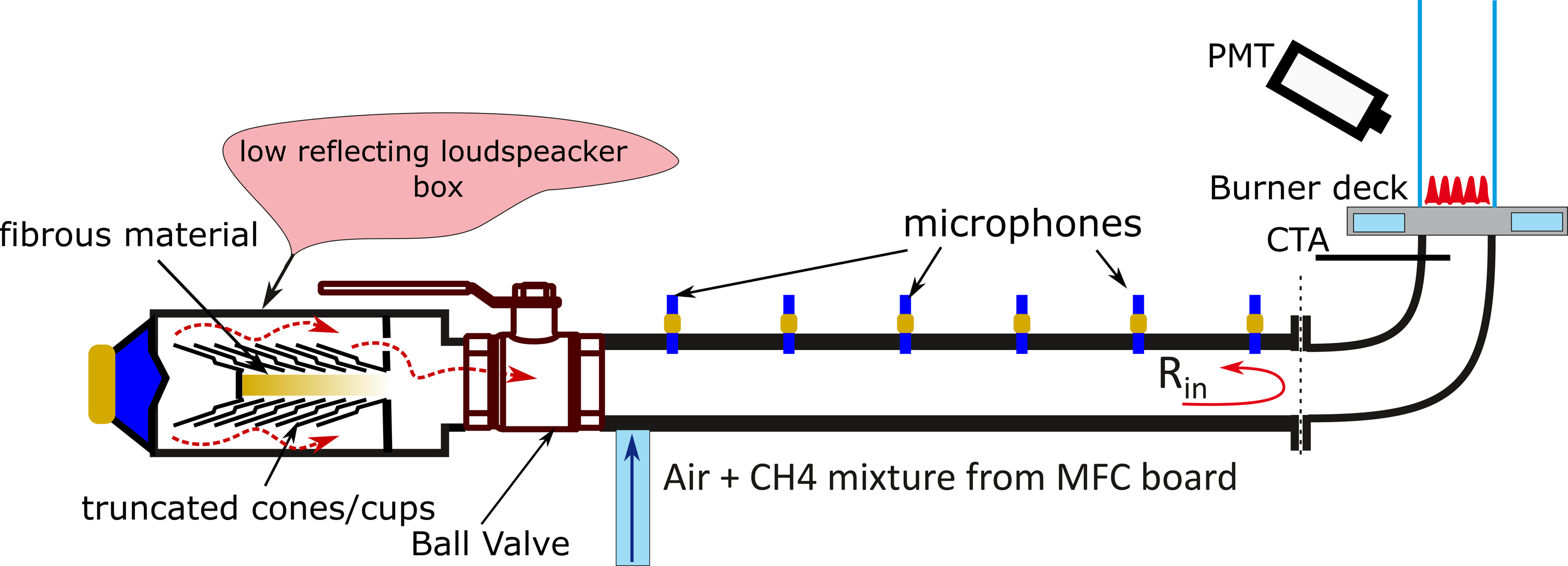
A test setup to measure the
The upstream side has a broadband damper with
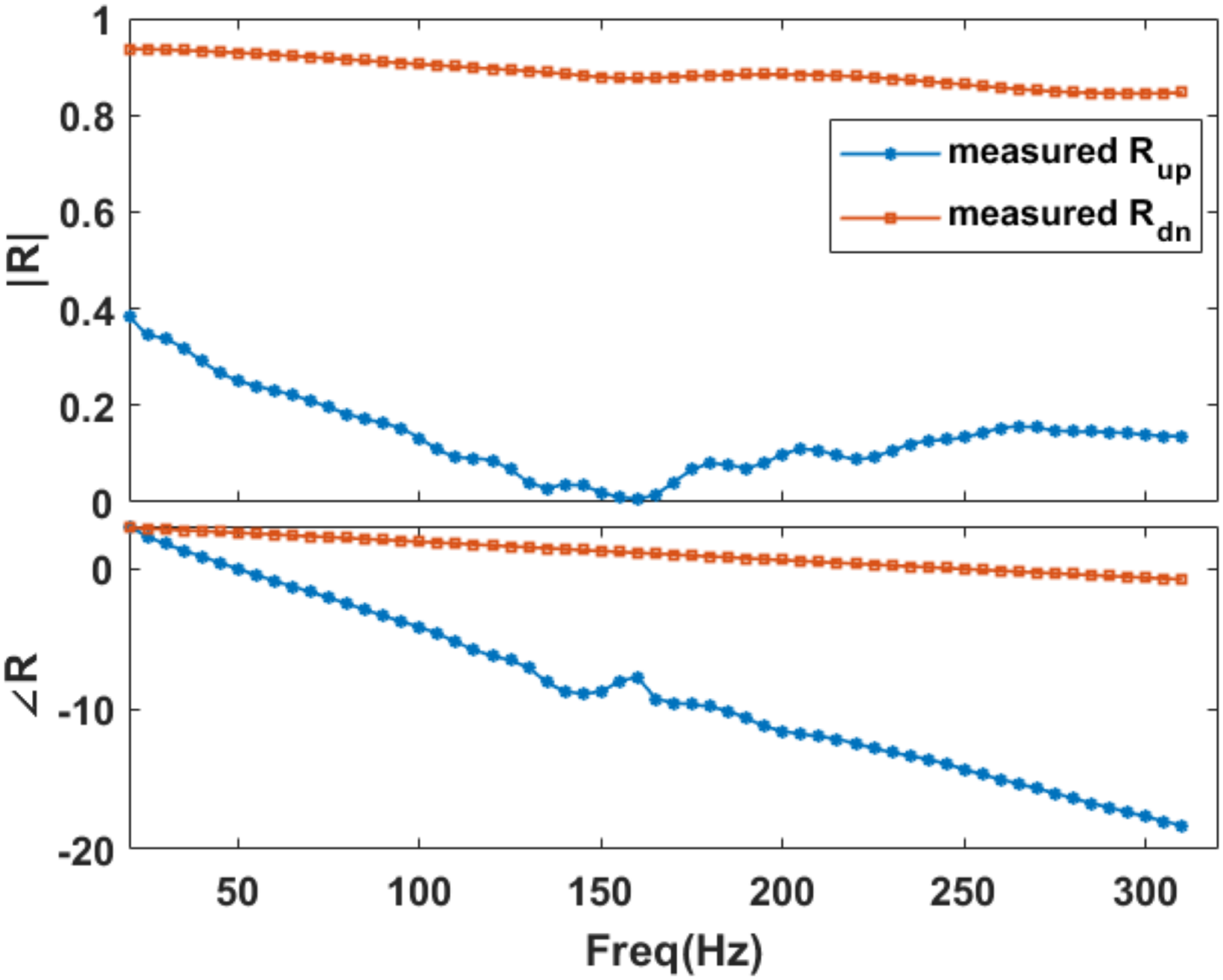
Measured
As an example, the flame transfer function for a brass plate burner with premixed burner-stabilized Bunsen-type flame is measured. The burner deck is a disk that has a thickness of 1 mm, and a diameter of 5 cm. The hexagonal pattern of round holes with a diameter of holes of 2 mm and the pitch between the holes of 4.5 mm is used. For brevity, the burner is called “D2P4.5”. The total open area of the burner is 399 mm.
2
The measured flame transfer function is used to calculate coefficients a, b, c, d of the MT. Figure 8 shows the flame transfer function of burner D2P4.5, at the mean velocity of the mixture through the burner holes of 70 cm/s and equivalence ratio of
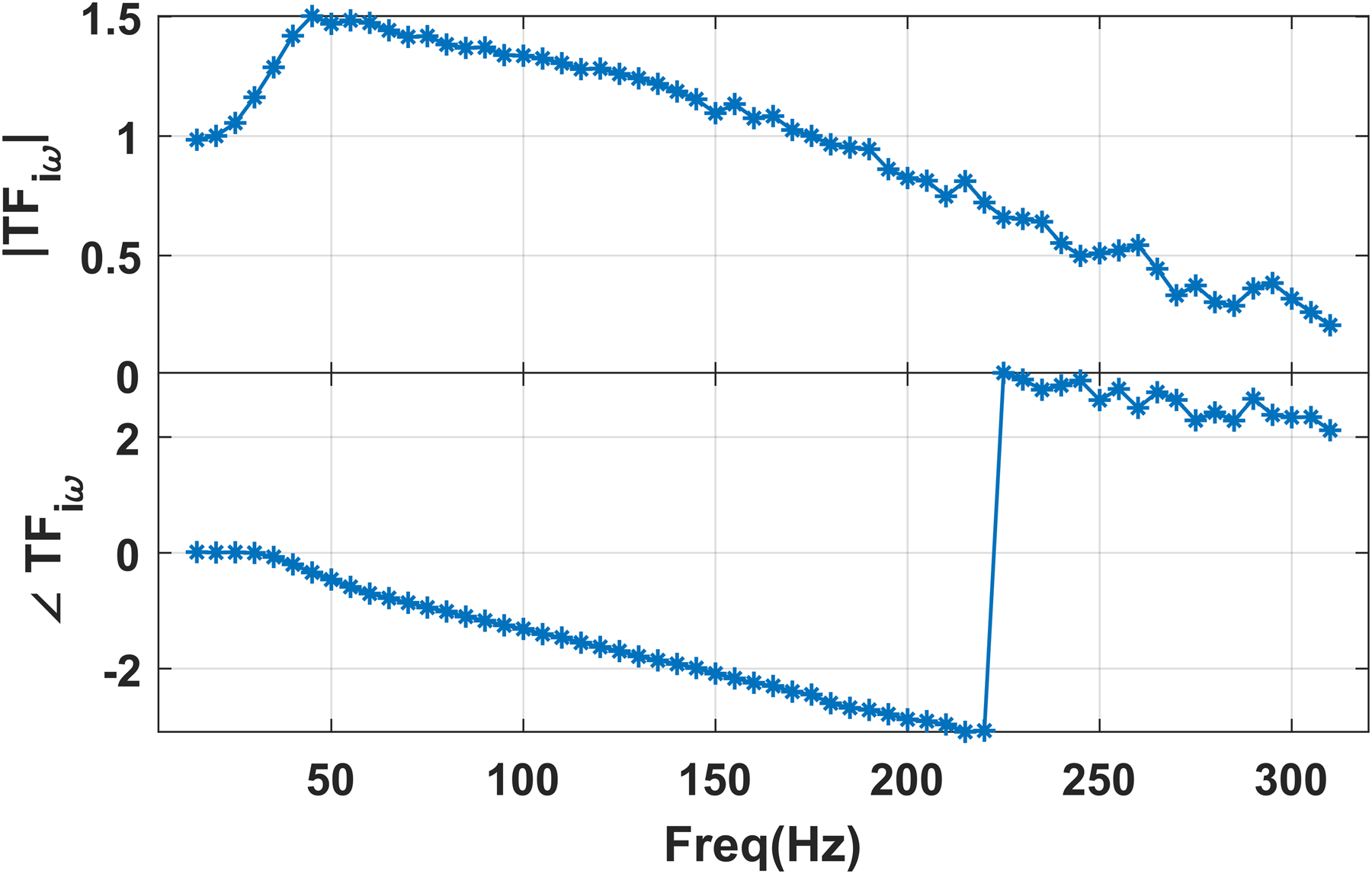
Measured flame transfer function of the burner D2P4.5 at
The impedance tube with 6 microphones shown in Figure 6, including the low reflecting loudspeaker box (damper) at the upstream side, is used to measure the reflection coefficient
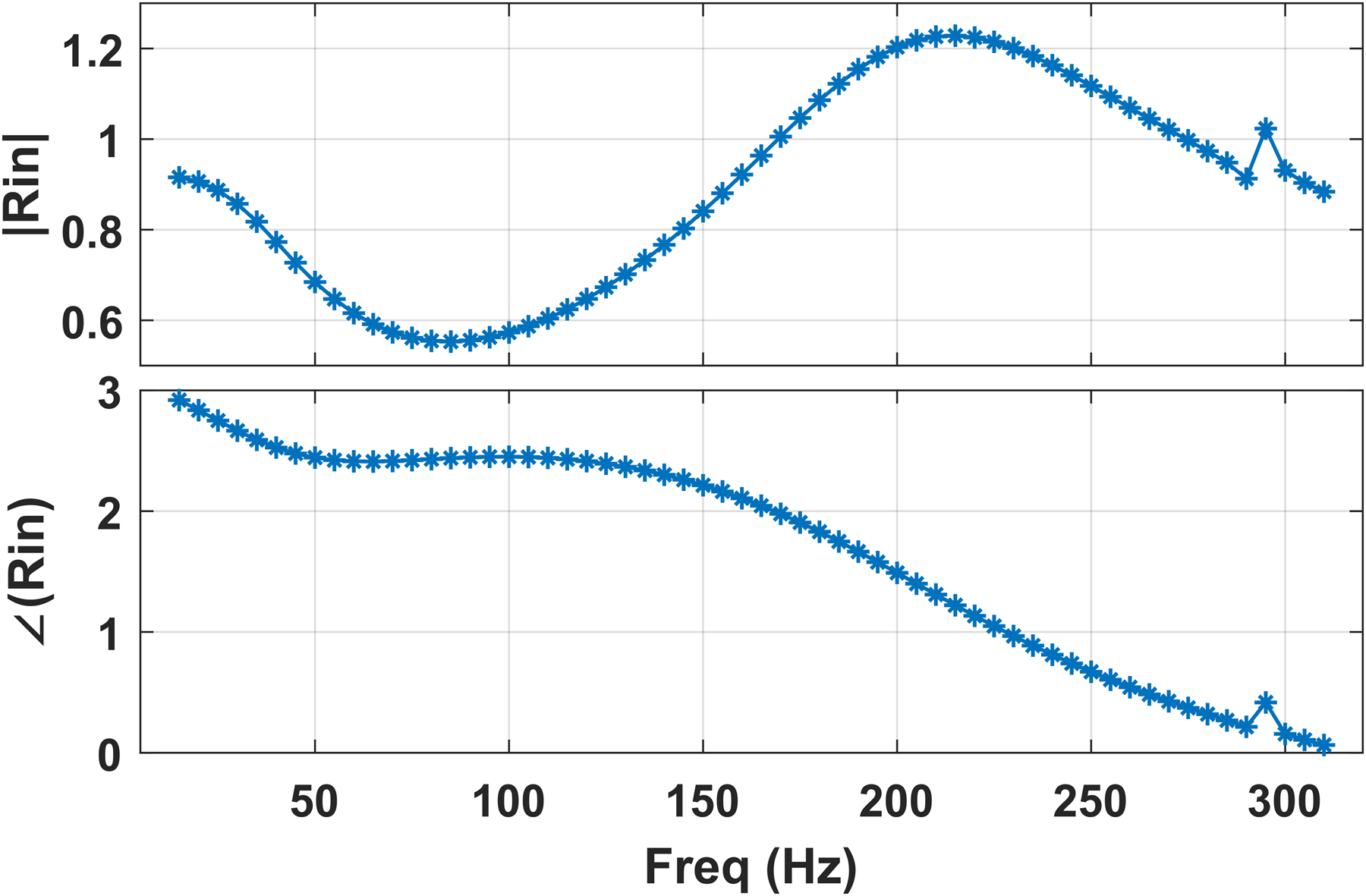
Measured
Results and Discussions
In this section, the analytical results derived in section 2 are examined for the case study expressed in section 3.
Stability analysis using Flame Transfer Function
For the case study as defined in the section 3, the Rollett stability factor K, and Edwards-Sinsky parameter
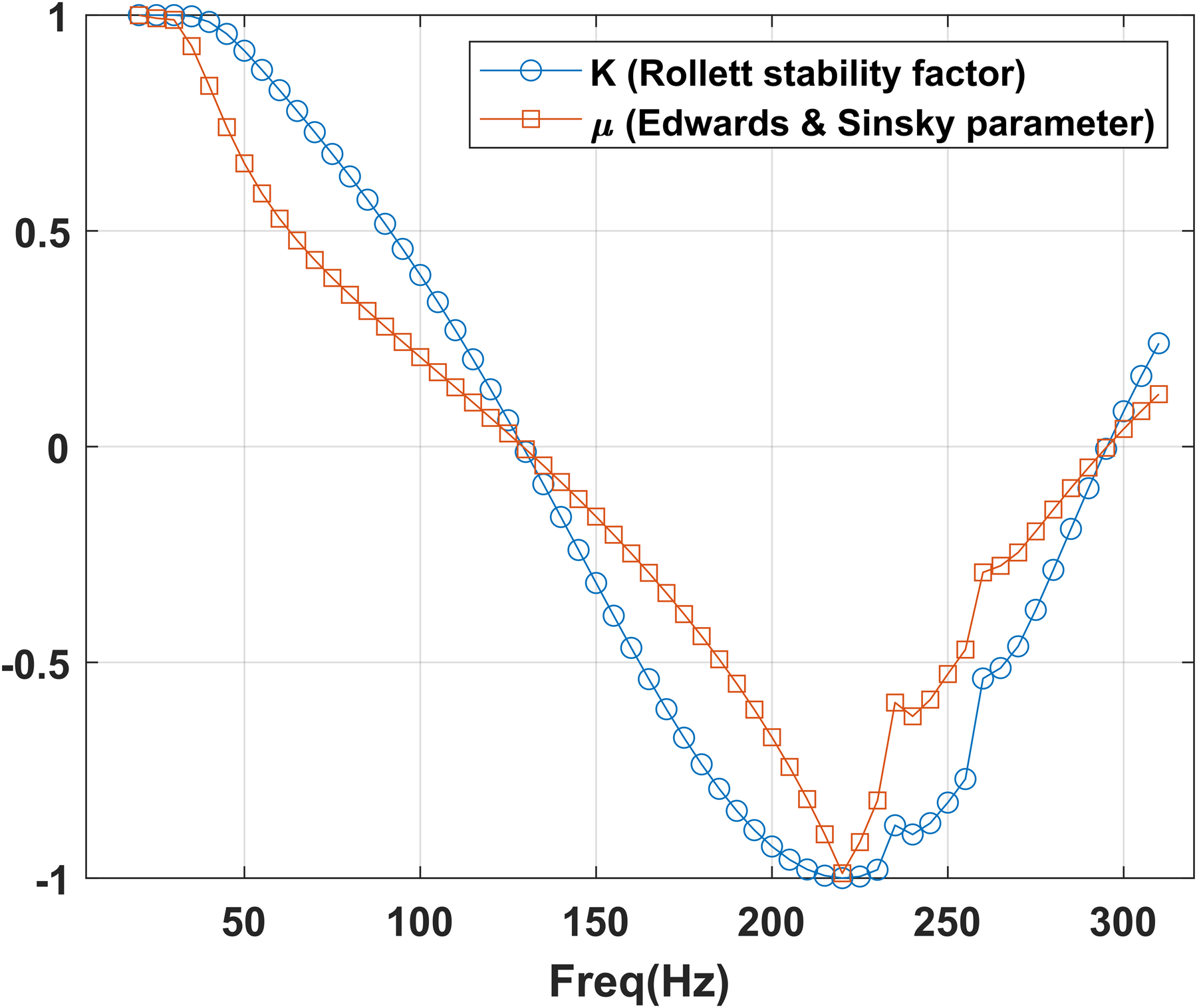
Calculated K and
As mentioned before, due to symmetry features of the transfer matrix for thermo-acoustic systems, both Rollett factor and Edwards-Sinsky parameter should be less than 1,
Upstream design to stabilize the system
Equation (8.a) reveals that for a specific
Besides, one can get the advantages of equation (8.b) to design the upstream reflection coefficient. It should be noted that the phase of the reflection coefficient at the downstream side can be easily changed, like by varying the length of the exhaust duct. However, changing the magnitude of the downstream reflection coefficient needs a dedicated gas path design or even external equipment like damper, muffler, etc. Therefore, one of the design strategies is to infer for the fixed value of
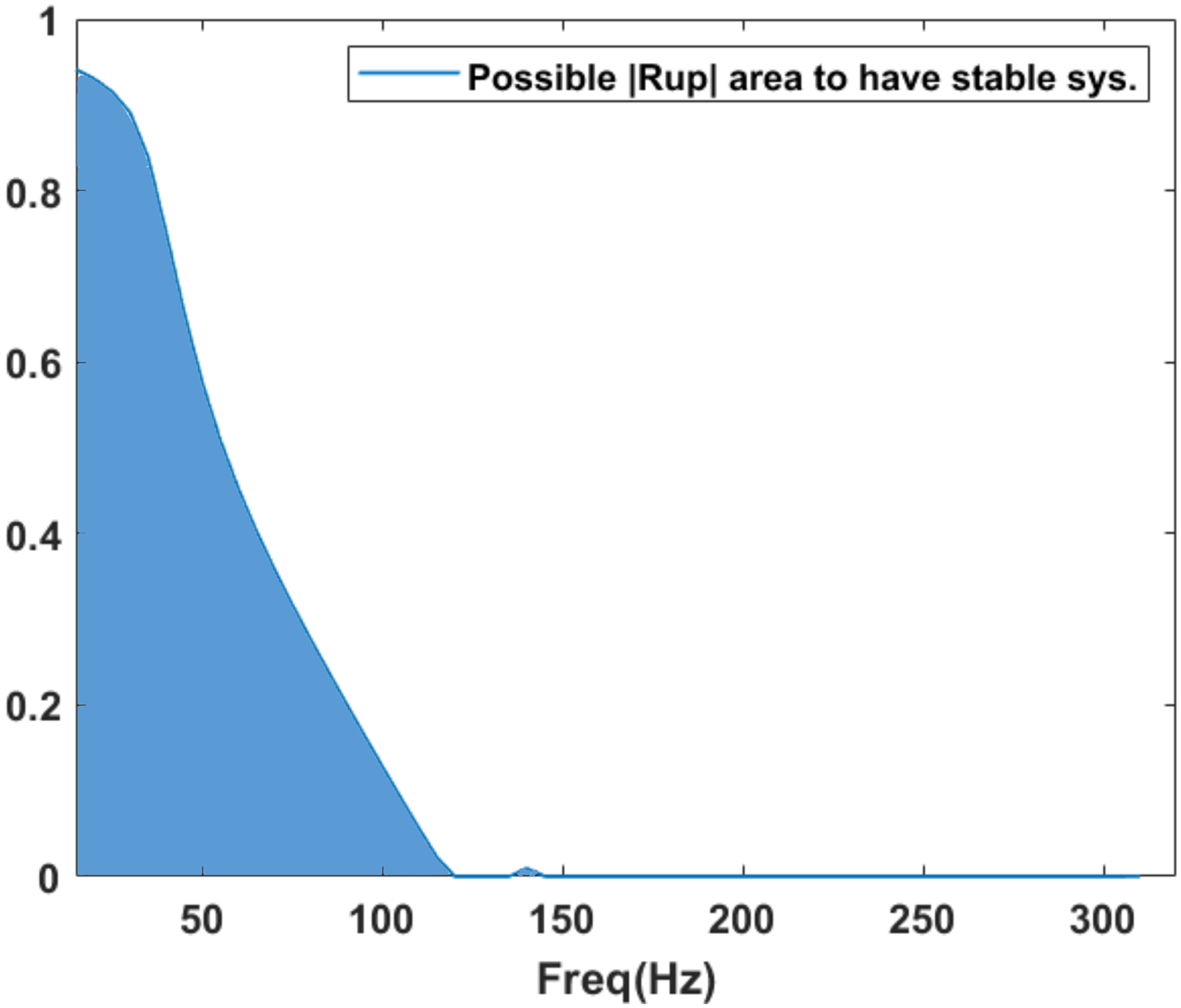
Region of
As can be seen in Figure 11, for frequencies higher than 120 Hz there is no value of
The reflection coefficient of the upstream side can be also designed from the MT strategy. Figure 12 shows the results of mapping the unit circle of
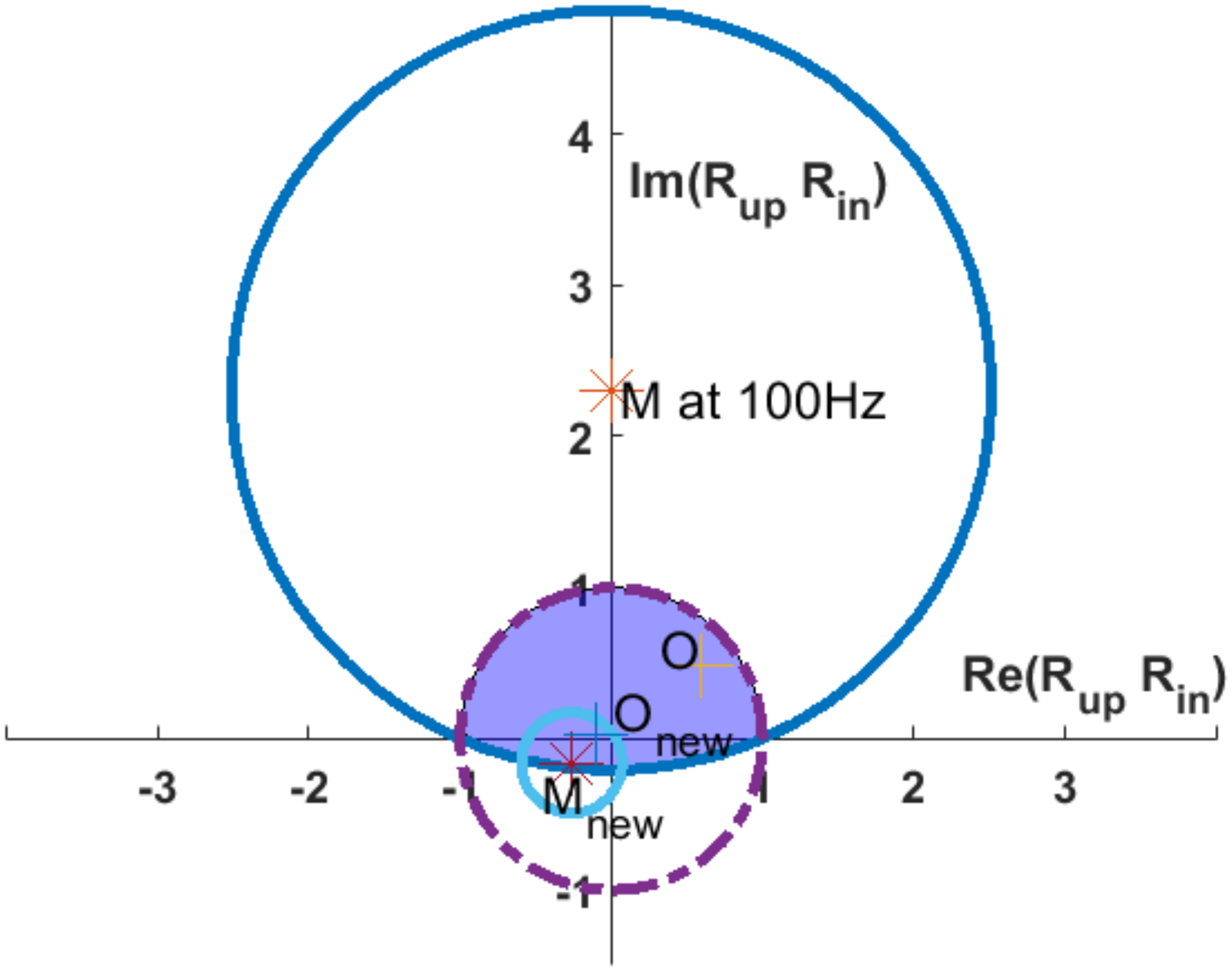
MT of
In addition, the system with a high value of the upstream reflection coefficient,
Downstream design for stability
Equation (8.c) could help to design the downstream part for a fixed value of
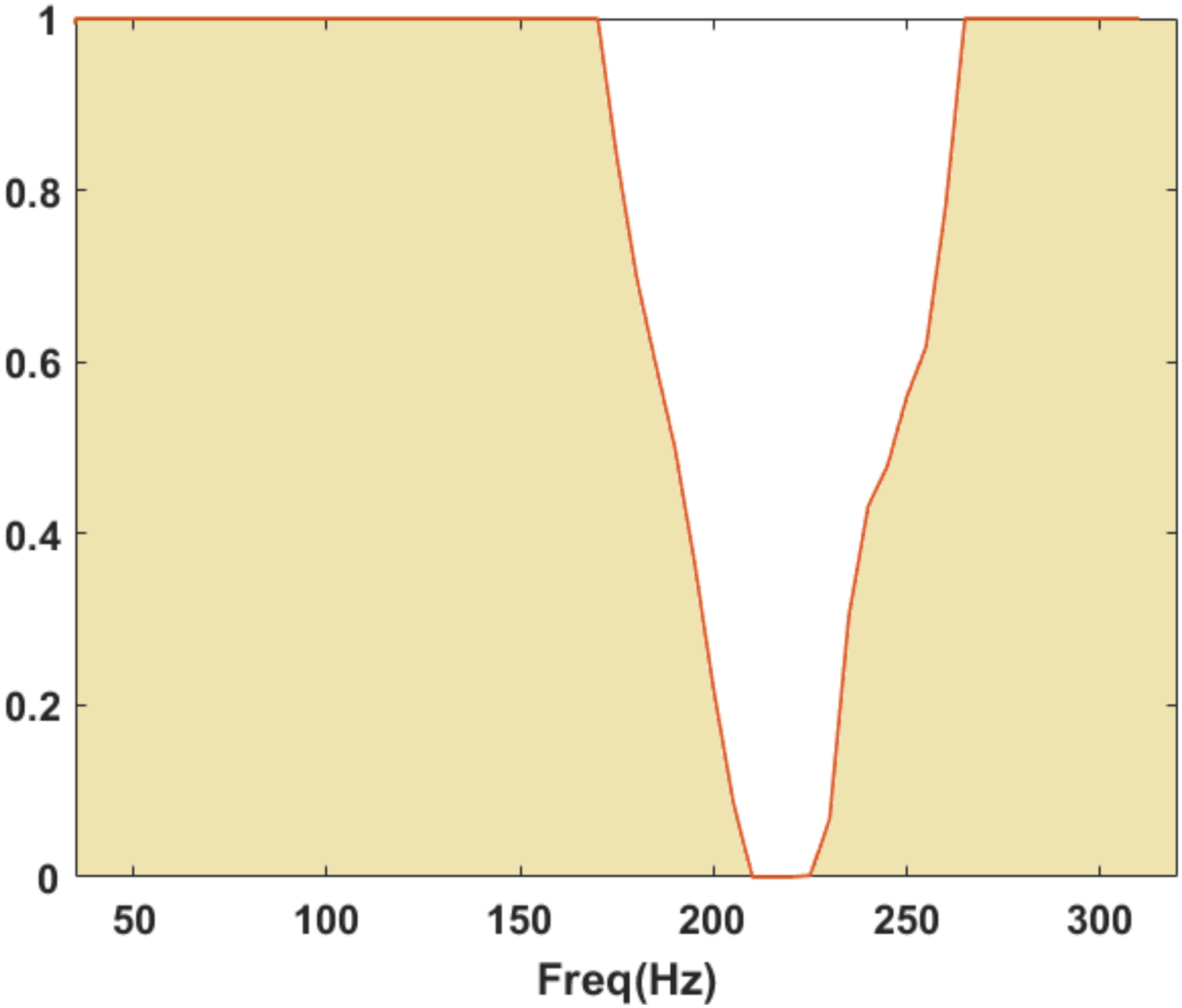
Region of
Figure 13 demonstrates that even for the fixed low magnitude of the reflection coefficient of the upstream termination
As expressed before, some combustion companies prefer to sell their product without the upstream side. Accordingly, the inverse transformation written in equation (21) could provide a method how to ensure the complete system stability for any values of magnitude and phase of
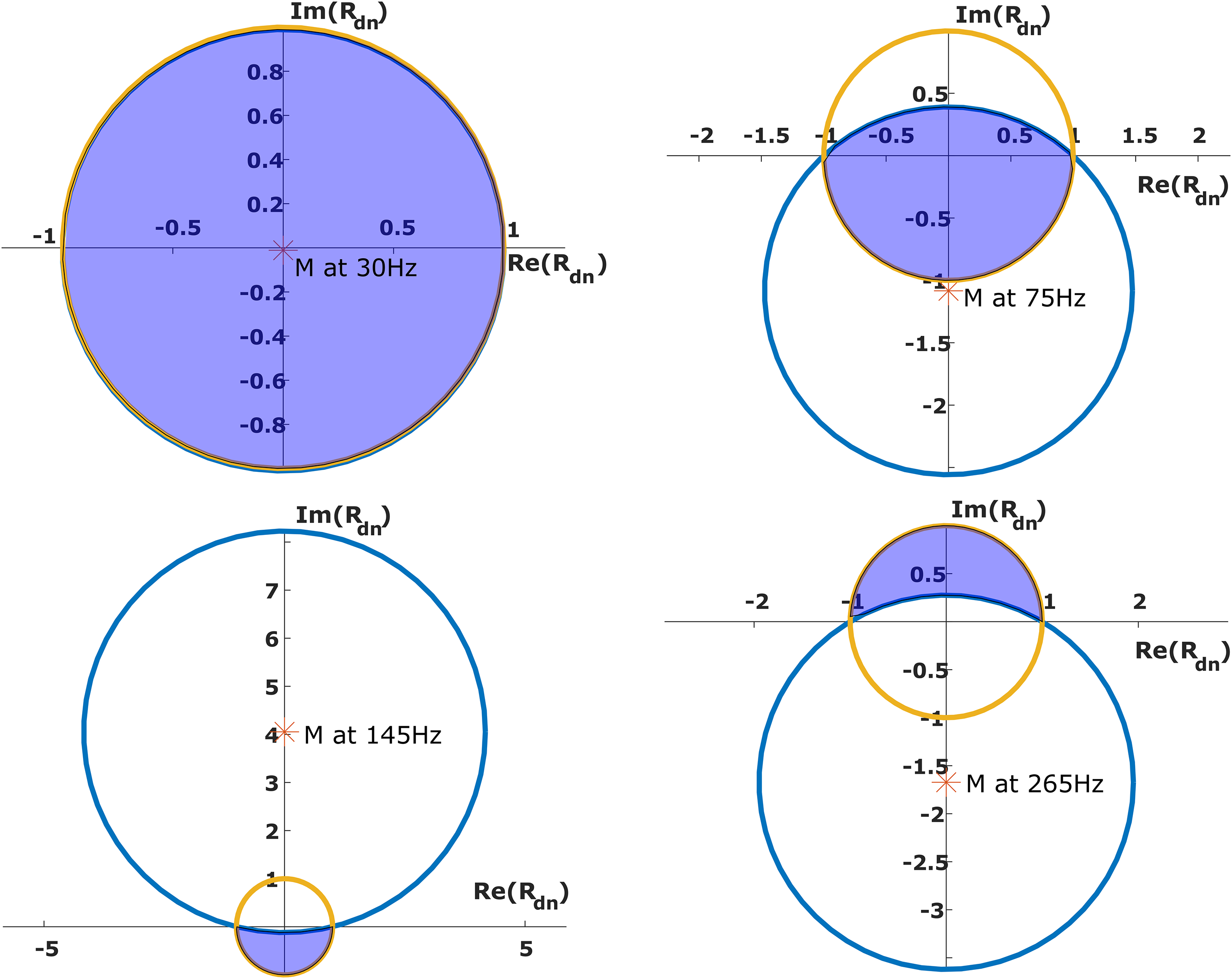
By developing these ideas further, one may suggest that the “volume” of possible
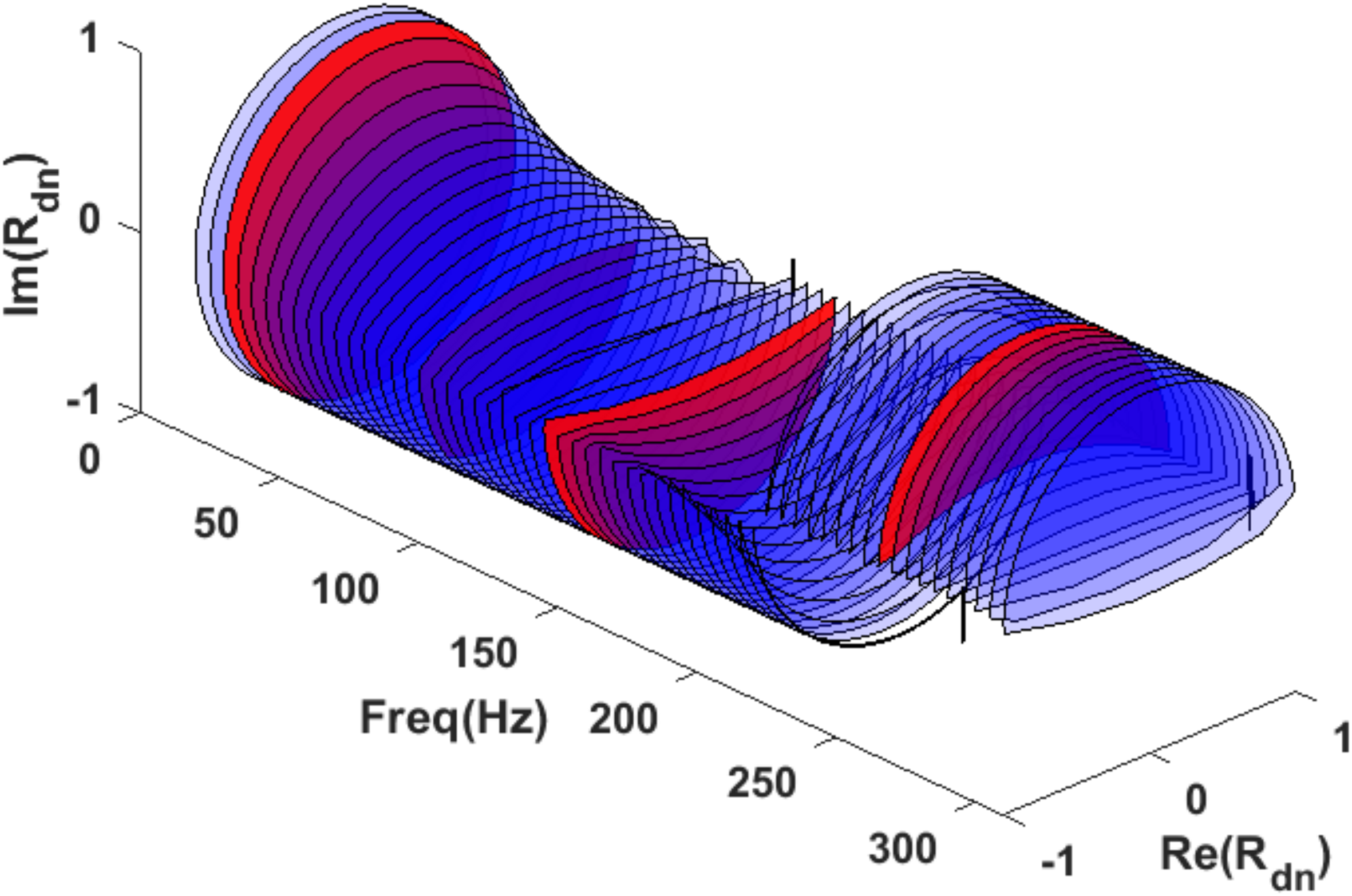
A 3D view of possible
Figure 15 demonstrates a 3D view of the discussed area in a frequency range 15–310 Hz. The four slices (joint areas) for particular frequencies as shown in Figure 14 are also marked in Figure 15 with the red color. If the reflection coefficient of the downstream side of the burner is lying inside this area (looking as a channel), then the system would be at a passive stability condition otherwise, the system will not be passive and the solution of the dilemma of stability-instability is related to the product of upstream and inlet reflection coefficients, i.e.,
Figure 15 could also be a productive tool for further analysis. For instance, one may conclude that at low frequencies, like 15–40 Hz, for almost any downstream termination of the mentioned burner at specified mean velocity and equivalence ratio condition, the system would be passive and, therefore, stable. The frequency ranges around 220Hz look the most problematic to stabilize because for downstream acoustics the range of values of reflection coefficients needed for stabilizing the system is narrow at these frequencies.
Continuing the case study further, by minimizing
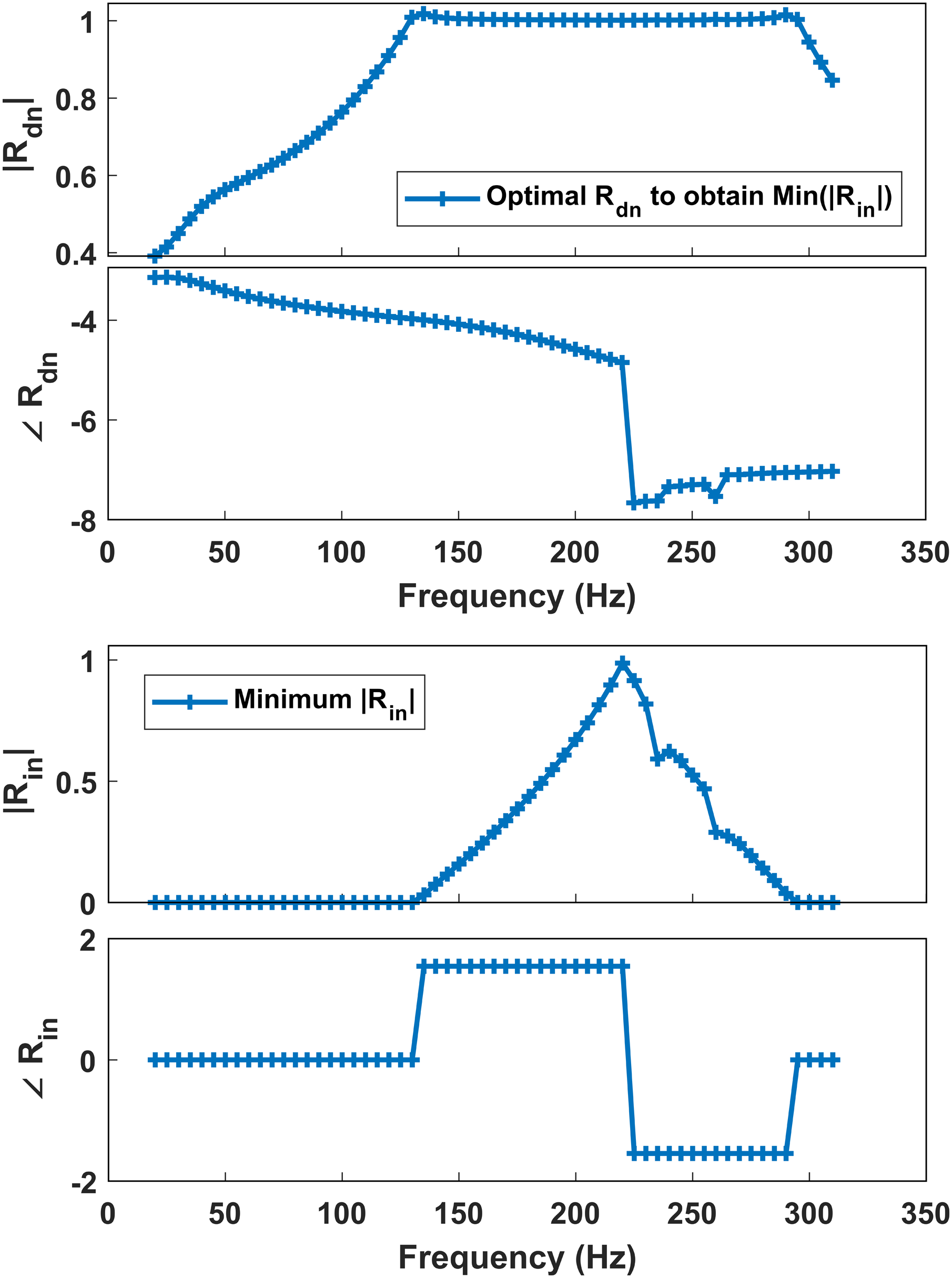
Optimal
These graphs also highlight the conclusion that for the considered burner/flame the frequencies around 220 Hz may require special measures to ensure system stability.
Conclusions
It is demonstrated that the system-level analysis of a network of two-ports is a very fruitful tool to perform investigations of many aspects of combustion acoustic instability phenomena. Particularly, it provides promising approaches to the task of system design aiming stability of appliance operation. Original algebraic proofs of conditional and unconditional stability criteria of linear two-port network systems are proposed. It has been shown that thermo-acoustic systems cannot be unconditionally stable. Hence, the conditional stability criteria have been investigated based on the algebraic technique. Also, a complementary framework of analysis is proposed which is based on the application of known properties of bilinear MT. The comparison of different approaches reveals relations between the results of the algebraic derivations, the geometrical approach applied in microwave theory, and the MT technique. Any of these three approaches can be applied to analyze the stability of the thermo-acoustic system. However, the technique based on the MT would provide more insightful information and a better visual and intuitive interpretation of results than the two other techniques.
The elaborated criteria of system stability can be applied for purposeful design of the upstream and downstream sides of the given burner with flame to provide thermo-acoustic system stability.
Furthermore, the elaborated approaches show principal requirements and propose the receipts how to design the acoustics of upstream and downstream sides of the burner such that the system operation would be stable.
Also, for each frequency, the area of possible
To confirm the validity and usefulness of the proposed ideas related to the combustor design strategies and evaluation of the figure of merit of burners, further theoretical development, and experimental checks are needed. This work is in progress and promises new directions for further research. Particularly, for the experimental verifications of the theoretical results new setup with a wide range of variable reflection coefficients at both up- and downstream terminations is developed. The final goal of future R&D works in this direction would be the elaboration of a convenient designer's toolbox supporting and suggesting design decisions.
Footnotes
Declaration of Conflicting Interests
The author(s) declared no potential conflicts of interest with respect to the research, authorship, and/or publication of this article.
Funding
The author(s) disclosed receipt of the following financial support for the research, authorship, and/or publication of this article: This work was supported by the Nederlandse Organisatie voor Wetenschappelijk Onderzoek, (grant number 16315).
