



Abstract
The Competence Network Inflammatory Bowel Diseases (Kompetenznetz Darmerkrankungen) was established in Germany in 1999 through a 10-year funding programme by the German Ministry of Education and Research. It was created to address the growing gap between the rising prevalence and therapeutic complexity of inflammatory bowel disease (IBD) and the fragmented care structures and isolated academic initiatives of the time. The network’s continuing mission is to improve care for patients with Crohn’s disease and ulcerative colitis by more closely integrating clinical practice, translational science and patient involvement. This review summarises the history, governance, registries, biobanking, clinical trials, educational programmes and collaborations of the Competence Network IBD. Over the past 25 years, the Competence Network IBD has established prospective national registries (e.g. RUN-CD, RUN-UC, VEDO-IBD and FilgoColitis), developed pragmatic real-world cohorts (TARGET and GeCer) and contributed to the UMBRELLA-IBD data warehouse of the Competence Network IBD in Germany. The network played a central role in creating the German IBD DNA collection and supported the Kiel University biobank, both of which link biospecimens with longitudinal clinical data to support genetic and microbiome research. It also conducts and coordinates multicentre clinical trials and has supported the development of the German evidence- and consensus-based IBD guidelines. With more than 800 members from university centres, community practices, nursing and patient organisations, it now provides a robust platform for research and knowledge transfer across all levels of IBD care. The Competence Network IBD demonstrates how long-term interdisciplinary and cross-sectoral collaboration can improve the management of chronic inflammatory diseases. By integrating research infrastructures with education and patient involvement, the network serves as a scalable and sustainable model for national and international collaboration in IBD.
Plain language summary
The Competence Network IBD demonstrates how long-term, interdisciplinary and cross-sectoral collaboration can improve the management of chronic inflammatory diseases. By integrating research infrastructures with education and patient involvement, the network serves as a scalable and sustainable model for national and international collaboration in IBD.

Keywords
Introduction
Inflammatory bowel diseases (IBD) – Crohn’s disease (CD) and ulcerative colitis (UC) – are chronic, relapsing disorders of the gastrointestinal tract with substantial impacts on individuals and society. In Germany, more than 400,000 people are affected, and prevalence continues to rise in line with global trends linked to urbanisation, diet and altered microbial exposures.1–3 The burden extends well beyond intestinal symptoms: many patients experience impaired quality of life, fatigue, extra-intestinal manifestations, reduced work productivity and increased rates of anxiety and depression. Because treatment decisions must integrate endoscopic and imaging findings, biomarkers, comorbidities, patient preferences and long-term safety considerations, effective care requires close coordination across specialities and health care sectors.
In the late 1990s, practice and research related to IBD in Germany were largely fragmented. Academic centres conducted small-scale studies, and most patients were treated in community practices with little connection to these research activities. The lack of harmonised datasets and shared biobanking limited reproducibility and scalability, and access to trials was uneven. In response, the German Federal Ministry of Education and Research (BMBF) introduced a research programme to promote disease-focused Competence Networks and to bridge disciplines and sectors. Founded in 1999, the Competence Network IBD (Kompetenznetz Darmerkrankungen) implemented this model in gastroenterology (Figure 1). It created a national framework linking university hospitals, community gastroenterologists, basic scientists, methodologists, nursing professionals and patient representatives, with the shared aims of coordinated care, improved therapies, standardised data collection and better outcomes.4–6
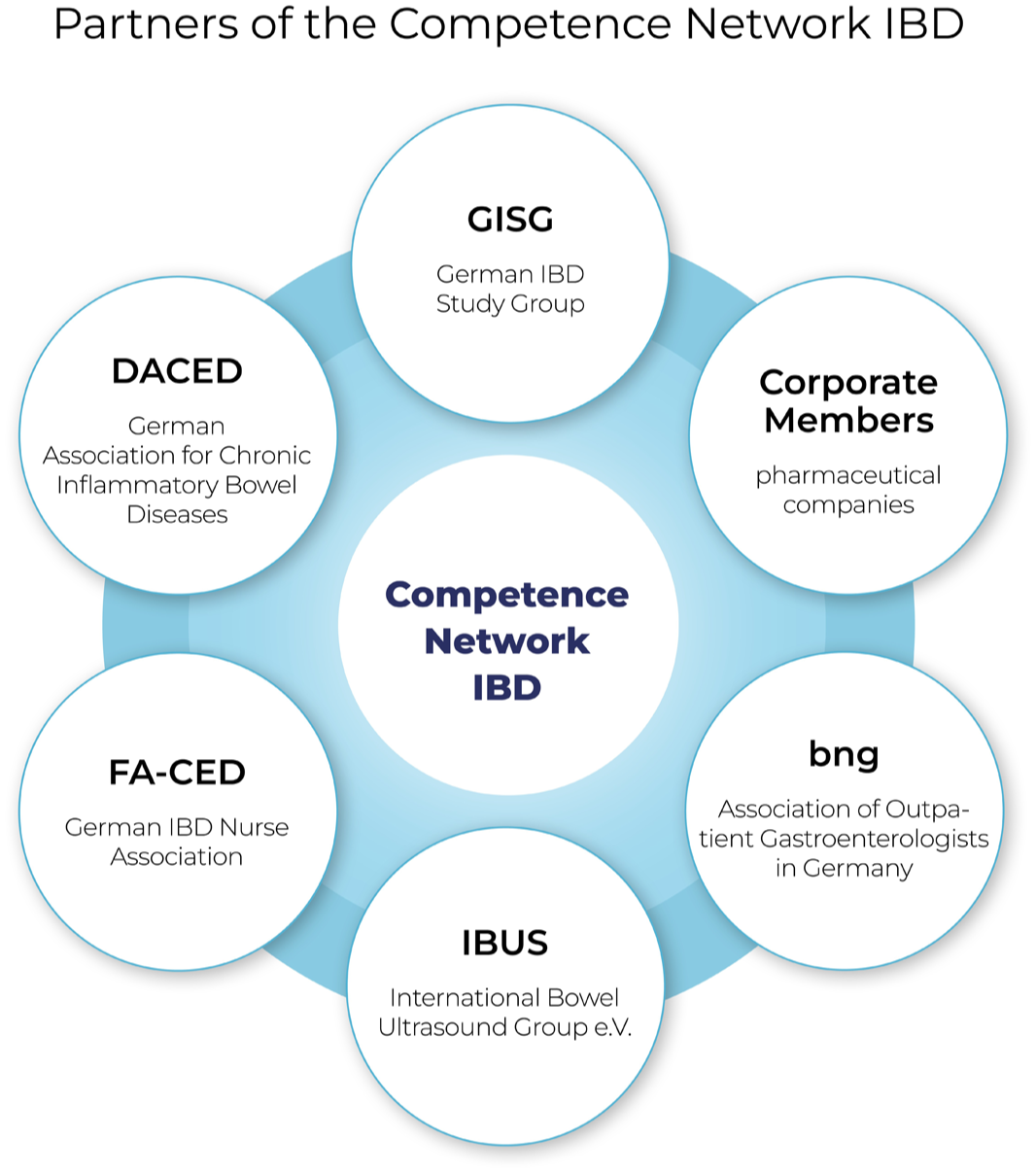
Structure and partners of the competence network IBD.
The concept was simple yet ambitious: shared infrastructures would accelerate research and its translation into practice; prospective registries would generate reliable real-world evidence; and a national biobank would enable large-scale translational studies. By involving patients, the network also sought to align research priorities with patients’ real-life needs and improve the quality of care across regions. Over the past 25 years, this approach has proved successful. The Competence Network IBD has grown into an independent association with more than 800 members. Roughly one-third are from hospitals, and around two-thirds are from outpatient gastroenterology practices. This mix creates different expectations and interests within the Competence Network IBD. Clinics and some highly specialised IBD practices primarily focus on scientific activities, including the implementation of registries and studies. In contrast, gastroenterologists in private practice primarily expect IBD training and qualifications for IBD specialist assistants, as well as knowledge transfer from universities and opportunities to participate in non-interventional studies as study centres. The Competence Network aims to serve these different areas of interest. It has established national registries and pragmatic cohorts, contributed to evidence-based clinical practice guidelines and consolidated these activities into the UMBRELLA-IBD data warehouse, a comprehensive resource for real-world IBD research in Germany and beyond.4,7
Historical background and founding of the competence network IBD
The competence network IBD grew out of discussions among clinicians and scientists who recognised the need for improved collaboration in IBD management and research. From its inception, the network has been committed to intersectoral inclusion: university hospitals and tertiary centres work alongside the community-based gastroenterology practices that care for most IBD patients. Basic science groups are integrated with clinical cohorts, creating a bridge between laboratory research and patient-oriented studies. Patient associations, particularly the German Crohn’s and Colitis Association (Deutsche Morbus Crohn/Colitis ulcerosa Vereinigung, DCCV), are actively involved to ensure that research priorities reflect patient needs.1,4
The network was formally established in 1999 through the funding programme of the BMBF, which provided financial support over three consecutive funding periods spanning 11 years, until 2010. Since then, the Competence Network IBD has continued as a fully self-financed, independent association (Figure 2).
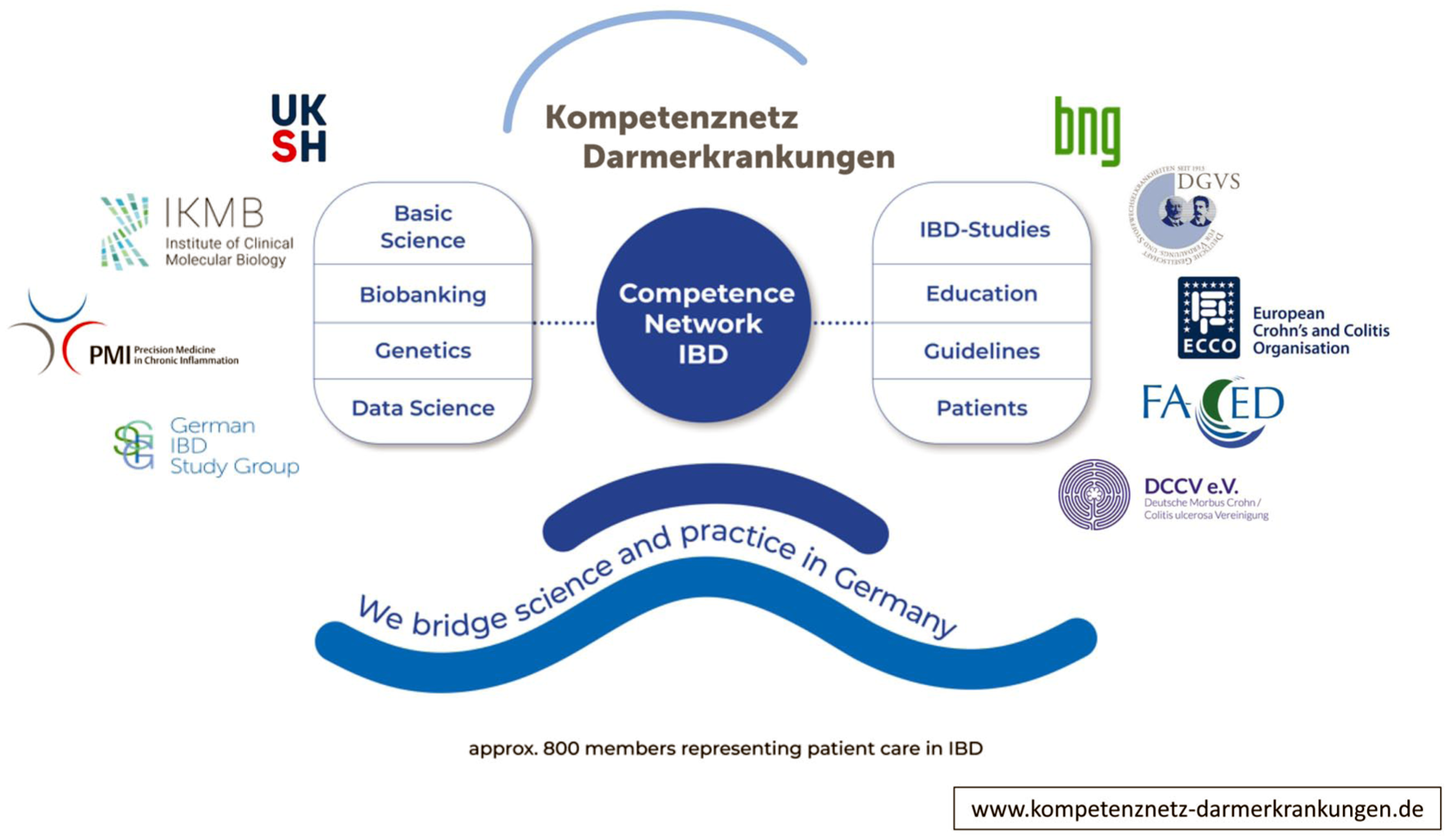
Competence network IBD at a glance.
During the funding phase, BMBF support enabled the rapid development of core infrastructures. Electronic data capture platforms were introduced, and standardised case report forms were agreed to enable harmonised, prospective registries. Diagnostic and therapeutic pathways were harmonised across centres, while a central coordination office in Kiel provided governance and quality oversight. A national biobank was also created to collect blood, serum, stool and tissue samples linked to clinical phenotypes. Governance structures included patient representation, data protection expertise and transparent conflict-of-interest policies, supporting a balance between academic independence and the need for external partnerships.
By the mid-2000s, the network had evolved from a project into a national platform. Symposia and working groups were held several times a year, creating communities of practice and facilitating exchange across specialities, including therapy, endoscopy, imaging, intestinal ultrasound, surgery, paediatrics, nursing and methodology. When the initial federal funding ended, the network reorganised as an independent non-profit association, sustained by membership fees, competitive grants and carefully structured collaborations with industry. The transition from a grant-funded project to a durable institution proved decisive for the longevity of the network.1,4
To secure long-term financial stability, the Competence Network IBD established the fully owned service company, CED Service GmbH, in 2008. It employs around 30 staff and supports the network’s broad range of activities. These include supporting education and training, as well as coordinating clinical studies. Each year, the network hosts around 60 regional and national training events and programmes for physicians, medical assistants and nurses. In addition, it convenes the annual IBD D-A-CH meeting, bringing together gastroenterologists from Germany, Austria and Switzerland.
Over the past 25 years, the Competence Network IBD has also organised 62 studies involving more than 9000 patients across 130 study centres, primarily in Germany. In 2009, the German IBD Study Group was established within the network to conduct smaller, non-industry-funded studies and to organise the annual DACED meeting for young scientists in the IBD field. Since 2018, the network has also participated in international studies. In this context, it has taken responsibility for ethics submissions and monitoring in Austria and Switzerland, as well as for the USE-IT project, an international collaboration with the International Bowel Ultrasound Group (IBUS) involving study centres in Australia, Canada, Denmark, Germany, Israel and the United States. All non-interventional studies were approved by the Ethics Committee of the Faculty of Medicine at Kiel University in Germany. Since 2022, phase II–IV studies have been approved by the relevant ethics committees in the participating countries, with submissions and authorisations processed via the EU Clinical Trials Information System. For some studies, the storage and analysis of biomaterials were carried out in close cooperation with the central biobank PopGen at Kiel University Hospital, in accordance with the General Data Protection Regulation.
Prospective real-world studies and clinical trials
Building on its registries and network of study sites, the Competence Network IBD became a reliable platform for multicentre clinical trials. Investigator-initiated studies have evaluated immunomodulators and biologics in different disease phenotypes and treatment lines. Participation in pivotal international trials has expanded access to innovations for patients in Germany, while pragmatic trial designs embedded in routine care have improved external validity. In parallel, comparative real-world work studies have assessed the effectiveness of different biologics in everyday practice, providing evidence on differential effectiveness and safety across patient subgroups and prior treatment exposures.
Study participants are informed, educated and recruited at specially established study centres. To facilitate participation, the Competence Network IBD uses the digital platform of the German patient self-help association (DCCV), where studies are presented, evaluated and recommended for participation when appropriate. Study invitations are also published in the DCCV member newsletter and disseminated via the Professional Association of Outpatient Gastroenterologists in Germany (bng), which regularly circulates information on Competence Network IBD studies through its collaboration with the network. Patients are also invited to participate in studies via social media. In addition, information materials are provided directly to the referring physicians in outpatient practice, who are asked to refer suitable patients to the study centres when appropriate.
Quality assurance has been a defining feature of all of these studies. Robust monitoring strategies (on-site, remote and risk-based), digital data capture platforms, and harmonised documentation protocols have been implemented to ensure methodological rigour. Over the past 25 years, the Competence Network IBD has contributed to the publication of 162 original papers and congress abstracts (Figure 3).

Cumulative number of publications (original articles and congress abstracts) based on competence network IBD studies over 25 years.
Prospective real-world studies
Major multicentre, real-world registries, including BioCrohn, BioColitis, RUN-CD, RUN-UC, VEDO-IBD, GeCer and TARGET,8–13 have generated valuable evidence on day-to-day clinical practice. Together, these registries have paved the way for the creation of the UMBRELLA-IBD data warehouse, which consolidates prospective, anonymised data from all the network’s major registry initiatives (Table 1).
Prospective competence network IBD studies and UMBRELLA-IBD database (status 08/2025).
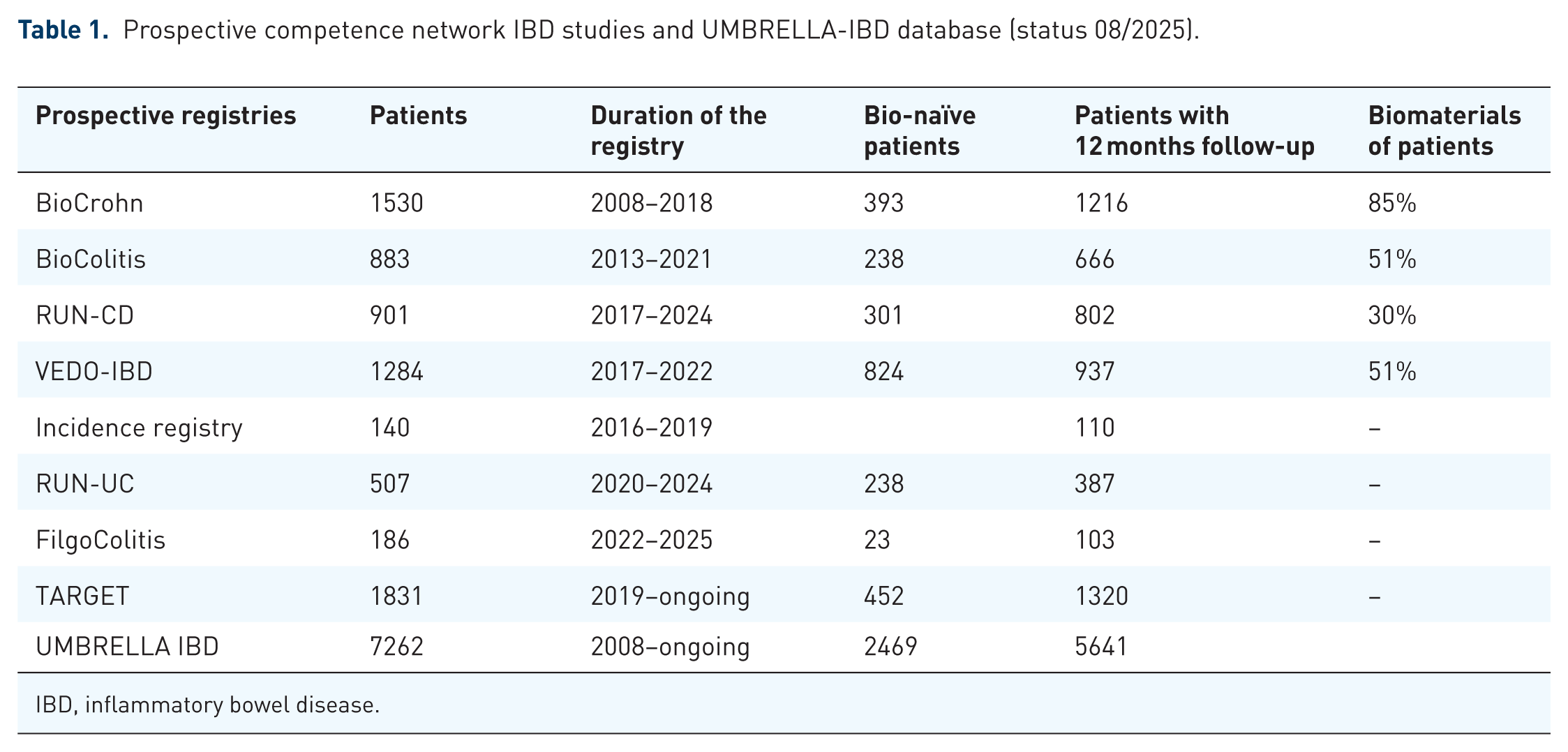
IBD, inflammatory bowel disease.
The registries of the Competence Network IBD are characterised by exclusively prospective data collection, with all data gathered according to clearly defined study protocols, underlining the quality and relevance of the resulting evidence. A 2020 analysis showed that, in terms of patient numbers, the network’s registries ranked fifth among national IBD databases in Europe. 14 However, many of the other databases included in that comparison primarily collect data as part of routine check-ups, with subsequent analyses thus relying largely on retrospective data not gathered under a dedicated study protocol. This distinction helps explain why case numbers differ between European databases and underscores the particular relevance of the Competence Network IBD registries.
Interventional clinical trials
The Competence Network IBD conducted the IBD Bio-Assist study from 2019 to 2023, a publicly funded, randomised German Innovation Fund study with more than 1000 participants; the study assessed whether additional care provided by an IBD nurse specialist improves patient outcomes. 15 The study assesses whether additional care provided by an IBD nurse specialist improves patient outcomes. The network is also acting as a contract research organisation in two further randomised trials currently underway: ORNATUS and MIRACLE. In these phase II–IV interventional studies, the network has set up a central reading system for intestinal ultrasound, endoscopy and histopathology to address the variability in interpretation between study centres.
Statistics department – digital innovations
The establishment of a dedicated statistics department has strengthened these efforts by enabling a wide range of analyses, from comparative effectiveness to safety surveillance. It also supports the development of predictive models and personalised therapeutic approaches. The longitudinal design of the registries allows analyses of disease trajectories and treatment sequences that reflect real-world practice.
Digital innovation in the network is exemplified by the MyTARGET smartphone app, which facilitates the collection of patient-reported outcomes in a way that is intuitive for patients and practical for clinicians. Tools such as this are now used in multiple studies and contribute to data security, convenience and the level of detail needed for modern clinical and health services research.
In parallel, the network has embraced big data approaches and artificial intelligence, working with bioinformatics groups and international consortia to integrate clinical, molecular and health services data. Machine learning is applied to model disease trajectories, predict outcomes and identify novel biomarkers, especially through multi-omics integration.
Biobanking and translational research
The Competence Network supported the development of one of Germany’s first nationwide gastroenterology biobanks, at Kiel University. Biospecimens, including blood, serum, stool and intestinal biopsies, are collected under standardised protocols and linked to detailed clinical metadata from the Competence Network IBD registries and other clinical studies. This integrated resource has enabled large-scale translational research in clinical context, which is an essential step toward precision medicine within the Excellence Cluster at Kiel University.
Stool and mucosal samples have supported microbiome studies that link microbial composition and function to disease activity, treatment response and postoperative recurrence. Translational projects have also explored biomarkers predicting response to anti-TNF agents and integrin antagonists, markers of mucosal healing and pharmacogenetic modifiers of drug metabolism. The link between bench and bedside has been strengthened by the creation and refinement of candidate biomarkers, which are coupled with longitudinal outcomes.
Seminal genetic studies have drawn extensively on these resources. Early work demonstrated the role of NOD2 variants in susceptibility to CD, defining key pathways in innate immunity and host–microbe interactions. Subsequent genome-wide studies expanded the catalogue of risk loci, emphasising the polygenic nature of IBD and pointing to central mechanisms involving epithelial barrier function and microbial sensing. In this context, collaborating with the International Inflammatory Bowel Disease Genetics Consortium was a significant scientific achievement. 16
Education and knowledge transfer
Chronic IBD present ongoing challenges in diagnosis, treatment and long-term management. At the same time, research and clinical practice in this field are evolving rapidly. To support high-quality care, the Competence Network IBD offers a comprehensive programme of continuing education based on the latest scientific research and designed to foster professional exchange.
Education and knowledge transfer have been core elements of the network’s mission from the outset. Annual scientific meetings and hands-on workshops bring together clinicians, researchers, nurses and patient advocates to share expertise (Figure 4). Regular series such as CED compact provide valuable updates and practical recommendations, and CED Regional fosters local dialogue. The CO|OPERATION series combines webinars and in-person events to promote interdisciplinary discussion. Major annual conferences, including DACED, Gastro – UP TO DATE and IBD D-A-CH, cover topics ranging from novel therapies to cross-border approaches to patient care.

Education and knowledge transfer architecture.
IBDD-A-CH is particularly noteworthy. Over the past 15 years, a robust network of IBD specialists in German-speaking countries (Germany, Austria and Switzerland) has been established. This network focuses on cross-sectional, translational and clinical studies that are particularly relevant to this geographic region. Recognising the central role of specialised nursing, the network also pioneered curricula for IBD nurse specialists. These three courses emphasise patient education, safety monitoring and the coordination of complex therapies. The IBD Nurse Specialist Basic Course introduces fundamental concepts, and the IBD Nurse Specialist Advanced Course addresses nutrition, physical activity and communication. Since 2008, approximately 2400 nurses and 1100 advanced assistants have been certified. The annual Comprehensive IBD Care Assistant Course is an intensive, extended programme combining theory, e-learning and practical modules, and represents the most advanced level of IBD nurse training accredited by the German Medical Association.
Another educational project involves training in intestinal bowel ultrasound. The educational programme started nationally and achieved international success through the newly established IBUS Group. It has now evolved into an independent international consortium for ultrasound education and a study platform for ultrasound research, supported by the Competence Network IBD.
Patient involvement and societal impact
A distinctive strength of the Competence Network IBD is the formal integration of patient perspectives. Representatives take part in governance bodies and study groups, co-design questionnaires and review educational materials. Embedding patient-reported outcomes and quality-of-life measures in registries has ensured that patient priorities become visible and actionable. Surveys have identified unmet needs, such as mental health support, nutritional counselling and smoother transitions from paediatric to adult services, which have later informed guideline recommendations and service redesign.
This participatory model has deepened trust and improved recruitment and retention in registries and clinical studies. More importantly, it has also changed the research questions being asked, with issues such as fatigue, pain and work participation moving from the periphery to the centre of inquiry. By treating patients as partners rather than subjects, the network has helped reframe IBD care around the outcomes that matter most to those living with the disease.
Challenges and lessons learnt
The Competence Network IBD has a heterogeneous composition, which naturally leads to differing expectations of the network’s role. One-third of its members come from the clinical and academic sectors, whereas the remaining two-thirds come from gastroenterology practices. While university clinics and some specialised IBD practices prioritise scientific structures for study implementation, gastroenterology practices focus more on IBD training and knowledge transfer. Both areas have been further developed and strengthened successfully in recent years, and the resulting cooperation has supported strong recruitment, particularly from gastroenterology practices. This has been achieved through a special sense of shared identity.
Long-term collaboration between sectors inevitably brings challenges. After initial BMBF funding ended, the Competence Network IBD had to establish a durable financial base. Diversifying income through not-for-profit activities and membership fees, national grants and carefully structured collaborations with industry partners proved essential. Independence was safeguarded by transparent conflict of interest policies and governance structures that clearly separated scientific decisions from financial considerations.
Quality management is another ongoing challenge. With many centres contributing data and biospecimens, variation in documentation and sample handling must be minimised. The network addresses this through standard operating procedures, regular audits, feedback mechanisms and continuous training. Digitalisation has improved the timeliness and completeness of data but also requires ongoing investment in IT security and data protection.
The IBD Competence Network demonstrates how long-term interdisciplinary and cross-sector collaboration can improve the treatment of chronic IBD. By integrating research infrastructures with training and patient participation, the network serves as a scalable, sustainable model for national and international collaboration in IBD. However, challenges may arise when transferring this model to other health care contexts, particularly regarding the availability of new therapeutic options, existing IBD-specialised care structures and the refinancing of such networks with funds outside regular health insurance, especially in low- and middle-income countries. Nevertheless, these problems may be addressed, at least partially, by establishing such structures gradually, as has been done over many years with the IBD Competence Network in Germany, and by adapting the model to local conditions.
Future perspectives
The next decade of the Competence Network IBD will likely be shaped by three priorities.
First, digital transformation will further integrate research and care. Mobile applications, electronic patient-reported outcomes and remote monitoring can help detect flare-ups earlier and support treat-to-target strategies. Artificial intelligence applied to endoscopy, imaging and histopathology promises greater precision and reproducibility. Linking these tools to registry platforms may make clinical trials more efficient and routine care more responsive.
Second, precision medicine is expected to move from aspiration to implementation. By linking longitudinal clinical data with multi-omic profiles, including genomics, transcriptomics, proteomics, metabolomics and the microbiome, the network aims to build predictive models of therapy response and disease course. Such models could reduce trial-and-error prescribing, shorten time to remission and personalise surveillance. Their success, however, will depend on rigorous external validation and attention to equity of access.
Third, the globalisation of IBD research will expand. Participation in international consortia, harmonisation of data standards and federated analytics will allow secure cross-border learning without compromising privacy. Alongside therapeutic innovation, there will be increasing emphasis on prevention and early intervention, including delaying disease onset in at-risk populations and reducing postoperative recurrence.
In summary, the next chapter of the Competence Network IBD will be written at the intersection of science, technology and the lived experience of patients – the same vision that inspired its creation 25 years ago.
Conclusion
The Competence Network IBD demonstrates how long-term interdisciplinary and cross-sectoral collaboration can improve the management of chronic inflammatory diseases. By integrating research infrastructures with education, training and patient involvement, the network serves as a scalable and sustainable model for national and international collaboration in IBD.
