




Abstract
Through different “eras of play,” association footballers have headed different types of footballs, in dry and wet conditions. With concern surrounding neurodegenerative disease development in footballers, much consideration is being given to heading impact severity, where inbound ball velocity is a key determinant. It is commonly hypothesised that modern ball types arrive at the head with significantly faster inbound velocities than historic counterparts. This study modelled a corner kick trajectory, which commonly precedes a header, using three different ball types, in both dry and wet conditions. Ball aerodynamic coefficients were attained through wind tunnel experimentation and were used to generate representative flight paths through a computational flight model with backspin, to determine the finite range of combinations of launch speeds, elevation angles, and spin rates for a given ball that resulted in corner kick trajectories that passed above the penalty spot, at a reasonable range of heights for heading interception. This study concluded that, between each ball type and condition, the inbound ball velocity was very similar. Launch conditions achieved by players had a greater influence on inbound velocity than the differences between ball type or wet conditions.
Introduction
In Association Football, players legally and intentionally use their head to propel or control the football for competitive advantages; a skill known as heading. The ball is governed by the International Football Association Board (IFAB) Law II. This law specifies ball shape, circumference, inflation pressure, and mass at the start of play. 1 Whilst minor modifications have been made to the original law, the major features such as circumference and mass have remained unchanged since 1937. 2 Nevertheless, ball manufacturers have evolved all aspects of material specification, construction, and manufacture through this period,3–5 such that players from different eras are known to have headed different ball types during matches and training. Over the last century, footballs have evolved from laced, uncoated hand-stitched full grain cowhide leather products,6–8 to multi-layer multi-material stitchless synthetic structures. 9 Traditional balls were notoriously hydrophilic,10–12 but developments towards laceless, coated constructions sought to reduce water uptake as early as the 1950s.10,13 Modern manufacturing techniques, including thermal bonding and fuse welding, have been developed and produced balls that almost entirely prevent water uptake. Since 1996, mass increase from water uptake in elite footballs has been limited by criteria within the FIFA Quality Programme.14,15
Retrospective cohort epidemiological studies examining former male professional football players in Scotland, Sweden, and France established an increased neurodegenerative disease mortality risk for this population, compared to matched control or general populations.16–19 It has been postulated that repetitive heading of the football through a footballers’ career may induce or exacerbate these outcomes. 20 Consequently, the impact severity of heading is commonly studied. The relative impact severity and disease risk between current, recently retired, and historic playing populations remains unknown, but this topic is of priority to inform potential treatment and governance interventions. This priority has been recognised within “English Football’s Joint Action Plan on Brain Health.” 21 The ball type used is a clear distinction between current and older footballing cohorts. There has been considerable speculation and anecdotal discussion regarding how impact severity may have varied through history with different ball types. 11
A series of studies12,22–30 have investigated macromechanical kinematic-based impact severity with respect to a variety of ball properties including ball type, mass, diameter, and inflation pressure. Each concluded that inbound velocity was the strongest predictor of collision duress, however other properties such as mass can also significantly contribute. Velocity governs both momentum and kinetic energy transfer, such that greater velocities deliver larger peak forces. Consequently, the inbound trajectory velocity immediately prior to heading plays an important role in determining the mechanical duress experienced during head impacts. Aerodynamic literature details how the final velocity of a ball trajectory can be a function of its launch conditions, environment, and in-flight aerodynamic behaviour.31–34 Whether such characteristics have differed between ball types through history, remains unexplored.
It has been widely hypothesised that due to the hydrophilicity of leather ball types, where mass increases due to water uptake, 35 the headed ball velocity of modern balls may exceed that of their historical counterparts. 36 This study sought to investigate this hypothesis using a set piece scenario, a corner kick, known to have been consistent through history. Whilst discussion on ball velocities often refers to maximal kicks, most repetitive headers arise from alternative game scenarios. Premier League data (2020/2021 season) validated corner kicks as an extremely common preceding scenario to headers and generated the greatest mean impact force of any measured scenario. 37 Specifically, this study considered a corner kick passing directly over the penalty spot at a height suitable for head interception (1.8–2.5 m). A finite range of possible launch speeds, elevation angles, and spin rates for each given ball in a dry or wet condition result in the ball passing through this region. From these kicks, an effective direct comparison could be made between the possible trajectories of modern and historic balls, in dry and wet conditions. Specifically, this study sought to address the following research questions:
Methodology
Ball specifications
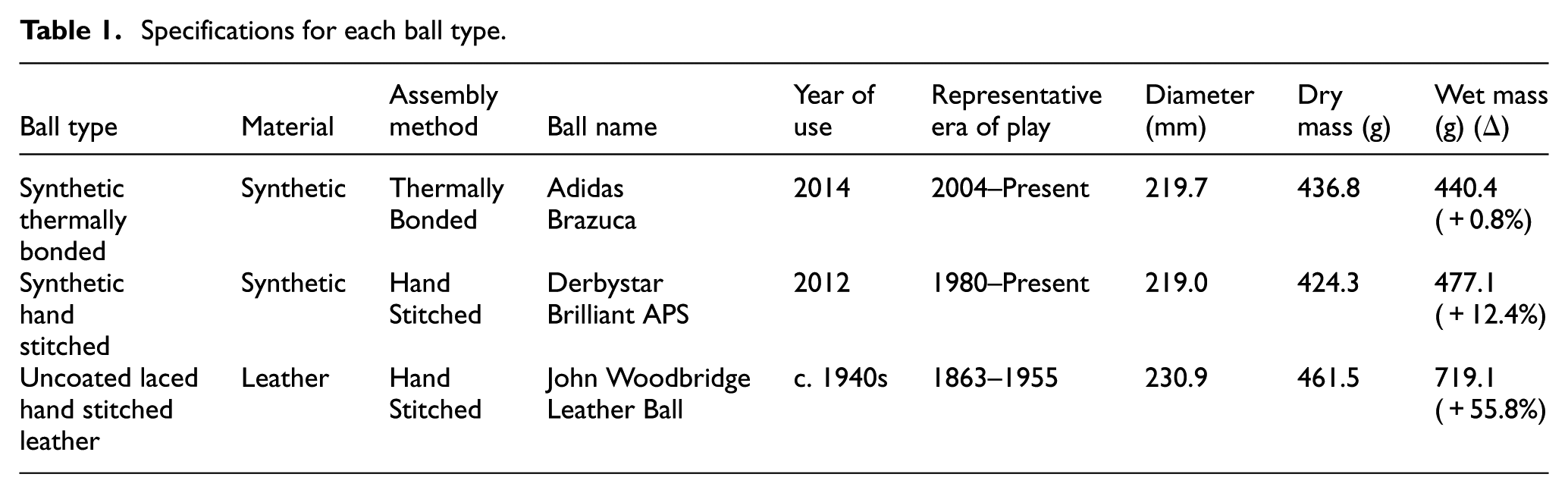
Three football types were selected to represent the most notably different elite match ball types through history – synthetic thermally bonded, synthetic hand stitched and laced uncoated hand stitched leather (Table 1). Each ball was in new or pristine condition. Old leather balls suffer from material degradation such that they would not accurately represent properties and characteristics from their representative “era of play.” Therefore, the leather ball chosen was a modern handmade ball and the best representation of those used historically. The specific model included representative shell construction and materials, including hand-stitching, laces, full-grain vegetable tanned leather, of an appropriate thickness, and did not include anachronistic shell materials. Ball diameter was reported as the mean of three orthogonal diameter measurements, at 1.0 bar inflation pressure, using an ATOS Core Optical 3D scanner (ATOS, Bezons, France). Diameter was assumed constant between dry and wet conditions. Mass measurements were taken in accordance with FIFA Quality Programme Test 05, using an EB Series Compact electronic scale (Ohaus, NJ, USA). Separate dry and wet measurements were taken for each ball. Wet conditions were achieved by full static submersion of balls, at 1.0 bar inflation, in a water bath (water temperature = 16°C), for 90 minutes to represent an extreme water uptake scenario, 35 permitting the broadest range of flight parameter modelling. Following removal from the water, wet balls were rested on a non-towelling surface (air conditions 21°C, 31% humidity) for 30 seconds prior to weight measurement to eliminate surface water not representative of ball mass.
Specifications for each ball type.
Aerodynamic measurements
Aerodynamic magnus force and drag coefficient profiles with Reynolds number and spin rate (0–500 rpm), for each ball in dry conditions, were derived from experimentally obtained data from the Loughborough University large wind tunnel, using methodology defined by Passmore et al.
38
Coefficients were derived by application of equations (1)–(3), where aerodynamic quantities were sensitive to ball diameter and standardised atmospheric conditions (



Where:
Flight model methodology
The scenario modelled was a corner kick towards the penalty spot (Figure 1). Based on a mean of permissible pitch dimensions (pitch width = 45–90 m; distance from goal line to penalty spot = 11 m), as defined within IFAB Law I, the kick modelled was of 35.5 m (
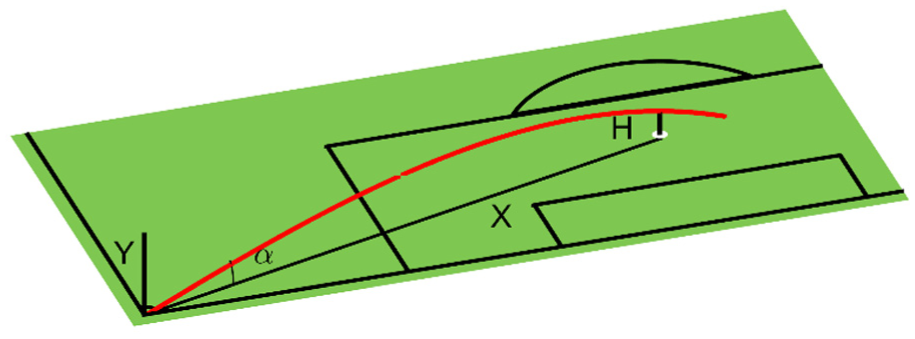
Global pitch axis convention.
These conditions were inputted to a finite difference flight trajectory model, written in MATLAB (version R2023b, MathWorks, MA, USA). At each finite increment time step of 1 ms, drag and lift forces acting on the ball were determined based on instantaneous Reynolds number and spin rate (ω). The drag force opposed the direction of travel, and the Magnus was derived using unit vectors; one for drag along the velocity vector of the ball, and the second derived using the cross product between the velocity vector and spin axis of the ball. The force applied along the two vectors were calculated using equations (4) and (5), with the resultant acceleration to be applied in each of the 2D global directions calculated in equations (6) and (7).




Where: F
d
and F
m
are the drag and induced Magnus force,
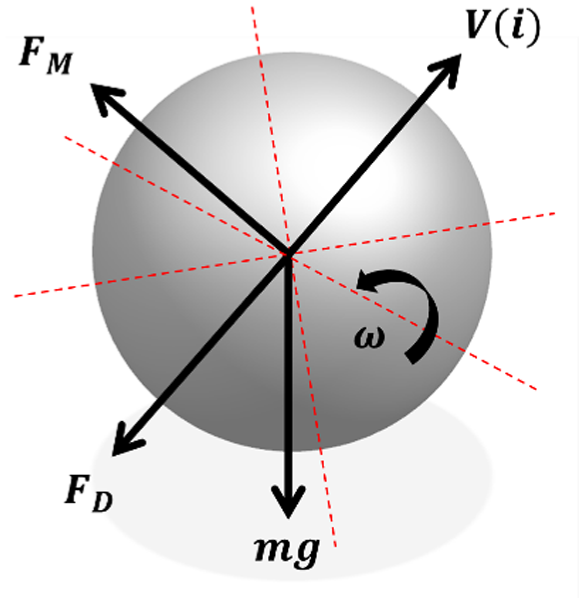
Forces acting on ball.
At every timestep, these forces were applied to the respective ball mass to calculate accelerations in the X and Y directions which were integrated across the time step to determine the new velocity vector and position (equations (8)–(10)). From these vectors and positions, aerodynamic coefficients and forces acting on the ball were recalculated for the next timestep, and this sequence repeated until the ball passed above the penalty spot or hit the ground. Successful flights were those whose positional height at the penalty spot lay within the header interception range (H min < Y < H max ). Unsuccessful flights were discarded, leaving a finite range of velocities, launch angles, and spin rates that generated successful flights. The velocity of the ball at the point of it passing the penalty spot was recorded.



where dt is the time step and subscripts i and i + 1 denote current and subsequent time steps, respectively. The same was calculated for the y direction, and α calculated from the resulting velocity vector.
Analysis
Statistical analysis of outcomes was also conducted in MATLAB, with statistical significance between balls and conditions tested through independent samples t-tests, conducted at the 95% significance level.
Results
Launch parameters for successful kicks
The range of successful flights, for each ball, in dry and wet conditions, were determined for every combination of launch velocity, launch angle, and spin rate (Figure 3). Successful flights were reported within the colourmap domain, which defined a series of launch condition combinations where corner kick trajectories achieved the target heading interception height. Regions not represented within this domain represented unsuccessful flights. Launch conditions with lower speeds and shallower angles produced trajectories that fell short of the penalty spot or below the desired interception height. Conversely, combinations of higher speeds and steeper angles resulted in the ball overshooting the interception height. In principle, these distributions continued at higher speeds, angles, and spin rates, however, those combinations were not considered realistic within human kicking capabilities.
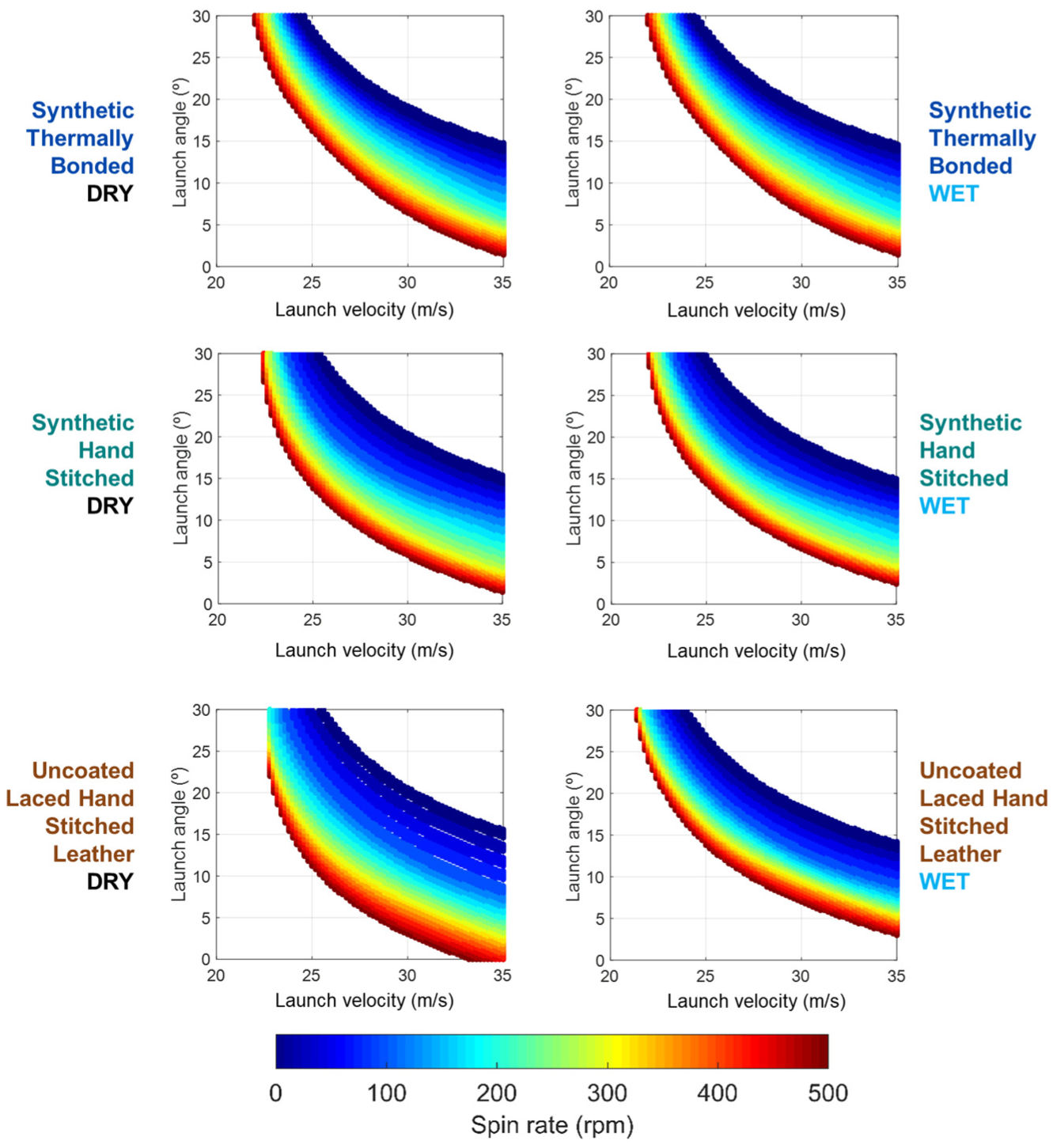
Range of corner kick launch parameters resulting in successful flights for heading at penalty spot. Each row represents a different ball type. The left column represents dry conditions, and right column wet conditions.
To achieve a successful corner kick trajectory, the required launch velocity was always greater than 21 m/s. For a given launch velocity, increasing spin rate decreased the required launch angle. For a given launch angle, increasing spin rate decreased the required kick speed. The range of conditions constituting successful kicks was comparable between ball types, but tended to be broader in dry conditions than in wet conditions. At low spin rates, trends between balls and conditions were similar, however at higher spin rates, conditions with lower launch angles and velocities became successful in dry conditions.
Inbound velocity
The inbound velocity at the heading interception height was determined for every combination of launch velocity, angle, and spin rate that resulted in a successful kick. Across the range of possible successful flights, header inbound velocity varied between 12.69 and 26.24 m/s, a 69.6% difference, as shown in Figure 4. For any given launch angle and launch velocity combination that was common between ball types and conditions, the wet leather ball delivered the greatest inbound velocity. For example, for a launch velocity of 28 m/s, and angle of 15°, the range in inbound velocity between all balls was just 2 m/s (10%). The variance in inbound velocity achievable through modification of launch conditions far exceeded the differences between balls. Nevertheless, when comparing between each ball type, in dry and wet conditions (15 pairwise comparisons), statistically significant differences were found in each case (where p < 0.001), except for the synthetic thermally bonded ball, between dry and wet conditions (p = 0.163). Whilst this significant difference between mean dry and wet velocity was just 0.83 m/s (4.5%) for the synthetic hand stitched ball, this increased to 3.1 m/s (16.3%) for the leather ball. The maximum achievable inbound velocity varied by 3.72 m/s (15.3%), where, again, the greatest difference was between dry and wet leather ball conditions. The minimum achievable inbound velocity ranged from 12.70 m/s (dry leather ball) to 14.88 m/s (wet synthetic thermally bonded ball), a 15.8% difference. These differences highlighted the way a player chooses to launch a corner kick is far more consequential to the headed ball velocity than the differences between ball type and condition.
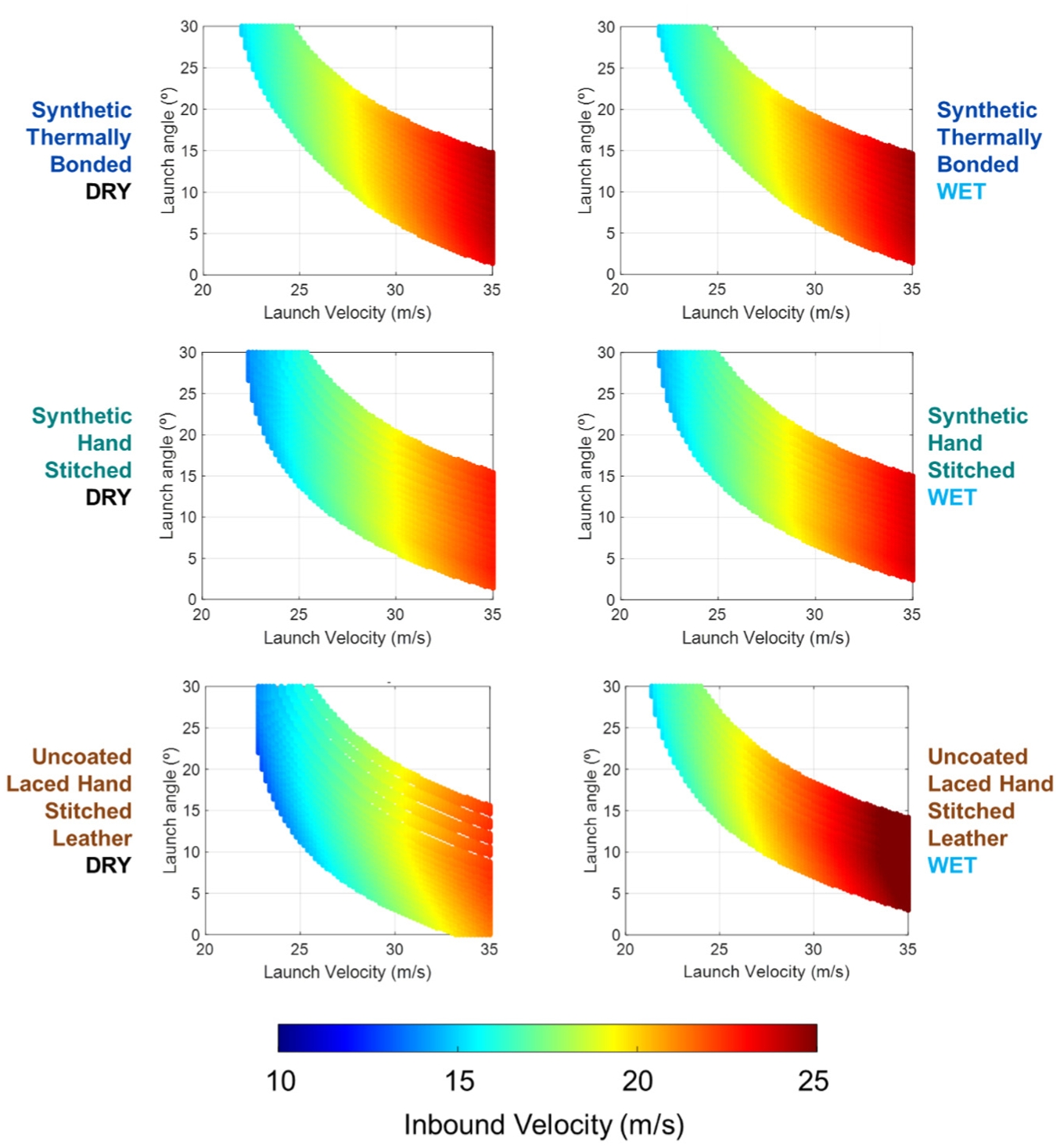
Inbound velocity for successful flights, for each ball and condition, with respect to launch angle and launch velocity. Each row represents a different ball type. The left column represents dry conditions, and right column wet conditions.
Discussion
The aim of this paper was to explore the hypothesis that modern balls arrive with higher velocity at the point of heading than balls used historically. A corner kick, a scenario common to all “eras” of football, was modelled. Combinations of launch speed, launch angle, and ball spin that resulted in a successful kick, passing between 1.8 and 2.5 m, were determined. Due to the possible variation in individual player technique and strategy changes through history, and physical player capabilities, determining a “like for like” kick is not without challenge. Hence, comparing the range of possible conditions was considered appropriate.
Subtle differences between successful kick launch condition combinations were observed between ball types and conditions. A narrower range of launch conditions for successful kicks were observed in wet conditions, with the magnitude of difference correlating to the magnitude of mass change. For projectiles with greater mass, the effect of aerodynamic lift was reduced. Therefore, for a given launch velocity at low spin rates, slightly larger launch angles were required. Further, at higher spin rates, the effect of aerodynamic lift was increased, resulting in successful kicks at lower launch angles. Despite significant attempts by manufacturers to optimise the aerodynamic performance of footballs,41,42 any differences between balls had negligible effects on heading arrival velocities.
This study started with the hypothesis that from a common corner kick scenario, modern footballs would arrive at the head with significantly faster inbound velocities. Whilst the modern synthetic thermally bonded ball did arrive with marginally faster inbound velocities than the dry leather ball, the opposite was true when considering the wet leather ball. The findings revealed that to achieve a successful outcome from a corner kick, extremely similar inbound velocities were achieved, for a range of balls through history, in dry and wet conditions. Therefore, this study disproved the hypothesis.
A fundamental difference exists between the maximal achievable velocity of the ball-human interaction during kicking, and what is actually observed within the game. Considering data detailing the most common preceding events for heading, 37 maximal velocity kicks only represent a small subset of heading exposure. Given concern surrounding the repetitive nature of heading, scenarios such as a corner kick likely demonstrate greater pertinence to the context. This study demonstrated the controllable nature of corner kick launch parameters to achieve a given outcome, which could be translated into other common preceding event scenarios, such as crosses, goal kicks, and passes. These controlled kicks represent the majority of heading exposure, and this study demonstrates that for successful outcomes, similar heading velocities will have been observed. Although statistically significant differences were identified in some cases, their practical significance should not be overstated. Within the parameter space for successful kicks, differences between balls with comparable launch conditions, for example 2 m/s (10%), were minimal compared with the much wider range of velocities achievable through variations in kicking technique, approximately 70%.
Many factors influence head impact exposure, most notably collision severity and heading frequency. 43 This research suggests that if the frequency of heading, and type of heading scenarios, has been consistent through different “eras of play,” then footballers may have not been exposed to significantly different heading velocities. This study cannot discount the influence of changing ball materials, shell construction, and manufacturing assembly method, on heading duress. It did not seek to resolve any association between ball velocity and brain health outcomes. Further exploration is required to address these questions. Nevertheless, this study justifies comparable testing of modern and historic ball types, in any environmental condition, under like-for-like velocity conditions.
The flight model within this study was simplified to isolate the influence of ball type and condition on arrival velocity, whereas realistically, 3D launch parameters arise from kicking. In addition, this study assumes that wet conditions have no significant influence on wind-tunnel aerodynamic coefficients. Further work is required to integrate a flight model analysis such as this with both ball-boot interactions through history and human capabilities. A follow-up investigating the adaptability of footballers to different balls and conditions, and the proportion variability of each launch condition variable, would also advance understanding of this topic. Within the context of brain injury, further research into damage mechanisms, associated thresholds, and their sensitivity to ball velocity is required to fully interpret these results contextually.
Conclusions
This study modelled, for a range of ball types through history in dry and wet conditions, the range of corner kick trajectories which would reach the penalty spot at an appropriate interception height for heading. The range of launch conditions required to achieve this outcome were broadly similar between ball type and condition. The way in which a player chooses to kick the ball, and the accompanying launch conditions, had a much greater influence on arrival speed at the head, than ball type or wet conditions. Due to the aerodynamic effects of increased mass, balls demonstrating notable water uptake demonstrated a slightly narrower range of possible launch conditions for successful kicks. However, between ball types and conditions, comparable arrival velocities at the head were shown. These results disproved the hypothesis that modern footballs’ header velocities are significantly greater than their historical counterparts. These outcomes provide indirect support for understanding the theoretical basis of head impact severity variations related to ball technology and conditions.
Footnotes
Acknowledgements
The authors would like to thank The Football Association (The FA) for funding to facilitate this research.

Funding
The authors disclosed receipt of the following financial support for the research, authorship, and/or publication of this article: This study was conducted following a philanthropic funding donation from The Football Association
Declaration of conflicting interests
The authors declared no potential conflicts of interest with respect to the research, authorship, and/or publication of this article.
Data availability statement
Data can be made available from authors upon reasonable request and relevant agreements.