




Abstract
Background:
Cough peak flow (CPF) is widely used for measuring voluntary cough intensity. However, the respective factors that affect CPF are not known. The aim of this study was to determine the factors affecting CPF by sex in community-dwelling adults.
Method:
We recruited participants using posters exhibited at a public gymnasium. Participation was voluntary, and all participants provided informed consent. Nonsmoking community residents (102 males, 49.6 ± 20.2 years of age; 101 females, 51.4 ± 18.4 years of age) participated in this study. The main outcome measures were sex differences in CPF, respiratory function, respiratory muscle strength, thorax extension, and grip strength. Factors affecting CPF by sex were analyzed using multiple regression analysis.
Results:
All parameters were higher in men than in women. CPF was affected by thorax expansion at the tenth rib, inspiratory muscle strength and forced expiration in 1 s in men, and thorax expansion at the tenth rib, inspiratory reserve volume, and expiratory muscle power in women. A weak negative correlation was observed between CPF and age (p = −0.24, p < 0.05) in women.
Conclusions:
The factors affecting CPF differed by sex in community-dwelling adults.
Clinical Trial Number: UMIN000023912
Keywords
Introduction
Aspiration pneumonia is a leading cause of death among the elderly. 1 Risk factors include dementia, dehydration, reduced swallowing function, and the requirement for sputum suctioning due to poor self-drainage. 1 One factor that determines self-drainage ability and airway clearance is cough intensity. 2 Diminished cough intensity is considered to increase the risk of atelectasis and pneumonia,3,4 An indicator of voluntary cough intensity is cough peak flow (CPF), the measurement of which has been shown to be both reliable 4 and reproducible. 5
A voluntary cough consists of deep inspiration, compression following closure of the glottis, and rapid expiration following opening of the glottis. These procedures are closely related to respiratory function indicators. 2 However, the effects of sex on CPF is unknown, although there are known anatomical differences in the larynx between men and women. 6 Furthermore, men and women are known to exhibit different predominant breathing patterns (abdominal breathing in men versus thoracic breathing in women). 7 In addition, although respiratory function and respiratory muscle strength are reported to decline with age, 8 reports on the relationship between age and CPF are inconsistent.4,5 Maintenance and improvement of CPF are known to be important for preserving self-drainage ability. Consequently, determining the factors affecting CPF in men and women and elucidating the relationship between CPF and age are considered important for therapeutic intervention aimed at maintaining and improving voluntary cough intensity.
Therefore, the present study aimed to determine the respective factors that affect CPF in men and women separately and to determine the relationship between CPF and age.
Methods
Participants
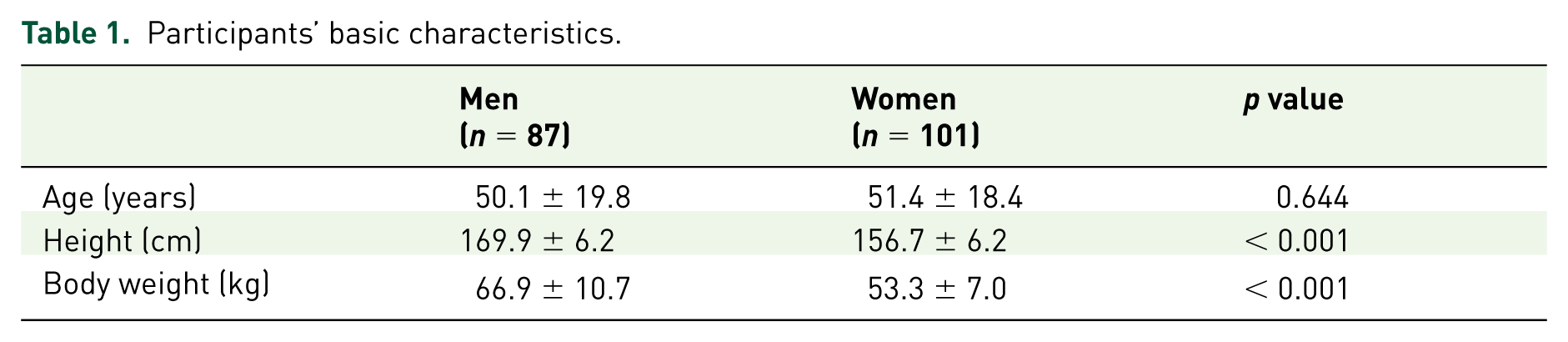
A total of 203 nonsmoking community-dwelling adults (102 men, age: 49.6 ± 20.2 years; 101 women, age: 51.4 ± 18.4 years) were recruited using posters displayed at a community sports facility. Participation was voluntary, and all participants provided informed consent. Participants with respiratory illness or missing data were excluded from analysis (Table 1). Sample size was determined using a power analysis program for statistical tests (G*Power 3.1.9.2, Heinrich-Heine-University Dusseldorf University, Dusseldorf); given an alpha of 0.05, a desired power of 0.95, and an effect size of 0.35, the desired sample size was 55. However, to perform multiple regression analysis, we need more than 90 samples for both sexes because we require approximately 10 times the number of explanatory variables to be input. 9
Participants’ basic characteristics.
Measurements of CPF, height, body weight, respiratory function, respiratory muscle strength, thoracic excursion, and grip strength were randomized. All measurements, besides height and body weight, were performed with the participants sitting upright, the soles of their feet touching the floor, and their heads and necks in a neutral position.
Cough peak flow measurement
To measure CPF, a face mask was attached to a peak flow meter (Assess Peak Flow Meter HS710012, Philips Respironics, Murrysville, PA, USA).4,5 Peak flow was measured during peak voluntary coughing from maximal inspiratory level in the face mask. All participants were instructed to cough with maximal effort. Three measurements were performed, with the highest value adopted for analysis.
Respiratory function measurement
Respiratory function tests were conducted with an electronic spirometer (SpiroShift SP-470, Fukuda Denshi, Tokyo, Japan). The following parameters were measured: peak expiratory flow (PEF), vital capacity (VC), forced vital capacity (FVC), forced expiratory volume in 1 second (FEV1), inspiratory reserve volume (IRV), expiratory reserve volume (ERV), and inspiratory capacity (IC).
Respiratory muscle strength measurement
Respiratory muscle strength was ascertained by measuring maximum inspiratory pressure (MIP) as an indicator of inspiratory muscle strength and maximum expiratory pressure (MEP) as an indicator of expiratory muscle strength. 10 As with respiratory function tests, measurements were conducted with an electronic spirometer (Spiro Shift SP-470, Fukuda Denshi), to which a nose clip was attached and a mouthpiece was affixed.
Thoracic excursion measurement
Thoracic excursion was measured with a thoracic excursion measurement device (T.K.K. 3345, Takei Scientific Instruments Co. Ltd., Niigata, Japan). After 30 s of quiet breathing, participants were verbally instructed to perform maximum inspiration and maximal expiration. The difference in thoracic circumference between maximum inspiration and maximum expiration was defined as thoracic excursion. Measurements were taken at the axilla, the xiphoid process, and the tenth rib level.
Grip strength measurement
Grip strength, an indicator of general muscle strength, 11 was measured with a baseline hydraulic hand dynamometer (W50175 Baseline hydraulic hand dynamometer, Nihon 3B Scientific, Inc, Niigata, Japan). Participants gripped the dynamometer with a neutral wrist position while seated upright with the shoulders in a neutral position and the knees flexed at 90°. During measurement, the participants were encouraged to exert maximum grip strength. Measurements were performed twice for both hands, with the highest value adopted for analysis.
Statistical processing
Men and women have been reported to exhibit anatomical differences in the larynx and to have different breathing patterns 7 ; therefore, we analyzed men and women separately. Fifteen male participants demonstrated a ceiling effect in CPF measurement and were therefore excluded. Thus, for analysis, we ultimately incorporated 87 men (age: 50.1 ± 19.8 years) and 101 women (age: 51.4 ± 18.4 years). For all items, after performing normality tests using the Smirnov−Grubbs outlier test, measured values were compared between men and women. Items demonstrating normality were analyzed with Welch’s t test, while items not demonstrating normality were analyzed using the Wilcoxon rank-sum test. 12
Stepwise multiple regression analyses for factors affecting CPF were performed separately for men and women. Instances where predictive formulas using height and body weight are represented with formulas using other variables, such as respiratory function 8 and respiratory muscle strength, 9 involve covariance. 13 In this study, CPF was used as the dependent variable in multiple regression analysis, and the explanatory variables were PEF; VC; FVC; FEV1; IRV; ERV; IC; MIP; MEP; and thoracic excursion, as measured at the axilla, the xiphoid process, and the tenth rib, as well as grip strength. Age, height, and weight were excluded as explanatory variables because these were involved in the formulas for calculating other variables.
The relationships between age and MIP, MEP, and CPF were analyzed using Pearson’s rank correlation coefficient. Statistical analysis was performed using Excel Statistics 2015 (Social Information Service Co., Ltd., Nishi-Shinjuku, Shinjuku-ku, Tokyo) with the level of statistical significance set at p < 0.05.
Ethical considerations
This study was approved by the Niigata University of Health and Welfare Institutional Review Board (17520 – 140811). Participants received a verbal explanation of the study, and written informed consent was obtained.
Results
All items demonstrated a normal distribution, except for body weight in women. Men demonstrated significantly higher values than women for all items, except for age (Table 2).
Measured values of cough peak flow, respiratory function, respiratory muscle strength, thoracic excursion, and grip strength.

CPF, cough peak flow; ERV, expiratory reserve volume; FEV1, forced expiratory volume in 1 second; FVC, forced vital capacity; IC, inspiratory capacity; IRV, inspiratory reserve volume; MEP, maximum expiratory pressure; MIP, maximum inspiratory pressure; PEF, peak expiratory flow; VC, vital capacity.
Correlation between age and maximum inspiratory pressure, maximum expiratory pressure, and cough peak flow
We found no significant correlation between MIP and age in women (r = −0.08, p = 0.43) or in men (r = −0.15, p = 0.15). Additionally, we found no significant correlation between MEP and age in women (r = 0.15, p = 0.14) or in men (r = 0.04, p = 0.72). Although no significant correlation between CPF and age was observed in men, a significant, although weak, negative correlation was observed between CPF and age in women (r = −0.24, p < 0.05; Figures 1 and 2).

Correlation between cough peak flow and age in men.

Correlation between cough peak flow and age in women.
Factors affecting cough peak flow
Thoracic excursion at the tenth rib, MIP, and FEV1 were adopted as factors affecting CPF in men, while thoracic excursion at the tenth rib, IRV, and MEP were adopted for women (Table 3). The following regression equations were obtained.
Factors affecting cough peak flow.

FEV1, forced expiratory volume in 1 second; IRV, inspiratory reserve volume; MEP, maximum expiratory pressure; MIP, maximum inspiratory pressure.


Discussion
This study is the first to examine factors affecting CPF and the relationship between CPF and age among male and female community-dwelling adults, separately. Men were found to demonstrate significantly higher values than women on all measurement items except for age. In terms of factors affecting CPF, thoracic excursion at the tenth rib was adopted for both men and women, MIP and FEV1 were adopted for men only, while IRV and MEP were adopted for women only; thus, the factors affecting CPF were found to differ between men and women. A significant, although weak, relationship between CPF and age was observed only in women.
In comparisons of measurement items between men and women, men demonstrated significantly greater height and body weight than women. Height and body weight affect respiratory function and respiratory muscle strength; 10 this may explain why men demonstrated significantly higher values for respiratory function and respiratory muscle strength than did women. Furthermore, the significantly greater height and body weight in men than in women may also be the reason for the larger cross-sectional muscle area and greater muscle force in men than in women. Additionally, the fact that thoracic excursion expands and contracts the thorax by the action of the respiratory muscles may be why men, with their larger cross-sectional muscle area and greater muscle force, demonstrated significantly higher values for thoracic excursion than did women.
Based on their functions, respiratory muscles are divided into inspiratory muscles and expiratory muscles. When inspiratory muscles contract, the diaphragm descends towards the abdomen, while the anterior chest expands longitudinally and then horizontally as the ribs are lowered, thus expanding the lungs. 14 Contraction of expiratory muscles increases abdominal pressure, which is considered to aid expiration. 15 Since it is useful to determine and treat the problematic procedures in coughing, 16 we examined the factors affecting CPF from the perspective of kinematics. The methods used to measure maximum inspiratory pressure (PImax) and maximum expiratory pressure (PEmax) were based on guidelines of the American Thoracic Society. We believe that one of the reasons that our observed values were smaller than previous reports is due to the geographic origin of our study sample. Chen and Kuo 17 established that Asian people have lower muscle strength than European people.
The single factor affecting CPF in both men and women was thoracic excursion at the tenth rib. The diaphragm, which is the main inspiratory muscle, and the transverse abdominal muscle, the internal abdominal oblique muscle, and the external abdominal oblique muscle, which are the main expiratory muscles, are attached at the tenth rib. During inspiration, excursion of the tenth rib results in extension of the attached transverse abdominal muscle, abdominal oblique muscles, and rectus abdominis. This extension, in turn, increases the tension of these muscles, which is considered to reflect larger inspired volumes during the first phase of cough and increase the muscle force exerted during expiration.
However, other factors affecting CPF differed between men and women. MIP and FEV1 were influential in men, while IRV and MEP played a role in women. Men tend to exhibit abdominal breathing 7 and are thus considered to exert diaphragm strength easily. During deep inspiration in coughing, the diaphragm functions intensely and expands the thorax, thereby triggering inspiratory action, 14 which may explain the role of MIP. Diaphragm function is also correlated with inspiratory muscle strength and increases the inspired volume during inspiration. 14 Inspiration early during the coughing process is necessary for increasing total lung capacity, and a high lung capacity improves the expiratory flow rate. 7 Therefore, it is plausible that the tendency of men to exhibit abdominal breathing permits rapid reduction of intrathoracic volume and complete expiration of ERV, which explains the role of FEV1.
For women, who predominantly exhibit thoracic breathing, 7 deep inspiration by primarily using the strength of the diaphragm is difficult; thus, it is plausible that deep inspiration in women also uses the activity of the intercostal muscles. The fact that the intercostal muscles exhibit inspiratory action and increase inspiratory volume 15 may explain the role of IRV in affecting CPF. Furthermore, rapid expiration using the abdominal muscles may be difficult for women, whose abdominal muscles exhibit less action during expiration than do those of men. 7 The internal intercostal muscles exhibit not only inspiratory action, but also forced expiratory action. 15 During voluntary coughing, these muscles are mobilized, thereby increasing intra-abdominal pressure and reinforcing compression following closure of the glottis. The fact that contraction of the internal intercostal muscles lowers the ribs and reduces the intrathoracic volume 15 may explain the role of MEP in modulation of CPF in women.
Based on the above, although both men and women are affected by deep inspiration and strong expiration during coughing, sex differences were observed in the factors affecting voluntary coughing. The results of the present study indicate that during deep inspiration, men demonstrate the effect of strength, whereas women demonstrate the effect of volume; while during strong expiration, men demonstrate the effect of force, whereas women demonstrate the effect of strength. These results suggest that for maintaining and improving CPF, which is important for preserving self-drainage ability, more detailed individual therapeutic interventions are possible for coughing in men and women, respectively.
In terms of the relationship between CPF and age, a weak negative correlation was observed among women only. Women demonstrate greater age-related morphological changes and greater vertebral deformation associated with reduced bone density than do men, as well as age-related kyphosis of the spine and expanded thoracic anteroposterior diameter. Expansion of the thoracic anteroposterior diameter, which puts the diaphragm in an extended position and leads to diminished respiratory muscle strength, 8 is thus likely to affect CPF. This effect of expansion of the thoracic anteroposterior diameter may be why women demonstrate a significant weak negative correlation between CPF and age. Another possible reason that may explain the relationship between CPF and age in women is age-related decline of MEP. MEP is generated from expiratory muscles, and muscle strength declines with age. 4 Although we did not observe any age-related decline in MEP, any changes in MEP might be reflected in the relationship between CPF and age.
The present study has some limitations. First, the participants were healthy individuals recruited at a community athletic facility, thus, the results of this study may not be directly applicable to elderly individuals or patients with respiratory illness. Although it will be necessary to verify our results in the elderly and in patients with respiratory diseases in the future, the findings obtained in this study can be referred to in developing strategies for improving coughing ability. Second, we did not measure the intrathoracic pressure and abdominal pressure based on the limited time to measure in the gymnasium. Cough is reported to be related to both intrathoracic pressure and intraperitoneal pressure.3,5,6 Because there are many influences on cough, future research will be necessary to clarify our results. Third, CPF was the primary parameter of interest in this study, and the exclusion of all those with the strongest CPF limits the ability to generalize this study’s results. Inclusion of those participants’ data could have altered the relationships found with the associated factors. Finally, although Smith and colleagues 18 demonstrated that operating volume is a determinant of CPF, we were unable to control the operating volume among the participants.
Despite these limitations, the present study can be used to compare such participants with healthy participants. The present study could also be used to aid in maintaining, improving, and preventing decline in voluntary cough intensity. Because the present study is a cross-sectional study, changes in CPF should be tracked longitudinally in the future in order to determine the effect of age on CPF.
Footnotes
Acknowledgements
We thank Assistant Professor Tomonori Nomura for guidance during this study. We would also like to express our sincere gratitude to Naotake Ueda, former director of the Nishi Sogo Sports Center, for his assistance in providing a location for measurements and in recruiting participants. In addition, we would like to extend our sincere gratitude to the students in the Department of Physical Therapy at Niigata University of Health and Welfare for their assistance in performing the measurements. Lastly, we are deeply grateful to all of the participants in the present study for their cooperation.
Funding
This research received no specific grant from any funding agency in the public, commercial, or not-for-profit sectors.
Conflict of interest statement
The authors declare that there is no conflict of interest.