




Abstract
Medical conference organisers have increasingly used social media to improve interaction and learning amongst healthcare professionals. Despite the increasing use of Twitter at critical care conferences, there remains considerable debate as to its impact and ability to generate meaningful discussions beyond the duration of the conference itself. We aim to analyse the trend in Twitter use at international critical care conferences between 2014 and 2017. Fifteen major, international critical care conferences were identified spanning 2014–2017. They represented the annual congresses of the leading critical care professional societies including the first critical care conference to incorporate social media, Social Media and Critical Care. There has been an increased utilisation of social media at all the conferences analysed. This is reflected both in the number of users and the number of tweets. Tweets from the official conference twitter account contribute only a small proportion to the overall number with the exception of the International Fluid Academy. The potential benefits of social media have resulted in a sustained increased in its use at critical care conference between 2014 and 2017. Our analysis provides a better understanding on the use of social media at critical care conference. Further studies are needed to ascertain if this increase in use translates to enhance learning and patient care amongst colleagues.
Background
At the turn of this century, in the aftermath of the ‘dot com bubble’, websites began moving from flat content platforms to more open spaces which allow users to create and share their own content. 1 Social media (SoMe) sites play a prominent role in ‘Web 2.0’ – these sites are defined as web-based services where users create a public or semi-public profile, articulate a list of users with whom they share connections and view this list of connections and those made by others within a system. 2
Twitter (founded in 2006) is a microblogging variant of a SoMe site where users interact via posts containing up to 140 characters (increased to 280 in 2017); hashtags within these posts enable aggregation of tweets into topics. In its second-quarter figures for 2017, Twitter declared 320 million active monthly users. 3
Nowadays, SoMe is fundamental in promoting communication and interaction in a variety of spheres. As connectivity within SoMe has been demonstrated to enhance behavioural change, 4 e.g. smoking cessation 5 and exercise, 6 we propose that SoMe can facilitate effective education and behavioural change in the environment of Intensive Care Medicine (ICM). This requires an in-depth understanding of the concept of SoMe, how it shapes discussions and how to utilise it safely and efficiently.
The use of SoMe as an adjuvant to traditional-format courses has been reported in the literature, with some success and evidence of benefit. In one experimental study, the integration of social networking with a seven-credit course for first year pre-health professional students (students who will go on to apply for Medicine, Dentistry, etc.) was shown to enhance student engagement and end of term performance. 7 Instant electronic communication facilitates student engagement, discussion and collaboration, both within and without a classroom environment. 8
Twitter has been used for some years to amplify the reach of scientific conferences, with growing success. Twitter posts (known as tweets) are shared with other Twitter users on one’s contact list; tweets labelled with a hashtag can further be seen by users not previously known to oneself, allowing them to participate in a broader discussion of subjects stimulated by the conference. To illustrate, tweets incorporating the hashtag #asm2012, representing the meeting of the American Society of Microbiology, became so popular that it was listed as a ‘trending’ topic on the Twitter home page. 9 There are a variety of factors which might increase engagement with a tweet; one of which is the inclusion of images, which significantly increase the probability that a tweet will be-retweeted, thus enhancing the reach of the original message. 10
ICM conferences have followed this trend, and a number of these have dedicated teams to design and curate their SoMe content during the conference. Where possible, conference organisers often request presenters to share slides in advance with social media teams to improve the quality of conference-associated tweeted slide photographs.
The purpose of our study was to analyse and describe the trends in SoMe (specifically Twitter) use at major international ICM conferences between 2014 and 2017.
Methods
The largest ICM conferences during the period 2014–2017 were identified by the authors, based on their reputation and the number of attendees. All conferences were open to healthcare providers of all training and education levels; each conference had a unique and specific hashtag to identify the conference name and year.
Symplur.com, referred herein as Symplur, is one of several commercial providers offering general interaction metrics for Twitter.com. Proprietary algorithms by Symplur were used to collect and compile tweets, obtain data regarding the number of individual Twitter users and total volume of Twitter interaction (defined as ‘impressions’) during the conference. Tweets were further subcategorised by the users’ affiliation, as declared on their Twitter biography (doctor, allied healthcare professional, journal, organisational provider, etc.).
Using a set of Symplur analytics software, we determined the relative proportions of types of tweets, e.g. original tweets (arising from discussions between users) versus re-tweets (which represent pass-along messages). Re-tweets are repeat postings of a different Twitter user’s tweet, allowing the first individual’s content to be viewed by the re-poster’s list of followers. This enhances the spread of information across the network.
Results
In total, 15 conferences were identified for analysis: European Society of Intensive Care Medicine annual congresses between 2014 and 2016 (LIVES), the Intensive Care Society (ICS) annual congress (State of the Art), the Society of Critical Care Medicine (SCCM) meetings (CCC45–CCC47), Social Media and Critical Care (SMACCUS, SMACCDUB and DASSMACC) and the International Fluid Academy meetings (IFAD2015, IFAD 2017).
Overall Twitter activity
Number of tweets, retweets and impressions by conference.

Twitter users
Volume of retweets and impressions also increased, commensurate with the number of tweets, across all conferences. The number of users increased overall across the specified time period (with SMACC alone having a slight decline between SMACCDUB and DASSMACC), as demonstrated in Figure 1. While the SMACC series demonstrated growth in Twitter users overall, growth was not maintained across all three conferences. However, given their high number of Twitter users, it is plausible that the SMACC series has less capacity for expansion, when compared with its peers. The sharpest rate of growth in Twitter users was noted in the CCC and LIVES conference series; LIVES had a 2.5-fold increase in Twitter users over the 3-year time period and CCC an almost four-fold increase in Twitter users.
Number of tweets per conference year.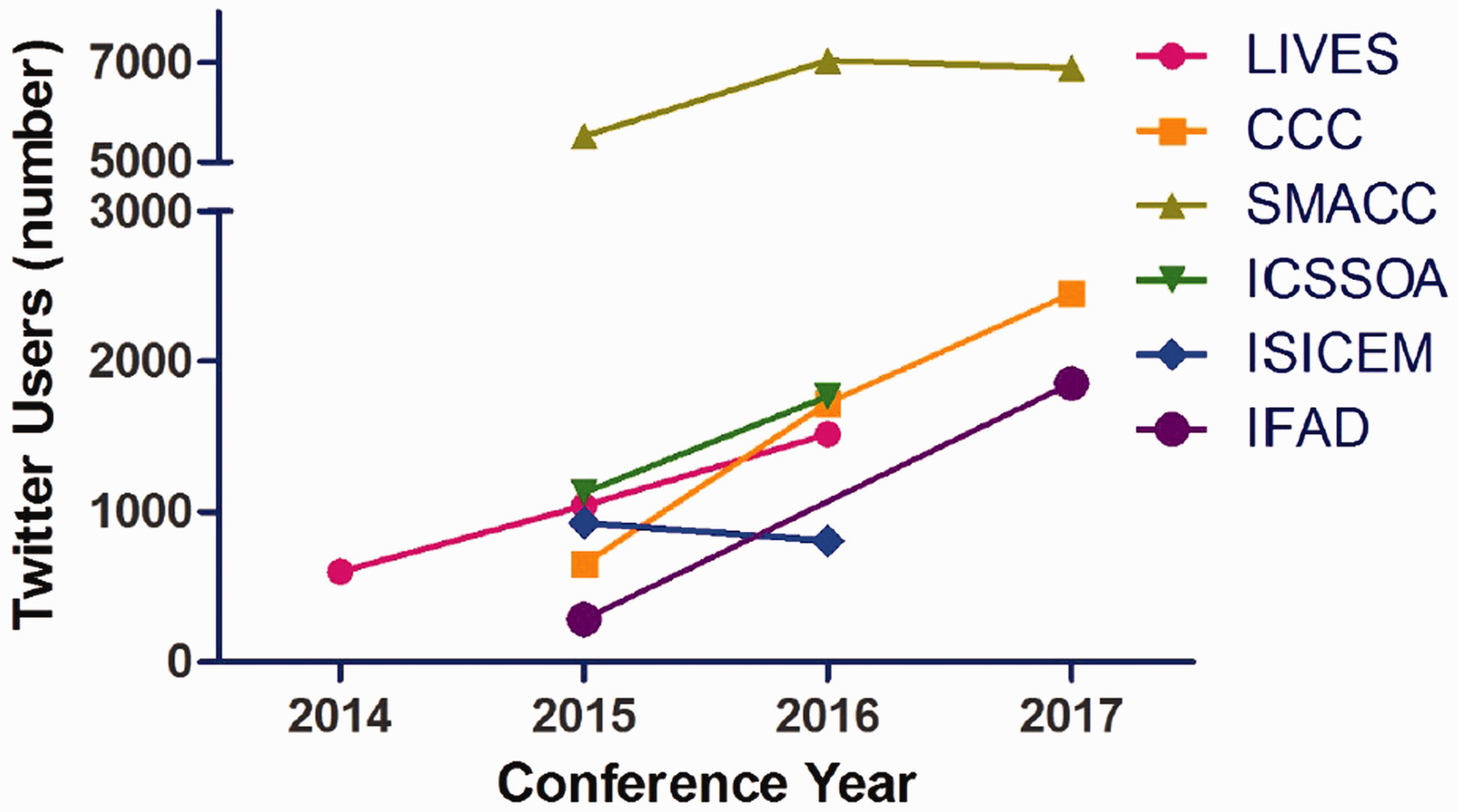
Tweets from individual users
Figure 2 demonstrates that over the reviewed time period, the tweet numbers per user stayed largely constant at the CCC conferences. In contrast, a significant increase was seen in the tweet numbers for each active user at the LIVES conferences.
Number of tweets per twitter user.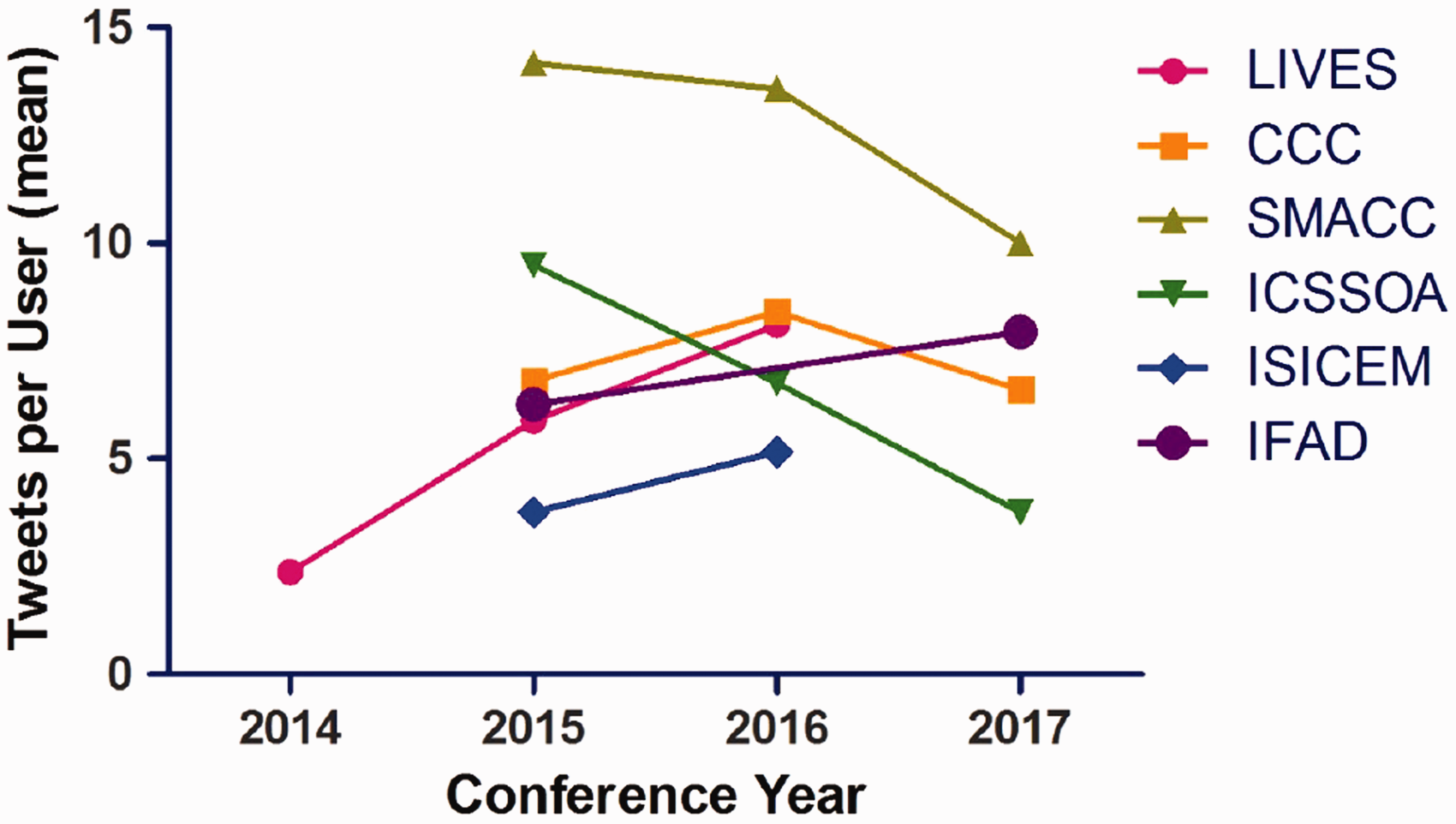
Percentage of users and number of tweets made at each of the major critical care conferences.

Tweets from official organisation Twitter accounts
Number of organising congress tweets for each of the major conferences, also displayed as a percentage of total tweets.

Discussion
Conferences are time-limited events; conference learning, traditionally, is limited to those who attend these events. Even so, a delegate at a multi-stream conference will not be able to attend every lecture. Not all conferences provide booklets (printed or digital) to support more detailed learning after the conference has ended.
One of the greatest benefits of SoMe in conferences is the rapid real-time sharing of educational resources, enabling absent colleagues to follow the conference from a distance at any time and promoting discussion around topics of interest with experts from across the globe. Learning is no longer restricted by the time or geographical limitations of the conference. Medical education in the 21st century has evolved with technology, and SoMe is now integral to this.
We have studied the trend in SoMe use across six different intensive care conferences between 2014 and 2017.
Our analysis has predominantly shown an increasing presence and utilisation of SoMe at all conferences except SMACC, and this may be related to the fact that delegate numbers were restricted at its most recent conference. SMACC was the first to champion the use and integration of SoMe into ICM conferences – once again, we emphasise that the total number of users and tweets at SMACC far exceeded those of other conferences.
The function of a well-organised SoMe team during a conference is to engage users in active discussion, provide educational links relevant to lectures and coverage of auxiliary events e.g. debates, panel discussions and provide a trail of organised resources for later use.
Despite the increasing presence of dedicated SoMe teams at conferences, it remains to be seen if it translates to improved delegate experience and perhaps more importantly, enhanced learning opportunities. There is no doubt that involvement of colleagues outside the physical confines of the conference is improved.
By comparing several major ICM conferences across the world, we were able to provide a more global view on the use of SoMe. We included the SMACC conferences as the benchmark ‘gold standard’ with which to compare the other ‘more conventional’ ICM conferences that have evolved to keep up with technological advancements.
Our analysis has focused on quantitative measures rather than qualitative ones due to the limitations of current analytical tools. The increase in number of tweets does not necessarily translate to increased number of informative or useful tweets although content analysis will be crucial in characterising this further. One suggestion may be that an increase in delegate number could underlie growth of SoMe use/engagement in this setting. Of the conferences in this study, only LIVES published exact delegate figures for the years analysed. Over this time, an increase in delegate number of less than 30% was dwarfed by a more than 775% increase in tweet number and a doubling in the percentage of delegates sending one or more tweets (from 12 to 24%). Whilst this cannot be extrapolated to all conferences, SoMe use/engagement at LIVES is patently not attributable to an increase in conference size.
Another limitation of our study is that we focused on a small number of international conferences. However, we felt that these conferences were the more prominent ones, and they had also engaged with SoMe as part of their conference experience.
Finally, we utilised data provided by Symplur, which focuses on Twitter use at these conferences. Whilst other social media platforms such as Facebook and LinkedIn were excluded, Symplur was chosen for its familiarity to clinicians and researchers.
Conclusion
The use of technology including SoMe has revolutionised the way we communicate on a personal and professional level. The way we learn and keep up-to-date has mirrored these advancements. ICM conferences have increased the utilisation of SoMe but further analysis is required to investigate delegate satisfaction and learning. This would guide the effective use of SoMe at future conferences to maximise educational benefit for delegates present and those colleagues who are unable to attend.
Declaration of conflicting interests
The author(s) declared no potential conflicts of interest with respect to the research, authorship, and/or publication of this article.
Funding
The author(s) disclosed receipt of the following financial support for the research, authorship, and/or publication of this article: International Fluid Academy.