




Abstract
Free Open Access Med(ical edu)cation refers to an online community of knowledge relating to medicine. Originating from practitioners in emergency medicine, it has since spread to critical care, internal medicine, prehospital medicine, paediatrics, and allied health professionals and continues to grow at an advanced rate. Weblogs (‘blog’ for short), emails, social media (in particular Twitter), recorded audio material ((podcasts), and video material are all produced on a daily basis and contribute to the continual professional development of trainees and consultants worldwide. In this article, we explain its background, rise to prominence, and explore some of its controversies.
Keywords
Introduction
Free Open Access Med(ical edu)cation, abbreviated to FOAMed, refers to a dynamic, ever expanding collection of articles, apps, audio and video material produced to assist in a clinician’s lifelong learning. 1
This concept is hardly new. Doctors were charged with this in the Hippocratic oath: ‘and to teach them this art-if they so desire it- without fee or covenant’. 2
Grand rounds and journal clubs have been a staple of hospital life for many years. Open-access journals have been available since the late 1980s offering a variety of articles free of charge. Weblogs (‘Blogs’ for short) are discrete internet sites that allow the creation of posts separated by date and time, similar to a ship’s log or diary. Medical blogs have been available to read free of charge since the 2000s.
FOAMed, however, is different. FOAMed is all of these resources and more, gathered into a rapidly expanding community of healthcare professionals. The community and conversation are an integral part of the concept, as is the promotion of asynchronous, self-directed learning.
Humble beginnings
The term came to be in 2012. At the international conference of Emergency Physicians in Dublin, two delegates were brainstorming on the use of social media in medicine. One of them lamented out loud the negative connotations of social media in the larger medical community, despite the fact that an increasing number of doctors were present on forums such as Twitter, Google Plus, and LinkedIn.
A new name was needed to dissociate those negative terms. The answer was, quite naturally given the location, to be found at the bottom of a pint of Guinness (Personal communications with Mike Cadogan, originator of the term FOAM and consumer of said Guinness pint.). The originators, however, wisely recognised that using their original abbreviation for this new entity (FOAM) as a search term on the internet would end up directing individuals towards images of bubbles. A more specific acronym was needed – hence FOAMed.
FOAMed originally had firm roots in emergency medicine (EM) but spread rapidly over 2012 to include critical care (CC), paediatrics, and toxicology. By the end of the year, there were 77 recognised EM and CC blogs. The CC community started to identify its own online educational need and a specific acronym – FOAMcc – was born. 3
Rise to prominence
2013 was a real turning point for FOAMed. Articles discussing the use of social media in medical education began to appear in mainstream journals. The New England Journal of Medicine published a journal correction, which was spotted due to statistical analyses performed by the FOAMed community. 4 In the same year in the same journal, the TTM trial was published, and within 72 h it had been debated, dissected, and its widespread impact decided using FOAMed, setting a precedent for FOAMed discussion intensity. 5
For the growing number of recognised contributors and users of FOAMed worldwide, a conference was organised to bring them all together. The Social Media and Critical Care conference (SMACC) was arranged in Sydney, Australia, an opportunity for the international community of FOAMed to showcase their talents. Of course, all the lectures would become available for free on the internet following the conference. 6
With a new style, 700 delegates, and a focus on collaboration, the conference was a huge success. The conference was organised again in 2014 (SMACC Gold), 2015 (SMACC Chicago), and is due to take place in Dublin in June 2016, now with 2000 delegates. Its popularity is such that all 2000 tickets sold out in two weeks.
As of the time of writing this article, there are 275 recognised EM and CC blogs using the term ‘FOAMed’ in their description. A similar explosion in activity has been seen in other forms of social media, with Twitter currently being the most popular. 3
Specifically to the UK, FOAMed has shown a similar trend in increased popularity, from four sites in 2012 to 19 sites in 2016. The Royal College of Emergency medicine has firmly embraced the ethos, having its own UK RCEM FOAMed network utilising various forms of social media to provide education mapped to the curriculum. 7 Its influence has spread to the CC community, with FOAMed and social media having a very strong presence at the ICS State of the Art Meeting last December. 8 The Intensive Care Society, along with editors of this journal, regularly contributes to blogs and podcasts.
How do I FOAMed?
With so many portals, and the perceived need for ‘tech-savvy’ attitude, it can be easy to get overwhelmed with content or just avoid the medium altogether. However, joining the conversation can be broken down into a few easy steps:
Activate a Twitter account:
Twitter is a social media platform allowing users to post 140 character messages (‘tweets’) onto a large continuous, real-time message board. Twitter remains the primary medium for communicating and distributing FOAMed; 86% of all FOAMed activity occurs here. There are 1300 users who identify with the FOAMed community on their user profiles, and 237,000 tweets about FOAMed were sent out in a six-month period between October 2015 and March 2016. 3
Registration is simple and free, and it can be used on a multitude of devices. Once registered, material can be retrieved by searching through ‘hashtags’ – simplified ways of grouping relevant information together. In this case #foamed and #foamcc are the most relevant. Other hashtags of interest are #meded (medical education), #foamped (paediatrics), #foamgas (anaesthetics) and #foamus (ultrasound described in more detail below).
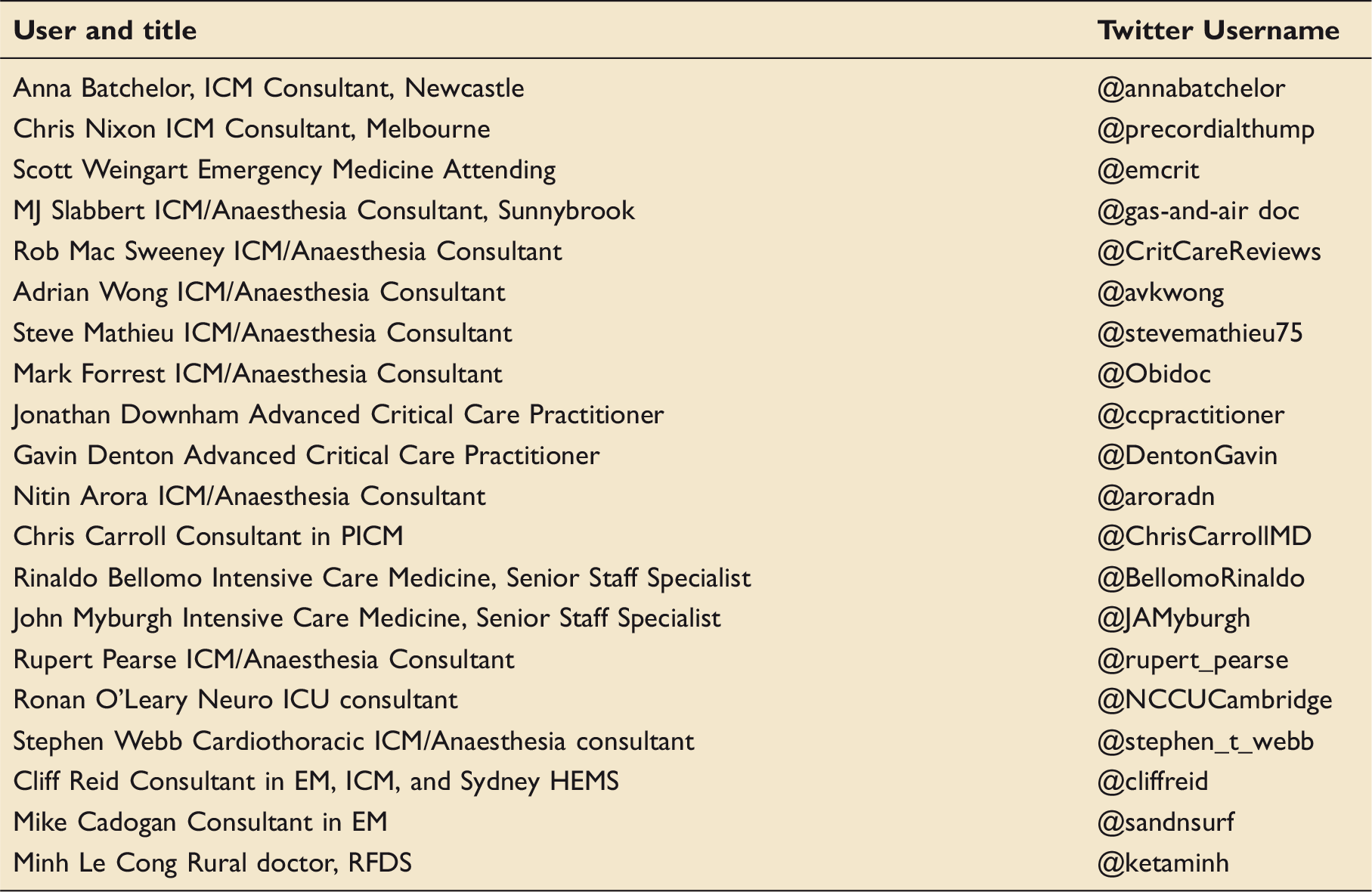
20 #FOAMed/FOAMcc Twitter Users To Follow. This is by no means an exhaustive list – just a starting point ….
Download or subscribe to a podcast:
A ‘podcast’ (portmanteau of ‘iPod’ and ‘broadcast’) is essentially an audio recording that can be downloaded and listened to at any time using a variety of devices – tablet, computer, or phone. On Apple devices, these are easily accessible using the ‘iTunes’ software package; Android devices have a number of software applications, such as Podcast Addict. They can also be downloaded and listened to directly from websites online.
Follow a blog, or blogs, using a feed aggregator:
With 275 different blogs producing a wide array of material, it can be difficult finding the time to visit them all one by one. ‘Feed aggregators’ allow content from a variety of websites to be displayed and browsed at once, like the contents page of a journal. Websites advertise that their content can be accessed in this way by showing that they have an rich site summary (RSS) feed or displaying this icon:

An example of a feed aggregator is Feedly.
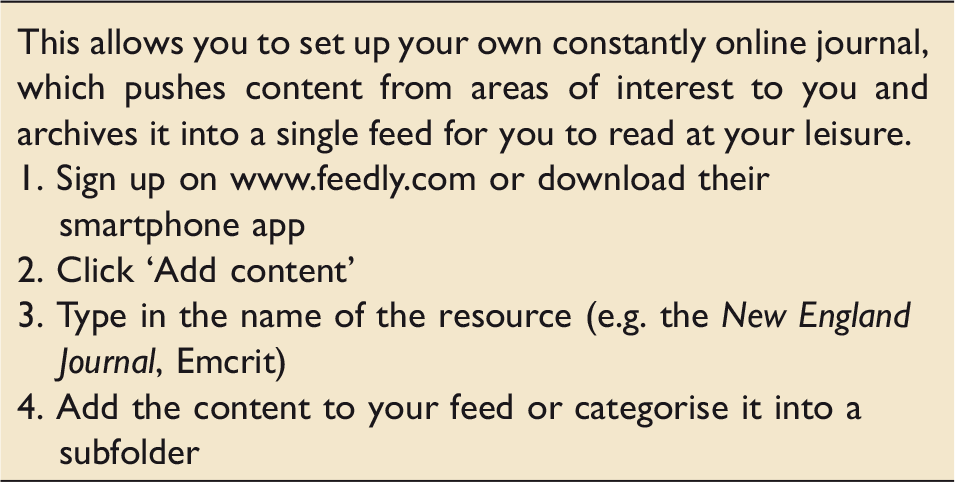
Box 2 contains some simple instructions on using an RSS feed aggregator.
Subscribe to a newsletter: How to use an RSS feed (FEEDLY™).
Just as the Intensive Care Society sends its readers a monthly email newsletter, many FOAMed websites offer the same service. Simply subscribe on their website to receive regular FOAMed updates in your inbox. One of the most popular of these in CC is the absolutely excellent Critical Care Reviews newsletter from the UK’s very own Rob MacSweeney.
Subscribe to YouTube or Vimeo channels:
YouTube and Vimeo are online video archives, containing a vast amount of material. They are increasingly used to host FOAMed content; the Australian and New Zealand Intensive Care Society and the Society of Critical Care Medicine in the US both have active channels containing lectures and other teaching materials.
Some videos (as anonymised short clips) can be posted directly attached to Twitter tweets, and this has allowed the development of education, discussion, and case reporting in point of care ultrasound (#POCUS) including echocardiography and other formats using the tag #FOAMus where printed static images really don’t suffice.
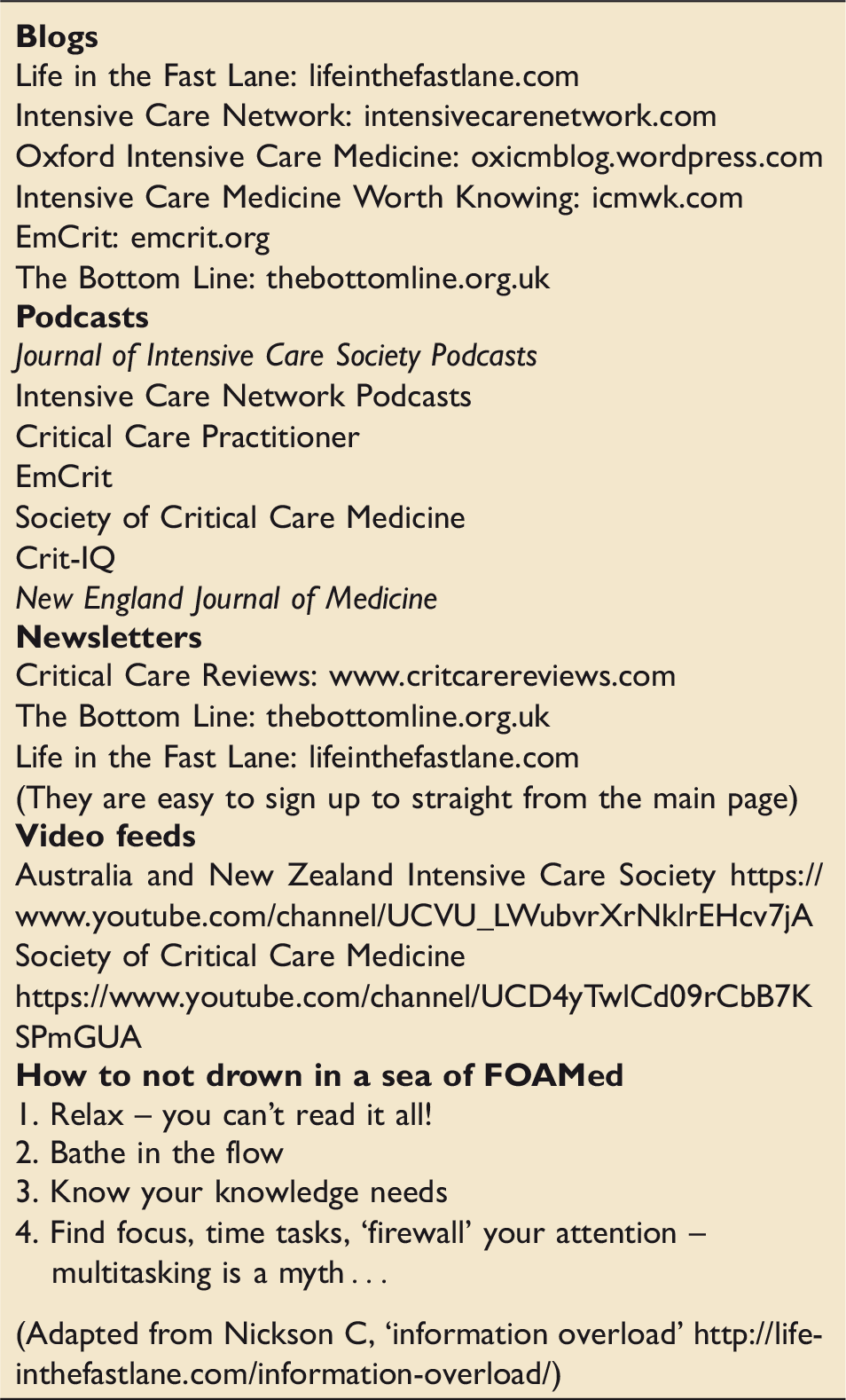
Recommended FOAMed resources.
Why should I FOAMed?
FOAMed has a number of powerful and potent advantages. Being plugged into a continuous community of learning and discussion has immense power. Recent innovations in CC practice – tranexamic acid, and apnoeic oxygenation/NODESAT been widely advocated and promoted by the community. 1 Weekly journal clubs are being held on Twitter around a variety of topics, and with their own hashtags (#nephjc and #genmedjc are examples). The FOAMed community has also gone a long way towards battling the increasing sense of isolation faced by medical practitioners in the current age – responding with care, compassion, and humour. A recent example of this was a humorous thread discussing driving, intubation, and double entendres (#gettinitin).
The FOAMed community is helping in research. Trials such as LeoPARDS 9 and REST 10 use social media to recruit and publicise. Recently, the first UK Intensive Care National Audit Project (ICNAP-1) was born out of a meeting of minds on Twitter. 11
To paraphrase Joe Lex, an emergency physician from the USA and one of the first FOAMed advocates, If you want to know how medicine was practiced 5 years ago, read a textbook. If you want to know how medicine was practiced 2 years ago, read a journal. If you want to know how medicine is practiced now, go to a good conference. If you want to know how medicine will be practiced in the future, get on the internet and use FOAMed. A demonstration of how easily FOAMed can fit into daily life.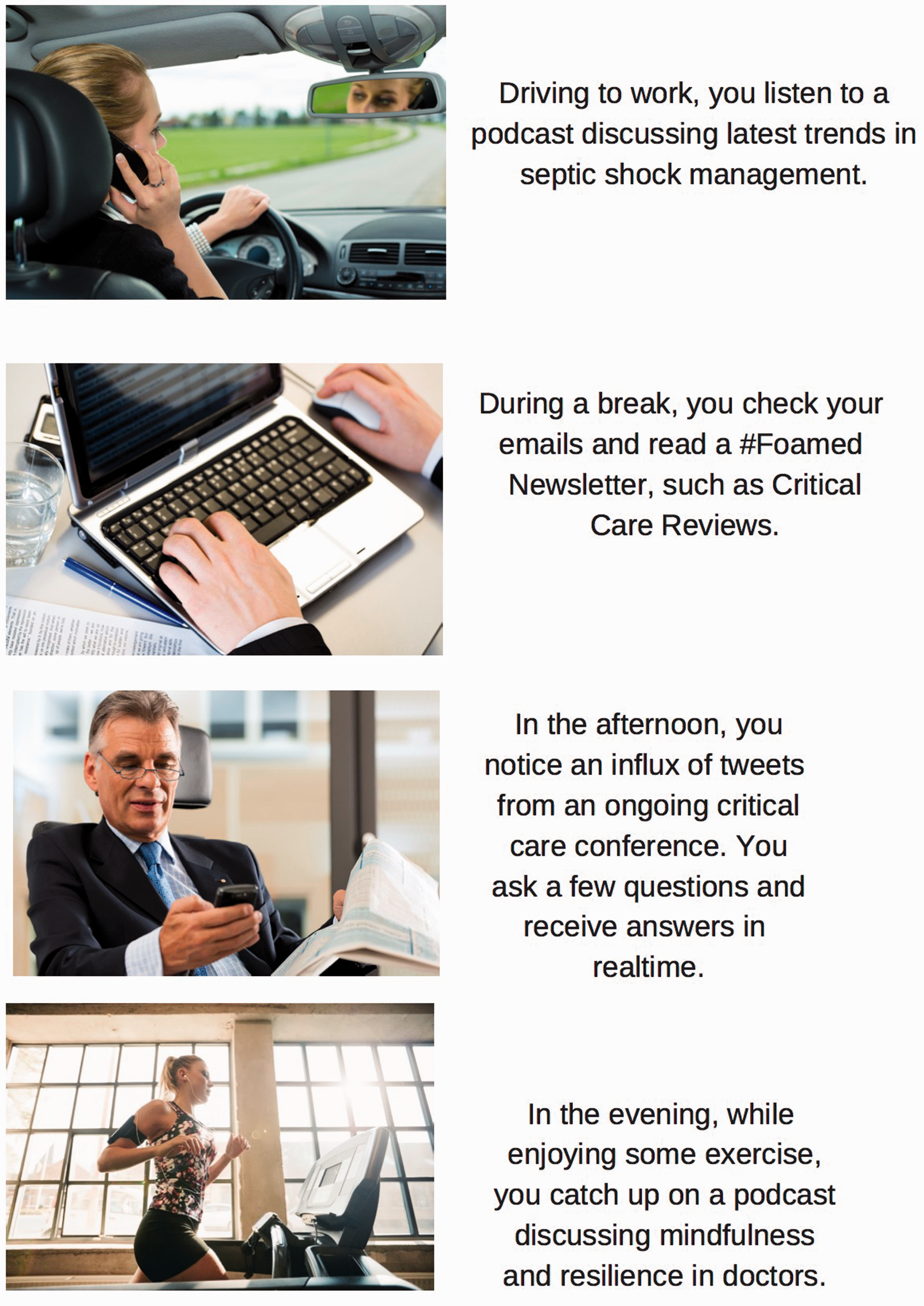
Controversies
FOAMed is not above criticism and should not be. Articles and podcasts can be published without traditional peer review, which has caused significant controversy. FOAMed has been accused of encouraging ‘eminence-based’ or ‘pundit-based’ medicine, where the most popular and charismatic material gains popularity without necessarily being the highest quality. 12 At times, bullying behaviours have emerged – supporting cricoid pressure, refuting tranexamic acid, and suggesting the need to measure FOAMed quality has resulted in ad hominem attacks on those individuals who dared to go against the grain.13,14
The future of FOAMed
FOAMed continues to expand and evolve, and works with its critics to improve. Peer review is becoming standard in many websites, and post-publication peer review and editing is being embraced as another standard. The SMACC conferences are setting new standards in medical education.
Within CC, established bodies – The Australia and New Zealand Intensive Care Society, The American Society of Critical Care Medicine, the European Society of Intensive Care Medicine, and our own ICS – are embracing FOAMed and incorporating it into conferences, websites, and e-learning. To facilitate change, the SCCM set up a Social Media Task Force to embed these new communication channels to its everyday life. Other societies are relying on the already active members, but all of them are clearly embracing this opportunity. It is not too far, when Continuing Professional Development points will be able to be gained via FOAMed, especially where the format is closer to the traditional education methods, such as a webcast or podcast (the ICSs are working on this as we speak).
FOAMed is also affecting the traditional journal, with ‘alternative metrics’, or ‘altimetrics’, measuring the impact of traditional articles by using the number of citations on Twitter and blogs. 15 These are gaining traction and becoming as important to authors as the traditional impact factor, to the point of being highly relevant when attracting research funding (Prof RM Pearse, personal communication).
Ultimately, FOAMed is destined to disappear and become a standard part of medical education – much like email went from being an interesting curiosity to a part of everyday life.
Conclusion
FOAMed is a large community of internet-based resources, using a large social media community as a means of delivering high-quality medical education to anyone with a device. It is the authors’ opinion that incorporating this community into our everyday practice has immeasurable benefits both now and into the future.
Footnotes
Declaration of conflicting interests
The author(s) declared the following potential conflicts of interest with respect to the research, authorship, and/or publication of this article: All of the authors are significant users of FOAMed. OO, JD, and JKB are Social Media editors for JICS, and produce the JICS Podcast. TS is member of the SCCM Social Media Task Force. OO also writes for two FOAMed resources – Life in the Fast Lane and The Bottom Line. JKB regularly publishes FOAMus. OO and TS are members of the ICNAP-1 Steering committee. The corresponding author is more than happy to be contacted with any advice regarding the use of FOAMed.
Funding
The author(s) received no financial support for the research, authorship, and/or publication of this article.