



Abstract
Despite scholars debating the contested nature of the history of mental healthcare in the Western world for decades, the notion of steady progress is still a common way of thinking about this history. In Britain, the shift from institutional to community care has seen little investment in long-term therapeutic services, harming those with a chronic mental illness. The article draws on a heritage project that deliberately implemented slow memory-making processes through the application of participatory art-based methodologies to make visible the neglected memories of mental health service users who have relied on a mental health day centre in England for over half a century. Slow memory work unearthed counter-memories that challenge dominant contemporary mental healthcare policy and practice, such as the modernisation of mental health services that individualise care at the expense of communal services.
Keywords
Introduction
The history of mental healthcare in the Western world has been the subject of debate for decades. However, the belief that reforms have progressed gradually is still a common way of thinking about this history (Punzi et al., 2024: 5), particularly in the mental health policy landscape. In Britain, the shift from institutional to community-based care has been accompanied by a lack of investment in long-term therapeutic services and support structures (Spandler, 2020), negatively affecting those with chronic mental health conditions (Calabria, 2022b). Since the 1980s, historians have been discussing patient-centred approaches to mental health history. Yet, histories that incorporate the perspectives of individuals with lived experience of the mental health system continue to be scarce (Calabria, 2024). Coleborne (2020) highlights a crucial distinction in historical narratives of mental ill health that give voice to individuals with lived experiences, whose personal accounts diverge from the perspectives often shaped by official, political and academic sources that have dominated historical representations since the 1960s. These dominant narratives centre on the idea that the past of mental healthcare was barbaric and that progressive reforms have been incremental, contributing to a cycle of despising the past and failing to acknowledge the present reality of mental healthcare (Wynter et al., 2023). The enduring popular perception of the brutality of psychiatry’s past and the incremental nature of progressive reform remains ingrained in public perceptions of past models of care, despite ongoing academic debates. By historicising alternative narratives from these dominant perceptions, fresh perspectives on the history of mental health can emerge, shedding light on previously overlooked aspects that challenge dominant discourses in mental healthcare policy and practice.
This article aims to explore the effects of the modernisation of mental health services in England from 2008 onwards on the provision of care for mental health service users who have witnessed the reduction of access to support systems and whose views differ from the official narrative of progress in the mental health policy landscape. Focusing on slow-paced and participatory memory-making processes, it showcases heritage research that foregrounds the memories of people who rely on mental health services to reveal individual and collective understandings of care through time. These memories were part of a participatory heritage project that deliberately utilised slow practices of remembering to explore and document the hidden legacy of a mental health day centre in Nottingham, United Kingdom. 1 In the last half a century, the day centre has provided psychosocial support at a time of significant changes in mental health provision, featuring occupational and psychotherapeutic rehabilitation activities. The article provides novel insights into the complexities of mental healthcare over time, challenging the common trope of progress in policy terms. It offers a deeper understanding of the uneven developments in mental healthcare and gives voice to the seldom-heard needs of people who rely on the mental health system. It goes on to address some of the concerns of marginalised individuals in the history of mental healthcare, providing a fresh and critical perspective on past care practices that have a bearing on current mental health policy.
This article draws on the theoretical framework of counter-memory to examine how marginalised or forgotten experiences challenge dominant narratives of progress in mental healthcare. Following Ricoeur’s (2004) argument that forgetting functions as a mechanism of power that shapes what is remembered and what is erased, and Demos’ (2012) understanding of counter-memory as oppositional knowledge capable of unsettling hegemonic histories, it positions slow, participatory memory practices as a method for generating counter-memories. It first charts the rise of day services in mental health in England and their demise following the transformations of mental health services in the latter part of the twenty-first century. It goes on to examine the processes and the impacts of fostering slow memory practices as part of a participatory heritage project that explored the memories of service users who rely on a mental health day centre. The focus then shifts to the analysis of how the collaborative, creative and slow processes of making memories allowed for the emergence of counter-memories that challenge the accepted wisdom of progress in mental health policy. The final part appraises the implications of the emergence of alternative representations of this past, such as the value mental health service users attached to accessing place-based services, for contemporary dominant discourses in mental health policy and practice.
Psychiatric daycare in Britain
Mental health day services in England can be traced back to the post-Second World War era, following the formation of the National Health Service and the introduction of the National Assistance Act 1948, which made day centres integral to social care. These community-based mental health services originated from efforts to decrease reliance on institutional care (Bryant, 2011). Yet the very emergence of day centres also reflected an ambivalent continuity with the institutional model. While designed to counter the depersonalising features of long-stay hospitals, early psychiatric day centres often inherited institutional logics, such as routinised daily structures, paternalistic oversight, practices aimed at managing chronic patients (Goffman, 1961), that positioned them as partial extensions of the old system rather than a definitive break from it (Jack, 1998). The development of community-based care coincided with the advent of social psychiatry, which emphasised the importance of community life and integration as preventive measures for mental health (Fussinger, 2011). Many of the innovations that were later advocated by anti-psychiatrists, such as day services, had already been introduced by reformist psychiatrists from the early 1950s onwards who had ‘a shared common desire to break with the traditional dynamics at work in mental hospitals’ (Fussinger, 2011: 148). In the 1960s, day hospitals arose, seeking to foster recovery and decrease the reliance on inpatient treatment through rehabilitation within the community. These day services implemented strategies such as social support, early treatment, occupational therapy and recreational activities to promote social functioning and reduce the stigma around mental health (Ramon, 1985, 2018). Despite these developments, driven by the social model of mental health, historically, daycare facilities, particularly psychiatric day centres, have been likened to institutions for providing outmoded and passive forms of care (Marshall et al., 2011) as care in this context has been largely perceived as reinforcing dependency (Weicht, 2010). These critiques echo wider public memory of the ‘bad old days’ of institutional care (Wynter et al., 2023), further blurring distinctions between community-based provision and the institutional past, setting the context for the counter-narratives explored later in this article.
The rise of consumerism in health and social care in the 1980s redefined the role of mental patients from passive to active consumers of services (Machin et al., 2023), expressed in some key policy papers of that time (Department of Health, 1989). These policies endorsed the view that community care should be directed towards achieving the best quality of life for people leaving hospital, advocating the provision of appropriate services; greater choice and say for the consumer; and support for people to remain in their own homes for as long as possible, with nursing homes and hospital care reserved for individuals whose needs could not be met in any other way (Rogers and Pilgrim, 2001). These changes coincided with the move from the provision of psychiatric care from institutions to the community, with the advent of deinstitutionalisation following the Community Care Act (House of Commons, 1990). The policy of personalisation of care introduced through the modernisation agenda since the Social Inclusion Unit report (Office of the Deputy Prime Minister 2004), and later the National Social Inclusion Programme (2008), emphasised patient choice and provided individuals with a personal budget to spend on treatment, rather than funding centralised services. The imperative of social inclusion in the English policy landscape was adopted to redesign mental health services as a means to encourage independence from services. The focus on individual choice and autonomy led to an overemphasis on individual outcomes of treatment, at the expense of social and collective outcomes. The Putting People First (HM Government, 2007) policy introduced personal budgets to be offered to all people eligible for social care to purchase their own individualised support, which meant that centralised funding for place-based services was put into question (Machin et al., 2023). These changes, alongside public funding cuts, meant reduced services and closures of day centres. The fragmentation of mental health services and their chronic underfunding in the years since deinstitutionalisation (Turner et al., 2015) have left some service users unable to access much-needed support (Calabria, 2022b; Spandler, 2016), whereas others find themselves shunted to facilities hundreds of miles away from home (Campbell, 2018). Service users have sought to safeguard opportunities for peer support in safe places (Bryant et al., 2010; Calabria, 2024) and grassroots campaigns have emerged to fight to keep these services open (Moth et al., 2015; Spandler, 2016). The lack of investment in therapeutic mental health services, coupled with the long-term impact of diminishing services, gave rise to the heritage project discussed in this article, which set out to make visible the legacy of a mental health day centre that survived the cuts.
The Heritage of Middle Street Resource Centre
In 2021, a consultation took place with service users who rely on Middle Street Resource Centre, a mental health day centre in Nottingham, England, as part of the dissemination work from a co-produced project that focused on the intangible heritage of Nottingham mental healthcare (Calabria, 2022a). 2 The consultation was underpinned by principles of participatory action research (PAR), a methodological approach that integrates action within research (Baum et al., 2006) to foster social justice through the ways in which the researcher engages with those who hold a stake in the research area in question (Calabria and Bailey, 2023). PAR emphasises involving all stakeholders as researchers, with a focus on addressing power dynamics (Kindon et al., 2007). This was particularly important in the heritage project, which engaged with mental health service users who routinely encounter unequal power relations in the mental health system. PAR demands a specific quality of interaction and an explicit connection between research and social action and impact, namely ownership understood as responsible agency in the production of knowledge, as it seeks to build communities of practice through positive working relationships and productive communication to harness dynamic exchanges and knowledge production (McTaggart, 1997). To this end, open discussions were actively encouraged to forge critical discussion about the legacy of the centre. The consultation revealed a hidden tradition of community activism and advocacy in mental health, fostered by mental health service users and their allies, which had not been previously researched. Middle Street Resource Centre is the only day centre in Nottingham still operating that caters to the psychosocial rehabilitation needs of people with long-term mental ill health.
The centre has a long history of providing care through an advocacy model for people with mental ill health. It was built in 1972 as a psychiatric day service, and in 1989, the centre’s staff began to embrace user participation, namely involving users in meaningful decision-making, which Barnes and Cotterell (2012) argue originated from the psychiatric survivors’ 3 collective action in the 1980s. People who relied on the centre began to volunteer to run the place and to build links with the community. This was a time when user participation in mental health services was not yet recognised or supported by professionals or policymakers. In the ensuing decades, the ethos of user involvement continued to be implemented through the formation of self-organising and mutual aid groups. In 2005, the local council implemented the national policy of modernisation (Bryant et al., 2010; Machin et al., 2023), which gave rise to personal budgets and self-directed support for people in need of continuing social care. This new form of individualised care was viewed more favourably than the provision of a day service, calling into question the future of the centre. From 2010 onwards, the centre was threatened with closure on several occasions, but it was saved by a 3-year campaign mounted by people who used it. Today, the centre runs independently from state services, following a co-production model. This means that people who use it, including those with lived experience of mental health problems, are included as equal partners in the decision-making processes.
In 2021, as the 50th anniversary of the centre was approaching, centre users expressed a desire to preserve its history, including the campaign to save it. The findings from the consultation with mental health service users led to the creation of a new heritage project, 4 which aimed to explore and document the social history of the centre, including a campaign (2010–2013) to resist cuts to mental health services and save the centre from closure. This campaign was ultimately successful and contributed to the development of independent groups and services that continue today.
This heritage project was developed in close partnership with Middle Street Resource Centre from the outset, with the explicit aim of making the centre’s social history visible. The day centre was a formal partner in the successful National Lottery Heritage Fund grant application, and the funder explicitly requires projects of this nature to valorise local heritage and make it accessible to wider publics. Participants and staff were clear that naming the centre was central to the project’s purpose, namely to foreground its historical and contemporary significance. Permission to name the centre was confirmed through ongoing dialogue with staff and participants as part of the participatory ethos of the research, while participants retained the option to remain anonymous in their individual contributions. The project explored the personal and collective meanings attached to the centre by those who use it, volunteer, or work there. This included the support it provides for the wellbeing of people with long-term serious mental health problems and its preventive function from relapse. The centre users, volunteers and staff helped identify the methodological tools needed to explore and document their histories. A collaborative team of researchers and artists engaged with these stakeholders in a facilitative rather than directive role, supporting participants’ creative decisions and remaining attentive to the unequal social and institutional contexts shaping their experiences.
The making of memories
The project’s participatory action research-oriented heritage approach, carried out from 2022 to 2024 (Calabria and Bailey, 2023), incorporated multiple creative methods to capture people’s individual and collective histories through inclusive, place-based art and storytelling methodologies that were chosen by service users and their friends and families. Several artists, including poets and filmmakers, were involved in the making of memories; over 300 people, namely centre’s users, staff, volunteers and others, including young people, became actively involved in arts and crafts activities, 5 including illustration work and the co-design of a community history booklet, writing poetry, 6 recording oral histories 7 and producing a film documentary. 8 A touring mixed-media exhibition was co-produced and is now available digitally. 9
The project’s slow process of making memories exemplifies the core ideas put forward by ‘slow memory’, an interdisciplinary and transnational initiative, 10 which aims to counter the adverse environmental, economic and social changes brought on by rapid acceleration through ‘taking time to slow down and remember well’. 11 It has been inspired by ‘slow science’ (Stengers, 2018) and by the slow movement (Wüstenberg, 2023). Slow memory contends that ‘the future of peace, prosperity, politics, work and climate will depend upon how we remember socio-cultural and political changes’. 12 The network seeks to slow down research methods and engage in the emergent concept of ‘slow memory’ as ‘an alternative kind of social remembering’ that ‘considers slow practices of remembering – of both events and processes’ (Wüstenberg, 2023: 63) in order to generate capacity, knowledge and impact.
Slow memory practices were particularly well-suited to working with what Chowdhury terms ‘fugitive memory’, namely recollections that persist in muted, fragmented or affective form and require time, trust and collective work to be voiced (Chowdhury, 2025: 584). Embracing a slow, participatory art-based methodology from the outset to co-construct the histories of the day centre allowed for a more equitable sharing of power and authority in the way the memories were produced and curated for public consumption, informed by a process of knowledge co-construction (Calabria and Bailey, 2023). The people who rely on Middle Street were able to make informed decisions on how to portray their memories, at their own pace, while also reflecting on individual and collective understandings of the persistent structural problems they face, exacerbated by the chronic lack of investment in social support structures. Brown et al. (n.d.) argue that the speed and timing of the major and often uneven transformations that have occurred in welfare systems in England and Europe over recent decades have been difficult to discern. This has meant that people at the receiving end of these systems become lost outside of these, rather than within, as was the case under institutional care systems. Brown et al. (n.d.) also argue that the closure of institutional sites brought about the erasure of memory relating to institutional space, doing away with the ability to challenge current care practices. By extension, day centres have faced the same fate. In this context of the suppression of memory, the people who rely on Middle Street Resource Centre took part in the project driven by the desire to commemorate the centre’s history, thus acting as a community of memory, a term used by Olick and Robbins (1998) to describe groups who sustain shared understandings of the past through collective acts of remembering, to resist its erasure while also reflecting on these transformations in order to imagine a better future. In this sense, day centres occupy a paradoxical place in the landscape of mental healthcare. While designed as community-based alternatives to long-stay hospitals, they have also inherited aspects of institutional culture and thus carry forward elements of the very past from which policy discourse claims to have broken away. This unresolved tension, between institutional residues and community-based aspirations, forms a crucial backdrop to the slow memory work undertaken in the project, which seeks to surface and contest these layered histories.
Thortify, a new social enterprise that promotes self-care through art, facilitated a series of slow-paced memory art and craft sessions with peer support groups at the centre. 13 A total of 16 co-produced sessions took place with 45 participants to explore their memories. The first 8 sessions were organised with the Beeston Women’s group, a long-standing peer support group whose members have met for over 30 years. Working with this group from the outset ensured that the project was grounded in participatory practice, enabling women with lived experience of mental ill health to shape the pace, focus and form of the activities in ways that countered the marginalisation and ‘othering’ they commonly face in the mental health system and wider public discourse (Boardman, 2011; Calabria and Bailey, 2023: 669; Dwyer et al., 2020). This foundation of slow, collaborative work created conditions for arts-based remembering to develop organically within the group.
Thortify provided a range of different arts and crafts activities to support exploration of individual and collective memories. As part of the slow, participatory process of remembering, the creation of memory boxes emerged as a significant collaborative practice within the project. A group of 12 women from the Beeston Women’s group worked alongside a visual artist to transform blank boxes into representations of their personal and shared histories of the centre. The artist’s role was deliberately facilitative rather than directive: she introduced a range of accessible materials and techniques, supported participants to develop confidence over time and adapted activities in response to the memories and ideas voiced in the sessions. This sustained, relational approach enabled participants to work at their own pace and integrate themes arising from discussion, such as friendship, acceptance and the temporal rhythms of using the centre, into the boxes’ design. The resulting memory boxes acted not only as visual artefacts of place-based heritage but also as a mechanism for deep reflection on the values and experiences that had shaped the centre over half a century. Together, the group also created additional artwork that complemented the boxes and extended the project’s explorations of memory and belonging.
One of the women explained that making memories became a vehicle to reflect on the collective meanings attached to the peer support group: This act of re-creating these memories and experiences has deepened our friendship and our bond as women, sisters together. The creative process flowed with the help and encouragement of Lauren [the artist] and those around us. It was fun, moving and inspiring and I feel honored to have been part of the process.
14
The collaborative memory-making work facilitated a safe space for the women to explore intergenerational meanings attached to the spatial and temporal use of the day centre, such as forming long-lasting friendships and feeling accepted. These slow practices of remembering, through a process of slowing down to engage at the pace that suited participants, became an important mechanism for deep reflection. Making the memory boxes helped to bring to light the gradual, subtle shifts in individual and collective meanings attached to the centre. Reflecting on the care received over time helped the women to realise that the values held at the centre were perceived to have remained consistent across half a century of the centre’s history. One woman recounted that: The first thing that struck me about Middle Street is how welcoming it is. It’s really got me thinking about the interesting conversations that we’ve been engaged in. People know about different projects, different routes, different information, that we’re exchanging whilst working. Although you’re starting off on one project, you’re actually pulled into so much more. I think about the things that were established 50 years ago, and we’re still holding out the same values. So the primary values that people are holding out for are warmth, friendship and acceptance.
15
The group further reflected upon their own shared memories through recounting the importance of a cup of tea and a biscuit to help people feel welcome and their collective intention of building an inclusive social network. These themes were reproduced in the visual art that the women produced (see Figures 1 to 3).

Importance of group outings memory box.
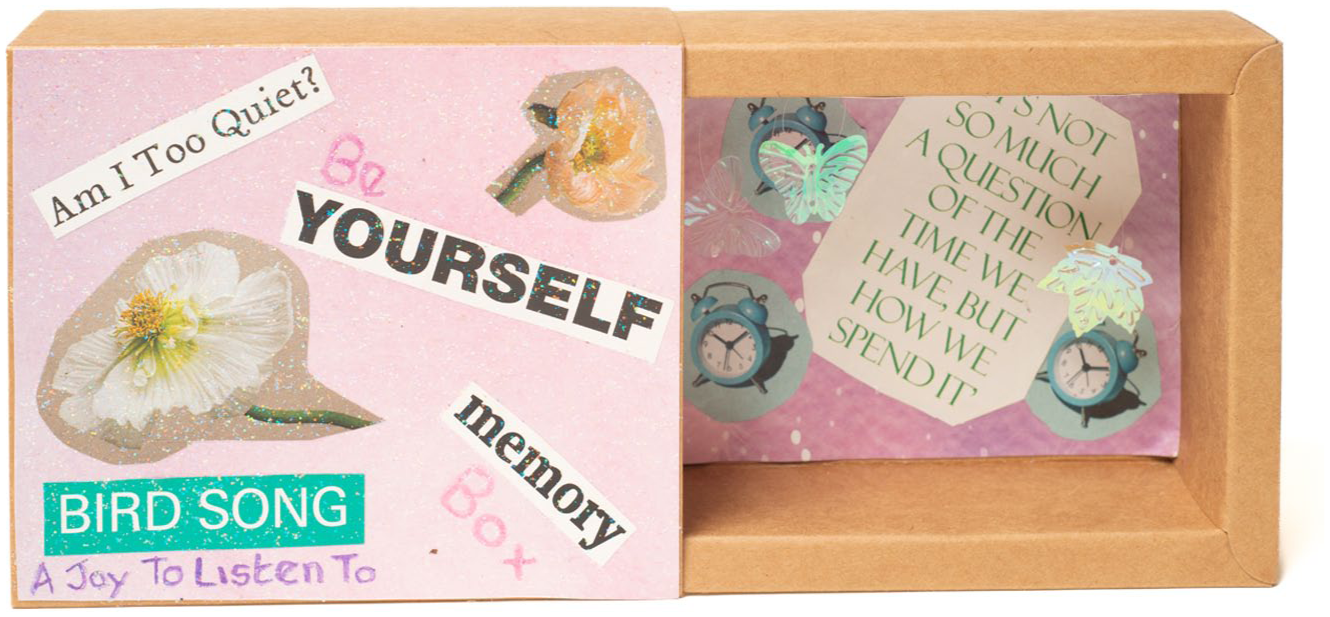
‘Being at the centre’ memory box.
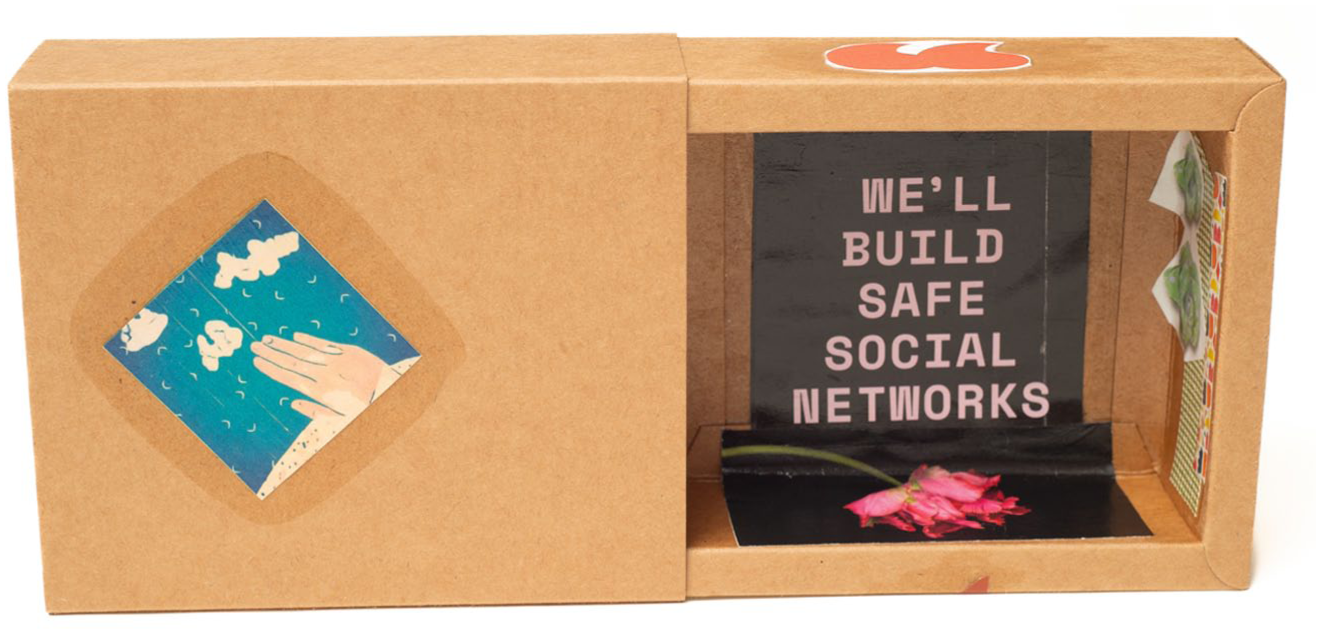
‘We will build safe social networks’ box.
Subsequently, several arts and crafts memory sessions took place at the centre café that were open to all peer support groups who engaged in the making of memory boxes and artwork while also sharing their memories of attending the centre over the years through reminiscence activities and oral history interviews. Several users of the centre reflected in their interviews on how place-based care therein helped their recovery during their mental health journeys. Many stressed the importance of the Middle Street centre being run on a peer support model where, alongside professional staff, centre users support each other. Being able to find someone who empathises with mental health challenges was seen as the key aspect of feeling valued. One centre user recalled that ‘you can come along with any lived experience of mental health, no matter how old you are, no matter how you live. If you want to come along and be part of it, you’re really welcome to join in’.
16
Another centre user explained: The centre enables people to help themselves. I think that’s a good way of putting it because, you’re not gonna get all the help you need here, but in some respects it gives you the ability to meet other people and feel better about yourself and develop the tenacity within yourself to make things in your own life better.
17
As part of the memory-making art and craft sessions in the café, centre users and volunteers collaboratively produced an art piece that weaves memories of Middle Street into a depiction of the centre’s garden. Several people spoke of an activity they had participated in a few years back, where they had built two clouds to represent positive and negative thoughts. The negative cloud was then shredded as a way to process these thoughts. Based on this idea, the centre users used papier mache to create two storm clouds for the group to decorate in a later session and reflect on this key memory. They also weaved messages related to supporting their mental health in the memory box (see Figure 4).
18
The making of the group memory box helped some of the centre users reflect on the drive behind the campaign to save the centre from closure. One man recalled: I resisted closure because after struggling with mood swings for many years on my own, I found it to be an invaluable resource. The possibility of it shutting down felt like a loss of my future. The centre holds immense significance for me and has been a lifeline for many others for decades, which is why we fought passionately to keep it open.
19
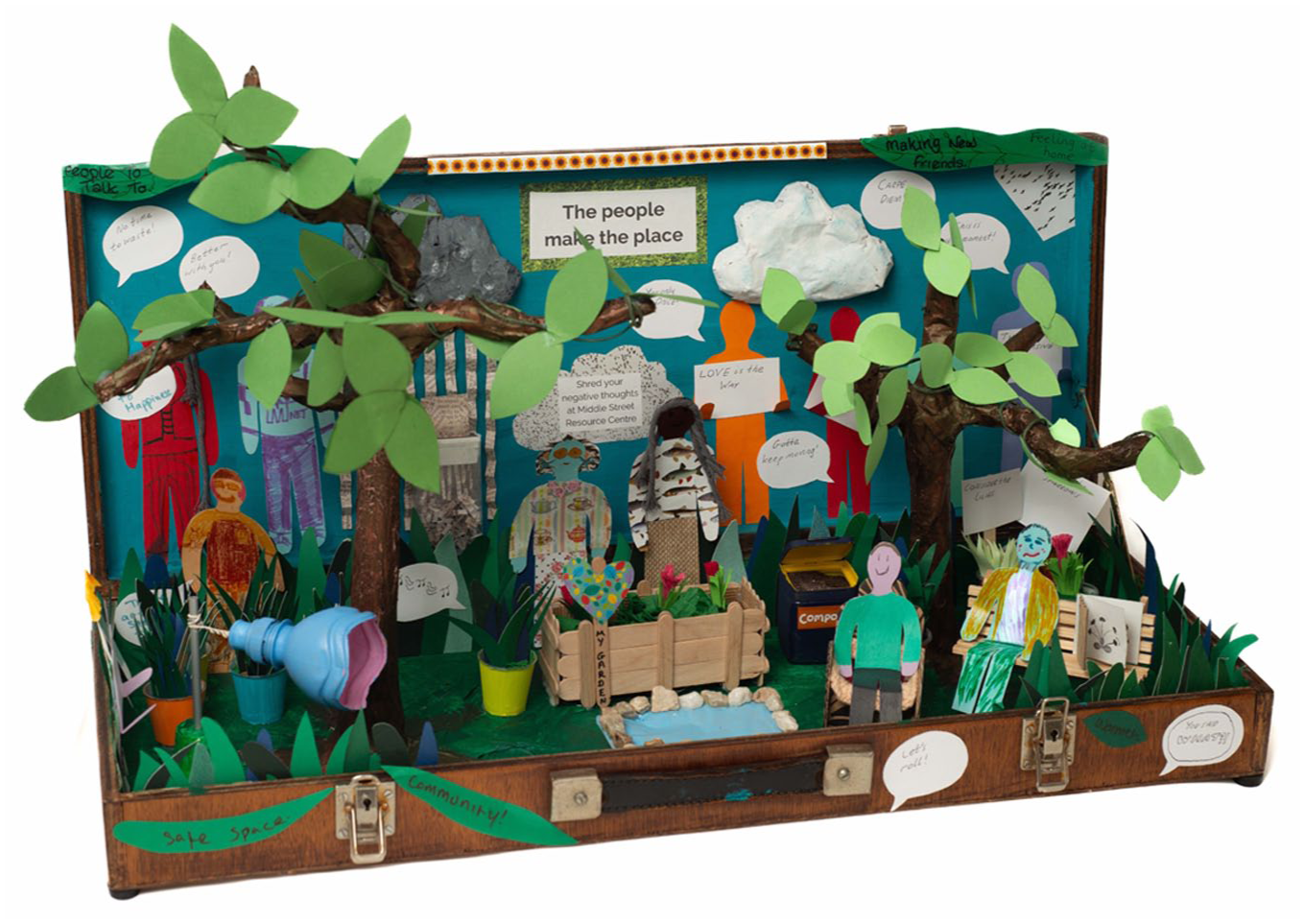
The ‘people make the place’ memory box.
The memory-making work that took place to explore individual and collective memories of the day centre, informed by deliberate participatory and slow art-based practices of remembrance, acted as critical interventions and became transformative for the service users involved. As a result of participation, their confidence in making art and engaging with people outside of the centre increased. One notable outcome of their involvement in the project includes several of the people who use the centre joining other local creative groups and taking a more active part in mainstream activities. 20 The artwork, including the resulting exhibition, was put on display at the day centre. The exhibition feedback received from individuals who rely on the centre for mental health support was overwhelmingly positive and acted as a platform for centre users to provide feedback to the staff and volunteers. Overall, centre users felt the exhibition portrayed the welcoming and supportive atmosphere of the centre, while staff and volunteers felt that it challenged stereotypical perceptions of day centres and showcased the importance of the long-term psychosocial support it provides, including the impetus behind the campaign to save it from closure. Many participants expressed a strong sense of pride in having their artwork and memories featured in a public exhibition. One service user remarked that ‘I would be lost without the centre, lovely to see it being celebrated’, while a volunteer commented that ‘the centre is a special place, this comes through the exhibition’. Another service user reflected that ‘I’m thankful for the staff’s help and support over the years, I wouldn’t be here without it’.
The art-based memory pieces were an integral part of the exhibition that toured in local libraries, where art-based workshops were offered to the public. The feedback from the visitors of the exhibition evidenced improved public understanding of the needs of people with mental health struggles. One person commented that ‘I found it [the exhibition] very illuminating. I am not local, but it appears to play a very important role in the culture of mental health/society’. Another reflected that it was ‘a powerful reminder of the value of collective experience in shaping how we make sense of madness and distress’. Another visitor noted: ‘Fascinating insight, learned a lot from the stories, very valuable to have this resource because it helps me understand the importance of this type of care centre’. 21
Slow memory practices represent a transformative approach to documenting and understanding the neglected historical narratives of people at the receiving end of the mental health system. The individual and collective meanings attached to the centre highlight how service users value access to place-based psychosocial support, despite the policy imperative of inclusion arguing against this form of provision (Bryant, 2010, 2011). The modernisation of mental health services failed to consider the difficulties individuals with long-term mental health conditions face in accessing social networks in the wider society, including social stigma and the fluctuating nature of mental illness (Ahad et al., 2023; Corrigan and Watson, 2002).
Counter-memories of care
The slow processes of remembering that took place through the making of memory pieces act as a form of counter-memories that help not only to remember those who are often ignored, forgotten or misrepresented in the long and uneven history of psychiatry and mental healthcare (Calabria and Ellis, 2024) but also to co-construct novel ways of understanding their present realities. Inclusive, place-based art approaches are particularly suitable for co-constructing counter-memories that subvert the official version of the narrative of progress that runs through social policy in England, which has done away with communal spaces for people with mental ill health. As Wynter et al. (2023: 1–16) have argued, it is impossible to discuss the history of psychiatry, mental health and institutions without also considering the reform, changes and continuities (as well as discontinuities or recapitulations) that have occurred over time. The constant recalling of the trope of the ‘bad old days’ has been essential to the development of modern mental healthcare. This pattern of myth and memory about the inherent nature of progress in mental healthcare continues to be repeated in public discourse today. This has contributed to a cycle of despising the past and failing to acknowledge the present reality of mental healthcare. However, as the memories shared by service users demonstrate, this day centre’s history cannot be neatly separated from its institutional past. The centre represents both a departure from and a residual echo of earlier models of care, an ambivalence that becomes visible only when slow memory practices allow for reflection on these continuities and ruptures. While official history often suppresses alternative memories, counter-memories provide alternative stories that challenge hegemonic discourses. The slow participatory process of remembering made it possible to resurface some of the silenced histories of the people who have relied on the Middle Street Resource Centre over the decades and fought against its demise. These counter-memories restore their temporal and spatial care needs based on their experiential knowledge that would otherwise remain invisible due to the epistemic injustices they continue to experience (Fricker, 2009).
Demos (2012) defines counter-memory as a collective practice aimed at relearning forgotten, suppressed or excluded histories, positioning it as a form of resistance against the pervasive influence of the spectacle in society. Tello (2022: 391) cites Demos in her examination of the concept of counter-memory in the context of global contemporaneity, framing it as a means to challenge dominant historical narratives and power structures. Demos further emphasises that counter-memory work is inherently social and political, serving as a means to contest and redefine the ways history is constructed and remembered. By engaging with counter-memory, artists and communities can disrupt conventional representations of the past, offering alternative perspectives that challenge the status quo. For Tello (2022), counter-memory practices work to subvert established, hegemonic accounts of history. Chowdhury identifies what she terms ‘fugitive memory’, namely recollections that remain concealed, indirect or held in fragile affective forms when political or institutional conditions make explicit articulation unsafe. Such memories ‘survive hidden from official view’ and surface only when a supportive community or context enables them to be voiced (Chowdhury, 2025: 584). The slow, participatory practices at Middle Street created precisely such conditions, allowing long-suppressed experiences of care, loss and resistance to emerge as counter-memories that challenge dominant narratives of progress in mental health policy.
Slow practices of remembering and the creation of counter-memories are crucial for understanding the gaps and misremembering that pertain to the evolution of mental health practices and policies, as they provide insights into the lived realities of those who have been subjected to transformations of welfare systems. These counter-memories give a radical meaning to the past by exposing some of the tensions and contradictions in mental health policy developments, problemitising the accepted wisdom of progress in mental health policy, such as the imperative of inclusion (Machin et al., 2023) under the vestiges of modernising mental health services (Bryant, 2010, 2011) which has over emphasised individualised care through personal budgets at the expense of collective needs and communal services. Several of the people with lived experience who volunteered or worked at Middle Street Resource Centre over the last 50 years recalled the devastating effects of self-directed support and budgets. These policy changes were nicknamed ‘state-imposed solitude’ and the ‘systematic destruction of services’.
These counter-memories can be understood as a manifestation of memory activism, questioning widely accepted historical narratives by subverting the hegemonic history of the modernisation of mental health services while emphasising the agency of the subaltern voices (Gutman, 2017). While activism broadly seeks social or political change, memory activism specifically uses the production, circulation and contestation of memories to challenge dominant narratives and advocate for justice. Assmann (2023) notes that memory activism emphasises the importance of individual and collective actors in extending our understanding of state and civil society relations. It has often originated from grassroots movements that challenge oppressive silences and injustices, seeking to reclaim the past as a means of advancing restorative justice and fostering social inclusion (Assmann, 2023: 2). In this vein, memory activism in the context of psychiatry can be traced back to 1980s campaigns by disability rights movement who fought against coercion in the mental health system (Barnes and Cotterell, 2012). More recently, the long-term impact of diminishing services, coupled with cuts to the welfare system, has given rise to a new wave of activism in mental health in which service user groups and their allies now fight to keep these services open and demand access to them (Calabria, 2024; Spandler, 2016). The long-term users of the centre who participated in the project are part of this social movement; all were involved in the campaign to save the centre in the 2010s, which they won. Gutman and Wüstenberg (2023: 5) argue that one of the goals of memory activism is to ‘achieve mnemonic or political change by working outside state channels’. In this context, memory is called upon to ‘as the crucial way of intervening in the process of societal change from below’ (2023: 6). In essence, the service users of the day centre set out to effect mnemonic change (Gutman and Wüstenberg, 2022) in their strategic efforts to challenge dominant narratives about the past of mental healthcare, aiming to alter public understanding of placed-based care as undesirable through the various co-produced heritage assets created as part of the project, such as the exhibition and a film documentary. This form of memory activism can be seen as extending beyond mnemonic change ‘to the larger societal transformation of policy and norms through targeting the dominant perception of a certain past in the present’. (Gutman and Wüstenberg, 2023: 9). In this context, the project of exploring and making visible the legacy of the day centre became a vehicle to reshape the collective memory of past models of place-based care.
Conclusion
Slow-paced, reflective art-based memory work emerged as a significant inclusive methodological approach in researching memories of social support and relational care at the day centre, providing a platform for marginalised voices to resurface and help expose the fallacy of progress in mental health policy. The group artwork and individual and group memory boxes helped to facilitate inter-subjective encounters that engendered new interpretations of the meanings attached to place-based care. This slow memory work is essential to build a more comprehensive understanding of how the past was lived by local communities, such as the people who have relied on peer support at Middle Street Resource Centre for decades, otherwise excluded from mainstream society. The co-produced memories of the people who rely on this mental health day centre help to uncover the impact of structural divestment from community provision for people with serious, long-term mental health conditions, particularly for older people. It demonstrates the paramount importance of place-based care as a collective form of support that goes against the individualised care rhetoric in mental health policy, shining a light on knowledge gaps that continue to persist in the history and contemporary practices of mental healthcare and treatment. The project’s findings also resonate with Chowdhury’s (2025) notion of fugitive memory, whereby marginalised experiences remain concealed until the conditions are right for them to surface. Slow, participatory methods created such conditions at Middle Street, allowing suppressed recollections of care, loss and resistance to emerge and to reframe how the past of mental healthcare is understood and remembered.
The adoption of a slow memory, participatory-led approach that embraced the arts promoted democratic relations between all involved by challenging traditional power relations in defining what constitutes adequate care and support. People with enduring mental health difficulties have remained underserved throughout the long history of mental healthcare, albeit in different ways. Exploring historical silences about the lived experiences of those at the receiving end of mental healthcare can help to unearth the uneven and often non-linear nature of the major transformations that have occurred within the field in its long history. This article has highlighted the erasure of the central role of place-based mental health services in the form of day centres as long-term structures in providing crucial social support to people with serious mental ill health. Moreover, these counter-memories help to bring to light the importance of relational spaces beyond the bounds of the mental health system.
In conclusion, practices of remembering that are intentionally participatory and slow-paced serve as a vital tool in researching the social history of mental healthcare, enabling researchers to engage with, make sense of, and represent embodied and relational qualities of collaborative research interactions. These practices can recognise and respect the experiential knowledge and agency of otherwise marginalised actors through creative and inclusive memory-making methodologies. As the Heritage of Middle Street project has evidenced, people with lived experience of mental distress can contribute their expertise in creating an important resource for re-imagining the hegemonic memory of mental healthcare in England. Acknowledging this alternative representation of the past of mental healthcare, and keeping this counter-memory alive, holds the greatest potential for community recognition, accountability and action; it also has the capacity to build a body of knowledge that can fundamentally reshape public understanding of what it means to care and to be cared for.
Footnotes
Acknowledgements
This article is based upon work from COST Action Slow Memory: Transformative Practices for Times of Uneven and Accelerating Change, CA20105, supported by COST (European Cooperation in Science and Technology). The author would also like to thank the participants in the project for sharing their lived experiences, informing this article and future research.
Ethical considerations
Ethical approval to collect these memories was granted by Nottingham Trent University, and informed consent was gained from all participants to collect and publish the data that has informed this article, including the artwork images.
Funding
The author disclosed receipt of the following financial support for the research, authorship, and/or publication of this article: This research was supported by an external grant from the National Lottery Heritage Fund.
Declaration of conflicting interests
The author declared no potential conflicts of interest with respect to the research, authorship and/or publication of this article.
Data availability statement
Portions of the dataset used in this research are openly accessible through the project’s website: https://www.mentalhealthcarememories.co.uk. Other components, including interview recordings and transcripts are deposited with East Midlands Oral History Archive:  . These are subject to access restrictions. Researchers may apply to the archive for controlled access following its standard procedures.