




Abstract
Taking Bosnia-Herzegovina as a case study, this article examines how memory activists, acting at the meso-level, use digital media to implement various counter-memory strategies in relation to the war of 1992–1995. A variety of practices at the margins of official historical discourses, which are still dominated by victimization and hatred, are examined and examples from both the literature and original empirical data are used to show how, in an extremely tense political climate, memory activists can use diverse strategies and tools to allow new representations of the past to circulate, bringing about mnemonic change. I suggest that memory activists in BiH, although operating in a public sphere governed by ethnonationalist divisions and political parallelism, use digital media as an arena, space, or repository for counter-memory narratives. Supported by thematic analysis, this interdisciplinary research paper responds to a need for contemporary empirical research on media memory activism and opens new perspectives for future interdisciplinary studies of these issues in other divided societies.
Recent work by scholars in memory studies and media studies has provided a glimpse into the expanded sphere of speech made available to marginalized groups by digital media. The Black Lives Matter and #MeToo movements have demonstrated the power of social networks in bringing the narratives of marginalized groups to the forefront of local, national, and transnational news (Jackson, 2021; Pine, 2023), while important studies have shown how the digital public sphere encourages debate about specific monuments or commemorations (Birkner and Donk, 2020; Bosch, 2017). The discussion of current events, such as the Russian invasion of Ukraine, in the digital environment demonstrates how collective memory struggles are also fought out in real time during traumatic events (Olzacka, 2024). The case studies explored in this article illustrate the challenges involved in circulating counter-memories in post-conflict societies in which the past is contested. Almost 25 years after the last war, Bosnia-Herzegovina (BiH) is still a divided society in which memory politics “seem to be in a deadlock—split and paralyzed between dominant nationalist memory approaches that will not budge from their essentialist positions” (Moll, 2013: 930). The counter-memories of minority groups or inclusive forms of remembrance are rarely discussed in the mass media. This “information blockade” (Lievrouw, 2011) makes memory activism, the “strategic commemoration of a contested past to achieve mnemonic or political change by working outside state channels” (Gutman and Wüstenberg, 2023: 5), more difficult. Based on the results of a thematic analysis, this article suggests a typology of the relationships between the counter-memory strategies deployed by various memory activists “organized from below” and their use of digital media to “compete for legitimacy for their interpretations of the past [and] taking a public stance vis-à-vis other actors in the public space” (Gutman and Wüstenberg, 2022: 1072). These plural and non-exclusive strategies are pursued not only by actors from independent and alternative media but also by individuals and groups working for NGOs, museums, and civic initiatives. Acting at the meso-level of remembrance, a level often overlooked in the Memory Studies literature (Keightley et al., 2019), these mnemonic actors benefit from new media and technologies to promote counter-memory narratives and create new spaces for sharing that are not limited by the usual boundaries of ethno-nationalism. Various strategies, combined with the mobilization of diverse digital tools, enable counter-memories to circulate in an “unmoored” digital public space (Zucker and Simon, 2020). Recognizing that, as Gutman and Wüstenberg (2022) have shown, counter-memory activities are not the exclusive domain of progressive memory activists, the analysis sheds light on practices geared toward transitional justice, using an extended definition of the term that goes well beyond legal procedures to include cultural and political dimensions (Simić, 2020) within in the Bosnian context (Koinova and Karabegović, 2017: 215–216). To meet these goals, this article is divided into three sections. The first presents a brief review of the literature on counter-memories—narratives that structure strategies and actions that rebut those in the official public memory—and on media memory activism—how these stories are presented to the target audience. The second section presents an analytical typology demonstrating that contemporary media and digital technologies in BiH can go beyond the wall or “blockade” of mass media to be used as an arena, space, or repository in which counter-memory narratives can be circulated in the public sphere. This qualitative research was conducted using discourse analysis, observation, and thematic analysis of 26 semi-structured interviews conducted in the field in 2021 and 2022 in both the Federation of Bosnia and Herzegovina (FBiH) and the Republika Srpska (RS). The concluding section discusses findings from the different strategies observed and the impact of digital media on dealing with the past in post-conflict Bosnia.
Counter-memory and memory activism
Foucault et al. (1977) defines counter-memory as “a transformation of history into a totally different form of time” (p. 160). That idea of a social memory that opposes official narratives about the past has been discussed by authors in cultural studies (Bold et al., 2002), political science (Auchter, 2017; Edkins, 2003) geography (Legg, 2005), feminist studies (Hirsch and Smith, 2002), and history (Boym, 2001). While the vast majority of counter-memory research is empirical and oriented toward analyzing the production and reception of specific initiatives, some common ground has been developed through critical studies (Tello, 2022). Dealing with the forms and functions of counter-memory, Wegner (2020) identifies four characteristics of counter-memory: “It is necessarily related and in opposition to another memory. It employs two different time horizons and enables transcultural memory negotiations. Finally, there are instances of moderate and radical uses of countermemory” (p. 1219). While the temporal question invariably appears in work related to counter-memory, the oppositional and transcultural characteristics of this definition are particularly important for BiH. First, counter-memory involves the concept of hegemony, which recognizes the importance of “localized experiences with oppression, using them to reframe and refocus dominant narratives purporting to represent universal experience” (Lipsitz, 2001: 213). Counter-memory is then an integral part of the power relations at work in any society, sometimes in a very visible way as in #BLM or more clandestinely as with the Last Address project in Russia. 1 Research on counter-memory in specific fields such as feminist studies has shown “that the content, sources, and experiences that are recalled, forgotten, or suppressed are of profound political significance” (Hirsch and Smith, 2002: 12). Second, the transcultural dimension evoked by Wegner is central to critical studies, such as postcolonial studies (Chakrabarty, 2007), that call for the deconstruction of dominant historical narratives and the inclusion of plural perspectives on global phenomena such as ecological crises or security relations. The transcultural characteristic has made a lasting mark on memory studies through Erll’s (2011) work on “travelling memory,” which calls for a disengagement from borders “based on the insight that memory fundamentally means movement” (p. 15), whether across time or space. Such work, part of the third wave of memory studies, is also important in the development of research into memory activism. Both a concept and a tool for analysis, memory activism makes it possible to observe how non-state actors manage to “cross a variety of borders” (Gutman and Wüstenberg, 2023: 8) to develop strategic actions that are embodied in a local context. As Radstone (2011) aptly reminds us, “even when (and if) memory travels, it is only ever instantiated locally, in a specific place and at a particular time” (p. 117). For memory activists, mediating their actions is thus essential to making these memories travel and digital media provide tools for accessing people and stories that have been silenced for many years, and for strategically circulating these narratives in the public sphere.
Public sphere, counter-narratives, and media memory activism
Following Connerton (1989), who saw cultural memory as an “act of transfer” (p. 39), analyses linking memory, media, and journalism have stressed that media “play an active role in shaping our understanding of the past, in ‘mediating’ between us (as readers, viewers, listeners) and past experiences, and hence in setting the agenda for future acts of remembrance within society” (Erll and Rigney, 2009: 11). In On Media Memory (Neiger et al., 2011), Journalism and Memory (Zelizer and Tenenboim-Weinblatt, 2014), and Save As—Digital Memories (Garde-Hansen et al., 2009), the authors have moved beyond a limited understanding of media as “the first draft of history” by focusing on the dynamics and processes that enable collective memories,—and counter-narratives in particular—to circulate in the public sphere. The public sphere, a Habermasian concept generally understood as a space of expression free of constraint that allows the formation of public opinion and eventually influences politics (Aubin and Rueff, 2016; Dahlgren, 1994), is an essential component of democracy given its importance to the development of an independent press. For scholars such as Nancy Fraser (1992), Habermas, by idealizing the bourgeois public sphere, ignored the possibility that counter-publics could be formed and act. She suggests instead that subaltern counter-publics “invent and circulate counter-discourses to formulate oppositional interpretations of their identities, interests, and needs” (p. 123), while Warner (2002) suggests that counter-discourse does not simply represent an alternative but aims to transform power relations. 2 Discussing the relationship between memory and discourse, Prendergast (2020) insists that “counter-memories have the same destabilizing aim as counter-discourses, in ‘directly opposing the master commemorative narrative, operating under and against its hegemony . . . in hostile and subversive relation (to it) (Zerubavel, 1995)” (p. 1039).
The issue of how such alternative narratives circulate despite the barriers imposed by dominant mnemonic entrepreneurs has received increasing attention in Media Studies and Memory Studies since 2010: the third wave of memory studies focused more on the “relational and processual” approach to memory transmission (Wüstenberg and Sierp, 2020: 3), while the development of the subfield of digital memory studies (Hoskins, 2018) showed how new technologies have made it easier to integrate alternative narratives, largely driven by developments in social media, into the counter-memory analysis (Birkner and Donk, 2020; Cieslik-Miskimen and Robinson, 2019). The impact of these media phenomena is such that Hoskins (2011, 2018) has moved from talking about collective memory to discussing a “connected new memory ecology,” recognizing that the media/memory nexus is disrupted by public participation in online environments, These new technologies also enable media memory activism, i.e. “when memory activists operate in various mediated spheres to fulfill their mnemonic goals” (Tirosh, 2023: 270), making counter-memory narratives (including archives, pictures, etc.) available to new audiences, local, national, and international.
Counter-memory strategies and digital media in Bosnia
Given BiH’s deep divisions and corrupt political class, as well as the exodus of many of its important social actors, hopes are dwindling for reconciliation and the end of conflict (Majstorović and Vučkovac, 2022). Since the signing of the Dayton Peace Agreement, the main ethnonationalist parties have turned from armed violence to a symbolic war. Through their speeches and actions, memory entrepreneurs are fueling the divisions between the three main ethnic groups in the country, the Serbs, Croats, and Bosniaks. As Kukić (2021) notes, in postwar BiH “we are all obliged to remember ethnically, not ethically 3 ” (para. 13). This stranglehold prevents civil society from benefiting from the memorial competitions of local elites (Jeftic, 2020). While part of the population acknowledges gray areas in the interpretation of the recent past (Andersen and Borčak, 2022), a majority, especially among the younger generations, prefers to stay away from such debates (Carabelli, 2018; Hromadžić, 2015). With the territory now largely fractured along ethnocultural lines, it is difficult for counter-memorial narratives presented by minority groups, or by other activists who refuse to accept the ethnonational division of society, to be heard. Nevertheless, many participants I met felt that, even if obstacles often seem insurmountable, reconciling the present with the past is a necessity: “if you move in any direction in your life, you will face it. This war is somehow the Zero point for this society” (CNA activist, 15 October 2021, personal communication). Memory activists use different strategic actions to enter the public sphere, relaying counter-discourses or creating original counter-memorial contents. Drawing on Trevisanut’s work, I suggest that two main strategies are being used in counter-memory initiatives in Bosnia.
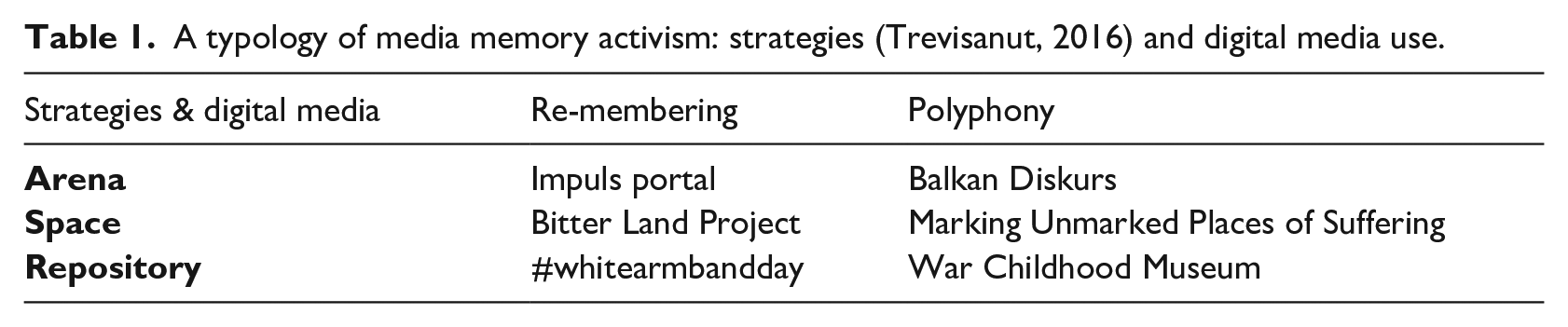
The first strategy, re-membering, arises from a desire to challenge official political memory and history “via the representation of situated knowledge and memory.” This strategy must be “performed by those who occupy and speak from a position of alterity” (Trevisanut, 2016: 48). 4 The second strategy, polyphony, includes strategies that advocate the acceptance of multiple narratives and perspectives in relation to an event or place by rejecting imposed linear and causal chronologies (Trevisanut, 2016: 48). 5 These strategies, understood as socio-cultural practices (Gutman and Wüstenberg, 2022), take different mediated forms to reach the public. In observing these processes in the literature and directly in the field, I developed an analytical typology based on the idea that memory activists in BiH use digital media as an arena, space, or repository that makes it possible to move beyond the wall that represents the traditional public sphere to create and circulate counter-memories (Table 1). The idea of the media as a wall is presented using recent studies by local NGOs as well as interviews with experts. Then, both strategies are considered in relation to three initiatives by memory activists in the context of post-conflict Bosnia-Herzegovina.
A typology of media memory activism: strategies (Trevisanut, 2016) and digital media use.
Mass media as a wall or “information blockade” in BiH
While an internationally led reform of the media took place in the years following the war, its results continue to be disputed (Jusić and Ahmetašević, 2013; Šajkaš and Tadić Mijović, 2016) and the mass media in BiH are still strongly divided along ideological, ethnonationalist, and religious lines (Turčilo and Buljubašić, 2017). This small country of 3.5 million people has more media outlets per capita than almost any other country in the world but these outlets lack sufficient revenue and are “unable to afford professional journalists, [and] often have to resort to ‘cheap’ partisanship, which is hardly rooted in a coherent editorial or ideological program but uses opinion journalism and ethnic or nationalist rhetoric to fill the daily news hole” (Voltmer, 2013: 23). Although hate speech is formally prohibited, it continues to appear in different forms: “[It] is more implicit and obvious in the arrogance and neglect of the other, disregard of certain themes that are not included in the agenda or historical revisionism, than it is explicit,” explain Majstorović and Turjačanin (2013: 70). According to observers, political parallelism between the media and political parties in BiH is very high (Voltmer, 2013) and the media that support the ruling parties have privileged access to information and funding. Transparency remains problematic—discussing the Bosnian media sphere, an editor of the Balkan Investigative Reporting Network (BIRN BiH) said that while she agrees that political parallelism is a huge problem, it is not the only one and the precarious situation of journalists is also highly problematic: “half of journalists in Bosnia work for below-average salaries, so I think that’s the one of the reasons how politicians can use them” (25 May 2022, personal communication). 6 Self-censorship is thus almost unavoidable for many journalists. This context makes it very difficult to circulate counter-memory narratives in the mainstream media and is particularly true for news reports about crimes perpetrated by the now-dominant group in each part of the country. Revealing facts or expressing opinions contrary to official memory policies exposes journalists to real threats. Despite awareness campaigns, the BiH Journalists Association has recorded a marked increase in verbal and physical attacks on journalists each year (Radević, 2023) and the situation seems even more problematic outside the capital, particularly in RS. 7 According to an interviewee, it is impossible to have nuanced debates on memorial policies in the Bosnian public sphere. One analyst at the Mediacentar in Sarajevo noted that several established media outlets still fuel divisions by quoting inflammatory discourse from political elites: “they just sometimes copy paste it without any critical sense to get more clicks” (23 May 2022, personal communication). None of the interviewees felt that the quality of the news in mass media in BiH made it possible to have reasonable discussions on how the conflict is remembered. This invisible wall explains why memory activists must find new ways to reach the public.
Digital media as an arena
In Critical Discourse Studies, the mass media are widely studied as a site of power (Wodak and Reisigl, 2019) in which “journalists and their preferred sources [have] more control over the portrayal of the past than any individual or group” (Cieslik-Miskimen and Robinson, 2019: 3). Alternative media and digital technologies offer a way to undermine the status quo and create mnemonic resistance. Referring to what she calls the post-broadcast world, Edy (2014) evokes the possibility that in a contemporary online media environment “feminist, ethnic minority, language minority, or other forms of alternative collective memory might be more easily shared both within the relevant group and with interested outsiders” (p. 74). Alternative media, which once lacked effective ways to reach their audience, can now use digital technologies to work outside the institutionalized media system and find a place in the public sphere. In BiH, these new media have taken advantage of the hybrid media system (Chadwick, 2013) to engage in difficult conversations and propose counter hegemonic narratives about the past. Although the traditional media remain dominant, these newcomers, often assisted by international organizations, are attracting renewed audiences. For journalists dealing with subjects related to memory activism, those alternative media represent a new discursive arena in which it is possible to discuss otherwise taboo subjects. Inexpensive to develop, these platforms not only facilitate the development of movements in the real world but also intend to create
a diverse media space in which any and all voices can be heard, and where anyone may contribute, reporting or opinion with a minimum of prior editorial gatekeeping, reflecting a commitment to speech and participation as the cornerstone of “radical democracy” (Lievrouw, 2011: 121).
Digital media are obviously not a panacea, and Bosnia’s memory activists face the same problems as activists elsewhere, particularly the possibility that an abundance of content available on different platforms can transform an expanded public sphere into multiple “memory silos generated by selective exposure” (Edy, 2014: 76) where counter-discourses and counter-memories will reach only a small and already convinced audience. However, despite these difficulties, the memory activists I met in the field are committed to a variety of strategies involving digital media as a way to break through the “information blockade” (Lievrouw, 2011) and fuel a new conversation about their society and its past.
Impuls
Media control is very strict in RS, but digital websites provide an arena in which it is possible to talk about otherwise taboo subjects, such as the Srebrenica genocide. Created in 2015, the Impuls portal provides extensive reports on difficult issues such as memorialization, corruption, LGBTQ2IA+ rights, and the environment. While regularly threatened by far-right groups and ultra-nationalistic parties, its journalists believe that they must use their voices to move their society beyond the divisions of the past. The first commitment of the journalists I met was to their profession, but the conditions in which they operate are forcing them to put on a second, activist, hat. While they often meet significant resistance to raising the memorial issues of minority groups (particularly the Srebrenica genocide or war crimes committed by RS Army in the Prijedor area Figure 1), they are proud to combat the prevailing silence about those crimes: “we opened many themes that didn’t want to or couldn’t be opened by other journalists who had much more money and resources” (28 May 2022, personal communication). Their strategy involves re-membering, as by providing a discursive space and encouraging exchanges with readers Impuls makes it possible for ostracized groups to participate in important debates about both present society and the past: “We want to show that not everyone in Banja Luka is silent” (Journalist 2, 28 May 2022, personal communication). Impuls is not the only site that provides an alternative to the partisan media system in BiH: Žurnal, Buka, Prometej, Frontal, eTrafika, and Tačno are other examples of this young network of independent voices who have embraced their alterity and oppose official narratives.
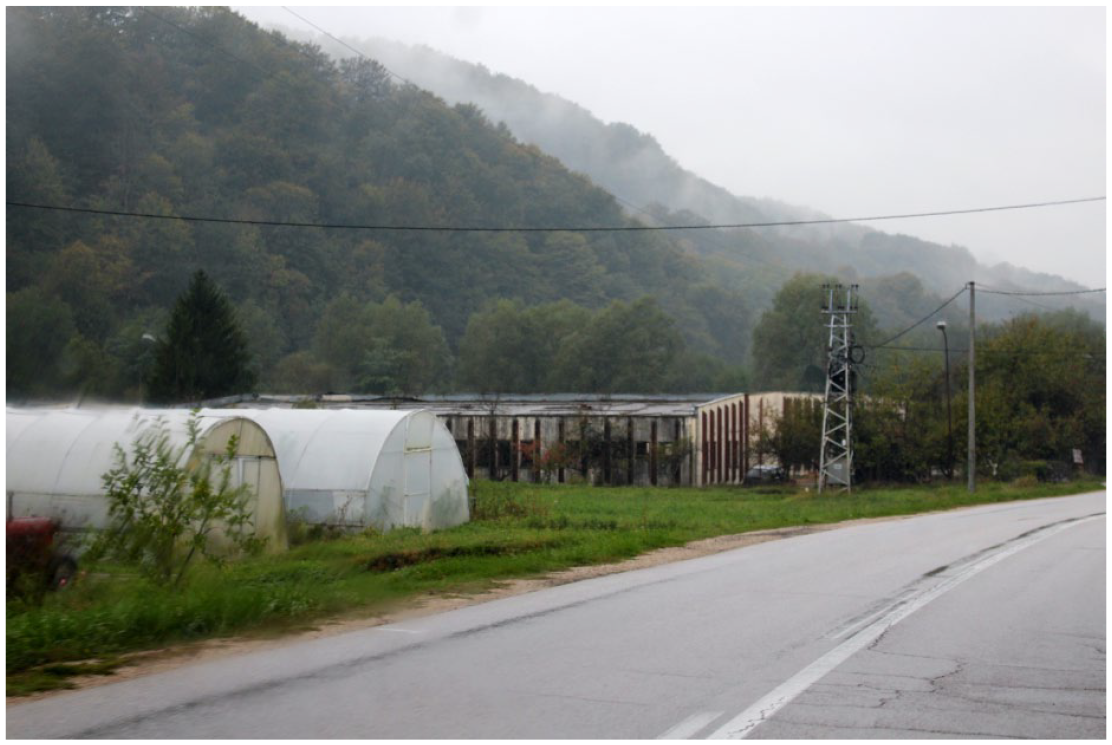
In the RS mainstream media, discussion of the Srebrenica genocide is taboo. Shown here is the Kravica agricultural cooperative, where over 1300 men and children were murdered in July 1995. The municipality commissioned work to erase traces of the genocide and make the site available for development by 2022, a topic avoided in RS media.
Balkan Diskurs
Since its creation in 2015, Balkan Diskurs, a digital platform developed through the Post-Conflict Research Center, has helped over 120 young journalists increase their reporting skills. A unique polyphonic web media, it presents the stories of Bosnian citizens in all parts of the country and the diaspora. Not only does its editorial approach encourage the presentation of a multiplicity of experiences but it offers training to journalists from all parts of Bosnia, regardless of their ethnicity. One of the correspondents interviewed said that this experience “open[ed] a completely new world to me because we got opportunity to talk about things that are usually not talked in our society, especially about topics that concern dealing with the past or reconciliation processes” (26 May 2022, personal communication). Financed by different international organizations, such as the National Endowment for Democracy (NED), Balkan Diskurs has developed numerous editorial projects, including Ordinary Heroes, a compilation of stories that focus on the last war and examples of cooperation between citizens of different ethnic origins, and Love Tales, stories of relationships that transcend ethnic barriers. For one editor,
I think we position ourselves to just sort of be a fresh and different outlook on what citizen journalism can be. We focus on that and providing different but still balanced reporting [mostly] on remembrance and dealing with the past. (26 May 2022, personal communication)
To open new perspectives on the country and its citizens, Balkan Diskurs focuses on the inclusion of diverse voices and subjects as a way to create a new arena for collaboration in a divided country.
Digital media as a space
With the development of new technologies, websites can provide access to new virtual counter-memorial spaces and allow readers to engage with new information formats. A good example is the work done by the Forensic Architecture project, which involved the cooperation of numerous actors (investigative journalists, architects, activists, NGOs) to present investigations using tools such as digital modeling and open-source data processing to uncover human rights violations (Fuller and Weizman, 2021). In many cases, these digital memory projects make it possible for previously isolated communities to come together, share painful experiences, and reappropriate their past in a space understood as “the imaginary counter-side of material place, as the ideational extension of physical presence” (Björkdahl and Kappler, 2019: 387).
To illustrate this discussion, I chose two examples supported by different strategies of interactive online maps that show the locations of mass graves or the sites of human rights violations in BiH and the surrounding region during the 1990s wars. It is easy to link cartography and memory: the real and virtual world are full of maps that point to significant elements of collective history such as archeological sites, places of important battles, and original travel routes. When how conflicts are to be remembered is at stake, other elements and issues become involved (Maisel, 2021). According to Murphy (2023), “memory mapping tends to how memory is housed and anchored in the visual in order to create richly layered, affective webs that link bodies, objects, ghosts, events, and memory narratives to place and to each other” (p. 362). As a map is a symbolic space that captures power relations, counter-mapping or community mapping was first linked to the territorial claims of the First Nations and to resistance to hegemonic narratives in postcolonial societies (Wainwright and Bryan, 2009). It is now mobilized by several groups, including the LGBTQ2IA+ community through the Queering the Map project (Kirby et al., 2021). In post-conflict spaces, and particularly in the Western Balkans, the forensic landscape remains a place of debates, appropriation, and heavy silences while a map of the mass killings is still slowly being drawn. Access and valorization to such data and places enables families and loved ones to anchor their pain and loss in an otherwise inaccessible space.
Bitter land
Anchored in the journalistic community, the Bitter Land project was initiated by BIRN in 2020 to map the mass graves that have been discovered in the area. Each site is linked to a list of judicial decisions, news reports, coordinates, archives, and onsite, satellite, and/or drone images. Bitter Land was begun as a way to advocate for acknowledgment of these places of suffering and formal identification by the state or entity of the location of the mass graves. Many of the sites are not accessible to the families of victims, the result of strong currents of denial and ethnonationalist policies in the country (Ristic and Mulaomerovic, 2020). Still in its early stages, the Bitter Land online database is intended to include informative texts, pictures, testimonies, film, and so on that shed light on these long-hidden places. Of the 42 mass grave sites discovered in the region, only 12 are currently publicly acknowledged. Created as an evolving database, Bitter Land illustrates the magnitude of the human tragedies that have been silenced over the years and promotes “witness citizenship” (Gómez-Barris, 2010). For the victims, who are mainly from minority groups and the diaspora, this visual representation validates their stories and life trajectories, exemplifying the re-membering strategy, that is, allowing these stories to become part of the common story again:
When we were creating this, we also wanted for the family’s members of [victims] and people who survived the war and the genocide, that if they are not able to come there or it’s too difficult for them to travel there, to maybe see online how does it look today and to have some kind of memory of this place . . . that is not just a forgotten piece of land somewhere but [to acknowledge that] somebody is doing something to honor it in a way (Project manager, 31 August 2022, personal communication)
With more than 11,000 people missing in the region, 7000 in BiH alone, collaboration between the population and the editorial team could lead to the discovery of new mass graves and new prosecutions. A virtual audience has begun gathering around the Bitter Land project, which, through mapping the invisible, is slowly becoming a place of engagement, facilitating the creation of an active community of memory.
ONMS
The Marking the Unmarked Places of Suffering (ONMS in Bosnian) initiative was started in 2015 by peace activists at the Center for Non-Violent Action (CNA) who had been working on commemoration initiatives with veterans of the different armed groups in the Bosnian war and came to feel that it was important to visit war landscapes and atrocity sites as a way to recognize the suffering of the “Other.” As part of a polyphonic strategy, the group began to travel throughout BiH to mark places where minority groups, victims not recognized by local authorities, had suffered. At each site, they erect a banner with the following inscription: “At this site, during the past war, people were subjected to inhuman acts. By not letting these events be forgotten, we stand in solidarity with all victims. May it never happen again to anyone.” Since the blue banners are often removed by those who object to this initiative, memory activists publish pictures of each of them, as well as information from local residents, on their website and in social media (Figure 2). Those in the organization feel it is crucial to show victims that their suffering is recognized: “if you are not legally recognized as victims, if you are not recognized in your own community, it’s a huge burden” (CNA activist, 15 October 2021, personal communication). For each action, they make sure to go in different communities to mark places for all ethnic groups of victims involved in the war (Serbs, Bosniaks, Croats). This commitment to the testimonies of the forgotten, or counter-memories, often gives rise to confrontations on social media: “they see that as relativization, they see that as it could harm them or their community, but we are also dealing with them [by engaging in the conversation on social media]” (CNA activist, 15 October 2021, personal communication). This project rests on the idea that space is intimately social. Through the power of images and written narratives associated with different locations, mapping spaces encourages victims, BiH citizens, and international actors to remember the war by linking it to sites that are often forgotten or have been silenced by political actors in the present.
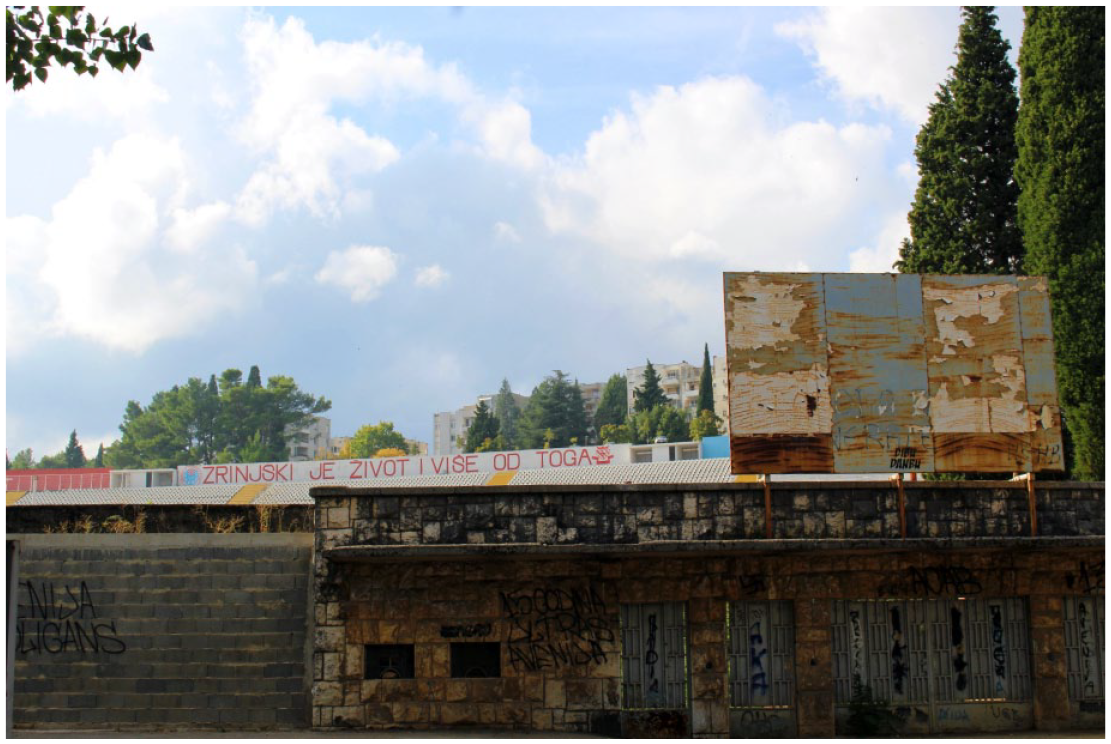
Bijeli brijeg stadium in Mostar. The banner, created by the activist group Marking the Unmarked Places of Suffering (ONMS) in 2019, identifies the site as having been used as a detention camp in 1993. The only remaining traces of their action are images on the organization website.
Digital media as a repository
The development of digital media and social networks, and the hyperconnectivity they create, has led to numerous reflections on how wars are remembered in the public sphere. They have also encouraged new studies on how the audience acts as a content producer in memory-related matters (Khoury, 2020; Schwarzenegger, 2016). A vernacular memory made up of countless pieces of the past (Pickering and Keightley, 2015), first expressed unfiltered and then recuperated and organized around a broader social issue, can enable lasting change (Pine, 2023). Digital technologies now allow individual memories to travel and to transform and be transformed in back-and-forth movements between the micro, meso, and macro levels of society. For example, the transnational movements mentioned in the introduction, such as #MeToo, which began with highly personal and singular narratives, are generating profound social change.
The interscalar dynamics in memory processes (Keightley et al., 2019) is inherent in personal war memories in post-conflict societies. In both examples in this section, meso-level actors use digital media to facilitate connections between individuals who share a common but differentiated experience of the Bosnian war and a wider public. For these memory activists, available narratives serve as a repository on which to base their actions in the media sphere. If the idea of repertoire refers to the (active) practices of memory actors, repository refers to the (passive) material gathered by these same actors by drawing on various mnemonic sources (Zamponi, 2018: 203). Remediated and curated in counter-memory projects, personal memories contribute to the “orchestra of social remembrance . . . new sites and places of memory emerge and are formed through digital media technologies and new memory objects can materialize” (Schwarzenegger and Lohmeier, 2020: 134). These new objects can be both tangible and intangible. In some cases, collected stories become the “raw material” (Reading, 2014: 748) for counter-memorial projects such as exhibitions, movies, or books, while in others, counter-narratives about the past act through digital space and social media. For example, the concept of digital protest or #hashtag memory activism (Bonilla and Rosa, 2015; Fridman and Ristic, 2020) rests on the idea of collecting stories that can travel freely in the digital environment, creating a “solidarity of the shaken” (Patočka, 1996: 134–135) that reaches beyond national borders and effects the real world. The dissemination of a multiplicity of personal narratives related to a contentious past, even if fragmented, can lead to renewed discussion of this past in the public sphere.
#WAD
Since the end of the Bosnian war, many memory activists have been working toward recognition of the crimes perpetrated against their relatives in the Prijedor area, now situated in RS. On May 23, 2012, activist and survivor Emir Hodžić defied local authorities by standing alone in the middle of the central square of Prijedor wearing a white armband. Pictures of his action on the social media site Stop Genocide Denial went viral, prompting many people to photograph themselves with a white armband and to share their personal stories using the hashtag #whitearmbandday. White Armband Day (Dan bijelih traka), organized by local activists, many of whom are Bosnian Serbs, has become an important commemorative event for memory activists and the diaspora, both onsite and online (Fridman and Ristic, 2020; Paul, 2023) as a way to remember the 3,176 victims from the region (Figure 3). Although this counter-memory action has been successful, with strong local, transnational, and transcultural aspects, the public sphere in RS remains largely silent about the crimes committed in the area.
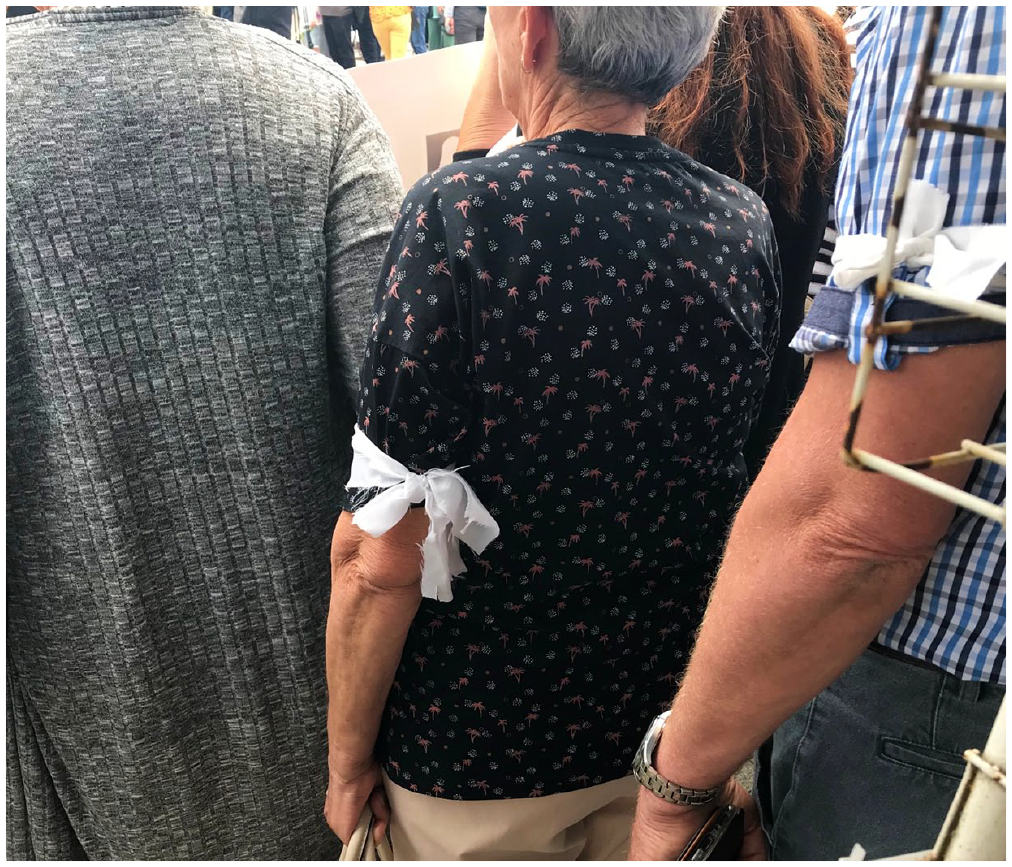
White Armband Day in Prijedor: The armband references May 31, 1992, when non-Serb populations were ordered, by a decree broadcast on the radio, to use a piece of white cloth to identify themselves. This marking would facilitate the sending of thousands of people to the torture camps of Keraterm, Omarska and Trnopolje.
Social media memory activism provides both a meeting point for victims and a source of information (Birkner and Donk, 2020). It demonstrates “how memory-making and -unmaking processes are defined but not limited by place and displacement” (Halilovich, 2022: 29). The initiative now led by Jer me se tiče (Because It Concerns Me) is based on a re-memory strategy aimed at both victims and antinationalist citizens and has been successful in encouraging the circulation of counter-memory narratives. 8 However, it also illustrates the dangers of this type of activism for those in the field: “After my interventions in 2015 there was a lot of public hate on my profile and stuff like that. I first changed my name to pseudonym and then I recently disappeared completely” (Activist Jer me se tiče, 6 September 2022, personal communication). Organizers are also finding the lack of concrete progress increasingly discouraging: “It’s very difficult to see a long-term solution today, short term is even more difficult because of the current radically shift to the right [in RS]” (Activist Jer me se tiče, 6 September 2022, personal communication). In recent years, many activists have chosen to leave the city or the country, exhausted by years of struggle and repression by local authorities and growing far-right groups in the region.
War Childhood Museum
It may be surprising to see a museum discussed in an analysis of the use of media by memorial activists. However, the War Childhood Museum (WCM) in Sarajevo is the result of a question posted on the web in 2010: Jasminko Halilović asked people who, like him, had spent part of their childhood in Sarajevo to provide a 160-character response to the question, “What was a war childhood for you?” After receiving more than 1,500 answers, Halilovic wrote a crowd-sourced book entitled War Childhood: Sarajevo 1992–1995. He and his associates began to collect testimonies and objects related to these stories, which lead to the opening of the WCM in January 2017. The WCM provides a unique resource for coming to terms with the past enabling “all voices to be heard and documented, regardless of national, ethnic, religious, cultural, racial, gender, and geographic backgrounds as well as experiences, beliefs, or world views” (War Childhood Museum, 2023, para. 5). Based on this idea of a polyphonic memory, the new museum quickly became a flagship for tourism in the capital (Mouliou, 2021; Niksic, 2020) and received the 2018 Council of Europe Museum Prize. “We were not well received by anyone, all levels of government were not happy with the initiative, so I think that’s a clear sign that we were doing something right!” (Direction member, 2 September 2022, personal communication). The refusal to identify perpetrators and to remain apolitical has led to criticism by nationalistic news organizations as, for some, the assertion of a collective Bosnian identity is expressed at the expense of the main victims of the war, the Bosnian Muslims.
The raw material retrieved from the web by the WCM team and curated in a museum space is encouraging difficult conversations both locally and transnationally. The team has expanded their activities to other war zones and trained a new team in Ukraine that, while unable to operate in a physical space for the time being, is sharing children’s stories of war as well as photographs of objects, part of a collection unfortunately being created today directly on their Facebook page rather than in the museum space. They also offer workshops by psychologists to help parents talk to their children about war as well as grief and death. Their work demonstrates how sharing the painful individual experiences of war can create new mnemonic solidarities.
Conclusion
This article aims to contribute to the literature on memory and media, focusing primarily on the use of digital tools by memory activists in their shared goal of disseminating and constructing counter-memories in the public sphere of post-conflict societies. It shows that digital media can be an important vector for counter-memories, allowing them to enter the public sphere in divided societies such as Bosnia-Herzegovina. Groups marginalized by hegemonic discourse, led in the Bosnian case by ethnonationalist parties, are able to access an expanded public sphere in which the past can serve to create a better future. The counterpublics being targeted, as suggested by Warner (2002), are not only ethnic minority groups restricted by the dominant political powers but a critical mass of citizens who wish to overcome elite-imposed social divides and find new ways to be heard. Polyphonic strategies, illustrated by the examples of the War Childhood Museum and Balkan Diskurs, open new spaces for less conflictual dialogues between the different groups that form Bosnian society. However, in a society as divided as BiH, where denial of wartime atrocities is on the rise (Suljagić, 2022), actions involving re-membering strategies focused on the issue of justice, such as the Bitter Land project by BiRN-BiH, or the right to commemorate, such as the #WAD initiative, seem also necessary. Activists in BiH, faced with memory policies rooted in the antagonistic and nationalistic, often find themselves forced to choose between this need to recognize the victims’ truth and the necessity of finding ways to live together. One of the keys to escaping this deadlock may be the transcultural characteristics of the counter-memory concept. In the post-Yugoslav space, for instance, there is frequent collaboration between memory activists, forming what Fridman (2022) calls a “region of memory” concentrated around anti-denial work. This kind of work echoes a third counter-memory strategy evocated by Trevisanut (2016): re-appropriation, where symbols and ideas from a common past are used to unify the divided. This idea of a region of (counter) memory in Western Balkans is expressed through transnational mobilizations, online magazines, podcasts, and art exhibitions. As Fridman points out, regional initiatives “hold the potential to bring together more actors and broaden the scope of actions” beyond the reconciliation and consensus urged by international political actors (Fridman, 2022: 186). Another promising avenue is the adoption of a polyphonic strategy coupled with an agonistic memory perspective, which would enable useful confrontations in the public sphere concerning the way the conflict is remembered (Nienass, 2023), as seen in the ONMS initiative. This strategy and media use do not deny that there are still wounds from the last war but focus on the necessary and difficult discussions still to come.
Thematic analysis led me to consider new media as an arena, as a space, and as a repository of counter-memory. It allows for a better understanding of the various trajectories and forms that counter-memory narratives can take in the digital environment in relation to the strategies deployed by activists. This analysis of media memory activism has shown that in all the cases considered, digital media have been much more than a mere means of transmission—they “also constitute the practical field of action where movements themselves are created and contested” (Fridman and Ristic, 2020: 72). They serve as a place to initiate new conversations about the past and to create tools that will enable Bosnian citizens to act as architects of their future. This article also extends an invitation for future research into the deployment of these forms of media memory activism in other post-conflict contexts. Finally, it opens avenues for reflection on the relevance of observing the transformation of conflicts through new perspectives such as generational changes among activists who use digital tools to place counter-memory narratives at the forefront of the public sphere. The activists interviewed for this research are mainly from the 1.5 generation and those of post-memory. This emphasis on these actors allows for the examination of post-conflict dynamics by embracing novel concepts such as “slow memory,” which delves into not only “to what is remembered” but also “the way something is remembered” (Fridman and Pavlaković, 2023: 6). This stance highlights that the “experiences of conflict are not evenly distributed” (McQuaid, 2023: 3), and ultimately, they have an impact on dynamics such as memory and media.
Footnotes
Acknowledgements
I thank the journalists, the editors, the NGOs workers, the artists, and the curators who shared their perspectives on memory activism, media, and journalism with me during my fieldwork in BiH. Thanks, to my director Aurélie Campana and my co-director Dominique Payette for their useful comments, and to the Memory Studies anonymous reviewers for their attentive reading and suggestions.
Declaration of conflicting interests
The author(s) declared no potential conflicts of interest with respect to the research, authorship, and/or publication of this article.
