




Abstract
This article expands the notion of slow curating by placing it in dialogue with debates on slow memory, framing it as an ethical–aesthetic methodology for engaging with interrupted and contested memories. Rather than a fixed function, slow curating is approached as a negotiated field of transformation shaped by the entanglement of objects, contexts and participants. While Johnston describes slow curating as a reflexive and context-responsive practice, here it is expanded into a temporal–political care methodology that sustains hesitation, latency and resonance within the curatorial apparatus.
Drawing on curating-as-verb, together with notions of diffractive temporality and dialectical contemporaneity, the article advances a vocabulary of tactics – dis/placement, re/composition, de/fetishisation and unlearning – tested through a critical reading of Once Upon a Time and Never Again (HLCK), an exhibition staging fragmented childhood memories in fragile co-presence. It concludes by reframing curating as a temporal–political practice through which disrupted memories endure in motion and align with slow memory as a critical horizon where the right to opacity is affirmed.
Introduction
This article examines how slow curating 1 operates as a critical methodology in dialogue with debates on slow memory, reorienting cultural mediation towards processuality, resonance and transformation. Drawing on Carson’s (2019) notion of curating as a verb – an agential practice in constant becoming – it explores slow curating as an evolving practice expanded beyond reflexivity into a temporal–political care methodology.
The argument unfolds through a case study – the exhibition Once Upon a Time and Never Again (Humanitarian Law Center Kosovo (HLCK), 2019; visited 2024) – informed by Agamben (2007), Ingold (2015), Lind (2012) and Mouffe (2013). It shows how slow curating functions as a space where multiple temporalities and memories negotiate their presence. This frame is also shaped by Barad’s (2007) notion of diffractive temporality and Bishop’s (2014) idea of dialectical contemporaneity, which emphasise the non-linear temporalities through which memory emerges. Johnston’s (2014, 2021) community-centred methodology is taken as a starting point and expanded into a temporal–political care methodology aligned with slow memory. Within this horizon, tactics such as dis/placement, re/composition, de/fetishisation and unlearning form a vocabulary of critical gestures. Together, they shape participatory spaces of resonance and co-presence, where intersecting temporalities bring memory into relation.
In this sense, slow curating emerges both as a community-responsive practice and a temporal–political field of latency, resonance and dissent: an ongoing negotiation of histories, futures and ways of being in time. The article contributes to memory studies by situating slow curating as methodological rhythm and temporal–political practice, while advancing a vocabulary of curatorial tactics and articulating their ethical and political implications in contexts of contested memory.
The article moves through three moments: it opens with the conceptual frame of slow curating, turns to Once Upon a Time and Never Again to trace tactics of slow curating at work and closes by considering their ethical and political implications for contested memory.
Unsettling fixity
Curating as a verb
Building on Carson’s (2019) proposition, let us begin by conceiving curating as a verb. The shift – from noun, a bounded profession, to verb, an unfolding action – foregrounds its agential nature and embraces the mutability of things in the world. Seen through this lens, curating appears not to be a static function but a dynamic process, continually shaped by context, relationships and intention. As Ingold (2015) argues, replacing nouns with verbs reveals how the world is never ‘ready to use’ but always in interaction. Curating is thus processual and relational, emerging through contingent engagements (p. 117). This perspective resonates with Lind’s (2012) view of curating as a method rather than a fixed category. She describes it as a craft extending beyond exhibitions and institutional walls – ‘curating in the expanded field’. Practice becomes method, enacted through context, engagement and emergence. This sense of curating as an unfolding craft also aligns with Agamben’s (1993 (1990), 2016 (2014)) reflections on singularity and resistance to categorisation. Singularity inhabits a threshold beyond fixed frameworks.Rather than occupying a predefined role, curating unfolds as an act of enactment—shaped by context, driven by engagement, and always in the making. If meaning, as Wittgenstein (2002 [1921]:§43) suggests, emerges through use, then curating similarly materialises through its entanglement with contexts and relations. Rather than a fixed category, it takes shape through enactment, negotiation, and transformation. While ‘the curatorial’ may suggest a condition, curating foregrounds the process of doing—an unfolding, situated practice. The emphasis is on action: curating as a verb underscores the fluidity and contingency inherent in curatorial work, affirming that meaning is not assigned but continuously shaped. Like language in Wittgenstein’s view, curating draws its meaning from use. Curating dwells in this threshold: a negotiation of becoming, a political act that unsettles taxonomies and resists fixity.
As a mode of practice, curating holds within it the possibility of both resistance and transgression, unsettling dominant structures and opening spaces for dissent – not as spectacle, but as transformation, as ethical attunement to what emerges in relation. As Mouffe (2013: 104) observes, curating becomes, then, an organic movement, unfolding, at its core, as a verb. Nevertheless, curating does not exhaust itself in action; it also thinks and transforms. Its meaning and identity do not pre-exist but emerge relationally, through context and interaction. What matters is not defining ‘what’ curating is, but understanding ‘how’ it happens – how it inclines, how it unfolds as a constellation of relations. It is a practice of becoming attuned to the textures of time, space and presence. This is consistent with Agamben’s (2016 (2014)) notion of singularity as constituted ‘through the practice of the self’. Drawing on Foucault, he describes this as the process whereby the subject is formed through its constitutive relation – remaining immanent: ‘the subject puts itself into play in taking care of itself’, becoming immanent (p. 104). In this sense, curating is not merely a professional practice but an act of care for oneself; care is the path of its constitution. Thus, curating is practised through care of the self, through attunement to the world, shaped by encounters and resonances.
This movement is non-linear: it happens along with, in relation to and through entanglements of subjects, objects and materialities. In doing so, it becomes world (Braidotti, 2013). To consider curating is, in this sense, to follow how it comes to be – what it is shaped by and the tactics it employs, where an ‘ontology of the how coincides with an ethics’ (Agamben, 2016 [2014]: 231): an ethics of being and making in the world, inherently a verb.
Slow curating: another skin for the verb
If curating is a verb – an agential practice always in the making – then the adjective slow lends it another skin. Johnston (2014, 2021) described slow curating as a community-centred, context-responsive methodology, grounded in collaboration and not-knowing. As Laermans (2012) notes, this stance of not-knowing is generative: it opens a space of potentialities without predefinition. Within Johnston’s rhythm, slow curating is less about controlling outcomes than sustaining openness where unexpected relations may emerge. In her doctoral thesis (2021), Johnston consolidated this framework into a seven-step methodology: research, experiment, observation, reflection, dialogue, adaptation and repeat. These steps function not as a linear sequence but as cyclical, open-ended processes grounding curatorial work in engagement and responsiveness to context. Johnston’s rhythm is sustained through collaboration, where research, dialogue and adaptation acquire force only when embedded in trust. In this sense, slow curating is not only a methodological cadence but a situated practice that unfolds with and through communities. Yet slow exceeds process: it interrupts efficiency, unsettles linear expectations and reimagines curating as an ecology of rhythms where duration and resonance shape presence.
Building on this methodology, the article expands it into a temporal–political care methodology. The tactics that follow – dis/placement, re/composition, de-fetishisation and unlearning – do not replace Johnston’s steps but show how curating, once qualified as slow, reconfigures temporality through gestures that sustain latency, resonance and dissent. To add slow to the verb is not mere modification but re-inscription: a new skin that redefines how curating inhabits the world. In this suspension, slow curating becomes a political and ethical–aesthetic act. To qualify a verb is to intensify it, pushing action beyond function and reshaping its force. Slowness here is not passive but an active energy that unsettles, reorders and intervenes, establishing another temporality and mode of presence. It reveals that time is not a linear flow but layered by traces and latencies – echoes persisting beneath the present. Thus, slow curating not only resists acceleration but reconfigures temporality, unsettling paradigms of fixity.
Naming slow curating enacts a shift beyond description, infusing practice with ethical, political and aesthetic dimensions. This echoes Rancière’s (2004) aesthetics, which reconfigures the distribution of the sensible and enhances resonance. In this sense, slow curating disrupts established modes of perception, creating new pathways of engagement while challenging dominant paradigms of visibility and value. By adjectivising curating as slow, the practice subverts productivist temporality, offering presence as dwelling and attention rather than extraction. Embracing non-linear engagement, it lets past, present and future interact unpredictably, dissolving boundaries between memory, perception and anticipation. As Johnston (2021: 78) reminds us, slow curating is not about ‘taking more time’ but about establishing a relational ethic of co-presence and care, where all actants are engaged and linear time is resisted. This insurgent temporality resonates with Braidotti’s (2013) posthuman proposal, where care and slowness counter the accelerationist logic of late capitalism. Within this refusal, slow curating does not merely decelerate but reconfigures visibility and engagement. It celebrates time as lived, attentiveness as unfolding and presence as care.
This resistance is also evident in Rosa’s (2019) notion of ‘deep time’, where deceleration fosters resonance – a deeper engagement with the world requiring openness to the unexpected. To render curating slow is to summon another temporality, one that challenges the hegemonic structure of contemporary time and echoes Lind’s (2012) view of curating as a political act, together with Mouffe’s (2013) agonistic logic. This logic embraces dissensus and plurality, conceiving the world as a ‘pluri-verse’ essential to the democratic public sphere (p. xv). Thus, slow curating is not only an aesthetic stance but a political gesture, reimagining time, place and relation as a resonant horizon of coexistence.
Just as curating as a verb resists essentialism by embracing multiplicity, slow curating extends this resistance into temporality. It challenges not only what is curated but also how engagements unfold. It does not simply contest speed but reconfigures how time is conceived and inhabited. If slow curating is an act of making present, it also raises the question of how we understand the presence of what has been and of what is yet to come. These questions invite a reconsideration of time and memory – not as linear succession, but as a field of tensions, resonances and returns. In resisting acceleration, slow curating also resists fixation, activating latent memories that insist on returning. In this sense, while grounded in Johnston’s methodology, slow curating unfolds as a temporal–political practice. It sustains latencies and reverberations, allowing interrupted memories to return and persist without resolution.
Johnston conceived slow curating as an iterative process – a cycle of research, experiment, observation, reflection, dialogue, adaptation and repeat – that gives the practice its rhythm: a cadence of listening, reciprocity and openness, resonant with Lind’s (2012) notion of curating as expanded method. Within this horizon, practice does not advance towards predefined goals but moves instead through reciprocity, trust and openness to the unexpected. On this terrain, curatorial tactics such as dis/placement, re/composition, de-fetishisation and unlearning act as the operative ‘how’ of practice: gestures materialised in exhibitionary space that reconfigure the experience of memory. They destabilise, reassemble, undo and unlearn. If the steps provide cadence, the tactics give density, embodying curating as a verb: an agential practice, always becoming, defined by its capacity to act in the world. These tactics echo dialectical contemporaneity, where multiple temporalities coexist in friction; they dialogue with the divided present and resonate with a diffractive sense of time as entanglement and intra-action. Here emerges a practice articulating ethics and aesthetics of care within a posthuman horizon, refusing accelerated productivism and opening towards vulnerability and becoming.
Steps and tactics do not compete but complement one another: layered dimensions of a situated practice. The steps mark the slow, relational cadence; the tactics materialise the gestures that give this cadence form in a curatorial apparatus. Together, they configure slow curating as an ethical–aesthetic practice: processual in rhythm, operative in gestures, always in becoming.
Where to land?
Latour’s (2017) question ‘Where to land?’ – posed in the midst of ecological and political turbulence – offers a generative provocation for curatorial thought. If slow curating unsettles the pace of contemporary practice, it equally destabilises the structures of space, revealing that the politics of temporality and spatiality are inseparable, disclosed through latency itself as a temporal–spatial condition where memory, presence and relation remain in continuous negotiation. Slow curating lands at the margins – not as sites of exclusion, but as thresholds of transgression where temporalities and spatialities converge, intersect and cross-pollinate, expanding the boundaries of what is said, shown or remembered. Within these interstitial folds, connections emerge that reconfigure places and times, entangling beings into constellations of relation that sustain socio-aesthetic imagination, collective memory, resilience and care. These gestures – practices of the self unfolded later through the case study – respond to the complexities of the world by shaping rhythms of resonance and circulation that are simultaneously temporal and spatial.
To inhabit these thresholds is to recognise that memory resists erasure and the past reverberates through the present, not as abstraction but as spectral force embedded in time and place. Slow curating is in dialogue here with the concept of slow memory: not merely a form but a productive, insurgent presence that sustains latency, unsettles closure and activates unfinished histories. As Wüstenberg (2023) argues, slow memory rejects event-driven models of history in favour of gradual, often imperceptible transformations – climate crises, deindustrialisation, the expansion of rights – that inscribe themselves in temporal–spatial textures rather than singular ruptures. Far from passive recollection, slow memory is both resistance and activism: an ethical response to slow violence that preserves uncertainty and insists on potentiality. At its core lies the invitation to inhabit the present as a horizon of becoming, where echoes of the past persist as unfulfilled promises pressing upon the now.
Such entanglement resonates with Derrida’s (1993) spectral temporality, where epochs do not succeed one another linearly but remain fractured and ‘out-of-joint’ (p. 20), overlapping and re-emerging unpredictably. Histories unresolved endure as echoes that reshape the present, refusing disappearance. Derrida’s insistence that the past never fully departs but hovers in latency reinforces slow memory’s resistance to closure: memory here is neither archive nor absence, but active presence. Agamben’s (2009) conception of messianic time intensifies this reconfiguration: the present is never singular but divided, interwoven with other times and charged with unrealised potential. To be contemporary is to perceive the darkness of the present while also grasping the possibilities it contains (pp. 52–53). Inhabiting such thresholds, slow curating becomes attuned to latency as both temporal and spatial conditions, unsettling hegemonies while sustaining the unfinished potential of becoming otherwise.
Practices that land in these interstitial zones often deploy dialectical approaches that foreground curatorial materialism (Krasny, 2016), dismantling disciplinary hegemonies through what Mignolo (2009) terms epistemic disobedience, and forging what Sternfeld (2017) describes as performative alliances. Krasny’s notion of curatorial materialism underscores the entanglement of matter, affect and discourse, reminding us that exhibitions are not neutral spaces but material assemblages charged with political and ecological stakes. Sternfeld’s idea of performative alliances highlights the potential of curatorial practice to create solidarities across disciplines, communities and epistemologies – temporary coalitions that resist institutional closure and produce new fields of relation. Together, these perspectives point to curating as an embodied and collective practice, grounded in material entanglements and oriented towards solidarities that remain provisional yet transformative. These gestures expose the difficulty of unsettling categories – time, space and value – that continue to anchor dominant epistemologies. Yet it is precisely here that slow curating insists: not only concerning itself with what is made visible, but with what resurfaces – what lingers, what insists on returning, like memory that never disappears but hovers unresolved. Its presence at the margins is not a retreat but a form of ethical engagement, demanding reconsideration of what is visible, what is valuable and what is possible. If temporality and spatiality are reconfigured by slow curating, so too is value, which ceases to be a fixed attribute and becomes a relational process of recognition, care and coexistence. Slow curating destabilises not only temporal and spatial regimes, but also the architectures through which value is assigned – challenging inherited hierarchies of heritage, questioning what counts as significant and opening space for relational, ethical and affective valuations to emerge. In this sense, slow curating extends beyond the disruption of pace or narrative: it challenges the very architectures through which knowledge and value are structured in society.
Bishop’s (2014) notion of dialectical contemporaneity reinforces this field, articulating a politicised understanding of the present as a fractured constellation where temporal–spatial layers overlap, interfere and renegotiate one another. Contemporaneity here is interruption and suspension, an interval where unfinished histories reverberate with potential futures, disrupting the tyranny of linear progress. Slow curating inhabits this constellation as a practice of unlearning and dissent: resisting closure, sustaining fractures and resonances and opening margins where care, imagination and responsibility persist. To land, then, is to step into indeterminacy as terrain – where memory resists closure, and the unfinished insists.
This cadence of indeterminacy demands not only conceptual reorientation but also iterative, situated practice. Here, slow curating gathers its ethical–aesthetic force in the shared labour of remembrance. Its iterative rhythm – research, experiment, observation, reflection, dialogue, adaptation – remains open to transformation and converges with the voices, silences and decisions of memory communities. In this convergence, slow memory is affirmed not only as horizon but also as practice: sustaining what lingers unresolved, allowing histories to breathe within the present and letting the cadence of slowness materialise as aesthetic gesture, ethical stance and political act. To land, finally, is to enact this shared labour of remembrance as common ground – an answer to Latour’s provocation, where the turbulence of the present meets the unfinished promises of memory.
Curatorial tactics of slowness and potentiality
At this point, slow curating is envisaged as more than a method; situated at the intersection of slow memory and dialectical contemporaneity, it unfolds as a critical mode of engagement – moving beyond exhibition-making and discourse to intervene in the very structures of temporality and meaning. It traverses multiple temporalities, spatialities and modes of being
The exhibition that follows offers glimpses into the tactics previously explored, tracing how they unsettle dominant epistemologies, resist the fetishisation of heritage and invite new modes of engagement. These gestures are not fixed strategies but unfold as openings – points of departure rather than definitive paths – operating as situated, provisional context-attuned operators. For clarity and legibility, the tactics are here unfolded across two movements. 2
Dis/placement enacts the self-repositioning of objects, voices and contexts, generating critical frictions that destabilise inherited frames, staging agonistic memory rather than conciliatory pluralism and allowing latent temporalities to surface. Re/composition assembles open, non-linear constellations of archives, affects and materials, privileging fragmentation, negotiation and co-presence. Here, agency is not centralised but distributed across human and more-than-human participants, reinforcing curating as a field of entangled constellations rather than hierarchical structures. De/fetishisation, here further approached through Agamben’s (2007) profanation, performs a self-desacralisation of heritage, returning artefacts to common use, juxtaposing the institutional and the everyday to redistribute not only visibility but also value – reconfiguring how significance is attributed and exposing curatorial frames. Unlearning affects a self-suspension of mastery, dwelling in hesitation and opening epistemic opacity, creating liminal zones where inherited categories undo themselves and alternative ways of knowing take shape. Co-constituted with communities, these tactics articulate themselves through shared decisions over what may surface and what must remain withheld.
Read together, these tactics materialise slowness as a curatorial practice that remains relational, diffractive and processual
Taken together, these curatorial tactics articulate themselves as a vocabulary through which slow curating comes to recognise itself as an ethical–aesthetic practice, where gestures of care and resonance intertwine with gestures of dissent and critique, making the ethical and the aesthetic inseparable. In this configuration, slow curating sustains latency, holds open spectral presences and mobilises dissent as a condition for memory. It does not resolve the past but allows it to return, unfinished, insisting on the present. These tactics are not proposed as an exhaustive taxonomy, but as openings that unfold differently in other contexts; naming them here offers both an analytical lens and a set of operators for future practice, reconfiguring conditions of visibility, presence and care in the face of interrupted memories.
Once upon a time and never again. Where absence becomes form
Visiting Once Upon a Time and Never Again meant entering a space shaped by insurgent memory and curatorial suspension, where testimony resists translation into pedagogy and refuses containment within reconciliatory frames. Conceived by Blerta Hoçia with the Humanitarian Law Center Kosovo (HLCK), the exhibition rejected both the monumentalisation and the aestheticisation of pain. It located itself within an interstice of ethical listening, spectral presence and shared responsibility. Names and photographs from the Kosovo Memory Book were placed in dialogue with objects entrusted by families, entering the exhibition through processes of collaboration and care. This was not incidental but the outcome of sustained dialogue and trust-building, where families actively determined what could be shared or withheld.
Here, the phases of research, observation, dialogue and adaptation converge: research emerges as a first gesture of care and listening, not an accumulation of information but an opening to what families are willing to share. Research, here, is already relational – an act of co-presence that sets the tone for what follows. From this attentive threshold, observation unfolds – of limits gently set – leading to dialogue about what may become visible and to adaptation shaped by the fragility of what can be entrusted. And yet, as in Johnston’s rhythm, each gesture carries the possibility of return – an unspoken repeat that threads the process with continuity, not closure. In this sense, the exhibition resonates with Johnston’s iterative methodology of slow curating, where outcomes remain contingent, and meaning emerges through responsiveness to context. Such negotiations exemplify slow curating as a relational methodology – situated, dialogical and attuned to the limits of representation. Yet while this iterative process foregrounds the embedded, dialogical dimension of slow curating, the tactics explored below – dis/placement, re/composition, de-fetishisation and unlearning – make visible how these gestures also operate at the level of temporality and form, unsettling dominant curatorial logics and activating memory as latency and resonance.
The title itself opens a rift. Once Upon a Time and Never Again disrupts narrative expectation by transforming what once signalled fantasy into a threshold of violence. It no longer offers a promise of enchantment but reveals a trace of innocence undone. The title does not introduce a tale; it reopens a wound. Between the suspended temporality of the fable and the fractured time of war, an unresolvable chasm emerges – a space where storytelling collapses into silence. From the outset, the exhibition enacts what Bishop (2014: 6) defines as dialectical contemporaneity: ‘the encounter of different historical temporalities within the same space, where the past is activated in order to critique the present and vice versa’. It resists smooth flows of time and generates moments of friction between then and now. Rather than reconcile this fracture, it sustains it.
This refusal of closure finds immediate spatial and material expression in the Wall of Names. The years 1998–2000 are inscribed in large, open figures, setting the temporal frame for what follows. Beneath them, the memory of 1133 children—1024 killed, 109 missing – spreads across the white walls, where thousands of names, etched in fragile lines, accumulate as a silent, resonant invocation (Figure 1). Each of these names is the outcome of long-term research and dialogue carried out by the HLCK with families across Kosovo. The act of inscription, therefore, does not only mark absence; it embodies the slow and painstaking process through which testimony, verification and trust were built. This gesture directly recalls the research phase of slow curating, where the gathering of voices and verification of memory is inseparable from relationships of trust. If the title already opened a rift, the Wall of Names materialises this refusal spatially and visually. Not simply echoing monumental traits – alignment, frontality, scale – it subverts them, refusing the stabilisation of memory into a resolved form. What unfolds is not a monument, but a surface of latency: an open field of absence and implication.
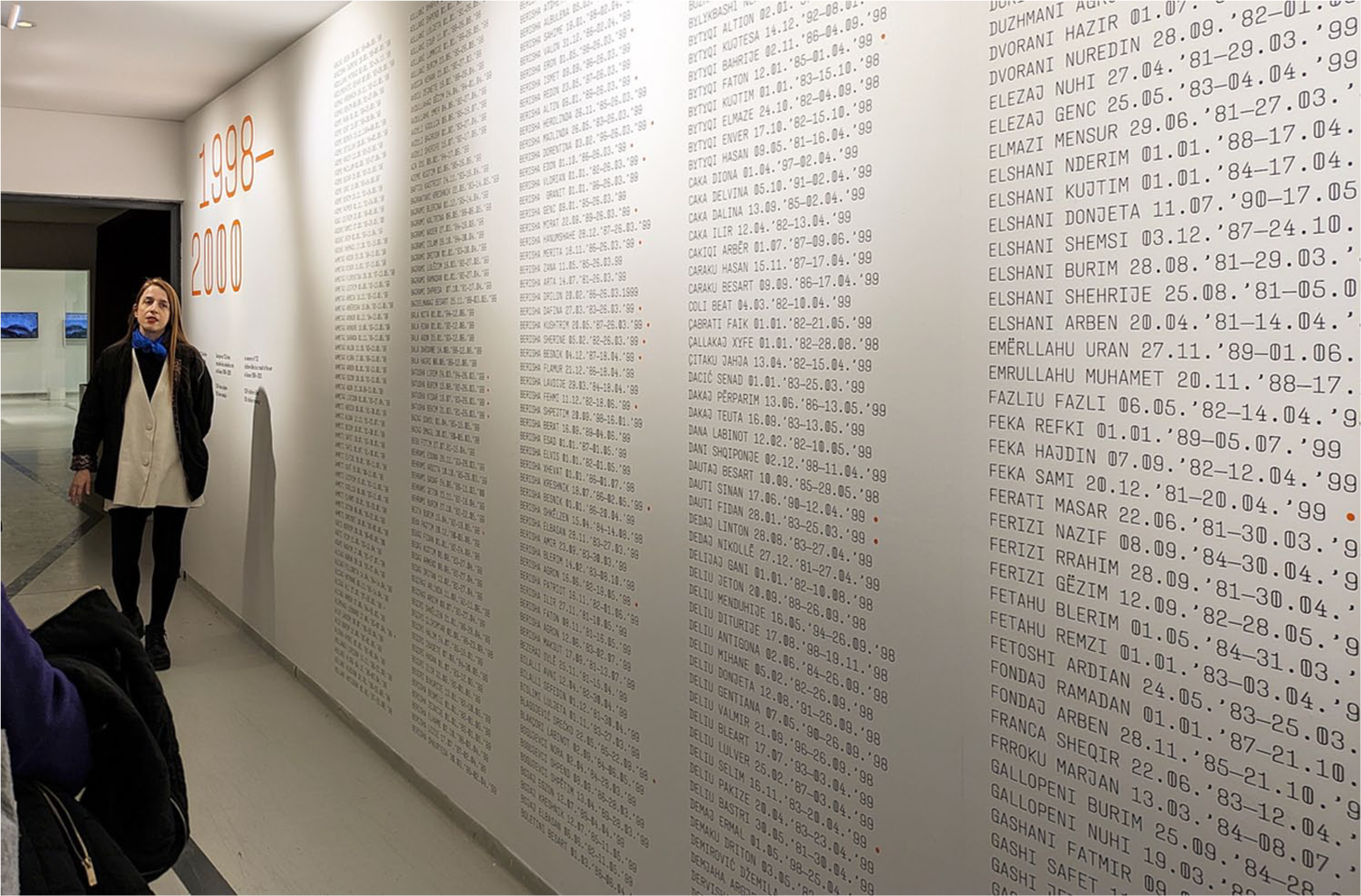
Wall of names. Once Upon a Time and Never Again. Humanitarian Law Center Kosovo (HLCK). March 2024.
Building on Young’s (1992) formulation, Widrich (2019: 66) reminds us that, after the counter-monument, memory no longer persists as monumental solidity but as an unfinished, ethical demand. Confronted with this surface of latency, the visitor is compelled to respond – through hesitation, through listening, through an embodied recognition of what remains unresolved. The tactic here is re/composition: the names form not a unified narrative but a dispersed constellation, where memory resists being fixed and reverberates as absence. By inscribing each name in a fragile line, the exhibition foregrounds latency and incompletion, holding the wound open.
This insistence on absence as a living surface is further reinforced by language itself. The use of three languages – Albanian, Serbian and English – acquires political resonance. More than a gesture of inclusivity, this linguistic polyphony enacts a ‘poetics of relation’ (Glissant, 1997), acknowledging the fractures left by conflict. To resist linguistic homogenisation is to resist forgetting; it frames memory as dissent. The wall text states: ‘This is a memorial dedicated to all the children killed and missing in the war rather than just an exhibition’, and further, ‘it is not only to commemorate and honour the victims and survivors, but also to seek the truth’. By naming itself a memorial while refusing the classical tropes of monumentalisation, the curatorial act reimagines the exhibition as a public zone of friction (Huyssen, 2003), where absence is held, not erased.
As light fades in the Dark Room, a voice emerges – the voice of Gramoz Berisha, survivor of the Kalabria pizzeria massacre. His murmured testimony evokes a suspension of narrative time. There are no images. Only the vibrating presence of the voice in the dark, and the irreparable absence it invokes. Listening here is already a form of implication, a condition for imagining the unseen. This choice enacts what Agamben (2007) calls a silent profanation. Protecting the word from spectacularisation, it refuses spectacle, deactivates the regime of the visible and returns the word to sensitive thickness. The voice becomes vibration. It traverses us, reconfiguring space as a liminal zone in which we, too, are displaced. Listening here is not passive; it is already implied. The tactic enacted is one of de-fetishisation: by withholding the image, the curatorial act dismantles the expectation of visual evidence and returns us to the fragile weight of the spoken word. At the same time, it performs unlearning: it suspends institutional mastery, privileging presence over representation and allowing what eludes articulation to remain open.
Crossing the sonic threshold of Berisha’s testimony, the visitor enters a space where light returns. The Glass Room and Children’s Belongings present a restrained, almost clinical brightness (Figures 2 to 4). It does not redeem what has been heard; it holds it in suspension. Light falls upon translucent display cases containing children’s belongings: backpacks, notebooks, toys and folded clothes. These fragments, worn, stained, silent, neither illustrate nor explain. They hover, worn and silent, barely anchored.
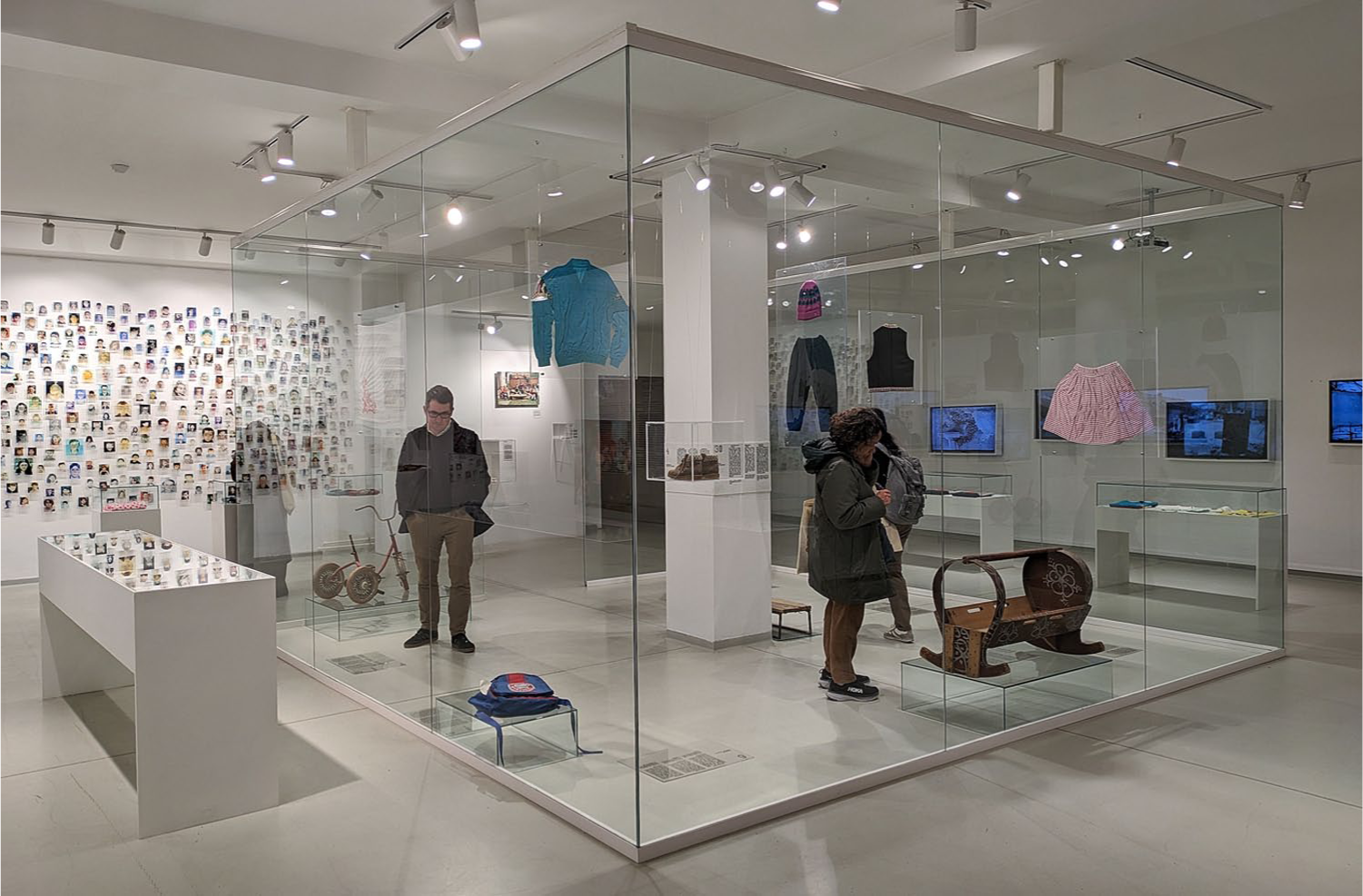
The Glass Room, a space of restraint and attention. Once Upon a Time and Never Again. Humanitarian Law Center Kosovo (HLCK). March 2024.
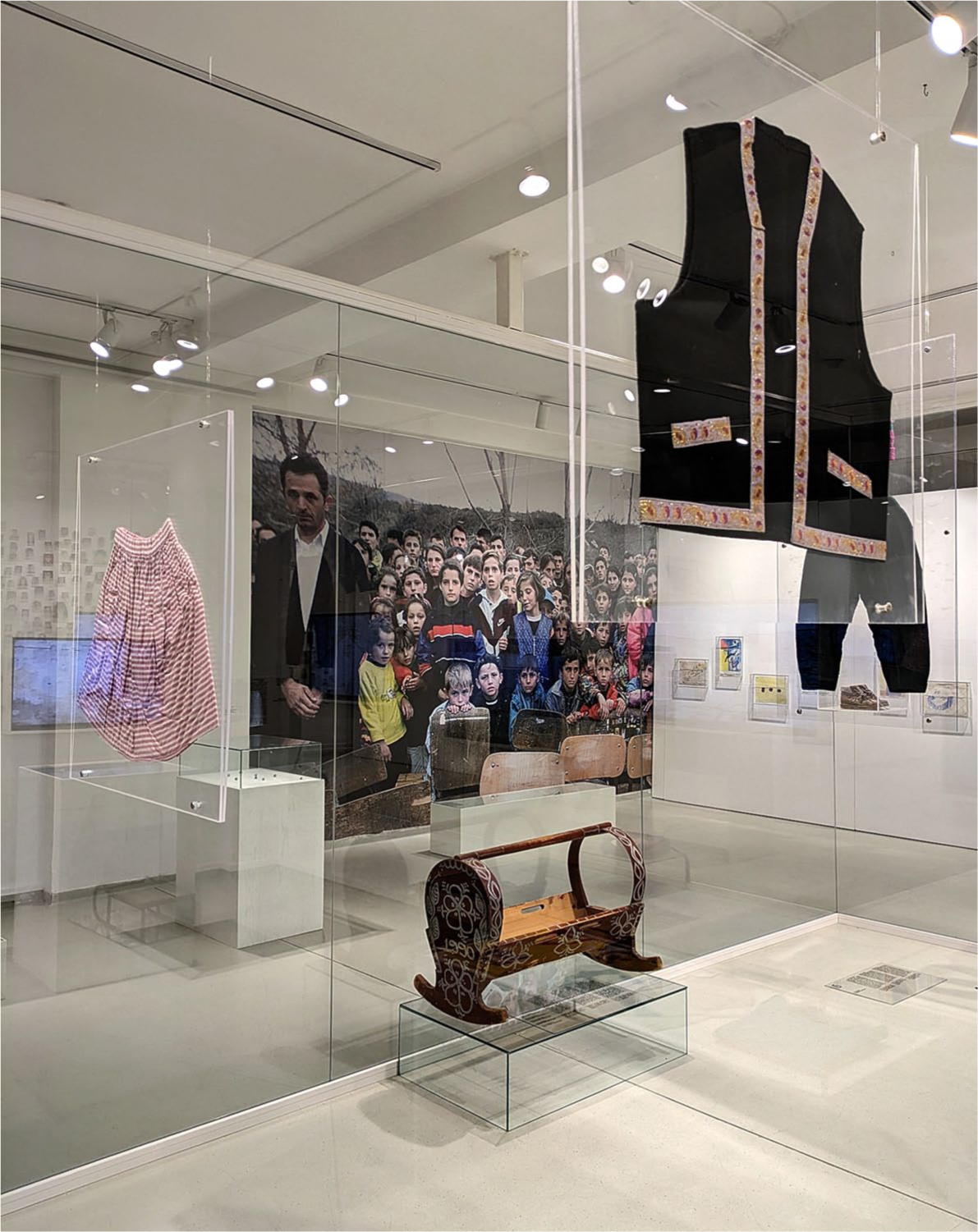
Children’s belongings in the Glass Room. Once Upon a Time and Never Again. Humanitarian Law Center Kosovo (HLCK). March 2024.
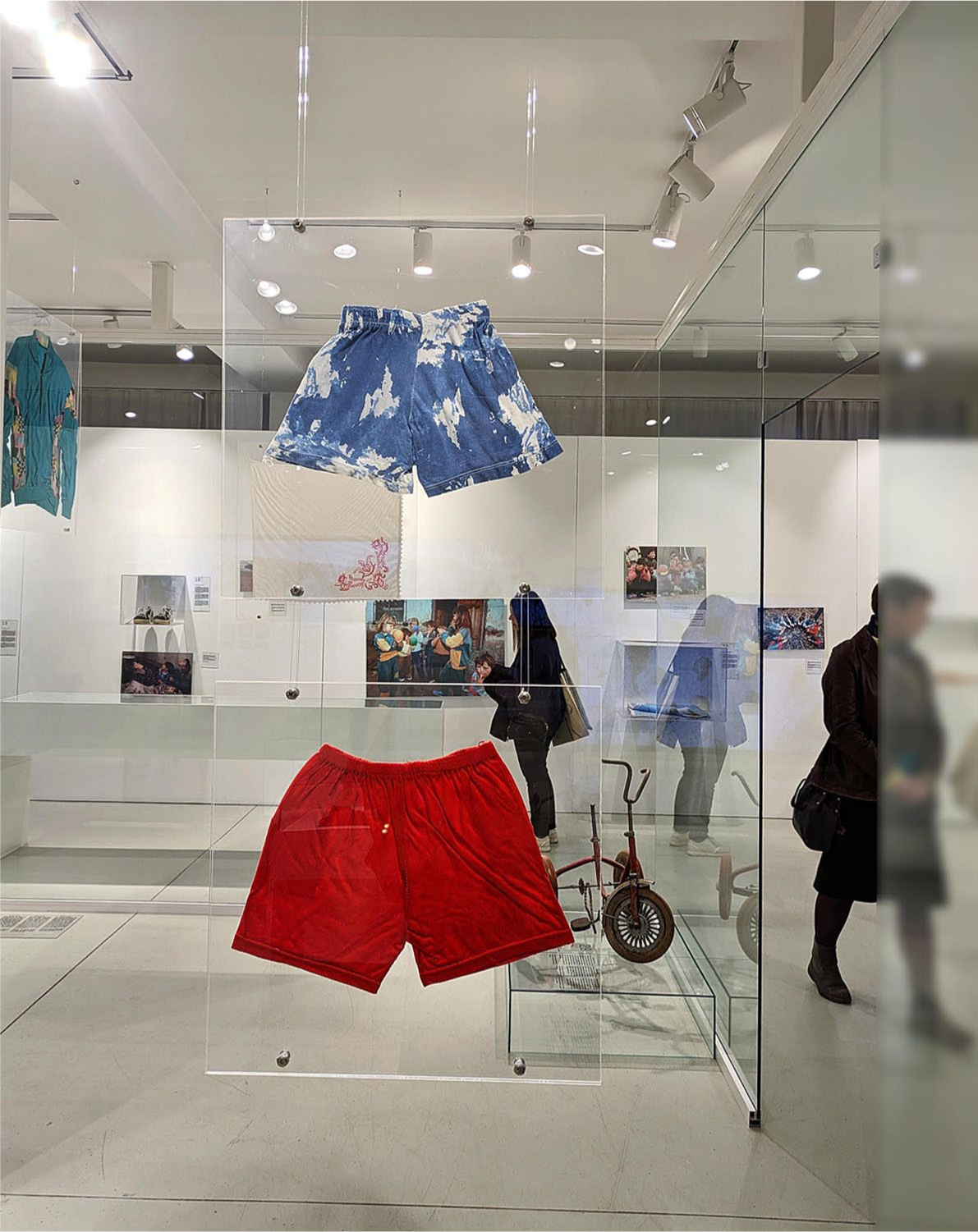
Unresolved presence. Once Upon a Time and Never Again. Humanitarian Law Center Kosovo (HLCK). March 2024.
The presence of these objects is inseparable from the process that enabled them to be here. Each fragment entered the exhibition through the trust and collaboration of families, who, in sharing these belongings, transformed the curatorial process into a relational act of (slow) curating. Here again, the phases of research, dialogue and adaptation intertwine: artefacts appear not as inert remains, but as negotiated presences, included through trust and adjusted to their fragility. The curatorial strategy here enacts Johnston’s (2014, 2021) emphasis on embedded, processual work: meaning does not precede the encounter but emerges within it, through reciprocity, hesitation and the ethics of not-knowing. At the same time, these fragments perform unlearning: they suspend the expectation that objects must evidence or explain, opening epistemic opacity instead.
This narrative inversion gains force in a context where public memory often exalts military heroes and glorifies masculine acts of bravery, while erasing the suffering of the most vulnerable, especially children. Against this hegemonic war memory, the exhibition redirects attention to traces of interrupted childhoods, refusing to normalise their absence. It is not about recounting how they died, but sustaining how they lived – even when official history reduces them to statistical oblivion. As the catalogue text insists (Krasniqi, 2019: 184), ‘a focus on their deaths would have reduced them to one single event: their finality’, risking the passivity the exhibition seeks to contest. Instead, it acknowledges the agency of children, whose stories ‘give voice to lives interrupted, not silenced’, and whose artefacts speak collectively in ways statistics cannot. Rather than speaking for absence, curating creates conditions for presence to co-emerge: across bodies, fragments, gestures, silences, in a shared field of memory and implication.
The captions, factual and restrained, offered no explanations. They located the absence and activated the trace. As the exhibition catalogue also notes (HLCK, 2019: 11), ‘many families lost not only their children, but also homes, photographs and the objects that once told their stories’. The devastation rendered material memory uncertain and fragmented. The difficulty in finding artefacts to activate remembrance reveals a form of violence that was also documentary. It destroyed not only bodies, but the very possibility of testimony.
These objects, once kept by families or recovered from sites of irreparable absence, are dis/placed from the intimate to the shared, from silence to vibration. This dis/placement, both physical and symbolic, is not merely spatial; it is a relational reconfiguration. The difficulty in obtaining objects that activate memory and carry meaning does not weaken the exhibition’s force. On the contrary, it renders each fragment more vibrant in precarity. Refusing the forensic gesture, the exhibition embraces the residual and fragile trace, summoning a diffractive mode of listening in which memory is not delivered but co-produced through tension between visibility and loss, between the real and the spectral. These artefacts are not illustrative evidence; they are insurgent bodies.
The translucent, silent vitrines did not simply protect the objects. They amplified them. The glass acted as a device of latency, preventing direct touch while inviting a deeper kind of visual listening. White light and the absence of interpretive mediation composed a curatorial grammar of restraint. Visitors were not asked to decode the objects, but to be with them. The space became one of sensitive suspension, where attention slowed, and fragments hovered, fractured and quietly summoned. This was not a site of resolution; it was a space of latency, where listening to what resists language allows the body to sense before reason. A backpack, a notebook, a piece of clothing – not evidence, but interrupted presences still demanding space. They persisted as matter in latency, caught within the fracture between the visible and the unspeakable – never inert, never reducible to residue. Rather than representing or explaining, the objects inhabit; they perform a silent agency, unsettling the viewer not through narrative but through their very persistence in latency.
This relational dimension is what curatorial tactics activate – not through display, but through suspended perception. The curatorial gesture does not organise or explain; it sustains. Translucent vitrines, glass, white light and silence compose a grammar of restraint. By refusing emotional immediacy, the curatorial apparatus disarms automatisms of reading. Interpretation is not guided; it is summoned through hesitant attention. In that interval, listening to what resists language – and sensing, before thought – becomes not only possible, but necessary. This experience is therefore not one of consumption but of suspension, where care does not translate or resolve but sustains presence in its fragility. To care, in this sense, is not to explain or mediate, but to protect what cannot be represented without loss, allowing interrupted matter to remain visible in fracture.
If the Glass Room and Children’s Belongings summoned absence through materiality, the Wall of Portraits displaced that presence onto the face. Memory emerged not through words, but through a rarefied surface and a silent vibration (Figure 5). Projected portraits of children, softly illuminated on a pale wall, appeared to emanate from the space itself. There was no frame, no visible boundary. Each face, alone and in chorus, interrogates. The faces surfaced, suspended, floating at the edge of clarity. The grid-like arrangement nullified hierarchy without imposing neutrality. No captions were offered; only faces suspended in an interrupted constellation. This quiet configuration compelled the gaze to decelerate, allowing it to be disoriented by a visual field that resisted control. As the visitor moved, the images multiplied. The slight translucency of the projection created optical vibration. It was not about seeing clearly, but about perceiving how each face unfolded into the memory of others.
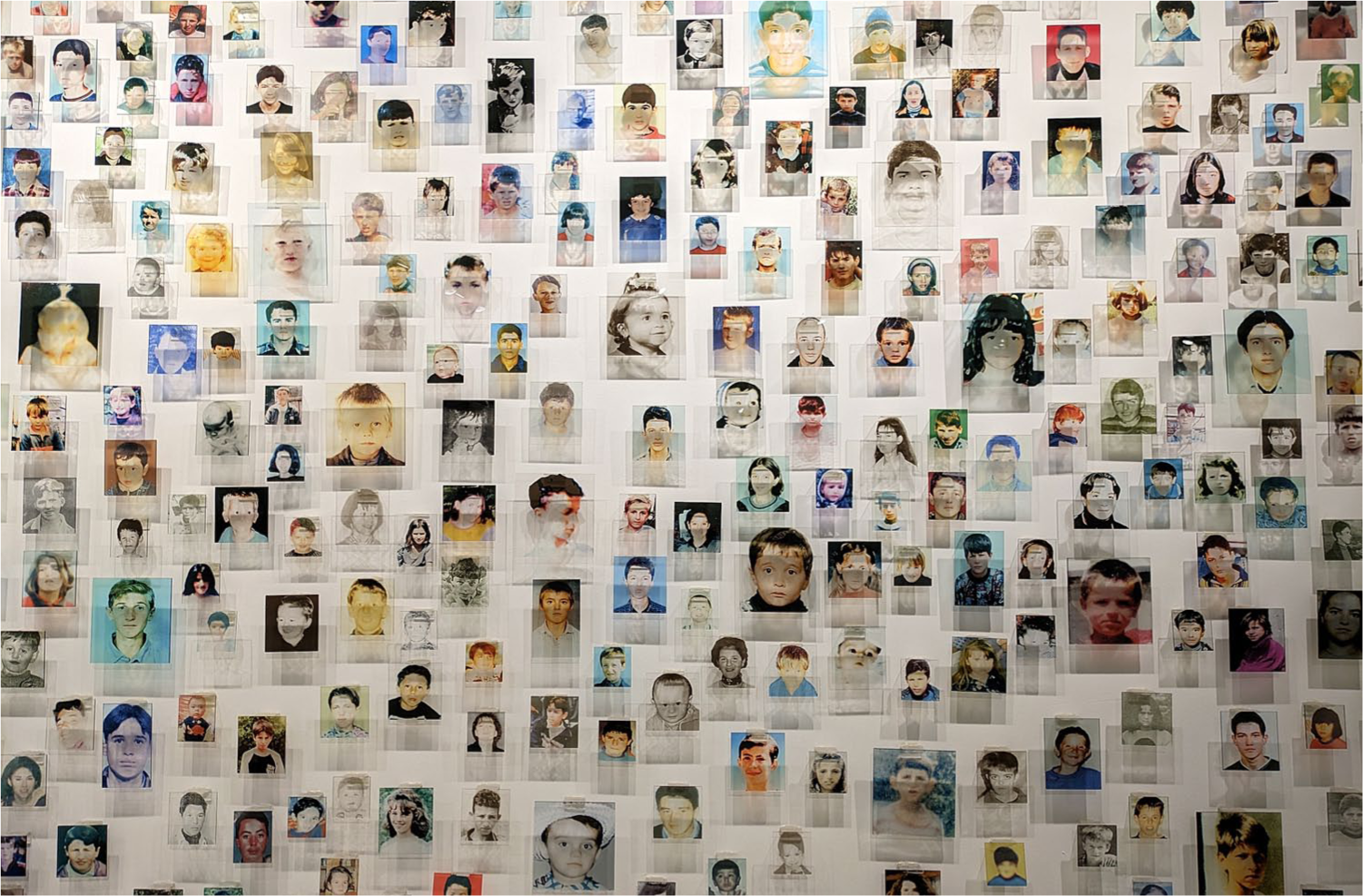
Wall of portraits. Once Upon a Time and Never Again. Humanitarian Law Center Kosovo (HLCK). March 2024.
The limited number of portraits acquired cumulative force. They did not merely represent; they suggested a diffuse, interrupted childhood. The effect was not emotionally invasive; it was spectral. The viewer was not absorbed by the face, but by a sense that something more, always beyond visibility, was vibrating there. Each image vibrates as an unresolved presence. It appears not as a memorial icon, but as ethical noise. The mural did not fix meaning; it suspended it. In this silent excess, nearly imperceptible, its curatorial force was activated – the power to destabilise perception not through absence, but through the vibration it accumulated. It rejects narrative linearity, sustaining a spectral field of reading. By reinscribing the faces of disappeared children within an apparatus of suspension and optical friction, the curatorial gesture refuses memorial closure. Choosing not to focus on death, but on the brutal interruption of life, constitutes a profoundly ethical curatorial gesture.
The curating of this mural operates with extreme subtlety. At the same time, it sustains critical intensity. It enacts a form of agonistic juxtaposition, where each face, exposed without caption, hierarchy or fixed identity, holds the tension between visibility and anonymity, between recognition and loss. What is presented is not a collection of portraits to be archived; it is an unfinished constellation that insists, without explanation. In sustaining this constellation without resolution, the mural does not close memory but lets it reverberate – an echo that carries forward into the wider curatorial apparatus of the exhibition.
Here, the critique also becomes political. By confronting the disproportion between lives lost and justice achieved, the exhibition exposes the architectures of value that underlie dominant epistemologies of heritage and memory. Slow curating here redistributes not only visibility but also value, challenging inherited hierarchies and opening the possibility of ethical valuations grounded in care. The Wall of Portraits thus resonates as both constellation and indictment: a space where memory refuses closure, value is unsettled, and responsibility intensifies.
Transversal resonances
Read across all its sections, Once Upon a Time and Never Again unfolds through curatorial tactics of deceleration, reorganising temporality through hesitation and suspension rather than flow or resolution. The friction between what is seen and what is felt suspends immediate meaning, opening a space where attention must hesitate. It operates as a curatorial grammar that reorders time, material and perception, privileging latency. This is not a narrative but a constellation of gestures – re/composition, dis/placement, de/fetishisation, unlearning, agonistic juxtaposition. As Krasniqi (2019: 184) observes, ‘the difficulty of securing objects that activate memory and carry meaning’ marks a field in which absence itself becomes generative. Memory is not recounted but reverberates as spectral presence, emerging through a fragile temporality woven from silence and matter.
Here, memory arises as echo: latency opens where gaze suspends, and responsibility intensifies. In this suspended field, slow curating resists symbolic pacification and sustains a zone of ethical vibration. Confronted with this surface of latency, the visitor is compelled to respond – through hesitation, through listening, through an embodied recognition of what remains unresolved. As Žunić (2018) reminds us, trauma resists transparent restitution; it surfaces belatedly, as latency and spectral afterimage. To curate trauma is not to restore wholeness, but to preserve opacity and fragility, where memory endures as an entangled, unfinished presence.
As James E. Young (1992) has argued, traditional monuments often displace memory rather than sustain it: the more it is fixed in external forms, the less it is lived from within. In contrast, counter-monumental forms refuse permanence and consolation, privileging provocation, disappearance and the return of memory’s burden to those who encounter them (Widrich, 2019). This temporal logic echoes Wüstenberg’s account of slow memory, where remembrance persists not in permanence but in what is unresolved, spectral and fragile.
The voice, too, functions not as a pedagogical instrument but as an agent of latency, exposing without resolving and sustaining presence in fragility. It is less empathy performed than relational availability to what resists language. In this gesture, curating performs unlearning, suspending mastery and allowing opacity to persist. Objects, too, inhabit this field not as inert residues but as active matter. In Ingold’s (2015) terms, they act, live and respond; their force lies not in what they reveal, but in what they withhold in silence. As Bennett (2010) argues, they are vibrant entities, irreducible to evidence or homage.
The temporality of this exhibition is not sequential; it is ethical. Post-memory, as Hirsch (2012) formulates it, is not totality but co-presence with what still lacks language. Listening becomes being-with. Attention is led less by empathetic projection than by relational availability and ethical restraint. Each fragment calls for care, not decoding. Not objects to explain but interrupted bodies to inhabit. The exhibition offers a choreography of deceleration, where not-knowing becomes an ethical condition. Through this gesture, dissent is sustained without dramatisation, and care becomes possible without narration. Here, slow curating tactics converge. The fragments are composed into constellations rather than linear accounts, their evidential aura dismantled, their meanings left suspended. In this suspension, learning happens; meaning reverberates without closure, exposing us to what remains unspeakable. In this sense, Once Upon a Time and Never Again activates knots of memory (Rothberg, 2010), where remembrance is constituted in the very crossings between histories, affects and silences. Rather than a single narrative, these knots sustain a field of implication in which memories reverberate across different temporal and cultural horizons. This is slow curating as care: sustaining presence in fragility, allowing another mode of listening to emerge, opening radical openness (hooks, 1989).
From the outset, the exhibition enacts what Bishop (2014: 6) terms dialectical contemporaneity: ‘the encounter of different historical temporalities within the same space, where the past is activated in order to critique the present and vice versa’. Rather than reconcile temporal fracture, it sustains it, activating what Barad (2007) calls intra-action: a mode where time is not linear but fractured, and phenomena emerge through entangled encounters. This is a diffractive operation – a reading-through of past and present where meaning co-emerges in encounters. The mural likewise rejects narrative linearity, sustaining a diffractive and spectral field of reading. By refusing memorial closure, it reopens the possibility of return – not to the past, but to the possible.
The temporality that emerges here is not one that explains or redeems, but one of suspension, reverberation and refusal. The exhibition insists on fracture – between what was promised and what was denied, between what has passed and what remains unrecognised. This is a porous, unresolved diffractive temporality, open to what has yet to take form. Its strength lies in preserving the still-to-be-said as a zone of critical vibration. Agamben’s (2007) conception of profanation sharpens this gesture: by deactivating regimes of spectacle and evidence, the exhibition returns language, image and object to the fragile thickness of presence. hooks (1989) reminds us that spaces of radical openness allow learning in suspension; here, unlearning becomes curatorial practice, suspending mastery and opening epistemic opacity.
Slow curating, therefore, emerges as more than a method: it becomes an ethical–aesthetic impulse. It privileges presence over representation, sustains latency and activates unfinished histories. What was introduced above as a vocabulary of tactics returns here as gestures enacted in the apparatus, where the exhibition itself materialises cadence. In this sense, the exhibition aligns with Johnston’s (2014, 2021) iterative methodology: research, experiment, observation, reflection, dialogue, adaptation and repeat. Where Johnston defines rhythm, reciprocity and iteration, these tactics enact that cadence in the apparatus, redistributing not only visibility but also responsibility. The outcome is not predetermined; it remains contingent, relational, always in becoming.
In this cartography of slow curating, each gesture – listening, suspension, dis/placement, re/composition, de/fetishisation, unlearning – does not fix meaning but proposes relations in resonance. Once Upon a Time and Never Again is not an answer; it is a field of implication, where objects, images and voices reverberate as devices of shared responsibility. By rejecting fixed narratives and explanatory logics, the exhibition activates a space in which memory is experienced as vibration. What becomes visible is not resolved history but its fracture, its echo, its potential for return. And in this sustained not-knowing lies the ethical force of slow curating: not organising the past, but keeping it open to the possible.
Here, slow curating is neither passive nor merely aesthetic. It is listening without resolution, the holding of what has no conclusion. Here, the child is not a symbol of loss, but an interrupted life that refuses to vanish – a presence inhabiting a fractured now. Here, slow curating is care without containment, dissent without spectacle, tenderness without closure. It does not organise trauma, but holds it with radical openness, within the space of the still-to-be-said.
Conclusion: slow curating as an ethical–aesthetic act
This text has positioned slow curating as an open-ended, relational practice, where engagement takes precedence over preservation and fluidity over fixity. Rather than adhering to predetermined meanings or fixed identities, it unfolds as an agential, processual practice shaped by mutable relations between objects, bodies, contexts and temporalities, sustaining a rhythm of reciprocity and care in which outcomes remain contingent, and meaning emerges through collaboration and ethical engagement. Within this framework, tactics such as dis/placement, re/composition, de-fetishisation and unlearning are specified as actionable curatorial operators that intervene at the level of temporality and form. They act not as translations of process or rearrangements of artefacts, but as concrete gestures of dissent and care that activate constellations of relation where memory emerges as latency, resonance and friction. The rhythm of slow curating sustains openness, while its tactics materialise gestures that configure an ethical–aesthetic field where care and relational resonance accompany – and also move beyond – critique.
Conceived in such terms, slow curating resists accelerated, extractive temporalities. Rather than privileging efficiency, it foregrounds depth, resonance and openness to the unknown. It reframes curating not as a role or institutional function, but as a temporal–spatial practice of potentiality, where heritage and memory are sustained as dynamic, contested and continually reconfigured. The curatorial gesture becomes generative rather than merely interpretative, holding open a space where the past returns as unfinished and the future remains in becoming. What began as a shift from curating as a noun to curating as a verb finds, in slow curating, a practice that resists fixity, enacting care as temporal politics. Reframed through slow memory, slow curating unfolds as a methodology of dissent and care, where the ethical, the political and the aesthetic converge. More than a ‘practice of the self’, it constitutes a political and epistemic act of contestation and reconfiguration: challenging hegemonic modes of visibility, heritage and institutional power, while affirming a practice rooted in care, relationality and radical indeterminacy. Refusing closure, it embraces the yet-to-come as ethical horizon – sustaining complexity, cultivating ambiguity and upholding the right to opacity, while inviting another mode of participation, one grounded in uncertainty, responsibility and resonance, where meaning remains open and relational.
Through its commitment to slowness, slow curating can transform exhibitions and museums into sites of critique, multiplicity and ethical encounter, where critique is inseparable from practices of care and relational resonance. It unsettles dominant narratives and reconfigures conditions of visibility, memory and belonging – not merely including marginalised voices, but amplifying dissent and destabilising institutional authority, opening space for alternative ways of knowing and being. In so doing, it reframes curatorial practice as radical openness – a space for the emergence of dissident presences and futures that resist foreclosure. As Once Upon a Time and Never Again demonstrates, these gestures are not abstractions but material practices that reorganise temporality, affect and responsibility within the curatorial apparatus. In this light, slow curating enacts what Laermans (2012) calls a pedagogy of not-knowing: cultivating hesitation and indeterminacy as conditions for activating potentialities. Rather than closing meaning, it holds open a shared horizon in which community, memory and temporality remain in becoming. In affirming slow memory as both practice and horizon, slow curating emerges as its curatorial enactment: sustaining latency, resisting acceleration and keeping time open to unfinished presences.
What remains is not closure but a gesture of openness: a curatorial practice that listens, hesitates and recomposes – holding space for resonance and dissent, for opacity and care, for presences that insist on returning. Slow curating thus lands not in resolution but in hesitation: an unfinished practice that calls for continual experimentation with how memory may endure otherwise. It names the possibility of inhabiting time otherwise, where memory endures as unfinished, and the future emerges already entangled with the responsibility of the now.
Footnotes
Acknowledgements
With deep gratitude, I extend my thanks to Blerta Hoçia, Cláudia Garradas, Fabiana DiCuonzo, Isabel Alexandre, Sofia Carvalho, Susana Gomes da Silva, Vayia Karaiskou, Vjollca Krasniqi and Yilmaz Vurucu for their thoughtful engagement and inspiring conversations over the past 2 years. A special thanks to Fabiana, whose collaboration in testing some of these curatorial tactics allowed me to expand on a previous text – deepening and reshaping ideas that continue to unfold.
Funding
The author disclosed receipt of the following financial support for the research, authorship and/or publication of this article: This article is based on the work from COST Action SlowMemory CA20105, supported by COST (European Cooperation in Science and Technology). COST is supported by the EU Framework Programme Horizon Europe. In addition, as a research member of CITCEM, this work was funded by National Funds through the FCT – Fundação para a Ciência e Tecnologia, within the framework of the project UIDB/04059/2020 ( ).
).
Declaration of conflicting interests
The author declared no potential conflicts of interest with respect to the research, authorship and/or publication of this article.