




Abstract
This article examines the commemorative strategies of two prominent South African museums, the Apartheid Museum and the District Six Museum, focusing on how remnants of destruction and systemic oppression, incorporated as memorial objects, affect the curated aesthetics of these spaces. Particular attention is paid to how rubble links museum interiors to their surrounding landscapes, with curation attributing meaning to it as a symbol of the plight of those who have been displaced or are no longer present. This is contrasted with apartheid benches, which serve as a foil for calling forth a spirit of solidarity against bigotry. The two museums are selected as case studies for their divergent approaches to shaping post-apartheid memory and redefining collective identities. The study argues that rubble generates an aura that introduces contingency into exhibitions, potentially disrupting established narratives and offering insights into the treatment of remnants of destruction at other memory sites.
This article investigates how sites of collective memory shaped by traumatic events incorporate remnants of destruction and systemic oppression as memorial objects. Focusing on two artifacts—rubble and apartheid benches—it explores how they contribute to the curated aesthetics of these spaces. Rubble, an apparently mundane yet symbolically potent material, subtly links museum interiors with their surrounding landscapes, while apartheid benches serve as a stark, recognizable symbol of segregation. The essay uses the benches as a secondary interpretive tool to analyze the museums’ construction of memory in opposition to the legacy of systemic oppression they symbolize. Ultimately, it suggests that rubble generates an atmospheric effect that unsettles exhibition narratives.
The inquiry is guided by several key questions: How does rubble, the raw evidence of destruction, transform into a cultural and aesthetic artifact within the museum context? What meanings emerge when rubble is juxtaposed with other exhibited memory objects on display? Furthermore, how might this focus on rubble open new avenues for interpreting exhibitions, particularly in terms of the devastated landscapes and the plight of persons—both deceased and living—connected to that land? Finally, how might this analysis contribute to bringing those erased from historical records into the fabric of public memory?
The context for exploring these questions is the memorialization of the apartheid era in the first two decades of democracy in South Africa. The article examines two prominent commemorative museums: the Apartheid Museum (AM) and the District Six Museum (D6M). While both institutions aim to shape memory as a foundation for a new collective identity, they diverge significantly in their approaches and objectives. The AM, located between Johannesburg and Soweto, aims to foster national reconciliation through a comprehensive documentary treatment of apartheid’s legacy. Its primary but limited connection to the surrounding land is in the incorporation of the history of mining on the Witwatersrand. In contrast, the D6M in Cape Town—the most well-known case of museums and monuments commemorating forced removals—profoundly engages with the landscape. Housed in a former church building on the boundary of the former District Six neighborhood, the museum memorializes mass displacement of residents from the area under previous racial laws. The D6M asserts the enduring spiritual presence of the community over the land, advocating for and defending the heritage of the area amid its ongoing redevelopment under the auspices of the official land restitution program.
The term “museum” is used here for ease of comparison, but it can obscure the nature of these institutions. 1 To explore the theoretical tensions between a community-oriented site of traumatic memory and an educational museum for nation-building, I propose a specific interpretive method for comparison. It shifts focus from symbols of collective life, resistance and triumph to particular items that symbolize the “other” against which a new moral order is defined. Apartheid benches, designated for exclusive use by “racial” groups, clearly serves this function in both museums and thus provides a deliberate point of contrast within the exhibitions. However, I argue that the narrative constructed around these benches contends with a different type of object altogether. Rubble, whether displayed directly or represented by materials like stones or gravel, acts as an index of the land’s devastation, carrying an unwelcome aura in both museum settings. Curated as a reflection of the historical experiences of marginalized groups, it introduces a dimension to these exhibitions that can fruitfully be considered for its impact on shaping collective memory.
After setting out the conceptual framework and approach in the next two sections, the essay proceeds to a description of relevant aspects of the permanent exhibitions at each museum. The penultimate section presents further reflection on the curatorial approaches to rubble, and its resulting aura, in the two cases. Ultimately, the essay argues that memory sites incorporating tangible remnants from landscapes of destruction provide fertile ground for critical reinterpretations of commemorative narratives and deeper reflection on the role of materiality in the poetics of public memory.
Key terms and approach
Rubble and ruins
Prominent scholarship in memory studies theorizes spaces covered in rubble and ruin under the sign of “voids,” taken to signify traumatic disturbances of modernity’s landscapes that defy representation. Thus Andreas Huyssen’s (2003) conceptualization of Berlin as a sign and image brings together Libeskind’s self-reflexive architectural “voids” in the Jewish Museum with inert spaces such as the “holes” in the urban-scape resulting from war and destruction, or at construction sites. Similarly, Dylan Trigg’s (2009) “phenomenology of negative space” considers Berlin’s “ruins” (which he defines to include rubble) as voids because they fuse an otherwise inaccessible past with the physical environment, thus profoundly disorienting us by “evad[ing] our intuitive desire to grasp the place in its totality” (p. 98). While these authors usefully conceive of what could be called an “untimely” effect on perception, they abstract from specific memory practices by positing a vacuum infused with a non-subjective testimonial function hinged on skeletal remains, whether as rubble or ruins.
Argentine anthropologist Gaston Gordillo offers a more explicitly materialist approach in his ethnography of the Gran Chaco. He conceives of “rubble” in terms of an “object-oriented negativity” that haunts the fetishized constructs of bourgeois modernity, especially historic ruins (Gordillo, 2014: 11). Gordillo (2014) conceives of the ruin as “a unified object that elite sensibilities treat as a fetish that ought not to be disturbed,” and instead conceptually disintegrates ruins into fragmented rubble, describing them as “nodes of rubble that form constellations” (p. 6, 5). Like Trigg and Huyssen, however, rubble-cum-ruins is attributed a general affect wherever it may be found, thus eliding its immediate and specific auratic effects, and attendant aesthetic and political implications, in specific sites.
The hauntology literature, on the contrary, often involves abstracting from materiality to posit persistent spectral entities at the boundaries of language’s capacity to signify. When this emphasis is corrected for and the focus moves from language’s recesses to materiality, the concentration on identifiable traces and remains limits its relevance to our study. For example, Nick Shepherd’s (2013) analysis of a memorial site at colonial burial grounds in Cape Town, situated near District Six, centers on the buried interns of slaves and other subaltern persons to argue that their significance lies in how “they materialize and embody a set of disavowed pasts and marginalized histories” (p. 241). 2 At the outset, a key distinction is that while human remains hold significant value in collective memory, rubble is typically seen as mere waste and thus linked with complete absence.
The present analysis underscores the role of memory work in making rubble significant at specific memory sites, emphasizing that materiality manifests inherently in a particular manner. Paradoxically, however, the defining characteristic of rubble in its raw state is its formlessness as an object of collective memory—unlike ruins, which retain some semblance of the original. Indeed, the preservation of rubble as part of a memorial is unusual, since rubble is not typically intended for collection or display. I therefore view these acts of preservation—through framing and form-giving—as endowing it with a basic meaning. Rather than leaving its connection to memory as a void or negation, my essay focuses on the aesthetics and poetics of presenting this specific museum object, not merely as an instance of a generalized materiality, but as integrally tied to the materiality of inscription.
Some guidance may be found in Achille Mbembe’s discussion (2002) of archival power as a process of selecting, organizing, and storing historical materials to both lock the past away and produce an imagination of it that serves present ends. Mbembe’s archives assemble the “remains” and “debris” of the deceased to create “an illusion of totality and continuity,” presupposing that the former carries within it the latter. In contrast, rubble appears inarticulate to the point where one cannot meaningfully speak of reassembly—its fragments are mostly beyond recognition or possess only rudimentary capacity to denote meaningful form. Rather than constructing a coherent narrative from “pieces of time” or “fragments of life” (Mbembe, 2002: 21), curation of rubble is essential to give it meaning in collective memory.
Curation
If curation imparts form upon rubble, an otherwise formless object, what kind of form and meaning does it engender? In the extensive literature on difficult memory, meaning is usually derived from traces salvaged to preserve memory (see Williams, 2007). However, rubble’s very materiality hinders the imaginative reconstruction of the past. In Heraclitean vein, it refuses redemptive meaning, for as the product of combustion—sand permanently altered by fire into cement, brick, and glass, then broken down, crushed, pulverized, along with rock altered by industrial process—it re-presents what happened but only as a result of complete destruction that leaves hardly a trace of what was there before.
I argue that the meaning content is wholly attributed by curation because the remnants lying there as piles of rubble exist merely as detritus unless linked to the historical events that produced them. Furthermore, rubble brings distinctive qualities to memorial environments because its significance is derived from its inherent and synecdochal connection to the land. Incorporating rubble in memorial practices is to conjure what happened not only at, but also to, the land. The connection between rubble and the land is curated to evoke its historical relevance, often by calling forth the presence of individuals and communities erased from collective memory and revealing the acts by which their lives were destroyed.
At the same time, rubble unsettles overarching curatorial frameworks and narratives. By bringing the traumatic landscape into the curated environment as a reflection of subaltern experiences, it introduces a poetics that is not fully controlled or anticipated by curatorial design. Several factors related to its peculiar materiality contribute to this effect. First, rubble’s nonsensical aspect as fragmented bits persists in its internal consistency even after some quantity of it is framed within an exhibit and assigned meaning. Second, as the material itself does not dictate form, the act of form-giving is especially arbitrary, raising questions about how subaltern experiences are represented. Binding the materiality of rubble to these experiences can have the effect of exposing how “material conditions reproduce the legacies of colonial and apartheid racialized inequalities and unequal material infrastructures of memorialization” (Robins and Spiegel, 2023: 68), imbuing elements of subaltern lives with an affective charge that disturbs dominant political and social-historical narratives. This underscores rubble’s potentially disruptive capacity in memory formation in revealing the land as a witness that refuses holistic representation.
Considering the generally dubious interest of rubble as memory object and recognizing the necessity of imposed curation, I propose reconceptualizing it not as a collection so many traces but rather in terms of its aura—the atmospheric effects that it generates when perceived within a display context.
Will and aura
An initial impetus for placing this perspective in the realm of collective memory may be derived from Nora’s classic depiction of the lieu de mémoire. As an embodiment of the will to remember, the lieu de mémoire is the curated expression of a historiographical consciousness that is answerable to a collective conscience. Nora (1989) claims that “even an apparently purely material site . . . becomes a lieu de mémoire only if the imagination invests it with a symbolic aura” (p. 19). Selected specific locations or objects are thus imbued with a sense of authenticity corresponding to the “sacred” tradition and patrimony in which they are embedded. Given the association of Nora’s concept of lieu de mémoire with the idea of the French nation (Ricoeur, 2004), the notion of aura resonates with a long-standing intellectual tradition that imbues artifacts with a sense of mystique connected to “a way of life.”
An antidote can be found in Walter Benjamin. He associates the concept of aura with the irreplaceable material presence of an original artwork or artifact—especially when situated in their original or culturally appropriate settings, where they preserve their mimetic integrity. However, Benjamin is also aware of the politically regressive connotations of aura, especially in reinforcing traditional notions of art’s mystique or “genius.” While the conventional interpretation of Benjamin (1969 [1935]), rooted in his renowned essay “The Work of Art,” confines “aura” to the aesthetic qualities of original artworks, Miriam Bratu Hansen (2008) emphasizes aura’s wider significance in Benjamin’s corpus as a potential presence in all objects. Aura thus emerges through the quality of attention given to an object and the expectation that it will reciprocate the gaze directed toward it. This reading highlights the aura’s reliance on acts of interpretation and underscores its inherent instability and relational nature. In Hansen’s (2008) words, “aura implies a phenomenal structure that enables the manifestation of the gaze, inevitably refracted and disjunctive, and shapes its potential meanings” (p. 342).
Benjamin’s definition of aura as “A strange weave [Gespinst] of space and time: the unique appearance [einmalige Erscheinung] of a distance, however near it may be” (cited by Hansen, 2008: 518) is particularly pertinent in the context of traumatic rupture. Carolin Duttlinger (2008: 90) further illuminates Benjamin’s notion by emphasizing his analysis of the photograph of the young Kafka, where his “melancholy gaze invests the image with an element of individuality and immediacy which punctures its formulaic arrangement.” By extension, we may inquire how traumatic events imbue places and objects with additional auratic qualities, as seen in ruins that serve as a memorialization of “the world prior to crisis” (Pohl, 2022).
However, the analogy breaks down when rubble is exhibited. The novel aura arising from this destruction lacks any resonance with the original and refers instead to the temporal displacement caused by the ongoing material evidence of complete destruction (cf Derrida, 2014). We perceive an aura arising from a sense of dread at the complete annihilation of the original form—even as a ruin. Rubble’s returning gaze seems to possess the uncanny ability to evoke involuntary memory, inducing a sense of temporal disjunction and foreboding about the future.
How does such a disjunctive aura meet the will to remember? At the aftermath of extensive devastation, I argue, the aura of the rubble exceeds its facticity as well as its assigned role within an exhibition’s symbolic and narrative framing, particularly where it is relegated a mere supplement, as at the AM. Even to incorporate stones or gravel to stand in for rubble can bring a visceral and symbolically irreducible element of vitiation to an exhibition’s intended effect (cf Clark, 2013). Once more, curation is essential, 3 and it involves not only the specific presentation of rubble itself but also its relational context with other objects. Thus, while the presentation of rubble—whether as a rough pile or a neatly framed exhibit—has its own significance, it is the broader sense of contingency that it imparts to the arrangement of other objects that ultimately holds greater importance.
Comparative interpretive approach
I investigate the AM and D6M primarily from the perspective of curation and spatial design to understand potential meanings and interpretive possibilities. To facilitate comparison, I deploy an interpretive heuristic that centers on the juxtaposition of benches and rubble within the memory formations of each museum. Apartheid benches served as a highly visible instrument for the routinization of racialism and the spatial regulation of everyday life. 4 Initially, similarities appear in how the apartheid benches are strategically incorporated into the exhibitions as well-understood emblems of apartheid that connect to the racial classification system through identity documents, residential segregation, separate facilities, and so on. They act as a foil for calling forth a spirit of solidarity rallying against the bigotry and ignorance they epitomize. However, as we shall see exemplified in the AM, collective identification in museums typically mounts unambiguous and iconic images. Occluded are those experiences that have left minimal or imperceptible traces—the sense of dread and forbearance accompanying the early morning descent into the mine, the daily struggle to survive, resignation and loss of animus, the abject feeling of standing before the eviction order, a life borne after injury and disability, and so on. These are not amenable to idealized notions of the liberation struggle and the nation-building meta-narrative (Soudien, 2008), or even to the nostalgic commemoration of local community.
The self-referencial character of the lieu de mémoire (Nora, 1989: 23) becomes particularly evident in the way museum interior spaces are demarcated from the external landscape. Simultaneously, the vibrant fullness of their respective exhibitions stand as an antidote to the enduring devastation of the land, the starkest evidence of which lies in the rubble. My analysis below reveals that the ambiguous presence of silent rubble and stones renders the exhibitions vulnerable to an inherent alterity in the surrounding landscape, which eludes these exhibitions’ attempts to encapsulate it.
Given the concern with curatorial aesthetics and the nuanced impact of rubble on perception, this study primarily relies not on visitor interviews but on more considered interpretations of museum exhibits found in museum inscriptions, exhibition catalogs, museum literature, and museum websites. Working with two extensively studied museums offers the advantage of ample secondary literature through which to extend textual and visual analysis. In addition, context and evidence is drawn from interviews and conversations with museum staff, along with participant observations conducted during research spanning from 2001 to 2019 at the D6M and in October 2019 at the AM. While there have been important developments since 2019, the primary focus remains on the formative stage of these exhibitions, occurring broadly within the transitional period post-apartheid, when the core of each exhibition was shaped.
Two memory sites
The AM
The AM recounts the history of apartheid as one of violent struggle between the state and the liberation movement (Bremner, 2007) and commemorates those who suffered and died under apartheid. Its impersonal and prison-like architecture, which is meant to signify apartheid-era repression, stands as a fortress against its immediate surroundings (Teeger and Vinitzky-Seroussi, 2007). Indeed, museum officials have expressed embarrassment at the origins of the museum in the immediately adjacent Casino Gold Reef City, which funded it at R90 million as part of its bid to gain a license. The active estrangement of the land enables the AM’s particular brand of historicism in the service of history writ large. However, this museum does bear an important though muted substantive connection to locality through the museum’s direct references to an abandoned gold mine on which the museum is built 5 (Autry, 2017: 144–145), particularly in the first part of the exhibition, where the visitor finds the element on which our analysis centers: stones as a surrogate for mining rubble.
The apartheid benches, obviously old and with original designations barely legible on the wood, are located in an elongated open area immediately after entering the museum. Sitting on them is not permitted. From their position in the exhibition, the benches mark a valuable point for reflecting upon the internal ordering of the museum. A short distance away, there is a moat of water bordering a low wall with an inspirational quote attributed to Nelson Mandela, June 1999: “TO BE FREE IS NOT MERELY TO CAST OFF ONE’S CHAINS, BUT TO LIVE IN A WAY THAT RESPECTS AND ENHANCES THE FREEDOM OF OTHERS.” Continuing through the exhibition, collective suffering and the spirit of reconciliation is most embodied in the figure of Nelson Mandela (Teeger and Vinitzky-Seroussi, 2007), who personifies the sacrifices and aspirations of the emergent nation (Till, 2020). Together, the moat and inscription offer an antidote to the infamous benches, the water mirroring upon its surface the message of hope. Thus the tone for the exhibition is set as iconic, universalist.
Overlooking this peaceful display are seven immense pillars dedicated to the principles of the new constitution, each with capitalized word: FREEDOM, RESPECT, RESPONSIBILITY, DIVERSITY, RECONCILIATION, EQUALITY, and DEMOCRACY. These too offer a stark antidote to the benches, but now in exclamatory form. Principles by which to found the new nation, they are to be the guiding lights of the story to unfold and are again displayed on the walls of the final room of the exhibition. Right under the pillars is a building with two entrances marked “Whites-Only” and “Non-Whites Only,” each leading to a hall containing ID documents. In light of the didactic function of these halls, the benches prime the visitor for what is supposed to be an immersive experience of the apartheid system of racial segregation.
After passing through one of the aforementioned racial classification halls, you come to the “Journeys” exhibit, the focus of our analysis of the AM. The narrowing pathway up the ascending ramp is meant to convey a “growing sense of imprisonment and confinement” (Apartheid Museum, 2018.: 13). It is bordered by a gabion wall of stones, which according to Rankin and Schmidt (2009: 88) “evoke the enormity of blasting and shifting the land to mine the deep reefs of the Witwatersrand.” The gabion wall, serving as the museum’s exterior barrier, may be easily overlooked as a memorial object, despite its imposing form. Yet these stones are made to bear a serious charge, their declared significance being to serve as “a reminder of the thousands of miners who toiled underground in pursuit of the gold metal that was to drive the country and the story of apartheid” (Museum Inscription). This suggests that as one proceeds one ought to remember the lives expended in breaking up that rock. Note that these stones are selected for size and shape and “sanitized,” certainly when compared to toxic mine rubble, which is of course hardly appropriate as memorial object. This sanitization is consonant with the role that these stones are to play in the triumphant narrative of miners’ historical contribution to national development.
The central focus of the Journeys exhibit lies not in the gabion wall—which we revisit later—but rather a series of large transparent glass panes or “mirror boxes,” featuring life-size figures of “the children, grandchildren and great-grandchildren of some of those who journeyed to Johannesburg following the discovery of gold in 1886” (Museum panel). Serving as backdrop, the gabion wall presents a contrasting theme of anonymous suffering, thereby staging the historic mission of those pictured walking up the ramp in building the city and the republic (see Figure 1).
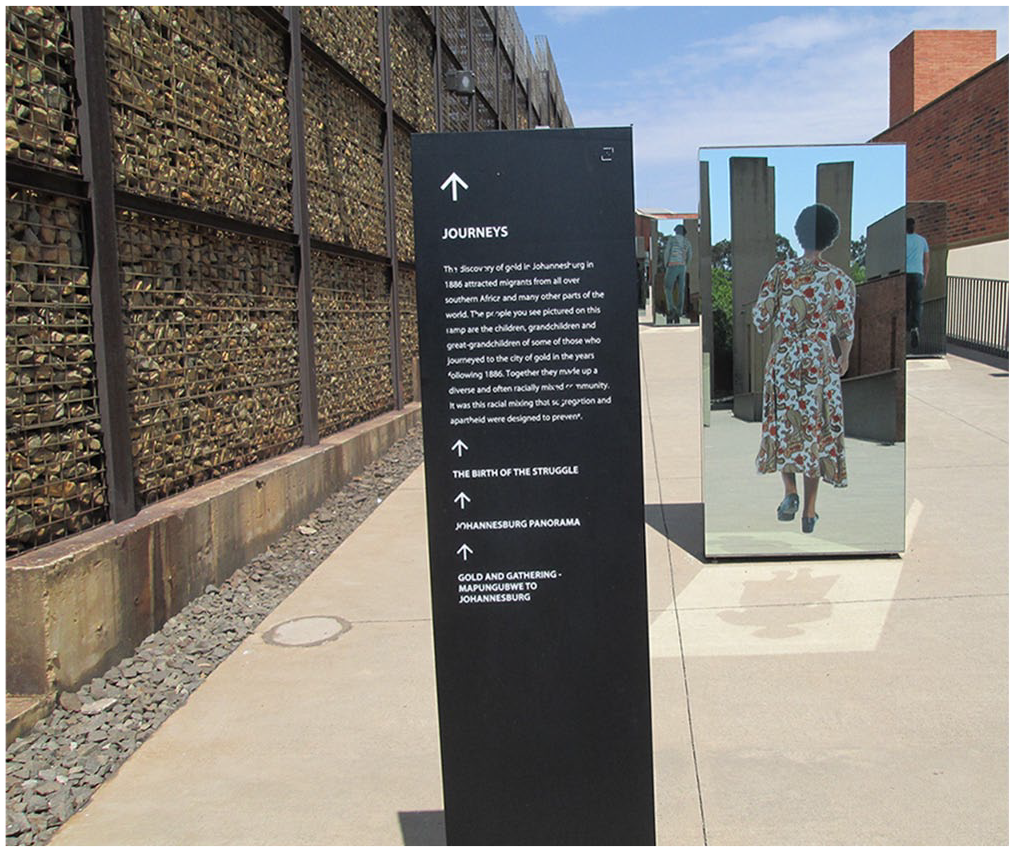
Journeys exhibit: ramp, gabion wall and “mirror boxes” (reflecting the pillars behind the photographer).
Furthermore, on the opposite side of the ramp from the gabion wall a series of alcoves are dedicated to the rock art of the Bushmen. These provide a “simulation of precolonial landscape” (Crysler, 2006: 26) in the register of mythical time. The Bushmen exhibit in turn relates to a “peace garden” at the end of the exhibition, both of which appear to provide a “prehistorical” counterpoint to the overall theme of progress. The Journeys exhibit is conceived in terms of a conciliation in which “The separate racial groupings come together” but are interrupted by a history of conflict (Apartheid Museum, 2018: 13), ultimately culminating in a “triumphantalist multiculturalism” and “an allegory of the inevitable triumph of good over evil” (Soudien, 2008: 214).
At the apex of the ramp, visitors reach a platform that offers a view of the city skyline, which the panel celebrates as “impressive” and “modern.” From this vantage point, one can see “the remains of mine dumps and the skyscraper skyline of Johannesburg,” while “Behind you lies Soweto,” South Africa’s oldest township, with well over a million inhabitants. Thus we have the classic modernization trope that sets the “development” of the “modern city” against the “underdevelopment” of the African townships. In the direction of the latter the view is completely blocked both along the ramp and on the platform (cf. Rankin and Schmidt, 2009: 90), an exclusion reflected in the demographics of the visitors, few of whom come from the townships.
Given this overall narrative arch, a second meaning of the stones in the gabion wall prevails: they are the byproduct of industrial process, refuse on the way to progress. Apartheid is posited as a cruel interlude that nonetheless helped—in the words of the initial inscription at the gabion wall—“drive the country” forward. The reference to the skyline suggests a freeze-frame view from a serene distance that abstracts from the actual city as it is rapidly being transformed, both through extensive development and the reclaiming of urban spaces by previously marginalized communities (Graham, 2007: 85).
Hence visitors arrive at a long set of curving stairs that leads down to the main and partially submerged section of the museum containing the central apartheid exhibition. The first hall at the bottom of the stairs prominently features a quotation about the significance of the gold mining period, along with “memory boxes” showcasing biographical details and artifacts of the individuals encountered on the ramp. Together, the ramp, panels, and room relating to the mines arguably form the most developed connection to the land on which the museum stands. However, the extensive exhibition downstairs consists primarily in history-telling focused on political violence and sacrifice in the service of the incipient nation, personalized through biographical memory of iconic figures. Where testimony is included, such as in the recordings of the TRC, “more ordinary unknown people acquire iconic status, as their hyper-scaled presences tell their stories in the documentaries shown in the museum’s viewing rooms” (Bremner, 2007: 102).
In the final room of the exhibition, where the Constitutional principles cover the walls in bold as on the pillars at the outset, visitors walk through a channel between two heaps of stones arranged on the floor to resemble the national flag. There a panel entitled “FREEDOM” invites the visitor to take a stone from one pile and lay it on another smaller but growing pile “in honour of the countless individual sacrifices that were made in order for this victory to be won.” This gesture may also symbolize the act of building the city of the future. Visitors thus transition from the explicitly themed apartheid exhibition, described as “the heart of the darkness of evil” (Apartheid Museum, 2018: 76), into the light of democracy (Crysler, 2006)—symbolized by a second lookout platform—before reaching the peace garden and souvenir shop. Designed to generate a strong emotional impact, the exhibition has nonetheless been criticized “as a theatrical device for narrating a singular history” (Findley, 2011), embodying a homogenization of disparate viewpoints to fulfill a “neutral, international, modernist aesthetic” (Bremner, 2007: 98).
The stones within the gabion mesh wall, despite their intended role in the triumphant narrative of national development, emanate an unsettling aura and introduce a non-conforming aspect to the museum’s otherwise sealed narrative. They possess distinct qualities when compared to other conspicuous auratic objects, such as the benches or the original Casspir vehicle prominently featured in the main apartheid exhibition, which visitors are invited to climb into (Rankin, 2013: 88). Viewed in conjunction with these latter artifacts, the gabion wall of stones can be interpreted simply as a representation of the resilience and fortitude of miners in the face of oppression. However, by virtue of its connection to the surrounding land it also carries connotations of the destruction of livelihoods and communities.
Yet stones remain mute and serve as a generalizing symbol unless given “personality” elsewhere. Notably, the figures pictured walking up the ramp are not the miners themselves. 6 Where the disturbing affect of the stones does root is in a large photograph of “hundreds of miners of all races, sitting together” in the first open hall before heading into the apartheid exhibition. It is presented as an illustration of “racial mixing,” but upon closer inspection the super-exploitation of black workers is nevertheless painfully clear (AM, 2006: 22). Also resonant is the gravel around an outdoor model of Mandela’s prison cell, recalling the quarry where he and other prisoners toiled daily to break rocks.
Perhaps the most notable exhibition space in which to track the significance of the stones is the “Life under Apartheid” room in the permanent apartheid exhibition downstairs. This room features a substantial collection of Ernest Cole’s photographs from his book, House of Bondage, including several depicting the migrant labor system and compounds. It represents a significant departure from the political-historical framing of the exhibition, confronting visitors with the daily struggles endured by black people under apartheid, and the very personal toll of all that went into reproducing, coercing, and controlling their labor.
Cole’s photographs possess striking auratic qualities in Benjamin’s sense, imbuing the depiction of oppression with elements of individuality and immediacy. For example, among them is a particularly powerful life-size photograph depicting black mineworkers standing naked in a line before a wall, undergoing a medical examination. Even if we cannot see their faces, the stark portrayal of each man’s naked vulnerability as they stand there against the wall shatters the anonymity imposed by overwhelming systemic violence. My point pertains to the impact of these images upon the exhibition as a whole. Cole’s photographs leave an auratic remainder that exceeds the dominant narrative, resonating with the gabion wall as a stark reminder of the mining rubble it represents—a direct outcome of the system that subjected racialized laborers to fatal work conditions.
The D6M
Everything in the D6M refers to place, yet District Six was almost completely flattened. About 60,000 residents were forcibly removed between 1968 and 1982 as the inner-city area underwent progressive demolition. Churches and mosques were left standing, but otherwise the very absence of ruins testifies to the extent of the destructive process. The main exhibition of the museum is located in a former church building on Buitenkant Street on the edge of the former neighborhood, engaging directly with the broader landscape of District Six.
Given the extensive destruction, the exhibition heavily relies on testimony, oral history, and archival fragments to reconstruct a mental image of life in the former neighborhood. It emphasizes the “community spirit” of District Six, characterized by conviviality and mutual care, regardless of “race” or class. Although the D6M draws substantially on nostalgic testimony of loss, struggle, and redemption, the presence of the rubble-covered land renders it unstable. Former resident Noor Ebrahim (1999: 9), and long-time guide at the museum, makes this explicit when he says in his memoir that 2 weeks after he and his family left District Six with their belongings in a lorry, “I passed my street again and saw that the house was gone. Even the rubble had been removed. I stood on the vacant lot with desolation in my heart.” The rubble unsettles and undermines the possibility of reconstructing wholeness from fragments, but in Ebrahim’s testimony, even this embodied negation is precious.
Although the museum emerges from a commemorative impulse, it does not so much strive to provide a tightly sealed narrative as to constitute a deeply testimonial place. As Chrischené Julius, then Head of Exhibitions, expressed, “The museum is not a grand statement. It’s literally the relationships we build with people over time and how people are always revealing new things and new aspects about their time in District Six or themselves” (cited by Moosa, 2020). This is exemplified by the large street map of the old District Six on the floor of the main hall of the church building—a distinguishing feature of the museum at its founding. It has received significant attention but warrants further examination within the current context as “a dynamic anchoring document, both in its central placement in the Museum and in its symbolism . . . [as] representative of the participatory nature of the Museum’s exhibition-making practice as a whole” (Soudien, 2019: 77). During the museum’s early days, former District Six residents were invited “to reclaim their addresses by writing their names onto the map” (Prosalendis et al., 2001: 81), and they included poetic text and images along the edges. These inscriptions infuse the map with personal significance, recreating the physical and emotional coordinates of a world and establishing the museum as a space of living memory.
Extending outwards from the floor map, there are a collection of historical and poetic texts, artwork, images, and soundscapes—mostly incorporated in subsequent installations. From the map, visitors can choose to go in several directions: to the recreated room of former resident Nomuvuyo Ngcelwane, the historical narrative panels around the outside of the main hall, the exhibits upstairs on the balustrades, the rooms at the back of the building such as the Memorial Hall (to be discussed shortly), or some of the more minor exhibits and displays.
At the map’s far edge is a bench with a “Europeans Only/Slegs Blankes” sign attached. By comparison to the other features, the bench is not prominent, and some people sit there quite casually. But then there is the bench’s racial designation, which institutes a break from the world recalled by the map as a refuge from apartheid. The bench is used not to point up historically unjust “race relations” but, in keeping with the museum’s critical stance on “race,” to question the very construction of its antinomies (Sanger, 2008). 7 This approach centers on the lived experience of “race” as a continuous and unresolved aspect of the present—notably reflected in the disproportionate number of light-skinned visitors.
The floor map and the other commemorative elements of the exhibition in the main church building could be interpreted as “answering to” the apartheid bench. In turn the bench, which stands at about a 45° angle to the map, also faces a display on the opposite wall entitled “Demolition,” which is covered by a large photograph of a bulldozer destroying buildings amid growing piles of rubble in District Six. Above this is another collection of newspaper clippings under the heading, “11 February 1966,” ignominious day of the declaration of District Six as a “White Group Area.”
On the other side of the bench, opposite the Demolition wall, rubble takes on added significance through a column of original street signs salvaged from the demolition process (see Figure 2). At the center of the column rests a mound of rubble gathered from the immediate vicinity of District Six. The eye is drawn upward toward the vertical alignment of street signs rather than to the debris below—affirming the prevailing narrative of District Six’s resilience and its figurative “rise from the dust.” The street signs evoke a sense of familiarity, starkly contrasted by the alien debris, together creating a palpable sense of irretrievable loss. This feeling is accentuated by a loosely arranged stack of suitcases between the bench and the column, with those on top displaying family keepsakes like photographs, embroidered towel, a tea set, and tin mugs. Visitors are often drawn to these personal details rather than the adjacent rubble (see Figure 3), which seems, from certain angles, to merge with the keepsakes while simultaneously receding into the expansive debris of demolition and displacement. Here, the suitcases and keepsakes serve as synecdoche, standing in for displaced lives and lost memories, while the rubble amplifies this effect by symbolizing the physical destruction of an entire community. Together with the prominent image of rubble on the Demolition wall, an insidious aura of ruination permeates the space.
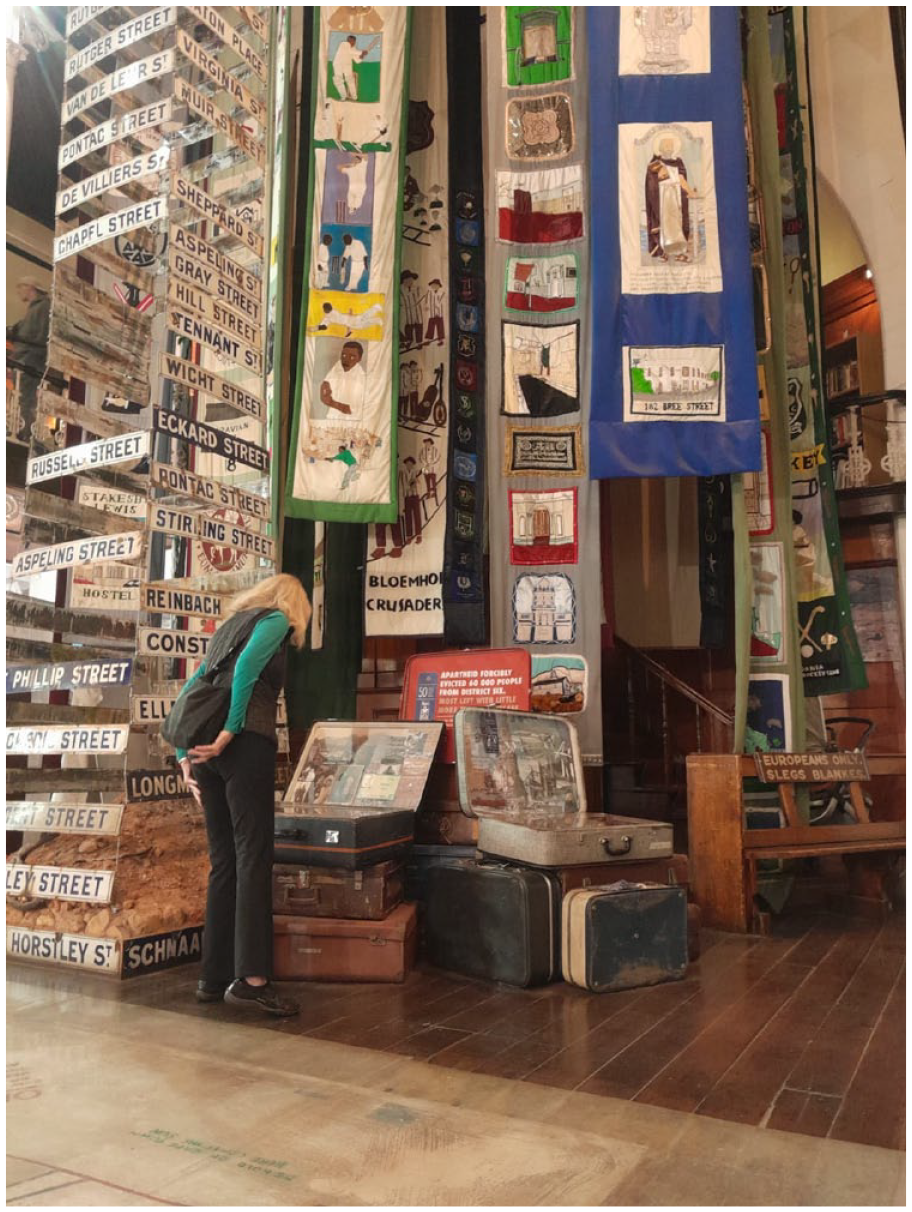
A visitor examines the contents of a stack of suitcases positioned between the apartheid bench on the far right and the column of salvaged street signs. The floor map is visible in the foreground.
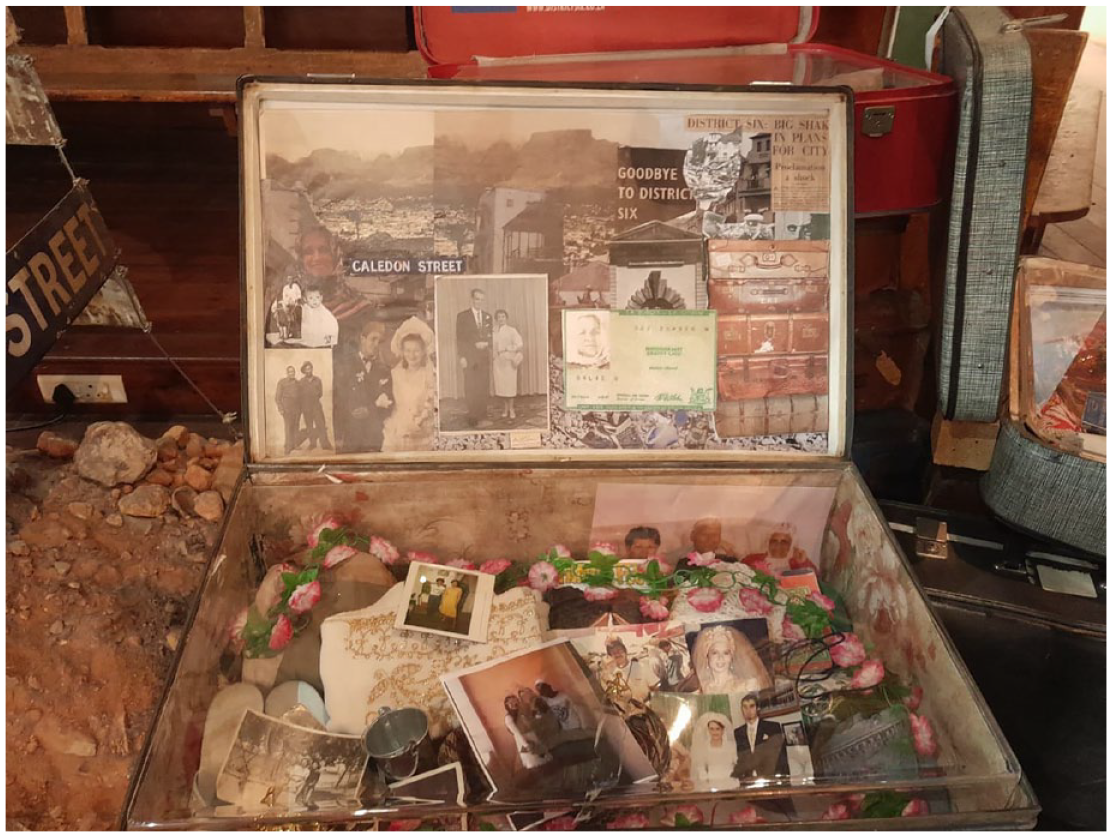
Detail of suitcase and pile of rubble.
The map and column of street signs—as well as a portrait gallery and memory cloth—comprise the core of the Museum’s first exhibition: “Streets.” Together, these are intended to reconstitute the intangible heritage of District Six. The enduring spatial arrangement at the heart of the museum generates a strikingly dissonant aesthetic effect. In this context, the bench is ancillary, an accent in a larger statement, but nonetheless telling in its enactment of a counterpoint. This is a pressing political question: several thousand claimants are to move back, and yet, almost 25 years after the establishing of the restitution program, only a fraction of the homes planned for construction have been completed and occupied, while many elderly claimants have died before seeing justice.
The desolation of the land stands in contrast to the crowded and spirited interior of the museum (Beyers, 2022). Nonetheless, from the museum’s location at the edge of the former District Six amid the busyness and dense urban construction of Buitenkant Street, the vacant spaces covered in rubble—hundreds of yards away—are consciously brought into the museum. Consider the Memorial Hall, a prominent room at the back of the main museum building (see Figure 4). It is part of the museum’s second major exhibition, “Digging Deeper” that opened in 2000, and which sought to deepen the engagement with District Six’s intangible heritage through an archeological engagement with the land itself (Rassool and Prosalendis, 2001). The room is dedicated to Horstley Street, from which some of the first forced removals from District Six took place in 1901. City health authorities blamed African dockworkers living on the street for spreading the bubonic plague, and summarily relocated them to a makeshift “location” on the outskirts of the city. A wall-sized photograph of Horstley Street’s remaining cobblestones, surrounded by the otherwise-ravaged landscape, forms the backdrop for various elements, including a sunken installation containing broken ceramics and other archeological remnants.
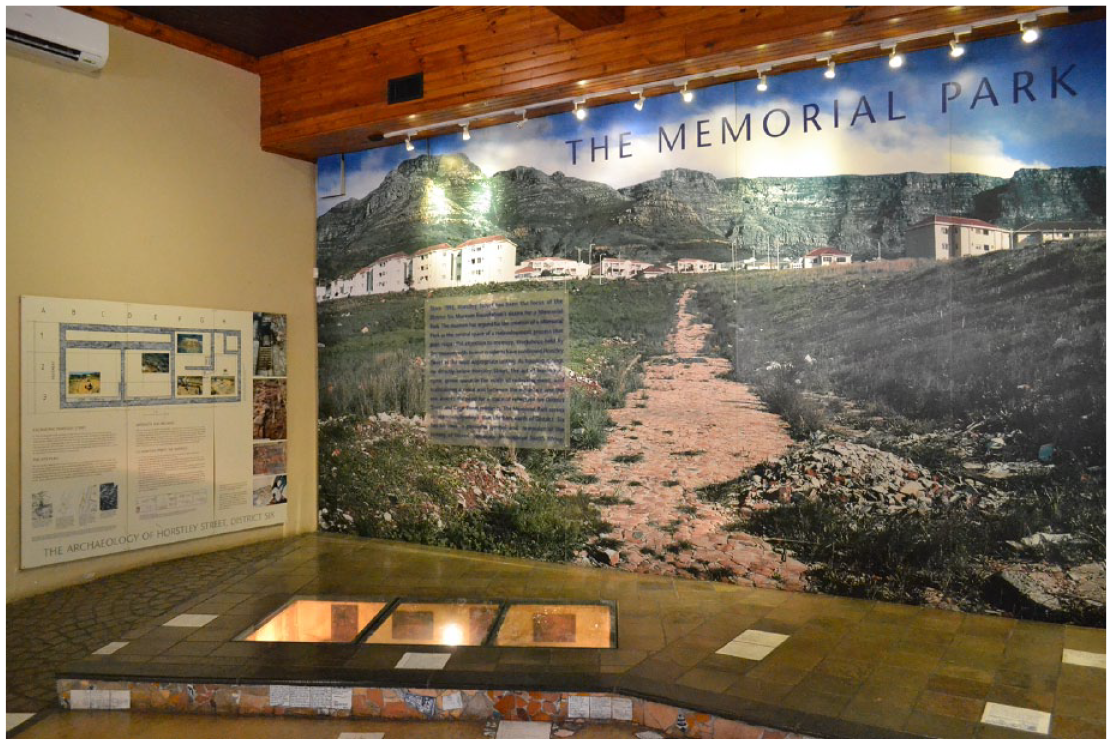
The Memorial Hall.
The curation of rubble imported into the museum imbues it with narrative significance, with the interior coherence of the exhibition drawing strength from its contrast to external disorder. Moreover, despite the deeply immersive nature of the main exhibition space, the fate of the land outside remains a constant and pressing consideration. A few hundred yards uphill from the museum, the remnants of demolished District Six remain conspicuous, even as a significant portion has been occupied by the Cape Peninsula University of Technology (CPUT) and various other construction projects that have gradually taken over vacant spaces. The Museum has long worked with the land by staging commemorative and artistic events, conducting regular walks through the site, and organizing or participating in protest marches and rallies.
During the “Hands on District Six” event in August 2003, the museum announced its plans to shift focus from restoration to engaging the emerging site (Bennett et al., 2007). This included creating a cultural center for the developing District Six at the Sacks Futeran Complex, 8 creating a Memorial Park, and establishing District Six as a Cultural Heritage Precinct in terms of the National Heritage Resources Act (1999). While I cannot go into this transition (see Hayes-Roberts, 2020), it will be useful to consider one example of a site-based activity spanning these periods: a cairn, which has been the destination of a “walk of remembrance” held annually on the 11 February anniversary of the declaration of District Six as a “White Group Area.” At the event, individuals who have experienced displacement from District Six and beyond lay a stone—either from the immediate area or from the vicinity to which they were moved—to the growing pile. This collective act of inscription has transformed the cairn into a recognized landmark (Bennett, 2022: 142). Situated at the former site of the iconic Seven Steps, the D6M (n.d.) museum website recalls the location as “the place where people met, where street crooners gathered to entertain themselves and passers-by, and where casual gamblers rolled their dice and dealt their cards.”
In 2015, the CPUT—formerly designated for whites only and the largest structure erected in District Six after its demolition—began construction on a new student residence at the very location of the cairn. Following protests by the museum and former residents, the cairn was preserved in the courtyard of the building, but surrounded by walls and cut off from a view of the mountain, sea, and city. Only limited access through the building was now possible, its projective aura of resolute insistence henceforth limited as an isolated and enclosed piece of curio. Since the confinement of the cairn, the museum has continued to elaborate the practice of “embedding an ongoing story into the site,” even as it continues to be transformed by new developments (Bennett cited by Joffe, 2020: 90).
Reflecting on the challenges faced by the D6M in its campaign to have District Six recognized as a national heritage site on the basis of its intangible heritage, former museum director Bonita Bennett (2022: 140) considers the “stark absence of physical traces—an outcome of the apartheid state’s determination not to leave any material evidence of the residential community that had once lived there.” This absence paradoxically underscores the necessity to redirect attention—already implicit in much of the museum’s practice—from remembered artifacts to the present site of remembrance, characterized by the indeterminate materiality of rubble as a distinctive form of untimely presence.
Comparison of curatorial aesthetics
We have focused on identifying the different commemorative strategies for incorporating rubble in our two case museums. Curation encompasses selection, framing, arranging, labeling, and other forms of curatorial treatment through which meaning is effectively “inscribed” onto the exhibition. Returning to our central question: How do we characterize rubble as an object of inscription in a memorial context? Rubble lies at the bottom of the symbolic formation of each museum, as it were, at the point at which its symbolic integrity falters. To the extent that it is incorporated, it appears as a primer for staging each museum’s key motifs and most emblematic items, its presence otherwise dissembled by the rest of the exhibition. However, one senses that it is not to be enlisted or dismissed so easily, for its peculiar materiality seems to refuse the narrative and aesthetics through which other objects are foregrounded.
Generally speaking, rubble—a heterogeneous and shapeless aggregation analogous to garbage—presents the disintegration of human artifice into indistinction, and not as an idyllic return to nature but as inorganic waste. We thus sense the evident unruly materiality of rubble in the very effort with which it is designated or framed, molded into shape, contained, “sanitized,” and by which its peculiar extensity is curtailed to suit the explicit aims of memorialization. This is taken furthest when rubble is “cleaned up” by careful selection to provide for regularity of shape, as in the gabion wall at the AM.
Because of its disordered form and squalid, unsanitary, and offensive quality, it is not amenable to being placed and assigned a name among other more aesthetically valued objects. Note thus that “rubble” usually does not call for a simple designation as such—it is either too obvious, or liable to be ignored. Nor is a “do not touch” sign necessary, not because rubble lacks fragility but rather because there would be little desire to touch it. Any appellation seems more like a justification for its inclusion in the display than a description that assigns it a definite meaning or clear place within the overall narrative. And yet context needs to be supplied, if not by a label, by other curatorial means.
The label at the gabion wall in the AM furnishes essential context in the absence of which its banal functional meaning would prevail. In this sense, the label becomes integral to the overall experience of the viewer and, along with other practices of curation, becomes intertwined with the aura of the stones. Pace Benjamin, for who the aura of the original artwork did not depend on its labeling or curation, such inscription is crucial for understanding certain museum objects’ significance and context, determining the ability of viewers to perceive and engage with the object and its aura.
In the AM this aura is both called forth and suppressed. In being made to represent laborers in their toil, the stones at the AM stand as poetic backdrop to the storied individuals pictured on the glass panes, next to which the miners symbolized by stone are anonymous. Thus in the instant of their representation the miners are spirited away by being turned into something else—a sacrifice for the new South Africa. There is scarcely a trace between the stones and their appellation, except for a faint aura—an underlying gnawing sense of coercion—that remains. Nonetheless, I have suggested that this auratic effect resonates with other parts of the museum, especially Cole’s photographs, and unsettles the otherwise-sealed grand narrative about the ascendance of the new nation.
The problem is different at the D6M, where the rubble is scarcely named at all. Instead, the physical arrangement for its presentation and its relationship with other objects provides the necessary context for interpretation. The vertically arranged street signs, themselves recovered artifacts from the wreckage, do not designate the pile of rubble below but rather the absence of the streets that ought to still be there. As fragmentary ruins amid the wreckage, the street signs invoke a world of mimetic correspondences (Benjamin, 1978 [1933]), but they are incapable of their original orienting function. Similarly, the floor map depicts the neighborhood that should still be there. The map and the street signs thus stand as an act of defiance of memory; they are a statement that community lives and stands “here” in the very will to remember. However, the incorporation of rubble within the museum walls infuses an ominous sense into the lively exhibition.
In both museums, rubble symbolizes those otherwise excluded from memorialization, reflecting the enduring legacies of colonial and apartheid-era racial inequalities, as well as disparities in memorial infrastructure (Robins and Spiegel, 2023: 68). This symbolic association emerges from decisions about its inscription—at the AM, a simple acknowledgment, and at the D6M, an invocation of destroyed homes, streets, and lives. However, at the D6M, rubble also serves as the basis for a difficult reckoning with the land, becoming a critical force for renewal (cf Lease, 2017) and struggle. This dynamic is evident in initiatives such as the cairn, the Horstley Street Memorial, and the wider campaign for National Heritage status.
While this article has focused on the effects of rubble within museum curation, rubble’s significance in District Six extends far beyond curated spaces. Inscription on the land itself involves contestation with various stakeholders with direct and often conflicting investments in it. Restitution-related redevelopment has prioritized rubble removal, raising critical questions about financial responsibility (NM & Associates, 2012), but without consideration of the implications for historical memory. Meanwhile, “squatters” residing amid the rubble, and who have constructed tunnels beneath, conflict with claimants who have acquired properties through restitution, as well as with other residents, business owners, developers, and municipal authorities—all of whom have a stake in removing them. These tensions underscore broader implications of how rubble is perceived, managed, and disputed, extending the discussion of memory and materiality into the lived realities of those involved with these contested spaces.
Difficult memory over landscapes of destruction
This article has examined how two museums employ distinct curatorial approaches to artifacts of destruction to shape collective memory in relation to the land. In the D6M, apartheid benches serve as a counterpoint to the remembered communal life evoked in the floor map. In the AM, they contrast with the principles of the new constitution displayed on the pillars at the exhibition entrance, and with the values personified by Nelson Mandela, as exemplified in the pool inscription.
Conversely, the display of rubble in both museums confronts viewers with the aftermath of destruction. Regardless of its particular framing within each museum, rubble remains as a synecdoche for the destroyed landscape in a place marked by traumatic events. Drawing on Benjamin’s concept of aura, with its disjunctive and untimely connotations, we see how the discomposing nature of the exhibited rubble unsettles the overarching narrative each museum seeks to construct. This untimely aura disrupts attempts to form an ethico-aesthetic whole based on discernable historical traces.
Focusing on rubble entails a perspectival shift as its form offers little intrinsic guidance for how it should be presented or interpreted within an exhibition. Any personal items found in the rubble do not usually feature in its display. Rubble, because it cannot be meaningfully separated into its parts, seems to stand in for the whole of what was destroyed—and how it was destroyed—in a way that other fragments cannot. This imbues rubble with a unique capacity to symbolize the plight of subaltern lives otherwise erased from history.
As noted with the stack of suitcases in the D6M, this synecdochal logic can be seen to extend to other tangible remnants used to evoke collective experiences and historical events at memory sites. Consider, for example, personal items or clothes recovered from former detention and torture centers or concentration camps, used in memorialization to reinstate something of the individuality of the murdered. Suspending the impulse to immediately reconstruct a whole—such as the individual’s life and biography—these artifacts appear as isolated fragments in a profoundly disrupted temporal and spatial context. They convey a sense of overwhelming violence through their intrinsic connection with piles of other personal belongings that those who died left behind. It is from this connection, along with their personal significance, that their aura emanates.
Approaching these artifacts as we have approached rubble in this article, curation becomes fundamental in imparting historical meaning, as form-giving must begin from scratch. Here, curatorial treatment gives rise to a dissonance between the bestowed form, which conveys intended meaning within the commemorative narrative, and the object’s materiality, which recalls its original context of violent destruction. Furthermore, because the process of inscription is needed to give form and meaning, it contributes significantly to the atmospheric effect generated—even as that aura exceeds the curatorial framing due to its connection with the wreckage.
The aura of synecdochal artifacts, contemplated in terms of their unique material qualities at particular sites, can serve as a valuable resource for engaging with difficult memory. Reckoning with the continuous impact of totalizing oppression and destruction upon our very field of perception is essential to harnessing this potential for an ongoing, immanent critique of emerging narratives of historical justice.
Footnotes
Acknowledgements
The author thanks Jonathan Bordo and Darius Zifonun for enriching conversations during the initial stages of this paper and research assistants Camilo Cueva-Fischer, Sarah McNeilly, and Kyle Sharratt for their valuable contributions. The author also thanks three anonymous reviewers for insightful comments that significantly shaped the paper’s eventual form and journal editors Steven Brown and Andrea Hajek for their support throughout the publication process.
