




Abstract
Central and Eastern Europe—scenes of brutal genocides in the past century—are dotted with sites of trauma. Only some of those potential sites of memory are currently marked with plaques or memorials. Mnemonic responses to such sites do occur but are not part of an easily readable symbolic system within official culture. They are often contradictory: at once supporting and blocking memory about a given event. The concept of “non-memory” developed by Polish sociologists might be helpful in grasping vernacular memorial activities that do not privilege verbal contact as the norm in the transfer of memory. Non-memory tends to combine dismantled symbolic means and extra-symbolic embodied tools and performative acts. Non-memory therefore takes part in the transmission of an experience of the past in particular when the past turns out to be difficult or impossible to inscribe within available cognitive frameworks.
Keywords
Unremembered, forgotten
Sites of post-violence about which it could be said that they are repressed, obliterated, or contested, reveal a fundamental discursive problem that critics struggle with when defining the memorial processes that occur around such places. The most commonly formulated designations are unequivocal: these are locales that are “less known” and “largely invisible,” “long forgotten and neglected” (as they are characterized, for example, in a document on killing sites by the International Holocaust Remembrance Alliance; Silberklang, 2015: 23). It seems to me, however, that the question is more complex than the suggested general feature of “being forgotten” (Sendyka, 2014, 2016, 2017, 2021). The trope that would lead toward one of the possible understandings was suggested en passant by Ulrich Baer in Spectral Evidence, as he was commenting on photographs of such sites. He wrote, “By casting an unknown place in the haunting light of déjà-vu, landscape photographs produce the mild shock of recovering what seems to be an unremembered—rather than a forgotten (emphasis mine—R.S.)—experience” (Baer, 2005: 78). The distinction made between the ideas in this sentence would suggest that not remembering and forgetting are not in fact synonyms. This was even more explicitly stated by a Polish cultural anthropologist Lech Mróz, whose article on the Romani Holocaust was entitled “Non-Memory Is Not Forgetting” (Mróz, 2000).
The term non-memory, at first glance, may appear to simply be one neologism more in the already overfull post-structuralist poetics of contradiction. Yet, it is difficult not to notice that in the Polish language, it works in quite a natural way—it is well-rooted in communicational tradition, independent, and semantically differentiated. This makes this language rather exceptional: neither in the main languages of the discussions about memory (Kończal and Wawrzyniak, 2018: 399) 1 nor in the Slavic languages will we find such a strongly present conception of an alternative form of memorial deficiency, in Polish predicated upon the negation of the noun “memory” (non-memory) in lieu of the separate noun form developed from the verb “to forget” (forgetting). For in the Polish language, niepamięć (non-memory) has been in use since Renaissance Polish (at least from 1584 when it was first recorded in a written form) as well as in Baroque, Enlightenment, and Romantic Polish (Bańkowski, 2000).
I would like to treat the presence of this separate term in the vernacular language and in non-specialist circles as an important indicator that the semantic value of non-memory differs from the one typically connotated with forgetting. The conceptual potential of the term “non-memory” was noted more than a decade ago by Polish émigré sociologists Maria Hirszowicz (working in Leeds) and Elżbieta Neyman (residing in Paris). In two takes—in Polish in 2001 (Hirszowicz and Neyman, 2001) and in English in 2007—they defined non-memory as societally significant gaps in the collective memory:
If we take memory to be the accumulations and registries of information embedded in social structures—as well as the embedded interpretations of that information—then non-memory encompasses everything outside the scope of that definition: unassimilated elements as well as elements either forgotten or effaced. Non-memory is, therefore, a concept broader in scope than mere forgetting or repression in the Freudian sense. (Hirszowicz and Neyman, 2007: 75, emphasis R.S.)
Hirszowicz and Neyman proposal seems so productive in relation to research objects like the clandestine sites of violence because it transgresses dualistic models based on binary oppositions between memory and forgetting. It draws attention not only to what is being obliterated but also to what has not been yet comprehended, incorporated, digested, voiced, symbolized, and fully communicated. Furthermore, the terminological proposal connected with the proposed term “non-memory” criticizes another binary opposition, which is created by the juxtaposition of terms describing the communicative memory and its “silent” forms (like—for instance—“embodied memory”). Hirszowicz and Neyman stress that negative forms of memory are not only a matter of personal, individual, neuronal, or psychological response to the past. In fact, they are as social a formation as “memory” defined by Maurice Halbwachs.
The terminological operation of Neyman and Hirszowicz (2007) in the article The Social Framing of Non-Memory is indeed indebted in the classic (1925) conception of social frameworks of collective memory by Maurice Halbwachs, but the authors also point out an important characteristic that separates (collective) non-memory with its positive inverse (collective memory). Collective memory, for the French sociologist, was the result of a natural process, “disinterested” (as opposed to motivated or historically constructed). Non-memory, however—as seen by Neyman and Hirszowicz—involves processes that are automatic, routine, and unconscious (“straightforward forgetting,” “non-objectivization”), as well as fully volitional (“biased blocking”); what is more, it is shaped not only by interacting individuals, but also by institutions (including religions or political doctrines) and media.
The term “niepamięć” (“non-memory”) indeed appears in the personal lexicon of a number of Polish intellectuals, among others: Jan Tomasz Gross (2004), Jerzy Holzer (1995), or Maria Poprzęcka (2014), 2 although instances of defining of the term are in fact scarce. Piotr Tadeusz Kwiatkowski in his text “The Social Creation of Collective Non-Memory” continued with the trope provided by Hirszowicz and Neyman, distinguishing the term “non-memory” from “forgetting” in such a way as to make clear that the latter would concern above all individual processes, and the former collective ones (Kwiatkowski, 2009, see also Kwiatkowski, 2014). “Non-memory” is a processing of “past matter” that consists in building up around the historical event a “blank spot,” with the simultaneous “preservation (of the past) through whatever fixing methods are available.” In particular, this regards events that are important to the collective, those that “have a significance that exceeds the individual” and are “potentially important to the current members of a given collective, but do not function in societal discourse, nor constitute a reference point for practical actions” (Kwiatkowski, 2009: 91). They “do not constitute a reference point” because as a result of a series of operations (such as passive “overlooking” or “neglect” or active “negation”) they have been excluded from referentiality. They have not, however, been subject to complete elimination; access exists to unremembered events: “they are apparent, i.e. socially established and available or lost in a recuperable way, i.e. relatively easy to recover” (as above). The “unremembered” past is thus invisible, but not inaccessible. It is right here, right beside us, but not so much so as to be referred to. It is a paradoxical being-in-non-being, the examples of which for Kwiatkowski are, among others, for different societies the Armenian genocide, the crimes of communism, or the Holocaust.
In social terms, non-memory would thus be a state of communal reference to the past in which what is remembered coexists with what is repressed and what is not yet assimilated. Contents having to do with the past would be in a fluid state of a negotiation carried out in the realm of the collective, in part passively, by means of not recording or memorializing, overlooking, neglecting some component of the facts concerning what has happened, but also in an active way through negation, erasure, censorship: in these activities, a role is also played by the institutions and media created by a given society. 3 Insofar as in Hirszowicz and Neyman, the difference between forgetting and non-memory rests on the inclusion in the realm of the latter that which is forgotten, but also that which is still not-yet-remembered, then Kwiatkowski’s conception is more strictly sociological and does not include contents that society cannot assimilate for reasons such as traumatization or the lack of suitable models for the rationalization of what occurred. It is hard in this case to defend the non-synonymous value of specific meanings for non-memory. Analyses of forms of forgetting like the typological arguments of Paul Connerton (2008) or Aleida Assmann (2012) have discussed very similar processes (Assmann has distinguished between preservative, selective, automatic, repressive, defensive, therapeutic, and constructive forgetting, while Connerton has differentiated between repressive, punitive, and structural practices alongside annulment, disappearing, and silence), as Kwiatkowski’s article (negation, erasing traces, censorship, eliminating references).
Important arguments in defense of the semantic autonomy of non-memory were added en passant by Lech Mróz (2000) in the aforementioned text on the Romani Holocaust, although they must be repurposed on the basis of the contents of the article since the term non-memory appears only once outside of the title. The ethnographer defines with the help of this idea—as can be inferred—an attitude he characterizes as a lack of efforts to “record in memory histories reaching far into the past” (Mróz, 2000: 110). Non-memory is a particular conflagration of memorial processes that occur around the experience of Porrajmos, characteristic of Roma communities. The “non-recalling” of stays in the camps was connected with limitations due to customs surrounding the remembrance of the dead (fear of encouraging the souls to returning, concerns about possible harm to the living). On a technological level, “non-recording of the camp past” was associated with the oral character of the culture, and on a social level, with (oftentimes difficult) relations between Roma and non-Roma. Non-memory did not indicate for Mróz, however, a forgetting of the past. Despite the lack of an elaborate symbolic apparatus to support the relationship with the past, the Roma were capable both of undertaking practices of commemorating the Porrajmos and—although with some delay—of constructing a narrative and a scholarly history of that past. Mróz does not mention this, but we can Infer from his reconstruction that in the face of a defunct chain of communication, other channels of transmission very clearly began to be in operation. 4
However, forcefully the idea of deploying the term non-memory was expressed in the title of Mróz’s article, its potential was only fully noticed by Sławomir Kapralski (2012), who in his monograph on Roma Porrajmos (A People from the Ashes, 2012, a chapter titled “History and Memory”) continued to think about non-memory and expanded the Mróz’s diagnosis from a decade before:
the Roma “do not remember” their Holocaust (to the extent that they really don’t remember it) not because of the fact that they are Roma (that their culture is distinct, etc.), but rather because the Holocaust had on them, as it did on all other survivors, an enormous influence, shaping their perception of time, history and themselves. (p. 242)
Romani memory is thus traumatized: “it is ‘mute’, but it leaves intermittent traces of the experience of terror—passing over in silence, gaps and tremors in cultural expression, by means of which it is possible to gain access.” These silences are, however, of a particular nature, and in order to clarify them it is necessary to take into account the networks of social relations” (Kapralski 2012: 242). Non-memory in Kapralski is not, then, the effect of repression or cultural taboo. The issue is rather that it touches on that part of experience that cannot be put into words; there exists for it no network of semantic interactions in which it might be communicated. Moreover, within the Romani community, work with the past takes place without the interference of organizing factors such as institutions, a conception of “state,” “nation,” “political power,” “national territory”: they remain on a communal level at which there is no readymade, universally comprehensible script of conduct. Hence, the effect of this work is not transmitted through the “socially dominant structures of language, symbolic culture or systemic activities” (Kapralski, 2012: 196), meaning that it lies beyond what had been defined as the terms of communicative or cultural memory in Jan Assman’s Kultur und Gedächtnis (Assmann and Hölscher, 1988). It is, however, conveyed and sustained. But how?
Memory beyond the discursive
The example below may illustrate the paradox of a memory transfer that occurs beyond what we are able to talk about, a transfer hiding behind the processes of non-memory, leading to the coexistence of seemingly conflicting phenomena: the simultaneous non-appearance and maintenance of a relationship to a particular event from the past.
The example comes from the village of Małków near Hrubieszów. Located here is the mass grave of 49 people murdered by the Germans at the start of the war: in December 1939, around 1800 men—local Jews—were forcibly sent toward the Soviet–German border. Those unable to keep pace were systematically shot. In 2013, this area was commemorated, thanks to the efforts of the Rabbinical Commission for Cemeteries: a plaque with information about the victims was placed here, and the burial area was covered with stones. An image from before this memorialization should, however, also give us pause; it reveals memory practices that are theoretically mutually exclusive but occur simultaneously (Image 1). In a photograph showing a portion of the unplowed field, we definitely see the effect of a memorial deprivation: the place is unremembered, neglected, “empty.” And yet, it also cannot be said that it has been totally forgotten. The person plowing the field—likely belonging to at least the third generation of people working on these grounds—has carefully bypassed the area where he might have hit upon human remains.
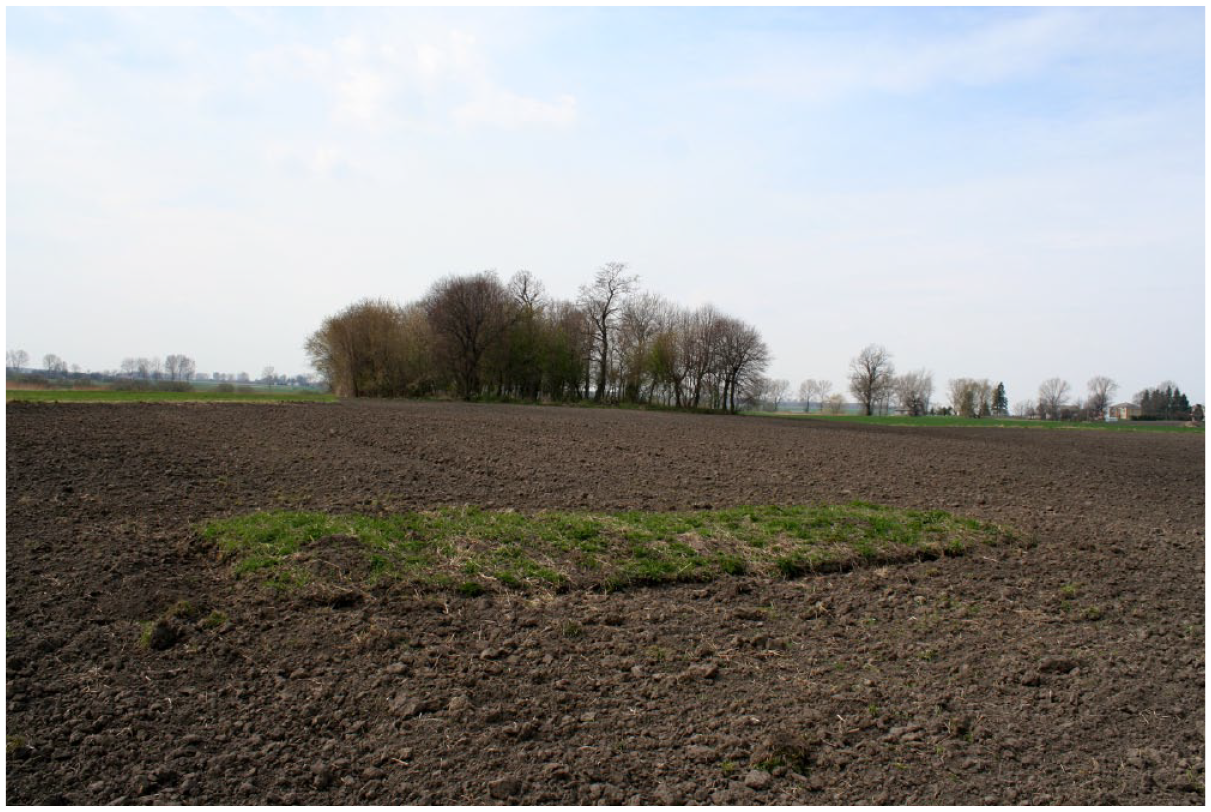
The site of a mass body deposition from 1939. Photograph courtesy of the Foundation Memory That Lasts and the Rabbinical Commission for Cemeteries.
The combination of the above photograph with Baer’s commentary allows us to understand what he was talking about when he suggested that a non-remembered site might not be entirely forgotten. Elements retaining active links to the past are still in effect, and although they do not fall within the bounds of facts, official communication, symbolic transfer, nonetheless the past continues to exist thanks to precise personal acts: gestures, actions, even those made and taken in complete silence, even if they occurred without the actor’s full awareness of their purpose. What is more, an intergenerational transfer of that strange mnemonic conglomerate comprised action, and the refusal to act is very evidently possible. Here, the transfer has a performative character: these gestures, this fixed tractor route, as well as paths people take around the site, contain references to the past.
For at least 30 years, ethnographers have been pointing to an unproductive error often underlying the work of memory studies scholars, namely, equating memory and discursive processes. Rosalind Shaw (2010), one of the most important researchers of nondiscursive sociocultural practices, mentioned in her summary article in the collective volume Remembering Violence: Anthropological Perspectives on Intergenerational Transmission precursors to this perspective including the works of Arthur Kleinman and Joan Kleinman (1994) and Paul Stoller (1994) on the cultures of China and Nigeria, Jennifer Cole (2001) and Michael Lambek (2002) on Madagascar, as well as her own work on slavery in Sierra Leone (Shaw, 2002), and research by Nicolas Argenti (2007) from Cameroon. The anthropological data show, in Shaw’s view, that knowledge about the traumatic (in the case of the research she cites, primarily colonial) past does not need to be conveyed through narrative, since mnemonic phenomena occur in a variety of contexts that resist textualization, for example, ritual practices (dances with masks, possession by ghosts, etc.) and daily performances that build social relationships. Moreover, the scholarly focus on the effects of violence through the perspective of an individual experiencing post-traumatic stress—an effect of the influences of the Western European psychoanalytic tradition—leads, as noted by Ruth Kevers et al. (2016), to the perception of the processes of post-violence work with the past in a narrow manner: as phenomena that are individualized (concerning the individual), medicated (examined as a disease), and pathologized (turning to the difficult past inevitably reactivates suffering and trauma). Furthermore, the “Europeanization” of difficult memory (i.e. proliferation, replication, or even “the triumph” of an international, globalized norm of response based on a virtue of atonement—see Gabowitsch, 2017) leads to the ethnographically unjustified omission of collective experience (different cultures have developed different memory norms), and—in another dimension—to the politicization of the results of this research.
The political consequences of universalizing Western “post-psychoanalytic” norms, in which the work of memory is subordinated to the need to “face the past,” are shown by Lea David (2017: 314), a sociologist working on the past of the Balkans. Jelena Obradović-Wochnik, a political scientist dealing with, among others, the processes of transitional justice, takes issue with any accusation of indifference to the past in post-conflict areas of the former Yugoslavia (Obradović-Wochnik, 2013: 328): silencing memory frequently has political and very real consequences (among them resistance to imposing normative Western paradigms of “working through the past”). 5 Thus, anthropologists and ethnographers are joined by representatives of other social sciences: political scientists, sociologists, and human rights researchers in arguing that apparent memorial scarcity is more productive when conceptualized not so much as physiological amnesia, traumatic denial, ethnically dangerous “indifference,” or socially excluding “forgetting” or “denial” (Cohen, 2001; Zerubavel, 2006), but rather a morphologically complex “site of silenced memory” that would be filled with a variety of components: an existing, communally shared—but for various reasons undisputed—knowledge, implicit practices and actions, and also—once more variously motivated—an incapacity to engage in the discussion of violence.
The ability to understand not talking about and not remembering the past beyond the binary opposition of remembering and forgetting is supported by an emerging discipline—the anthropology of silence. Silence and oblivion “are often confused,” as the philosopher Luisa Passerini has written,
when memory is analyzed as narration, be it oral or written: what is not said may be such either because it has been repressed—by trauma, contrast with the present, conflicts of individual and collective nature—or because the conditions for its expression no longer/do not yet exist. (Passerini, 2007: 15–16, emphasis R.S.)
The main opposition to “the commonplace view that silence is the space of forgetting and speech the realm of remembrance” has been built over more than a decade by historian Jay Winter, who in 2010 took issue with the binary approach to remembering and forgetting proposed by Marc Augé in Oblivion (Augé, 2004; Winter, 2010: 4). According to Winter’s (2010) diagnosis,
Silence, we hold, is a socially constructed space in which and about which subjects and words normally used in everyday life are not spoken. The circle around this space is described by groups of people who at one point in time deem it appropriate that there is a difference between the sayable and the unsayable, or the spoken and the unspoken, and that such a distinction can and should be maintained and observed over time. Such people codify and enforce norms which reinforce the injunction against breaking into the inner space of the circle of silence. (p. 4)
6
Thus, silence may be the not-yet-spoken, something that would like to get out but that has been restrained as a result of the “developmental disorder” of a given society. The anthropologist Ann L. Stoler, examining the colonial past and the forms of its memory, introduces the term “aphasia” to replace the inaccurate and misused terms “forgetting” and “amnesia.” “Aphasia” as a concept that forms the cognitive framework of research allows us to see various causes of communication blockage, “active dissociation” of data, obstruction of memory flows, and loss of access to the intelligible past, which are not due to ignorance, prejudice, or denial. Aphasia connotes,
dismembering, a difficulty speaking, a difficulty generating a vocabulary that associates appropriate words and concepts with appropriate things. Aphasia in its many forms describes a difficulty retrieving both conceptual and lexical vocabularies and, most important, a difficulty comprehending what is spoken. (Stoler, 2011: 125)
I propose, inspired by these scholars’ work, that between the poles of remembering and forgetting, discussing and silencing the past, there are many micropractices of dealing with what cannot quite be “spit out,” and the transmission of what cannot be comprehended by a suddenly disintegrated language and conceptual system, or by one not yet prepared for such a challenge. I would like to follow these grass-roots, poorly identified actions in this chapter, moving away from the binary models available to memory studies. I will chart the possible features of non-memory, and venture an exhaustive description in the conclusion of this article.
Moreover, I propose that the complexity of this intermediate field can reveal the whole spectrum of the effects of not speaking. Many researchers in the field of social studies notice non-pathological, positive effects of silence about the past. Taking the past out of the discursive field may therefore under certain conditions be constitutive and indispensable for the identity of both the individual and the entire community, argues the political scientist Kennan Ferguson (2003) in Silence: A Politics. Priscilla B. Hayner (1996), active in international legal bodies of transitional justice, emphasizes that the reason for not discussing the past may be the desire for reconciliation, which for local settlements is often simply unavailable without “letting go” of wrongs (p. 176). The psychologist Pihla Maria Siim, looking at immigrant communities from the former Soviet Union in Estonia, sees a similar mechanism in smaller, family-based communities. Here, too, the memory of the past is sometimes silenced, often in order to maintain cohesion (Siim, 2016: 74). Instead of treating these transmissions of memories of the collective violence past that are inconsistent with the “community’s narrative and discursive conventions” as “pathological signs,” they can be viewed as “the resilience communities exercise,” argued Ruth Kevers et al. (2016: 631), sometimes as deeply compatible with the local cultural norms (as demonstrated, for instance, by Carol Kidron in her research on Buddhist communities; Kidron, 2018; also Kidron and Kirmayer, 2019). In conclusion, then, interdisciplinary research combining memory studies, anthropology, sociology, and cultural psychiatry calls increasingly for notions to be drawn from the recent critique of the concept of post-traumatic stress. From this perspective, more productive conclusions for memory studies would offer relational, socio-historical, and cultural approaches that, in the absence of any discourse on the past, would nonetheless be able to perceive more than just a (normatively non-neutral) “denial.” Silencing memory is a socially framed process, just like memory itself, and thus a very complex cultural phenomenon, constantly changing, co-shaped by political factors and ethical norms.
Silent knowledge and forbearance of speech
Convincing results of research on “silent transfer” of the past from witnesses, critical toward hypotheses of pathological impact of the traumatized memory 7 were proposed by Carol Kidron, an Israeli ethnographer working with the descendants of victims of the Holocaust (Kidron, 2003, 2015, 2021). Kidron (2009) opposes the one-sided and reductive treatment of this transfer, this Eurocentric—as she writes—privileging of verbal contact as the psychosocial norm (silence here signifying repression and a pathological state) and shows that “ethnographic accounts of Holocaust descendants depict the survivor home as embedding the non-pathological presence of the Holocaust past within silent, embodied practices, person-object interaction, and person-person interaction” (p. 5).
In private, silence can be a medium for the transfer of emotions, a means of communication, the passing on of knowledge as it often takes a form that Jay Winter (2017) has called “performative acts of non-speech” (p. 173). Here, specifically Kidron cites the examples of survivors who still use objects from the camps (she gives the example of a prison spoon). 8 The survivors express a relationship to the past by mimicking it and through body language, maintain the practices that enabled them to survive (i.e. food storage, food sharing). This type of interaction, according to Kidron (2009), “semiotically and sensuously resurrects the past” (p. 12). They transport into the present not only tension or pessimism, as Kidron notes, but also the sense of a regained “gift of life,” allowing for a communal experience of the traumatic past in a controlled way and therefore supporting a healing process.
“Tacit knowledge”
9
is connected here to what Kidron (2009) calls the “forbearance of speech,” noting that
. . . the resultant loss of words need not signal psychological maladaptive repression of the past, the failure of interpersonal interaction, or ultimate forgetting and absence. Instead, the network of media of domestic silence appears to constitute an alternative, nonverbal route through which the emotive and corporeal experience (rather than the recollected cognitive narrative) of the past may be transmitted/communicated and thus made actively present and lived in daily interaction. (p. 16)
Traces of walking around the unmarked mass grave in Małków demonstrate the access of the local dwellers to some tacit knowledge, and if Kidron is right, it is an embodied communication about the past. I would like to treat this type of transfer as important, maybe even fundamental in the face of the key problem of my research, that is, of apparently “forgotten sites of memory” that turn out to be immediately findable by locals (Pollack, 2014), who seem to have some intrinsic knowledge unavailable to others.
Among the examples of silent transfer, Kidron (2009) also cited verbal communicative situations that have, however, a particular character, namely, “parent-child interaction in the form of dicta and fragments of mythic tales of survival” (p. 9). An example of this type of practice of transmitting knowledge of the past through narration that is transformed, deformed, remade in the shape of fiction has been given by Marta Kurkowska-Budzan. In Jedwabne, in fact, circulate at least two stories rooted in the events of 10 July 1941 when local Polish population killed local Jews. The first story goes as follows: on the market square in Jedwabne there is a place, on which
Jewish woman holding a child in her arms was killed. Long after the war, the weeds between the cobblestones here grew in the shape of a cross. If this phenomenon had appeared a few meters further away, people from all over the area would not gather before it in propitiatory prayer. (Kurkowska-Budzan, 2002: 115)
10
Another story goes as follows:
The Jewish man who being drowned by participants in the massacre called out to heaven, “Mary! Saint Joseph! Stand by me!” When the perpetrators attempted to pull the corpse out so as to rob it of expected jewelry and clothing, a “real miracle happened,” as people tell it: “the Jew was as naked as God had created him.” Since that time all those who dove into the pond in search of lost Jewish gold met with divine punishment—they all drowned. (Kurkowska-Budzan, 2002: 115; see also: Kurkowska-Budzan, 2008)
Ewa Wolentarska-Ochman commented on these oral histories in 2006 in an article published in “History and Memory,” writing that those
mythologized narratives of events . . . enabled the community to express collectively what could only be acknowledged privately. By locating the tragedy in the Christian narrative tradition of the sinful man and punishment by God, the Jedwabnians could work through the tragedy and the two sites could accommodate the community’s feelings of guilt and contrition. (Wolentarska-Ochman, 2006: 173)
Sławomir Kapralski (2006) opposed this conclusion, publishing a critical response to Wolentarska-Ochman’s text in the same issue of the journal:
I claim that genuine memory of the crime in Jedwabne is something that Jedwabne society detaches itself from, and it is only when an external stimulus changes the “equilibria,” when the social framework of their memory changes, that local people, or at least some of them, can become involved in the activity of remembering. (p. 182)
For Kapralski, “mythologized,” “hallucinatory,” and “hyperrealist” tales are a way of closing off from a difficult truth and the acceptance of its consequences; they thus become counter-remembrance. Taking into consideration the findings of recent ethnographers of Holocaust post-memory, we may accept, paradoxically, that both Wolentarska-Ochman and Kapralski are right here.
The mythic tale from Jedwabne is simultaneously a deeply disfigured narrative about the past, homeopathically diluted and repackaged in discourses of salvation (Christianity), while, however, it upholds a carefully prepared sort of knowledge of the past, stubbornly renewing the discourse on guilt, transgressing ethical norms and the necessary punishment. Contradictory impulses, typical to incidents of non-memory, are thus simultaneously enacted: collective actions sanction the social breach, but they place within this breach something that prevents it from ever being able to be fully closed. The example taken by Kurkowska-Budzan perfectly shows the basic differences in the operations of collective memory on the local, vernacular level and on the official one, shared by society operating at a higher level of organization. Halbwachs’ classic distinction of social memory (personally experienced) and historical memory (mediated, retold, transformed into a version accepted by the broader community) allows us to understand that the lived event is mediated and transmitted to non-witnesses in at least two registers: the official one, making use of symbolic communication, rational logic and narration, remaining within the realm of influence of official culture (national, state, but also now: transnational and global) and that intimate one, in which the transfer occurs by means of distorted symbolic modes (mythologized narratives, dictums, unfinished sentences), and—following Carol Kidron—extra-symbolic modes, as well, thanks to the non-verbal elements of speech and performative acts: somatic activities, interactions with objects and people. “Tacit knowledge” (Bollas, 2017) meets here that what can be put into words. What has been consciously recognized mixes with the “unthought known”: something that we actually do know, but about what we do not want, or cannot think, and what remains in the realm of uncanny cognitive recognition-omission. 11
Vernacular memory
In practice, we know little about the processes taking place in these intimate social circles when they involve the distortion, transformation, and deformation of knowledge about the past (cf. Lury, 1998). While memory studies has at its disposal tools for analyzing cases when cultural and communicative memory is influenced by the media and mass data exchange (here I have in mind concepts of prosthetic memory (Landsberg, 2004) and memory implants (Golka, 2009)), little is known about collective vernacular memory, in particular, with regard to its elusive symbolization and encapsulation in language. Arthur and Joan Kleinman (1994), working in the disciplines of cultural psychiatry and anthropology, made this unequivocal pronouncement in their article on corporeal memory:
Because few social theorists have bothered to explore the methods of remembering that underwrite the incorporation of the social body into the physical body, the theoretical cartography that maps the processes that mediate (and transform) the nexus between the collective and the individual is undeveloped to an alarming degree. (p. 708)
It happens, however, that scholars working with ethnographic interviews note important observations en passant that are potentially useful for scholars attempting to understand strategies of incomplete or deformed remembering. For example, Sławomir Kapralski, in researching the Holocaust, has noticed a tendency among respondents to introduce fantasy themes, private mythologies, while also adopting avoidance strategies that permit them not to discuss certain topics (Kapralski, 2016: 347). Anna Wylegała (2014: 288), working on the memory of the forcibly relocated, has also written of a willingness to adopt an anecdotal mode. A team of researchers at Jagiellonian University (2016–2020) working on unremembered post-genocide sites noticed a tendency on one hand toward aphatic structures (e.g. diverse strategies of Aesopic encryption, that is, figures of antonomasia, aposiopesis, metaphors, periphrases, modulated prosody, the mitigation of content by means of body language, the avoidance of certain words, the usage of euphemisms), while on the other hand, toward loquacity or logorrhea accompanied by neological activity (in particular when it was necessary to bypass a problematic term), dynamizing stories in adventure (picaresque) formats when speaking of an interpolated past, along with mythologizing or creating “screen narrations,” in order to prevent unwanted content from revealing itself in communication (Sendyka, 2021; Sendyka et al., 2020).
Fredric Jameson (2005) has noted that the memory of a crucial historical event will not tolerate half-measures, even if “there is no right way of dealing with the past” (p. viii). This notion turns out to be inadequate if we observe practices of remembering from a “grass-root” position, directly in the place where one of the many tragedies of the Holocaust occurred. It turns out that vernacular memory when confronted with a difficult past tolerates quite well—perhaps even prefers—precisely half-measures, where “tacit knowledge” is tied to “forbearance of speech,” where the past is dismantled and reshaped into a mythic fiction that becomes bearable and safe; where it is revealed only minimally, through gestures, deformations of statements, the use of objects. This is why, for example, places connected with an event the local community is unable to fully and entirely assimilate are marked through provisional gestures—things already imbued with the role of indexes, but not yet symbols (see Sendyka, 2017). This is why “legends” surround them. Here what no one knows how to talk about mixes with what there is no official local language for, what has not been assimilated and what has been blocked or silenced. It is for precisely this extra-symbolic blend of memory forces that I propose (after Hirszowicz and Neyman) the term non-memory (which is not, I repeat after Mróz and Kapralski, forgetting). I argue that we are not dealing with a state of amnesia, but rather with a complicated set of impulses toward preserving a relationship to the past—in the form of the half-measure, in a homeopathic form—and maintaining a safe distance from it at the same time, ensuring “mnemonical security” (Mälksoo, 2015: 221; Nowak et al., 2018: 12, 61). 12
I think that understanding and conducting further research on grass-root, vernacular memory formation may make a significant contribution toward understanding the processes of transforming non-memory into memory, uncovering that impulse that Kapralski has discussed and that is essential if what has thus far been excluded from the symbolic realm is to find its way to articulation and acceptance in the official realm. 13 Necessary to this process would be precisely actions such as bringing the vernacular and the official closer to one another, instead of subjugating one to the other (which, as we know all too well at this point, thanks to ethnographic and sociological studies, leaves the impression of forcible action and at the local level brings about a violent reaction against, a repelling of the processes of remembering; see David, 2017, 2020).
Focusing on the not yet fully understood vernacular layer of the circulation of memory also has the potential advantage of supporting cognitive efforts in the face of memory processes within poorly recognized so-called traditional communities of memory (milieux de mémoire), which, according to the research of Zuzanna Bogumił and Małgorzata Głowacka-Grajper (2019), still maintain a parallel existence alongside the national community and have not been completely marginalized or deactivated over the course of the processes of modernization. Focusing the attention of memory studies on the underinvested vernacular layer has this potential advantage, too: it supports the development of “situated knowledges,” that is, information made real, critical, and non-hegemonic, moving away from a model of vertical domination (e.g. of the predominance of the center over peripheral territories).
This, in turn, would foster the culturally diverse, non-hegemonic memory studies that Lea David calls for, a memory studies that would efficiently circumvent the dangers of memory standardization by ignoring the globalized or Eurocentric expectations of a “proper way of remembrance,” free from the influence of “supposedly universal normative principals [sic], disclosing homogenizing and monopolizing tendencies of the human rights regime to enforce hegemonic visions of the past across the globe” (David, 2017: 318). In the end, this would be an important step toward the decentralized, “provincial” memory studies proposed by Kornelia Kończal and Joanna Wawrzyniak, one capable of applying at last a “more integral approach to memory chronologies and cartographies” (Kończal and Wawrzyniak, 2018: 399; cf. Collins et al., 2020), of encompassing not only global but also vernacular memory practices. 14
Non-memory: conclusions
In conclusion, I will venture a preliminary list of characteristics that I would attribute to the state of “non-memory.”
Non-memory is performative: it manifests itself in gestures, actions, and in refraining from both, for it may be connected with prohibitions; it is affective and can be linked to experiences of anger, fear, and shame that retroactively bring about strong emotional reactions to things that remind of a given event; non-memory is irrational—it creates narratives that turn the past into legends, introducing supernatural themes, it is filled with ghost stories or stories with uncanny happenings; it is somatic, rather than cerebral—transmitted by the expression of the body and by facial expressions more often than by ordered discourse; on the linguistic level, it is communicated mostly through negative forms: passing over in silence, refraining, omitting, stumbling on words, and any other form of disfiguring the tone and form of articulation—it is a “tacit knowledge”; on a psychological level, its manifestations ought not to be confused with the processes of repression: it relates to something we do know, but do not want to think about (an “unthought known”); non-memory is collective—its practices require group action, in small communities, connected especially by ties of memory (milieux de mémoire) or kin (familism); it has a volitional character: it is a result of unarticulated silent consent within the community, consent that defies group disintegration. Non-memory is an inclusive term covering those components in processes of remembering that defy symbolization—it is not identical to forgetting. It is also not the same as amnesia or—again—repression. It is a middle terrain of the operation of memory, rich in action especially when it has to do with a difficult or conflicted past. The concept of non-memory not only accentuates the under-researched and under-estimated “intermediate” memory formations but also challenges scholarship too often focused on the two binary poles of (individualized) traumatic memory and (public) “official” memory. Non-memory defies the above binary being both a result of socially, nationally, collectively narrated or silenced past and the private, intimate, vernacular experience of it, not fully understood, voiced, or ready to be shared. By taking up a bottom-up scholarship, starting from the “vernacular” level and allowing for the emergence of its particularities and auto-referentiality (relying upon, among other things, the production of “localized,” “grassroot” terminology) without subjugating it to a discourse elaborated in the center, without privileging what is communicative, cultural, symbolic, memory studies can access phenomena that defy standards of European or global memory.
Translated by Jennifer Croft.
Footnotes
Funding
The author(s) disclosed receipt of the following financial support for the research, authorship, and/or publication of this article: This work was supported by the National Programme for the Development of Humanities of the Ministry of Science and Higher Education, Poland. Grant number 2aH 15 0121 83. Translated with funding support from the Jagiellonian University under the Excellence Initiative—Research University programme (the Priority Research Area Heritage), which also supported the open-access publication of the text.
