




Abstract
This article turns to the queer memorial activism of the Uckermark Initiative in Germany. This network of feminist, lesbian, queer and trans antifascist activists has been organizing for over two decades to memorialize forgotten victims of Nazi terror – girls and young women who were incarcerated for their non-conforming gender, sexual and social behaviour at the Uckermark Youth concentration camp. The Uckermark Initiative’s memorial activism instantiates my thinking about the performative affects and effects of such organizing. I conceptualize the durational counter-memorial activism enacted on the former camp site as memory care work, which I argue produces new social formations that I term queer akinship. Queer akinship is a social formation enabled by relations of adjacency, where subjects develop queer kin relations through the durational work of caring for the remembrance of forgotten victims of state violence.
Keywords
Introduction
In 2008, during my first visit to the memorial site for the former Ravensbrück concentration camp for women, located about 60 miles north of Berlin, a bright pink sign first caught my eye. Its colour and stencilled letters distinguished it from the official signage at the Ravensbrück state memorial, pointing the way to a ‘former Youth concentration camp for girls and young women’ at Uckermark 1 (Figure 1). Here, a short distance from Ravensbrück, the Nazi state had incarcerated primarily girls and young women whose sexual, gendered, social, or political behaviour countered Nazi norms and ideals. Deceptively called the ‘Uckermark Jugendschutzlager’ (Uckermark Youth Protection Camp, my emphasis), the camp’s goal was the ‘re-education’ of the detained youth. In 1945, the Uckermark site was emptied and turned into a camp for Ravensbrück prisoners.
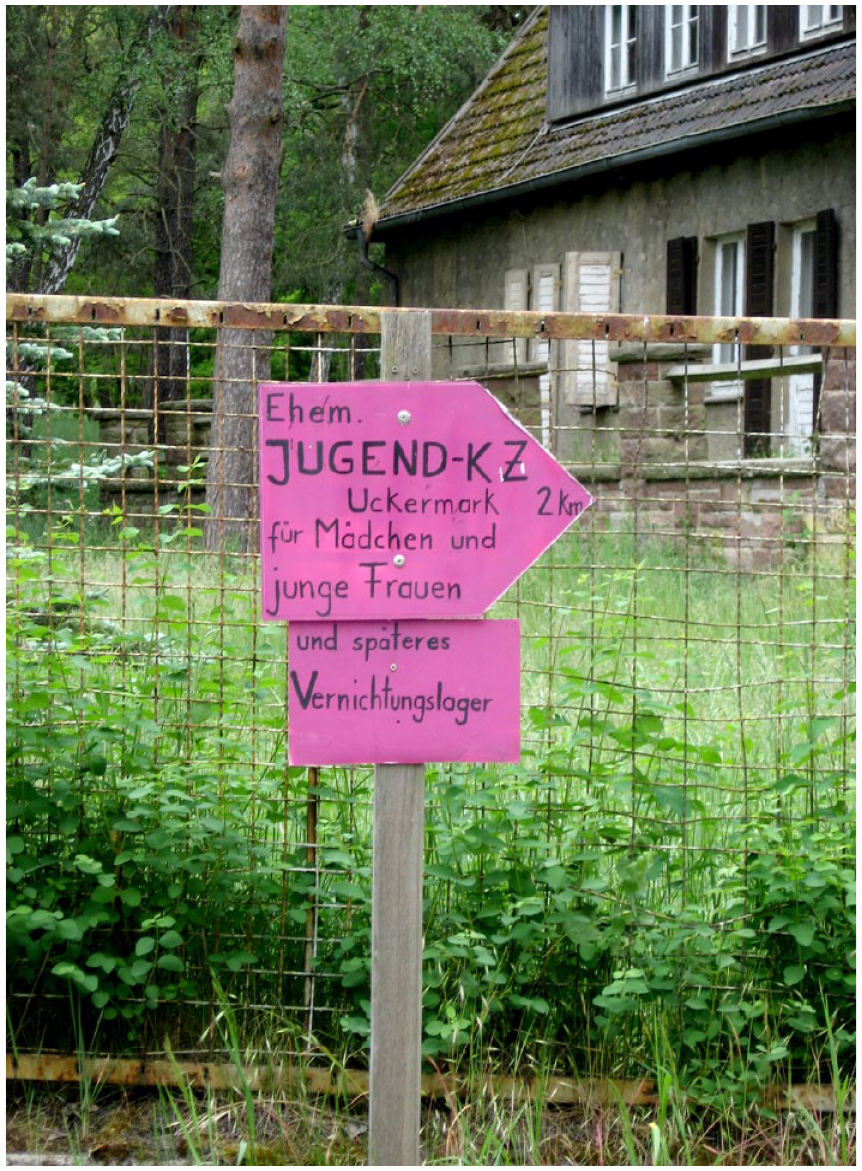
Signage for the Uckermark youth camp at Ravensbrück.
Though in close geographical proximity, the afterlife of Ravensbrück and Uckermark could not be more different. Ravensbrück became one of three national memorial sites in East Germany, while the Uckermark camp and the girls and women who had suffered and perished here were largely forgotten. That is until a network of feminist, lesbian, queer and trans antifascist activists put the Uckermark camp – and those who suffered there – back on the map. This group has been organizing politically for the recognition of this forgotten camp and its stigmatized former inmates since 1997 and guerilla-style established a counter-memorialscape on the abandoned site.
The memorial activism of this group offers an occasion to consider the queering of memory in two ways: the first part focuses on what I describe as the performative affects of the counter-memorial established on the Uckermark site, which, as queer refusal, sets this memorial in conflict with the professional memorialization at Ravensbrück. 2 The second part of the article considers the performative effects of the durational activism at Uckermark, now conceptualized as memory care work, and the social formation this work produces, which I call queer akinship.
Queer akinship draws upon two different registers. First, it references relations of adjacency – akin-ship – where people, phenomena, places and feelings are akin to each other, not unlike each other, similar or alike, possibly affiliated or allied, maybe kindred in spirit; without collapsing them and their very distinct historical positionalities and experiences into each other and into sameness. Ravensbrück and Uckermark are, thus, ‘akin’ to each other in the sense that both are memorial sites, both speak to gendered histories of incarceration, and they exist, spatially, alongside each other. But the memorialization enacted on each site differs in fundamental ways. Unlike those who suffered and died at Ravensbrück, who have had a more extended history of being memorialized through the apparatus of the German state, pre- and post-reunification, the girls and young women incarcerated at Uckermark were not even recognized as victims of Nazi persecution until recently. The Uckermark memorial activists, and those they commemorate and whose memories they care for, thus operate at a different scale and intimacy to their remembered subjects. I argue that the decades-long memory activism at Uckermark can be fruitfully understood as producing a register of akinship grounded in adjacency: by existing alongside and by sharing, for example, the ejection from the normative social, political, sexual, gendered, and/or class order that structures the white German heteronormative family – however, to historically contingent differential social effects. Recognizing such social adjacency as ‘feeling akin’ does not (or not necessarily) flatten and conflate the suffering of those who were tortured and died at Uckermark with that of the activists who organize for their remembrance today. Instead, recognizing queer akinship as adjacency acknowledges the stigmatizing and violent logics of the past and its continuity as social marginalization in the present.
The second understanding of akinship that informs this article is a-kinship, similar in grammatical structure to terms like asexuality and asociality. This second understanding of akinship names both structures of refusal and being refused: refusing the heteronormative condition of the family and being refused and excluded from having one’s intimate relations recognized as akin to family, as queer commitments and relations often are. Akinship allows us to name the relational productivity of queer memorial activism. Conceptualizing the enduring activism at Uckermark as care work considers the social formation this work produces: a formation marked both by adjacency – spatially, historically, and affectively – and by relations of refusal, tensions and contradictions. Naming this queer akinship attunes to how trans- and inter-generational memory care is productive while also holding in view the affective and political complexities that all kinship involves. This article develops an analysis of queer akinship through a reading of the actions (and refusals) of the Uckermark Initiative. Borrowing from Ana Dragojlovic’s (2018) discussion of archival performance, this article hones in on the affective politics of queer counter-memorial work by attending both to the affects of memorial performances and their queer effects.
I begin to develop here the concept of queer akinship through an analysis of the performativity of memorialization in two key ways: in the first instance, through a close reading of the specific ‘mnemonic technologies’ (Van Doorn, 2016) enacted at the Uckermark site. These include signage, installations, landscaping and mapping, and recurring memorial events that exceed their functional frames to become affective performances. There is a performative effect of the memory produced and cared for at Uckermark, which is a political affect that scandalizes the erasure of persecuted women and girls from public memory. There is also, however, a different performative effect of doing this work. This effect consists of the relationships and affiliations, real and imagined, that emerge in and through durational memory care work. That second instance of performativity is considered in the later part of the article where I more fully develop an understanding of how akinship emerges as a queer performative effect of affective memorial activism. This section reflects upon the intergenerational and transgenerational transmission of memory between those who had been imprisoned at Uckermark and the activists who memorialize them. I also build on existing literature about intergenerational transmission, most specifically Marianne Hirsch’s (2008, 2012) influential postmemory and queer kinship literature, to argue that the effects of durational memory care on the Uckermark site are social relations akin to – alongside and in tension with – queer kinship itself. 3 I come to this conceptual insight through observations of the changing memorialscape during near-annual visits to the site, observations of the interactions between activists and survivors at annual liberation celebrations and other events; by way of informal conversations, as well as structured interviews with activists. 4
Uckermark: a history
To understand how memorialization at Uckermark instantiates queer memorialization and how this memorialization might performatively produce a case of queer akinship, I first turn to the history of remembering and forgetting that put Uckermark on and off the map. Uckermark’s is not a well-known public history. Yet, among the many sites of Nazi terror, Uckermark stands out as the only camp for girls and young women. Between 1942 and 1945, approximately 1200 youth aged 16–19 years (and later up to 21 years) were incarcerated in the deceptively named ‘Uckermark Youth Protection Camp’. Most girls and young women came to Uckermark from other social ‘welfare’ institutions based on negatively assessed behaviours, personal attributes or alleged hereditary inclination towards criminality (Anders et al., 2013; Guse, n.d.). They were first processed at the Ravensbrück women’s concentration camp and then transferred to the newly established Uckermark youth camp. Later, separate barracks were added to house incarcerated young Roma and Sinti women, as well as Slovenian partisans. At Uckermark, prisoners were triaged and housed according to their potential for ‘re-education’ (Guse, n.d.; Strebel, 2003).
Of particular significance to my argument are the grounds on which the girls and young women were detained at Uckermark. In the camp records, most girls and young women were categorized under the stigmatizing term ‘asozial’ (anti-social). This category of prisoners has not been deemed worthy of memorial repatriation as part of Germany’s dealing with its Nazi past. In the Nazi state, ‘asozial’ 5 was a diffuse term. Never clearly defined legally, ‘asozial’ covered an ever-expanding catalogue of anything considered non-conforming, undesirable, and a threat to the ideal of the national socialist Volksgemeinschaft (people’s or national community) (Ayaß, 1995; Schikorra, 2009). 6 As a policing category, ‘asozial’ enabled mass arrests of socially marginalized populations (Arolsen Archives, n.d.; Schikorra, 2009). A wide range of behaviours were targeted in youths. These included but were not limited to: rebelling or running away from harsh welfare organizations; being part of or having parents who were part of the political resistance; being part of the oppositional youth group ‘swing kids’, fans of British and American swing music; frequenting dance clubs; consuming alcohol; having contact with Jews or foreign workers; frequently changing address; missing at work or refusing to join the obligatory National Socialist girls’ organizations (Guse, n.d.). Racism and eugenics also led to the incarceration of mixed-raced young women (Strebel, 2003).
From 1940 onwards, ‘asozial’ became a charge predominantly wielded against girls and women, often based on sexual behaviour deemed nonconforming, such as sex with foreigners or Jews, changing sexual partners, sex work or same-sex relations (Anders and Forschungswerkstatt Uckermark, 2013; Schikorra, 2001, 2009).7 According to Bernhard Strebel (2003), ‘sexuelle bzw. sittliche Verwahrlosung’ (‘moral and sexual degeneration’) was the dominant incarceration category at Uckermark. As a vague collective grouping, authorities diagnosed sexual ‘illness’ as the root of the prisoners’ nonconforming behaviour. 8
Belying its distinction as a ‘youth protection camp’ tasked with ‘re-education’, imprisonment at Uckermark resembled incarceration at the Ravensbrück concentration camp for women. The latter provided Uckermark access to an already established carceral infrastructure and personnel. 9 Like the Ravensbrück inmates, the young Uckermark prisoners were forced into hard physical labour in agriculture and rented out profitably to nearby SS armament industries, local small businesses and private households. Their subjugation was promoted ‘as modern work education’ (Guse, n.d.). While the death rate at Uckermark is unknown, the few existing survivor accounts report deaths from tuberculosis, poisoning, beatings and shootings. Martin Guse (n.d.) concludes that ‘health damage with possible fatal consequences for the young prisoners was at least tolerated by the SS’. In Strebel’s (2003) assessment, youth camps like Uckermark served as experimental sites for the broader National Socialist annihilation strategy, which targeted outsiders who threatened the cohesiveness of the Volksgemeinschaft (p. 357).
In January 1945, the youth camp was emptied and turned into a death camp for Ravensbrück prisoners. From 1945 until their final departure in 1993, the Soviet army used the Ravensbrück and Uckermark sites for military purposes. By 1959, as a result of pressures from international survivor organizations, parts of the former Ravensbrück camp had been established as one of only three national memorial sites in the German Democratic Republic. No such lobby existed for the memory of those who had suffered and died at Uckermark. Quite the opposite: until well into the 1950s and 1960s, Uckermark was regarded as a ‘positive example’ for the ‘retention of difficult to educate juveniles’ (Limbächer et al., 2005: 8). Ravensbrück survivors sought to distance themselves from those incarcerated as ‘criminals’ and ‘Asoziale’ at Uckermark and elsewhere, thereby lending further legitimacy to the National Socialist system of prisoner categorization (Eschebach, 2009; Strebel, 2003). Uckermark victims were not recognized, mourned, or grieved in the post-war period but were ‘ghosted’ and faced continued stigmatization, even incarceration. Understandably, few came forward to testify about their imprisonment. And those who had been incarcerated as ‘asozial’ or ‘criminal’ remained excluded from compensation payments, which were explicitly limited to those persecuted for racial or political reasons. As ‘unworthy victims’ and deserving incarceration, those who had suffered and died at Uckermark, together with the camp itself, were not only not commemorated but actively forgotten – at least until recently. 10
Since 1997, the Uckermark Initiative has been organizing politically for a memorial for this forgotten camp and its former inmates. Indeed, the Initiative für einen Gedenkort ehemaliges KZ Uckermark (‘Initiative for a memorial at the former concentration camp Uckermark’, hereafter Uckermark Initiative or Network) has been so successful that today, while still not formally a state memorial, the site is open to visitors and its history is addressed at the Ravensbrück memorial. Yet, to the extent that this public recognition of the former Uckermark camp can be deemed a success, in no small part due to the activists’ efforts, its very success might risk destroying the very forms of queer memorialization that the Initiative has established on the site – shall we say, ‘extra-legally’. In the next section, I focus on the affective performance of the queer memorial activism instantiated at Uckermark, which I argue is productive of social formations marked by relations of adjacency, both spatially and relationally, that exist alongside and in defiance of formally sanctioned state memorial sites.
Uckermark as queer counter-memorial
Counter-memory, as well as counter-memorial and counter-monument, are terms frequently deployed to denote memory work that counters institutionalized and hegemonic memory of nation states, governments, mainstream mass media, and the broader public by amplifying the memory of the oppressed and of those who have been marginalized or excluded from official and professional remembrance (Demos, 2012; Medina, 2011). Defined as ‘bottom-up’ rather than ‘top-down’, counter-memory tends to be unapologetically political in its aims to democratize and pluralize memory for greater social justice, especially for those whose suffering and violation have been forgotten, ignored, or repressed as deemed unworthy of remembrance. Accordingly, counter-monuments and counter-memorials materialize this contesting, resisting, or ‘defiant’ memory work, often involving conflicts between, for example, memory professionals and memory activists. 11
Let me take you to the scene of ‘extra-legal’ memorialization at Uckermark by travelling along the foot and bike path that connects Ravensbrück to the neighbouring town. The path is part of the Berlin–Copenhagen European cycle route. Here, dots of red paint mark wooden poles. Nothing indicates that these dots mark the perimeter of the former Uckermark camp fence. Only on the turn leading to the Uckermark site do we encounter a large bilingual (English and German) billboard, which reads: ‘In remembrance of the girls and women who were imprisoned, tortured, and murdered in the girls’ concentration and extermination camp Uckermark’. The sign confronts travellers abruptly with the largely unknown fact of the Nazi gender-specific imprisonment of girls and young women, a group that in a heteropatriarchal context is symbolically constructed as in need of and deserving protection. 12 The difficult knowledge that the sign presents – the torture and murder of children and youth – contrasts sharply with the surrounding elegiac landscape of one of Germany’s most picturesque and tranquil recreation areas. 13 Different from other more widely known, mapped, and sign-posted concentration camp memorial sites, Uckermark is not spatially bound by what Pastor and Kent (2020) describe as ‘liminal settings’ that organize grieving and commemoration so as to ‘not disturb’ (p. 253). Quite the opposite. The information board raises a spectre of violence that interrupts, even sabotages, recreational and everyday travel pleasures. The dissonance between the sensory experience of the tranquil and peaceful landscape and the sudden epistemic confrontation with its violent history instantiates what Mihaela Mihai (2022) describes as ‘a moment of hesitation’ that has the potential to puzzle, raise curiosity and maybe provoke the wish to learn and understand more (p. 49). 14 The sign is an example of what Dylan Robinson and Keavy Martin (2016) call ‘aesthetic action’: a disruptive ‘sensory stimulus’ that produces ‘felt impacts’ with potential ‘social and political effects’ (p. 2). This sign initiates visitors to the performative effects of the other ‘mnemonic technologies’ (Van Doorn, 2016) that they will encounter once they venture further onto the Uckermark site.
During my first extensive visit in 2011, accessing the former youth concentration camp site required trespassing. The area was officially closed to the public due to safety concerns. Having to trespass only added the romance of transgression and defiance that counter-memory can provoke. A hand-painted sign ‘Access Welcome’ beckoned (Figure 2). To anyone stepping around the forbidding gate, an extensive counter-memorial landscape opened up on the overgrown site. The memorial was created over the years by the Uckermark Initiative, primarily during Antifascist Feminist Volunteer Work Stays, which since 1997 have taken place here nearly every year. Like other voluntourism programmes, during the Uckermark work stays, participants spend 2 weeks living and learning together and working on the site. However, unlike other voluntourism programmes run by non-profits and charities, the Uckermark programme has clear political commitments and is organized autonomously by and for ‘WomenLesbianInterTrans*’ participants. 15
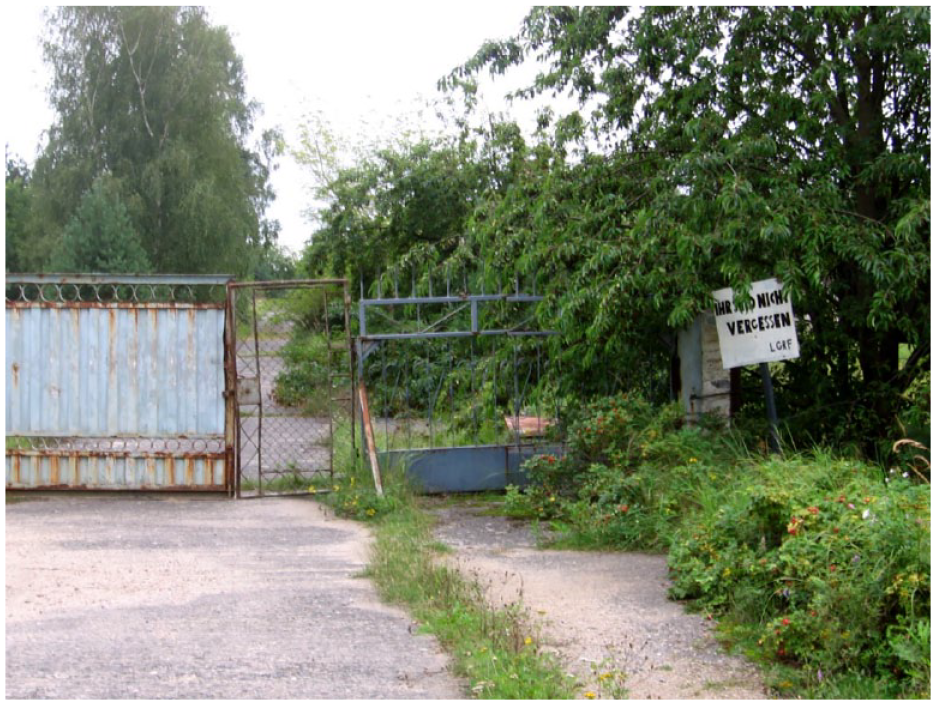
Gate to the site of the former Uckermark youth camp.
After years of political organizing by the Uckermark Initiative, all remnants of the area’s post-war usage have been removed. Yet, it remains difficult to imagine the size and layout of the former camp fully. No original maps or photos survived. Knowledge of the physical layout of the former camp is based on archaeological digs conducted by the participants of two initial summer work camps, in 1996 and 2001, and on the few survivor testimonies that do exist. Participants of subsequent summer work programmes translated the archaeological findings into a memorial landscape using affordable and readily available materials: A red paint line across dotted rocks indicate the original orientation of the camp road across the site (Figure 3). Plain metal poles stuck into the ground signal corners of a former camp building. A walking path marked by rocks takes visitors across the grounds with simple information boards that offer some semblance of orientation, summarizing the camp’s history, grounds for incarceration, inmate biographies and daily routines based on the little survivor testimony that exists. Many boards don’t just inform but directly indict the historical violence enacted on this site and the continued persecution of Uckermark survivors in the post-war period. Other signs protest the constant state of neglect, lack of funding and recognition, the exclusion of Uckermark survivors from compensation granted to other victim groups and the site’s frequent vandalism by neo-Nazis.
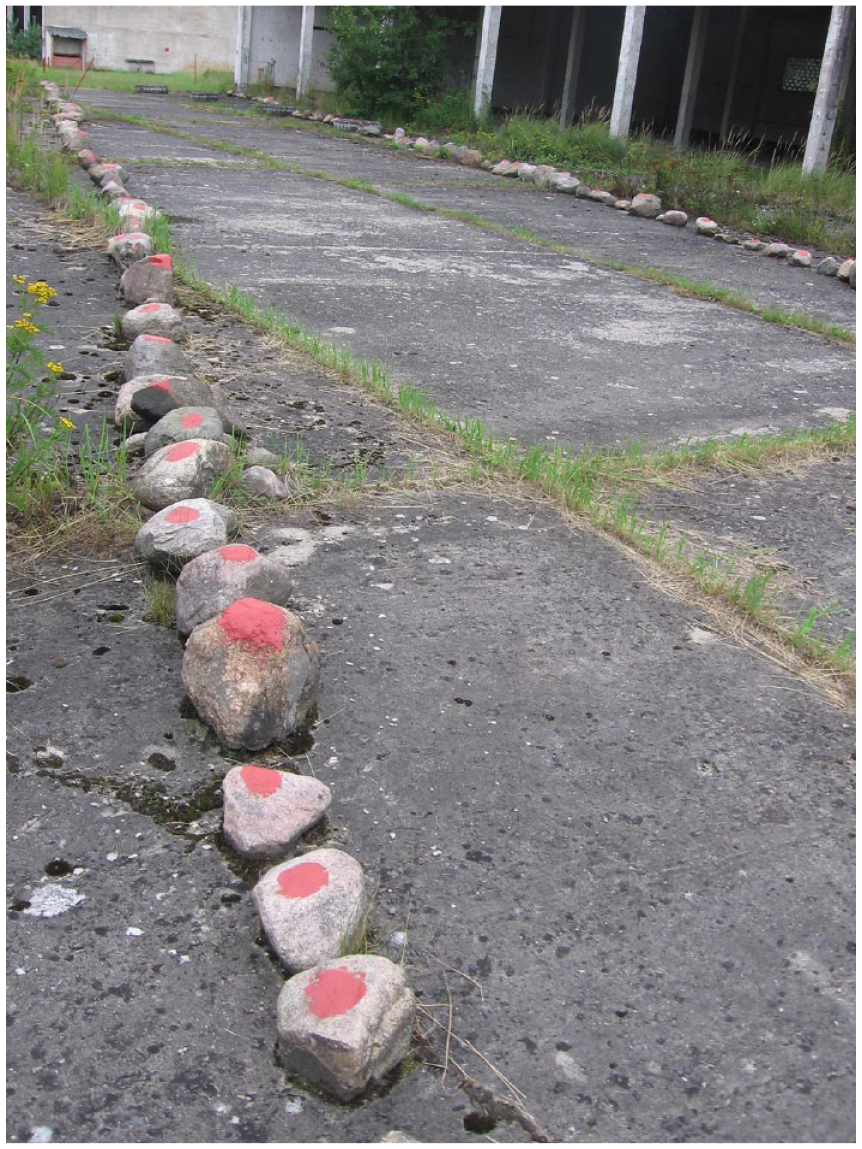
Rocks marking the course of the former camp road.
Boaters who pass by the Uckermark site on a popular canoe route find themselves equally unexpectedly greeted by the words printed on a large banner spun between trees on the river banks: ‘Nature has grown over all the suffering. I only found the landing stage where [the electronics company] Siemens loaded the boats on the [river] Havel and a few remains of the special barrack, which my daughter had dug out’. Unless one is already aware of the significance of the location (and few are), the banner and quote seem so out of place that they are of equal measure unintelligible and intriguing – at least until one spots other signs along the riverbank, naming this as the location of the Uckermark concentration and later death camp. Beside the banner, a ghostly chicken wire sculpture, one of several so-called Maschas on the site, seems to hail passers-by 16 (Figure 4). Only those who land (if approaching by water) or walk down across the site from the entrance gate will learn from an information board that the banner’s quote is part of a 2008 letter written by the Uckermark survivor Maria P to the Ravensbrück survivors’ community. In the letter, Maria P expresses her shock about vandalism on the site. Reproduced in its near entirety, the letter both documents a survivor’s outrage over the deplorable state of this site of Nazi terror and indicts those who have neglected to remember the site’s violent past. Quoting the survivor’s voice serves to authenticate the Uckermark Initiative’s extra-legal memorial work and to authorize speaking on behalf of long-ignored victims, the vast majority of whom cannot speak any longer for themselves. To be a voice for victims is central to the political self-understanding of the activist group and the legitimacy of its efforts. 17
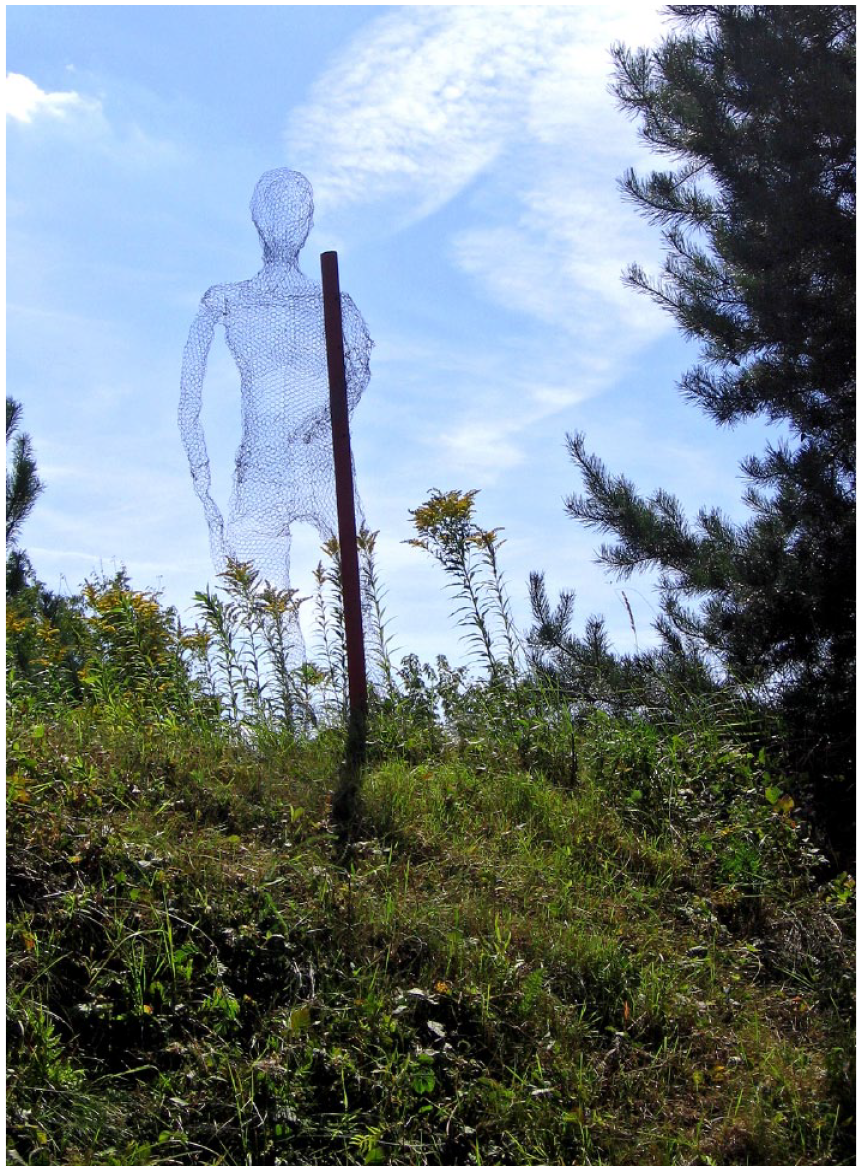
One of the chicken-wired Masha sculptures.
DIY aesthetics as mnemonic technology
Crucial features of the queer counter-memorial practices and politics at Uckermark are the site’s memorial architecture – signage, site markers, information plates, and installations – most of which are low-tech and low-budget – do it yourself (DIY) style. Limited financial resources certainly play a role in these choices. More importantly, Uckermark’s DIY aesthetics reference the countercultural art and design styles and practices associated with the riot grrrl feminist punk movement, zine culture, and the craftivism of third-wave feminism (Triggs, 2010). This queer and feminist subcultural appropriation of the 1950s ‘Do it yourself’ home repair movement signifies the rejection of corporate culture, capitalism and consumerism in favour of democratizing cultural production, creativity and self-expression through affordability and access (Triggs, 2010). At Uckermark, the DIY aesthetics perform feminist – and arguably queer – antifascist autonomous political organizing and the commitment to what the Initiative calls Open Memorialization (‘offenes Gedenken’) (Rotmund, 2017). Open Memorialization is victim-centred, collective, always in process, informed by ‘a critical, antifascist and feminist engagement with the history of National Socialism’ (Rotmund, 2017: 102), and it demands political responsibility for the continuation of that history in the present. 18 Open Memorialization rejects professional memorial practices at state-run sites of Nazi terror like the neighbouring Ravensbrück memorial. It indicts the aesthetic abstraction, musealization and historical objectivity at these sites for increasingly ignoring the wishes of survivors and their descendants (Rotmund, 2017: 102). By contrast, Open Memorialization claims to be driven by the wishes of survivors and their descendants; they – rather than historians and memory professionals – are the ‘experts’ who must not be silenced again (p. 102). Rejecting the passive consumption at sites of institutionalized commemoration, the Uckermark Initiative aspires to collective, non-hierarchical, inclusive and continuously evolving participatory and politicized memorialization.
Embedded in the overgrown landscape, visitors thus encounter what, with Roger Simon (2005), we can understand as ‘a performative practice which attempts to bring past lives and places into presence’ (p. 87). Such memorialization aims not just to teach visitors about systematic past violence but also to create emotional bonds, processes of identification or implications in historical narratives of violence in ways that make these events and the experiences of suffering that they represent personally and politically significant (p. 87). Beyond just informing and making present the long-overlooked history of National Socialist persecution of non-conforming girls and young women, the performative remembrance practices on this site call on visitors to consider the ‘difficult inheritance’ (Simon, 2005) that this history poses in the present and for the future. Besides memorialization and dignified remembrance, the site represents a call for political responsibility and collective action to end the ongoing victimization, marginalization and criminalizing of social groups deemed ‘asozial’ today.
The Uckermark Initiative’s counter-memorial commitments have long set it on a collision course with the adjacent Ravensbrück memorial. The conflict manifests itself not only aesthetically but also in irresolvable disagreements over terminology. As a state institution, Ravensbrück’s commitment is to historical ‘accuracy’. It thus utilizes the euphemistic National socialist term ‘Jugendschutzlager Uckermark’ and its English translation ‘Juvenile Protection or Education camp’ – in scare quotes across all signs, maps and exhibition spaces. This term is unacceptable to the Uckermark Initiative because it reiterates violent language and thus fails at what Saidiya Hartman, in a different context, aptly describes as the challenge of ‘revisiting the scene of subjection without replicating the grammar of violence’ (Hartman, 2008: 4). And the affective, ethical and legal force of the term ‘concentration camp’, not just in Germany but globally, matters significantly to the survivors and their descendants. But, for now, adjacent signage stages conflict spatially, one put up by the Initiative, another one by Ravensbrück proper. 19
As a ‘mnemonic technology’, the DIY commemorative aesthetics on the site references a more extended history of feminist and queer activism, including the memorial politics of queer activist groups such as ACT UP! during the HIV/AIDS crisis in America. This activism politicized grief and transformed mourning into militancy through new forms of public and collective mourning and commemorating not yet publicly grieved queer lives (Ahmed, 2004; Crimp, 2002; Cvetkovich, 2003). As mnemonic technology, at Uckermark, DIY aesthetics perform feminist and queer grief, loss, outrage and anger. These and other affects connect contemporary feminist, lesbian, trans and queer antifascist activists to girls and young women targeted by the Nazi state for their non-conformity.
Long-term memory care
The persistence and durability of the Uckermark Initiative have long intrigued me. This autonomously organized network of geographically dispersed activists has creatively, innovatively, and, most of all, persistently agitated for the recognition of Uckermark for over a quarter century. The work is done without significant outside funding or organizational structures that stabilize other political and civil society organizations. While the earlier part of this article makes the argument for the performative affects of the counter-memorialscape at Uckermark and its queer and feminist DIY aesthetics, in this part, I speculate about the performative effects of this work. It is not, or not only, the Nazi construction of those incarcerated at Uckermark as sexually, socially and gender deviants that makes this a queer memory project. Nor is it the identities of the activists. These do matter. But beyond asserting queer identities, the durational memory activism of the Uckermark Initiative instantiates my thinking about the social forms this work produces. I argue memory care work creates forms of queer affiliation, which we might productively understand as queer akinship.
Much has been written about the transmission of traumatic memory between generations, such as postmemory (Hirsch, 1997, 2002, 2008), secondary witnessing (Apel, 2002) and, in more psychoanalytic terms, transgenerational haunting (Abraham and Torok, 1994). 20 This body of work has drawn attention to the ways traumatic memory is inherited within families and communities and articulates itself symptomatically: as psychical attachments, refusals and bodily symptoms; enacted, acted out and worked through in cultural production, politics and daily life.
Postmemory makes intelligible the intensities with which the children of survivors of trauma and extreme violence encounter the experiences of their parents or other family members, namely ‘so deeply as to seem to constitute memories in their own right’ (Hirsch, 2008: 13). 21 One of the most defining dimensions of this concept has been its rootedness in close affective, intimate and psychical connections, initially within families and, in Hirsch’s early formulation, between mothers and daughters. Subsequently, Hirsch (2012) has distinguished between familial and affiliative postmemory, with the latter signifying the feeling of a connection to the people or events affected by trauma outside of one’s family or community. In 2015, in conversation with Ayşe Gül Altınay and Andrea Pető (2015), Hirsch further explained that affiliative memory transmission, beyond the intimacy of blood and identitarian ties, concerns ‘how certain stories and certain histories circulate through a generation where some people feel drawn to them, being responsible and holding them and caring for them to hand them down, though they may or may not be familially connected’ (p. 392, my emphasis). For her, this is about solidarity and ‘what it means . . . to engage in the form of care for people and stories that would otherwise fall out of history’ (p. 392, my emphasis).
Such ‘caring’ for girls and women who – together with their stories – have ‘fallen out of history’ is an apt description of the Uckermark Initiative’s activism. Indeed, memorialization at Uckermark is not driven by memory inherited within existing close affective familial or communal relations. The Initiative vigorously rejects the suggestion that their activism is grounded in identifying with the girls and young women they commemorate, based on imagined shared gender, sexual, class or political identities. Indeed, instead of shared identities and identification, I suggest that the labour of caring has relational or kinning effects. Here I am stretching Signe Howell’s (2003) definition, which explains kinning as the processes whereby a ‘previously unconnected person is brought into a significant and permanent relationship with a group of people that is expressed in a kin idiom’ (p. 465). I use kinning to think about the forms of belonging that memory care at Uckermark produces.
Thinking of memory activism at Uckermark in terms of care and care work draws on a range of influences, beginning with Joan Tronto’s and Berenice Fisher’s (1990) capacious definition of care as ‘everything that we do to maintain, continue and repair our “world” so that we can live in it as well as possible’ (p. 40). Widely cited, this definition expands care beyond private nurturing and public care (health, welfare, education) into ethical and political practice. Most recently, Michaela Mihai (2022) further expands care to think through what she calls an ‘aesthetics of care’ (p. 47). With this term, Mihai attends to ‘the crucial labor of mnemonic care’ (my emphasis) that particular artworks perform, namely, a political reckoning with communal histories of widespread complicity in and impure forms of resistance against violence. While Mihai is interested in the political effects of what she calls ‘aesthetic mnemonic labor’, I am interested in the social effects of the political mnemonic labour performed at Uckermark.
Uckermark activism is reparative in several different ways: most directly materially. It involves the decades-long building and rebuilding of a memorialscape exposed to the elements – not only to the weather but also to neo-Nazi attacks. Symbolically and representationally, the reparative work involves restoring identity and dignity to those who were wrongfully incarcerated at Uckermark and whose suffering has been made invisible in the post-war period – legally, financially and hermeneutically by the long-lasting public refusal to recognize the girls and young women prisoners as victims of Nazi violence. The memory work at Uckermark also constitutes atonement, consciously named or not, for the ‘sins of those who came before’. Though activists have only recently publicly acknowledged the need to consider their own structural, if not genealogical, implication in the history of violence that Uckermark represents. 22 Uckermark activism may very well constitute a form of ‘working through’ the difficult knowledge of one’s implication into this history, whether consciously or not. And refusing identification with the victim as the motivating factor for activism at Uckermark does not mean foreclosing the kinship of queerness altogether. Indeed, the Initiative’s activism may very well constitute a form of manifest or latent self-care. Their political work explicitly contends that the normative violence of the ‘welfare’ system did not end with the Third Reich but instead continues as an ongoing structure, if under somewhat altered signs, in the present. 23 At stake are not only the erasure from public memory of girls and young women targeted by the Nazi ‘welfare’ but also the continuation of that history of state violence as the ongoing marginalization of queer, trans, gender-nonconforming, poor and neurodiverse girls and young women – not unlike like the activists themselves – today.
Memory care at Uckermark includes speech acts, such as survivor testimony displayed across the site and online, which reconstitute the subjectivity, identity and agency of the young Uckermark prisoners who can no longer speak for themselves. Speaking for victims has long been deemed problematic, even appropriative, including by the Initiative itself. However, any curation of survivor voices at memorial sites, museums and elsewhere is selective, strategic and often didactic. Indeed, the curation of testimony as a representational technique is more similar than different from the ways identity and self are constructed in relational processes in care contexts. Moreover, the feminist care ethic literature fundamentally challenges the notion of the autonomous and self-defined subject in favour of ontological relationality and an understanding that humans are not atomistic individuals but instead embedded in, attached to, and dependent on, as well as vulnerable to, and in need of care by others.
With the notion of memory care work, I seek to acknowledge the affective and relational work involved in memorial activism at Uckermark and elsewhere. The gentle and attentive care that the activists give to the now very old and frail Uckermark survivors when they are able to attend the annual liberation celebrations is a testament to evolved relationships that are maintained across – and even despite – all identitarian and political differences. However, memory care understood as labour is also repetitive and tedious work. It is far less heroic than counter-memorial activism promises, especially if not idealized as selfless care or courageous resistance in an uncaring and cruel world. And the notion of memory care recognizes that care is not always nurturing or even good, nor is care without tensions and conflicts between those who care and those who are cared for. (Relatedly: not all memory is worth nurturing.) Memory care work sometimes includes problematic overreach, including claims on behalf of the girls and young women it represents for political ends. This care work is shot through with psychic projections, speculation and aggression, all of which are part of caring human relationships. Indeed, a turn to memory care work invites further analysis of the complex web and dynamics of power that run through the relationship between carer and the cared for and can help untangle the conflicting positions and interests of survivors, their descendants, memory professionals, activists – and these are not mutually exclusive categories – and the state, all of which come to bear on the memorialization enacted at sites like Uckermark.
Queer akinship
At Uckermark, caring for memory does not involve memory inherited from within consanguine familial relations or affectively affiliative attachments. Instead, the Uckermark Initiative’s memory care work, both materially on the site and through the social ties with survivors, whether these are physical, textual or imaginative encounters, is performative. By this, I mean the care work produces forms of affiliation that I conceptualize as akinship. Akinship is both similar to, but not to be confused with, being the same as; and akinship is not to be conflated with ‘being family’, in the queer sense, all while gesturing towards the ejection from normative familial structures, national or intimate, that marks much of queer life. Instead, akinship is about adjacency: both geographical adjacency to institutional state memory and familial relations and forms of descent. Queer kinship studies have long insisted that kinship structures are not, or not only, grounded in biological connection or even love. But queer kinship can emerge from the durational work and commitment to caring, especially in the face of the ongoing devaluation, marginalization and violence directed at those considered queer (Freeman, 2021; Herring and Wallace, 2021). Akinship also references not being kin and the long, violent history of who can be and can have family, whose families are supported and protected, and whose families and kinship ties were severed and destroyed through genocide and other violences, including the Holocaust. Queer Akinship recognizes the affective and political affiliation of kin-like relations across social, generational and temporal differences and distances made from memory work, rather than being the grounds on which memory is transmitted between generations.
Akinship is an effect of the affective work that activist memory care entails. As such, queer akinship is always shaped by the complex and dynamic attachments that it might entail, but it cannot be reduced to identification or the appropriative violence deemed so problematic within identificatory relations. The durational memory care work performed at Uckermark (and also elsewhere) is a process by which strangers are made familiar. It is the work of kinning. Social relations are established in learning about, caring, agitating and speaking for those who suffered at Uckermark, and intimacies emerge, real or imaginary, between activists, victims and survivors. The counter-memorial activism and the memory care work thus are processes of making akin across social differences and historical distance. Queer akinship gestures to social relations that are like kinship and not kinship at the same time.
Concluding thoughts
Queer and feminist aesthetics drew me initially to the Uckermark site, and its guerilla-style counter-memorial has brought me back for many more visits since. Initially, I was captivated by the affective performance that the Uckermark activists stage here, interrupting the elegiac landscape’s peaceful image that conceals the area’s history of violence. The mnemonic technologies of the Uckermark memorial interrupt the decades-long repression of a chapter of gendered, sexual and classed local and national history. The site’s aesthetics were familiar expressions of feminist rage over state-sanctioned violence against women and girls and over queer lives that remained ungrieved/ungrievable within gendered, heteronormative, racist, classist and neuro-normative frames that continue to shape who and what counts as a socially credible and memory-worthy subject, experience, body, family unit or intimate relationship.
Activism at Uckermark has long engaged in critiques of the conscious and unconscious forgetting practices by which dominant hetero-patriarchal and cisgender culture and history are established and maintained as normal and legitimate. That said, queering memory involves more than just adding or recovering lesbian, gay, bisexual, transgender/transsexual, queer or questioning and Two-Spirit (LGBTQ2S) lives. Instead, we might want to remember Teresa de Lauretis’ (1991) early articulation of queer theory’s critical impulse and adjust it for queer memory studies to ‘not only . . . engage in the conceptual and speculative work of queer [memory] production but also in the necessary critical work of deconstructing our own [memory] discourses and their constructed silences’ (p. iv). Queering memory then includes and exceeds the ‘collecting of the memories of queers’ (Baird and Prosser, 2017: 27) and is not reducible to ‘identity-queerness’ that stabilizes LGBTQ existence, communities, and histories for the present. 24
After years of observing the developments at Uckermark, albeit from a distance, I was incredibly impressed with the relational durability of the memory work here. The decades-long struggle for a dignified memorial at the site of the former youth concentration camp, against much resistance and many roadblocks, and without submitting to the pressures of state and professional memorial practice and aesthetics, showed tenacity and consistency, especially for a loosely organized and geographically dispersed, autonomous network of activists. Increasingly, I became interested in this durability and in how activists come to care for the memory and memorialization of girls and young women strangers. Ultimately, I suggest that learning about, researching, and organizing for forgotten victims of Nazi terror are forms of memory care work that lead activists to care deeply about the girls and young women who were incarcerated at Uckermark. Memory care work begets caring – and the social relations, attachments, and forms of belonging that I call queer akinship.
An analytic focus on memory care adds to our understanding of the ways memories circulate cross-generationally and how some come to attach to the memories of strangers. Different from more widely used and highly generative concepts like postmemory, transgenerational haunting and secondary witnessing, at Uckermark, activists do not ‘inherit’ memories through the intimacy of family, community or shared identity. Instead, memory care involves processes similar to the curation of memories, often through intense research processes, political organizing, memorial building and other labours. Such work is kinning work because it constitutes the intimacy of kin-like relations. Indeed, I suggest memory care is a kin-constituting practice, where kinship is not the goal but a consequence. By naming the relations that emerge through the kind of memory care work I have described earlier as akinship, I want to emphasize adjacency and difference. Memory care work can make strangers feel familiar, like kin and akin, kin-like, and kindred in spirit and politics, without collapsing them into being ‘family’ – queer or otherwise.
Footnotes
Acknowledgements
I am deeply grateful to the Uckermark activists for their work and the willingness of individuals to speak with me during my visits to the site. This paper does not claim to represent their voices, but rather offers a reading of the site. Any misreadings are my responsibility. My thinking benefitted greatly from conversations with Insa Eschebach and Matthias Heyl, as well as the feedback from two anonymous reviewers. With deep gratitude to Debra St. John, Judy Davidson, Catherine Kellogg, Natalie Loveless, Jerine Pegg, Sheena Wilson – and, always, Nat Hurley.
Funding
The author(s) received no financial support for the research, authorship and/or publication of this article.