




Abstract
This article investigates the mnemonic labour of LGBT+ activists and movements. It examines activists’ efforts to shape and mobilise memories for mnemonic, cultural and political change. The concept of the ‘memory-activism nexus’ is adopted as an analytical framework to unpack the relationship between memory in and of LGBT+ activism. This framework allows for a deeper understanding of the role of memory within the unique cultural orientation of LGBT+ movements. The article first offers an overview of the diverse approaches to mnemonic labour in the recent history of LGBT+ activism. Focusing on Argentina, the article then analyses the walk for Lesbian Visibility Day, organised in Buenos Aires by the activist collective Frente Docente Disidente in 2021. This case study shows how activists organise and sediment cultural memories for their later adaptation and (re)mobilisation.
Introduction
Memories, Resistances and Pleasures. We gather to intervene in the streets of San Telmo neighbourhood, aiming to recover and document the historical memories of lesbian activism. We will walk from Defensa and Chile [Street], passing through the basement of Pasaje San Lorenzo, Plaza Dorrego, Brasil [Street], until we conclude at Parque Lezama. Our goal is to reclaim the struggles of the Latin American territory to make them present and to highlight the focal points of lesbian resistance (Frente Docente Disidente, 2021).
This call was posted on the Instagram account of the Frente Docente Disidente (FDD; Dissident Teachers’ Front). Established in Buenos Aires in 2018 by education workers and activists who identify as sexual dissidents, the FDD invited activists to join a march in the historic San Telmo neighbourhood for the 2021 día de la visibilidad lésbica, Lesbian Visibility Day. In Argentina, Lesbian Visibility Day commemorates Natalia Gaitán, also known as La Pepa, who was killed in Córdoba on 7 March 2010 by her partner’s stepfather. In 2021 Buenos Aires, on the warm and sunny afternoon of March 7, a group of mostly women activists met at the corner of Chile and Defensa Street. As described in the call, their aim was to (re)produce and publicly display the memory of lesbian resistance. As one activist expressed it, their goal was to make visible ‘una memoria sin registro histórico’, a memory without historical records. As I will describe later, they covered walls with images recovered from archives and renamed streets. By forging and sharing stories of past and present activism, they honoured the resistance and the activist values of lesbian women. I interpret this collective endeavour as a manifestation of ‘activist mnemonic labour’. When activists adeptly craft and bridge narratives that encapsulate their historical encounters with violence and resistance, they imbue the formation of new identities and storylines with both retrospective reflection and forward-looking vision (Salerno, 2023: 2). In doing so, they contribute to and shape memory landscapes for protest and social change.
An investigation into activist mnemonic labour reveals the interconnection between the sedimentation (della Porta, 2020) of the remembrance of past movements and activists within cultural recollections and the (re)mobilisation of such recollections in acts of contention in the present. These dynamics exemplify what Ann Rigney (2018) has recently termed the memory-activism nexus, which denotes the interconnectedness of the memory of activism (its sedimentation in cultural recollections), memory in activism (how the memories of past struggles and cohorts of activists inform later contentious actions and movements), and memory activism (the production of cultural memories to influence present and future remembrance). Media and cultural forms play a crucial role in these processes of sedimentation and (re)mobilisation. On one hand, media and cultural forms allow mnemonic interventions in acts of contention to reach an audience in the present. On the other hand, they allow activists to transform their actions into cultural memories that can be transmitted, adapted and reused in various contexts, extending beyond the ‘here and now’ of an individual mobilisation.
Within this framework, I examine in this article the interplay between moments of mobilisation and the sedimentation of memories. The manner in which activists sediment their memories in organised or amateur cultural forms for later (re)mobilisations remains an overlooked phenomenon. Only recently have social movement scholars recognised the importance of processes allowing social movements to constitute a (re)usable legacy in forms of cultural sedimentations, which may support activists’ contentious actions for social change in the long run (Amenta and Polletta, 2019; della Porta, 2020). This neglect is somewhat surprising given that Charles Tilly (1995: 27) had already emphasised the importance of ‘repertoires’, for the embodied transmission of a sort of procedural memories relating to contentious actions. Cultural memory studies (Rigney, 2016), the field from which this article draws, can make a fundamental contribution to this issue within the recent and growing interest in social movements and activism. To comprehend the interplay between activist mnemonic labour and social change, I will begin with an overview of the use of memory in LGBT+ (Activist Mnemonic Labour) movements. 1 This overview will establish a general framework for delving into the case of Argentina and the specific case study I will examine, namely the walk organised by the FDD for the 2021 Lesbian Visibility Day. In the final two sections of the article, I will analyse activist mnemonic labour as connective work and explore its role in the recovery and sedimentation of the memory of activism for later mobilisations and re-uses.
LGBT+ activism: navigating mnemonic, cultural and political change
Since the 1970s, LGBT+ demonstrations, with Pride marches as the primary example, have mostly been conceived by activists as ‘parties with politics’ (Browne, 2007: 65). In these demonstrations, activists address cultural norms rooted in heteronormativity. For instance, in public demonstrations for equal marriage and adoption rights for same-sex couples, LGBT+ activists expand or challenge dominant socio-cultural concepts of ‘family’ and ‘kinship’ (Taylor et al., 2009). In essence, I argue that, in LGBT+ activism, cultural changes are envisioned as the main driver for producing shifts in various social spheres. This extends its action well beyond the boundaries of institutional politics, policy or legal codes alone.
Katherine McFarland Bruce (2016: 9–20) suggests that the cultural orientation of LGBT+ movements contributes to the limited attention of social movement scholars to LGBT+ activism. Classical theories in this field assume that the state is the central source of power and hence of oppression and domination (Armstrong and Bernstein, 2008: 75). In this perspective, activism revolves around the state as an actor to be contested or supported. This state-centred view aligns with recent discussions of memory activism, especially when scholars explore activism in transitional processes (Gutman, 2017; Wüstenberg, 2017), where the transformation of political institutions takes centre stage. However, besides theoretical considerations, another methodological and practical challenge may have driven scholars to adopt this state-centred focus. Assessing the successes or failures of a social movement against changes in legislation and institutional politics is relatively (and methodologically) straightforward (Polletta and Amenta, 2022: 381).
The study of the so-called ‘new social movements’ (Melucci, 1985) has sparked a growing interest in investigating the cultural dimension of contentious actions. Nevertheless, the exploration of the cultural impact of social movements is still in its infancy. Francesca Polletta and Edwin Amenta (2022) argue that in the study of social movements, we should regard culture as the ideas, values and assumptions that underpin all social practices. Culture, as a meaning-making force, traverses, shapes and connects various spheres, of which politics and policies are only one – though a very important – element. For my work here, this implies that cultural change cuts through all spheres of society, informing changes in politics, policies, economy, media and so on. Within this emerging framework, Polletta and Amenta acknowledge the crucial role of memory. They argue that ‘[m]ovements may have an impact on public opinion in the longer term by how the movement is remembered’ and by shaping the memory of movement events (Amenta and Polletta, 2019: 282).
When engaging with mnemonic labour, LGBT+ activists address the heteronormative systems of meaning that dictate how individuals, societies and institutions remember and why. Activists may either reinforce or disrupt such systems. This distinction between conservative and disruptive projects, and the interplay between cultural and political change in societies, becomes clearer when we look at post-World War 2 LGBT+ activism in the United States, such as the Annual Reminder, and compare it with Pride marches.
The Annual Reminder was a demonstration held in Philadelphia on 4 July from 1965 to 1969 (Hall, 2010). By demonstrating on the same day as the national commemorations of the U.S. Independence Day, homophile activists sought to remind public opinion that homosexuals were being denied their rights. During demonstrations, men wore jackets and ties, while women donned dresses. Activists explicitly refrained from holding hands or displaying same-sex affection. By joining the National Commemoration of Independence in protest, the activists’ goal was not to change prevailing cultural values but rather to display their complete alignment with them. This demonstration affirmed the rights of LGBT+ individuals to participate in the national commemoration, as ‘good citizens’ conforming to hegemonic cultural codes. In this sense, although the Annual Reminder called for equality for LGBT+ individuals, it was part of a culturally conservative memory activist project, which the Pride marches in 1970 eventually co-opted.
The rapid shift in the nature of LGBT+ activism in 1970 can be succinctly described as a transition ‘from the goal of integrating into societies to the goal of disintegrating them’ (in words attributed to the feminist and environmental French activist Françoise d’Eaubonne). Activists aimed to radically transform the cultural norms that regulate societies rather than align with them. Between 1969 and 1970, LGBT+ activists saw in the strategic commemoration of the riots that occurred at the end of June 1969 in the Stonewall Inn in New York a resource for sustaining mobilisation in yearly commemorative and protest gatherings (Armstrong and Crage, 2006). Activists shaped a ‘commemorative vehicle’ (Armstrong and Crage, 2006: 726–727) and utilised the proximity of national commemorations such as Independence Day (and the Annual Reminder) to establish their own commemorative space on the calendar, close to, but different from, the national one. The case of Stonewall illustrates the relationship between the memory of activism – where activists crafted a carrier of memory (Armstrong and Crage, 2006: 725) to organise and sediment their narratives of resistance and struggle into an available cultural form – and memory in activism: the annual gatherings for commemoration and protest.
In the 1970s, LGBT+ activists also initiated efforts to challenge monuments and public commemorations. A prominent example in Europe was the disruption in May 1970 of the annual Dutch Remembrance of the Dead commemoration at the National Monument in Dam Square in Amsterdam, which is dedicated to those who lost their lives in military conflicts or peacekeeping operations. During the ceremony, LGBT+ activists sought to place a lavender wreath in memory of LGBT+ individuals, asserting their right to be recognised and remembered. The protest resulted in the imprisonment of activists but also popularised the practice of wreath-laying demonstrations. In these events, LGBT+ activists organised walks and placed flower wreaths at sites of memory and during commemorative occasions, asserting the right of LGBT+ individuals to be acknowledged in national memories. 2
In recent decades, there has been a surge in initiatives to create spaces where the memory of LGBT+ activism can be collected, from memorials and monuments to activist archives (Davison, 2023; Gowing, 2018; Salerno, 2024; Sheffield, 2020). An example is the Homomonument in Amsterdam, inaugurated in 1987. The Homomonument is located in Westermarkt, sharing the square with the Westerkerk and the Anne Frank House. It consists of three pink triangles used for commemorative gatherings, placing flowers, paying silent respects to victims of dictatorships, homo-, bi and trans-phobia, as well as remembering activists. With its architectural design, the Homomonument aligns with and is influenced by the moral and behavioural norms that govern other Holocaust spaces (Dekel, 2013). However, in contrast to examples such as the Holocaust Memorial and the Memorial to the Persecuted Homosexuals in Berlin, the Homomonument has been designed to transform its triangles into a dance floor, allowing visitors to jump, dance on them, take pictures, and enjoy themselves throughout the year (Zebracki et al., 2023). If Pride marches are parties with politics, the Homomonument hosts parties with memories. According to Sarah Ahmed (2006), to ‘make things queer’ means ‘to disturb the order of things’ (p. 565). By adopting queerness as a modality of contentious action, LGBT+ activists challenge the order of things and may transform the way societies remember.
This overview reveals two distinct approaches in LGBT+ activist mnemonic labour. In the first approach, LGBT+ individuals display their alignment with hegemonic cultural and social norms during commemorations and demonstrations. While this approach can lead to significant successes and recognition for certain groups within the LGBT+ spectrum, it may come at the expense of other marginalised social groups. In the second approach, LGBT+ activists contest norms governing cultural memory formation in relation to gender and sexual orientation. These norms dictate not only what and who is ‘memorable’ but also what is sayable and visible, as well as notions of legitimate and immoral actions. Challenging these norms has implications for the agency of LGBT+ activists. For instance, when a riot is remembered, its memory legitimises past or future acts of self-defence and resistance, even if they breach legal or moral standards (Dorlin, 2017; Pineda, 2021). This broadens the LGBT+ protest repertoire, empowering LGBT+ people beyond commemorative settings and bolstering their present and future struggles.
These examples illustrate how cultural changes drive transformations across various social spheres. Mnemonic shifts, within a culturally conservative approach, can prompt social changes by integrating LGBT+ individuals into existing frameworks. Alternatively, mnemonic changes can challenge cultural systems to impact other social spheres. Activists may transform mnemonic forms, including behavioural, aesthetic and moral codes tied to remembrance contexts. For example, the introduction of playful and festive elements in Holocaust memorial sites exemplifies such transformations. Or they may bring to light previously silenced stories of repression and resistance among LGBT+ people, focusing on mnemonic contents. In both cases, the critical focus lies on the relationship between activist mnemonic labour and underlying systems of meaning that regulate society at large. Thus, activist mnemonic labour extends its influence beyond mnemonic changes, affecting other spheres of society as well.
While my focus so far has primarily revolved around the United States and Europe, the next section turns to LGBT+ mnemonic labour in Latin America, and more specifically Argentina, a topic that has been hitherto neglected. By closely examining the Lesbian Visibility Day walk in Argentina, the objective is to illustrate, at a more tangible level, the semiotic and cultural strategies that shape LGBT+ mnemonic labour. This analysis thus aims to explore how LGBT+ activists create communicative settings and design the cultural embodiment of memories to challenge cultural norms and trigger social change.
LGBT+ activism in Argentina
The history of contemporary LGBT+ activism in Argentina can be divided into three distinct phases. The first phase (1967–1976) began with the formation of Nuestro Mundo and the creation of the Argentine Frente de Liberación Homosexual in 1971 (an alliance between different groups of activists) (Ben and Insausti, 2017). Initially, activists employed strategies aligned with the homophile approach (Fernández Galeano, 2019). The incorporation of more radical groups, particularly young students, connected the Front with the transnational sexual liberation movement and the local national liberation politics, heralded by the Peronist movement.
Disbanded in 1976 by the military dictatorship, the movement regained visibility with the return of democracy (1983) and the establishment of Comunidad Homosexual Argentina (1984) by Carlos Jáuregui (Bellucci, 2020). During this second phase (1984–2002), integration with the broader Human Rights movement, led by the Madres de Plaza de Mayo (Mothers of Plaza de Mayo), was sought. However, the prevailing heteronormative ‘family setting’ (Jelin, 2008) in Argentine human rights activism posed challenges, which were not overcome until the period of the Kirchnerists’ presidencies (2003–2015). In this third phase, LGBT+ movements gained more substantial support from the broader Human Rights movements and the state, which now approved of equal marriage and instated gender identity laws. In these almost 60 years of history of LGBT+ activism in Argentina, the ‘L’ of lesbians has found itself caught between the dominance of homosexual activism led by gay men and feminist activism led by heterosexual women (Bellucci, 2020). Nevertheless, in the last 60 years, prominent and iconic figures such as Ruth Mary Kelly, Martha Ferro and Ilse Fuskova have emerged as notable points of reference for the rights of Lesbian women and their visibility within the broader LGBT+ and feminist movements.
Santiago Joaquín Insausti and Pablo Ben (2023) argue that over the past two decades, LGBT+ activist organisations in Argentina aligned themselves with (neo)Peronist governments and leaned towards a homonationalist approach. 3 Presidents Néstor Kirchner (2003–2007), Cristina Fernández de Kirchner (2007–2015) and Alberto Fernández (2019–2023) positioned Argentina globally as a nation committed to human rights, tracing a binary division between dictatorship and democracy in the elaboration of state memory policies. Within this agenda, the recognition of ‘gay rights’ (Encarnación, 2016) played a strategic role. Similarly, associating Argentina with Europe through perceived cultural similarities facilitated its representation as a ‘Whiter’ nation compared with its neighbours (Insausti and Ben, 2023: 67). LGBT+ activists generally aimed to fit into this framework, which facilitated significant LGBT+ advancements in legislation and state policies but failed to capture fully the historical experiences of LGBT+ individuals (Salerno, 2017). Specifically, the homonationalist approach in memory activism obscures the experiences of trans and ethnic minorities oppressed in both democratic and dictatorial eras. In an interview with Cole Rizki (2020), an activist emphasised that ‘no state apparatus goes to bed genocidal and then wakes up democratic’ (p. 94). In other terms, cultural systems enabling dictatorship predate and outlast it, while institutional changes alone are necessary but not sufficient for supporting oppressed social groups. A perspective that assesses social changes in relation to institutional and legislative transformations may not capture this aspect. Cultural change is slower, more diffuse, and more difficult to assess than policy and political changes. This makes them challenging to analyse. Nevertheless, as stressed by Polletta and Amenta (2022), scholars should try to tackle these aspects. Accordingly, this article aims to contribute to these debates through its exploration of Lesbian Visibility Day and its close reading of the walk organised by the activists of the FDD in 2021.
The FDD emerged in late 2018 as an alliance mainly comprised of women working in formal and informal education in the Buenos Aires area. Following the end of Cristina Fernández de Kirchner’s presidency in 2015 and the subsequent centre-right government of Mauricio Macri, cutbacks in public services prompted activism among teachers identifying as sexual dissidents. They began gathering in March 2019 and established an Instagram account to share details about their first demonstration, namely the 2019 March for the National Day of Memory for Truth and Justice. Initially, during public demonstrations, FDD members identified as lesbian and bisexual women, politicising their identity as ‘sexual dissidents’. They viewed education as a battleground – capable of disciplining children as well as fostering critical thinking and freedom of thought. Initially focusing on ESI, integral sexual education, part of school curricula in Argentina, FDD’s demonstrations since 2019 have covered various issues, from abortion rights to justice demands for incarcerated women and disappeared LGBT+ individuals. FDD’s approach detaches from the homonationalist approach that Insausti and Ben (2023) see as prevalent in LGBT+ activism in Argentina. As I will point out later in relation to the 2021 walk for Lesbian Visibility Day, FDD activists illuminate the history of Black Argentinian and Indigenous people, connecting it with LGBT+ history and contrasting it with the institutional representation of the country as predominantly ‘White’ and ‘European’. During the pandemic, their online activity intensified, with activists conducting media interviews. 4 The 2021 Lesbian Visibility Day marked one of the first occasions for the group to reclaim the streets after the COVID lockdowns.
Lesbian Visibility Day is celebrated in various countries, although the date may vary depending on the country. Presently, it is internationally celebrated on 26 April in many nations. However, in some countries, activists opted for dates that resonate with the local history and struggles of lesbian women. For instance, in Chile, it falls on 9 July to remember the killing of artist Mónica Briones due to her sexual orientation, which had prompted lesbian women in Chile to organise in activism. In Paraguay, it is observed on 16 September to mark the date of the first lesbian demonstration in the country in 1993. In Brazil, it is marked on 29 August to commemorate the first Seminar of Lesbian and Bisexual Women, which took place in Rio de Janeiro in 1996. As one can tell from these examples, in some countries, Lesbian Visibility Day has evolved into a commemorative vehicle for the memory of activism. The organisation of walks, marches and parades on these days allows lesbian activists to mobilise and publicly display their memories through demonstrations.
Argentine activists selected 7 March, the day of the murder of Natalia Gaitán. Her killing, in 2010, had occurred just before International Women’s Day (8 March) and was close to the National Day of Memory, Truth and Justice (24 March), dedicated to honouring victims of the Argentinian dictatorship (1976–1983). Like in the case of Stonewall and Independence Day, this timing elevated Gaitán’s memory and made it suitable for public commemoration, strategically positioned in a period already significant in the country’s memory calendar. 5 The proximity to International Women’s Day and National Memory Day empowered lesbian activists to assert their right to memory, encapsulated in slogans like ‘la memoria no es un privilegio cisheterosexual’ (memory is not a cis-heterosexual privilege).
2021 Lesbian Visibility Day: a (memory) walk in San Telmo
In 2021, to mark Lesbian Visibility Day, FDD activists organised a walk. They chose the neighbourhood of San Telmo due to its historical significance in the formation of Buenos Aires and Argentina as well as its association with activists and diverse social groups. The walk was organised around eight stops, at the following locations: the corner of Chile and Defensa, Pasaje San Lorenzo, Balcarce, Plaza Dorrego, the corners of San Juan and Defensa, Piedras and San Juan (which in the event was skipped due to time constraints), Brazil and Defensa, concluding at Parque Lezama (see Figure 1, the map produced by activists in their call on Instagram). In this section, I describe the walk, which I will then analyse in the following sections.
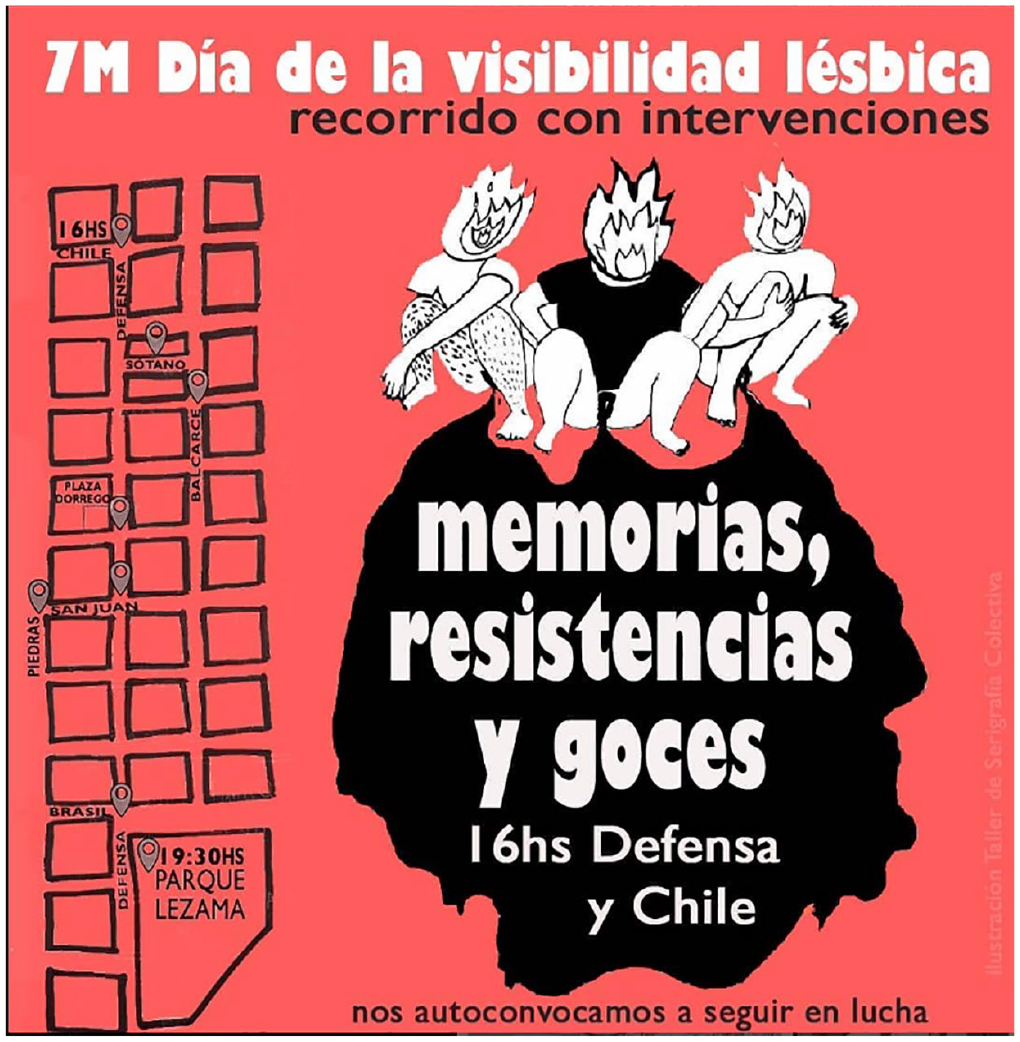
The announcement of the commemorative walk for Lesbian Visibility Day with a map. Courtesy of Frente Docente Disidente.
At the corner of Chile and Defensa Street, an activist recounted stories of Chilean women who were murdered because of their lesbian identity as well as the history of lesbian resistance and activism in Chile dating back to the 1980s. As the narration continued, two activists wearing balaclavas affixed portraits of these victims to the wall, while a third marked the locations of the murders on a map of Chile. In addition, the iconic photo of demonstrators at the monument of General Baquedano from the 2019 Chilean uprising was displayed (Thygesen, 2024). By using the toponym ‘Chile’, this collective performance transformed the corner into an impromptu open-air exhibition (see Figure 2) showcasing the memories of lesbian Chilean activists up to the recent uprising.
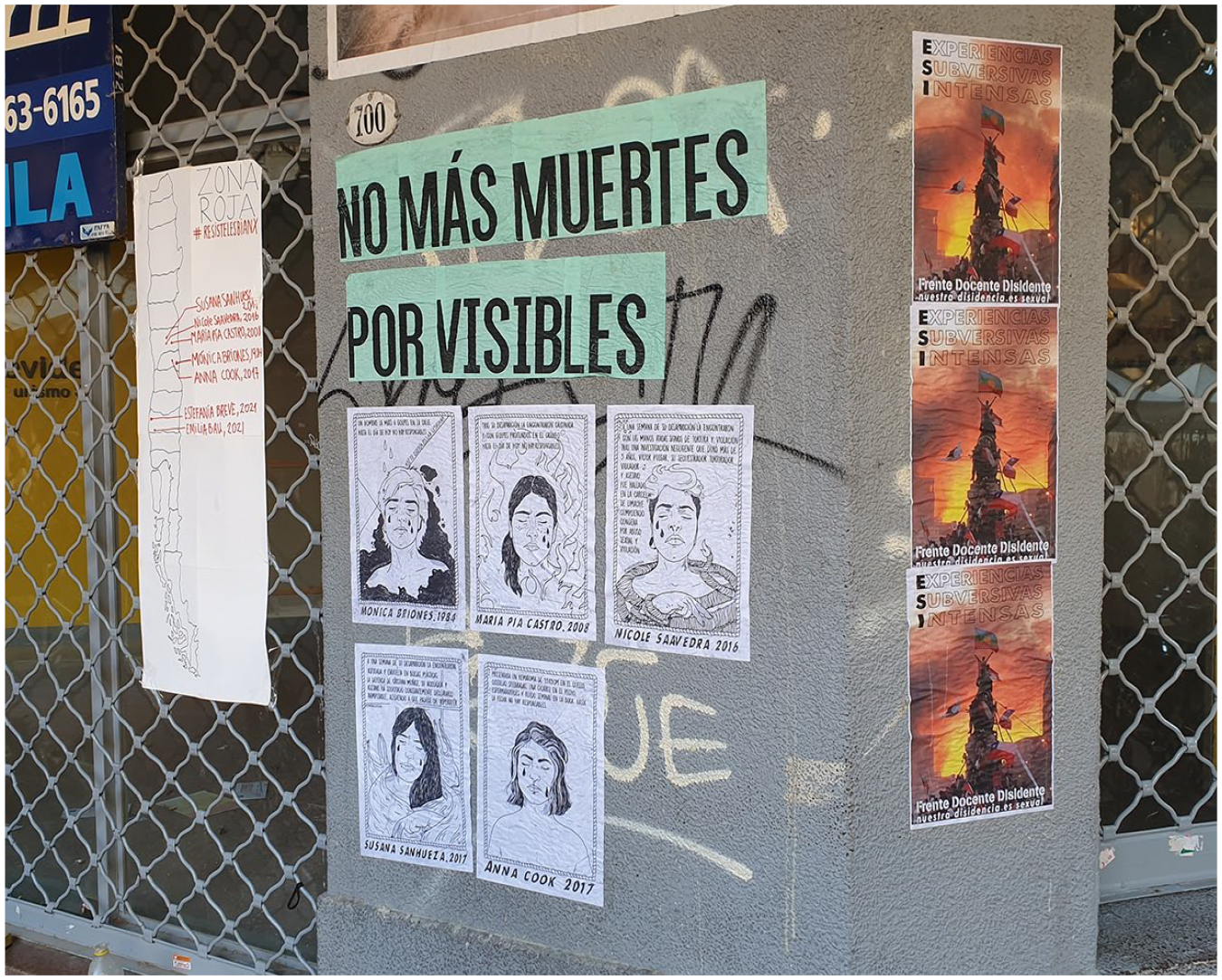
The corner Chile–Defensa after the activist performance. Photo by the author.
Pasaje San Lorenzo, the second stop, held special significance for lesbian activists due to the presence of a basement apartment known as the ‘sótano de San Telmo’ (flores, 2015). This had been a central hub for lesbian activists, led by Martha Ferro (1942–2011), during the 1970s and 1980s. As participants arrived, activists adorned the building’s walls with portraits of Ferro and activist groups from the 1970s, accompanied by periodical clippings and archival records in the form of posters and collages (see Figure 3). Some of these documents were from the 1970s Frente de Liberación Homosexual of Argentina, purposefully imbuing the space with historical narratives of LGBT+ activism from that era.
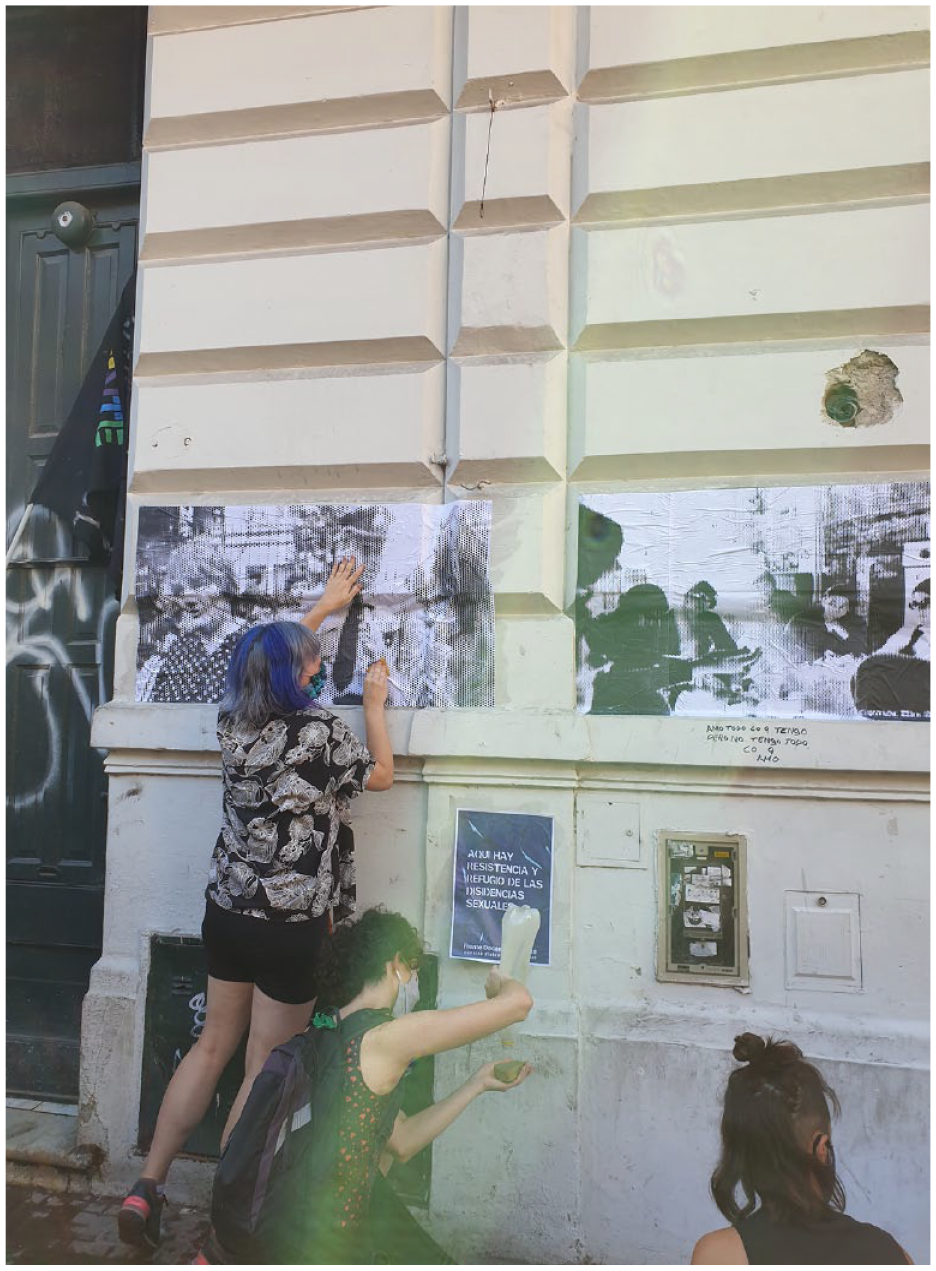
Activists affixing pictures from the 1970s and archival records in Pasaje San Lorenzo. Photo by the author.
During this stop, activists presented narratives linking this specific place to others across time. First, one of the activists highlighted its historical significance for lesbian activism, emphasising the pivotal role of Ferro, with a reading of a text by the journalist Adriana Carrasco, Ferro’s life partner. Later, an Afro-descendant activist explored the history of Casa Mínima, a small house opposite the sótano, considered the smallest in Buenos Aires. Such houses were once inhabited by slaves, and this particular one is believed to have been donated to the first freed Black man in Buenos Aires by his former White ‘owner’. 6 Expanding on the Casa Mínima tale, the activist highlighted the layers of bricks laid by Black slaves and Indigenous people forming San Telmo’s foundational underpinnings. The urban space itself is interpreted as a testament to the shared experience of oppression and resistance among subaltern groups. In their narratives, activists directed attention to an underground space encapsulating the memory of Black and LGBT+ people, and which the narrative symbolically attempted to bring to light: the basement apartment for lesbian activists and the layers of bricks piled up by slaves beneath the feet of walkers.
Starting from Balcarce Street, another mnemonic practice makes its appearance: street renaming. Balcarce, a town in the Buenos Aires province, lends its name to a traditional cake called torta Balcarce. In Argentina, however, ‘torta’ is also a derogatory term for lesbian women. Utilising the system of urban toponymy as a pretext for their narratives (similar to what happened with ‘Chile’ at the beginning of the walk and ‘Defensa’ and ‘Brazil’ towards the end), activists playfully renamed Balcarce as ‘Tortas Balcarce’, thus celebrating non-metropolitan lesbian women. By reclaiming the term, they aimed to transform it into a positive label within Buenos Aires’ toponymy.
The fourth stop was at Plaza Dorrego, where the city of Buenos Aires officially joined the declaration of independence of the United Provinces from the Spanish Empire in 1816. Activists drew on the symbolic power of this national memorial site to remember colonialism and its violence. It was in this area that colonisers first arrived, initiating the dispossession of land from the Indigenous population, and where ships disembarked Black slaves for trade (only later was the bed of the river moved further to the East). Reading an excerpt from his book Fiestas, baños y exilio. Los gays porteños en la última dictadura (Parties, toilets and exile; Gays in Buenos Aires in the last dictatorship, Modarelli and Rapisardi, 2001) – a seminal work systematically documenting sexual dissidents’ resistance in the 1970s and 1980s – the writer and activist Alejandro Modarelli added further layers to this stratification of history: the resistance of gay men in public toilets, usually located underground, where people met clandestinely for socialising and having sex. Plaza Dorrego is thus conceptualised again as a palimpsest of histories. The juxtaposition of silenced narratives, imagined as located ‘underground’, forged tangible and semantic connections between the histories of lesbian, gay, Black and Indigenous people.
The fifth stop was at Defensa Street, which was renamed ‘Autodefensa Lésbica’ (Lesbian Self-Defence, see Figure 4). Portraits of Gaitán were displayed along with slogans on street plates. An activist narrated the stories of lesbian women facing violence, focusing in particular on the story of Eva Analía de Jesús, known as Higui. In 2016, Higui, a lesbian woman, was a victim of ‘corrective rape’. Her attempt to defend herself during the sexual assault resulted in the death of one of her assailants. Higui was subsequently imprisoned and was tried for murder. During the walk, activists joined the campaign for Higui’s liberation, linking it to the memory of Gaitán, whose murder is commemorated on the Argentinian Lesbian Visibility Day. Activists argued that Higui’s fate could have mirrored Gaitán’s if she had not defended herself, thus asserting her right to self-defence. Similar to the case of Stonewall, where the commemoration of an illegal act (a riot) aimed to change moral and cultural codes, the linking of Gaitán’s commemoration to the recognition of Higui’s right to self-defence challenges social, moral and legal norms. Drawing on mnemonic practices, activists perform in the public space a moral reconfiguration of the distinction between legitimate and illegitimate action against sexist violence. This transformation is symbolically marked by the renaming of Defensa Street to ‘Lesbian Self-Defence’ Street.
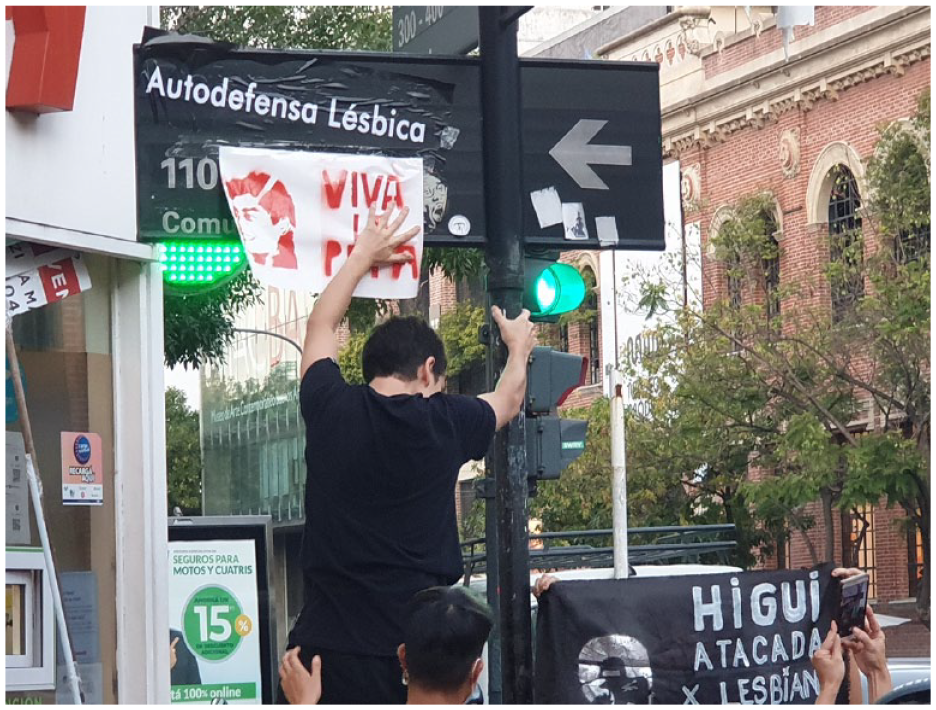
The renaming of Defensa, the portrait of Gaitán and a sign for the liberation of Higui. Photo by the author.
The sixth stop marked another significant street renaming. At the Parque Lezama and Brazil intersection, two Brazilian activists carried a replica of Rio de Janeiro’s street sign reading ‘Rua Marielle Franco’. Franco was a bisexual socialist activist and city councillor, who advocated for favela residents’ rights, stood against police brutality and spoke for the official recognition of Lesbian Visibility Day in Rio. Franco was murdered in 2018 for her political activism, leading a street near Rio’s city council to be renamed ‘Rua Marielle Franco’ in her honour. However, during the 2018 presidential election campaign, a far-right candidate destroyed the sign and shared the act on social media. In response, activists created a website that provided a toolkit for producing and installing replicas of the sign. 7 This initiative garnered widespread national and global support, with activists in Buenos Aires joining it. After recounting Franco’s life and dedication, the two Brazilian activists affixed the nameplate while the crowd chanted, ‘Marielle Franco, presente, ahora y siempre’. This slogan holds particular significance in Argentina as it is typically reserved for the memory of the disappeared during the last dictatorship, thereby creatively connecting histories through mnemonic practices drawn from diverse traditions. 8
Finally, the walk was concluded by a group of women – amateur musicians and activists who were part of the drumming workshop Batuka 9 – playing drums in Parque Lezama. This musical culmination was in line with common practice in demonstrations in Latin America which often include professional or amateur percussion groups. Percussion is also vital in cacerolazos, protests where pots and pans (cacerolas in Spanish) are used as instruments. In Buenos Aires, percussion workshops like Batuka are very popular. Participants in these workshops are prepared to use percussion in public gatherings, whether recreational like carnival spectacles (murgas in Argentina) or political like the March for Memory, Truth and Justice on 24 March. Thus, the soundscape from these workshops merges the realms of celebration and collective action.
Activist mnemonic labour I: connective histories and queer arrangements
The description of the walk shows how activists utilise urban space as both a symbolic and a local anchor to reference and connect the historical experiences of Black slaves, lesbian activists, gay men, and Indigenous people from/in Argentina and beyond. Activists strategically leverage the contiguity of physical spaces that witnessed and encapsulated these experiences, as well as the urban toponymy in the historical neighbourhood of San Telmo as a public mnemonic system, to bridge temporal, geographical and discursive divides in the historical experiences of different social and national groups.
In the words of Marianne Hirsch (2012: 20, 230), we can define this aspect of activist mnemonic labour as a form of ‘connective memory work’, where activists shape cultural memories across lines of difference. This is not only accomplished in terms of connecting mnemonic contents but also through mnemonic forms. In fact, the walk in San Telmo represents the assembly and creative blending of various memory practices from diverse traditions and contexts, which are adapted to the local setting of Buenos Aires and reinterpreted according to the significance of Lesbian Visibility Day for lesbian activism. 10
The main practice that seems to offer FDD’s activists a model for designing their own walk is ‘Relato situado: Una topografía de la memoria’ (‘Situated story: A topography of memory’). ‘Relato Situado’ is a guided walk in Buenos Aires that follows the path of the baldosas de la memoria (memory tiles), which commemorates the 30,000 disappeared victims of the last dictatorship. These walks intertwine cultural memories with archival documents through situated storytelling, where participants engage with the stories depicted on the tiles and share their own personal memories. Using situated storytelling as their main technique, activists looking for historical justice in the context of the Argentine post-dictatorship transition incorporate, by adaptation, other practices within their walk. On one hand, by affixing activist pictures to walls after aesthetic re-elaboration, FDD’s activists appear to draw inspiration from urban interventions by activist and artistic groups such as Grupo de Arte Callejero and H.I.J.O.S. (Levey, 2020). On the other hand, by renaming streets to honour women killed because of their sexual orientation, gender and political engagement, they connected the walk to similar actions that had gained prominence and visibility in the 2010s–2020s (most notably in Brazil the protests held in memory of Franco since 2018 and, in the United States, the Black Lives Matter movement).
In this way, FDD activists tapped into the memory of the disappeared and associated their own protest with a traumatic paradigm (Jelin, 2002) with the principal aim of constructing a defiant and non-normative discourse about memory. Two elements exemplify the deviation from the memory of the disappeared as emerging from ‘Relato situado’. The first is visible in the accompanying Instagram image (see Figure 1): it depicts three women urinating, with the words ‘memory, resistance, and pleasure’ emerging from the urine. With this image, FDD’s activists programmatically centre their approach to memory on pleasure and challenge norms of decency and social expectations, even when commemorating victims of a violent past. The second element is in the soundscape of the walk, 11 particularly in the transitions between stops, when activists engage in spontaneous shouting, chatting, laughing and the singing of slogans. These transitions highlight the walk’s joyful and playful nature – the pleasure (the ‘goce’ mentioned in the call) of appearing and acting together in the public space as women and lesbian women. Memories of collective and individual traumas thus become platforms for expression through dance, song, shouting and drumming, and a celebration of togetherness. In this sense, FDD’s actions and re-elaboration of the memory of the disappeared resonate with the practices carried out at the Homomonument in Amsterdam, where Holocaust memory serves as a platform for joyous gatherings that blend scripted mourning and queer celebration.
Drawing on Cecilia Sosa’s (2014) seminal analysis of non-normative mourning and commemorative acts in post-dictatorship Argentina, the FDD’s reinterpretation of remembering within the post-dictatorship context exemplifies queerness as a method for activists to rethink memory-making. For example, Sosa and Page (2023) have recently analysed how the disobedient daughters of perpetrator fathers disrupt kinship, fatherhood and family through ‘acts of defiliation’ (pp. 56–59). Their analysis expands the use of the concept of ‘queerness’ to encompass mnemonic practices beyond LGBT+ identity politics. By adopting, adapting and blending different mnemonic practices and reconfiguring their normative meanings, the FDD’s activist mnemonic labour allows for the emergence of a ‘queer arrangement’ (Sosa and Page, 2023: 62) for memory-making. This arrangement adapts mnemonic forms and practices from both local and transnational contexts to the local context and causes. Through adopting queerness as a method in their activist mnemonic labour, the activists of the FDD propose an image of Argentinian memory and history that contrasts with institutional and homonationalist narratives. They help in the emergence of the memory of a ‘less White’ country by making the history of Black Argentinians visible. In addition, with their transnational approach, they not only build alliances across borders but also show their connection to the history of (lesbian) activism in neighbouring countries, thereby deconstructing the supposed exceptionality of Argentina within Latin America.
Activist mnemonic labour II: recovering, sedimenting, mobilising
In the FDD’s call for the walk (quoted at the beginning of this article) and throughout the walk itself, a particular fact was emphasised: the memory of lesbian activism lacks documentation. Therefore, the walk’s objective was ‘to reclaim and document the historical memories of lesbian activism’. This sets FDD’s walk apart from the ‘Relato situado’, where cultural markers (the tiles) already exist in the urban space to prompt narration. The ‘Relato situado’, akin to many practices addressing historical injustice, thus demands recognition of something that is already there publicly available. In FDD’s walk, however, lesbian activists underscore their intention to recover and even create records of the memory of lesbian activism for the first time. These records (such as photographs and street nameplates) were subsequently designed, produced and installed in urban spaces to function as cultural markers and carriers of the memory of lesbian activism. Around these elements, activists orchestrate their performances.
The activist mnemonic labour before the walk thus revolved around record recovery and record making (Sheffield, 2018), aimed at documenting the memory of lesbian activism. Before the event, activists conducted archival research, utilising both institutional and activist archives, as well as digital and non-digital collections. This process involved gathering documents associated with past activists in Argentina dating back to the 1970s. For instance, pictures of Martha Ferro and documents from the Frente de Liberación Homosexual of Argentina (1971–1976) were recovered, aesthetically reworked and displayed at designated stops, as described above. The text of journalist Adriana Carrasco on lesbian activist Martha Ferro was not only read during the walk but also printed and distributed among participants as a small booklet, featuring Ferro on the cover. Research on the history of San Telmo and lesbian activism in Brazil and Chile, along with the production of the diverse material described earlier, thus preceded and prepared the walk.
However, record making as a form of activist mnemonic labour is not solely confined to the memory of past activism. During the walk, activists also documented all actions and shared them online via Instagram stories on the FDD page. This live recording and dissemination of the walk via social media not only extended its outreach beyond its physical presence but also transformed the walk itself into a potentially archivable and collectable complex entity (on activist archiving see also Rigney, 2024). The live recording served as the initial raw material for constructing the memory of the walk as a reflection of contemporary lesbian activism for the future. The FDD Instagram page served as the primary platform for creating these records and disseminating them in the form of Instagram stories, which have a lifespan of only 24 hours. Once these ephemeral Instagram stories disappeared, FDD created permanent posts to document and commemorate the march. Digital tools such as Linktree were used to compile and distribute all materials. In addition, other activist archives, like the queer digital archive Potencia Tortillera, included the walk in their collections to preserve and disseminate its records. 12
A selection from this material was later collected into a booklet, which was released digitally on the National Day of Memory for Truth and Justice (24 March) and later sold in paper format at a Buenos Aires bookshop (as well as uploaded on the ISSUU platform). 13 The booklet starts with the term ‘anti-repressive March’ and includes a list of commemorative days, which connects Lesbian Visibility Day with other commemorative occasions. 14 The booklet features diverse materials: archival records, memories, autobiographical texts, images and a bibliography connecting various causes. Photographs from the 2021 Lesbian Visibility Day walk are accompanied by texts exploring the history of the basement of San Telmo and the figure of Ferro in lesbian activism. The cover combines the post-dictatorship Argentina memory framework, represented by the slogan ‘Memoria, Verdad, Justicia’ (Memory, Truth, Justice), with LGBT+ activism, reflected in the words ‘Orgullo, Identidad’ (Pride, Identity).
The intense production and dissemination of archived and archivable material documenting FDD’s activism facilitate what I have referred to as ‘sedimentation’ (following della Porta, 2020: 565). The creation of cultural memories of lesbian activism before, during and after the walk enables the accumulation of a reservoir of material available to activists for subsequent recovery and reuse in future mobilisations. It is in this sense that activist mnemonic labour transitions from the endeavour of producing the memory of activism to the subsequent mobilisation and recirculation of such memory in later activism, namely in new and varied demonstrations.
In the case of the 2021 Lesbian Visibility Day walk, we can mention at least two occasions in which the records produced during that event informed and supported later mobilisations. The first occurred just 2 weeks later, during the National Day of Memory in Buenos Aires when activists reused material from the Lesbian Visibility Day walk within a different commemorative context (Figure 5). This allowed the cultural memory of lesbian activism produced for the walk to extend beyond its initial commemorative setting and become active in other contexts. It is the sedimentation of activists’ actions into cultural records that allows memories to be passed on and inform later mobilisations, facilitating the reuse of slogans, texts, materials and other mnemonic contents and forms (Blom, 2024).
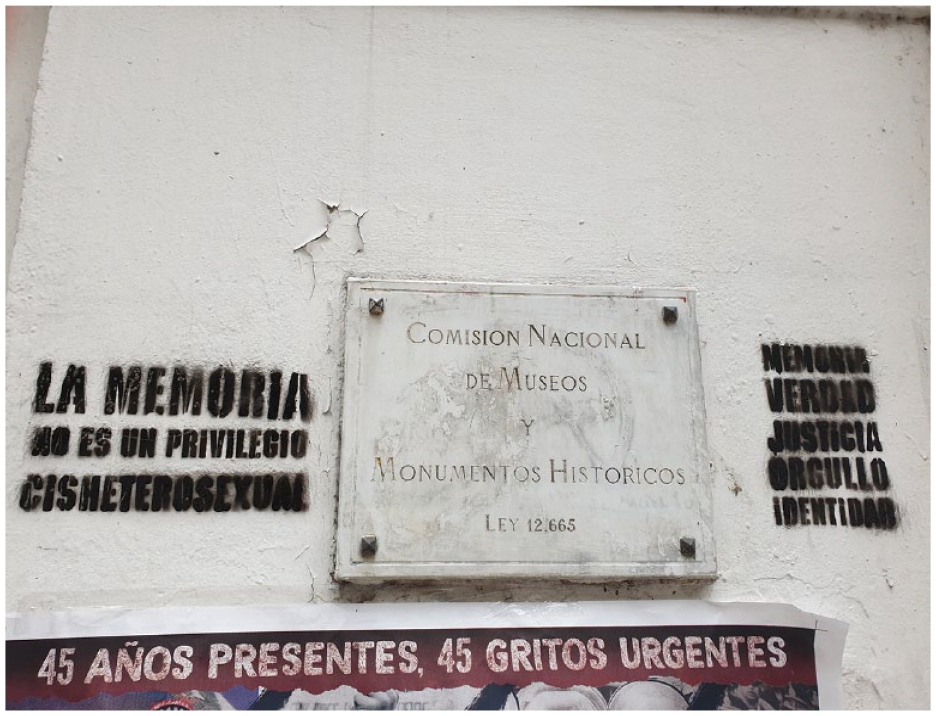
Two of the slogans used by the FDD in the Memory Day march and in the Lesbian Visibility walk written at the entrance of the headquarter of the National Commission of Museums on 24 March 2021. Photo by the author.
The 2024 Lesbian Visibility Day provided the second occasion. The gathering took place in Parque Lezama, where the 2021 walk had concluded after marking the territory of San Telmo as the proper site of memory for lesbian activism. The 2024 call explicitly mentioned Argentina’s recent shift to the right with the election of the new president, the anarcho-capitalist Javier Milei. Activists emphasised the need to challenge the ‘sexual logics of the Right’ by ‘reviving our memories of struggles and resistances’ and collectively creating ‘new images of memory, struggle, and deviant pleasure’ (Frente Docente Disidente, 2024).
The theme of the gathering is the hand game rock paper scissors (‘Piedra, papel, tijera’, see Figure 6). The playful reference is reinterpreted, as the rock is presented as a symbol of resistance, the scissor as a reference to lesbian pleasure and the paper as the creative work of making ‘memory images’ for the city, that is producing new records and new material for building the memory and archive of lesbian activism. The commemorative gathering in 2024 was particularly aimed at raising awareness of the cases of Tehuel de la Torre, a young trans man who disappeared in 2021, and Pierina Nochetti, a lesbian activist who faced a 4-year prison sentence for writing the slogan ‘¿Dónde está Tehuel?’ (‘Where is Tehuel?’) on a wall. 15 Tehuel de la Torre disappeared on 11 March 2021, just 4 days after the 2021 walk, and for this reason, he is not included in that walk. However, the case of his disappearance was immediately taken up by many activist groups, including the FDD, which thereby joined and connected also with trans activist groups. It is in this way that the remembrance of Gaitán on 7 March annually becomes a framework for claim-making within the mobilisation for new causes and cases of injustice. The image circulating with the call is a graphical reinterpretation of the photographs from the 2021 walk, depicting an activist covering a wall with a sign that evokes Gaitán (with her nickname of La Pepa, see Figures 4 and 6). By recovering and re-elaborating this image, activists organise new gatherings based on the knowledge and practices developed in 2021. The utilisation of this picture illustrates how this memory can also become ‘procedural’; the picture indicates to activists that creating and attaching images will be part of the repertoire to be performed in the gathering. The stock of images and records produced in earlier gatherings thus give shape to and transmit the protest and commemoration repertoire of an activist group, informing its reproduction across different contexts. In this sense, the interaction between the sedimentation and mobilisation of memories seems also to call for a reconceptualisation of the relationship between ‘repertoire’ (as activists’ embodied knowledge in performances) and ‘archive’ (as inscribed or recorded knowledge; see on this Levey, 2020). These two concepts have usually been theorised as alternative methods of memory transmission (Taylor, 2003; Tilly, 1995). However, the case of the FDD demonstrates that archive and repertoire can be conceptualised as two complementary moments. These moments are articulated through multifaceted forms of remediation (Rigney and Salerno, 2024: 15), in which a record informs the organisation of a new contentious and commemorative performance, and the new contentious performance is recorded and sedimented again in the form of a cultural carrier, available for potential future uses. 16
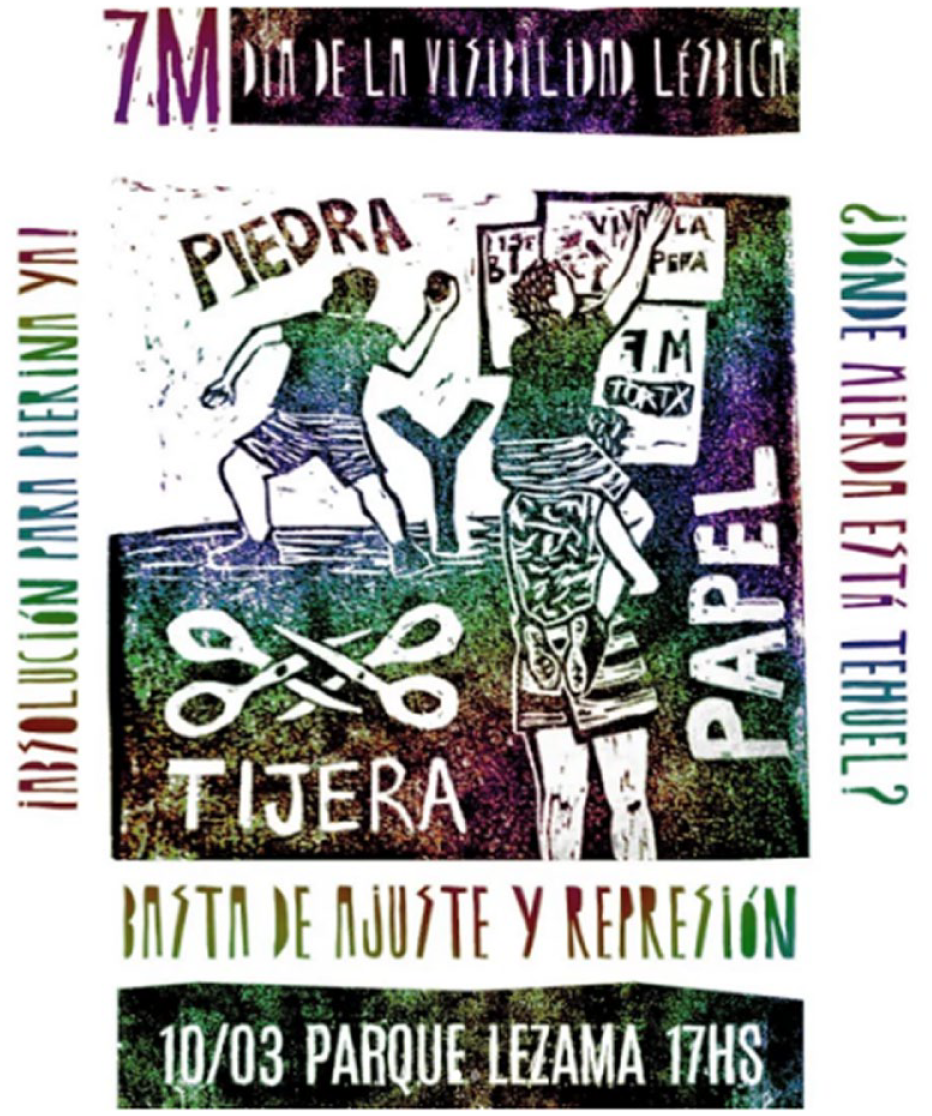
The image published on Instagram by the FDD for the 2024 Lesbian Visibility Day. Courtesy of Frente Docente Disidente.
Conclusion
The case of the 2021 Lesbian Visibility Day walk illustrates how mnemonic labour supports and informs LGBT+ activism in various ways. In particular, we have observed how, through their mnemonic labour, activists connect various social groups and bridge discursive, temporal, and geographical divides. By documenting both past and present activism, activists enable the reuse of this material to inform and support subsequent mobilisations. This facilitates the dissemination of mnemonic contents and forms across diverse contexts.
As Amenta and Polletta (2019: 282) argue, memory serves as a strategic resource for social movements to foster cultural change in the long run. However, this can only occur if mnemonic transformations developed in specific commemorative settings extend beyond their original contexts, adapting to and integrating with new situational frameworks (ultimately being prepared to disengage and reemerge elsewhere again). In order to achieve this, it is necessary to mobilise memories within various contexts so that they can sediment into cultural memories, ready to be readapted and remediated in future mobilisations. Della Porta (2020) underscores the strategic role of ‘reproductions’ in social movements for effecting change. Nevertheless, transitioning from a sociological to a cultural memory studies perspective, the concept of reproduction for social change requires further exploration. Simply representing or reenacting contentious events in commemorative settings, as della Porta seems to suggest, may not suffice. The case of the Lesbian Visibility Walk can illuminate these nuances.
First, what is ‘reproduced’ by activists extends beyond historical events and figures and includes repertoires of action, which bridge different contexts. In the case of the Lesbian Visibility Day walk, memories from diverse social groups intertwine, fostering the exchange and blending of different modes of remembrance across various social frameworks. Following the walk, the compilation of records enables the reemergence and adaptation of this material in other communicative contexts. This facilitates the adoption and adaptation of mnemonic contents and forms across different commemorative and non-commemorative contexts.
Second, during the walk, the resignification of public spaces to reveal the history and contributions of lesbian activism is more than just a means of representing the past. It involves imagining an alternative world where heteronormative conventions in public spaces and collective memory-making are momentarily suspended, and where the memory of lesbian activism and struggles is inscribed into the system of signification that structures the urban space. This reshaping and connection of histories and spaces serve as a medium for activists to construct and enact a different possible world, albeit momentarily. Viewed through this lens, activist mnemonic labour does not solely operate on the level of the ‘representational’ – as della Porta’s analysis might imply – but is inherently ‘performative’. This aspect in activist mnemonic labour transcends a sole focus on the past and becomes a tool within world-making projects (Berlant and Warner, 1998), where activists are not just revisiting the past but also perform a different future world, serving causes and transformations that extend beyond the mnemonic realm.
Footnotes
Funding
The author(s) disclosed receipt of the following financial support for the research, authorship, and/or publication of this article: Research for this article was financially supported by the Marie Sklodowska-Curie Actions under grant agreement 840302: MemoRights–Cultural Memory in LGBT Activism for Rights.
