



Abstract
This piece explores why and how the praxis of disobedience, as articulated by the daughters of the perpetrators of state terrorism during Argentina’s last dictatorship (1976–1983), might be read as an instance of queering memory. The analysis focuses on the trajectories of Liliana Furio (a founder member of the Historias Desobedientes collective) and Mariana Dopazo (ex-daughter of one of the dictatorship’s most infamous perpetrators) to illustrate the differing ways in which the mandate of blood has been challenged through public acts of defiliation. Based on our documentary project material, we consider the ways in which the emergence of these disobedient daughters enacts a collective ‘coming out’ and unprecedented disruption of the normative imaginaries of bloodline ties that have traditionally shaped the local aftermath of violence. We argue that their performance of defiliation puts forward a queer arrangement that unsettles the established landscape of human rights activism in Argentina and beyond.
Introduction: the political mise-en-scène for a public ‘coming out’
On 3 June 2017, a small group of women calling themselves the Historias Desobedientes [Disobedient (Her)stories] convened during the Ni Una Menos [Not One Less] women’s movement’s second anniversary march. Together, they stretched out an ample banner that clearly stated their collective subject position as ‘hijas e hijos de genocidas’ [daughters and sons of the perpetrators of genocide], and their cause: ‘por la Memoria, la Verdad y la Justicia’ [for memory, truth and justice]. Founding member Liliana Furió, seen smiling at the camera third from the right in Image 1, was one of these women. Her chronicle of this day captures the intense emotional tangle of sorority, indignation, liberation, celebration and trepidation that palpitated among this small group of women as they made their way through a sea of faces, some bewildered by their presence, others offering gestures of admiration and affection (Furió, 2018: 88). The multitudinous public demonstration of indignation against gender-based violence and reproductive injustices provided a hospitable environment for this emerging group of feminist and human rights activists to enact what we will suggest here might be read as their public ‘coming out’. These audacious women had come together as the daughters of the perpetrators of state terrorism during Argentina’s last civic-military-ecclesiastic dictatorship (1976–1983), empowered by the affective bonds that were uniting them through their personal urgency to disobey a paternal mandate, and a political desire to challenge the patriarchy. On that day, the reclamatory celebration of women’s rights – to visibility, equality, safety and respect in both public and private spaces, to gender justice – provided the perfect mise-en-scène for the inaugural expression of what we will argue in this article has become a powerful voice queering the memory of dictatorship as it resonates across the established human rights landscape.
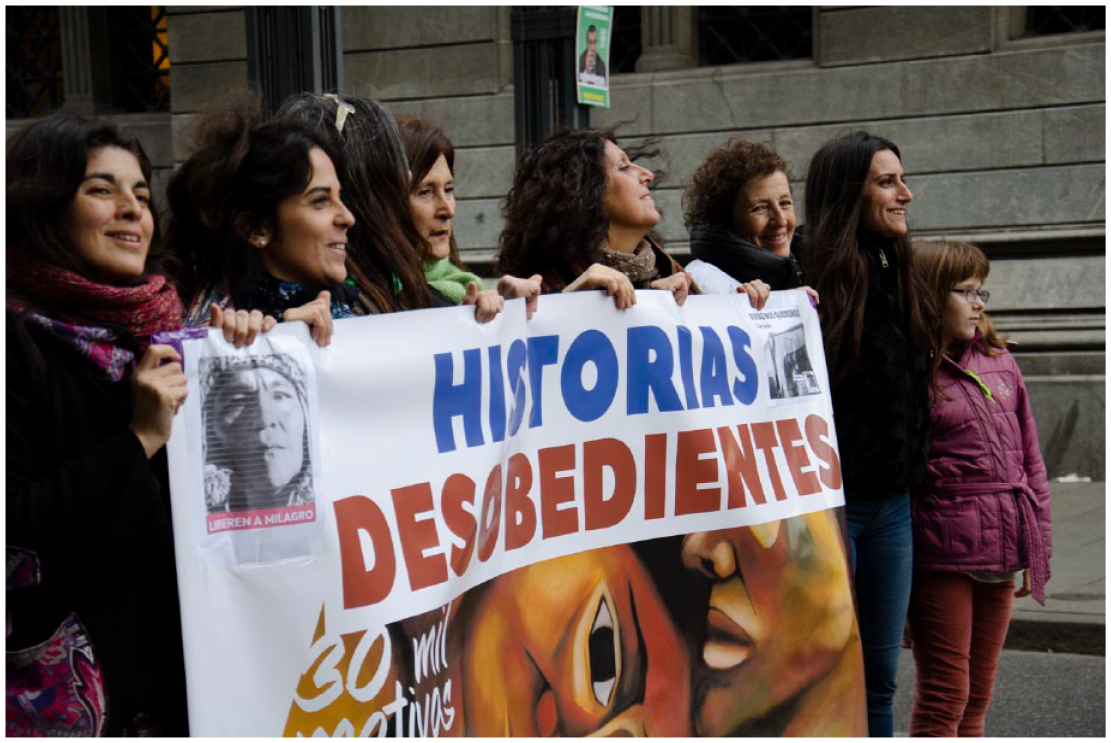
Historias Desobedientes’ [Disobedient (Her)stories] first public appearance during the anniversary march of Argentine feminist collective, Ni Una Menos [Not One Less], 3rd June 2017.
The political conjuncture at the time bore a fascinating contradiction. On the one hand, the powerfully effervescent feminist ‘green tide’ [marea verde] – an intergenerational phenomenon characterised notably by its extreme youth and formed mostly of schoolgirls – was regularly occupying the streets to condemn gender-based violence, stake claim to gender equality and demand reproductive rights. On the other hand, then-president Mauricio Macri’s conservative and neoliberal governance (2015–2019) was marked by the revival of a reconciliatory rhetoric of forgetting and impunity. Indeed, understanding the complexities of this peculiar entanglement between a rhizomatic feminist awakening and a regressive backlash in official, institutional memory politics is vital to fully appreciate the intricacies of the socio-political landscape in which this public ‘coming out’ took place. The Historias Desobedientes’ inaugural public appearance came just a month after the shock of a Supreme Court ruling, commonly known as the ‘2-for-1’, that enabled a retrospective reduction in sentence to be applied for those already convicted of, or still awaiting trial for, crimes against humanity. The ruling was met with widespread condemnation and disbelief across the political divide, a phenomenon known locally as ‘la grieta’ [the ‘crack’ or ‘crevice’]. It had revived the unsettling spectres of amnesty and impunity that had pervaded from the late 1980s to the early 2000s, underpinned by what was now considered much more widely to be a highly controversial official discourse that articulated that ‘dragging up the past’ was in ‘no one’s interest’: such rhetoric relied on a historical version of the dictatorship as ‘a dirty war’ [una guerra sucia] (the term used by the junta itself to describe state terrorism) between ‘two demons’ [la teoría de los dos demonios]. 1
Unlike the apathy among the general public that had enabled such policies in the 1990s, the 2017 ruling triggered widespread popular indignation. It was a testament to the expanded societal commitment to human rights activism that had been cultivated throughout the successive Kirchner mandates (Néstor Kirchner from 2003 to 2007 and Cristina Fernández de Kirchner from 2007 to 2015) as they made the memory of dictatorship a matter of state. On 10 May 2017, people did not only express their fury and disbelief; they acted on it, filling the streets in a multitudinous public display of condemnation. Together, they formed a veritable community in mourning that they were ready to defend as such. As they convened in the streets, they each held a white triangular kerchief, long the iconic symbol of the unwavering decades-long campaign led by the Mothers and Grandmothers of Plaza de Mayo since they first stepped out to demand the reappearance of their disappeared children and grandchildren on 30 April 1977. This was the first time that members of the general public had carried a white kerchief, alongside the Mothers and Grandmothers, though not tied onto their heads out of deference to these historic figures of resistance. The multitudinous public display of the white kerchiefs somehow embodied the agentic transference of the memory of dictatorship to a much wider audience. For decades, the right to mourn the 30,000 disappeared, who were the victims of state terrorism, had been confined to the network of kin associations cultivated between the relatives of victims and those who had survived illegal detention. This crystallised in the form of a genetically defined bloodline lineage and expressed by the trope of the ‘wounded family’ (Sosa, 2014: 8), whereby the experience of mourning was carefully guarded in the hands of those affected directly by loss.
During the period 2003–2015, this confinement of mourning to the normative, nuclear biological familial configuration, which included the mothers, grandmothers, relatives and the children of the disappeared, began to be displaced. Shortly after taking office, late President Néstor Kirchner announced: ‘We are the children of the Mothers and Grandmothers of the Plaza de Mayo’ (Tiempo Argentino, 2016). Within this displaced biological rhetoric that marked the Kirchner mandates, the broken lineages mourned by the Madres and Abuelas were indeed displaced; they became expanded, countersigned and even queered. Self-invested as the figure of the son, the late president showed how the lineage of loss did not belong entirely to the ‘direct victims’ but rather it could also be inhabited by those who had adopted grief as a personal and collective commitment (Sosa, 2014: 3, 2021: 140). The official rhetoric thus separated the performance of grief from its biological legitimacy, opening up the possibility of a queer family in mourning. The pañuelazo [the name given to the massive display of white kerchiefs] that occupied the streets in 2017 might be read as the apogee of this process. The strength of the popular demonstration of fury meant that incumbent president Macri finally agreed to revoke the application of the ‘2-for-1’ sentence reduction for crimes against humanity. The stage was set for unexpected new voices to join collective expressions of indignation; the atmosphere was ripe for the collective memory of dictatorship to be queered by the inclusion of such voices.
Most significant as context for this piece is the fact that this judicial scandal proved to be the catalyst for a series of disobedient voices to break through the silence that had been imposed on them from a very young age by a powerful patriarchal, paternal mandate operating not only on a societal level as part of the dictatorship’s repressive apparatus but inside their family homes. One of these voices that emerged among the multitude belonged to Mariana Dopazo, the self-declared former daughter of Miguel Etchecolatz, one of the dictatorship’s most infamous perpetrators of genocide. Having already changed her surname by legal petition in 2016 and disgusted by the gross injustice of the 2-for-1 ruling, Mariana participated in the massive protest of 10 May (her first appearance at a human rights demonstration) and publicly spoke out against her former father for the first time.
This inspiring and provocative set of disobedient daughters, sons and family members have since become a powerful voice – as individuals and in various collective configurations – in support not only of memory, truth and justice in relation to the last dictatorship, but also as activists addressing the intersectional struggles in contemporary society. Their emergence, across the Southern Cone, is now a well-documented phenomenon through their own collated writings (see, for example, Colectivo Historias Desobedientes, 2018; Dopazo, 2019b) and several academic pieces (Gago, 2020; Lazzara, 2020; Page, 2021; ; Sosa, 2022). Based on fieldwork conducted between November 2018 and August 2019 with Mariana Dopazo and Liliana Furió, as part of a documentary film project that explores the feminist imaginaries of state terrorism, here we want to elucidate why and how the praxis of disobedience, as articulated by these two women, might be read as an instance of queering memory. We argue that the public emergence of these disobedient daughters enacts an unprecedented disruption – the ultimate subversion perhaps – of the normative familial imaginaries of blood relationships to victimhood and perpetration that have historically given shape to the memory and postmemories of state terrorism in Argentina (Jelin, 2008; Sosa, 2014). The disobedient trajectories of Mariana and Liliana that are explored below illustrate the different ways in which they have chosen to challenge the personal, political and societal mandate of blood. The imbrication of their artistic expressions and their emergent activism show how they have become part of the ever-expanding queer family in mourning instituted by the Kirchner presidencies. Their queering of the established trope of the ‘wounded family’, by means of their respective acts of defiliation, requires rather paradoxically enacting a fissure within their own families – a wound in the normative familial structure that must not be sutured. As we look at these particular expressions of disobedience through the intersectional and intergenerational conceptual lens offered by queer memory studies, we perceive new ways of understanding the phenomenology of the transgenerational transmission of memory and its potential not only to welcome radical new voices from (often controversial) subject positions but to connect the memory of dictatorship intersectionally to contemporary feminist struggles for social justice, collective memory and gender equality.
Disobedience as a form of queering memory
In our framing of disobedience as a form of queering memory, we are guided by both the embodied and metaphorical potential of queering as a notion. This is akin to Sara Ahmed’s (2006) suggestion that ‘[t]o make things queer’ means ‘to disturb the order of things’ (p. 565). By openly embracing the pillars of memory, truth and justice traditionally championed by the network of kin associations belonging to the victims, the disobedient daughters discussed in this article generate a disturbance that reverberates across the established imaginaries of state terror. They do this by calling into question normative, biologically determined, definitions of kinship and, thus, openly redefining their own family ties to the perpetrators of genocide as irreconcilable. The public performance of this ‘coming out’, outlined above and developed below through conversations with two disobedient daughters (one of whom incisively defines herself the ex-daughter of her progenitor), might be thought of as a closet door opening out towards new politically and ethically motivated forms of collective and expanded affiliation. We might think of these as ‘queer bonds’. In the 2011 GLQ special issue on ‘queer bonds’, the editors Joshua Weiner and Damon Young include within the term all those ties ‘that appear under different conditions of negation, connections and constraints beyond the contractual agreements between autonomous, positively defined subjects as presumed in liberal theories of the social’ (Weiner and Young, 2011: 223). Particularly, in our case, this means forms of affection and care that reach beyond the ‘wounded family’ of bloodline victims to constitute forms of relationality that contest the biological narratives of injury recounted by the relatives of the victims in Argentina. By bringing those queer bonds enacted by the daughters of the perpetrators to the fore, we also want to examine as a form of queering memory those alternative forms of support, love and care that have become possible in the local aftermath of violence. The call to disobey enacted by the daughters resonates like a tantalising mantra that whispers: ‘[y]ou must come out, for your own sake and for the sake of all of us’ (Bockman (1986) quoted by Sedgwick, 2008: 71). It represents a process of identification with others engaged in a similar process of becoming disobedient but also, and perhaps more importantly in this case, a process of identifying against the patriarchal lineages in which society has inscribed them as belonging to the same heteropatriarchal ideological matrix as their fathers (Sedgwick, 2008: 61). By querying and queering the biological and heteronormative narratives of kinship, these disobedient women express a subversive reckoning with their own conditions of ‘implicated subjects ’ as agents of transmission (Rothberg, 2019: 2), not only in relation to state terrorism but also, through their engagement with a decolonial feminist ethos, to deeper post- and neo-colonial histories of oppression.
This empowering act of ‘detachment’ from biological lineages (Dragojlovic, 2018: 92) in the intergenerational sculpting of memory holds the possibility of reimagining the future by queering specifically defined blood lineages of victimhood and perpetration, challenging the notion of historical ‘bystanders’, and granting a wider communal and symbolic significance to the ‘wounded family’ in mourning that transposes biology (Sosa, 2014). If the emergence of the H.I.J.O.S. collective [Sons and Daughters for Identity and Justice Against Forgetting and Silence] in 1995 was still firmly inscribed within the established bloodline tradition, the recent emergence of the group Nietes [grandchildren of the disappeared and children of the H.I.J.O.S.] in 2019 embraces the radical potential of queering memory. This is evident in their choice of gender-inclusive language: nietes (as opposed to ‘nietos’) of the desparecides (in favour of ‘desaparecidos’), a deliberate obliteration of the masculine ‘o’ which would normally serve as the default formulation of plural nouns according to grammatical norms. The subtle choice of the inclusive ‘e’ was not trivial, but an important marker of the millennials and Generation Z, born long after the end of dictatorship. It brought an original performative flair to what was considered to be the sacred, unalterable lexicon of the human rights movement. Moreover, the adoption of a gender-inclusive lexicon signalled the wholehearted embrace of gender fluidity and a queer paradigm (Sosa, 2022). Emerging concurrently as activists within the feminist and human rights demonstrations, both the Nietes and the Historias Desobedientes offer new branches to the ‘wounded family’ and a memory of state terrorism that is committed to gender equality and justice.
What we argue here is that, when explored through the prism of queer memory, the activism performed by the disobedient daughters offers a further empowering fold in the intergenerational transmission of the memory of dictatorship. As noted by queer scholars C. L. Quinan and Esteban Muñoz, the act of analysing memory through queer lenses also offers the opportunity to rethink hidden narratives of memory activism. Making these obscured narratives visible unlocks ‘opportunities for creative self-determination’ (Quinan, 2021: 105), which would certainly seem to capture the process of coming out enacted by the disobedient daughters in Argentina.
Quinan’s notion of ‘transfilial negotiations’ is particularly illuminating. It is developed as an approach to analyse the ways in which the memory and trauma of Algeria’s colonial history have not only been informed by those who directly experienced colonial repression and the war of independence but have also been trans-passed to contemporary generations to shape in their own ways. This resonates strongly with the disruptive, contemporary arrangements of kinship that the Argentinean disobedient daughters and Nietes are operating in the wider, transnational realm of memory. Indeed, we are witnessing new types of ‘queer bonds’ that interrupt intergenerational transmission along bloodlines while enacting a politics of detachment through the display of alternative affects. As Ana Dragojlovic (2018) also argues in her exploration of ‘intergenerational hauntings’, this time in the post-colonial Indonesian context, the ‘public display of negative feelings towards biological family, interrogation of expected loyalty and an open call for detachment’, enable a queer expression of empowerment through a ‘politics of negative affect’ (pp. 92, 94). The two case studies that follow examine the complexities of this phenomenon in detail. They show the extent to which the expressions of negative affect have managed to trouble traditional framings of victimhood that set a boundary of legitimacy, along blood lineages, between those who have the right to mourn and those who do not within the Argentine context. The disobedient daughters propose creative new arrangements that unsettle this marker of legitimacy both in the realm of memory and kinship as they transpose their own bloodlines and the local context.
Mariana Dopazo: photography, disidentification and the possibility of fiction
On 24 March 2019, we had the pleasure of accompanying photographer Mariana Dopazo, the former daughter of one of the dictatorship’s most infamous perpetrators, to the demonstration that marks Argentina’s ‘National Day of Memory’, on this occasion the 46th anniversary of the military coup that imposed the brutal dictatorship. The annual commemoration-cum-demonstration-cum-festivities brings together human rights groups and committed citizens and has been a public holiday since 2014. The spectacle of banners, music, speeches, games and dance that comprises the 24M demonstration is often referred to as the ‘mother’ of all human rights demonstrations. On this occasion, it was about daughters, daughters who have redefined the ties to their fathers. This was only the second time that Mariana had attended the 24M march, where she explained very candidly that she had been unable to attend this event until she had legally changed the paternal surname acquired at birth, adopting instead her maternal surname Dopazo. Mariana is the former daughter of Miguel Etchecolatz, Director of Investigations of the Buenos Aires Provincial Police Force during 1976 and 1977, who died in July 2022. His crimes included kidnapping, torture and the theft of babies born in captivity. Tried in 1986 and then swiftly pardoned in 1987 when the Impunity Law of Due Obedience was declared constitutional, it was during his (second) trial in 2006 that the term ‘genocide’ was cited for the first time in a court of law to refer to the crimes against humanity committed by the state under the military junta. Mariana stopped seeing her father at the age of 15. ‘I will not give him the right to be my father’, she explained defiantly. In her case, becoming disobedient takes the form of nominal and judicial act of defiliation, rather than repudiation of a filiation that remains, as in the case of the Historias Desobedientes collective. But long before this very personal process of defiliation had officially been sealed, she had been fascinated by the Mothers of Plaza de Mayo on their Thursday circuits and those demonstrating at the 24M march. She would observe, and in her own way accompany these acts, through the distant, muted and unreciprocated gaze of her camera. Like many of the disobedient children of perpetrators, artistic expression offered her an alternative and affectively rich form of language, where no verbal narrative was yet possible, as a means of breaking through the silence, of experimenting with forms of affiliation and affective communication that go against bloodline ties.
‘The possibility of changing my surname had to do with a personal act, which later also became a leap into the public sphere’, she explained to fellow photographer Agustín Mendilaharzu, as they followed the passage of the multitude through the lenses of their cameras (Image 2). ‘Faced with this cruel and deadly filiation, I no longer allow him to be my father. This is not to say that I have run away from that place, rather that I no longer allow him to inhabit a space that he never occupied anyway’, she affirmed. Mariana’s change of name might also be interpreted as a variation on the disobedient ‘coming out’, a form of political ‘disidentification’ (Muñoz, 1999: 7) that has enabled her to overcome her biological identity and imagine herself differently: ‘to begin to invent, to tell another story’, as she puts it. She did this through the gaze of her camera lucida, constructed with all the complex affective textures of a point-of-view perspective traversed silently by an inherited sense shame, the desire to disown and repudiate, admiration for those demanding justice for the victims and a covert desire to cultivate alternative forms of attachment in solidarity.
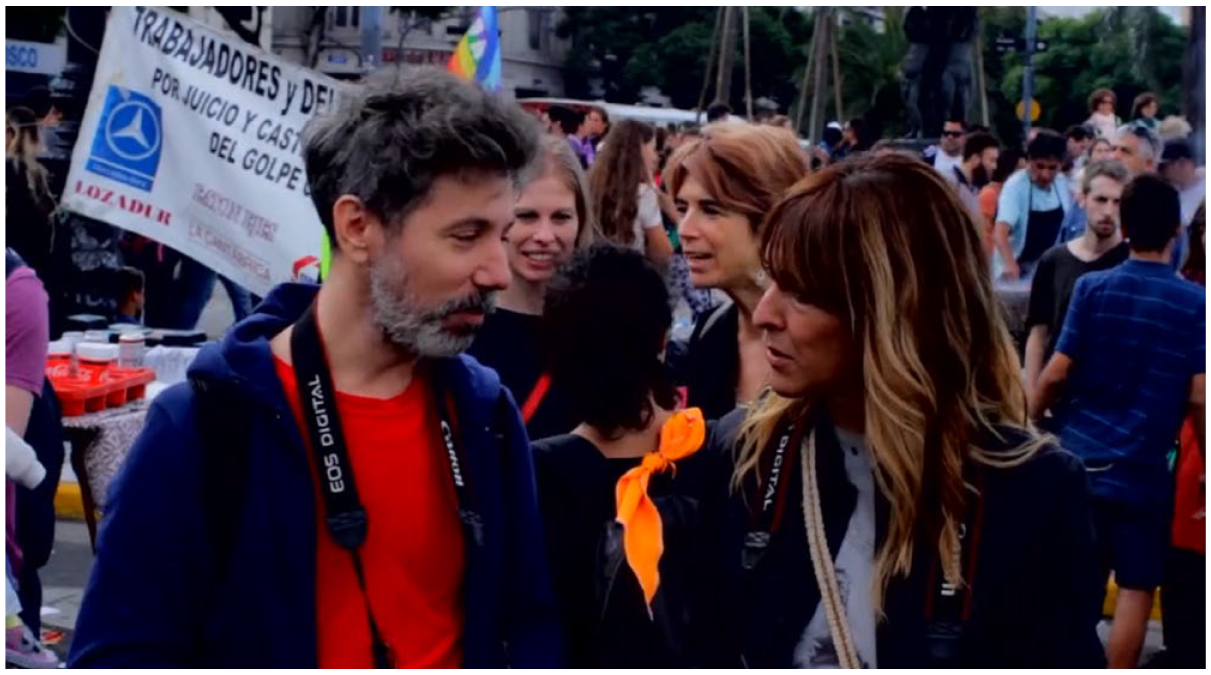
‘Getting past my father is a long-awaited and rather strange step for me, [. . .] it is to begin to invent, to tell another story’ (Mariana Dopazo, 2019: 55, our translation). 2
Mariana’s words on photography reveal a sensitive ethical consideration of ‘regarding the pain of others’ (Sontag, 2003), of when to press the button on the camera and when to rest her lens and leave it pointing away from the scene she beholds. She is clear that there are times when she is unable to take photos and that this has to do with her divisive subject position: When you are involved and it was your parent who perpetrated the crimes, I can assure you that the scene changes a thousand times over. There are few moments in which I remain like this [she raises her hands away from the camera]. I just stand with the lens pointing upwards.
Where Mariana did take photographs of these displays, she never felt able to develop the images. The photographs that she would discreetly take of the Mothers of Plaza de Mayo performing their Thursday circuits are locked in ageing film rolls that she believes have by now expired. ‘It was the gaze and silence’ (Dopazo, 2019a: n.p., our translation), 3 she recalled. Taken at a time when only victims’ families held a legitimate voice in human rights discourses, the images hiding in the rolls of film respect the victims’ agency and prevent any return to a time when she was bound by paternally mandated family ties. The mention of Mariana’s undeveloped negatives acknowledges the haunting presence of the Mothers; they also demonstrate how visibility and invisibility are constructed and a choice. The advent of digital technologies has since changed the photographic apparatus. Her contemporary photographs, which often display a gaze situated explicitly in direct and close confrontation with the police, urge us to engage with both her personal and societal trauma as they enable her to enact a ‘radical departure’ from her own family history of abuse and violence (Dragojlovic, 2018: 98). In this manner, she reveals how negative feelings can mobilise affective forces to break silence.
When considering the specific effects of the photographic image on its onlooker, Roland Barthes refers to the jab of the ‘punctum’, the intimately perceived aspect of the image – the ‘accident which pricks me (but also bruises me, is poignant to me)’ – that holds private meaning outside its historic and cultural coding (or the ‘studium’). He also describes the punctum as a kind of projected ‘umbilical cord’ (Barthes, 1981: 80), suggesting as Marianne Hirsch (2008: 98) also does in her work on postmemory that the photographic image always risks ‘falling back’ into a familial register . Mariana actively resists this relapse into the familial, by carefully considering the parameters of her photographic gaze, by choosing which images to develop, by placing emphasis on the presential, embodied act of taking a photograph rather than on the photograph as an object that reproduces the moment. She instead demonstrates the possibilities of what Hirsch has more recently termed ‘affiliative postmemory’ (2012: 36) through photography – a transversal and embodied intergenerational transmission of trauma cultivated through affective ties to an expanded community (read: political family) in mourning. Her practice of defiliation and ‘desidentification’ also suggests a reinvention of alternative forms of kinship, based on political lineages of transmission that stand against blood. Beyond Hirsch’s expanded, ‘affiliative’ forms of postmemory, the praxis of disobedience that might also be conceived in terms of a set of the above mentioned ‘queer bonds’ or ‘transfilial negotiations’, as enacting ‘a complicated – and complication of – generational transmission of both memory and affect’ (Quinan, 2021: 111). This also involves an inversion, or queering, of the traditional hierarchy of the parent–child relationship, commonly referred to in Argentina as ‘el mandato al revés’ [reverse mandate]. The non-linear temporalities of disobedience act as a type of reversed pedagogy, evident also in the green tide of schoolgirls and young women who have become entitled educators illuminating the path of collective knowledge for their sisters of all ages. Indeed, the Argentine daughters of perpetrators have unlocked a new turn in this inverted, transfilial and ultimately queer vindication by setting up a new alternative lineage, disaffiliating themselves with their criminal fathers and embracing instead the wounded family of victims.
Mariana’s decision to change her name also had to do with the gendering of family identity and the need, as she told fellow photographer Agustín, to ‘break out of a patriarchal matrix’, imposed by the perpetrator father and ‘dictated by discipline, silence, fear, and obedience’. 4 She is now part of a queer lineage marked by what José Medina has described as political ‘disidentification’. As the queer scholar argues, the notion of a family should be understood ‘as a hybrid notion that contains social and political elements as well as biological ones. Families are not just biological groups, but social structures and legal institutions’ (Medina, 2003: 661). Any family, conceived in this ‘pluralistic’ sense, is defined as much by the ‘network of differences’ at work within than the network of differences segregating it from other families (Medina, 2003: 659, 661). As part of her process of disidentification, Mariana chooses to empower those internal differences that make her culturally, politically and ethically opposed to her father. Thus, by queering the heteronormative assumptions upon which her birth identity had been biologically, legally and culturally inscribed, she initiated instead a process of defiliation that opened up to new forms of affective attachments that go beyond jus sanguinis. Indeed, she has inadvertently contributed to queering the tradition of the ‘wounded family’ while introducing a further fold into the performance of memory in relation to blood.
Liliana Furió: the queer embrace and the collective path of repudiation
If Mariana’s process of disidentification took a very personal pathway, then the members of Historias Desobedientes opted for a collective coming out, one that brought their intimate trajectories together in a public voice; one that is based on a visceral opposition to the father–daughter tie that they nevertheless retain in defiance. As Liliana Furió argued during a conversation in 2018, ‘We are disobedient daughters; this is the location from which we are speaking. This is the most political and philosophical place. It is from here that we can question and call upon others. It is revolutionary’. Her smile, as she spoke, acknowledged both the intimate and public paradoxes implied in her argument. Indeed, queer thinking has been defined as a way of ‘doing’ that embraces contradictions as part of radical thinking (Quinan, 2021: 107). Liliana is a committed feminist activist, a filmmaker and a passionate advocate of tango queer. As the very personal introductory voiceover of her 2016 documentary Tango Queerido cited above suggests, the corporeal language of the tango and the possibilities of undoing the dance’s gendered protocols inspired profound changes in her life (Image 3). The fluid, sinuous and entangled movements of the dancers portrayed in Liliana’s documentary, as they move in and out of the leading role, offer an empowering countersignature to the corseted linearity imposed by biological heritage. They also serve as a beautiful metaphor for a language capable of dancing out of the silence to perform more than one kind of ‘coming out’. In Liliana’s case, the act of coming out has offered a new form of knowledge based on the affinities between sexual desire and political thinking. This has become a crucial frame within the human rights landscape through its imbrication with the feminist movement. Historias Desobedientes made its first public appearance just a year after the documentary was finished, suggesting that, for Liliana at least, as the tango queer and feminist families became an important part of her life, so she became able to redefine the ties to her father.
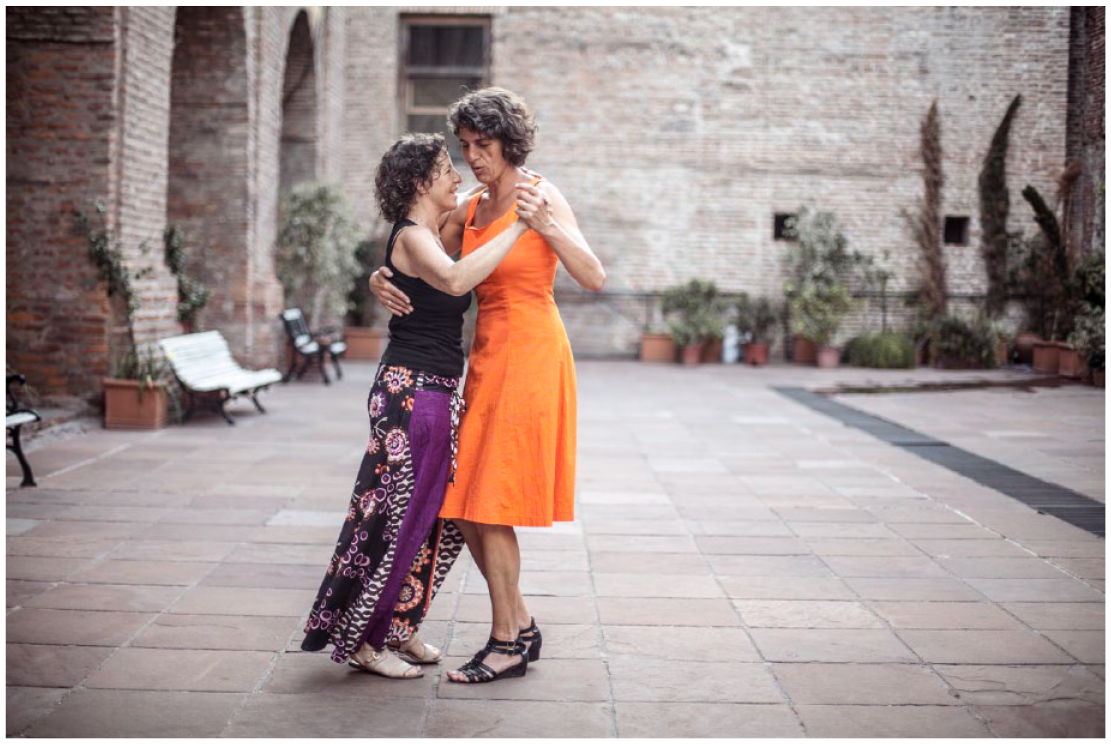
Dancing the coming out. ‘All language determines, especially corporeal language’ (Liliana Furió, Tango Queerido, 2016, our translation). 5
The members of Historias Desobedientes draw upon the visceral rejection of their fathers to unleash a process of self-transformation that has extended into the political arena. In line with Dragojlovic’s critique, the group also shows how affective forces are not simply autonomous or non-conscious but work across binaries helping to mobilise critical forms of activism, which respond to urgent political purposes (Dragojlovic, 2018: 105). By adhering to the local bloodline tradition of the victims’ associations and openly acknowledging themselves as the daughters, sons and family members of the perpetrators of genocide, the group has made the very conscious, paradoxical and disturbing decision to acknowledge the biological bonds that tie them to their fathers. The collective openly repudiates the crimes committed by its fathers and/or family members. It is in this distorted and dissident reimagining of kinship, in the visceral rejection of their fathers, that an affective and political mode of queering memory has emerged both as an expression of self-transformation and a public statement of repudiation. The group challenges, in particular, definitions of paternity in which this biological tie is legally mandated to constitutionally muzzle them. The Argentine penal code stipulates that immediate family members (spouse, offspring, direct descendants or siblings) are not allowed to report a person to the police or testify against them in a court of law. This makes their repudiation of the sinister bond that ties them to their fathers more complex and, until constitutional reform is achieved, an unattainable political gesture. This perhaps explains why the threat of the ‘2-for-1’ ruling was so sickening for these women, who already felt silenced by the idiosyncrasies of the judicial system. In this sense, the group’s ‘coming out’ is, to borrow the words of Sedgwick (2008) once again, ‘fraught with intensities of incorporation, diminishment, inflation, threat, loss, reparation, and disavowal’ (p. 61). The collective experience of these intensities, however, also gives the coming out an empowering and festive aspect, characterised by the desire to forge new affective bonds.
As with many of the victims’ associations, bloodline ties have become their main political weapon, though not without controversy. The emergence of a collective that decided to name itself as the ‘children’ of the perpetrators of genocide generated disquiet among local human rights organisation, most notably the above mentioned collected formed by the H.I.J.O.S. (children) of the disappeared. As we were able to witness during the process of filming our documentary, this is still for many the only group that has the right to call itself ‘the children’. Historias Desobedientes were also clear in their response to these concerns: We never wanted to take the place of any human rights organization. Never. We are something else. We are at their service . . . When we emerged, we didn’t know what we were opening up. We felt that it was necessary and what happened seemed wonderful.
6
One of the daughters of the perpetrators of genocide offered clarification of their collective subject position during that fractious night of filming in Buenos Aires: ‘We are not victims, but citizens affected like any other. With an added plus: that the terror was generated by our own fathers’. 7 In fact, Liliana’s father, Paulino Furió, was the Head of Military Intelligence in the province of Mendoza between 1976 and 1977, the peak of the repression. After 14 lawsuits for forced disappearance, torture, murder and the appropriation of children, he was given a life sentence, albeit one that he was allowed to serve at home. Liliana Furio (2018) recalled in our conversations how surreal his imprisonment at home felt because, inside the house, daily life continued as normal; ‘we continued to celebrate birthdays as if nothing were different’, was the example she gave (n.p., our translation). Her father eventually developed senile dementia, before dying in 2019. ‘Unfortunately, I cannot rebuke him anymore’, she lamented. ‘I tried. Whilst I was trying to come up with new strategies to get him to speak, the man was lost’ (Furió, 2018: n.p., our translation).
Queer activists and scholars have identified performance as the place where theory can be ‘ Feminism was a huge eye-opener for me. It was an ‘aha!’ moment when I realised that the misogynistic environment in which I grew up was not the norm, that I had been living with the foot of the enemy bearing down on me without realising it. (Díaz-Ridgeway, 2020: 84)
Apart from Historias Desobedientes, Liliana has created a movement that defies patriarchy from the very heart of Argentina’s popular culture: the Feminist Tango Movement, which promotes a space for the popular dance away from the sexism and traditional gender roles characterising the milonga. What could not at first be stated in words could be danced, said in a different language. Erin Manning (2007) argues precisely that the improvisational nature of Argentine tango dance suggests ‘a process we must begin anew’ (p. 23), an enactment-together of multiplicities in which the partner – always the unknowable Other – opens up a path towards zones governed by the ‘not-yet invented’ (p. 35). The fluid and interchangeable dancing positions that are embraced in the queer milonga that Liliana runs in Buenos Aires do not only map out the non-hierarchical contours of pleasure and desire across space (the dance floor). They also provide the occasion to rehearse and embody the kind of non-linearity and circularity that reimagines relationships through time; to choreograph and perform a queer expression of memory and blood, which go beyond traditional claims of victimhood. These ‘entangled temporalities’, as characterised by Françoise Vergès, are the kind of ‘temporality that emerges from the struggles that reopens history, encompassing memories, archives, and narrations’ (Gago, 2020: 116–117). Within this logic, acknowledging and confronting a sinister inheritance, Historias Desobedientes connects with other lineages in mourning. In doing so, they enable a queering of heritage that simultaneously reimagines the future; this is a future that is rebellious, non-binary, nonconsanguineous and self-determined (Quinan, 2021: 105).
A pink banner to ‘close the circle’
Both Liliana and Mariana attended the 24M demonstration in 2019, the former alongside her fellow desobedientes. Amid the established display of silhouettes giving symbolic presence to the figure of the disappeared, accompanied by traditional claims for ‘memory’, ‘truth’ and ‘justice’, a new banner stood out. Its statement, set on a bold pink background, read: ‘The guerrilla women are our companions’. 8 The banner belonged to Ni Una Menos, the movement that had played host to Historias Desobedientes’ first public outing 2 years prior. It announced the circular genealogy of a queer political phenomenon that was traversing normative societal structures, challenging the grounds on which the nation state had been imagined and radically disordering understandings of time. The expression of rebellion referred not only to those militant women who had put their bodies, ideas and emotions on the line, and ultimately given their lives, for revolutionary change in the 1970s, but also to contemporary activists: ‘queers’, ‘witches’, ‘Indigenous women’ and all those ‘who invest their bodies and their desire in revolutionary struggles’, as Ni Una Menos described its members on a post uploaded on their website that day. 9
As medieval feminist scholar Carolyn Dinshaw (1999) has suggested in her research on archives and sexualities, queer temporalities have the power to envision radical new intimacies between past and present: ‘a concept of queer relations across time’, she argues, ‘recognizes the past, including the distant past, as a vibrant and heterogeneous resource for self-fashioning as well as community building’ (Dinshaw, 1999: 142). For the members of Ni una Menos and the disobedient daughters, the recent past of terror and military violence also emerged as a vital source of encounter. Their desire to dismantle the iterative layers of a patriarchal mandate that has reasserted itself through each generation enables a vital instance of encounter between the memory of state terrorism and military violence and gender-based violence, both contemporary and historic. It is through this sense of companionship that Mariana and Liliana were able to make themselves part of a community embracing these intersecting struggles. Eventually, this risky act of sororal communion led to the creation of their own shared (circular) genealogy of disobedience in which self-determination became an intimate and public possibility by halting both the (social) reproduction of heteronormative accounts of kinship and the prolongation of patriarchal lineages characterised by violence and impunity. The rhizomatic branches created by this transgenerational and transfilial sense of rebellion remain open to new possibilities for subjectivities and agencies that are not bound by parental or biological attachments.
The emergence of the daughters of the perpetrators as a political actor in Argentina is hard to imagine as having been possible before the appearance of the feminist movement in 2015. As the Ni Una Menos banner travelled through the multitude giving material presence to the perhaps unexpected message that time can be deferred, refused and contested from a non-biological perspective, the disobedient daughters were also finding their way through these complex temporal folds. Indeed, both groups are the fruit of the cross-fertilisation between memory and feminism that has taken place in recent years. As Argentine activist and scholar Verónica Gago (2020), a founding member of Ni una Menos, proposes, ‘The former daughters’ personal and collective story of defiliation establishes a new way of demanding justice and punishment, based on disobedience to patriarchy’ (p. 115). The interfolding palimpsests of these two struggles are captured in Rita Segato’s conceptual fusion ‘femi-geno-cide’ (Segato, 2012, no page. The term, which positions gender-based violence on a continuum with state terrorism, explains the extent to which both types of violence are part of long-embedded categories of heteropatriarchal and (neo)colonial violence – real, structural and symbolic – that constitute the palimpsests that the disobedient daughters must negotiate in the process of ‘transfilial transmission’ (Quinan, 2021). The possibilities of alternative, transfilial attachments in the form of ‘queer bonds’ were crucial to enable them to ‘work through’ the historically negated linkage daughter-perpetrator-father.
The disobedient performance of defiliation – whether Mariana’s strategy of disidentification or Liliana’s (and by association the Historias Desobedientes) open repudiation of their ties to their criminal fathers – put forward a significant queer arrangement that unsettles the established landscape of human rights activism in Argentina and beyond. Furthermore, their praxis of disobedience is an important example of the ways in which queering memory is a vital part of society’s resistance to multiple forms of exclusion and discrimination attached to their biological birth. In that manner, we argue, the disobedient queer activism of the disobedient daughters offers ‘a means of traversing and creatively transforming conceptual boundaries’ as much as ‘the critical potential of queer theory always develops beyond the realms of sexuality and sexual identity’, as it was defined in a seminal Social Text dossier on Queer Transexions of Race, Nation, and Gender (Harper et al., 1997: 1). In this sense, the emergence of the disobedient daughters of perpetrator fathers may be a haunting presence in the contemporary human rights landscape beyond Argentina, particularly for established victims’ groups. As Eng et al. (2005) suggested some time ago, the very definition of queerness ‘remains open to a continuing critique of its exclusionary operations has always been one of the field’s key theoretical and political promises’ (p. 1). The audacious and, for some, controversial voice for transfilial justice and memory performed by these disobedient daughters certainly contributes to this task of envisaging alternative and renovated forms of transmission of memory and affect in a transnational scope. While dismantling normative approaches to victimhood and introducing a subversive performance of blood, these daughters stand up their negative affect to critically expand the field of memory studies and the human rights movement as they partake in a queer embrace that encourages sharing the pleasures of being together in the aftermath of loss.
Footnotes
Acknowledgements
The research for this article was sponsored by the Arts and Humanities Research Council, U.K. project, Screening Violence: A Transnational Study of Post-Conflict Imaginaries (AH/R006512/1). The authors would like to thank the editors of this special issue and the peer reviewers who provided advice and suggestions on a previous iteration of this article.
Funding
The author(s) received no financial support for the research, authorship and/or publication of this article.
Notes
Author biographies
 , Alejo Moguillansky, forthcoming), on intersection of the imaginaries of violence and gender in post-dictatorship Argentina for the Screening Violence Project (Newcastle University). As an Argentinean sociologist and cultural journalist, she completed her PhD in Drama at Queen Mary (University of London), which was awarded with the Publication Prize Most Distinguished Thesis of the Year (AHGBI). Her first monograph is entitled Queering Acts of Mourning in the Aftermath of Argentina’s Dictatorship (Tamesis Books, 2014) and has published extensively at the crossroads of memory, performance and affect in journals such as Memory Studies, LAP, Critical Times and Subjectivity, among others. She co-edited Afectos y saberes en la performance argentina contemporánea (Buenos Aires: Libraria, 2020), alongside Jordana Blejmar and P Page.