




Abstract
This article examines how Timor-Leste’s dead are memory workers. Drawing on ethnographic research, it probes how the restless spirits of those who died during the Indonesian occupation (1975–1999) are activating practices of searching for and recovering their bodies among their families and communities that allow them to be ‘gathered in’ and cared for in new geographic and socio-political spaces. These practices enable the re-membering of communities of the living and the dead in the aftermath of the profoundly dismembering effects of the occupation while also allowing some of the silences of nation-and-state-building projects to be made partially present and negotiated. I suggest that while the dead are not memory activists in the sense that they push for a specific social or political agenda, they are memory workers in the way they work on the living, opening up reparative and political possibilities. The work of the dead troubles the distinctions between the active and the passive, the subject and object, and the human and the more-than-human that lie at the heart of dominant understandings of memory-work and memory activism, inviting new ways of thinking about agency and the unexpected avenues through which social and political change can sometimes take place.
Introduction
Memory-work and its more political cousin, memory activism, are generally regarded as active, deliberate, human-driven endeavours. It is assumed that the transformative political and social possibilities of remembering will emerge from individuals’ and groups’ conscious engagements with a violent, traumatic, or oppressive past. On this reading, memory-work is a form of labour that enables the recalibration of relationships with the past and the ‘remak[ing] of the social world’ (Jelin, 2003: 5) while memory activism involves the ‘strategic commemoration of a contested past’ by those seeking to challenge dominant memory narratives or pursue political change (Gutman and Wustenberg, 2023: 5). In this article, I draw on ethnographic research in Timor-Leste to ask the following: what might it mean to consider the dead as memory workers? I explore how the work of the dead can trouble the distinctions between the active and the passive, the subject and the object, and the human and the more-than-human that lie at the heart of dominant understandings of memory-work, inviting new ways of thinking about agency and the unexpected avenues through which social and political change can sometimes take place.
The scholarship on memory-work and memory activism is only beginning to probe the domain of the more-than-human, including ghosts, the spectral and the uncanny (Auchter, 2023; Kent, 2023; Leong, 2023). In a recent chapter, Jessica Auchter (2023: 117) suggests that ghosts might be understood as ‘disruptive memory activists’ in the way that they ‘haunt the efforts of other actors to solidify a particular notion of the past’. Taking cultural studies accounts of ghosts, haunting and the uncanny as her point of departure, she conceptualises the figure of the ghost as ‘that which occupies the inter-state-eal spaces, those between being and non-being, between life and death and between the state and the myths that sustain it which, in some contexts appears as the uncanny’ (Auchter, 2023: 118). She insists that key to understanding the ghost as a memory activist is ‘considering how the affective “atmosphere” generated by its haunting’ (Auchter, 2023: 118) can influence human action when it comes to memory-work.
Like Auchter, I do not regard the spirits of the dead in Timor-Leste (ghosts in our common usage of the word) as autonomous memory activists who deliberately pursue a specific social or political agenda. I see them instead as memory workers who, by working on the living, can open up reparative and political possibilities. Their primary work is to unsettle: by insisting on their individualised care they prompt those close to them to act and disrupt national political agendas that would treat them as passive and mute symbols, or as ungrievable. My argument also extends Auchter’s insights and cultural studies’ accounts of ghosts in two ways. First, while these accounts treat ghosts as a conceptual category, my interest is in the agential dimensions and political implications of ghosts in a specific empirical context, Timor-Leste. This is important because the ghost is a ‘social figure’ (Gordon, 2008 [1997]: 8) that cannot be understood in isolation from its political, social and cultural context, in which it performs different roles in ‘knowledge production and cultural self-understanding’ (Dziuban, 2014: 112–113). In Timor-Leste, as in many other Southeast Asian societies, the spirits of the dead are not simply metaphors, symbols of ‘troubling memories, especially those associated with trauma and injustice’ (Good et al., 2022: 440) but rather ‘salient, social beings’ who remain deeply connected to the living and who must be managed for the sake of intergenerational wellbeing (Bennett, 2018: 185). While they are recognisably human, they are also more-than-human ‘supernatural’ entities (Fernando, 2022: 568) who can haunt the living through dreams and other embodied experiences. Haunting can be a visceral and sometimes frightening experience in which people are ‘accosted by the dead’ and in which ‘temporality no longer maintains its chronicity’ (Langford, 2016: 2; see also Good et al., 2022: 440; Lincoln and Lincoln, 2015). 1 Second, I am concerned not only with the immaterial presence of the ghosts or spirits of the dead, but also the dead’s material presence as bones, fragments of clothes and other traces. Informed by anthropological insights, I suggest that the dead have both an ‘affective presence’ as spirit agents who make demands on the living and an ‘emotive materiality’ as substances that were once human beings and seem to demand care and attention (Krmpotich et al., 2010: 373; see also Fontein, 2022: 84; Ngo, 2021). In Timor-Leste, the material presence of the dead is becoming increasingly evident as localised practices of recovering, reburying and caring for human remains are allowing some of the dead to ‘resurface’ or otherwise become visible. It is in their entangled spectral-material presence – as spirits and as bones – that the dead act upon the living, prompting emotional reactions and actions, and sometimes disrupting the commemorative narratives and practices that underpin elite-led nation-and-state-building. In these ways, the dead can be understood as possessing a form of agency.
To understand the specific ways in which the dead act in Timor-Leste, it is necessary to go beyond dominant western modes of inquiry and engage with local ways of knowing and being. While around 98% of East Timorese identify as Catholic, maintaining relations with both human and more-than-human beings, including places in the landscape, particular animals, spirits of various kinds and ancestors remains ‘fundamental to the multiple tasks of keeping life going’ and sustaining intergenerational wellbeing over time (Palmer and McWilliam, 2019: 475; see also Bovensiepen 2009). Mortuary rituals, which consist of both Catholic and animist components, play a critical role in this process. They enable the return of the dead to their ‘proper place’, both geographically (on their ancestral land) and spiritually, allowing them to safely transfer to the ancestral realm so that harmony can be restored in the spirit world and the world of the living (Robins, 2013: 195). After burial takes place, the dead do not retreat to a remote realm but forge new social relationships with the living. Families continue to visit the graves of the dead, especially on important religious days such as All Souls Day (2 November) and converse with and care for them (Grenfell, 2012, 2015). And once they are cared for, the dead can also care for the living, providing them with advice and assistance in everyday matters.
The material, political, social and spectral legacies of mass violence and colonialism have profoundly disrupted these customary mortuary rituals and peoples’ relations with the spirit realm. The 24-year Indonesian occupation of the territory (1975–1999) that followed on from Portuguese colonial rule (16th century to 1974) was especially brutal, with the regime deploying strategies of necro-power that ranged from enforced disappearances and executions to mass killings, aerial bombardments, and displacement-induced starvation (see CAVR, 2005). Many died ‘bad’ (violent or untimely) deaths, their bodies unable to be recovered, causing suffering and uncertainty not only to the living but also to the dead, violently dismembering them from their families and communities and disrupting the usual process that allow them to become safely dead (see Fontein 2010). The spirits of the unrecovered dead have, like those who died bad deaths during 20th-century mass violence in Cambodia (Bennett, 2018; Guillou, 2012; Hughes, 2024), Vietnam (Kwon, 2008; Lincoln and Lincoln, 2015) and Indonesia (Dwyer, 2009; Dwyer and Santikarma, 2003; Good, 2015, 2019), become restless and unhappy spirits who remain trapped in a dangerous liminal realm. They cause problems for the living, making demands for proper burial and care and imbuing landscapes with a dangerous potency. These spirits commonly linger in the place of their death, troubling those living nearby. They can also inflict misfortune and disasters upon their surviving relatives, such as illness, death and infertility, profoundly disrupting intergenerational wellbeing.
The article draws on the findings of ethnographic research in Timor-Leste (2015–2019), which examined local scale and evolving practices of searching, recovering, reburying and caring for the dead. I conducted open-ended interviews with relatives of the deceased, members of veterans’ groups, clergy and local government representatives in various locales. I also visited cemeteries, ossuaries and memorial sites and participated in rituals for the dead, including a Kore Metan (‘taking off the black’) ritual, church services and massacre commemorations. The research took place over several visits, and was facilitated by my long-term (over 20 years) research engagement with Timor-Leste and the pre-existing relationships I had with many of my interlocuters. While I began my research with an interest in my interlocutors’ political and reparative goals, their concerns soon pushed me to engage with the realm of the more-than-human. I came to realise that just as the living were working with their memories of the dead in the search for peace and wellbeing or to pursue diverse political goals, the dead were also working on the living as the living encountered their remains and spirits through dreams, visions, feelings and other bodily sensations or when they travelled through dangerous, enspirited landscapes. I began to ask my interlocuters questions about their dreams, their experience of places and landscapes, and the ways in which they felt the dead – and the domain of the spirit world generally – to be present in their lives. I also began to pay more attention to people’s body language and embodied reactions during ritual and at specific sites, including my own. Over time, I became increasingly aware of the limits of human knowledge and agency, of how change can sometimes take place at the margins of the visible and invisible, of the sayable and the unsayable, the human and the more-than-human. Put differently, I came to realise that researching the work of the dead poses complex ethical and methodological challenges, calling for alternative approaches that unsettle traditional understandings of subjectivity (including the individual, knowing researcher subject) and make space for the unpredictable, the unknown.
In the sections that follow, I examine how affective and embodied experiences of Timor-Leste’s restless spirits are activating responses from the living that are allowing the dead to be ‘gathered in’ (Renshaw, 2010: 454) and cared for in new geographic and socio-political spaces. This is drawing the dead and the living into new affective communities that go beyond the dead and their immediate kin. I first probe how these practices work as a powerful means of re-membering (Langford, 2009: 701) communities of the living and the dead in the aftermath of the profoundly dismembering effects of the Indonesian occupation’s necro-power. I then elucidate how they are also allowing things that are not ‘sayable’ or have been pushed to the margins of state-and-nation-building projects to be made partially present and negotiated in the realm of the everyday.
Gathering-in and reburying the dead: re-remembering communities
Across Timor-Leste, widespread citizen-led practices of searching for, exhuming, and reburying the dead are underway. Many are looking for those who died during the first 5 years of the Indonesian occupation, a time when tens of thousands of people had fled to the mountains and forests to shelter with the armed resistance guerrillas, FALINTIL (Forças Armadas da Libertação Nacional de Timor-Leste/The Armed Forces for the National Liberation of East Timor) and were continually on the move to evade attack or aerial bombardments from the Indonesian military. Unknown numbers died either due to direct killing or from disease, starvation or exhaustion in remote areas of the landscape, especially the very young and the elderly. The bodies of the dead often had to be abandoned or buried in shallow provisional graves covered with dut (grass) and marked with small rocks: there was no time for proper burial.
Many of these bodies have not been recovered, leaving a damaging legacy of thousands of ‘corpses out of place’ (Warren, 1993: 3), disrupted mortuary rituals and restless spirits. During my fieldwork, people spoke of being motivated to search for the dead by powerful and sometimes frightening embodied experiences such as dreams, illnesses and visitations, which were interpreted as messages from the spirits of the deceased that they continue to suffer. Angelo, for instance, recounted how he had suffered from debilitating back pain for over a decade, an affliction that he explained was a message from his deceased relatives, killed in 1976 in a remote area of Lautem, that he had not yet met his responsibilities to care for them and give them a ‘good place’ (fatin diak). 2
Experiences such as these are prompting families to raise their own funds, piece together the recollections of witnesses and draw on the advice and expertise of ritual leaders to identify the sites of human remains. The next step is organising expeditions, often by hired four-wheel drive vehicles, to remote areas of the landscape, where people may camp for weeks while they search for fragments of bone or clothing and dig with rudimentary tools, such as spades and crowbars. While the work is exhausting and hot, it is often said that the dead help the living, giving them the strength to complete it. As one man explained, the dead and the living ‘think of one another’ (hanoin malu), which imbues the digging with a sense of collective moral purpose and mutual care. 3 If fragments of bone are found, the expertise of ritual leaders is drawn on once more to aid in their identification before these substances are carefully wrapped in tais (woven cloth) and carried to the family’s ancestral land and ritually reburied. In cases where bones or other material traces of the dead cannot be found, ritual experts can sometimes call the spirits of the dead to enter rocks and soil at the presumed site of the killings. These substances then become the ‘bodies’ of the dead.
While families are at the forefront of many of these efforts at recovery and reburial, others are initiated by those who are connected to the dead through shared experiences of struggle, resistance and suffering. This includes former members of the armed and clandestine resistance. 4 This initially seems surprising; as in other parts of Southeast Asia, the dead are usually categorised into the family dead and the ‘unknown’ dead (see Guillou, 2020) and mortuary rituals tend to be concerned solely with the transformation of one’s own dead into benevolent ancestors. That caring for the dead has become much more than a family affair is a reminder of how the massive scale of bad death during the Indonesian occupation exceeds the capacities of customary mortuary rituals. As Guillou (2020) has observed for the violence of the Khmer Rouge period in Cambodia, ‘the main issue is not – or not only – for people to take care of their own dead and neglect the others but to “reorganise” the chaos created by too many deaths in dreadful circumstances’ (p. 327). Creative practices emerge as people find new ways to deal with this chaos.
The interest of former resistance actors in recovering the dead also speaks to the powerful affective bonds that were forged among guerrillas and between guerrillas and civilians during the Indonesian occupation, especially during its early years when there was a mutual reliance upon one another for survival. Some of these actors have formed ‘commissions’ for recovering human remains at the scale of the village or subdistrict to search for and exhume the bones of combatants and civilians in their specific geographical areas, including men, women and children. These remains (or other substances) are carefully wrapped in tais (woven cloth) placed in coffins and temporality stored in small ossuaries (sometimes called uma mahon/shade houses for the dead) in villages until such time as they are able to be identified and reburied. In a context where forensic DNA technologies are not available, identification takes place through alternative modes of inquiry and has important affective dimensions. It relies, for instance, on families’ recollections of the deceased’s clothing and associated belongings, their dreams (in which the deceased may visit and provide clues about their location), the interpretation of signs in the natural world, and the incorporation of Indigenous forensic practices. 5
Commission members frequently narrate their responsibilities to care for their fellow kamarada (comrades) and community members who did not survive the occupation. Some of my interlocutors spoke of how it was almost unbearable to imagine the remains of former family and community members lying abject and neglected in remote parts of the forest, slowly decaying, devoid of attention. Exacerbating this sense of the unbearable is the damage that is thought to ensue from a failure to care for the dead, which may affect not only on the wellbeing of families but also their broader communities, and even the state. Interlocuters described how the restless spirits of the unrecovered dead can make the land difficult to cultivate or cause dangerous motorbike accidents for those passing through those areas. Their blood is said to make the land ‘hot’. Members of the Natarbora commission recounted their experience of a devastating locust plague that had been unleashed upon the local community in the early 2000s by the restless and unhappy spirits of the dead, who had visited an old man in a dream and had complained that they did not yet have a ‘good place’. The head of another commission spoke of how the nation would not become stable until the remains of all those who died during the struggle for independence were recovered and properly cared for. As he put it, ‘if we don’t look for the dead, if the government doesn’t consider those who made sacrifices, independence will not be right (los). Their spirits will continue to wander’.
6
Another resistance veteran stressed:
We need to look for the mate ruin (the bones of the dead). They will help us go ahead. It’s lucky that we lived, they didn’t live. If we don’t do this the mate ruin can have a big impact on our development . . . we have to love our mate ruin.
7
Not all those who died during the Indonesian occupation can be reburied. In cases where bodies are co-mingled in mass graves, people often say that the remains of the dead should not be removed; this would disturb their spirits and customary methods of identification will not always be successful. In these cases, caring for the dead is taking place through other practices such as through the building of memorials and monuments and the emplacement of small plaques listing the names of the dead. The spirits of the dead can then be called to these sites, where they are then integrated into the social community of the living and the dead, no longer restless and wandering.
One example is the makeshift cross and chapel that has been constructed by the community in the subdistrict of Remexio, in Aileu near the site where many former prisoners died in the early years of the Indonesian occupation. Here, as in many other places, the community was disturbed by restless spirits yet they felt unable to disinter the human remains, which had mingled and, distressingly, had been disturbed by pigs and dogs. 8 Instead, soon after the end of the Indonesian occupation, they decided to build the chapel and cross, to which they recently added a small plaque listing the names of 37 deceased persons and funded by small US$2 financial contributions from families. Families describe the plaque as an important means of educating a new generation of Timorese about the consequences of the war (konsequensia funu) and ‘dignifying’ the dead whose remains still lay below. The naming of the dead might be also understood as a powerful reversal of the violence that had ‘shattered the intimate relationship between a body and name’ (Rojas-Perez, 2017: 108), allowing for the restoration of that relationship, for the disappeared body to reappear even though the bodies themselves have not been retrieved (see Auchter, 2014: 70; Leong, 2022: 303–304). The memorial site was inaugurated in 2018 through a ceremony that involved the calling of restless spirits to the site and the delivery of ritual prayers (hamulak). Pedro, a key local organiser explained how, following the ritual, families knew the spirits of the dead had arrived in their new place. Some dreamt that night that the spirits had climbed the mountain and entered the ancestral realm, while others heard drumming coming from the site late in the evening and saw light emanating from the area. ‘We knew’, he said, ‘it was the spirits of the dead. So, we felt content, it was los (right)’.
This case is particularly interesting because the dead had not died at the hands of the Indonesian regime but had perished in what was called a national rehabilitation camp (Campo de Rehabilitação Nacional, or RENAL) run by the key East Timorese resistance party, FRETILIN (Frente Revolucionária de Timor-Leste Independente/Revolutionary Front for an Independent East Timor) for those deemed to be ‘traitors’ or ‘reactionaries’. Many such camps or prisons existed during the early years of the Indonesian occupation; some were little more than holes in the ground covered by large wooden bars with a large rock place on top (CAVR, 2005 Part 5: 12). Detainees were required to work during the day, collecting firewood and water or cultivating rice-fields, and at night they attended classes in ‘political education’ to bring them back into the FRETILIN fold (CAVR, 2005: Part 5: 12). Thousands may have died in prisons such as these, languishing from a lack of food or water, or from severe beatings. In a new era of national independence, where former resistance leaders are now in key political positions, these deaths have become a ‘public secret’ (Taussig, 1999: 5), something that is widely known but cannot be spoken of. The sites of many RENAL prisons are overgrown with weeds and undergrowth, both hidden from public view and lulik (spiritually potent) due to being inhabited by the dangerous restless spirits of the dead (Figure 1).
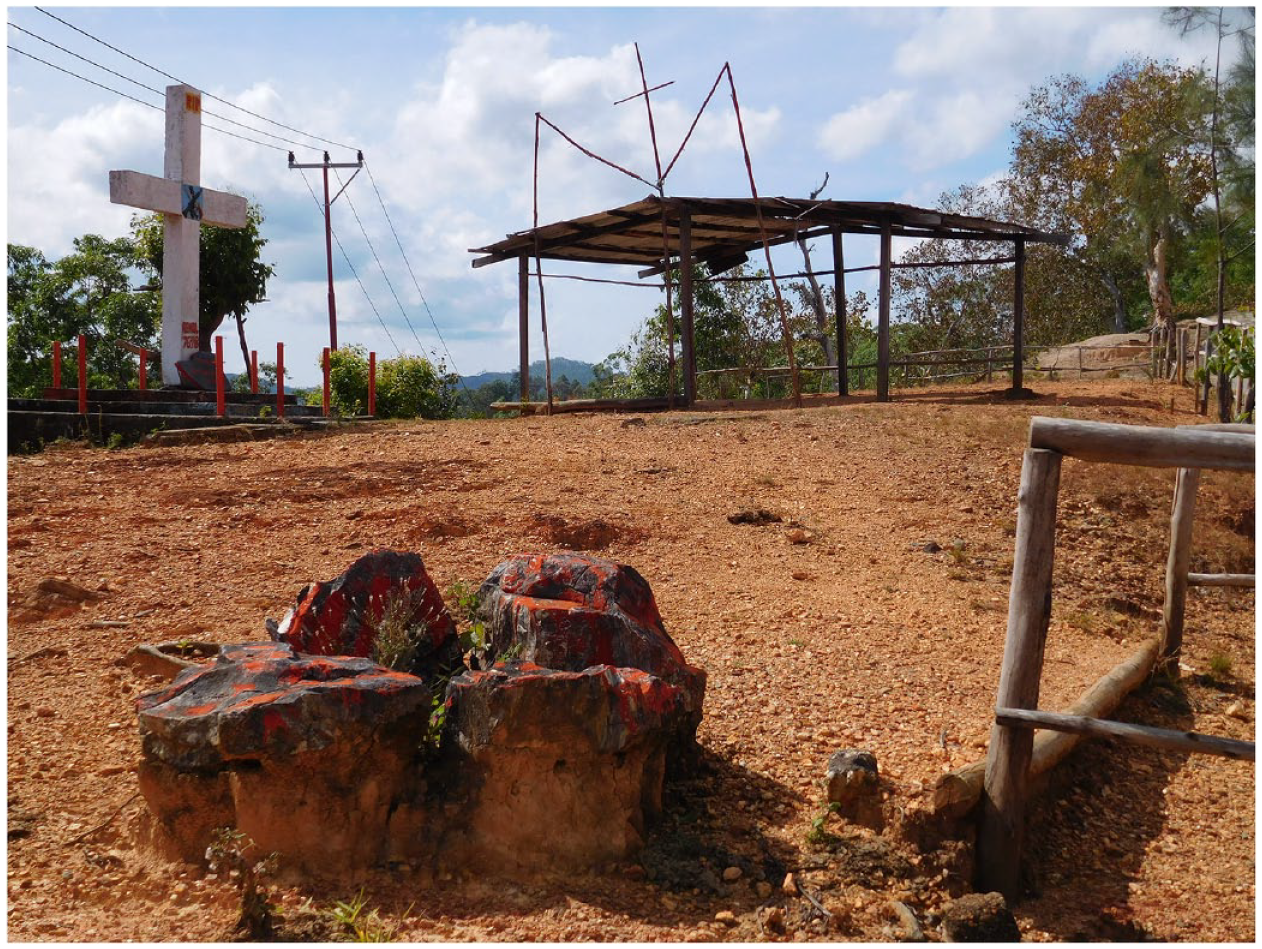
Makeshift cross and chapel at Remexio (credit Lia Kent, 2018).
These diverse practices are ‘gathering-in’ Timor-Leste’s dead so that they can be cared for, acknowledged, mourned and re-membered as part of their families and communities (Renshaw, 2010: 454). Layla Renshaw has described how the ‘gathering-in’ of human remains, photographs, clothing and letters as part of recent exhumations of Spanish Civil War mass graves in Spain has allowed the deceased to be imagined ‘as real and once-living individuals who can be mourned’. Assigning the dead ‘locally meaningful conceptualizations of identity’ has contributed to the sense that they are both ‘known and knowable’ by their community, despite the fact almost 70 years has elapsed since their deaths (Renshaw, 2010: 454). The gathering-in that is taking place in Timor-Leste, while likewise allowing the dead to become known and knowable, is also producing new spaces of memory and mourning and new collective rituals that are drawing the dead and the living into new communities that go beyond the dead and their immediate kin. For instance, an annual collective ritual takes place in Remexio, which brings together families from different parts of Timor-Leste whose loved ones died in the prison for a Catholic mass, and to light candles and care for the dead. The ossuaries constructed by the commissions for the recovery of human remains have also become spaces where new rituals are being devised and new communities of the living and the dead are being created. For instance, regular rituals of cooking for and eating with the dead are organised in some ossuaries, which bring together families with the dead to reassure the spirits that they have not been forgotten. As one commission member explained, ‘the dead, like the living, can be hungry and thirsty’ and ‘they can see us even if we can’t see them’. [Eating with the dead] ‘expresses our solidarity with them, and it calms them’. 9 These rituals are especially important as these spirits, while no longer restless and dangerous, remain in a liminal realm until their bodies have been properly emplaced in the landscape. Other new spaces include the village-level cemeteries that are being constructed in some areas to rebury the dead gathered by the commissions, which enable the dead to remain close to their families and communities (Figure 2).
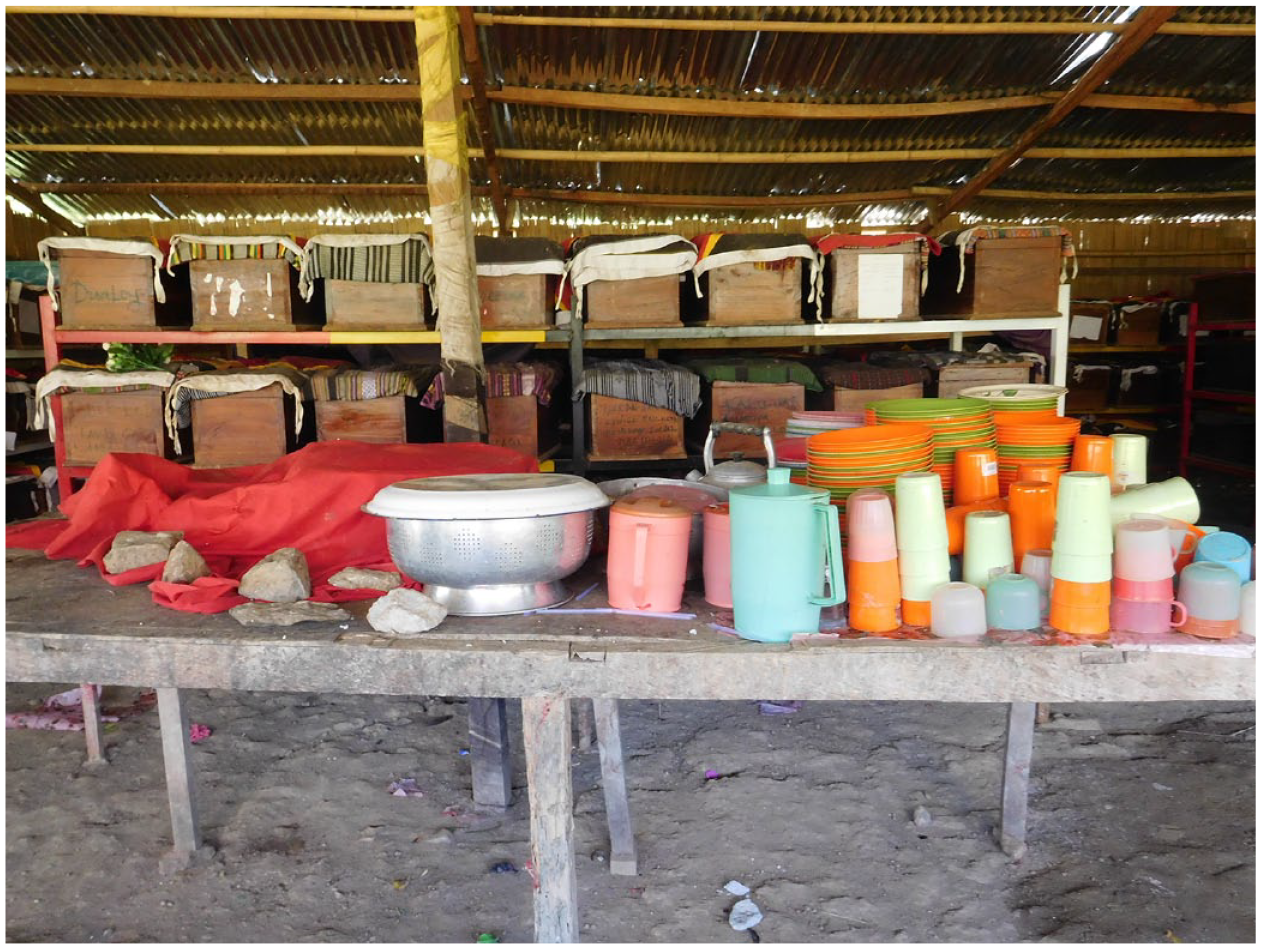
Eating with the dead, Kelikai ossuary (credit Lia Kent, 2018).
In these ways, practices of recovering and caring for the dead are evolving, relational practices that emerge from the inter-workings of the living and the dead. As the dead press their demands on the living, they are prompting creative practices that allow them to resurface and be re-membered as part of families and communities, and re-integrated into local social worlds. These dynamics are producing new spaces, communities and collective rituals.
Negotiating the silences of nation-and-state building
While these practices, spaces and communities of re-membering can be understood as local responses to the specific problem of massive bad death and disrupted burial rituals, I would like to suggest that they also need to be contextualised as part of a period of intensive nation-and-state building. Put differently, it is perhaps not coincidental that Timor-Leste’s restless spirits have become especially demanding, and responses to them especially visible, during a time of rapid political and social change. Over the past 20 years, political elites have been deeply invested in the crafting of a unified national identity, and the forging of a new political community, from the ruins and fragmented experiences of conflict and colonialism. Alongside the ‘rolling out of ambitious plans for regional development and economic transformation of the country’ (Palmer and McWilliam, 2018: 266), different ‘necro-governmental’ technologies (Rojas-Perez, 2017: 17) have been brought together to craft a united, heroic narrative from experiences of suffering and death. Those who died while participating in the formal structures of resistance to the Indonesian occupation have been ascribed militarised, masculine ‘martyr’ subjectivities, transformed into symbols of the sacrifices made for national liberation. Their sacrifices are rewarded through heroic monuments and commemorative rituals; their living relatives are provided with substantial pensions and medals as part of a veterans’ valorisation programme. New official spaces of memory – Garden of Heroes cemeteries – are being built, where martyrs’ bodies (if they are able to be recovered) are being reburied in even, linear rows and where the behaviour of mourners is disciplined. By conjoining ‘development’ with the containment of grief and loss, a forward-looking vision of a modern nation-state is projected. Yet, these official imaginings are intersecting unevenly with other forms of authority and legitimacy (for instance that possessed by former resistance actors, the church, customary authorities and ancestors, as well as international peacebuilders) in ways that are generating new uncertainties and creating ‘emergent and shifting nexuses of power’ (Arensen, 2021: 4).
Scholarship on haunting and the uncanny often points to a close connection between ghosts, change, exclusion and repression. Byron Good (2021: 524) writes of how ghosts, although part of local social and cultural worlds, may become especially insistent and demanding at times of radical change and disruption. In her influential book Ghostly Matters: Haunting and the Sociological Imagination (2008 [1997]), Avery Gordon links haunting to forms of ‘containment and repression’ that are inevitably always incomplete’, acting as a means through which ‘we are notified that what’s been concealed is very much alive and present’ (p.xvi). ‘Haunting’, Gordon (2008 [1997]) suggests, ‘is one way in which abusive systems of power make themselves known and their impacts felt in everyday life especially when they are supposedly over and done with (slavery, for instance) or when their oppressive nature is denied’ (p. xvi). Leong (2023) connects the resurgence of ghosts in Southeast Asia to the emergence of ‘monumental nation-building projects, where states have sought to mold unified societies out of disparate and plural communities’ (p. 324). To the extent that these projects have marginalised the histories and memories of some communities, they have left behind ‘fragments’ (Leong, 2023: 325; see also Leong, 2022). Experiences of ghosts and of haunting is one way in which these fragments manifest.
What ‘fragments’ are being left behind by Timor-Leste’s monumental nation-building projects? Two themes are especially relevant. The first is that these projects are marginalising the histories and memories of some East Timorese, while reifying others. There is only space for some of Timor-Leste’s dead in the state’s necro-governmental imaginaries, those who fit the subjectivity of the heroic masculine martyr. In the state’s differentiation between categories of the dead, and its elevation of worthy forms of suffering and sacrifice, there is a distinguishing between lives that are publicly grievable and those that are ungrievable (see Butler, 2009). Martyrs who held formal positions in the armed and clandestine resistance are construed as having ‘willingly’ given their lives for the struggle for independence and set apart from categories of the ‘inconvenient dead’ who do not fit with the state’s usable past. This includes civilians, women, children and those who, in assisting or working for the Indonesians were labelled as ‘traitors’ and sometimes killed for their treacherous acts. These exclusions are not simply symbolic but have tangible social, political and economic consequences. The public recognition and reward that is bestowed upon those who can claim a space within the martyr category is not insignificant in a context of widespread poverty, a context where the ‘glittering promises’ of the state’s development vision have failed to materialise for many East Timorese living in rural areas and where new forms of precarity are emerging (Palmer and McWilliam, 2018; see also Kammen, 2018).
Second, even where the dead are publicly grievable, the extent to which the state’s necro-governmental logics treat them as symbols of the suffering and sacrifices of the living rather than agents who remain part of the social world is itself a form of exclusion. The state’s projects treat the dead as passive and mute not as social and political actors; their suffering is deemed to be a problem of the past, not a problem that continues to interpenetrate the present. This conception of death and the dead is one in which the living are expected to ‘move on’ and in which dead bodies need not be individually recovered, reburied and cared for. The sacrifices of a few national leaders – ritually reburied in the Garden of Heroes or commemorated through heroic monuments – might stand in for the sacrifices of all. Locally led practices of recovering and caring for dead are also treated with suspicion, marked, like other animist practices, as ‘backward looking,’ ‘mired in ignorance and superstition, ill-suited to the challenges and opportunities of the modern nation’ (Palmer and McWilliam, 2018: 274). They are deemed to be economically wasteful and time consuming, diverting people from more productive economic pursuits (Kent and Feijo, 2020). These ideas stand in stark distinction to the social understanding of death and the dead held by many East Timorese in which the dead remain part of the social world and in which the bodies of all the dead are required to be individually recovered, reburied in their ‘proper place’, and cared for.
Far from containing the legacies of ‘massive bad death’ (Sakti, 2020), the state’s necro-governmental projects seem instead to have opened up of new possibilities for the dead to make their presence felt and demands known to the living (see Spooner Lockyer and Kilroy-Marac, 2021). These demands are being experienced in a context where the silences of the state’s projects are unable to be overtly challenged and, indeed, have been partially internalised. Lisa Palmer and Andrew McWilliam (2018: 272) astutely observe how East Timorese remain ‘ambivalently entangled’ with a hard-won national identity. The discourse of national unity, masculine heroism, and development promoted by political and government leaders remains persuasive, generally accepted or at least accommodated by the wider population (see also Bovensiepen, 2015, 2018). In this environment, deliberate memory activist practices that challenge the state’s projects and narratives, although not entirely absent, are rare. 10 However, peoples’ affective and embodied experiences of the dead seem to be allowing the silences of these projects to be made at least partially visible in ways that enable them to be practically negotiated and subtly eroded. Put in a different way, these practices are working against the state’s attempts to divert citizens from their responsibilities to the dead and orient them to the (presumed) needs of the present while also enabling forms of care for the dead in a context where some lives have been rendered ungrievable. Let me elaborate on these points through three observations that highlight how the dead, while not pushing for a specific political agenda, demand individualised care, prompting families and communities to act and ‘interrupting the disciplinary shape of stories told about them’ (Langford, 2013: 211).
The first observation is that the dead are interrupting the state’s attempts to treat them as passive symbols of the trauma or sacrifices of the living who can be firmly placed in a past temporality (see Traube, 2020). As families and communities continue to divert substantial resources and energies into practices of recovery and reburial, the state’s projects of memorialising and symbolically recognising a selected group of martyrs who might stand in for the sacrifices and suffering of the nation is disrupted. These practices attest to the continuing suffering of all the unburied dead, a suffering that imbues landscapes with dangerous potency and disrupts intergenerational wellbeing. This is a suffering that, by making demands upon the living and invoking ritual responsibilities of care, unsettles linear and forward-looking narratives of state-and-nation-building, which characterise ‘the past as something absent of distant’ and conceive of death as an ‘instantaneous event or an immanent end after which the deceased person simply ceases to exist’ (Bevernage, 2012: 344). In demanding individualised care, the dead seem to demand ‘a more ethical relation to the past’, ‘rejecting the idea of the past as something “dead”, as something that automatically “distances” from the present’ (Bevernage, 2012: 348). In doing so, they unsettle the state’s attempts to deem the violence of the Indonesian occupation over-and-done-with, contained and controlled.
Second, and relatedly, the dead are unsettling the state’s attempts to spatially and temporally contain (some of) them in state-sanctioned Garden of Heroes cemeteries. As the dead resurface and transform from a spectral to a material presence, demanding ongoing care from the living, they are prompting the creation of new communities, new spaces and new rituals that escape the state’s efforts to confine them to designated state-sanctioned spaces, which may be far from their families and communities, and where rituals and behaviours are prescribed and constrained. The local rituals of eating with the dead in the ossuaries, of commemorating the dead at the Remexio memorial and the new village-based cemeteries that are being constructed escape state-centric mechanisms of memorialisation, allowing the dead and the living to care for one another in multiple spaces and through fluid practices that are close to their families, their communities and their land.
A third function performed by the dead is their wearing away of the distinction between the grievable and ungrievable. This is especially apparent as the dead assume a material presence, demanding care and pushing back against the state’s desire to leave some bodies ‘for dead’. 11 The dead, as they become visibly present, either as bones, graves, coffins, memorials or names inscribed on plaques, become harder to ignore, transcending, at least partially, their hidden state. These resurfaced bones provide material evidence of the thousands of lives lost during the occupation due to bombings and the slow violence of disease, starvation and malnutrition, making visible complex experiences of suffering and struggle by countless ordinary men, women and children. Some of the dead killed by the East Timorese resistance movement are also becoming at least partially visible, such as in the example of the memorial and plaque at Remexio. These material traces provide evidence of forms of suffering and sacrifices that have been marginalised in the state’s commemorative narratives and allow the ungrievable to be publicly mourned and cared for.
In sum, in a context where opposition to the silences in the state’s necro-governmental projects is not necessarily being publicly voiced, the dead are able to do things that the living cannot. While the dead do not pursue a deliberate political agenda, they are memory workers in the way they work on the living, insisting on the importance of individualised care and unsettling the state-and-nation-building logics that would treat them as passive and mute substances. As the dead prompt the living to act, they are allowing ordinary East Timorese to navigate the silences of nation-and-state building and care for those who have been rendered ungrievable. Through the re-membering of children, brothers, sisters, parents and friends, new social communities of the living and the dead are forged, bringing a measure of peace to both. The silences and exclusions of the states necro-governmental technologies are not so much being discursively revealed or resisted as they are being practically negotiated and navigated in the realm of the everyday in ways that have both reparative and political effects.
Conclusion
In Timor-Leste, the dead are memory workers. As the restless spirits of the unburied dead act on the living, they are prompting responses that enable them to be cared for in an environment where the silence and exclusions of secular, forward-looking projects of state and nation-building cannot be openly challenged and perhaps have been partially internalised. As the dead ‘resurface’ or otherwise become visible, they are making (partially) present the ethical inadequacies of these projects, their inability to do justice to the profoundly disruptive experience of massive bad death and its ongoing resonance in the presence. They are also allowing the practical negotiation of these silences and exclusions in the realm of the everyday such that the ungrievable dead can become grievable. These practices are not simply manifestations of memory activism by living Timorese who are contesting dominant narratives, configurations of power and the allocation of material resources, nor are they practices that are taking place in an intimate realm divorced from the political. Neither are the dead acting deliberately and autonomously. Rather, a complex remaking of fractured social and political worlds is taking place at the margins of the visible and the hidden, the spoken and the silent, involving the inter-workings of the living and the dead (see Good et al., 2022: 443). This remaking is necessarily uncertain and open-ended, as the dead and their demands, like the spirit world generally, can never be fully known or understood (Bovensiepen, 2018; see also Johnson, 2020). As Andrew Johnson (2020) has described in relation to the occult forces that intersect with large-scale dam-making projects in the Mekong, there is a sense that ‘complete knowledge is always elsewhere’ (p. 6). This opacity is at once a source of potential disaster as well as it is ‘a sense of potential’ or possibility (Johnson, 2020: 14). This possibility, I would argue, is a political possibility in the sense that the dead, who cannot be ‘bought off, threatened, or silenced’ (Auchter, 2023: 12), act as a ‘crack in the reigning reality that has been naturalised and inevitabilised’ (Gould, 2019: 33).
What do these insights suggest for understandings of memory-work? Perhaps the clearest insight is that paying attention to the work of the dead challenges the destabilises many of the dichotomies that lie at the heart of dominant understandings of this process (the visible/invisible, the absent/present, the now/then, the subject/ object, the active/ passive). The practices that are underway in Timor-Leste reveal how the past can become present and have social and political effects in the world not only as it is deliberately invoked but also as it is experienced through unanticipated affective and embodied encounters with the spectral and the material traces of the past. These insights invite a more complex account of agency that recognises that human beings, acting consciously and deliberately, are not the only memory workers in town. What is called for is an account of memory-work that recognises agency as ‘distributed’ among the human and the more-than-human, emerging through forms of relational interaction (Crossland, 2017: 188). 12 This more complex and less human-actor-centric understanding of agency invites a deeper engagement with the unknown, the unexpected and the never-fully-and-finally complete nature of memory-work. It also offers new ways of thinking about how, in settings where dominant discourses are not able to be critiqued (and are perhaps also partially embraced and internalised), it is through entanglements between the human and more-than-human realm that possibilities for social and political change may emerge.
Footnotes
Acknowledgements
The author would like to thank all her East Timorese interlocutors for generously sharing their time and insights. She also thanks Shameem Black and two anonymous reviewers for their valuable comments on an early draft.
Funding
The author(s) disclosed receipt of the following financial support for the research, authorship, and/or publication of this article: This research was supported by an Australian Research Council Discovery Early Career Researcher Award (DE150100857).
