




Abstract
The year 2021 marked the 400th anniversary of the Banda massacres, in which the army of the Verenigde Ooostindische Compagnie (The United East India Trading Company) massacred the Bandanese in a brutal campaign designed to secure a monopoly over the global nutmeg trade. While for centuries, the Bandanese remembered the massacre in a range of cultural mediums, the 400th anniversary was marked by a production of a multi-media project entitled The Banda Journal, produced by Muhammad Fadli and Fatris MF and from West Sumatra, Indonesia. The Banda Journal project represents a new form of decolonial memory work that accentuates the connections between place and memory for people from Indonesia’s ‘outer islands’ including people who fled the Banda islands following the massacre. In addition, the project adopts decolonial methods and critically engages with histories of colonialism to move beyond nationalist framings and prompt reflection on the excesses of capitalism and economic exploitation and the resilience of affected communities.
Introduction
In 1621, the United East India Trading Company (VOC) Commander, Jan Pieterszoon Coen, carried out a massacre and enslavement of Bandanese people in the Eastern part of present-day Indonesia in pursuit of a monopoly on the trade of the spice nutmeg. VOC rule lasted until 1799 after which the Dutch state began to pursue a more thorough agenda of colonialism in Indonesia based on both the extraction of resources and labour and increasing control of people’s lives. The violent methods of the VOC, however, continued to be replicated in a series of brutal campaigns to crush local resistance most notably in the Aceh War of 1873–1913. In the Banda islands and related communities of exile, the Banda massacres continued to be remembered through forms of cultural memory including dance, song and commemoration. Yet, the approach of the 400-year anniversary of the massacre in 2021 prompted additional diverse forms of commemoration and memory activism in both Indonesia and the Netherlands involving artists, scholars, intellectuals and community members. In the Netherlands, this included an online exhibition about the history of trade in the spice of nutmeg and its uses (Westfries Museum, 2021), a new critical analysis of Coen’s actions in Banda as a genocide (Van Pagee, 2021) as well as a renewed push from some to dismantle the Coen monument in the city of Hoorn (NL Times, 2021). In Indonesia, this included a new film about the islands and the nutmeg trade entitled Banda: The Dark Forgotten Trail directed by Jay Subyakto (2017) as well as an innovative photographic/documentary memory project, the Banda Journal (2021) produced by a Sumatran journalist Fatris MF and Sumatran photographer, Muhammad Fadli.
In this article, we argue that the Banda Journal can be viewed as a complex example of contemporary Indonesian decolonial memory activism. This activism both aligns with and departs from memory activism defined by Gutman and Wustenberg (2023) as ‘the strategic commemoration of a contested past to achieve mnemonic or political change by working outside state channels’ (p. 5). The work of Muhammad Fadli and Fatris MF is, we argue, a specific form of memory activism that offers a decolonial perspective by emphasizing the excesses of modernization and capitalism that drove both the quest for empire and control of global trade and which continue to underpin the process of extreme environmental exploitation in Indonesia today. Walter Mignolo and Catherine Walsh (2018) argue that decoloniality, or the quest for non-colonial alternatives, has a long history and reflects an extended process of ‘(trans)local struggles, movements, and actions to resist and refuse the legacies and ongoing relations and patterns of power established by external and internal colonialism’ seeking to challenge multiple forms of hierarchy that are ‘intertwined with and constitutive of global capitalism and Western modernity’ (pp. 16–17). In the Indonesian context, a decolonial perspective requires attentiveness to the ongoing nature of colonialism and modernity and related hierarchical dynamics of power (Boonstra et al., forthcoming). Muhammad Fadli and Fatris MF’s decolonial practice both engages with memory of the harshest and most exploitative dimensions of Dutch colonialism but also links these extractive practices to global capitalism and ongoing global and local structures of power. We argue that a crucial aspect of the decolonial approach evidenced in the Banda Journal is the authors’ alertness to the ongoing dynamics of power between the contemporary centre of Indonesian power of Jakarta (and Java) and the small remote Banda islands which continue to be positioned as ‘outer’ and often peripheral islands of Indonesia. This orientation is firmly based on the artists’ own positionality in the island of Sumatra as well as in their firm commitment for meaningful engagement with citizens of Banda islands and with the exiled Bandanese community on the Kai islands. In our article, we reflect on the extent to which people from islands sometimes demarcated as the ‘outer islands’, have different viewpoints on colonial violence and coloniality.
On the basis of its attention to geography and memory we argue that The Banda Journal project is deeply transcultural. While the term transcultural memory in memory studies has been conceptualized by Astrid Erll (2011) as a research perspective that accompanies translocal, diasporic, and cosmopolitan memory, emphasizing the flows of memory across national borders and different cultural contexts, in the case of multi-ethnic Indonesia, transcultural has an additional dimension. It requires attention to the country’s diverse islands and regional contacts that have many different, but referential cultures of memory that arise from the experiences of being part of a former empire that experienced different forms of colonialism. Through our close attention to these cultures, we also contribute to the process of decentring Indonesian studies of memory. With the exception of the work of Spyer (2000), Brauchler (2023) and McGregor (2014), few scholars have examined memory work outside of Java.
In this article, we focus on the decolonial memory work of The Banda Journal reflecting on how the journal narrates and frames the Banda massacres, the lingering traces of the ‘spice trade’ and of colonial conquest in the Banda Islands. Drawing on this key text and an interview with Muhammad Fadli, we chart how The Banda Journal positions the Banda massacres as one of central events in the history of global capitalism and economic exploitation. We argue that this work challenges romanticized images of the spice trade and of the European Golden Age, moves beyond nationalist framings of Indonesian history and connects the Banda massacres to histories of global capitalism and economic exploitation. ‘Songs from Another Land’, the short documentary that accompanies the website and publication, adds another layer of complexity to the work, by focusing on the ways in which the memory of the massacre travelled with the community exiled by the massacre 400 years ago. We also draw attention to Muhammad Fadli and Fatris MF’s decolonial art practices which encompass careful attention to the ethics of photography, joint collaboration with local people and recognition of local knowledge.
The Banda massacre
The Banda islands in Eastern Indonesia consist of several islands including Neira, Lonthor, Rhun, Ai, Rozengain and Gunung Api. Before the Banda massacre took place in 1621, nutmeg was grown by local people and traded to Malay, Chinese and Arab traders who sold the spices across the region and around the world from as early as the 6th century. Nutmeg was valued medicinally in most parts of the world, reaching a high price especially because of its repute for curing the plague, but in Europe, it was primarily sought after as a spice (Ghillean and Nesbitt, 2004: 116). Nutmeg was so valuable at the time that each time it changed hands it increased in value 100% (Andaya, 1993 [1983]: 7). In this period, the Dutch VOC company sought to push out the Portuguese and British presence in Eastern Indonesia in order to achieve a monopoly on nutmeg trade.
While the VOC was a trading company in many respects it functioned like an imperial enterprise as it had its own army, occupied foreign territories and built strongholds in pursue of profit and when considered appropriate also conducted diplomatic work (Clulow, 2019: 15). Willard Hanna (1978: 19–24), a diplomat, who wrote one of the earlier accounts of Dutch trade and the Banda islands argues the Dutch tried to force upon the Bandanese an agreement in 1602 to grant them a monopoly on trade across all the Banda islands, but due to the system of many village chiefs, in contrast to a sultan, there was no single authority with whom to negotiate and the agreement was not enforced and the Bandanese continued to trade with the British and others. The Dutch persistent push to overtake control of trade faced resistance from both the Bandanese and the British. In 1609, when the Dutch attempted to forcibly negotiate more concessions the Bandanese on Neira island, feeling threatened, killed 27 Dutch men (Hanna, 1978: 29). Hanna (1978) further argues that the locals were fearful of the Dutch because of a prophecy that an army of ‘fair headed, light skinned, fully clad strangers who would attempt to conquer the islands’ (p. 27). One of the junior merchants who was part of the 1609 expedition Jan Pieterszoon Coen continued to view this episode as an instance of Bandanese ‘villainy’ (Hanna, 1978: 53). This incident led to escalating demands from representatives of the VOC to solve the problem of Banda including a call in 1612 by L’Hermite, a merchant in Banten for the Dutch, to ‘totally conquer’ Banda or for the local people to be ‘entirely exterminated’ (Clulow, 2019: 36).
Fourteen years after the 1609 incident, Jan Pieterszoon Coen became VOC Commander determined to gain complete control of the Banda islands. Written records document Coen’s firm belief that the use of force and the expulsion of the local population was the only way to gain full control of the islands. Coen’s plan was to create a system whereby the Dutch would oversee plantations reliant on imported slaves. In 1621, he sailed to the islands with an army of 1655 Europeans who joined 250 Dutch men already at the garrison, 286 Javanese convicts and 80–100 Japanese mercenaries (Hanna, 1978: 49). Following an incident that was interpreted as a sign of a planned Bandanese attack on the Dutch on 8 May 1621, 44 prisoners including orang kaya (community leaders) were brutally beheaded and quartered. Those who survived mostly fled to the English controlled islands of Rhun and Ai (Hanna, 1978: 55). Writing about this massacre Des Alwi (2005: 79) comments that the Dutch showed no mercy and felt no sense of sin. After their villages were raised to the ground, some Bandanese fled to the exposed hills away from the nutmeg plantations refusing to pick the crops. Under these conditions, some died from exposure, starvation and disease, while others were rounded up and shipped to Batavia as slaves. Across this campaign of violence in 1621, Hanna (1978: 52–55) estimates that of the 15,000 inhabitants perhaps only 1000 survived. Alwi (2005: 81) gives more precise figures estimating that around 6000 Bandanese were massacred, 789 sent to Jakarta, 1700 fled to the Kei and Seram islands and other places. The 8th of May is usually recorded as the date of the Banda massacres despite the fact the campaign extended to before and after this incident. In his detailed analysis of the period, Adam Clulow (2019: 17–19) argues that the violent actions taken by VOC leaders were propelled by fear and a sense of crisis on the part which accompanied European expansion more broadly.
In a recent intervention into the historiography around the massacres and the resultant VOC occupation of the Banda islands, the local Bandanese scholar Muhammad Farid, together with Juul Sadee (2023), have argued that Western historiography of this period has erased the role of women and the resistance that they mounted. This erasure is the result of a long-held tendency to record and write male-centred accounts of history. Farid and Sadee draw attention to a 2006 book written by Des Alwi called Sejarah Banda Naira, which references the important role played by local woman and warrior Bhoi Kerang, the daughter of King Lautaka who was killed in a battle against the Dutch in 1609, in mobilizing the widows of the men killed in 1621 to fight against the Dutch. Further to this, they point to the persistence of memories of Bhoi Kerang in oral culture on the Banda islands. The role that women are believed to have played in resisting the VOC advance, combined with the respect for women in Bandanese culture, gives them a special role in relation to rituals of remembrance of the massacres (see below).
Following the Banda massacre Coen set up nutmeg estates based on the perkenier (nutmeg planter) system which relied on imported enslaved labour. This process of importing labour and bringing in more estate holders introduced ethnic diversity to the Banda islands. The remaining Bandanese, and the Bandanese who were returned to the islands as enslaved labourers, played a key role in passing on knowledge about how to grow and harvest nutmeg (Winn, 2010: 368–369). These Bandanese passed on agricultural traditions to Indian, Dutch and local migrants to the islands who came as both enslaved persons and estate holders (Winn, 2010: 368–369). Up until the 1850s, the Dutch state continued to make vast sums of money from control of the Banda islands and the related trade in nutmeg. By the end of the 19th century the Banda islands, however, became a drain on resources due to the falling value of nutmeg and the fact that nutmeg seeds had been smuggled out of Banda and successfully planted elsewhere (Hanna, 1978: 102, 116–117, 120–121). Although nutmeg continues to be produced there today, the islands today are mostly known as a tourist destination due to the beautiful sea life and snorkelling/diving opportunities around the islands.
The Banda Journal
The Banda Journal was produced by a journalist and a photographer who for many years have worked for newspapers and magazines. Fatris MF is a West Sumatran writer who has worked as a journalist for publications such as leading national news magazine Tempo and authored several books and Muhammad Fadli is a West Sumatran freelance photographer who has worked for many national and international magazines such as Tempo, National Geographic and The Wall Street Journal. The Banda Journal, however, was an independent self-funded project which was not produced for a commercial magazine. It was published by Jordan (2023), a Jakarta-based independent publisher which focuses on books that espouse ‘critical and progressive thinking’ and which are not averse to ‘confronting all censorship and limitations imposed by our local government and norms’. The emphasis of the publisher on independent and critical works is important in terms of the broader framing of this work.
This journal can be placed within the context of Indonesian memory activism in relation to human rights claims which commenced in the early 1990s with the work of Indonesian Legal Aid (Lembaga Bantuan Hukum Indonesia) focusing on remembrance of the system of enforced military prostitution by the Japanese army. They used survivor testimony as a way to seek recognition and justice from the Japanese and Indonesian governments for their suffering (McGregor, 2023).
Memory activism became more pronounced, and indeed possible, with the fall of the 32-year authoritarian regime of Suharto in 1998. Much of this activism, however, has been directed towards achieving mnemonic and political change in relation to how cases of military violence perpetrated during the Suharto era are remembered and addressed by the Indonesian government. For the last 20 years memory activism in relation to the 1965 military directed genocide has included public campaigns of remembrance, an international people’s tribunal, documentary film productions, digital memory projects and a range of artistic and literary works (see Leksana, 2020; Leksana and Subekti, 2023; McGregor, 2017, 2018a, 2018b, Wieringa et al., 2019). The drivers of this activism have been survivors of the violence, their children and grandchildren as well as human rights groups. In the case of the sexual violence during the Japanese occupation and the 1965 violence most activism has originated from the major cities of Java, which reflects the related concentration of human rights organizations and cultural production in these cities.
There have been repeated efforts since the Indonesian revolution of 1945–1949 to remember the worst Dutch led massacres such as the Westerling massacres, which took place in the island of Sulawesi in 1946–1947. Memory activism in relation to the Dutch colonial violence, however, intensified from 2011 when some survivors and descendants of survivors began to demand compensation (McGregor, 2014). Much of the recent memory work related to colonial history has been produced by artists in both Indonesia and the Netherlands (Boonstra, 2022; Dragojlovic and McGregor, 2022). Indonesian artists, like many other artists from the Global South, have played an important role in challenging ongoing forms of colonialism within and beyond the art world (Castellano, 2021). Curator Sadiah Boonstra (2022) has observed that many Indonesian artists have been at the forefront of efforts to offer new decolonial perspectives on Indonesian history and the legacies of colonialism, increasingly drawing attention to the continuous, but often undervalued process of local knowledge production. We suggest that the two makers of the Banda Journal are decolonial practitioners invested in disrupting both Indonesian and the Dutch state narratives about the Banda massacres and pointing to the wider implications of injustices related to the spice trade. As such, they are not directly calling for political change, as the definition of memory activism noted above implies. This is because decolonial memory activism is not confined to challenging state narratives alone, instead it seeks to challenge the ongoing nature of colonialism and coloniality and related structures of power.
The fact that two West Sumatran men drove this project is from the outset significant given the dominance of Java-based artists in Indonesian cultural production. Their positionality as Sumatran artists situates their project as a very specific form of Indonesian translocal memory as it challenges the Javanese dominance in cultural production, including memory work. In the mainstream national discourse, the main islands outside of Java such as Sumatra and Sulawesi as well as the smaller islands are often referred to as the ‘outer islands’. Each broad region of Indonesia has different experiences of colonial contact and occupation. Due to the location of the spices in Eastern Indonesia, this region was one of the first European contact zones and the first to be colonized. West Sumatra shares with the Banda Islands a history of the extraction of local produce and resources dating back to 1685 when the British East India Company secured a deal with a local ruler and agent for control over the supply of pepper, which soon resulted in a local rebellion (Veevers, 2013: 688). It is also region in which there was strong resistance to colonialism dating from the 1820s in the form of the Padri War (1803–1837), where the Padris sided against the Dutch and local officials, and the communist uprisings of the 1926–1927 which were brutally crushed by the Dutch. In recent years, West Sumatra’s connection to Dutch colonial history has been heavily foregrounded by the 2019 designation of Ombilin Coal Mine in Sawahlunto as a United Nations Educational, Scientific and Cultural Organization (UNESCO) world heritage site (Susanto, 2019). This mine, which was opened in the late-19th century by the Dutch, relied on extreme exploitation of local Minangkabau as well as Javanese and Chinese contract workers and convict labourers.
We interviewed Muhammad Fadli in May 2023 to ask about his connection to Eastern Indonesia and Eastern Indonesians. He shared with us that he travelled to Eastern Indonesia including Papua, Ambon, Sulawesi and Sunda several times in his role as a photojournalist/documentary photographer. On each of his journeys, local people were interested in his background and upon hearing that he was from Sumatra he found people were quite open and this, he noted, was possibly related to the existence of ‘a lot of resentment outside Java towards Java’ (Fadli, 2023). This resentment stems from the fact that Indonesian politics has from the proclamation of independence in 1945 until today been dominated by the Javanese and to the fact that until the early 2000s, the Indonesian state was highly centralized. This resentment was so extreme that it led to regional rebellions, such as the Permesta rebellion of the 1950s waged initially by military and civilian leaders from Sulawesi (in Indonesia’s east) and then West Sumatran leaders, demanding greater regional autonomy (Harvey, 1977). Today, there are continuing grievances particularly in West Papua related to the perceived exploitation by the central government (and multinational companies) of the plentiful resources of the outer islands, patterns of Javanese out migration and the view that the economic development of Java has been prioritized (Macleod, 2015).
Muhammad Fadli’s interest in Banda Islands goes back to his elementary school when he first heard about the Islands. He noted, in the first year of junior high school I read about the Banda islands briefly. Because the Banda Islands and also Ternate . . . were the reasons why the Europeans came. Because they were looking for the spices right. At that time, I was still thinking but why? Why should they look for spices? For me it sounded very stupid at the time. But it was still very intriguing for me because the Europeans came for the spices and circumnavigated the world because of that. So it was pretty significant and I am amazed with that story. (Fadli, 2023)
Muhammad Fadli did not think of the Banda Islands for a long time after this until his university friend Fatris (2017) was given an assignment by the Jakarta-based tourism magazine Destinasian to write an article to commemorate the 350th anniversary of the Breda Treaty in which the Dutch traded the British Manhattan Island for one of the Banda islands: Rhun Island. Fatris MF’s descriptions of the Banda Islands awoke a new interest in Muhammad Fadli, so he travelled there and the two began to document the islands and the histories of related communities in more detail.
Muhammad Fadli (2023) describes The Banda Journal as a photodocumentary project which is distinguished from photojournalism by the length of time and related reflection which accompanied this project: it commenced in 2014 and was completed in 2021. The project consists of the photographic and text-based publication entitled The Banda Journal (2021), a short documentary ‘Songs from Another Land’ and the bilingual Indonesian English website. The authors took advantage at the time of new emerging technologies in website design that included the possibility of adding video footage to the website to create a more immersive experience for viewers. In terms of the mission of the journal, they note that ‘the Banda Journal highlights the legacy of centuries-long colonization and exploitation in the remote Indonesian Banda Islands’. Muhammad Fadli and Fatris (2021) suggest the Banda islands are relatively forgotten today but ‘the project tells of a tiny land that changed the world’ (p. 11). This reference refers to not only the European contest over the islands and control of the nutmeg trade, but also to the consequences of the Breda Treaty. In the photographic book, the authors stress how remote and under resourced Rhun Island is today due to the collapse of the nutmeg trade, so much so that the people have to import fresh water. They contrast this to the thriving island of Manhattan, the heart of New York (Fadli and Fatris, 2021: 127–128) highlighting the long-term economic consequences of colonialism.
Muhammad Fadli and Fatris (2021) stress that in The Banda Journal project they tried to compose stories and photographs from fragments of the past that collide with the present. Banda is a valuable lesson about struggles, exploitation, pain, brutality, greed, and great deeds (sometimes bordering on the ridiculous) that test the limits of humankind. (p. 11)
This situates The Banda Journal as an Indonesian translocal memory project firmly based in the critique about the extremes of economic exploitation that underpinned the European nutmeg trade. On their website, they link the capitalist exploitation of the VOC, as ‘the world’s first multinational corporation’, to genocide and slavery. This represents a departure from earlier histories produced by Indonesians that have not often so directly connected colonial economic exploitation to genocide and slavery. From the vantage point of contemporary Indonesia, links could be made between these historical critiques of the first multinational corporation and the present day costs of meeting the demand from national multinational corporations for palm oil, the production of which is connected to the destruction of rainforests and global warming. In an interview, Muhammad Fadli (2023) pointed more specifically to links with the coal and nickel mining industries which are sold to the people as being for their benefit, but which in reality mostly only benefit the companies in charge while causing environmental destruction. This critical lens frames The Banda Journal as an important Indonesian memory activist project produced by non-state actors that emphasizes ongoing continuities with colonialist modes of extraction of resources and related labour exploitation.
The visual representation of The Banda Journal website (2023) features moving footage of the turbulent Banda Sea with several islands visible in the background. 1 This is overlaid with striking red netting that resembles the lattice structure of the nutmeg fruit. This form symbolizes how the islands have been held captive, because of the prized nutmeg plant. While red is the colour of the nutmeg, it is also a symbol for the violence and bloodshed that has occurred on these islands. This imagery is particularly striking as it stands in a sharp contrast to imagery of beautiful calm landscapes, usually used to represent not only the romanticized ‘spice islands’ but colonial imagery of the Dutch East Indies more generally (Pattynama, 2012: 265–279; Protschky, 2011: 11). The opening image of The Banda Journal website is followed by a page of introduction to the Banda islands noting that European ‘discovery’ of the islands and the creation of the VOC were deemed ‘important milestones in the history of globalization, modern economy, and capitalism. But the price was high: with genocide, enslavement, and the brutal oppression of the islanders’. 2 Here it is noticeable that these two Indonesian writers directly challenge positive images of the so-called Dutch ‘Golden Age’ of exploration pointing to the price local people paid.
The authors of The Banda Journal also take a reflexive approach to the photographic images they present balancing attention to colonial remnants and life today in the Banda islands. In doing so, they project an awareness of the historical uses of photography in Indonesia to both reproduce, but also challenge colonialism (Arnold, 2022). They use photographs of colonial heritage to reflect on the contemporary traces and meanings of colonialism. For example, a photograph of a dilapidated white gateway at the entrance to a nutmeg plantation on Ai Island is included on the website and in the book. The name engraved on the gateway is ‘Welvaren’ which translates as prosperity (Figure 1; Muhammad Fadli and Fatris, 2021: 16). Positioned alongside this image, the authors invite audiences to think about what came from this so-called European ‘age of prosperity’. The remains of three of four large colonial forts are captured in images (Figure 2). According to Muhammad Fadli, the forts are one of the most remarkable visible legacies of the colonial period. There are definitely too many for a place that is so small. It totally tells me something about its significance in the past. Otherwise why would they spend tons of money in the fortifications if no benefit [sic]. Some forts are literally facing each other. You are standing in one and you can see the other. (Fadli, 2023)
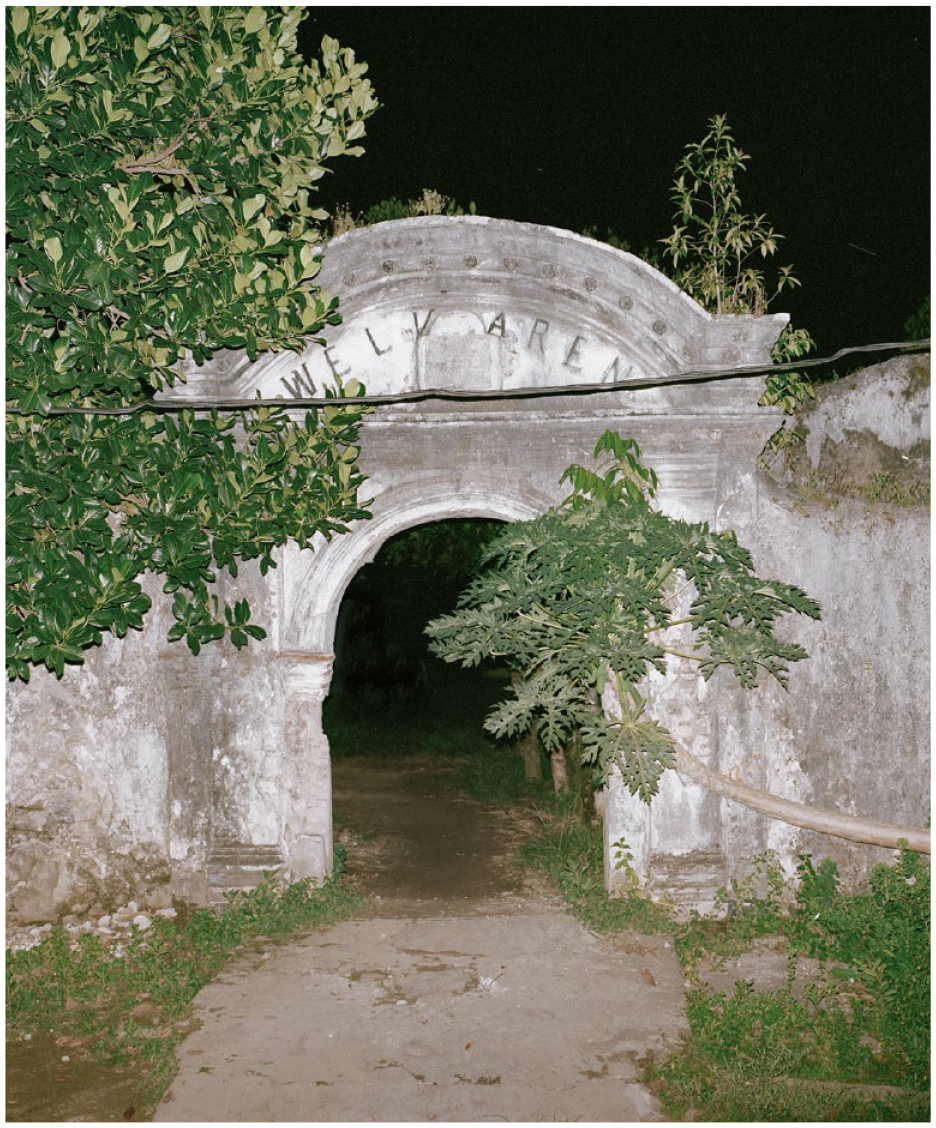
The Welvaren gateway to a nutmeg plantation on Banda Neira island, photograph by Muhammad Fadli (with permission).
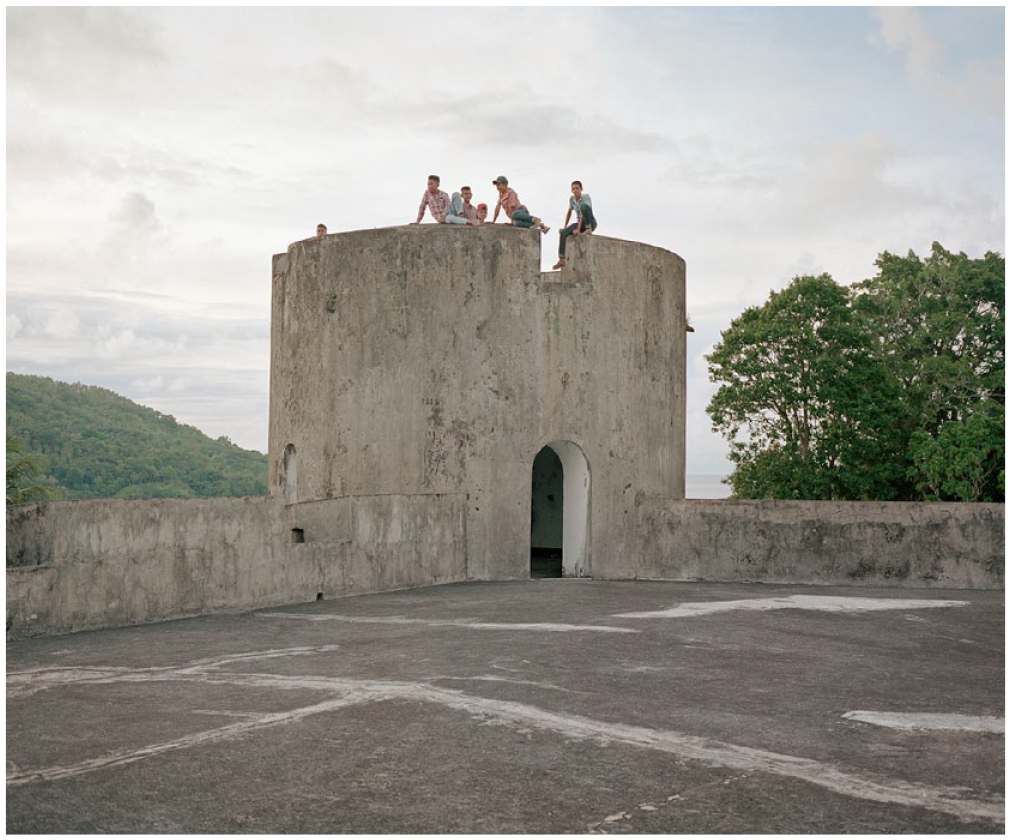
Children playing on Belgica fort, Banda Neira, photograph by Muhammad Fadli (with permission).
Here, Muhammad Fadli accentuates the extent to which the VOC viewed nutmeg as a treasure to be guarded at all costs (see also Dhont, 2022: 92).
Alongside these traces of colonial history, the authors provide portraits and commentary on contemporary residents of the islands such as school children, nutmeg plantation owners/workers and fishermen. In this way, Muhammad Fadli and Fatris MF emphasize how locals have continued to live with the resources at their disposal from both the nutmeg plantations, but also the surrounding sea.
The Banda Journal includes a photograph of the Bandanese on Banda Besar commemorating the massacre by standing looking out to sea with bamboo poles to symbolize the poles upon which the heads of orang kaya were placed (Fadli and Fatris, 2021: 84–85). This is one of the most direct forms of engagement with memory of the massacres on the islands and encompasses explicit reference to the killings.
Beyond mentions in this text of how the Bandanese commemorate the massacre we know that Bandanese women passed stories of the massacre down through the performance of a local adaptation of the Eastern Indonesian war dance, the Cakalele dance. Under the watchful eye of the VOC outright protest at the massacres was not possible so, according to Alisjahbana (2021), it was women as the main survivors who turned to dance as an allowable form of cultural expression and healing. The dance is one part of a larger ritual called buka kampong authorized by designated women cultural leaders called Mama Lima (Farid and Sadee, 2023). It is a form of connection to spirits, honouring and respecting the ancestors who were killed (Alisjahbana, 2021). We, by contrast, view the women’s performance as an un-speakable (Dragojlovic and Samuels, 2023) form of memory work allowing for memories to be commemorated by women, who under the heteropatriarchal order of the Dutch colonialism were not perceived as a military threat despite local accounts of female resistance to the invasion (Farid and Sadee, 2023). These century long performances, which are not featured in The Banda Journal, indicate a long history of gendered memory and ways in which heteropatriarchal order structures memory work across centuries.
The Banda Journal project does, however, pay close attention to translocal community memory and knowledge production related to the massacres in the short documentary film, ‘Songs from Another Land’. This documentary which Muhammad Fadli and Fatris MF dedicate to the 400th anniversary of the massacres features an interview with a descendant of the original community of Bandanese who fled Banda to Kai Besar, an island located 300 km to the southeast of the Banda islands. It is on this island that Bandanese refugees established a new community which became known as Banda Eli. In the documentary, they note that the descendants on this island have continued to maintain the original language of Banda or turwandan, which is no longer spoken on the Banda Islands. This is confirmed by the research of Collins and Kaartinen (1998: 525). The disappearance of this language on the Banda Islands is perhaps a consequence of the complex mixing of cultures which took place after the massacres with the arrival of imported indentured labour described earlier. Kaartinen (2013), who has conducted extensive fieldwork in the Banda Eli, notes that Turwandan was mostly used to convey stories about ‘the migrations and sea voyages of their ancestors’ (p. 387) as well as being used for songs performed for life rituals and festivals. In the final scenes of the film, an elderly woman Mustika Latar sings a few verses of a song in Turwandan language emphasizing the endurance of Bandanese culture and therefore cultural resilience. Muhammad Fadli and Fatris MF note that these songs are known as Onoton Sarawandan (Fadli and Fatris, 2021: 217). They explain that the word wandan, also the root word of turwandan language, is the old name of the Banda Islands documented in a 14th-century Majapahit text Negarakertagama. Here, language serves as an important way of preserving memory for displaced Bandanese people and acts as a thread that connects these communities with those that remained in the Banda Islands.
This is an incredibly important example of translocal memory that reflects the geography of Indonesia as an island nation and patterns of forced internal migration. When we interviewed him, Muhammad Fadli (2023) stressed ‘the song is not like the history you record in the books. It is oral history’. In the song, Mustika Latar performs, she narrates the story of her family’s former village in the Banda islands and recalls dramatic moments linked to the family’s forced migration to the Kei Islands following Coen’s invasion in 1621. Muhammad Fadli (2023) wondered at this form of oral memory passed down across the generations, despite the fact that Mustika Later had never visited the Banda Islands. For the authors, this was proof of the lasting connection between the islands. For us, it emphasizes the ways in which memories resonate across the different colonial contexts of Indonesia. The tone of Mustika’s singing is that of lamentation which Kaartinen describes as typical of the ‘weeping’ like genre of Bandanese songs. Mustika Latar is connected to three important family lineage groups on the island and she plays a central role in her community as an elder female community leader as a custodian of memory (Kaartinen, 2013: 391–392).
For most of the film, however, Elder Lawataka Latar from the same family clan narrates the story of his people in Bahasa Indonesia, a language he shares with the West Sumatran filmmakers. He states in the documentary that ‘our ancestors said that Jan Pieterzoon Coen was the one who waged war in Banda. The war against our ancestors’. He refers to Coen as ‘the butcher’ (orang jagal). Commenting on the significance of the massacres he says, ‘nutmeg always brings death. The annihilation of our people was because of nutmeg’ (Pala ini selalu mengangkut orang mati. Dulu orang-orang kami mati disebabkan pala). Sharing passed down memories of Coen’s 1621 voyage he explains, ‘He arrived with ships laden with weapons’. Through this image, Latar evokes parallel histories of invasion and occupation from the vantage point of the shorelines of local societies that were under attack, importantly reversing the all too common Western and colonial-oriented narration of events from the vantage point of colonial powers aboard the approaching ships (Milton, 2020). This film and the oral testimonies within it serve as a means of joint knowledge production and highlight the translocal remembrance of the massacres, despite the passing of above 400 years. The decision by the journal authors to include these complex dimensions of memory work across different islands is decolonial because of the commitment to engage the complexity of Indonesian colonial history and to disrupt the sense that there is just one story to be told about this past.
The way in which this project was carried out also reflects important attention to decolonial practices, in particular, the collective creation of knowledge and consultative approach taken in the project. Both Muhammad Fadli and Fatris MF, for example, visited the Banda Islands multiple times and stayed with community members engaging in long conversations with them to understand both the history and present of the islands (Fadli, 2023). Getting to the islands requires significant effort as one must first travel to Ambon and then either fly by light plane or take a 10-hour boat journey there. Following stories they heard on the Banda Islands about the original Bandanese who forcibly migrated away from the islands, they journeyed by sea for 10 hours first to Kei Kecil Island, then by boat to Kei Besar Island and then by road and boat for another 5 hours along to coast to reach the Banda Eli community. Hearing the stories of people such as Mustika Latar and Lawatakar Lata, the authors of the journal felt like they had ‘closed the book’ or completed part of the story missing on the Banda Islands themselves (Fadli, 2023). This is because the community on the Banda Islands today is very cosmopolitan consisting of Buginese, Butinese Madurese, Javanese such that there are not that many original Bandanese left. Further reflecting a commitment to joint knowledge production Fatris MF taught in the local school on Banda Naira for a brief period collecting accounts for school children about their hopes and aspirations and included these in the journal. The fact that they termed this project a journal also draws attention to the fact that they viewed their work as a subjective representation, rather than as a single authoritative account. Again this reflects a decolonial stance in the sense that they were not aiming to produce a new singular narrative of history, but instead to draw attention to diverse aspects of the past and present of the Banda islands.
The production of The Banda Journal was also informed by attention to the ethics of photographing people. Muhammad Fadli (2023) explained their commitment to informing everyone who was photographed for the project about the purposes for which the photographs would be used. Over his career which began as a photojournalist, he shared that he has become far more reflexive about his practice including a tendency in the world of photojournalism to capture, for example, images of suffering to sell news. He now tries to keep at the forefront of his mind, the fact that ‘photography is a colonial practice’ and to therefore practice what we describe as a more decolonial approach. At the conclusion of gathering photographs and before publication on the website and in the resultant journal, for example, he and Fatris MF presented all the images they wanted to use to the community on the Banda Islands through an open exhibition (Fadli, 2023). The point was to both update the community on the images they wanted to use and to check if there were any objections.
Conclusion
The Banda Journal is an important project by two non-Bandanese Indonesians to explore in greater depth the history and significance of the Banda massacres and the legacies of the VOC from the perspective of the Bandanese. This decolonial memory project was forged outside of mainstream art institutions such as galleries and conventional memorialization projects funded by the state or hosted by national or regional museums. It importantly draws attention to the larger dynamics of modernity, colonialism and economic exploitation highlighting the lasting effects of such processes, and the violence that underpins them, on everyday people. Due to the West Sumatran background of its authors, this project includes a rare attentiveness to the dynamics of what it means to be from ‘the outer islands’ of Indonesia and from the relatively forgotten Banda Islands.
The website, publication and short film emphasize local and translocal modes of remembrance of colonial violence. Here, there is attention not only to the traces of the nutmeg trade on the Banda Islands today and of the extent to which this spice was prized and guarded, but also to complex processes of commemoration of the brutal VOC violence and related local knowledge production. The recorded video ‘Songs from Another Land’ featuring the narration of memories of the massacres and of the lost Banda homeland by two elder migrants from the Banda Eli community on Kei Besar Island demonstrates the translocal dimensions of memories that have been kept alive in this diasporic community. The Banda Journal stands as an example of the fast-emerging modes of socially engaged art projects in Indonesia, that not only offer decolonial critiques of the Dutch colonial exploitation, but also address multiple economic and cultural hierarchies within the Indonesian nation state as well.
At the heart of this project is the desire to disrupt Indonesian and the Dutch state narratives about the Banda massacres and to offer a far broader lens on the implications and legacies of injustices related to the spice trade and colonialism more broadly. Departing from a rigid definition of memory activism which is directed only at states Muhammad Fadli and Fatris MF seek to challenge the ongoing nature of colonialism and coloniality and related structures of power.
Footnotes
Acknowledgements
The authors would like to thank Muhammad Fadli and Fatris MF for sharing their work and insights with them and for permission to use the two photographs here. They would also like to thank the reviewers and editors of this special edition for their time and insights provided through the review process.
Funding
The author(s) disclosed receipt of the following financial support for the research, authorship, and/or publication of this article: This research has been funded by an Australian Research Council Discovery Grant (DP210102445) for the project Submerged Histories: Memory Activism in Indonesia and the Netherlands.
