




Abstract
This article examines the lexical memory work performed by the British New Left as it differentiated itself from the organised labour movement post-1956. It argues that activists use memory to reframe the meaning of keywords in the ‘protest lexicon’, and that this is an important, though usually implicit, activist cultural practice. Based on previous work in conceptual history and cognitive science, it begins by situating lexical memory work as an activity on the border between narrative historical memory, semantic memory and implicit collective memory. It then discusses the resignification of the word solidarity during the long 1960s, when lexical work was a key feature of the New Left’s apostasy from traditional Marxism. Finally, it examines the case of the British heterodox Marxist journal, Solidarity, outlining how it intervened in the protest lexicon by wrenching free the keyword solidarity from previous meanings, changing its historical referent and, ultimately, resignifying it.
Keywords
Introduction
Language is a primal medium of memory, both for individuals and for society. Nevertheless, how language in context conveys memory has been little studied as such. This article takes as its point of departure the hypothesis that words carry memory in a variety of ways, from the tainting of certain ‘formulas’ (Krieg-Planque, 2003), such as ‘final solution’, to the encoding of ‘mnemonic metonyms’ for complex emerging historical narratives (Teichler, 2022: 83) and the creation of what Eviatar Zerubavel (2003: 40) calls the ‘quasi-contiguity’ of historical periods by words like ‘republic’. Observing how speakers and writers actively engage with these different mnemonic dimensions of language can cast light on a typically unmarked but important site of ‘activist memory work’ (Merrill et al., 2020: 4).
Language is a key medium for the ‘memory–activism nexus’ (Rigney, 2018): the mutual imbrication of cultural memory and social activism along the axes of the memory of activism, memory in activism and memory activism (see also Daphi and Zamponi, 2019; Gutman and Wustenberg, 2023). This is not simply because of the primacy of language as a medium of memory, but also because of the specific ways protests and activism are structured around key terms and phrases. Contentious action is characterised by economic communication with mass appeal, achieved in large part by the expansion and contraction of discourse around routine cries, claims and appellations – best exemplified by that iconic building block of protest: the slogan (Blom, 2024; Carle, 2020; Van De Velde, 2020, 2022). This expansion and contraction of discourse plays out both in the public arena and in continuous negotiation within movements and collectives, whether it be on the nature of their collectivity, the boundaries of their membership, their aims or their appropriate action repertoire. As eminently portable capsules of meaning, words can get mired in tactical concerns in the context of contentious action. As such, they can come to operate in much the same way as the transnational ‘repertoires’ of contentious action which social movement scholars have been compiling over the past 50 years (Steinberg, 1999; Tarrow, 2013).
Memory comes into play in different ways in the suite of keywords that movements use to communicate their aims, hopes and public actions. In order to study how these words behave at scale, over time and, not least, in relation to one another, they are usefully conceptualised as particular instantiations of a protest lexicon. Words like sit-in or solidarity – the keyword central to this study – are not just gatekeepers to the repertoire of action, but frequently index particular historical precedents that give them meaning. Calling the human blockage of a traffic intersection a die-in, for instance, conjures a particular history of nonviolent action going back to the 1950s. Besides structuring the discourse of a movement around central claims and forms of action, these words also orient activists in time, referring them to particular origin stories and traditions, and setting future agendas. They are key in articulating the relationship between the past, present and future, and the nature of movement actors’ control over it. Through the shared topographies they mediate, keywords and formulas help consolidate movement actors into interpretive communities, or ‘counterpublics’ (Warner, 2002).
The negotiation over words, their meanings and their historical resonance, then, is a core facet of activism, not just for its intervention in dominant discourse, but also for how it shapes social action itself. These negotiations directly intervene in the collective memory of a movement, and simultaneously depend on the memory work of framing past and recent events in specific ways. They are not a passive reflection of changing times but a discursive act, if not necessarily consciously strategic. The shape this work takes closely depends on the possibilities afforded by the media in which it takes place. The last section of this article will turn to the periodical medium. The collaborative, multi-media and time-sensitive nature of periodicals (Teichler, 2022: esp. 83–84), as well as their combination of discursive genres, deliberate polyglossality and intertextuality allow them to capture the complexity of these collective negotiations in rich ways.
In this article, I will explore lexical memory work around the term solidarity, a transnational keyword for different forms of revolutionary sociality. The argument consists of three parts. Based on previous work in conceptual history and cognitive science, I begin by situating lexical memory work as a cultural activity on the border between narrative historical memory and implicit memory. I then discuss the resignification of the word solidarity during the long 1960s, an era characterised by linguistic playfulness. Lexical work was a key feature of a general ‘apostasy’ (Zamponi, 2018: 270) from traditional Marxism by the New Left. Finally, I examine the case of the British heterodox Marxist journal Solidarity. Drawing on a content analysis and iterative keyword searches of the first six volumes (72 issues) of Solidarity, which appeared irregularly between 1960 and 1971, I outline how the editors and contributors to this journal worked to redefine the meaning of the keyword solidarity by changing its historical referent. They called on readers to disassociate the word from previous official usages, aligned it with alternative historical events and finally consolidated their efforts by establishing alternative traditions of thought and writing.
Lexical memory work
Since the linguistic turn of the 1970s, insight into the different ways in which words store the past has been building. In his classic work from 1976, Raymond Williams (1983) developed the study of keywords as a way of exploring how different meanings, values and ‘formations and distributions of energy and interest’ (p. 11) inhere in parallel political discourses. Meanwhile, conceptual historians such as Reinhart Koselleck, J.G.A. Pocock and Quentin Skinner drove home the point that different significations of words not only muddy the waters between opposing sides of social and political debates but that changes in the meaning of words over time also complicate speakers’ – and later historians’ – relationship to the past (Koselleck, 2011; Pocock, 1989: 12–14). Research in cognitive psychology has shown that the way in which speakers verbally encode events exerts a major influence over how they recall them (Amberber, 2007: 1). As vehicles for cultural memory, there are various ways in which words call into being historical reference and continuity, acting either as narrative frames or evoking canonical historical events, as in the case of exodus and revolution (Walzer, 1985).
Word definitions are often intuitively conceived of as more or less static entries in one’s mental lexicon. However, modern cognitive approaches suggest that semantic meaning is better understood as a combination of individuals’ understanding of a term’s history of use and its relationships to other words, in Firth’s (1957) well-known phrase, ‘the company it keeps’ (Kumar, 2021). These relationships include both a term’s regular co-occurrence with other words and its relationships to other concepts in semantic networks (relationships of synonymy, antonymy, metonymy, etc.). The realisation that word meaning is relational was also one of the keystones of structuralist and poststructuralist approaches to language, and it has profound ramifications. It means, among other things, that narrative interventions in collective memory on the part of individual language users has the power to resignify concepts by shifting the cluster of shared associations. Choosing particular words to refer to past events not only frames the event in particular ways but can also reshape the meaning of the word itself within a particular community. While explicit redefinition is relatively rare (and more the remit of the historian than of the activist), by combining word choice and the re-narrativisation of events, speakers routinely give new meaning to words by simply using them in new ways. As this article aims to show, however, resignification can also mean destabilising received or authoritative meanings and associations without immediately proposing an alternative.
Words belong to the domain of the ‘implicit’ in multiple senses of the word. They work in the background of culture and are often not subject to explicit discussion in the way events and narratives are. For this reason, their structuring power in communal thought is often overlooked. This is partly because speech relies on what in cognitive psychology has come to be known as ‘implicit memory’: the domain of procedural knowledge rather than of conscious and declarative recall. This is despite the fact that the mental storage of word definitions is classically grouped under the umbrella of explicit ‘semantic memory’. Although speakers can consciously reproduce word meanings, important linguistic knowledge that is activated in speaking and in the anticipatory process of listening and processing language, including rules of combination and distributional relationships, is acquired by implicit learning and often not consciously accessible to speakers (Ettlinger et al., 2011). Implicit language knowledge determines the sayable, and conversely, as speakers verbally encode narrative, frame events, and engage in explicit and pragmatic resignifications of words, they tug at underlying implicit structures. Lexical memory work, then, happens at the intersection of explicit and implicit memory. It is an agent of what Astrid Erll (2022) has recently proposed to call ‘implicit collective memory’: models, processes and schemata that are not explicit, not intentional and non-conscious, including ‘visual icons, narrative patterns, stereotypes, metaphors, world models, values and norms, or certain ways of acting or ‘doing’ things’ (p. 4).
Shifting the frame from historicising keywords of political discourse to observing cultural practices by which speakers mould shared meanings to their purposes is liable to get bogged down in problems of structure and agency. Pocock captured some of this complexity in his observation that individual thinking is both
a social event, an act of communication and of response within a paradigm-system [and] . . . a historical event, a moment in a process of transformation of that system and of the interacting worlds which both system and act help to constitute and are constituted by. (p. 15)
To add to the complexity, Sidney Tarrow (2013) more recently commented on the multiple arenas in which these historical transformations happen:
language [does not drive] action independent of other factors, but . . . plays an important role in the construction, the endurance, and the diffusion of contentious politics. . . . Such a combination of factors cannot be understood through linguistic analysis alone. We need to combine attention both to the meaning of words and to the strategic situations in which word workers find themselves when they employ them: to the actual work that words do in specific contexts. (p. 21)
With this complexity in mind, pinpointing the origins of changing word meanings in the cauldron of social movement action is tricky business – even at those times when the centrality of practices of resignification to activist theory and practice seems clear. One obvious pitfall is the tempting short-cut of attributing conceptual shifts to known entities (Marx, Lenin, Luxemburg), rather than attempting to answer the more difficult question of how new meanings and associations spread and stick (Soni et al., 2021). In what follows, I attempt to address this broader question by observing how ‘word workers’ engaged the key term solidarity in the 1960s to outline some of the various shapes lexical memory work has taken in the context of periodical publishing. The small heterodox Marxist journal Solidarity offers a particularly rich case to do so. Besides being a hinge period of social activism with the rise of the New Left, the playful 1960s were also a vibrant era of language innovation – and Solidarity showcases various ways in which activists engaged in this.
Metamorphoses of the keyword solidarity
In addition to the political stakes of keywords, developing a shared vocabulary helps social movements in consolidating their collectivity. This is perhaps nowhere more apparent than in those words in the protest lexicon that have to do with activist sociality. In English, these include comrade, unity, sympathy and solidarity. Even if terms like these might for the general public be little more than ‘empty signifiers’ which are structurally open to receive meanings from their context (Laclau, 2005: 96–97), this is often not true for movement actors, who use various pragmatic and discursive means to narrow the high degree of semantic vagueness associated with such words (Sperber and Wilson, 1995: 172ff.). As Jodi Dean (2019: n.p.) suggests in her study of the term comrade (originally derived from camarada, sharers of rooms and boards), this appellation is not simply a term of endearment but ‘indexes a political relation, a set of expectations for actions toward a common goal’.
The transnational and translinguistic cry of solidarity has arguably an even broader purview than comrade in the current era. Although the two words are intuitively connected in their association with socialist discourse, solidarity has quite a different origin. Originally from French legal language indicating mutual responsibility, the term was popularised among class reformers internationally by French utopian socialism and social thought (Featherstone 2012). In the 1840s, Pierre Leroux and key Fourierists were formulating conceptions of solidarity as a ‘non-Christian ethical demand’ (Bestor, 1948: 273; Le Bras-Chopard, 1992: 55). In the 1890s, the term took on broader significance, as Émile Durkheim popularised an influential distinction between pre-modern ‘mechanical solidarity’ and the ‘organic society’ deriving from occupational interdependence, while Léon Bourgeois operationalised the term as usable political doctrine by referring to individual citizens’ debt to society (Béland, 2009: 448). In the twentieth century, in the instrumental definition that Leninists adhered to and many among the New Left abhorred, solidarity became an occasional synonym for the ‘conscious discipline’ to maintain unity and a ‘single will’ (Lenin, 1997 [1920]: n.p.; Stjernø, 2005: 53–54).
In the 1960s, the use of solidarity underwent a sea change. As Steinar Stjernø (2005: 191) suggests, students and new radicals appropriated traditional ideological language from traditional Marxist spheres but imbued it with additional, and sometimes rather different, values. In making solidarity ‘a vivid concept with much richer content and connotations than had been the case so far’ (p. 190), they balanced their interest in traditional union vocabulary with a new emphasis on individuality and a rejection of the conformity that had been integral to the concept before. As the analysis of the journal Solidarity below will show, young radicals made efforts both to destabilise the received, authoritative meaning of the term, and to imbue it with new associations from world history. Evidence from Google Ngram corroborates the shift Sternø observes and further pinpoints when this new, more individualistic definition took hold. Looking at the most common verbs and prepositions associated with solidarity in their English Corpus (2019; Michel et al., 2010), the 1960s show a historical break. There are two clusters of verb types associated with solidarity: those to do with outward demonstration, show and express, and those to do with inner consolidation, build, promote, maintain, strengthen and grow. In the 1960s, the demonstrative verbs (show and express) quickly outgrow the others (Figure 1).
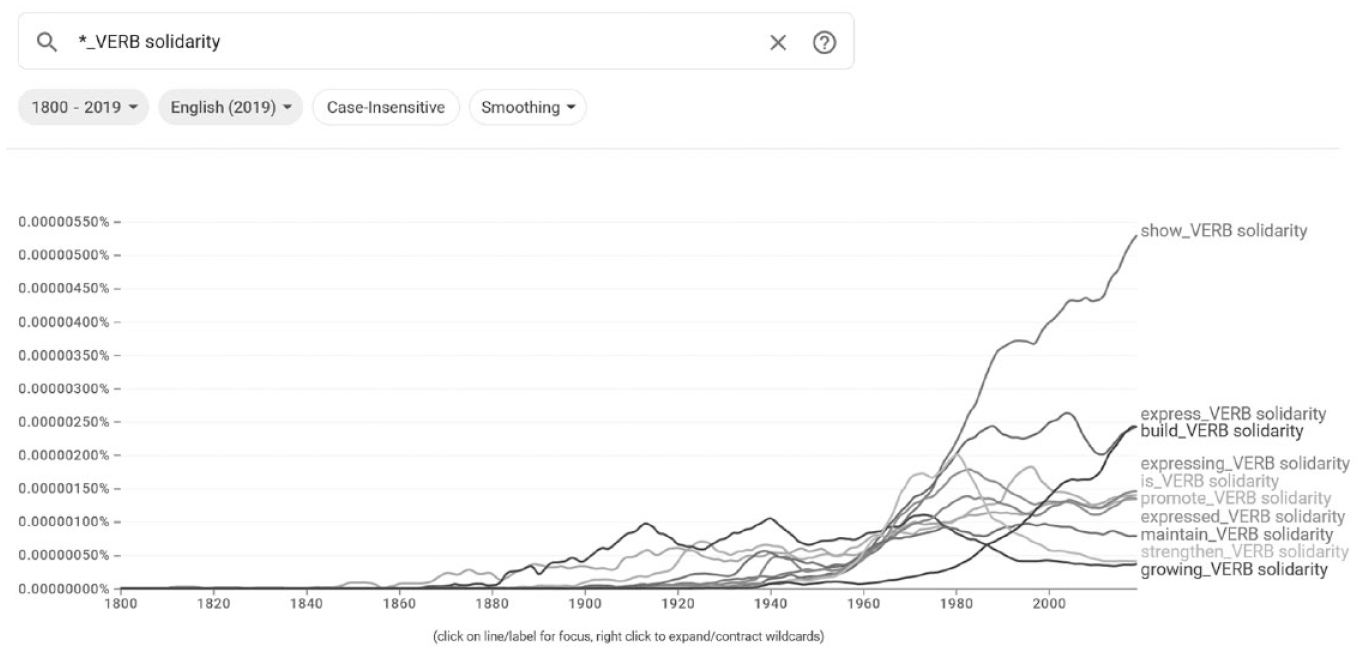
Most common verb collocations with solidarity.
According to the Ngram English 2019 corpus, after a period of falling use of the term in line with Stjernø’s account, in the 1960s, solidarity began increasingly to be mentioned again. Up until 1965, the organic phrase ‘growing solidarity’ was the most used, and ‘promote solidarity’ and ‘strengthen solidarity’ close seconds. From 1965 onwards, ‘show solidarity’ and the combined frequency of ‘express’ and ‘expressed solidarity’ are the most often used. More strikingly, looking at prepositions, it is also in the 1960s that solidarity with begins to overtake the dominant solidarity of (Figure 2). The latter combination, which would seem to connote more strongly a sense of unity and uniformity, falls out of favour rather markedly.
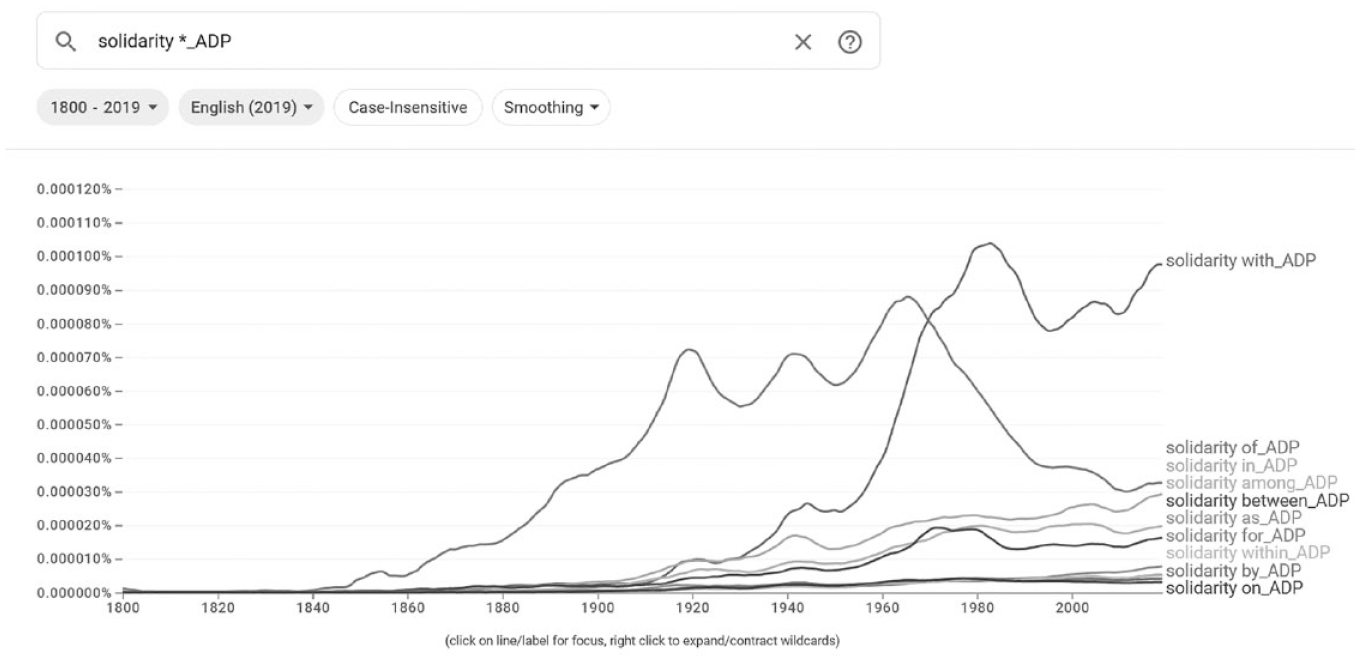
Most common preposition collocations with solidarity.
Both of these co-occurrence patterns suggest that the 1960s were a hinge period in the collective understanding of the word solidarity. It seems plausible to interpret these changing use trends in light of both the growing importance of mediatising protest (Gitlin, 2003 [1980]; Rigney and Smits, 2023: 12), and the more common extension of solidarity to dissimilar and distant groups which Stjernø chronicles. It is also a hallmark of the rise of the New Left. The broad-based countercultural movements of the New Left came to have more cultural impact than what they wrote off as staid doctrinal socialisms – and their conception of solidarity became more prevalent.
Solidarity and 1960s’ apostasy
Lorenzo Zamponi has observed that ‘limited apostasy’ from inherited stories and symbols, rather than compliance and due reverence, is an important operation within the memory–activism nexus. A pressing need in some historical contexts, this apostasy is a way for newer generations of activists both to manoeuvre more freely and to increase their appeal for a wider audience (Zamponi, 2018: 270–274). Stjernø’s observations on how young radicals of the 1960s explicitly engaged the legacy and language of the organised socialist labour movement suggest a clear case of apostasy. It was not only disillusionment with political developments in communist states, such as the repression of the Hungarian revolution in 1956, that alienated students from Marxist orthodoxy but also frustration with the daily politics of unionising and organising. Michel Foucault (1991), for instance, recalled how time spent among Tunisian students left him feeling ‘full of bitterness’ as it revealed to him the futility of the ‘indomitable discursivity’ in Europe, ‘all that muttering of political speeches and debates . . . that unleashing of theories, anathemas, the splitting up into factions – all very disturbing and all of very little interest’ (pp. 135, 138–139). In a similar vein, the German radical author Hans Magnus Enzensberger (2016 [1966]: n.p.) described his bewilderment when he attended the ‘Peace Congress’ at Baku in 1966, where
[t]he professional peaceniks [made] very long, empty speeches, identical in 15 languages. They can’t mention Vietnam without using the word heroic. The American war they call ‘the death throes of Imperialism’. . . . I decide not to say anything at all on the podium. I just don’t feel like taking up the fight against these windbags.
Young radicals’ apostasy from labour orthodoxy fuelled the ludic experimentalism of the 1960s protest culture. As indicated by the suggestive characterisation of 1968 by Lauren Berlant (1994), the generation’s embrace of ‘utopian logic and tonal disruptions of theoretical, descriptive, and analytical norms’ had everything to do with the new ways in which movement actors used language (p. 127; see also McCann and Szalay, 2005). These (usually) young idealists made efforts to wrest loose from overdetermined and historically loaded terms, and studying the manoeuvres by which they intervened in these ties to the history of activism before them contributes to understanding the full range of their cultural impact.
Solidarity was founded by a small autonomous Marxist group called Socialism Reaffirmed (1960–1992), which had been expelled from the Socialist Labour League. The first few issues appeared under the title Agitator. Professing their ambition of aiding the autonomous organisation of the working class, the journal combined historical analyses and theoretical pieces with quips and crudely drawn cartoons. It was part of a network of European publishing initiatives, including Unità Proletaria and Pouvoir Ouvrier Belge, and it was especially influenced by Socialisme ou Barbarie and its intellectual leader, Cornelius Castoriadis. Socialisme ou Barbarie published its own eponymously titled theoretical review (1949–1967), which Solidarity discussed and occasionally translated. Solidarity had official regional divisions in several cities in Britain, and they were engaged in a range of industrial disputes and pacifist and antinuclear initiatives. Throughout its existence, the collective also published around 60 pamphlets on current and historical topics, which closely intertwined with their periodical publishing venture. Although editors continuously encouraged their readers to hand out copies to friends and colleagues and impressed upon them the vital importance of ensuring new subscriptions, Solidarity’s circulation remained small. By the early 1970s, circulation of the journal was by their own reports about 1200. Nevertheless, the initiative ultimately managed to keep the journal running for over three decades – a remarkable achievement for this fringe political scene.
In line with Castoriadis’ ideas, Solidarity promoted the idea of ‘self-management’ and denounced capitalist forces as well as trade unions and organised Marxisms as agents of ‘bureaucratisation’ that kept the worker down. They sought to fight bureaucratisation not just through rational argument but also through maintaining a vibrant style in their mimeographed journal, explaining:
Solidarity has never tried to imitate the sterile formula of most left wing papers, which consist essentially of repeating the reports of the capitalist press and adding a ‘revolutionary’ epitaph or interpretation. . . . [Any] real movement for socialism must become a total movement. (Solidarity 1967b, 1)
Of particular interest here, is that they were acutely sensitive to the role played by language in bureaucratisation. The journal abounds with sarcastic takes on ‘jargonologists’ (Solidarity, 1960c: 6) and ‘marxicologists’ (Solidarity, 1960b: 17) and running gags such as the feature ‘Who said it?’, which invited readers to ‘Take a pin. Shut your eyes, and. . .’ pin a given quote to any of the dissimilar figureheads suggested. The editors often reiterated their ambition to avoid jargon, and demonstrated their sensitivity to language on the occasion of the change of the title of their journal from Agitator to Solidarity:
Words had either become meaningless . . . or as distorted and ‘bureaucratised’ as any of the institutions of contemporary society. [AGITATOR] smattered of blind militancy, of ‘good ruck’ for the sake of it – whereas our task was, to assist in the development of a new kind of socialist consciousness . . . Our new title SOLIDARITY reflects our aims more accurately. Solidarity is not only a good old-fashioned principle. It is an essential part of everyday working class experience. (Solidarity, 1961a)
In this article, the editors critique the bureaucratisation of language and elaborate on the deliberations involved in their title change. Sensitive to the mnemonic associations of words, they explain that solidarity has a historical pedigree as a common sense ‘principle’. In the same breath, however, they also put forth their own definition of the term, as grassroots and everyday – a far cry from the near-synonym with discipline common among Leninists and much more in line with early nineteenth-century Utopian socialist hopes for the transformation of everyday experience than with the tactical leadership of labour unions.
The editors also emphasised the importance of using everyday language in their reflections on historical revolutionary activity. In an analysis of the Paris Commune, for example, prominent commentator Maurice Brinton warned that:
For intellectuals words are often substitute for action. For workers, actions are a form of speech. To add revolutionary theory in the course of revolutionary action is the essential task of the revolutionary proletariat. This was the immortal contribution to revolutionary theory of the Parisian workers in 1871 and of their successors, the Hungarian workers of 1956. Such was the language of the Commune, which socialists must now attempt to decipher. (Brinton and Guillaume, 1961: 17)
In line with their reading of history at key junctures such as the Commune and the Hungarian Revolution, the group explicitly wanted to be a mediator of the working-class movement and not an intellectual vanguard (Anderson, 1964; Cardan, 1967 [1963]; Solidarity, 1960a: 2, 1961b: 2). Rather than suggest their own theoretical terminology, then, they sought to refresh extant vocabulary, particularly vocabulary related to revolutionary sociality, like that ‘good old-fashioned principle’ solidarity.
The editors did this in a variety of ways. Periodicals are polyglossal, time-sensitive collages often produced under significant constraints, which use a variety of strategies to cement together events, publications and readerships into a greater whole. Engaging their readers at regular intervals to present curated selections of texts and materials, and thereby satisfying consumers’ need for relevant (i.e. time-anchored) information, novelty and repetition (Beetham, 1990; Mussell, 2015), and emotional attunement (Dillane, 2016), periodicals are a vibrant medium through which they carry out lexical memory work, and they have their own affordances for doing so. Solidarity’s attitude regarding the dangers of jargon and the importance of non-hierarchical, grassroots solidarity spoke from individual articles, editorial decisions and intertextual references. The following sections address ways in which both editors and individual contributors engaged in lexical memory work to disassociate solidarity from previous meanings, realign it with alternative histories and, finally, to consolidate their use of the word.
Disassociation
In line with their stated goals, one way in which Solidarity worked on the protest lexicon was to encourage critical attitudes towards historical events, particularly to authoritative accounts of those events. They especially did so in their editorial voice and through compositional decisions like juxtaposition and repetition. Irony, a trope rooted in the discrepancy between the literal meaning of words and what is intended, was a major means of achieving this distance. By fostering ironic distance, Solidarity invited its readership to question sedimented meanings and be receptive to new significations.
The editorial voice was primarily expressed in editorials, commentaries and frequent asides. It invited a critical and often humorous distance from the materials and events discussed. A review of the Italian film Il Compagni (1963), for instance, instructed readers on the critical consumption of portrayals of strikes in film generally. Il Compagni was contrasted favourably to British films, which ‘usually take their subject as a jumping off point for a comedy . . . or for a faintly sensational/violent treatment . . . The causes of the strike in these . . . pictures were hardly mentioned’ (IJH, 1966: 8). The article goes on to explain why, while English distributors have given the film the ‘box office title’ The Organiser, a better rendering would have been ‘‘the Comrades’ or even ‘Solidarity’’ (p. 8), as it portrays well the underlying causes for the collective action. The review is used as a broader invitation to critical media consumption, taking as its notable starting point insinuations about word choice in a film title.
The editorial commentary also used irony to break with sedimented understandings of keywords explicitly. In a discussion of the events of May Day in 1969, for instance, they criticised a decision of the ‘(Stalin-dominated [sic]) London Committee for the Defence of Trade Unions’ to expel a delegation from the May Day Committee, concluding ‘With “comrades” like this, the movement scarcely needs enemies’ (p. 3). This ironic tone pervaded the publication. The discussion of the life of English Radical John Thellwal (1764–1834) by one ‘Ichabod’ (1967), for instance, denounced the Romantic poet Coleridge for refusing to offer shelter to the persecuted ‘starving comrade of his youth’ (p. 17). This phrase offers a complex irony-laden mnemonic move, asking readers to imagine the situation in terms of left wing anachrony (‘comrade’), while simultaneously drawing attention to Coleridge’s flagrant betrayal of this ‘comradeship’. These two rather different ironic uses of the word ‘comrade’ both draw attention to the pervasive hypocrisy attached to it – in its misapplied sense.
Despite the technical limitations of its duplication by mimeograph, Solidarity used key affordances of the medium to destabilise received language and resignify keywords, particularly repetition and juxtaposition. Editors used the means they had at hand, self-consciously including scissors and paste items, crude cartoons and hand-drawn headers. The repetition of the title Solidarity across the issues is the most marked example of resignification. Printed on a coloured cover page, the word drew all discussions under the same banner and gave readers a sense of inner coherence and continuity over time. The typography shifted from capitals to a more conversational lower-case (3.9), and from vol. 5 onwards, the cover page now and then included illustrations. Like many of the other cartoons, drawings were often ironically juxtaposed with public discourse. The cover of 5.2, for instance, shows a worker in breeches strangling the Goddess Britannia, with the caption ‘Strikers “throttling the country”/LEND A HAND’ (Figure 3). The cover of 6.5, by contrast, suggested Solidarity’s mobilising ideal. Befitting its lead article on youth culture, it depicted a brick wall with the graffiti ‘We are the writing on your wall’. Design choices like these worked on the shared memory of the readership, positioning Solidarity as an iconoclast of time-honoured national symbols or projecting it into a future in which youth cultures would take the lead – and take their ‘good old-fashioned principle[s]’ with them.
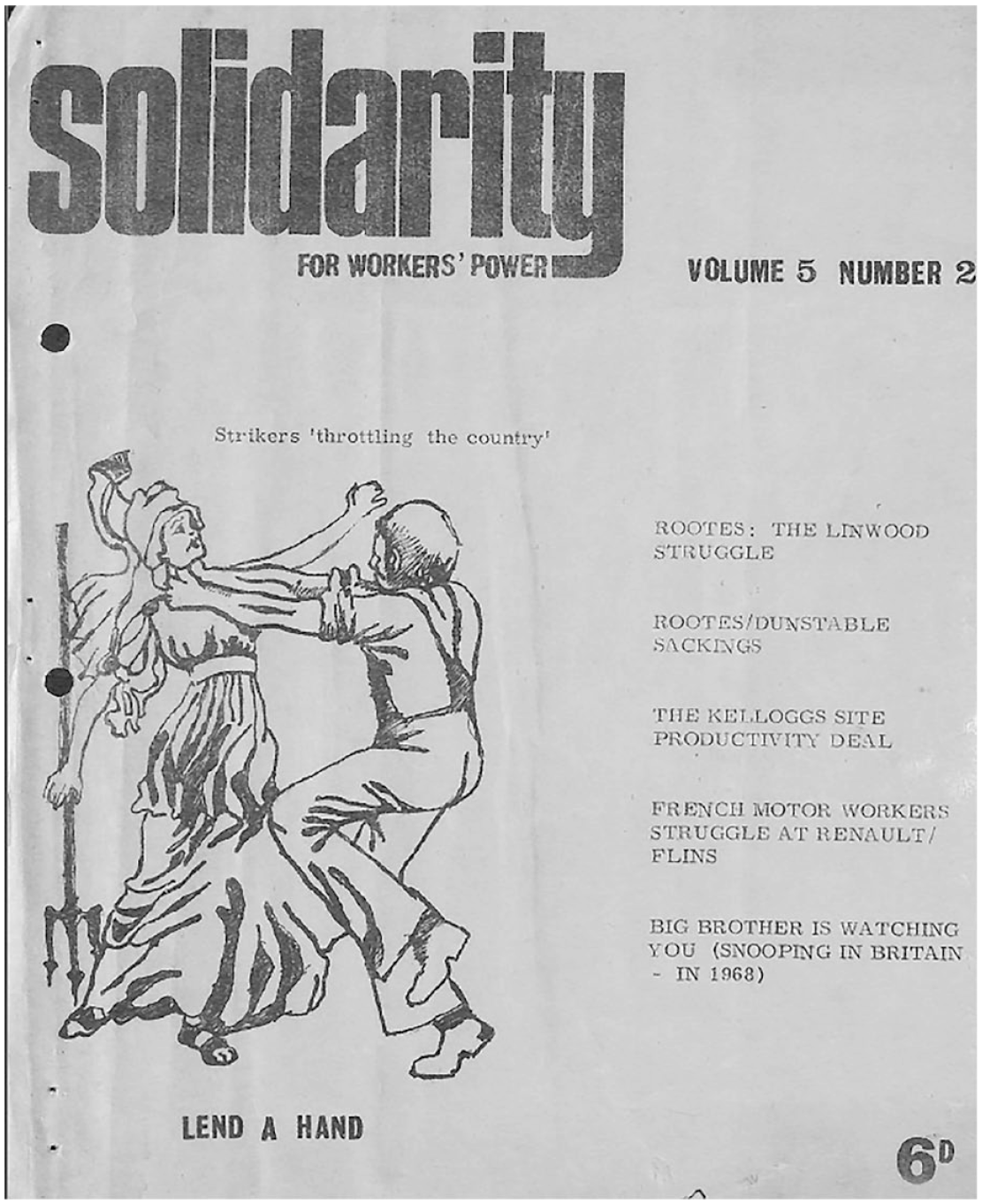
Strikers ‘throttling the country’.
Realignment
The primary mnemonic strategy for reappropriating the vocabulary of solidarity was to associate it with alternative historical memories. One of the abiding aims of Solidarity was to treat readers to alternative histories of anti-bureaucratic mass movement against capitalism, examining the forms of spontaneous social organisation which sprang into existence at revolutionary critical junctures. Rather than invent new words to describe these, which would mean contributing to the ‘tyranny of jargon’ they were seeking to overthrow (BP, 1960; Solidarity, 1960c, 1961c: 1, 1979: 3), writers reinscribed extant terms by changing their historical associations and offering alternative alignments.
A key reference point of Solidarity’s alternative working-class history was the Kronstadt Rebellion in 1921, when sailors of the Russian Kronstadt naval base rose up against Soviet rule and successfully pressured the Communist Party to implement economic liberalisations. The journal republished several texts on the event, including Ida Mett’s (1938) La Commune de Cronstadt (Solidarity 2.6, later published separately as Solidarity Pamphlet 27; Solidarity 1967a [1938]) and Victor Serge’s (1945) Kronstadt ’21 (Solidarity 1.7, later published separately as a Solidarity Pamphlet in 1975). These texts indicate the collective’s efforts of research and translation, and they were meant to uncover alternative interpretations closer to Solidarity’s conception of spontaneous organisation. As the editors pointed out, they considered the Kronstadt Rebellion a ‘decisive turning point in the Russian Revolution . . . [when] two different conceptions of working class power confronted one another’ (Solidarity, 1961c: 21). They posited that ‘malevolent distortion’ in canonical Marxist interpretations of the event ‘implicitly reveal[ed] their conception of “socialism”’, that is, seeing the power of the Party or the ‘workers’ state’ as something different from or superior to the power of the masses themselves, and showed ‘how shallow and reactionary’ its working definitions of concepts like the ‘workers’ state’, ‘workers’ management’ and ‘bureaucracy’ were (Solidarity, 1961e: 25). In recovering and circulating these accounts, then, editors not only offered an alternative revolutionary history, but an alternatively coded revolutionary language with which to act in the present and formulate agendas for the future.
Victor Serge’s account offered a poignant combination of first-hand observation of the events and analysis of the ideology behind the Party’s repression of the Kronstadt insurgency. The author took his shock at catching the party lying as his starting point. The ironic ending of the piece drove home the schism between the jargon and the realities Serge (1961) experienced:
We were advancing towards a classless society, a society of free men; but the party never missed an opportunity to remind people that ‘the reign of workers will never end’. Over whom were the workers to reign then? And that word ‘reign’ – what does it mean anyhow?’ (p. 24)
Throughout, the text indicates the ironic distance between worlds used and the events unfolding – with the notable exception of solidarity, used as part of the phrase, ‘act of solidarity’ (‘in any case the Kronstadt uprising began as an act of solidarity with the Petrograd strikes’, 18; ‘As an act of solidarity with Kronstadt, an entire regiment was going to switch sides’, 21). In this context, solidarity is pragmatically defined as a spontaneous action not motivated by ideological considerations – a sharp contrast with officials’ vocabulary.
Ida Mett’s analysis used a similar definition of solidarity:
The Kronstadt resolution had the merit of stating things openly and clearly. But it was breaking no new ground. Its main ideas were being discussed everywhere. For having, in one way or another, put forward precisely such ideas, workers and peasants were already filling the prisons and the recently set up concentration camps. The men of Kronstadt did not desert their comrades. . . . The Kronstadt sailors were thereby showing a spirit of solidarity, in the best working class tradition. (Solidarity, 1961e: 26)
Solidarity is implicitly redefined as not only the quality of acting in common and standing by comrades going through difficult times but also as anti-intellectual and non-verbal. It is a spirit that is difficult to pin down and a spontaneous but well-worn practice of the working class. It is also connected to the authentic representation of group interests: the sailors’ demands added nothing extraneous to what was ‘being discussed everywhere’.
Looking at the patterns of co-occurrence in the journal, most articles associated the term solidarity with deeds-oriented, local and spontaneous activity. Combinations like ‘the solidarity of the garage’ (Solidarity 2.4), ‘shop floor solidarity’ (Solidarity 2.1) and ‘inter-factory solidarity’ (Solidarity 3.3) suggested that solidarity is only meaningful in real-world collegial contexts. However, the editors put faith in solidarity not just as an expression of local grounding, but also as a world-historical force. This equally prominent conceptualisation was put forward in martial turns of phrase like ‘the value of militant solidarity’ (Solidarity 2.4), ‘workers create among themselves a certain solidarity and discipline’ (Solidarity 1.2) and ‘solidarity is the central issue for defence’ (Solidarity 2.3).
Besides canonical historical events like the Kronstadt rebellion, the Paris Commune and the Hungarian Revolution, members of Solidarity were also keen to print recollections of smaller autonomous protest events. In 1963, for example, they printed the recollections from the past 30 years by a ‘Merseyside docker’. This ‘Steve Dore’ labelled as solidarity, their in-group feeling rooted in shared hardship and couched in language from below. He closed his account with the reflection:
Our own solidarity, unquestionable as it is, is our salvation. It will win us many small victories. Our grandsons will probably carry on where we leave off, struggling to make the industry fit to work in. Time may be on our side, but in 32 years I still have to use my docker’s hook, and nurse it as one of my best friends. Varicose veins, rupture and premature old-age are beyond cure within our industry. We live with them. Our language is also our own. (Dore, 1963: 27)
Expressing nostalgia for the potential of the period 1945–1964, the writer placed his experience of the solidarity of the dockers in the historical tradition of the nineteenth-century early labour movement:
The halcyon days of Tom Mann [1856–1941] and Ben Tillet [1860–1943] had now returned. The solidarity of the docker was unquestioned. . . . We had survived the war against the dictator Hitler. Why should we bow the knee with cap in hand to the dictatorship of ‘Joint Management’? (Dore, 1963: 24)
This example shows a dual process of historical realignment in lexical memory work. On one hand, the passages pragmatically define the term solidarity through association with particular historical narratives and contexts (in this case, late nineteenth-century strikes and the 1960s). At the same time, they draw out new historical patterns by yoking these events together and describing them in the same terms.
Consolidation
Historical examples like that of Kronstadt, as recounted by Mett and Serge, lent historical legitimacy and precedent to the patterns of use of solidarity in the journal generally. Solidarity also directed readers towards other publications that shared their outlook, reporting on, engaging with and sometimes translating their activities for their readership. They published a pamphlet series of theoretical texts as well as interpretations of current and historical events in no particular order, including several of the longer analyses mentioned above (Solidarity). 1 They frequently advertised this pamphlet series on their pages, reminding readers of their contents and relevance and, in printing overview catalogues, developing the cohesion between the disparate events discussed. Readers, then, were not only encouraged to study and further circulate these interpretations; they were also invited to conceive of Solidarity as a coherent ideological project in which they themselves could engage. Blurring the boundaries between the activities of interpretation, writing, reading and circulation, Solidarity enacted the new collectivity they attempted to describe. They also granted their own language use historical legitimacy, which helped to consolidate their memory work.
In addition to contemporary initiatives, Solidarity sought to spotlight older traditions of leftwing periodical publishing relevant to their perspective. They repeatedly referred, for example, to Workers’ Dreadnought (1914–1924), the paper associated with suffragist and socialist internationalist Sylvia Pankhurst (p. 2.4; 3.4). In an article arguing that any understanding of ‘a genuine movement’ would require new histories that avoided the ‘carefully cultivated myth of the leading role of the Communist Party’, one contributor not only mentioned Workers’ Dreadnought as an early example of this effort, but also as an active participant in a ‘genuine movement’ of autonomous actions in favour of the unemployed (Weller, 1967: 30). The editors reprinted an article from a 1922 issue of Dreadnought, which offered satirical advice to workers, labour leaders and the labour party. In line with Solidarity’s tone and outlook, the critical angle of the piece honed in on language use, urging leaders to ‘Forbid any mention of class war’ and ‘talk constantly of “industrial peace”’ (Solidarity, 1964: 7) and the Labour Party to ‘talk much about the many blessings of democracy. This makes the workers forget that they are now enjoying the one blessing that democracy has always given them – The Right to Starve’ (p. 8; original emphasis). By placing themselves in the tradition of historical predecessors like the Dreadnought, Solidarity built readers’ awareness of past alternative historical interpretations and simultaneously lent historical weight both to their own critiques of mainstream uses of the protest lexicon, as well as their own redefinitions (such as the idea of a ‘genuine’ movement based on solidarity). Recirculating texts and explicit intertextuality, then, were important ways for the collective to consolidate their lexical memory work.
Conclusion
The protest lexicon not only connects activists across geographical locations but also across time. However, keywords are not crystallisations of historical sedimentation but sites that are continually appropriated and worked on by opposing factions. In its discussion of Solidarity, this article has touched on some of the affordances of periodicals for this work. Different dynamics come into play for other language contexts, including everyday speech. Complementing the study of the shifting meaning of keywords with attention to these cultural practices lends further texture to the history of activism, the role discourse plays in it and the memories conjured in its course.
This article has cast light on lexical memory work as an important site of the memory–activism nexus. It argued that words are carriers of memory and that keywords of the protest lexicon conjure particular memories. Activists sometimes sustain the historical weight of particular terms, and, on other occasions, find it unhelpful and jettison them in a gesture of apostasy. The journal Solidarity illustrates that words do not just work on memory, exerting constraints on the historical imagination, but are also a site of memory work. At the border territory between narrative historical memory, semantic and implicit memory, Solidarity intervened in their readership’s shared mental representation of the past in various ways as they sought to introduce readers to alternative histories of activist sociality. Editorial commentary and compositional features encouraged readers to adopt ironic distance from dominant usages of solidarity, particularly as applied to the representation of historical events. Concomitantly, Solidarity printed articles which applied the word to fresh historical contexts, such as the Kronstadt Rebellion. Finally, the editors of Solidarity positioned their initiative in an alternative interpretative tradition regarding working-class history, thereby consolidating their efforts. In their recurrent reference to Worker’s Dreadnought, for instance, they selected articles with similar ironic tonality and critical regard towards language. They also created a broader ecology of pamphlets, giving readers a sense of continuity of their intellectual tradition. Solidarity’s construction of a historical alternative to organised Marxist language use powerfully legitimated their version of the protest lexicon and helped create a new usable past for readers.
Footnotes
Acknowledgements
The author is grateful for the thoughtful feedback by Judith Naeff, Nafiseh Mousavi, Ann Rigney, Sam Merrill and the anonymous reviewers; and to her colleagues Duygu Erbil, Clara Vlessing, Tashina Blom and Daniele Salerno for helpful comments on earlier versions.
Funding
The author(s) disclosed receipt of the following financial support for the research, authorship and/or publication of this article: Research for this article was financially supported by the European Research Council (ERC) under Grant Agreement 788572: Remembering Activism: The Cultural Memory of Protest in Europe.
