




Abstract
The Museum of Memory and Human Rights in Chile hosts regular travelling exhibits about the country’s recent traumatic past of 1973–1990. In this article, I study the visitor books (VBs) that accompanied travelling exhibits to the cities of Valdivia and Puerto Montt to examine their effect on the audience. The entries reflected a variety of writers, from younger generations to survivors and witnesses. The analysis shows that the VBs are used to exercise the right to memory, to confirm their ‘duty to remember’ manifested in the presence of transitional justice discourses, and to express emotions that seem to reflect a positive and healing effect. Moreover, it was proven that the nature of the visitor’s memory (direct or postmemory) would showcase different reactions to the exhibit experience.
The Museum of Memory and Human Rights (MMHR) in Chile has its headquarters in a popular neighbourhood of its capital, Santiago, where its permanent exhibits and research centres are located. As part of its engagement activities, it fosters regular travelling exhibits in Santiago and other regions 1 to bring to as many people as possible the historical material that proves what occurred during the civic–military dictatorship that ruled the country between 1973 and 1990. The repression of the period affected peoples’ lives everywhere in Chile as reflected in the literature and the presence of memorials (Lira, 2016; Memoria Viva, 2023; MMHR, 2023; Páez, 2003). 2 The goal of the exhibits travelling to regions in Chile is to create historical consciousness, to honour the victims and to ‘make the culture of human rights and democratic values the fundamental ethical stance shared by Chilean society’. 3
Qualitative research on the visitors’ experience of memory museums is scarce (Light et al., 2021), and practically non-existent in the case of travelling exhibits (Rojas-Lizana, 2021). One partial way to study these experiences is through the examination of visitor books (VBs), which are a tradition included in social practices, such as galleries, historical sites and museums. This article explores the visitor views as presented in the VBs of the first MMHR’s travelling exhibits, which took place in November–December 2011 in the cities of Valdivia and Puerto Montt, one year after the Museum’s inauguration.
The region in which Valdivia and Puerto Montt are located registered 202 deaths during the dictatorship, of whom 71 are on the list of disappeared people. Most victims were rural labourers who had contributed to land reform. In 1973, 17 labourers from an estate near Valdivia (Chihuio) were executed. During the regime, organisations formed by relatives of the victims had the support of the Catholic church and non-governmental organisations. Puerto Montt especially had several active groups of support and resistance, such as the Chilean Commission of Human Rights and the Teachers’ Association (MMHR, 2014).
The corpus includes all the entries in the VB (182) of Valdivia and Puerto Montt. They were classified and analysed, using tools of discourse analysis to examine the effects the experience produced in the audience and to determine which discourses it triggered. Writing in a VB is an anonymous and voluntary act that typically occurs immediately after the ‘physical’ experience of the visit. These characteristics make its content a rich source of complex discourses in which we find levels of engagement and persuasion, emotions, reflections and testimonies that reveal the social positioning of the visitor and give us a glimpse of the range of thoughts and emotions that emerge in these experiences. 4
In the following sections, I introduce the MMHR and its objectives within the context of memory museums, then review selected works about VBs and museums and outline the methodology. In the analysis, I examine the effects of the exhibits in three forms: the visitors as agents of memory work when exercising their ‘right to memory’, the presence of memorialisation in the form of human rights discourses promoted by the MMHR and the exhibits’ contribution to reflection and reparation. When present in the discourse, markers of direct memory and postmemory are specified.
Memory museums and the MMHR in Chile
Memory museums, human rights museums and sites of trauma all proliferated at the beginning of the twenty-first century as part of processes of transitional justice and the recommendations of truth commissions around the world (Erni, 2022). Their emergence responds to several objectives such as to prevent violence, provide symbolic reparation and create public awareness about violations of human rights in the recent past (Basaure and Estévez, 2018; Perreault, 2017; Sodaro, 2018, 2019; Light et al., 2021). More specifically, memory museums claim to have the function of preserving historical memory with both short and long-term objectives. The former aims to recognise the existence of this memory since memory as a (human) right was denied or suppressed by authorities during and after the periods of violence. 5 Once this memory is acknowledged, the objective is to compensate the victims/survivors through acts of reparation in the form of commemoration and visibility. To address the long-term objectives, these sites try to influence citizen reflection and broader civic engagement with messages of commitment to the construction of a just and peaceful society that fosters a solid culture of human rights (Apsel and Sodaro, 2020; Estévez, 2018).
The MMHR is one of over 200 memory sites across the country of Chile (Sodaro, 2018). However, it is unique in that it was a major 5-year project built with governmental funding in which diverse participants were involved, such as museologists, architects, victims, ex-political prisoners and the State (Faba and Aedo, 2021; Teixeira and Vieira, 2019). 6 Inaugurated in 2010 during the first presidential period of the socialist Michelle Bachelet, the rationale for its construction followed the recommendations of two National Truth Commissions which called for the need to contribute to the reparation process through measures to honour and compensate the victims (MMHR, 2022; Read, 2018).
The basis of the Museum collections rests on audio-visual and written documents of the period from 1973 to 1990 which were declared ‘Memory of the World’ by UNESCO in 2003. The material includes artefacts, documentary photos, drawings, video recordings, testimonies, interviews, art pieces and places of reflection (see detailed descriptions by Andermann, 2012; Hite, 2018; Lazzara, 2011; Sodaro, 2018; Teixeira and Vieira, 2019; Violi, 2018). The MMHR’s mission is ‘to allow dignity for victims and their families, stimulate reflection and debate and to promote respect and tolerance in order that these events never happen again’. 7 This implies the understanding that reconciliation, memory and human rights should be a matter of national concern and not just a problem for victims and relatives (Ferrara, 2020).
The MMHR has been criticised in the academia for projecting a conciliatory view that gives no space to more polemic versions of history; that is, the Museum does not provide a historical context covering the years before the dictatorship and understates the identities of civilian and military perpetrators, as well as the involvement of the United States (Lazzara, 2011, 2018; Sodaro, 2018; Villegas, 2022). Despite this conciliatory stand, this museum has been constantly under attack from right-wing sectors (Faba and Aedo, 2021; Frei, 2018). Thus, unlike other officially built museums, the MMHR is not regarded as a ‘device of power based on global strategies’ (Soares, 2021: 3) because it does not impose the version of memory held by the economic and media power groups.
There are over 20 academic publications about the MMHR in the form of articles and books (some of the most recent being Faba and Aedo, 2021; Hite and Badilla, 2019; Teixeira and Vieira, 2019; Villegas, 2022). There are fewer articles analysing audience responses to the Museum and its exhibits. These studies have examined the interaction between guides and visitors (Infante, 2015b), the effects of the Museum on university students regarding transitional justice topics (Balcells et al., 2018), its effect on visitors as reflected in the Museum’s VB (Rojas-Lizana, 2019, 2020, 2021) and the effect of a digital experience through the study of comments on the Museum’s Facebook platform (Águila et al., 2022).
The VB
VBs are used in different spaces to register the attendance of visitors and their impression of the site and exhibits. Their voluntary and anonymous nature is helped by the strategic location close to the exit that may appeal but does not impose the decision to write one’s thoughts (Kavanagh, 2000). The VB in museums has several communicative functions, such as giving feedback on exhibits and infrastructure or expressing reflections, impressions, emotions, hopes and wishes. In the case of memory museums, visitors may write to unburden themselves of powerful emotions before emerging to the outside world (McLean et al., 2007; Noy, 2008). Publications on VBs have covered the research value of their study (e.g. their truthfulness and spontaneity), including their limitations such as lack of demographic information and sampling bias, as illiterate people and those who would not write for several reasons are excluded (Coffee, 2013; Macdonald, 2005; Noy, 2015; Reid, 2005).
There are studies of specific VBs in memory museums in Germany (Macdonald, 2005), Israel (Noy, 2008, 2009), Japan (Chen, 2012), Vietnam (Ngo, 2020), the United States (Morris, 2011) and Lithuania (Isaac and Budryte-Ausiejiene, 2015). Their general findings are that the exhibits produced reflection, emotional involvement, scepticism, gratitude and healing. The two studies of the MMHR’s VB in the Santiago headquarters reveal that they manifest a rich source of themes related to citizenship discourses such as ‘Never Again’ and ‘Let’s Not Forget’ (Rojas-Lizana, 2019, 2020). They also show that VBs contain the extensive presence of the speech act of gratitude, reflections on the connections between past and present (also present in Águila et al., 2022) and expressions of emotions that reveal a healing effect across generations. Some entries showed that visitors treat the MMHR as a place of pilgrimage to communicate with their loved ones who are among the detained-disappeared (Rojas-Lizana, 2020).
The VBs used in this research belong to the first travelling exhibits of the MMHR in the southern cities of Valdivia and Puerto Montt that took place in 2011, 1 year after the Museum headquarters’ inauguration. These VBs are simple notebooks where visitors could write freely without limits of space or having to provide any form of personal information. 8 This freedom facilitated diverse types of messages that varied from one word to one page, including drawings (see Figure 1). The Valdivia VB covers 20 days of December (2–21) and contained 86 entries, while the Puerto Montt VB contained 96 entries distributed in a longer period between 6 September and 2 November. The demographic data has been inferred from the discourses themselves, as well as the style of writing and orthography. Most writers declared themselves to be Chileans and revealed a range of ages and experiences with their historic memory which will be explored in the analysis section of this article. All entries but one were written in Spanish.
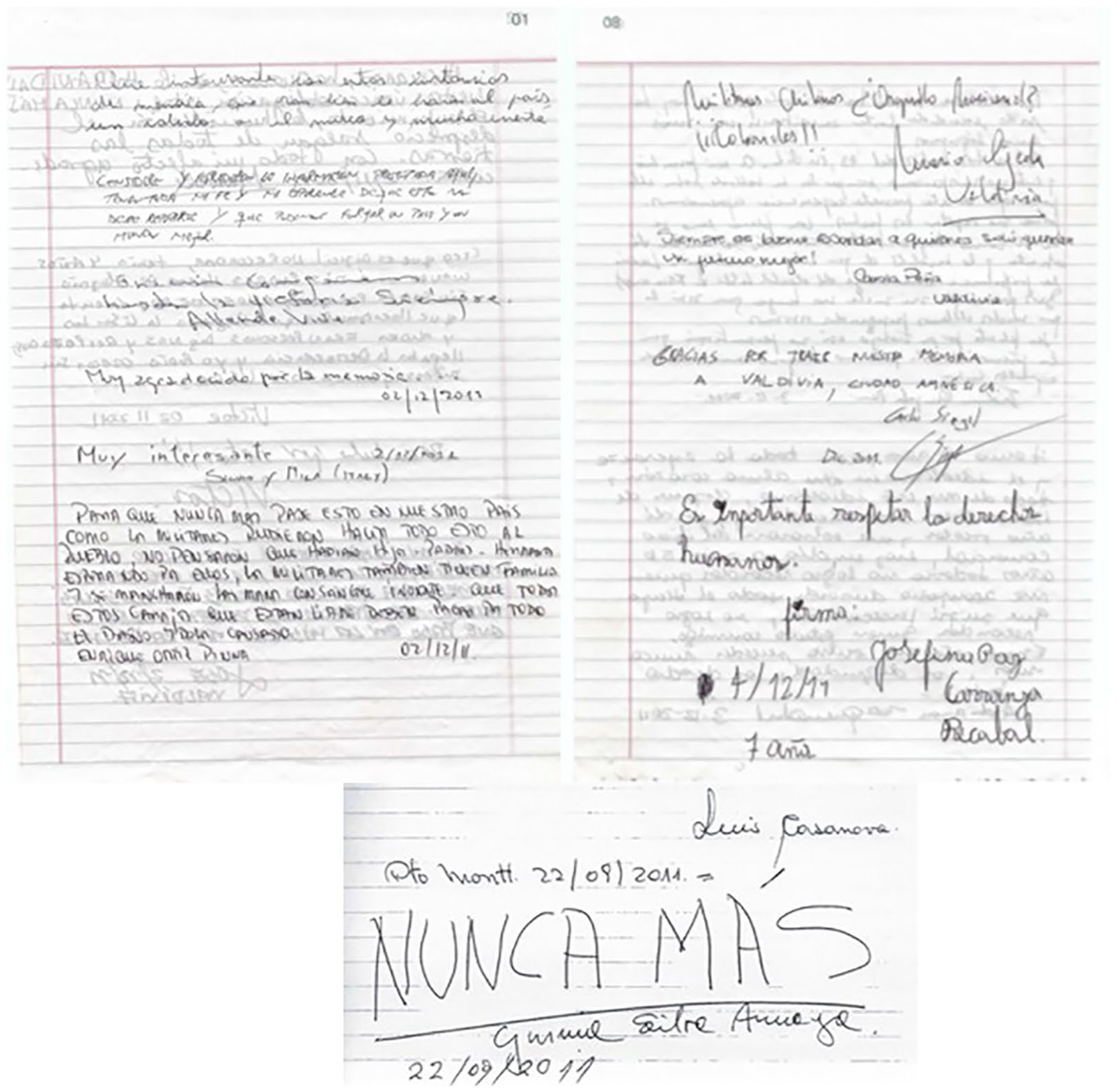
Pages of the VB of Valdivia (left) and Puerto Montt (right). (Archive MMHR).
Methodology
The MMHR provided me with scanned copies of both VBs as PDF files. Unfortunately, there is no information on the number of people visiting the exhibits or other details that would help to contextualise the experience. 9 All comments were subjected to close reading and classified using the following three general criteria: the pragmatics of speech acts (Austin, 2000), emotional language used in the entries and the type of citizenship discourse expressed. When present, the type of memory registered in the entries’ discourse was also tagged, following Hirsch’s (2012) classification. These are: direct memory, inherited postmemory and affiliative postmemory. Direct memory refers to people who experienced the traumatic period of the civic–military dictatorship (1973–1990), either as victims or witnesses. Postmemory, defined as ‘structure of inter- and transgenerational transmission of the traumatic experience’ (Hirsch, 2008: 10), manifests in two forms: inherited (or familiar) postmemory, which is acquired through intergenerational transmission, and affiliative postmemory, which refers to younger generations who have acquired knowledge of the period through indirect sources such as school or media. The analysis will show that these memories would evidence different reactions to the exhibit experience.
The entries were analysed using tools from discourse studies that examine language in everyday use. Specifically, I combined organisational principles and tools of critical discourse analysis (Wodak, 2011; Wodak and Meyer, 2009) identifying contents and topics, discursive strategies and the use and frequency of linguistic means (highlighted in bold in the examples). When quoting the entries, I used V or PM (for Valdivia and Puerto Montt), followed by the number of the entry as placed in the VB. The use of the double slash (//) indicates that there is a full stop in the original. I deleted details that could identify the writers. The unadorned English translations in the analysis are mine; in some cases, I included the original Spanish for the benefit of multilingual researchers.
Categories of historical memory in the VBs’ entries
When visitors interact with an exhibit, they bring their own experiences, historical views and beliefs to the encounter, together with a specific emotional state and disposition (Maturana and Davila, 2015). Chilean historical memory generally presents one of two ways of understanding the civic–military dictatorship of 1973–1990: ‘memory of rupture’ or ‘memory of salvation’ (Stern, 2010). The memory of rupture, which is adopted and documented by the MMHR, portrays the period as a negative experience in Chilean history in which democracy was eliminated and basic human rights violations became a systematic practice on the part of the dictatorship, who would prosecute, torture and kill their political opponents. On the other hand, those who hold a memory of salvation deny in certain cases that human rights violations took place or justify these violations through a necropolitical view (Mbembe, 2003; Rojas-Lizana, 2022) that regards the period as a necessary intervention to stop the chaos in which they perceived the country to be during the Unidad Popular government. This form of memory is considered denialism given the solid evidence provided nationally and internationally that the civic–military dictatorship did violate human rights and exercised political genocide (Basaure and Estévez, 2018; Infante, 2015b; Rojas and Shaftoe, 2022; Stern, 2010).
Of the 182 10 entries registered in both VBs, five manifested a memory of salvation, of which two were instances of trolling (Cook et al., 2017) and hate speech (Lakoff, 2000). These two entries may have been written by the same person as both presented the same handwriting and no personal identifiers: V9: ‘Well deserved, for [being] rotos’, 11 and the exclamation V18: ‘Viva Pinoch[et]!!’ Two other entries (PM58, V36) were slightly more articulate in their content; one criticises the exhibit as a one-sided account of history: ‘Good expo but only talks about the bad things from that date, which is not good because it’s clear that you’re all communists [drawing of a swastika]’. The other entry (V36) just states ‘Pinochet shown to be the best of all time’. The fifth entry is interesting in that it admits, ‘under no circumstances do I justify the torture and violence [committed], but I still believe that military intervention was necessary’ (V52), which is scarcely found in right-wing everyday discourse (Rojas-Lizana, 2022).
The rest of the entries (177) manifested a memory of rupture. These comments showed also other forms of individual diachronic memories: direct memory, inherited postmemory and affiliative postmemory (Hirsch, 2012, see Methodology section).
Effects of the exhibits
The forms in which the travelling exhibits affected most of the visitors who wrote in the VB were reflected in the themes they highlighted as well as the discursive resources they used. These were very similar to those found in the VBs of the permanent exhibits of the MMHR in Santiago (Rojas-Lizana, 2019, 2020). 12 The comments were classified into reflections, testimonies, speech acts and emotions. In this analysis, I will centre on three themes: (1) The use of the VB as a space in which the right to memory is exercised; (2) The use of the VB to reinforce the discourse of the duty to remember, promoted by the MMHR; and (3) The use of the VB to manifest emotions that seem to reflect a positive and healing effect on the writers. It is necessary to mention as a caveat that these results are limited by the fact that they only cover the impressions of the VB’s writers, not of all those who attended the exhibits.
Exercising the right to memory
The right to memory is a fundamental principle promoted by the MMHR and is considered a citizens’ human right that was denied during the dictatorship (Rojas and Shaftoe, 2022). The VBs show diverse ways in which this right is exercised. For example, several entries contain the writers’ contact details, as they wish to contribute to the construction of collective history by offering their testimony and donating archival material (arpilleras,
13
letters, exile material). In this way, the VBs serve a bridging function between the visitor and the Museum.
Example 1 PM14 Eduardo X X. Sector Las Beatas. Tiresia 10th Región de los Lagos. // [I have a] PM15 Marcela X X X // Tiresia 10th Region de Los Lagos, I am 35 years old. V11 03-12-2011//I
The exhibits motivated these two generations of visitors to exercise their right to memory by sharing their direct testimonial accounts, thus making visible a part of history that was negated before the return to democracy. Their discourse manifests a strong conviction against the privatisation of memory (‘must be preserved’); this emerges as part of their moral commitment as survivors to promote the discourse of Never Again (explored below in ‘Exercising the duty to remember’). The articulation of memories, according to studies on traumatic testimonies, provides relief and therapeutic closure (Atkinson, 2020; Chen, 2012; Levi, 2019).
In these cases, the visit has triggered their personal memory and the desire to be heard, demand justice and/or contribute (using the word ‘aportar’ many times) to the construction of this historical memory. Interestingly, a common discursive feature in those who declare a direct memory of the period is to write their full name (which in Spanish includes two surnames) and other personal and identifying information, such as places, phone numbers and dates. This detailed self-identification makes them real, true and contactable, in contrast to the instances of trolling that do not leave identifying markers. Including these details may have the (unconscious) purpose of leaving proof of the veracity and transparency of their testimony, to answer to possible denialists and to truly record a memory that was hidden for years.
Another way to exercise this right to memory is present in comments that declare to be visiting in the company of family and friends, as museum visits are commonly social events (Noy, 2017). In this way, the exhibit becomes a participatory instance that builds community and is an occasion for intergenerational conversation.
Example 2 PM24 10/9/2011 // I came to see this very interesting exhibition V74 A great exhibition! Interesting, this shouldn’t happen anywhere. This is a result of the military coup. O V67 18/12/11
All these entries show explicit gratitude for the visibility given to the recent past that they can share with their family. The visit generates participatory spaces in which memory is understood as shared knowledge. Personal memory becomes collective in its social construction. The discourse of the pedagogical function of history (‘a lesson’) and the discourse of Never Again (see next section) are also present.
Exercising the duty to remember
Like the right to memory, the duty to remember (memorialisation) is a fundamental principle in the search for coexistence, solidarity and healing, which is expected to be adopted at both an individual and institutional level with the creation of instances that promote truth and justice (Garzón, 2015; Rojas and Shaftoe, 2022). The reflections that the exhibits triggered are related to two of the ethical discourses associated with this principle, and which are highly promoted by the MMHR in its mission: the discourse of Never Again (Nunca más) and the discourse of Let’s Not Forget (No olvidar). These discourses are interconnected and were adopted by the Museum from its inception, as they are also part of transitional justice’s core principles (Blanco-Rivera, 2020; Rojas and Shaftoe, 2022).
The inclusion of ‘Human Rights’ in the Museum’s name refers to international agreements on the matter which have been adopted by other museums around the world, making memory a transcultural phenomenon (Carter, 2013; Erni, 2022; Jave, 2020; Purbrick, 2011; Read, 2018; Sodaro, 2018). 15 The discourse of Never Again started in Europe in connection with Auschwitz (Meister, 2005). In Abya Yala, most notably in Argentina, Uruguay and Chile (Lazzara and Blanco, 2022), it refers to the history of the political genocide and violations of human rights perpetrated by the dictatorships that ruled during the second half of the twentieth century (Crenzel, 2015; Sikkink, 2008). Never Again is the most visible discourse promoted by the MMHR both in the exhibits and in its mission statement. This discourse not only refers to never repeating these violations and remembering them but also to commit as citizens to living in a society which prioritises an inalienable respect for human rights (Estévez, 2018; Read, 2018).
Never Again and Let’s Not Forget are the most prominent discourses found in the VBs studied in this article, which was also the case for the Santiago VBs studied by Rojas-Lizana (2019, 2020). 16 Thus, of the 182 entries, 52 stated the phrase ‘never again’ (nunca más) explicitly (15 of them emphasised by using capital letters, see Examples 1, 2 and 3 and Figure 1). Within these, 30 used it as part of the final clause ‘so that it does not happen again. . .’ (para que nunca más), marking it as a wish for the future and of a better society. In relation to ‘Let’s Not Forget’, related lexical items appeared 67 times in the entries (‘memory’, ‘let’s not forget’, ‘do not forget’, ‘remember’), revealing that these two discourses and their aims are adopted in these visitors’ reflections as important components in the country’s road to healing.
It is worth noting that given the presence of transitional justice discourses in the entries, the word ‘reconciliation’ is never mentioned in the Puerto Montt VB, and only mentioned twice in the Valdivia VB (comments 12 – in Example 5 below – and 84). This may be due to the recurrent reflection that after over 20 years since the end of the dictatorship, little had been achieved in terms of truth and justice ‘product of the tight political and legal framework that left Pinochet, his followers, and the economic system protected after the end of the dictatorship’ (Rojas-Lizana, 2020: 20; see also Blanco-Rivera, 2020; Cornejo et al., 2020; Páez, 2003). In fact, 24 comments criticised their contemporary democracy for either the impunity granted to past crimes or because violations of human rights were still occurring at the time of writing in the form of neoliberal policies supported by the Constitution created by the dictatorship in 1980 (see, e.g., V11 in Example 1 and PM29 in Example 3: ‘it is more necessary in times in which the people are struggling again’, likely referring to the secondary and tertiary student protests of 2011). This discontent resulted in the social upheaval of October 2019, called Estallido social (Águila et al., 2022; Charney et al., 2021).
Example 3 V14 [heart drawing] // V33 It is so shocking (impactante) to see all these images and to learn about many things that PM29 11 – September – 2011 // Sincerest thanks for
Never Again is here treated as a collective cross-generational responsibility, manifested in the inclusive first-person plural (‘our’, ‘us’ and ‘we’), that incorporates not only the wish not to see the crimes against humanity repeated but also an appeal to be in a vigilant state in a democracy of defending human rights, given their fragility (‘most necessary (when) the people are struggling again’). V33 displays an inherited postmemory by telling us they have previous knowledge of history (‘I was able to know through my family’); however, it was a partial knowledge, as the images of the exhibit seemed to have produced an impact not experienced before (‘very shocking’, ‘very powerful’) that reinforces the desire to keep the memory. PM29 is an example of affiliative postmemory (‘thanks for refreshing our memory’), which are memories acquired through media and school. 17 The writer states not to have direct experience of the period but still feel the pain of others. It was interesting to find in several of the comments that the wish for Never Again extends beyond the country’s borders as a ‘universal’ principle, expressing that it should be observed across the world (e.g. PM14, in Example 1, V14 in Example 3, and six more entries).
The discourse of Let’s Not Forget is usually accompanied by clauses expressing the reason for keeping this memory: to defy impunity, to honour the victims and never to repeat history. Its relevance and call to action are present in expressions such as ‘must know’, ‘it is very important’, ‘we have to’, ‘let’s. . .’ (see Example 4). This brings to mind the Ciceronian phrase historia magistra vitae est, as the need to go beyond the pain of memory to transform it into a lesson that helps people to recognise the mistakes of the past so that they are not repeated in the future (Forchtner, 2016).
Example 4 V12 V62 An incredible sample of the reality experienced in our fatherland; with our youth, PM68
The three quotes from Example 4 show young people with postmemory (marked in the use of the possessive). They centre on three actions in relation to the Let’s Not Forget/Never Again discourse: to learn (V12), to acknowledge (PM68) and to build a better country (V62). These, and other similar entries reflecting this postmemory (like PM29 in Example 3), manifest a sense of duty and commitment to the construction of a better society, expressed in promises as well as an abundance of expressions of gratitude towards the victims. This commitment relates to the ethical principle that Dussel (2011, 2013) in his Ethics of Liberation calls ‘interpellation’; that is, the stance that recognises and adopts the ‘clamour’ of the marginalised to add oneself to their call for justice, and, in this case, to honour and acknowledge them as those responsible for the youth being ‘born free’ (V62).
Reparation: healing and learning
Part of the objectives of a memory museum is the promotion of social healing and reconciliation (Williams, 2017). It is known that these museums can produce powerful emotional experiences for the visitors and may contribute to healing through acts of remembrance (Brown, 2013; Sodaro, 2018); however, these experiences may not necessarily be positive (Light et al., 2021). Healing is difficult to measure in discourse, but it can be deduced in the expression of emotions and in speech acts such as gratitude and congratulations that have been recognised as positive and beneficial in other contexts (Rojas-Lizana, 2015). The 182 entries of the VBs included 68 explicit forms of gratitude (‘thanks’, ‘express gratitude’ and ‘I am grateful’).
The entries show that those writers who have a direct memory of the period are thankful for the exhibit that, although it may bring painful memories, comforts them by knowing that their experience has been preserved as a confirmation of a long-denied truth. They are also thankful for victims being remembered, and for the youth being able to learn from this recent history and become better citizens.
Example 5 PM79 23/09/2011 // A strange V60 PM25 11 September 2011 // I was a political prisoner. The 5th of October 1973 I lost my father, grandfather, and uncle. I am a member of the X X family, from Y place in Region de los Lagos. My name is Daniel X X.
There are many entries manifesting a plethora of strong and traumatic emotions (PM79). However, they generally conclude with the expression of optimistic or hopeful feelings, which would indicate, cognitively speaking, that the experience was positive. In the examples above, they are expressed with the phrases ‘I congratulate’, ‘HOPE’, ‘I trust’ and ‘THANK YOU’. Full names of dead victims and their relation to the writer are frequently included in the entries as an act of memorialisation (V60, PM25).
On their part, younger visitors express gratitude for the teachings that derive from the exhibit, especially the connection between Never Again and Let’s Not Forget that I mentioned earlier, and the benefits of keeping the memory of recent history. Many of them confess to having been disinterested in the topic until they visited the exhibit.
Example 6 V72 ‘For life, for truth, for justice’. ‘It is the struggle of the people, not of one political party’. // PM32 PM39 14-09-2011 //
As we see, these young people manifest gratitude for the knowledge they gained and the reflections that emerged from the exhibit, admitting it was a necessary exercise for people who did not want to engage with the past before. The experience has promoted a sense of solidarity and national inclusivity, manifested in the use of possessives and words referring to the homeland, such as ‘history’, ‘Chile’, ‘my/our country’ and ‘compatriots’.
Conclusion
The study of VBs offers a window into the thoughts of everyday people and, in this case, can be used as a tool to measure the effect that memory exhibits produce in their visitors. Although the scope of this study is limited to those who made the decision to leave an entry, the findings are similar to those found in the MMHR VB and online comment studies (Águila et al., 2022; Rojas-Lizana, 2019, 2022), which included corpora of thousands of entries.
The regional VBs studied registered a variety of writers, from young people without memory of the period or with an affiliative or inherited postmemory, to survivors and witnesses. These writers’ discourses vary in focus but agree on the importance of keeping and displaying this memory of the recent past. The discourses manifest a wide variety of speech acts, in which congratulating and especially expressing gratitude are prominent. Visitors thank the Museum for exhibiting proof of their historical memory, and of the violations of human rights that occurred during the civic–military dictatorship. They agree that this display intensifies the duty to remember, and that the discourses of Never Again and Let’s Not Forget are fundamental discourses of citizenship that contribute to building a better society. Some of the comments emphasise the importance of these exhibits to build national consciousness, especially in times in which these writers felt that not enough had been done in terms of reparation and reconciliation.
Older writers who had a direct memory of the period express gratitude to the MMHR for the experience that, although it brought painful memories, also gave them a sense of relief at knowing that their memory has been preserved and that the victims are honoured. This sense of relief is also implied in their exercise of the right to remember through their testimonies and memories since this version of history was officially denied until 1990 (and beyond; see González and Rubio, 2022). Younger visitors, in comparison, express gratitude to the victims who fought for the democracy in which they were born and commit themselves to the protection of human rights.
The emotions identified in the entries’ discourses ranged from sadness to shock, to solidarity, acceptance and pride. In many cases, it was possible to identify a healing effect, as the writers used linguistic resources associated with wellbeing and positive coping such as volunteering testimonies and writing reflections ending in positive (optimistic) comments. It can be concluded that the efforts to take travelling exhibits on traumatic memories of the recent past to regional areas contribute positively, at least to most of the VB’s writers, to the integration and construction of a future with a civic commitment to memory.
Footnotes
Acknowledgements
The author thanks the personnel of the Museo de la Memoria y los Derechos Humanos for facilitating the corpus for this research, especially Beatriz Águila, Walter Roblero, María Luisa Ortiz and Francisco Estévez. This article is based on a paper prepared for the conference VIII Congreso de Educación, Museos y Patrimonio ‘Compartir, incluir e integrar para el futuro’, Valparaíso, Chile, 2019, published in 2021. She dedicates it to the memory of David Dungay and María Martín.
Funding
The author received no financial support for the research, authorship and/or publication of this article.
