




Abstract
In this article, I use narrative analysis to examine practices of postmemorial resistance to oppressive authorities in interviews with descendants of Ingrian Finns. The themes that were important to the interviewees concerned questions of historical and contemporary social injustice activated by family memory. My two case studies, based on biographical data collected in Finland in 2020–2021, reflect Ingrians’ descendants’ experiences of marginalization, based both on their inherited family memories of oppression and on their own experiences of having a different family story than those of the social majority. My analysis reveals how the postmemorial work of the descendants of Ingrians is socially, politically and temporally expansive. In contrast to Hirsch, I argue that postmemory, as processed in acts that I conceptualize as postmemorial expressive and rhetorical resistance practices, reflects an identity position.
Introduction
The vast literature on postmemory has concentrated on the intergenerational transmission of trauma and on its consequences, whether psychological and affective (Harris, 2020; Hirsch, 2008, 2012) or artistic (Hirsch, 2012; Mihăilescu, 2018; Romera-Figueroa, 2020). However, some alternative interpretations, such as postmemories of joy, have been raised in the search for new perspectives on postmemory (Wolf, 2019). Marianne Hirsch (2008, 2012, 2019), who coined the concept of postmemory to describe the trans- and intergenerational transmission of embodied experience and traumatic knowledge, has recently stated that ‘a focus on the memory of resistance and refusal, on small and large acts of political opposition, and of rescue offers a different paradigm of postmemory’ (Hirsch 2019: p. 175).
Taking a sociological perspective, I understand resistance as active behaviour done in opposition to someone or something that is understood to be unjust or unfair (Hollander and Einwohner, 2004). In this article, I contribute to the understanding of postmemorial resistance practices by using Patricia Ewick and Susan Silbey’s (2003) method of analysing social structures in narratives of resistance to authorities. In the analysis, I concentrate on the stories’ moral side (Riessman, 2008: 61–62) by paying attention on how the actors use their sociocultural resources in resistance practices (Ewick and Silbey, 2003). By using narratives of resistance to institutional authorities, I illustrate how single, passing and individual acts of storytelling expand socially, temporally (Ewick and Silbey, 2003) and politically. Because stories of resistance are narrated in connection with other stories, they are also bound to the knowledge about workings of social structures and power relationships in general (Ewick and Silbey, 2003). I argue that the social, temporal and political extensions in morally active ways of storytelling are essential for postmemory.
Hirsch (2012: 35, 2019: 172) has stated that ‘postmemory is not an identity position but a generational structure of transmission embedded in multiple forms of mediation’, or as Achugar (2016: 8) describes it, a type of relation between generations that produces a certain type of memory. However, my findings suggest that postmemory, when extended to a societal level in postmemorial work, reflects identity positions. According to Hirsch (2012: 33), postmemorial work ‘strives to reactivate and re-embody more distant political and cultural structures by reinvesting them with resonant individual and familial forms, mediation and aesthetic expression’. However, these re-embodiments and reactivations take form in contemporary social environments. I argue that memories shared in Ingrian families can have an impact on the identities of subsequent generations who live among populations that have mostly different kinds of family memories. I conceptualize the identity position as it relates to family history as an experiential minority position, capturing the experience of otherness of Ingrian descendants in their everyday encounters. By experiential, I refer to knowledge based on experiences that are shaped through encounters with other individuals, things and places. The experiential is socially constructed and has its foundations of knowledge in the reality of everyday life (Berger and Luckmann, 1967). I consider it possible for the experiential knowledge shared through family stories to function as what Stuart Blume (2017) has called ‘filters’, reshaping the experiences, emotions and actions of individuals.
An increasing body of research has shown that we need to develop analytical tools to understand the intergenerational transmission and reconstruction of memories that have moral valence (Gerber and van Landingham, 2021) and relevance for memory activism (Rigney, 2018). The present study concerns the active historical consciousness of research participants based on intergenerational memory transmission, renarration and interpretations of past events (Welzer, 2010: 6). The transmission of social and political values (Muti, 2021; Slabáková, 2021) and attitudes can affect interpretation of the past, present and future among the descendants of Ingrians. I argue that the transmission of social and political values is reflected in the subsequent generation’s postmemorial work of moral valence. People engage with morality in everyday practice (Abbott, 2020), including with postmemories specifically created in their families. Individuals tend to retrospectively evaluate their family’s past in moral terms (Savolainen, 2020). Following Sayer (2005: 8), I take morality to mean ‘simply the matter of what kinds of behaviours are good, and thus how we should treat others and be treated by them’.
The parents of the individuals studied here as cases were transferred from the German-occupied area near present-day Saint Petersburg to Finland during World War II. They are the Finnish-born descendants of Ingrians (also referred to as Ingrian Finns) and second-generation from the perspective of cross-border displacement. Typically, Ingrian Finns as an ethnic group refer to Finnish-speaking Lutherans who lived in Russia and the Soviet Union. 1 Ingrians lived in the historical area of Ingria surrounding the current metropolis of Saint Petersburg, where they settled after migrating primarily from Karelia and Savonia during the period of Swedish empire in the seventeenth century. Russia took control of the region in 1721, after the Great Northern War. Under Russian rule, Ingrian Finns were at first allowed to uphold their heritage, meaning that the Finnish language and institutions such as Lutheran churches and Finnish schools were maintained. These institutions shaped Ingrians’ ethnic identity in the multicultural region. However, the Russian state began Russifying ethnic minorities at the end of the nineteenth century through cultural, linguistic, religious and administrative practices, and the area of historical Ingria was closely integrated into the development of the Russian capital, Saint Petersburg (Kalinitchev, 2016).
For centuries, the historical area of Ingria was a multiethnic region belonging to a politically and geographically fateful border area. In the scientific literature, the region has been conceptualized as an ‘unruly buffer zone’ (Kepsu, 2017) found in an ‘unfortunate geographical location’ (Matley, 1979) because it has been a borderland area impacted by several wars. In the twentieth century, a large part of Ingria in the Leningrad area 2 belonged to the zone that historian Timothy Snyder (2015) has called the ‘Bloodlands’, where the regimes of Stalin and Hitler carried out most of their murderous work.
Like many other Soviet citizens belonging to ethnic minorities, Ingrians suffered from totalitarian social engineering, especially during the time of Joseph Stalin, when at least six million people were resettled in the Soviet Union for ethnic, professional and other social and political reasons (Polian, 2004). Many researchers have underlined the dark side of Ingrian social history in the Soviet Union, including ethnic persecution, repeated deportations and other forced displacements (Flink, 2010; Lahti-Arguntina, 2001; Miettinen, 2004; Reuter, 2023). Moreover, during World War II, the state of Finland transferred 63,000 Ingrians from the German-occupied area to Finland with the German armed forces (Kähäri, 2023; Nevalainen, 1990). At the same time, Ingrian men fought with or were forced to work for the Soviet Red Army, the German armed forces or on the Finnish side. After the war, the Allied Control Commission, consisting mainly of Soviet members, monitored the fulfilment of the conditions of the Moscow Armistice and the Paris Peace Treaty with the Finnish State Police (Valpo). Of the Ingrians living in Finland, 55,000 returned to or were deported to the Soviet Union as Soviet citizens, and many were punished for treason (Flink, 2010). Between 1944 and 1954, 5000 Ingrians fled to Sweden (Kähäri, 2021; Notini Burch, 2014: 163), and some of them continued their refugee journey to more distant countries. The legal position of the Ingrians who stayed in Finland as Soviet citizens was unclear and remained so for a long period of time (Flink, 2010; Kähäri, 2021). The legal, societal and political context created extreme insecurity and fear in Ingrian communities, whose family histories were marked by traumatic pasts, heavy losses and the unpredictability of the future (Kähäri, 2021).
This study illustrates how the Ingrian families’ pasts include oppression by both the Soviet and the Finnish authorities. Because of their traumatic and stigmatized social history, many Ingrian family stories have been silenced and remained untold (Siim, 2016). In this context, even remembrance itself can function as counter-history (Rigney, 2018: 377) and an act of resistance. Also, renarrations can function as acts of resistance, which is shown in the cases described here. I present Ingrian descendants’ stories about their family members’ oppressed positions by analysing two cases out of a large biographical data set consisting of 64 biographical interviews with 29 interviewees collected from descendants of Ingrians in Finland, Sweden and Estonia between 2020 and 2021 for the project Postmemory of Family Separation: An Intergenerational Perspective. 3
Interviewees for the project were found via multiple channels: a newspaper article about the research project in the Finnish newspaper Turun Sanomat, 4 a Facebook group called Ingria, and our partner, the Finnish Literature Society (SKS). Some interviewees were recruited through social networks and the snowball method. I had previously collected oral history data for the SKS project Ingria and Ingrians – Recording histories, preserving memories, 5 and I was already familiar with the Ingrian communities before starting research for the project. Moreover, I became cognitively and affectively ‘bound’ to the narratives of Ingrian people shared with me during the SKS oral history project which was beneficial for the following project.
In the biographical interviews, I implemented a loose thematic structure based on life course events in chronological order and Ingrian social history. We discussed the phases of life: childhood, adolescence, adulthood and retirement, if relevant. However, we concentrated on events related to family relationships, family history and experiences of Ingrian heritage and ethnic background, which was quite natural for the interviewees because they had received information about the study beforehand. During conducting the data, I noticed that the interviewees’ interpersonal family relationships were highly influential in their personal biographies. Moreover, I got the impression that many of the interviewees were keener to discuss family history than their contemporary family life, which I reported in my field notes during data collection.
I consider biographical research to be a method of inviting stories through empathy, where openness to the interviewee’s experiences, moral evaluations and emotions is at the core of sensitive research. Conducting a low-control interview and asking few specific questions often stimulate politically and emotionally charged narratives. However, when collecting data, I found questions like ‘What kind of experience was it for you?’ and ‘What kind of moment was that? Can you describe it?’ to be essential in the biographical meaning-making processes, which can be seen in the data presented in this article. I understand that each social narrative environment affirms certain stories and ways of narrating experience (Gubrium and Holstein, 2008). James Holstein and Jaber Gubrium (2020: 70) have pointed out that ‘all interviews are active, despite attempts to regiment, standardize, and neutralize the process’. This means that the biographical data in the present study is relational and constructed cooperatively in a reflective process between the interviewee and the interviewer closely intertwined with social-historical reality of both interaction parties (Eichsteller and Davis, 2022). 6
Intergenerational transmission of politically contested and painful pasts requires active meaning-making, including agreements, rejections, corrections and reformulations that result in the transformation of family stories (Welzer, 2010). Intergenerational memory transmission of the past is, as Harald Welzer (2010: 5) points out, a communicative process because social memory ‘exists between subjects and not within them’ [italics in the original]. Thus, the creation of postmemory is also social and therefore an interaction, not merely the transmission of a family memory. I consider my interviewees to be agents of change and cultural reproduction, not simply recipients of their parents’ or grandparents’ trauma, memories, ideologies and practices (see also Achugar, 2016: 9). Thus, complex and contested family pasts can be re-evaluated and recategorized for political and social purposes. This may also raise contemporary resistance motivated by historical consciousness among postgenerations. For me as a sociologist, the biographical interview provides data on the individual within the social context meaning that the data collection process, the analysis and the results are responding to the questions about how a community like a transnational family in a society can affect to the formation identities and actions.
I chose two case studies for closer examination because the cases concern central events of Ingrian social history and portray postmemorial resistance practices in a descriptive way. They also reflect the central topics of the wider data set, such as Ingrians’ narratives of oppression, resistance to unjust authorities, societal questioning of their political loyalties, and feelings of otherness. I show that both the historical consciousness of belonging to an oppressed minority and the perception of social ignorance related to postmemorial resistance practices were at the core of Ingrian descendants’ experiential minority position.
In the data, it was common to look for memory sharing and reception outside the family. However, interviewees seldom found acceptance and understanding, especially among people who were regarded as distant to the Ingrian experience. The stories of the two cases highlight second-generation Ingrian activism and activity, reflected in their expressive and rhetorical agencies. These kinds of agencies have been identified in other memory studies as well (e.g. Savolainen, 2020: 1025). My study demonstrates that subsequent generations are eager to search for meanings and identities related to their families’ past, and they may also be active in representing those meanings and identities in their actions and speech. In the analysis, I ask how aspects of social structures and moral positions appear in the narrated stories and in interviewees’ postmemorial work. The specific postmemorial work related to oppositional attitudes and acts among Ingrian descendants relates closely to the practices that Ewick and Silbey (2003: 1331) describe as ‘structures of social action and the possibility of resistance but also about the justice and morality of resistance to authority’. In the narrative analysis, I concentrate on how interviewees select, connect and organize persons and events in the stories. I have chosen specific narrative sequences in the analysis to illustrate the meanings of key persons and events related to interviewees’ familial reminiscence in their postmemorial work. Moreover, I pay specific attention to the social and political aspects of the stories. Narratives are bound to the social structures which are embedded to power flows in a broader world (Plummer, 2020; Riessman, 2008: 8), meaning that narratives are politically ‘active’. This idea is based on the relational theory of power discussed in the theories of Michel Foucault (e.g. Foucault, 1977). I analyse how material, linguistic, symbolic and organizational phenomena are reflected in the second-generation interviewees’ family memory and postmemorial resistance practices, and how these are related to the interviewees’ biographies and their central moral, political and social positions. Family is a dynamic collective in remembering the past (Muti, 2021) and postmemory as a form of family memory seem to have a vivid impact on Ingrian postgenerations. Family memory is typically formed by interaction between children and their parents, establishing an intergenerational memory which is collective in its character (Erll, 2011: 306).
Resistance to authorities among Ingrians and their descendants
Sociologist Anni Reuter, who has explored the deportation of Ingrian Finns, has recently pointed out the meaning of resistance to Soviet authorities among Ingrians who experienced persecution and forced displacements in the Soviet Union (Reuter, 2023). Many Ingrians were quietly active in resisting the communist government and its oppression, such as by ridiculing the authorities with mocking songs and poems (Reuter, 2019). The central narratives of Ingrians have typically concerned their ethnic background as Finns, ethnic dispersion, deportations, hunger, harsh living conditions, imprisonment and the traumatic loss of loved ones (e.g. Reuter, 2020). Ingrians have also expressed institutional distrust towards the Finnish authorities during and after World War II, when they were used as wartime labour in Finland and often treated with disrespect (Kähäri, 2021). In both the Soviet and Finnish contexts, Ingrians resisted being controlled in an unjust manner by escaping from deportation destinations (Reuter, 2020) and fleeing from the country (Kähäri, 2021). Thus, the Ingrians who experienced ethnic persecution, deportations and other forced displacements often practised resistance to authorities. The attitude of resistance that was shared among Ingrian communities and families was also reflected in the stories of some Ingrian descendants.
Some descendants’ postmemorial work was related to the oppression experienced by their ancestors and took the form of expressive or rhetorical acts of resistance. These practices were often bound to artistic ways of remembering and a rebellious attitude in relation to authorities, or to critical evaluation of power differentials and morally active justice claims. Both ways of resisting were bound to the need to discuss the moral framing of unjust events of the past. Moreover, the interviewees experienced the moral framing of these events in both physical and virtual spaces during their acts of resistance when renarrating the ‘material evidence’ they could rely on to support stories that might otherwise have been left intangible. Thus, in contrast to Hirsch (2012: 48), I think that postmemory, as opposed to memory, may also to some extent be a morally evaluative memory striving for authenticity and truth. This may specifically be the case for small and relatively quiet minorities and for ‘minorities within minorities’, whose histories from their own perspectives have remained unwritten.
However, interviewees’ postmemorial work related to their Ingrian heritage was often socially ignored or rejected by the majority, reflecting the phenomenon of otherness discussed in the interviews in the broader data set, particularly among descendants born in Finland. This is highly significant because Ingrian Finns and Finns have traditionally been considered to originate from the same ethnic, linguistic and religious folk group. Thus, it is the experiential level, relating to social history of transnational oppression inherited via family memory and extended postmemorial resistance practices, which seem to draw deep distinctions between individuals and groups. Thus, the specific thing that makes Ingrian Finns a minority in Finland can be postmemory itself. Specifically, Finns without Ingrian heritage often had difficulties understanding the experiential and emotional meaning of persecution, accusations of disloyalty and discrimination for Ingrian families. In the data, it seemed that people living in the post-Soviet state as Estonia people had more same kind of experiences of oppression that could be shared in communities that Ron Eyerman (2012) could call ‘carrier groups’, which helped them to deal with trauma related to deportations and the events of World War II. The carrier groups as bearers of memory, are central to the making of social trauma, representing, and articulating it, making it to available to communication and shared understanding (Eyerman, 2012: 573–574).
Timo’s expressive postmemorial resistance: a return to his ‘inherited’ house
Timo is a highly educated man from Finland, born to a Finnish mother and Ingrian father in the 1960s. He serves as a reservist in the Finnish armed forces and has long been highly active in associations that embody his values of social responsibility and spiritual growth. Timo’s Ingrian father, paternal grandmother and other relatives were displaced to Finland during World War II. Timo’s grandfather, his father’s foster father, was left dead in a pit in the Soviet Union, and his uncle died as a refugee in Estonia. From time to time, Timo travels to the places where key family events took place to remember the loss of the close family members he never personally met.
Timo’s father’s life story was highly meaningful in Timo’s biography. From the beginning of the interview, Timo narrated long stories about the fate and survival of his father, rather than talking about himself. He explicitly reflected on how his family’s forced migrations were meaningful to him, explaining that family members had shared stories of deportation in his childhood. In the biographical interview, he returned to his father’s experiences again and again, constantly making temporal transitions and experiential analogies between his own life and that of his father.
Timo’s narrative in the biographical interview concerned fundamental events of Ingrian social history widely shared among Ingrian families: deportation and escape. ‘Flight talk’ describing escapes from deportation destinations was common in the broader data set. Timo’s flight talk was based on a short, fragmentary family story concerning the deportation of his father’s family from North Ingria, near present-day Saint Petersburg, to Siberia in the 1930s.
They were sent somewhere. I don’t know where. They were sent somewhere in Siberia, but they had a chance to come back.
You mean your grandparents were sent?
Yes. So, my mother’s – I mean, my father’s mother, Anna, and his father, Juho, they were forced to move somewhere in Siberia. I don’t remember where they were sent.
Was it the time of ethnic cleansing at the border [of Finland and the Soviet Union]?
It probably was. In any case, my father had already been born [. . .] So it was before the war, ’37, ’38. There was a law – but anyway, they managed to return to [another place in Ingria], a little village near Saint Petersburg, before the Germans attacked. And this village was occupied by the Germans, and they had a chance to go to Paldinski [Estonia].
Timo’s narrative of the historical forced displacement experienced by his family underlines the relativity of truth and uncertainty of historical knowledge, as the family is sent ‘somewhere’ in the Siberia. As Sicher (2000) noted in his study on post-Holocaust narratives, second-generation Ingrian interviewees’ narratives of their parents’ traumatic past were related to ‘the fragmentation of the self, the relativity of truth, to the fluidity of memory and to the impossibility of ever fully knowing’. The uncertainty concerning key family events may be the essential reason causing Timo to be troubled about his family’s traumatic past. Siberia often stands in as a generalized destination for deportations in the Soviet Union in the stories of Ingrian descendants. The actual destination of the deportation is not important to the narrative; instead, the reason for the deportation – the order that Timo calls the ‘law’ implemented by the Soviet authorities in 1937 and 1938 – and how the interviewee reconstructs the story of forced displacement is key. Timo develops a story of a traumatic key event in his family history, a narrative reconstruction of a disruptive family event in which he is emotionally involved. His imaginative closeness to the family homestead recalls stories that are in Hirsch’s (2012: 5) terms ‘evacuated’ by the descendants of survivors.
Instead of concentrating on the deportation itself, Timo quickly changed the focus of the narrative to the family’s return to the Saint Petersburg area. The story included the theme of flight, referencing Ingrian resistance to the punishment practices of the Soviet authorities, although only as a sidenote. Escape was a silent way of resisting the unjust use of power in the Soviet Union (Kähäri, 2021; Reuter, 2020). Timo’s deportation narrative was extremely short, concentrating on the resistance of his family members who left the place they had been deported to, presumably without permission. In the family memories of Ingrians, this was highly typical after forced displacements to Siberia (Reuter, 2020). The ability to escape reflected the fact that there were discontinuities in the totalitarian Soviet system. People in Russia have traditionally taken advantages of their social networks, for example, to survive harsh conditions (Ledeneva, 1998).
The deportation of Timo’s family members was based on the Soviet rule that “seemingly regarded” them as anti-Soviet elements. Specifically, between 1937 and 1938, the People’s Commissariat for Internal Affairs (NKVD) repressed so-called anti-Soviet elements, former kulaks and criminals according to NKVD Order No. 00447 (Snyder, 2015: 81). Even earlier, many Ingrian families had been deported as kulaks to the peripheries of the Soviet Union during the time of eliminating nationalism (see, for example, Flink, 1991; Suni, 1991). Mixing class terror and national terror was a typical practice to oppress minorities in the Soviet Union. In his story, Timo refers to a ‘law’, which he does not explicitly describe. This relates to the fact that the deportations of the ethnic minorities in the Soviet Union were often implemented by the decisions of the ruling Communist Party, the Soviet government and their representatives based on the actions of the security service (Polian, 2004: 2). Also, the mass deportations of Ingrian Finns from the border area were based more on the administrative practices rather the judicial field of the Soviet system (Reuter, 2023). However, Timo is aware there was rule and that the operations related to it were extremely fateful to his family and the Ingrian community as a whole. The orders made ethnic cleansing and deportations from the border area administratively acceptable, but their implementation was not acceptable to the people who were targeted by the unjust power of the Soviet authorities. According to Ewick and Silbey (2003: 1353), ‘because rules commit organizations to lines of predictable action, rules create both opportunities to resist and means of resistance’. In the case of Ingrian families, too, with administrative orders emerged opportunities to resist.
Later, awareness of the unjust use of power by the Soviet authorities against his family members seemed to be the key motivator of Timo’s expressive postmemorial resistance. In the biographical interview, he told me about returning to his family’s homestead in a narrative that illustrated his personal agency in relation to Soviet oppression:
What kind of experience was it for you?
It was wonderful. I had just left the [Finnish] army. I had stolen an army shirt from there. I have the army shirt on, and I’m standing with my arms crossed in the picture. Here is my inherited house! And it is going to be taken back someday, but not today.
Did you feel a connection to it as a place –?
Well, it is my inherited house.
– when you think about the history of your family?
Well, I don’t know. Of course, it is. I was there. I returned there. When I spent time in Saint Petersburg, I drove there. I have an old map in Finnish. And I had white paint and a paint brush with me. I drove through the Karelian Isthmus to the house and wrote the old Finnish names on the stone foundations of the burned houses. And then I visited [the Ingrian village] by the river, where the old [enterprise] owned by my father’s family was. Then I saw the places [my grandmother] told me about.
Having broken legal rules and conventions both in Finland and the Soviet Union, Timo seemed to be bound to his family’s intergenerational practices of resistance. However, Timo had been born in a relatively free Western democratic state, where he had freedom of speech as well as freedom to act as a ‘memory activist’. His resistance was far from the indirect and silent resistance practices described by Reuter (2020) as typical among oppressed Ingrians in the Soviet Union during the Stalinist regime. It was a public form of expression, as is typical of postmemorial work. Timo performatively resisted the deportation of his family from their homestead, the event of oppression that deprived his family of their property and material resources. He also resisted the Russification of Finnish place names with his act of artistic postmemorial resistance. He emphasized the meaning of his ‘inherited house’, although he had not inherited the house in a legal sense, only in his imagination, underlining the idea of material heritage (Figure 1). Timo was in a way between the present and the past but emphasized his return to his father’s homestead, the place his grandmother had told him about, repeatedly mentioning his own physical presence in North Ingria: ‘I was there’, ‘I returned there’, ‘I drove there’, ‘I visited there’. These statements highlight Timo’s agency as well as the geographical, cultural and political distance between the place he was born in western Finland and his family’s homestead in the Leningrad area. He made his own imaginative rules and claims regarding the ‘inherited’ house. Timo stated that the house is owned by his family and playfully asserted that the house will be reclaimed someday. This is a sort of moral claim, not a legal claim, as he constructs his own rules in a postmemorial performance and practice of resistance.
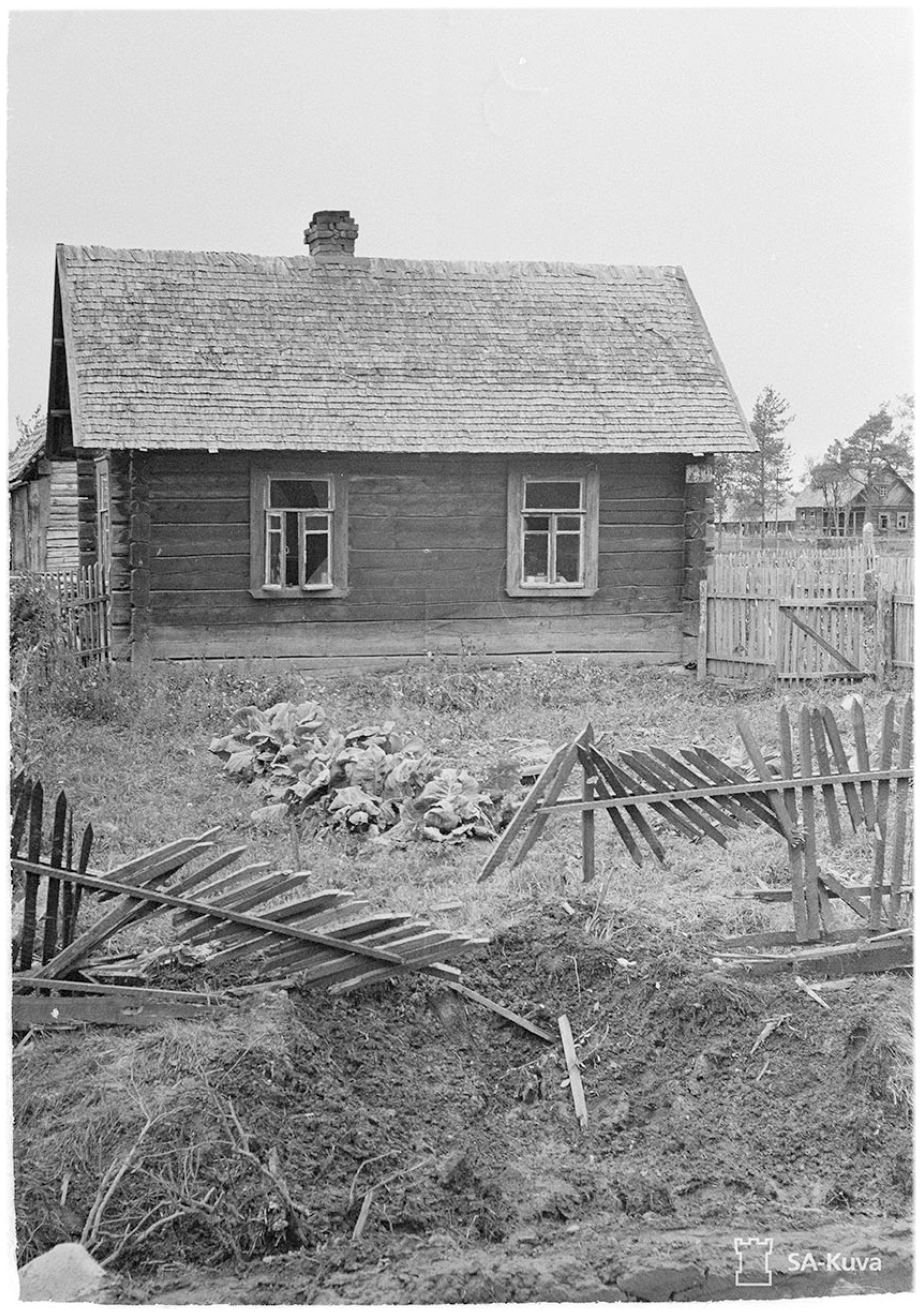
An Ingrian house in Aleksandrovka, during World War II. Photograph from SA-Kuva, the Finnish Wartime Photographic Archive of the Finnish Defence Forces. 7
In his narrative, Timo was extremely conscious of his family’s historical lack of power. By wearing his Finnish army shirt, he used the material and symbolic resources he derived from a military organization, the Finnish armed forces, to take on the role of a ‘fighter’, making his expressive postmemorial resistance visible. Stealing the shirt from the Finnish army was an illegal act done for a higher purpose, with the ‘justness’ of Timo’s postmemorial act outweighing questions of legality. Timo’s acts were clearly related to oppressive social structures and not limited to the individual or familial dimension of postmemory. He left marks on the environment in time and space, just as the family memories transmitted by his father and grandmother had left marks on his consciousness. By visiting Ingria and recalling the moment when his family members lost their home and right to self-determination, Timo performed postmemorial work and presented justice claims reflecting his moral position in historical social structures.
The narrative of return underlines Timo’s emotional bond to his father’s homeland as well as his political and legal opposition to Stalinist repression, even after a long period of time. His narrative mediates what Hirsch (2012: 206) describes as ‘political, economic, and juridical claims of dispossession and recovery that often motivate return stories’. However, the saddest part of Timo’s story is the loneliness of his return, which reflects the lack of social sharing and understanding of Ingrian postmemory:
Did you make those trips alone or did you have –?
Timo: I was alone. They weren’t at all – [the Finnish] men on the job were only interested in drinking. They were more interested in drinking.
This exchange reveals the lack of social reception of Timo’s experiences related to his family’s persecution. Timo’s colleagues at work were not interested in his return. Even Timo’s own children were disinterested in Ingrian history, while Timo himself said he had read ‘all the books I managed to get my hands on’ regarding Ingrian history. Though Timo had spent a lot of time with his colleagues and children, they were ‘outsiders’ from the point of view of his key experiences. His experience of the past and present was different than that of others due to his extremely close connection to the family memories shared by his father and grandmother. Timo’s postmemorial work, which related to the family stories he had heard during his life, illustrates his experiential minority position, based both on his family’s oppressed and marginalized past as well as on his own social isolation when reminiscing the past.
Olga’s rhetorical postmemorial resistance: a return to the memory of an executed uncle
Olga is a woman from Finland born to a Finnish father and Ingrian mother in the 1960s. She has a business education and works in the public sector. Olga’s professional skills include searching for information from a variety of sources, which later enabled her postmemorial work. She has been active in helping immigrants to integrate into Finnish society, a way to express her values of solidarity and care.
Olga’s Ingrian mother was displaced to Finland with her siblings during World War II. Olga’s grandmother died in a camp in the German-occupied area, and her grandfather disappeared before the war. 8 Olga’s family memories from the Soviet Union are scarce, and it is impossible to know if her grandfather was a victim of Stalinist terror or not. However, according to Olga’s mother, there was a lack of information about the fate of Olga’s grandfather. Life in Ingria was said to be lovely before the war. Uncertainty concerning the fates of lost relatives in the Soviet Union or German-occupied area during World War II is common in Ingrian family memories.
In World War II, Ingrian men fought in several armies depending on their location, citizenship, ethnicity and political loyalty. Many times, hunger or violence was the motivation to join a foreign army (Kähäri, 2023). When even brothers could be fighting on opposite sides of the front, it was often impossible to construct a shared story concerning the central historical events and experiences within an Ingrian family. Olga’s uncle Arvi “joined or was forced to join” the Red Army and disappeared, and his unsolved fate became the central loss for Olga’s mother. She regularly recalled the loss of her beloved brother, and Olga herself became affectively troubled by the loss as well. Although Olga never met Arvi, she had an extremely intensive relationship with his memory. Later, as an adult, Olga began to fill in the triggering family memory of Arvi with information she found in archives and on the Internet. Her actions could be described as a ‘digital narrative return’ to the life of her lost uncle, as she used the data available in a religious journal on the Internet to get to know and understand her family history:
One time, I found farewell letters on the internet. They were published in a religious magazine [. . .] And this Arvi Teräväinen, he was in his twenties. He begged for mercy from the state of Finland. But the Finnish [authorities] executed him because the Russians had forced him to be a spy. Because Ingrians – probably because they spoke the Finnish language – they were recruited to spy [for the Red Army]. And indeed, he was in [prison] and died there.
The story illustrates how Olga solved the mystery of her uncle, which her mother’s repetitive stories had made relevant for her. Moreover, the story demonstrates the oppressive use of power by both Soviet and Finnish authorities, reflecting the problem shared by Ingrians, who ended up in various countries during World War II. Namely, state authorities used their knowledge of both Finnish and Russian for political and institutional purposes.
During World War II, specifically in 1942, many Soviet citizens who were of ‘kindred’ ethnicity to the Finns, such as Karelians and Ingrians, were sent to Finland to spy (Kosonen, 1989: 67–68, 84). In Finland, both popular opinion and the attitudes of authorities working in the armed forces were understandably extremely harsh towards these people (Figure 2). Soviet spies were regarded as sly and dangerous (Kosonen, 1989: 67). Finland aimed to execute Soviet spies in courts-martial as quickly as possible (Kosonen, 1989: 67). Olga felt ambivalent about the state powers involved in her uncle’s death, as her interpretation was that her uncle was ‘forced to spy’ by the Russians and then executed by the Finns. On one hand, it was known that authorities in the Soviet Union blackmailed their citizens to get them to spy in Finland (Kosonen, 1989: 136). On the other hand, the treatment of Ingrians in the Finnish armed forces was contradictory in many regards. While some Ingrians were being ‘protected’, others were executed. The familial experience of being left without choices in the context of the oppressive use of power is typical among Ingrians living in different countries. Ingrians’ ethnicity and loyalty were under suspicion.
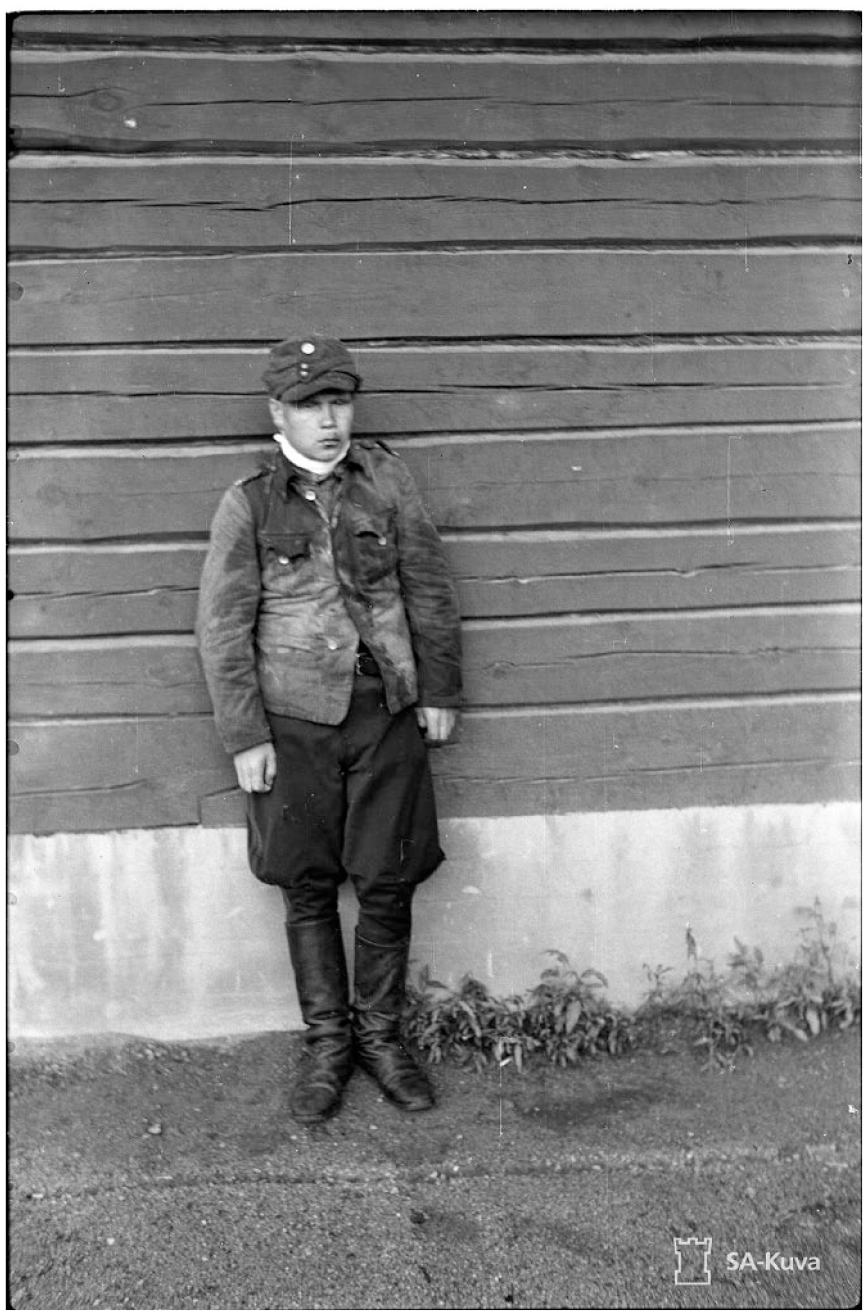
A captured Finnish-speaking Ingrian spy, dressed as a border guard officer, during World War II. Photograph from SA-Kuva, the Finnish Wartime Photographic Archive of the Finnish Defence Forces. 9
Arvi’s farewell letters had been found in the private archives of the Finnish priest who served both Ingrians and members of the Finnish armed forces during the war. In her biographical interview, Olga blamed the Lutheran priest for not sending Arvi’s farewell letters to his family after Arvi was imprisoned for spying for the Soviets. She also accused the priest of adding his own politically motivated religious thoughts to Arvi’s letters and made morally relevant justice claims regarding the unjust acts of the priest. Olga’s rhetorical postmemorial resistance implicated politically motivated religious authorities, an attitude she expressed multiple times in her life story and which had been transmitted to her by her mother.
It was the blasted priest’s fault. He should have acted earlier since he had those letters. He could have been in contact with the family members because it was the last wish of Arvi and all those [other] Ingrian men. But no. It was not until the priest died that these letters were found in his belongings. And there [in the letter], Arvi says goodbye to Anni, Maria, Toivo, and Iida. All the names are said right. One half of the letter seems to be dictated by the priest, and the other half of the letter is written by Arvi. The first half is written in religious, literary language.
Rhetorically, Olga called into question the morals of the Finnish Lutheran priest and judged him for not righteously serving prisoners of war. According to her story, the priest, serving the juridical purposes of the Finnish state, failed to make an effort to contact the Ingrian family members of a Soviet spy. Arvi was a Soviet criminal and, from the perspective of the Finnish authorities, extremely low in the social hierarchy. In Olga’s interpretation, the Finnish priest lacked respect for the last wishes of an Ingrian man who did not have any rights. Olga morally evaluated the socially meaningful historical situation, addressing the unequal power relationship between the Ingrian prisoner of war and the Finnish priest, whose actions seemed to be in conflict with basic Christian principles. These differences in power and authority emerge from historical silence to face Olga’s critical evaluation in her rhetorical postmemorial resistance. She made justice claims and had a strong need to discuss the moral framing of the unjust event. In this regard, postmemory, as opposed to memory, may to some extent be a morally evaluative memory striving for authenticity and truth (cf. Hirsch, 2012: 48). Olga was both overwhelmed by what she had learned about her uncle’s fate and also extremely emotional about the acts of the priest:
What kind of moment it was? Can you describe it?
What?
The moment you found [the letter]?
On the one hand, it was terribly sad because my mother never did find out his fate. And on the other hand, it is overwhelming that so close a family member, my uncle – what kind of a life he had, compared to my spoiled life. There is such a deep gap between our fates. [. . .] Anyway, I was so annoyed that [the priest] promised to find [my uncle’s] family members and to give his farewell letter to his family members. It was quite disgusting.
Olga’s story speaks to the affectivity of a ‘digital narrative return’ in the search for a family member who is both distant and close. Arvi was endlessly missed in the intimate realm of Olga’s family, which explains Olga’s postmemorial work and the emotional intensity of the moral evaluations she made. Moreover, Olga positioned the Finnish Lutheran priest as an outsider in her story.
Olga’s story extended socially and temporally when Olga said that her sister had been in contact with the priest’s grandson, who was responsible for publishing the private letters in the religious magazine. The grandson had come into possession of the priest’s private archive, including Olga’s uncle’s letters, and was also criticized by Olga in moral terms.
Elina, my older sister, was in contact with Mikael [the priest’s grandson] because she was so irritated [laughing]. She is an atheist, as we all are. She was so irritated by [the priest]. And she asked Mikael. . . But he didn’t bother to. . . They just published those without informing us. I mean, this Mikael didn’t bother to find whose. . . You just find out yourself.
Thus, by the end of Olga’s story, both the priest and his grandson were outsiders. Olga’s moral evaluation included both historical persons and events, and contemporary persons and events. The priest took part in the state’s oppressive acts towards her family member, and the priest’s grandson Mikael did not seem apologetic or empathetic to Arvi’s family members for having exploited the intimate, traumatic family story by making it into a religiously motivated public story. Moreover, Olga refers to her family, ‘we all’, as atheists, setting them apart from the Lutheran faith that is typically associated with Ingrians. Olga empathized with her exploited family member Arvi and held a dual position of being subordinated both herself and on behalf of her uncle when doing her postmemorial work of moral valence. Olga and her family members are in a different, subordinated political, religious, class and ethnic position compared with the priest and his grandson, and they aimed to rhetorically release themselves from inequities relating to sociohistorical meanings.
Olga’s uncle had hardly any possibilities to resist his superordinates. However, Olga seemed to do her postmemorial work also for him, resisting their superordinates with her uncle in her imagination. Her uncle begged the Finnish authorities for mercy, which highlights his utterly subordinated position as a humiliated prisoner. The acts of Olga and her sister against those in superordinate positions as well as their negative attitudes towards historical authorities and their descendants appear to disrupt the hierarchy between subordinate and superordinate families. It was obvious that Olga’s postmemory and familial moral interpretation was quite the opposite of that laid out in the religious journal, which was written by a religious person who wanted to turn the life story of Olga’s uncle into a religious lesson.
Conclusion
In this article, I have focused on the memory of resistance and postmemorial acts of political opposition, contributing to the paradigm of postmemory (Hirsch, 2019) from the perspective of sociology. The themes that were important to the interviewees concerned questions of historical and contemporary social injustice activated by family memory. By concentrating on postmemorial resistance practices of Ingrian descendants, the analysis illustrates how descendants of Ingrians living in Finland were morally bound to their family history, which was reflected in their postmemorial work. According to Ewick and Silbey (2003: 1355), ‘transactions among persons of different degrees of power and authority rely on silent but mutual recognition’ of the power differences. The descendants of Ingrians were highly conscious of their family members’ historical lack of power and challenged unjust state authorities and politically oriented religious actors through their actions and speech, undertaking postmemorial work of moral valence. The themes that were important to interviewees in the broader data set often concerned questions of historical social justice activated by family memory (Dellios, 2018). My findings suggest that an individual postmemory, when extended to politically or morally active postmemorial work taking the form of resistance to unjust authorities, reflects the identities of the interviewees, in contrast to Hirsch’s (2012) characterization of postmemory.
In memory studies, some researchers, such as Öndercan Muti (2021), have recognized the need to look at the social and political effects of family memory among subsequent generations. Recent studies on Ingrian oral history have shown that the attitude of resistance towards unjust authorities emerged in Ingrian communities in the Soviet Union (Reuter, 2019, 2020), in the German-occupied area during World War II (Kähäri, 2023) and in Finland and Sweden (Kähäri, 2021). This attitude of resistance may have also been transmitted intergenerationally, from one generation to the next. This highlights the meaning of the family as a dynamic collective in remembering the past (Muti, 2021), inspiring subsequent generations to undertake postmemorial resistance practices, at least in a democratic context like Finland.
Harald Welzer (2010: 5) has commented that ‘family memory does not serve as storage for memories but as a catalyst for the most different elements of the past to be specifically combined by the involved persons’. This study indicates that Ingrian family memory is no different. By engaging with the socially functional acts and justice claims in their postmemorial resistance practices, the interviewees seemed to present themselves as historically orientated contemporary mnemonic agents, even memory activists. Radmila Švarícková Slabáková (2021) has highlighted that people experience their first associations with the wider world in families, and that the stories shared in families have a remarkable impact on our historical consciousness. This was also reflected in this study. I have shown how intimate Ingrian family stories later motivated interviewees to search for places, materials and encounters related to the past and to process them in their postmemorial work of moral valence.
My interviewees were typically alone in their deep interest in their family history and in their remembrance of the past, even within their own families. Feelings of otherness were reflected in the stories of my interviewees in various social environments in the broader data. However, this phenomenon was particularly evident among interviewees who challenged the powerful through expressive or rhetorical resistance practices using their personal, institutional, professional and other sociocultural resources. A lack of social recognition in their everyday encounters may also have an impact on their feelings of otherness, which were quite frequent in the broader data. Many of the Ingrian descendants, specifically those living outside the post-Soviet context, seem to stand at the margins with their family histories, which fit poorly into national ways of remembering. Of the cases in the present study, Olga’s family story is particularly hard to present in the context of Finnish public remembrance. Many experiences related to Ingrian family memories do not fit into the general picture of central historical events from the perspective of the majority, creating experiential minority positions. However, working with family memories can create new possibilities to include marginalized individuals and groups in history (Barclay and Koefoed, 2021) and public discussion, as the present study shows.
Family stories that did not resemble those of others or did not fit well into national frameworks were often socially ignored or rejected. The social ignorance or rejection was often experienced in hierarchical social structures where other stories or interpretations were seen as more valuable or interesting and worthy of being told from the point of view of individuals belonging to the majority. This also reflects the fact that wide recognition of Ingrian past and experiences has not taken place in public in Finland (Savolainen, 2021: 921). Moreover, the need for social recognition and the reception of family memory concerns only not Ingrian descendants, but migrants and minorities in general. Nonetheless, the recreation of emotionally meaningful communities when sharing memories typically requires a shared history of experience (Kivimäki, 2019: 25–26). In this regard, sharing intergenerational family memories may be more meaningful with people belonging to groups that have similar family histories.
Footnotes
Funding
The author disclosed receipt of the following financial support for the research, authorship, and/or publication of this article: The research was funded by the Research Council of Finland (grant number 344527)
