



Abstract
This article demonstrates the post-World War II conflict of memory in Serbia, as manifested in the transformation of urban space in the post-war decades. The authors focus foremost on Zemun, a district of Belgrade which, between the mid-nineteenth and mid-twentieth centuries, was home to a significant German population. The term ‘memoryscape’ (Sławomir Kapralski) is used to discuss changes in the urban fabric. Post-war manipulations of space, based on the ideological foundation of brotherhood and unity, and treating members of the German nation as collectively responsible for the war, resulted in the erasure of all traces of German presence in Zemun. The article describes the Zemun conflict of memory using the example of a German cemetery that was liquidated by the authorities after World War II. In the 1950s, a hospital was erected on the site of the former necropolis, and the area functions nowadays as a difficult-to-access ‘non-site of memory’ (Roma Sendyka). The tombstones from the destroyed cemetery were used to build the stairs leading to Kalwarija Park. For decades, this fact was treated as an urban legend, but its authenticity was confirmed when fragments of grave inscriptions were discovered on the slabs used in the stairs during renovation. Kalwarija Park itself constitutes a remnant of the German Catholic heritage of this area, now dominated by Orthodox residents.
Introduction
The space we live in always remains embedded in a specific value system. It reflects the state of social life and various socio-cultural processes whose dynamics are strongly linked to the cultural differences of its inhabitants. As the Balkans are a multi-ethnic and multi-confessional region, it is filled with places where the histories of many different national, cultural, ethnic and religious
groups intersect. However, the characteristics of such areas are undergoing changes driven by inter-group memory rivalries. Some groups emerge dominant from this uneven fight, while others get erased, with all traces of their historical presence fading into obscurity. Thus, the space that once was a multicultural city ceases to be a site of dialogue and becomes perceived as a stage of conflict.
In this article, we would like to consider the space of Belgrade – the focus of numerous memory conflicts in the second half of the twentieth century, all of which left their marks on its urban fabric. Exploration of the urban space and analysis of the historic traces make it possible to reconstruct the rivalry process and identify the hierarchy among narratives about the past. Today’s Belgrade is dominated by signs and symbols related to collective national memory, and still includes fragments of its former multi-ethnic identity – a polyphony of memory (Traba, 2009). Material traces of the past make up a landscape in which various groups can identify their own significant places commemorating their historical experiences. In the twentieth century, any space-related actions performed in the city were aimed at making the landscape subordinate to the dominant version of history and questioning the presence and importance of other groups (including Jews, Roma and Germans). However, it should not be forgotten that Belgrade used to be a city whose ethnic diversity was ‘outstanding by the degree and quality’. The Kingdom of Serbs, Croats and Slovenes, established after World War I and renamed the Kingdom of Yugoslavia in 1929, united three South Slavic Nations, several non-Slavic ethnic minorities from the neighbouring states (Hungarians, Romanians, Albanians) and other ethnic groups (Jews and Roma) within one state organism (Vidaković-Petrov, 2020: 239–240).
By deciphering the city-place of Belgrade and experiencing it as a memorial site, which Aleida Assmann (1999: 309, after Saryusz-Wolska, 2011: 142) refers to as a Gedenkort, we aim to reconstruct the history of the city’s marginalised Other. We want to focus our attention on the material traces of Belgrade’s German community, which was rarely of interest to researchers and whose memory is preserved in the city only in a limited scope. Consequently, our analysis foremost concerns the district of Zemun, once a separate border town in Austria-Hungary with a significant German population – about 8000 prior to World War II. 1 We are primarily interested in ‘places of rupture’ (Polish: miejsca przełamania; a term coined by Karolina Ćwiek-Rogalska, 2017: 13) where the elements of German culture remain noticeable in the fabric of the dominant Serbian culture of Belgrade. Our article aims to create a map of such places.
In its traditional definition, an identity, be it social or national, is based upon a foundational of the so-called ‘community of memory’, which consists of such elements as: cultural tradition, language, ethnicity, and a community of experiences (Assmann, 2008; Halbwachs, 2008; Traba, 2009: 76–77). However, such an approach implies that those whose history differs from the standard version should be excluded from the community. This exclusion process is conducted at the same time as the formation of a cohesive vision of what defines members of a community and what undermines their identity. The (cultural) landscape is subject to the same operations and can be protected, modified, interpreted, as well as read as a sign (‘semiotization of a landscape’, Assmann, 2008: 75). When analysing the dimensions of local mnemotopography, one ought to consider the meaning and features of a cultural landscape in regions with multicultural traditions (in this case, Belgrade), and what they can tell us about the hierarchies of memory. Thus, we treat the landscape, or simply the urban tissue, as a palimpsest containing overlapping layers of the recorded past. Some of them are visible at first glance (which does not necessarily mean that they are ‘noticed’), while others remain hidden. The latter need to first be found to be seen, but they also often emerge on their own from beneath the superimposed layers.
Belgrade and Vojvodina – mental and geographic boundaries
Cities, especially metropolitan ones, are sites of convergence for ‘the issues of contemporary urbanism and architecture, national identity and statehood, historical memory and forgetting’ (Huyssen, 2009: 435). Huyssen wrote this passage with contemporary Berlin in mind, but his words could also apply to Belgrade. It is a city with an extremely rich and turbulent history, and a paradoxical site of collision for different symbolic orders – one dating back to the times of the Ottoman reign and another emerging from the hyper-modern utopia of the city of the future.
Belgrade is one of the European cities in which the region’s past is clearly revealed in historical traces. The city has no clear centre and is very dispersed in its layout, as the districts located far away from the most representative section of the city often function more like the capital’s satellites than its integral parts. Zemun, whose separation is historically motivated (more on that below), is one of such satellites, while New Belgrade emerges from the post-war order as an embodiment of the socialist concept of a self-sufficient district. The image of Belgrade as a divided city is more than a metaphor, it is also a historical reference. In the past, Belgrade was a border city which separated two empires. Divided by two rivers, the space belonged to two political organisms: one part of today’s Belgrade existed within the borders of Austria-Hungary, and the other was in the Ottoman Empire.
In terms of geography, contemporary Belgrade is still located on the borderlands, between Vojvodina and Central Serbia. Two rivers pass through the capital: the Danube and the Sava, the latter forming the natural southern border of Vojvodina 2 (the northernmost region of Serbia). This area remained part of Austria-Hungary until the end of World War I. The post-war merging of Vojvodina and Central Serbia constituted a fusion of regions with different traditions whose roots belonged to different culture circles. At that point, Serbian society, which began to form in today’s Vojvodina at the end of the seventeenth century, 3 was cut off from European influences, as a result of the Turkish conquests, and subject to far-reaching modernisation (both in the intellectual and economic sphere) driven by the expansion of the Habsburg power into the territory of southern Hungary (Janjetović, 2016: 28). Today, the Sava still constitutes a natural border between Vojvodina and central Serbia. It flows through Belgrade, dividing it into two sections: Zemun lies on one side of the river, while the ‘proper’ Belgrade is located on the other bank (Figure 1).
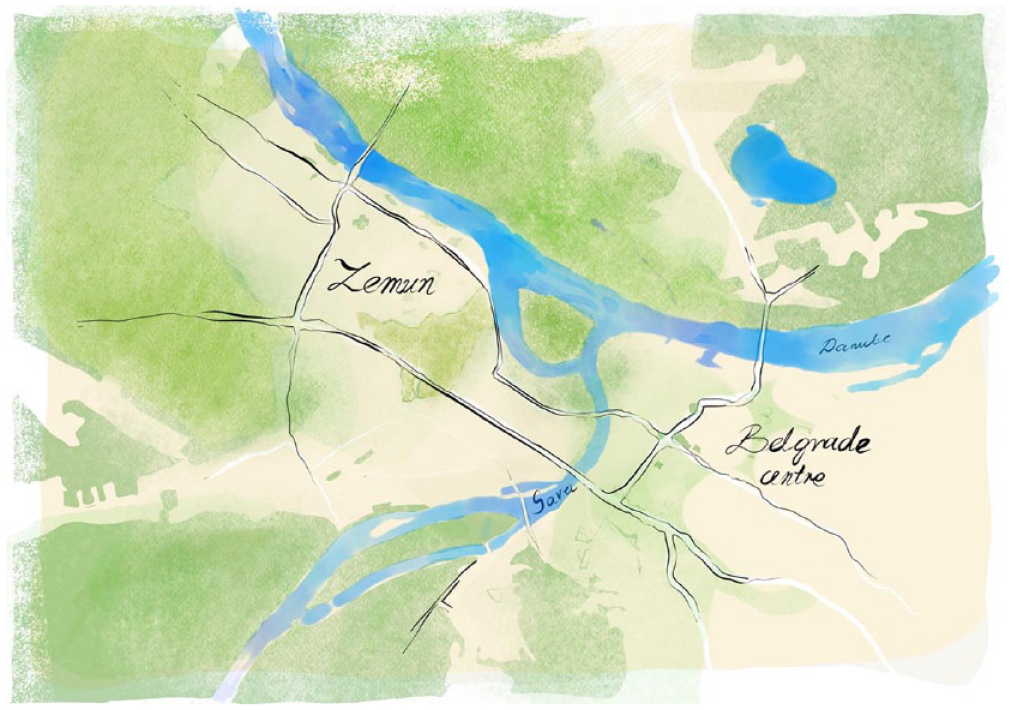
Location of Zemun within the city of Belgrade (author: Aleksandra Stępień).
The above-presented geographic and historical information is extremely important for our considerations, as it allows us to distinguish between Vojvodina (in which Zemun is geographically located) and the central part of the country, with the capital in Belgrade. Importantly, in geographic terms, the Serbian capital still stretches across both of these regions. However, to this day, the people of Belgrade who live in Zemun often clearly distinguish between Zemun-Vojvodina and Belgrade-Serbia, emphasising that Vojvodina differs from the rest of Serbia in many respects. The residents of Zemun may employ demarcating and distancing strategies in very radical ways. One of our interlocutors who lives in Zemun, a local history enthusiast and propagator of knowledge about the multiculturalism of the region, repeatedly emphasised during the interview that his focus is only on Vojvodina, and that he had no interest in Belgrade. 4 It is all the more astonishing when one considers that Zemun, as was already mentioned above, is nowadays one of the districts of Belgrade, and its centre is located only a few kilometres away from the central pedestrian street of the capital. On the other hand, these two areas of the city are separated by a river. A renowned Serbian architect and intellectual, Bogdan Bogdanović (2007) noted that the Danube and the Sava used to separate Central Europe from the Balkans, and according to some, even from Asia (p. 14). The Sava is still sometimes seen as a geographical border between Europe and the Orient. Both of these concepts are, of course, ideological constructs, 5 although some people still see the opposition between Europe/Vojvodina and Orient/Serbia as an indisputable fact. In this image, a mental map is superimposed on a geographical map. The neat and very meaningful rule of ‘maximum diversity in a minimum of space’ (Czapliński, 2016: 244) 6 is of key importance to the very spirit of Vojvodina. It is founded on the myth of a conflict-free existence within a multi-ethnic, but relatively small area.
In our analysis of the space in question, we noted that memory is both disjunctive and combinatorial; it is susceptible to both disassembling and reassembling (Rothberg, 2017: 169). Moreover, another concept which is fundamental to our considerations is that of ‘memoryscape’ (memory landscape), which refers to both a symbol and a real area in which ‘collective memory is spatialized’ (Muzaini and Yeoh, 2005: 345, after: Kapralski, 2012: 89). The cultural landscape, formed at the interface between people’s actions and historical time, is closely interlinked with the concept of memoryscape. The topography of the city and its existing artefacts reflect both the passage of time and people’s actions (Frydryczak, 2014: 195–199). Research indicates that a landscape is understood as a record of, and testimony to, the lives of past generations that left their mark on its territory (Ingold, 1993: 152–174). At the same time, it is consciously shaped and constructed in accordance with the current demand of the authorities. This proves the thesis that it is possible to read history in the landscape. Kapralski describes this paradoxical nature of the relationship between memory and space/landscape in an interesting way by expanding Clifford Geertz’s distinction between a ‘model of something’ and a ‘model for something’ (Geertz, 1973, after: Kapralski, 2010: 40). He points out that space can perform both of these two functions. When it exists as a ‘model of something’, it represents the remembered past. However, when the model is consciously designed by those who have power over it, it becomes a ‘model for something’ that functions as an instruction for memories, a form of a memory framework (Kapralski, 2011: 50).
Both the symbolic space and the real area are of great significance in our considerations. The historically and geographically defined territory is the real space, while the image preserved and shaped by culture gains a symbolic dimension. In this case, the symbolic space, as expressed by the region’s inhabitants, is the image of Vojvodina as a multi-ethnic place where different national minorities lived side by side in peace and harmony before World War II. The Vojvodina understood as such is a positive autostereotype used as the basis of promotional strategies of cities or international events. 7 It is the place where physical geography meets mental geography, 8 with the latter referring not entirely to a tangible site, but foremost to a location built upon the presumptive values which the local residents follow and identify with. Therefore, tolerance and respect for others remain important parts of the tradition and memory of the region’s population. However, their importance is called into question by the post-war destruction of sacred and cultural sites constituting remnants of the presence of non-Serb ethnic groups (Germans, Jews) and the contemporary lack of care for the memorial sites of minority groups. 9 The above-mentioned idealistic image of Vojvodina seems to be more of an imaginary construct than a reflection of reality. It should, however, be clearly emphasised that there is no shortage of individuals and institutions in the area that are actively working to preserve the multicultural heritage of the region’s past. 10
Germans in Zemun
The territory of northern Serbia, that is, the area of present-day Vojvodina, began attracting representatives of various nationalities in the seventeenth century. Serbs were the largest group of such settlers. They were brought to the region by their religious leaders at the end of the century, migrating from the so-called Old Serbia and Kosovo to the southern borderlands of the then Austro-Hungarian Empire. Other groups which moved to Vojvodina from those areas at that time included Aromanians, Greeks, and Albanian Catholics (the so-called Kelmendi). They were followed by settlers from other regions: from the west – Šokci, Bunjevci, and Croats; from the east – Catholic Bulgarians and Romanians; and from the north – Germans, Catalans, French, Italians, Czechs, Slovaks, Ruthenians, Hungarians, Jews, and Roma (Kwoka, 2017: 128–129). As a result of these migrations, Vojvodina became a multicultural, multi-ethnic and multi-confessional region in which Germans constituted a significant minority.
The history of Germans (in Serbian referred to as Podunavski Nemci/Švabe, in English as Danube Swabians, and in German as Donauschwaben)
11
in the territory of present-day Serbia dates back to the turn of the seventeenth century and is connected with the withdrawal of the Ottoman Empire from Pannonia. At that time, the Habsburg state began establishing settlements in the areas abandoned by the Turks. As noted by a Belgrade historian, Zoran Janjetović (2016), whose research focuses on the German presence in Serbia (p. 32), living side by side for many years,
Serbs learned to respect [Germans], coexist with them in peace and sometimes even cooperate, but it seems that real closeness between representatives of the two groups has never emerged. The differences between them were always too great, and, in the second half of the 19th century, they no longer concerned primarily divergences in their ways of life, but rather future interests and mentality.
12
In the history of Yugoslav Germans, the period leading up to World War I, and the interwar period in particular, is known as the time of national enlightenment. During that period, Germans performed the role of intermediary between Yugoslavia and Central Europe. Innovations in material culture and technology reached Yugoslavia via Germans (Janjetović, 2009: 79).
World War II was a turning point in the relations between the groups. Dissatisfied with the place they held in the Kingdom of Serbs, Croats and Slovenes (post-1929, in the Kingdom of Yugoslavia), and persuaded by propaganda, the majority of Danube Swabians sided with Hitler (with support expressed both in words and in actions). Young people returning to the Kingdom of SCS and later to Yugoslavia from their studies in Germany or Austria were particularly susceptible to the Nazi ideas. Protestants, unlike Catholics, also tended to favour Nazism, as they were much more involved in activities aimed at preserving their national distinctiveness. The Nazi ideology was also more attractive to the poorer social strata (Janjetović, 2016: 37; Janjetović, 2009: 219, 238–242). The Swabian-German Cultural Association (German: Schwäbisch-Deutscher Kulturbund), which was first founded in 1920 in Novi Sad, also became much more active in the 1930s. At first, it was a cultural organisation, but its activities began to turn political in the mid-1930s, in line with its members increasing Nazi sympathies (Janjetović, 2009: 230).
The question of the responsibility of the German minority in Yugoslavia for war crimes has still not been answered in an unequivocal manner by the Serbian historiography. To this day, there are texts published (both in Serbia and other countries) that question the voluntary involvement of Serbian Germans in the war on the side of the Nazis, but also ones that emphasise the activity of Danube Swabians in the military structures 13 during World War II in Yugoslavia (April 1941–October 1944). The legitimacy of the repression of the German civilian population, especially intense in Yugoslavia between 1944 and 1948, is a particularly problematic and often uncomfortable issue. The following facts are indisputable: the Nazis occupied parts of Serbia during the war, local Germans were appointed to a significant proportion of administrative positions, and in the post-war years, this ethnic group was assigned collective responsibility for the suffering caused by World War II. As a result, all Germans were associated with fascists who symbolised the enemy in post-war discourse. This narrative, created by the new communist authorities, led to deliberate transformations and unconscious neglect of public spaces, resulting in the almost complete disappearance of any traces of German heritage in Serbia.
In the post-war years, 14 this spatial control was exercised through a variety of practices. Its primary aim was to ‘cleanse’ history by highlighting similarities, blurring differences, and introducing one dominant point of view (Muzaini and Yeoh, 2005: 345, after: Kapralski, 2010: 28). In the post-war years, interventions in the landscape focused on constructing signs of the desired vision of the past, with a bronze-cast figure of a partisan as its symbolic hero. Considered in the context of the models proposed by Kapralski, such a landscape is understood as a ‘model for something’. Space became the scaffolding for propping up imagined visions of the recent past, and the landscape was used to build a community around the history of the collective fight against fascism and by strengthening the cult of partisans. 15 However, in this article, we deliberately avoid focusing on the landscape transformations aimed at commemorating the heroic anti-fascist narrative, as these issues have already been studied and described in detail (Karge, 2014; Manojlović Pintar, 2014).
Despite the efforts of successive authorities managing this space, not all traces of the unwanted past have disappeared irretrievably. The remaining fragments are embodiments of the stories of no longer present communities that nevertheless demand to be told. They function as markers of the past and, by their very nature, highlight the existence of a certain gap, a significant absence. Traces of the German community in Zemun are left completely unmarked and, as such, are completely devoid of meaning for many Belgrade residents. Assmann (1999: 309, after: Saryusz-Wolska, 2011: 142) describes such remnants as something that still exists, but paradoxically indicates an absence – as something located in the present, but clearly referencing the past.
Situated on the border until the end of WWI, Zemun was a multi-confessional and multi-ethnic town. Like other municipalities of the Habsburg Empire, it was divided into quarters. The old part of the city was populated by educated and wealthy people representing several ethnic groups. Serbs constituted the majority of residents in the so-called Upper Town (the northern part, located on the right bank of the Sava River). In terms of numbers, Germans constituted the second biggest ethnic group in Belgrade (after the Serbs), including both Protestants and Catholics. They began settling in Zemun in the mid-eighteenth century and their population grew in the nineteenth century when a large group of families moved there from the Banat area. They established a settlement, Franztal, at some distance from the city centre, below the Upper Town. German residents could also be found in other districts of Zemun, but this was the only one where they were the majority. 16
Zemun in the memoryscape
For Germans, one of the most important places in Franztal was the Catholic Church of Saint Wendelin, which was built in the Gothic style in 1888. A still-operating school named after Petar Kočić was established in the immediate vicinity of the church at the beginning of the twentieth century. Interestingly, the church building survived World War II and the city’s liberation (including the 1944 bombing by the allied forces, which damaged the city centre). It remained standing until 1955 when the communist authorities in Yugoslavia ordered its demolition. 17 Both researchers and enthusiasts suggest that the church was monumental, but no physical traces of its presence remain in the area. The church’s baptismal font is the only element preserved to this day (Figure 2). It is now kept in the garden of the Church of the Assumption of the Blessed Virgin Mary, located in the centre of Zemun. However, the Church of Saint Wendelin is still present on the mental map of local non-professional guides and enthusiasts, who claim that it was located on the site of today’s school. In the imagined geography, the non-existent church functions as one of the important sites in Zemun, a remnant of German presence in the city. The church is also noticeable in the virtual space, as old postcards depicting its construction are some of the images most frequently used in retellings of the pre-war history of the town. The social media page Stari Zemunci (Old Zemunians) acts as a vernacular, virtual archive of the city. 18
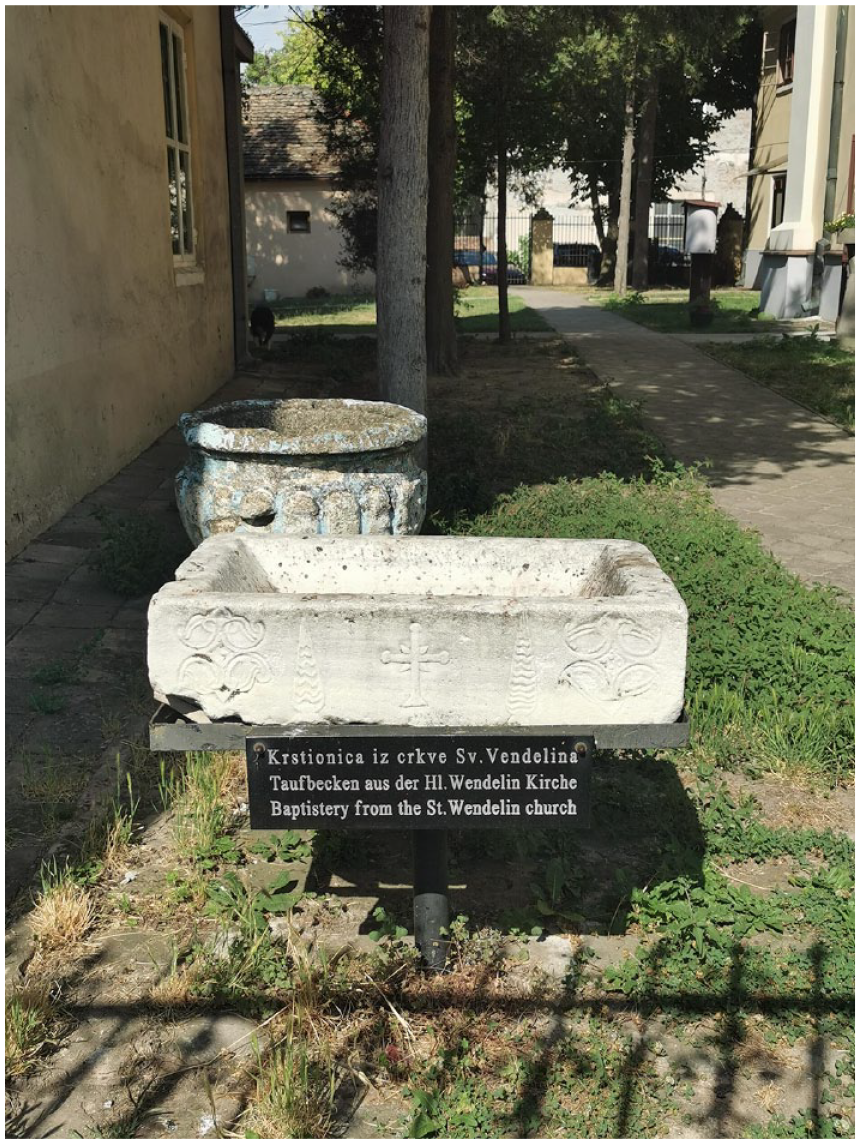
Baptismal font from the Catholic Church of Saint Wendelin (photo: Katarzyna Taczyńska).
This example demonstrates the highly subjective character of the concept of a mental map or mental geography. What, for representatives of one social group, is an extremely important and meaningful place in space, may be practically invisible and insignificant for the members of another community. Mental maps are the landscapes people carry in their heads, and they are not made up of physical material, but of images created by culture, memories, but also mediated messages about the past. This confusion is also a clear indication that members of different ethnic groups assign different values to elements of the same space.
Another important element of Zemun’s public space associated with the presence of Germans is the Evangelical Church (Figure 3). 19 Unlike the Church of St. Wendelin, its building has been preserved till this day. Evangelical liturgies are still held there, attended by members of the Slovak minority. The building was erected in the interwar period. Interestingly, the native inhabitants of Zemun call it a ‘synagogue’, although it is difficult to ascertain why. The most obvious (although unproven) explanation is that the city’s inhabitants perceived this church as a symbol of otherness – a signifier indicating a rite which is different from Orthodoxy. This association with unspecified otherness could result in confusing the names of religious buildings. After the end of World War II, the communist authorities placed a five-pointed star, a symbol of their power, on the church. In the following decades, the church functioned as a public building, and at the turn of the twentieth century, it was rented out to a private owner who turned it into an amusement arcade. It was not until 2005 that it was declared a cultural monument.
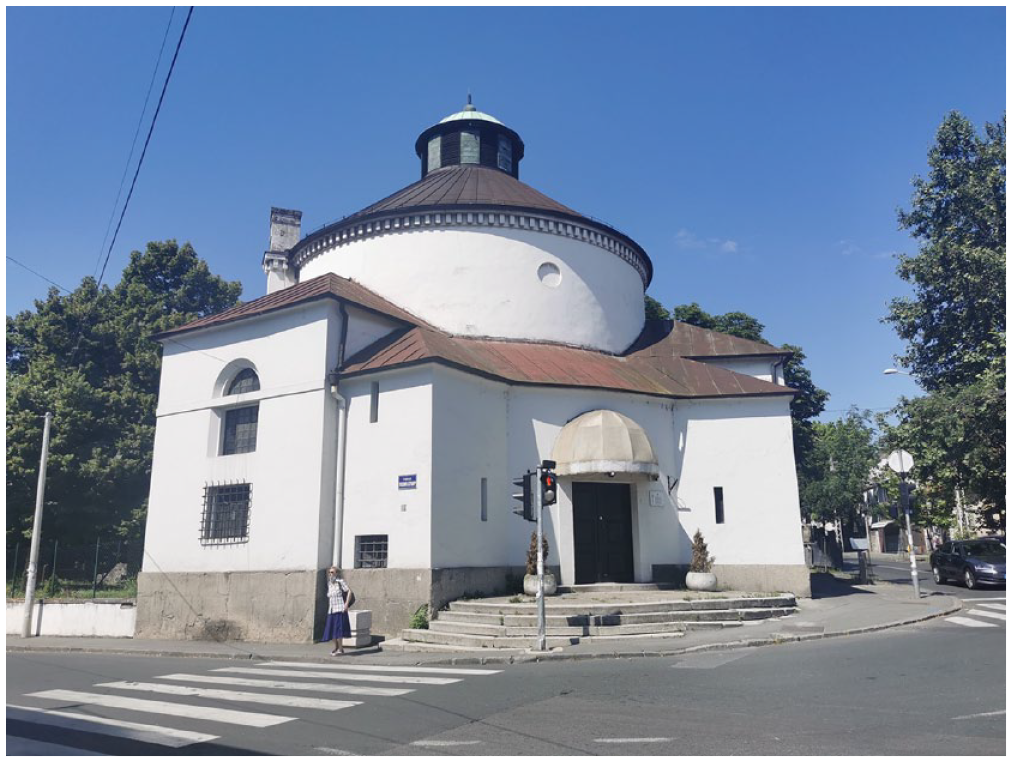
The Evangelical Church (photo: Katarzyna Taczyńska).
In the post-war period, all manipulations of space introduced throughout Vojvodina were aimed at removing traces of German presence in the region. In this context, the story of the disappearance of the cemetery in the Franztal district is particularly interesting and multi-faceted. It is worth remembering that the cemetery plays an important role in social life. As it is associated with the sphere of sacrum, its violation is seen as profanum. Moreover, it is the presence of a group’s resting places in a given area that determines the group’s sense of connection with the space, indicating the continuity of its tradition. Thus, the cemetery becomes a component of identity by means of its clear designation.
It is difficult to say whether this was meant to be a symbolic method of disposing of the war enemy or whether the liquidation of the necropolis was motivated by its uselessness. After all, usefulness is one of the prerequisites for the continued existence of places. In Zemun, as throughout all of Yugoslavia, the size of the German population decreased considerably after the war as a result of repressions, forced resettlements and individual voluntary relocations. The Germans of Vojvodina were replaced by new Orthodox settlers, arriving primarily from southern Serbia, Bosnia and Montenegro. A Croatian historian, Vladimir Geiger, claims that in the post-war years, German cemeteries tended to be deliberately liquidated or left to fall into neglect throughout Yugoslavia, not only in villages which underwent population transfers. Burial sites located near forced labour sites and camps for Germans disappeared in a similar manner (Geiger, 2015: 13). The stones obtained during such deliberate liquidations were often used as a building material.
This brings us back to the history of the German cemetery which ceased to exist after World War II. An administrative decision issued by the Ministry of Interior of the Democratic Federal Yugoslavia (Dec. No. 1253, dated 18 May 1945), which ordered the liquidation and destruction of cemeteries and graves of occupiers and state enemies, was a clear expression of this space cleansing strategy. This undesirables group included German, Italian, and Hungarian soldiers, as well as Ustasha, Chetniks, and members of the Slovenian Home Guard (Slovenian: Domobranci) (Geiger, 2015: 12). The vast area of the former necropolis, today partly overgrown by trees, became the site of the Bežanijska kosa hospital and its accompanying buildings. The hospital’s website (under its ‘History’ tab) states that the decision to use these premises to organise a municipal hospital for respiratory diseases was made in 1953. It officially opened in 1956. The website does not provide any information about the original function of the site and mentions only that the buildings which were first constructed for the Forestry Department were rebuilt and adapted for the use of the hospital. 20
The liquidation of the cemetery, which undoubtedly preceded the construction of both the Forestry Department’s buildings and the hospital, can be interpreted as an attempt to erase physical traces of the German community of Zemun. When the dead are buried in a cemetery, they get separated from the living people. But, paradoxically, the cemetery itself is an ambivalent space, an ‘in-between’ area where the dead and the living meet. In symbolic terms, this meeting is represented in all commemorative acts, undertaken both on individual and collective levels. Thus, as long as a cemetery is a physically existing space, the presence of the (buried) dead in a given territory also remains an undeniable fact. In that symbolic sense, the physical annihilation of the place (removal of the material designate) is also a magical act. With the removal of the signs of the dead, their bond with the living is eliminated, and the space itself is ‘exorcised’ (Ćwiek-Rogalska, 2017: 157). At the same time, it is also a wishful act, because it assumes that destruction of the place (and the so-created emptiness) will erase the former German presence.
If we remain within the circle of traditional/pre-modern beliefs according to which the borders of the territory of familiarity are marked by graves, 21 then the destruction/physical liquidation of cemeteries can be interpreted as a sign aimed at challenging the right of Zemun’s Germans to perceive the town as their own.
A monument dedicated to soldiers who died during World War I is the only sign located in the area which denotes not just a German, but a multicultural past to Zemun (and the whole area of Vojvodina). The obelisk is located on the grounds of the above-mentioned hospital, at some distance from the main gate. The area is covered with tall trees, which effectively hide the space in shade, and there is no marked path leading to the site. The monument contains the names of German, Serbian, and Hungarian soldiers who died during World War I, followed by the dates 1914–1918 (Figure 4). These surnames provide clear evidence of the multicultural nature of the region. Thus, the monument commemorates the deaths of those soldiers, but also testifies to the ties that bound its sponsors, and the soldiers to which it was dedicated, with their ‘small homeland’ (Ćwiek-Rogalska, 2017: 55). 22 This product of human hands speaks of times past, and its existence in the landscape proves that the landscape itself has the capacity to preserve the past. However, it is worth mentioning that the contemporary meaning of this monument is slightly different than it was when it was first erected. Today, we read it primarily as a sign that many nations used to coexist in the area.
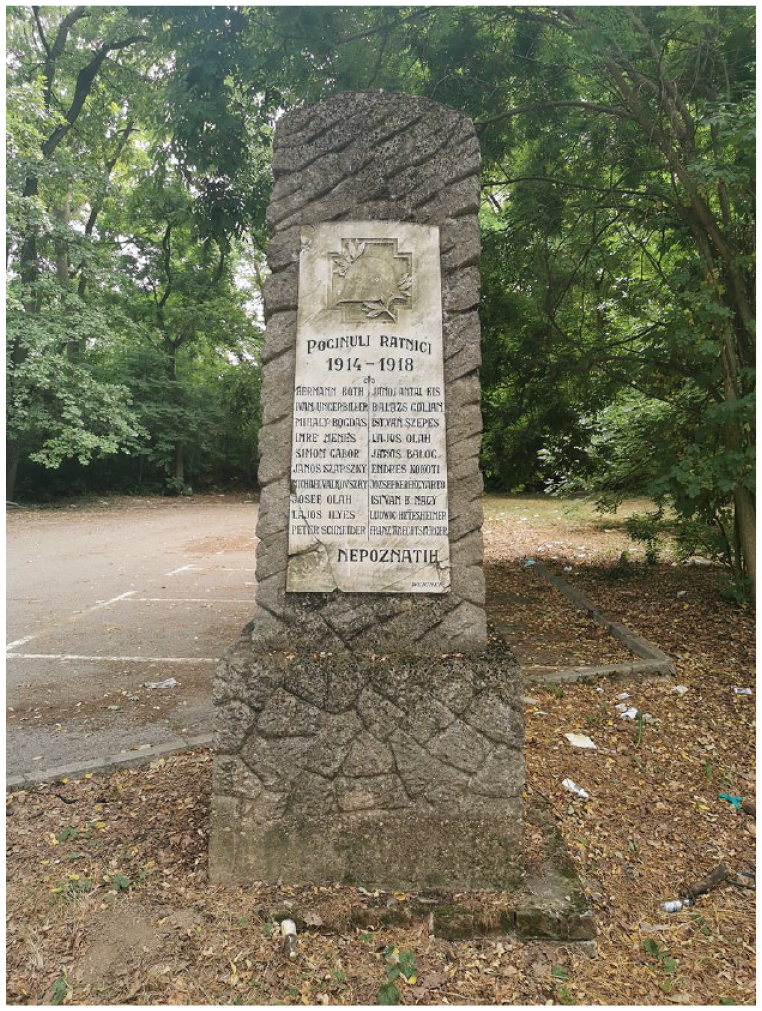
Monument located on the grounds of the Bežanijska kosa hospital (photo: Katarzyna Taczyńska).
It is worth noting that the hospital administration staff was unaware of the existence of the monument, and one person reacted with some reluctance when asked about the possibility of entering the hospital grounds to see it. The monument remains intact, but no sign indicates that the site of the hospital was once a cemetery. In many ways, the place is similar to a non-site of memory. Writing about such spaces and their affective impact, Roma Sendyka (2014) draws attention to their ambiguity (p. 291). She calls any such place ‘non-congruent’ and states that ‘[i]t is a strange and inhospitable place, surprising, devoid of markers and forms of interpretation; without specified location, unmapped, without any codes of use, even as basic as the instruction for passage.’ Despite the lack of references to the former function of the hospital space, the cemetery site has not been completely erased from people’s memory. The cultural landscape is characterised by certain disturbing ontology: what is imagined and remembered can sometimes be as significant and real as its physical elements (and sometimes even more so) (Ćwiek-Rogalska, 2017: 191). In fact, one can learn about the existence of the cemetery from the local amateur historian who was our guide during a trip following the traces of German heritage of Zemun. A space which has been intentionally transformed usually carries a double meaning. While elements of physical space can be erased, memory cannot be eliminated as easily. Therefore, the same space, shared by members of different groups, may be perceived differently by each of them. Seeing (and understanding space) depends on the chosen perceptual lens, which may be based on memory, but also on the way in which the remembered information is conveyed (Howard, 2013: 43–53).
As already stated, the history of the cemetery has many layers. According to the few on-line texts devoted to the German Zemun, the remains of the dead buried in the German necropolis were transferred to the municipal cemetery of Bežanijska kosa. 23 In 2011, the descendants of former Zemun residents from Salzburg organised a clean-up of the German part of the cemetery and the erection of a monument. It commemorates the residents of the Franztal district who, as can be read on the obelisk, ‘lost their homeland’.
Shattered tombstones from the German cemetery were used to build steps leading to Kalvarija Park, located on one of the city’s hills (Figure 5). 24 For many years, this information was assumed to be an unproven urban legend. Ultimately, it was confirmed during renovation of the stairs when fragments of the slabs were moved. When turned over, it was revealed that they were covered in inscriptions. 25 The memoryscape is not a static monolith. It is subject not only to changes created by people, but also to transformations affected by the passage of time. Then, it reveals its paradoxical nature: it can be an ally of a deliberately erased past (e.g. the original inscriptions that were supposed to be covered up are uncovered), but it can also be an ally of manipulators. It is probably the passage of time that has made the inscriptions on the tombstones partially invisible.
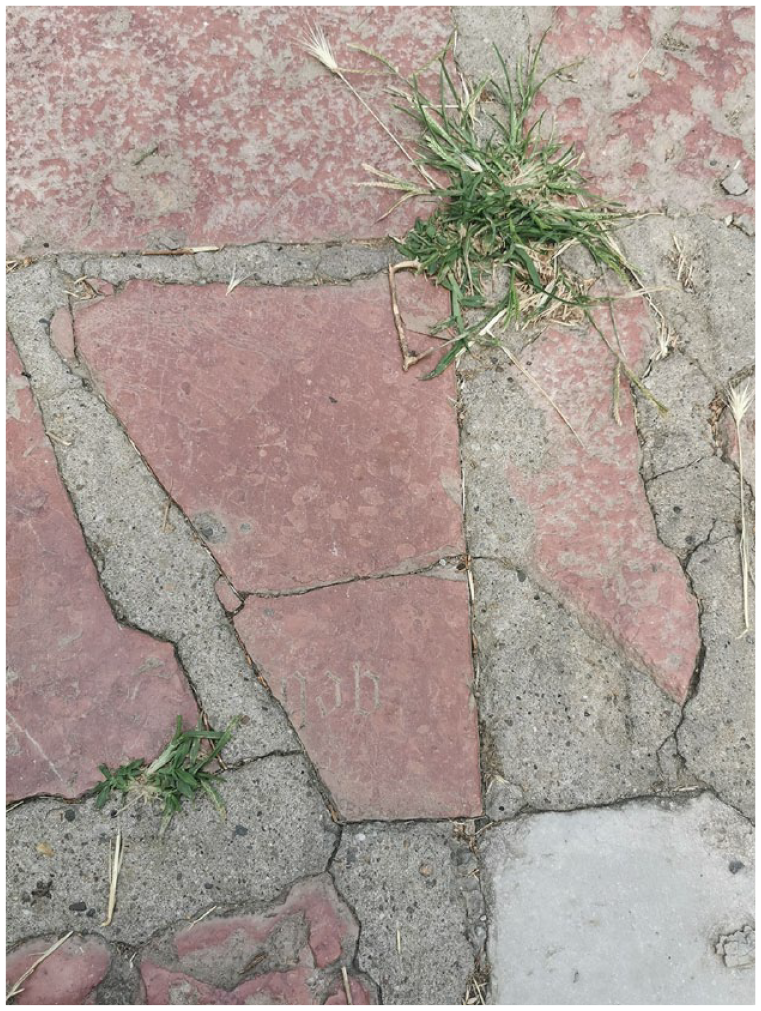
Fragments of shattered tombstones in the steps leading to Kalvarija Park (photo: Katarzyna Taczyńska).
The Zemun stairs lead to Kalvarija Park, which itself contains remnants of the area’s past. The park used to include Stations of the Cross, but today there is no trace left on the hill. However, according to another urban legend, one of the crosses was hidden and kept by the Zemun residents. It was later moved to the town’s cemetery, where it still stands today. According to a local amateur historian, there are also sites of mass burials on the hill, but we have not been able to find any confirmation of this claim.
Conclusion
The above-presented considerations allow for putting forward several hypotheses. The dominant national and nationalistic memory has deliberately overshadowed the memories of minorities in the Zemun area in the post-war years. Subsequent political and historical breakthroughs (the death of Josip Broz Tito, the bloody break-up of Yugoslavia, the so-called democratic breakthrough in Serbia) did not result in any significant changes in this respect. The memory of German presence in Belgrade is still part of an unwanted legacy which is, at best, only partly accepted, as it indirectly refers to the post-war repressions which were often levied against Germans by Serbian society. Furthermore, it draws attention to the Serbian responsibility for neglecting formerly German 26 memorial sites, which calls into question the positive self-image of the group. It should be noted that traces of the presence of other minorities (e.g. Jews and Roma) in Belgrade are also hardly noticeable in the contemporary urban space. As each of these groups has its own specificity, their proper description would require separate studies.
Kapralski (2011) notes that
cities offer a fictional and misleading vision of the past [. . .] The urban landscape is a stage upon which the battle over the past is waged, and, in this fight, different groups try to shape the space to match their own ideas about the past, thus, finding themselves in conflict with other groups undertaking similar actions. (p. 59)
The disappearance of remnants of the presence of different ethnic groups in a given area often does not result from conscious and deliberate actions. The memoryscape can be transformed in a somewhat involuntary manner as a result of negligence, which seems to be motivated by contemporary local residents not feeling a sense of community with the groups that no longer live in the area. Kapralski aptly observes that the process of erasure intensifies when only one homogeneous group remains in one multi-ethnic physical space. Then, the controlled landscape retains the elements that this group wants to remember, while everything else is destroyed, neglected or preserved in a way that distorts its meaning (Kapralski, 2010: 31). As a result, places associated with an unwanted minority presence gain a new lease of life. To complicate this picture a bit, it should be noted that post-WWII Vojvodina was not really homogeneous, but rather dominated (like all of Yugoslavia) by the narrative of the country’s victory over fascism and the associated partisan myth. Groups which could not claim membership in a so-defined community (Germans and Hungarians) did not have the rights, and later also the means, to preserve and ensure their symbolic presence in the landscape. Such sites can be preserved only if the community considers them to be part of their own heritage which requires real care. 27 For this to happen, they must first be noticed.
When considering the removal of the German cemetery from Zemun, it should be noted that the measures employed to achieve this goal were paradoxical in nature. In fact, the destruction of the cemetery, and especially the use of its material elements (the tombstones which were incorporated into the stairs), prevented it from disappearing completely. The cemetery is a sectioned off/separated space (usually clearly distinguished from the surrounding area [e.g. with a wall]), but in Zemun, it became dispersed. The signs of its past existence (the tombstones or their fragments built into the stairs) left the confines of the original location and ‘wandered’ into other places, marking their presence in the urban fabric. Thus, contrary to the wishes of its destroyers, the intention to erase the cemetery created the opposite result. Signs of the German presence in this area are not marked and can be anywhere.
Belgrade’s current identity is practically devoid of any German elements – they do not constitute a permanent, visible part of the urban fabric. Thus, the German past is not included in the public sphere, or to be more precise, its presence is narrowed down to only one aspect – the issue of war guilt. At present, there is no room within this sphere for rapprochement or intercultural dialogue and the memory of the Germans who lived in Belgrade is relegated mainly to the field of personal memory. Finally, it is worth adding that (especially in Vojvodina) there are initiatives aimed at highlighting the significant role played by the Germans in the area in the past. However, they represent activities from the sphere of vernacular memory 28 and their scope is limited to the local dimension. 29 Still, their description and analysis could certainly become the subject of a separate study.
Footnotes
Acknowledgements
This article is part of the project Memory Rivalry in a Multi-Ethnic Society. The Case of Serbia (No. U1U/P01/NO/02.64). We would like to thank Neven Popović for sharing his knowledge about Germans in Zemun.
Funding
The author(s) disclosed receipt of the following financial support for the research, authorship and/or publication of this article: The research has been supported by a grant from the Priority Research Area (Heritage) under the Strategic Programme Excellence Initiative at the Jagiellonian University. The field research was conducted in Serbia in July 2021.
