




Abstract
This article illustrates the predicaments of self-acclaimed global cities that come under pressure to decolonise heritage practices. Examining the politics of public memory in post-imperial Hamburg through the inner-city redevelopment project Hamburg HafenCity, it shows how commemorative landscapes are co-produced by market rationalities. Through document analysis and interviews with city planners, artists and campaigners, the article explores urban toponymies and heritage sites as relational and contested configurations of post-colonial memory and culture. It finds that the HafenCity’s colonial heritage premediates the area’s contemporary symbolic programme which celebrates European expansion, cosmopolitanism and Hamburg’s maritime tradition. The article engages with the multiple modes of encounter and performative responses that (neo-)colonial memory landscapes elicit. It redraws the affective geographies of (un-)belonging in a post-imperial city and charts decolonial propositions of civil society actors.
[S]ilence can nourish a story and establish a communication to be patiently saved in periods of darkness, until it is able to come to light in a new and enriched form.
Introduction
From the mid-nineteenth century onwards, in a time of imperial frenzy, major European cities competed to style themselves as centres of empire. Imperial capitals such as London, Brussels, Paris and Lisbon and mercantile cities such as Marseille, Bristol, Seville or Hamburg embedded the imaginative geographies of the modern colonial world deep into their architectural fabric (e.g. Driver and Gilbert, 1999, 2000; Möhle, 1999; Peralta and Domingos, 2019). The monuments and street names, mansions, imperial gardens and pompous government buildings with exotic facade motifs outlived the demise of colonialism – their symbolism today bears witness to European imperial claims to people, territories and natural riches. Yet gradually, these remnants of empire were integrated into more contemporary cultural programmes. Post-imperial ‘global cities’ (King, 1990a) herald diversity and cosmopolitanism as new tropes of a city marketing that attracts visitors and investment. The results are gentrified urban landscapes whose centres display palimpsests of memory and culture, yet largely avoid a reflection on how cities were entangled in colonial dispossession, enslavement trade and genocide (e.g. Keith, 2005; King, 2004; Shaw, 2005).
Cultural memory is by no means one-dimensional, static or permanent, but rather multi-layered and in a constant state of flux (Erll, 2011). In European metropolitan centres that are characterised by ethnic and cultural diversity, post-colonial 1 negotiations over memory, identity and place unfold, intensify and draw public attention (e.g. Ha, 2014; Jacobs, 1996). 2 For several decades, Indigenous, Black, 3 People of Colour and migratory and diasporic communities have been campaigning to transform commemorative landscapes that whitewash slavery and colonialism (for the German context, see, for example, Diallo and Zeller, 2013). In 2020, the murder of George Floyd and the globalising Black Lives Matter movement energised antiracist protests and brought the debate on colonial heritage into mainstream media, which lead to the collective toppling of the statue of slave trader Edward Colston in Bristol, UK. Recently, in cities around the world, claims to ‘decolonise!’ have gained popularity across cultural, academic and activist spheres.
In this article, I take a closer look at the ambiguous ways in which colonial histories are made in/visible in the post-imperial European port city of Hamburg in Germany. I explore how local municipalities and private investors as well as postcolonial initiatives and networks of affected communities appropriate, re-imagine and reshape public spaces of colonial heritage. In doing so, I build upon earlier research on the ‘coloniality of the city’, that is, on (neo-)colonial paradigms of urban and cultural planning and on the forms of social resistance they encounter (e.g. Bonnett, 2002; Cross and Keith, 1993; Kollektiv, 2017). 4 I further contribute to an emergent body of critical heritage scholarship that analyses decolonial modalities of heritage practices beyond binaries of ‘remembered vs. forgotten’ (Knudsen and Kølvraa, 2020: 12) and that is sensitive to the affective infrastructures and transcultural constellations in which multiple, albeit unequal, social actors shape public narratives of the past (e.g. Knudsen et al., 2021; Lähdesmäki et al., 2019).
To understand how colonial heritage is negotiated in the city-state of Hamburg that is linked to the Atlantic by the Elbe estuary, I chose the quarter HafenCity as a single instrumental case study (Stake, 1995). 5 Constructed on the waterfront area of Hamburg’s former colonial port, the HafenCity and its flagship building, a concert hall named Elbphilharmonie, are the city’s new maritime landmarks. A white and early-stage researcher, I gained local literacy of post-colonial heritage through decolonial memory activism and institutional work in Hamburg since 2017. 6 The knowledge and social experiences I was able to develop provide the framework for this study. Adopting a mixed-method and overall qualitative approach, I combined interpretative research on documentation with ethnographically inclined, semi-structured interviews with policy makers, with local artists and with campaigners who engage with the Hamburg HafenCity from a postcolonial perspective. The institutional and social texts I examined are cited throughout the article; they include exhibition catalogues and programme booklets, tourist information and websites, records of the Hamburg state government and parliament and an application for World Heritage status as well as press releases, position papers and open letters of civil society groups.
In the first half of the article, I present excerpts of Hamburg’s colonial history before developing the idea of the ‘cultural memory complex’ which serves the paper as a methodological concept (a relational reading of material configurations of culture and memory in space). Re-mapping the HafenCity’s statues, streetscapes, buildings and cultural institutions, I trace the web of semantic relations between post-colonial urban toponymies, heritage sites and architecture, all of which I treat as devices of narrative construction. In doing so, I examine the ways in which site-specific colonial legacies have been converted by investors, city planners and cultural institutions into identity-forming trademarks of ‘maritime expansion’ and ‘cosmopolitanism’.
In the second half of the article, I turn to the different ways in which colonial heritage formations are experienced, made sense of and engaged with depending on the social ‘situatedness’ of individuals (Tolia-Kelly et al., 2016). Exploring different emotional interpellations of (neo-)colonial urban geographies, I illustrate the dissonant affective infrastructures of (un-)belonging that post-imperial city space creates. Finally, I contextualise the HafenCity within civil society efforts for postcolonial heritage reappraisal and outline key propositions of the decolonial cultural politics that sustain them.
Fragments of Hamburg’s colonial legacy
Cities around the globe held key positions in the genesis and expansion of European-led enslavement trade and colonialism (King, 1990b; Wallerstein, 1974: 164–223). In The Invention of the Americas, Enrique Dussel (1995) illustrates vividly how Europe’s metropolitan centres were linked to the colonial Atlantic and contributed to early-modern global capitalism: In the famed triangle of death, ships left London, Lisbon, The Hague, or Amsterdam with European products, such as arms and iron tools, and exchanged these goods on the western coasts of Africa for slaves. They then bartered these slaves in Bahia, Hispanic Cartagena, Havana, Port-au-Prince, and in the ports of the colonies south of New England for gold, silver, and tropical products. The entrepreneurs eventually deposited all that value, or coagulated human blood in Marx’s metaphor, in the banks of London and the pantries of the Low Countries. Thus modernity pursued its civilizing, modernizing, humanizing, Christianizing course. (p. 122)
From early on, the port city of Hamburg was one of the economic nodal points in the colonial networks described by Dussel. With no military fleet of its own, the city-state’s merchants first invested in Portuguese colonial expeditions (Poettering, 2019), then participated in the colonial enterprises of the Netherlands, Denmark and Great Britain, and later began to establish overseas trading outposts to deal with raw materials and enslaved Africans (Jokinen, 2010; Möhle, 1999). During the eighteenth century, Hamburg became one of Europe’s prime locations for sugar refining and for the processing of cotton (Todzi, 2018). Scholars estimate that at the end of the eighteenth century ‘half of Hamburg’s population lived of the offshoots of the enslavement trade’ (Reinhard, 2016: 470). 7
Documenting the activities of traders such as Heinrich Carl von Schimmelmann (1724–1782), Robert M. Sloman (1783–1867) or Adolph Woermann (1847–1911), artist and curator Hannimari Jokinen (2010) describes Hamburg’s merchants as [. . .] early global players that directly affected the history on and in-between different continents. They were big landowners, war profiteers and discreet backers in the transatlantic enslavement trade. Overseas, they cleared expropriated areas into huge monocultures, undertook ‘punitive expeditions’ inlands and used forced labour on their plantations. They knew how to cleverly influence governments and how to receive military support.
8
To protect their private trading posts on the West African coast, the merchants of the Hamburg Chamber of Commerce lobbied the national administration in Berlin to formally establish German colonies in 1884 and played a central role in the Berlin Africa Conference of 1884/1885 (Möhle, 1999; Todzi, 2021). In return, Hamburg was granted extensive privileges on national colonial trade and the city’s port became one of the largest industrial harbours in Europe by the turn of the nineteenth century (see Figure 1). 9
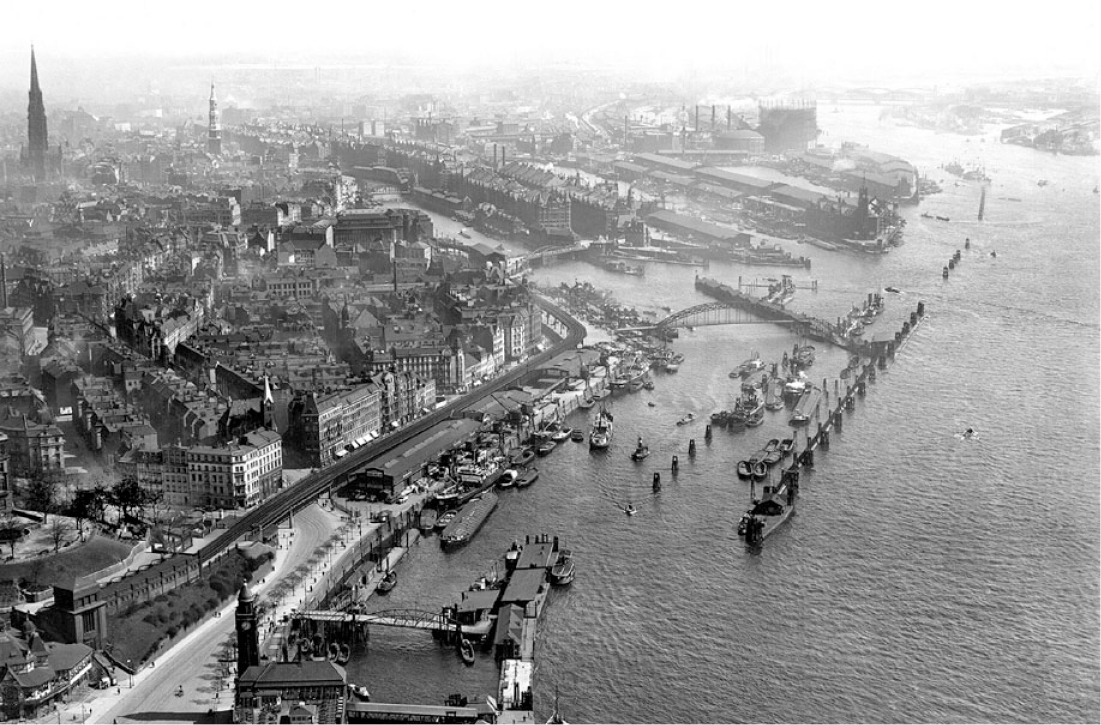
The Hamburg harbour at the turn of the nineteenth century. Photo courtesy of ©HHLA/Hamburger Fotoarchiv.
As the central transfer point for national colonial trade and for the shipping of colonial military infrastructure, the city of Hamburg and its elites became complicit in the genocide against the Ovaherero and Nama people that lasted from 1904 to 1908. Under the supreme command of the German-Prussian Emperor Wilhelm II (1859–1941), General Lothar von Trotha (1848–1920) set off with his troops from Hamburg’s Baakenhafen, a harbour basin at the eastern tip of today’s HafenCity, for the lands of the Ovaherero and Nama – today’s Namibia and then German South West Africa (Kawlath, 2019). The goal was to eliminate the anti-colonial resistance of the Herero warriors who were led by Paramount Chief Samuel Maharero (1856–1923) and of the Nama who were led by Captain Hendrik Witbooi (ca. 1830–1905). During the colonial genocide that followed, systematic killings, forced dehydration, starvation, sexual violence and medical experiments in the erected concentration camps nearly annihilated both peoples (Zimmerer, 2008). 10 Investors from Hamburg including the Norddeutsche Bank and Adolph Woermann made profits from the genocide, for example in the Otavi mines and in the surrounding road and railway construction of the Otavi Mining and Railway Company (Jokinen, 2010). In Namibia, the descendants of the victims have, for the most part, remained landless. 11
The Hamburg HafenCity as a cultural memory complex
The early twentieth century origins of memory studies and several of the field’s following key texts were entangled in a Eurocentric epistemology (Rothberg, 2013; Torres, 2017). More recently, however, important previous conceptualisations of social memory frameworks (Halbwachs, 1994 [1925]) canonical collective memory (Assmann, 1995) and national memory sites (Nora, 1997) were advanced by transcultural approaches and methodologies (e.g. Erll and Rigney, 2009; Sengupta and Schulze, 2009). Today, scholars examine cultural memory as generated by unbound cultural practices and artefacts, as channelled by various media, and as circulating within and across heterogeneous and unequal socio-cultural networks (e.g. Bond and Rapson, 2014; Cesari and Rigney, 2014). As a result, the interdisciplinary field has become a key resource for the exploration of memory and heritage practices in post-colonial societies.
Cultural heritage sites are public places that can be visited and where history and culture are displayed and mediated (e.g. MacDonald, 2013). Giving materiality and durability to cultural memory, they ‘themselves have a history and [. . .] only continue to operate as such as long as people continue to re-invest in them and use them as a point of reference’ (Erll and Rigney, 2009: 2). Since the demise of colonialism and the end of the Cold War, the increased mobility of people, cultures and knowledges and the multiplication of available archives have challenged hegemonic narratives of heritage sites in post-imperial cities. How have policy-makers in Hamburg attempted to fix the ‘messy state of mnemonic affairs’ (Erll, 2011: 14) and how have they renegotiated the city’s colonial heritage?
To analyse how the HafenCity negotiates the colonial legacy of the space it is built upon, I conceive of it as a ‘narrative space’ (e.g. Duncan, 1990; Duncan and Duncan, 1988). 12 More specifically, I conceptualise the HafenCity as a ‘cultural memory complex’, that is, as a roughly delineated urban space that exhibits a relatively high concentration of carriers of official cultural memory, such as heritage sites and historic architecture, prestigious public buildings, museums, public artworks, statues and monuments. I argue that these public configurations of memory do not represent isolated lieux de mémoire, but stand in relation with each other – a relation that is meaningful and that can be analysed. Together, the individual parts form a meta-narrative of different layers and degrees of complexity that weaves itself through a cultural memory complex. The touristic appeal of a cultural memory complex stems from this very effort to ‘tell the tale’ of a nation’s past (or that of a local community’s).
Complexes of cultural memory tell a story not only to those visiting from afar but also superimpose cultural narratives on local communities. Predominantly, the producing of commemorative landscapes reifies and consolidates the imaginaries of social elites and inscribes these imaginaries into public spaces of every-day urban life where they are consumed, re-imagined and contested (Rose-Redwood, 2008; Rose-Redwood et al., 2017). Owing to their representative function, complexes of cultural memory are usually carefully maintained and invested in with public funding. Presenting cultural achievements or possessions, for example through a display of art or craftwork, architecture or preserved historic sites, they invent and give stability to a cultural identity. By expressing cultural wealth and power, or by mourning those who died of what is presented as a common cause, complexes of cultural memory can induce affective responses such as pride, awe or a feeling of belonging. 13
In post-industrial cities, the construction of sanctioned commemorative landscapes not only serves sovereignty claims over the past of a political elite, but increasingly follows market rationalities. Competing for new sources of income, such as the influx of creative capital, tourism or private investment, the economic prospects of major cities rely on the successful creation and enactment of a public image or city branding (Kavaratzis, 2004; Kearns and Philo, 1993; van den Berg, 2015). Marketing agencies and municipal departments seek to create unique and affective narratives that make central urban areas distinguishable (Richter, 2014). The expansion of museums and heritage sites or the construction of solitary signature architecture all upvalue a city’s symbolic economy. They are part of a process of ‘culturalising’ of city space (Reckwitz, 2009: 173–180).
This type of urban transformation is particularly noticeable in run-down, post-industrial riverine areas that are regenerated to become ‘urban flagship projects’ (Carrière and Demazière, 2002; Dörfler, 2011). When Hamburg’s central port moved to the more spacious south side of the Elbe during the 1960s, its former quaysides and warehouse district deteriorated. First plans to re-integrate the extensive dockland area date back to 1997 and the site began to be transformed into a mixed-use urban quarter called HafenCity in the early 2000s, following neoliberal logics of city planning that included wholesale land privatisation (see Figure 2). 14 Today, the HafenCity is one of the largest inner-city redevelopment projects in Europe; it is meant to represent a culture-, knowledge-, and business-oriented global city with a strong maritime tradition. 15 The quarter offers cultural activities and features prime residential real-estate, several hotels, a cruise ship terminal, the new HafenCity University and an expanded shopping promenade. Consulting companies, multinational corporations such as Unilever or the mineral oil group BP as well as coffee and chocolate companies relocated to the HafenCity and often draw on the area’s ‘overseas flair’ in their advertisement. 16
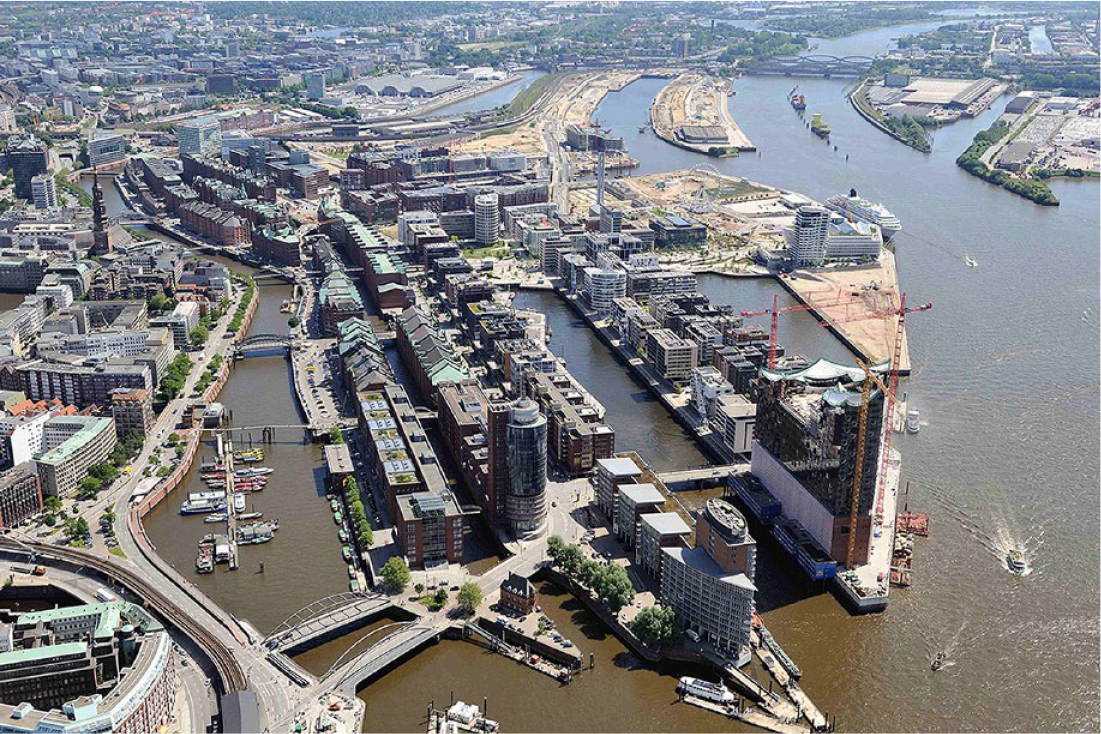
The growing HafenCity and the adjacent historical warehouse district in 2013. Photo courtesy ©Kuhn/Fotofrizz.
The HafenCity’s branding narrative: the ‘European Age of Discovery’
Building on Charles Landry’s (2000) writing on the ‘creative city’, Andreas Reckwitz (2009) describes how agents of city branding draw from anything they can find when investing urban space with symbolic meaning, ‘including previously banal or even problematic phenomena or what was taken for granted: natural environments, industrial monuments, local customs, former city dwellers of dubious fame’ (p. 161). In Hamburg, political and economic elites, who share an interest in the valorisation of city space, found a rich historical repertoire that facilitated the process of city-branding. 17 Perhaps most prominent among the many architectural remnants of Hamburg’s maritime colonial history is the historical warehouse district called Speicherstadt, a neo-Gothic assemblage of warehouse blocks built at the turn of the twentieth century. In the late 1990s, the previously neglected buildings began to be refurbished, reinvested in with cultural meaning, and gradually converted into a heritage site. In 2015, UNESCO rewarded the city’s efforts when it granted the Speicherstadt World Heritage status, yet both the city’s application (Free and Hanseatic City of Hamburg, 2015) and the UNESCO evaluation (ICOMOS, 2015) failed to mention the site’s colonial subtext.
The systematic omission of colonial history also applies to the many museums in the HafenCity. At the time of writing, the Speicherstadtmuseum continues to exhibit historic refinement tools of coffee, tea, sugar, cocoa and rubber trade without reference to the city’s entanglements in colonialism and in the transatlantic enslavement trade. On the website of the International Maritime Museum that is located in one of the Speicherstadt’s oldest preserved warehouses, ‘curiosity and strive for power’ are named as the driving forces of international seafaring in Hamburg: ‘Maritime history is global history, and where could it better be told than at the port, Hamburg’s gate to the world’ (International Maritime Museum Hamburg, 2009). Further north, in the German Customs Museum, a single artefact appears as a decontextualised and fragmented reference to the area’s colonial legacy. A medium-sized tin shield displays the German Empire’s imperial eagle with the inscription ‘Imperial Customs Inspection Office Windhoek’.
Throughout the HafenCity, a palimpsest of foreign ‘travelling memory figures’ from different epochs and geographic trajectories of European expansion are on display. In the late nineteenth century, Hamburg’s merchants built the bridge Kornhausbrücke as a symbolic entry point to the warehouse district Speicherstadt and to connect it with the city centre (see Figure 3). The bridge features two larger than life-sized sandstone statues of Christopher Columbus (1451–1506) and Vasco da Gama (ca. 1460s–1542), the latter holding a map and a golden sword. On the southern side of the bridge, statues of Ferdinand Magellan (1480–1521) and James Cook (1728–1779) were destroyed during World War II. The statues bear witness to an early presence of a modern imperial imaginary that celebrated European expansion by cross-referencing foreign conquerors. 18 The Speicherstadt was festively inaugurated in 1888, just 4 years after the formal begin of the German colonial empire and the Berlin Africa Conference. Emperor Wilhelm II, an enthusiast of maritime warfare and imperial expansion, was officially received in Hamburg for the occasion.
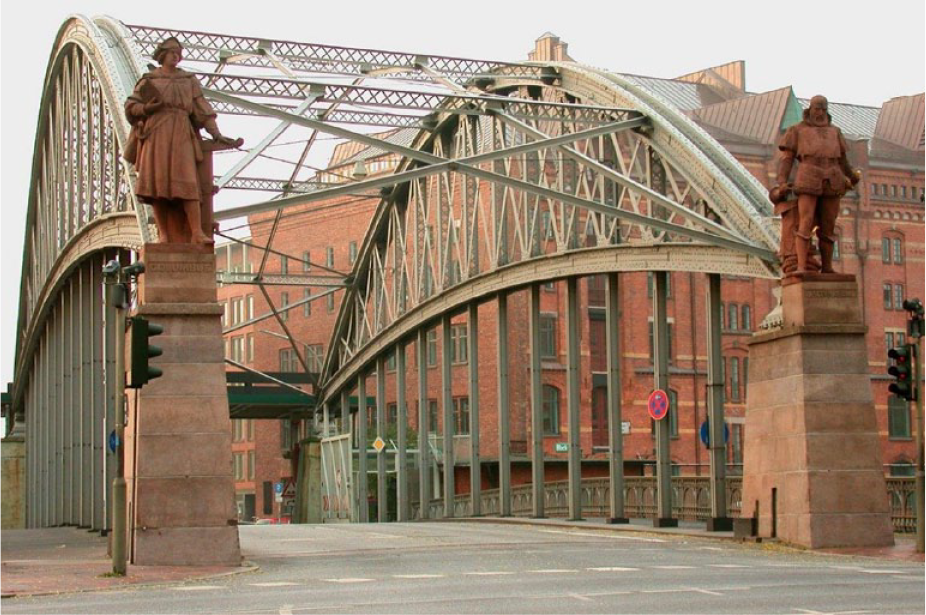
Built in the late nineteenth century, the Kornhausbrücke is framed by two sandstone statues of Christopher Columbus and Vasco da Gama. Photo courtesy of ©Denkmalverein Hamburg e.V.
In the HafenCity, policy makers not only conserved but also expanded on the colonial symbolism of the Kornhausbrücke. Renovated in 2007, the statues of the bridge ‘premediate’ (Erll, 2009) the HafenCity’s contemporary symbolic programme. The newly built red-brick offices that dominate the western segment of the HafenCity near the touristic river esplanades display large gold-plated metal letters identifying them as Columbus Haus (see Figure 4), Humboldt Haus, Vespucci Haus and Amundsen Haus. The museum port Sandtorhafen, a refurbished segment of the historic harbour and a heritage site, is framed by the newly constructed square Magellan-Terrassen. Close by, the square Vasco-da-Gama-Platz features a silver plaque that honours the ‘Portuguese Seafarer’. At the eastern tip of the harbour basin Grasbrookhafen, the square Marco-Polo-Terrassen connects to a sculptured building of luxury flats, the Marco-Polo-Tower. Decontextualised, repeated and placed in immediate proximity, these toponyms of male historical figures conflate into a single, celebratory cultural memory framework of the ‘European Age of Discovery’, of which Hamburg positions itself as the host.
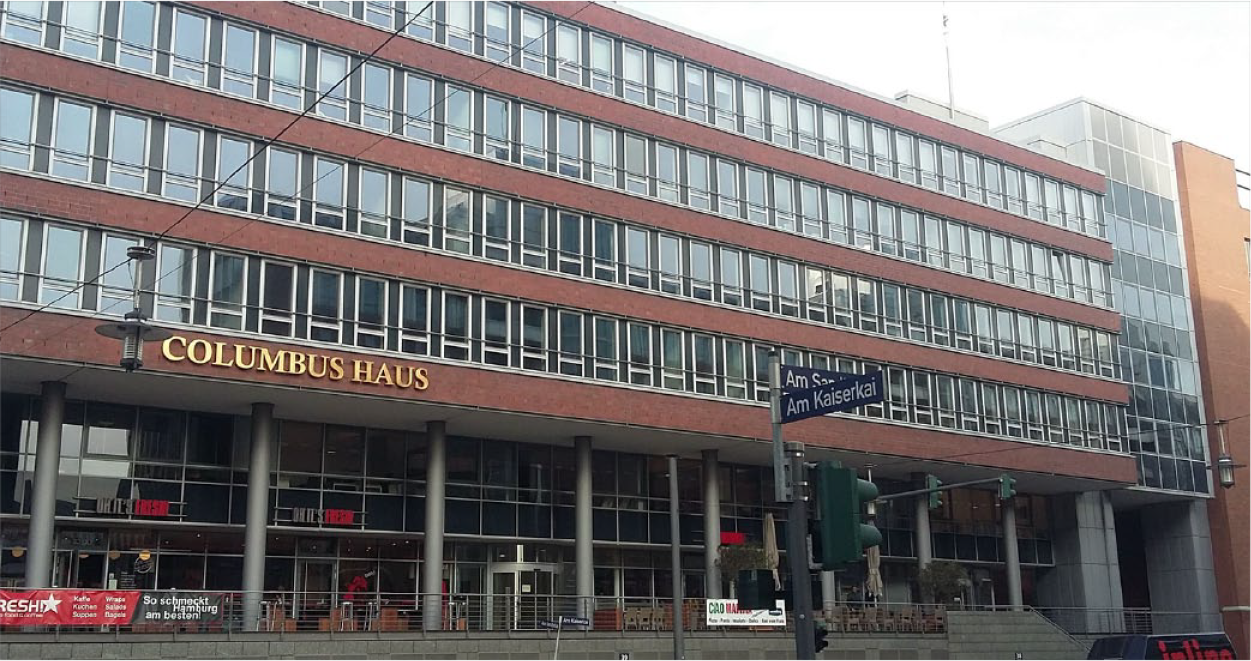
The Columbus Haus at the end of the street Am Kaiserkai. ©Jonas Prinzleve.
In the HafenCity’s commercial centre Überseequartier (Overseas Quarter), the residential tower Cinnamon, the Virginia Haus, or the Java Haus carry names of colonial spices and previously colonised territories. Mostly foreign memory figures were chosen, as if to avoid explicit reference to German colonialism. These neo-colonial toponymies are complemented with domesticated foreign street- and square names of indirect or no colonial connotation such as Singapurstraße, Shanghaiallee, Koreastraße and Chicagostraße. The HafenCity thus cultivates a Eurocentric cosmopolitanism that celebrates European-led globalisation and the world’s coming together under a single market. 19 By honouring Wilhelm II through the street Am Kaiserkai (By the Emperor’s Pier), themes of European expansion are consolidated with national imperial symbolism. Businesses such as the cafés Kaiser Perle (Emperor’s Pearl) or Kaiser Suite contribute to the ‘imperial ambience’ that is amplified by impressive sightlines across the Elbe onto the city’s current industrial port. At the south-western tip of the quarter, the Platz der Deutschen Einheit (Square of German Unification) opens up to the concert hall Elbphilharmonie whose shiny facades resemble ocean wave lines. Constructed on top of a shell of a historic warehouse, the HafenCity’s flagship building is visible through different viewing axes from around the city.
The coloniality of cultural memory and affective dissonance in the HafenCity
The HafenCity’s cultural memory complex is based on – and further develops – the area’s colonial-imperial heritage. Strategically combining local, national and European cultural memory frameworks, it markets a post-imperial imaginary of cosmopolitan and maritime tradition and identity. The HafenCity website’s history section is a good example of the ‘restorative nostalgia’ (Boym, 2001: 23) that saturates the area’s cultural display. Describing a planned demolition of the historic Speicherstadt during the early 1980s, the leaflet HafenCity Hamburg: Spuren der Geschichte (Kähler, 2001) suggests that popular protest put a stop to the plans. The text paints an ahistorical picture of a homogeneous Hamburg citizenry that is bound by its maritime legacy: A unanimous storm of protest from Hamburg’s citizens quickly swept this plan off the table – a proof of how much this place touches on the core of Hamburg’s identity. This is also where sentimentality lies – the Speicherstadt represents a longing for faraway places, the smell of strange spices and the awareness of first-class refinement recalls once again the great time of Hamburg’s merchants at the end of the 19th century [. . .]. (p. 32)
The quote is exemplary for the HafenCity’s wider heritage discourse in which the colonial mines and plantations are absent and so are the people who worked on them, or the conditions of their labour that lay at the basis of the ‘great time of Hamburg’s merchants’. 20 Instead, cultural memory constructs and exoticizes a muted other, expressing a nostalgia for the time of empire, for undefined faraway places and their ‘strange’ products. This ‘coloniality of cultural memory’ orchestrates the city’s affective geographies of citizenship and (un-)belonging. It produces an imaginative landscape that performs an interpellation, granting cultural identification to those visitors who are unaware of – or who have themselves benefitted from – the legacies of colonialism. 21 The selective rewriting of a suitable past makes unavailable uncomfortable questions of racism and violence, offering the possibility of a continuous dissociation. 22 Diverging information that re-associates the city of Hamburg and its maritime image with systematic injustice is perceived as unsettling. It disturbs a discursive order in which Eurocentric cultural memory enjoys a dominant and unmarked position.
Not everyone, to be sure, identifies with the cultural narratives that the HafenCity offers. (Neo-)colonial formations of heritage and cultural memory, even if disguised as celebrations of ‘cosmopolitan globalisation’, provoke affective dissonance and contestation. 23 In an ‘Open Letter to the City of Hamburg and the People of Hamburg’, the Association of the Ovaherero Genocide in the USA (AOG) raised awareness on how the city’s commemoration of colonial perpetrators is capable of triggering negative emotional sensations in those directly affected by the legacies of colonial violence: ‘The symbols are painful reminders to us, the descendants of the first 20th century genocide, on how our people were murdered, while the world remained silent then and continues to be silent today. [. . .] This is painful to us’ (Association of the Ovaherero Genocide in the USA, 2017).
The affective modes of encounter of (neo-)colonial heritage in post-imperial landscapes are manifold and depend on the orientation and positioning of the encountering subject (e.g. Ahmed, 2006; Rothberg, 2019). In Plantation Memories: Episodes of Everyday Racism, Grada Kilomba (2008) describes the repeated trauma caused by the ‘restaging of a colonial past’: ‘It is a violent shock that suddenly places the Black subject in a colonial scene where, as in a plantation scenario, one is imprisoned as the subordinate and exotic “Other”’ (p. 13). In a rich and compelling prose text, the local activist and member of the Initiative Schwarze Menschen in Deutschland Ginnie Bekoe (2015) makes a similar observation on the HafenCity: Walking through Hamburg’s streets makes me feel unhappy. I walk past the Vespucci- and the Columbus Haus towards the Kaiserkai, Vasco-da-Gama-Platz, the Magellan-Terrassen, Marco-Polo-Terrassen. [. . .] I think of the ‘suppressed revolts’ that were genocides, of fighters who defended their homes and lives, and of ‘Schutztruppen’ who defended profits. I think of the millions of people murdered, lynched, enslaved, exploited, raped, abducted, and I see magnificent facades, newly built residences, new nameplates. [. . .] Every step through these streets is a kick in the cultural memory, a renewal of collective trauma. Our stories do not count. We are invisible when a conqueror is stylised as an ‘explorer’. We do not count when an agent of enslavement and exploitation becomes merely a ‘seafarer’. (pp. 144–145)
24
Bekoe reveals how colonial public memory in urban space and the set-in-stone imaginaries of empire generate feelings of exclusion and unbelonging. At its core, the coloniality of cultural memory in the HafenCity reifies a binary notion of whose stories and whose lives ‘count’ – and whose do not. In Hamburg, it has sparked a range of resistant practices by local citizens who reclaim, rewrite and reimagine the area and who campaign for a decolonisation of its heritage display.
A decolonial turn in public memory? Civil society pressure and ‘reframing’ in Hamburg
Since the beginning of the construction of the HafenCity in the early 2000s, Hamburg’s postcolonial initiatives voiced criticism. Responding to the municipal plans to decorate the area with the names of European ‘discoverers’, the civil society working group Hamburg Postkolonial and the art project afrika-hamburg.de (2005) remarked that [t]hese names give the wrong impulses, because they stand for men who colonised, forcibly Christianised and plundered entire continents. If the city of Hamburg wants to live up to its claim of cosmopolitanism and wants to welcome, for example, guests from South America and Africa, other street names are needed [. . .].
The activists who criticise the HafenCity for its toponymy are part of a wider, heterogeneous network of civic actors who contest colonial heritage practices in Germany and beyond (e.g. Ha, 2014; Zeller, 2018). Antiracism and Black advocacy groups such as Initiative Schwarze Menschen in Deutschland have existed for several decades (Diallo and Zeller, 2013: 165–231). Since the early 2000s, they have been complemented by a growing transcultural civil society field of post- and decolonial initiatives who are responding to public institutions’ long neglect of colonialism and its legacies. Associations and projects such as Berlin Postkolonial, Decolonize Berlin, AfricAvenir International, the NGO alliance No Amnesty on Genocide!, freedom-roads.de, No Humboldt 21, Freiburg Postkolonial, Leipzig Postkolonial, Decolonize Erfurt and many others are (re-)constructing alternative postcolonial archives, publish didactic material, or offer postcolonial city tours. 25
Increasingly, artists and cultural practitioners, scholars and students as well as activists and campaigners intervene in cultural, academic and public spaces to expose and dismantle colonial language and symbolism. Besides efforts to decolonise urban toponymies, they have energised public debates on museal exhibition practices, on the restitution of looted cultural objects and human remains, or on the question of reparation payments for colonial atrocities, genocide and land dispossession. Within the realm of cultural memory and heritage, a central general aim is to change the way that colonial history is remembered; the dominant historical perspective on colonial perpetrators ought to be decentred by giving visibility and shifting the focus to those that live through, resist and fight against (neo-)colonial violence and racism. 26
Different artists have engaged with the HafenCity from a critical postcolonial perspective. 27 In 2015, Hannimari Jokinen collaborated with migrants who share a refugee experience to create the project ‘Prints Left’. Discussing themes of globalisation, forced migration, war and colonialism in Hamburg, the project observed that ‘goods from all corners of the globe are rapidly and conveniently shipped here, whereas many people fleeing to Europe have to risk their lives using dangerous migration routes’ (Jokinen and Hoang, 2016: 87). To intervene in the HafenCity’s public space, the artist sought to manufacture large-scale banners that would carry oversized images of shoe prints of the refugees as well as their signatures – and to place these banners onto the building facades that display colonial names in the Überseequartier (see Figure 5). The images were intended to re-inscribe the lives of those affected by the legacies of colonialism into the city-text, from which they have been excluded. The signatures and the silhouettes of the footprints would have staged unexpected encounters, disturbed the HafenCity’s symbolic order and enunciated the uneasy ambiguity between absence and presence of marginalised groups in post-imperial city space. The HafenCity’s consortium rejected the project, but the graphics were nevertheless drawn up and exhibited at the exposition ort_m. 28
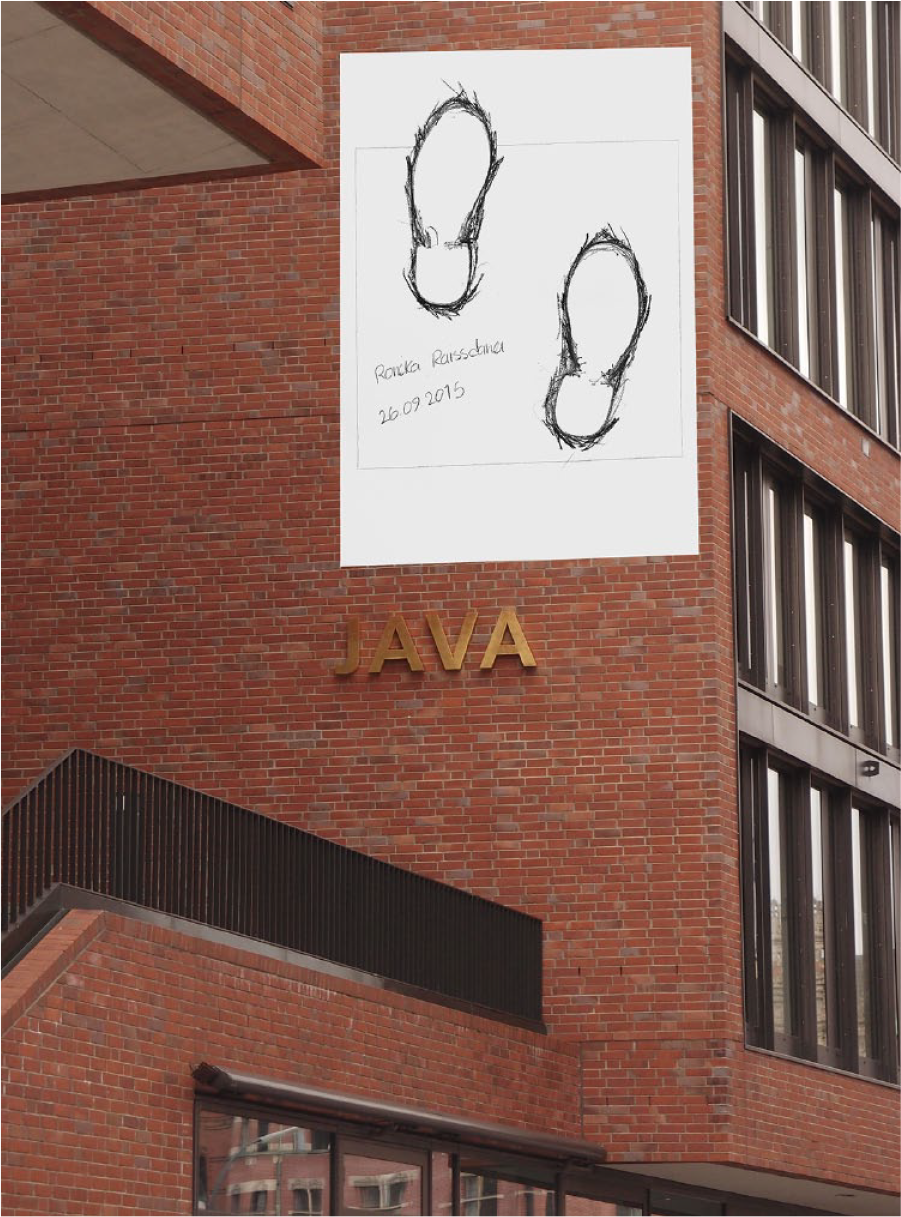
Photomontage ‘Prints Left’: a concept for banner installations on building facades in the Hamburg HafenCity as part of the art project ort_m [migration memory] (ort-m.de). Photo courtesy of Hannimari Jokinen, 2015. ©afrika-hamburg.de.
In the political and cultural forums that negotiate postcolonial heritage reappraisal, another key concern of decolonial initiatives involves the recognition and active redistribution of agency towards affected communities. In Hamburg, the 2014 senate bill (Drs. 20/12383) to ‘reappraise Hamburg’s colonial heritage’ failed in its attempt to initiate a city-wide postcolonial programme because it bypassed the descendants of the victims of colonialism and Hamburg’s Black and migratory communities. 29 In 2018, an international delegation of Herero and Nama representatives visited Hamburg for a grassroots congress and to advance the dialogue with key stakeholders in the city. 30 During a protest march that passed through the HafenCity and in a series of public panels, one of which was held in the HafenCity’s Baakenhafen, the delegation emphasised that their demands could only be met by joint political processes in which the affected communities took up key roles. Accordingly, their slogan stated, ‘Anything about us without us is against us!’
During the official reception of the delegations in the colonial Kaisersaal (Emperor’s Hall) of the Hamburg City Hall, Senator Carsten Brosda issued a public plea for forgiveness in an apologetic speech act in front of the traditional leaders that were present. 31 Yet up until the time of writing, there exists no memorial to the colonial genocide in the city that would enable commemoration, mourning and critical reflection. Instead, in the Baakenhafen, where a ‘green, socially mixed neighbourhood for living and leisure’ (HafenCity Hamburg GmbH, 2020) is being developed (see Figure 6), the HafenCity’s largest public square was recently inaugurated as Amerigo-Vespucci-Platz. 32 This illustrates how institutional performances of regret exist ‘alongside and in contestation with non-regretful coping strategies’ (Toth, 2015: 553) which include varying and overlapping performances of denial, displacement and re-enactment of colonial symbology. In the realm of heritage and memory, efforts for restorative justice continue to compete with (and inside of) long-established epistemological and spatialised architectures of coloniality.
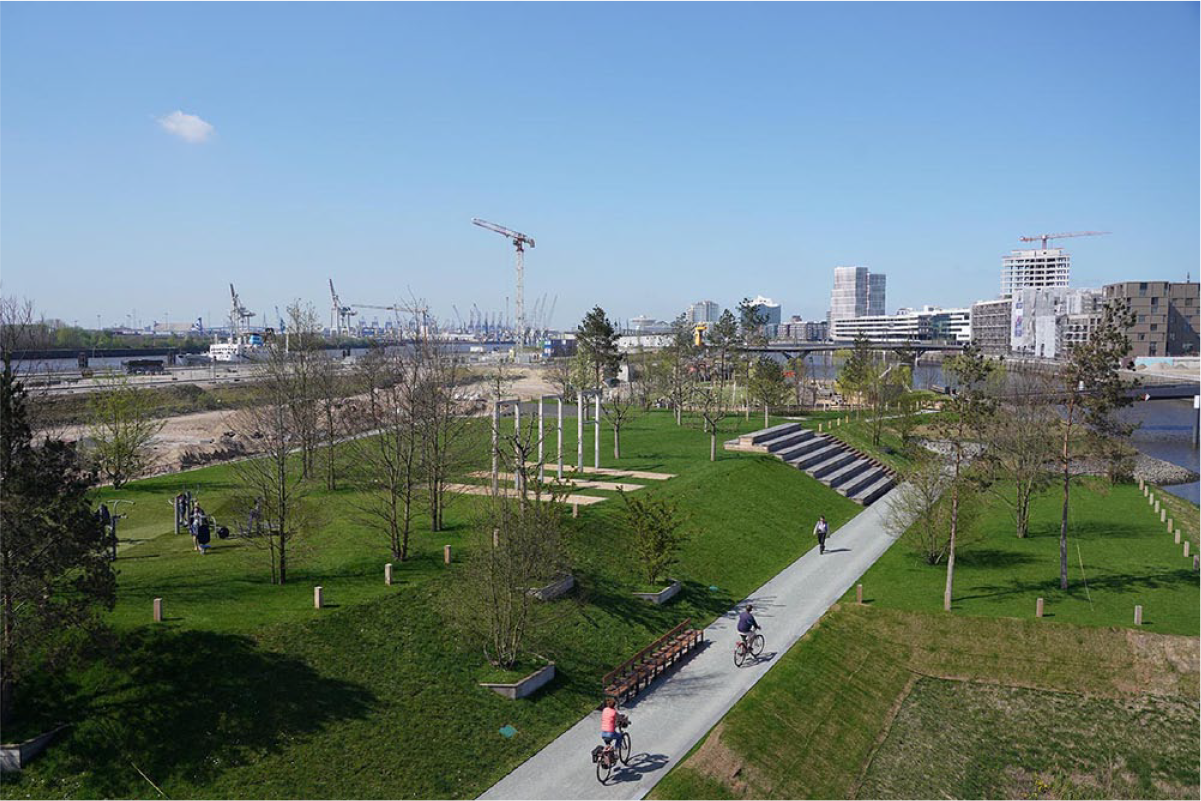
The Baakenpark was erected on an artificial embankment raised inside the harbour basin of the Baakenhafen. Photo courtesy of ©ELBE & FLUT.
As a result of civil society pressure, institutions are increasingly forced to be seen to be engaging with their historical colonial complicities and implications. In the preparation of the visit of the Herero and Nama delegations to Hamburg, local activists and representatives of affected communities resumed talks with the city’s Ministry of Media and Culture which resulted in the creation of the biannual Round Table Colonial Heritage, a platform for dialogue between communities, civil society initiatives, cultural institutions and political administrations. In 2019, the city created an advisory board of majority Black and migrant-diasporic scholars, activists, educators and artists to jointly develop a decolonising remembrance concept for the city of Hamburg. 33 These and other efforts may be signals of a beginning paradigm shift in Hamburg’s remembrance culture.
Municipal and cultural institutions are not monolithic and do not always stand in binary opposition to civil society demands. Instead, they adapt, respond to and interact with the socio-cultural processes and actors that surround them. Perhaps similar to other European cities, Hamburg is witnessing the beginning of a critical ‘reframing’ of its (neo-)colonial memory landscapes, that is, the incorporating of colonial heritage into new, more ‘consensual frames’ (Knudsen and Kølvraa, 2020: 11). The city’s official cultural programme is adjusting. Leading cultural institutions are conceding to the transnational interest in postcolonial discourse and culture, and museums begin to feature temporary exhibitions around postcolonial themes. 34 In 2021, the HafenCity’s own corporation for cultural development launched the project ‘Imagine the City’ which included a temporary artistic veiling of the colonial statues of Vasco da Gama and Columbus in ‘tropical designs’. 35 Increasingly aware of the political urgency and mobilising force of postcolonial memory struggles, city developers, museum executives and staff of municipal cultural departments convene in meetings with post- and decolonial campaigners and cultural practitioners. These processes of reframing of colonial heritage are hardly ever free of conflict. Activists and members of affected communities expose and politicise the asymmetrical power relations that underpin them. They guard against a misrepresentation and appropriation of marginalised knowledges that are increasingly in demand.
Conclusion
In this article, I have examined the coloniality of cultural memory in Hamburg, a former imperial metropolitan centre, and looked at the different affective engagement that post-imperial city space provokes. The longue durée of Hamburg’s colonial history includes a complicity in the transatlantic enslavement trade and an active role in the colonial genocide against the Ovaherero and Nama people. Yet in the urban redevelopment project Hamburg HafenCity that is built on the quayside of the city’s former colonial port, city planners and policy makers reinvented the imaginative geographies of empire. Different carriers of cultural memory inform each other and are curated to tell a story. This ‘cultural memory complex’ draws on different, inter-layered colonial memory frameworks (local, national and European). Colonial heritage and imperial memory tropes are integrated into a contemporary symbolic programme that attempts to reconfigure them as brand values of a cosmopolitan, global and maritime cityscape.
Imperial toponymic inscriptions recreate painful environments for those who are directly and negatively affected by racism and other social legacies of colonialism. The HafenCity’s celebration of imperial memory reproduces, at least symbolically, the colonial violence the space is implicated in. In Hamburg, civil society initiatives and affected communities have been campaigning to reappraise colonial heritage for several decades. Artistic and educative projects provide alternative archives for postcolonial memory, while political campaigners seek restorative justice for colonial atrocities. Hamburg’s colonial history is no longer unknown but is being carried into different public forums by activists, students, scholars and artist. Picking up on a global trend of decolonial heritage practices (Knudsen et al., 2021), cultural institutions begin to engage with (their own) colonial legacies. I have suggested that within these processes of reappraisal, decolonial cultural politics demand a shift of focus to the subject-positions and histories of anti- and postcolonial resistance as well as the active redistribution of agency towards affected communities, who have been primarily responsible for energising postcolonial debates. Further research may address the multiple challenges civil society and community actors face in driving processes of decolonisation of cultural memory in cities around the world.
Footnotes
Funding
The author(s) disclosed receipt of the following financial support for the research, authorship, and/or publication of this article: This article is based on PhD research funded by Fundação para a Ciência e a Tecnologia (FCT).
