




Abstract
The figure of the ‘Arctic hysteric’ emerged in the late nineteenth and early twentieth centuries in the discourses of polar explorations and Arctic colonisation as part of photographic and narrative archive of Westerners’ encounter with Greenlandic populations. This racialised and gendered trope made a mark on the European collective memory of Arctic explorations, solidifying an image of native Greenlanders as infantile, frail and in need of protection from the deleterious effects of civilisation. As such, post-colonial scholars have suggested that ‘Arctic hysteria’ cannot be regarded as a solely psychological diagnostic, but needs to be historicised in the context of colonisation and the social disruptions and hardship it brought about for the Inuit. This article, first, undertakes an analysis of the photographic figurations of ‘Arctic hysteria’ to investigate their place in the collective memories of polar explorations, including erasing the role of Indigenous people in these explorations, and, more broadly, construing imaginary geography of the Arctic as an uninhabited and empty place, a canvas for colonial projections, rather than a native homeland. Next, it focuses on artistic resignifications of ‘Arctic hysteria’ in the work of Greenlandic-Danish artist, Pia Arke, and argues that these resignifications are an example of a decolonial project of counter-memory of the Arctic, which is based on a refusal of regarding colonisation as past. Tracing coloniality and its effects in the domains of the body, affect and intimacy, Arke explores the possibilities of creating a shared and relational Arctic memory.
Keywords
Introduction
Much of the impetus of the decolonising movements today comes from restitutive demands made by social actors seeking to reclaim objects of cultural heritage and Indigenous knowledge belonging to their creators, caretakers and custodians (see, for example, Björnberg, 2014; Bodenstein et al., 2022; Bruncevic, 2021; Matthes, 2017; Sandis, 2014; Scott, 2019). Focusing on the post-colonial Arctic 1 and cultural memory of modern polar explorations, this article addresses an issue that has been on the margins of cultural retrocession debates and of the politics of heritage return: the reclaiming of colonial photographs in anti-colonial and Indigenous approaches to restitution. Within these struggles and debates taking currently place in Greenland, art and creative practices have occupied an important place; as the Director of Nuuk Art Museum, Nivi Christensen (2022) argued, Greenlandic artists have been at the forefront of the debates about decolonisation and indigenous rights and knowledge, including their engagements with issues of post-colonial cultural memory.
One of the reasons why pictorial archives and colonial-era photographs have been marginalised in the debates about post-colonial restitution is because images do not easily fit into the dominant definitions of ‘looted things’. What thus makes engagements with images by contemporary Indigenous and post-colonial artists important are the ongoing practices of resignification and undoing of ‘colonial visuality’ (Cummings, 2011), which in turn enrich and radicalise debates about restitution and its relation to collective memory (cf. Fforde et al., 2020). What does it mean ‘to return an image’ when hand are not items made and cared for by the colonised and Indigenous people, but, rather, photographic depictions of their ancestors and homelands, produced by European and North American administrators, anthropologists and explorers? These images’ stylistic design, semantics and intentionality reflect stark power differentials operative in colonial settings. They were created not for the viewing of the people whom they depicted, but for the knowledge, pleasure and consumption of the Western publics, and were often taken without consent or awareness of those whom they ‘forced to be seen’ (Cole, 2019). Solomon-Godeau states about colonial photography that, while claiming the ‘capacity for objective transcription’ of the world, these images ‘desire[d] to commemorate the singular and the unusual (the exotic, the Other)’, and became an important ‘tributary to the progress of empire [and a] fuel for the mission civilisatrice’ (Solomon-Godeau, 1991: 171, 172).
And yet, today these images can evoke complex and ambiguous feelings and responses. While they are frequently a documentation of systemic and epistemic violence, these photographs can also be carriers of communal meanings and familial attachments and hold mnemonic significance for people whose ancestors these images depict. Among others, speaking at the 2022 conference of the Nordic Memory Studies Association in Reykjavik, Eva Maria Fjellheim gave a powerful account of the complex emotional and political response to photographic images of her Sami ancestors produced by Norwegian state functionaries, which represent implementation of racist and eugenic state policies (see also Fjellheim, 2020). This article analyzes images of so-called ‘Arctic hysteria’ or pibloktoq, belonging to the pictorial archives 2 that were created by Western polar explorers and anthropologists during two subsequent phases of Arctic explorations: the 1879–1900 period (so-called ‘race for the Pole’) and the 1900–1924 period (characterised by disputes of polar claims) (Graugaard, 2018; Huhndorf, 2000; Rud, 2017). The photographs of ‘Arctic hysteria’, depicting Greenlandic women 3 in a condition of heightened stress and anguish, became part of archives documenting polar explorations and Arctic ethnography, including museum collections (the American Museum of Natural History, The Peary-MacMillan Arctic Museum) and those of scientific societies and associations (The Explorers Club in New York) (Dick, 1995; DPetersen, 2015). 4 The photographs were produced and circulated with the intention of illustrating narratives of pibloktoq. Starting with the first mention in Josephine Diebitsch-Peary’s diaries, a range of ethnographic and socio-psychological texts on pibloktoq was published by European and North American authors starting from 1890s until 1920s, and later (see, for example, Brill, 1913; Novakovsky, 1924; Steensby, 1910). 5
The images of ‘Arctic hysterics’, including depictions of the violent ways in which the women in the photographs were handled and restrained, are important documents of counter-memory of Arctic explorations and colonialism. They form a visual counterpoint to hegemonic narratives of Greenland’s ‘benign colonialisation’ and of the beneficial effects of polar explorations for the region and local populations, which contributors to critical Arctic studies have vehemently contested, drawing on Indigenous and post-colonial perspectives (see, for example, Boyle and Carden, 2021; Christensen, 2017; Egede Lynge, 2006, 2011; Lennert Jensen et al., 2022; Maegaard and Mortensen, 2022; McLisky and Møller, Møller, 2022; Petersen, 1995; Sogaard, 2020; Thisted, 2012; Vold, 2021). This article seeks to add to that scholarship from a critical memory studies perspective by asking about the role of the ‘Arctic hysteria’ images in the construction of colonial memory of the Arctic and of cultural perceptions of the Greenlandic populations. My approach borrows from Achille Mbembe’s (2002) writings on post-colony and his conceptualisation of colonial power as commandment that operates through a dual modality of creation and destruction. Mbembe’s notion of colonial power as a miracle – one that at the same time negates or empties ‘what is’ and brings into existence a radically new order and set of meanings – offers possibilities for a productive critical engagement with the photographic archives of ‘Arctic hysteria’ created during the polar explorations by drawing attention to the destructive-creative power dialectics operative in the field of cultural memory. This perspective formulate a question what memories these photographic figurations of ‘native hysteric’ invisibilise and empty, and what mnemonic order they simultaneously call into existence and institute as dominant. 6 Within this theoretical trajectory, it also becomes possible to address the broader cultural significance of these photographs and of the mnemonic figurations of ‘native hysterics’ by bringing into relief their role in discourses of Arctic colonisation, and their inclusion in the social imaginaries that accompanied and fuelled polar explorations.
In the second part of the article, I shift focus onto contemporary critical and creative engagements with the pictorial trope of ‘Arctic hysteria’ by the Greenlandic-Danish artist Pia Arke (1958–2007). Arke was born in Scoresbysund in Northeast Greenland (to Greenlandic mother, Justine Piparajik Birgithe Arqe, and Danish father, Jorgen Gant). During her childhood, the family frequently relocated due to Gant’s work as a telegraphist. This in turn affected Arke’s capacity to gain linguistic fluency in East or West Greenlandic (Gregory, 2017). Arke moved permanently to Denmark in 1987 to study at the Royal Danish Academy of Fine Arts; her master’s thesis Ethno-Aesthetics (Etnoæstetik) from 1995 has been regarded as a key text of cultural post-colonial critique in the Nordic region. She lived in Copenhagen until her passing in 2007, creating and exhibiting numerous art projects that combined the media of photography, graphic art, painting and written text – Arke also developed and frequently used in her work a human-sized camera obscura. Her artworks include Nuugaarsuk (1990), Imaginary Homelands (1992–2003), Arctic Hysteria (1996), Legende I-IV (1999) and Stories from Scorebysund: Photographs, Colonisation and Mapping (2003). Arke’s creative work, as Gregory (2017) discusses, often articulated the complexity and tensions of hybrid subject positions and ‘divided cultural identity’. She examined relationships between history, coloniality, the ‘in-between space[s]’ and concurrent ‘perspective[s] of the insider and the outsider’ (Gerges-Miranda, n.d.). Situating my interpretations of Arke’s three artworks alongside discussions of her work in Greenland, Denmark and beyond (see, for example, Christensen, 2021, 2022; Jonsson, 2012, 2013; Mondrup, 2012; Sandbye, 2022; Thisted, 2012; Von Harringa, 2021; Von Spreter, 2021), I argue that they are a form of resignification of the colonial mnemonic trope of ‘native hysteria’. The ‘counter’ orientation in Arke’s art has been noted in cultural studies; among others, Sandbye (2022) has analysed Arke’s project Stories from Scoresbysund as an artistic production of counter-images, and Von Spreter (2021) has aptly characterised Arke’s use of colonial photographs in her montage techniques as a practice of ‘visual repatriation’ and ‘reclaiming’. Framing Arke’s ‘Arctic hysteria’ series as counter-memory, it is important to note the dual dynamic at work in her art – both a critique of the dominant Arctic discourse and memory and an attempt at ‘filling the gap’ that occurs in the wake of such a critique. 7 As such, this work of counter-memory also touches closely on questions of restitution and repair with which this article opened. The ‘Arctic hysteria’ series complicates the dominant paradigm of post-colonial restitution in going beyond demands for physical return and access; rather, in her creative practice, Arke actively retrieves and reclaims colonial imagery, and her artistic resignifications speak to the connection between restitution and ‘undoing’ imperialism.
In conclusions, I elaborate three interrelated vectors of counter-memory at a work in Pia Arke’s visual resignifications of the ‘Arctic hysteria’ trope. First, there is counter-memory as a recognition and validation of lives excluded from the official versions of history (and not only excluded, but interdicted and foreclosed from memory, cf. Mondrup, 2012). This notion of counter-memory draws on the contribution of Indigenous scholarship into memory studies (see, for example, Fjellheim, 2020; Kidman and O’Malley, 2018; Quayle et al., 2016), as well as takes as its inspiration Toni Morrison’s (2019) well-known idea of ‘resisting disremembrance’. 8 The second dimension of counter-memory in Arke’s images is restitutive, which recognises in her artistic practice enactments of retrieval and return of what has been seized, appropriated and destroyed (images, material objects and memory). The third of counter-memory in Arke’s artwork associates remembrance with reparative effects and is underwritten by ethics of shared remembrance that resists partitions and exclusionary categories of collective memory.
‘Arctic hysteria’ photographs as a colonial trope
Post-colonial critiques of ‘Arctic hysteria’ (pibloktoq) 9 have identified it as a diagnostic category that closely imbricated modern medical and natural sciences on the one hand and Western expansionism in the Arctic on the other hand (Dick, 1995; Kaalund, 2021a, 2021b). 10 The nexus of science, exploration and colonialism in the Arctic were conspicuous in the ‘epistemological framing of fundamental differences between colonised and uncolonised bodies [. . .]’ (Rud, 2017: 74). Modern polar explorations played an important role in the economic and political subordination of the Arctic to the imperial systems of control and extraction. Through their utilisation of anthropological and photographic technologies, they resulted in creation of vast visual collections, which became key to the cultural productions of difference between Europeans and their ‘others’ (Bloom, 1993; Hight and Sampson, 2002). These thus contributed to a colonial ‘imaginative geography’ of the Arctic and were often based on ‘representations of peoples and places that express[ed] the perceptions, desires, fantasies, fears, and projections of their authors’, governed by the reified ‘distance between self and other, or between home and abroad’ (Desbiens, 2017; see also Said, 1978).
The polar explorers’ narrative and visual accounts from the nineteenth and early twentieth centuries contributed to the constructions of the ‘North’ as desolate, pristine, alluring and dangerous. Jen Hill (2008) argues that Arctic’s associations with a pure and unspoilt place were a particularly salient feature of this colonial imaginary, which imbricated with a sense of possibility and a promise of ridding oneself of anxieties of modernity. Those who ventured into the Arctic separated from ‘the problematic political, racial, and economic relations of empire’, as well as from the class conflict ‘at home’ (Hill, 2008: 5). This mapped onto the idea of the Arctic as a kind of terra nullis that was void of ‘proper’ inhabitants (see Radcliffe, 2022; Steinberg et al., 2015). Through the imaginary of an unknown and uninhabited place, Arctic was constructed as a place that colonial exploration, extraction and penetration; an object of adventurers’ desires and scientists’ interest (see DHastrup, 2007). It could only be explored at the cost of heroic effort and perseverance, and that would test the limits of human capacity and endurance (cf. Bloom, 1993). Feminist cultural scholars have in this context convincingly argued that the construction of the Arctic as a liminal place, untouched by modernity, was interwoven with discursive patterns of ‘feminisation’ of the Arctic, which in turn consolidated the image of polar explorations as an exclusively male activity (see, for example, Bergmann, 1993; Bloom, 1993; Collins, 2022; Ingólfsdóttir, 2011; Leavenworth, 2010; Reeploeg, 2021; Thisted, 2010; Von Spreter, 2021).
While the travelogues and photographs produced by the polar explorers and anthropologists, and featuring the Arctic landscapes, fauna, flora and its Indigenous populations, enjoyed the status of objective scientific records, they were meticulously curated. This was also the case with photographs of the ‘Arctic hysteria’, as exemplified by Donald B. MacMillan’s images of pibloktoq taken during the 1913 ‘Crocker Land’ expedition, and reprinted in Dick’s (1995) article on ‘Arctic hysteria’ as a colonial construct. One of the photographs shows the explorer’s painstaking preparations to record an episode of pibloktoq. The production of these carefully arranged and stylised images of the Arctic played important role in legitimising the explorations as it presented the Europeans and North Americans as credible observers and analysts of the Arctic, and potentially its trustworthy caretakers. Their activities were justified, and perhaps even necessary, and had an unambiguously beneficial impact. Recent historical scholarship has questioned this idea of the Westerners’ beneficence by stressing the explorations’ detrimental social, cultural and environmental impact on the region and its human and animal inhabitants (Kaplan and LeMoine, 2019; LeMoine et al., 2016; McCannon, 2013).
The images and narratives of ‘Arctic hysteria’ produced by the explorers and anthropologists generated scientific interest in its symptoms and aetiology, including psychoanalysis, genetics, environmental causes, diet and psycho-biology (Baashus-Jessen, 1935; Brill, 1913; Gussow, 1960; Novakovsky, 1924; Steensby, 1910; Wallace, 1961). In the post-war period, pibloktoq was included in the discourse of transcultural psychiatry and classified as a ‘culture-bound syndrome’ (Yap, 1951, 1962). It was included in the DSM-IV among dissociative disorders and defined as ‘single or episodic disturbances in the state of consciousness, identity, or memory that are indigenous to particular locations and cultures’ (cited in Fulk, 2012: 1206; see also Higgs, 2011; Nasser, 2012). It was from DSM in 2014. Critical cultural approaches to these images and narratives were developed more recently by post-colonial and feminist scholars who viewed ‘Arctic hysteria’ as a symptom of colonialism. Drawing on the conceptualisation of colonisation as a process that is not only political-economic, but also cultural (Thomas, 1994; see also Hight and Sampson, 2002), this scholarship views ‘Arctic hysteria’ as a colonial trope that expressed and amplified an ‘aesthetic distinction [. . .] between “them” and “us” (Bertelsen, 2012 [2009]: 261).
The early twentieth-century anthropological and psychological responses to pibloktoq simultaneously pathologised, orientalised and sexualised a profusion of behaviours and practices, by compressing them into a singular ‘idiom of distress’ (Nichter quoted in Briggs, 2000: 248). Some of the behaviours categorised as pibloktoq were related to shamanic practices and rituals (see Higgs, 2011), but the ‘Arctic hysteria’ images are also striking demonstrations of a ‘colonial myopia’ in that the Westerners who took the photographs did not recognise or reflect on the role that their presence and behaviour might have played in the events at hand. They did not see were people finding outlet for stress, anguish, anger or hostility, in response to the Westerners’ intrusive, violent and disruptive practices, or that at hand was, perhaps, a kind of resistance and protest against them. 11 The social, political, cultural and environmental impact of the polar explorations on the Greenlandic populations has been well documented (see, for example, Dick, 1995, 2002; Hanrahan, 2017; Kaalund, 2021b; Kaplan & LeMoine, 2019; LeMoine et al., 2016; McCannon, 2013; Toft and Seiding, 2013), and many of Archival photographs of pibloktoq were taken in the context of the recruitment and relocation of the Inuit from Northern Greenland, both men and women, as key facilitators of, and participants in, the overland explorations of the Northwest Passage. Bertulli et al. (2013: 318) list hardships that Greenlanders people in the polar explorations endured as potential factors in pibloktoq: ‘long separations of family members and compatriots, strenuous and perilous sledging trips, sexual exploitation and abuse of women, and compulsory work routines, noise curfews, and rationing’ (see also Dick, 2002). Dick (1995) documents a range of potential pibloktoq factors, including food insecurity, alienation, displacement, and sexual harassment and assault (in the official narratives created by the explorers sexual violence against Greenlandic populations are rarely mentioned, by Dick finds reference to sexual assault in the diaries of Evelyn Briggs Baldwin, meteorologist in Peary’s 1893–1895 expedition). Drawing on archival and archeological evidence, LeMoine et al. (2016: 6) note that many recorded pibloktoq cases took place at Cape Sheridan (place were Greenlanders recruited by Peary in the 1908–1909 North Pole were stationed), and they link pibloktoq to the experience of being far away from their communities, to social and personal vulnerability, and to disruption to peoples’ relationships with place and with ‘memoryscapes’. They argue that stark physical geographic differences between the Harstene Bay region (which the recruiters inhabited) and Cape Sheridan (where the participants in the overland explorations of the Northwest Passage were stationed for 18 months) created daily challenges and undermined the Greenlanders’ place-based relations, meanings and identities (cf. Nuttall, 1992: 38–58).
The role of the native people in the Arctic explorations has been marginalised in the Western cultural memory, which features the polar expeditions as a (nearly) exclusive domain of European and North American activity, technology and expertise (LeMoine et al., 2016: 1). And yet, as Kaplan and LeMoine (2019: 103, 106) argue in regard to Peary’s expeditions, ‘almost every element of [his] success was based on Inughuit technology and dependent on their willingness to help him’ and ‘is directly attributable to the labor, knowledge, and skills of Inughuit men and women’ (see also Weisburger, 2010). That includes ‘the clothing [Peary’s] men wore, expertly made by Inughuit women’, food supplied by the hunters, and management of dogs and sledges based on ‘traditional Inughuit design’ (Kaplan and LeMoine, 2019: 105–106). The images of ‘Arctic hysterics’ play a role in that mnemonic erasure, or dis-remembrance, of the native people (and especially Greenlandic women) in polar explorations and in their marginalisation in that history. Depicting the Indigenous women as ‘unstable, crazed, and savage’ not only undermines acknowledgement of their role in ‘initiating the explorers and colonisers to the reality of their Arctic’ (Mondrup, 2012: 267), but also forecloses their recognition as the Arctic’s inhabitants, whose profound knowledge of the place legitimises their claims to its land. As such, these images play a role in erasing from (Western) cultural memory the image of the Arctic as properly inhabited, and as (someone else’s) homeland, rather than a canvas for colonial projections of snowy vastness and hyperborean emptiness that was open for conquest, exploration and extraction (see Bloom, 1993; Hanrahan, 2017; Steinberg et al., 2015; Thisted, 2006, 2010).
The race and gender of ‘Arctic hysteria’
The racialised and gendered representations of distress in the pibloktoq narratives and photographs have been read as a counterpoint to the narratives of ‘benign colonialism’ in the Arctic (Kuratorisk Aktion, 2012a, 2012b, 2012c). They can also be approached from the broader angle of a cultural idiom that channelled the Western societies’ anxieties surrounding gender, race and whiteness in the late nineteenth and early twentieth centuries. Their narratives have stitched together seemingly contradictory meanings of hysteria prevailing at that time in Europe and North America. Feminist perspectives place the social figuration of ‘hysterical women’ against the backdrop of the ideas and movement for women emancipation and their demands for access to public and educational institutions, such as medical schools (Briggs, 2000; Krasny, 2020). Hysteria became the ‘sign and symptom of conflict over the cultural meaning of gender’ (Briggs, 2000: 247). Briggs proceeds to outline the modern discourse on hysteria as not only a gendered, but also highly racialised diagnostic since its underlying anxieties about women’s emancipative demands and about their reproductive performance was directly linked to whiteness and class.The figure of a hysterical ‘overcivilized’ white and middle-class woman emerged through discursive opposition to her invisibilised other: the ‘racialised, colonised, and hardy’ ‘savage woman’ (Briggs, 2000: 255, 257). Even though the visual and narrative trope of ‘Arctic hysteria’ developed on the margins of this larger social discourse in Europe and North America, it was imbricated with similar significations. On the one hand, it invoked gendered and racialised notions of ‘weakeness’ contained in the diagnostics of nervousness, neurasthenia and excessive excitability, which were discursively assigned to the destabilisation of native societies by the encounter with ‘Western civilisation’ and their inability to process and to cope with complexities of modernity (cf. Boag, 1970). On the other hand, it also contained racist representations of native women as the (over-)sexualised, seductive, promiscuous and reproductive (Bloom, 1993).
The colonial discourse has worked in this case as what Wahneema Lubiano describes as an overarching ‘cover story’ (cited in Briggs, 2000: 266): it effaces and masks inconvenient contents, and substitutes it with an ‘alternative presence’ that redirects the reader’s attention and ‘makes absent what has to remain unseen’. In the context of ‘Arctic hysteria’ representations, this means that while Greenlandic women were marginalised and stereotyped in the history of polar explorations, through the pibliktoq photographs they were also invested with a racialised and orientalised hyper-visibility (cf. Bjørst, 2014). It is important to approach the ‘Arctic hysteria’ images in relation to this dual dynamic: they both marginalise and invisibilise those whom they depict and, at the same time, force them to be seen by rendering public these difficult and intimate situations and states of distress. As such, these images articulate the workings of colonial power through the dual register of governing visibility and invisibility, while operating under the cover of ‘scientific objectivity’ and certain measure of innocence in that the explorers appear in relation to these images as dispassionate and benign bystanders to dramatic displays of emotionality and irrationality.
Furthermore, it is important to note the metonymic and metaphoric operations in the ‘Arctic hysteria’ images in regard to the dual register of seeing and not-seeing: they establish a chain of signification by connecting place and the gendered and racialised bodies of its inhabitants. For one, the pibliktoq episodes were linked to derogative projections of the Inuit ‘character’ by depicting emotional outbursts or displays of distress as expressions of essentialised features and uncontrollable elements of ‘wildness’ ascribed to the people and the place alike. The distressed women were seen to embody and express some of the characteristics of the Arctic landscape that dominated their Western cultural representations. Thus, native bodies were represented in relation to, and as an extension of, a place that was defined as a site of extreme experiences and limits of reason (cf. Hill, 2008: 3–5). The climactic speculations about pibloktoq originating in result of extreme temperatures, winter darkness or seasonal oscillation further consolidated this imaginative geography of the Arctic as a place endowed with an ‘uncanny potential’ to drive people mad and delirious (Bowers, 2017: 77). 12 What remains ‘covered up’ in these tropes is the Arctic not as a while canvas of colonial projections, but preexisting and dynamic memoryscapes; the Arctic as a homeland and a place of belonging of people upon whom the explorers had come to depend not only for the accomplishments, but often for survival. The metonymic-metaphoric movement from the hyperborean environments and landscapes onto the Indigenous Greenlandic women sought to colonise their bodies as site of the imaginative geography of the North. The photographs sometimes depicted the women unclothed, or partially unclothed, and the accompanying narratives emphasised the native women’s (alleged) insensitivity to the low temperatures as they lay down on the snow. The political import of these depictions is that the ‘Arctic hysteria’ photographs depicted their racialised and gendered subjects as lacking or compromised humanity. Related to this is the attention the explorers paid to the hysterics’ vocalisations of distress, which they distinguished from verbal language and described instead as inarticulate sounds or animal noises (see, for example, Whitney cited in Dick, 2001: 58).
Another trajectory through which the narrative of deficient humanity was established was through infantilising representation; the ‘Arctic hysterics’ were depicted as puerile figures, which accorded with the broader colonial trope of ‘child-like aborigine’, vulnerable and innocent in their encounter with modernity and Western civilisation (see, for example, Faulkner, 2016). Brill’s (1913) article on ‘Arctic hysteria’ exemplifies this approach within the cultural discourse of psychoanalysis. He interprets manifestations of excitable or emotional behaviour as a child-like response to unfulfilled need for attention and to the withdrawal of love and affection. Brill based his argumentation on Peary’s and MacMillan’s frequent characterisations of the Inuit as ‘children’, for instance MacMillan (in a conversation with Brill) allegedly said about a distressed Greenlandic woman he has witnessed that she was as ‘a little child discouraged and unhappy because it imagines that no one loves it or cares for it and therefore runs away’ (Brill, 1913: 517). In The North Pole, Peary (2006 [1910]: 46, 50–51) described Greenlanders as ‘(i)n temperament like children, with all a child’s delight in little things’ and stated that
[They are] much like children, and should be treated as such. They are easily elated, easily discouraged. They delight in playing tricks on each other and on the sailors, are usually good-natured, and when they are sulky there is no profit in being vexed with them. [. . .] They are keenly appreciative of kindness, but, like children, they will impose upon a weak or vacillating person.
The ‘dangers’ that Western civilisation posed to the native people were precisely those of corrupting the ‘child like qualities which constitute their chief virtues’ (Peary, 2006 [1910]: 47). Brill (1913: 520) thus described the hysterics’ distress as a juvenile tantrum: ‘[t]here is hardly anything more childish than the imitation of the dog or a bird, or the running away into the hills singing and crying’. Whether depicting the bodies of the Greenlandic women as ‘merged’ with the environment or the landscape, or by rendering them child-like and animal-like, the colonial trope of ‘Arctic hysteria’ was a visual and narrative idiom for identifying the Indigenous people of the Arctic ‘incomplete humans’ – in need of protection, guidance and restraint.
Mnemonic resignifications: ‘Arctic hysteria’ in Pia Arke’s practice of counter-memory
This section focuses on the critical and creative resignifications of ‘Arctic hysteria’ in the art of Pia Arke as a practice of counter-memory. Arke addressed the plurality and hybridity of her identities by invoking the position of a ‘mongrel subject’ and of a ‘mongrelisation’. For instance, speaking to Stefan Jonsson in 1995, she said that she had been ‘[born into] silence that surrounds the bonds between Greenland and Denmark’ (Arke in Jonsson, 1995). Von Harringa (2021: 51) has argued that the idiom of a ‘mongrel subject’ is in Arke’s case irreducible to the question of a ‘mixed heritage’, but also invokes an ‘empowered subject positioning which centers Indigeneity within the hybrid conceptualizations of [Arke’s] practice – as the grounds of a creative autoethographic praxis’. On this point, Arke’s (2010 [1995]) artistic productions are imbricated closely with political and critical concerns articulated in the essay Ethno-Aesthetics. Challenging the self/other binary imposed by the coloniser’s epistemological framework, Arke (2010 [1995]) stresses the importance of carving out the ‘third place’ by those who do not conform with the position of ‘an ethnographic subject’ and ‘an ethnographic object’ (see also Bertelsen, 2012 [2009]). Thus, Arke’s resignifications of ‘Arctic hysteria’ fall within the broader horizon of her attempts at interrogating and undoing coloniality and its imprints on numerous practices and understanding, ranging from ‘mapmaking, time, memory, space, silence’ to ‘identity and myth’ (Arke, 2003). It is also important to remember that this project extends beyond negative or disruptive gestures. 13 Rather, the key component of Arke’s artwork has been affirmation of those local collective memories, relations and resurgent histories, which colonial descriptions marginalise and ‘ethno-aestheticise’. As I show in my analysis of Arke’s three artworks, that works includes a counter-mnemonic dimension, through which Arke recovers and ‘restitutes’ cultural memory that has been dominated by colonial representations. 14
Through a series of artworks on the ‘Arctic hysteria’ images, Arke interrogated colonial practices of documenting, examining and classifying Greenland and its inhabitants, and problematised their underpinning desire – to access the reservoirs of authenticity that ‘the native’ represented (see Arke, 2010: 337–339). While researching the pictorial documentation from Peary’s expeditions in the collections of the Explorers Club in New York, Arke found an image of a partially unclothed Greenlandic woman in the restraining grip of two White men by her side. The woman in the picture was being pacified by the two men posing for the photograph. She was visibly distressed. For Arke, this image constituted a point of refutation of the narratives of the explorers’ benign and beneficial presence in the Arctic, created by Peary, MacMillan and others (partly to ensure financial support from donors). Rather, the image reduces the woman’s body to a sign and a metaphor of the obstreperous Arctic nature, and casts the men are capable to exerting control over her (it). While the woman’s gaze is not visible in the image, which suggests that she might not have been aware that the photograph was taken, the men’s poses seem carefully adopted, they gaze directly, and their postures and expressions exude confidence.
Arke viewed this image as incriminatory evidence in relation to the history of the explorations and a potential liability for those Western institutions that remained committed to preserving these narratives. When Arke sought permissions from the Explorers Club to reproduce the photograph in her art project, she was denied on the grounds that the image was of a ‘sensitive nature’ (Baldwin, 1995). The rejection of Arke’s request was an ironic repetition of a colonial gesture, which, operating under the guise of benevolent and humanitarian concerns, enforces its power to control bodies, objects and affects. In her art project designed around the image, Arke responded to the club’s decision by highlighting its power articulations as a prohibition of visibility of coloniality’s violence. Importantly, there was a dual political trajectory to that response: on the one hand, Arke took an anti-colonial stance by calling into question and defying the prohibition, and on the other hand, she engaged in practices of counter-remembrance. Arke reproduced the photograph five times, using green-and-brown colour scheme (see Image 1), and included it as part of a visual and textual montage in the special issue of the Dutch catalogue Attack!. The reproduced and artistically modified image appears adjacent to the words from the Explorers Club’s letter (‘we regret to inform you at this late date that due to its sensitive nature the Club is placing restrictions on the photograph you requested’) (see Baldwin, 1995). The question ‘what it means to return an image’ arises again as an institution with vested political interests in preserving Peary’s legacy denies the right to the use of these images to people with ancestral and communal relation to those whom the photographs represent.
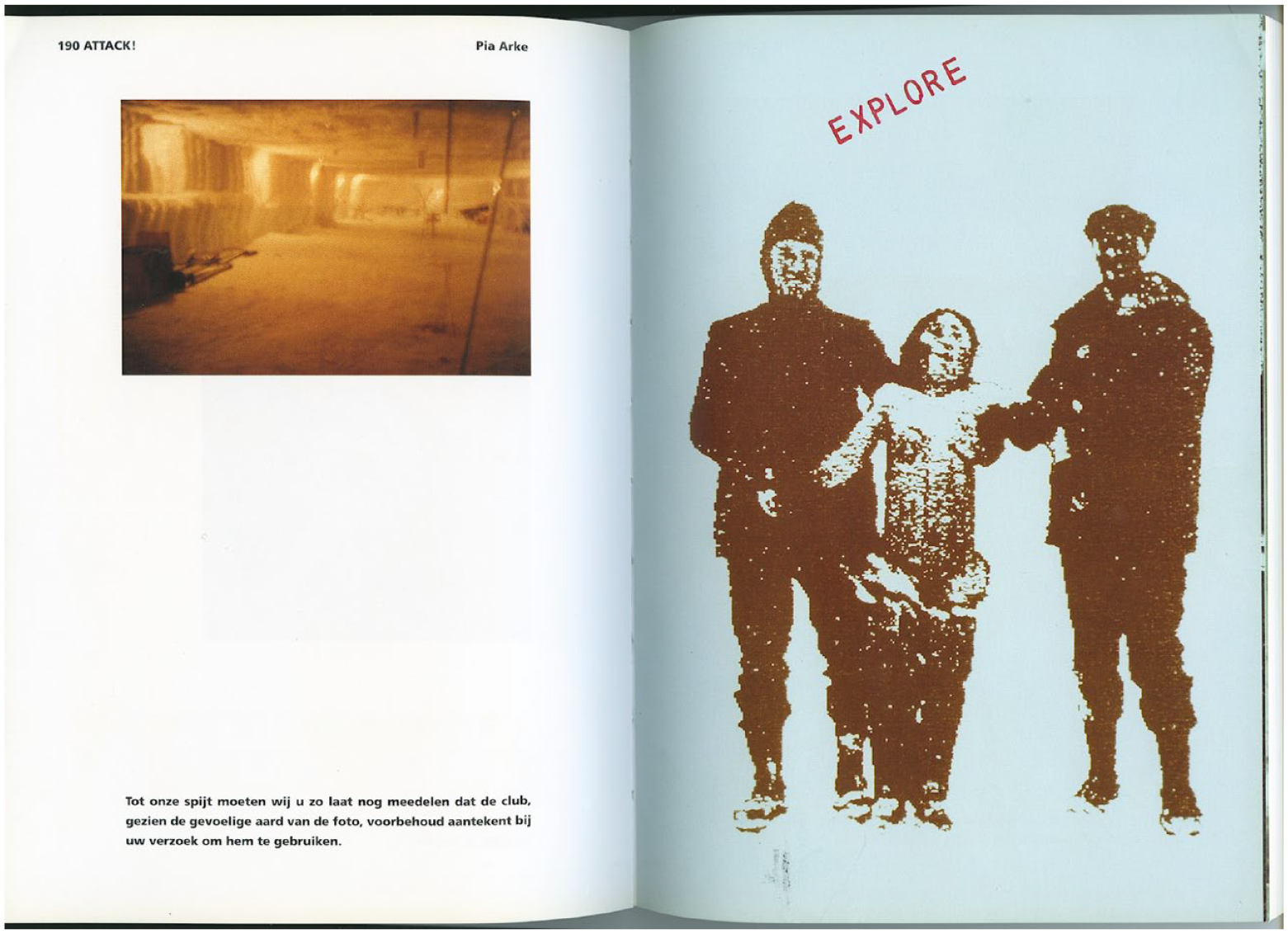
Pia Arke’s contribution to the 1999 issue of Attack!’.
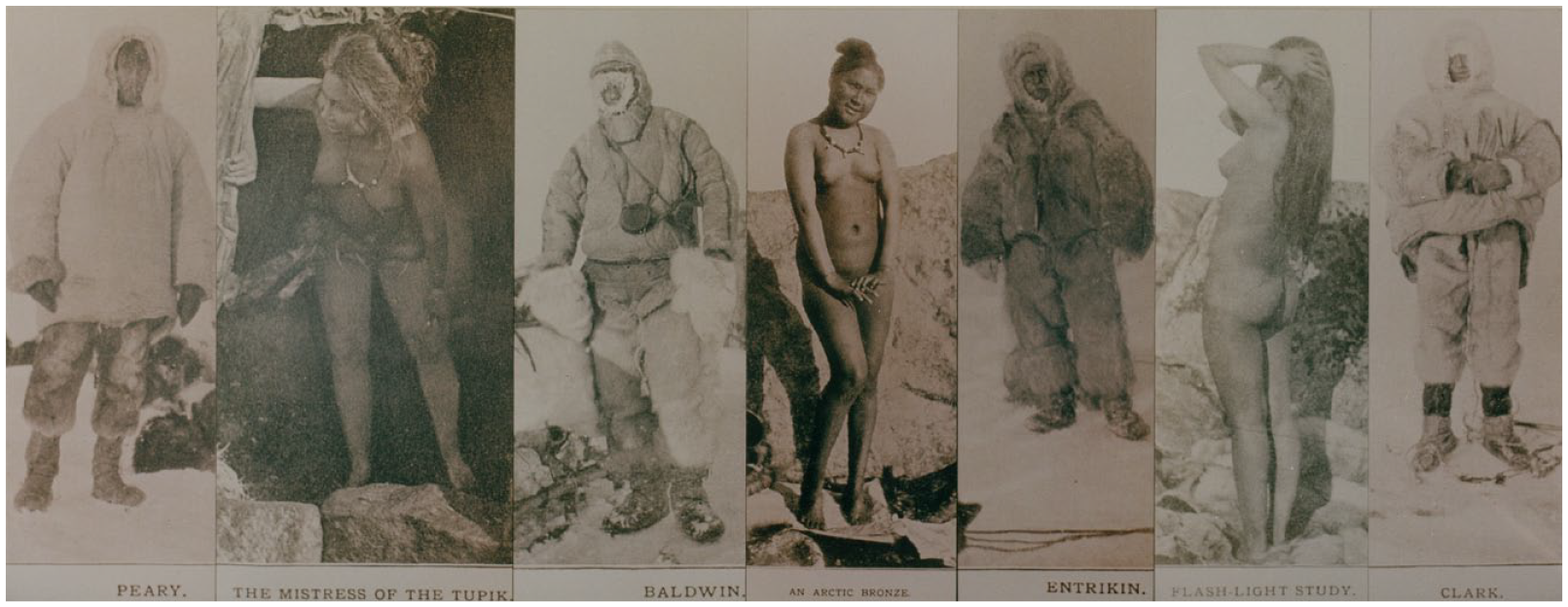
Pia Arke, Arctic Hysteria IV (1997).
Arke’s schema for organising her images in Attack! was also a visual chart of colonial violence and how it operates at the level of epistemology and through obliteration of subjectivities and memories. The scheme includes five different modalities of colonial power, which Arke idiomatised as: ‘explore’ (where the ‘Arctic hysteria’ image was placed), ‘control’, ‘taboo’, ‘restricted’ and ‘gone’. Through her images, Arke not only refused to submit to the prohibition on visibility, but she also engaged in practices of counter-memory. The action of pressing the shutter button multiple times creates a distance between the officially sanctioned and dominant memory and the artist; that distance creates the necessary space for the enactment of different kinds of remembrance. With each click of the button, Arke ‘undoes’ colonial representations as she situates continuation and presence of counter-memory (against the idiom ‘gone’); of freedom and refusal of prohibitions and limitations (against ‘restricted’); and of historical truth and avowal of responsibility (against ‘taboo’). Arke claims the ‘right to be remembered’ (Huggan, 2018: 97–98) by those who are recorded in dominant history in an ‘invisible ink’ (Mondrup, 2012: 267).
Another example of an artistic resignification of the ‘Arctic hysteria’ images is Arke’s ‘Arctic Hysteria IV’ (original lost, 2010 reproduction in the collections of Collection of Louisiana Museum of Modern Art). It is a ‘[y]ellow-toned photo montage [. . .] of seven juxtaposed photographs’, which Arke took from Peary’s 1898 book, Northward over the ‘Great Ice’ (Mondrup, 2012: 267; see Von Spreter, 2022). Four photographs show Peary and other members of the expedition (Clark, Baldwin and Entrikin), and three photographs feature anonymous unclothed Inuit women, whom Peary labelled as ‘The Mistress of the Tupik’, ‘An Arctic Bronze’ and ‘Flash-Light Study’, ‘associating the women with classical sculptures and paintings of “exotic” women’ (Thisted, 2012: 287). All these photographs featured separately in Peary’s journal, and by bringing them together, Arke articulates tensions, absences and erasures in these representations. Gustafsson (2022: 147) suggests that montage technique ‘ignite[s] mutual tension [of past and present] that allows us to glimpse them together’, thus creating ‘sudden actualization or flash-like cognition in the present’. In effect, Arke visualizes – and disrupts – the binary epistemic scaffolding propping dominant cultural memories of Arctic colonialism, including oppositional figurations of the male Western explorer and the female Greenlandic ‘savage’, and the stark contrast between bodies that colonise and those that are claimed as objects and ‘terrains’ of the colonising practice.
In ‘Arctic Hysteria IV’ (Image 2), Arke creates a critical ‘aesthetic space [in which] undigested traumas can resurface’ (Kuratorisk Aktion, 2012b: 155). By deconstructing the binary categories framing the visual documentation of Peary’s contact with the Inuit, Arke brings to the fore what the colonial discourse on ‘Arctic Hysteria’ disavowed and rendered invisible: the place of affect, desire and fantasy in the production of Arctic photography. She suggests that while Arctic explorations were underpinned by desire to explore and reach the inaccessible places of the North, it also had a strong sexual dimension. The nakedness of native women’s bodies was a recurrent, if not obsessive, element in the texts and images produced by the explorers, including depictions of ‘Arctic hysteria’ (the subjects in the state of excitability and distress were frequently featured as semi-dressed, undressed or undressing). In ‘Arctic Hysteria IV’, Arke disallows for the explorers’ gaze and body to remain invisible; rather as Mondrup (2012: 267) suggests, she ‘puts male desire on view. [Desire for k]nowledge, power, and sex. His erection under his clothes. A desire that was so pronounced that it had to be hidden behind science and skins and furs’. As such, the artwork illuminates the cultural and epistemic patterns within which particular ways of imagining the Arctic propped and framed colonisation.
Arke also shows that art can play a role that is not only a critique but also an act of reclaiming. She brings to the fore her dual response to these historical images: on the one hand, the explorers’ photographs of Greenlandic women clearly express colonial desires to objectify and to appropriate native bodies, and on the other hand, as ancestral depictions these images are also carriers of meanings, affects and memories that are irreducible to the colonial intentions with which they were produced. For that reason, I think that it is important to recognise in ‘Arctic Hysteria IV’ a work of counter-memory that resists and opposes colonial appropriations of historical representations as through her artwork Arke actively affirms and avows what the dominant memory disavows (in the psychoanalytic discourse, disavowal is never simply falsification or denial but signifies what is foreclosed from, or expelled beyond, consciousness and memory, or expelled beyond it). ‘Arctic Hysteria IV’ articulates Arke’s feminist and post-colonial sensibilities in that she is less interested in deconstructing colonial discourse of economic power or ideology, and is drawn instead to exploring how colonisation imbricates with structures of intimacy and embodiment, including ‘family relations and family ties’ (Thisted, 2012: 289). What comes to the surface in the interstices of the images included in Arke’s montage are the lives of Greenlanders who were born from explorer-fathers and Greenlandic mothers; ‘the flesh and blood of human beings that exits as a result of the [colonial] encounter’ (Thisted, 2012: 289).
Another artistic resignification of the colonial ‘Arctic hysteria’ trope is Arke’s 1996 ‘Arctic Hysteria’ video installation. It features Arke herself, recorded in the subject position of an ‘Arctic hysteric’; in a crawling motion, moving in and out of the frame, ‘on a pinhole camera landscape photostat [from southern Greenland] laid out on the floor’ (Thisted, 2012: 288). In that video Arke appears to be ‘smelling and scratching the surface, as though she wanted to enter into the picture and disappear into the ice-and-snow-covered landscape’ (Jonsson, 2012: 318), even though she also tears the image into shards. Arke is naked, and yet, as Thisted (2012: 288) aptly puts it, she is ‘totally unflirtatious, uninviting, [and] unimpressed’. By staging herself as an ‘Arctic hysteric’, Arke ‘turns the [. . .] gaze back on the viewer’ and problematises the historical and contemporary uses of Greenland as ‘a surface for [colonial] projections’ (Kuratorisk Aktion, 2012c: 193). The critical aesthetic of the installation interrogates Greenland’s colonial representations and resists the history that denies some of its subjects the possibility of an active experience of the world by designating them as hysterical, irrational and not-fully-human (cf. Kuratorisk Aktion, 2012a: 73). In response to the question ‘what it means to return an image’, the ‘Arctic Hysteria’ installation suggests that acts of retrieval and reclaiming can also involve destruction. Debates about heritage restitution have included problematic paternalistic narratives that insist that on preservation of the objects as a universal demand. Indirectly, Arke’s video troubles the assumptions underpinning current politics of preservation by confronting its viewers with a question whether (and when) destruction can be a justified response to the ‘dominant regime of representation’ (Jonsson, 2012: 318).
‘Arctic Hysteria’ casts into relief politics of restitution as an act that exceeds relocation of objects or granting access to them. Rather, more radical notion of restitution stresses that restitutive practice is inseparable from acknowledging risks and vulnerabilities that result from relinquishing control, from shifts in the redistribution of power, from taking historical responsibility and from learning to live with loss of these objects (cf. Mbembe, 2019, 2021). As such, ‘Arctic Hysteria’ video installation articulates another meaning of counter-memory as a reparative action. I have argued in this article that the colonial photographs of ‘Arctic hysteria’ foreclose from collective memory that, first, the explorers ventured into someone else’s homeland – a place that was saturated with life, knowledge, habitus, oral traditions and memory – and, second, that the scientific interest in the region is inseparable from questions of desire, sexual relations (and sexual violence). The ‘Arctic Hysteria’ video installation adds to that argument by showing that counter-memory is a shared memory, rather than simply an intersection of separate or partitioned (Greenlandic and Danish) national memories. For Arke, such mnemonic reciprocity was a condition of possibility of decolonised relationality. Her resignifications of ‘Arctic hysteric’ show that counter-memory is, potentially, a practice and a process opens a ‘reparative horizon’ (cf. Mbembe, 2021) by resisting the partitioning of memory and by embracing mnemonic reciprocity and entanglement. Such counter-memory links questions of history with ‘future responsibility’ (Bertelsen, 2012 [2009]: 261).
Footnotes
Acknowledgements
This article was first delivered at the 2022 Nordic Memory Studies conference. My thanks go to the organisers and to the audience for comments, questions and for wonderful hospitality, especially Gunnþórunn Guðmundsdóttir. My great thanks go to two anonymous reviewers for their critical and very helpful engagement with this text. Finally, many thanks to Jenna Moilanen, the research assistant in this project, who has assisted in collecting the material.
Funding
The author(s) received no financial support for the research, authorship and/or publication of this article.
