




Abstract
This article examines the legacies of colonial detention in Kenya and considers the adaptive digital heritage practices used by the Museum of British Colonialism to hold space for the individual experiences of survivors. The histories of British atrocities committed in colonial Kenya during its Emergency period have been contested, both academically and publicly. Considering this, MBC, in partnership with African Digital Heritage, has been motivated by a shared desire and responsibility to restore marginalized narratives where they have been ignored, silenced, and destroyed. Using digital technologies and heritage practices grounded in co-creation and personal exchange, this article offers a framework to reimagine colonial heritage and memories of conflict.
Introduction
Atrocities committed during war hold a profound space in the collective memory of societies and the heritage of the conflict. The infrastructure of war may have been destroyed or repurposed, but the memories stay, with survivors seeking new meaning to ascribe to these environments. Nowhere is this more evident than in the historical legacies of the Mau Mau rebellion in colonial Kenya. Between 1952 and 1960, Britian’s colonial government fought a brutal and oppressive counterinsurgency campaign to dispel the colony of anti-colonial dissent. The Mau Mau movement, made up of Kenyans mainly from the Gĩkũyũ ethnic group populating the central region of the country, threatened the colony’s stability. 1 After early insurgent attacks on loyalist Kenyans and agents of the state, the colonial administration mobilized to incarcerate, interrogate, forcibly contain, and execute suspected Mau Mau fighters and its sympathizers. Kenya’s landscape drastically changed. A network of nearly 100 internment camps – detention, works, and transit – were established to detain approximately 80,000 Kenyans who were held without trial (Anderson, 2015: 142; Bruce-Lockhart, 2014: 591). In addition, approximately 1.2 million Kenyans – mainly Gĩkũyũ, Embu and Meru district populations – were forcibly resettled into so-called ‘villages’, controlled by colonial officials and its African Home Guard (Feichtinger, 2017: 53). The sheer scale of detention and brutality, compounded by the intensely politicized history and academic scrutiny of colonialism in Kenya, raises challenges in the memorialization of this conflict. The Museum of British Colonialism (MBC)’s approach to the heritage of Mau Mau demonstrates the need for adaptive and digital heritage practices grounded in co-creation and personal exchange to hold space for the individual experiences of those who lived through it.
The histories of British atrocities committed in colonial Kenya during its Emergency period have been contested, both academically and publicly. There are several reasons for this. Notably there was the active process taken by the former British colonial administration of Kenya ‘to edit, to sanitize and to censor history’ (Anderson, 2015: 143). Only in 2013, after the successful lawsuit brought by Kenyan claimants against the UK Foreign and Commonwealth Office (FCO), were the hidden ‘sensitive’ records of the former colonial government forcibly released. Britain’s now notorious ‘Operation Legacy’ had set the rubric to either destroy or secretly remove government documentation that detailed the colonial state’s systematic use of torture, coercion, and indiscriminate levels of violence against Kenyans suspected of participating in the anti-colonial movement Mau Mau. In this unprecedented case, the FCO was forced to settle and pay out 19.9 million pounds compensation to the 5,228 claimants, issue a statement of regret, and fund a memorial in Kenya (Anderson, 2015: 142). Although it was not just Britain seeking to silence these histories. In the decades that followed Britain’s retreat from Kenya, with Kenya gaining its independence in 1963, presidents Jomo Kenyatta and Daniel Moi upheld the colonial legislation banning Mau Mau activity and any formal recognition or national memorialization of the horrors of the Emergency period were absent (Wahome et al., 2016: 215). Kenyatta sought to ‘forgive’, but most notably ‘forget’ the Mau Mau (Speitkamp, 2016: 207). Kenyatta’s Kenyan African National Union became ‘a favoured African ally’ to Britain as it sought an economically beneficial post-colonial relationship with its former colonial occupiers rather than a complete break which Mau Mau motives represented (Cullen, 2017: 1). It was not until 2003 during Mwai Kibaki’s presidency that the ban was lifted, and the Kenyan government began any investment into the heritage of Mau Mau.
In light of these contested legacies, the MBC, in partnership with African Digital Heritage (ADH), has been motivated by a shared desire and responsibility to ‘restore African pasts’ where they have been ignored, silenced, and destroyed. 2 MBC began as a joint Kenya/UK initiative founded to creatively communicate suppressed and marginalized histories of British colonialism. I became a member of this collective in 2018, as a British historian unravelling my own complicity in the colonial practices that shape the academy, its research methods, and dissemination practices. This article provides an overview of MBC’s collective action for ‘material and intellectual reparations’ (Gani and Khan, 2024: 11). As Wahome et al. (2016: 214) argue, memorialization of the Mau Mau ‘is crucial to understand what remedial action needs to be taken to address what were gross violations of human rights’. MBC confronts this challenge, operating across a digital space in line with newly emerging virtual museums as a practice to expand its audience. 3 While the inclusion of ‘Museum’ in the name may be misleading to some, it marks the context in which the organization was created. The very idea of museums is rooted in colonialism and ‘too many contemporary museums are dusty relics of empire itself’ (Moshenska, 2020). MBC seeks to reimagine this. It does not hold a physical collection. Instead, MBC creates, shares, and acts as a repository for digital resources that highlight lived experiences of British colonialism. As a collective, we have been motivated to detoxify museums as educational, cultural centres and make knowledge, particularly of marginalized and colonized peoples, more accessible.
Since it began in 2018, the organization has evolved to include historians, archaeologists, digital heritage specialists, practitioners, and community activists from around the world, though retaining its strong Kenya/UK foundation. To date, much of MBC’s work has focused on the Mau Mau Emergency, and the network of detention camps where Kenyans were held without trial in the 1950s (Anderson, 2015: 142; Bruce-Lockhart, 2014: 591). As a team, we have sought to locate these sites, understand their afterlives, and create 3D digital reconstructions to preserve and contextualize them. In addition, we have been keen to explore the stories of survivors of this conflict, to hold space for their testimony and to platform them globally through our online digital archive and exhibition space. MBC’s approach aligns with other ‘unofficial histories’. As Harriet Purkis (2017: 434) identifies, the creation of ‘new digital heritage content about ordinary people’s life histories is an important part of the democratization of heritage’ which encourages ‘participation and engagement with the public’. By bringing African oral traditions into conversation with the digital expertise of pioneering cultural heritage specialists in Kenya, the project has signified a departure from colonial methodological approaches to the history of Africa and considers innovative African solutions to counteract the European destruction of indigenous knowledge, culture, and memory.
This approach offers a new framework to the interrogation and recognition of the collective memories associated to the Mau Mau Emergency. 4 In light of Operation Legacy, and the decades of national silencing which followed, memories of Mau Mau are plagued with misrepresentations and ambiguities. Rose Miyonga (2023: 98) emphasizes that ‘the production of knowledge around the Mau Mau war’ is also ‘an emotive issue’. The enduring legacies of colonialism have resulted in ‘very few cases’ where ‘communities have a say in the management of their heritage’ across Africa (Abungu and Ndoro, 2023: 6). MBC has therefore drawn from reparatory histories and decolonizing historical approaches to reveal the active efforts taken by former colonial powers and preceding independent states to silence and alienize anti-colonial activists from national narratives. 5 As Catherine Hall (2018: 6) emphasizes: ‘If we are haunted by past memories that are not shared by others, it can be deeply lonely’. This loneliness is further exacerbated in the case of Kenya, not only by the destruction of historical records associated with the atrocities committed within British camps, but also in the destruction or repurposing of these physical sites. The unique driver to challenge these distorted histories has become the application of digital heritage techniques. 6
Digital technologies have been essential tools for MBC to translate academic research for a public and community audience. Rather than speaking in the colonizer’s language, MBC has sought to find ways to write and create anti-colonial histories that are owned and rooted in the communities that challenged colonial powers. In many ways, MBC’s audience is reflective of those producing the work (Coffee, 2023: 144). Its online audience is predominantly drawn from Kenya and the United Kingdom. Of those engaging with our social media presence, the audience ranges between the ages of 18 to 45 years old. The online resources tend to attract young Kenyans with either a personal connection to the anticolonial movement, or those who feel their education did not sufficiently address this history (Coffee, 2023: 144; Maina, 2024: 441–42). This is similar for our UK-based audience also. The work of MBC and ADH seeks to repatriate meaning and significance to spaces and sites that hold intensely shared trauma, memory and experience. With MBC’s intentional Kenya and UK coalition, we have successfully bridged two significant collections of sources – survivor testimonies across Kenya and the infamous ‘migrated archive’ in London – to counteract the silences within each space. By doing so, we can more effectively communicate with our two main audiences: Kenyans with limited access to the UK records, and Britons who have often been taught a sanitized version of the historic atrocities.
MBC cannot claim to tell a representative history of British colonial atrocities, nor a comprehensive treatment of all anticolonial movements. By starting with Mau Mau, we are aware that this can further entrench a Gĩkũyũ-centric narrative to the histories of anticolonialism in Kenya, a history not all Kenyans can claim (Odhiambo, 2003: 44). In addition, by focusing on Kenya, we centre British human rights abuses in this campaign. This was MBC’s starting point. Since 2018, MBC’s online and in-person presence has expanded to explore a wider history of British colonialism particularly through it’s ‘Paper Trails’ series. 7 But for our Kenyan audiences, it is necessary that our focus expands to challenge Mau Mau-centric narratives of anticolonial heritage–widening the ethnic, temporal, and geographical scope of these histories. By acting as a depository for historical knowledge generated and created in innovative ways, the website serves as a custodianship to this cultural heritage contributed by its community.
In building MBC’s heritage on Mau Mau and sites of detention, women’s stories also scarcely appeared. Most of our exhibition work between 2018 and 2022 focused on the vast network of detention and works camps that Britain rapidly expanded in the early 1950s (Branch, 2005: 262). My own research takes a different approach, and instead considered Britain’s villagisation scheme. Through this research, I sought to understand the gendered design, construction and policing of these spaces which were supposedly implemented to ‘protect’ civilians (Rebisz, 2024: 1047). The project was part ethnographic, with the inclusion of interviews I conducted with mainly Gĩkũyũ women who the colonial state targeted as those suspected of sustaining the Mau Mau movement, and part archival, with extensive exploration of colonial government records and those from international humanitarian organizations and volunteer groups active in the so-called villages. I conducted this research alongside the evolving collaborative MBC digital exhibitions. Methodologically, this heavily influenced the ways in which I examined and thought about the spatiality of these villages and its infrastructure. By collaborating with Chao Tayiana Maina and Mike Wanjala, digital expert, we were able to translate these findings into a digital reconstruction of a village.
This article plots the development of our ‘Barbed Wire Village’ project and considers the methodological obstacles and opportunities in co-creation, dialogical practices. It reveals the benefits and necessity of sustainable and anti-colonial approaches to ‘reparative’ public history projects using digital and participatory formats to add cultural value to the communities impacted. The educational potential here is evident. It identifies how wider audiences can be drawn into more representative histories of Mau Mau, particularly those relating to non-combatants. Importantly, this project offers a framework for collective approaches to understanding memories of conflict in their contemporary context. Co-creation here is not simply between the initial interview participants, the historian, and the digital heritage innovators. The dialogue extends and is grounded in ongoing conversation with the people who endured this history. Digital heritage projects need to expand beyond reimagining colonial and humanitarian visuals of these sites of detention and containment. The communities who lived within them must be in close physical proximity to the research process and dissemination phase. This article argues for reflexive heritage practices rooted in community co-creation, alongside the use of digital technologies, to reimagine African heritage.
Documenting, mapping, and digitally reconstructing emergency sites
The physical divides and tactics of separation were acutely pronounced in Britain’s response to the Mau Mau. The first phase of MBC’s exploration into the Emergency period was to generate a digital map using the platform Carto to visualize the scale and reach of detention across Kenya. This ‘Pipeline’ network of detention, works and holding camps has been at the centre of much academic and public scrutiny due to the human rights abuses committed in these spaces. 8 While the existing scholarship has revealed how Britain rapidly extended its colonial prison complex in the 1950s to tackle anticolonial efforts, this visual aid offered new insights of interrogation. Notably this map reveals how the landscape of Kenya was transformed into an environment of detention and containment. It shows that the infrastructure of Britain’s counterinsurgency campaign was not contained to the central region of the colony where the war was mainly fought, but that the prison complex extended across the eastern, central and western region of this territory. This spatial mapping raises new questions about the varying environments these camps were established in, and the internal exiling anticolonial fighters experienced by being placed in more ‘remote’ locations.
Once these sites were documented, the second phase of the project was to consider the physicality and composition of these spaces. How did they look in the 1950s? What is left of them today? What were the afterlives of these sites of intense violence and torture? Two sites stood out regarding the shared afterlives and materiality: former Aguthi Works Camp and Mweru Works Camp. This fieldwork stage generated most of our documentation of the functionality of these spaces in late-colonial Kenya. Aguthi and Mweru had mainly housed individuals, and their families on the periphery of the site, who were suspected as having ‘softer’ Mau Mau sympathies. Characteristic of the Pipeline system was the sorting of individuals on a scale of involvement. Those who fell in the ‘Black’ category, deemed the most ‘hardcore’ of the organization, had been exiled to camps in harsh and remote regions such as Tsavo desert or Lamu island (Boender, 2023: 129). Those deemed ‘white’ or ‘grey’ remained in the central region of the colony. These works camps functioned as restricted locations for the colonial state to extend its so-called ‘rehabilitation’ process. Through a programme of intense labour, screening and interrogation and Christian teachings, the colonial state hoped to ‘cure’ individuals of the ‘Mau Mau disease’ and reintegrate them back into society (Anderson, 2005: 203; Pringle, 2017: 99).
If you enter Aguthi or Mweru today, you could be forgiven for having little knowledge of its grim past. Both Aguthi and Mweru have since been repurposed and transformed into schools. Aguthi now stands as Kangubiri Girls High School, and Mweru as Mweru High School. These afterlives are in direct comparison to the likes of Manyani detention camp in the Tsavo region which has been incorporated into the post-colonial prison system in Kenya. 9 Commonalities are evident in what remains of Aguthi and Mweru. Barbed wire lining the roofs of what were once cells to house detainees, can now be seen in the classrooms for students. Solitary confinement cells are now used as dormitories or store cupboards. To those unaware of the history of these spaces, it is likely they would not immediately notice this context. There are three holes carved out of the bottom of a door to a store cupboard in Kangubiri school. It is believed that these holes had previously been used by guards to keep watch of the confined inmate. The door has simply been turned upside down during the renovation of Aguthi into a school to obscure this meaning.
Yet there are more obvious signs of colonial detention iconography and materiality. At Mweru, remnants of a kiln remain standing, albeit crumbling from natural decay. ‘MWC’ to denote ‘Mweru Works Camps’ can be seen stamped into bricks holding up various buildings now repurposed as school infrastructure. At Kangubiri, the former trench that ran around Aguthi Works Camp is still visible, though trees now grow in these spaces where wooden spikes had once been placed as a deterrent and obstacle to anyone attempting to escape or infiltrate the camp. The most pronounced Emergency infrastructure is that of the ‘Mau Mau Torture Room’ which remains largely untouched at the side of the main road leading into Mweru High School. The school’s governors made the decision to add a plaque which contextualizes and explains what this chamber was likely once used for. In 2019, deputy principal of Mweru High School, Patrick Karaya explained: We have decided that they must remain there. . . Some people may think that it’s a myth [that Mweru was a detention camp], but if they come and see and look at it, and we encourage them to touch it, they know it’s a reality. . . Being an education institution, we always tell the students to value that history, because it is the history that has made us what we are. It stands as an important recognition to the horrors that had once taken place within this space.
10
As a digital museum which prioritizes accessibility and equity in the dissemination of public histories of colonialism, the team sought digital methods to creatively communicate the findings of these sites to online audiences that the site attracts from around the world. Part of this has been to share ‘Field Diaries’ of our visits – YouTube videos which have attracted over a thousand views per entry. A digital approach enables MBC to tell these histories without needing to hold a physical collection and to restore cultural meaning to these sites. By drawing together the visual findings from fieldwork trips, oral histories from local communities and Mau Mau veterans, alongside archival evidence from the colonial records, digital heritage experts led by Tayiana Maina built digital reconstructions of sites within Aguthi and Mweru. 11 Particular focus was set to build the watch towers where security of the camps were stationed, the entrance to Aguthi Works Camp, and the solitary confinement cells. For Mweru, the former torture chamber and the mass living cells were reconstructed. These reconstructions not only reveal the scale of these sites, but also the environment, textures, and colours, which are not always captured in the colonial photography. By reconstructing parts of the colonial prison infrastructure which are no longer visible, alongside those aspects that remain, MBC has been able to recontextualize the histories of these spaces which now stand as schools. 12 The visuality of these resources transcend regional and national dialects, and ‘challenges users in the metropoles to not look away but to confront the atrocities’ once ‘committed in their name’ (Coffee, 2023: 146). This first phase provides a framework to challenge the heritage amnesia of Britain’s colonial past, but by focusing on the Pipeline of detention and works camps, the silencing of civilian experiences of this conflict persisted.
Barbed Wire Village
On September 16, 1954, Britain’s War Council put forward the order for the closer administration of civilians in central Kenya, as a matter of priority (Anderson, 2005: 200–201). Since Emergency orders had been introduced in 1952, the colonial state security forces had successfully purged Nairobi of suspected ‘terrorists’ and began filling transit, works, and detention camps with ‘suspects’ – Aguthi and Mweru being a part of this complex (Anderson, 2005: 200–201). Civilian support and access were, however, sustaining the forest fighters and undermining the colonial state’s military response. Villagisation, the forced resettlement of all Gĩkũyũ, Embu, and Meru district populations who had not declared their loyalty to the colonial state, was a decisive and indiscriminate step taken to cut off this support. 13 Forced relocation and the concentration of civilian populations in a counterinsurgency was a tried and tested measure among Europeans, but particularly Britain, at this time (Stone, 2017: 3). Just a few years prior to its introduction in colonial Kenya, Britain had introduced this policy in colonial Malaya, seen as a real military success (Nagl, 2002: 75). Forced relocation and civilian concentration has a much longer colonial genealogy when comparing to Britain’s campaign in the Second South African War between 1899 and 1902, the Spanish campaign in Cuba between 1895 and 1898, as well as the US campaign in the Philippines between 1899 and 1902 (Beckett, 2001: 36; Stucki, 2018).
These villages were designed to tighten population control, enhance surveillance strategies, and exacerbate wider reward and punishment schemes deployed as part of the campaign to defeat Mau Mau insurgents (Rebisz, 2021: 44–48). The British colonial administration believed Gĩkũyũ women to be the ‘eyes and the ears’ of the Mau Mau (Bruce-Lockhart and Rebisz, 2023: 487). 14 The colonial government embedded their eyes and ears into the day-to-day lives of civilians through villagisation (Rebisz, 2024: 1051). By comparing the photographs of these villages with the testimonies of those who lived within them, and visiting the sites where these villages once stood, we can begin to dissect how village planners achieved these goals. Most photographic evidence of these villages is in the UK National Archives within the Information Department’s collection.
Colonial officials may have used the euphemistic term ‘village’ to describe these spaces, but this was done so to occlude the carceral nature of the sites. With the term ‘concentration camp gaining an even deadlier association after the Nazis’ use of them during the Holocaust’, just a mere 9 years prior to Britain’s villagisation policy in Kenya, it is striking to see the efforts made by the colonial state to distant itself from this recent history and living memory (Rebisz, 2021: 42 and 49). Gĩkũyũ families were ordered to build their living huts in very close proximity to one another. 15 In order to maximize space, this was done so in rows which descended hillsides. This directly contradicted the ways in which Gĩkũyũ families would have lived their lives. Gĩkũyũ homesteads would have consisted of multiple buildings, spaced out from one another and much further away from their neighbours. 16 Here colonial planners wanted to contain large populations of people in a highly controlled way. In addition, camp planners used barbed wire fences and 10-ft deep by 15-ft wide trenches lined with thick sharpened sticks to enclose these punitive villages; though there was variation in the sizes of these trenches from village to village (Elkins, 2005: 241). 17 The purpose of this design was to keep inhabitants in and Mau Mau fighters out of access to their supply chain. The security post was stationed at the top of the ridge, protected by further trenches and fences, only accessible by a drawbridge entrance. In internal village planning documents, it is stated that these design features were all to facilitate greater checks on ‘inmates’. This was very different to the representations of these spaces as ‘villages’ with playgrounds, shops, and community activities shared by the Information Department, another attempt to stress the humanitarian connotations of a ‘village’ rather than a ‘concentration camp’. In an interview with Grace Kanguniu, she explained that the village she was forcibly resettled to had two entrance gates which were manned by guards. She describes the ‘entire place as being well-fortified, as the gate would be brought down with a rope whenever they were permitted to enter or exit under guard escort’ (Rebisz, 2024: 1054).
Archival material from the colonial administration and humanitarian organizations provides a base to get a sense of how these spaces looked. The colonial archives, as well as documentation from organizations like the International Committee of the Red Cross (ICRC) and the British Red Cross Society (BRCS), document some photographs of several villages. The UK National Archives hold numerous photographs taken by the colonial government’s Information Department throughout the 1950s. When examined in relation to the FCO files, as well as those from the Colonial Office, one can construct a solid history on the security-first planning of villagisation which begins to challenge the humanitarian notions the colonial state justified the policy on. Strikingly, most of these photographs include the title ‘model village’ on the descriptions. Brian Drohan (2017: 4) recognizes that Britain went to great lengths to manipulate public perceptions of the brutal methods being deployed in the colonies. The images housed at the ICRC and the BRCS inevitably foreground humanitarian actions and labour. Welfare workers are depicted holding Kenyan children, distributing milk, or engaging with Gĩkũyũ women in homecraft classes. 18 Much like the state records, these can be compared to humanitarian written records to craft the history of humanitarian intervention and the dire state of some villages that became the main benefactors to humanitarian aid. Staging photographs of a well planned out village with villagers receiving aid from volunteers served as excellent propaganda. What these photographs cannot reveal are the ‘enacted and embodied’ memories of villagers within these spaces (West, 2014: 177).
Inevitably the testimonies of those who lived inside these villages add a whole new layer to the narrative. They largely confirm that villagisation served a security purpose and that the term ‘village’ was really a euphemism for ‘camp’. Instead, participants used the term ‘kambi’, translated from Gĩkũyũ to ‘camp’, or expressed that they were ‘encamped’. 19 In addition to the testimonies already explored, women recalled feeling under watch of the guards, having their freedom of movement restricted, and experiencing extreme hunger and desperation for access to food. 20 It is significant that participants stressed that their experience in the villages was either worse than those in detention camps, or the experience reflected the same as being a detainee. 21 Their testimonies challenge the significance of the Red Cross’ contributions laid out in the organization’s documentation. The Red Cross constructed a narrative whereby they had successfully ‘advanced’ Gĩkũyũ women through homecraft education and were keeping babies alive through their vast milk distribution service and motherly nurturing (Rebisz, 2021: 169). Only two out of nine participants recalled seeing a Red Cross worker throughout their time villagised, and all participants commented on villager malnutrition and starvation. Yet the reporting from the BRCS suggests their prolific presence throughout this network of villages. This is unsurprising given that much of this material in the Red Cross archive would have been made to generate a solid donation effort. Women’s testimonies, therefore, enhance and advance the stories of villagisation. The meanings and significance attributed by women to specific sites of violence and coercion, but also community and care within the villages, challenge the written archives and institutional narratives in striking ways.
Two sites inside the villages stood out in significance during the interviews: the security post and the living huts. When I asked Sophia Kiarie if she could describe her living hut, she pointed out an integral part of its design which was less noticeable when reviewing photographic evidence of the villages. As she explains: There were two windows, and they are facing the Home Guard post. So, in the morning, you are supposed to open the windows, and the guards would make sure and so they would use the binoculars to see which house window is not open they would know and send the guards there to check.
22
By forcing women in this village to build their huts with windows facing the security post, ‘the colonial state was able to occupy its gaze on the living quarters of all inhabitants’ (Rebisz, 2024: 1056). This enabled the penetrating eye of the colonial state into spaces more regularly ascribed as ‘private’. For those in the villages, these huts were not at all private. Instead, they served as de facto cells where those inside remained under constant watch by male colonial guards. Using binoculars and the watch tower to look out for illegitimate activity and combining this with a physical presence of guards near the huts themselves, camp security ‘could effectively uphold its surveillance strategies’ (Rebisz, 2024: 1056). This method drew from carceral traditions of the panopticon, whereby institutional buildings are erected to enable guards to observe the prisoners (Foucault, 2020 [1975]: 199–201). 23 A key element of Jeremy Bentham’s panopticon theory emphasizes the inducement of a ‘state of conscious and permanent visibility’, so prisoners regulate their own behaviours in fear they are being watched at any time (Foucault, 2008: 6).
Women and girls were acutely aware of the monitoring they were under in the villages. Sophia prepared a drawn bird’s eye view of Kamandura village where she was forcibly resettled and she drew attention to the Home Guard post, situated at the top of the hill, looking down on the huts. She identified multiple watchtowers at this post. In describing these, she explains the watchtowers were in, ‘all corners. People would say, “We see the Home Guards up there”. And it was in a hilly area . . . the watch tower officers could see the entire village’. 24 This location of the Home Guard watchtowers ‘enabled better surveillance’ for the colonial government, ‘but it also reinforced state authority and presence on inhabitants’ (Rebisz, 2024: 1045). It was an ever-visible presence where inhabitants knew they were always under the gaze of the state. This ensured women and girls regulated their own behaviour to avoid being punished by guards for breaking rules.
Having visited the sites where these villages once stood, it was evident that the positioning of this Home Guard post also exacerbated feelings of terror among inhabitants due to it being a central site of punishment. Multiple women explained to me that each Home Guard post contained a cell-like structure whereby women and girls were brought to be questioned, tortured, sexually assaulted, or punished. 25 When considering the overall geography of the village the visibility of this site of punishment is prominent. The security posts were situated at the most visible and highest point of the village. There would be nothing discreet about guards forcibly handling a woman or girl taking them to the security post to face interrogation or imprisonment. Other inhabitants could watch and hear this happen from their huts (Rebisz, 2024: 1062–1063).
The mapping of these sites decodes the symbolic forms of violence that shaped the process of forced relocation. Using a similar framework to the digital reconstructions of Aguthi and Mweru, I began collaborating with Tayiana Maina and Wanjala to develop a digital reconstruction of a colonial village. By drawing together the photographic, archival, and testimonial research conducted for the doctoral thesis, we began the process of reinstating meaning to these spaces. Unlike Aguthi and Mweru, there is very little physical evidence of the colonial villages. After 1956, the colonial state began relaxing security measures across the villages and the slow process of land demarcation began with families awaiting their allotted plots. The afterlives of these spaces are much more ambiguous as families repurposed the materials of the village infrastructure to rebuild their lives after villagisation. 26 Like Aguthi though, the trenches that once bordered the villages can be found in various places across central Kenya. In some instances, the cooking stones which would have been used within living huts remain rooted in the ground. In its current form, the digital reconstruction of the example village is incomplete. 27 We have initially focused attention to the living huts, the security post, and an example of the drawbridge entrance over the trenches that surrounded this post, and palisade fencing. The reconstruction is yet to depict some of the finer details of life within these spaces; particularly elements pertaining to food stores, latrines, and the surrounding border trenches and barbed wire fences.
Many of the women I interviewed still live within walking distance of the place they were once forcibly resettled to. In one case, Grace Kanguniu’s house today is within the boundaries of what was once the location of her encampment. Having experienced intense physical violence perpetrated by guards there, Grace was demarcated land in the post-conflict era to rebuild on this site. 28 Grace narrates her experience as a protagonist to the wider Mau Mau story. In her interview, she subverted a victimhood discourse and perceived her suffering as part of the war effort (Rebisz, 2021: 204). While stories of violence dominate the testimonies of individuals once villagised, so too do stories of belonging, community, and love. 29 When reflecting on her time in a colonial village, Sophia Wambui Kiarie recalls that there was ‘a feeling of community and of sharing everything; happiness, grief, food, and water’. 30 Susan Wanjiru Giteru explains, ‘we loved each other so much . . . there was not anyone mean towards another’. 31 These memories reveal the complex emotions experienced by those in forced encampment. In some instances, they may reflect the age of the participants. Those interviewed who were children when in the colonial villages reveal more nostalgia towards other villagers. 32 It could also reveal the juxtaposition of their less fond memories of those working as village security and with the colonial government. Coming together to share sustenance, emotional support, and kindness was imperative to the wider networks of household community inside these fraught and violent spaces. The embodiment of these memories is ever present and ever changing. Digitally mapping and reconstructing a site like this enables us to further ascribe meaning and give space to the memories of civilians whose experiences rarely feature in the heritage of Mau Mau.
Reparative histories of encampment and landscapes of collective memory
An important question and concern driving this project has been about ownership. While MBC and ADH are co-creators in this knowledge production, so too are the survivors who shared their testimonies. This emotional labour is fundamentally the foundation in shaping discourse on lived experiences of encampment. The visual descriptions of the villages, the experiences shared within them, and the memories of the abuse endured that were shared in the interviews have done more for our understanding of the geography of these sites than the colonial photography ever could. By creating new visual and interactive resources to digitally reconstruct these sites, MBC and ADH can memorialize and acknowledge the individual and collective experiences of colonial brutality and coercion. The reconstructions also offer some form of permanence to this history. A history that the colonial state very much intended to destroy and silence.
Part of this commitment to permanence has been to donate physical exhibition material of the ‘Barbed Wire Village’ exhibition to Nyeri Museum – National Museums of Kenya. Nyeri Museum is the only museum in Kenya which is solely dedicated to Gĩkũyũ cultural heritage and histories of Mau Mau. Its main exhibition features histories of the Emergency period and Kenyan society post-independence. Alongside these display boards, the museum holds a small collection of material culture pertaining to Gĩkũyũ society, as well as Mau Mau memorabilia such as home-made weapons which would have been used by the forest fighters. The museum mainly attracts local visitors from the Nyeri region, particularly local school children. This is an audience MBC does not get to engage with as easily online. It is also the host of the Mau Mau War Veteran’s Association and holds historic significance as a space built in 1924 initially as an African Native Court which had mostly dealt with Gĩkũyũ customary cases during the colonial period. Since then, National Museums of Kenya acquired the building in 2007 where it has stood as a museum since.
All too often, ethnographic research of this kind, especially conducted by scholars located in the Global North, is extractive and remains in the confines of their institutions (Kessi et al., 2020: 273; Linstrum et al., 2022: 6). A main motivation has therefore been not only to share these research findings globally, but to essentially ‘bring them home’. 33 Nyeri county, being at the heartland of the villagisation project and a home to Mau Mau memorialization seemed the most suitable way to do so. An important feature in this was to create a physical exhibition of the ‘Barbed Wire Village’ which was first shown in Nairobi at the Baraza Media Lab in 2022. In the Summer of 2023, I was joined by Suhayl Omar and Linda Ngari, members of MBC, and MBC’s long-standing collaborator Anthony Maina, to host an event in partnership with the Nyeri Museum team to share the findings of this research and the physical versions of these reconstructions. 34 This was an important consultation stage of the project to engage with Kenyans who had lived through villagisation or had family who had done so, to reflect, discuss, and foster a space for community exchange and dialogue.
The physical exhibition is also a vital adaptation of MBC’s digital approach to heritage. MBC’s digital presence and reconstruction work has enabled new audiences from around the world to engage with the histories of Mau Mau. To ensure the work is relevant and suitable to more rural and older audiences, particularly those in Kenya, a more traditional approach to museum practice was necessary. The physical version of the ‘Barbed Wire Village’ comprises of eight exhibition panels which present the historical context of Britain’s villagisation policy and includes the oral testimony presented in this article to explore the experiences of those forcibly resettled. MBC also commissioned a physical model representing a village. The model includes living huts, the main security post, Home Guard watch towers, and the surrounding spike-filled trenches (Figure 1). The ability for visitors to touch this part of the exhibition provides a more ‘intimate experience’ where visitors can feel an ‘emotional and imaginative contact with people’ who experienced these sites (Kanari et al., 2022: 16). In addition, this physical model could act ‘as connectors and triggers of recall’ for the event participants to encourage a ‘dialogue of memories’ as this section draws from (Izard and Celigueta, 2022: 141).
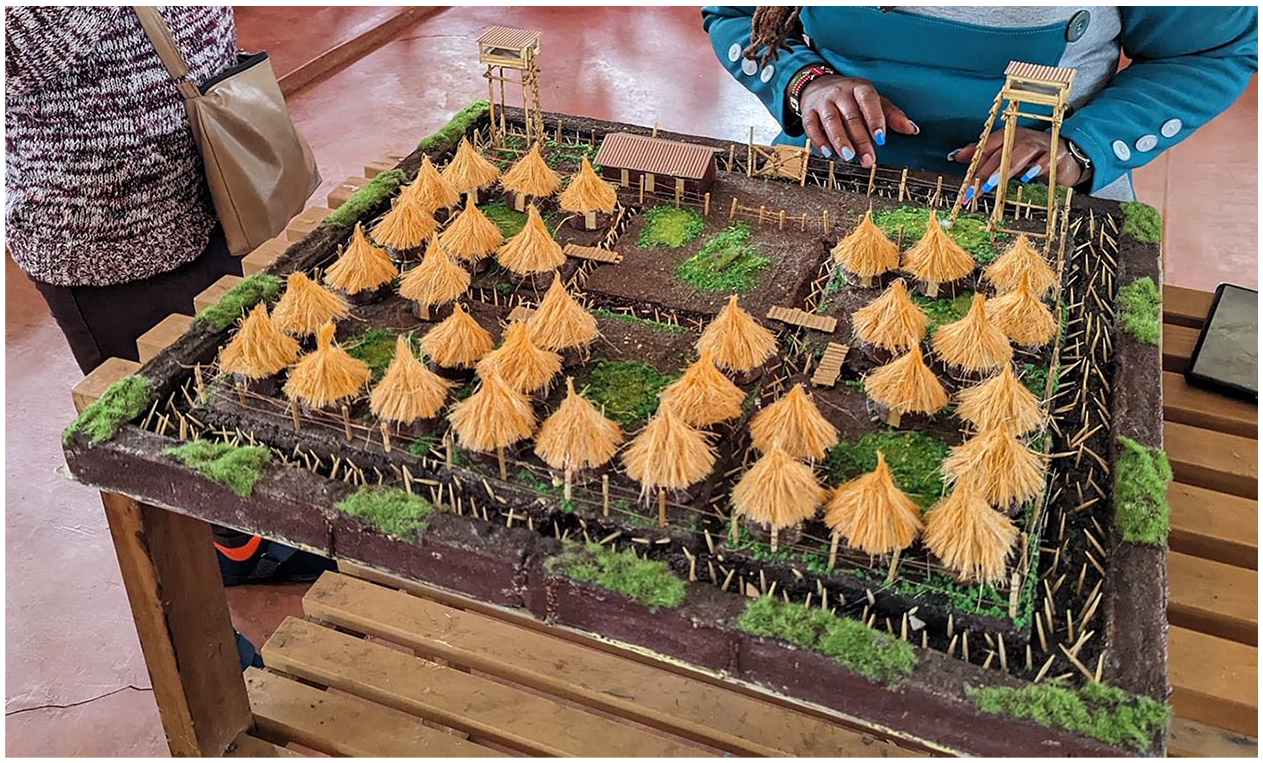
Model for the ‘Barbed Wire Village’ physical exhibition.
Approximately 40 local people were invited along to this day, most of whom were Gĩkũyũ elders who had lived through the Emergency and had either been detained by the colonial state or forcibly resettled. Other guests included family members of these elders and the museum staff. The format of the day included a guided tour of the donated exhibition, a discussion held around the reconstructions, a catered lunch, followed by a performance by a local Gĩkũyũ cultural dance group. Later in the afternoon, there was time for Anthony, our research collaborator and translator, and I to have individual conversations with elders who wished to discuss their responses to the exhibition and the research outputs in greater depth. Fostering a strong community exchange and dialogue regarding this difficult past had influenced the research project and subsequent exhibition, but it too was the reason for holding this event and consultation phase with survivors. While challenging for those involved in relation to the memories shared, the event felt celebratory. The atmosphere was warm, there were laughs, there were embraces, it seemed like a positive step in enhancing community ownership of this heritage.
The discussion which took place around the reconstructions raised several themes, notably relating to the spatiality of the villages, anecdotes of loss, and issues pertaining to reparations and memorialization (Figure 2). 35 The participants largely confirmed the visualization of the physical village reconstruction. They paid close attention to the drawbridge entrance which had restricted their access moving in and out of the villages. They recalled the 6-ft deep trenches that this drawbridge reached across, drawing particular attention to the wooden spikes that lined them. Participants identified missing infrastructure in the reconstruction such as the granary stores and areas where livestock would have been kept. In keeping with the initial testimonies shared, a large focus of the discussion centred on the living huts. Participants recalled living with five to eight additional families within one hut. This meant women built a shared cooking space in the centre with large stones, with adults sleeping on the outer fringes of the huts and in some cases children sleeping in ‘make-shift sacks’ outside of the huts. 36 They emphasized that in comparison to Sophia’s testimony regarding the hut windows, many of them were not permitted windows. Instead, they had a door which had to face the living hut next to them. Guards then ordered them to build their shared latrines in between the huts, towards the back, to not block the areas in front of the huts which would be patrolled by guards.
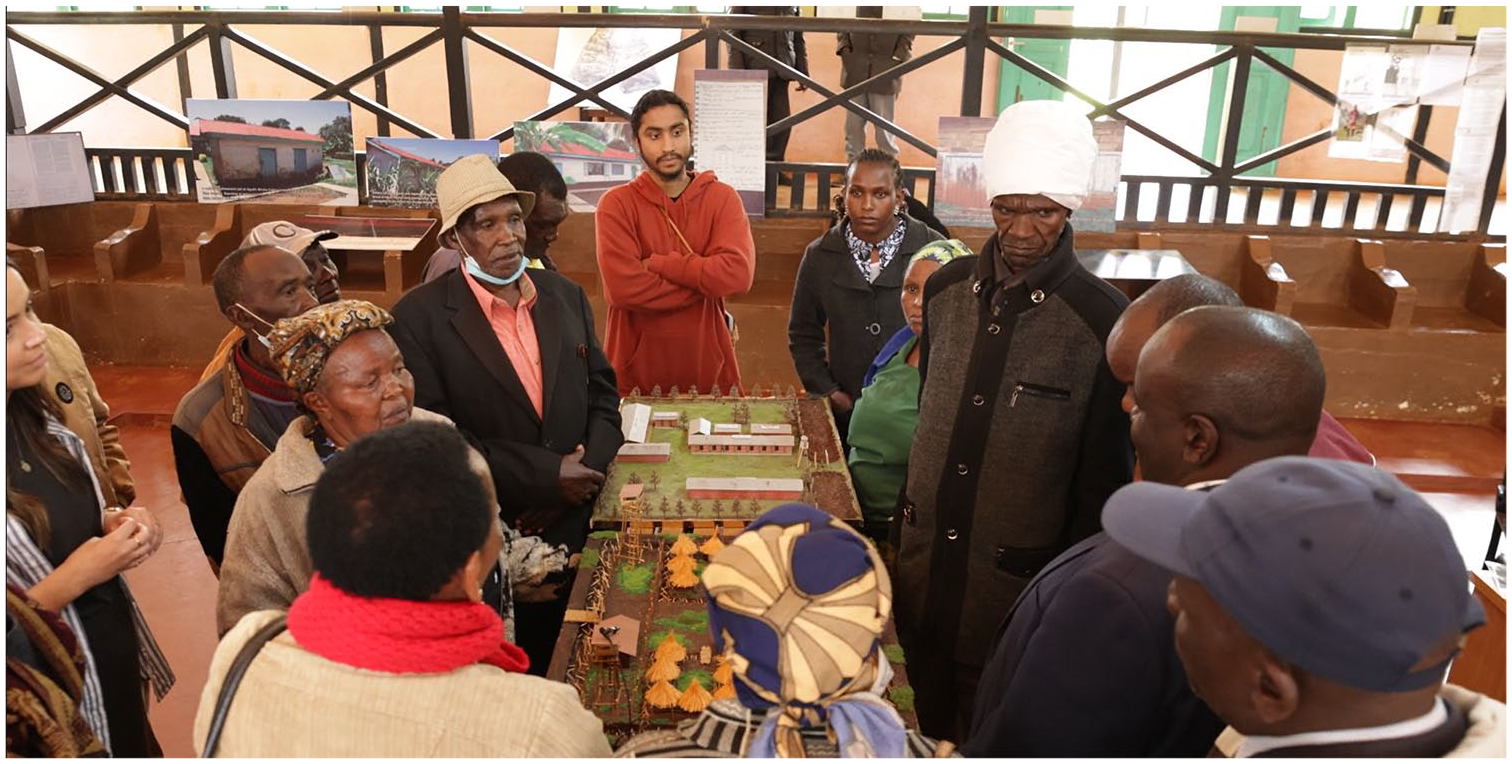
The group participant discussion taking place around the physical reconstructions of a colonial village and detention camp.
Having this visual aid to instigate the discussion was effective in disentangling commonalities and differences in individual and collective memories of these spaces. While most agreed on the general visuality and spatiality of the village, personal anecdotes offered an additional layer. One participant expressed that the colonial village was ‘just another jail’. While they were permitted to leave the village for an hour at a time to forage for sustenance, if you were late back, you would be punished at the security post. To one participant, this was not a security post, but a ‘torture chamber’. Many of the event participants had been both incarcerated as a suspected Mau Mau member and then villagised upon release. This was common in the process of the Pipeline. 37 There was a consensus that there was little difference between being detained and villagised, and it was striking that one participant expressed a seemingly better experience being detained in Manyani detention camp than in a colonial village because at least ‘you could be fed’. Characteristic of the villagisation programme was the intense underfunding of this process and a severe lack of resources to sustain those resettled there (Feichtinger, 2016: 53–54).
Commemorating the dead and the significance of former villages and detention camps as eternal resting places of those who died during the conflict was striking in the discussion. Participants mainly identified the lack of food and water as the main culprit of deaths within colonial villages. This has been corroborated by scholarship and primary archival evidence which has shown severe issues of starvation across the villages (Bennett, 2013: 224). 38 Participants signify the locations of their dead family members by the detention and works camps where they had been incarcerated. The repatriation of the bodies of those killed or died while detained or villagised has never been resolved at a national level. The picturesque landscape of the central region of Kenya which was once coopted by white settlers as part of their ‘happy valley’ tells a different story underground. Numerous mass graves of the conflict fatalities are yet to be fully identified and gazetted. 39 Repatriating bodies to surviving families has been a topic of contention in Kenya, especially in light of the Kimathi family’s ongoing pressure on the British government to reveal where the unmarked grave of Dedan Kimathi, senior Mau Mau leader who was arrested in 1956 and executed in 1957 by the British, is. His wife Mukami sadly passed in 2023 having fought a lengthy battle to acknowledge Dedan Kimathi’s role nationally and internationally in the fight for freedom and identify his final resting place. There are tensions here on who is commemorated, and where these sites of commemoration are erected in relation to post-colonial national memory. With no grave to attend, Kimathi’s statue in the country’s capital city of Nairobi, and the more recent memorial in Nyeri county, have become prominent sites for commemorating his and the Mau Mau’s legacy. In most other cases, the specific camp or village that a family member died in or was executed at remains the final resting place.
What was acutely clear from our discussion were the feelings of betrayal and dissatisfaction felt by those who had supported the struggle against the colonial state, experienced torture and mistreatment, but never gained recognition, acknowledgement, or compensation for this. One participant stressed that those who went on to hold high political positions in newly independent Kenya, those considered ‘loyal’ to the colonial government, gained the most land. 40 Yet those who fought in the forests and civilians who provided supplies to fighters felt they received nothing in comparison. There is a clear frustration that the struggle is twofold. In part, this is about raising awareness and restoring these narratives to the historical discourse, something they recognize this project as doing, but the other part being a further push for reparations, something they identify as a collective effort in lobbying the Kenyan and UK governments. It was clear from the discussion that the High Court settlement in 2012 did not go far enough to extend to civilians who also experienced torture, displacement, and a legacy of ‘land grabbing’. One participant asked what ‘accountability and justice’ then looks like ‘in this system of violence’.
This betrayal is distinctly intergenerationally transmitted. One participant whose parents had been involved in the Mau Mau said: Some of us have not gone to school due to these atrocities, some of us inherited a lot of pain and suffering. . . these stories are passed on by our parents to children, to our children. Even the young ones being born now are seeing the same issues that our parents suffered because of the hand of our colonial governments. Now, when some people see a mzungu (white person) somewhere they can even throw stones, we need to heal our hearts, not only compensating, but we cannot heal and reach a point to come together without compensation.
He went on to extend his gratitude for the exhibition: We want to thank you for this research, the work you have done has gone a great mile to show the world that Mau Mau suffered . . . Africans have been neglected in terms of historical fact . . . you and the others doing this research you are regarded as a family of the Mau Mau . . . to Mau Mau, their rights have been validated.
This sentiment reconfirmed the value in this sort of research – activist-led research – and reparative modes of dissemination. It was not lost on the participants and researchers involved of my positionality as a British scholar researching Gĩkũyũ experiences of forced resettlement. I, unlike the survivors of this conflict, their families, and many Kenyan scholars, have had far greater access to key resources that outline the colonial government’s approach to suppressing the Mau Mau and the handling of human rights abuses. Up until December 2024, these records were only available for consultation in the UK National Archives. After ongoing calls for their return to Kenya, the British High Commissioner to Kenya, Neil Wigan, handed a digitalized version of these files to President William Ruto at an event at the National Museums of Kenya. Until these are processed and provisions are provided for Kenyans to view them, researchers can only access them from London. 41 This has been compounded by the ‘hostile environment’ of UK visa access for Kenyans; a stark contrast to the ease of access I have as a British citizen visiting the Kenya National Archives. 42 It is important, however, not to overemphasize the significance of these records over the ecologies of knowledge that pre-existed their discovery. Mau Mau memoirs, oral histories, and material culture from this period offered vivid evidence for those seeking to find it, prior to the release of the ‘migrated archive’. 43 These institutional, epistemological, and academic inequalities persist and uphold the barriers which sought to prevent Kenyans from formulating an enriched narrative of the Mau Mau Emergency.
Conclusion
Britain’s attempts to distort, control, and destroy unsavoury narratives of its systematic and widespread human rights abuses in late-colonial Kenya, was a deliberate attempt to suppress the legacy of Mau Mau. Operation Legacy has had a profound impact, both in Kenya and more globally, on the memorialization of anticolonial efforts to dispel British colonial control. The early presidencies of Kenyatta and Moi contributed to this also. It is evident from those who participated in this project, which the scars of this conflict will never heal. The emotions felt by Kenyans who were incarcerated or forcibly resettled during the Emergency period are shared intergenerationally. Sites where Kenyans experienced intense violence and suffering are woven into the fabrics of everyday society. Places that were once forced labour camps are now school grounds where Kenyan children learn and play. Britain’s colonial prison complex and villagisation scheme reshaped individual’s relationships to one another and the land upon which they live.
Digital reconstructions not only allow us to document and memorialize these marginalized histories, but it also enables us to ‘radically reimagine, redefine and restore African pasts’ (see Note 2). What was once silenced, is now shared globally. While issues of accessibility have been at the forefront of MBC’s and ADH’s digital practices, so too has been the restoration of ownership and influence for participants in these heritage practices and the memories of Mau Mau. This has required a return to more traditional heritage approaches in the form of a physical exhibition housed in Nyeri, the heartland of the Emergency, as well as consultation during the dissemination phase. By drawing together the oral histories and traditions shared by survivors with the expertise of digital cultural heritage specialists, this project hopes to offer new frameworks for innovative solutions which counteract the European destruction of African knowledge, culture, and memory.
Footnotes
Acknowledgements
The author wishes to extend their deepest gratitude to Jochen Lingelbach and Gabriel Moshenska for their feedback on earlier drafts. The author is also grateful to the journal editor and peer reviewers who provided thorough and thoughtful feedback on the submission. While this article has been authored by one member of MBC, the project, ideas, inspiration, and unrelenting energy of this work is representative of all those within our collective, both past and present. By collective, this extends beyond the committee members and collaborators listed on the website, it includes every participant, translator, research assistant, driver, photographer, artist, guest speaker, and donor to the organization.
Funding
The author disclosed receipt of the following financial support for the research, authorship, and/or publication of this article: The author is grateful to have received financial support from the British Institute in Eastern Africa and the Centre for Black Humanities, University of Bristol for the research published in this article.
