




Abstract
Addressing the work (or, indeed, the lessons) of Memory Studies, Ann Rigney has suggested that the creative arts play a particular role as ‘catalysts’ in the cultural understanding of the past. Contrasting an example of contemporary theatre repertoire with an officially legislated ‘theatre’ of remembrance, this essay reflects on differences between the cultural politics of a creative performance produced by Warsaw’s Nowy Teatr – (A)pollonia – and those of commemorative ‘performance’ mandated by the state concerning specifically the citation of ‘Righteous among the nations’. In a context where memory wars over ‘the good name’ of Poland include recourse to the law intervening in both scholarly and artistic research, how might this theatre production offer a form of counter-memorability to claims about national ‘tradition’, especially with respect to remembering the Shoah?
Introduction
In contrast to the West, where the Holocaust has become the symbol of shared responsibility for the crimes of the past, most Eastern European countries have not fully succeeded in overcoming the legacy of the half-century silence on that subject under the Soviet rule. (Koposov, 2018: 144) The identity card, with its stamp of Hitler and its photograph of my father, jolted me to a sharp and unexpected focus. It brought to the fore every other tiny fissure in my understanding, all the minuscule silences and unanswered questions that had been invisible before. (Neumann, 2021: 20)
The title of this essay offers a condensed version of its concerns, evoking relations between a set of terms – ‘refraction’, ‘implication’, ‘question’ and ‘silence’ – where each term itself suggests a further context of its own. Their relation here, however, indicates a ‘multidirectional’ field of enquiry (to adapt Michael Rothberg's account [2009] of cultural memory 1 ), where one might consider the refraction of silence and the question of implication, as much as the silence of implication and the refraction of its question. Refraction, here, is exemplary of the play between metaphor and concept that orients the following discussion – with its own question of making visible or explicit the invisible or implicit. As with the performance to be explored – the Nowy Teatr’s production of (A)pollonia – there is no attempt to define the silence in question, but rather to offer testimony to its resonance. It is the potential of such testimony (generated by performance), rather than a review of what may have already been written about the production (at least, as it is available in English), that is put into dialogue with what Ann Rigney (2021) evokes as the ‘catalyst’ role of the creative arts within cultural memory (p. 12); that is, with the motive and dynamic of change in understanding the past. Preliminary to considering the conceptual implications of such reference to a ‘catalyst’, however, the essay attests simply to my own experience of what calls for reflection in (A)pollonia, which I have been lucky to see three times ‘live’, as well as many times in its film version, which is hosted by the Polish cultural media website, Ninateka. 2
As instances of what Eneken Laanes and Hanna Meretoja (2021) have called ‘cultural memorial forms’ (p. 3), 3 the relation of terms in my title – figured, for example, in the juxtaposition of the two epigraphs that interweave the familial and the national, as also the (auto-) biographical and the historiographic – refer to contested sites for addressing civic values. Between politicians and artists (not to mention historians and lawyers), the proverbial appeal to the ‘conscience of the nation’ involves a sense not only of ‘memorial forms’ but ‘counter-memorial forms’, where the past appears ‘through the generation of stories that can refigure, and not just express, the identities of the actors who encounter and appropriate them’ (Rigney, 2012: 610). 4 Furthermore, with respect to the context of this special issue of Memory Studies, such forms of cultural memory may also be considered through the lens of the ‘local’, as itself a concept of and for enquiry. Broaching a question of names – whether mythical or historical, remembered or silenced – the reflections here are conditioned by the fact that Memory Studies belongs to the academic Anglosphere, displacing cultural refractions of the local and the international into its own field of reference. 5 Memory wars – or what, in the Polish context, is called ‘history politics’ 6 – are discussed here in English translation, where the naming of positions as nationalist and cosmopolitan, exceptionalist and comparative, is already inscribed in their ‘local’ relations (generating claims about both commemoration and defamation), regardless of their Anglophone abstraction. 7
A ‘local habitation’
In Shakespeare’s A Midsummer Night’s Dream, Theseus evokes the work of imagination (not to mention the proximity between madness and poetry) as that which ‘bodies forth the forms of things unknown’. He describes these forms as giving ‘to airy nothing a local habitation and a name’ (V.i.1844–1847) and it is precisely this giving form to cultural memory by ‘aesthetic agency’ (Rigney, 2021) – as, potentially, of ‘things unknown’ – that is explored here, as offering an example of memorial ‘catalyst’.
8
Contrasting an instance of contemporary theatre repertoire with an officially legislated ‘theatre’ of remembrance, this discussion reflects on differences between the cultural politics of a creative performance and those, for example, of a commemorative public holiday – as contested sites of and for the ‘lessons’ of memory, specifically with respect to the historical-cultural citation of ‘Righteous among the nations’. Alongside the recognition of individuals’ courage and sacrifice, there is a profound question of temporality in this citation, made by Yad Vashem, through the refraction of implication concerning the saving of life (as that of a world) to which it attests. The recognition of the Righteous is meant as an example of the past in the present, raising its own questions of and for the inter-generational transmission of civic (distinct from religious) values. As Ann Rigney (2021) writes:
For things worth remembering to be constituted as memory, they must also be translated into transmissible experience. This entails using available media and calling on a repertoire of cultural forms [memoirs, monuments, documentaries, exhibitions, and so on] which act as carriers of memory and structure information in a meaningful way. It would seem that memorability-as-relevance [related to social frames] and memorability-as-meaning [related to mediation] are co-produced in a mutually reinforcing way that we are only beginning to understand. (p. 13)
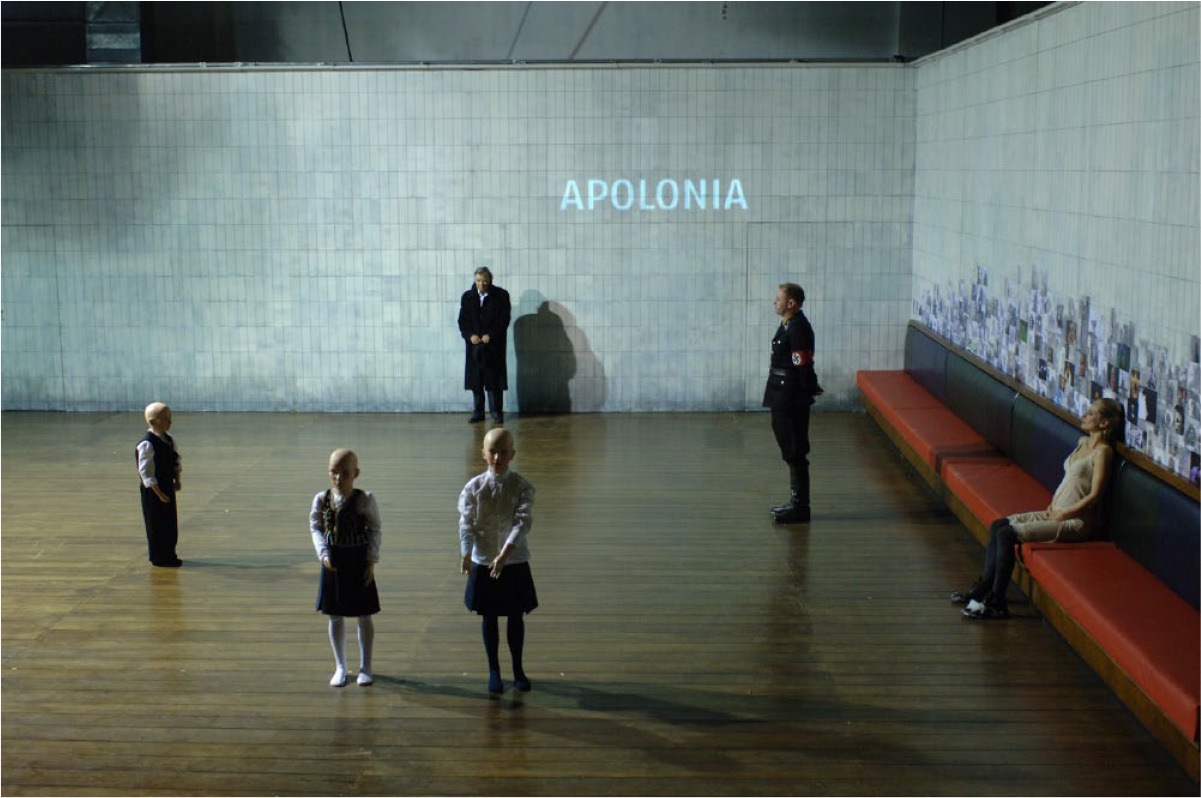
(A)pollonia (Sc.xiv) directed by Krzysztof Warlikowski (2009). Photo by Stefan Okołowicz.
Theatre, as a practice of ‘transmissible experience’, offers a manifold understanding of citation in the production of ‘memorability’, which contrasts with institutionalised forms enacted by the state. The cultural work of learning to remember – where learning about what is (to be) remembered concerns an understanding of how it is (to be) remembered – involves a ‘fundamentally dynamic approach to the study both of cultural memory and of the media which shape it’ (Erll and Rigney, 2012: 1). Of relevance for the example considered here is that the ceremonial theatre of national remembrance – honouring individuals in the name of a nation or state – tends to occlude (or, indeed, deny) the ambiguities of implication that artistic agency often engages with explicitly. Where Yad Vashem recognises individuals universally, the present Polish government (in 2021) recognises the Righteous nationally, in an appropriation that (as we shall see) is as much contested as celebrated.
While theatre is often conceived of in terms of a distinction between the ephemeral and the archival, or between the corporeal and the documented, these oppositions themselves have long been theorised in theatre and performance studies, not least in ways that engage with suppositions that are also prevalent within memory studies (to cite only Schneider, 2011 and Auslander, 2018, as well as my own work Twitchin, 2016). In the case of (A)pollonia, we are considering a production (a ‘catalyst’) that continues to be in the Nowy Teatr’s repertoire more than a decade after its premiere (in 2009) and which has been seen all over the world. Although centred on the re-interpretation of plays from the European canon of ancient Greek tragedy, refracted through the experience of the Nazi occupation of Poland, one index of the production’s extraordinary impact is that it is read ‘locally’ where ever it is performed internationally. As the Nowy Teatr’s dramaturg, Piotr Gruszczynski, observes:
The production has been presented in many different countries . . . [although] we were very much afraid that this story is so European that people won’t be interested in it. So, it was very surprising for us that the theatre was always full and that many people stayed in the theatre afterwards to discuss it with us. They found their own stories that were parallel or similar to what we were presenting. (Twitchin, in press)
The very title of the production – (A)pollonia – offers a complex, ‘local habitation’ of meaning, condensing the names of a historical person (Apolonia Machczynska), a country (Polonia), and an ancient Greek god (Apollo). Within this polyvocal palimpsest, each name refracts the others in an interplay between the mythical and the historical, the personal and the national. For instance, as the director, Krzysztof Warlikowski, observes, the choice of Apolonia as a name for a daughter born around 1918 may cipher hopes invested in the founding of the Second Republic following the First World War. ‘Her name’, Warlikowski (2015) suggests, ‘is like a conspiratorial symbol of patriotism’ (p. 151). Indeed, the war’s outcome ended the partitions to which Poland had been subjected since the late eighteenth century – and in consequence of which Poles had found themselves fighting each other on both sides of the conflict. 9 This year of hope is officially commemorated in the name of one of Poland’s highest awards, inaugurated in 1921, Polonia Restituta – a combination of terms whose resonance changed in 1945, with the end of the Nazi occupation and the country’s subsequent incorporation into the Soviet Bloc; and again in 1989, with the end of the Cold War.
Despite this historical conditionality, in which the official sense of Polonia changes, the citation also evokes – at least, for ethno-nationalists – an essential meaning; one that would eschew the multidirectional refraction of nationality through the title of citizenship. The ‘restitution’ of a multicultural republic, offering pluralistic legal and cultural recognition of minorities (thereby relativizing claims of and for a majority national identity), contrasts, for example, with the idea of a Catholic kingdom reigned over by the Virgin as its queen – a contrast that informs the underlying memory politics of ‘honouring the good name’ of Poland, both locally and abroad. Indeed, the sense (supposedly) of ‘slandering’ national memory (or its mythology) raises profound questions about how cultural memory is localised through the genealogies – and politics – that give it ‘a name’ (not least, in law) and evoke, thereby, claims (and, of course, counter-claims) concerning the shibboleths of national identity that can often appear paranoid in relation to the international. 10
In this context, the legendary example of diasporic Jews settling in Poland is especially poignant. As recorded by Schmuel Agnon (at the end of ‘the long nineteenth century’), this legend is presented as a parable of many voices speaking of and to each other across the generations:
We did not know, but our fathers told us how the exiles of Israel came to the land of Polin [Poland] . . . [T]hose that seek for names say: ‘This is why it is called Polin. For thus spoke Israel when they came to the land, “Here rest for the night [Po lin]”. And this means we shall rest here until we are all gathered into the Land of Israel’. Since this is the tradition, we accept it as such. (Agnon, 2004 [1916])
Here the history of a name ciphers an understanding of exile, which now includes the homelessness of the dead. In the new century, this name has also become emblematic of ‘local’ cultural memory politics concerning the ‘restitution’ of Polish identity with the opening of the famous Polin Museum in Warsaw in 2005. 11
In the transmission of memory, names are never univocal. We are adopted into a genealogy when named by our parents, an adoption that is then certified by state and religious institutions. The familial and the national intersect (sometimes in conflict), as identity is conditioned by forms of recognition that operate as a mode of shibboleth, which can then also be falsified or forged. As is reflected in the epigraph from Arianna Neumann, names link us to the histories of others, even as these relations are inscribed with ‘a caesura in possibility . . . divid[ing] into a possibility and an impossibility, into a potentiality and an impotentiality’ (Agamben, 1999: 145). 12
In Lost in Translation, for instance, the memoir of her childhood dislocation from Poland to North America in 1959 (escaping the experience of ‘local’ anti-Semitism, still prevalent after the genocidal war against European Jewry), Eva Hoffman (1998) observes:
[M]y parents have no lack of the dead to honour, and I am named after both my grandmothers – Ewa, Alfreda – two women of whom I have only the dimmest of impressions. There aren’t even any photographs which have survived the war: the cut from the past is complete. (p. 8)
Her sister, Hoffman (1998) also explains, is named in honour of an aunt (her mother’s sister), another relative who did not survive the Shoah:
My own sister is named after this person who exists like an almost concrete shadow in our lives – Alina – and my mother often feels a strange compassion for her younger daughter, as if with the name she had bestowed on her some of fate’s terrible burden. ‘Sometimes my heart aches for her’, she tells me, ‘I don’t know why. I’m afraid for her’. I inherit some of this fear, and look on my sister as a fragile, vulnerable creature who needs all my love and protection. (p. 7)
Others may be remembered in our ‘own’ name, then, often burdened with an ‘inherited fear’. Who one is named after may encipher what remains unnameable, a sense of meaning (or of inheritance) without a habitation – a citation bereft of testimony. The shibboleth of a name may become, thereby, a burden of silence in which one is not allowed to speak for oneself – in one’s own name – given the impossibility of speaking for the other in whose memory one was named. Memory is caught up here in a set of implications that precede us, in which the silence of the dead echoes in the voices of the living. A name may cipher what remains unsaid in what is spoken and it is this that (A)pollonia explores, in its reflections on tragedy and history (addressed in the next section of this essay), staging a mutual refraction in and for cultural memory of the figures of Apolonia and Alcestis.
It is in this sense that we might hear the echoes of Apolonia-Polonia in the theatre of Holocaust memory in Poland, as constituting a field of ‘cultural memorial forms’ or ‘memorabilities’ that condition an understanding of civic space in terms of contested appeals concerning the meaning of names in both official speech and artistic agency. 13 Both conformism to a ‘patriotic’ myth of the ‘martyred nation’ and the work of comparative and critical historiography 14 are refracted in the question of a specific name that simultaneously ciphers the local and the international in this context: that of the ‘Righteous Among the Nations’. Adopted from Talmudic tradition in the citation given by Yad Vashem to recognise Gentiles who aided Jews during the Second World War, the title of ‘Righteous’ has been inscribed in Polish memory wars in profoundly contested ways. 15
In a famous essay from 1987, Jan Blonski (2018 [1987]) (citing the testimony of poems by Czeslaw Milosz written in Warsaw during the occupation) proposed that while ‘participation and shared responsibility are not the same thing’, nonetheless, ‘one can share responsibility for the crime without taking part in it’ (p. 284). Addressing the theme of Poland’s ‘good name’, interwoven with the complex resonances of the ‘Righteous’, Blonski asked:
What about the ‘good name’ of our society? Our concern about the ‘good name’ is ever present and, even more so, in public discussion. To put it differently, when we consider the past, we want to derive moral advantages from it. Even when we condemn, we ourselves would like to be above – or beyond – condemnation. We want to be absolutely beyond any accusation, we want to be completely clean. We want to be also – and only – victims. This concern is, however, underpinned by fear – just as in Milosz’s poem – and this fear warps and disfigures our thoughts about the past. (280–281)
This relation between responsibility and participation is accompanied for Blonski with a fear of being thought to be among the Gentile perpetrators of the genocide by its Jewish victims. It is precisely this concern with implication that is resisted by official commemorative culture and in particular by what the historian Jan Grabowski has called ‘the Righteous defence’. As Grabowski (2016) writes, ‘It is practically impossible nowadays to find any official declaration concerning the Shoah that does not make a specific reference to the number of “Polish olive trees at Yad Vashem” or some other form of the Righteous defence’ (p. 19).
It is, perhaps, a moot point whether (as Koposov suggests in the first epigraph) there is a European-wide sense of ‘shared responsibility’ for the Holocaust; that is, a recognition that the Nazis were able to put a Europe-wide logistical infrastructure, and even a Europe-wide complicity, into the service of genocide. In Poland, this issue is especially polarising ‘locally’ – with many (like Blonski) acknowledging a painful need to address the fact that participation in the Holocaust is not confined to the Nazis alone, while others insist on Poland being an exception to what is ‘shared’. 16 The question of silence in this context involves not simply the official post-war ‘amnesia’ regarding, for instance, the blackmailers (szmalcownicy) who pursued a form of civilian Judenjagd (hunting of Jews); but also the silence taken upon themselves by those who had in fact helped Jews. In contrast to recent government marks of remembrance, many of the Righteous themselves lived in fear of their neighbours, as is detailed by Anna Bikont (2015 [2004]) in her study of Jedwabne. This question of silence in the lived cultural memory of neighbours – of, precisely, its ‘local’ meaning – is symptomatic of profound questions of implication; that is, for the Polish civic space or ‘theatre’, in its expanded (or, indeed, catalytic) sense.
Addressing this context Grabowski (2016) writes: ‘At this stage one could ask: what is wrong with celebrating the Righteous? Unfortunately, everything depends on the context and the goals of the celebration’ (p. 19). For, as he notes:
Symbolic gestures never occur outside of a broader social and political context. Their meaning and influence is always dictated from without. Left-leaners or right-leaners, Poles or Jews involved in the Righteous defence, all of them make – given the pervading political climate – an important contribution to the fundamental revision of memory of the Holocaust in Poland. . . (Grabowski, 2016: 25)
Here, the historian sets the scene for a contrast between official memory discourse – institutionalised, for example, in 2018 with a National Day of Remembrance for Poles who saved Jews under German occupation – and what is, in a sense, a form of counter-memorability (already presented ten years previously) through the artistic mediation of cultural memory offered by (A)pollonia. For one of the spurs to the direction that the production took during its preparation was the company members’ experience of an award ceremony held at the National Theatre to honour Poles who had aided Jews, which generated a deep sense of ambivalence. As Warlikowski (2015) observes, reflecting on this experience:
To show Apolonia’s story could be taken as a statement from a Polish director maybe suggesting that the actions of the Poles in relation to the Jews during the war were better than we often think. But in fact I felt a lot of unease about this situation, particularly our ‘comfortable’, often complacent attitude to sacrifice today. After many years during the communist period when the deeds of those who helped Jews were only recognised by the Jewish community and Yad Vashem, there is finally a wider acknowledgement of these ‘heroes of our society’ – but it’s selective, and it’s never free of interests: political, media, and those of ‘good conscience’. (p. 172)
17
In this case, we see contrasting claims between the state and the arts in conceiving of the ‘conscience of the nation’ (especially as concerns the supposition of a ‘silent majority’). For both sides, however, there is no doubt that what is at stake regarding this civic ‘theatre’ is not simply the past but the present, addressing the question of implication (as that of cultural memory) in the understanding (or catalysis) of ‘Polish history’.
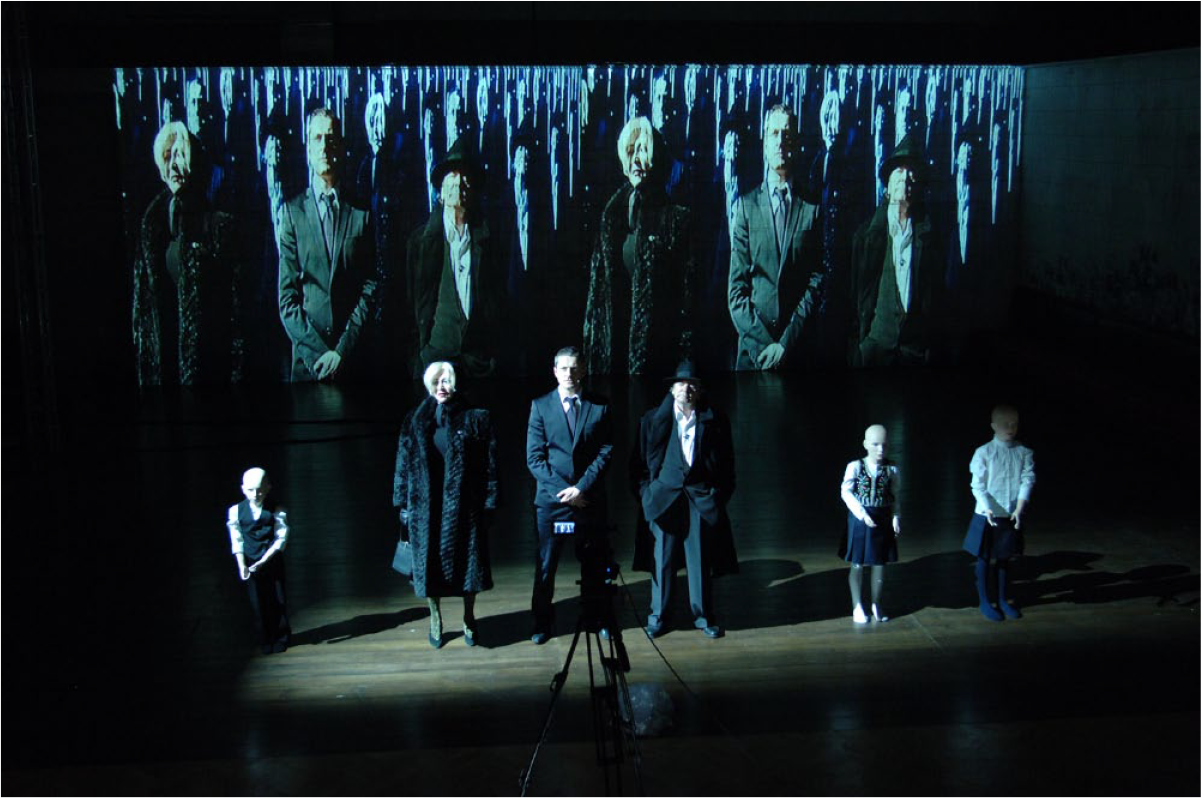
Photo by Stefan Okołowicz of (A)pollonia directed by Krzysztof Warlikowski (2009), Sc.xiii with its monologue by Admetus (Jacek Poniedzialek).
An ‘essential lacuna’ and the question whether ‘this world can be saved’
Between implication and silence, how is the burden of the one refracted by that of the other – broaching, perhaps, a question of complicity? Silence here concerns not only externally imposed conditions of censorship and prohibition in memory studies, but the internalisation of secrets and taboo – whether familial or national (as is expressed in the two epigraphs). Besides shibboleth, we might also consider euphemism, as another mediation of cultural memory in both official and artistic speech addressing the civic space for which theatre provides a metaphor. In wanting to give voice to the unsaid (perhaps to give a hearing to the unspeakable), what might be the specificity of citation and testimony in these different ‘theatres of memory’ – not least, in the recognition of the Righteous? Does citation affirm testimony (above all, that of survivors), as if these were simply commensurate with each other? Or does citation gloss over the potential incompatibilities of testimony with itself, eliding (what Agamben calls) its ‘essential lacuna’ (Agamben, 1999: 13)?
In contrast to the official commemoration of the Righteous, now legally mandated by a day in the national calendar (24 March), the Nowy Teatr production of (A)pollonia offers a question of memory. As a form of counter-memorability to an official theatre, the sense of ‘local habitation’ in this production is fractured between history and myth, diaspora and return, Poland and Israel, and between the living and the dead. Specifically, the production invokes the memory of Apolonia Machczynska and the circumstances of her recognition by Yad Vashem interwoven with a re-interpretation of the ancient story of self-sacrifice by Alcestis (as told by Euripides). 18 Brought into the present, these fractured relations between history and myth within the ‘theatre’ (or ‘cultural memorial form’) of civic values reach into the enduring dislocation of hopes concerning Polish-Jewish relations, such as those expressed by the historian Piotr Wrobel (1997) that ‘the burden of history will eventually disappear. . . and hostility and mistrust will give way to consensus and reconciliation’ (p. 560). Referring to a ‘tragic dialogue of the deaf’ (Wrobel, 1997: 567), evoking a ‘double meaning’ or ‘double truth’ (Wrobel, 1997: 568) as between Jews and Poles in the history of the Second World War, Wrobel (1997) poses a question that has become all the more disturbing in the present century: ‘Or is it possible that we do not need a common interpretation of history and [that] objectivity is neither achievable nor important?’ (p. 567). 19
While recent Polish law has even sought to make this painful question one to be tested in the courts (albeit now in civil rather than, as originally planned, criminal courts), the refraction of implication – as between history and memory (Le Goff, 1992) or archive and witness (Agamben, 1999) – eludes the consensual and reconciled, concerning fundamentally a question of justice for the dead. It is this that (A)pollonia explores with the examples of Iphigenia, Alcestis and the tribunal that concludes the Oresteia. This tragic model of the trial, as a catalyst of and for civic understanding, resonates with the enduring – and complex – appeal of and to the cultural memory of ancient ‘Athens’ (Loraux, 1991, 1993). Here the ‘airy nothing’ of theatre ciphers the past’s implication in the present through its inverse – the implication of the present in the past – as a question of theatrical agency itself, relating the mythical trial in Aeschylus’ Eumenides to a historical example in research by Christopher Browning and Hanna Krall. 20
The fictional tribunal of theatre (albeit one evoking a historical reality) is played in (A)pollonia as if it were a TV popularity contest, with a judge or show host made up to look like the Joker. With the unsettling grotesque of his painted-on smile, this figure addresses the audience directly:
‘Whosoever saves a single life, saves an entire world’, it is written in the Talmud. We engraved those words on a medal. We bestow the medal upon Apolonia Machczynska, who has saved a single life. And did she save an entire world? Can this world still be saved? (Warlikowski et al., 2014: 45; Ninateka: 2.52.30-2.59.00)
Perhaps the most resonant refraction of implication here is condensed in the pregnant word ‘still’; that is, in the evocation of a future anterior – addressing the past as that which will have been. Within such creative memory, the past has yet to have happened – bodying forth the very possibility of hope for a release from the burden of tragic repetition (as revenge), from what remains unsaid in all that has already been said.
This scene, in part two of (A)pollonia, concerning the afterlife of the past (including the burden of survival) refers back to a short scene (Sc. XIV) that ends part one, which is itself a transformation of Euripides’ Alcestis (to which we will return), where roles are paralleled between the mythical (adapted from Euripides) and the historical (adapted from Krall). The same actor plays the father in each, the same actor plays Thanatos in the one and an SS officer in the other, and the same actor, Magdalena Cielecka, plays the woman who makes the ultimate sacrifice for others in both. That the Alcestis-Apolonia figure is played as pregnant also underlines the gendered aspect of this evocation of the ethics of self-sacrifice, one that occasions a profound experience of silence.
In the play text the constitution of this silence is orthographically represented simply by an ellipsis (‘. . .’), in the absence of any answer to a repeated question, one that implies incrimination. The SS officer presents Apolonia’s father with the possibility of taking on himself the death sentence entailed by being caught aiding Jews under the Nazis in Poland, of sacrificing himself for her and her children, including the one as yet unborn. As in Euripides, the father refuses this possibility of self-sacrifice – albeit now by keeping silent (in contrast to the Euripides) – as one scene (Sc. XIII) morphs into another (Sc. XIV) through this transition from the story of Alcestis into that of Apolonia:
End of Sc. XIII
Wait, don’t leave me alone! Not now! Is that you? Is that you, my love? Why won’t you say anything?
Who hid the Jews?
I did.
Yes. It was you.
Sc. XIV
We know that. Who else?
Nobody. I did it alone.
I’m going to sleep. Are you coming? I’ll make the bed.
Perhaps you will tell us?
I assure you . . .
I’m asking him! Well?
I’ve told you. No one else knew. No one!
You didn’t know anything either, did you? Only the person who hid the Jews is going to be punished. If it was you – your daughter will live. If it was your daughter – you will live. All you need to do is say: I hid them, my daughter didn’t know about anything. Well. . .? (Warlikowski et al., 2014: 36–37; Ninateka: 2.18.55-2.22.10)
In the performance (this is the refraction of theatre rather than literature, after all), the silence (‘. . .’) is made palpable by suddenly cutting the ambient underscore that has accompanied the whole scene. This makes audible a sense of time and space that is simultaneously fiction and actuality, echoing the mutual refraction of past and present. The silence resonates in the bodies of the audience, effecting a catalysis of cultural memory – not just between actors within a scene, but between the stage and the auditorium. The audience’s presence provides the testimony of and for a creative citation of the past, counter-pointing the question of tragedy (as a structure of repetition in the form of myth) with the register of the historical. Here the question of justice (for both the living and the dead) is woven through a re-writing of classical mythology in which the question of life and death – as that of self-sacrifice for another (but no longer that of tragic ‘fate’) – is echoed in an almost unbearably intimate silence. . .
The sense that the past could be transformed, that injustice could be recognised and acted upon in the future (if not in the present), is key to what is (still to be) remembered culturally. Otherwise, the historian (or the theatre maker) simply catalogues an archive of the ways by which lives have been destroyed, giving no more meaning to such events than their factual possibility; as if the fact of the matter were sufficient justification for it being recorded and as if this by itself constituted ‘understanding’ (with or without any recognition of the ‘Righteous’). In the Nowy Teatr’s engagement with the work of Hanna Krall – whose writing is itself exemplary of enquiry into the implications of cultural memory and its transmission 21 – this creates an occasion in which to reflect on the future anterior, as addressed by Walter Benjamin (writing in 1940). Benjamin (2006 [1940]) evokes the sense of ‘fanning the spark of hope in the past’, as concerns the historian ‘who is firmly convinced that even the dead will not be safe from the enemy if he [the enemy] is victorious’ (p. 391). Unsettling any sense of celebration concerning the Righteous, (A)pollonia rehearses this memorial hope with and for a present audience. 22 The repertoire of the Nowy Teatr in this instance aims, precisely, to ‘wrest tradition away from the conformism that is working to overpower it’ (Benjamin, 2006 (1940) 391), and which still informs nationalistic claims to protecting the ‘good name’ of Poland.
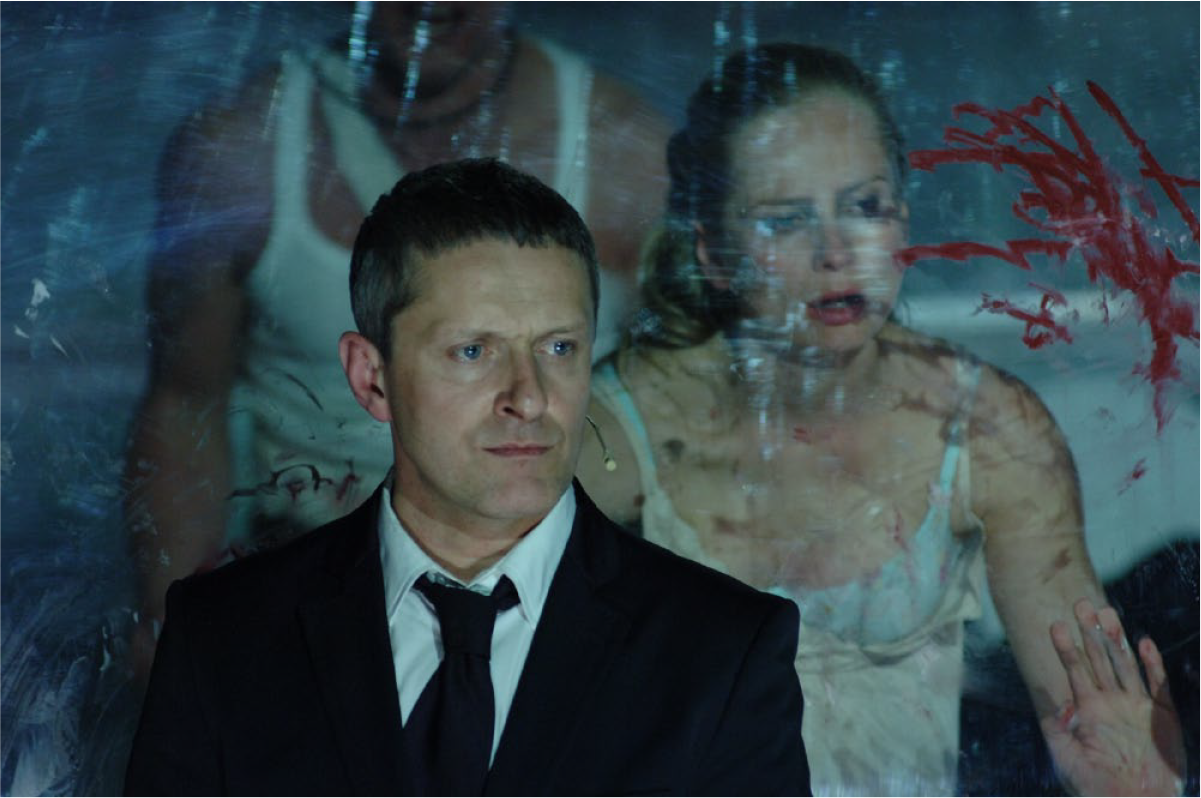
Jacek Poniedzialek (Admetus) and Magdalena Cielecka (Alcestis), Sc.xiii. Photo by Stefan Okołowicz of (A)pollonia, directed by Krzysztof Warlikowski (2009).
‘To be taught afresh’
At the beginning of this century, the historian Tony Judt (2010 [2005]) observed:
The new Europe, bound together by the signs and symbols of its terrible past, is a remarkable accomplishment; but it remains forever mortgaged to that past. If Europeans are to maintain this vital link – if Europe’s past is to continue to furnish Europe’s present with admonitory meaning and moral purpose – then it will have to be taught afresh with each passing generation. ‘European Union’ may be a response to history, but it can never be a substitute. (p. 831)
It becomes increasingly clear, however, that the sense of ‘forever’ in Judt’s invocation of Europe’s debt owed to the past (as, precisely, to the dead), with specific regard to the Second World War and its aftermath, is already historical, if not yet part of ‘that past’ itself. 23 The ‘local’ cultural implications (‘admonitory meaning and moral purpose’) of the Shoah and its ‘memorability’ (Rigney), within what was until recently called the ‘new Europe’, are manifestly fractured not shared. 24 For the ‘new’ turns out, in part, to have been a return of the ‘old Europe’, of a desire to give ethno-nationalist meaning to what the ‘local’ names. In this context, the question of constitutional rights for minorities remains fundamental to a civic (rather than an ‘ethnic’) understanding of citizenship (just as in the inter-war Polish republic); not least, with respect to legal recognition of ‘sacral symbols of community’ (Koposov, 2018: 302) and their potential ‘defamation’ by those who are said to be ‘anti-Polish’ (and are even denounced as working ‘in the service of Brussels and Berlin’ (Machcewicz, 2021: 21)).
As concerns the shibboleths (or, perhaps, the cultural latency) transmitted in the post-war ‘silence’ referred to by Koposov in the first of my epigraphs, addressing the ‘local’ as if it could be winnowed from the international (particularly in the Anglophone conditions of a reading such as this one) is itself problematic. Here the question of the historical time of (A)pollonia is symptomatic of what may ‘still’ be remembered trans-generationally through its performance, offering a counterpoint to the ‘national theatre’ of government-mandated remembrance ceremonies. As Warlikowski (2015) notes, the time both of and for the production was (and perhaps remains) the immediate post-war period – when it would have been impossible to produce:
I was searching to create a performance that should have been made in Poland immediately after the Second World War, about anti-Semitism and Nazism. Of course, it wouldn’t have been possible to make something like (A)pollonia then, but – as a member of let’s say the [first] ‘post-war generation’ – I wanted to conduct a reflection about the war and about the different points of view that can be taken towards it. And also to incorporate a perspective taking into account the Polish-Jewish relationship that has developed since the fall of the Wall, as this theme has been voiced for the first time, from all sides. Before 1989 [during the communist period], this had been a taboo subject. (p. 150)
It is precisely this sense of anachronism that offers a key to the production’s refraction of implication and its potential role as a catalyst of and for cultural memory, working through the form of theatrical agency particularly.
In Euripides’ eponymous play, Alcestis offers to die in the place of her husband, Admetus, when neither of his parents accepts to do so. In (A)pollonia’s version of this myth, the actor playing Admetus, Jacek Poniedzialek, addresses the audience directly to pose a question concerning the difference between a world that is saved through a desire to save only oneself and a world that is saved through a desire to save another, even at the cost of one’s own life. Poniedzialek’s question – concerning the very role (Admetus) that he is playing – involves the sense that it is only in actually saving another’s life, regardless of the motive or desire, that ‘an entire world’ may be saved. But if this may be a necessary condition, one can still only speculate about its sufficient condition – for perhaps only a god could judge of its truth. In the Biblical tradition, history is written before and not after the Day of Judgement – a day, as the opening of an impossible archive (unsealing the Books of Life and Death), that will never arrive in our life time and which, therefore, remains a subject of and for cultural memory. 25
In playing Admetus, Poniedzialek speaks to the audience about this mythical role, evoking the possibility (or not) of a shared understanding of sacrificing one’s own life for another – as this prefigures, within present cultural memory, the question of recognising the ‘Righteous’ and whether the world (as the shared, ‘local’ habitation of this very question) may be saved. Tellingly, as concerns the civic resonance of his speech, it ends with a visceral metaphor of silence:
Scene XIII
I am standing here before you. Look at me. Are you looking? With contempt, right? Contempt and disgust. And superiority. You would not have agreed to such a sacrifice. Someone sacrificing their life. Never. You’d rather die. Would someone here prefer to die? You, sir? Madam? You wouldn’t, sir? So that makes two of us: that’s a relief. Because all the rest love the life of others more than their own. We love our own life. And that’s a sin! Some Jew once said it was a sin to survive if you took a slice of bread away from someone. A slice of bread! What if you took someone’s life away? Excuse me for wanting to live. But I’m not asking for your pity, I’m not asking you for anything. You can stick your pity up your righteous asses! Why am I even saying all this? Words are of no use either, they disappear like water in the sand, this wet sand that fills my mouth. I can feel the sand, so I’m alive. I’m alive. (Warlikowski et al., 2014: 35; Ninateka: 2.13.12-2.16.05)
In this contemporary version of the ancient play, there is no chorus to discuss the death of Alcestis – played by the same actor who plays Apolonia in the scene immediately following (as quoted above). Rather, there is a defensive antagonism concerning responsibility and implication, refracting a tragic question of forgiveness in relation to another’s (self-) sacrifice. For this ‘Polish’ Admetus, the metaphor of wet sand in his mouth weighs on the tongue of speech, where (in contrast to the state’s theatre of remembrance) the refraction of implication is a catalyst of and for critical reflection – distinct from the denigration by self-proclaimed patriots of a ‘pedagogy of shame’. 26
This particular metaphor of and for remaining alive ‘unjustly’ – before the anticipated judgement of the present audience, at least – is drawn from Jonathan Littell’s (2010 [2006]) novel, The Kindly Ones, citing the European-wide translatability of what endures of the Nazi legacy (whether in French, Polish, Greek, or English). The title of Littell’s novel, Les Bienveillants (The Kindly Ones) translates the Eumenides – the title of the third part of the Oresteia. Unlike Aeschylus’ play, however, there is no role for Athena in the Nowy Teatr production, no transforming of the Erinyes into the Eumenides, the Furies into the Kindly Ones; and the cycle of revenge that is threaded through questions of historical guilt, themselves nested in the intimate relation between the perpetrating and witnessing of violent crimes (or, in Blonski’s terms, between participation and responsibility), is no longer mediated by a chorus. The Nowy Teatr production explores the refraction of the tragic with the civic without any intervention of the divine, even if the same word ‘theatre’ appears to apply to both the mythical past and the historical present.
For what and for whom are the dead (to be) remembered; not least, in the context of understanding ‘European union’ today? For whom – and why – is the question of sacrifice, one’s own or that of others, significant when re-presented as a question of and for theatre, distinct from the civic demands of the state; that is, for a present audience (whether ‘locally’ or internationally)? In this creative – or catalytic – refraction of implication, between actor and audience, the past is conceived of as what will have been when addressing the question (for both the living and the dead) of ‘saving an entire world’. This is precisely the potential of theatre as a cultural memorial form (as a ‘vital link’) regarding what is to be ‘taught afresh’ (Judt). As Rigney (2021) proposes:
Memory Studies needs to understand better the dynamics whereby collective memory can be revised and remade in response to changing social conditions and changing social imaginaries . . . [T]he creative arts can be seen as catalysts in creating new memories, supplementing what has been documented with imaginative power and creatively using cultural form to generate vibrant [if not always literally true] stories that may then be picked up and reworked in other disciplines. (p. 12)
The translatability of these ‘new memories’ that give to ‘airy nothing’ a name do not necessarily honour the shibboleths of the unspeakable. Besides the performative inscription of archival records into historical narrative (and its forms of national identification), the ‘silences and unanswered questions’ that Ariana Neumann addresses in her memoir (cited in the epigraphs) are transformed by the work of contextualisation. The past is never simply what it was; but it is equally never simply what it will have been – ‘revised and remade’. As Erll and Rigney (2012) observe concerning ‘the word itself . . . “remembering” is better seen as an active engagement with the past, as performative rather than as reproductive’ (p. 2). The once vaunted claim for an ‘end of history’ has proved to be as mistaken about 1990 as, therefore, about 1945. The relation between history and memory, as between citation and testimony, involves continuing conflict concerning the justice owed to the dead – in the present as in the past.
Footnotes
Notes
Author biography
 .
.