




Abstract
To assume responsibility for perpetuating legacies of historical violence, argues Michael Rothberg, subjects need to know how they are implicated in these legacies. Public history museums can play a central role in the task of revealing to visitors their modes of implication. Since they serve “the public” however, they encounter visitors with very different modes of implication to reveal. This article examines this challenge and ways to tackle it using the case of Holbæk Museum’s West Zealand and the West Indies. The exhibit provides a good opportunity to examine this challenge given its effort to reveal how an area unimplicated in common narratives about Danish colonialism is deeply entangled with the history of the Danish slave trade and enslavement in the Caribbean.
Introduction
Histories of violence are central to forming identities and places as well as economic and political structures. Therefore, people today benefit and/or suffer from legacies of violence just by belonging to a particular collective and socioeconomic order. This means that even without harmful intentions, direct enactment of violence, or even awareness, their participation in these collectives and orders perpetuates these harmful legacies. This position, where one “is neither a victim nor a perpetrator, but rather a participant in histories and social formations that generate the positions of victim and perpetrator” is what Michael Rothberg (2019: 1) calls an “implicated subject.”
Lack of awareness of how one is implicated in particular histories of violence can hinder efforts to address these histories’ ongoing legacies. Consciousness of one’s contributions to these legacies represents an important first step toward assuming responsibility for such contributions. This emphasis on present-day, and forward-looking responsibility brought by a consideration of implication, Rothberg argues, also allows us to move away from questions of guilt and genealogical relation associated with direct perpetuation.
Distinctly, the forward-looking lens of responsibility is predicated on understanding the historical rootedness of the structural inequalities in question. This dynamic points to implication’s synchronic and diachronic nature. Beginning and ending with quotes by Iris Marion Young (2011: 182), Rothberg (2019: 52) explains Any “society aiming to transform present structures of injustice requires a reconstitution of its historical imaginary”—and that politics involves a broadly shared societal responsibility to take collective action in the present to transform institutions and conditions that propagate the aftereffects of unjust histories. Historical injustice itself cannot be undone; but this “irrevocability of unrepaired past injustices makes those of us in the present responsible for facing up to its facticity.” We must “deal with [that past] as memory.”
Recognizing people’s modes of implication, let alone disclosing it to them, however, is complicated. Subjects can simultaneously stand to benefit from some violent histories while at the same time being oppressed by others (what Rothberg calls “complex implication”). Moreover, there is no guarantee that knowledge of one’s implication will translate into an assumption of responsibility and action toward social justice. Nonetheless, it is hard to imagine social justice and the ability to form coalitional solidarity between differently positioned subjects without it (Rothberg, 2019).
Because awareness of one’s implications plays a central role in the pursuit of social justice, scholars analyze works of literature, art, and activism to understand who is the implied target of implication and on what terms implication is revealed and enacted. Authors, artists, and activists, however, have considerable creative and moral freedom in choosing their target audiences. In contrast, public history museums are state-funded institutions intended to serve the public. While keeping in mind that the question of who the implied subject the museum curates for is—and who falls outside its definition of “the public”—is itself a crucial issue of social justice, this article’s emphasis is slightly different. Viewing public history museums as primary sites for revealing modes of implication through history and memory work, this article explores how history museums, which serve diverse and differently positioned visitors, can offer valuable insights into the work of implication, thereby contributing to broader efforts toward social justice.
To explore the question of how can a public history museum reveal to a diverse set of visitors their varying modes of implication in the history presented, I examine the Holbæk Museum’s West Zealand and the West Indies exhibit and guided tours in Denmark. The exhibit represents a good opportunity to explore this question since it specifically takes on the task of revealing to its largely ethnically Danish, local visitors how their country- and region- are implicated in the history of colonialism and slavery in the former Danish West Indies (DWI). 1 Knowledge about Danish colonialism and enslavement in the Caribbean has been largely limited within the broader public in Denmark until 2017 which marked the centennial commemoration of the Islands’ sale to the United States to become the US Virgin Islands (USVI) (Andersen, 2019; Coley, 2018). Moreover, efforts to bring this history to light have overwhelmingly centered around the nation’s capital Copenhagen (Baark, 2024), leaving other parts of the country, such as West Zealand unimplicated.
I begin the article by providing a brief background on the memory of the DWI in Denmark and the West Zealand and West Indies exhibit. I then contextualized the exhibit within the broader historical engagement of Danish museums with the DWI. Next, I delve into the specifics of the Holbæk exhibit, covering the curation process and goals of the two original exhibits (one of which became permanent), as recounted in several interviews with the manager/curator during my visits to the museum between 2021 and 2024. I then offer a description and analysis of the permanent exhibit, focusing on how it dis/implicates visitors spatially and temporally, before turning to examine how the guides operationalize and navigate the exhibit space in their tours.
To explore how the guides navigate the complex task of guiding different people through a fixed exhibit, I asked each guide to walk me (either physically or mentally) through their tour. In the process, we could linger in different parts of the exhibit (stations in their tour) as I asked them to reflect on the goals for their tour, experiences that led them to this particular iteration of it (the “trial and error” phase), parts they wish to highlight or avoid, what they find challenging/successful in their tour and how their goals for the tour (and hence the tour) might change with different groups. While relatively structured, the interviews often morphed into conversations where I too shared challenges I encounter when teaching issues relating to racism at a predominantly white, Scandinavian university and my experiences in high school, learning about slavery, colonialism and the Holocaust in eSwatini (then Swaziland) as a white, Jewish teenager.
Background: DWI in Danish memory and museums
Terms like colonial “non-memory” (Blaagaard and Andreassen, 2012) and “innocent colonialism” (Andersen, 2014) described Denmark’s memory culture regarding the DWI. The 2017 centennial commemoration, however, met Denmark not only during the era of “decolonization” but also during fierce debates regarding Danish identity ushered by the #MeToo and Black Lives Matter (BLM) movements. 2 Since collective memory is a reflection of collective identity, the memory of the DWI itself became an avenue for negotiating over who is part of the Danish public, resulting in heightened engagement with the anniversary and the memories it commemorated (Eldar, 2024). This heightened engagement was also reflected in the museum realm.
Only two of the largest six institutions that dedicated exhibitions to the DWI during the centennial retained the exhibits as permanent (Halberg, 2018). One of these institutions, the Holbæk Museum, is also the only museum dedicated to regional history whereas the rest pertain to national ones (including the Maritime Museum in Elsinore, the only other museum outside of the capital to have a DWI-related exhibit) (Halberg, 2018).
The Holbæk Museum, which is part of a regional association of 11 West Zealand Museums, dedicated two exhibits to the DWI during the centennial. The first, West Zealand and the West Indies, centered excavated historical connections between the region and the DWI and became permanent in light of the extent of material found. The second featured a place for reflection and aimed to engage visitors with the ongoing legacies of the history of Danish colonialism. The exhibit made national headlines for its discussion of the use of a racial epithet.
In her overview of how the DWI have been exhibited in Denmark throughout the centuries, Rikke Halberg (2018) shows that within the few temporary exhibits showcasing the colony in one way or another, the predominant narrative concerned the lives and perspectives of the colonizers. Exhibitions such as the 1888 Nordic Industrial-Agricultural, and Art Exposition and the 1905 Danish Colonial Exhibition (Greenland and the Danish West Indies) and exhibitions from Iceland and the Faroe Islands in Copenhagen even featured Afro-Caribbean adults and children from the DWI as a part of the exhibits that objectified and exoticized the Islands and their inhabitants.
Since the Islands’ sale, the DWI’s history has been exhibited eclectically in Denmark. While a 1960s exhibit in what is today the Maritime Museum took on the subject of the slave trade as based on few items and dry historical facts dealing with key dates and events, the 1967 exhibit at the National Museum centered on the furniture and living of the Danish elite on the Islands. An exhibit in 2000 at the National Museum addressed slavery and the slave trade as part of its discussion of Danish mercantilism but did so by focusing on Danish men who played different roles within this history (Halberg, 2018). Similarly, the 2013 exhibit at the Maritime Museum mentioned slavery in the context of Danish mercantilism. Here too powerful men and objects of trade represented the focal point of the exhibit.
The year 2017, however, represented a shift in the ways museums handled the history of the DWI. In her study of the centennial-related curation process and exhibitions, Astrid Nonbo Andersen (2019) shows how at the center of nearly 30 special exhibits concerning different aspects of DWI history, were concerns about “how can exhibits deal with the painful history of slavery and colonialism in a way that bridges divides, creates empathy, and shapes attitudes and ethics, without perpetuating the representation of people of African descent as dehumanized commodities?” (Andersen, 2019: 56–57). Notably, these concerns and others were also raised in special seminars and workshops designed to help curators tackle the task of exhibiting the history of the DWI successfully (Andersen, 2019). Nonbo Andersen’s (2019) visit to 19 exhibits, analysis of three major (temporary) exhibits, and interviews with numerous curators point to a common goal to challenge “a distanced audience.” She writes, The very emotional approach to colonial history found among many descendants of enslaved Africans in the Caribbean is unquestionably rare among most Danes. This has to do with the fact that this history was, until recently, ignored in Denmark. It also reflects how family history and personal experiences of the visitor often influence his/her emotional response to the exhibition in question. (p. 62)
Therefore, “sensitizing a primarily ethnic Danish audience that is not descended from enslaved Africans to the lingering effects of colonialism and slavery was a central goal of several special exhibitions” (Andersen, 2019: 61). This common goal, based on the distant nature of white Danes’ relationship with the subject, however, is somewhat contradictory to a common challenge many curators faced. This challenge was the heightened emotional response with which their exhibits were received. While this response included left-wing activists’ backlash, it was predominantly from the right and comprised media scrutiny, politicians’ critique, and even death threats (Andersen, 2019).
This discrepancy suggests that what is perceived as “emotional distance” isn’t necessarily a natural outcome of Danish memory culture and its unique circumstances (e.g. not having a direct familial connection to the history in question). Instead, it may also reflect a great emotional investment in distance from this history, an investment which results in a reluctance to being implicated in the histories of slavery and colonialism. Reluctant responses to suggestions one is complicit in racism characterized by victimization and defensiveness have been attributed to what Robin DiAngelo (2011) calls “white fragility.” DiAngelo primarily attributes the phenomenon to white people’s lack of exposure to racial stress and therefore greater sensitivity to it. Nonetheless, it is also important to consider other reasons for the emotive responses to implication, including the potential psychological repercussions of implication (negation of well-established positive self-perceptions of Denmark and Danes as innocent, “self-made,” color-blind, and equality-loving (Loftsdóttir and Jensen, 2012)) and material ones (e.g. reparations).
The intensity with which the exhibits were received impacted curators. While some contemplated refraining from sensitive subjects altogether, others reported rethinking their approaches toward “sensitizing a primarily ethnic Danish audience . . . to the lingering effects of colonialism and slavery” in a way that wouldn’t generate counterproductive sentiments (Andersen, 2019). The fact that the primary audience Danish curators targeted in their exhibits is that of a white Dane that needs to be implicated in this history without being triggered, works to produce what Mattias Danbolt (2019) calls a particular “public.” Building on the work of Michael Warner, Danbolt compared the types of “publics” produced by the London, Sugar and Slavery exhibit at the Museum of London Docklands and that of the Tea Time exhibits in the Danish Maritime Museum.
Various curatorial strategies feed into the production of a particular “public.” At the Docklands Museum, Danbolt (2019) argues, the direct and systematic address to the visitors with the pronoun “you” when presenting the histories and ongoing legacies of slavery, creates a “public of accountability” (p. 69). By anticipating this “public” as their visitors, the exhibits call it into being as ‘a public that is willing to account for and respond to the exhibition’s proposition of how we all are entangled in the unfinished history of colonial relations’ (Danbolt, 2019: 71). In contrast, the Maritime Museum’s Tea Time created “a public of infotainment” (Danbolt, 2019: 72). Inviting visitors to take on the perspective of the merchant, framing this history as a matter of the past and making the slave trade into an interactive video game all worked to “presents the act of playing ignorant and cynical as a way to address, if not redress, colonial ignorance and cynicism” (Danbolt, 2019,: 75).
Following critique, the Maritime Museum removed the game and added to each colonial/mercantile station displayed a text by a contemporary of that place. While these modifications don’t alter the exhibit’s main message, they reflect the challenging task of creating a public of accountability around topics such as colonialism and slavery out of visitors invested in distance from these histories. 3 This challenge is magnified when considering the potentially exclusive nature of focusing on notions such as “accountability” or “responsibility” when addressing a particular public. This focus may not address parts of the public whose modes of implication in the histories presented are vastly different (e.g. those oppressed by its ongoing legacies).
With this background on how the DWI has been exhibited in Denmark and some of the challenges associated with exhibiting the DWI in Denmark, we can now turn to introduce the West Zealand and the West Indies exhibit.
Curating the DWI in Western Zealand
As a historian specializing in DWI history, Holbæk Museum manager Karen Sivebæk Munk has sought ways to exhibit DWI history at her museum for years. She has been particularly troubled by the uneven recognition of the impact of Danish colonialism in the Caribbean; while the presence of Denmark’s colonial past is hard to ignore in the USVI, it is barely recognized in Denmark. In 2013, after the 11 West Zealand Museums merged, the new regional museum conglomeration decided that once in 4 years all member museums would pursue a common theme. Knowing 2017 will mark the centennial, Sivebæk Munk suggested exhibiting the ties between the region and the former colony, a suggestion that was embraced.
To prepare for the exhibit, Sivebæk Munk attended workshops and seminars mentioned above and visited the Museum of London. There, she was advised to involve local DWI/USVI stakeholders in the creation of the exhibit. Since there are no distinct DWI/USVI populations in Denmark, and because the USVI are an extremely diverse place, Sivebæk Munk resolved to invite two artworks from La Vaughn Belle, a St. Croix artist dealing with colonial history and memory. In addition, as the person tasked with finding homes for three sculptures gifted by the USVI to Denmark for the centennial (see Eldar, 2024) she visited the islands, gave talks, and answered questions about the planned exhibit.
To excavate the ways in which colonialism shaped West Zealand, Sivebæk Munk and her colleagues researched the economic, cultural, and personal connections between the regions. Their findings were so extensive, that they decided to turn the exhibit “West Zealand and the West Indies” into a permanent one and it opened on Transfer Day’s centennial, 31 March 2017. As Sivebæk Munk explains, opening up these stories about the landscape and all the manors, the big estates here in Western Zealand that was actually the reason why we made this permanent is because we found out that all the noble families in our area- they had all connections to the West Indies. So the aquaculture that we are so proud of in our area is actually based on financial fluids from the colonial times where they could develop their buildings, where they could develop the agriculture- technology in agriculture . . .and our harbors here, where all the tradesmen also were very active. It has nourished our area. And every time I give a tour in the exhibition, I mention that I don’t think that our area is unique. I think that if you make a study on the whole of Denmark, it would be the same pattern. This has not just been something about the king, the capital, it has been something that has influenced the whole nation.
Following her experience, Sivebæk Munk actively works to encourage colleagues in other regional museums to excavate their areas’ colonial connections.
The process of “excavating connections” however, involves deciding what constitute a “colonial connection.” This dynamic became apparent during the Museum’s effort to identify colonial items within the museums’ conglomeration’s existing collections and storage of approximately a quarter million objects. As almost no items were found, the task turned into an exercise in what Derek Alderman and Rachel Campbell (2008) call “artifact politics.” Such exercise includes re-evaluating artifacts’ classification in terms of who they are related to and what stories they tell. A revealing example of the way the museum went about this re-evaluation includes re-interpreting its existing collection of old refined kitchenware (including a punchbowl, sugar dispenser, and coffee jug) as colonial items. In the exhibit, the items show visitors how the production and procurement of colonial goods greatly influenced things as intimate as consumer habits, diets, cuisines, and objects within people’s homes.
This interpretation of artifacts serves the exhibit’s purpose as can be inferred from its description on the museum’s website. The description (machine translated) hints at the exhibit’s work of “implicating” the region: “West Zealand and the West Indies” is the story of West Zealand’s importance in Danish colonial history. At the same time, it is the overlooked story of how the country outside the capital profited from the colonies. We often hear about large mansions in Copenhagen, paid for by the fortunes made on sugar from the Danish West Indies. However, the rest of the country was just as deeply engaged in the colonial trade. A trade which brought great wealth to Denmark. The traces from the West Indies are also found in West Zealand. (Museum Vestsjælland, 2020)
The description is followed by what visitors can expect to see at the exhibit. These include both “tangible” items such as a conch shell and a saber used to suppress the 1848 emancipation rebellion, as well as “intangible traces that lie in the many human destinies that were affected by the 250 years of colonialism” (Museum Vestsjælland). Examples of such intangible traces feature the experiences of Danes from the region who founded and/or lived in colonial settlements on the islands. The introductory description concludes with the separate final sentence “But it is not least the story of great riches created on the trade in sugar and enslaved people.”
As the introductory text shows, the main intervention the exhibit offers is to alleviate ignorance about how colonialism informed this region of Denmark. As Sivebæk Munk shared, People here are reacting, you know, locally. “Why are you making an exhibition on the Danish West Indies in a local museum in Western Zealand?” And when they come in, and they experience it or get a tour, they are very struck that “Oh, yes, it has something to do with my family and my landscape.”
Nonetheless, as we will soon see, its ability to reflect the ongoing influence of this history on the region and Denmark as a whole is limited. In this context, it is important to mention that the exhibit was originally opened alongside a temporary one, whose main aim was to reflect on the ongoing legacies of colonialism in Denmark. The exhibit was made in collaboration with a local school, and students created content based on discussions with their family members about “hot” issues such as the usage of racial terminology (the Danish N-word commonly used by older generations) and the question of an official apology (“Should we apologize for something that someone had done before we were born? Is that possible?”).
The focus on school students, Sivebæk Munk explains, stemmed from the premise that they represent the future generation, and thus a better avenue for investment in societal change. She adds that in contrast to previous generations, they are more diverse and less emotionally invested in the narratives challenged, leading to greater openness. The emotional investments in narratives of innocence came to the fore in one of the temporary exhibit’s displays where old black baby dolls (called in Danish “n-word dolls”) were displayed along with the question if it is ok to continue referring to them by this name. Holbæk Museum posed this question a few months after the National Gallery of Denmark (SMK) faced great backlash for its decision to remove racial epithets used in its internal classification of artworks (Andersen, 2019). Since Holbæk did not make a similar decision but asked visitors themselves to weigh in on “the question of the n-word,” the staff was surprised to receive similar backlash with accusations of politically correct-based censorship. 4
Despite the backlash being stressful, Sivebæk Munk believes the media storm increased the exhibit’s publicity and its number of visitors. After asking visitors to post their thoughts using post-its directly on the doll’s display case, one could hardly see the dolls, illustrating to visitors how the issue at stake isn’t the artifacts but the societal issue they represent. As reflected in the backlash to Holbæk and the National Gallery, this “issue,” is often framed in Danish media and politics as censorship of free speech and great defensiveness and victimization from people who use the word freely and are offended by the suggestion that it makes them racist (Danbolt, 2017).
Danish museums have previously engaged visitors in curatorial matters they deemed “controversial.” In 2012, the National Museum asked visitors to reflect on their decision not to display Native American scalps in the Powwow exhibit through Facebook and a digital survey. Building on Janet Marstine’s work, Randi Marselis (2016: 20) described the invitation of diverse publics to engage in museum ethics, and acknowledge disagreement and alternative views as “radical transparency.” Although the museum upheld its decision, Marselis (2016: 29) argued that this engagement promoted “democratic pluralism” by platforming transgressive voices. Nonetheless, as Marselis (2016) finds, the transgressive voices platformed reflected how European audiences may not understand why their museums should “have social responsibilities toward faraway source communities” (p. 30).
Keeping this finding in mind, it is important to consider two other potential ones. The first relates to the commenters’ referral to the exhibition of human remains from prehistoric Denmark in other parts of the museum as justification for exhibiting Native American scalps from colonial America (Marselis, 2016). This reflects a lack of understanding of colonial power dynamics, ethics of provenance, and how different histories bear differently on the present. Second, arguments pertaining to the Danes “right” to see the scalps owned by their National Museum may reflect a sort of entitlement racism, where in the name of freedom, people feel they can say, see, and act in whatever way they want regardless of how it may affect other people (Essed and Muhr, 2018: 188).
The reason it is worth discussing this 2012 case at length, is that it reflects not only a lack of understanding toward “faraway source communities” but also people within the Danish public. Despite the museum’s best intentions, what could it mean for a Dane who might relate to the Native American experience of colonial domination (for example, of Greenlandic heritage) to see their compatriots debating whether they are entitled or not to see colonized people’s remains displayed? And to return to Holbæk—what lessons is a black student expected to learn about Denmark’s pluralistic democracy and museums’ curatorial practices when witnessing their classmates debating what they can be called? 5
These examples, once again, illustrate not only the fact exhibitions are aimed at and produce a particular kind of public, but also point to some of the key difficulties curators face when trying to design one exhibit for people implicated very differently in sensitive histories. Before returning to Holbæk and examining how guides grapple with these difficulties in the design of their tours and the ways they navigate them, I will first provide a brief account of the exhibit itself and showcase a few examples of missed opportunities to implicate visitors spatially and temporally. While other examples will come up in the guides’ accounts, this short overview is meant to give an idea of the physical setting the guides are “working with.”
Spatial and temporal implication at the West Zealand and the West Indies
In the introduction to the exhibit, visitors are told about the DWI and how the labor of the enslaved enriched Denmark such that “traces from the West Indies can be seen everywhere in Denmark” including West Zealand. It describes this colonial history as one that “wove” the two places together and the sale of the colony as an act that “closed the door” on a predominantly Afro-Caribbean portion of the Danish population and rendered the colonial metropole’s population ignorant of this history. Accompanying the text is a display featuring a conch shell. Its varying functions as a horn (to order life/summon rebellion on the plantation/ a fire alarm in West Zealand) reflect an idea of multiple meanings and perspectives around a shared history.
The backdrop to the introductory text and the whole exhibit is a wallpaper composed of an inventory listing people enslaved in the DWI. As the curator explains, this choice is meant to reflect that the enslaved are the basis for everything one will see at the exhibit. Relying on enslavers’ inventory lists to represent the enslaved, however, also foreshadows the ways in which the exhibit handles the archival limitations characterizing slavery where people were deprived of the opportunity to preserve their own stories.
Nonetheless, one example of an effort to overcome this challenge is the bust of General Buddhoe (Moses Gottlieb). The bust, which was gifted to Denmark through a fundraising effort in the USVI and claimed by Sivebæk Munk, challenges the benevolent narrative of emancipation dominant in Denmark by reminding visitors it was Buddhoe’s rebellion that forced the Danish governor to sign the decree in 1848. The bust is displayed next to what the guides call “the power case” for the way it shows the entangled roles the church, military, and Danish monarchy played in slavery, which is represented by shackles (Figure 1). Other displays provide facts of the transatlantic trade, spotlight chronicles West Zealand families who lived on the Islands and points to ways the colonial wealth and good informed the West Zealand (Figure 2).
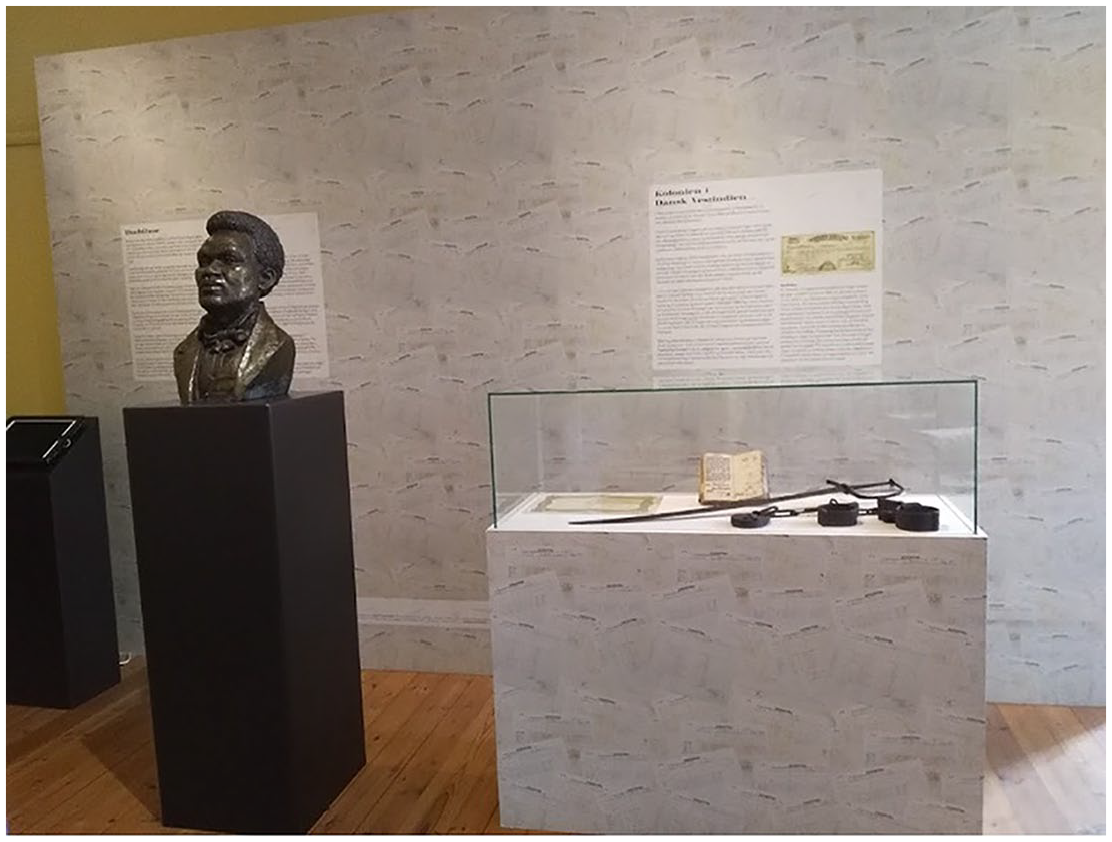
The bust of General Buddhoe made by the Ghanian-US artist Bright Bimpong is the fourth replica of the statue as the three originals are placed in a prominent position on each of the Islands, creating another point of connection between West Zealand and the USVI.
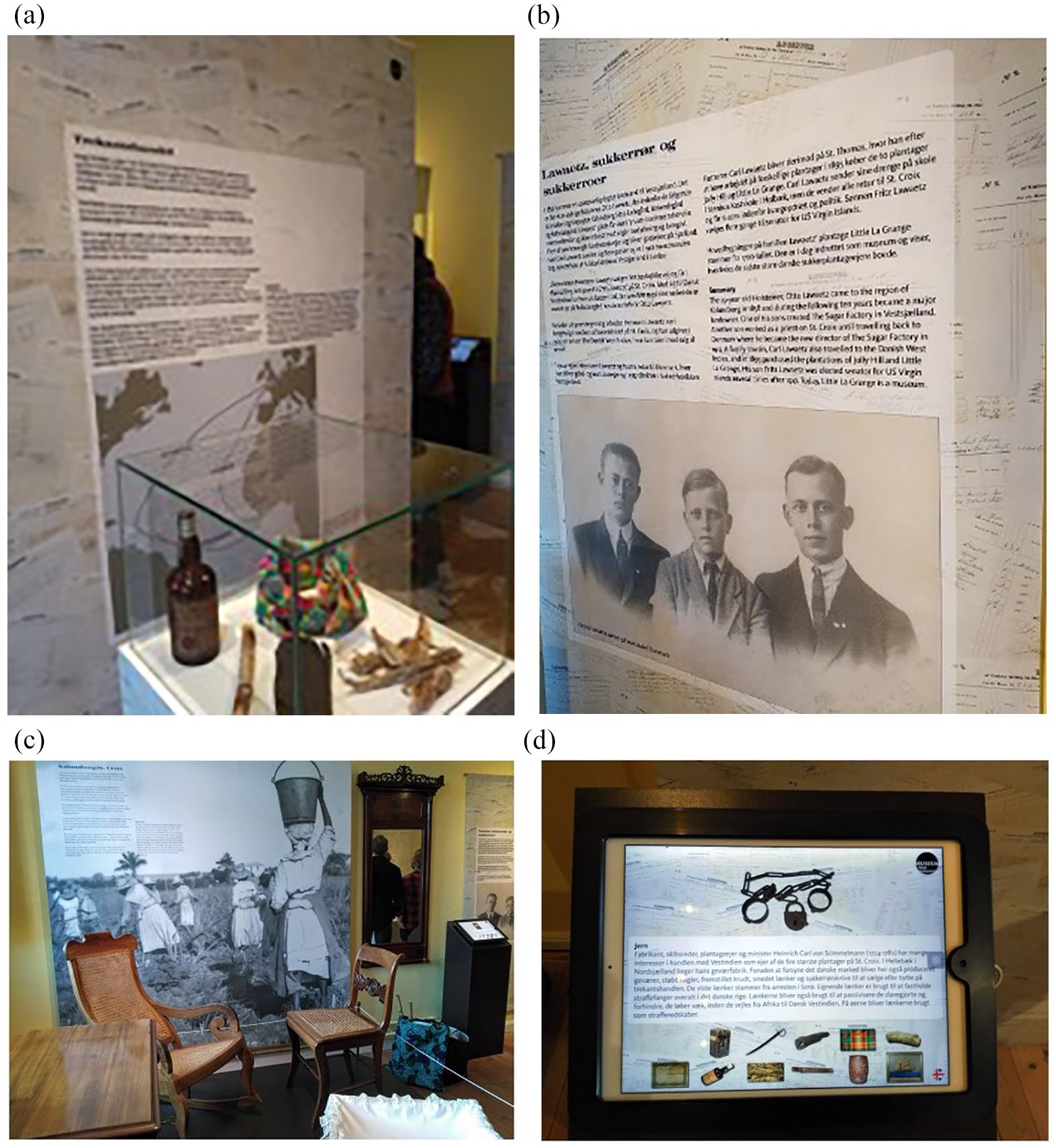
Top left: Display on the triangular trade. Top right: information on the Lawaetz family who used DWI-made wealth and knowledge to develop sugar-beet production in West Zealand. Bottom left: the story and furniture of a Danish family living in St Croix. Bottom left: explanation of how the iron-products factory in North Zealand produced rifles and chains used to control the enslaved.
The displays and informative texts show great potential for the work of implication. Nonetheless, when this potential is not fulfilled, visitors might be left with a message of disimplication. Consider the kitchenware case described above and a map of West Zealand pointing to the different manors directly involved in the plantation economy. While visitors can recognize teacups and jugs as items from their own lives and see their own hometowns on a map tying their region to a faraway land—both the map and the kitchenware are from the 17th and 18th hundreds. This makes the displays less relatable and anchors the influence of colonialism on the region as something of the past. Incorporating a modern item into the kitchenware display and merging a contemporary map onto the old one, could have helped cement the notion that this history is still relevant today.
Similar issues are reflected in a display case featuring stereotypical depictions of black people on various paraphernalia. Among the items, the most contemporary one is that of a “n-doll” which also recounts the exercise of, and backlash against, the temporary exhibit. In addition to problems associated with replicating offensive representations and language, the intention of showing how dehumanization was required to legitimize exploitation is arrested by the fact that one can get the false impression that such representations and their effects are not widespread anymore (see Danbolt, 2017). This is another missed opportunity to show how colonialism continues to inform contemporary Denmark.
The last example to reflect missed opportunities along both temporal and spatial implications is the video installation Somebody’s Been Sitting in My Chair, Somebody’s Been Sleeping in My Bed (2011) by La Vaughn Belle. The footage follows Belle as she walks across a plantation mansion in St. Croix, the opulent home of the enslaver. Walking in the empty residence amid the luxurious period furniture, one can sense her great discomfort being in this space as a black woman, a trespasser. Eventually, a sound of someone entering the house frightens her and she escapes out the window. The video successfully conveys questions about power, racialization and ownership of space. Nonetheless, its placement in a centuries-old plantation home also confines these questions to what can be considered as the archetypical site of these spatial dynamics. This placement therefore risks forsaking the fact that these dynamics, where some bodies are seen as “out of place” in certain spaces did not stay in the plantation home, but have proliferated to countless other sites across the globe (McKittrick, 2011) including Denmark (Midtvrkn Diallo, 2019; Hassani, 2022).
As we will later see, Sivebæk Munk and her staff are aware of some of these issues, as ideas around temporal connectivity seem to be at the heart of new plans to expand the exhibit. This awareness is also reflected at the tours, where the manager’s openness to critique and improvement allows great flexibility with how the guides operationalize the exhibit space. We will now turn to their accounts as organized along the main themes arising in the interviews. These begin with the guides’ articulations of their own implication, followed by who is seen as a subject of this history during the tour and who remains unimplicated. We will then explore their strategies to alter and introduce modes of implication on spatial and temporal grounds before concluding the article.
Guiding implication
The three young and thoughtful guides walking local teenagers through the West Zealand and the West Indies exhibit- Ida, Liv, and Daniel—haven’t worked side-by-side. Ida is the head of oral history dissemination at the museum and therefore the main architect of the tour. She was replaced by Liv when stepping away for her first maternity leave, and by Daniel for her (then, upcoming) second. Despite using the same physical space and tour-foundations, each guide brings their own perspective, as informed by their professional background and lived experiences. Awareness of how their lived experience and embodiment feed into their approaches and desired goals showcases their reflexivity about their own implication in this history. This reflexivity is significant as it has been found to be a central factor in the success of guiding people through sensitive topics (Eldar and Jansson, 2021; Johnson, 2002).
Ida is a historian born and raised in “white Denmark” where racism was normalized. She specialized in the politics of DWI’s built heritage preservation in the USVI, worked as a guide to the African collection at the National Museum, and lived in Ghana where she met her husband. Her personal experience as a parent to a mixed-heritage son confronted her with Danish racism and ignorance. Ida sees ignorance of Afro perspectives and histories in Danish society as a main factor contributing to ongoing white supremacy. Her current approach as a guide thus mostly concerns ways to compensate for the exhibit’s lack of engagement with Afro-Caribbean perspectives.
Liv’s Jewish background made her aware from a young age of the discrepancy between mainstream discourses and other ones, leading her to specialize in minority discourses as a historian. Studying about Jews in medieval Europe clarified to her the centrality of the figure of the “other” in the formation of European identity. Recognizing how different forms of racism intersect in the production of white, Christian European identity showed her the common interests different minorities share and how minority voices benefit society at large. She therefore sees the tour as an opportunity to amplify voices that have been silenced in Danish history and discourse.
Born in Denmark to a Danish mother and a Turkish father, Daniel was drawn to study intercultural encounters in addition to colonial history. He sees Denmark’s denial of its colonial history as hindering efforts to tackle racism, which he experiences personally. For him, failure to acknowledge Danish colonialism and slavery positions Denmark as innocent and exceptional and thus not in need of improvement. Attending to current manifestations of racism therefore necessitates honest engagement with its uncomfortable past. For this engagement to be immersive and memorable, Daniel combines sensory experiences into the tour.
As seen, the guides are reflexive on how they are implicated in this history and how this sense of implication is guiding their motivations and approaches. In contrast, their mainly white students find it hard to understand how they are implicated in the history presented and black students are those systemically signaled out as subjects this history relates to. The fact that people of African descent (PAD) in Denmark are seen as subjects of the history of slavery although the vast majority of Danish PAD have direct ties to the African continent and therefore no genealogical connection to the history in question, is telling of the racial legacies this history holds in contemporary Denmark, legacies that implicate black Danes in this history.
This dynamic is reflected in all of the guides’ experiences, including in three anecdotes shared by Liv. In the first, during her tour white students bullied a black classmate, using the n-word while suggesting he was their slave. In another, a black student with Caribbean heritage openly shared her family connection to the history with her attentive and supportive classmates. In the last, a white teacher signaled out a black student and asked him to share with the class how he might relate to the history told, to which he responded with visible discomfort. Similarly, Daniel shared how he felt compelled to pause and acknowledge the discomforting nature of the topic after recognizing the discomfort of a black student and Ida lamented the appropriateness of white guides walking black kids through this history after a black student broke down in tears and anger during her tour.
The incidences are rich with issues to consider and unpack. Among these, is a reflection of who is understood as a subject of the history of slavery and is made hypervisible and uncomfortable, and who is it that is left unmarked by it, unimplicated. While all guides wish to encourage white students to be agents of social justice by conveying to them that they are implicated in this history, they all struggle with the idea of discomforting them into a counterproductive defensiveness, or, as Liv puts it, “block it out.” For Ida, the attentiveness to the experience of white people is also reflected in the physical exhibit itself. As mentioned above, one of the main ways colonialism influenced the region is through the wealthy local families that owned plantations and traded in colonial goods. Their wealth and influence informed the region in many lasting ways hardly known to contemporary residents who see the grand estate as anachronistic feudal remnants. If people don’t know how these manors and families right here have anything to do with them, Ida wonders, can they understand the lives of people in the Caribbean as something that concern them? Unfortunately, curating a familiar “mercantilist story,” she concludes, provides a more legible starting point than “starting with warlords in West Africa or trading ships.”
While lamenting the need to cater to this target audience with narratives she’d rather forsake, Ida also views it as an opportunity and a responsibility. This came across when I shared my concerns about the “black doll” exhibit’s question’s framing and the conversations I feared it legitimized. While not endorsing the exercise, Ida, who has been actively working on a whole new section dedicated to stereotypes asked Who enters this museum? Who comes in the door? It’s not people from the Virgin Islands. It’s hardly Copenhageners. It is the people that live around here. And this area is also the area where most people vote most right wing. So don’t we have an obligation to enter into that conversation to try and expose the facts, the history behind these caricatures? To give people knowledge to hopefully change their minds about some of these things?
Nonetheless, while she “very much recognize[s] the need to create space for the explanation behind why things are changing” for the main visitors’ demographic, Ida eventually dropped the stereotype exhibit idea. Thinking about the school kids she takes through the exhibit, she is deeply troubled by the thought of exposing kids to stereotypes they haven’t even seen in their lifetime, and how doing that one time to one black student would be “one time too many.”
The challenging situation where guides need to implicate white students without triggering them while changing the terms upon which black students are implicated—and all within a particular physical setting—compelled them to devise different strategies. Daniel who finds himself in and out of the tour tip-toeing around “white fragility” resolves to embrace discomfort and encourages students to do the same. By preparing them to experience it, he hopes to both lower defensive responses from white students and prepare students of color for hypervisibility. In addition, by embracing discomfort he knowingly disturbs the “hygge” concept, a cultural norm celebrating harmony that in recent years has also been recognized for its role in hindering efforts to tackle racism by positioning those who point racism out as those who break the cherished cozy atmosphere (Nielsen-Bobbit, 2020).
Fearing disengagement, Liv maintains a sense of comfort by using passive language that omits direct perpetrators when discussing slavery and colonialism (i.e. “disimplicate”). She hopes this will lay the groundwork for more challenging future engagements. However, when white students are disrespectful, she can find herself scolding them: “You know, when you laugh about this, you need to realize it happened to actual people, and it was our ancestors who did it.” Nonetheless, Liv aims to move students away from agency-repressive ideas of pure good and evil by unpacking the motivations of young Danish sailors in the transatlantic trade. She hopes to stimulate reflection on the systemic factors leading ordinary people to do bad things (i.e. implicate) and recognize that wealthy merchants and planters were common oppressors for both the lower classes in Denmark and the enslaved.
Ida also experiences the impulse to shake white students out of disrespect or indifference. She avoids direct implication in her narrative, however, not by relying on passive language to blur perpetrators. Instead, she uses the temporally distancing pronoun “they,” meaning it is the historical Danes responsible for the atrocities recounted rather than “we” (e.g. “when they sold the Islands”). Her reasoning also differs from Liv’s as for her this decision isn’t grounded in fear of having white students “blocked out,” as much as she fears it can exclude students of color who might not see themselves as a part of the historical “we” referred to. Her consideration for students of color’s sense of dis/comfort is also reflected in her active effort to change the terms of their implication in this history.
Reflecting on how black and brown students “connect to these stories” Ida says, I see how difficult it is to teach the subject if all they have- the only role they can take when we tell the story—is the role of somebody getting whipped or the role of somebody getting their hands chopped off. It puts them in a position that’s not very . . . it doesn’t give them any agency in the classroom. And if a big, big part of teaching children about history is making it relatable, right? So that . . . you are awake some of that interest. And yeah, you can do that with guns and atrocities and slavery and punishment. But then if you really had to put it like on the line . . . Like then you’re enslaving history.
Ida’s awareness of how a particular retelling of history affects students’ agency in their classroom today, demonstrates the diachronic and synchronic nature of implication. As Rothberg (2019: 56) explains, While certainly material and structural in their expression, gendered and racialized forms of domination also involve processes of meaning making and subject formation that sediment historical legacies both for those who are disadvantaged by such legacies and for those who are advantaged by them (i.e., implicated subjects).
In the case of Danish colonialism and enslavement, among these sediments are the lingering legacies that entangle black Danish students in this history despite having no genealogical connection to it. These include narratives and stereotypes about black people as (a)historical agents.
To counter this narrative and re-formulate black students’ modes of implication, Ida activates the exhibit in various ways. She uses a map showing the three islands as a prompt to talk about the 1733 six-months-long heroic enslaved uprising in St. John. The furniture owned by the West Zealand family when they lived in the DWI is an opportunity to talk about the conditions under which enslaved women worked as domestic servants. Instead of recounting the lives of its owners, a beaded purse offers a prism into the lives of its makers.
To foster spatial connections between the DWI and West Zealand, all guides visit a colonial-era merchant shop outside the exhibit. There, students encounter bags of coffee, sugar, spices, and tea with exotic names and racist depictions of their producers. Through the visit, guides seek to highlight the centrality of othering in the process of legitimizing exploitation. To engrain ideas around relationality between the conditions of West Zealand and the West Indies, Daniel reminds students of a local herring saltery exporting food for those enslaved on sugar plantations. He offers students salted dry fish alongside a sweet period cake, demonstrating how the privileged reality of consumers was based on the oppression of producers.
To foster temporal connections, all guides incorporate contemporary examples when asking students to reflect and analyze the packages of “colonial goods.” Drawing from personal experience, I asked Daniel if, when asking students to rank racist representations he isn’t worried about reproducing offensive images and making students of color hyper-aware of their features. Daniel said that by sharing his racialization experiences and framing all depictions as racist, he fosters an open atmosphere encouraging students of color to be vocal. In a country where discussing racism is almost taboo, this exercise validates their experiences and students of color often share their stories with him. Nonetheless, he also attributes this dynamic to his embodiment, as students of Middle Eastern background might approach him before the tour even begins.
One of the things that make the guides’ task so challenging, is that in many ways what they do is explain the historical construction of their- and their students’ embodiments. Therefore, while students of color seem to feel comfortable unpacking that with Daniel, it isn’t obvious that the same exercise is experienced the same with Liv or Ida. The latter even wondered if it is appropriate at all for white guides to walk students of color through this history as she believes they deserve to hear this history from “someone who looks like them.” While Ida does not like evoking her son and husband, she sometimes resorts to doing so, as she feels it both provides more credibility to her charges concerning the ongoing legacies of racism in Denmark in the eyes of white students and eases the discomfort of students of color.
Like the other strategies used by the guides, the decision to reveal their own multifaceted implications doesn’t resolve the messy and at times suboptimal ways this history is communicated to the differently positioned students touring the Holbæk Museum. Nonetheless, by being open and reflexive the guide let the students know that they are in this messy and unresolved journey together with them, at least for a couple of hours they have together. Then, they can only hope they will find ways to continue the journey once they step outside the West Zealand and the West Indies exhibit.
Conclusion
Public history museums are important sites in the task of illuminating to people how history informs the present. As such, they can play a central role in revealing and challenging visitors’ modes of implication. Unlike stationary objects such as artifacts and displays, guides must interact with the visitors entering the museum. This interaction reveals how the history displayed is met among visitors who experience the weight of this history very differently. Attention to their experiences and the strategies they devise to navigate the challenging terrain of revealing and challenging differently positioned visitors’ various modes of implication can be instructive. This is particularly the case as more museums take on the important task of tackling histories of colonialism and slavery and “decolonize.”
In the context of these efforts to tackle uncomfortable histories is essential to hold on to Marselis’ (2016: 30) conclusion that “it is of utmost importance to include source communities and other intended audiences in any deliberation about an ethical future for ethnographic museum.” This conclusion can be expanded not only through a consideration of the coloniality embedded within museums at large (Karina, 2022; Vawda, 2019), but also through a reconsideration of who are the “audiences” versus the “other audiences” museums should include into their deliberations. A helpful point of departure for this reconsideration is offered by Shahid Vawda (2019: 76): Postcolonial communities are disaggregated and dispersed: they are found in the South, but are also diasporic and very much part of the North. It implies the colonisers are, or should be, part of the postcolonial and decolonisation practices, and that contacts with postcolonial communities globally should be sustained and fruitful, rather than fleeting and ephemeral.
Appreciation to how the public, like the individuals composing it, is made out of innumerable intersections of histories and their multifaceted interactions in the present can usher not only coalitions between differently positioned subjects, but also thoughtful and thought-provoking curatorial practices to encourage them.
Footnotes
Acknowledgements
I’d like to thank the editor and the anonymous reviewers for giving me a chance to improve the manuscript through their valuable feedback and thoughtful suggestions. I’d also like to thank organizers and participants in the MSA’s 7th annual conference’s session Memory Space and Place where earlier version of this paper has been presented. Finally, I’d like to thank the generous researchers at Roskilde University’s Department of Communication and Arts for sharing their time and insights with me.
Declaration of conflicting interests
The author declared no potential conflicts of interest with respect to the research, authorship, and/or publication of this article.
Funding
The author disclosed receipt of the following financial support for the research, authorship, and/or publication of this article: The study was supported by the Swedish Society for Anthropology and Geography (SSAG) PhD scholarship.
