




Abstract
The present study focuses on memory work in school textbook illustrations of the Finnish Civil War (1918). A thematic narrative analysis shows how the content and meanings conveyed through visual narratives have developed in the past century. Besides changes in specific narrative, the interpretation of the functions of themes shows a gradual change in the schematic narrative template: the hegemonic, victor’s narrative has been gradually replaced with alternative accounts since the 1950s. The defeated side has been represented in school textbooks since the 1950s, and since the 1990s, the narrative has evolved from pointing out the similarities between the two sides to arousing emotions of sympathy for the victims of the War. Since the 2000s, visual images have been used to highlight multi-perspectivity in history. This study shows how the cultural trauma and reconciliation process has been conveyed in educational material and how the narrative templates may dynamically change.
Introduction
History education plays an important role in conveying hegemonic narratives and constructing collective memories (Sakki, 2016). Collective memory defines a group, its values and norms, and in this way is used to legitimize the group’s behavior (Páez and Liu, 2015). Especially in the context of traumatic national events like a civil war, an analysis of the officially transmitted collective memories makes it possible to understand the social functions different narratives play.
According to several researchers (e.g. László, 1997; Wertsch, 2008), socially shared conceptions are transmitted through narratives. In the present study, we focus on a specific form of narration: visual narratives. In our study, which focuses on the Finnish Civil War, we understand visual narrative as a storyline suggested in a set of images (themes) depicting events and characters of the history. According to Wertsch (2008) the elements of narrative are organized by the schematic template. Wertsch has shown how templates may remain the same even though the specific events of the narrative alter. However, he did not explain the situation that the template can change.
Post-conflict societies have used different strategies to cope with the dark past in education (Bentrovato, 2017). Often, soon after the conflict, the strategy is narrative silence and focus on the victor’s perspective. However, this is likely to hinder intergroup relations and any reconciliation efforts in divided societies (Ahonen, 2012). Stradling (2003) have suggested that multi-perspective or multi-narrative approach could promote reciprocal empathy and intergroup reconciliation.
Visual images are important carriers of social knowledge over generations, and the specific qualities of images, especially compared to written texts, include emotive and reality-evoking effects (Joffé, 2008). Emotional messages conveyed by visual narratives make the illustrations into potential means to invite the reader to empathize with the characters (Riessman, 2008: 142), and thus a visual image is a potential tool for evoking narrative empathy (Liu and László, 2007). Even though analysis of history narratives in the context of collective memory has been a vivid area of research, visual narratives have rarely been studied. Even rarer are the attempts to apply Wertsch’s (2008) concept of schematic narrative templates to an analysis of visual narratives.
The present study contributes to the field of memory studies by showing how the longitudinal analysis of the narratives may reveal the change of schematic narrative template. This, in turn, helps us to understand the different phases of collective remembering and to identify the possibilities to alter the meanings of shared narratives. The Finnish Civil War was fought in 1918 between the socialist Reds and the non-socialist Whites ended with the victory of the Whites, and led, soon after the conflict, to the establishment of the victor’s version of the history. For example, Kantola (2014) has shown how the public bottom-up renegotiations of the memories of the War took place after 90 years of the actual event. The analysis of the change of official (top-down) narratives may inform how public unofficial commemorations became possible.
In order to achieve these goals, we analyze the illustrations of the chapters of the Finnish Civil War in history textbooks from the 1920s to 2010s. More specifically we ask: (a) How is the Civil War narrated in textbook illustrations, (b) What kind of functions do different narratives serve, (c) What is the schematic narrative template structuring the specific narratives? Data-driven thematic content analysis is accompanied by theory-driven analysis in which social representations theory (e.g. Moscovici, 1984) is used as a guiding framework. First, we introduce the theoretical concepts applied in the study as well the context, the Finnish Civil War in 1918, and the emergence of the visual narrative of the war.
Narrative organization of collective memory
Collective memory refers to shared knowledge concerning a common past. Halbwachs (1980) emphasized the role of society as a context in which shared conceptions are created, recognized, and localized. In social psychology, collective memories are often seen as one type of social representation (e.g. Liu and László, 2007; Sakki, 2016; Tileagă, 2009). Social representations generally refer to everyday knowledge that facilitates communication among group members and helps us to orientate towards the world (Moscovici, 1984).
To make it possible to use the past creatively for different needs and threats the group faces, collective memory is characterized by selective remembering and selective forgetting (Halbwachs, 1980; Páez and Liu, 2015). To identify the different social functions of the collective memories in a narrative, a researcher should ask which events and characters are included and which are excluded? (Riessman, 2008: 152). Collective desires constitute the group’s joint projects (Bauer and Gaskell, 1999). For example, in post-conflict society, the project could be creating a sense of togetherness through enforcing the institutionalized victor’s narrative of the past.
According to the social representation theory, there are two interrelated processes through which people construct conceptions of topical social issues. These processes are called objectification and anchoring (Moscovici, 1984). Objectification refers to the process in which something abstract, like a historical event, is turned into something tangible, for example through a metaphor, a figure or a person, while anchoring refers to the process in which a phenomenon is given a specific meaning. In addition, some representations may acquire an almost unquestioned position, that is, become naturalized, and as a result, start to symbolize a whole event or a specific time period. From then on, naturalized representations define the way in which that particular historical event is expected to be narrated. To give an example, in the Finnish context, an image of soldiers dressed in white winter camouflage is an objectification of the Winter War, a war between Finland and the Soviet Union in 1939–1940, in which Finland lost some of its territories but avoided total occupation, despite the military superiority of the Soviet Union. The Winter War is anchored to the ideas of national unity and the collective heroic fight against heavy odds. The image crystallizes the deep-rooted social representation of the Winter War conveying symbolical meanings of the national myth of Winter War characterized by national unity and Finnish heroism against overwhelming enemy (Hakoköngäs and Sakki, 2016).
Tileagă (2009) argues that in social communication, narrative form has a significant role as it is a tool to convey a message effectively to group members. Wertsch (2008) has distinguished between two types of narratives: specific narratives, which refer to explicitly mentioned events and characters of the history, so-called mid-level events, and schematic narrative templates, which refer to generalized narrative forms that underline a range of specific narratives. Using the example above, the Winter War could be the specific narrative, an event that can be located to years 1939–1940. The meaning behind the mid-level event, namely the collective fight against a great enemy, represents the schematic template that could be identified as the organizing structure of several Finnish narratives.
Wertsch (2008) has shown how schematic narrative templates are relatively static by nature: even though the mid-level events of the narrative are replaced, the underlying structure remains the same. Wertsch argues that templates are static in nature because they are so internalized and thus not openly discussed. Hakoköngäs and Sakki (2016) call these deep-rooted social representations of history naturalized collective memories. The question arises as to the kind of situation in which and the kind of process through which the template may change, as seen for example in Finland, where the collective memory of the Civil War has changed over the decades. For example, after the WWII, the term “Freedom War” emphasizing the victors’ perspective was gradually replaced with the more neutral expressions such as “the War Between the People”. From the 1960s onwards, the name started to evolve into “the Civil War”, which is nowadays the most widely used name of the conflict (Haapala, 2009). Hakoköngäs and Sakki (2016) argue that even though the collective memory resists change, different voices may gradually be adopted as elements of the social representation. When enough new elements are integrated into the narrative, its meaning changes as does the social function conveyed by the schematic template.
As earlier studies addressing the memory work and reconciliatory processes in post-conflict societies have shown, the reconciliation process may take generations (Ahonen, 2012; Kantola, 2014). We argue that the identification of these changes in schematic templates and the joint project, that is, the function of certain memories, requires a longitudinal approach (see also Bauer and Gaskell, 1999). The present study responds to this need by analyzing the visual narratives over a period of ten decades. To contextualize the analysis, it is necessary to look at the beginning of the development of the narrative.
The emergence of the visual narrative of the Finnish Civil War
The Civil War divided Finland in the spring 1918. The War was fought between the the socialist Reds and non-socialist Whites and it formed a part of the First World War. The Civil War itself lasted 4 months, from late January to mid-May, but the acts of violence committed by both sides left a deep cultural trauma in Finnish society, and the memory work to heal the trauma has continued over generations (e.g. Ahonen, 2012; Kantola, 2014).
Postponed societal reforms and major disparities in wealth between different societal groups were some of the reasons stirring the conflict. The Reds received some help from the former imperial Russian troops and occupied most cities in southern Finland in the beginning of the War. The Whites asked Imperial Germany to send back the Finnish Jagers who had been undergoing military training there. Later, Germany also sent a division of German soldiers to assist the Whites. With the German help, the Whites were able to occupy the most important Finnish cities, and the War ended with the defeat of the Reds in mid-May 1918 (Tikka, 2014: 90–118). Some 11,000 lives were lost in the atrocities committed by both sides during the war. After the War, members of the Red Guard who had not fled to Russia, as well as civilians associated with the defeated side, were interned in prison camps. During a period of 7 months, including both the War and the period of imprisonment, a total of some 36,000 lives were lost, approximately one percent of the population of Finland at that time (Tikka, 2014: 92). The Whites, victors of the War, established a hegemonic narrative, in which the victors were praised and the defeated side was disparaged. To fasten the establishment of “the victor’s truth”, both oral and visual narratives of the defeated side were excluded from the public commemorations for decades after the War (Peltonen, 2003).
In April 1918, the Finnish Senate set up a committee to collect documents on the crimes of the Red regime in Finland, including photographs (Roselius, 2013: 41–48). Images of the Reds were used to point out their “criminal characteristics” compared with the Whites (Kleemola, 2018). In mid-1930s, after an initiative proposed by the leader of the White army, General Mannerheim, some 5000 photographs showing the victories of the Whites in the War were collected, and the selected ones were published in a book called “The Finnish Freedom War in Pictures” in 1934. The book was an example of the ways in which the victors established the hegemonic visual narrative of the War. (Kleemola, 2018: 267). Collecting and publishing photographs depicting the War was part of the myth-building process (Peltonen, 2003; Roselius, 2013) and an example of selective remembering (Páez and Liu, 2015) that aimed to shape how the event should be remembered. The extensive collection of photographs and other memorabilia provided textbook authors and publishers a pre-selected resource to illustrate the chapters depicting the War. The visual narrative of the War in the history textbooks started to take a shape in the early 1920s.
The role of images in the textbooks
The educational context in which the textbooks were produced provides a background to analyse the role of visual images, like photographs and drawings, in different decades. The Finnish national curriculum in the 1920s indicates that it was understood, at least to some extent, that pictures had pedagogical value and served an important function as teaching and memorizing aids. However, there were also reservations regarding the use of images, and the curriculum stated that verbal presentation was preferred given the fact that there was no guarantee that the images were not merely a product of the illustrator’s or photographer’s imagination (Maalaiskansakoulun opetussuunnitelma, 1925: 56). Also, due to the limited printing technique and the need to keep the price of the books moderate, the visual narratives during the interwar period remained short.
In the 1970s, the Finnish history curriculum moved from a chronological to a thematic structure, the critical analysis of sources became increasingly important in teaching, and images were used as pedagogical material for learning through research (Rantala and Ahonen, 2015: 131). During the period from the 1970s to the 2010s, more space was generally given to images in Finnish history textbooks (Tykkyläinen, 2014). Increased visualization was partly a result of cheaper printing costs but also a pedagogical need to bring books to life and make them more interesting.
Until 1970s, Finnish textbooks were mainly written by academic researchers and education officials; later, along the implementation of the comprehensive school system, authors were mainly school teachers. Respectively, the number of authors per textbook increased from two to three in the 1980s and even six authors in the 1990s (Rantala, 2017: 274–275). Until 1992, textbooks had to be approved by the National Board of Education (Kouluhallitus), and after that, authors and publishers got more freedom to decide about the contents of books (Rantala and Ahonen, 2015: 118).
Material and method
We analyzed a total of 54 Finnish history textbooks published from 1924 to 2017 (the books are listed in Supplemental material). Given the lack of availability of precise statistics on the distribution of individual textbooks, we included the books published by the all major Finnish publishing houses (see Rantala, 2017). To provide a broad view to the visual narratives of the Civil War and thus to be able to draw more general conclusions we included books intended for different grades. The chapters addressing the War included a total of 350 images, mainly comprising photographs from the period of the War, but also a smaller quantity of other kinds of illustrations like maps and documents.
To answer our three-fold research task, a three-step analytic procedure was applied involving moving from the analysis of contents (the “what” question) to the analysis of functional aspects of the illustrations (the “how” and “for what purpose” questions). In the first step of the analysis, to provide a systematic and comprehensive description of the mid-level events forming the specific narrative, including, for example, persons, events and places (Wertsch, 2008), the images were analyzed according to the principles of thematic analysis (Riessman, 2008). We adopted a bottom-up analytical approach, beginning with close readings and re-readings of the material. Along with the content of the images, we also considered their composition (i.e. which ones appeared together), sizes and positions within the chapters when interpreting how a certain theme objectifies the War. The term objectification refers to the process in which something abstract and distant (such as an event in history) is made tangible for example through visualization (Moscovici, 1984). The findings of the thematic analysis were arranged as periods within which certain themes prevailed. For example, a theme presenting the White soldiers marching into the capital was interpreted as objectification of military discipline and heroism, and the theme was strongly present in the period from the 1920s to 1955.
In thematic analysis, the primary attention is on “what” is narrated (Riessman, 2008: 53). In order to answer the questions of “how” and “for what purpose”, the second phase of the analysis included the definition of anchoring, that is, how socially salient topic acquires a meaning (Moscovici, 1984). In order to define the meaning(s) of visual narration, we considered the textual explanations underpinning the desired meaning of images (Barthes, 1977; Heikkilä, 2006). In practice, we paid special attention to the captions of images to identify their intended function. We did not aim to quantify the contents of the illustrations, which we believed would produce a mechanistic account of the narrative development. Given that one image may emotionally charge the whole chapter, we reasoned that trying to interpret the role and meaning of distinctive themes appearing would be a more productive approach than counting image frequency. For example, the above-mentioned theme presenting White soldiers marching into the capital was hegemonic between 1920 and 1955. The theme had a similar ethos to the other themes of that period and this ethos was interpreted as an anchor to reverence for the White heroes.
Finally, in the third step of the analysis, the schematic narrative templates, that is, the underlying generalized structures serving different social functions, such as positive in-group identity (Wertsch, 2008), were named based on the objectifications and anchorings identified of specific narratives in the textbooks. The third step of the analysis was the most inventive and applied exercise, as there is no established framework to identify schematic templates in the visual narratives. We followed Wertsch’s (2008) definition according to which schematic narrative templates shape specific narratives and have the capacity to serve as cultural tools for members of the group. For example, the theme of the White soldiers along with other themes of the same period unequivocally narrate the victor’s story, which we interpreted as a schematic template constituting an institutionalized perspective to interpret the Civil War from the 1920s to 1950s.
Results: From the victor’s story to multiple narratives
As a result of thematic analysis of the history textbook images depicting the Finnish Civil War, we identified five different phases of narrative. These phases took place in separate time periods, even though the starting and end points of the periods were not clear-cut. The specific narrative of the War evolved from period to period, as new themes (mid-level events), like actors and events, were adopted to visualize the War. We described the content of the new themes (objectification) and interpreted how they changed the meaning conveyed through the whole narrative (anchoring). Finally, we interpreted the social function of each narrative: it was found that the schematic narrative template changed as the new themes made the narrative serve new functions. The findings of the three steps of analysis are summarized in the Table 1.
The specific narratives of the Finnish Civil War, their objectifications and anchorings, and the schematic narrative templates employed in textbooks (N=54).
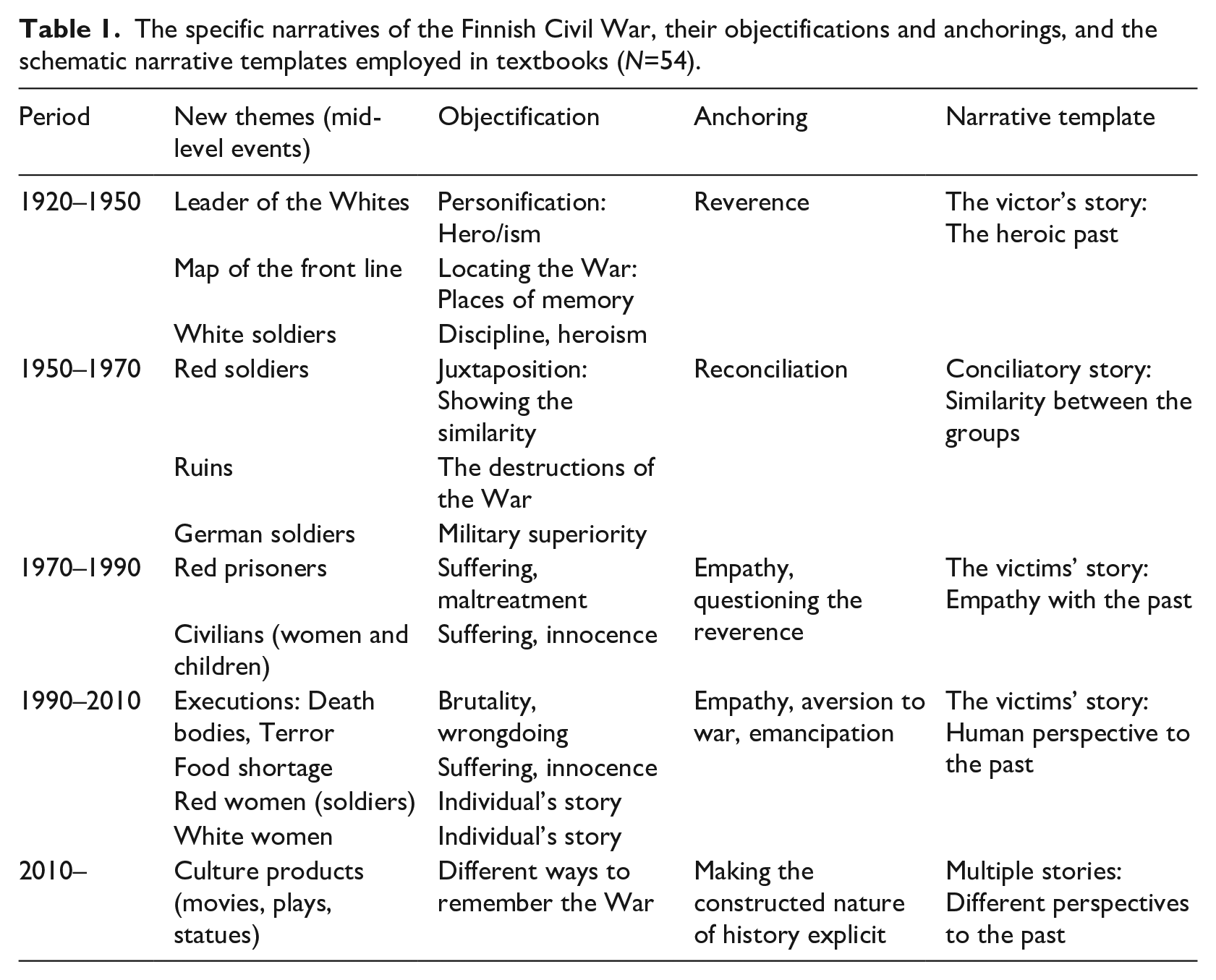
The analysis showed that the visual narrative of the War was altered by gradually integrating new themes next to the previous ones. In other words, the themes used for the first time in the 1920s are still present in the 2010s, but the overall meaning of the narrative has changed as new contents and graphical solutions (like juxtaposition of images) have set the narrative a new frame of interpretation. Next, we will describe the specific narrative as well as the schematic narrative template of each period in detail.
The victor’s story 1920–1950: The heroic past
As described above, photographs and other related visual material were collected and published soon after the Civil War ended. The earliest theme in the material portrays General Mannerheim, the Commander-in-Chief of the White troops (Mantere and Sarva, 1924: 306). The theme was repeated in each following book and it is reasonable to argue that Mannerheim was naturalized as a symbol of the War in the 1920s, that is, he started to symbolize the whole event. In the 1930s, the books featured the first maps (e.g. Mantere and Sarva, 1935: 415) depicting the front line as well as the Battle of Tampere. From this point on, maps formed a separate part of the narrative and a start to define “places of memory”. Even in the 2010s, Tampere is still an important location for the commemorations of the War (Kantola, 2014). In the 1930s, along with the portrait of Mannerheim and a map, the War was objectified in images depicting (unnamed) White soldiers making their vows and marching into the city of Helsinki (Juva et al., 1938: 220, 221). This theme expanded the anchoring to the heroism of the victor from Mannerheim to the entire White army, thereby reinforcing the hegemonic victor’s story.
Reconciliatory aims of Finnish school (Rantala, 2018) were not visible in the visual narratives between the World Wars. During the Second World War the portrait of Mannerheim still dominated the narrative (e.g. Heporauta, 1940: 258; Mantere and Sarva, 1944: 311–315). Mannerheim was the commander-in-chief also in the WWII and acquired a central position in the official history narrative of Finland (e.g. Hakoköngäs and Sakki, 2016) which explains why his portraits was printed in textbooks edition after edition. The result of the war in fall 1944 forced Finland to adopt a new political stance toward the former enemy Soviet Union which included, following the peace treaty, abolishing all anti-Soviet organizations and release formerly forbidden socialist organizations to act. One substantial action was a review of education, which also applied to school textbooks. The censorship was ordered by the committee appointed by the Council of State, and in the process, 28 history textbooks were banned and many books were censored in part. The censorship was put into practice in schools by pupils who crossed out the anti-Soviet and pro-German sentences from the textbooks (Ekholm, 2000: 37–43; Rantala, 2017: 257) but the effort was only partial as some schools still continued using banned textbooks and publishing houses kept reprinting them (Rantala, 1997: 66, 67).
Even though progressive politicians and the National Board of Education wanted the schools to promote the reconciliation, the history textbooks were characterized by the victors’ nationalist ethos up until the 1940s (Rantala, 2018). Despite demands from the political left, the narrative of the Civil War was not revised in the censorship exercise due to time pressure. After it turned out in the parliamentary elections in 1948 that Finland would not fall into the hands of socialists, history teaching lost its immediate political volatility. Old textbooks kept dominating the markets (Ahonen, 2017: 46). Thus, it is not surprising that the effect of the censorship was reflected with delay in the visual narrative of the Civil War: Mantere and Sarva’s (1946: 402–405) textbook published in 1946 contains the same images as in the 1944 and 1935 editions. However, several books from the late 1940s to the first half of the 1950s contained only one image of the War, which again was a portrait of Mannerheim. Ruutu (1951) went even further and the chapter on the Civil War did not contain a single image. Thus, the visual narrative was for a while either entirely removed from schoolbooks or minimized to the image of Mannerheim.
To conclude, the first period of visual narrative of the War was objectified with the images of the Whites and anchored to the reverence for the victors of the War. The schematic template organizing the narrative can be described as the victor’s story in which the past is seen as a heroic and legitimate fight against the evil side. The social function was to uphold the social order established after the War.
Conciliatory story 1950–1970: Two perspectives to the past
Textbook authors and publishers started to rebuild the visual narrative of the Civil War after the censorship period followed by the WWII. In politics, socialists, communists and the Agrarian League (since 1965 the Centre Party) were the most powerful groups in the parliament. The government aimed on the one hand to secure good relationship to Soviet Union and on the other to diminish political contradictions in domestic policy. The active political left group added pressure to integrate to textbooks the Reds’ perspective on the War which had so far been downplayed by the official narrative.
In a political situation in which the voices from the political left had to be listened more than before, “the Freedom War” mythos was no longer cherished and accordingly ceased to play such a central role (Roselius, 2013). The elementary school curriculum in 1952 focused strongly on humanity, which in turn meant that the role of the nationalistic and militaristic historical narrative diminished. The focus in schools was now on cultural rather than military history. (Rantala, 2017: 259, 260.)
In addition to the new political line in post-war Finland, the change in narrative might have been affected by the changes in the ideals of history teaching. Following the German example, the history teaching aimed to follow principles of academic history research, for example, by paying more attention to familiarizing pupils with historical sources (Rantala and Ahonen, 2015: 43). During this period, Finnish historians abandoned old nationalistic emphases and aimed for a more objective interpretation of the past based on research, not ideology. The new perspective was gradually transmitted to school textbooks as well. (Ahonen, 2017: 47, 48.) This paved way to new insights into the War.
The first signs of change toward a new period in history textbooks can be traced to the late 1950s. The 1959 edition of Mantere and Sarvas’ textbook features more images of the War than any of its predecessors. The most notable new visual theme was presenting Red soldiers as equals with the Whites. The new theme did not depict the Reds single-mindedly bad or good, but explains that individuals in the past had different motives for the War. For example, Mantere and Sarva (1959: 358–364) describe the background of the Reds on the one hand in “revolutionary extreme groups”, and on the other in a “confident and idealistic labor movement”.
Since 1950s, visual juxtaposition of Whites and Reds was used as an instrument of reconciliation to underline that the two sides of the War were both human beings, similar and not different Finnish people (e.g. Kiuasmaa and Perälä, 1968; Kuosmanen and Kaljunen, 1964; Vehvilä and Castrén, 1967). Captions like: “These pureblooded Finnish men fought in 1918. Due to tragic historical circumstances they stand in opposing groups” (Vehvilä and Castrén, 1967: 183), underlines the idea of fostering reconciliation and empathy through showing the similarity and even creating the idea that the War was only a result of the course of history, not because either side was evil or good. Also, German troops appeared in the visual narrative in this phase which is another indication of the change in tone, as highlighting the role of Germans questions the previously cherished military proficiency of the Whites. Previously the Whites were presented as a main actor of the narrative, but now it was implied that the help from Germany enabled their victory. In the caption the reader of the visual narrative was guided to see “The notable difference between the proficient army of the superpower [Germany] and the ‘temporary peasant army’ [the Whites]” (Vehvilä and Castrén, 1967: 184) which undermines the superiority previously connected to the Whites. By contrast, the role of Russian soldiers was not visualized at all. The reason could be that the authors did not want to provoke the idea of Russians intervening in Finnish affairs.
To summarize, the new visual themes and the graphical solutions since the 1950s emphasized the similarity of the two sides in the War. The theme objectifying the aftermaths (ruins) drew attention to the devastation of the War instead of the heroism. The narrative of the period was anchored to the idea of reconciliation, and the schematic template served the conciliatory process underlining that the opposing sides of the conflict were members of the same group. It is also in the 1960s that the names referring to the War started to change from “Freedom War” (Whites) and “Class War” (Reds) to a more neutral “Civil War”.
The victims’ story 1970–1990: Empathy with the past
Under the new school curriculum in the 1970s teachers were advised to allow for different interpretations and labeling of the Civil War (POPS-70, 1970: 46, 47). In politics, socialists, communists and the Centre Party remained in power. The communists demanded condemnation of the historical traces of the bourgeoize “White Finland”. In the late 1960s, as part of the international student protest movement, radicalized Finnish students argued that the society was still mostly governed by old, nationalist minded elites (Kleemola, 2019: 1). Maintaining good relations with the Soviet Union affected the history education in the 1970s and 1980s: the National Board of Education controlled the textbooks for too critical portrayals of the Soviet Union, and the Finland-Soviet friendship association organized concerted seminars for historians as well as seminars on history textbooks (Ahonen, 2017: 183, 184). As a result, the trend in the public debate in the 1970s was to underline the victimhood of the Reds, and schools tried to achieve a balance between the old and the new perspectives (Ahonen, 2012: 81). In textbooks the event was called, for example, “The War in 1918” and “The Civil War” (Lehtonen and Huttunen, 1973: 171) and “The Finnish War of 1918” (Castrén and Huttunen, 1984: 85) creating a reconciliatory frame to read the visual narrative.
In the visual narrative of the Civil War, the previously integrated visual themes were complemented with themes focusing on the suffering of the Reds. Lehtonen and Huttunen’s 1973 edition, for example, depicted for the first time Red prisoners waiting for transportation to the prison island. The photograph was accompanied by a long caption, stating on the one hand that the first act of clemency took place in 1918, and on the other hand that “11,800 people died of hunger and various illnesses in the prison camps” (Lehtonen and Huttunen, 1973: 164). Red prisoners were also depicted with the caption: “Hunger, misery and depression are evident in this image” (Castrén and Riikonen, 1976: 205) encouraging feelings of empathy for the Reds.
The experiences of civilians were also added to the narrative. For example, several images showing women queuing for food demonstrated the societal problems before and during the War (e.g. Ahonen et al., 1985: 83). The narrative was also extended to children, for example showing them collecting food from the forests (e.g. Castrén and Riikonen, 1976: 207), and highlighting that the tragedy of the War affected people who did not participate in the actual warfare.
To conclude, the third period in the evolution of the visual narrative of the War was characterized by the objectifications of the consequences of the War, like ruins of the cities and suffering of defeated Reds, and civilians. Following the general trend in Finnish political life, in which the political left criticized openly the values of “White Finland”, the new themes anchor the narrative to empathize with the Reds. Instead of pointing out the similarity between the two sides of the conflict, the schematic template served to underline compassion for the defeated and weak in the course of history, and thereby to question the reason to feel reverence for the victors.
The victims’ story 1990–2010: Human perspective on the past
The new decade in the public memory of the Civil War started with Finnish integration into the European Community and the collapse of the Soviet Union in the early 1990s. Social democrats and the Centre Party preserved their position in the parliament, but already in the late 1980s the center-right National Coalition Party acquired more political power in the parliament. For the first time since the WWII, it was politically possible to adopt a more critical perspective toward the Reds and Russia (Ahonen, 2012: 79–81). The enquiry-based multi-perspective approach to history education that took root in the 1990s led to the inclusion of everyday historical narratives. This multi-perspective thinking centered on an interpretive and evidence-based process of historical enquiry, promoted with the increased use of photographs, letters and other everyday documents in textbooks.
New themes depicting executions of Red soldiers (e.g. Rosendahl and Saija, 1993: 82), and dead bodies of executed Reds anchored the brutality of the War. Showing corpses no longer seemed to be sensitive and in the 2000s they were present in almost every book. The objectifications of the wrongdoings like executions committed by both sides in the War switched the empathy from the Reds to all victims of the War and underlined the general human perspective of the past. The narrative moved from war history to social and microhistory, to emotionally charged individual narratives showing the human face of the War. A few books framed the narrative using a euphemism, like “War Between the People” (Ahonen et al., 1990; Hannula et al., 1995), but most authors referred to the event as the “Civil War”. The increasing temporal distance to the actual event as well as the liberating societal atmosphere may have resulted in that depicting cruelties (e.g. executions) in the schools were for the first time considered appropriate.
Also, women were accorded an active role in the narrative: in Ahonen et al. (1990: 56) book, the caption reveals that the dead photographed were, in fact, women. The brutal image could evoke strong emotions against the perpetrator, but the caption emphasizes that “both sides perpetrated this kind of cruelty”. Since then, several other textbooks mentioned the role and experiences of women. For example, Anteroinen et al. (1999: 239) present a large image of three female Red soldiers posing with guns. The caption states that women’s participation was motivated by ideals of work and equality: “many working-class women took up guns and fought equally alongside men”. The caption anchors the theme to wider ideological questions like gender equality. The emerging theme responded to the general societal change in 1990s in which women got more visibility in the Finnish politics and society.
To summarize, the narrative in the fourth phase continued the same tone as the previous one: underlining the victims’ perspective and the cruelties of the War. On the other hand, the new themes emphasizing micro-history, and, for example, women’s role switched the focus to understanding the varied motives of the people in the past (see Ahonen, 2017: 192, 193). The schematic template evolved to serve this new message, named here as human perspective on the past. The biggest change of the time was caused by the collapse of Soviet Union, which however, did not seem to have an immediate effect to the visual narrative of the War.
Multiple stories 2010–: Different perspectives on the War
The temporal distance to the Civil War spanned three to four generations in the 2000s and the 2010s, and only a few witnesses were still living. In 1998, the Finnish Government initiated a project with a view to constructing a database listing the victims of the War. One specific aim was to untangle the national trauma of 1918. Within popular visual culture, the War was a topic of several movies which projected a psychological and micro-historical perspective on the War, depicting the conflicting motivations of the members of both sides. The movies took up the same issues as depicted in the textbooks in previous decades, but with a stronger focus on the experiences of individuals, especially women and children (Mähkä, 2018). The popular culture presentations of the War also showed that the past could be narrated through fiction and even in entertaining ways.
During the most recent period in textbooks, only one new major theme was integrated into the visual narrative, namely images depicting different official and unofficial ways of representing the War. These commemorations include various cultural artifacts like still-shots from movies, cover images of novels and even comics which were created to commemorate the War or were just inspired by it (e.g. Aalto et al., 2009: 87; Kohi et al., 2006: 63–64).
The visual motif of commemoration first appeared occasionally already in the 1930s, when Mantere and Sarva (1935: 414) showed a photograph of a statue honoring White heroes. The next time this kind of visualization appeared was in Ahtiainen et al. (1998: 90) book showing a statue commemorating Red soldiers. However, in the 2010s, it seems that these kinds of images have become an integral part of the narrative. The new theme is an objectification of the fact that there is no single truth but several perspectives to history. The images of commemorations anchor to an idea that the history is constructed differently in different contexts and by different actors.
To summarize the analysis of the fifth period of visual narrative, the new theme makes it visible that there is not only one way of narrating the history, but that narratives are constituted by different, also conflicting, commemorations of the past. Even though it might be too early to interpret the changes in the schematic narrative template, it seems that the most recent narrative is organized around the idea of multiperspectivity. This corresponds with the more recent ideal of the history teaching in which the boundaries of the historical event are extended to the present day, and in this way reinforced the historical consciousness of pupils (Rantala and Ahonen, 2015).
Conclusions: From the victor’s story to multiple stories
The present study contributes to the field of memory studies by presenting an empirical example of longitudinal analysis of visual narrative. Thematic analysis (Riessman, 2008) makes it possible to analyze the specific narratives and their change, while the social representations theory (e.g. Moscovici, 1984) provides conceptual tools to interpret the schematic templates. Furthermore, the analysis of visual narratives switched the focus on the emotional side of the narrative and the narrative empathy evoked toward a certain character of the story (Liu and László, 2007).
To summarize, the analysis of the visual narratives of the Finnish Civil War in history textbooks from the 1920s to the 2010s traces the evolution of the visual narrative in five phases. First, from the 1920s to the 1950s the victor’s story was personified in General Mannerheim and anchored to reverence for heroes of the War. Second, new voices were heard in the late 1950s, as soldiers were brought into the picture and their similarity as ordinary men was shown through juxtaposition of images in the 1960s. The new narrative anchored to the idea of reconciliation. Third, between the 1970s and 1990s, the narrative expanded with new themes depicting the cruelties of the War. If the emotional undertones of the images in earlier decades reflected reverence and reconciliation, now it was anchored to empathy for the victims of the War. Fourth, the emotional and human perspective on the War was emphasized in the 1990s and 2010s, accompanied by micro-historical perspectives. In the fifth phase in the 2010s, images related to later historical commemorations were also included in the narrative as the temporal distance from the event grew. In theoretical terms, various objectifications that were captured in the visual representations of the War in the form of people, places, symbols, clothes, and colors, trigger anchors that serve strong emotional functions, such as feeling of honor, suffer, brutality, compassion and empathy. In that respect, objectification and anchoring can be regarded as highly emotional processes (Höijer, 2010). In other words, textbooks may emotionally objectify war with images that appeal to strong emotions such as disgust and pity, for example, by presenting images of innocent civilians or executions. These emotionally loaded images are given meaning through the process of anchoring that provide an explanation and code for action. The analysis shows how the social functions of the schematic templates have evolved from inviting to feel the reverence for the victors to empathize with the victims and recently to see that there are different perspectives from which one can narrate the conflicting past.
Wertsch (2008) has shown that the identification of the schematic narrative templates might be difficult as they are not made explicit. As certain ways of representing the past become normalized and acquire a deep-rooted position in collective memory, the templates resist the changes. Hakoköngäs and Sakki (2016) have suggested that the naturalized social representations of history are stable but may gradually change as new voices are integrated into the discussion. The present study shows that the longitudinal approach makes it possible to trace the changes in the templates and the collective project (Bauer and Gaskell, 1999) by identifying the set of mid-level events constructing the visual narratives of the historical event.
In the present study, the most notable change in the schematic template took place in the 1950s, when the hegemonic victor’s story was replaced with the reconciliatory story. The next changes in the template are not as easy to trace but to compare with the previous narratives, textbooks in the 1970s to 1990s and the 1990s to 2010s provide a frame in which to empathize with the defeated side and then the victims of the War in general. Even though it may be too early to draw conclusions based on the most recent textbooks, it seems that the template is moving toward a more multi-perspective understanding of the past. The changes are not clear-cut but they happen as textbook authors and publishers gradually suggest and integrate new themes into the narrative in the new editions of the books (see also Hakoköngäs and Sakki, 2016). The new voices in the narrative can be partly explained in the context of political climate: for example, in Finland after the WWII, it was necessary to unify the nation for domestic policy reasons, as well as to please Soviet Union. On the other hand, the collapse of Soviet Union in 1990s did not have a clear effect on the mid-level events in the narrative.
The results of numerous previous studies on the treatment of the “dark past” support the findings reported above. Teaching conflicting historical issues like the Civil War is not a simple task. It is common for groups involved in a conflict to form selective collective memories of it (Páez and Liu, 2015). This may well involve focusing on the other side’s responsibility for the conflict and its crimes and atrocities, while at the same time concentrating on one’s own legitimacy, self-righteousness, glorification and experiences of victimization (Bar-Tal, 2003). History textbooks are not without significance in this process in having constructed and legitimized images of out-group hostility as opposed to in-group superiority, heroism and historical rights to territory, power and resources. In so doing, textbooks have, in turn, reinforced antagonistic relations between social groups (Bentrovato et al., 2016).
The victor’s story in the first phase in Finnish textbooks represents the single narrative approach (Ahonen, 2012) while the conciliatory and victim’s story represent the multi-perspective narration (Bentrovato, 2017). Earlier studies have shown that the key to reconciliation is the acknowledgment of historical moral variability and the idea that roles of the out-group and in-group members are not simply wrongdoers and heroes (Čehajić-Clancy et al., 2016). The shift toward multi-perspectivity in the visual narrative of the Finnish Civil War could be attributed to both the increased temporal distance from the collective conflict and the change in educational ideals since the 1960s emphasizing enquiry-based learning and providing pupils different “sources” to construct their own interpretation of the past (see: Ahonen, 2017: 193).
Multi-perspectivity is suggested to promote reciprocal empathy (Stradling, 2003) but is has been also asked whether it can hinder the construction of shared narrative necessary for constructing the shared identity, or whether it can lead to entrenched polarization (Bentrovato, 2017). To be able to be used in a pedagogically constructive way, textbook authors and publishers need to recognize the capacity of educators and pupils to use the materials provided by the first mentioned. They also need to resolve the limitations of space, printing technology and image resources. (Wagner et al., 2018.)
One limitation of the present study is its focus on one specific aspect of history education, namely school textbooks: they represent only one of various sources of knowledge that shape the collective memory of the War. Earlier studies in the Finnish context have shown the important role of the popular culture representations, especially Väinö Linna’s novel “Under the Northern Star”, (1959–1962) as the culmination points in the public memory (Ahonen, 2012: 76). On the other hand, it has been noted that, for example, the use of historical films in education is a rather recent phenomenon because they were not previously considered reliable educational material (Kansteiner, 2017). Páez and Liu (2015) remind that the conflict between official and informal memory is common but lay historical narratives tend to reflect institutional history narratives. It is thus still reasonable to assume that through exposure to the contents of the school textbooks, pupils acquire knowledge about political matters and form attitudes toward various societal issues (Bar-Tal and Harel, 2002). Indeed, pupils report that they are more likely to learn about political issues through reading textbooks than through any other activity (Chambliss et al., 2007). It should be noted that the visual narratives are only one dimension of the textbooks where messages in practice are constituted by the interplay between the plain text and images. The formation of the narratives through the multimodal texts should be investigated in the future studies.
Even though the analysis showed how the hegemonic victor’s narrative of the Civil War was replaced with the conciliatory narrative and then again equipped with new themes switching the focus on the multi-perspective understanding of the past, it would not be realistic to conclude that the social representation of the Civil War in Finland has become naturalized in the 2000s. Quite the contrary, several authors have noted that the memory of the War still haunts the minds of Finns and that memories keep surfacing (Ahonen, 2012). In 2017, a polemic discussion that arose surrounding a proposed commemorative coin for the Civil War depicting the execution of some Reds shows that the topic is still controversial. The debate resulted in the coin never being issued (Mähkä, 2018). In the context of visual memory, this was significant in that it showed that sensitive topics need to be framed carefully: a similar scene was depicted several times in school textbooks in earlier decades without a public debate.
Supplemental Material
Supplementary_Material – Supplemental material for Remembering war through images: Visual narratives of the Finnish Civil War in history textbooks from the 1920s to the 2010s
Supplemental material, Supplementary_Material for Remembering war through images: Visual narratives of the Finnish Civil War in history textbooks from the 1920s to the 2010s by Eemeli Hakoköngäs, Olli Kleemola, Inari Sakki and Virpi Kivioja in Memory Studies
Footnotes
Declaration of Conflicting Interests
The author(s) declared no potential conflicts of interest with respect to the research, authorship, and/or publication of this article.
Funding
The author(s) received no financial support for the research, authorship, and/or publication of this article.

Supplemental Material
Supplemental material for this article is available online.
Author biographies
References
Supplementary Material
Please find the following supplemental material available below.
For Open Access articles published under a Creative Commons License, all supplemental material carries the same license as the article it is associated with.
For non-Open Access articles published, all supplemental material carries a non-exclusive license, and permission requests for re-use of supplemental material or any part of supplemental material shall be sent directly to the copyright owner as specified in the copyright notice associated with the article.
