




Abstract
Memories of wars and constantly living with them become the measure of citizenhood, revolutionary commitments and piety remembering, where an incessant state-sponsored memory machine frames memory as a civil religion. This article argues that memories, remembering and mnemonic acts become the forces that hold a civil religion together, and then explains how mnemonic subjects/remembering individuals contribute to a civil religion through consumption of memories. I ground my argument in anthropological explorations of how the Iranian state choreographs a memory machine that collects, publishes and circulates memories of the Iran–Iraq War (1980–1988). The memory machine tries to inspire postwar generations with an Islamic model of piety, invent a militarized civil religion and inculcate the revolutionary youth into it. However, the Iranian revolutionary youth use memories of the war as ‘wiggle rooms’ to reshape the state-choreographed civil religion without expressing either dissent or absolute compliance. Ethnographically, I highlight that the revolutionary youth’s compliance may seem blind obedience but on the contrary, their compliance is an agentive attempt to resist subtly, find individuated sovereignty and craft mnemonic subjectivities under authoritarian conditions.
In his Transformation of Iran’s Political Culture (2000), Professor Reza Sheikholeslami (1941–2018) concluded that ‘many Iranians view official religion as a politically expedient innovation, a caricature of what religion should be or at one time was’ (p. 132). He stressed that Islam among Iranians had been replaced by ‘cultural traditions’ because of ‘an internalized sense of superiority toward almost all non-Iranians, especially those living in the neighboring countries . . . The political culture of national superiority negates transnational solidarity based on faith’ (Sheikholeslami, 2000: 132). Findings of GAMAAN 1 in their recent survey report on Iranians’ attitude towards religion (Maleki and Tamimi Arab, 2020) differently echo Sheikholeslami’s assertions. The report does not confirm the replacement of religion with cultural traditions, but it clearly shows Iranians are not in favour of the Islamic Republic and a state that is based in a religion. For instance, after surveying 50,000 individuals, the weighted results showed that 68% of Iranians ‘believe[s] that religious prescriptions should be excluded from state legislation, even if believers hold a parliamentary majority’ (Maleki and Tamimi Arab, 2002: 1). It seems large groups of Iranians do not support commingling Islam and politics or even some of them refuse Islam; however, Islam and its ‘history’ remain the most important sources of discourse and inspiration in the Iranian statecraft and its political culture.
Matsunaga (2007), Mirsepassi (2011), and I (2019a) among others have shown that there is a particular segment of Iranians who are committed to the Islamic piety, the Iranian state and they continue to believe in revolutionary values in Iran. In addition, the transitional network of nonstate armed combatants based on the Shia Islam remains pervasive in West Asia. Therefore, I argue against Sheikholeslami and his lesser epigons (Chatterjee, 2011; Hatina and Litvak, 2017; Holliday, 2011; Jahanbakhsh, 2001; Keddie, 1980; Roy, 2010; Tabaar, 2018) and stress the pristine separation of religion and cultural traditions as well as how some social actors enact religion could be misleading. It is not enough to discuss any religion through dualities such as an official religion that embraces certain kind of politics, the canon and legal norms versus a lived religion and how some imagine a ‘religion should be’ or remove a religion from its ‘cultural traditions’ and social actors who configure it. I follow Shahab Ahmed (2016) who showed in his book What is Islam, religions are socially enacted through amalgamations of practices and negotiations among various factors and actors. Through poetry and frictions of secular, sacred and profane, he showed that the socially pervasive poetry among Muslims is not merely about the tension between the Islamic (what Sheikholeslami called the ‘official religion’) and lived Islam but it indicates ‘the very ethos of a lived reality comprising a plurality of evidently contradictory meanings in life’ (Ahmed, 2016: 36, emphasis added).
Shahab Ahmed called on the poetry and I follow postwar mnemonic practices to demonstrate that the very contradictory meanings embedded in them constitute the citizenhood of my interlocutors who are known Jawanan e Inqlabi which I translate as the Iranian revolutionary youth. They are the specific segment of Iranian society who continue to adhere Islamic Republic and strive to preserve religious practices in their everyday lives. They seemingly comply and support the state but I show, through my ethnographic encounters, their compliance is a mere singing along to endure the Islamic Republic of Iran’s society of control. Mnemonic practices shape the citizenhood among the Iranian revolutionary youth. They are the postwar generations who were born after the Iran–Iraq War (1980–1988) and consider themselves the heirs of the 1979 Iranian Islamic Revolution. They express strong commitment to Shia Islam, comply with the religious leadership and enlist for Shia militias the armed mobilizations in various regions. My ethnographic journeys among them began in 2012 when I focussed on Shia nonstate armed actors and young men who volunteer to join Shia militias. However, I focussed on the role of memories of the Iran–Iraq War and Iranian memory machine since 2015 when there was a resurgence of Iranian volunteer combatants who enlisted to fight against the so-called Islamic State of Iraq and Syria (ISIS).
I conducted my interviews in either Iran (Khuzestan, Semnan, Kerman, Kermanshah, Bousheher, Isfahan and Hamedan), or Iraq (Karbala, Baqdad, Basra), or Syria (Damascus and Idlib) or a few times in Lebanon (Saida and Beirut) by meeting the volunteers before deployment, sometimes during specialized training or after returning from assigned operations. My long years of researching the transnational network of Shia militias allowed me to hold semi-structured interviews or organize focussed groups that combatants could express their thoughts in resonance or contradict each other. Often, I organized memoir-reading groups in which combatants and I would discuss how they saw themselves in the pages from Iran–Iraq War publications while they were about to be deployed into the battlefield a few days later.
I observed during my fieldworks, on one hand, the state propaganda apparatus which I explain as the memory machine circulates memories of war to maintain a single narrative of the war and establish the culture of martyrdom in Iran. The memory machine dictates remembering as the measure of citizenship, loyalty to the revolution, height of piety and the revolutionary zeal. On the other hand, the revolutionary youth situate their religiosity in the culture of martyrdom that represents martyrs and expresses piety through scripts that they withdraw from circulated memories. To put it concisely, the Iranian revolutionary youth become mnemonic subjects immersed in memories of the bygone war in response to the memory machine and acts of remembrance become their performances of citizenhood. Based on what the memory machine spews as the culture of martyrdom and how the revolutionary youth respond to it, this article argues there is an explicit link between citizenship and remembrance.
The link between citizenship and remembrance explains how memories become a civil religion due to how religious states and their citizenry relate to each other. I stress memory as civil religion emerges from negotiations of a citizenry and a ruling state after the furry of battles, sounds of war and canons fall silent. In Iran and other societies where Islam is the pervasive religion, the culture of martyrdom and Islamic configuration of modes of remembrance add more complexities to the link between citizenship and state. To explain these complexities, I borrow Bellah’s (1967) concept of ‘civil religion’ and highlight agentive contributions of a specific part of Iranian citizenry who contributes to a civil religion held together by memories of the war. The civil religion among the revolutionary youth is a particular code of civility, citizenship and piety. This code explains how they position themselves vis-à-vis the Iranian state and the God by extension. In other words, this article shows the Iranian revolutionary youth do/craft the civil religion according to their political positioning vis-à-vis the state, lived experiences and appropriation of the culture of martyrdom in Iran. They are not mere recipients and compliant pious subjects, but they rather insert their agency and shape the civil religion through their own ways of engaging with memories. I especially pay attention how their political positioning stimulates plurality rather than perpetuating the authoritarian agendas of the Iranian state; therefore, civil religions emerge rather than a dominant overarching civil religion. The plurality and multiplicity occur only because the revolutionary youth find wiggle room in memories and mnemonic acts.
The Iranian revolutionary youth enact (perform/live/represent/embody) and configure the civil religion through mnemonic acts such as commemorating the Iran–Iraq War, reading martyrs’ memoirs and paying homage to memorial sites. These mnemonic acts are well-aligned with the state; however, they incorporate Islamic Persianate heritage as well as cultural practices like folk and traditional classic music, which are usually frowned upon by pro-state hardliners and bring about their own modes of being a pro-state pious citizen. Therefore, the civil religion because of the memories and individuated set up of mnemonic acts become a pious space where the revolutionary youth can reconcile their Islamist-pro-revolution affiliations with what is perceived as nationalism and Persianate heritage. Their civil religion is a messy relational mode of being pious that allows individuation in relation to the state but not according to it. Shahab Ahmed (2016) articulated this mode of being pious as contradictory meanings in life and I phrased it as a messy relationality to highlight possibilities that one fashions their own sense of religiosity, assumes one’ own definitions of martyrdom, positions one’s own sovereignty versus the Iranian state and finally ‘be’ a pro-state pious citizen in one’s own terms.
Tracing civil religion through relationalities and Latourian network-thinking (2007) distinguishes modes of being pious from the Durkheimian approach to religion, as a ‘unified’ and coherent system of beliefs and practices (Durkheim 1964: 129). In addition, I step away from reifying terms that some used to explain the civil religion in Iran with dualities such as ‘din-e-dowlat, religious ideology and institution sponsored by the government’ versus ‘din-e-mellat, the so-called indigenous Islamic Shi’ite beliefs and practices by the people’ (Braswell 1979: 223). There are other forms of civil religion in contemporary Iran (e.g. popular or Bazari civil religion) that fall beyond the scope of my argument here. I set out to explain how negotiations between the revolutionary youth and the state bring memories of the war and mnemonic acts into the civil religion in a particular segment of Iranian society rather providing a complete account of civil religion in Iran.
Bellah (1967), in a Durkheimian fashion, proposes civil religion as a seemingly coherent system sponsored by either church or state or as a formula for secular nationalism that remains bound to a religious framework (cf. Coleman, 1970). He additionally stresses secular nationalism and the role of citizens by suggesting that the civil religion is a unique province of neither church nor state. Bellah (1965: 171) defined a civil religion as a set of beliefs, rites and symbols that convey each person’s role as a citizen and their society’s temporal and spatial place in relation to some form of ultimate existence and meaning (see also Coleman, 1970: 76). Hence, I apply Bellah’s framework to explain citizenhood and citizenship in Iran through memories of the war feeding the civil religion and how it becomes an arena where revolutionary youth perform their mnemonic subjectivities.
Bellah suggests a civil religion in form of an overarching religious category fed by national sentiment, state and church without considering agentive capacities of a citizenry, how citizens actively configure a civil religion and how multiple forms of civil religions operate in a given country. I deliberately engage with Bellah’s civil religion to avoid dissecting religion into official, every day, or doctrinal domains. Instead, I show civil religions are expressions of the larger body of religion entangled with nationalism, politically informed social imaginaries. There is an additional twist in postwar societies such as Iran, memories of wars hold civil religions together through collaborations of social actors, institutions, gods, temporalities, pasts, futures and states. This twist and the additional layer are particular to postwar societies because the war era militarizes the relationship between a citizenry and state and the war penetrates frames of remembrance as well as mnemonic practices.
In the following sections: First, I elaborate on the history of establishing organizations and institutions that constitute the memory machine, their operations, how they emerged from the war era’s political climate, and what kind of memories the memory machine perpetuates. Then, I link them to Shia Islam to show how these memories and their representations of martyrdom operate through the civil religion. Second, I analyse ethnographic evidences, observations, stories and conversations with the revolutionary youth. Finally, I bring it all together to show that the civil religion is a relational platform where citizenhood is practised through remembrance in Iran. Hence, I stress the application of civil religion as an analytical category of memory studies can contribute to religious studies and offer a better grasp of citizenhood, piety, plurality and secularization of religion as the social enactments of religion rather than negating it.
The memory machine, martyrdom and the civil religion in Iran
Iraq’s invasion of Iran on 22 September 1980 was an aggressive consequence of the rise of the Islamic Republic of Iran and the fall of the Pahlavi Monarchy in 1979. It is said that Khomeini’s rhetoric of ‘exporting the revolution’ appeared to threaten neighbouring countries (Emadi, 1995; see also Seliktar and Rezaei, 2020), which the Iraqi despot Saddam Hussein saw as an opportunity for warmongering. However, the Iranian state survived the 8-year war by mobilizing combatants, calling and conscripting all able-bodied men to the war. Far from dismantling the Iranian state, the war consolidated it further. The Iranian state skilfully drew from Islamic history, sacred figures of Shia faith and national sentiments to articulate a language of resistance and victimhood. For instance, the organization that assigned and deployed volunteer combatants to fronts and mobilized civilians was named Sazman e Basij Mostazafin (the Organization of Mobilized Oppressed, hereafter, Basij). The very name of the organization drew from Quranic terminologies and the vocabulary of Muhammad, the Prophet of Islam, to imply that the mobilization of oppressed Muslims was an act of defence against the tyrant of the time and all who fell in this cause were martyrs.
In addition, Saddam’s secular Baathist political ideology made it easier for the Iranian propaganda machinery to suggest the ongoing war was about the breakdown of the global Islamic community and the clash of secularism versus religion (Roy, 2007). Notions of ‘war against the empire’ and ‘resisting secularism’, based on what Dabashi (1992) called the ‘theology of discontent’ or Iranian Islamic civil religion, were especially effective because Iranians were still fresh from the 1979 revolution. In other words, memories of the revolution, which were already strongly influenced by the clergy, Iranian political Islam and Shia religiosity, paradoxically combined with socialism to supply the discourses of war with meanings and religiously saturated significations. The memory machine was institutionalized and launched its multimedia operations during the war, including memory networks in larger cities where combatants would share their battlefield stories to encourage further enlisting and recruiting more volunteers to fight the war (Saramifar, 2021).
After the war, the memory machine has taken up the task to single-handedly write the past and renders it accessible to the postwar generation who were children, very young or not yet born during the war and introduces martyrdom to them. The memory machine is an apparatus of authoritarianism by enforcing a singular narrative of the past and rewriting the history through selective remembering. This enforcement is not practised only through cultural campaigns and propaganda. It even extends to the attempted assassination of some authors like Mandanipour in 1996, an Iranian novelist whose novels on the Iran–Iraq War remain banned until today. 2
The memory machine and the bureaucracy of martyrdom
The bureaucracy of martyrdom is the part and parcel of the memory machine. It produces martyrdom administratively through circulation of policy papers, meetings and establishing working units as well as organizations one after another. The historical background into the bureaucracy of martyrdom portrays how the Iranian state is entangled in the civil religion under discussion here and how the state persuades the revolutionary youth. From the war’s earliest moments, the Iranian state remained attentive to ideological rhetoric, propaganda and Islamic dissemination, prompting the establishment of Otaq e Jang (the War Room). The War Room was a media network run by Iran’s sole national broadcast organization and it was led by Kamal Kharazi, who later became Minister of Foreign Affairs (1997–2005). It coordinated all news coverage, propaganda and religious dissemination at the war fronts and wherever recruitment campaigns sought new combatants.
The War Room gradually changed during the war, expanding its operational and organizational capacities and changing its name to Setad tabliqate Jang (the Organization for Dissemination of the War). It was finally deactivated at the end of the war in 1988. Its staff and personnel were dispatched to different organizations across various print news outlets and broadcast organizations such as national TV and radio. The literati, intellectuals, artists, poets and musicians who had collaborated with the Setad were absorbed into two prominent propaganda wings of the Iranian state (fieldwork, 2015): Revayate Fath (Chronicle of Victory, hereafter RF) and Hoze Honari-e Inqilab Islami (the Artistry Center of the Islamic Revolution, which I have elsewhere translated as the Art Academy, hereafter HH), which were initially embedded in Sazmane Tabliqat e Islami (the Organization of Islamic Dissemination). RF specialized in visual media: art-house cinema, documentaries and artistic expressions of war via fine arts such as sculpture, modern painting and theatre. HH grounded its approach in collecting memories, memory writing, publication of memoirs and feeding the memory machine’s representational capacities. However, this division of tasks collapsed. Most of RF’s projects were discontinued, and RF’s budget was severely reduced because Iranian political leadership judged RF’s orientation to highbrow representations of the war ineffective. RF continued to produce small budget documentaries about the war, but HH’s simple, clear storytelling and dissemination via memories were considered more impactful (fieldnotes, 2016, interview with the director of RF). Due to the popular appeal of HH’s products and approaches, HH became the custodian of war memories and their circulation and publication across Iran.
The Setad also initiated Arzeshhaye Defa Moqadas (the Organisation for Preservation of the Heritage and Values of the Holy Defence), which continues its activities today in close association with HH, along with Sazmane Hifz Asar, the heart of the Iranian memory machine (see Saramifar, 2019b; Varzi, 2006), which promotes a culture of martyrdom. The organization posits everyday life as the arena to normalize martyrdom and perpetuate nation-building around Shia notions of sacrifice and salvation. Sazmane Hifz Asar paints murals on city walls, maintains the burial grounds of martyrs, circulates memorial posters for installation in educational institutes, advises the Ministry of Education on the inclusion of martyrdom-focussed curricula and manages associated organizations dedicated to keeping the culture of martyrdom alive and rooted in the revolutionary struggles and the war (see also Rolston, 2020). However, due to its unsystematic growth Sazmane Hifz Asar has become inefficient, ineffective and out of touch with how Iranian society has developed since the end of the war (fieldnotes 2016, interview with Shahraki Pour, coordinator of the national conference for Social Sacrifice). Therefore, Shoray Aliye e Tarvij va Tosaye Farhang e Ithar va Shahadat (the Council for Popularizing and Developing the Culture of Sacrifice and Martyrdom, hereafter Shora) was instituted in 2012 to set out guidelines and oversee all things related to martyrdom. The Shora determines all cultural policies concerning martyrdom; for instance, it determines the slogans printed on publicly installed banners, which religious slogans should be announced and repeated by clergies during commemorations or other public religious rituals, composes the religiously loaded messages printed on monthly water and electricity bills and decides which authorities must read, approve and even censor the memoirs that HH prepares for publication. Anything or anyone related to the culture of martyrdom performs at the pleasure of the Shora.
The memory machine expands itself to fill every corner of Iranian society, yet the expansion is poorly coordinated. This memory machine is an unsystematic bureaucratic machinery peddling memories, and it adds a new section to itself every few years to rectify and reform the malfunctioning sections. Regardless, it ends up financing costly new campaigns and administrative adventures that eventually become ineffective like the others. However, memories of war continuously are transmitted and circulated successfully among postwar generations despite the sluggish bureaucracy of martyrdom. They are successful due to the civil religion which operate as the arena where the revolutionary youth try to carve out space for finding individual sovereignty, sense of piety and the culture of martyrdom despite the memory machine. I elaborate on this point in the next section to show how the revolutionary youth enact the civil religion because it is their only way to synchronize religiosity and individuality while maintaining political commitments to the Islamic Republic of Iran.
The culture of martyrdom and enactments of the civil religion
Mnemonic subjects/remembering social actors shape the memory machine by responding to its dictions, production and memories that it circulates. Mnemonic subjects’ responses are enactments of the civil religion held together by memories. For instance, Iranian revolutionary youth consume, read and absorb the products of Islamic Republic’s memory machine. They become paying consumers who purchase memoirs, they become readers of the memory machine’s dictions by spending time to engage with memoirs, they absorb the memory machine’s dictions to share with peers, they willingly become the informal voices of the memory machine.
Put simply, the civil religion emerges from negotiations, interactions and relational dynamics between social actors, political apparatus and mnemonic economies. The civil religion is not merely there practised by social actors, waiting to be located by spectators and pointed at by researchers. The civil religion is an enactment by the revolutionary youth, held by memories and bolstered by the state. For instance, the emergence of the civil religion is exemplified in the trajectories of how HH and some cultural institutions target the revolutionary youth. HH considers its consumers, decides marketing policies and promotional campaigns for war memoirs. I learned HH and some cultural institutions target the revolutionary youth through three forms of desire:
first, the desire for adventure and socially legitimate transgressions,
second, the desire for religiously sanctioned pulp fiction, romance and heroism, and
third, the desire to access martyrdom.
War memoirs satisfy the demand for pulp fictions that stimulate excitement through socially accepted violence or religiously permitted romantic desires. On one hand, the memoirs depict the excitement of battle, weaponry, danger, heroism and camaraderie, and then, on the other hand, memoirs highlight romantic desires of pious male combatants and revolutionary in subtly flirtous plots, love stories and companionship. The war memoirs, especially in print, creatively and sometimes successfully fulfil the demands of the youth and entertain these desires. For instance, the book series The Hidden Half of the Moon showcased interviews with wives of shohadaye shakhis (distinguished martyrs). The series focussed on the martyrs’ personal lives, showing how they lived, loved, flirted, expressed romantic interests in their would-be partners and sired children religiously. The book series portrays the emotional qualities of martyrs’ lives and reveals how their affective existences were not entirely dedicated to religious causes and devotion to the divine. Although, the most important form of their desires focusses on how martyrdom is rendered accessible through war memoirs.
In Shia Islamic history, martyrdom was the reward for legendary men and women without equal. Martyrdom was the affair of extraordinary individuals who either were the ‘holiest of holies’ such as the Prophet Mohammad and Imams who embodied the God’s grace or their companions who accessed the God’s grace because their proximity to the ‘holiest of holies’ (Fischer, 1980). The access to martyrdom was lost due to the occultation of the last holy Shia personality who shall return as the Messiah. However, the Iran–Iraq War democratized martyrdom by rendering it accessible to twenty-first-century men and women who believed in the sacrality of sacrifice but were too impatient to wait for the Messiah’s return.
The memoirs and memories of these twenty-first-century people turned martyrdom into something tangible, believable and more importantly accessible. Before the Iran–Iraq War, martyrdom had been contained by the ‘Karbala Paradigm’ (Fischer, 1980) based on narratives of the martyrdom of Hussain, the youngest grandson of the Prophet Mohammad. 3 Today the story of the Battle of Karbala, which took place in AD 680, provides the faithful with a martyrdom template and ‘a mnemonic [model] for thinking about how to live’ (Fischer, 1980: 21). Hussain’s martyrdom-template became a paradigmatic model to desire and aspire to, but no one truly believed it would be possible to follow it and comply with its dictates (cf. Talebi, 2013). Hussain was/is the epitome of sacrifice: he refused to abide by the illegitimate authority of the tyrant of his time and paid the price for his dignity with his head. Such an epitome remains inaccessible and impossible to emulate because Hussain is presumed per Shia doctrine to be a chosen ineffable man from the seed of the Prophet who is never polluted with sins (see Yazbeck, 2018). Hussain supposedly achieved salvation before his martyrdom, whereupon the Iran–Iraq War’s martyrs and fallen combatants made the martyrdom-template accessible to ordinary men and women. In other words, to paraphrase my interlocutors, ‘the gates of martyrdom were within reach’ for those who wished for a different kind of death.
Martyrdom and the story of the Battle of Karbala – or in Fischer’s words, the Karbala Paradigm – were embedded symbolically in Iran’s religious imaginaries and its aspirations to justice, resistance and social change. Furthermore, stories of Hussain gave rise to rituals, commemorative practices and narratives in which his Shia followers lamented the loss of blood of the God (Thar Allah) and realized their insignificance next to the majesty of his sacrifice and grace. Meanwhile, Iran’s civil religion was constituted by an impossible myth, as long as it referred to the events of Karbala and the martyrdom of Hussain. Everyone was kept perpetually in debt for Hussain’s martyrdom, incapable of performing this, the most exalted form of sacrifice, despite their willingness to give their lives for any Islamic cause. However, the memory machine has tried to write the Iran–Iraq War’s fallen combatants into the civil religion that the revolutionary youth take part in it via incessant commemorations, publications and expanded itself using the already existing template. Such a civil religion held by memories shape interactions among the revolutionary youth, how the position themselves against other Iranians, among themselves and finally vis-à-vis the state. One of my fieldwork encounters would explain this idea more explicitly.
I often sent large numbers of books, especially newly published memoirs of martyrs, to Amsterdam near the end of my fieldwork in Iran. I often used the Iranian postal service because it was far cheaper than paying the extra cost to the airlines. However, I was unaware that the regulations had been changed in 2018: now, nobody could post more than three books internationally. I stood there with a pile of 21 books on the counter, frustrated with the new regulation. The clerk remained polite while I explained I deserved an exception because I had not known about the regulation and could not carry the heavy books back to my place. Finally, the section manager intervened. He sported a revolutionary appearance (lightly trimmed beard, buttoned Mandarin collar, white shirt like a clergyman’s, a rosary in his right hand, on which he wore an opal ring). He looked at my stack of books and allowed an exception. Assertively, and loudly enough that the rest of the people in the line would hear, he said, ‘your books are very worthy and valuable. We appreciate that you send the books about martyrs abroad. This is the only reason I allow it this time, only in the name of the martyrs’. My books and my supposed ‘distribution’ of the culture of martyrdom beyond Iranian borders meant I was no longer an annoying citizen asking to be exempted from the rules, but a citizen deserving of such an exception. I was also given a generous discount on the postal charges, despite clearly not deserving it. Appreciation of martyrdom was the currency that changed my status vis-à-vis the state bureaucracy. It was the civil religion that the revolutionary youth are inculcated and indulged in it that shaped my interactions with the explicitly pro-state section manager and he distinguished my citizenhood from that of those who were standing in line to send care packages to their children studying abroad.
The civil religion under the discussion offers scripts of civility, religiosity, and lifestyles through memories and biographies of martyrs. A visible example is the story of the marriage of Ali Tajalayee, who was martyred during the war, and how it has inspired other revolutionary youth in their own marriages. In an interview for the Hidden Half of the Moon series, Tajalayee’s wife narrates how just before the pronouncement of the marriage vows, Tajalayee mentioned to his bride that he had heard that God surely grants the prayers of a bride at the moment of the pronouncement of marriage. He asked his bride to pray for his martyrdom at that very moment during the marriage ceremony. Tajalayee was martyred shortly after his marriage, and his story has become a script followed by other young revolutionary men who enlist for armed combat in Iraq and Syria. Captain Vahid Zamaninia is a very recent example. He followed Ali Tajalayee’s script and, at the age of 27, was martyred in action alongside Lieutenant General Qassim Soleimani, who was assassinated by US forces in Iraq on 3 January 2020.
Captain Vahid Zamaninia was killed alongside his commander just 2 months after marrying. His wife, Zahra Qafari, has shared her story of the moment of the pronouncement of the marriage on Instagram and in interviews. 4 The circulated story follows the script of Ali Tajalayee’s memory, with the slight change that the revolutionary woman plays a stronger role, encouraging her would-be husband to seize the moment and ask her to pray for his martyrdom. Zahra Qafari and the parents of Captain Vahid Zamaninia refer to this story as evidence of his commitment to revolutionary values and the culture of martyrdom. The reward for this commitment – a performance of mnemonic subjectivity par excellence – was recognition of the Captain’s citizenhood and his selection as the bodyguard of Lieutenant General Qassim Soleimani, the most celebrated Iranian ‘hero’ in the current era. In performing his professional duties in the Islamic Revolutionary Guard Corps (IRGC), Captain Vahid Zamaninia did not comply with any Quranic traditions, religious scripts or anything derived from the Islamic canon. He enacted the religion neither in compliance nor in subversion; instead, he lived, married and died through a civil religion held together by memories – not necessarily memories of the Battle of Karbala but memories of the Iran–Iraq War that render martyrdom accessible to the postwar generation.
The story of Captain Vahid Zamaninia elucidates how finding memory scripts and singing along the memory machine are not mere blind compliance and indoctrination in the culture of martyrdom. Instead, there is an agentive compliance at work among that the revolutionary youth. They struggle to find themselves within the culture of matrydom, practise Shiaism, craft their citizenhood and their struggles are entered into the relational network that I call here the civil religion among the Iranian revolutionary youth.
Memory machine and rituals of the civil religion
The memory machine does not perpetuate remembrance and memories of the war with books, publication and propaganda alone. It also organizes performative acts that resemble Shia religious rituals such as pilgrimage. Sazmane Hifz Asar, in consultation with the Shora, administers Setad Markaziye Rahiyan-e Nur (the central coordinator for Seekers of Light, hereafter RN), which organizes commemorations and tours to former combat zones. The former combat zones in Southern (Khuzestan) and Western (Kurdistan) borders of Iran with Iraq are turned into memorial sites and opened for visitors and state-sponsored tours during the commemorative events. These tours are organized during the New Year holidays (Nowruz); families and thousands of university and high school students participate. These tours are presented as pilgrimages to holy sites – not a commemoration of fallen national heroes – to encourage the assumption that former combat zones are sacred realms where martyrs fell, and their sacred blood was offered in the name of Islam.
The former combat zones are reconstructed, trenches are rebuilt, flags with religious inscriptions installed, and a military soundscape created. Designated guides and veterans in military uniform stand in every corner, and they are informed in advance about ‘red lines’ during oratory training. They know what types of memories and stories could be shared and which stories they must avoid. The visitors participate in commemorations following etiquettes and rituals of Muslim Shia pilgrims who visit holy sites. They walk barefoot on sand and gravel, humbling themselves and crying in memory of the pain suffered by martyrs (Saramifar, 2019b). The term Ziyarat (pilgrimage) is constantly used by visitors and organizers because of its resonance with Shia practices and rituals of visiting shrines. At each memorial site, RN has built shrines for martyrs with choreographed designs, sounds, colours and even movements to feed the affective embrace of memories and provoke religious sentiments in visitors. However, unforeseen elements may communicate with the visitors and provoke their religiosity and sentiments instead of all the flags, mosques, shrines, posters, and memories recalled and narrated.
The unforeseen elements such as chainlinks and barbwires are often installed along borderlines and memorial sites to separate them from the Iraqi territory. They were installed because the memorial sites are former combat zones on the borderline between the two countries. They function merely as fencing and nothing else. However, I noticed the majority of visitors, especially the revolutionary youth and those born after the Iran–Iraq War, treat the chainlinks and barbwires as holy sites, shrines and sacred objects because they are reminders of combatants’ painful stories, often narrated by veterans and depicted in Iranian war cinema. The chainlinks and barbwires remind the sacrifice of combatants who lay across barbwires or under chainlinks to create a bridge for their comrades, who then could avoid being caught in the metal wirings and the landmines buried underneath them. This was an accepted ‘sacrifice’ whenever a regiment could not disarm landmines due to the lack of expertise or time to cross certain areas without risking exposure to enemy fire.
The weight of a body fallen onto barbwires or crawled underneath chainlinks would explode the anti-personnel landmines and thus neutralize them; then, the corpse would become the bridge for the entire regiment. After the war, the mortuary and MIA recovery units searched for the remains of those left behind, and they found bones, skulls, dog tags and pieces of uniform stuck on the barbwires and chainlinks. Therefore, visitors see barbwires and chainlinks through memories of these martyrs and treat them as shrines of martyrs without bodies, even though the newly installed barbwires and chainlinks are only there to stop visitors from wandering into the Iraqi territory. The barbwires and chainlinks become holy sites. Visitors tie knots or pray beside them, even though they were installed merely as borderlines and nothing had ‘actually’ happened around them. The rituals of pilgrimage, shrine-culture and Shia religiosity embedded in Iran’s civil religion turn a location devoid of memory into a memorial site through the material presence of barbwires and chainlinks (Figures 1 and 2).
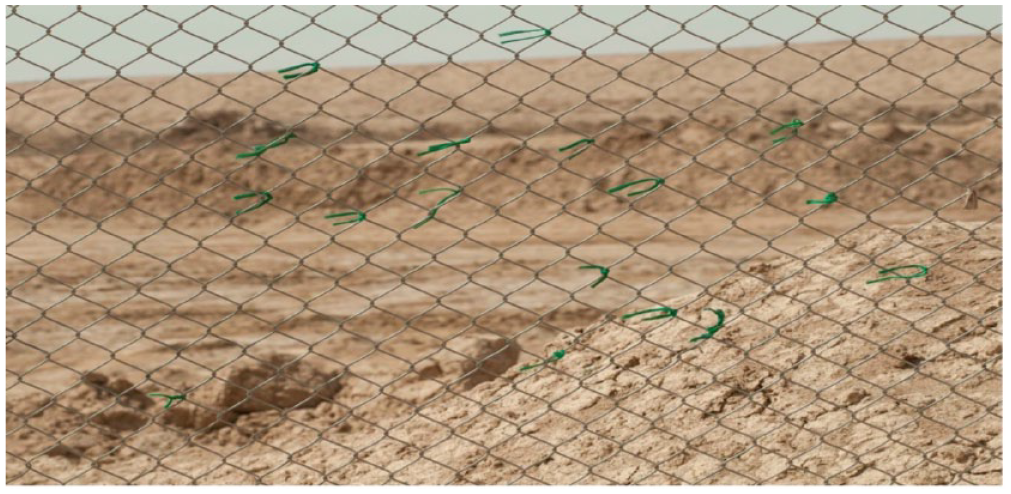
Visitors tied green strings on chainlinks (borderlines) in a manner practised at shrines, where pilgrims tie a string as a covenant between themselves and the ‘holy’ figure buried in the shrine.
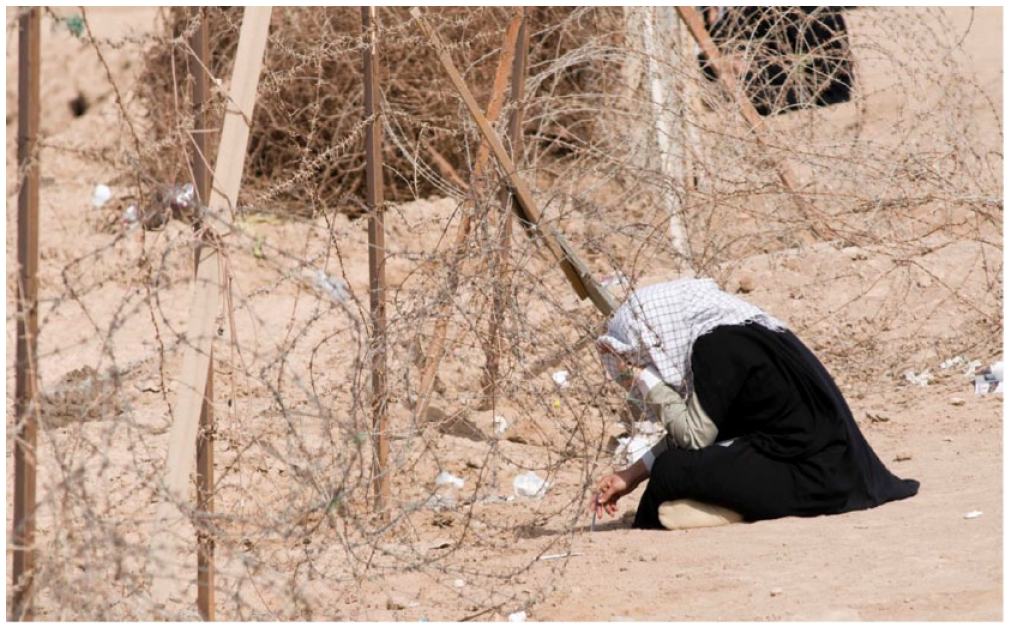
Some visitors treat barbwires as holy sites that remind them of stories that they have heard about the combatants. They do so despite the presence of a shrine dedicated to unidentified martyrs just a few metres away from the fences.
The memory machine proceeds not only because of the state sponsorship and the bureaucracy of martyrdom which I explained earlier through the history of the development of some Iranian propaganda institutions. It is perpetuated and continues to proceed unhindered because it is also integrated into the Iranian revolutionary youth’s civil religion via their perceptions of the culture of martyrdom and their social-religious imaginaries.
Mnemonic subjectivities, memories and civil religion
The Iranian state and its military apparatus used the ‘shrine protection narrative’ against ISIS to justify Iran’s military presence in Syria and Iraq (Isakhan, 2018). The narrative claims that Iranian forces are mobilized to defend Shia holy shrines and assist their regional brethren in Iraq and Syria. But although the shrine protection narrative called for fighters to defend Shia Islam and its associated holy figures, many of the volunteer combatants I interviewed did not invoke this popular narrative in Iran to justify their decision to volunteer and enlist. Instead, they either upheld the idea of defending the nation and its people or thought about the war in Syria by mentioning the Iran–Iraq War. For instance, Hadi passionately told me: This nation, these beautiful Islamic cultural heritages, all the celebrations and laughter that we have together would not be possible if some men did not offer their lives. I am here because of them, and I am going to fight for them. (Fieldnotes, 2017)
Hadi, aged 27 years, was an avid reader of war memoirs. He worked for a small private company that often received IT security consultancy contracts from the engineering division of the Revolutionary Guard. Codes, computers and Hollywood TV series were his life. During our interview, he was adamant to make me understand how martyrdom works and why he volunteered to fight alongside the Iranian Revolutionary Guard in Iraq. Hadi and many other young men I interviewed revered the memories of the Iran–Iraq War and martyrs they had read about and upheld them as their frame of reference. They saw a direct link between the martyr’s sacrifice and the nation’s security, unlike some of the Iran–Iraq War martyrs whose notion of martyrdom was devoid of national sentiments. This became even clearer when I began conducting group interviews of veterans who organized tours for visitors to memorial sites and younger combatants from the postwar generation who had seen action in Syria, Lebanon and Iraq. While my interlocutors were visiting holy shrines in Iraq, I was able to get five or six of them together. My simple question, ‘How would you describe a martyr?’ led to chaos, cross-talk, frowning and disagreement between the veterans who had experienced war in the 1980s and a postwar generation that had returned fresh from the front lines less than a month ago (fieldnotes 2017).
The veterans stressed selflessness and how a martyr enters into a direct transaction with the God regardless of rewards, Heaven or any consequences. 5 The veterans who I interviewed spoke of a mystical attraction to martyrdom, to which the younger combatants added, ‘still, there is a nation that must be protected and we as citizens are responsible for it’. Ahmed, a 65-year-old veteran who lost an eye in the Iran–Iraq War, smiled, affirming that ‘the God protects and blesses the nation. It is the very sacrality of martyrdom that encourages him to bestow his blessings’. The group remained silent for a while until finally, a younger combatant spoke up: ‘No, we are agents of the God and followers of martyrs’ past, so we dedicate ourselves to the country that houses the Shia nation. The rest is with the God, but first, we act’. The younger combatants agreed that martyrs of the Iran–Iraq War were their frame of reference and linked it to the nation and citizenhood. In other words, most of the revolutionary youth understood martyrdom beyond Shia Islam and religious framework, but rather they saw martyrdom in relation to Iran, their sense of the civil religion and obligations towards the country. Their political Islam was nationally oriented, and some of them even critiqued that the IRGC for omitting the name of the country in its name despite it is a section of Iranian armed forces.
Most revolutionary young men and women had a favourite martyr whom they adored or favourite war memoirs they had read over and over or gifted to a sweetheart. They took the stories from memoirs that inspired their lifestyles and wove them into their daily lives. For instance, every night around midnight, Mahdi, with whom I stayed during my fieldwork, went out to collect trash bags that careless neighbours left in the alley and took them to municipality trash pickup locations. He always took on this self-appointed task with a smile and never expressed anger towards his neighbours or other residents who were careless with their trash. Mahdi explained how Bakeri, a martyr who had been the mayor of one of Iran’s northern provinces, selflessly dedicated himself to the people and considered his civil duties as important as his combat missions. Mahdi, a 33-year-old dentist, was neither a member of IRGC nor affiliated with any political institutions linked to the Iranian state. He aligned his citizenhood with the memory of a martyr embedded in the civil religion instead of responding with a line from Islamic traditions and discourses.
6
Mahdi exemplifies many other revolutionary youths of the postwar generation who draw lifestyle-inspirations from memoirs to express civic responsibility and configure their citizenship beyond the doctrinal limits of religion. Adil, a 29-year-old baker, shifted his successful confectionary shop from the posh part of Isfahan to the city’s impoverished neighbourhoods because he read how a martyr carried sweets in his car to make people smile. Adil explained: Life is precarious even for those who are not religious. Life under sanctions is difficult for all Iranians, and we cannot force all Iranians into mosques, but I can make their lives better with bigger smiles because they are my people; they are my Iranians. He stressed ‘off course; I take my political responsibility seriously. I believe in the AK-47 in one hand and shirini (sweets) in the other hand’. (Fieldwork, 2018)
Today, Adil remains MIA (missing in action) since his body could not be found after the liberation of Idlib from ISIS forces, but his unit-mates still run his confectionary. They have changed the name of Adil’s shop to Bekhand Shahrvand (Smile Citizen), and some revolutionary young men buy sweets every Friday from them and distribute them among those in need ‘to make Adil happy’. The name change is another telling example to emphasize how martyrdom, religion and citizenship operate within their notion of civil religion and the memories of fallen men hold the civil religion in contemporary Iran.
Remembering with the memory machine, but not exactly
Up to this point, I have shown how war memories perpetuate a culture of martyrdom and link the revolutionary youth and the Iranian state through the civil religion. Also, I have stressed this civil religion is configured by the revolutionary youth, they contribute to it as mnemonic subjects who respond to the memory machine. The war memories are tinged with religion and imply religiosity, but they are not religious memories in the sense described by Halbwachs (1992) or Hervieu-Léger (2000). War memories do not inculcate the so-called religious memories that reinforce a ‘group defining itself, objectively and subjectively, as a [doctrinal] lineage of belief’ (Hervieu-Léger, 2000: 125.). Instead, they operate as a civil religion, which allows for more flexibility, individual appropriation and a sense of national belonging beyond the Islamic canon and discourses. The Islamic discourses, and by extension the memory machine, inspire the frames of remembrance but do not dictate them. However, memories, as the forces that hold civil religion together, provide space for social actors to perceive martyrdom differently and appropriate religiosity in their own ways.
I have shared my observations and conversations to depict the civil religion as a realm where citizenship is interwoven with remembrance, especially in places where remembering is the measure of religiosity, revolutionary commitment and civil responsibility by extension. However, this does not mean the revolutionary youth comply absolutely with the memory machine and the memories that it perpetuates. At first glance, the civil religion and memories may suggest compliance and adherence to memory scripts like that of Captain Vahid Zamaninia. But deconstructing and unpacking this compliance explain how social actors, or in this case revolutionary youth, apply their own individuated worldviews and take on the memory scripts. In other words, the cases of the revolutionary youth in Iran shows social actors under authoritarian conditions use the civil religion as a ‘wiggle room’ in which to exercise their agency and craft a citizenhood forged in a manner that pleases the Leviathan while still finding some degree of individual sovereignty for themselves. This is possible only because memories, remembering and mnemonic acts hold the civil religion and turn it into a mode of relating and crafting political positions under authoritarian regimes and theocracies. As a final note, I ground my ideas through conversations with Ali and Maryam:
Their engagement ceremony took place at a martyrs’ memorial site during a pilgrimage tour of former combat zones, and they subsequently arranged to hold their wedding at the martyrs’ burial grounds in Tehran. The couple had fallen in love at a book festival organized for and dedicated to war memoirs by Setad. They simultaneously asked a bookseller at the festival for the last remaining volume of a memoir. The bookseller suggested they narrate their favourite memories from the war memoirs so he could decide who deserved the book. This became the beginning of their courtship, which mainly happened in the course of demonstrations, memoir reading clubs and pilgrimage to former combat zones. The war memoirs brought them together, and they asserted that ‘martyrs facilitated’ their union. After a few months of interviews and hanging out, I realized they did not actually prefer to organize their ceremonies at memorial sites or burial grounds. Instead, they resorted to these options because they could not afford a marriage hall big enough to accommodate all their guests. ‘I am dedicated to martyrs’, Maryam said, ‘but I like some part of my life to remain for myself . . . we could not afford it, and so we opted for a wedding among martyrs’. Then she shyly said, ‘I am ashamed that everyone thinks we did it out of devotion, and they gave us so many compliments; I even received a commendation at work because I lived the life of a revolutionary’. Ali and Maryam were avid readers of memoirs, but both agreed that
We need to see how martyrs’ lives guide us. We can follow them . . . but we are in a different geopolitical era. Not everything is about Islam nowadays – we need to think about all Iranians, even those who don’t believe in political Islam . . . Unfortunately, the Iranian state does not understand this well, so we need to become strategic. We follow martyrs, but we don’t ‘follow’ martyrs. Do you get me?
Following the memory machine is not about blind compliance with martyrs, the culture of martyrdom and the memory script. Instead, I have shown that following the memory machine is an agentive compliance that the revolutionary youth have crafted to better negotiate with the state and subtly resist it by configuring the civil religion. How revolutionary youth configure the civil religion offers a noteworthy perspective on the role of memory, remembering and mnemonic practices in postwar societies, formation of religiosity and operations of the citizenhood in authoritarian and theocratic contexts. Civil religion is an incoherent and inchoate domain configured by mnemonic subjects and citizenry to find ways of individuation, positioning themselves versus the state without losing their grasp on either religion or their individual autonomy. Therefore, following and tracing memory as civil religion highlights the political undertone of piety and how citizenry and state are linked not though religious discourses such as ‘political Islam’ but memories that inspires citizenhood.
Footnotes

Notes
Author biography
Younes Saramifar is a cultural anthropologist and ethnographer working along historians in the Faculty of Humanities at Vrije Universiteit Amsterdam. He is an interdisciplinary scholar working on political violence, hope, piety and ideas of history through approaches of material religion, postcolonial thinking and speculative realism. The Middle East and the transnational Shia network at large are his research areas. He recently has published Sontag and the Image Machine in Iran in the edited volume Philosophy on Fieldwork.