




Abstract
By adopting the idea of points of memory, this article engages with oral history interviews of former child and youth internees of Finland, most of them children of German fathers and Finnish mothers. The article analyzes how points of memory emerge and performatively operate in reminiscing by focusing on personal accounts that revolve around material objects. In particular, points of memory will be analyzed in what follows by applying the concept of poetics, understood here as a juxtaposition of textual units that gives rise to emergent meanings. What is more, these personal accounts will be examined in relation to collective and public internment memory. Accordingly, the article aims at illustrating these accounts as (1) instances of (moral) rhetoric through which interviewees perform various social and political acts (e.g. claim accountability or retrospective justice) and (2) means in the production and transmission of memory.
In the beginning of the 2000s, a pink paper dress functioned as the trigger for the journalist Mikko Määttälä to start investigating the internment of German civilians in Finland between 1944 and 1946. Impressed by a dress which a mother made for her daughter at the internment camp, and bewildered by the historical event of the internment behind the story of the dress, Määttälä decided to direct a documentary film on the subject. Määttälä explained to me the exact moment of coming across the dress and becoming aware of the internment:
Gunvor began to tell me that she had been at the internment camp after the war. And then I remember very clearly, it is also written in here [pointing to the book he wrote], when she told me that she noticed that I was interested in the topic. So she went to the room adjacent to the dining room and came back with a kind of little girl’s dress made out of crepe paper. […] Being a TV reporter, the film started to roll in my head, and I thought that there definitely was the topic of a story here. When it comes to history, I am a very curious guy. And it started to interest me a lot. And after thinking about the topic and after investigating the internment of Germans, Finnish Germans, I offered the topic for the Silminnäkijä (“Eyewitness”) program on TV2. (4/21/2017)
In 2003, the Finnish public service broadcasting company Yle broadcast a documentary film by Määttälä entitled Vankileirien Suomi (“The Finland of Prison Camps”). This film not only brought the event of internment to the historical consciousness of Finns, but it also initiated a memory process that was related to it. Before the documentary film, the event had been almost totally absent from public discussion in Finland, including academic research. The memory process initiated by the film included a popular history book by Määttälä, a research project of the National Archives of Finland focusing on the official records of internment, newspaper articles, and actual monetary compensation in 2014 for child and youth internees.
My interview with Mikko Määttälä was not, however, the first time I had heard about the pink paper dress (Figure 1). I met its owner, Gunvor Brettschneider, in March 2015 when I interviewed her about her internment memories. During the interview she told me how her mother had made the dress at the camp. Gunvor was 10 years old when she and her family were interned for almost one and a half years due to their German citizenship. After my interview with Gunvor, I heard the story of the paper dress time and time again. First of all, the dress is presented in the documentary film. Second, the story of how the dress functioned as an initial starting point for becoming aware of internments frames Määttälä’s popular history book on the topic, Vihollisina vangitut (“Imprisoned as Enemies”; 2006). Both Määttälä and Brettschneider also spontaneously mentioned the dress when I interviewed them. Indeed, the pink paper dress is a testimonial object that not only speaks of the historical event of internments, but also of the story of becoming aware of the event in the first place. In personal narration, multiple temporal layers and events are attached to the dress, paradigmatically linking together and giving rise to emergent meanings through this reflexive coordination.

The pink paper dress (Photo: Ulla Savolainen).
Indeed, the pink paper dress is a material vestige of the past that functions as a memory container and a means for creating and transmitting both personal and collective memory. Oral and written narratives dealing with personal memories appear in relation to these kinds of tangible reference points that can be called points of memory. According to Hirsch and Spitzer (2006), points of memory are testimonial objects inherited from the past. As concrete aspects of the past in the present, points of memory are fundamentally arguments about memory insofar as they participate in and comment on the temporal and spatial transmission of memory. In other words, points of memory are carriers of memory while simultaneously manifesting the process of its transmission (Hirsch and Spitzer, 2006: 354–355, 358).
By adopting the idea of points of memory (Hirsch and Spitzer, 2006) as a jumping-off point, this article engages with oral history interviews of former child and youth internees of Finland, most of them children of German fathers and Finnish mothers. I will analyze how points of memory emerge and performatively operate in reminiscing by focusing on personal accounts that revolve around material objects and belongings. In particular, points of memory will be analyzed in what follows by applying the concept of poetics, understood here as a juxtaposition of textual units that gives rise to emergent meanings. What is more, these personal accounts will be examined in relation to the wider collective and public internment memory. Accordingly, my aim is to illustrate these accounts as (1) instances of (moral) rhetoric through which interviewees perform various social and political acts (e.g. claim accountability or retrospective justice) and (2) means in the production and transmission of memory.
Based on my analysis, I suggest that points of memory operate in personal narration as linkages between personal and collective memory (see also Hirsch and Spitzer, 2006). In the case of oral histories of former internees in Finland, this means that personal narratives of material objects function as a means of reflecting on (and possibly also overcoming) the disrupted transmission of memory. What is more, I suggest that by reminiscing on material objects, both lost and present, former internees demand justice for themselves with regard to official acknowledgment of their experiences related to past injustices, and make accountability claims with respect to those responsible for the internments. By combining the approaches of cultural memory studies, oral history research, folkloristics, and linguistic anthropology, my article aims at opening new directions in the critical interdisciplinary discussion on the intersections between collective and personal memory in general and on accountability claims and (retrospective) justice in personal narration in particular.
The data of my research consist of 26 oral history interviews 1 of former child and youth internees who were interned in Finland in 1944–1946. The oral history interviews, as well as related ethnographic work, were conducted in Finland and in Germany during 2015–2016. All the interviewees spoke fluent Finnish, which served as the interview language. 2 Interviewees were born between 1926 and 1943, which means that they were between 1 and 18 years of age when the internment began. In terms of gender, 14 of the interviewees were women and 12 of them were men. In addition to the interviews with former internees, I interviewed the journalist Mikko Määttälä, author of a documentary film (2003) and a popular history book (2011) concerning the internment, and analyzed media discussions on the internments and the compensation law that came into effect in Finland in 2014.
Internments in Finland
As is well known, the twentieth century was an age of forced labor and concentration camps, mass internments, and deportations of citizens and foreigners (Robertson, 2004: 130; on terminology, see Schiffrin, 2001). The background of the internment of German and Hungarian citizens in Finland includes the two wars between Finland and the Soviet Union, the Winter War (1939–1940) and the Continuation War (1941–1944), both of which Finland lost. In the latter, Finland was officially an unallied co-belligerent of Nazi Germany, as that country significantly assisted Finland in the war efforts. Indeed, in 1941–1944 Finland was in many ways totally dependent on German military and economic support. Help from Germany notwithstanding, in the summer of 1944 Finland could no longer successfully continue the war against the Soviet Union. Thus, Finland ended up suing for peace. The conditions of the Moscow Armistice agreement between Finland, the Soviet Union, and the United Kingdom were heavy for Finland. In addition to the cession of areas in Eastern Finland and Lapland to the Soviet Union, Finland had to pay extensive reparations and expel the German forces staying in the northern parts of Finland at that time. German troops refused to exit Finland voluntarily, which led to the Lapland War between Finland and Germany from September 1944 to April 1945 (see Kivimäki, 2012: 483–484, 492–492; Kinnunen and Kivimäki, 2012; Vehviläinen, 2002).
In addition, the armistice agreement obliged Finland to intern all of the German and Hungarian citizens, also civilians, who were living or staying in Finland, which led to the internment of 470 persons between 1944 and 1946. During the first stage, the internment applied to men and adults only. After a month, however, children, Finnish-born wives of German men, and elderly and sick persons were also interned. Most of the internees were harmless civilians, without any real connection to Nazi Germany or the German army, apart from their nationalities. Many of them were second- or even third-generation Germans living in Finland or their Finnish-born wives, who had dual citizenship or who had had to give up their Finnish citizenship altogether in marriage. According to the legislation at that time, the children of these couples were automatically given citizenship according to their fathers’ nationality (Jensen-Eriksen, 2009: 24–41, 2010b: 133–134). In addition, the agreement demanded that the Finnish government freeze all German and Hungarian assets in Finland. In order to make certain that these would not be taken abroad or otherwise lost, the Custodian of Foreign Property took control of the properties of Germans in October 1944. Crucially, this seizure of assets not only applied to the German state’s properties in Finland but also to the assets of private persons (Jensen-Eriksen, 2010a).
The internment camps (eight camps altogether) were located mostly in the southern part of Finland in former hospitals, sanatoriums, boarding schools, and so forth. The camps were administered by Valpo the Finnish security police. Conditions in the Finnish camps were relatively humane insofar as family members were not separated from each other, and the inmates were not tortured or intentionally mistreated. Instead, they were given food and they were able to receive medical care. However, due to a shortage during wartime, the quality of food was poor (see Jensen-Eriksen, 2009, 2010b; Uhlenius, 2010). Most of the internees were freed in March 1946.
After the liberation, the internment was not publicly discussed in Finnish society until 2003. Academic research on the topic was also nonexistent. In 2003, however, the Finnish public service broadcasting company Yle broadcast a documentary film by the journalist Mikko Määttälä entitled Vankileirien Suomi (“The Finland of Prison Camps”). This film revealed that contrary to the prevailing knowledge, it was Finnish officials who made the decision to intern the children and Finnish-born women, not the Soviet Union. This claim was later confirmed by historian Niklas Jensen-Eriksen (Jensen-Eriksen, 2009). According to my interviewees, this information came as a shock to the former internees. Until then, they had believed that the Finnish officials had no choice but to also intern Finnish-born women and children. Now former internees learned that instead of the Soviet Union, it was their own country, Finland, that had decided to incarcerate them. Mikko Määttälä’s documentary started a process of emergence of public awareness regarding the internment, including a research project on the topic (Jensen-Eriksen, 2009; Uhlenius, 2010; Westerlund, 2008), a nonfiction book (Määttälä, 2011), media discussions, and eventually a law of compensation passed on 1 September 2014 (on the reception of the law, see Savolainen, 2018). Indeed, the internment memory was created in the dynamic interplay between public and personal memory work (Savolainen, 2017a).
Points and poetics of memory
Inspired by Roland Barthes’s concept of punctum, memory scholars Marianna Hirsch and Leo Spitzer (2006) use the idea of a point of memory to describe and analyze testimonial objects inherited from the concentration camps as intersections between the past and the present, places and times, and personal and cultural memory. Being sharp, small, detailed, and piercing by their bearing, points of memory puncture temporal layers and transmit the past in the present in the form of material traces (Hirsch and Spitzer, 2006: 358; see also Connerton, 1989: 13; Siikala and Siikala, 2005: 119–120). As also noted in folkloristics, anthropology, and narrative research, oral and written narratives dealing with memories materialize in relation to multiple tangible reference points that can be called “points of memory” or “sites of memory.” These tangible marks can be objects or documents, but also named places and dates. They are traces, metonymical evidences of the past, and as such they confirm the continua and links between the past and the present (e.g. Kuusisto-Arponen and Savolainen, 2016; Siikala and Siikala, 2005; Tonkin, 1992; Glassie, 1982). They prop up and maintain memory, but their significance is dependent on the narratives and memories connected to them (Halbwachs, 1992: 202–205).
In oral and written reminiscing, points of memory (e.g. testimonial objects, sources, concrete places) often appear as spots of temporal stratification, as breakages in the syntagmatic continuity of the narrative, as deviations from the plot, as temporal leaps, and as associations with other memories related to different events and times. In narration, points of memory thus associatively bind together memories from several different occasions and times. These associations are based on paradigmatic logic, which means that even though they belong to different times and events, they are related to the same particular point of memory, which is why they share a connection and belong together (Kuusisto-Arponen and Savolainen, 2016; see also Jakobson, 1987: 97–100, 109–114; Siikala and Siikala, 2005: 112–117; Portelli, 1997: 101; Hastrup, 1987: 262–263).
Hastings and Manning (2004) note how social and cultural sciences have tended to predominantly interpret language use as either referential (referring to objects and events which are exterior with respect to the speaker) or as expressive (referring to the speaker’s self or identity). This tendency can be detected in oral history research as well, where interview speech is typically interpreted either as (1) information about the past, like oral histories or (2) information about the speaker’s subjective identity. Although these functions of language use are naturally also central in oral history accounts, I would suggest that they not be regarded as the only ones. Instead, in order to address what people actually do in reminiscing in the context of an oral history interview, we need to pay attention to other functions of language use as well.
In this regard, I would argue that poetics is central in any analysis regarding the organization of points of memory in personal narrative. In folkloristics and linguistic anthropology, poetics refers to the functional principle that underlies (verbal) expressive works and is inherently interlinked with a set of social values or cultural connotations (Shuman and Hasan-Rokem, 2012: 56). Poetics is fundamentally performative in the sense of reflexively organizing the textual units of expression within a textual whole as mutually indexical. Poetics thus refers to juxtaposition of textual units, which results in emergent meanings (Lempert and Fleming, 2014; Lindfors, 2017: 172; Shuman and Hasan-Rokem, 2012: 70; see also Jakobson, 1987: 71–93). In other words, poetics refers to performative action (in the form of persuasion, for example), not (only) to “mere” esthetics ( Lempert and Fleming, 2014: 487; Herzfeld, 1997: 142–145; on terminology, see Lindfors, 2017: 170–171). 3 Analysis of the poetic dimensions of oral history accounts means widening the focus of inquiry from “what is said” (either about history or identity) to “what is done” in reminiscing (see also Hastings and Manning, 2004). Methodologically, the notion of poetics expands the focus of analysis from representations toward the actions and practices of agents, simultaneously promoting the understanding of the role of individuals in processes of cultural and collective memory.
In the two main research fields focusing on social and cultural aspects of memory, (cultural) memory studies and oral history research, actional or rhetorical dimensions of reminiscing and memory have been somewhat disregarded (see, however, Hajek, 2013; Immler, 2012). Despite the vast body of research in cultural memory studies on the roles and functions of tangible objects and locations in memory processes (e.g. Freeman et al., 2016), studies focusing on the cultural, political, and moral dynamics of these vestiges in grassroots-level memory work and textual practices are still scarce (see, however, Kuusisto-Arponen and Savolainen, 2016). Cultural memory studies have also investigated the dynamic, processual, transnational, mediated, and traveling nature of cultural memory (Bond and Rapson, 2014; De Cesari and Rigney, 2014; Erll, 2011; Assmann and Conrad, 2010; Erll and Rigney, 2009; Rothberg, 2009) to the extent that often “products” of memory or “memory” itself, instead of individuals, have been granted the status of an agent.
While another field centered on social and cultural memory processes—namely, oral history research—has indeed focused on individuals’ memories and reminiscing, it has primarily concerned itself with the representative dimensions of reminiscing (in the sense of emphasizing history or identity), by the same token disregarding many other functions of personal accounts (see also Hastings and Manning, 2004) and downplaying cultural frames and patterns (such as expressive genres) that guide representations of personal experiences and link them together with the cultural (see, however, Portelli, 1997; Savolainen, 2017a, 2017b).
My point here is not to dismiss the achievements of memory studies or oral history research, but instead to point out the need to pay attention to the expressive and rhetorical agency of individuals in processes of cultural memory. After all, testimonies, narratives, and the life stories of individuals have—as representations of personal, cultural, or collective memory—been in the nexus of both oral history research and memory studies. Thus, sidestepping the expressive, rhetorical, and actional dimensions of these genres of personal narrative seems like too great a loss. Despite similar interests, the connections between these two research fields are also relatively weak (Hamilton and Shopes, 2008; Heimo, 2016), which hinders mutually productive interdisciplinary discoveries. My aim in this article is to continue filling this gap by focusing on the poetics of points of memory produced in the context of an oral history interview. By doing so, I wish to open new perspectives onto the role of individuals in the processes of cultural memory.
The lost summer home
Former internees’ memories of material objects are often memories of lost property, memories of assets that were confiscated from them and handed over to the Soviet Union as part of Germany’s war reparations. In this chapter, I will explore memories of lost property by focusing in-depth on one chosen interview. I have chosen this particular interview as an example, as it reflects many of the central issues related to memories of confiscated properties in my research data. In order to contextualize my forthcoming analysis, I will briefly outline the life story of this particular interviewee. She was born to German parents in Finland who migrated to Finland from Germany at the beginning of the 1920s due to business reasons. The home language of my interviewee’s childhood family was German, and she and her siblings studied at the German school in Helsinki, the capital of Finland. My interviewee was 18 years old when her internment began. After the internment, she completed her studies and soon thereafter she met her future husband and had two children. As my interviewee’s husband was of Finnish-Swedish background, Swedish became the home language of their family although they also used and spoke fluent Finnish. My interviewee made a decision not to speak German, her mother tongue, with her children.
The theme of loss runs through this particular account in many ways. In the case of the interviewee’s life narrative (at least the one she constructs in the interview), the event of the internment operates as a fold in her life story. It separates life before and after the internment, periods which are depicted as being very different. In a sense, this overarching duality between “before” and “after” functions as the most abstract poetic juxtaposition in her interview narrative. The interviewee articulates comprehensive change through two thematic domains that recur throughout the interview. First, she discusses the loss of family assets, namely, their summer place, and second, she reflects on her difficult relationship with her German background and identity, which the war transformed into a negative and even shameful aspect of herself. This change indeed resulted from the war, but in her memory it is articulated through interlacing topics related to the loss of family properties and her experience of the changed social status of German nationals in Finnish society.
Before the actual interview, my interviewee began to tell me about her summer home in the archipelago near Helsinki, where she and her relatives still visit frequently. While telling me about this dear summer home, she continuously referred to the family’s former summer home, which was located nearby on a small island. She told me that her family had lost this place when the properties of Germans were confiscated and handed over to the Soviet Union after the internments. Later, this small island was passed on to the communist youth organization, which started using it for leisure purposes. Eventually the island became the private property of a wealthy family from Helsinki. In the meantime, my interviewee’s family had bought a new summer home within sight of the lost one.
When listening to her account, in which she continuously referred to the lost summer home, I began to understand a bit about what constituted the significance of this place for her. It represented the time before her life comprehensively changed. Indeed, when describing the time before the internment, the interviewee referred in a nostalgic if bittersweet manner to her happy childhood at the lost summer home. Interestingly, even though the lost place is unattainable, because it does not belong to the family anymore and she has not been able to visit there ever since, it has been very much present in her life. Being within sight, the lost summer home has been a concrete reminder of what the family lost and what should—but cannot—be transferred to the next generation. As such, it is a point of memory painfully exhibiting loss and the disrupted transmission of memory. This is illustrated in the next quote:
So, did you often go near there?
Well, I have visited there during winter when there was ice, so it was possible to go there by kicksled. I showed these islets to my eldest son and he exclaimed that if he had money, he would buy it back! We used to swim there a lot, so yes, we did. Now this place, where we are now, where we have [the new summer home], my sister has already transferred that to my sons and it is very nearby. You just go rowing, and you can see it. (1/21/2016)
The summer place, which is both far and near, lost and very much present, is a point of memory in her narrative. Memories related to different periods of life are gathered around the lost place, which has become a symbol of all the consequences of the internment for her life and for the transmission of family memory and heritage. Thus, as a point of memory the lost summer place also manifests the temporal incongruity identified by Barthes as a punctum of time (see Barthes, 1981; Hirsch and Spitzer, 2006: 266). Simultaneously, the lost summer home represents both (1) the era of childhood, intact identity, and future possibilities and (2) the period of adulthood, loss, disrupted memory transmission, and convoluted identity. In her narration, the event of internment charges the summer place with interpenetrating double chronotopes (i.e. constellations of time, space, and personhood; see Agha, 2007; Bakhtin, 1981). That is, in the realm of memory, these chronotopes are autonomous with regard to temporal sequentiality, and in the realm of narrative, they function as poetically performative by mutually indexing each other.
It is also clear that the thematic domains of the lost summer place and Germanness are linked together in the interview account in many ways. In addition to concrete connections, namely, the fact that German citizenship was the actual reason for losing one’s property, these domains are associated together in more abstract levels of experience. Indeed, for the interviewee the lost summer place is not only associated with her being German but it also manifests her sorrow over the renunciation of her German identity. In her narration, the loss of the summer place parallels the change of self-understanding and self-representation, withdrawal from Germanness, and even turning against it. For her, this retreat not only applied to the ways in which she represented herself to others, but it also meant changing herself on a more comprehensive level: But after that, life was altogether different. Totally different. I felt myself very lonely, because schoolmates who were the same age… It was like, it [the life that was before] did not exist anymore. So that I had to change myself, like entirely different, to leave that… […] I got a sort of feeling of guilt, that being German was something bad. But my sister was entirely different. She was a very strong person. [In Swedish she said:] “What does this have to do with us?” So she was who she was. Yes, but I was totally different in the sense that I turned against what was German, which my sister did not do. (1/21/2016)
Interestingly, in her account, both of these losses, the loss of the summer place and the loss of her German identity, intertwine with the character of the interviewee’s sister who had recently passed away (at the time of the interview). The interviewee relates how her sister declined to bear responsibility, guilt, or blame for the crimes of Nazi Germany. Furthermore, her sister refused to give up her German identity and change herself into something else. By emphasizing how strong her sister was, the interviewee sets her sister’s strong nature against her own character, which is consequently depicted as weak. By underlining her sister’s strength in terms of holding on to her identity, my interviewee also insinuates that for her, the loss of German identity was not only personal but a transgenerational loss. The act of “changing oneself into something entirely different” represents the interviewee’s sense of incapability to transmit to the next generation memory and heritage related to Germanness. In her account, the sister’s character also acquires a crucial role of mediator in terms of transmission of family memory and identity, as she, unlike the interviewee herself, adhered to her German identity.
What is especially relevant here is that the interviewee also tells how her sister, who did not marry or have children of her own, transferred her own share of the new summer place, the one located within eyesight of the lost one, to her sons. When interpreted in relation to the interview account as a whole, it is clear that by telling about this act of transferring the summer place to the next generation, the interviewee grants her sister a key role in the transmission of German identity to the next generation. In narration, the co-occurrence between the thematic domains of the summer place and the German identity creates a paradigmatic link, which also enables meaning to transfer between them. By operating as a node between intact childhood and more troubled adulthood (between before and after), in her interview narrative, the summer home is a point of memory that poetically articulates issues related to difficult German identity.
In this particular life story, the thematic domains of the summer place and German identity expand through coordination and juxtaposition to denote not only the sorrow over concrete material loss and change of identity, but also the grief over the breach of the transgenerational transmission of memory and heritage. In blaming herself for giving up her Germanness, she shifts the liability on the matter elsewhere: It was quite a change. You had to like change yourself mentally, when Germany had been strong before the Second World War, and English was not so strong as German [language], also at school. And there was this change that good friends, many were gone from the German school. Many families had gone back to Germany, and then again, others, my dear friends, moved to Sweden. […] And those families that had been part of that, my father was not in the party at all, because it was not… He was against this. I still remember, when we listened to Hitler’s speeches, he would say [in German she says:] “That screamer!” (1/21/2016)
The interviewee argues that due to the change in the Finnish political and cultural atmosphere, she had no other choice but to get rid of her signs of Germanness. She argues that even though her family was against Hitler, they still had to be ashamed of their Germanness and thus hide it. A change in the post-war political atmosphere in Finland not only negatively affected the social status of Germans, irrespective of their political stands, it also led to the internment of Germans and Hungarians and eventually resulted in the confiscation of German assets. Indeed, in the interview account, the postwar change in relation to attitudes around Germany and Germans is blended together with the loss of property, namely, the summer home, the point of memory. Considering these connections, the interviewee’s statement related to her father’s antipathy toward Hitler’s Germany functions also as an accountability claim vis-à-vis those who considered her family as representing the guilty party of war. In other words, the interviewee is, first, demanding acknowledgment of her (and her family’s) moral integrity with respect to the war crimes of the Third Reich. Second, she is asking for redemption with regard to the breach of memory transmission. In the interviewee’s narrative, the summer home as a point of memory thus poetically articulates and intimately intertwines with claims of retrospective justice and accountability. This illustrates performative efficacy of points of memory and poetics.
Children’s war reparations
In contrast with the interview analyzed in-depth above, accounts of lost property as points of memory often become more entangled with concrete means of compensation of past injustice. In the case of internment in Finland, demanding justice in the form of compensation is linked to the emergence of the public memory. As noted above, Mikko Määttälä’s documentary film (2003) triggered the memory process around the internment by framing the event as an injustice. In terms of the emergence of memory, the awareness of injustice played a key role. Further still, information about the active role of Finnish officials in the internment caused moral shock (see Jasper, 1998; Jasper and Poulsen, 1995) that mobilized former internees to demand compensation from the Finnish government. After the documentary, the former internees organized themselves and appointed an unofficial committee, which started to campaign for the law of compensation. With regard to the compensation itself, the former internees had three demands. First, they demanded symbolic monetary compensation; second, they asked for an apology from the Finnish state; and third, they requested to be included in the (medical/physical) rehabilitation program for war veterans. Finally, after approximately 10 years of lobbying and campaigning, compensatory legislation was enacted on 1 September 2014. The law, however, fulfilled only one of the internees’ demands. According to the law, persons who were interned as minors were entitled to monetary compensation of 3000 euros, or 1500 euros if the internment lasted for less than 1 month (Finlex Data Bank, 2014; State Treasury, 2014). Approximately 50 persons were entitled to this compensation in 2014 (on the reception of the law, see Savolainen, 2018).
Interestingly, internees’ demands for the law did not include full compensation of the assets that were handed over to the Soviet Union. Yet, according to my research data, internees have not forgotten that their families and also they themselves, as children, lost their properties as part of Nazi Germany’s war reparations to the Soviet Union. By contrast, many of my interviewees discuss in detail what they had lost and what this loss means to them. Sometimes the interviewees speak of their right to compensation by directly citing their lost property, but more often the link between lost property and compensation is made through implicit comparisons. Indeed, instead of making explicit demands for full compensation for their material losses, by underlining what they had lost they implicitly express their dissatisfaction with the law. Thus, the accounts of lost property that are positioned in parallel with the accounts of dissatisfaction with the law underline the feeling that former internees still consider that the state owes them something, at least morally, as the next example demonstrates: The thing that felt bad later, of course, and still feels bad, of course, was that all of the property was taken. For us children it meant that even all of our toys were taken away, the dolls and the puzzles. And, of course, maybe not the money, but also that all of the accounts were emptied. Well, children did not have so much. Afterwards I have thought that it indeed was a pity that all of the money was taken away, the children’s money […] Now afterwards I felt, when it came out that it was Finland after all that did this decision to our mothers and us children… I found it so unjust then. (3/04/2015)
According to my data, one way to seek accountability and justice in personal narration is by bringing forward the more-than-personal quality of the loss. When discussing their lost properties, my interviewees appeal to and sympathize often with the experiences of their parents related to the post-internment time, when they had lost everything and had to start from nothing. The next example illustrates this clearly: For me this, when I started to campaign for this compensation, the compensation was not maybe, or is not, the most important. Overall, it is that the state gives us an acknowledgement that it was like a violation of human rights. For me, what was important was that I thought of my mother’s destiny, a mother who had never visited Germany, who did not speak German, and who had, however, taken care of the home and three children, and who had worked, and who was a regular Finnish woman. Who then lost… First, who was interned one and a half years, and who after that also lost everything. […] And they [the parents] never really got back what we had before wars or before the internment. It was a difficult time in Finland. And after […] you had been isolated for one and a half years and you had to start all over from nothing, there was no money, no clothes, nothing. And there was no job, no home. […] Mother and father, father was almost 47 years then, mother was a bit older as she had already turned 50. So at that age, to start to build a new life in a post-war society… Our parents did not reach that [former standard of life], because the money went to the education of us children. And at that time, there was no societal support. […] Afterwards, I have had the feeling that it [the compensation] was specifically for mother and father. (3/04/2015)
While the interviewee expresses her dissatisfaction over the contents of the compensation law in many ways during the interview, here she claims that the main reason for her struggle over the compensation law was not about receiving the actual concrete (monetary) compensation. By contrast, it was to redeem her mother. This incongruence stems from the perceived moral banality of demands of material compensation in contrast with more abstract strivings for justice. In relation to this, she justifies the injustice of the loss of property by relating her mother’s life story and by underlining her weak connections to Germany and German culture, her marriage aside. In other words, by appealing to her mother’s life story the interviewee extends what at first glance might seem to be a narrative of a meager personal loss to the realm of the more-than-personal. As Shuman (2005) has noted, despite the cultural weight and emphasis given for the firsthand-experience on one hand, and for the objective distant knower on the other hand, stories gain their rhetorical efficacy and legitimacy also through the use of the personal to represent more-than-personal (pp. 3–4). In the case of the previous example, coming to encompass many generations, the affect of injustice is also emphasized.
These examples show that accounts of lost property often function as points of memory in personal narration. They poetically bind together events, topics, and notions related to different periods of life through paradigmatic association, including the notion of compensation. Often in personal narration, points of memory are also connected both to representations of personal experiences and to the realm of the more-than-personal (typically represented by generational chains), which thus become poetically paralleled. That is to say, personal experience of loss here comes to allegorically represent wider or more-than-personal conditions through poetic parallelism. In interview account, this process of semiosis can be pinpointed to the accounts of lost property as points of memory. Furthermore, this notion calls for interpreting points of memory as performative claims of accountability and retrospective justice.
When it comes to accountability claims, however, in the case of internments in Finland the historical context mitigates the guilt of Finnish officials insofar as the implementation of the internment was characterized and fueled by fear of Soviet occupation if Finland did not properly follow the conditions of the peace agreement. Due to these mitigating factors, which may raise a question around the sense of compensation altogether, the confiscation of children’s belongings is an especially powerful topic in terms of making accountability claims and demanding retrospective justice and compensation. As children cannot at all be considered participants in war (let alone its guilty parties), at least not according to the prevailing understanding of human rights, the confiscation of children’s belongings represents an injustice that not only rhetorically underlines the victim position of the child internees but also makes those responsible for internments and confiscation of assets morally accountable. In modern Western culture, which places strong emphasis on victims’ testimonies—and confessional intimacy in general, for that matter (see Illouz, 2008; in arts, see Grobe, 2017; Lindfors, 2019)—the creation of this type of opposition authorizes former internees to share their experiences. Above all, it entitles them to claim concrete compensation of past injustice. Performing as points of memory, accounts of confiscated children’s property not only refer to past or present conditions, or reflect and express identities, they come to function primarily as moral support for speakers’ demands of justice. The significance of points of memory is that they mediate between personal and collective memory, between multiple temporal levels, as well as between the realms of the personal and the more-than-personal. Poetic patterning renders them mutually indexical so that they begin to express and amplify unspoken meanings.
Concluding remarks
Before concluding, I will return to the pink paper dress, discussed in the beginning of this article. Indeed, the pink paper dress not only operates as a material object that transmits memory, but its ambiguously striking physical presence yields itself to and facilitates claims of accountability and retrospective justice. First, being pink, decorative, and impractical, the dress indexes bourgeois bliss, which is often the correct term to characterize interviewees’ memories of their lifestyle before the internment, especially with respect to what they lost. Second, being made of paper, the dress also symbolizes the period after the major change caused by the internments and political turn, which is characterized by depression, dearth, scarcity, and unjust loss. These two dimensions are inseparable and poetically co-present in the very physical presence of the dress, thus enabling paradigmatic association and meaning transfer between them. When paralleled with the prior state of affluence and happiness, the unjustified loss is amplified. This poetic juxtaposition has performative power as it comes to operate as a platform for various social and political claims such as demands of justice.
This poetic pairing is also obvious in Gunvor Brettschneider’s interview account. Indeed, the first time she mentioned the dress to me in her interview was after she had told me about the poor conditions and scanty meals at the internment camp. In her reminiscing, scarcity and shortage, which characterize the time after the change, belong to the same paradigm as the dress, which also happens to embody the felicity of prior times. Most importantly, soon after associating the dress with her feelings of injustice caused by internment and loss of property, she implicitly justified and backed up her general claims regarding accountability, retrospective justice, and compensation. Määttälä also uses the dress in framing his own agenda of bringing the unknown event of internment out in the open, as well as his promotion of the public acknowledgment of the internees’ experiences. Hence, in these oral history accounts, the pink paper dress rhetorically functions as a point of memory through which interviewees perform various social and political acts, all the while promoting the creation and transmission of internment memory (Figure 2).
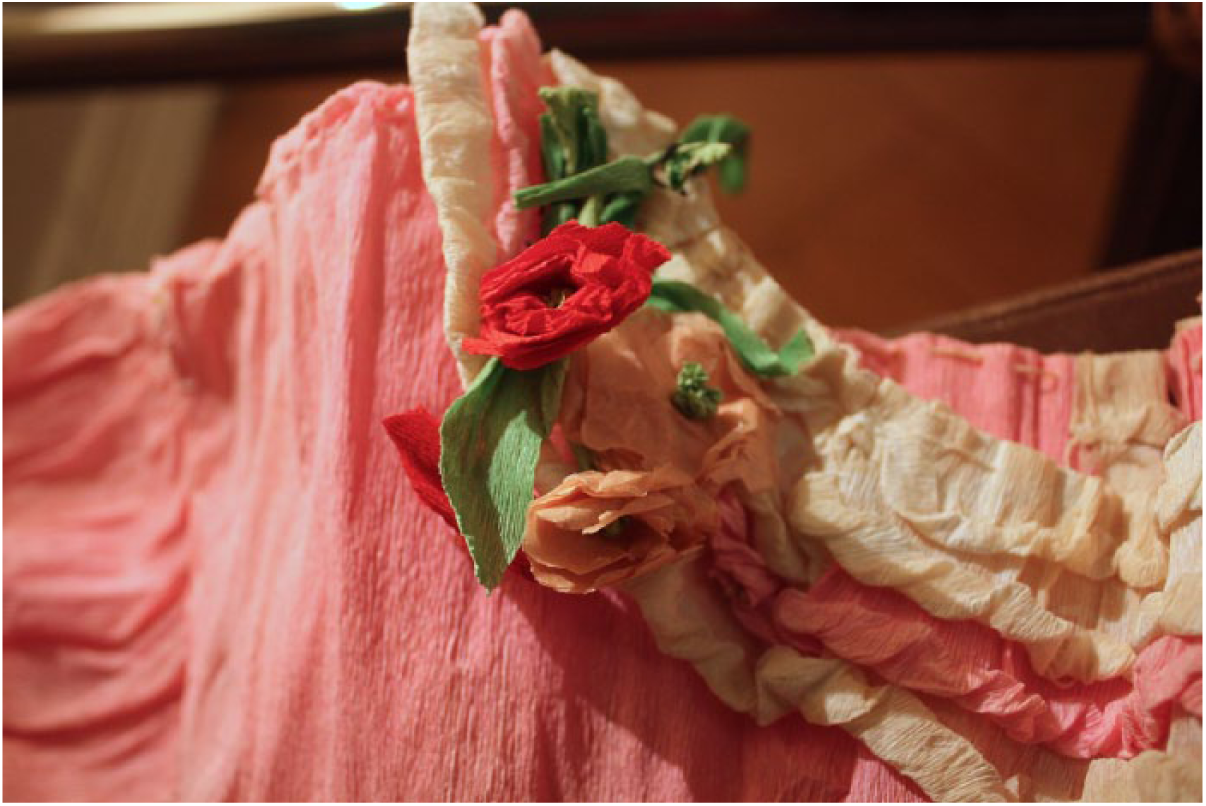
A detail of the pink paper dress (Photo: Ulla Savolainen).
In this article, I have explored how points of memory emerge and performatively operate in personal narration produced in the context of an oral history interview. In particular, I have examined personal accounts that focus on material objects and belongings as points of memory. These accounts were analyzed by applying the concept of poetics, conceived as a reflexive comparison of textual units that gives rise to emergent meanings and stands in relation to the wider collective and public internment memory. The aim of my article was to shed light on these accounts, first as instances of (moral) rhetoric through which interviewees carry out various social and political acts, such as making claims for accountability and retrospective justice, and second, as a means in the production and transmission of memory. My analysis shows that in the case of the oral histories of former internees in Finland, personal accounts of material vestiges function as means of reflecting on and also overcoming the interrupted memory transmission. Furthermore, my analysis indicates that by creating personal accounts of material objects, lost and present, former internees demand retrospective justice for themselves with regard to official acknowledgment of their experiences and make accountability claims with respect to those they consider responsible for, or guilty of, the internments.
By combining the approaches of cultural memory studies, oral history research, folkloristics, and linguistic anthropology, my article opens new paths for interdisciplinary discussion on the interrelationships between collective and personal memory in general and on accountability claims and (retrospective) justice in personal narration and reminiscing in particular. I claim that due to narrators’ aims to achieve social change, personal accounts produced in oral history interviews should not be interpreted primarily as referential descriptions of the past, the present, the world, or reflections of the speaker’s subjective identity. Thus, in this article I focused on the poetics and performativity of personal narration by analyzing the reflexive combinations of textual units conceived of as mutually indexical. As poetics is inherently entangled with performativity, analysis of the poetic dimension of personal accounts produced in the context of oral history interviews expands the focus from “what is said” (either about history or identity) to “what is done” (see also Lempert and Fleming, 2014; Hastings and Manning, 2004). I suggest that this shift has important methodological consequences for the study of oral histories and personal, collective, and cultural memory. Indeed, it widens the focus of analysis from representations (about history or subjective identity) toward the actions and practices of individuals (claiming accountability or retrospective justice). This change in focus, I believe, also promotes understanding of the role of individuals in processes of cultural and collective memory.
Footnotes
Declaration of conflicting interests
The author(s) declared no potential conflicts of interest with respect to the research, authorship, and/or publication of this article.
Funding
The author(s) disclosed receipt of the following financial support for the research, authorship, and/or publication of this article: I am grateful for the Academy of Finland projects SA 294292 and SA 308661 for funding my research. The research for this article has been conducted within the research project LIVINGMEMORIES—Living Together with Difficult Memories and Diverse Identities (ERA. Net Plus with Russia, EU FP7, the Academy of Finland).
Notes
Author biography
