




Abstract
Since the 2000s an alternative engagement with the communist past has emerged across media in Romania in the shape of a generational discourse, which negotiates a post-communist generational identity for individuals growing up in the 1970s–1980s. This article focuses on the online memory practices of this self-dubbed “latchkey generation” by investigating an emerging life writing genre—the Facebook generatiography—and its reliance on the archiving of communist memorabilia in the shape of photographed objects. How do generational frames of remembrance, members of a specific generation, and the sociotechnical affordances of Facebook pages intra-act to produce this genre? And what does it “do” in the context of post-communist Romania? This article sets about answering these questions while arguing for the renewed need to think about generations as generically actualized discursive strategies in the age of social media.
Generations of post-communism
In the wake of December 1989, dissident memoirs, prison and exile diaries, 1 and television documentaries 2 documenting political violence and state repression flooded the Romanian public sphere, functioning as substitutes for slow or ineffective transitional justice processes. Beginning as a form of resistance and protest by an elite minority against the new democratic state’s failure to “work through” the traumatic history of communism, the discourse of “memory as justice” became dominant in the 2000s 3 (Petrescu, 2008; Petrescu and Petrescu, 2007, 2009), with staunch anti-communism as its only legitimate inflection. As a result, public memory discourses polarized the intellectual elite as righteous “watchdogs” of memory against the amnesiac political class and the oblivious masses. The anti-communist discourse propagated by the former meant that suffering and national victimization were the only morally acceptable narratives about the past.
In the 2000s, alongside the duty to remember approach to the recent past emerged a focus on the right to remember one’s childhood and adolescence in communist Romania as an experience characterized by innocence and free play despite the poor living standards and political violence. 4 This discourse comes in the shape of generational life writing authored by Romania’s self-dubbed “latchkey kids.” In socialist Romania, the strict pronatalist legislation 5 and few day-care facilities meant that many children were left unsupervised after school while parents were at work, hence the generational label. As opposed to the general usage in the West, being a latchkey kid does not immediately involve grim upbringing and parental neglect, but is rather associated with learning self-reliance and responsibility as a result. Although the emergence of a “latchkey generation” is a relatively recent discursive phenomenon, it has resulted in a churn-out of autobiographies and autofictions, 6 the launch of a television guest show of the same name, 7 series of newspaper articles, 8 and a vibrant “web sphere” 9 (Foot et al., 2005) of generational memories focused on memorabilia from communist Romania. A large part of these material memories are archived on highly popular Facebook pages, where the grassroots heritage of communist “things” in the shape of photographs is driving a positive generational discourse. These Facebook “generatiographies” 10 are the focus of this article.
One of the tenets of digital memory studies is that “a new ‘living archive’ is becoming the organizing and habitual condition of memory” (Hoskins, 2015: 663), and Facebook itself has been defined as “an archive of human relationships” (Richardson and Hessey, 2009). Romanian Facebook generatiographies function as what Ann Cvetkovich (2003) has called “archives of feelings”—“repositories of feelings and emotions, which are encoded not only in the content of the texts themselves but in the practices that surround their production and reception” (p. 7). On Facebook, production and reception and the affective engagement with memories leave traces in the digital “text.” The particular type of intra-action between users and platform results in a new way of generational identification but also in an adaptation of a software genre—the Facebook page—which is turned into a grassroots heritage project. As Eichhorn (2008) notes, in the digital age, “to write in the archive” might mean writing “for and even like the archive” (p. n.p.). Constructing generational identity on Facebook is a process of co-construction which prompts a series of questions that I tackle in this article: How do generational frames of remembrance, Facebook users, and the sociotechnical affordances of Facebook pages intra-act to produce a new memory genre? What does this genre “do” in the context of post-communist Romania? What is its role in negotiating post-communist identities and memory cultures on Facebook as a translocal (Kytölä, 2015) platform?
I address these questions with reference to two media objects from the latchkey generation web sphere: the Facebook community pages “Generaţia cu cheia la gât”/“The Latchkey Generation” and “Copilăria anilor 80–90”/ “Childhood in the 80s–90s,”which I analyze as exemplary cases selected on the criterion of popularity. 11 I have conducted participant observation of “latchkey” Facebook groups starting with 2011/2012. I used my free Facebook account to join these groups out of personal interest, which turned into a research interest several months afterwards, as part of a bigger research project. At first, I followed posts in my newsfeed, then I selected the option “Get notifications” but I also regularly browsed through the albums of photos stored in these groups in the “Albums” sections. Throughout the initial period of observation, I worked inductively, tracing and noting the rhetoric strategies used by page admins in the framing of the posts, categories of comments and the general dynamics of the groups. Beginning with 2015, I downloaded the most popular 50 wall posts using screen grab browser add-ons, saved them as PDF files, and re-read them four times. I identified recurrent framings of posts by the page admins as well as clustered typical forms of engagements by members of the two Facebook communities. The examples featured in this article are the most popular posts and were chosen as typical strategies of display and framing of visual material.
Connect to remember: “doing” generation on Facebook
Research in media and communication studies has revealed that in journalism “common narrative devices and themes of youth and nostalgia” (Kitch, 2003: 185) are used in a way that gives individual stories generational appeal and makes generational identity a matter of social memory, “newsworthiness,” and commercial marketing potential. Carolyn Kitch’s research, for example, has shown how American newsmagazines constructed generational identities over the last two decades of the twentieth century in culturally, commercially, and politically driven ways. In the meantime, the ways in which generational memory is mediated and mediatized have been increasingly influenced by everyday digital media (Hoskins, 2009) and the sociotechnical practices associated with them (Van House and Churchill, 2008). With advent of social media in the 2000s and the “discovery of generation as news” (Kitch, 2003) in newsmagazines and on television, the Romanian “latchkey generation” became a popular marker of generational identification. Although research into post-socialist generational discourses has been steadily emerging (e.g. Berghoff et al., 2013; Haukanes and Trnka, 2013; Kaprans, 2010; Shevchenko, 2008; Yurchak, 2006), little research has been done about Romanian generational landscape (Petrescu, 2014; Petrescu and Petrescu, 2014). Likewise, research on Facebook mnemonic communities (e.g. De Bruyn, 2010; Gloviczki, 2015; Marcheva, 2013; Micalizzi, 2013) has not focused on generational discourses, despite the fact that Facebook groups dedicated to generational life writing have cropped up in a variety of national contexts. 12 This article comes to fill this gap, drawing on scholarly work that looks at how generational discourses are constructed and used as discursive strategies (Foster, 2013; Reulecke, 2008; Shevchenko, 2008). I take a post-structuralist perspective on the latchkey generation, seeing it as a “generationality” (Reulecke, 2008), a discourse comprising characteristics that individuals or “‘generational units’ collectively claim for themselves” and/or are “ascribed to such units from the outside” (Reulecke, 2008: 119). This perspective I find avoids the pitfalls of a tradition of generational thinking (Kansteiner, 2012) that sees generations as objective and observable social groups. Generations are therefore discursive formations, prone to being rewritten and remediated in flux with historical, political and socio-technical dynamics in a “mutual constitution of entangled agencies” (Barad, 2007: 33). The Romanian Facebook pages that I analyze here are a case in point since, as I argue in the following sections, a new genre of generational discourse emerges through the dynamic intra-action (Barad, 2007) between generational frames of remembrance, members of a specific generation, and the sociotechnical affordances of Facebook pages.
Before going into the analysis of the case studies, a caveat about how genre is used in this article is needed. Digital media genres have been attracting scholarly attention, but there are still a host of problematic issues concerning the special relationship between medium, software, and genre which are far from being resolved (Askehave and Nielsen, 2005; Crowston, 2010; Dillon and Gushrowski, 2000; Eichhorn, 2008; Giltrow and Dieter, 2009; Lomborg, 2011; Mehler et al., 2010; Miller and Shepherd, 2004, etc.). A proper discussion of the many, at times conflicting, viewpoints on how to theorize digital genres falls outside the scope of this article. I will content myself to saying that I find Stieg Lomborg’s (2011) focus on “what genres do and how genres are done and socially negotiated in actual communicative practice” (p. 62) productive. I also find useful Lomborg’s differentiation of genres on the software and functional levels: the former are defined by their “communicative characteristics and interactive functions” and the latter, according to “specific communicative purposes and social uses on various levels of specificity” (Lomborg, 2011: 58). Thus, I treat the Facebook generatiography as operating within the software subgenre of the Facebook page and see its pragmatic use as that of constructing a mnemonic community focused on co-creating a generational identity by sharing, evoking, and reflecting upon popular culture items and photographs of objects from one’s formative years.
By far the most popular Facebook generatiography, “The Latchkey Generation,” was set up 29 March 2011 as a community page and currently counts 296,669 “likes.” 13 It mixes photographs representing communist material culture with “folk wisdom” and miscellanea posts. The administrator of the page also uses the page to advertise products of small companies. 14 These unrelated topics take up approximately two thirds of the posts. However, while posts featuring communist memorabilia attract tens of thousands of likes, thousands of shares, and hundreds of comments, advertisements enjoy very little popularity, showing that the members’ real interest is in “produsing” childhood memories. There has also been noticeable fluctuation in content throughout the years, with much more focus on advertising in 2013–2014 and a return to the theme of childhood experiences of communism in 2015, presumably as a result of a dramatic drop in the number of likes, shares, and comments.
Set up on 24 February 2012, “Childhood in the 80s–90s” has accumulated 176,795 likes (Figure 1). 15 Much more focused on visually recycling communist memorabilia, this page nonetheless features a significant number of photographs of idyllic rural life, thus also apparently departing from its announced purpose. Unless, that is, one bears in mind that with the fast pace of industrialization in communist Romania, a large percentage of the population moved from rural areas into cities.
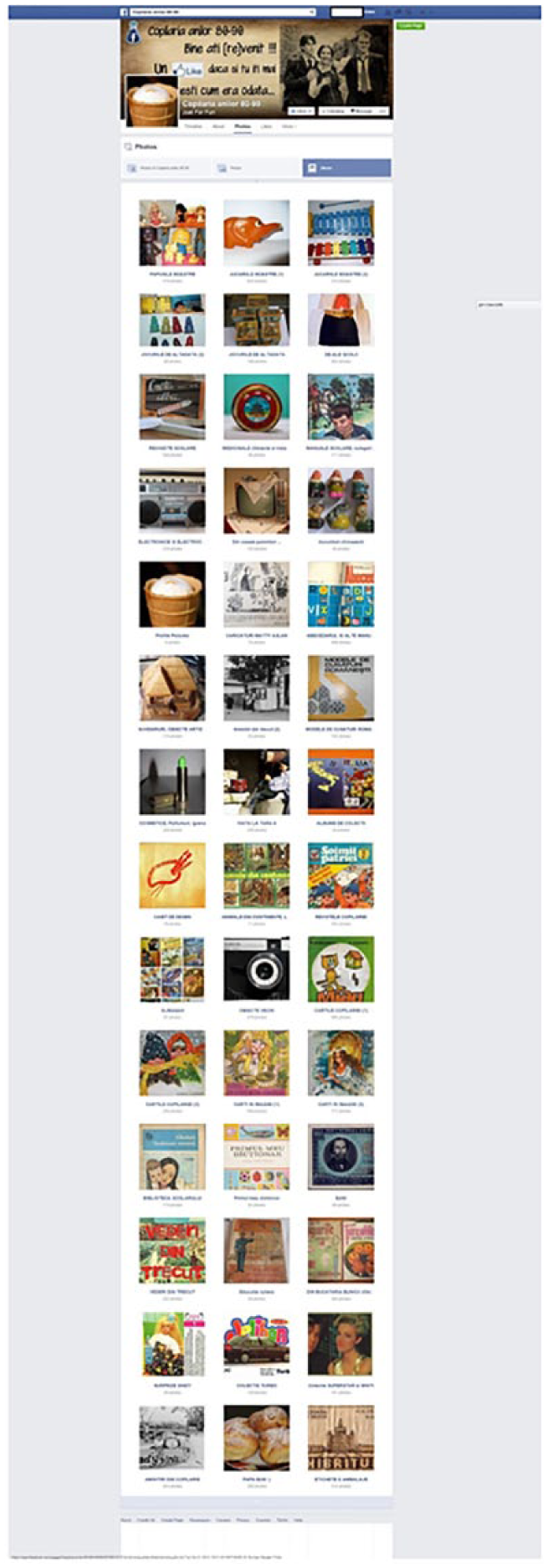
Screen grab of the Albums section of the Facebook page “Childhood in the ‘80s–‘90s.”
Both these groups don clear generational markers: the cover photo of “The Latchkey Generation” page shows a group of children playing in the street and features the condition for belonging to the “in-group”—“If you grew up in the ‘80s–‘90s, then you are one of ours.” The profile picture features a man dressed in a T-shirt branded with the URL of the community page, hinting at a generational identity engineered by an anonymous “author.” 17 With an ice cream cone profile picture and a still frame from one of the most popular teen flicks of the 1980s—Liceenii/The Graduates (1987)—as a cover photo, “Childhood in the 80s–90s” also asks for proof of identification: “Welcome (back)!!! Like us if you also remember what things were like back in the day …” These “paratextual” features are calls for performing belonging algorithmically, getting users to boost the popularity of the page. The generation is thus rendered visible on Facebook where communicative remembering leaves material traces that form the “text” of the generatiography, making it a “mediated remembering community” (Jones, 2013). Although quantitative data are not available, based on clues provided in comments, the majority of users are people born in the 1970s–1980s into working-class or middle-class backgrounds.
According to Bohnenkamp, the generatiography is characterized by the style of essays, by a generational paratextual framing and a focus on generational identity constructed through a common media culture that is canonized in hindsight. As such, it is conceptualized as a highly performative genre, helping to not only describe the commonalities of a generation but to actually write a generation into being. (Bohnenkamp, 2010; Weingarten, 2013). As danah boyd (2007) argues, social networking presupposes that users must “write themselves into being” (p. 13), so the inherent performativity of social networking sites (SNSs; Liu, 2007) enhances that of generational life writing, making it a demonstrably collective discourse. As members articulate “their digitally material connections through various forms of affective exchange” (Van Doorn, 2011: 534), they produce the Facebook generatiography; in turn, the Facebook platform, through the enabling constraints of its software genres—in these two cases the Page—“produces” these communities, which would otherwise never form offline. This mutual determination reshapes remembering processes (Van Dijck, 2011; Van Doorn, 2011; Van House and Churchill, 2008), showing how “‘technologies of the self’ can simultaneously function as ‘technologies of affect’ that reinforce and demarcate social ties” (Van Doorn, 2011: 540). The “explicit and tacit models of social and personal memory” that are “baked into” the design of platforms such as Facebook come to play a part in the construction and performance of generational memory (Van House and Churchill, 2008: 297). These Facebook groups show how online memories are not “simply shared and told, but creatively constructed” (Garde-Hansen et al., 2009: 12) at the intersection of multiple agencies.
The generational collective is determined and rendered visible by the connective (Hoskins, 2009, 2011). By conditioning generational belonging on medium-specific discursive elements, the admins make members co-creators of the generatiography. Although the administrators of the pages are the most frequent posters, posts by other members are allowed upon “editorial” acceptance. The admin of “The Latchkey Generation” is careful to highlight the most popular posts and ask for them to be liked again or check that the members are connected and interested by posting “verification” status updates such as in Figure 3: “If you remember then you are surely part of the Latchkey Generation.” The post had indeed garnered 6668 likes and had been shared 735 times. “Childhood in the 80s–90s” focuses more sharply on archiving memorabilia through concerted efforts, with posts by members viewed separately in the “Posts to page” section of the timeline making for a more varied input. The two groups contrast quite sharply in terms of “authorial” control: members’ intervention is limited to commenting and liking in the former and expanded to posting in the other. For “the Latchkey Generation,” “network sociality” and demonstrating generational strength in figures through a mostly phatic dimension (Wittel, 2001) seem to be more in focus. It is worth remembering that “Phatic messages potentially carry a lot more weight to them than the content itself suggests” (Miller, 2008: 395). In Figure 3, the text links generational belonging to material culture, the visual element makes the post instantly recognizable and shareable, and the community is created and reinforced through liking in response to the phatic function of the text.
As recent scholarship shows, the like button fulfills much more than a constative function—it is performative, “a conscious rationalized action that connotes an external tag of connection between an individual, a discursive element, and a social stance.” (Peyton, 2014: 113) Through liking, Facebook “favours instant, gut-fired, emotional, positive evaluations” (Van Dijck, 2013: 13) but also determines exposure. For example, users can simply “Like this page,” allowing posts to enter their newsfeed according to algorithms set by Facebook or choose to receive notifications for every post by selecting the option “Get notifications.” The more active they are in liking, sharing, or commenting the more posts will be present in their newsfeed. What is more, “liking” appears in other friends’ newsfeed as part of a “social awareness stream” (Naaman et al., 2010), leading to a snowball effect. The same goes for sharing posts from the Facebook groups to personal Walls: members not only enmesh them into the self-narrative of their individual Facebook profiles, but also mediatize generational discourse and engage non-members. They “activate relational impulses, which are in turn input for algorithmically configured connections—relationships wrapped in code—generating a kind of engineered sociality” (Van Dijck, 2011). The Facebook generatiography operates in the interplay between the “technological unconscious” (Beer, 2009; Hoskins, 2009) and the members’ desire to connect generationally.
While recent scholarship has revealed the intense debates about the recent Soviet past going on in social media in the genre of the “web war” (Rutten, 2013), Romanian generatiographies are more about harmonizing generational identity then actually debating multiple interpretations and temporalities of (post)communism. A high degree of conformism marks the generational Facebook groups belonging to the latchkey web sphere. For example, the group “The nostalgia of our childhood in the Golden Age” states up front what on other Facebook pages remains hidden between the lines, namely the reluctance to have various perspectives juxtaposed: My parents were not involved in communist politics, being part of the plain and simple working class. They were not persecuted by the former regime or not more “persecuted” than the majority of Romanians. They simply raised their kids in a town in a region of a communist country, Romania, trying to offer them a carefree childhood. A lot of respect and compassion for those whose childhood was difficult, whose parents suffered at the hands of the regime, etc … this group is maybe not for you. (“About” section)
This is obviously more than a precaution against vexing other sensibilities. It is also a means to ensure that those who do join the group share the same outlook and can create a coherent generatiography. More importantly, it is an indication of class belonging that remains largely unarticulated and only vaguely traceable in comments.
By now, it is a foregone conclusion in memory studies scholarship that “quotidian, technologized and digitized activities are inherently commemorative” (Crownshaw, 2012: 237). Scholars like Morris-Suzuki (2005) have attempted to differentiate between types of mnemonic engagements facilitated by sociotechnical affordances of different media, concluding that some “seem readily adaptable to the tasks of interpretation and analysis, others […] seem more readily given to tasks of evoking identification with the experience of the past” (p. 23). The Facebook generatiography falls in the latter category. By facilitating the sharing and archiving of visual memorabilia and promoting instant identification through liking, sharing, and commenting Facebook generatiographies configure an alternative yet fairly uniform affective re-attachment to the past.
Generatiographical objects
In this section, I would like to turn to the ways in which users of Facebook latchkey communities curate generational identity through material memories. In Facebook generatiographies, the communist past is “personal, visual and collectable” (Kitch, 2006), a socially curated archive of photographs, where the archiving affordances of Facebook play a big role in what is being remembered and how the “story” is written. So, then, what stories get told around or through objects? What precisely happens when “the print autobiography is no longer the only medium,” to paraphrase Ann Rigney? In her article, Rigney (2010) claims that “the possibilities afforded by hypertext generate connections that are associative rather than chronological, and that […] often rely on the same iconic images as placeholders for new stories” (p. 115). It is communist memorabilia that play this role of placeholders for the generational stories of Romania’s “latchkey kids, as digital memory objects that are distributed throughout the network” (Van Doorn, 2011: 540). Proper narratives are few and far between on these Facebook groups. Instead, members discuss the biography of the objects posted, reminisce about the practices surrounding them, inquire into their availability or state whether they owned them or still do. Posts sometimes trigger archival responses from members, whose photo-comments are meant to add to a series (Figure 3: one commenter adds the photograph of another cigarette brand in response to the post and garners 231 likes) or to contribute unrelated iconic items that are felt to be missing.
Seeing that communist memorabilia is conspicuously absent offline, 18 these groups afford a new form of remembering together through these shareable and spreadable “icons of failed time” (Bartmanski, 2011), which are heavily imbued with nostalgic attachment. This is more clearly the case with “Childhood in the 80s–90s” where the “About” section invites visitors to browse albums at their leisure. “The Latchkey Generation” features albums put together towards the beginning of its online presence, but has become considerably more random and disjointed, focusing more on “folk wisdom,” possibly a sign of the exhaustion of the archive of memorabilia and a continuation of archiving feeling “by other means.”
Post-communist generationalities are often associated with nostalgic remembrance. One only has to think of the film Goodbye Lenin (dir. Wolfgang Becker, 2003) to understand how different types of nostalgia have been linked with generational identities in post-communist memory discourses. Theorizations of post-communist nostalgia are too rich to review here, but nostalgic affect is crucial in Facebook generatiographies, so a few distinctions are in order. Svetlana Boym’s categorization in two discrete typologies (the restorative and the reflective) has been seminal in academic discourse until recently. In public discourse, another, less refined polarization exists between the reactionary nostalgia of the retired working-class that wishes the social security of communism back as opposed to the more playful and ironic nostalgia of those coming of age in 1989, who know full well communism was grim and can make fun of it tenderly, precisely because they are now successful neoliberal subjects. 19 Needless to say, empirically, things are fuzzier than this asymmetrical binary and more recent academic work has challenged such enduring distinctions. For example, the tendency to explain post-socialist nostalgia as a form of mourning of a failed utopian project or the collective romanticizing of the past due to a failure to “catch up” (e.g. Buck-Morss, 2002; Scribner, 2003) has received useful corrections (e.g. Boyer, 2010; Todorova and Gille, 2010). There have also been calls for the “de-essentialization and de-ontologization” of nostalgia (Velikonja, 2008: 29). Echoing Karen Stewart’s plea to treat nostalgia as a “cultural practice, not a given content” (Stewart, 1988), Nadkarni and Shevchenko (2015) warn against the belief that “the very structure of nostalgia endows it with a particular political meaning” (p. 63). In the same vein, Velikonja (2008) defines nostalgia as “a set of generally unconnected semiological strategies, operations and exchanges in various environments and among different groups of people engaging in them with a special purpose, or even without any purpose” (pp. 28–29). Emphasizing the mutability of nostalgia, Velikonja (2008) notes the “ahistoricity, ex-temporality, ex-territoriality, sensuality, complementarity, conflicted story lines, unpredictability, polysemism and episodic nature” (p. 28) of nostalgic narratives. Post-communist nostalgia has been reconsidered as a search for iconological consistency (Bartmanski, 2011; Oushakine, 2007), with the success of nostalgic icons attributed to them being “mnemonic bridges to rather than tokens of longing for the failed communist past” (Bartmanski, 2011: 213). Serguei Oushakine defines it as “an attempt to chronologically enclose, to ‘complete’ the past in order to correlate it with the present” (Oushakine, 2007: 455). Facebook generatiographies have a structuring effect on nostalgic forms of attachment to the past. Borrowing heavily on the retro style so present in social media at large, Romanian Facebook generatiographies blend in transnational generational templates (e.g. the listicles “You know you were born in the 1980s if …”), nostalgia for obsolete media, nostalgia for consumer practices, and nostalgia for the perceived innocence and stability of communism. Although there has been research into the diverse mediations of post-communist nostalgia (Todorova, 2010; Todorova and Gille, 2010), closer engagement with media affordances as factors in nostalgic remembering is lacking. In Facebook generatiographies, multiple templates and semiotic practices are juxtaposed, creating different patterns of generational nostalgia. I therefore find it more useful to withhold diagnoses of nostalgia and instead focus on how users mediate various nostalgic modes or deflect accusations of reactionary nostalgia through engagement with materiality.
By sharing memorabilia from their communist childhoods, users turn them into “mediated memories that become socialized as digitally material artefacts which are durable as well as mutable, reflexive as well as performative” (Van Doorn, 2011: 541). In an environment that functions algorithmically and where content is constantly recirculated and can pop up unexpectedly in one’s newsfeed, Schwartz observes that “Rather than relations of possession, people then have neighbourly relations with the memory objects that populate their digital environments” (Schwarz, 2013: 7). Indeed, discussions often revolve around the ownership of the actual objects archived as photographs online, pointing to how these are rarely part of some purposeful collection, but rather the lackluster junk of the transition, rediscovered in the homes of parents or bottoms of cupboards. However, the amateur photographs show close-ups of objects displayed against non-descript backgrounds, removed from their everyday material embeddedness and staged as iconic (see Figure 2), while others are clearly represented following the “mash up aesthetics” of the online, with collages featuring quite prominently (see Figure 3). Although the commercialization of communist memorabilia has never taken off in Romania as, for example, in Germany, in Figure 4, the photo bears the watermark of a buying and selling site, okazii.ro, showing how content flows and is repurposed in Facebook generatiographies. This retreat into the realm of everyday materialities is shaped by the specifics of Facebook remembrance practices. Little would Romanians in the 1990s have imagined that communist “things” would ever be given a new lease of life. Nowadays, as the “latchkey” Facebook page is becoming typified, communist memorabilia have entered a new cycle of their “social life” (Appadurai, 1986), facilitated by the specific curatorial affordances of SNSs (Giaccardi, 2012). These material memories enable an avoidance of a clear stance towards the past, a retreat into the thingness of the objects on display, perhaps even a sort of “infantile citizenship” (Berlant, 1997) under the guise of “cultural intimacy” (Herzfeld, 1997).
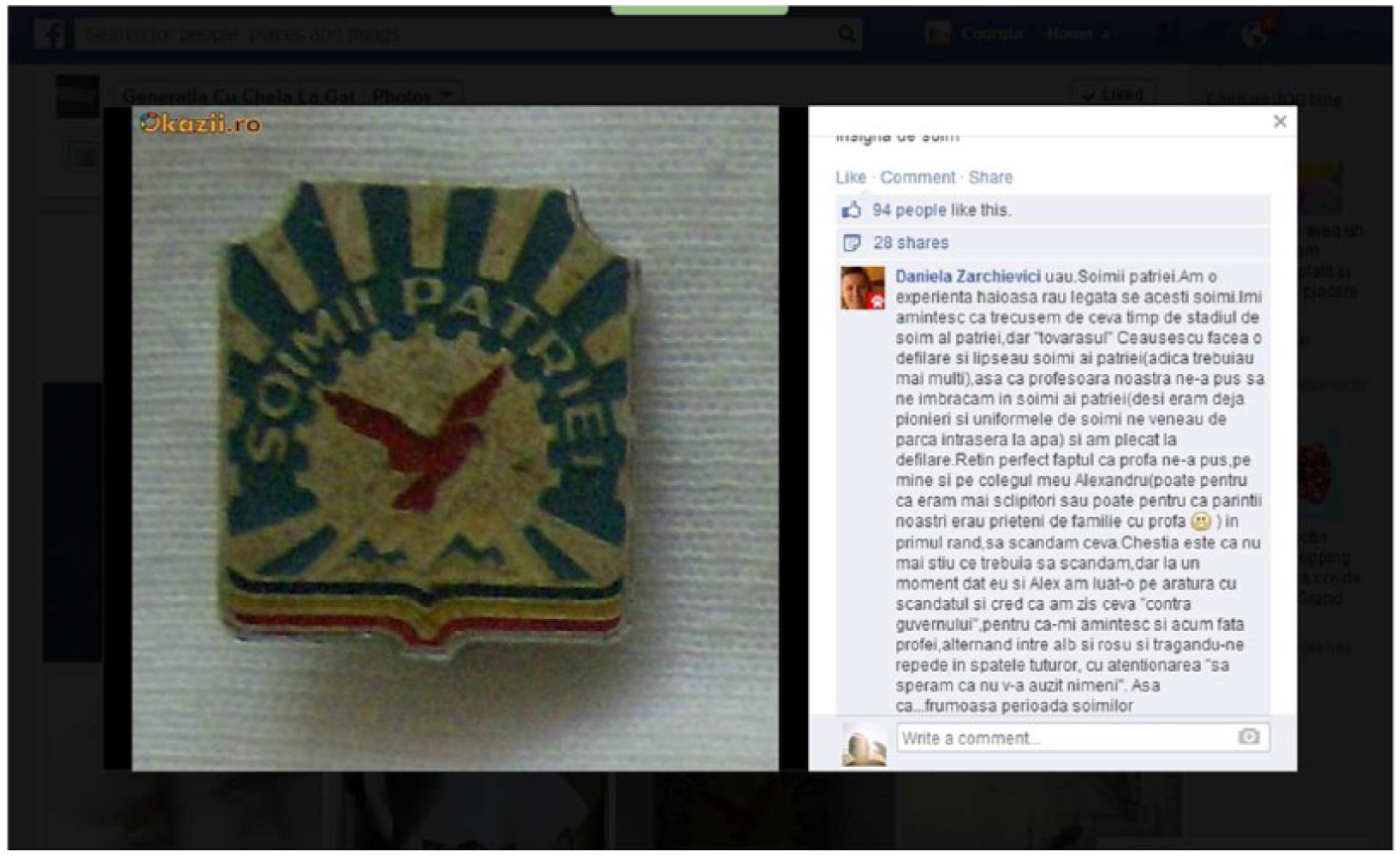
Photo of a “Falcons of the Motherland” insignia.
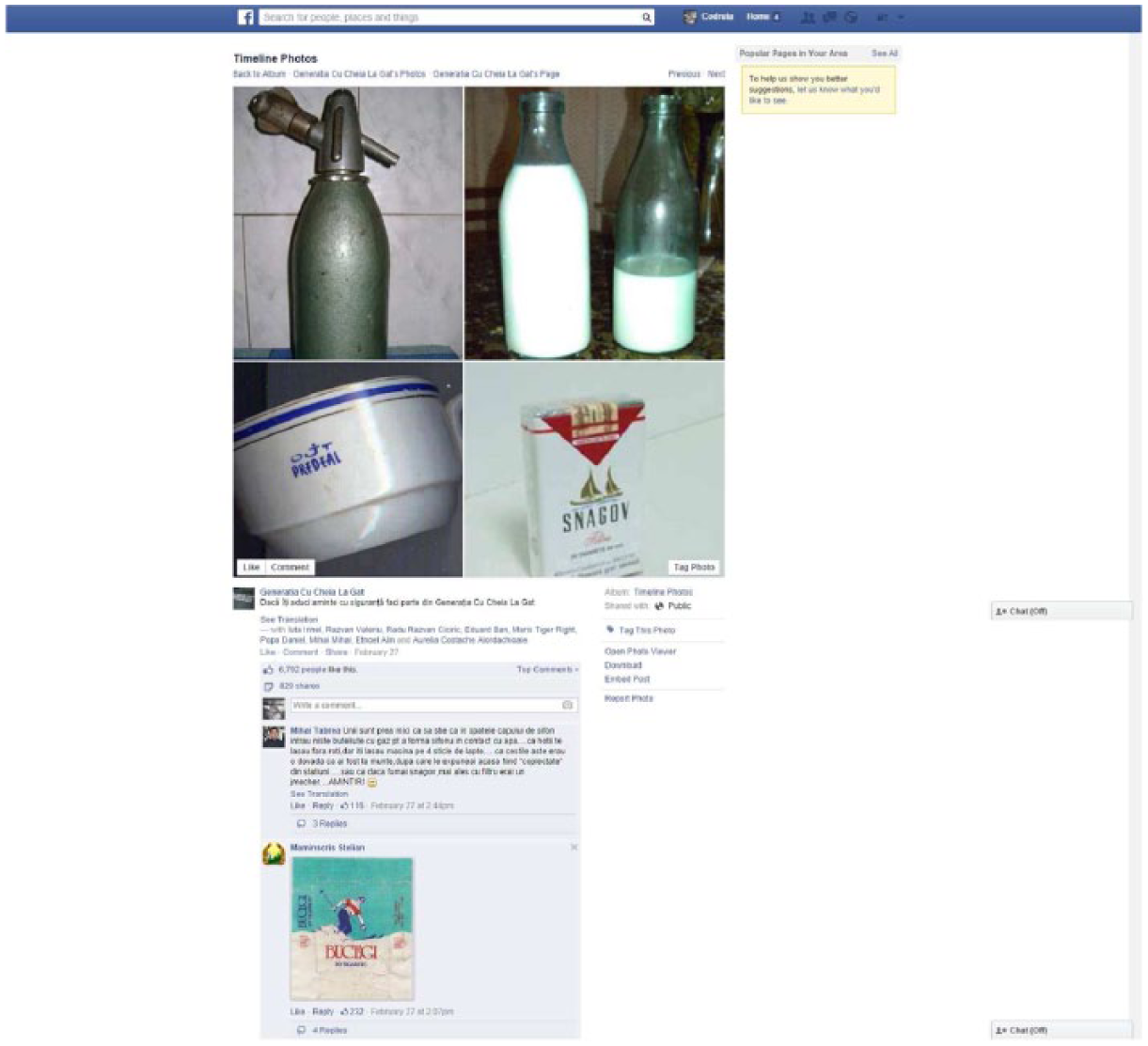
A collage of photos representing a seltzer water bottle, milk bottles, a coffee cup marked with the logo of a Romanian mountain resort hotel and a pack of Romanian cigarettes.
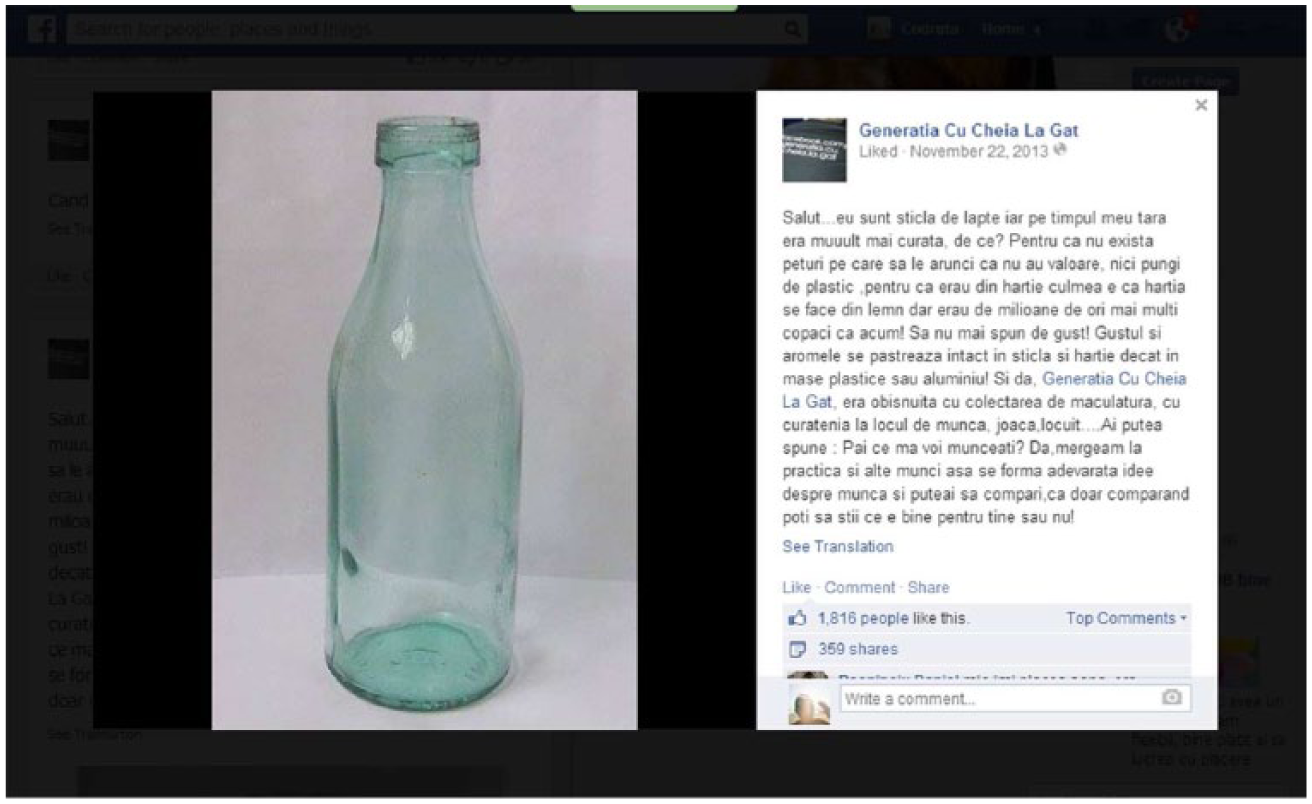
Photo of a milk bottle and an associated text written from the point of view of the object.
There are few instances where users engage with the multimodal objects posted in ways other than the performative actions baked into the Facebook interface. One such example is one comment to the post in Figure 2. For one user, the insignia of the Falcons of the Motherland communist youth organization triggered the recounting of an anecdotic episode: Wow. The Falcons of the Motherland. Here’s a really funny experience related to these falcons. I remember I was well past the “falcon” age, but comrade Ceausescu was organizing a march and there were not enough falcons (they needed more), so our teacher made us wear the Falcon uniforms (although we were Pioneers and the Falcon uniforms looked shrunken) and off we went. I distinctly remember that the teacher asked me and my mate Alexandru (maybe because we were the brightest or maybe because our parents were family friends of the teacher’s :D) to march in the first line and shout out slogans. Thing is I can’t remember what the slogans were, but at some point Alex and I deviated from them and I think it came out as something “against the government” because I can still remember the teacher, the colour of her face alternating between white as a sheet and red as beetroot, pulling us to the last ranks, saying “let’s hope nobody heard you. So … the times of the falcons were really good ones.” (D Z 19.04.2011)
Membership in “The Falcons of the Motherland” organization is remembered ambivalently: despite the anecdotic style, the hypocrisy of the system and the fear it could instill are not eschewed. However, communist childhood experiences are framed as facilitating mischief, playful—or involuntary—subversion, protected by age from any of the moral implications of participating in propagandistic activities that accounts of adult experiences.
Most comments are often repetitive (sometimes tens of members will comment confirming they owned/own the objects in the photos with very little variation in phrasing), and one might rightly presume that the aura of the rediscovered object is worn away through repetition. However, this canonizing of communist memorabilia proves crucial to identity construction. Facebook generatiographers construct themselves as collectors and consumers of the discredited junk of communism, involved in “socially distributed curation” (Liu, 2012), working against the silencing of the banal, the trivial, the everyday of late socialist Romania, and salvaging “ordinary affects” (Stewart, 2009). Symbolically recuperating these “generatiographical objects”—to paraphrase Janet Hoskins (1998)—is tantamount to recuperating one’s biography from a period that has been stripped of any positive association and demonstrating valuable insider’s knowledge: Some are too young to know that the bottle cap contained CO2 cartridges to turn water into syphon … that thieves left the car resting on four milk bottles when they stole the tyres … that these cups were proof that you had been to the mountains, and you’d display them at home after you “collected’ them from the resorts … or that if you smoked snagov, especially the filter cigarettes, you were cool … MEMORIES☺. (Mihai Tabrea 27.02.2014)
Such comments affirm the enviable material culture knowledge of those who are “old enough” to remember the whole world of associations around everyday objects, which comes to contrast sharply with previous discourses which operated with the trope of communism as disease, and concluded that “several generations have to pass” before the nation can be “healthy” again. For example, the queuing experience—a commonplace of representations of communism, the totem of humiliation, poverty or, at best, forcible solidarity—is re-signified as joyful adventure: Oh, those were the days!!! At 21 h on the dot, a gang of fifteen-twenty children would gather outside the apartment building, holding bags with empty milk bottles … and surprisingly we weren’t the first to queue. We’d be so upset and disappointed … but we’d soon get over it. We were going to spend the night queuing lest someone should throw our bags out of the line☺ … moments I’m sure we all dearly remember☺. (Marilena Buzatu 27.02.2014 2:35 p.m.)
These memories of how fun was had despite and to spite the shortcomings with childlike verve act as a palliative for dominant accounts about the utter senselessness of the recent past.
Since the discourse on the communist past has been “confiscated” by intellectual elites after 1989, this is also an exercise in articulating the sensibilities of other socio-economic classes. Generatiographies introduce a sort of nostalgia for deprivation that is paradoxically quenched by a visual consumerism of the kind afforded by Facebook. This type of symbolic consumerism is only apparently paradoxical. As Jonathan Bach (2002) notes with reference to German post-unification identities: “the socialist system worked to constantly deprive and stimulate consumer desire in an ongoing cycle” (p. 550). This ambivalence towards consumption continued in post-communism once the market was flooded with the formerly fetishized because inaccessible products, triggering a re-valuation of the once despised domestic “substitutes” as “a strategy […] to not be speechless in a discursive field of cultural production that is dominated by the West” (Bach, 2002: 554). In Facebook generatiographies, the construction of counter-narratives of consumption is afforded by a new type of sociality—the connective sociality of SNS mediated by multimodal objects, which replaces the sociality of solidarity and competition in “making do” with the little that was available. Complex materialities are therefore part and parcel of nostalgic re-attachments to the past in a globalized culture of consumption, where a dialectic fetishism of consumer goods is used to negotiate the spatio-temporal constellations of post-communism.
In one particular example, the centrality of generatiographical objects goes so far as to make the object “do the remembering.” The post in Figure 4 surprisingly borrows the voice of the object in an act of ventriloquism, speaking for a whole generation: Hello … I am the milk bottle and in my day the country was muuuch cleaner, why? Because there were no plastic bottles or bags to discard, these were made of paper and even though paper is made out of tree trunks there were a billion times more of those than there are now! Not to mention the taste! Taste and aromas are kept intact in glass or paper as compared to plastic or aluminum! And yes, the Latchkey Generation was used to recycling paper, cleaning up the workspace or the playground … You could say: What, did you work? Yes, we did hours of industrial or agricultural practice and that’s how we got an idea about what work really is and we were also able to compare; only by comparing can you know what’s good for you and what isn’t!
Blending in environmental concerns with reflections on preparedness for the labor market (reminiscent of the Generation X vs the Millenials discourse), this post uses the voice of the object to deflect potential accusations of actual support for the communist regime. One comment breaks the generational sense of pride amply supported by many of the posts and comments by introducing a “latchkey” identity that is characterized by doubt and uncertainty: I speak in the name of those born in 1973, we didn’t kill Ceaușescu, we were too young, but we remember him … we would have received housing and holidays … we are the first to have lost, we didn’t understand much from democracy either, it rolled over our lives … if it’s good or bad, I don’t think the latchkey generation has found the answer yet … that’s my opinion. (NB 24.11.2013)
Although infrequent, the argumentative exchange above points to potential ethical controversies. Because it seems to display “restorative nostalgia” (Boym, 2001) instead of keeping in line with the “apolitical” generatiographical nostalgia, one commenter takes issue with the page admin over the post in Figure 4: “admins of the latchkey generation, other posts and comments are interesting, but this one sounds like you’re siding with Ceausescu’s nostalgics, better go to North Korea is you think dictatorship is the only solution for recycling and ecology!?” (V M, 23.11.2013. 10: 16 pm). An interesting temporal layering can be read between the lines here: members of the Facebook latchkey generation may be nostalgic, but the commenter pleas distancing from “Ceauşescu’s nostalgics”—generally associated with the older generation. Different generations, different nostalgias, the comment seems to imply. This is quite a common rhetorical move, as Nadkarni and Shevchenko (2015) note, “in order to retain an aura of authenticity, nostalgia has a stake in insisting on its political neutrality” (p. 80). Dissociation from the nostalgia of older generations doubles as both a generational marker, as well as a refusal to admit to the politics of nostalgia inherent in the “lighter” and more “youthful” recollections of the latchkey generation. Projecting “political backwardness onto nostalgic practices elsewhere” (Nadkarni and Shevchenko, 2015: 81), in this case onto the older generation serves to further deflect.
The examples discussed in this section have revealed the compelling interdependence between social media grassroots heritage practices and identity construction in Romanian generatiographies. Through the iconic reconstruction of personal and collective biographies via the biography of objects, members of Facebook communities are aestheticizing memory and creating templates that perform a semiotic and axiological re-framing of communism. Their discourse is not so much oppositional to previous or contemporary anti-communist ones as it is concerned with valuing generational structures of feeling. This generatiographical mode of remembering is an attempt at sense-making through things, an exercise in mapping out the ruins of the past and rediscovering their use-value for present identity-construction needs.
In Facebook generatiographies, generationality is defined by knowledge of material culture as well as by various rhetorical moves meant to keep accusations of instrumentalizing nostalgia at bay. Members and admins aim to separate themselves from the older nostalgics in not claiming outright that “communism was better” but at the same time they do not indulge in a postmodern game of blasphemous irony. They seem to approach the past with a “new sincerity” (Yurchak, 2008).
Facebook generatiographies in a “translocal” perspective
As we have seen so far, Romanian Facebook generatiographies advocate the latchkey generation’s relevance in genealogical as well as social terms as a dynamic, adaptable generation. In post-communist Romania, this generational discourse fulfills particular functions. But are its means idiosyncratic? To what extent is this, strictly speaking, a post-communist generational discourse? As I have noted at the beginning of this article, the generatiography is a genre that has surfaced in Germany, Poland, the United Kingdom and the United States alike. A simple Facebook search using keywords such as “80’s childhood,” “80’s kids,” “80s nostalgia” yields a wealth of western-based generatiographies: “80s kids rule,” “Raising 80s Awareness,” “70s &80s kids That’s how we rolled”—to name a few evocative examples. Let us zoom in on one example. The Facebook community page“70’s &80’s kids, That’s how we rolled,” set up in August 2012 states its purpose in its About section: “This page is based in Glasgow uk it’s for everyone who grew up in the ‘70s & ‘80s. Feel free to share your favorite toys, sweets, tv shows ect[sic]& whatever else you remember. hope you all enjoy this page xx.” The mixed function of archiving material culture and the memory discourse around it is strikingly similar to what we have seen in the Romanian examples. The page has garnered 230,637 likes 20 and features mostly timeline photos, but also three albums specially dedicated to collecting photographs of childhood sweets and foodstuff, home ware and fashion. The members of the ‘70s–‘80s Facebook community “’70s–‘80s, that’s how we rolled.” are engaged in similar generational life-writing processes (compare Figures 4 and 5).
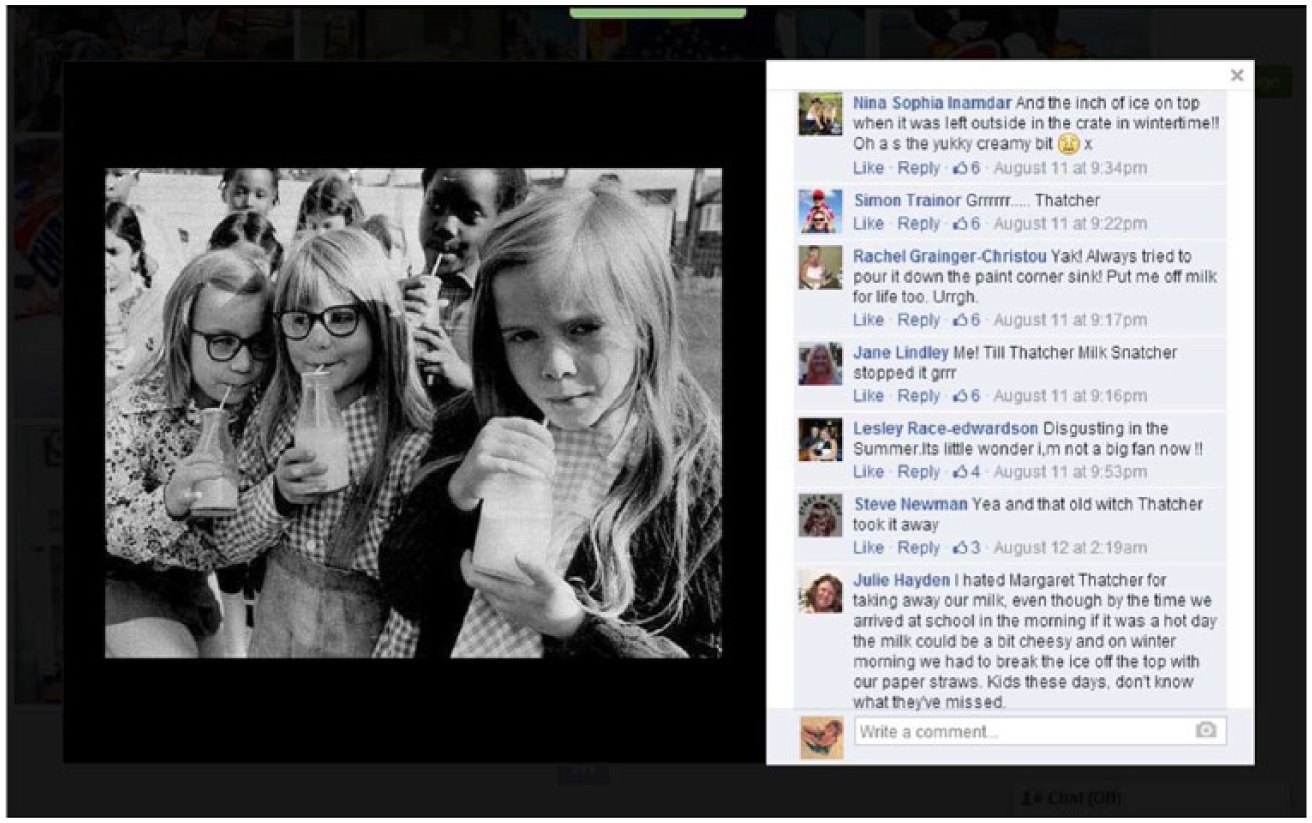
The post asks “Who remembers free school milk?” and has garnered around nine thousand likes.
Figure 5, for example, presents a different cultural setting to the milk bottle, this time occurring in Thatcher’s 1980s, also generating more political comments alongside evocations of sensory experiences. The ambivalence of the poor quality of the product and the disappointment of not receiving it anymore invites interesting parallels with the complex relationship Romanian children had with the milk bottle and the everyday practices around it. However, there is no disagreement among commenters and no sense of entering a potential ethical minefield of nostalgia, which goes to show how post-communist nostalgia even when focused on “childhood things” remains more problematic than its “western” counterpart.
Given the clearly identifiable generic features present in Facebook generatiographies across national borders, it is perhaps safe to claim that a return to genre, particularly within a platform such as Facebook, might invite fruitful exchange and comparison between “western” and “eastern” brands of nostalgia or even destabilize these awkward dichotomies. However, I am by no means suggesting that this should be done at the expense of local sensibilities by isolating genres from the rhetorical contexts in which they operate or by neglecting national or regional social networking platforms. Instead, my claim is that further research into the translocal dynamics of cultural templates would be fruitful, also in view of recent appeals for reconceptualizing “post-communist nostalgia” in the economy of affect afforded by social media. 21 As Dirk Uffelmann (2014) notes, “Only an integrated approach to genre, which encompasses technical conditions as well as rhetorical rules and cultural particularities, can help us understand how memory emerges and changes online” (p. 1), given that genre is a “decisive mediator” on the transnational (or perhaps better said, translocal) social media stage (Uffelmann, 2014: 16). Facebook generatiographies operate on a middle ground negotiating between the “global” online media and “local” nostalgic modalities. Especially when dealing with social media where these tensions endure in even more challenging forms, the type of reflection on form-content-context that genre invites can thus open new spaces for discussion.
Conclusion
This article has investigated the generational discourse of the Romanian latchkey generation as mediated and rhetorically constructed on Facebook, paying close attention to its generic actualization. Genre has been shown to be analytically useful in understanding the mediated nature of memory as it brings together cultural and media templates, discursive contexts and users, revealing how they co-construct each other. Operating as a welcome middle term between content analysis (which can lack medium-specificity) and media technology analysis (which risks media determinism), genre is methodologically useful in the expanding field of digital memory studies, particularly in light of recent focus on transcultural memory processes and re-evaluations taking place in post-communist studies. Although the scope of the article does not allow for a proper investigation of these potentials, I hope to have made a case for the need for further study.
The latchkey generation discourse as actualized in Facebook generatiographies has been shown to be predicated upon the interdependence between alternative affective engagements with the past and a new relationship with communist materialities. The members of the latchkey generation act as proud virtual collectors-consumers of communist memorabilia justify their curatorial practices through their specific generational location, which allegedly allows a more detached perspective. Rutten cogently explains how post-soviet fighters in “web memory wars” would be wrongly labeled digital “tourists of history” (Sturken, 2007) and more aptly described as “digital archaeologists’ (Rutten, 2013). In Romanian generatiographies, it appears that both concepts help to illuminate different aspects of the mnemonic and affective labor (Hardt, 1999) on Facebook.
In Romanian latchkey kids’ approach to online heritage practices lies implicit the claim that theirs is a liminal generation—well-versed in Cold War realities but also conversant with capitalism and democracy. However, “material success and fluency with the new transnational ‘rules of the game’ does not preclude a resistance to fitting seamlessly within the new global order.” (Nadkarni and Shevchenko, 2015: 79) and Facebook generatiographies give some insight into how this negotiation plays out within a specific social media genre.
Constructed as a generation of hope in 1989 and as a disappointed generation in the 1990s, a generation who would have to simply wait it out until the past is erased from Romanian collective memory, the latchkey generation has been rediscovered as “news” in the 2000s and reinvested with different social significance. Generational (re) attachments to the communist past are highly mediatized and mediated discursive formations that are very much in flux and whose capacity for political mobilization deserves further investigation.
Footnotes
Acknowledgements
This article has benefitted from feedback offered by Professor Marianne Hirsch during the Mnemonics Graduate Summer School, Stockholm University, 21–23 August 2014 and Professor Mitja Velikonja during the workshop—Digital Memories, Digital Methods: Transcultural Memory in Europe Beyond Web 2.0., part of ISCH COST Action IS1203. I wish to thank Elisabeth Wesseling, Renée van de Vall, Georgi Verbeeck and Jo Wachelder at Maastricht University for offering their valuable insights on earlier drafts of this article. I also wish to thank my two anonymous reviewers for their invaluable suggestions.
Declaration of Conflicting Interests
The author(s) declared no potential conflicts of interest with respect to the research, authorship, and/or publication of this article.
Funding
The author(s) disclosed receipt of the following financial support for the research, authorship, and/or publication of this article: This work was supported by The Netherlands Organisation for Scientific Research (NWO) within the program PhD in the Humanities (grant number PGW-13-23).