




Abstract
Among the strategies followed by far right groups for normalising their messages of intolerance in contemporary Europe, sites of memory play a pivotal role. Adopting an actor-centred and instrumentalist perspective of memory work and memory politics, the article considers sites of memory as products of the framing and staging of the past by the memory entrepreneurs, leading figures within the community of remembrance who, mastering the art of memorialisation, strive to establish their revisionist history within the state-endorsed memory politics. The far right memory entrepreneurs spatialise their memory work in sites of memory that downplay the history of violence of their group and present its heroic and patriotic side. The degree of success in contesting such sites shows whether the memory entrepreneurs have succeeded in normalising their messages. The article analyses the making and the contestation of a site of memory established by the far right in post-communist in Romania.
Keywords
Introduction
Far right groups are recognised as a societal danger at global level. According to Ramet (2010: 6), they are groups of ‘organised intolerance’. In 2018, the European Union acknowledged that their attempts to be accepted as part of civil society are accompanied by the perpetration of acts of discrimination and violence. As recognised by the United Nations, the commemorations for the Nazi regime, their allies and related organisations, in public marches, conferences and celebrations held at specific sites of memory are instruments that the far right uses for normalising its presence in the public space. The work in and around sites of memory allows the far right veterans to pass the torch to younger generations by establishing continuity with the commemorated fallen and by voicing their self-exculpating revisionist historical accounts.
This article draws theoretically from actor-centred studies on memory work and sites of memory to analyse one far right site of memory: the Cross of Tâncăbeşti, built in post-communist Romania by the legionary movement.
The main questions of this inquiry are: Who creates far right sites of memory, why and how? What relationship do these sites have to the cultural memory and history of the far right? What can the contestation of those sites by external actors show about the normalisation of the far right within broader society?
As I will show, far right sites of memory are created by the memory entrepreneurs of the far right milieus. By mastering the cultural memory of their group and devoting attention to the political context in which they operate, the far right memory entrepreneurs strategically influence how things are remembered, downplaying the history of violence of their group to favour its normalisation in the present. The degree of success of external actors in contesting the far right sites of memory shows if the memory entrepreneurs have succeeded in normalising their messages within broader society.
Far right sites of memory and their contestation
Establishing physical sites of memory and commemorating there their fallen is one of the tactics that far right groups implement to achieve visibility, since sites of memory materialise and simplify the reception of core moral and forward-looking messages conveyed in the memory work (Winter, 2008: 61, 2013: 213) and they are central in the making of cultural and political community (Till, 2003: 292). Far right sites of memory, as all sites of memory, are devices for remembering selectively and for escaping history (Nora, 1989: 19–24; Ricoeur, 2000; Starzmann, 2016). Far right sites of memory resemble the sites of counter-memory of the subaltern. However, far right groups are far from being the subaltern groups indicated by Davis and Starn (1989) and by Jelin (2003), even if they operate similarly. In their sites of memory, the far right inscribes its ‘true’ national character, constructed by references to martyrdom, self-sacrifice, patriotism, heroism and the social exclusion of the group by evil forces, while references to responsibilities for past violence are not exhibited or referred to.
The post-1989 European context favours this process of memorialisation by which the far right normalises its messages. The context favours the equalising of the fascist victims of WWII, the victims of communism in Eastern Europe and the victims of fascist violence, including the Holocaust. For the East European far right, this equivalence is a powerful instrument for establishing the Nazis and their collaborators as forces of national liberation from the Soviet terror and for justifying the persecutions of the Jews, presented as supporters of communism. For the West European far right, remembering the WWII violence of the anti-fascist partisans and of the Allies serves the purpose of rehabilitating the losers of WWII and their inheritors (Stone, 2014).
Spatialising the memory of far right leaders and martyrs in sites of memory is a process visible all over Europe in the last thirty years. These sites are established both in public spaces but also in cemeteries or private properties to escape the memory laws that forbid the public commemoration of war criminals or the exhibition of far right symbols (see, e.g. Stocker, 2017). Each of these sites is contested by states and private groups who do not accept the normalisation of the far right exclusionary messages. In Western Europe, some of the sites erected by fascist and authoritarian regimes with a self-celebratory function are still in use despite their contestation. The Valley of the Fallen, erected by the Francoist regime, was contested after the transition by the formerly-silenced oppressed, but it started to be depoliticised by law only in 2007, in a still-ongoing process (Ferrandiz, 2011). In fascist Italy, the birth-town of Mussolini was promoted as a place of pilgrimage; since the inhumation of the Duce in the local cemetery in 1983, far right pilgrimage has restarted, provoking contestations against the illegal apology of fascism at national level, but with no tangible consequences (Serenelli, 2015) until the present day. In some cases, far right sites of memory are constructed by manipulating the commemorated significances. For example, the memorial to fascist war criminal Rodolfo Graziani, erected in 2012 in Affile, Italy with public funding, downplays its apologetic nature and omits the mass killings that Graziani was responsible for in Ethiopia; contested by the partisans’ association and defined by the courts as an apology for fascism, the memorial is still standing (Chalcraft, 2018). In some cases, like the Yser Tower in Flanders, the far right hijacks the sites’ significance and contends it with other groups; in this case, the contestation is for the site (Lagrou, 2003: 299).
In Central and Eastern Europe, memory games are played through the reassembling of memory materials forced into silence during communism (Mink and Neumayer, 2013: 9). Since no monument to far right leaders survived the post-WWII iconoclasm, the far right either appropriates the sites’ significance or establishes new sites. In Ukraine, several monuments to Nazi-collaborationist Stepan Bandera, established since the 1990s by the far right with the approval of local institutions, have been contested without success by the Russian minority (Liebich and Myshlovska, 2014). The far right also establishes new sites of memory for highlighting the martyrdom of their comrades for the national cause, as it is the case for Bleiburg, Austria, where Yugoslavian partisans killed several collaborationist ustasha at the end of WWII; the contestation of the ustasha symbols on the site became a national matter in Croatia in the 2000s and led to the partial downplaying of openly nostalgic ceremonies (Radonic, 2019). Some far right groups, strongly opposed and criminalised in their own countries, expatriate to spatialise their memory work: since the 1990s, several West European and Scandinavian former Waffen-SS groups have moved their commemorations to Estonia, Russia and Ukraine, ‘rediscovering’ and celebrating there, with no contestations, WWII battles held against the Soviet Union (Werther and Hurd, 2017).
Focusing on the organisers of memory work – the memory entrepreneurs – may show which relational strategies engender and maintain the spatialising of organised intolerance in sites of memory and the entrepreneurs’ indirect relationship with the contestation of such sites by external actors.
Staging and framing the past: The memory entrepreneurs and their social space
Adopting an instrumentalist view of memory politics and memory work (Bernhard and Kubik, 2014), I consider sites of memory and the commemorations organised there as part of the business of the ‘agents of remembrance’ (Mills and Walker, 2008; Winter, 2008: 67; Winter and Sivan, 1999: 59). Since memory work is an actor-centred activity resulting from militant commitment and discourse production, I choose to implement a bottom-up approach (Winter, 2010: 42) to sites of memory, and I interpret them as the result of the work of key agents of remembrance – the memory entrepreneurs. These are enterprising moral leaders of social agents who, struggling over memory (Jelin, 2003: 33–34; Pollak, 1993), operate to establish a specific revision of the state-endorsed memory politics (Bernhard and Kubik, 2014; Neumayer, 2017: 993). Their political work (Gensburger, 2016b: 36) is carried out by influencing how the past is remembered, objectifying (Kansteiner, 2002) and re-signifying (Tóth, 2019) the cultural memory of their group (Assmann and Czaplicka, 1995) in monographs, journals and documentaries, fixing dates and anniversaries of remembrance, establishing and maintaining rituals and ceremonies, and materialising and maintaining sites of memory (Buscatto, 2006; Jelin, 2003: 33–34; González and Pagès, 2014; Winter, 2008).
Pollak (1993) differentiates between memory entrepreneurs who create new references and those who enforce them. I prefer to indicate the second group as memory militants (Conan and Rousso, 1998: 112). Memory activism creates an independent social world in which anyone can argue a position and try to achieve public legitimacy for the group (Gensburger and Lefranc, 2020: 100–102). Within this social world, memory entrepreneurs are those who most proficiently master the materials of the past, with a holistic vision of their positioning in the public debate: they know when and where to say and do what, and how. The entrepreneurs keep reinventing their community over time, providing it with cohesion and meaning. Their work requires optimal social (Wüstenberg, 2017), organisational (Winter, 2008) and intellectual skills (Eidson, 2005), together with a good dose of imagination and ruthlessness. Instead, the group’s militants follow the established and constantly reinvented cultural memory for legitimising their identity (Gensburger, 2016b: 37).
The main means by which memory entrepreneurs craft their narratives is by framing and staging memory. The staging takes place by managing the past’s representations (Del Monte, 2015). Coordinating and manipulating the elements inherited from scattered individual and often contradicting or even openly conflicting accounts – the ‘noisy cacophony of unofficial memories’ (Starzmann, 2016: 10) – the memory entrepreneurs know how to highlight certain elements and downplay or ignore others (Del Monte, 2015; Mink and Neumayer, 2013). The staged memory, crafted to produce the desired effect, omits historical contextualisation that would be dangerous for the group’s self-representation, favouring instead the representation of a just, pure, innocent, martyred and victimised community (Rousso, 1985: 73). The traces of the framing work are visible in the sites of memory, which favour the forging of an articulate, multi-sensorial structure of recollection which is experienced during pilgrimages and commemorations (Tilley, 1999).
Contrary to Pollak (1993), I tend to see the justification constraints which would limit the framing of memory as limited to those elements that are necessary for maintaining internal coherence within the group’s discourse, since remembering together is essentially a strategy to maintain group cohesion (Moshenska, 2006). Memory, framed and staged with selected materials, helps the group to maintain an internal coherence in its discourse, which is the essence of its social cohesion (Del Monte, 2015). Therefore, memory work serves as a relational paradigm (Gensburger, 2016a: 403). With this perspective, sites of memory are devices to spatialise the desired framed and staged memory in order to keep the group’s cohesion at all costs. In memory work, beliefs and emotions count. Hate counts too. Spatialising its core beliefs in sites of memory offers the far right infinite possibilities of normalising their group and their messages of organised intolerance in the face of internal competition and external contestations.
Case Study: Romania
In the following case study, I will analyse the framing and staging of memory by far right memory entrepreneurs by focusing on one site of memory, on its making and on the history it omits. Lastly, I will analyse its contestation, which aims at neutralising the work of the memory entrepreneurs. I choose to focus on Romania, a country in which the demise of the communist regime has engendered a competition between multiple, competing state and private memory entrepreneurs to spatialise a profitable memorialisation of the past in street names, memorials, statues and crosses (Ciobanu, 2014; Stan, 2013; Verdery, 1999: 39–40). Since 1990, several groups of radical continuity and radical return (Shafir, 2010: 213–215), often backed by far right politicians and intellectuals from the late Ceauşescu regime (Shafir, 2007, 2014), have tried to exploit the collective anxieties by proposing vengeful solutions against the communist elites, proposing antisemitic and xenophobic scapegoating visions (Tismăneanu, 1999: 154). The substantial continuity of the self-exculpating discourses for the national responsibilities for the Holocaust and the re-emergence of individual memories of oppression under communism resulted, for the Romanian far right, in the equivalence between the Holocaust and the crimes perpetrated by the communist authorities against Romania. This double genocide theory, only apparently designed to establish the martyrs of communism beside the Jews who died in the Holocaust, aims at convincing that the sufferings imposed by the national community on the Jews was a ‘natural reaction’ to the earlier sufferings imposed on the nation (Shafir, 2017). This discourse aims to give credibility to the ‘nostalgic antisemites’, who wish to rehabilitate interwar fascism and to establish a Jewish responsibility for the communist crimes in a ‘country-specific negationism’ that is a further weapon for the discursive arsenal of Holocaust-deniers and trivialisers (Shafir, 2007: 60). By these means, Romanian far right memory entrepreneurs aim to establish, by memory work, an empathic proximity between the national community and antisemite murders from the interwar- and WWII- periods.
Since the 1990s, several far right private organisations aimed to re-establish Ion Antonescu as a national hero and the legionary movement as a legitimate national movement. Antonescu’s normalisation was promoted by the România Mare party, the most influential and powerful far right group. Elected in local and regional councils, its politicians established Antonescu’s myth in the public space by erecting statues, dedicating street names to him and even financing frescos of him in Orthodox churches (Cazan, 2018; Chioveanu, 2003; Florian, 2007; Shafir, 2007). Conversely, the myth of the interwar legionary movement, an interwar mass movement characterised by extreme antisemitism, anticommunism and xenophobia, made its reappearance promoted by a myriad of small parties, local associations and cultural foundations which were cut off from positions of power (Endresen, 2011, 2012). These far right groups competed to establish either Antonescu or the Legion’s founder C. Z. Codreanu as national heroes, with the broader aim of normalising their own existence. Besides open nostalgia, they also operated by hijacking the discourse on the communist past, which since 1990 had been the key feature of the memorial discourse developed by the democratic opposition against Ion Iliescu’s semi-authoritarian regime (Tismăneanu, 2015).
With the 2002 memory law, issued under international pressure, Antonescu’s iconography was partially removed from the public space (International Commission on the Holocaust in Romania, 2004: 390). However, the myth of Codreanu and his legionaries persisted undisturbed in privately-organised initiatives held in the public space. This was due to two sets of reasons, one depending on the context and one due to the skilfulness of legionary memory entrepreneurs. Since the 1990s and until the rise of the prisons’ saints movement, the legionaries were perceived as few, merely nostalgic, politically meaningless and hopeless protesters. Their underestimation was due to two reasons. First, Iliescu had legitimised the Bucharest repressions of 1990–1991 by claiming that the protesters were ‘legionaries’, while it was evident that there was no ‘legionary danger’. Second, the post-communist Romanian mass culture was a propitious cultural space for far right ideologies, antisemitism and xenophobia (Andreescu, 2003: 22). This passive normalisation is proven by the few indictments set between 2002 and 2015 for exhibiting fascist symbols, despite these being present in multiple legionary public events (Shafir, 2018: 103). Neither did the International Commission for the Study of the Holocaust in Romania (International Commission on the Holocaust in Romania, 2004) dignify the post-1989 legionaries with attention in its recommendations to the Romanian government, while it devoted a paragraph to denouncing Antonescu’s myth.
Undisturbed, the legionaries hijacked, one by one, the discourses developed by the emerging civil society: those on communist crimes, on anti-communist resistance and on dissidence (Stan, 2013). The legionary memory entrepreneurs placed themselves in the service of these communities of remembrance to help them to present a coherent account of those neglected pages of Romanian history (Ciobanu, 2014). In the 2000s, under the leadership of the centre-right and on the impulse of democratic intellectuals, the state started to endorse those discourses. The Presidential Commission for the Study of the Communist Dictatorship in Romania pointed out that among all the societal groups who had fought against communism and had suffered the regime’s repression, the legionaries were only a minority. However, the legionaries downplayed the dismissal and persisted to present their movement as the main anti-communist force and their comrades as the main victims of communism (Totok and Macovei, 2016: 149).
Most recently, the legionary memory entrepreneurs have been trying to establish the Legion as a movement of national martyrs by supporting the prisons’ saints movement, which aims to convince the Orthodox Synod to canonise several victims of communism, among which some were legionaries (Ciobanu, 2018). By the mid-2010s, the phenomenon of the prisons’ saints had considerably expanded, even receiving explicit endorsement by several state cultural institutions (Shafir, 2018). In contrast to this trend, in 2015 the Romanian parliament amended the memory law of 2002 by including the word ‘legionarism’ beside ‘fascism, racism and xenophobia’ and by defining the legionary movement as a fascist organisation. However, the legal constrictions have not stopped the public glorification of the legionaries (Shafir, 2018) to the present day.
Far right sites of memory: Between open nostalgia and innovative martyrdom
The approach of the legionaries to sites of memory includes both openly nostalgic spatialising, in which the celebration of the movement and the exhibition of its symbols is explicit, and also innovative spatialising, in which the legionary discourses and symbols are downplayed and the focus is on the martyrs of communism and on the anti-communist resistance. The many monuments to the anti-communist resistance (e.g. the ones in Deva, Constanţa, Sâmbată de Sus and the ‘Wings’ monument in Bucharest) and to the victims of communism (one example is the Calvary of Aiud – see: Grigore, 2015; Paul, 2004) are sites of memory for the legionaries, who contributed to finance their construction even if they carry no explicit reference to the Legion. However, these sites are not profitable for analysing how the far right memory entrepreneurs materialise explicit memorialisation of organised intolerance, and how this is contested. Nostalgic sites of memory, which are inscribed within the same strategy of normalisation, better serve the purpose.
The legionaries have established openly nostalgic sites all over the world since the Cold War exile. Yearly, a patrol of legionaries travels to Majadahonda, Spain to visit the Moţa-Marin Monument, an inheritance of the Francoist regime contested by the local community for its linkages to the far right Falange. In Hamilton, Canada, a cross has been erected on private ground to commemorate legionary Aron Cotrus, cultural attaché of the Nazi-collaborationist National Legionary State in fascist Italy. Outside the Romanian Orthodox Church of St. George in Indiana Harbour, IN, the exiled legionaries had erected a cross, now removed, to some of their comrades killed by the communist regime. In both North American sites, the commemorated legionaries are normalised by downplaying their past activism and by referring either to their artistic virtues (Cotrus) or to their participation in the anti-communist resistance (the legionaries commemorated in Indiana Harbour were parachuted into Romania by the CIA in 1953).
In post-communist Romania, the legionaries have both created openly nostalgic sites of memory or appropriated and re-signified pre-existing ones as such. An example of an appropriated site is the St. Ilie Gorgani Church in Bucharest, which was regularly visited by the legionaries in the interwar period; since 1989, the legionaries have continued to visit the church and to hold memorial functions for their fallen there. Among the sites established after 1989, the funerary obelisk erected in 1998 at the Cemetery of Predeal, aimed at remembering the legionaries killed in 1939 by the Carlist regime and inhumated there during the National Legionary State, has become a site of pilgrimage for legionary factions. Another newly-established site is the Cross of Tâncăbeşti, dedicated to the memory of the Legion’s founder and 13 of his closest associates, killed in the wood of Tâncăbeşti while under arrest by order of King Charles II in 1938. The Cross of Tâncăbeşti radically differs from the obelisk of Predeal and St. Ilie Gorgani: the site is not a place designated for cult or commemoration, it is a public place; it is not pre-existing, but established in post-communist Romania; finally, it is the only site explicitly dedicated to the Legion’s founder. As such, it is the most mediatised legionary site of memory in which celebrations are held once per year. Therefore, it represents the most viable case study for showing how far right memory entrepreneurs try to normalise organised intolerance in sites of memory, and for analysing the contestations of such efforts and their impact.
Primary sources for this investigation are legionary cultural products printed after 1989, which permit the reconstruction of the history of the site with a focus on the memory entrepreneurs’ work. A field-trip in 2019 allowed me to experience and contextualise the site in its space. The attempt to escape history by presenting the legionaries as victims and Tâncăbeşti as a site of martyrdom has been analysed through the lens of historical scholarship and by additional research on the 1930s–1940s newspapers, with focus on the legionary memory work from the interwar period onward. For analysing the contestation of the site, I have used the files of the case moved against the site in various juridical courts and public authorities in 2012 by the Elie Wiesel National Institute for the Study of the Holocaust in Romania, a governmental cultural institution which has often denounced the attempts of promoting the cult of fallen legionaries in the public space (Ciobanu, 2015: 157). Although I have considered to contact the legionaries organisations to obtain more information on the site, I ultimately decided to step down, in order to avoid the danger that my research become vehicle for the memory entrepreneurs’ narratives.
Establishing a far right site of memory
The making of the site dates back to the early 1990s, once the first sites of memory for commemorating the victims of communism were established. The use of Christian crosses, aimed at symbolising the victims of communism’s death, religiosity and anti-communism, became a common strategy for marking public spaces by private initiatives organised by several groups of the emerging non-state civil society seeking justice (Ciobanu, 2014; Stan, 2013). The legionaries were among them. Already in 1990, in Timişoara, a group of legionary veterans erected a cross to former political prisoners (Marineasa, 1990).
The first openly nostalgic legionary site of memory was established in 1993 in the woods of Tâncăbeşti (Mişcarea Legionară, 2007). The promoters of the initiative were Oviudiu Guleş, university student and main distributor of legionary literature at that time, and negationist writer and journalist Ion Coja (Shafir, 2014), followed by few young activists. Staging and framing the remote past was done by organising a conference in central Bucharest (Vlad, 1993), a religious function at St. Ilie Gorgani, and by erecting on-site a small Christian cross with the names of the 14 fallen legionaries written on it (Puncte Cardinale, 1993). The commemoration at Tâncăbeşti did not attract an external audience, since the site is placed in a narrow strip of white road just few meters from the DN-1 national road, thirty kilometres North of Bucharest, in the middle of the countryside.
The first nationwide mediatisation of the spot occurred in 1995, with the re-inhumation of Corneliu Georgescu, first-hour legionary and minister in the Nazi-collaborationist and legionary-led Romanian National Government of Wien (1944–1945) next to Radu Mironovici, another founder of the Legion, in the cemetery of Ţiganeşti, near Tâncăbeşti. The old veterans, mobilised by the Buna Vestire Foundation, read poetry written in the communist prisons and sang the movement’s interwar songs. A faction of younger legionaries in green uniforms (led by Şerban Suru) was also present. The TV-cameras followed the procession to the Cross of Tâncăbeşti, where the veterans held prayers, lit candles and set up a picture of Codreanu (Fundaţia Ion Gavrilă Ogoranu, 2018). The Buna Vestire Foundation and Suru’s faction had chosen to utilise the spot as a site of memory, acknowledging implicitly the work spatialised by Guleş and Coja.
In 1998, the nephew of Codreanu utilised the site to advertise the establishing of a legionary party. The political attempt involved memory work around the site, with the establishing of a new cross and the organising of a commemoration (Endresen, 2011, 2012). Although the attempt was unsuccessful, the cross remained on the spot. The following year, the Foundations Gheorghe Manu and Bună Vestire, both very close to each other and to the legionary far right party Everything for the Homeland, coordinated several commemorations across Romania for the hundredth anniversary of Codreanu’s birth, in which the cultural memory of the Legion was flanked by references to the victims of communism and to the anti-communist resistance. The organisers succeeded in gathering over one hundred participants at the commemorations at the wood of Tâncăbeşti, in which a three-meter-high cross was set up (Figure 1). Built in the traditional style of the Romanian folkloric-religious art, this cross is still present on site. On the front base, the crafters carved a dedication to the 14 legionaries (Figure 2) beside solar and Christian symbols (Figure 3). Verses taken from the poetry The Grave of the Captain by legionary poet Radu Gyr are carved on the rear (Figure 4). The cross had been planned and financed by a transnational committee composed of Codreanu’s brother, two formerly exiled legionaries and two crafters (Figure 5). Five of the six financers were legionary veterans residing abroad (Anonymous, n.d.). Significantly, the cross from 1998 was removed in an attempt to unify the commemorations around a single monument. In the following years, the factions continued to utilise the spot for their memory work in separate memorials, in the presence of guests from foreign far right groups. The site unites them all in fostering the image of Codreanu and the Legion as a movement of martyrs, in a meta-narrative that omits a history of violence and of memory entrepreneurship.
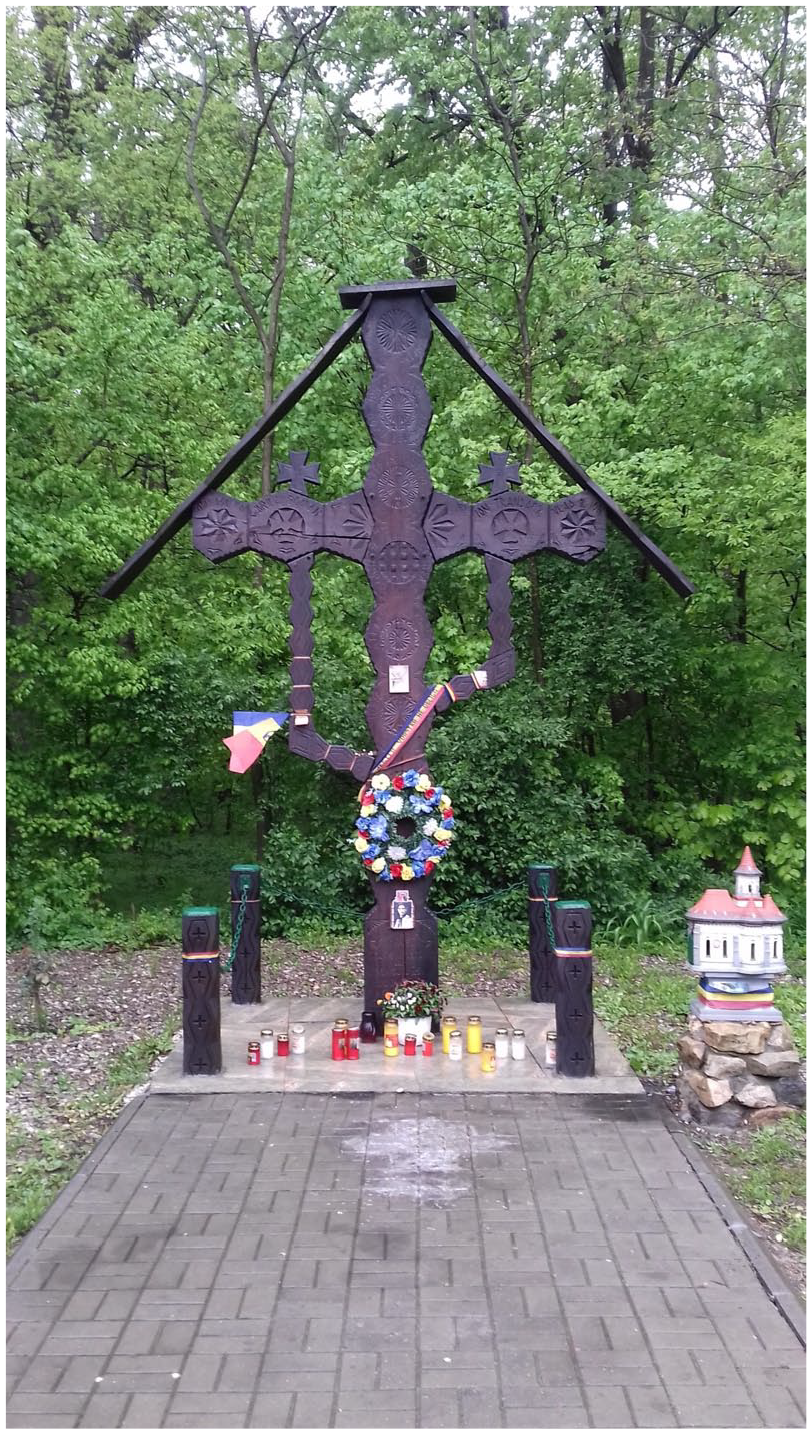
The Cross of Tâncăbeşti. Front.
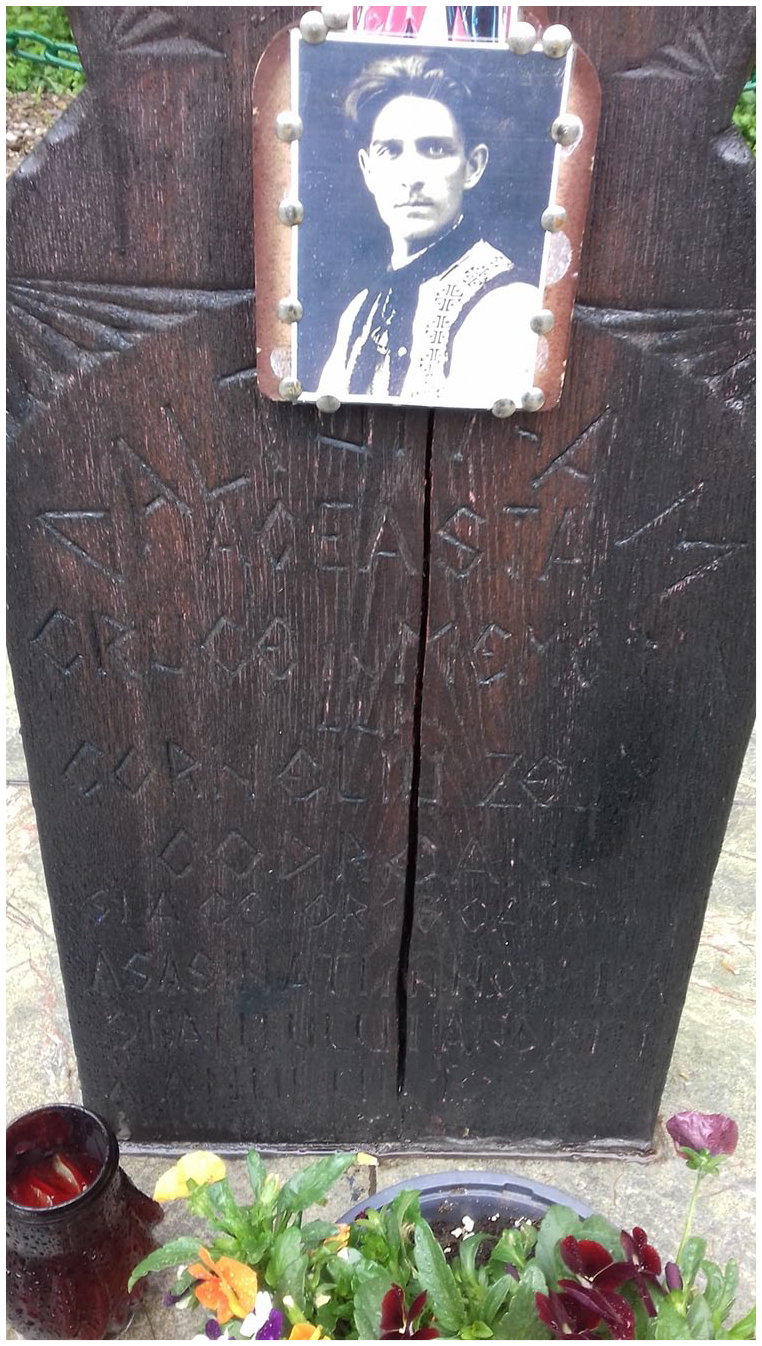
Cross of Tâncăbeşti, front base. Inscriptions and photo of Codreanu. The text says: ‘We raise / this / cross in memory / of / Corneliu Zelea / Codreanu / and of those 14 comrades / killed in the night / of Saint Andrei / of year 1938’.
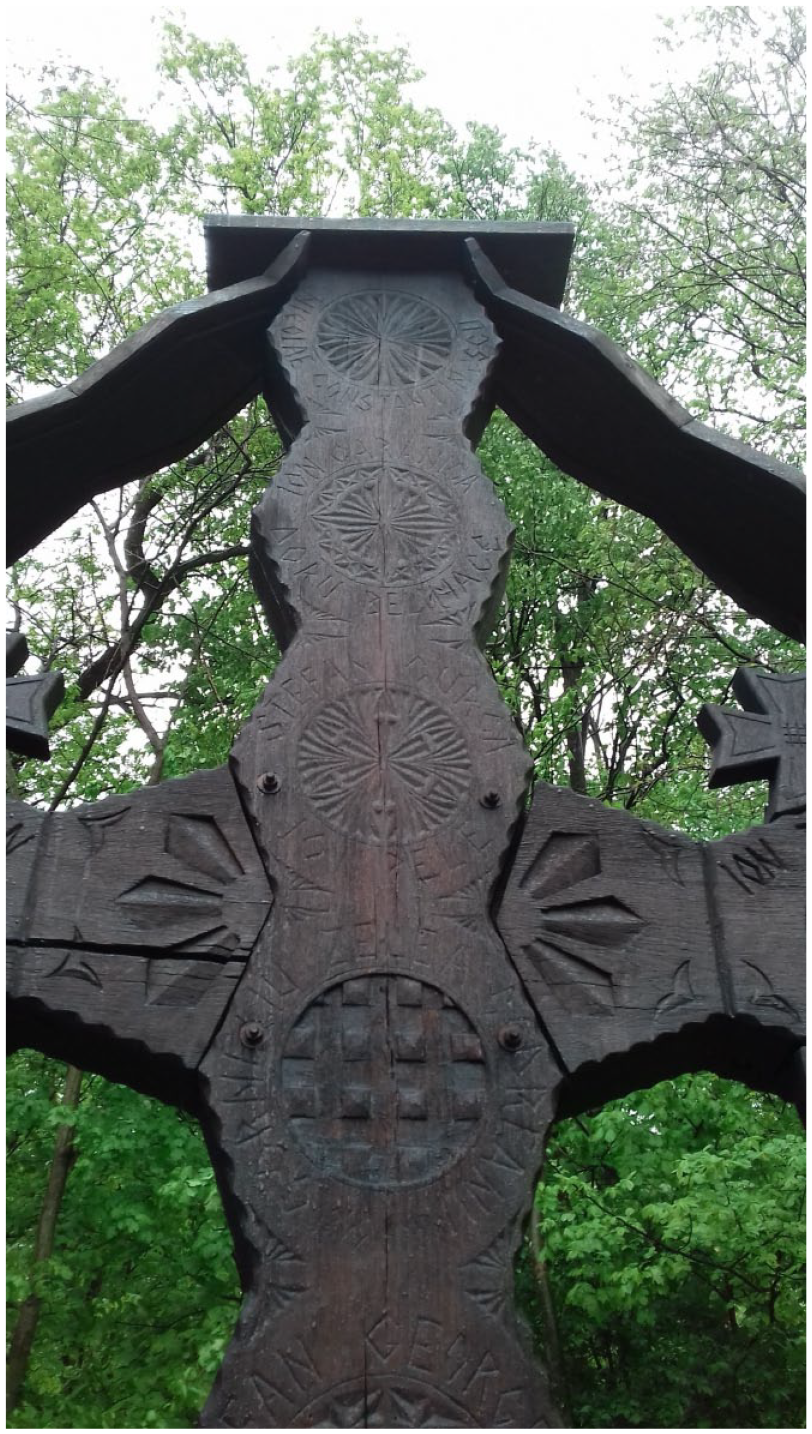
Cross of Tâncabeşti. Bars intersection.
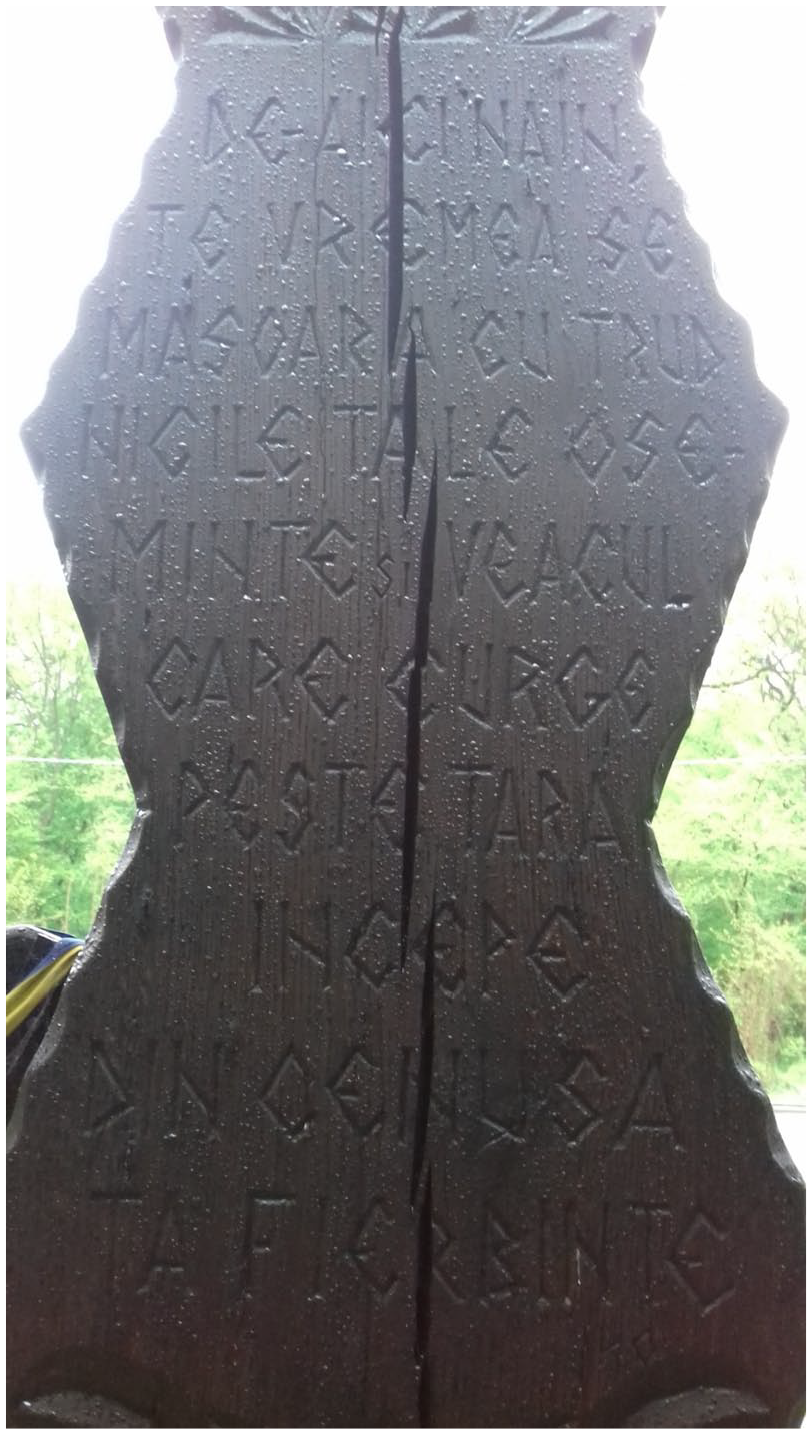
Cross of Tâncăbeşti. Rear. Verses by Radu Gyr: ‘from here on / time is / measured with your poor bon/es, and the age / that flows / over the country / starts / from your / hot ash’.
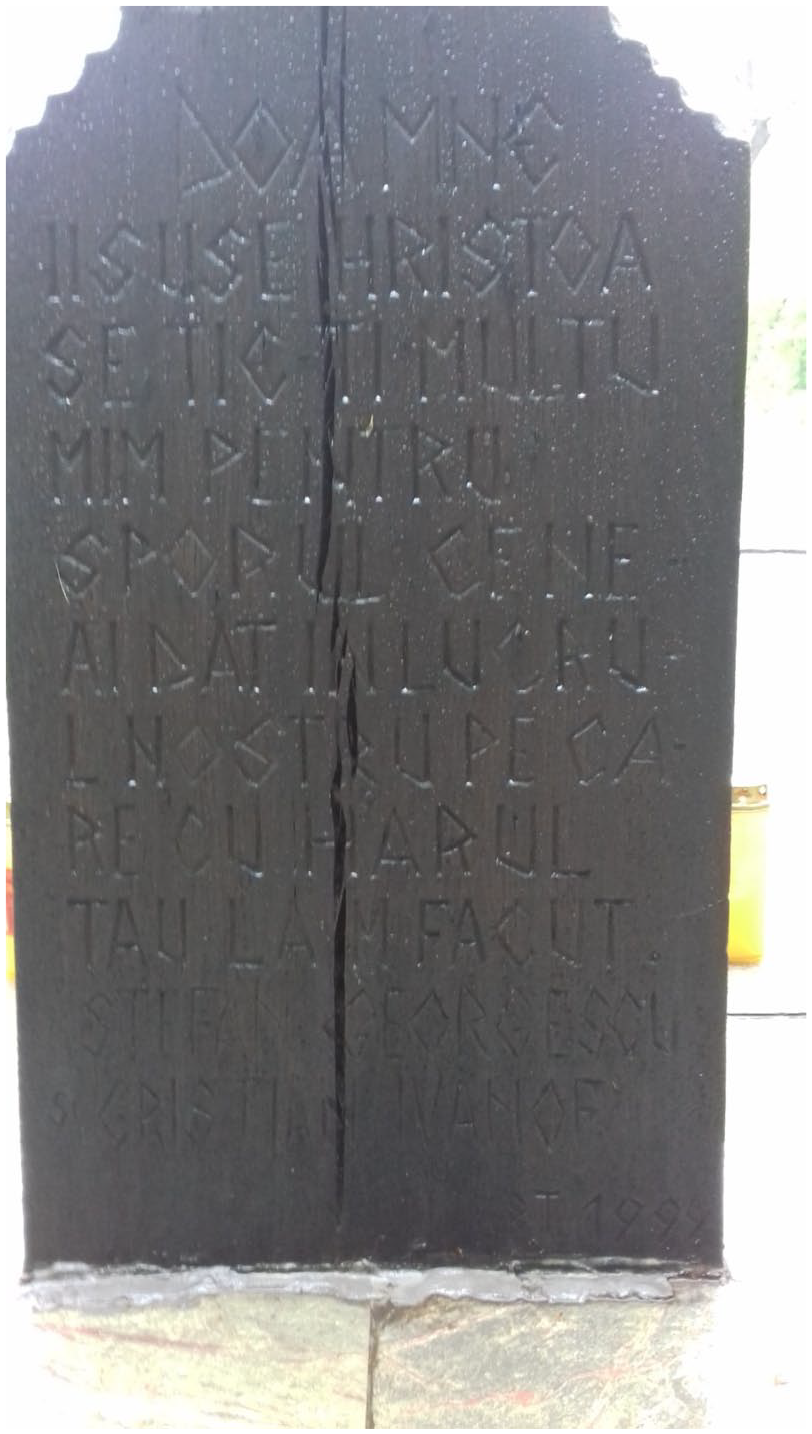
Cross of Tâncăbeşti. Rear. Dedication by the carvers: ‘Lord / Jesus Christ / we thank you / for / the success that / you gave us in our work / that with your grace / we have done / Ştefan Georgescu / Cristian Ivanof’.
Downplaying violence: A history of legionary memory entrepreneurship
The meta-narrative of martyrdom embodied in the Cross of Tâncăbeşti originates from the cultural memory of the movement, crafted in the interwar period and re-elaborated and transmitted by legionary memory entrepreneurs until the present day in historical accounts, poems, songs, written memoires, images, symbols and commemorations. However, the history of the movement is much more than the self-exculpatory narrative contained in its cultural products and materialised at Tâncăbeşti. By contextualising the cultural memory of the Legion in its history, highlighting its omissions and decontextualisations, it results evident that the Cross of Tâncăbeşti is a site for normalising organised intolerance through memory work.
In contrast to the Legion’s cultural memory, historical research shows that aestheticising and justifying violence was an integrant part of the movement’s politics and practices (inter alia Clark, 2015; Iordachi, 2006; Rusu, 2016: 254–255; Săndulescu, 2007). The Legion founder was a murder: in 1925, Codreanu killed Constantin Manciu, police prefect of Iaşi, in cold blood. In the process that followed, Codreanu presented Manciu’s homicide as an act of self-defence and was acquitted, despite the certitude of his responsibility (Clark, 2015: 52–54).
The other 13 legionaries commemorated at Tâncăbeşti were killers as well. They formed the ‘Nicadori’ (‘Killers’) and ‘Decemviri’ (‘Ten Men’) death squads. In 1933, the ‘Nicadori’ killed prime minister Ion Duca, opponent of the Legion. In 1936, the ‘Decemviri’ killed Mihai Stelescu, former legionary who had become a political opponent of the Legion; in both cases, the killers declared their responsibilities immediately, absolving the Legion of any legal or political responsibility (Biliuţă, 2013: 197–198; Veiga, 1995: 229).
Codreanu was a skilful memory entrepreneur. He sacralised the death squads, which sacrificed their freedom for the movement (Clark, 2015: 105). In 1937, with the death of legionaries Ion Moţa and Vasile Marin in the Spanish Civil War, Codreanu implemented an unprecedented work of sacralisation of the fallen, which involved a massive memory work (Săndulescu, 2007; Veiga, 1995: 231) finalised in political gain in the upcoming political elections (Figure 6). This work succeeded in turning the Legion into a mass movement. However, the establishment of the Royal dictatorship in 1938 nullified the efforts. The new regime erased the legionary memory work materialised in sites of memory throughout Romania (Clark, 2015: 218). The killing of Codreanu and of the two death squads was justified by staging their escape from custody. Since the police were conscious that the legionaries used memory entrepreneurship for political gain, the 14 bodies were disfigured, buried in a mass grave in the courtyard of Jilava prison, and covered with a huge quantity of concrete, so that they could not be commemorated (Cuvântul, 1940a).
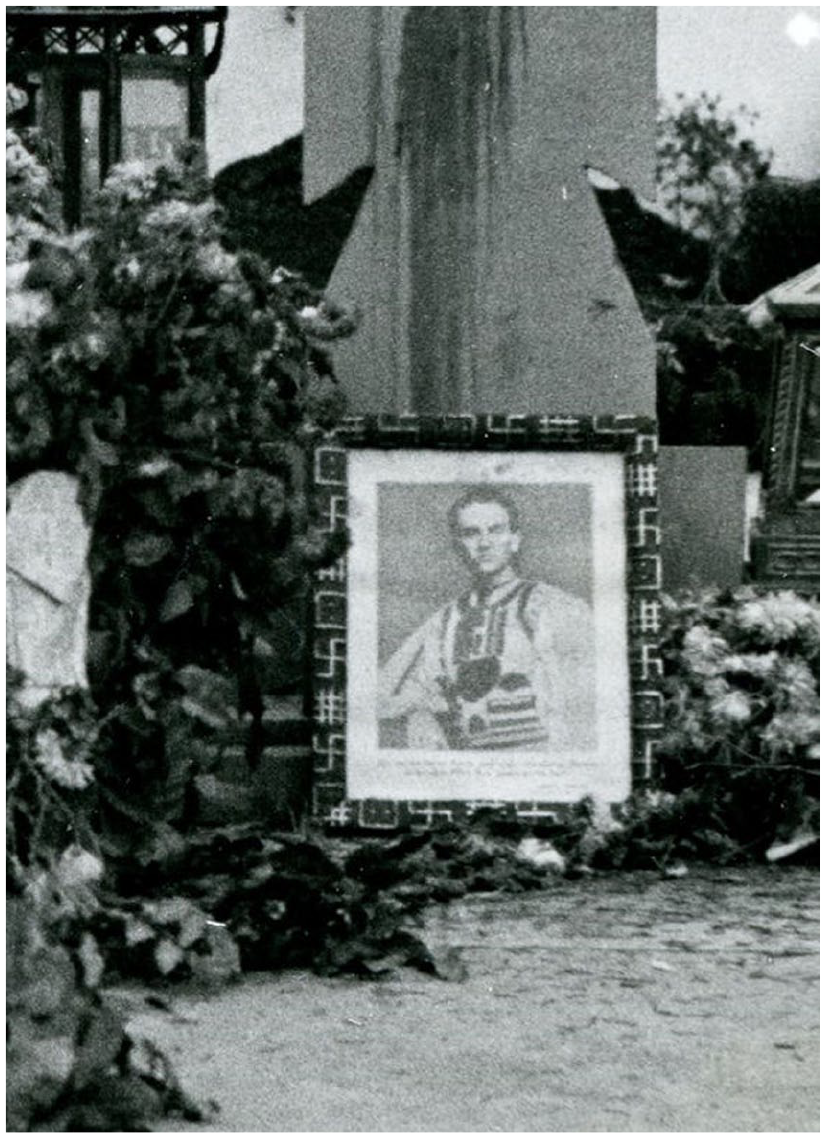
Funerary portrait of Ion Moţa, 1937. Swastikas, jail bars and the electoral symbol of the Legion are carved on the frame of the picture.
With the establishment of the National Legionary State in 1940, the movement became the only legal party, under the leadership of Codreanu’s successor Horia Sima, and of general Ion Antonescu as head of state. In order to consolidate his weak leadership (Deletant, 2006: 57; Iordachi, 2006: 43), Sima implemented the memorialisation of the fallen legionaries as a state cult. Sima had become a memory entrepreneur, and he publicly expressed consciousness that ‘the tombstones of the fallen are the foundation of our existence’ (Cuvântul, 1940b). Acknowledging Codreanu’s mystical leading of the movement from the beyond (Acţiunea, 1940), Sima established memorial days (Porunca Vremei, 1940) and ordered the exhumation and inhumation of the fallen (Universul, 1940). The funeral of the 14 legionaries of Tâncăbeşti in Bucharest, held on 30 November 1940 (Figure 7), should have become the highest point of this memory work (Biliuţă, 2013: 290–292). Specifically, the operations held in the courtyard of Jilava for exhuming the remains (Figures 8 and 9) were central to Sima’s strategy (1982, chapter 1). However, this operation was downplayed by the media since, in the same days, the legionaries implemented three massacres, killing 66 victims and putting at risk the credibility of the government.
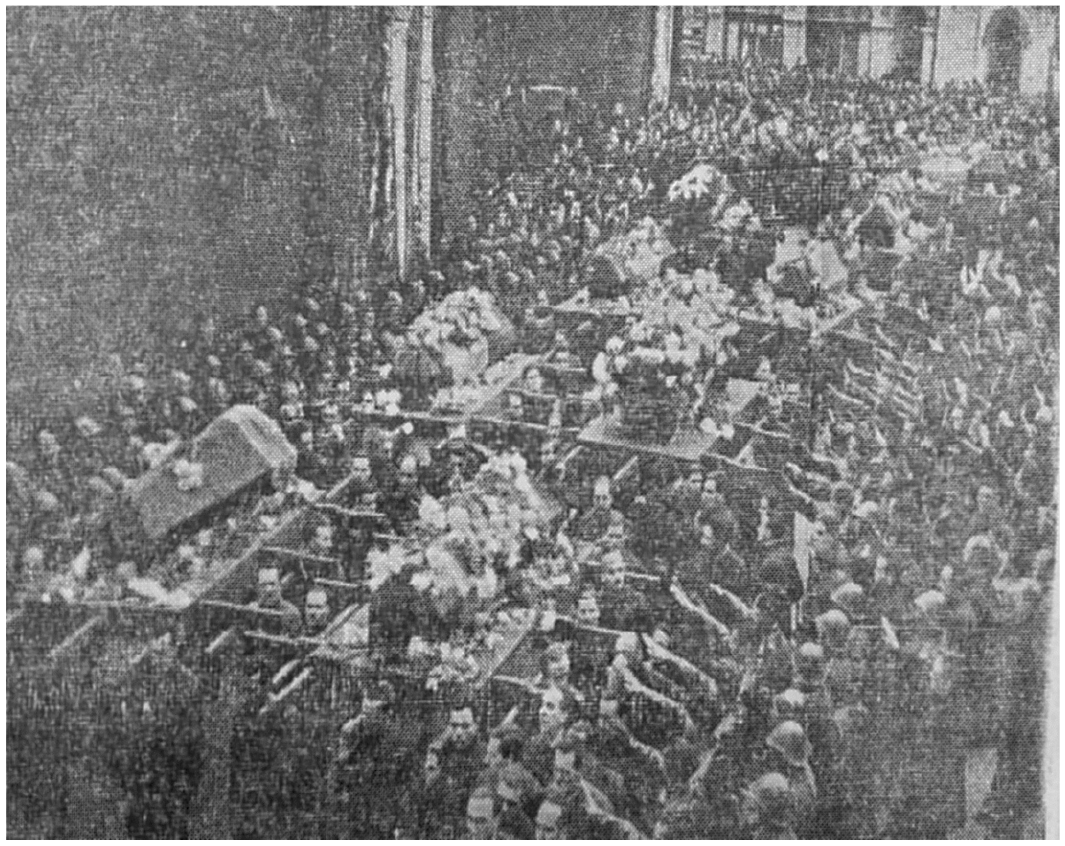
The funeral march for Codreanu, Nicadori and Decemviri, in front of the Church of St. Ilie Gorgani, Bucharest, 30 November 1940 (Cuvântul, 1940c).
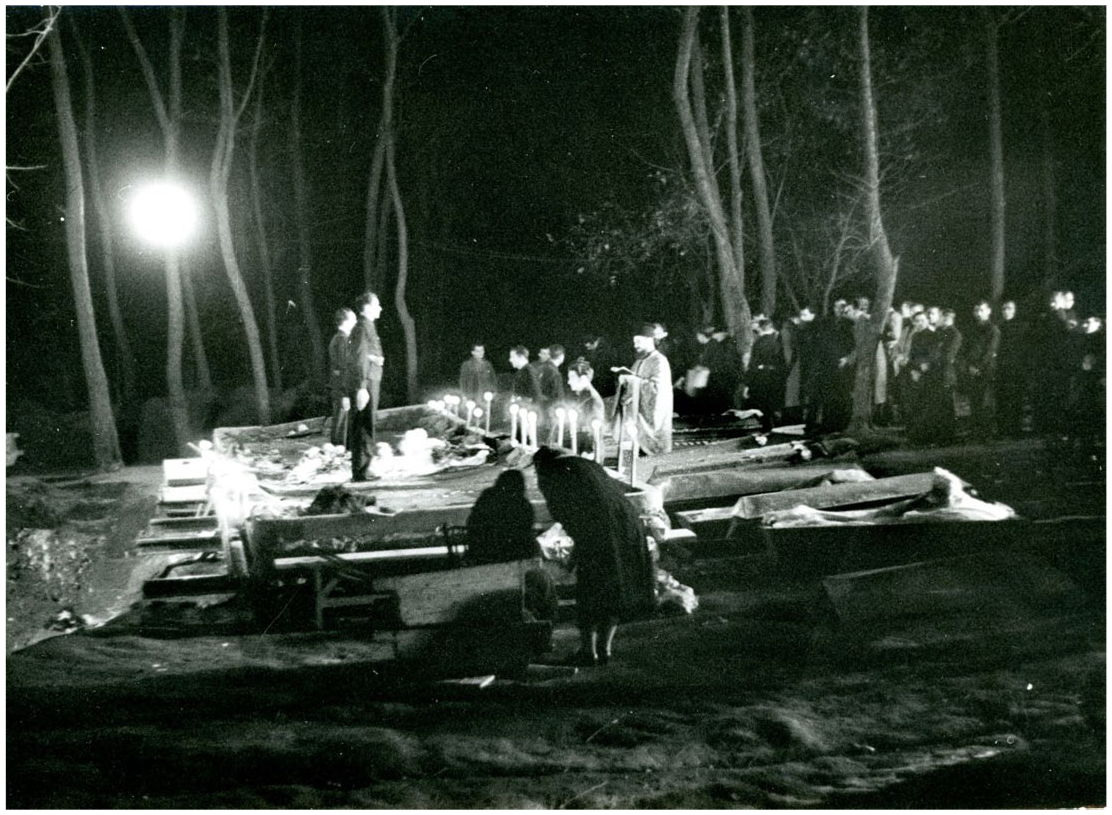
Exhumation of the 14 legionaries killed in Tâncăbeşti in the courtyard of Jilava prison, 27 November 1940.
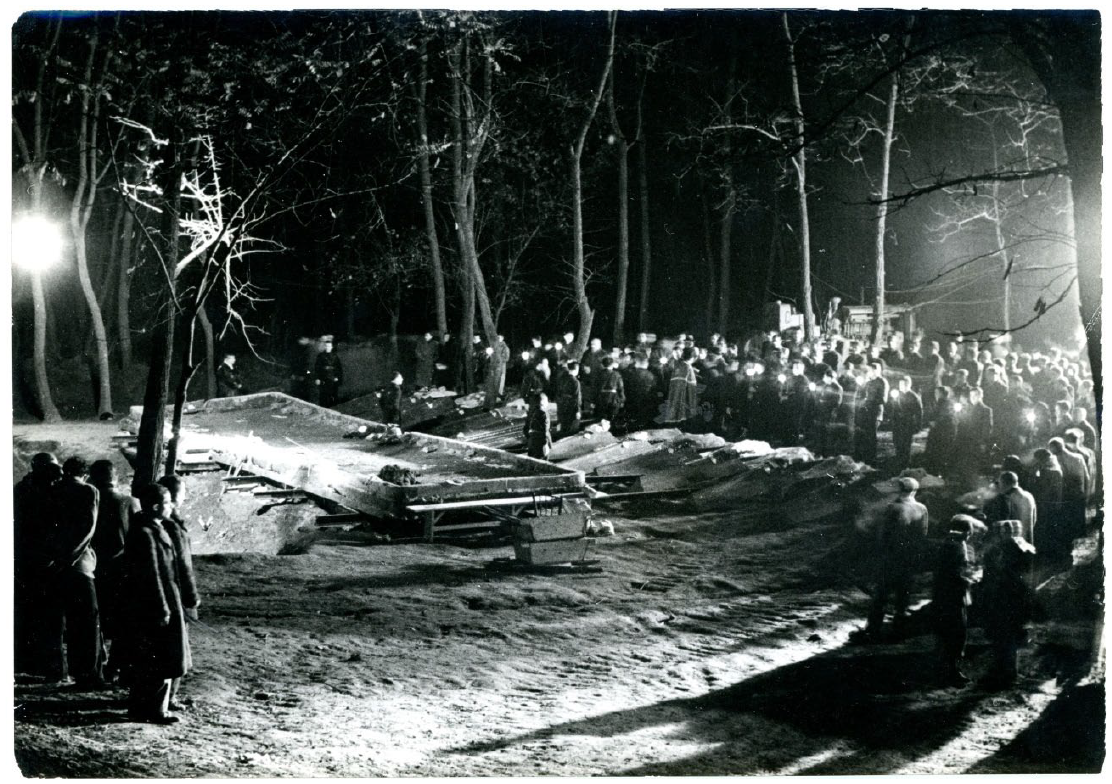
Exhumation of the 14 legionaries killed in Tâncăbeşti in the courtyard of Jilava prison, 27 November 1940.
In January 1941, Antonescu got rid of the legionaries, allowing them to first implement the pogrom of Bucharest (International Commission on the Holocaust in Romania, 2004: 4–7). With the help of the Nazis, the legionary hierarchs repaired to Germany, where they continued their collaboration, and their memory work, until the end of WWII (Figure 10). During the Cold War exile, Sima repaired to Spain and continued to invest in memory entrepreneurship, supervising also the commemorations at Majadahonda (Figure 11). In Spain, the wood of Tâncăbeşti had been popularised as place of martyrdom in several poems and posthumous memories which reached the exiled legionary groups worldwide. After 1989, the exiled legionaries could pass the torch back home, by shipping books and journals to old legionaries and young sympathisers. That corpus of cultural products, which contained basic knowledge on how to frame and stage the Legion’s past for political return, favoured the education of new generations of legionary memory entrepreneurs in post-1989 Romania. The cult of Tâncăbeşti was one among many narratives created to assist the memory entrepreneurs in framing and staging the Legion as a movement of martyrs.
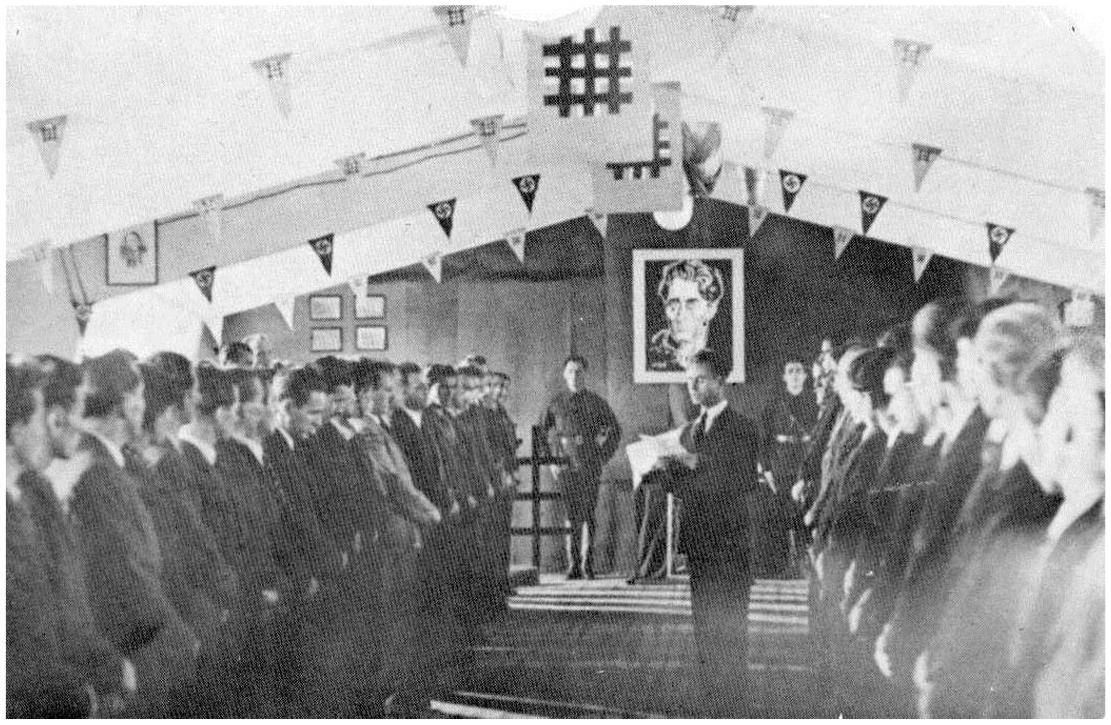
Jail bars and swastika pennants adorn the hall of the barracks of Marienehe near Rostock, Germany, for an official gathering of the exiled legionaries, 1941 (Borobaru, 1977: n. 26).
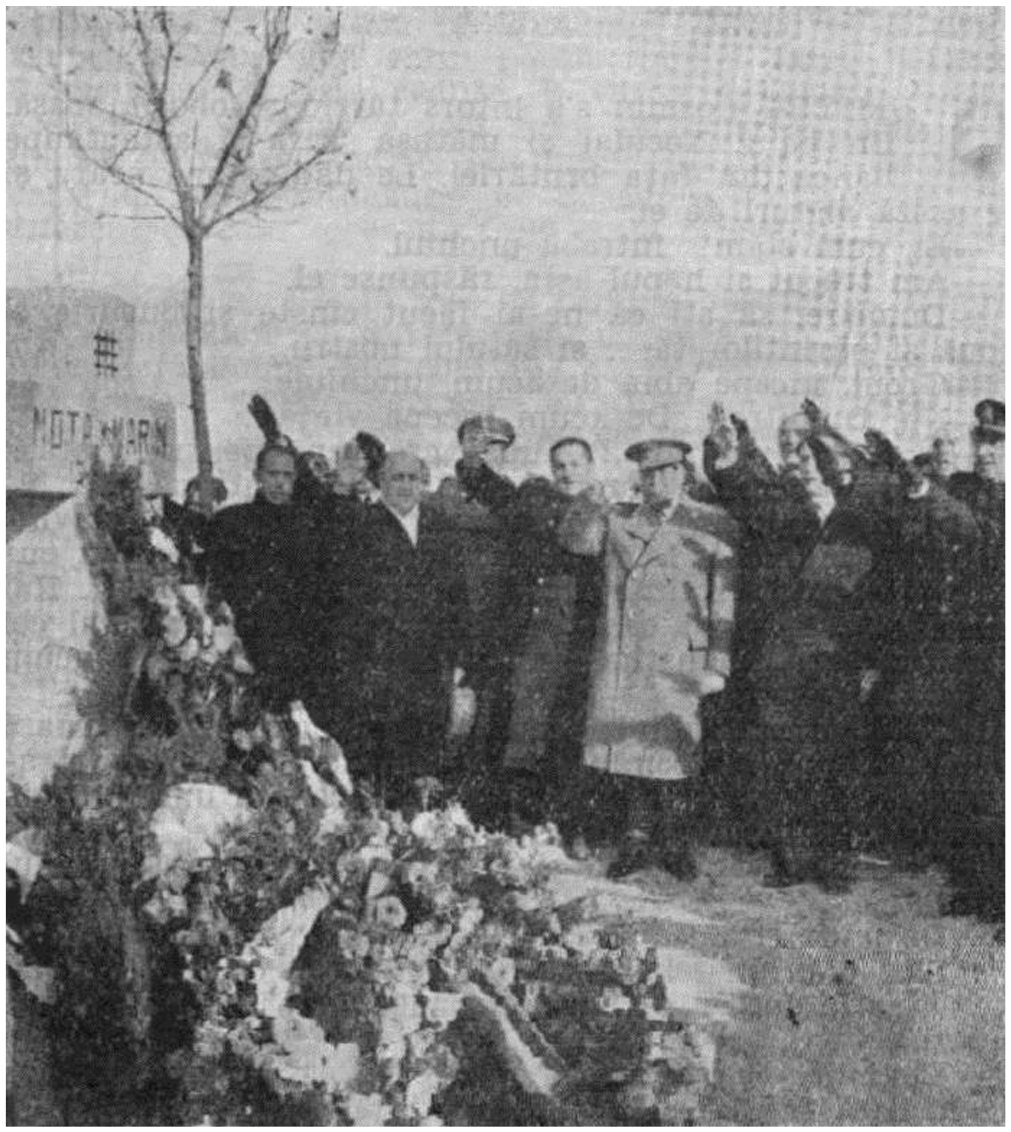
Commemoration at Majadahonda, Spain, in front of the cross in remembrance of Ion Moţa and Vasile Marin, 13 January 1957 (Carpaţii, 1957).
Contesting a normalised site of memory
The political lack of success of the legionaries in post-communist Romania may be only temporary and, for this reason, the presence of its discourse in the public space should not be underestimated (Cinpoeş, 2012). The normalisation of the Legion as a movement of victims of communism and prisons’ saints may prospect a bright future for organised intolerance. The Cross of Tâncăbeşti is the most explicit sign of warning that the movement still promotes messages of intolerance that should not be ignored. Awareness that the site attempts at normalising organised intolerance has been voiced since 2012 by the Elie Wiesel Institute.
The Institute started to contest the site in April 2012, issuing a petition to the Higher Court of Justice. The cross, it was reported, carried fascist symbols and pictures that promoted persons responsible of actions against peace and mankind, in violation of the 2002 memory law. 1 The Prosecutors of the Court of Buftea, to whom the petition had been forwarded, replied that there was no infraction among those listed in the law: ‘Codreanu, in his quality as leader of the Legionary Movement’, they wrote, ‘cannot have the status of a “person guilty of committing crimes against peace and mankind” in the sense of the legal text’. The cross could not be considered ‘propaganda’: the symbols could have been displayed ‘with scientific or educative aim’. Finally, the Prosecutors declared that ‘in absence of data or sound evidence regarding the existence of an organisation with fascist, racist, or xenophobic character’, no legal action could be taken. 2
The Institute appealed the decision, stressing that since the symbols were on-site, somebody must have put them there. It also pointed out that on the site two unauthorised masts with symbols were present. Furthermore, it contested the suggested educative or scientific aim of fascist symbols in a site which is placed just some meters from a highway (Figure 12) and in which no indication that scientific or educational activity is held there is present. According to the Institute, the Prosecutors had overturned the meaning of the law, since those symbols were aimed at promoting hatred. 3 However, the Prosecutors turned down the Institute’s appeal. 4 In consequence of a further appeal to the Higher Court of Justice, 5 the Prosecutors decided to not proceed regarding the promotion of legionary ideas, but they choose to acquire further evidence regarding the establishing of a hate organisation and the possession, selling and spreading of legionary symbols. 6
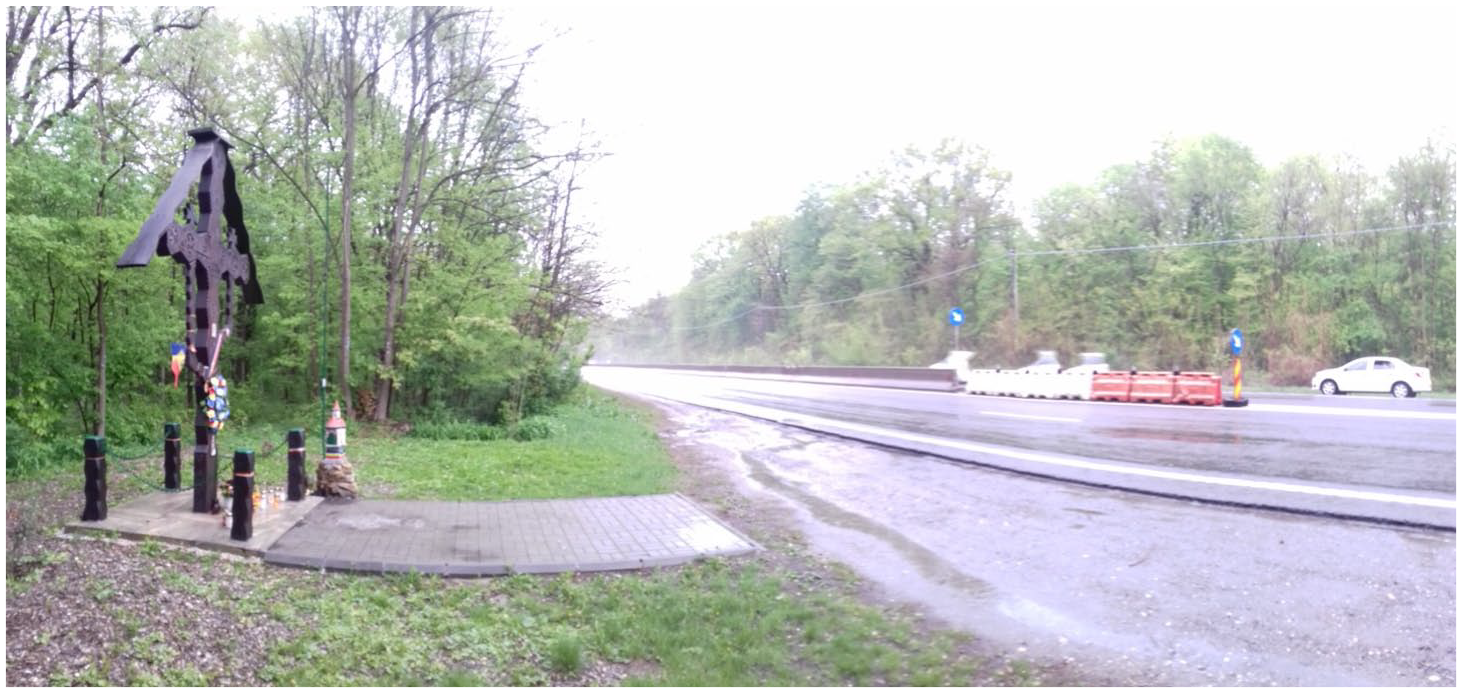
Placement of the Cross of Tâncăbeşti.
The Institute also started a parallel inquiry to check by which legal criteria, not pertaining to memory laws, the cross had been built in 1999. The Bucharest Regional Direction of Roads and Bridges informed that the monument had been built on public ground ‘after some authorisation issued by the Municipality of Ciolpani’. 7 The Municipality subsequently communicated that by 1999 it was not responsible for the issuing of building authorisations on public land, but it informed also that back in 1999 it had advised positively regarding ‘locating a commemorative cross’, after a petition by the two artists and Codreanu’s brother. 8 However, the favourable advice given by the Municipality, the Regional Council of Ilfov explained, should have been preceded by the issuing of a certificate of urbanism requested to the Council by the Municipality; the favourable advice given by the Municipality to the legionaries was not preceded by the issuing of such authorisation. 9 Therefore, the monument is an abuse, as also notified by the National Commission for the Monuments of Public Domain, and the Municipality of Ciolpani was (and still is) obliged to take charge of the matter. 10 In October 2012, the Institute informed the Municipality that it had a prerogative to tear down the cross, 11 but it received no answer.
Nor did the 2015 memory law against legionarism had an effect on the site. The law succeeded only in preventing Codreanu’s picture and legionary symbols from being exhibited in the site for some years. The commemorations at Tâncăbeşti continued and after a few years the symbols reappeared.
Conclusion
Far right sites of memory serve to normalise groups dedicated to organised intolerance. Their makers, the memory entrepreneurs, know how to differentiate the materialisation of the memory work in order to maximise its impact. In the Romanian context, the legionaries either hijack strategically discourses on the communist past and help other groups in spatialising their memory in sites of memory but, as shown, they also establish nostalgic sites dedicated to the Legion and its fallen. Both typologies of sites are aimed to present the Legion and its members as victims of evil forces. At present, the support to other memorial discourses is the main means by which the legionaries strive to manipulate the state-endorsed memory politics. However, openly nostalgic sites are equally important, since they serve to foster the cultural memory of the movement among competing factions and to present the Legion to the national audience as a movement of martyrs and as a community of remembrance. As shown by historical contextualisation, the entire cultural memory on which the legionary memory entrepreneurs rely for normalising their messages omits a murderous history. Knowledge on how to escape history is a direct inheritance transmitted from the interwar era across the two centuries in a myriad of cultural products and commemorative practices; turning to profit such inheritance is up to the skills of the memory entrepreneurs. As shown, the Cross of Tâncăbeşti omits from its narrative the homicides committed by the 14 legionaries there commemorated; in this way, the site appears to be one among the many present in post-communist Romania for commemorating subaltern victims. Post-1989 Romania has proven to be a safe harbour for these kinds of memory games played in the public space: illegal under many points of view, the site considered is still in use, despite the several protests by the Elie Wiesel Institute, which opposed to the normalisation of organised intolerance by struggling for neutralising a product of the memory work of the legionary memory entrepreneurs.
Footnotes
Acknowledgements
I wish to thank Andrej Kotljarchuk, Irina Sandomirskaja, Dragoş Petrescu and Cristina Petrescu for their constructive criticism on the seminal version of this study, presented in November 2019 at the conference Central and Eastern Europe 1989–2019: Orders and Freedoms, organised by the Centre for Baltic and East European Studies at Södertörn University, Sweden. I thank also the two anonymous peer-reviewers for their insightful comments on a previous version of this article.
Declaration of conflicting interests
The author(s) declared no potential conflicts of interests with respect of the research, authorship, and/or publication of this article.
Funding
The author(s) disclosed receipt of the following financial support for the research, authorship, and/or publication of this article: This research has been financed by the Foundation for Baltic and East European Studies (Östersjöstiftelsen, Sweden) through the research project ‘Memory Politics in Far Right Europe: Celebrating Nazi Collaborationists in Post-1989 Belarus, Romania, Flanders and Denmark’, based at the Institute for Contemporary History, Södertörn University, Sweden, between 2018 and 2021, under grant n. 40/17. The 2019 research trip to Bucharest, Romania has been financed by Helge Ax:son Johnsons stiftelse under grant n. F18-0306.
