




Abstract
This article proposes the concept of sustainable flood memory as a critical and agentic form of social and cultural remembering of learning to live with floods. Drawing upon research findings that use the 2007 floods in the South West of England as a case study, we explore and analyse the media representations of flooding, the role of community and communicative memory of past floods for fostering resilience, and map emotional and affective responses to floods. To approach flooding in this way is critical to understanding how communities engage in memory practices (remembering and strategically forgetting) in order to cope with environmental changes. Moreover, the article embraces a research design and strategy in which ‘memory studies’ is brought into a conversation not only with geography (mental maps), social sciences and flood risk management policy but also with stakeholders and communities who collect, archive and remember flood histories in their respective regions.
Keywords
Introduction
Floods vary in kind and severity, but at worst they can be catastrophic in their impact on individual and collective (community) wellbeing. Having said that, it is also the case that their impact can often bring new collectives into existence, with increased possibilities for being social as a flood community (see Jencson, 2000; Oliver-Smith and Hoffmann, 1999). The materialisation of flood remembrance, for example, in texts, images, (social) media, landscape, shared practices, depends upon the social, cultural and economic conditions of a potential collective in the geographical area at flood risk. While the cultural memory of flooding may well be alive and attached to feelings of resilient community in one section of a floodplain, further down river, personal memories of past floods may be hidden, forgotten or ignored. As the river moves through regions and settings, carrying a mnemonic capacity to imprint landscapes as well as minds, the capacity for sustaining flood memory is mobile and in flux.
Within the media-scape, flood narratives are equally dynamic. They are recorded and represented nationally and globally as human stories of natural disaster, that issue forth a politics of vulnerability and/or triumph. Memorable data as tweets also become mappable along floodplains (see Graham et al., 2012). The aftermath of a flood requires a multi-stakeholder response debated in the mediated public sphere of news broadcasting and print editorials. An environmental policy around flooding is as much a media and cultural policy of remembering to live with water as it is hard engineering and dredging. In this article, we offer a theoretically informed analysis of visual and interview data of remembering and forgetting practices of and in flood risk communities within a geographic region of the United Kingdom. This research formed part of the Sustainable Flood Memories Project (2010–2013) funded by the Economic and Social Research Council (ESRC), and our focus was upon the value and function of flood memory as a tangible and travelling discourse, form and practice within and across settings.
The project sought to increase understanding of how flood memories provide a platform for developing lay knowledge. The aim was to create social learning opportunities in communities for adaptive capacities and flood resilience. The notion of community resilience can be viewed through a series of different lenses – institutional, infrastructural, psychological; social, economic, cultural, environmental; and coping or adaptive (see, for example, Norris et al., 2008; Steiner and Markantoni, 2013). Recent catastrophic floods in the United Kingdom continue to impact adversely on human livelihoods, highlighting both the limitations of strategies that solely rely on ‘expert’ flood knowledge, and the potential value of integrating lay knowledge in flood risk management (FRM) (McEwen and Jones, 2012). What is often missing from knowledge exchange activities between experts and communities is the role that memory plays both on the ground and in organisational and institutional narratives.
Background contexts
Recent research critically reflects upon floods and their representation. The following have addressed contested or competitive mediations of flooding within nations and regions during and after events: the Tsunami of 2004 (see Hastrup, 2008), Hurricane Katrina in 2005 (see Littlefield and Quennette, 2007; Robinson, 2009), the Pakistan Floods of 2010 (see Murthy and Longwell, 2013), the Brisbane Floods of 2011 (see Bohensky and Leitch, 2013), and the representation floods from the 1950s to 2000s in the United Kingdom (see Escobar and Demeritt, 2012; Furedi, 2007). However, the social and cultural differences between these flood events are not only a result of the climatic and geographic distinctions between regions and weather systems but also the dynamic inheritance of social attitudes towards water embedded in place and context while travelling across settings. From local modes of storytelling to national news and social media networking, floods are iterative, itinerant and relational, offering up insights into change as well as acknowledging continuities in local community experience.
Elsewhere, we have written in depth about our concept of ‘sustainable flood memory’ (see McEwen et al., 2012). This is conceived as an approach to memory work that is community-focused, archival, integrating individual/personal and collective/community experience, involving inter-(vertical) and intra-(horizontal) generational communication, with concern for the future. Such memory is ‘sustainable’ in the sense that it creates and supports the conditions for its furtherance, with strong attention to knowledge exchange and social learning, and to using associated lay expertise in delivering on future resilience needs. Here, we consider flood memory as the narratives, oral and archived histories and folk memories of previous flood events and their impacts that are embedded in local communities’ heritage and culture. Living with floods and flood risk can become a part of peoples’ individual, family and community memory and identity, which makes it dynamic, mobile and shareable but also easily lost, neglected or silenced.
In the broader context of communicating water issues, Stedman (2014) has noted that the water sector can be a subject of intense emotion […]. It is such a vital sector that its activities affect people in a very direct and personal way, and this significant level of concern must be understood and respected in order to communicate well. (p. 126)
Furthermore, as Linton (2010) states, ‘water [as a cultural/political issue] is everywhere’ (p. x). This is clearly so for flooding, as in the United Kingdom and globally there have been a series of severe flood events and, in relation to climate change, flood risk looms ever larger across many areas previously imagined not to be at risk. ‘Sustainable flood memory’ research is a proposed intervention into water communication that demonstrates how the discursive terrain of thinking water has become necessarily multi-disciplinary on the one hand and stakeholder/community engaged on the other (see Herve-Bazin, 2014).
In popular writing, floods continue to offer connectivity across time and place – as in Withington’s (2013) Flood: Nature and Culture which converges Noah, the China floods of 1931, and the broken levees of New Orleans – offering historical repertoires of disaster (see also Kempe, 2003). This may imply a collective memory of flooding. It may also assume that there is nothing working against personal remembering and resilience within and outside the flood risk area, such as the economic drive to move on (‘business as usual’), a resistance to collective victimhood (‘our finest hour’), the mediation of flooding as traumatic (‘we need to forget’) or the flood as rare/extreme (‘the one in one hundred year event’). The media templates of deluge, disaster or even problematic ‘cleansing’ of a built environment in response to floods may even further forgetting.
Therefore, in developing a site-specific and applied memory approach to flooding in selected catchment areas along a river system in England – with differing lived experiences and relationships to that river – it becomes less easy to apply a historical rupture thesis whereby cultural narratives of resilience are said to give way to narratives of vulnerability. As in Gutsch’s Ohio River (US) research in 2011, in which a ‘mental mapping’ methodology (see Cloke et al., 2004; Gould and White, 1986; Lynch, 1980; Wood, 2010) engaged communities in visualising the river, we also approached flood risk and resilience from the perspective of narrative. This was in terms of ‘connecting’ extant flood materialisation and creating new narratives by bringing people together to share experiences, memories and anecdotes.
While we did not undertake ‘mental mapping to construct [a] place’ (Gutsch, 2014: 105) of flooding that we could decode through stories, we did explore memories of flooding as always already produced by and through a watery sense of place. It was from the perspective of water, the river and the flood that we sought to gather, connect and construct transferable and mediated memories. If places defined by rivers and floods are to be interpreted by researchers then we need approaches that not only elicit stories from mapping the self in relation to place but that also ‘story’ water in relation to the self and community. Future research may wish to extend this idea into exploring water’s memory (its chemical composition as an archive of human stories) and storying the river as a reflection of a social mentality at any given point in time. To start with personal and community immersion in (narratives of) water (its abundance and scarcity, its destruction and vitality), is a response to Furedi’s call for ‘a more systematic engagement with the historical dimension of disaster consciousness’ in his analysis of flood narratives in the United Kingdom. Thus, we offer our flood memory as an opportunity to ‘illuminate the distinctive features of the contemporary response to adversity’ (Furedi, 2007: 250) as deeply personal, somatic and affective. The aim is to draw upon a wider repertoire of agentic, resistant, mnemonic tactics that individuals and communities may or may not inherit, remember and re-use that a focus on the broader contextual historical and collective narratives of flooding may miss. These tactics cannot always be textually analysed by the researcher nor easily communicated by media, but they are connective and mobile.
About the ESRC Sustainable Flood Memories Project
Floods in the United Kingdom continue to impact adversely on human livelihoods, highlighting both the limitations of ‘expert’ flood knowledge and the potential of lay knowledge in FRM (McEwen and Jones, 2012). The need to link ‘elite strategies to daily life’ is very much at the heart of the political economy of disaster and risk management (see Jones and Murphy, 2009: 5). In the case of catastrophic events, such as the 2007 UK Floods, the control of the elite production and consumption of flood knowledge provided both constraints and opportunities. The emergence of more visible, distributed flood awareness through social networks suggests that new technologies of remembering and connecting flooding are emerging. In the light of this, we determined an urgent need post-2007 to evaluate the extent to which, and in what ways, community flood memories contributed to local/lay flood knowledge that build resilience to changing flood risk and flood events. It was the emphasis upon flood memory that was unique to the way we designed and executed the research: not only through analysis of extant flood heritage and materialisation in the region but as produced by the participants in our research as stakeholders, actors and followers of flooding.
The UK ESRC funded interdisciplinary research project ran from 2010 to 2013 and comparatively studied four floodplain settings in the lower Severn Valley, United Kingdom, after the extreme 2007 floods. These floodplain groups have different histories, forms and levels of past flood experience, and different degrees of community development. It was their ‘watery sense of place’ post-2007 that connected the settings through their shared and increasingly mediated collective memory of extreme flood and water scarcity. However, the selection of the case study settings was based upon a large and varied amount of demographic data (i.e. population size, living arrangements, households with lowest floor level above ground, old/new build property, age, gender, ethnic group, household composition, qualification levels, rural/urban, employment levels, transient/permanent population, average distance from river, average distance to commute to work, regularly flooded or first time). The project aimed to evaluate the extent to which communities with a history of past flood events are more resilient to future floods than communities with no previous flood history, or floodplain groups without any shared memories of flooding. Similarly, we were also interested in the emergence of new digital technologies for recording, sharing and remembering flooding across settings. Below we outline the aims, methods and methodological issues of the project, before exploring emergent themes from the results and drawing out the important role of emotion, affect, trauma and active forgetting as constitutive features of a sustainable flood memory.
Flood memory work methodology
Our ‘sustainable flood memory’ approach was based upon a site-specific, interdisciplinary methodology of memory work, visual ethnography, archival research, oral history interviewing, and flood agency reflections. In what follows, we present the methodology that sought not only to understand the mechanisms by which flood memory is (or is not) sustained in the region and on the ground but also how our project produced flood memory as an outcome. Our research of flood resilience through flood memory took into account long-standing personal and collective memories of flooding, the trauma or excitement during flood events, and the variety of mechanisms whereby communities already create, store and re-purpose their flood knowledge. This entailed working closely, carefully and ethically with communities and individuals. Some of these were still traumatised by their experiences of floodwaters destroying their homes but nevertheless wished to share their experiences, have these recorded and not forgotten. There was only one case in which a very valuable respondent to an earlier project, who had previously created a digital story for YouTube on her traumatic experience of the 2007 flood, broke all contact with the project team. This may have been due to ‘flood fatigue’ (‘i.e. people wanting to move on and not dwell on the past’ (see Walker et al., 2010: 86)) as the same respondent declined to be involved in flood anniversary activities. There may of course be other reasons for this withdrawal. ‘Flood fatigue’ was a term more used by the local media organisations, but was also declared to us by other respondents, as a form (or tactic) of forgetting.
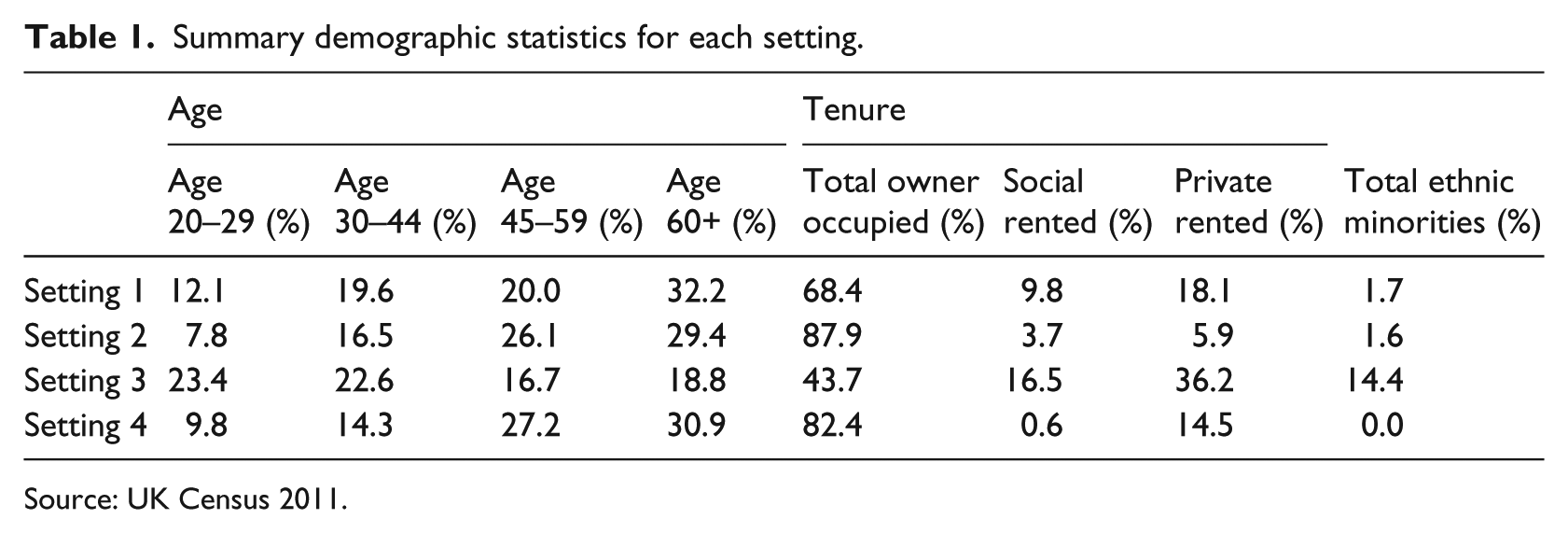
The four floodplain settings comprised the following (see Census Data, Table 1):
Summary demographic statistics for each setting.
Source: UK Census 2011.
Setting 1. An established urban community with a significant history of episodic extreme floods, regular experience of flooding, and corresponding flood memories. This is a small town with a mixed demographic of ages and social classes, small and large housing developments, good access to services, roads and employment. The topography of the town is at the confluence of two rivers, sandwiched between a heavily used motorway to the East and the Cambrian Mountains to the West.
Setting 2. A ‘newer’ urban community with no previous flood history (with no widespread flood experience since 1947, and parts built after 1947) but which was badly flooded in 2007. The latter is characterised by estates built in the 1960s, and the 2011 census indicates that it contains a higher proportion of retirees than the town average but with lower levels of unemployment. This setting is adjacent to Setting 1 and so shares the same topography.
Setting 3. A floodplain city ward with a history of extreme flooding including recent experience in 2007, and with significant transient or intermittent residential patterns. This is a densely populated area (relative to size) of a key city in the region, comprising of lower income families and individuals, social housing and includes a traveller settlement. It is of mixed age with some transitory occupants and although ethnic diversity is not a key feature of this particular setting (which is located near the river), the wider city does have a longer history of immigration. This setting is topographically broader and flatter, and acts as the lower floodplain of the river on its route to the sea.
Setting 4. An established rural community with a significant history of episodic extreme floods over many centuries. These are small groups of houses, with a higher than average age for the area, comprising retired professionals, farmers and settled owner-occupiers, who are all White and middle class. Close to a designated Area of Outstanding Natural Beauty, Setting 4 presents as a typical Cotswold village surrounded by buildings and landscape features of historical and cultural interest. It is a well-preserved and tended environment with high levels of social, cultural and economic capital. The enterprising farmer at the centre of village life (only resident who lived through the 1947 floods) is also a living archive of flood memories, documentation and past resilience strategies.
A total of 65 residents were interviewed in-depth across the case study settings, using snowballing techniques and a quota approach to sampling on the basis of gender and age (but not ethnicity). The method sought to identify interviewees who would have strong memories of the 2007 floods, as well as past floods. These interviewees self-selected or were selected by the researchers because they were keen to share their memories and watery senses of place.
These interviewees were typical of the settings, in so far as they represented those who were interested in local flooding, had been affected by the severe 2007 flood, or had historic memories of flooding and community they wished to share. Of course, this did not capture every memorable experience of the 2007 floods from these communities and did not mean the interviewees were indexical to the entire communities’ memories of floods. On the one hand, the research team found it difficult to engage younger members of all these communities in the research (18–25 and 26–40 age groups), which suggests an identifiable disinterest based on age, demands of employment/families, ownership of property and settlement across the settings. On the other hand, the interest in flooding among our interviewees flowed across the settings (as the river does), while revealing some setting-specific differences. Selecting for typicality (i.e. viewing the memories as coming from a contained cultural memory of living with/without floods), and also selecting for interchanges (i.e. recognising that water is always in transit across communities) was the balance we struck. As Erll (2011) has argued, ‘Mnemonic constellations may look static and bounded when scholars select for their research, as they tend to do, manageable sections of reality (temporal, spatial, or social ones), but they become fuzzy as soon as the perspective is widened’ (p. 14).
We sought to widen our perspective on flood memory from a detailed focus upon class, ethnicity and socio-economic status or upon the representation of floods in specific content, carriers or containers of flood memory (see Erll, 2011). To mentally map the place of flood could make ‘place’ a container of those memories that might be in danger of creating a cultural ‘levee syndrome’ (memories held back and repressed) in which we have contained not only the river but also the ability to remember and thus imagine water differently. To collect, connect and reinforce flood memories is to accept that flood communities and flood communication are not always rational. In fact, we could use the workings of flood memory to explain how the collective memory of disaster decays over time (such as in Gould and White’s reference to the 1906 San Francisco earthquake), and needs that ‘sharp jolt of reinforcing information’ (Gould and White, 1986: 28) that memory work provides. Thus, we offer a broader perspective on how people at flood risk live in permeable communities, to both water and to remembering, as well as how forgetting, loss and neglect of flood memory also travels within and across these settings: In the transcultural travels of memory, elements may get lost, become repressed, silenced, and censored, and remain unfulfilled. This is a consequence of the existence and variable permeability of borders. Movement across boundaries is always contingent on specific possibilities and restrictions, which can be of a medial, social, political, or semantic nature. (Erll, 2011: 14)
The semi-structured interviews covered recording, communicating and maintaining or discarding flood memories, and their perceived relationships to community resilience, as well as showing up trans-cultural flood memory across places and settings. Emergent and recurrent themes were explored using NVivo, and thematic nodes were used to pattern the responses to make visible the reiterated and itinerant themes, such that we could undertake a thematic analysis.
Our focus upon finding evidence of active remembering and active forgetting (drawing on the work of Connerton, 2008) in these communities speaks to continua and dis-continua that a historical–scientific approach may miss. We worked from the premise that flood memories can be practised vertically (between generations/over time) as much as horizontally (during the incidence of flooding through a wide variety of persons, media and communications). Connection of the horizontal and vertical ‘planes’ on which ‘memory transmission’ occurs is, says Pickering and Keightley (2013: 115), critical for understanding ‘the mechanism by which experience derived from others becomes integrated into our own life-stories’. Thus, we explored how flood memories can be sustained across communities with differing flood experiences and demographics. In what follows, we focus upon the following: flood history to (mediated) flood memory; remembering as resilience; emotion, trauma and forgetting; and the underlying economies of remembering floods.
From flood history to (mediated) flood memory
The 2007 floods were produced by the combination of fluvial, pluvial (rainfall) and excess groundwater, causing extreme flooding in South West England. The ‘flood rich’ period of the last two decades on the middle/lower River Severn had been preceded by a ‘flood poor’ period in the 1970s/1980s, with a flood cluster in the 1960s. Hence, those with living memories of extreme flooding in the region were likely to be older and long-term residents. The largest flood in the period of living memory had occurred in March 1947, in which snowmelt caused by warm rain on snow had added to the volume of water moving down the River Severn, and had been well documented by photographs which could be readily remediated from archives by journalists covering the flood event of 2007 (see Figure 1). Thus, the 1947 and 2007 floods were medially connected for their iconicity and capacity to trigger popular memory, and not for their hydrological or geographical similarity. Their connection also marked old and new media templates as narratively coterminous but technologically distinct.
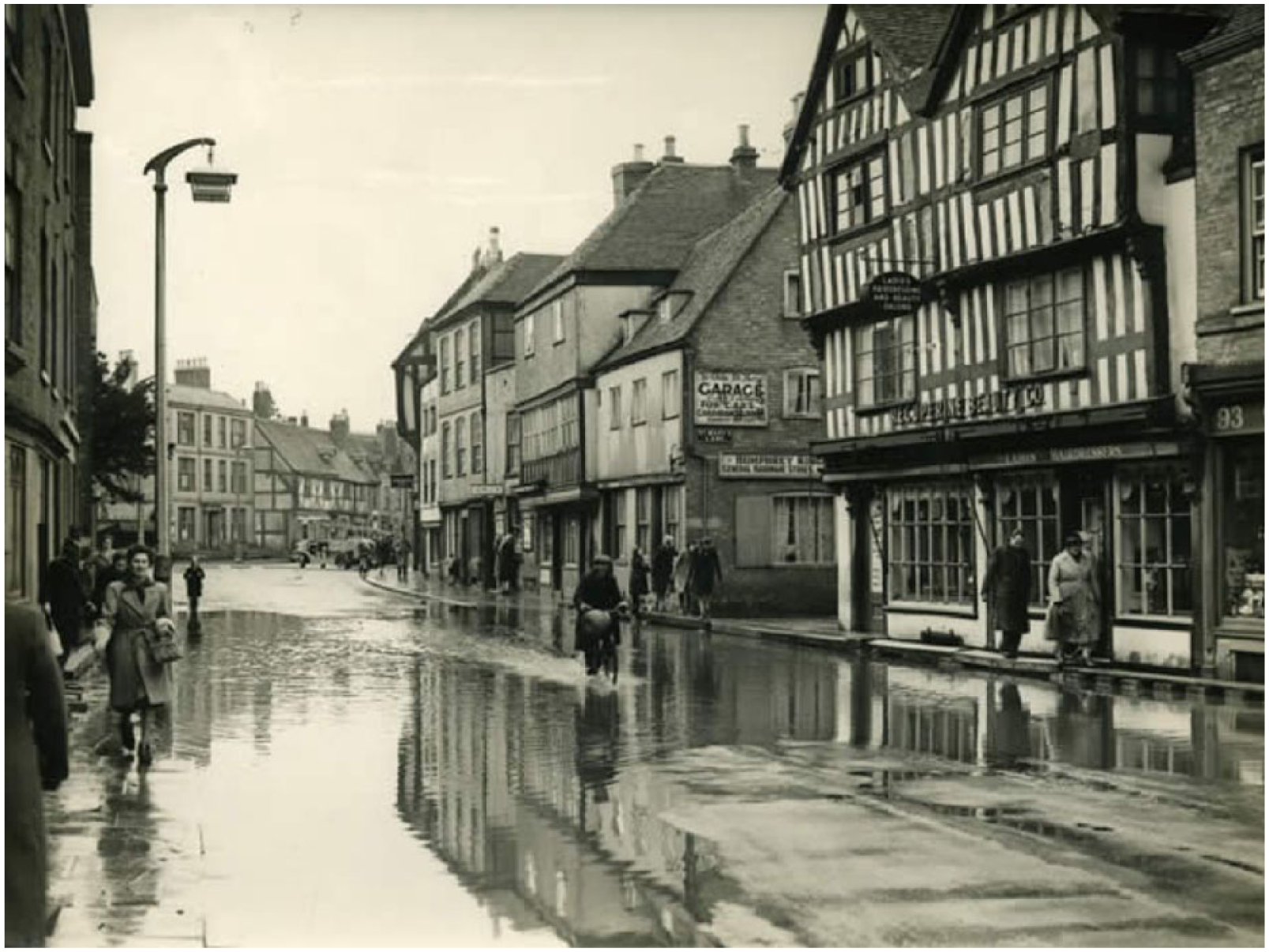
A photograph of the 1947 floods in (Setting 1).
On 25 July 2007, Martin Wainright of The Guardian newspaper wrote, Britain is no world-beater when it comes to flood prevention and control, but the country has few equals in putting up memorials to great soakings of the past. Everywhere from York to Gloucester via London, notched poles mark the riversides, engraved with historic high-water levels. Prominent on them all is the date 1947, the benchmark year in living memory for every subsequent flood. (Wainright, 2007 (online))
This region and this period of time were important for our research for two key reasons. First, the 1947 and 2007 floods had been intensely mediated through print newspaper and video respectively, with photographs connecting both events. They were being connected in terms of a collective memory to reinforce a ‘Blitz spirit’. Many of our interviewees, mentioned the war as an important marker of British resilience to flood disaster. This historical connectivity, neglected living with water as a continuous activity, and produced the flood narrative in terms of national identity that conjoined extreme weather and war: Source: Gloucestershire Echo. Published with permission.A gentleman walked up to me and said in a German accent, ‘Tell me, what is the difference between Germany and [Setting 1]? Four years ago we had massive floods and there was looting and fighting. I come to [Setting 1] and everybody has a smile, they’re out sweeping the streets, emptying their houses of water. It’s so different – why?’ I said, ‘It’s the Dunkirk spirit!’ (Male, 66, Setting 1, describing the floods of 2007 for a digital story)
Second, the floodplain residents of the region were a source of living and potentially transmittable memories of resilience, who had access (whether they knew it or not) to a long history of flood materialisation. Thus, the kinds of material that we came across during our interviews and correspondence ranged from contemporary archives, such as photograph galleries on mobile phones and text/image/video files on laptops, to the more traditional, such as newspaper clippings in albums, in public houses and personal scrapbooks gathered in plastic carrier bags. One interviewee kept a decanter on her table, which contained (after over 5 years) a volume of turbid water from when the flood had entered her property (see Figure 2 below). As a memento, this bottled floodwater, was an unexpected materialisation but certainly served to anchor flood memory in a talking point for visitors, such that its story demanded to be told.

Floodwater in a decanter.
Van House and Churchill (2008) argue that ‘[b]oth personal and collective memory rely in part on the records of the past and on our technologies and practices of remembering’ (p. 295). This mnemonic connectivity remembered as a living with water (literally living with a decanter of floodwater) was a continuous activity but was not always shared or shareable within and across the community. Private remembering of flooding took on micro-discursive and anecdotal proportions that became intimate remembrances with researchers.
Moreover, it is important to note that this region has materialised flooding over many centuries but that this memorialisation does not necessarily lead to an active remembering as resilience. Dated public flood marks in the Setting 1 Abbey (see Figure 3), on town walls, commercial buildings and in public spaces were joined post-2007 by unofficial flood marks of residents inside and outside their homes and gardens (see Figure 4).
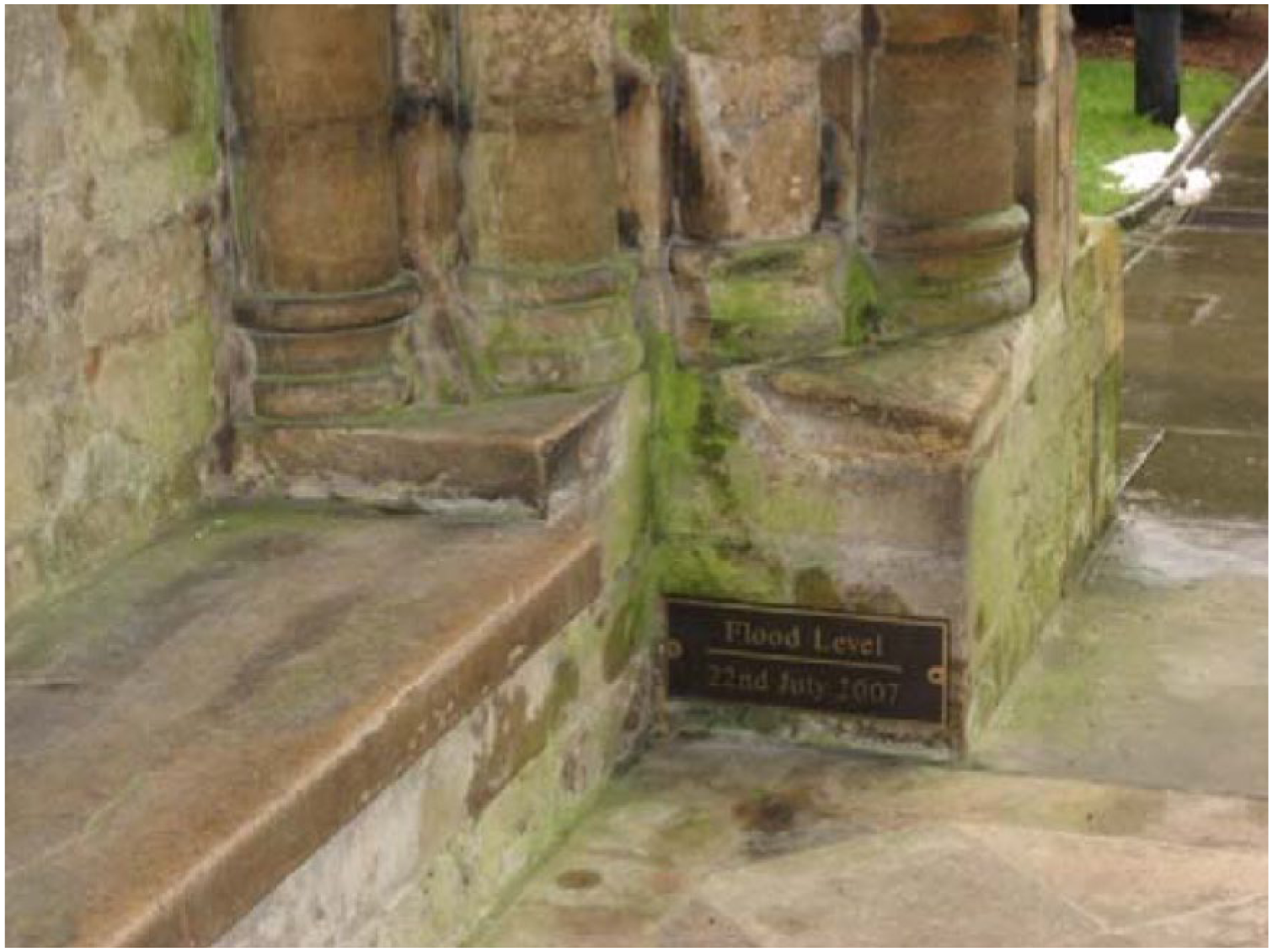
Setting 1 Abbey Flood Level 2007 Official Mark. Dated 22 July 2007.
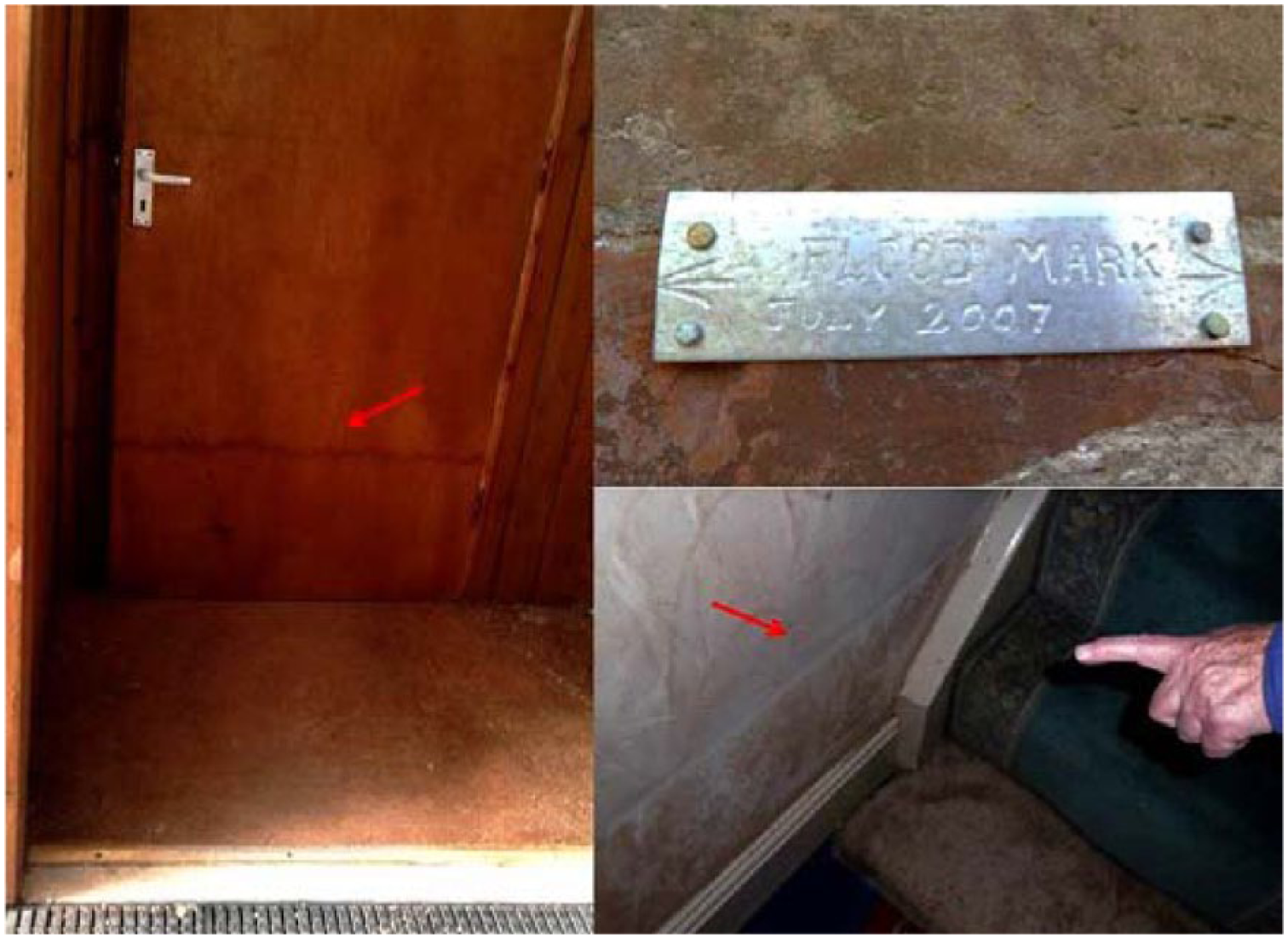
Unofficial flood marks of residents inside and outside their homes and gardens.
Photographs of watermarks, or fingers pointing to where water had risen to, became iconographic of domestic flood photography and readily shared with researchers.
Other material evidence of flooding in local landscapes such as stage boards, gauges, barriers and large engineering defence systems (see Figure 5) lived alongside less material stories, anecdotes, hard copy/digital photographs, collections of maps, scrapbooks, virtual (online) collections, and repeated or painful memories (see Figure 6).
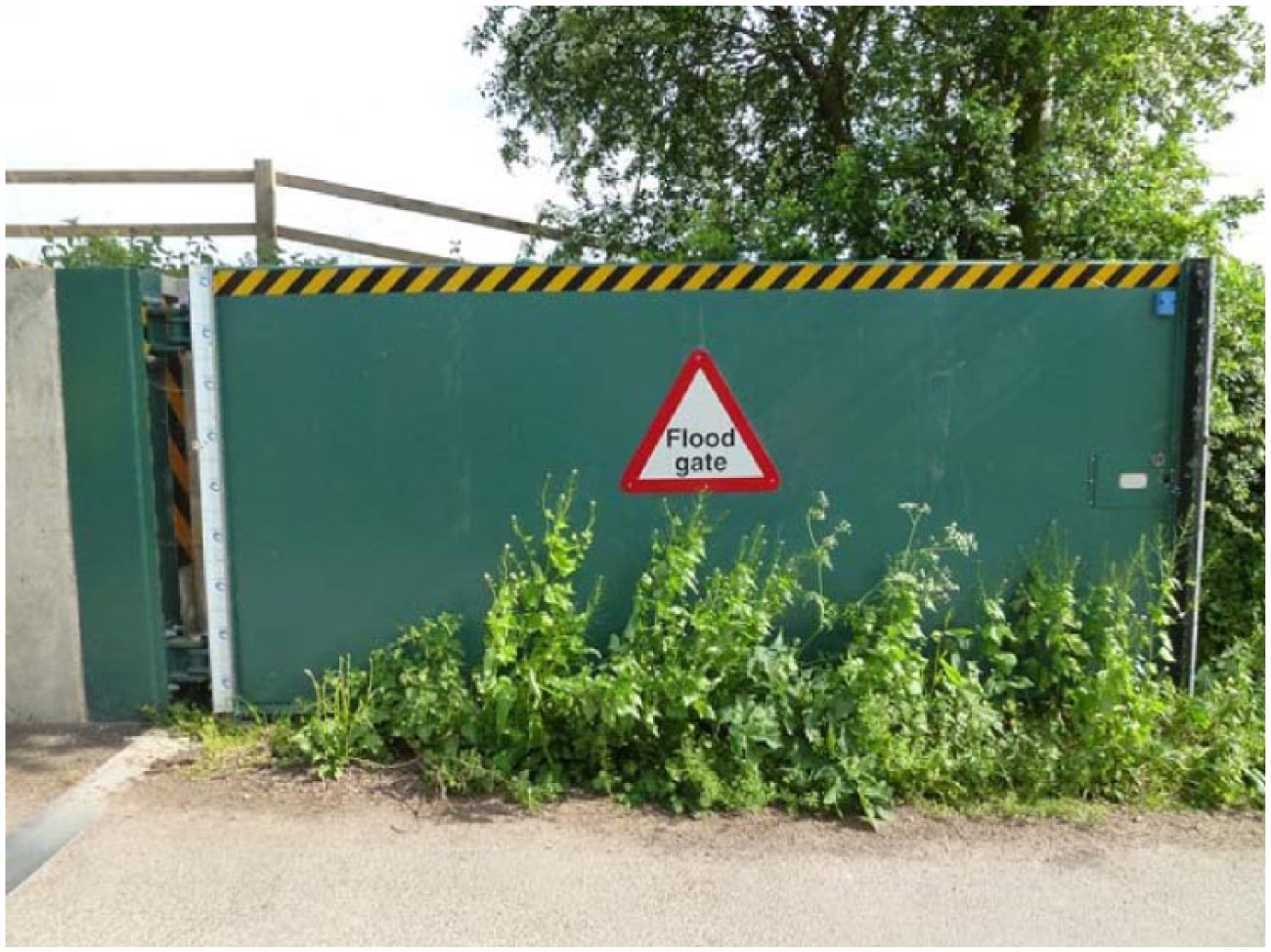
Photo of a flood defence system implemented after the 2007 floods.
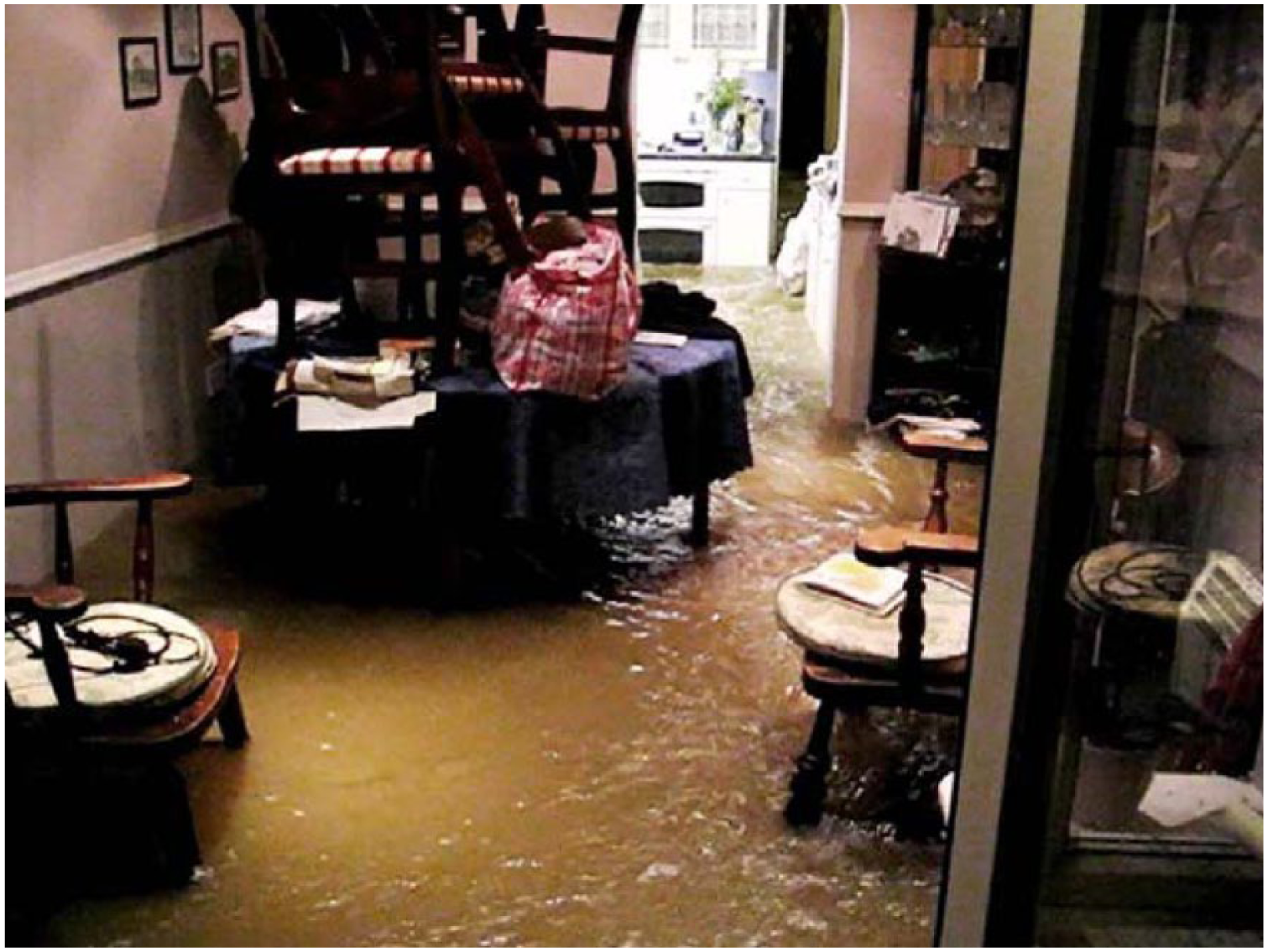
Screen capture from a home video, July 2007: floodwater surges through the kitchen and living room of his (Setting 1) house.
Our research was able to collect a wide repertoire of mediations of flood events from archives (official and unofficial). We were also able to show how flood memory continues to be embedded in the landscape (flood marks, hard engineering, home protection systems, flood gauges and embankments), materialised through domestic media (photographs, home video and increasingly socially networked media and stories): often made personal in its anecdotalisation.
This repertoire was in opposition to the iconographic Setting 1 Abbey surrounded by floodwater as readily available media shorthand for (biblical) deluge, used both to mediate the flood but also to trigger forgetting by regional stakeholders with image fatigue. Any future Google search of the 2007 UK Floods will elicit these aerial shots. However, the far more ‘personal face’ of disaster sought out by journalists and produced by emerging Facebook groups suggested that media, memory and flooding were becoming critically intertwined. Thus, the 2007 UK Floods provided a benchmark against which to review policy and practice, and to measure the old/new mechanisms involved in sustainable flood memory. Here, an increased focus on community resilience viewed through different lenses (institutional, psychological, infrastructural) was integrated with an approach that drew out the memories of how flooding and FRM policies had played out in historical and living memory.
Towards remembering as resilience
In 2005, the UK Environment Agency’s (the environmental regulator, hereafter EA) Report ‘Improving flood warning awareness in low probability and medium-high consequence flood zones’ approached the paradigm shift towards resilience through a traditional marketing and communications perspective (R&D Project W5-024, 2005). It recognised the need to profile different target audiences in terms of flood awareness, probability and history; the need to define the communication objectives in line with the value systems and perceptions of those different audiences; and to establish the communication mix and channels for delivering different message components. From a media and communication studies perspective, this framework conceptualises flood risk as environmental event content and the community as an audience in broadcast terms. Such a framework presents a number of key questions about FRM in the twenty first century. What are the value systems and perceptions in mixed communities along a floodplain and how might they have been materialised over centuries (not just in the recent past)? What would be the best channels for exchanging messages of flood awareness, probability and history in a mixed-media culture where community members are not passive consumers of information but actively living with water? How are communication repertoires incorporating new methods of engagement with flood risk communities already engaged in diverse practices of personal, collective, social, cultural, archival and materialised flood memory?
A total of 2 years later, the EA was tested to its limits. Water supplies had become contaminated (effecting 350,000 people), electricity was in danger of being overwhelmed, with the less noted underlying threat posed to the national security systems of Government Communications Headquarters (GCHQ) being a possibility. While this region had a long history of flooding as noted above, and with 2007 the wettest summer since records began in 1776, it was now becoming popularly remembered as a region in crisis, taken by surprise, and un-prepared.
However, at a local level, preparedness was marked in terms of community memory. For example, in rural Setting 4, we found evidence of preparedness in the village between new and established residents through their references to remembering. In the excerpts below, a new family describe not knowing what to do in a flood, but their neighbours knock on their door and advise them: But they knew about the floods and they knew the impact and they knew we’d been flooded and they know what it’s like to have the road flooded and the inconvenience of it, whereas the [family name 1], and the [family name 2] who’d only moved in 7 days earlier, those people, you felt sorry for them really. (Female 63 and Male 70, Setting 4)
Moreover, despite the differences between settings in terms of size and demographics, the remembering practices of older residents played a pivotal role in the transmission of flood memory for resilience. Those with access to or in a good relationship with this older resident below were in a privileged position for preparedness: Across the river here, there used to be railings – about three foot, three foot six and when the river was rising if you could see the top of the railings you knew you were alright. Once the railings had disappeared you thought, look out, possibly it’s coming. And very often it did. So when the flood is about the only controlling factor, about whether you are going to get it bad or indifferent is whether there is a high tide and whether there is a southwesterly wind with it. South Westerlies push the tide and can bring it up here half an hour quicker. So, if you’ve got fresh water, high tide, plus wind, it’s a fine line if you’re going to get flooded or not. (Male, 74, Setting 3)
The lay expertise of a local flood protagonist was a prominent feature of this urban community, and he goes on to describe how he watches local river gauges to judge the power of any coming flood, which is a technique used by other older residents of the city: And then the Sunday morning I got up early and I could see the water was going to come in because at [name] Lock there’s measurements and if it’s 23-feet which the normal river level is about 10′. At 23′ it’s going to come in the house. You do get warnings but I go by my own warnings. By the lock, if it’s 23-feet. (Female, 79, Setting 3)
Flood marks, flood gauges, early warning systems (mediated by television, radio and online), public photographs, videos and news reports are the mnemonic practices that ensure that floods cannot be entirely erased from lived memory. Nevertheless, remembering resilience (as in the previous generation’s ability to live with floods) is not the same as remembering as resilience (the active use of personal, collective and cultural memory for social cohesion and preparedness). While there is less emphasis on how individuals engage with the longer history of flooding in a community (materialised through hard engineering, heritage and archives) or the ways in which flood communities come into existence through a collective memory of flood knowledge of lay expertise, our research revealed a wide variety of strategies for remembering were being used. Marking and recording floods, childhood memories, organisational memory, archival memory and the recollections between stakeholders all played a crucial role in keeping flood memory alive. Clearly, there are aspects of mental mapping taking place in these accounts. People have spatialised memories of processes and events that form a geographical basis for assessing risk and action in relation to flood events. We feel that there is a complex interplay between the conscious, rational aspects usually associated with mental mapping and the subconscious and affective processes of memory and habitable place sensing.
There were, however, differences in the case study areas in terms of the depth and prominence of flood memories. In Setting 3, a small core of (mostly) elderly residents possessed high levels of lay expertise. One resident would note the river level as it reached the fence posts by the river and could estimate the time until it reached his street. Looking back to her youth, another resident described how she would go to a little hole in a floorboard, through which she poked a stick to find out if there was any water under the house yet, its rising or falling. Such ways of remembering seemed to be in transition. The interviewees described a disappearing past in which people were very aware of flooding and accepted its effects. One resident told of her disbelief at the reactions of newer residents during a recent flood: I was quite amused with this recent flooding. Neighbours were ringing up the fire brigade to come and pump out the water and demanding sandbags from the council. Never thought of this in the old days – just accepted it. (Female, 82, Setting 3)
If the case study area in Setting 3 was characterised by strong but fragmenting and disappearing flood memories, Setting 1’s interviewees demonstrated a more active flood resilience and awareness. Setting 1 had several prominent flood marks in the town centre. During interviews, most local residents produced some kind of personal archive – be it an album of photographs, a scrapbook or an Images folder on a computer. Many described flooding in stoical terms: We just get on with it; we knew it was a flood risk area when we bought the house, it has always been thus, and always thus will be. This watery sense of place was often accompanied by a frustration with the town’s subsequent media portrayal as a ‘flood town’. In Setting 1, the Chamber of Commerce (a body representing local business) worked hard to express that the town was open to business and that flooding was normal and regular, just extreme in 2007.
Perhaps due to its rural location, small size and the relative wealth of its inhabitants, Setting 4 interviewees often described neighbourhood bonds that, unlike Setting 3, remained not only tight but also enabled one of the villages to mobilise a powerful flood defence committee that went on to create real change: [The Flood Committee] were lucky because [Resident 1] was the secretary, [Resident 2] was the solicitor and did all the legals, and [Resident 3] was the engineer. And [TV Presenter] whose mother used to live in the village said if he were still working at [Television Programme] he said he would do a programme on this village. (Female, 73, Setting 4)
The Setting 4 community’s accounts of resilience also contrasted to the other case study areas in that they illustrated how the residents had used their lay knowledge to affect the subsequent work of the agencies on the ground. The individual lay knowledge held in Setting 4 was arguably no greater than that of some of the residents of the Setting 3 case study area, but whereas the latter voiced frustration and anger at being ignored by the council and agencies, the Setting 4 residents had succeeded in working in an agency partnership to get a new flood defence system built for their village. Although the Setting 4 interviewees gave accounts of disagreement, the testimonies of flood resilience were markedly different to Setting 3 and this can be seen in two quotations below, both on the subject of neighbours: Everybody mucks in. If they know people on the River, they help people on the River. The community is good. (Male, 55 years, Setting 4) … All strangers … I don’t know anybody next door that side. You see, this house this (other) side was all knocked into flats. I think it’s either six or seven self-contained units for students. Never see anybody. (Male, 75 years, Setting 3)
Of the four case study areas, it is unsurprising that Setting 4, a rural village setting with an established community and a long history of flooding was considered the most resilient. A small community of 20 houses, with most residents over 50 years of age, it defined itself as ‘a very close-knit community’ (Male, 75, Setting 4). During the 2007 UK Floods, the vulnerability of residents in their 90s, and the need for younger community members in their 70s to go through a process of moving furniture upstairs, rescuing residents in boats, and moving vehicles away from rising waters is less a matter of having an ‘emergency plan’ and more that ‘we would rely on local knowledge’ (Male, 75, Setting 4). Trivial acts of remembering are lifelines: every time it floods, they move their cars to higher ground and the milkman (who remembers which car belongs to which resident) leaves the milk on top of the right cars. Moreover, important memories serve to instruct present and future generations. The 1947 flood experience is passed down from father to son, knowledge of ancient flood banks (with rumour or legend that monks constructed them), and memories of the three different types of flood defence systems since the 1970s: I think the big advantage is really experience and the next generation experiencing what could be a problem in future. My thought is that this third flood bank, year after year it seems to want making higher, so obviously the flooding situations over the years getting worse and I think experiences from previous floods is quite a benefit for the next generation to understand. (Male, 75, Setting 4)
For communities to be aware of flooding (and very importantly to prepare and take action) as a form of ‘socio-ecological resilience’ (Adger et al., 2005: 1036), then they need to record and remember in some (everyday) way (e.g. home video, photographs or flood marking). We found in our review of the settings that it is very difficult to ensure policies compel people to take any action without them remembering prior flood experience. Even if communities have experienced flooding, the evidence suggests that they not only need repeat experience or need to remember the flood events repetitively, but they have to deal with the social and economic compulsion to forget.
Emotion, trauma and forgetting flooding
The continuum of local and sustained knowledge communicated in and between communities through remembering as integral to resilience, was made possible in our research through sharing memories across the catchments (see follow on ESRC Knowledge Exchange Project 2013–2014). However, in gathering that evidence we became equally sensitised to the emotional trauma of the flood event and how the remembering of its impact in the present moment of the research interview may re-perform that trauma. This occurred in one workshop as participants re-viewed their digital stories with fellow community members and found the mediated remembering distressing. In our coding of the thematic analysis of the interview data, we found that emotion and affect were key themes around which we could build nodes for interpretation (see Figure 7 which demonstrates how we coded the node of Emotion and Affect).
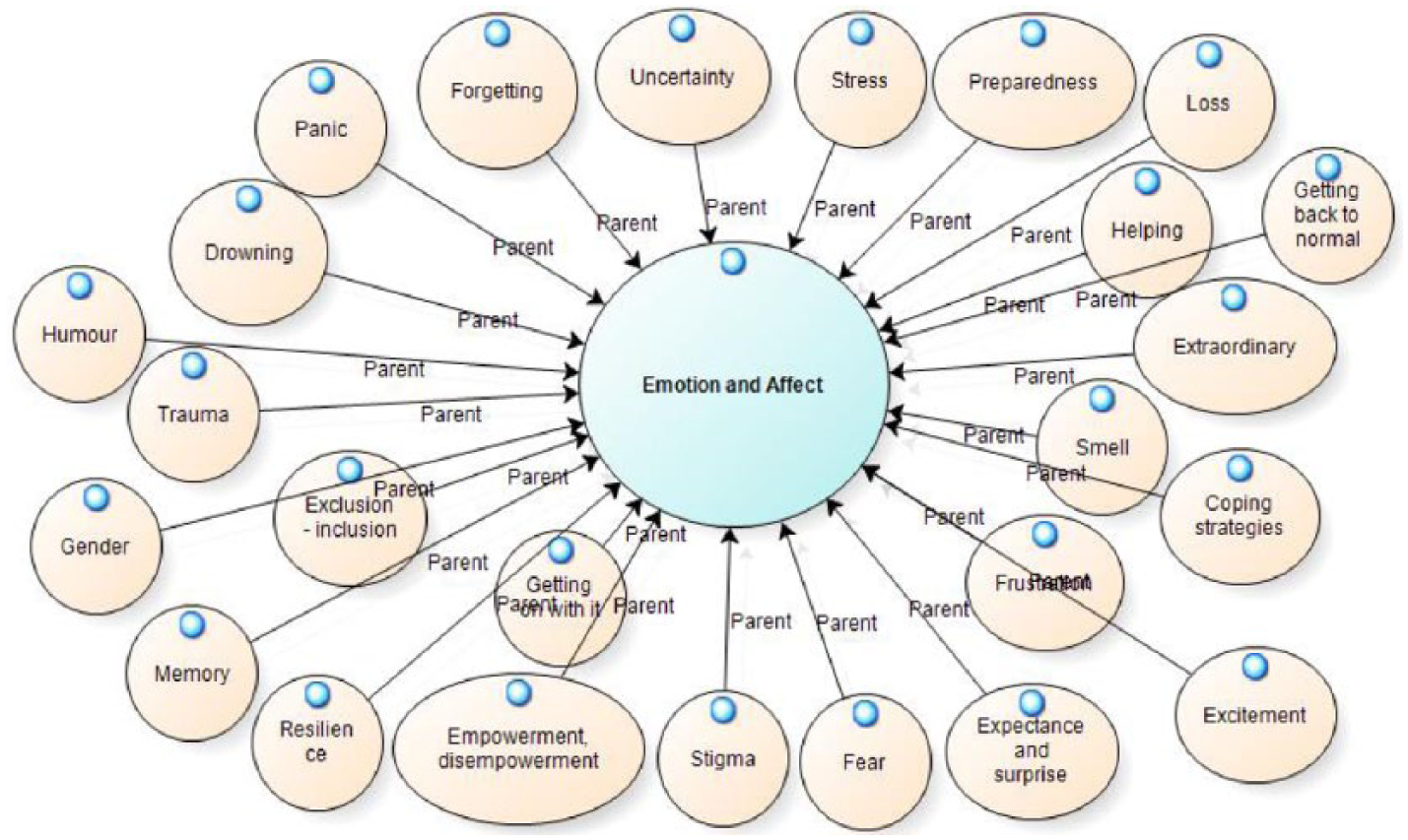
NVivo-generated image of the ‘Emotion and Affect’ model, showing the child nodes (created through line-by-line coding) and the Parent node, or Theme, which they are clustered under.
Examples of active forgetting in the flooded communities were intriguing, and emotion and affect played a key role in forgetting; stress over the loss of material items (white goods, furniture, gardens and décor) was overshadowed by stories of spoiled family heirlooms, photograph albums and mementos. There are memories of the floods that interviewees thought better not discussed, more in terms of the emotional trauma remembering would have on the collective sense of identity and community, than on the personal. In the course of the interviewing, we spoke with people who had archives, which they felt – if publicised – could be damaging to local businesses or the perceptions of the community: There’s massive resistance to acknowledging flooding here [in the county], to the extent that some wouldn’t take up the grants for property protection. They didn’t want to show that their house had been flooded. (Councillor, Setting 3)
While we had expected reluctance to remember due to personal trauma and distress, less anticipated was the shared urge to forget because of cultural, economic, commercial and governance reasons (i.e. the selling of a house, the attracting of new people and tourists, and the effacement of disruption to local business), and attribution of responsibility for flood protection to the State). In one case, this was connected to the widespread miscommunication that followed the floods and the coverage in national newspapers to the point where people decided to keep quiet and bury their personal archives and memories: I’ve got a whole load [of photographs] that I’ve kept on the side somewhere but I never got to upload them. I was going to but then a couple of months after the flood, a lot of the business people were saying ‘We’ve got to do something about [Setting 1 town]’. You mention [Setting 1 town] and all people think about is this picture that appeared in the Telegraph by Getty images of [Setting 1 town] Abbey surrounded by floods. And a lot of the business people thought it was quite negative. So I didn’t publicise too much that I had the pictures because I didn’t want people whinging. (Male, 40, Setting 1)
Therefore, to forget flood risk (personally and collectively) can be to live with inscribed vulnerability in a deep and abiding way but also to remember flood risk (as an individual) is an equally vulnerable position to take.
The political economy of remembering and forgetting flooding
As Krause et al. (2013) argue, ‘[f]loods are a threat to livelihoods and landscapes in many places around the world and at many points in history. Yet, they also seem to be an intrinsic component of many landscapes and livelihoods’ (p. 218). There is much research and policy literature on living with rather than against floods (see Cabinet Office, 2008; Few, 2003; Jencson, 2000; López-Marrero and Tschakert, 2011), as well as understanding flooding through value systems of good and bad water as in Walker et al.’s (2011) flooding as a ‘socio-natural-technical assemblage’ (p. 2304). In our research, flooding was remembered as ‘bad water’, for example, Very nasty stuff floodwater – very toxic. (Male, 65, Setting 4) I couldn’t let the cat out because the garden was thick with mud. All this Severn silt you know, trying with buckets to wash it away, and I thought, ‘I think I’m a bit too old for this’. And my sister-in-law says, ‘you shouldn’t be living there’. (Female, 79, Setting 3)
While childhood memories of flooding suggested ‘good water’: I’ve always been brought up around flooding. As a child, we used to walk the floods. We’ve done it on Christmas day, walk to the pub at [meadow], across the embankments – the flood barriers. There was water rushing – it was quite deep – all holding hands, linked, and mum had wrapped scarves around our hands. (Male, 34, Setting 1) I wasn’t very old – 10 or 11-years old – when I was here in the flood. And I just had the happy memories of rowing around in boats and thought it was quite exciting at that age. (Male, 75, Setting 4)
The political economy of flood risk shows (see Oliver-Smith, 2009), as does any vulnerability to disaster, how ‘societies incorporate extreme events, whether chronic or one-time/short-lived, into their social, political, and ideological structure’ (Jones and Murphy, 2009: 3). If that structure is driven by an underlying economy of an urge to forget (to move on, back to normal, business as usual, deferral of responsibility) then flood preparedness and resilience is low. Some flood memories collected also described the breaking up of communities and the loss of local flood knowledge. This is a particular feature of interviews with older members of the community. In the examples below, two residents of Setting 3 describe the emergence of transient populations in their estate and the subsequent loss of relationships with neighbours: Well a builder might probably buy my house, you know. There’s a guy next door, he’s doing a lot of building. … a house that sold two doors down, and they were actually working on it when the 2007 floods came. That was sold to a builder. I don’t think you’d get family people buying it. (Female, 79, Setting 3) All strangers … I don’t know anybody next door that side. You see, this house this (other) side was all knocked into flats. I think it’s either six or seven self-contained units for students. Never see anybody. (Male, 75 years, Setting 3)
For the development of flood memory and relationships with other stakeholders, the implications of these changing communities are unknown. What is clear is that within some of the settings the project encountered members of the community who had a high profile in terms of local flooding and whose advice was trusted beyond that of the local government or the environmental regulator. In the excerpt below, a resident of Setting 3 describes a neighbour: There’s a guy by us – they call him Noah because he’s permanently on about the floods. … Oh God, he’s a legend. (Female, 79, Setting 3) Everything he said would, has happened. It all came true. It all came true. Because the Authority said, ‘No, no, it won’t make any difference, you won’t get floods and all this’. It’s always in the newspapers, and everything he said happened, all of it. He predicted everything. (Female, 79, Setting 3)
Moreover, while political and economic factors drive an exposure to environmental vulnerability, as communities expand on coastline cities or in lowland river confluences, those same communities materially inscribe their social relations into this built and natural environment (see Harvey, 1996). That is, they find ways of remembering flooding (through protagonists such as ‘Noah’ above) and flood events over time (through their own personal media collections). At the same time, they are potentially storing those memories in ‘hard to reach’ places, forgetting them or not passing on inheritable knowledge. As the County Archivist stated, when our project promoted community remembering, I think from a collection point of view, it’s made us aware of the value of the material we’ve got because of course we have a lot of plans and maps and other documentation which could be used and is used for planning for development and also future planning for flood relief and things like that. So it just makes you realise that our documents, they have a really important current use as well as for more academic or recreational researchers. (County Archivist)
Conclusion
It is not surprising that floods engender long and generalist views of their iconicity and connectedness to deep time events considering their impact on communities and lives. Our research only focused on the contemporary flooding of 2007, that had evoked memories of the 1947 floods in the region and began to connect with the deeper archival evidence of floods marked locally both on buildings and in the local county archive. This chimes with the theoretical paradigms of trans-cultural memory (Erll, 2011) as noted above, in which memory travels in time and through time, always connecting and being (re)mediated (Garde-Hansen, 2011). As the waters retreat, subside or are pumped away, the complacency around inadequate flood barriers and management soon proffers critical reflections upon local or societal factors that contribute to consequences, from blocked ditches and drains to global climate change. Thus, a cultural memory of flooding and a collective memory of flood events play a significant and under-researched role in the individual’s sense of future preparedness. With the shift to a paradigm of distributed FRM, the implications for community responsibility and action tend to be significantly underestimated. This awareness is critical if communities are to adapt and prepare for future floods, and to take on lead or partnership roles in FRM with agencies in changing risk contexts. Community–agency collaborative working at a local level is a key requirement in local resilience building (see work of the UK’s National Flood Forum) and a memory policy may play an important role in a working across settings agenda.
It is worth highlighting that Twitter was yet to come of age in 2007 and this may suggest (to a media literate urban elite) that regional communities were unable to connect and cope. Yet, a longer view of inherited flood memory tells us something quite different. Resilient communities have access to a wide range of flood materialisation and expertise as found in those settings where lay experts were active in communicating their memories and knowledge. Forgetting, though, was a critical issue: through a loss of flood markers, living witnesses and archival material, and in more macro terms through the political and economic drive to forget. Epistemologically, flood history as a discipline (in its focus upon disruption, change, adaptation, loss and vulnerability) may forget flood memory as a personal and local practice of continued resilience. Thus, future researchers should not limit the study of flood memory to the contemporary period. As we have suggested and published elsewhere, there are deeper histories that draw remembering and forgetting into a relationship with flood preparedness (see Krause et al., 2013; McEwen et al., 2012).
We have not had the space here to analyse in depth the relationship between memory and the archival evidence of flooding in the four settings. Evidence curated for the first time for one of the digital storytelling workshops we ran in Setting 3 revealed an appetite among communities for researching flood archives of local material. Clearly, more research should be undertaken on remembering and forgetting over a longer period of time in order to cast light upon the inheritance (or not) of customary knowledge and local cultures whose economic activity depends upon or is disrupted by flooding. Such a folkloric memory approach to flooding (that our research only hints at) may shed more light on understanding the inheritable social frameworks of flood knowledge that communities may or may not have access to. As we suggested at the beginning of this article, we should understand sustainable flood memory as travelling, across settings as well as through time, and the vehicles by which it moves (in minds, media or archives) require continued connection and communication. A sustainable flood memory not only requires improved flood communication with and between communities but a questioning of ‘traditional consultation methods’ in favour of ‘a more pro-active participatory role involving local communities, academics and policy makers’ (Myatt et al., 2003: 580).
The extent to which flooded communities can take ownership of their own flood materialisation (from hard engineering to storytelling) may have an important function for resilience. It also demands ‘strong interdisciplinarity’ in research across the sciences and arts. Therefore, the role of the social, creative and cultural plays just as significant a part in remembering as defence systems, barriers and dredging. Our research, then, is produced within the tension between drama and continuity that has characterised UK flood policy as a fairly recent paradigm shift from flood defence (working against water) to FRM (working with water). An overview of this shift is provided by Pender and Faulkner’s (2011) edited collection Flood Risk Science and Management, whose cover features the iconic 2007 aerial shot of the Setting 1 Abbey surrounded by floodwaters, and an image that members of that community wished to strategically forget for economic reasons. Thus, the implication for us, as researchers, in ‘dredging up’ the memories of flooding, was never far from our minds and built into our ethical approach.
Finally, ensuring that communities learn to live with floods has to address a set of dynamics at work in the settings that a memory studies approach reveals: childhood memories and emotional responses of fun and fear, the making and recording of flood memories in the domestic and public spheres by individuals, the active forgetting of flooding by businesses and organisations, the remembering relationships and organisational memory practices among flood actors, stakeholders and flood researchers. Personal memory is a finite resource of potentially high-energy engagement. Forgetting how to live with flooding reveals a political economy of mismanaging memory (as much as water) that drives vulnerability. This may go some way to explaining why the direct communication effects of flood awareness campaigns do not necessarily produce rational behaviours, and that ‘a stronger model linking domains of psychology, social science and information technology’ is required (Clark and Priest, 2008, ESRC Report). For this reason, our follow on projects were to work with the EA (the environmental regulator) to explore the role of digital and social media for producing more sustainable flood memories through personalised and networked digital storytelling and web-based applications.
Footnotes
Declaration of Conflicting Interests
The author(s) declared no potential conflicts of interest with respect to the research, authorship, and/or publication of this article.
Funding
The author(s) disclosed receipt of the following financial support for the research, authorship, and/or publication of this article: This research was funded by UK Economic and Social Research Council (ESRC) Grant reference numbers RES-062-23-2783 and ES/I003576/2. The authors thank all participants in the project, and the referees for their valuable critique.
Author biographies
 ) (2011–2015) on creative, mediated and archival methods used by communities prone to environmental crises to share local knowledge and promote resilience. She is currently leading a major Research Councils UK (RCUK) funded project DRY (2014–2018), which is exploring science-narrative integrated approaches to develop an evidence base for drought risk decision-making in the United Kingdom (see dryproject.co.uk).