




Abstract
This article delves into the intricate processes of memory within occupational groups, with a specific focus on perceiving memory as a way of adapting to a changing environment. We are investigating how individuals from two occupational groups in the university (academic and non-academic) navigate the process of remembering and forgetting to adapt to a changed environment (leadership change). Using two university colleges as case studies, we examine this phenomenon over a 1.5-year period via qualitative interviews. Our findings underscore that distinct occupational groups employ varied approaches to draw upon the past, where the key is in how they “sense” the situation. This article contributes by operationalizing four manifestations of “senses” to elucidate how organizational memory, encompassing both forgetting and remembering, operates as a means of adaptation.
Keywords
Introduction
According to Wilson (2005), while memory is inherently an individual capacity, its significance extends beyond the individual when considered in a social context. The evolutionary purpose of memory is to facilitate adaptation to changing environments both at the individual level and at the group level (Kluge and Gronau, 2018; Sherry and Schacter, 1987). Therefore, memory can be perceived as an adaptive specialization, and the aim of memory and much of the physical organization of the brain is to solve adaptive problems (Cosmides and Tooby, 1997). Moreover, according to Klein, Robertson, and Delton (2010), memory serves as an evolved system to plan for future actions.
In this article, we assert that “sensing” plays a crucial role in facilitating the processes of organizational memory. Organizational members at the collective level sense what to remember and what to forget to adapt to new conditions. According to Olick (1999: 338), “social frameworks shape what individuals remember,” and individuals are the carriers of this remembering. Therefore, we assert that sensing is a valuable tool for investigating memory in this study. Sensing reflects how organizational members experience; that is, remember and forget aspects of organizational life. In our understanding, various types of senses reflect the “epistemological importance of history” (Coraiola et al., 2021: 2). Senses highlight how the past is dynamic and socially bound: the past is both remembered and forgotten for various epistemological purposes. A catalyst for elucidating the mechanisms of memory through the lens of sensing originates from the idea of the “embodied narrative,” as proposed by Cunliffe and Coupland (2011: 64): “whether we are conscious of it or not, we shape our lives and ourselves ‘sensible’ through embodied (bodily) interpretations in our continuous everyday interactions.” In other words, the embodied narrative signposts the “lived experience” (Cunliffe and Coupland, 2011). Therefore, we define “sense” as an embodied narrative that has multidimensional manifestations also in respect to organizational memory.
We also agree with Zerubavel on how organizational remembering is not so much about “what actually happened in history” but more about “how we remember it” (Zerubavel, 2003: 2). Organizational groups (e.g. occupational groups) may control the shared narratives and how the past ought to be remembered (Aeon and Lamertz, 2021; Coraiola and Derry, 2020)—even to the extent that “groups can produce memories in individuals of events that they never ‘experienced’ in any direct sense” (Olick, 1999: 335). A good case of the heterogeneity within memory creation has been described by Collinson (2006). She studied university administrators and demonstrated how administrators often perceive themselves as being invisible compared to academic colleagues. Certain occupational groups within an organization may have a stronger “voice” in shaping what ought to be remembered and what should be forgotten yet the extent of their impact on organizational memory remains surprisingly under-explored.
This gap presents a unique opportunity for investigation: our study finds its niche at the intersection of memory processes and the interpretative practices of occupational groups. We investigate how certain actors (occupational groups) sense what to forget and remember to adapt to changed environments. To date, the nuanced ways in which these groups engage with the acts of remembering and forgetting—how they draw on historical experiences to navigate their current context and influence future directions—remain under-investigated. In addressing this, our study aims to provide an occupational perspective on organizational memory contextualized within the significant event of leadership transition as a memorable event. In pursuit of our objective, we formulate the following research questions:
RQ1. How do members of the organization utilize memory to adapt to changing organizational environments?
RQ2. Is there a distinction in the processes of remembering and forgetting among academic and administrative staff in response to a leadership change?
The paper is structured as follows: The Conceptual Background section offers an overview and identifies gaps in existing literature on occupational groups and organizational memory, framing them as a means to operationalize the concept of “sense.” In the second section, we present our study design and methods. The third section provides an overview of our results and includes a discussion of our findings in comparison to existing research.
Conceptual background
Occupational groups and organizational memory
We highlight the influence of broader societal and industry contexts on organizational memory, extending beyond the internal dynamics of a single organization. Prior research has touched upon this, examining how memory functions at the societal level (Ocasio, Mauskapf, and Steele, 2016) or within an industry (Coraiola and Derry, 2020), and its impact on organizational memory. Dierdorff et al. (2009: 974) define occupations as “collections of work roles with similar goals that require the performance of distinctive activities as well as the application of specialized skills or knowledge to accomplish these goals.” In line with Price (1997), who distinguishes between management and administrative occupations, we also distinguish between academic and non-academic occupations. Scholars in occupational studies, such as Trice (1993) and Dierdorff (2019), have consistently highlighted the importance of recognizing occupations as critical and distinct subcultures within an organization. Trice and Beyer (1993) discuss how especially distinct occupational groups (e.g. doctors, academics, pilots, lawyers, etc.) tend to develop a sense of occupational “ethnocentrism”—the belief that their perspectives are superior. In addition, as noted by Van Maanen and Barley (1984) and Covin (1988), occupational groups also differ in how they sense organizational events.
Therefore, recognizing the importance of a polyphonic perspective, it is vital to examine how occupational groups in an organization vary in regard to organizational memory—what they remember and forget. Such diversity stems from their negotiating power and the relative strength of their professional identity versus their organizational identity, leading individuals to align more closely with their profession. Garcia-Lorenzo (2020: 9) adds that groups may also interpret the past differently based on “the future each group imagined,” leveraging historical narratives as tools to negotiate and sculpt their envisioned future.
The selectivity of memory storage and retention plays a crucial role in determining what is remembered and what is forgotten (Lingle and Ostrom, 1979). This phenomenon is partially rooted in selective perception, where individuals prioritize stimuli they deem most likely to be significant while disregarding others (Matlin and Foley, 1992). Selectivity encompasses the perception, interpretation, and retention of various elements such as information, experiences, and emotions. Within organizations, members often demonstrate a tendency to excel in remembering aspects they personally deem significant.
Occupational groups and remembering
The definition of organizational remembering involves an engaged social process in which groups provide social structures and shared understandings to individuals, assisting in fostering a sense of belonging within a group or organization. In other words, organizational remembering makes a strong connotation to the social context—to the group: “members of a group share a similar set of cultural tools, especially the narrative forms, when understanding the past” (Wertsch and Roediger, 2008: 324). It can be anticipated that various organizational occupational groups may hold distinct memories of the same events due to differences in social context and the significance of shared experiences. In short, different occupational groups within an organization may remember the organizational past differently. Also, there is always “the possibility that different remembers are valued differently in the group” (Olick, 1999: 338). Compelling evidence supporting this idea comes from a study by Ybema (2014), which demonstrated how editorial staff in a newspaper leverage traces of a shared past in constructing their version of history to secure approval for change and counter competing perspectives.
Occupational groups and forgetting
Organizational forgetting signifies a process where individuals overlook (forget) shared understandings impacting the social construction of membership within an organization (Casey and Olivera, 2011; De Holan et al., 2004) In other words, collective erosion of organizational memory (Foroughi and Al-Amoudi, 2020). Kluge and Gronau (2018: 13) argue that “forgetting is required for adaptation to new environmental conditions.” Furthermore, Anteby and Molnár (2012: 36) claim that forgetting is “a collective identity enactment strategy.” For example, there is a common understanding of how communities are least inclined to forget aspects such as events and routines that are central to their identity (Aeon and Lamertz, 2021; Cappelen and Pedersen, 2021). This tendency could presumably extend to occupational groups with strong identities, like those in the medical and military fields or academic communities. Therefore, we agree with Aeon and Lamertz (2021: 37) that within occupational groups, “identity endurance might require organizational forgetting.” However, the necessity of organizational forgetting is context-dependent: there are times when preventing forgetting is vital, and others when it is beneficial to let go of certain memories (De Holan et al., 2004; de Holan and Phillips, 2004).
Remembering and forgetting as adaptation through sensing
Considering the evolutionary aim of memory—to adapt to changing environments—how do occupational groups know what to remember and what to forget? Sensing generally refers to the ability to detect and respond to stimuli. In the context of memory, this may be related to how individuals perceive and react to information presented to them. Forgetting occurs when organizational members struggle to recall information at a particular moment. As Tulving (1993) explained, this phenomenon may be influenced by numerous factors, including the classification of material in a way that makes it challenging for individuals to retrieve relevant cues. Forgetfulness can act as a defense mechanism in certain circumstances, particularly when faced with threats. Amid organizational changes, as classification systems are re-evaluated, this process can affect which specific experiences and emotions are retained in memory, allowing organizational members to retrieve them, while others may fade away.
Across organizational and management literature, distinctions are drawn between four ways of sensing: sensemaking (Maitlis, 2005; Weick, 1995), sensegiving (Gioia and Chittipeddi, 1991; Scarduzio and Tracy, 2015), sensekeeping (Kindsiko, 2018), and sensebreaking (Scarduzio and Tracy, 2015).
Sensemaking reflects the act of “making sense” (Weick, 1995: 4), suggesting that organizational members sometimes confront complexities in their environment that challenge their existing cognitive frameworks. With this in mind, sensemaking may become evident, especially in cases when organizations face some kind of disruption (Scarduzio and Tracy, 2015) like a change in the leadership.
Sensegiving is the process of attempting to influence the meaning-construction of others toward “a preferred redefinition of organizational reality” (Gioia and Chittipeddi, 1991: 442). In other words, sensegiving always means that someone is “giving sense to” the current state of affairs. Sensegiving marks influencing power, where great efforts are exerted into normative argumentation on how things should be.
Sensebreaking involves the process where organizational members “must break down sense in order to give sense” (Giuliani, 2016: 221). Sensebreaking aims to destabilize the existing state of affairs within organizations (Almqvist, et al., 2011: 124), encompassing disrupting frames of reference by questioning the current state of affairs and dismantling old meanings (Pratt, 2000; Scarduzio and Tracy, 2015) and often requires disconnecting or distancing oneself from established narratives (Aula and Mantere, 2013; Rom and Eyal, 2019).
Sensekeeping is the endeavor to maintain the existing state of affairs, preserving the status quo, and providing justifications as to why the proposed reasons for changing the current state of affairs are not sufficiently convincing (Kindsiko, 2018).
Conceptualizing memory as for adapting to a change, sensemaking seeks to reflect, sensegiving aims to provide, sensekeeping aims to preserve, and sensebreaking aims to disrupt the past. Depending on their strategic position within the organization, occupational groups may differ in how and why they operationalize the four dimensions of sensing.
Recollecting the past might help make sense of or preserve the status quo (remembering), or it might as a means to provide or disrupt sense (forgetting the past). This paper aims to advance the understanding of these four senses, offering insight into how organizational memory functions as a mechanism for adaptation.
In this article, by examining the role of past leaders in organizational memory, we address the essence of our study: How organizational members from different occupational groups use memory to adapt to changing environments—specifically, how they use recollections of the past to understand leadership changes. Each individual, based on their occupational role within the organization, may sense or perceive the world of work and its changes with individual variations (Kindsiko and Vadi, 2023).
Methods
Study site: Estonia
Our study is based on two colleges in a large public university in Estonia. Located some distance from the main campus, each college possesses a distinct identity. To preserve confidentiality, we do not disclose the names of the university or the colleges. The colleges are managed by the director, elected to 5-year terms by the university senate with the possibility of serving two consecutive terms at most. Our research commenced following the tenure of the previous leaders who, after a decade in their roles, were ineligible for reelection under the university statutes. Subsequently, these leaders exited the organization to pursue opportunities elsewhere.
Research setting and data collection
Our research questions were examined through an explorative qualitative study aimed at understanding the manifestations of organizational memory during a transition of leadership in the two colleges. Leaders who have been entrenched in an organization for an extended period often become integral to daily practices and the organization’s identity. Indeed, leaders play a pivotal role in shaping organizational memory, leaving a lasting imprint even after their departure (Basque and Langley, 2018).
This study has two notable contextual features. First, the academic setting allows us to provide a strong occupational perspective to organizational memory studies by focusing on both academic and administrative professionals who are acknowledged as having significant influence within academia (Tapanila, Siivonen, and Filander, 2020). Second, the tenure of the previous leaders, having been in their positions for a decade, suggests their deep entrenchment in the annals of the institution, and so the past leader represents a strong symbolic subject within the institutional memory.
We engaged with our participants—the new leaders and academic and administrative staff—on three occasions. Data collection commenced immediately after the new leaders began their first academic semester in September 2015, capturing initial reactions and experiences from both the leaders and the staff as the former leadership exited and the new leader stepped in. The second data collection phase took place at the end of the academic year in the spring of 2016, with the final round in June 2017, by which time, the new leaders had been working for a full academic year.
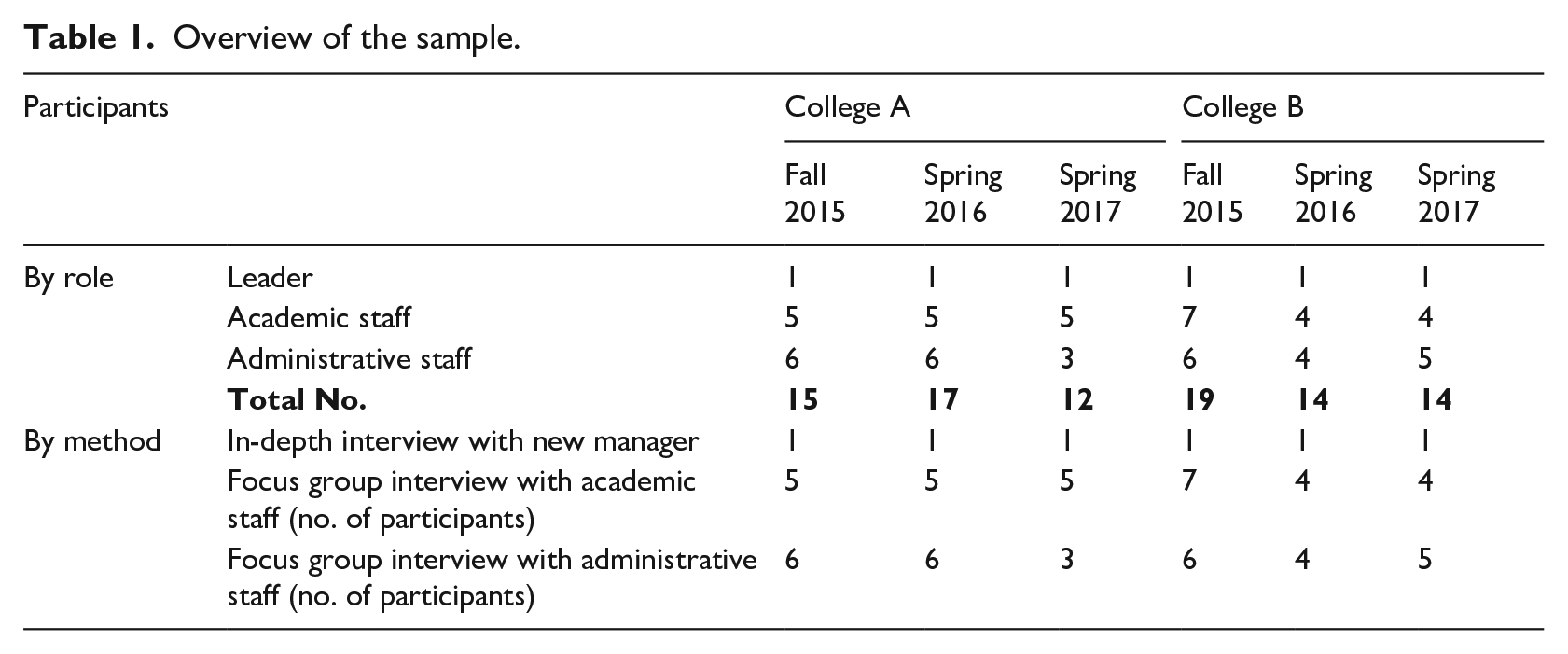
Data were gathered using qualitative focus groups and in-depth interviews. The study drew on 18 focus group discussions with staff (academic and administrative) from Colleges A and B and three comprehensive interviews with the respective college leaders. A local gatekeeper, following guidance from our research team, facilitated a sample with a diverse composition, reflecting various academic and administrative roles, as well as gender and tenure diversity. The perspectives of 30 academic staff, 30 administrative staff, and two leaders are reported in this article (Table 1).
Overview of the sample.
The majority of the interviews were conducted in Estonian, with one conducted in English. The focus group discussions and individual interviews yielded 23 hours of audio recordings, which were subsequently transcribed into 353 pages (Calibri font, size 12, with 1.15 line spacing). The participants provided oral informed consent at the time of their interview. Participation in the study was voluntary and did not include any monetary or other incentives.
Data analysis
In the data analysis, we follow two incremental steps: de-contextualizing and re-contextualizing.
Step 1: De-contextualizing the past leader
To capture the discourse that entails the leadership changes (specifically, reflections on the past leaders within memory), we utilized ATLAS.ti to decontextualize the data, identifying all mentions of past leaders. These mentions of the past leader are critical as they unveil how employees perceive the leadership transition. As a labeling mechanism in our analysis, we signposted instances in the transcripts where the old leader is mentioned. This serves as a tool for establishing connections between these mentions and how individuals adapt to the leadership change, addressing the evolutionary function of memory, including aspects of remembering and forgetting as a means of adapting to environmental shifts. Initially, we digitally coded all mentions of past leaders, yielding 322 references. This left us with text fragments associating the past leader with various themes. A recurring pattern observed during the interviews was the way the past leaders were invoked in the discourse, seemingly to convey a particular message or fulfill a specific function. Throughout the interviews, we perceived how informants talked of the past leaders as if they were still there (especially during the first round of interviews) influencing the present. We agree with Barrett et al. (1995: 365) as they claim how “the accounts people generate and the words people use are not a matter of accurately reflecting the world but rather are a matter of coordinating social relations.” Therefore, we can explore how the memory of the past leader is coordinating the present social relations, especially in the context of occupational groups.
Step 2: Re-contextualizing
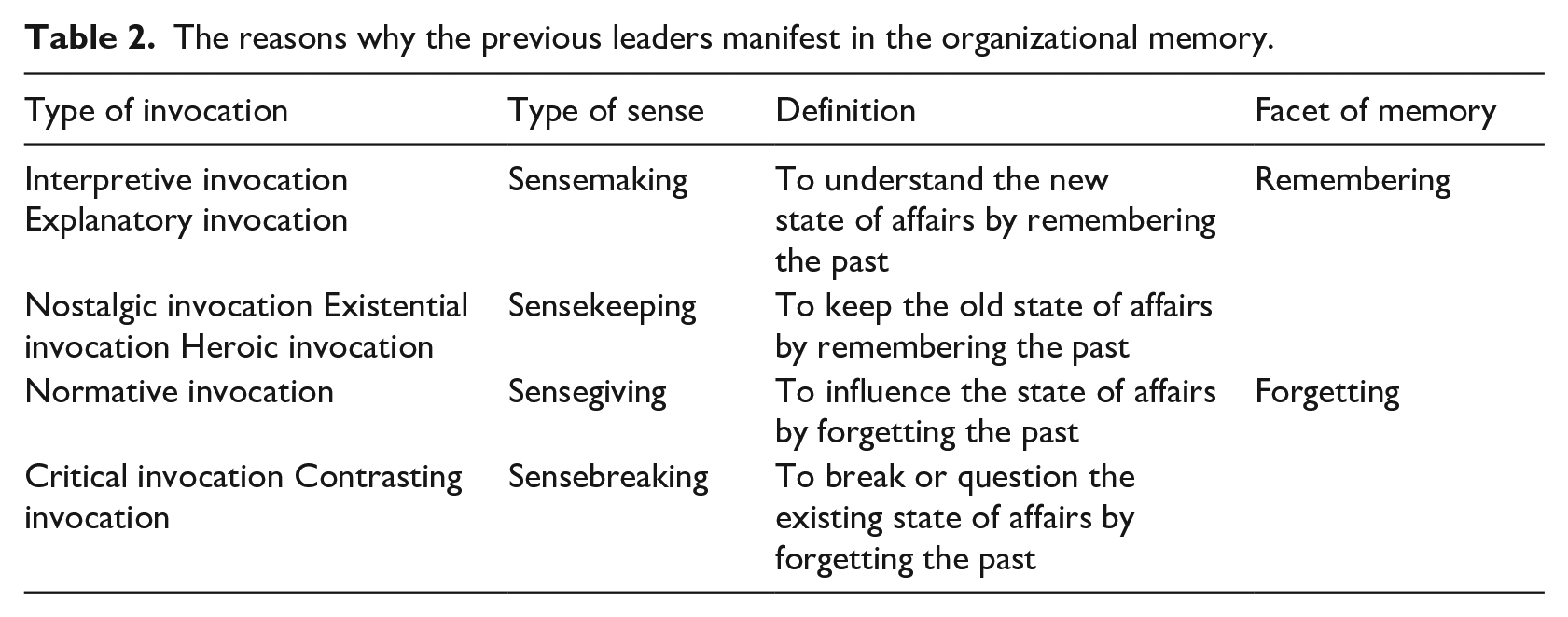
During the re-contextualizing step, we examined the patterns and their contextualized meanings within the transcripts. Upon extracting references to the former leaders from our transcripts, our goal was to discern the intent behind these—exploring the reasons and contexts in which the past leaders are mentioned. Through the categorization of these references, we identified that the concept of sensing helps answer the question “How is the past recalled.” At a broader level, the processes of remembering and forgetting contribute to answering the question “Why is the past recalled.” The ways in which the past is invoked become apparent through four distinct forms of sensing the past: sensemaking, sensegiving, sensebreaking, and sensekeeping. Each form signifies a different function for the organizational members and for the organization itself (see Table 2). In simpler terms, the past leaders are invoked in the discourse for specific purposes. For instance, in the act of recalling the past, sensemaking seeks to strengthen interpretive capabilities, whereas sensekeeping signifies the preservation of the past. In contrast, when it comes to forgetting, sensegiving is aimed at increasing influence, while sensebreaking conveys a destructive power. With this, the four senses function as tools for understanding how the organizational memory manifests in practice.
The reasons why the previous leaders manifest in the organizational memory.
In addition, the dynamics shown in Figure 1 give evidence of the proportion of the four senses across professional roles. The administrative staff seems to be more influenced by the change in leadership. We see this trend, especially in the context of sensebreaking and sensemaking. As administrative staff have more daily connections with the leader, they seem to experience the change in the leader most directly.
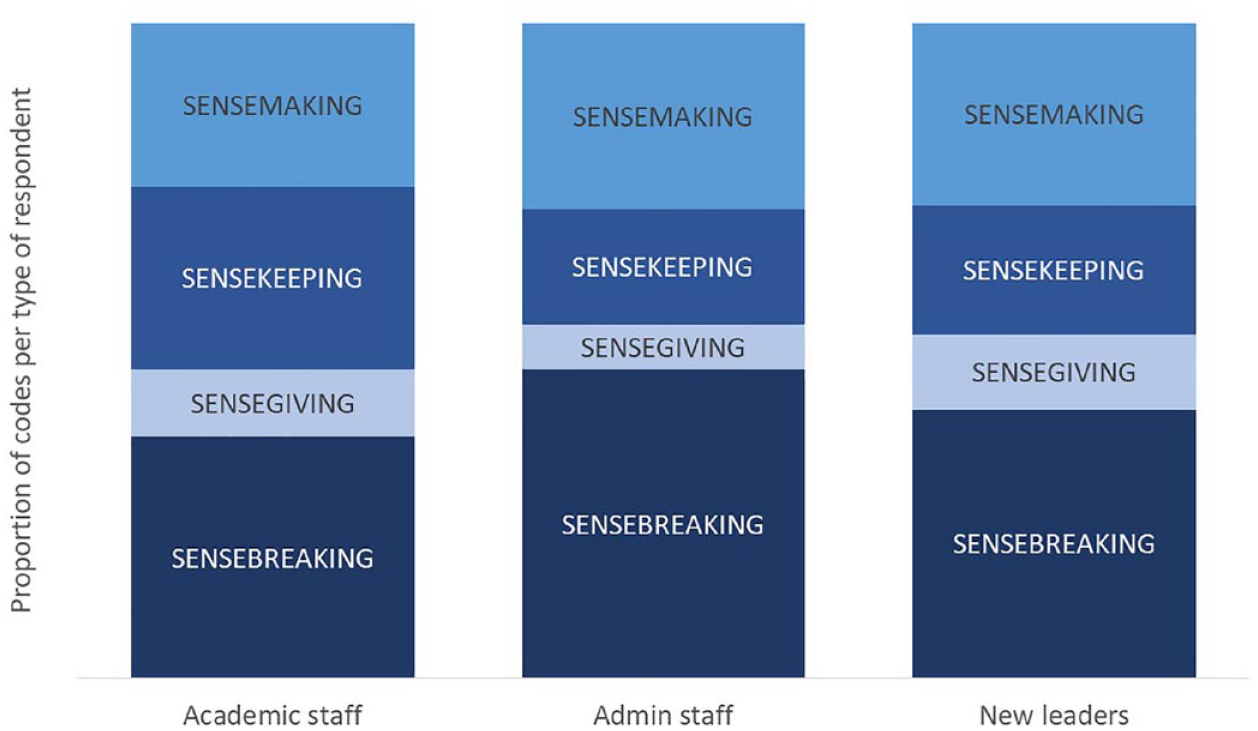
Sensemaking, sensegiving, sensebreaking, and sensekeeping by roles.
As the sample is too small to map the dynamics of senses both across time and roles, we can still reveal how time makes a difference. As time evolves, each type of sense may claim a different proportion of the staff’s attention in organizational discourses—over time, as sensebreaking and sensegiving increase, sensemaking and sensekeeping decrease (see Figure 2).
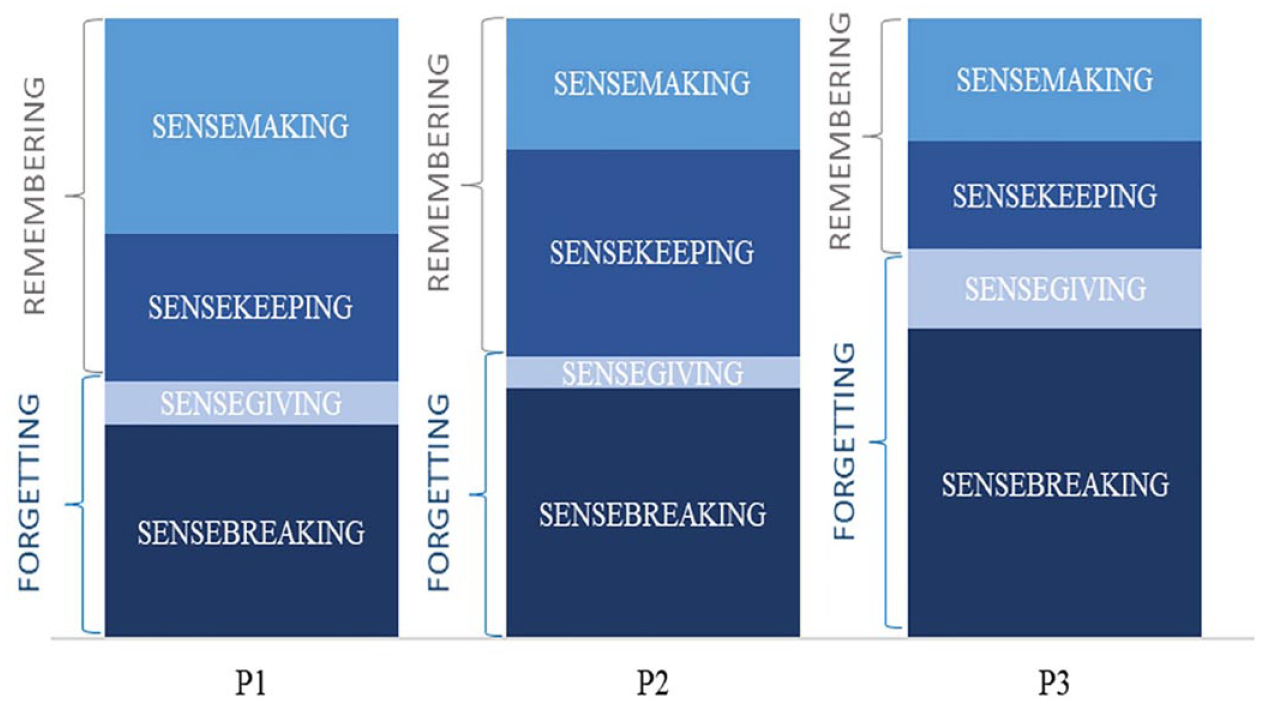
The balance between sensemaking, sensegiving, sensebreaking and sensekeeping over time.
Findings
Remembering is anchored in sensemaking and sensekeeping, while forgetting is anchored in sensegiving and sensebreaking
Remembering is anchored in both sensemaking and sensekeeping. On one hand, individuals remember to make sense of new situations. An example from the study shows an administrative employee reflecting on the contrasting leadership styles of two leaders, noting that “Authoritarian leadership was replaced with a somewhat more democratic leadership style” (Administrative Staff B, P3). This offers a neutral interpretation of the events that unfolded over the past one and a half years following the leadership transition—the staff member engages in sensemaking. In a similar vein, sensemaking is utilized to understand the reasons behind current realities—here, remembering is employed to provide explanations. For instance, new leaders may endeavor to comprehend historical practices within the organization, while also attempting to discern the underlying causes of specific behavioral patterns among employees. A comment from a new leader exemplifies this—the leader understands how employees have been long led in a top-down manner, and inevitably the new bottom-up approach has caused misunderstandings:
They have been used to this kind of chain of command. They have always had their tasks that they need to do, and now they might feel left out. Well, no one is telling them what they have to do, at the same time, they do not know how to take the initiative. They feel as if the new leader thinks they are not needed here. (New leader A, P1)
Conversely, organizational members engage in sensekeeping to maintain coherence and continuity. Referring to the past leader as a shield is a common pattern when the members of an organization want to maintain the status quo. Sensekeeping represents a deliberate effort to safeguard individuals from the pressures of change and urge them to keep remembering. For instance, the previous leader was often mentioned in relation to specific behavioral patterns or events. For example, in the case of social events employees often referred to the good old times:
Those social events in college, they are still amazing, or aren’t they? I can’t say. But when in the old times he [the old leader] came, hair flying in the air . . . Yesss, right! /. . ./ He was just such a cool guy! (Academic staff B, P2)
Forgetting is anchored in sensegiving and sensebreaking
First, sensegiving seems to play a central role, especially during the start of a leadership transition. For instance, during our interviews, we noted that references to former leaders were often used to guide and inform the new leader’s approach to managing the organization. Especially at the start of the first period of data collection, the previous leader was actively involved in transitioning the role to the successor. Therefore, such references might indicate an underlying resistance to the process of forgetting and can be viewed as an effort to undermine it:
At the beginning, when the past leader helped me to settle in here, she mentioned very often how she worries that I tend work at a distance work. The college was supposed to be an organization where you have to be physically present every day. (New leader A, P1)
Actively directing the new leader toward the preferred way—the employees are reluctant to forget the old routines, “Her [the old leader] spirit is still present, and we can still witness the attitude of ‘She did it like this’” (Administrative staff A, P1).
Second, when organizational members perceive an opportunity to usher in new rules and more favorable conditions, they invoke the past to disrupt established norms. We observed instances where the past leader was invoked in the discourse to break old patterns by criticizing them. Such critical invocation can take place also at the organizational level, touching upon strategically important questions, for instance, that an organization should be strong also without a leader:
With this leadership change I would like to hope very much that the college would get stronger as an organization. Right now, it is still her [old leader’s] college. Her spirit, and the attitude that “She did it this way” is still here. But actually, an organization is never a single person’s organization. The organization itself should be strong and at some point grow its own standards and values and so on. (Administrative staff B, P1)
As an example of sensebreaking, the administrative staff’s frequent interactions with the leaders often exposed them to less favorable aspects of their leadership. Consequently, such exposure led to a gradual forgetting of the past leadership. Over time, as the new leaders introduced different leadership styles to the organization, the administrative staff began to question and reevaluate previously established norms and practices.
Occupational dichotomy in organizational dynamics: academic vs administrative perspectives
Our study distinctly demonstrates that administrative staff are more impacted by the changes in leadership compared to other occupational groups. For instance, consider the following statement from a part-time lecturer highlighting their limited engagement with the organization:
Working as a lecturer with a fixed contract I do not have deep experience with the organization. I just come and go—do my teaching. For this reason, I cannot really see any change [in leadership]. (Academic staff B, P3)
Furthermore, our data confirmed what has been clearly established in the literature (Collinson, 2006)—the academic and the administrative occupational groups tend to contrast each other. Below is a vivid example of the us vs them between these groups:
We got a new coffee room [located on the second floor of the college]. At first a lot of [academic] people were against it because we have this term “the second floor”—the floor where only administrative staff work. (Academic staff A, P3)
Due to their frequent interactions with the leadership, the administrative staff often experience changes in leadership more acutely, which, in turn, influences the shaping of organizational memory. New leaders tend to introduce new routines that affect the administrative staff daily. Consequently, both the administrative staff and the new leaders (as dominating or even competing occupational groups) need to make sense of the new situation. In these discussions, references to the past leader are commonly used to interpret and elucidate the current state of affairs:
Some people expect me to be the new him [the past leader]. And I am not the new him. I don’t even want to be the new him. Because of the reality right now—we need different [leader]. (New leader A, P3)
However, as new leaders begin to alter the status quo, their distinct leadership style is different from the past one, the occupational power shifts to the new leaders in fostering strategic forgetting as a way to exert influence. This is sensegiving in action. We observed many instances where the new leaders consciously engaged in sensegiving—signaling to their employees how the new leadership would be different. Both new leaders declared at the beginning of the data collection phase how they need to inform the employees of their leadership style:
I need to talk to them. I just have to explain what my leadership style looks like! (New leader B, P1)
By the end of the data collection, one and a half years later, the new style has still not settled in—the leaders are still engaging in strategic forgetting to root out the old leadership style:
I am, how to say . . . a leader that tends to stay in the background. I expect people to lead themselves. I do not lead by assigning tasks, I lead by expectations. I explain what my expectations are, what should we strive for, and then I expect people to reorganize themselves around their own work. The previous leader was more of a hands-on person. She provided tasks and then checked whether the tasks had been fulfilled. This has changed and I still see how for some employees it [the change in leadership style] still creates a mess. (New leader B, P3)
This is clearly mirrored by the employees themselves, “Actually, the [new] leader emphasizes it often how her leadership style is different and compares herself to the old leader” (Academic staff A, P3).
With the onset of the leadership changes, the administrative staff exerted considerable effort to interpret the emerging situation—grappling with how things might shift (anchored in their memories of the past). Over time, as they grew accustomed to the new leadership dynamics, the former leader’s approaches became increasingly distinct from those of the current leadership, eventually fading from the organizational memory. Essentially, new points of reference began to take root.
Our study highlights the pivotal role memory plays for organizational members as they navigate changes within their environment, influenced significantly by their occupational roles. Diverse occupational groups within the organization tend to leverage their unique perspectives and experiences in interpreting and responding to changes. The occupational context thus becomes a lens through which organizational members make sense of the shifting environment, shaping their adaptive strategies and responses based on their distinct professional identities.
With the onset of the leadership change, administrative staff devoted considerable effort to interpreting the new situation—how things might be changing from now on (remembering the old). Over time, they started to become accustomed to the new leadership style, thus the previous leader’s style not only became more and more distinct from the current leader’s ways but also gradually began to fade from the collective memory. In other words, new frames of reference started to settle in.
Discussion
Theoretical contribution
Our research sheds light on the varied strategies distinct occupational groups employ to harness the past, emphasizing the importance of their “sensing” of situations. This paper advances the field by defining and illuminating four aspects of “sensing,” which in turn brings to light the role of organizational memory—encompassing both forgetting and remembering—as an adaptive mechanism. In detail, the interplay of forms of sensing (as outlined in Figure 3) mediates the duality of remembering and forgetting, with observable variations in how occupational groups engage in sensing.
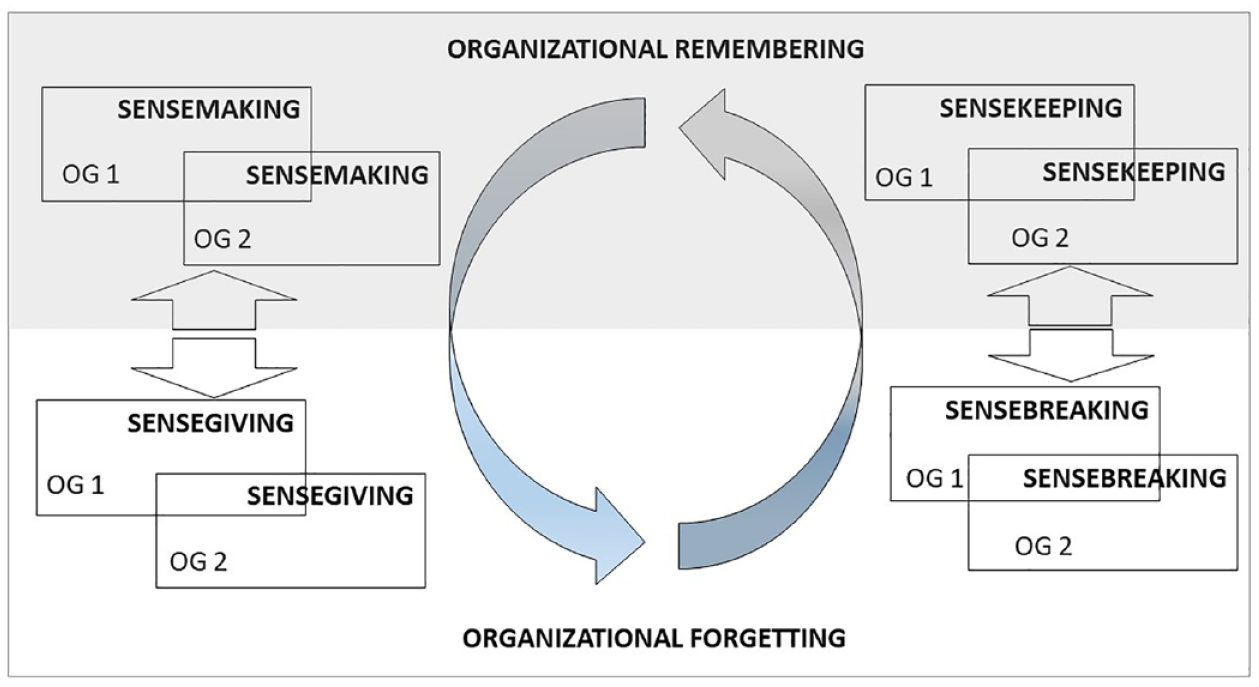
The role of sensing in organizational memory processes: occupational perspective.
Occupational groups may vary in terms of both the intensity and motivations for recalling the past, possibly shaped by factors like ties to the leadership and the organization. Given the individualistic and self-driven nature of academic work (Hotho, 2013), academic staff may distance themselves more from the impact of leadership changes. Furthermore, the prevalence of part-time or fixed-term contracts among academic staff (Westoby et al., 2021) also affects their linkage to organizational memory. As a result, academics may experience a deeper affinity with their academic peers than with the organization as an entity.
In contrast, administrative staff, whose roles are more closely tied to leaders and organizational management processes, may exhibit a tighter bond to the changes at the management level. Such variations are significant at the occupational level, underpinning the idea that we must consider the distinct ways occupational groups differ, not just in their recollection or omission of details but also in their underlying reasons for remembering and forgetting. As previous studies have shown, occupational groups frequently hold divergent memories of the same events (e.g. Aeon and Lamertz, 2021). Our study contributes to explaining the reasons behind this phenomenon.
Our research reveals that the processes of remembering and forgetting are not only inherently polyphonic but also politically charged. This aligns with the perspective of Nissley and Casey (2002: 44), who noted “organizational memory may be politicized.” For instance, specific occupational groups may utilize the past for purposes distinct from those of other occupational groups, particularly when examining those with considerable influence within the organization. Our findings echo Suddaby and Viale’s (2011: 436) assertion that professionals have the power to create, maintain, or transform institutions because “professionals are uniquely positioned within organizational fields as brokers of varieties of capital.” From the practical viewpoint, managers should first recognize the presence and power of different occupational groups within their organization. Second, they should develop strategic interpretation skills to discern the different sensing methods employed by each group when they reference the past.
Limitations and future research
Our study not only contributes to current understandings but also highlights avenues for future research. Our study focused on the academic setting, which may differ significantly from business organizations. Academic institutions are distinctive in that they typically eschew the stringent managerial hierarchies found in business settings, with academic staff more committed to their profession and global academic networks than to their immediate academic unit or university. Our study, set in an academic context where occupational groups enjoy considerable academic freedom and bargaining power, may amplify their voices compared to those in standard business organizations.
Our study provides evidence of the multifaceted nature of organizational memory and its operation through the forms of sensing: sensemaking, sensegiving, sensekeeping, and sensebreaking. These were examined during a leadership transition within an academic organization. Future studies could profitably investigate how these senses are manifested during different organizational events, such as rebranding or mergers. Understanding how organizational memory responds to these challenges can further our grasp of how collective perceptions of significant change processes are formed and managed.
Footnotes
Funding
The author(s) disclosed receipt of the following financial support for the research, authorship, and/or publication of this article: The work of Dr Anne Reino was supported by the Estonian Research Council (grant PRG1513). The work of Dr Eneli Kindsiko, Priit Vahter, and Maaja Vadi was supported by the Estonian Council (grant PRG791).
