




Abstract
In Bosnia and Herzegovina (BiH), scholars and practitioners often cite the lack of shared narrative as a primary challenge to long-term peace. A study of the multi-ethnic, collaborative story-telling work of the Post Conflict Research Centre (PCRC), a Bosnian peacebuilding organization, however, tells a different story. Instead of aiming to forge a singular narrative, PCRC weaves together multiple stories that express complex positions while driving narrative frames that show peace is possible. In a context where actors might not be ready for a joint narrative, the organization demonstrates how plural stories can co-exist, and be strategically mobilized and disseminated through diverse formats to actively engage others in peace-building processes. Identifying key narrative principles, tactics and frames employed by PCRC, this article proposes more attention is paid to how narrative can be strategically harnessed to de-stabilize the stories that drive entrenched division and to foster and cultivate a culture of peace.
Introduction
Stories serve a sense-making function in all cultures, they inform how we see each other and influence what we believe and choose to act on (Law, 2000; Polletta et al., 2011). Intractable conflict is increasingly defined by radical disagreement that involves competing truth claims and opposing views of history and politics (Ramsbotham, 2010). Narratives – patterns that emerge from stories and that provide structure to specific stories – are central to the formation and sustaining of the grievances that drive violence and conflict. 1 Narratives provide the moral architecture that serves as the justification and impetus for people’s actions (IFIT, 2021). The peace scholar, JP Lederach has posited that narrative work is central to pathways to peace. He suggests one way to understand cycles of violence and protracted conflict is to visualize them as narrative broken and peace-building as narrative restored; the deeper challenge of peace-building, he explains, is ‘to reconstitute, or re-story, the narrative’ (Lederach, 2005: 146).
This article explores what this challenge of re-storying looks like in practice. It considers narrative as a form of strategic peace-building (Lederach and Appleby, 2010). Strategic narratives are understood as the means by which political actors attempt to construct shared meanings to shape the behaviour and attitudes of others (Miskimmon et al., 2017). This article examines how strategic narratives and narrative strategies can be harnessed to subvert radical disagreement, destabilize conflict narratives and cultivate a culture of peace. It builds on existing research that argues that narrative transformation is key to the creation of durable peace and lasting change (Cobb, 2013b; Federman, 2016). Given that international affairs and politics are increasingly understood as a matter of ‘whose story wins’, framing strategic narrative as a form of soft power that can be harnessed for peace focuses our attention on what kinds of kinds of stories are likely to persuade and under what conditions (Roselle et al., 2014). It also requires that we consider how the performative process of building and sharing stories works to expand moral imaginations and actively shape and cultivate peace for people living with the legacies of conflict (Lederach, 2005).
Providing an empirical case study of the Bosnian peace-building organization the Post Conflict Research Centre (PCRC), this research identifies key narrative principles, tactics and frames that underpin the multi-media collaborative storytelling at the core of PCRC’s work. These narrative frames advance stories that show peace is possible, that counter negative and divisive stereotypes, that carve spaces for diversity, creativity and tolerance, and that discuss remembrance and justice. In BiH, the lack of shared narrative is often seen as the main obstacle to durable peace. However, in a country where narratives are seen as the problem, PCRC demonstrates how they can serve as a solution. The organization, with its plural storytelling initiatives which include documentary films, photography exhibitions, youth magazines and festivals, peace education workshops as well as an online multi-media platform and participatory media training and youth correspondents network, allows for diverse positions and stories to co-exist in a context where actors might not yet be ready for a shared or joint narrative.
Findings from this research show how the cultivation of multi-dimensional and multi-ethnic stories is central to strategic narrative peace-building approaches. Whilst the dominant ethno-nationalist narratives reduce and simplify working as drivers of polarization and division, PCRC’s multi-ethnic work illustrates how diverse narratives work as enablers of peace (Cobb, 2013b; Federman, 2016; IFIT, 2021) and how the vital and complex work of narrative braiding (Cobb, 2013a) is key to strategic narrative peacebuilding. Recognizing the contested character of Bosnia’s past conflicts and not seeking to undermine the validity of different groups’ grievances or compound feelings of guilt or shame, PCRC layer stories, incorporating new actors and voices, seeking out narratives that craft alternative visions of their country, that cultivate an openness to difference and that catalyze dialogue and reflection. With this story weaving they illustrate that cultivation of peace is not about developing a singular shared narrative but about creating a rich, diverse web of stories that inspire a new peaceful future. PCRC’s work demonstrates how strategic narrative peace-building pushes beyond the crafting and communicating of stories to the active co-creation and mobilization of constructive stories (Senehi, 2002) through proactive dissemination, structured peace education, training and mentoring, capacity building and engaging civil society and young change-makers. Narratives on their own are not enough but it is how one co-creates stories and ‘what one does with the narrative’ that counts (Gomez and Coombes, 2019: 16).
In what follows, this article first provides an explanation of the research methods that underpin this case study and an organizational overview of PCRC. It then considers the literature on narrative and strategic peace-building, drawing on existing research to define and expand the notion of strategic narrative peace-building and the question of what kinds of stories and narratives work strategically as enablers of peace. It then presents a brief overview of the context in Bosnia before providing an analysis of the key narrative principles, tactics and frames that underpin PCRC’s strategic narrative work.
Methods
PCRC’s harnessing of creative and participatory multi-media within the highly divisive Bosnian context provides a unique opportunity to examine the strategic use of narratives for peace. First registered in 2011, the female-led and Bosnian-run organization was born of a conviction that there was an urgent need for Bosnians to forge narratives that created common ground, fostered dialogue, diversity and tolerance, and worked towards restoring intergroup relations (Šarić, 2021). PCRC’s Founder and President, Velma Šarić, a former journalist and researcher, describes how they saw the arts, film, photography and media, tools that were ‘completely neglected at the time’, as key ways to engage and inspire audiences (Šarić, 2021). In their first decade, their activities have garnered significant attention. Academic research attests to the positive impact of their projects (Čehajić-Clancy and Bilewicz, 2017; Fairey & Kerr, 2021; Simić, 2016) and multiple awards recognize their innovative work and highlight its potential for expansion and replication. 2
PCRC design their projects to tackle what they identify as three ‘grievance-related drivers of conflict’ in BiH: polarizing and negative media content, the lack of role models and social influences that perpetuate negative perceptions, and attitudes towards the ‘Other’ (PCRC, 2017a). The organization employs a solution-focused and multi-pronged approach to design programmes of various components that harness creative visual multimedia to forge different stories that engage and promote critical thinking and dialogue. They produce documentaries, mobile photography exhibitions, public art interventions, photographic publications, youth media platforms and magazines. 3 PCRC focus their efforts on youth and use creative interventions as opportunities to disseminate multi-ethnic narratives, to bring people together in training, workshops, screenings, festivals and events and, crucially, to create their own stories that foster a culture of peace.
The majority of the narrative examples discussed in this article have emerged out of PCRC’s two flagship programmes: Ordinary Heroes and Balkans Diskurs. The first, Ordinary Heroes, comprises multiple components that use stories, captured in films, photographs and testimonies of international and Bosnian ‘rescuers’ (Dudai, 2012), to promote intercultural understanding and create a new generation of role models that embody courage and compassion. Rescuers, or ‘moral exemplars’ (Čehajić-Clancy and Bilewicz, 2017), are ordinary people who during times of conflict and violence go against the grain to protect and save people from different groups or on different sides of the conflict from themselves. PCRC produced a mobile photography exhibition, ‘The Rescuers’ (2011), and a series of documentary films, Ordinary Heroes (2013), that tell the stories of multi-ethnic rescuers during the Bosnian war. These stories are disseminated via broadcast and social media, and through public exhibitions and screenings, reaching communities and towns across the country. PCRC organize workshops that use Ordianry Heroes stories to model and discuss interethnic co-operation by exploring moral courage, active and passive bystanders, and the power of social influences (PCRC, 2017b). Ordinary Heroes stories are also used in training and education materials, including a countering violent extremism online initiative and a teaching manual on genocide and peace. 4 An annual essay competition, the ‘Srđan Aleksić Youth Competition’ run since 2014, provides young Bosnians with a chance to write and share stories of moral courage and interethnic cooperation from within their own communities.
The second programme, Balkans Diskurs 5 and the Balkans Diskurs Youth Correspondents Programme (BDYCP), feed into PCRC’s goal to build the capacity of young Bosnian change-makers by providing journalism, photographic training and mentoring to young Bosnians and an online multi-media platform to disseminate their stories. Launched in 2014, Balkans Diskurs provides young journalists, activists and academics working in the Western Balkans with a space to publish their stories and analyses of regional issues. With an active social media presence, Balkan Diskurs publishes articles and online exhibitions on topics that directly relate to peace-building and reconciliation, as well as on broader socio-economic and identity issues such as women’s, disability and animal rights, entrepreneurship and culture. Every year PCRC run BDYCP, a journalism and multi-media training and mentoring programme for up to 20 young Bosnians. BDYCP aims to catalyse youth-produced media content and increase the capacity and credibility of Bosnian youth as relevant voices and actors within BiH peace-building processes. Over 100 young people have so far participated, creating an active network. Evaluative research into participants’ experiences demonstrates how the programme solidifies their positive attitudes towards inter-ethnic co-operation, reconciliation and inclusive society while amplifying and extending their profiles and networks as young peace-builders and media professionals (Fairey 2019).
Miskimmon et al. (2017) propose that strategic narratives should be examined at three points in the communication process: their formation, their projection and their reception by audiences. This research principally examines the formation and projection of the narratives employed by PCRC and draws on existing evaluative research (Čehajić-Clancy and Bilewicz, 2017; Fairey 2019; Fairey & Kerr 2020) on the impact of PCRC’s work to consider their reception, not in terms of definitive proof of their effects but rather to demonstrate how iterative learning garnered from audience responses is incorporated and used to inform adaptations in their evolving narrative strategies.
The article draws on five years of collaborative research with PCRC and data gathered over two different research projects. 6 From 2017 to 2019, as part of wider research into arts-based peacebuilding in the Western Balkans (Fairey & Kerr 2020), evaluative research was conducted on BDYCP (Fairey 2019). From 2019 to 2022, research has focused on building a wider organizational case study of PCRC’s activities, networks and strategic vision. Methods have included a thematic review and analysis of 10 years of strategic organizational documents and data, 7 and of all PCRC visual outputs. This thematic analysis was supplemented by multiple interviews with key staff and collaborators, and participant observation of events, presentations, photo exhibitions and film screenings over four different trips to Sarajevo. In addition, the author worked with PCRC directors to develop an organizational ‘Theory of Change’ 8 which served as a process to engage in active discussions about PCRC’s strategic objectives and vision. Through a thematic analysis of the various forms of data gathered over the period, the research has examined PCRC’s conscious and implicit formation, and identified key narrative frames and strategies that shape their editorial, dissemination and outreach policies, and the content and stories that they produce. Images are central to strategic narrative research (Crilley, 2015) and PCRC’s work primarily employs visual media and storytelling; however, the analysis in this article focuses on the broad narrative frames and strategies that underpin PCRC’s storytelling work rather than specifically discussing their visuality which will be the subject of future writing.
Narrative and peacebuilding: Reviewing literature, research and practice
Given that narratives shape our identities, understandings and behaviours, it is unsurprising that in recent decades serious attention has been given to narrative as a lens to advance thinking in international relations, peace and conflict studies, and conflict transformation. Scholars across these fields highlight the central role of narratives in driving and sustaining conflict (Cobb, 2013b; Federman, 2016), political violence (Graef et al., 2020), influencing international politics (Miskimmon et al., 2017) and in conflict resolution (Cobb, 2013b; Federman, 2016). They highlight that the study of narrative is central to understanding how conflict is defined, constructed and perpetuated over time. Intractable conflicts can be understood as embedded in stories that construct enemies, fuel discord, and justify and perpetuate violence and division. Federman and Niezen (2022) and Cobb (2013a, 2013b) argue that conflict narratives reduce complexity and thrive on binaries. In the same way, post-conflict stories that employ over-simplistic categories of victim, perpetrator and hero have serious consequences for peace and reconciliation efforts (Federman and Niezen, 2022). Senehi (2002) distinguishes between destructive and constructive stories, arguing that, while destructive stories sustain mistrust and denial, constructive stories are inclusive, and foster collaborative power and mutual recognition. If destructive narratives are left intact they will continue to undermine other attempts at conflict transformation, mediation and dialogue (Cobb, 2013b; Federman and Niezen, 2022; Senehi, 2002). Crucial to durable peace is narrative transformation that interrupts cycles of conflict by constructing and narrating stories that recognize the interconnectedness of all parties (Cobb, 2013b).
When peacebuilding is recognized as a form of persuasion (Federman and Niezen, 2022: 327), strategic narrative peacebuilding can be understood as the intentional cultivation of persuasive stories to foster peaceful relations. Within the peacebuilding field there is recognition of the need to commit to a more profound understanding and engagement with the reductive societal narratives that underpin conflict and that directly inform peace-building agendas. Recent sector initiatives such as narratives for peace (Roig, 2019) and re-framing peace initiative (Lindland et al., 2020) highlight the need to build narrative competency while narrative change practitioners suggest that peacebuilders proactively harness narrative strategies and tactics (Gomez and Coombes, 2019; Oxfam and On Think Tanks, 2020).
Research points to how narrative and storytelling is embedded into transitional justice as part of truth-telling processes (Clark, 2022) and traditional peacebuilding and indigenous justice systems (Batchelor et al., 2007). Storytelling interventions that bring together people from different sides of a conflict to listen to each other’s personal stories and to engage in dialogue have been shown to have the capacity to reduce prejudice, re-humanize, build inter-group empathy and foster reconciliation (Bar-On, 2006; Furman, 2013; Oberpfalzerová et al., 2019). More broadly, a strong accent is placed on the value of storytelling within transitional justice as a means of healing and giving victims a voice; however, Clark (2022) warns of ‘narrative social bulimia’ when the ready consumption of victim/survivor stories imparts a temporary sense of inclusion but ultimately leaves actors feeling used and rejected.
The critical question is what types of narratives and stories are most ‘constructive’ (Senehi, 2002) at countering conflict narratives and fostering peace. Noting the potential for face-to-face storytelling interventions to re-traumatize participants, or even to reactivate conflict-related frames (Oberpfalzerová et al., 2019), Bar-On’s (2006) concept of a ‘good enough story’ recognizes that stories might be imperfect but that they are good enough if they generate inter-group empathy and support reconciliation without alienating or hurting other participants. Various narrative scholars agree that, while simplified stories are drivers of conflict, complex narratives are enablers of peace (Cobb, 2013a, 2013b; Federman, 2016; Federman and Niezen, 2022; IFIT, 2021; Roig, 2019; Simmons, 2020). Cobb (2013a: 117) designates that ‘better formed’ stories which transform conflict develop complexity through various dimensions: more complex plots, with more events and a circulating logic that connects past, present and future; rounded characters that show both their good and dark sides; and a moral order that is multi-modal rather than binary. Anchored in the moral agency of their characters, ‘better formed’ stories firstly restructure the past conflict so that all parties are acknowledged and accept some responsibility for its creation, and secondly allow for the construction of new identities for everyone involved (Cobb, 2013b). In the post-conflict space, narratives blur the boundaries between fixed categories of victim, perpetrator and hero, showing actors as whole people, with different layers that work to ‘thicken the story’ (IFIT, 2021) and ask for reflection and recalibration (Simmons, 2020). They encourage people to re-shape the ways they relate to each other, building new forms of affiliation while respecting autonomy. Federman and Niezen (2022: 30) describe this as a ‘paradoxical move towards and away from each other’ that creates the context needed to generate inclusive narratives that promote mutual connection and security.
Various narrative thinkers point to Cobb’s (2013a) notion of narrative braiding as a means to create better-formed stories by weaving together the strands of the conflicting narratives into larger wholes in which all sides are represented and have legitimate roles to play (IFIT, 2021; Roig, 2019; Simmons, 2020). Such story weaving creates a narrative web that produces the conditions for public deliberation that can transform conflicts (Cobb, 2013b). In this sense, strategic narrative peace-building is not about forging a single common narrative where everyone tells the same story, especially in an environment where actors are not yet ready for a joint narrative (Adwan and Bar-On, 2004), but about cultivating an environment where many narratives co-exist. The challenge is how peace-builders engage with narratives in ways that seek complexity, that open up, rather than close down, conversations and that construct meaning with others (Roig, 2019) instead of acting as ‘combatants’ who seek to convert rivals and to occupy the whole of the discursive space (Ramsbotham, 2010: 289).
Identifying stories that bring ‘peaceful’ narratives to life and make people reflect and act on them necessitates a deep understanding of the context, media ecologies, cultural norms and psychological factors which enable and constrain narratives, and that make some stories more persuasive than others (Federman and Niezen, 2022; Miskimmon et al., 2017; Polletta et al., 2011). Vermeersch (2022) argues that bottom-up storytelling can be used by conflict-affected communities as a basis for strategies to rebuild their lives after conflict. Participatory and collaborative story-telling processes are key in building the capacities of local actors to develop and define their own ‘better-formed’ stories about themselves and each other (Federman, 2016). Clark (2022) argues that ‘narrative plasticity’ is key to giving conflict-affected actors more control over the stories they tell and to allowing those stories to organically change shape and to develop in new directions that stretch beyond traumatology and victimhood and build resilience.
The Bosnian context
The lack of a shared narrative in post-war BiH is frequently cited as the country’s biggest challenge by scholars who point to Bosnia’s ongoing struggles to come to terms with its burdensome past and to engender reconciliation between ethnic groups (Bell, 2018; Belloni, 2019; Greiff, 2018). The Dayton Peace Accords, that in 1995 brought an end to the bloodshed of the Bosnian war, froze ethnic division into a complex system of multi-ethnic government in which a tripartite Presidency, with one candidate elected from each of the three constituent peoples – one Bosniak, one Croat and one Serb – share executive power. An entire institutional system based on ethnicity has served to entrench ethnic division resulting in frequent deadlock as there are no incentives for politicians, who are elected into office as representatives of their respective ethnic groups, to make cross-ethnic appeals or invest in co-operation (Belloni, 2009). Nationalist agendas fuelled by well-worn separatist narratives have served to imprison politics and obstruct reconciliation efforts. Research reveals that the International Criminal Tribunal for the former Yugoslavia (ICTY), rather than individualizing guilt, has served to further reinforce ethnic cleavages and distrust (Milanović, 2016). Despite billions invested in transitional justice mechanisms and international peace-building initiatives there is widespread disillusionment and cynicism amongst Bosnia citizens about the striking gap between the promises of the liberal peacebuilding agenda and day-to-day realities of deteriorating economic, political and social conditions (Belloni, 2019; Kappler, 2012).
Over 25 years since the end of the war, recent political crises highlight the ongoing fragility of Bosnia’s peace. 9 Competing narratives and three conflicting views of history dominate public discourses. Bosnian print and broadcast media, primarily controlled and owned by political interests, produce extensive ethno-nationalistic content (Sokol, 2021). Political division is replicated in the education system where under the ‘Two Schools Under One Roof’ scheme, children are ethnically segregated and there are three different sets of national curricula (OSCE, 2018). Bosnia’s youth are coming of age in a country with one of the highest rates of youth unemployment in the world. 10 Many growing up with selective and inherently divisive stories of the past are not exposed to narratives that bridge ethnic divides and, excluded from playing active leadership roles in peace-building (Gillard, 2001), have little opportunity to gain awareness about notions of tolerance. Surveys attest to growing levels of youth apathy and apolitical attitudes as young Bosnians have lost confidence in institutions and political actors (Ziga et al., 2015). Everyday public life in post-war Bosnia is fundamentally and inescapably political with local processes that create high tensions, continually raising the question of whether just one Bosnia is possible (Greiff, 2018: 13).
Harnessing narrative: Principles, tactics and frames
In this polarized and highly sensitive context, how do PCRC meet the challenge of creating narratives that open up, rather than close down dialogue? How do they use stories to co-construct meaning with others when many of those they want to reach are resistant or disengaged? This analysis identifies cross-cutting narrative principles and tactics employed by PCRC and four narrative frames that underpin the plural stories they put out into the world.
Narrative principles and tactics
PCRC made an early and conscious decision to create stories that speak to the lived experiences of all of Bosnia’s ethnic groups. Their multi-ethnic platform is a central principle of their story work. The established way of working in BiH was to present stories specific to each ethnic or religious group separately (Šarić, 2021) but PCRC decided to feature ‘three stories on one platform’. Their first film Uspomene 677 (Pincelli, 2011) that tells the stories of three concentration camp survivors and three teenagers from each of Bosnia’s constituent ethnic communities coming to terms with the country’s violent past was accused of relativizing history. Šarić says their approach is to tell stories that speak to the experience of all ethnicities so that viewers can decide on truths themselves. Uspomene 677 epitomizes Cobb’s (2013a: 14) description of narrative braiding as the different stories provide strands that anchor the identity of each ethnic group and weave together a collective context ‘that retains the particularity of the narrative strands, yet they are wrapped around each other at junctures where the legitimacy of one party touches the terms of the Other’s legitimacy’ without a clearly defined closure.
Narrative braiding allows for stories that involve the participation and representation of all parties. Rather than flattening stories into a nondescript common, it reflects the complexity of different experiences, their elements of tension, contestation and connection, and subverts the persistent political atmosphere that pitches different histories against each other, perpetuating conflict. Milovanović (2021) who told her own story in Uspomene 677, expands on the effect of this weaving of different narratives: ‘Obviously we don’t have one official narrative and everyone knows that, listening to all these stories you are fine with that, the strong feeling is that we must work to make sure this never happens again.’ PCRC demonstrates a skill crucial to the work of constructing complex peace narratives: the capacity to find points of narrative alignment that foster a sense of shared destiny within a plural narrative landscape that holds multiple conflicting positions (Miskimmon et al., 2015).
Cobb (2013b: 120) designates narrative liminality, a ‘betwixt and between’ space where the narrative of the self and its relationship to the Other is disrupted but not yet reformulated as critical to emergence of new narratives where people can re-imagine their roles and the markers associated with them. Placing different stories and positions alongside each other without forcing a resolution or shared narrative speaks directly to people’s lived experiences in deeply divided societies and succeeds in forging a shared recognition and understanding. Polletta (2008: viii) reminds us that good stories are not necessarily coherent and resolved with clear moral punchlines. Ambiguous stories can be an important resource to forge identity across political difference because they allow different ideas to hang together while ‘pointing in quite different normative directions’ (Polletta et al., 2011: 211).
While their multi-ethnic approach has been challenging, it has created opportunities, allowing them to reach previously inaccessible audiences. An example is when PCRC held a public photography exhibition of My Body: A War Zone about the use of sexual violence as a weapon of war in Banja Luka, the largest city in the Republika Srpska. The veterans association who wanted to ban the exhibition backed down when they understood that it featured stories of Serb, as well as Muslim and Croat women (Šarić, 2021; Simić, 2016). At its launch the President of the Association of Camp Inmates said ‘it was the first time that one project was balanced and gave space to all women and their suffering’ (Šarić, quoted in Simic 2016: 20).
A sensitive approach is their second key narrative principle. PCRC are very careful about the terminology they use in a country where terms are loaded and the wrong language can alienate and stoke division. With My Body: A War Zone, PCRC made a conscious choice to re-frame the women who had suffered sexual abuse as survivors rather than (voiceless) victims in an effort to shift the narrative frame around sexual violence. Crucially, PCRC work carefully to ensure their stories do not make accusations or exacerbate feelings of personal or collective shame or guilt for the abuses that happened during the conflict. At one point they worked with the confessions of perpetrators recorded at the ICTY but they quickly realized that this was too sensitive, feeding into wider discourses that perpetuated cultures of blame (Šarić, 2021). PCRC recognize that constructive stories build a context where problems are understood as the result of complicated histories and patterns rather than the result of the failure of one group (Federman, 2016).
These factors around trust and sensitivity of approach and language directly relate to PCRC’s emphasis on quality, the third key principle that underpins their work. PCRC maintain high editorial and journalist standards. They make a point of ensuring that their content is available in multiple languages. For PCRC, quality is crucial to ensuring results – engaging audiences and building the capacities of the Bosnian media producers and storytellers (Šarić, 2021; Woodward, 2021). In the context of creative participatory work, there is often a false choice presented between quality of process or product but PCRC sees the two as being symbiotic. Being linked to high- quality work helps the youth correspondents to raise their profiles and credibility. It inspires them to raise their standards and achieve their objectives (Milovanović, 2021). The priority always has to be to maintain a commitment to ethical and consent standards, and to telling the story well (Šarić, 2021).
PCRC have developed various narrative tactics to enable dialogue around contentious topics such as genocide and violence against women. One key learning has been the value of using stories from other countries who have suffered histories of conflict and violence as a means to ‘indirectly’ approach and discuss sensitive issues and introduce concepts (Milovanović, 2021; Šarić, 2021; Woodward, 2021). Seeing how people respond to international stories of moral exemplars, PCRC realized it was easier for young people to speak when they were talking about conflicts in countries other than their own. PCRC now frequently harness this strategy of introducing and exploring issues around genocide, war-time sexual violence and war crimes through international and historical stories before looking at and talking about the issues in the Bosnian context. Milovanović (2021) comments that it opens up new ways of thinking for Bosnians as they realize it is not just Bosnia dealing with these issues. Learning from international examples also works to reduce the feelings of national shame that obstruct people’s ability to be able to acknowledge what happened.
Narrative frames
With a deep knowledge of ethno-nationalistic narratives in BiH and how they want to change them, PCRC have a clear sense of the kinds of stories they want to tell. However, these are not explicitly defined in any formalized criteria or editorial policy. For the purpose of this research, I have identified four strategic narrative frames that underpin PCRC’s storytelling. The theorization of narrative frames in this context refers to the messages that frame and drive the stories, and that seek to persuade audiences and foster positive peace. Stories generated by PCRC belong to one or more of four narrative frames that: (1) demonstrate peace is possible; (2) counter divisive and negative stereotypes and narratives; (3) foster creativity, tolerance and diversity; and (4) centre justice and remembrance. These frames can be thought of as tacit, embedded implicitly into PCRC’s narrative approach. They are emergent in the sense they have evolved through years of responsive and adaptive peacebuilding (de Coning 2018) but simultaneously have been strategically cultivated to provide alternative narratives in the context of Bosnia’s highly polarized landscape. In reality, many of the stories PCRC produce and facilitate do not fit neatly into any one of the identified narrative frames but cut across them. Those leading PCRC note that, rather than hold explicit narrative policies, they want to remain open to the stories that come to them. They encourage the young people they work with to bring them new ideas and to write about the things that interest them (Milovanović, 2021; Šarić, 2021; Woodward, 2021). Imposing formal guidelines on story types would curtail the very openness that PCRC are trying to cultivate in others.
Peace is possible
PCRC consistently emphasize the importance of positive stories that, in a country with high levels of youth disillusionment, work to inspire Bosnians into realizing that peace is possible. As Milovanović (2021) puts it: we grow up in a system that is very dark, plagued with corruption, where the opportunities for living are few. There is this depressive sentiment that our parents carry because they went through the war and they can’t see anything good for the future.
Bosnian youth, Milovanović asserts, need something to believe in to see a future. The Ordinary Heroes stories, by finding examples of people who showed compassion in the face of intolerance and brutality, create new role models for young Bosnians. PCRC believe that another narrative of wartime events needs to become part of the historical record, one that breaks with people’s existing convictions and that builds understanding of the courage shown by ordinary citizens (PCRC, 2017b). Drawing on research that defines criteria for how moral exemplar interventions work to foster interethnic reconciliation (Čehajić-Clancy and Bilewicz, 2017), PCRC use their Ordinary Heroes stories to evidence and illuminate the bravery and kindness of others. Then they mentor and support Bosnian youth to go out into their communities to find examples of their own ordinary heroes. The Ordinary Heroes stories are generative with each story leading to the creation of more stories creating a new narrative landscape that disrupts totalizing conflict narratives that designate heroes as leading war figures and civilian populations as passive victims of violence.
When participants co-construct stories, the hope is they are more likely to uphold and perpetuate them, leading to lasting outcomes (Federman, 2016). Dudai (2012) argues that rescuer stories should become an integral part of transitional justice because of their potential to catalyze reconciliation through their re-humanization of the other and the way they challenge the idea that ordinary people are powerless to act. Research undertaken on PCRC’s Ordinary Heroes project shows evidence that their youth workshops increase youth’s open-mindedness to people from other ethnic groups and build their capacity to reduce ethno-nationalism (Čehajić-Clancy and Bilewicz, 2017). Heroic icons give us hope but what is crucial is who gets to say who is a hero (Federman and Niezen, 2022). By re-calibrating which actions and behaviours are celebrated as heroic as well as handing power over to young Bosnians to identify and designate their own heroes, PCRC’s Ordinary Heroes stories undermine neat categories that assign people as victims, perpetrators, bystanders and heroes whilst paying homage to those who model empathy, courage, inter-ethnic connection and a will for peace.
Many other PCRC projects pursue the ‘peace is possible’ narrative frame. The Love Tales is a recent photographic storytelling project which consists of interviews and portraits of couples in successful inter-ethnic relationships (see Figure 1). It aims to challenge the ingrained narrative that real connections between Bosnia’s ethic groups are unattainable. It is featured in PCRC’s most recent publication, MIR, an annual youth culture magazine that contains 56 stories of creative entrepreneurship and inter-ethnic collaboration. Šarić (2021) explains that the focus is on raising positivity, on demonstrating what can be achieved and learning to value and cherish peace; the stories show that ‘peace is a process, that it needs to be built, to be invested in, that someone needs to build this country. They say that if peace is possible on a small scale then it is possible on a grand scale.’
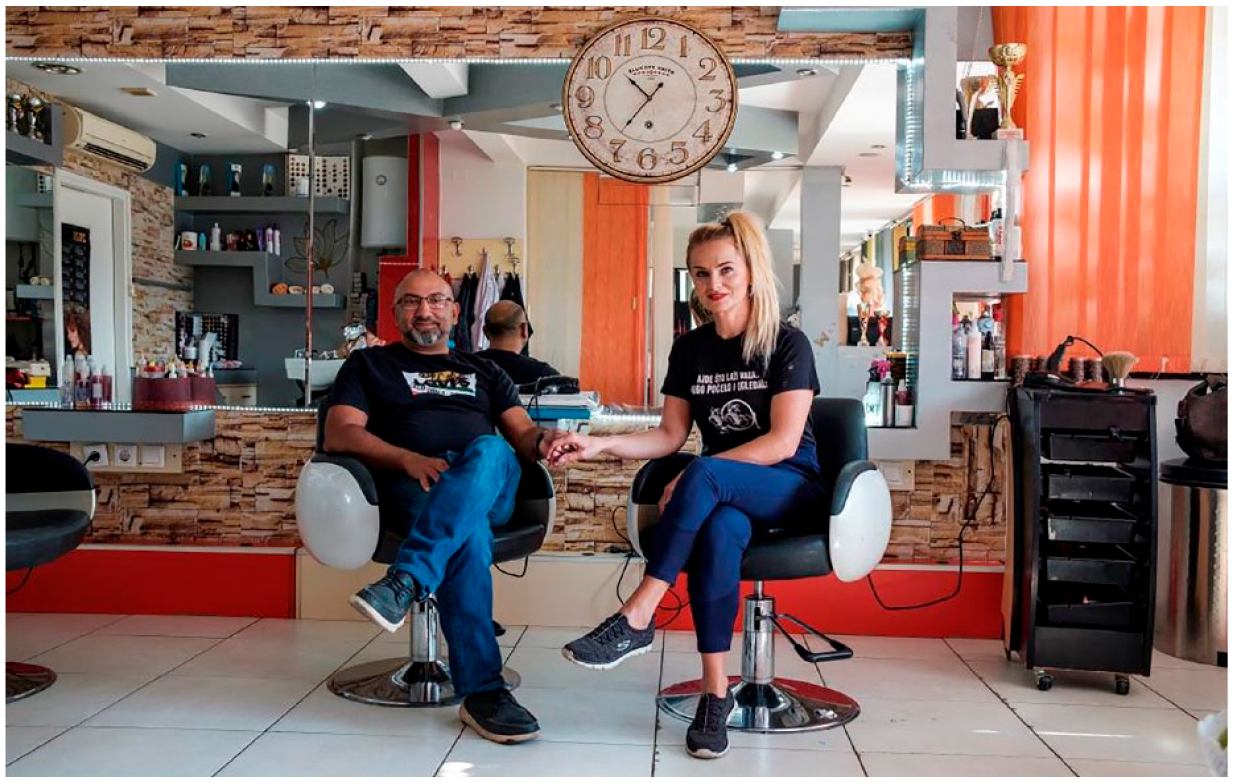
Extract from The Love Tales.
PCRC recognize that infusing the narrative space with positive stories is, on its own, not enough to build a culture of peace but, with their accompanying educational work, they want to encourage Bosnians to look deeply and critically at their history, to inspire them to forge a different future by modelling how peaceful co-existence between ethnic groups is possible and by evidencing the creative capital and potential of the country. Their approach actively illustrates Roig’s (2019: 7) point that narrative peace work is not about convincing people to change their identities but rather to construct and re-inforce a new narrative that can accommodate plurality and builds a common understanding of the possibility of peace.
Countering divisive and negative stereotypes and narratives
While PCRC’s strategic approach to narrative often works by engaging audiences in conversation about sensitive and contentious subjects indirectly, some of their storytelling looks to actively confront divisive, harmful stereotypes. On the Margins is a photographic project that tackles the discrimination and persecution faced by BiH’s Roma community by challenging negative stereotypes of the Roma. Coming across a document which listed Roma stereotypes, Woodward (2021) describes how PCRC worked with up-and-coming Bosnian photographers and in collaboration with Roma community leaders to find images and stories of Roma people who did not conform to or who directly challenged these persistent stereotypes (see Figure 2).
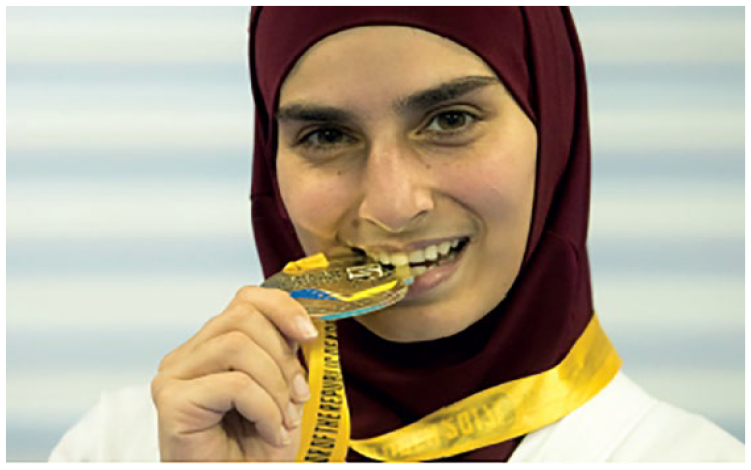
From On the Margins.
This approach built on learning they gained when curating Transitions, a co-curated exhibition telling the transitional justice journeys of four different countries. For the different Bosnian chapters, they worked with the photographer to make sure that for every image that spoke to the persistent divisions there was a counter image that told of the evolving togetherness, reconciliation and justice. There was an intentional hunt to find images that represented not just one story but that spoke to all sides of the narrative.
Counter narratives, also known as response narratives, contest dominant narratives which strip their subjects of moral agency by launching themselves ‘at the logic, coherence and the closure of the dominant narrative working to upend it’ and to forge new stories (Cobb, 2013b: 87). However, there is a debate around their effectiveness. Nelson (2001) argues that efforts to recontextualize some counternarratives end up reproducing the dominant narrative and maintaining marginalized identities. Narrative change advocates cite neuroscience research that suggests that, by calling out what you do not want to see, you can inadvertently confirm or reinforce the narrative you want to reject (Oxfam and On Think Tanks, 2020: 49). Transitions and On the Margins demonstrate how this can be done simultaneously and suggests that implicit in the forging of new narratives is the countering of damaging, persistent and engrained stereotypes. When they saw On the Margins, which was intended for external audiences, Roma community leaders decided they too could use the stories to empower, inspire and bring together their own youth. They referred to how the negative image of the Roma had been absorbed by their own young people (Woodward, 2021). This points to the potential value of narrative work to counter stereotypes and restore relationships within as well as between communities.
Fostering creativity, tolerance and diversity
Messages that foster creativity, tolerance and diversity are inherent to all the narratives that PCRC work with but this narrative frame is especially evident in the diverse work created by the Balkans Diskurs youth correspondents who produce bottom-up stories on subjects relating to identity, culture and rights (Fairey 2019). PCRC’s recent youth magazines ASBO and MIR (see Figure 3) feature diverse stories authored by young Bosnians that showcase creative innovation, collaboration and entrepreneurship. MIR’s 56 different features are ordered into sections such as Activism & Youth, Travel in BiH, Fashion and Design, Art, Photography and Music, Heritage and Architecture. These categories highlight positive stories of young Bosnians forging new futures, creating successful creative businesses and founding social enterprises. They celebrate Bosnia’s rich cultural heritage and its natural beauty, and present multi-identities and diversity as a ‘sign of prosperity and not an issue’. 11 They showcase ways that young Bosnians are creating inter-ethnic spaces, using culture to create and build together across ethnicities, and how for many of them living inter-culturally is not something forced, imposed or unusual but a way of living that is cherished. 12
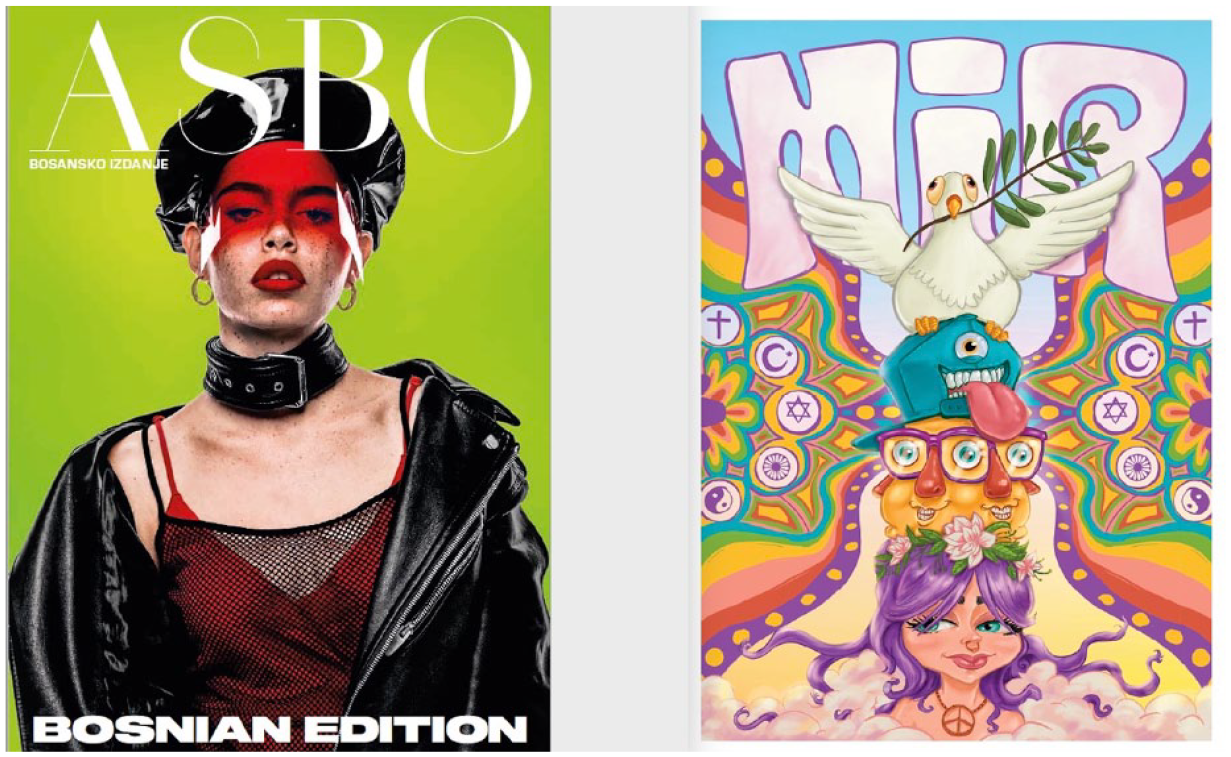
Covers of ASBO and MIR magazines.
MIR’s editorial describes the magazine as providing ‘a platform for young inventive people who push social and creative boundaries’ that brings together diverse stories and ‘connects themes across borders’ (MIR, 2022: 2). There are stories of rappers, jewellery designers, former soldiers, war correspondents and horses but each speak to a common frame that fosters creativity, tolerance and inter-cultural living. The stories demonstrate the advantages and benefits of living and working together. They present inter-ethnic living not just as desirable but as normal. The stories actively ‘re-story’ (Lederach 2005) Bosnia, projecting an image of the country as dynamic, proud and resilient.
Remembrance and justice
Whilst a large part of the stories that PCRC produce are forward looking, a number of their initiatives are dedicated to remembrance and to commemorating survivors and victims of the war. In their more recent project curated in collaboration with the Srebenica Memorial Centre, Momento, PCRC use objects donated by Srebrenica Genocide survivors and victims’ families as a means to tell real-life stories of victims and survivors via images and audio testimonies (see Figure 4). 13 Cobb (2013b: 31) highlights how those who advocate the creation of a shared narrative as an approach to conflict resolution not only risk omitting the narrative violence that has taken place but can be complicit in supporting injustice and the exclusionary practices that gave rise to the violence in the first place. It is crucial to find a way to name and be witness to the violence but without perpetrating or perpetuating that same violence. Šarić (2021) emphasizes the need to find ways to commemorate that do not blame or perpetuate collective guilt. The sensitive curation of Momento involved working with the objects and testimonies, survivors and victims’ families, drawing on ICTY and the Court of BiH findings, and using audio to bring the stories of the objects and the images to life.
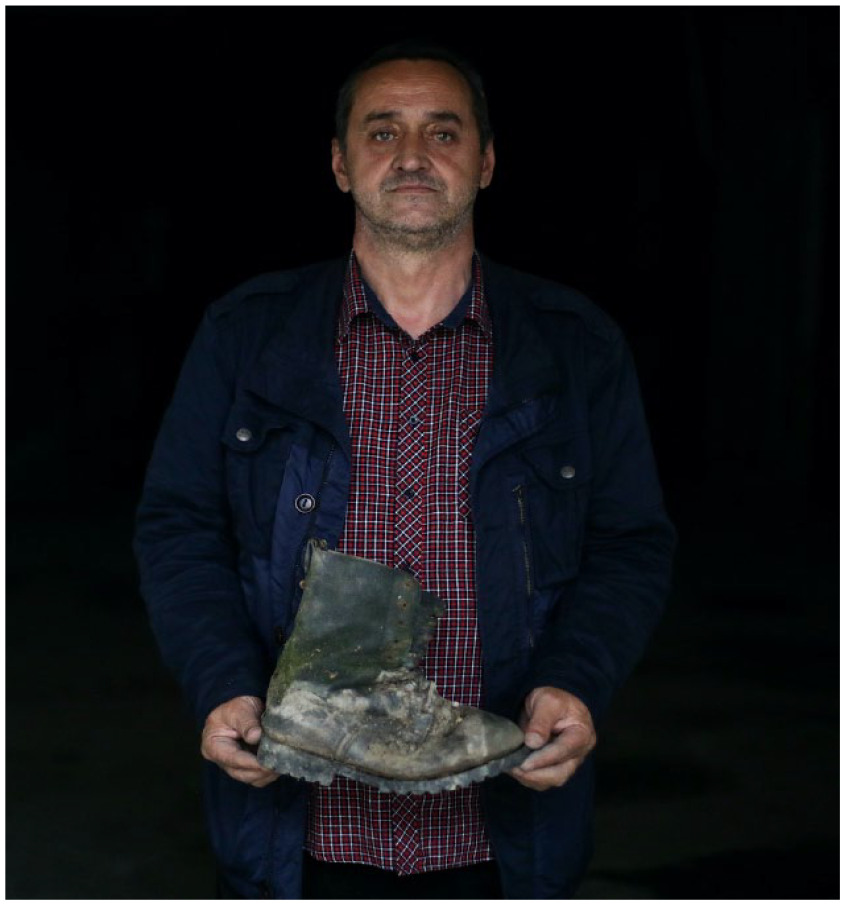
From Momento. Munir Habibović spent six days on the Death March, along with thousands of other men who knew they would not be safe staying in the Srebrenica area nor at the UN base at Potočari. He still remembers how he narrowly escaped an infamous ambush at Bukva during which about one thousand of their unarmed men were killed. Munir’s deaf-mute brother Mirsad was killed in the genocide whilst trying to seek protection at the UN base. Mirsad’s remains were found in the Lažete mass grave in 2002 and he was buried in the Srebrenica-Potočari Memorial Center in 2003. © Photograph: Armin Durgut. Reproduced with permission.
Narratives that speak directly to the past, that honour victims, are a key part of a vision for a justpeace (Lederach and Appleby, 2010) that understands recognition and reparation as central to durable peace. However justpeace does not just look to the past. Strategic peace builders pay close and careful attention to the ways in which inequalities continue to be re-produced and contribute to latent conflict and the ongoing generation of hostilities. Balkan Diskurs articles take on issues such as disability, gender, LGBT and minority rights reporting on contemporary justice and rights campaigns.
Conclusion
This article has provided an analysis of how narrative, in the context of BiH, is being strategically harnessed to build durable peace and reconciliation. Whilst existing research on the impact of PCRC’s activities (Čehajić-Clancy and Bilewicz, 2017; Fairey 2019; Fairey & Kerr 2020) evidences the positive impact of their work on peace and reconciliation processes, further detailed research is needed to measure the impact of specific kinds of narratives on attitudes towards peace and reconciliation across different types and profiles of audience.
The peace potentialities of narratives are, of course, context-dependent. Stories that have an impact in one context or with one audience will not have the same effect with others. Cobb (2013b) warns that narrative transformation cannot be engineered and that ‘better-formed stories’ are more poetic than formulaic. There are no prescriptive models for strategic peace building. However, this article offers an insight into how strategic peace builders can harness narrative tactics, strategies and frames to foster and restore a culture of peace. The peace potentialities of strategic narratives are significant but they also face considerable constraints relating to capacities around resources, dissemination and narrative competency. PCRC acknowledge this is slow, long-term work. Peace-building narratives need to be shared repeatedly to engage and secure supporters, working towards penetrating social consciousness over time (Roig, 2019). Contextual conditions need to be better understood and researched.
Ramsbotham (2010) argues that radical disagreements can only be dispersed by subversion. Multi-layered narratives that foster peace, tolerance and plurality and that engage with complexity destabilize the reductive stories that fuel division, hate and othering. Narrative is a key strategic peacebuilding tool that warrants further attention when narrative complexity is understood as a fundamental condition of post-conflict resilience (Federman and Niezen, 2022). PCRC’s work demonstrates how constructive narratives that work to foster peace are evolving dialogues through which meaning is co-created (Roig, 2019). They focus not only on collaborative construction of stories but on the weaving together of multiple narrative frames and their strategic facilitation, education and projection. Creating spaces for different groups to hear plural stories, to discuss grievances and concerns, to be inspired by the alternative possibilities and to look to the future enables people in conflict-affected and polarized societies to more pro-actively shape the kinds of narratives they want to subscribe to and that make peace possible.
Footnotes
Funding
The author(s) disclosed receipt of the following financial support for the research, authorship, and/or publication of this article: This research was supported by funding from an AHRC Follow On Grant as part of the research project Art & Reconciliation (ref: AH/T007966/1) and by Dr Fairey’s Leverhulme Early Career Fellowship, Imaging Peace (ECF-2020-175).
