




Abstract
Hostile political actors can use antagonistic strategic narration as a means of marring the image of targeted states in the international arena. The current article presents a content analysis of narratives about the Netherlands that were published by Russian state-sponsored media outlet RT between 2018 and 2020, capturing a period of heightened tension between the states. The authors distil and describe six overarching narratives used to portray the Netherlands as a state of liberal chaos. They analyse them using a framework of strategies underpinning Russian state-sponsored media’s narration, and interpret their strategic functions within the context of recent Dutch–Russian relations. Finally, they provide directions for future research, such as expanding on nuances within Russian media’s negative portrayals of different states or exploring the possible psychological responses this narration may elicit in the Dutch domestic audience.
Keywords
Using international news media to engage and influence foreign audiences is a fundamental ambition in Russian foreign policy (Russian Ministry of Foreign Affairs, 2016). State-sponsored transnational media outlets RT and Sputnik have been labelled as public diplomacy vectors for the Russian government to articulate their vision of the international order and pursue foreign policy objectives (Elswah and Howard, 2020). Both outlets have been criticized for projecting false or distorted information about international affairs, termed as ‘antagonistic strategic narration’ (Wagnsson and Barzanje, 2021). Strategic narratives are defined as ‘a means by which political actors attempt to construct a shared meaning of the past, present, and future of international politics to shape the behavior of domestic and international actors’ (Miskimmon et al., 2013: 2). They therefore act as tools to imbue facts and events with meaning in a manner that benefits a political actor’s objectives. Strategic narratives can be ‘antagonistic’, with political actors dispersing critical or hostile information about another political actor to inflict harm – a concept described as ‘malign information influence’ (Wagnsson, 2020).
RT and Sputnik’s projection of antagonistic strategic narration can be considered an aspect of their roles as ‘organs of influence’ for the Kremlin (Rose and Dyomkin, 2017). Antagonistic narration is used to rearticulate, or undermine, the status and image of particular states in accordance with Russian leadership’s medium and long-term foreign policy goals. This is reflective of the competitive approach that Russian leadership takes towards foreign policy, where ‘the insecurity of others makes Russia itself more secure’ (Giles, 2019: 23). Szostek (2020: 2729) describes the Kremlin’s approach as rooted in its understanding that international media influence is a ‘zero-sum game in which they must fight their hostile Western rivals for supremacy’. Projecting distorted and critical information that mars the image or reputation of targeted foreign states can therefore be seen as a weapon to be wielded in this battle – within Russia’s broader grapple for status and soft power from the West (Forsberg et al., 2014).
Russian malign information influence in the Netherlands
Several studies have investigated the antagonistic nature of narratives projected by Russian state-sponsored media about different international political actors. This includes case studies of narration about European countries (e.g. Deverell et al., 2020; Rebegea, 2019; Wagnsson and Barzanje, 2021) and the United States (e.g. Ramsay and Robertshaw, 2019), or organizations such as NATO or the EU (e.g. Chaban et al., 2017; Ramsay and Robertshaw, 2019). Building on this, the current article intends to analyse recent coverage published by RT to understand how it (antagonistically) narrates a currently understudied case: the Netherlands.
Investigations have revealed instances of RT and Sputnik content about the Netherlands filtering into both mainstream and alternative Dutch media (Kouwenhoven and Heck, 2020), and recent years have seen public discourse concerning Russian malign information influence in Dutch society intensifying (Volkskrant, 2020). Despite these concerns, analyses of Russian media narratives about the Netherlands remain scarce. Some studies have examined Russian narration of events involving the Netherlands (e.g. Rietjens, 2019; Zhabotynska and Velivchenko, 2019), but a more general account of Russian media’s narration about the Netherlands is lacking. By providing this, we aim to contribute to discourse around the potential damage of Russian malign information influence in Dutch society as ‘there is a need to understand how narratives are constructed to be able to assess their harmful capacity’ (Deverell et al., 2020: 2).
Dutch–Russian relations
An examination of Russian state-produced media narration about the Netherlands is particularly pertinent given the backdrop of contemporary Dutch–Russian relations. Studies have shown an apparent inverse relationship between the degree of antagonism in Russian media’s narration about a certain political actor, and the relations or strategic importance that that actor has to Russian leadership. For example, comparative analyses of Sputnik narratives showed that ‘rough’ portrayals of Denmark and Sweden, who were narrated as unstable and culturally deviant, differed from the more ‘delicate’ portrayals afforded to Finland and Norway (Deverell et al., 2020: 16). This difference can be connected to the latter two’s Russian borders and prominence in Arctic security, which confers utility to Russia and may precipitate restraint by Russian leadership, in contrast to Sweden and Denmark whose relations with Russia are less beneficial. Chaban et al. (2017) have noted a similar mechanism in their analysis of Russian (international) media’s narratives about the EU following the Russian–Ukrainian crisis in 2014. They observed a substantial shift, where the narration became more hostile and had an ‘increased emphasis on the fragmented and therefore weak nature of the EU’ (p. 495) after the crisis. They connect this shift in sentiment to the EU’s public rebuking of Russia as a consequence of the conflict.
While, historically, relations between the Netherlands and Russia were largely amicable, they have increasingly soured across the last decade. The Netherlands itself holds significance in Russian history, with much documentation indicating the formative influence of Czar Peter the Great’s visit to the Netherlands in 1699, when he established a permanent diplomatic mission in the Hague to strengthen the states’ relationship (Neumann, 2008). Indeed, 2013 saw the states celebrating a ‘friendship year’ marking 400 years of bilateral relations; ter Haar (2017) describes Dutch–Russian relations since the cold war as developing, buoyed by a mutual interest in cooperative economic development, and how Dutch responses to Russian misconduct were typically tethered to broader EU- or NATO-wide responses.
However, the downing of Malaysia Airlines Flight 17 (MH17) over eastern Ukraine in 2014 – a flight with 196 Dutch citizens on board – and the subsequent criminal investigation catalyzed a steep decline in relations between the states (Van der Togt, 2016). Two parallel inquiries concluded that the aircraft was downed by a BUK-TELAR system thought to be of Russian origin (Joint Investigation Team, 2016; Onderzoeksraad voor Veiligheid, 2015). Criminal proceedings began in 2017 and, in 2019, the Dutch public prosecution service charged four people, including three Russians, with shooting down the aircraft (Government of the Netherlands, 2019) with court proceedings for this case beginning in June 2021. These developments were repeatedly dismissed by Russian leadership as attempts ‘aimed at discrediting the Russian Federation in the eyes of the international community’ (Russian Ministry of Foreign Affairs, 2019). In July 2020, the Netherlands brought a case against Russia before the European Court of Human Rights (Government of the Netherlands, 2020b), described as ‘unfriendly actions’ in a statement by Russian leadership, and leading to its withdrawal from ‘pointless’ talks with the Netherlands in October (RT, 2020a). Further events punctuated this deterioration in relations, such as the controversial 2016 Ukraine–EU association agreement referendum, viewed by some as an example of Russian foreign influence (Applebaum, 2016), or the Netherlands accusing the Russian secret service of attempting a cyber-attack in 2018 (Algemeen Dagblad, 2018).
The current study
The positioning of the Netherlands as our study’s focus allows us to build on and extend previous examinations of how Russia antagonistically narrates Western states. Flight MH17 and the legal case unfolding around it can be seen as a watershed moment in Dutch–Russian relations (Van der Togt, 2016), the most prominent in a series of cascading disagreements. It also marks the beginning of a more independent, outspoken approach towards Russia by the Netherlands (ter Haar, 2017), including its ongoing pursuit of legal accountability by the Russian state, a source of mounting damage to the Russian international image. This brewing geopolitical context inevitably pervades any analysis of Russian narratives about the Netherlands and confers our case study with a particular significance amongst other studies of how Western states are represented by Russian state-sponsored media. The current study therefore contributes an examination that can enrich our understanding of antagonistic strategic narration and, in particular, how such outlets leverage antagonistic strategic narratives to portray a state in direct, ongoing and very publicized contention with Russian leadership − a Dutch thorn in the Kremlin’s side.
Method
Data selection
We analysed a corpus of 146 articles published by RT (rt.com), across a three-year period between 1 January 2018 and 31 December 2020, constituting a recent and sufficiently-sized sample. A total of 156 articles were initially selected, having been tagged as ‘Netherlands news’. The database was then combed to ensure that the majority of each article’s content was focused on the Netherlands; 10 articles were then removed due to not fulfilling this criterion.
Analytical framework
We embrace an analytical framework proposed by Wagnsson and Barzanje (2021). Devised using Sputnik’s coverage of Sweden between 2014–2018, the framework has later been applied to Sputnik’s coverage of other Nordic states (Deverell et al., 2020) and Sweden during the Coronavirus pandemic (Hellman, 2021). The framework outlines three principal antagonistic narrative strategies employed by Russian state-sponsored media. Destruction aims to dismantle perceptions of a target state’s military resolve, economic strength and governmentality (Deverell et al., 2020: 4) by amplifying portrayals of crime, disorder and internal divisions, weakening domestic military support and harming the target’s image as an attractive partner for alliances (Wagnsson and Barzanje, 2021: 12). Suppression aims to tarnish a state’s moral image by projecting narratives that pathologize a targeted state’s ‘way of life, leadership or population’ and present it as ‘morally deviant’, belittling the state’s moral, cultural, or religious standards and emphasizing liberal or non-traditional values in the state. Finally, direction tacitly induces, through narration, geopolitical behaviour by the state that is strategically advantageous for the Kremlin by positively narrating desirable events and negatively narrating undesirable developments.
The strategies align with extant analyses of Russia’s geopolitical ambitions to undermine cohesion in the West (Pomerantsev and Weiss, 2014), gain recognition as a great power (Miskimmon and O’Loughlin, 2017; Szostek, 2017) and portray itself as the global defender of traditional conservative values (Hutchings and Szostek, 2015). In applying the framework to RT narratives of the Netherlands, we make further contributions to the field by developing this analytical framework’s generalizability. All previous applications of the framework have used Sputnik and, while convergence in thematic content between RT and Sputnik has been observed (e.g. Ramsay and Robertshaw, 2019), this would be its first application to RT.
Data analysis
We began with an ‘ethnographic content analysis’, where articles were read chronologically and repeated topics were noted (Altheide and Schneider, 2013). We defined a topic as the subject or event that the article centres on. New topics were listed as they were identified, sometimes leading to the assimilation or separation of categories to be more inclusive or specific, and the coding of previous articles adjusted. This constant comparison method allowed for flexibility in the identification of codes and ensured they represented the whole corpus. This process led to the identification of 15 distinct topics.
During this coding procedure, attention was given to the ‘documentary reality’ of the articles: that they are documents of a Russian media organization with specific strategic intentions. This informed our identification of the antagonistic strategic narration. Synthesizing many definitions, Coticchia and Catanzaro (2020: 7) consider strategic narratives as ‘storylines’ that are ‘deliberately designed to achieve political objective’. Therefore, we not only focused on what topics were discussed, but how they were discussed: what elements were amplified, what frames were used, who were the central figures and how the articles hung together as a narrative sequence. The procedure identified six narratives, which we formalized alongside the identified topics in a codebook (see Tables 1 and 2 in the supplemental material to this article).
Two human coders then used this codebook, systematically noting when topics or narratives were present in an article. Importantly, every article had to be assigned at least one topic, but not every article had to be coded with a narrative. The coders underwent training where they familiarized themselves with the coding framework. Good average pairwise agreement was found after an initial coding of 15 percent of the corpus, and the coders clarified any drastic differences in their approaches before proceeding with the rest. Finally, we conducted reliability tests to ensure that there was strong agreement in how the raters coded the corpus. The kappa scores – a statistical test that calculates the degree of agreement between two or more independent raters on a scale between –1 and 1 – were all close or above 0.7, satisfying accepted cut-offs (McHugh, 2012). Full reliability indices are displayed in Table 3 in the supplementary material to this article.
Results
We identified 15 topics and 6 distinct but intersecting narratives. These narratives assemble the article topics into cohesive and consistent stories that are woven through RT’s narration of the Netherlands. The extent to which these story topics contribute to each narrative can also be seen in Figure 1, as well as the total occurrence of each of the six narratives. Often the narratives intersected, with 28 articles contributing to at least two narratives; 49 articles did not contribute to any narrative and were mostly short, factually-based updates about the coronavirus pandemic in the Netherlands.
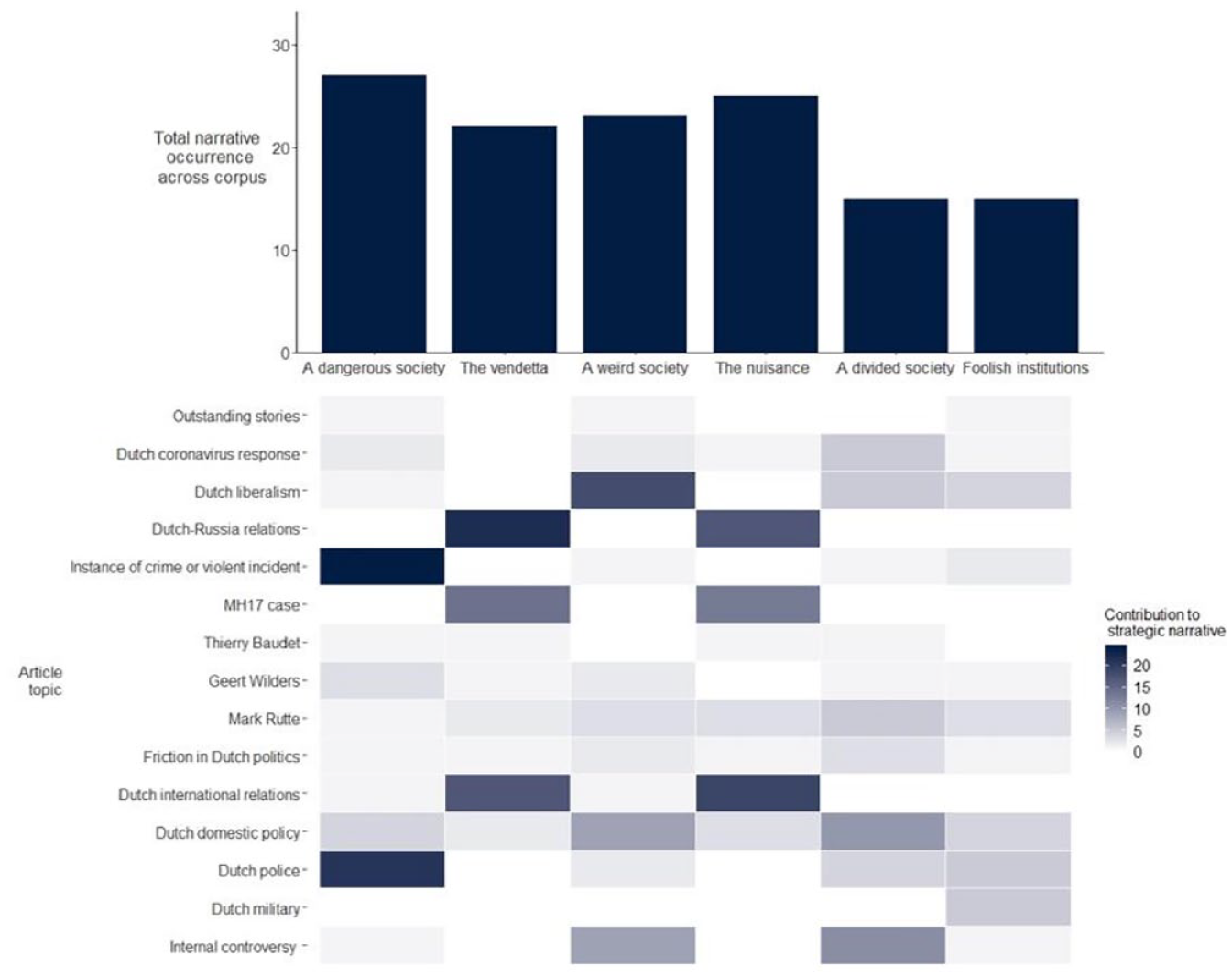
A bar plot indicating the total occurrence of each antagonistic strategic narrative identified and a heat map indicating the contribution of article topic to each antagonistic strategic narrative.
In the following section, we will describe and illustrate each identified narrative and discuss the extent to which antagonistic narrative strategies are being employed. In presenting our findings, we offer a few particularly pertinent examples of each narrative. More examples can be found in the corpus on the study’s online repository.
A dangerous society – Dutch violence and crime
Figure 1 shows that the most common antagonistic strategic narrative that was identified in the corpus was ‘a dangerous society’. This narrative portrayed the Netherlands as an unsafe and chaotic state, with rising levels of crime, violence and terrorist attacks. The propagation of this narrative was almost always achieved through the disproportionate amplification of random instances of violence or shootings. Such articles consisted mainly of videos or graphic images, with little supporting text or context (e.g. RT, 2020d). In this, the articles seemed intent on viscerally depicting a sense of danger within the Netherlands rather than relaying information. Other articles were less sensational but still depicted crime as common across the Netherlands. Examples here included stories of Dutch police discovering ‘torture chambers’, or an elaborate theft of a famous painting from a Dutch museum.
The ‘dangerous society’ narrative was sometimes broadened in more extensive, analytical pieces, such as articles describing the Netherlands as a ‘narco-state’ with a veneer of harmony and prosperity but a vulnerable underbelly, overrun with criminal gangs who are ‘taking advantage to create a parallel mafia society’ (RT, 2018a). References were also made to the lax approach of the Dutch to drugs – echoing Sputnik’s focus on the effects of Danish drug policy (Deverell et al., 2020: 13) – or immigration – a consistent theme in Russian narration (Wagnsson and Barzanje, 2021) – as ‘root’ factors in this rising unsafety.
We see the ‘dangerous society’ as a strong example of the destruction strategy. The narrative describes the Netherlands as chaotic, disorderly and teeming with crime and violence. In this, it builds an image of weakness and disarray, painting the Netherlands as an anarchic state that has lost control of its citizens and is therefore also unlikely to be capable of coordinating proper defence.
A weird society – Dutch hyperliberalism
The second most prevalent narrative was ‘a weird society’, used to portray the Netherlands as an eccentric society with strange, overly progressive values. Stories of Dutch liberal values almost exclusively contributed to this narrative, with some additional stories about Dutch domestic policy or societal tension included. The articles often had a derisive or demeaning tone. For example, the previously mentioned creation of a transgender pride street was mocked as a ‘woke paintjob’ (RT, 2019i), efforts to diversify street names were portrayed as liberal pandering (RT, 2019a), and a policy to minimize contact in the coronavirus pandemic by finding a stable sexual partner fed an image of Dutch ‘sexual permissiveness’ (RT, 2020c). Such articles often included derogatory Twitter posts, intimating that such events had led to the Netherlands being ridiculed internationally.
Sometimes, the narration of this ‘overly liberal’ approach tipped into highlighting its potential dangers. For example, a Dutch university’s policy to advertise job vacancies as ‘women-only’ was floated as actually detrimental to women (RT, 2019e). More extremely, a government policy to provide female drug addicts with contraception was described as evidence that ‘liberal ideals can turn deeply sinister’ (RT, 2020g). The ‘weird society’ narrative also sometimes intersected with other narratives, such as ‘the unsafe’ space, where the previously mentioned ‘narco-state’ article suggested that ‘the Dutch have also brought many of the problems upon themselves’ with their liberal gedoogbeleid approach to law enforcement. 1 In this narrative, we see a concerted effort to malign the progressive ideals of Dutch society.
This ties into Russia’s portrayal of Europe as a decadent, deviant space where norms have degenerated (Tyushka, 2021) and, within this, how the Netherlands has long been afforded a leading role in Russia’s construction of European liberalism. For example, Edenborg (2018) discusses Russian media’s coding of Dutch society in 2013, where a reporter mentioning ‘Dutch tolerance’ was underlaid by more nefarious intentions by implicitly associating the Dutch normalization of LGBTQ issues to paedophilia. Such representations of European degeneration serve as a favourable downward comparison that Russia can instrumentalize when projecting its previously mentioned image as the global defender of traditional values. We believe the ‘weird society’ narrative, therefore, constitutes the clearest example of suppression in the corpus. In belittling Dutch society and culture, pathologizing the progressive aspects of its culture and mocking liberal groups who are pushing for these ‘strange’ policies, we see a concerted effort to tarnish the Netherlands image as respectable or admirable. Instead, the Netherlands becomes absurd and ridiculous, even morally reprehensible, and undeserving of recognition by the international community.
The vendetta – Dutch Russophobia
Another prominent narrative was one frequently discussed in the literature examining Russian media: anti-Russian attitudes (Elswah and Howard, 2020). Russia has projected this narrative for some time, casting itself as a ‘besieged fortress’ that is under threat from the West (Blank, 2008: 15). Sometimes, this narrative unfolded in broad and unspecific examinations of Dutch Russophobia. For example, Geert Wilders of the Party for Freedom is interviewed in 2018, lamenting the broad Russophobia that is rooted in Dutch society (RT, 2018b). The article emphasizes quotes praising Vladimir Putin as a leader and criticizing general Dutch policy towards Russia. However, more precise accusations of Dutch Russophobia were also made by RT. For example, the expulsion of Russian agents suspected of attempting a cyber-attack on a chemical watchdog is dismissed as an example of a wider ‘anti-Russia’ campaign waged by NATO members (RT, 2018e). Meanwhile, the People’s Party for Freedom and Democracy (VVD) is criticized for ‘Russian scaremongering’ in their campaigning during the 2019 European elections (RT, 2019d).
Of course, a large amount of the Dutch Russophobia narrative is stimulated by the MH17 investigation. In 2018, outrage followed the Dutch-led JIT levelling of ‘groundless’ accusations of Russian involvement in the disaster (RT, 2018c). Attention is paid to ‘ignored’ counter explanations, which absolve Russia of wrongdoing and are narrated as more plausible than the Dutch accusations. In 2019, the inquiry into the downing of the airliner is described as ‘dragging on’, with Russia being ‘side-lined’ by the biased investigation (RT, 2019f). In 2020, Russia’s decision to withdraw from the trilateral MH17 consultation panel is portrayed as a natural and understandable conclusion given ‘Dutch provocations’. Proof of this injustice is offered in the fact that ‘the Dutch government did not even wait for the preliminary results of these consultations before taking Russia to the European Court of Human Rights in July’ (RT, 2020f).
These narratives align with those found in similar analyses of Russian narration after the Skripal incident, another international flashpoint that garnered global outcry toward Russia. Here, the most common narratives projected by Russian media also involved the West rejecting Russia’s willingness to cooperate, a lack of evidence and accusations of ‘Russophobia’ (Ramsay and Robertshaw, 2019: 26). In all, throughout our 3-year sample, Russia is consistently portrayed as the victim of a campaign intent on the ‘the demonization of Russia by the Western pro-war neocon faction, in pursuance of Cold War 2.0’ (RT, 2020f). The Netherlands, then, is presented as an active and unrelenting member in this group and the MH17 case as ‘a crucial milestone in ratcheting up this demonisation’ (RT, 2020f).
It is within the scaffolds of ‘the vendetta’ narrative that we see the clearest examples of direction coming to the fore. The VVD’s anti-Russian ‘attack’ during their campaign is blasted as ridiculous, and their political position is described as ‘perilous’ (RT, 2019d). Conversely, Geert Wilders, who praises Putin and whose openly anti-immigration, anti-EU and anti-Islam political views are strategically desirable for Russia, is afforded a positive interview piece (RT, 2018b) and right-wing populist party Forum voor Democratie and their leader Thierry Baudet are afforded a ‘promising newcomer’ frame across several articles. These varying narrative valences appear to be likely attempts at steering Dutch political discourse in directions more favourable to the Kremlin. Meanwhile, undesirable accusations by the JIT regarding MH17 are criticized and dismissed by Russian media. This negative narration, presumably, is to manoeuvre opinion towards a more positive posture regarding Russia’s suspected involvement: one of outrage at their unfair and unjust treatment.
The nuisance – the Netherlands as a troublesome international actor
‘The vendetta’ heavily intersects with ‘the nuisance’. While ‘the vendetta’ portrays the Netherlands as a key proponent of a widespread and relentless anti-Russia campaign, ‘the nuisance’ extends this more broadly. It paints the Netherlands as a generally reckless geopolitical actor, whose destructive behaviour is detrimental not only to Russia but also to numerous other states.
For example, the Netherlands is shown as a selfish actor in the EU who economically benefits from the Eurozone at the financial expense of other members, and who turns its back on fellow members during their economic decline during the coronavirus pandemic. Presented without nuance, the Dutch government’s reluctance to ‘spread the burden’ is described as a ‘timely reminder’ of the lack of European unity during times of crisis (RT, 2020b). Further events build this narrative, where outside European borders, the Netherlands is shown as ‘irking’ the states of Turkey, Israel and China in various diplomatic moves, although these articles are less pointed in their blame framing (e.g. RT, 2019b).
With ‘the nuisance’, the intention appears to be to paint the Netherlands as a difficult, disruptive and, at times, greedy actor in the international arena who ignores EU values of unity and provokes irascible states with tactless political moves. Elements of ‘the nuisance’ narrative can be seen as destruction, although this is not as clear-cut as earlier examples. One might also suggest that stories that portray the Netherlands as, for example, benefiting at the expense of other allies, are instances of stories with more than one function. Although critically narrating the Netherlands specifically, they can also be seen as internationally-orientated, undermining broader targets such as the EU or NATO. While other narratives we have marked as destruction, such as the ‘dangerous society’, seem to reflect internally to damage perceptions of the Netherlands’ internal functioning, the nuisance portrayal reflects externally to damage the image of the Netherlands as an attractive alliance partner. This reinforces Deverell et al.’s (2020:16) reflection that antagonistic strategic narration, while of course often focused on harming the narrated state, can also double to weaken international unity.
A divided society – Dutch society at war with itself
The notion of the Netherlands being divided was another narrative that was frequently woven through the corpus. This narrative amplified an image of the Netherlands as rife with internal division, fragmented along several contentious lines: farmers angry at national climate policy, COVID-19 deniers against lockdown measures, anti-Islam movements, anti-racism protestors, or even friction within the Dutch government itself. Often, these divisions were shown as almost or already bubbling over into violence and protests, demonstrating how the ‘divided’ narrative intersects with the ‘dangerous society’ narrative. Such instances of protests were similarly sensationalized by their central use of graphic videos and pictures.
The ‘divided’ narrative also intersects with the ‘weird society’ narrative, with clashes outlined between, for example, conservative Dutch citizens and the societal push for liberalism. The previously mentioned ‘transgender crosswalk’, for instance, was suggested as a move that would ‘only increase the division of society’ (RT, 2019i). Moreover, a national debate over Black Pete 2 was framed in this progressive vs traditional values clash, where ‘another much-loved figure’ is lost to ‘cancel culture’ (RT, 2020i). An incoming policy permitting euthanasia in children is depicted as divisive in government, showing progressivism vs conservativism reaching the upper echelons of Dutch society (RT, 2020e). This intersection of the ‘divided’ and ‘a weird society’ narratives binds the idea of polarization within the Netherlands with its liberal proclivities, portraying the high levels of division as a product of the contentious issues that this non-traditional culture cultivates.
Therefore, both destruction and suppression, albeit suppression to a lesser extent, are built by the ‘divided society’ narrative. Portrayals of such divides directly play into the destruction strategy, weakening the Netherlands’ image as an ordered state that is capable and ready to defend itself. Suppression is again evident in the divides between progressive vs conservative, where conservative groups fight to retain a semblance of traditional moral values in the Netherlands.
Foolish institutions – laughable, incompetent, disingenuous Dutch institutions
The final narrative we identify in the corpus is that of ‘foolish institutions’, which focuses on denigrating Dutch authorities and institutions. This narrative is built in articles that portray Dutch institutions as laughable and incompetent. For example, several stories amplify and mock mistakes made by Dutch security institutions. A disproportionate amount of articles are devoted to the Marechaussee – the Dutch police force with military status – sounding a false alarm at Schiphol airport and causing a mass evacuation (e.g. RT, 2019j). The Dutch air force is mocked in articles for incidents where they accidentally damage fighter jets – the ‘bizarre’ incidents emphasized as an example of Dutch carelessness with one of the most expensive weapons purchases in Dutch history (e.g. RT, 2019h). The Dutch military is derided for forcing troops to buy their own supplies before an upcoming NATO drill (RT, 2018d). Such stories are relayed with a caustic tone and framed as ‘embarrassing’ examples of ‘lapses’ by Dutch security institutions.
The police are also reflected poorly. Circling back to the ‘narco-state’ article, RT suggests the report the article centres on reads ‘like a concession of defeat’, with the Dutch authorities and government described as ‘sclerotic laissez-faire institutions’ (RT, 2018a). Political institutions receive similar treatment. Dutch politicians are portrayed as airheads, unsure how the country should be named, and the Dutch Defence Minister Ank Bijleveld is mocked for fumbling simple security protocols (RT, 2019g, 2020h).
However, incompetency is not the only trait attributed to Dutch institutions and sometimes RT’s portrayal insinuates more disingenuous intentions. Policies to diversify street names are dismissed as pandering to ‘wokeness’, plans to lower highway speed limits are framed as the government symbolically bowing to environmentalists (RT, 2019a, 2019k). In the previously mentioned contraception article, we see Dutch institutions being portrayed in a more sinister way, the ‘abhorrent, nuts, insane’ policy lodged by the Dutch House of Representatives and condoned by members throughout the Dutch government. The prime minister himself, Mark Rutte, is portrayed as two-faced, blithely straddling both sides of the progressivism vs conservatism division by voicing disapproval for Black Pete but refraining from decisive action. His response, rather than being seen as diplomatic, is portrayed as an indication of his hypocrisy, preserving ‘his cherished liberal sanctity’ while ‘simultaneously stay[ing] on-side with the cultural conservatives’ (RT, 2020i).
‘Foolish institutions’ contributes heavily to destruction. Blame for insecurity and conflict in the Netherlands is attributed to state institutions by making them seem disorganized, disingenuous and hypocritical. There is a concerted effort by Russian state-sponsored media to damage the perceived capabilities of target state institutions, consistent with the destruction strategy.
Discussion
We have highlighted six antagonistic strategic narratives that RT used to narrate the Netherlands between 2018 and 2020. These include depicting the Netherlands as rife with crime and violence, led by foolish and incompetent state institutions, and inhabited by a divided population with untraditional and ‘weird’ progressive lifestyles. We further identify a clear villainizing narrative of the Netherlands’ international political behaviour, especially regarding the ongoing Dutch-led criminal investigation into Russia’s involvement in the MH17 disaster. These six narratives appear frequently in RT’s daily coverage, often together, and converge in their contribution to a grand narrative of the Netherlands as a state of ‘liberal chaos’. In this grand narrative, the Netherlands is a society that is rife with crime and violence, led by incompetent and immoral politicians and institutions, and defined by a bizarre and immorally progressive culture.
To aid our analyses, we adopted Wagnsson and Barzanje’s (2021) ‘destruction–suppression–direction’ framework, obtaining evidence of the framework’s applicability outside of Sputnik. Most notably, we identified a substantial use of the destruction strategy, to which four of our six identified antagonistic narratives correspond – ‘a dangerous society’, ‘a divided society’, ‘foolish institutions’ and ‘the nuisance’. These narratives coalesce to paint a particularly disparaging portrait of the Dutch state and its authorities, who appear to be incapable and have lost control. Herrmann (2013) describes how a state’s capabilities form an integral element of its image in the international arena and, as a small state, the Netherlands is said to be particularly reliant on a capable image, particularly regarding its reputation as a hub for international law (Wohlforth et al., 2018). The antagonistic narration we identify is therefore particularly sensitive for the Netherlands. Here, of course, it is impossible to ignore the background of current Dutch–Russian relations and one might connect RT’s significant use of the destruction strategy with this omnipresent contextual background. The heavy-handed use of destruction could be interpreted as a ramification of the ongoing Dutch-led criminal investigation and a method of discrediting the Dutch image as a reliable and trustworthy political actor on the world stage.
At this point, it is fruitful to consider how our results resemble those of previous examinations of Russian antagonistic strategic narration. Overall, they appear to show remarkable consistency with other analyses. The general ‘liberal chaos’ narrative trend aligns with the overarching narratives identified by Ramsay and Robertshaw (2019: 70), who conclude that ‘political dysfunction is the key overarching narrative in RT and Sputnik coverage of politics and society in Western countries’, summing narration about many European states. Specific narratives also seem to be repeated, even across outlets. For example, ‘a divided society’ echoes Sputnik subplots intent on accentuating internal divisions in Nordic states (Deverell et al., 2020: 11; Hellman, 2021; Wagnsson and Barzanje, 2021: 11). Similarly, Ramsay and Robertshaw (2019: 70) identify ‘social conflict’ as one of the most salient themes running through RT and Sputnik’s narration of several European states. The ‘weird society’ mirrors Wagnsson and Barzanje’s (2021: 8) identification of ‘the Ultra-Modern space’ subplot in Sputnik’s narration of Sweden that ‘makes Sweden look like a ridiculous space that is not to be taken seriously’. ‘The nuisance’ is reminiscent of Sputnik’s narration of Denmark as an ‘annoying’ actor in the international arena (Deverell et al., 2020: 13).
This, therefore, raises the question: given current tension between the two states, is the narration the Netherlands receives any harsher than that identified in other examinations? This is difficult to answer definitively without employing a more formal comparative analysis, but it is illuminating to look at differences between the cases. For example, Deverell et al. (2020) describe how Sputnik often narrates Nordic states as victims of their connections to NATO or the EU. Norway and Finland’s connections or proximities to NATO, for example, were described as obstructing the cultivation of a stronger, beneficial relationship with Russia (p. 10) and the influence of the EU was narrated as the root of Denmark’s poor standing (p. 12). In contrast, connections between the Netherlands and NATO or EU were infrequent and, when references were made, its portrayal resembled a ‘villain’ rather than ‘victim’ role, as in ‘the nuisance’ narrative (e.g. RT, 2019c, 2020b). Similarly, in contrast to the ‘Sweden in decline’ narrative where ‘invasions’ by migrants or liberal activists were narrated as dragging Sweden into immorality (Wagnsson and Barzanje, 2021), immorality was rather portrayed as deeply rooted in Dutch society, with its ‘historic liberalism’ pervading the culture for centuries (e.g. RT, 2018a, 2020g).
Given these nuances, one might venture that the narration the Netherlands receives does seem slightly more hostile, mainly in its more ‘villainous’ portrayal and how its domestic problems are cast as a result of itself, rather than of others. However, a pertinent limitation is that we do not employ a more formally comparative approach, either in a temporal sense or between cases, which may help us understand this more clearly. Future research might consider expanding on these nuances within antagonistic strategic narration: the villain vs victim roles that emerge within the contours of a state’s negative portrayal, or more broadly, of the seemingly contingent nature of Russian antagonistic narration. Here, as suggested above, comparative analyses (e.g. Deverell et al., 2020) or more longitudinal designs (e.g. Chaban et al., 2017) could be used to further explore how the degree of antagonism fluctuates depending on the state’s relationship with Russia. It would be particularly interesting to adopt a case-comparison analysis of states varying in their relations with the Kremlin. For example, for states such as Slovakia or Bulgaria, whose strong affinities with Russia and low institutional strength leave them vulnerable to Russian influence (Galeotti, 2017: 7), one might expect comparatively less destruction and suppression, and more direction. Conversely, for Poland, whose ‘intractable hostility’ to Russia should lead to ‘demonization’ (p. 8), one might then expect more destruction or suppression and less direction.
Future research might also seek to explore the reception of these identified strategic narratives, which Miskimmon et al. (2013) note as a key direction for future strategic narrative research. Strategic narratives can be intended for and received by different audiences. In this case, narratives projected by a foreign language, internationally-orientated outlet such as RT can be considered as targeting foreign audiences – although similar narrative content of European failure is also commonly received by the Russian domestic audience in national news outlets (Tyushka, 2021). Given the rise in the discourse around the potential security threats conferred by Russian malign information influence on Dutch society, especially with recent investigations detecting churnalized content in Dutch social media spaces (AIVD, 2021; Government of the Netherlands, 2020a), one of the most pertinent foreign audiences to explore here would be the Dutch domestic audience. RT and Sputnik are sometimes conceptualized as ‘discursive launchpads’, meaning their narrative content is often dispersed more widely via social media, YouTube platforms, Russian-affiliated ‘internet troll armies’, or by local media outlets (Ramsay and Robertshaw, 2019; Wilson et al., 2018). Their narration can therefore collaterally reach audiences far wider than just active consumers of RT and Sputnik that are thought to be fairly few (Crilley et al., 2020) and thus may distort exposed Dutch citizens’ perceptions of their own domestic political reality.
But what precise psychological responses would be elicited in Dutch audiences consuming this antagonistic strategic narration? There is limited evidence of the psychological effects that such malign information operations are often assumed to trigger, and even less that can confirm causal relationships between antagonistic narratives and responses (Hoyle et al., 2021). Causal evidence could, however, not only confirm malign information influence’s destabilizing potential, but also inform policy towards countering it. Evidence of the effects of frequent narrative strategies might be used to smartly shape counternarrative construction or hone societal resilience initiatives (p. 16).
The surfaced narratives certainly seem to have harmful capacities. One might predict that exposure to the destruction narratives, which depict the Netherlands as a chaotic society and are tethered by an emphasized notion of institutional culpability and disingenuity, could lead to reduced trust in state institutions and fear or anger responses in the Dutch audience. Conversely, emerging research indicating that those drawn to Russian state-sponsored media are typically already critical of Western liberal values (Wagnsson, forthcoming) might suggest that ‘a weird society’, focusing on the Dutch culture of liberal permissiveness leading to rising crime and vulgarity, or Dutch progressive policymaking coming at the expense of ethics and integrity, could lead to anger, shame or perceived degradation of the Dutch identity in citizens – ‘status loss for the readers’ (Wagnsson and Barzanje, 2021: 12). These predictions warrant attention from future psychological research, which may follow a research agenda positioning content analyses, such as this study, as the impetus for experimental designs examining audience responses (Hoyle et al., 2021).
Conclusion
The current study sought to identify and analyse the narratives that Russian state-sponsored media outlet RT uses to construct an image of the Netherlands, a case whose contemporary political relations with Russia confers pertinence, but that had not been examined. We uncover six antagonistic narratives that coalesce to portray the Netherlands as a state of ‘liberal chaos’. We also note a significant use of narratives used to portray the Netherlands as incompetent and unreliable – termed as ‘destruction narratives’. In discussing our results, we have ventured possible political motives for such a portrayal, connecting the study to the broader, contentious political context between Russia and the Netherlands. In doing so, we have developed thinking on how the political backdrop may influence the portrayal Russian media affords different states in the West. In comparing our findings to previous analyses of Russian antagonistic strategic narration, we have broached nuances in antagonistic narration that warrant future examination. Finally, we have advanced thinking on the reception of these narratives, particularly in the Dutch domestic audience, and discussed hypotheses that experimental research testing possible cognitive and emotional responses to this narration may investigate.
Supplemental Material
sj-docx-1-mwc-10.1177_17506352211064705 – Supplemental material for Portrait of liberal chaos: RT’s antagonistic strategic narration about the Netherlands
Supplemental material, sj-docx-1-mwc-10.1177_17506352211064705 for Portrait of liberal chaos: RT’s antagonistic strategic narration about the Netherlands by Aiden Hoyle, Helma van den Berg, Bertjan Doosje and Martijn Kitzen in Media, War & Conflict
Footnotes
Acknowledgements
The authors would like to thank the anonymous reviewers, as well as Charlotte Wagnsson, Eva-Karin Olsson and Maria Hellman for their constructive comments, and Katharina Karnbach for her help with article coding.
Funding
The author(s) disclosed receipt of the following financial support for the research, authorship, and/or publication of this article: This research was supported by TNO and the MoD/FMW.

Supplementary material
Supplementary material for this article is available online.
Notes
Author biographies
References
Supplementary Material
Please find the following supplemental material available below.
For Open Access articles published under a Creative Commons License, all supplemental material carries the same license as the article it is associated with.
For non-Open Access articles published, all supplemental material carries a non-exclusive license, and permission requests for re-use of supplemental material or any part of supplemental material shall be sent directly to the copyright owner as specified in the copyright notice associated with the article.
