




Abstract
International Relations (IR) scholars have theorized the significance of communication and messaging across state borders, using notions such as soft power, sharp power, propaganda and illiberal communication. This study contributes to this body of research by investigating narrative persuasiveness by way of a large-scale experimental exploration of narrative reception. The projection of strategic narratives has become a central feature of modern influencing across borders. Despite the existence of a growing literature on the potentially harmful effects of such narratives, however, their persuasiveness remains under-researched. This article seeks to help fill this gap by asking what might induce people in Sweden to side with strategic narratives projected by Sputnik, the Russian state-funded news media platform. The article puts a central component of Walter Fisher’s classic narrative paradigm to the test: the notions of narrative probability (consistency and coherence) and fidelity (previous life experience). In a rare large-scale survey experiment (N = 2,032), three narratives from Sputnik were presented to respondents to establish the potential perceived narrative probability and fidelity. Contrary to Fisher’s argument and some previous works on strategic narratives, the results show that people can be persuaded by a narrative without having personal experience of the topic, and despite regarding the text as incoherent. This indicates that information influence projected through strategic narratives can be effective regardless of the form of the message and even when introducing unfamiliar ideas. This is an interesting addition to findings in previous studies that source awareness does not negatively affect the effectiveness of strategic narratives. The article ends by highlighting contributions to previous research on persuasion and by suggesting avenues ahead.
Keywords
Introduction
The potency of narratives has not been lost on the disciplines of international relations (IR) and security studies, as scholars have taken ‘a narrative turn’ in their research (e.g. Claessen, 2021; Freedman, 2006; Khaldarova, 2021; Miskimmon et al., 2017). The narrative turn forms part of a larger trend among IR scholars to theorize the significance of communication and messaging across state borders, using notions such as soft power (Nye, 2004; Roselle et al., 2014), sharp power (Walker, 2018), disinformation (Bennett and Livingston, 2018) and malign or illiberal communication (Elsehawy et al., 2021). This study contributes to this body of research by investigating narrative persuasiveness. A meta-analysis of primary studies shows that exposure to narratives has the capacity to make audiences align with the viewpoints of the narrative, yet additional research is required to identify the features of a message that either strengthen or undermine the effects of narratives (Braddock and Dillard, 2016: 18). Taking on this challenge, this study asks: What might induce people in Sweden to align with strategic narratives projected by Sputnik, the Russian state-funded news outlet?
Narratives have considerable power in diverse sectors of society, from business to politics, as can be seen in advertising and ‘story banking’, the systematic collection of personal narratives to be used for political purposes (Trevisan et al., 2020). One problematic result is that actors can exploit the power of storytelling for purposes of malign information influencing. Such information is most often projected through international broadcasting and sponsored primarily by illiberal regimes.The problem is not primarily inaccuracy, but systematic bias and aggressive tone. This kind of media reporting can harm the targeted society, often by preying on feelings of identity grievance (Nisbet and Kamenchuk, 2019) and fears connected to uncertainties in people’s daily lives (Birge and Chatterje-Doody, 2021: 172). This mirrors the use of ‘agitainment’ – a tabloidization of political and ideological reporting that exploits popular anxieties – and ‘exclusionist identity discourse’, a journalistic style in Russian domestic media broadcasting that is promoted by the state (Tolz and Teper, 2018: 223–224). Influencing projected across borders can also gain force by tapping into local media environments and news feeds. Sputnik reporting on Sweden reflects Swedish far-right narratives (Åkerlund, 2021: 2) and works by citing enraged or scornful Swedish social media posts in order to amplify messages.
Scholars have identified a range of aims behind such influencing efforts, most notably to sow division in the target country, undermine democratic institutions and craft a more favourable image of the source country or a less favourable image of a global rival (Bennett and Livingston, 2018; Walker, 2018). Russian state-sponsored international broadcasting is certainly not unique in being set up to serve the goals of a state, and Sputnik and RT are not direct mouthpieces of the Russian state. Nevertheless, they are major international media platforms backed by the Russian government for the purposes of projecting Russian influence abroad (Ramsay and Robertshaw, 2019: 11). Contemporary Russian state media company RT also shares certain organizational properties with its Soviet predecessors, such as state supervision, self-censorship and socialization of staff to foster an anti-West agenda (Elswah and Howard, 2020: 640–641).
Studies of Russian state-backed media platforms have shown that over 80 percent of Sputnik’s and RT’s coverage of European countries focuses on issues related to ‘conflict within politics and society, the failures of public bodies, or alienation within the democratic system’ (Ramsay and Robertshaw, 2019: 91). RT has furthermore been shown to be using sophisticated narrative strategies to project Russian ‘great powerness’ to Middle Eastern audiences, promoting the country’s image of diplomatic governance in the area, and legitimizing its role as a saviour in the Syrian conflict (Dajani, 2021). Other observed methods include the use of political satire and/or affective content to attract audiences, add legitimation and evoke emotional responses (Crilley and Chatterje-Doody, 2020: 728–729, 2021: 283–285).
Despite the growing literature on the potentially harmful uses of strategic narratives projected by Russian and other broadcasters, their effects remain under-researched. Some recent studies make attempts to fill this gap. One study found that, although the audience is large, the engagement with RT’s Twitter content is done by a vocal minority, indicating that the visible internet activity of RT’s audiences is not representative of the consumer group as a whole. Active consumption of Russian state-sponsored media is thus not the same as engagement with or endorsing of the content, raising questions about previously assumed effects. The same study also found the audiences to be strikingly heterogeneous, indicating that RT consumers are not a unified group of far-right extremists (Crilley et al., 2022: 229–237).
On the other hand, a study on American audiences shows that propagandist RT reporting on Ukraine does have negative effects on readers’ views of the country, despite them knowing the source of the information (Fisher, 2020: 282, 287–289). RT’s use of affective and sensationalist video reporting on the Syrian conflict has also been shown to elicit emotive negative responses toward the West from commenters. Although the content’s causal effect on audiences’ opinions remains unclear, it indicates an ability to provoke affective investment and online engagement, possibly reinforcing existing anti-Western sentiments (Chatterje-Doody and Crilley, 2019: 173, 175; Crilley and Chatterje-Doody, 2020: 728–729). The aforementioned satirical content, however, seems to provide mixed results, as some commenters agree with the content while others disagree or even call them out as propagandists (Crilley and Chatterje-Doody, 2021: 283–285). The varying results of these studies point to the complexity of narrative persuasiveness and thus raise the question: what makes Russian strategic narratives effective?
Whereas most research on reception has been carried out in a US setting, we focused on Sweden, a key target of Russian influence operations (Ramsay and Robertshaw, 2019: 80). Modern Russian strategy is very much about the cognitive dimension (Splidsboel Hansen, 2021) and Sweden has been systematically portrayed by Russian media as a particularly bad example of extreme liberalism, possibly because of its traditionally strong liberal policies in realms such as gender and multiculturalism. The aim is to incite right-wing, anti-liberal, anti-migrant sentiment, polarize Western audiences and promote Russian conservative world views at home and abroad (Colliver et al., 2018; Deverell et al., 2021; Edenborg, 2021). Yet, Sweden is also strategically significant to Russia in a traditional sense. On occasions, the two countries fought wars – most notably, one that resulted in Sweden losing Finland to the Russian Empire in 1809. During the Cold War, the Nordics were strategically peripheral (Hyde-Price, 2018: 440); yet, in Baev’s (2018: 410) analysis, they have now become strategically important, due to the location of Russia’s main base for strategic submarines in the Kola Peninsula. This makes the High North central to both the US and Russia, as a key location for placement of early warning and missile defence systems. Geopolitically, the Nordics are also key, due to the competition for influence in the Arctic region. Finally, there is the economic/energy-related dimension, with oil and natural gas reserves in Western Siberia and offshore (p. 411). The continuous and increasingly hostile Russian rhetoric regarding a potential Swedish (and Finnish) NATO membership illustrates this strategic significance well (Sokolsky, 2017: 3; Tanner, 2022).
In contrast to previous studies that focus primarily on false information, this study examines the attractiveness of heavily slanted narratives that might, but need not, include disinformation. The scant research findings that are available indicate that assessment of a narrative is not necessarily dependent on accuracy, or on views of the sender (Schaewitz et al., 2020; Szostek, 2018). Szostek (2018) found that Ukrainian media consumers assessed the credibility of news based not on an assessment of factual inaccuracies, but on personal preferences and priorities.
Personal narratives formed through life experience seem key to our understanding of the narrative process. We align with the view that social life is ‘storied’ (Somers, 1994: 614). Meaning-making is a dynamic process where personal narratives meet media narratives, since ‘. . . all of us come to be who we are . . . by being located and locating ourselves (usually unconsciously) in social narratives rarely of our own making’ (Somers, 1994: 606). The study of open-ended processes of narration – and the monitoring of responses to media narratives that include dialogue and protest – requires methods such as focus groups, audio-diaries and in-depth interviews (Colley, 2017; Szostek, 2018). The survey method cannot grasp the situation in which each individual is embedded, or the audience interaction with, or resistance to, a media narrative (Baker, 2007: 154). It cannot establish whether narratives are interpreted in a way that the transmitter intended. Readers will form their own narrative when reading the text, depending on their own personal narrative and the situation in which they are embedded. By asking about the readers’ immediate reactions and whether they agree and are willing to share with family and friends, we nevertheless gain a rudimentary knowledge of how the message is received. Furthermore, we claim that our understanding of the transmitter’s intended meaning is correct. Previous research has shown that Sputnik and RT tend to project certain narratives towards Sweden, the Scandinavian countries and the Netherlands, and it is with this knowledge that we have interpreted the transmitter’s intentions (Deverell et al., 2021; Hoyle et al., 2021; Wagnsson and Barzanje, 2021). Moreover, as discussed later in the text, narratives may have an impact even if the reader does not interpret it in the way the transmitter intended. Narratives of a contentious content may sow division and cause conflict, regardless of the context in which the reader shares it.
We conducted a nationally representative survey to answer the research question: What textual properties might compel people to align with a strategic narrative? We aimed to answer the research question by using Walter Fisher’s (1984, 1985, 1989) classic narrative paradigm to investigate whether people are more prone to align with a strategic narrative depending on two key mechanisms: narrative probability, the structure of the text; and narrative fidelity, its resemblance to previous life experience. There is a clear link between this paradigm and strategic narratives. In order to shape the behaviour of domestic and international actors, as strategic narratives aim to do, we suggest that they need to persuade – at least parts of – the ‘target audience(s)’. In other words, parts of the target audience need to find the narrative rational (probability) and compelling (fidelity).
In contrast to previous qualitative studies, the survey method used in this article enabled us to reveal general tendencies within a large population. We also contribute to methodological development by suggesting a way to operationalize and test the elusive concepts of narrative probability and fidelity. Finally, we will suggest avenues for further exploration of what induces people to align with a strategic narrative.
Fisher’s narrative paradigm and strategic narrative research
Most scholars agree that narratives are uniquely persuasive, but what constitutes a strong narrative that is particularly appealing to people, remains an unresolved question. WR Fisher’s (1984) narrative paradigm, moves beyond pure logic and rationality when assessing the quality and potential success of an argument: (1) humans are essentially storytellers; (2) the paradigmatic mode of human decision-making and communication is ‘good reasons’ which vary in form among communication situations, genres, and media; (3) the production and practice of good reasons is ruled by matters of history, biography, culture, and character along with the kinds of forces identified in the Frentz and Farrell language action paradigm; (4) rationality is determined by the nature of persons as narrative beings – their inherent awareness of narrative probability, what constitutes a coherent story, and their constant habit of testing narrative fidelity, whether the stories they experience ring true with the stories they know to be true in their lives (narrative probability and narrative fidelity) . . . and (5) the world is a set of stories which must be chosen among to live the good life in a process of continual recreation. (pp. 7–8)
Before discussing Fisher’s paradigm further, we will briefly relate the article to research on persuasiveness in IR and media studies. The traditional notion of ‘propaganda’ is still in use (Bastos and Farkas, 2019; Benkler et al., 2018), yet current research on persuasion also adopts other labels, such as disinformation (Edenborg, 2021), fake news (Monsees, 2020) and antagonistic or malign information influence (Hoyle et al., 2021). Scholars tend to agree that such persuasion should not be understood as a one-way process, but as a complex acitivity taking place in a social media environment with audiences as potential co-producers of foreign messaging (Mejias and Vokuev, 2017). This renders narrative research all the more relevant. In their overview of research on narrative persuasion, Bilandzic and Busselle (2013: 201) explain the role of the audience in terms of ‘story realization’: the audience members’ cognitive and emotional understanding of the events based on the text and their own pre-existing, relevant knowledge of the topic . . . While the elements of the story exist in a text, the realization of the story exists in the mind of the audience members as they experience the narrative.
Taking a closer look at research on persuasion among IR scholars focusing on narratives, Ringsmose and Børgesen (2011: 513–515) suggest that the prospect of narratives taking hold within a target audience depends on whether they are consistent and possess a ‘clarity of purpose’ and ‘a prospect of success’. We can discern the impact of Fisher’s narrative paradigm here: clarity of purpose and consistency can be sorted under Fischer’s category probability.
Other scholars emphasize factors more in line with fidelity. They suggest that, if a strategic narrative resonates with collective identity or political myths, the target audiences will be more susceptible (Hudson, 2015; Khaldarova, 2021; Schmitt, 2018). Schmitt (2018: 489) concludes from a case study of Russian strategic narratives in France that strategic narratives tend to take hold if they resonate sufficiently with (primarily) national political myths. Similarly, Khaldarova (2021: 16) demonstrates how the Russian Channel 1 crafted narrative representations of Ukrainians to align with its audience’s ‘cultural, historical and spiritual values’. From the viewpoint of Fisher’s paradigm, these studies are more concerned with fidelity in terms of past experience, or how individuals’ views and values are interwoven with the ‘history, biography, culture and character’ of their society. Colley (2017), Szostek (2018) and Archetti (2015) also emphasize previous experience, but at the individual level. Colley (2017: 4) emphasizes ‘selective emplotment’ while Szostek (2018) highlights personal experiences and social connections as primary factors behind narrative persuasiveness. This is in line with Archetti’s (2015: 55–56) argument that how individuals craft their narratives is primarily dependent on the narratives of the local community where they are situated (pp. 52–53). The essence of persuasion thus lies within individuals and their previous experience, very much in line with the notion of fidelity.
In sum, scholars within IR and Media Studies disagree about which aspects of social reality make a narrative compelling. Schmitt (2018) and Khaldarova (2021) highlight that narratives need to resonate with political myths, culture and history, whereas Szostek (2018) and Archetti (2015) emphasize personal opinions, narratives and experience, while Hudson (2015) discusses cultural heritage. Ringsmose and Børgesen (2011) for their part are more concerned with the structural properties of a narrative. The results of this study aim to shed some light on these controversies.
Theoretical background
Taking a closer look at Fisher’s concepts, narrative fidelity concerns the ‘true qualities’ of a story, which depend on ‘the soundness of its reasoning and the value of its values’ (Fisher, 1985: 349–50). It is ‘determined’ by whether the story fits with previous life experiences and touches something within the individual, ‘whether the stories they experience ring true with the stories they know to be true in their lives’ (Fisher, 1984: 8). ‘Previous life experience’ is broader than physical or real experiences, and can arise from observations people make after news consumption, or by listening to stories told by friends or family, according to the logic ‘this is something that could have happened to me’ (Polletta and Callahan, 2017: 393–394, 400).
Narrative probability concerns how probable the story appears to the listener, judging from its internal consistency: whether it comes together as a credible, believable, well-told or well-composed text. The reader/listener is supposed to make a critical assessment of structure, whether the story ‘hangs together’ and whether there is ‘coherence, consistency, and noncontradiction’ (Fisher, 1985: 349, 364).
Fisher’s paradigm has been tested, utilized and critiqued by narrative researchers (e.g. Hobart, 2013; Roberts, 2004; Rowland, 1989; Van der Broek, 2021). The paradigm – and narrative fidelity in particular – remains elusive. As Roberts (2004: 138) puts it: ‘There is a vagueness about this in the paradigm, as we are left unaware of the processes under which this ringing true might occur.’ In this article, we set out to test these specific structural properties, but also to help hone the concept of narrative fidelity. Fisher does not clarify whether probability is more important than fidelity or vice versa; or whether one or both of these components need to be present. We therefore formulated our hypotheses in a way that might shed some light on this puzzle.
It is important to remember that the phenomenon of persuasion – as we generally understand it – does not always yield a change of belief among the target audience, but might reinforce a pre-existing belief. Furthermore, our study views content through a structuralist prism. We do not analyse the actual content in terms of, for example, how the narrative resonates with a particular national political myth. In addition, we exclude variables such as source and context.
Method
The study conducted an online survey experiment (N = 2,032) from 18 to 27 May 2021. Participants were recruited by the research agency Novus, from a randomly selected web panel of a representative random sample of the Swedish population with no opportunity for self-selection. The response rate was 51 percent; of the 3984 people invited to participate, 2032 people aged between 18 and 89 responded. The survey was designed as a longer interview. Respondents were invited to read three news articles from Sputnik News and each reading was followed by a randomized block of questions. The age distribution of the participants was fairly similar to that of the general population, with a slight underrepresentation of the youngest age groups of 18 to 29 and 30 to 49 years, and a slight overrepresentation of the older age groups of 50 to 64 and 65 to 79 years. Weights have been applied in order to compensate for the disproportionate stratification. There are no indications that the non-response rate could skew the results.
The articles from Sputnik News were published between October and December 2020. Each article was different, but all three possessed the structural properties we aimed to study. The articles were selected based on two principles. First, the structure and style of the articles are typical of Sputnik News reporting about Sweden. They revolve around issues that have been the subject of public debate and it is likely that many respondents would have been able to recall discussions on similar topics from their own experience or from the media. The articles are thus suitable for testing both probability and fidelity.
Thematically, the articles are typical examples of malign influencing, and comprise narratives on current social topics that are typical of Sputnik reporting on Sweden (Deverell et al., 2021; Hellman, 2021; Wagnsson and Barzanje, 2021). Previous research has demonstrated how Sputnik’s news reporting is strictly thematic; every piece is tailored to fit into one or more of the small number of subplots that are presented in the main narrative that Sweden is a state in decline. The appearance is less like traditional news media coverage, which is driven by a daily news agenda, and more like a calculated campaign of highly selective reporting on a small number of pre-set themes. Another technique is to serve the reader an incomplete story and expect them to fill in the blanks in a process of meaning making (Wagnsson and Barzanje, 2021: 244). Sputnik articles habitually begin by catching readers’ attention, proceeding with a story on an event and ending with a critical remark that is often not directly related to the overall story, but can work to undermine Sweden, often by seeking to destabilize or polarize the country. The articles often seem slightly incoherent, linking issues that do not obviously hang together. The narrative mainly revolves around topics linked to identity grievance, anti-liberal views and the smearing of political leaders and societal institutions (Wagnsson and Barzanje, 2021: 250).
The first article (article A), ‘Swedish armed forces reveal secret drills with US’, 1 mirrors a recurring Sputnik theme of Swedish Russophobia and exaggerated threat perceptions. It tells a story that is critical of Sweden, as a country that used to be non-aligned but is now cooperating with NATO and the US. The article ends by quoting Sweden’s Defence Minister describing Russia as the greatest threat to Sweden and arguing that this is the pretext for Sweden’s ‘ongoing military beef-up’. The second article (article B), 2 ‘Swedish police designate more women, immigrants as “priority area”’, reprises a recurring narrative on the shortcomings of the Swedish authorities, in this case recounting how the police are failing to deal with ‘burgeoning no-go zones, street shootouts, explosions, and gangland violence’. This narrative contrasts the shortcomings of the police with its prioritizing of the recruitment of more women and people with foreign backgrounds to the police force, ‘in a perennial bid to emphasize diversity and increase representation’, despite the fact that these groups have difficulties meeting the required standards. The third article (article C), ‘Oh Lord! Church of Sweden to produce new post-pandemic book of ‘gender-neutral hymns’, 3 reflects a common Sputnik narrative that denigrates exaggerated versions of Sweden’s liberal habits and values, contrasting them with ‘traditional’ and ‘sound’ values. It tells a story about the Church of Sweden responding to demands for more inclusive, gender-neutral hymns, for example by trying to use ‘God’ and ‘You’ instead of ‘Father’ and ‘He’ in the new book of psalms. The article ends by a standard paragraph included in most articles in which the Church of Sweden is mentioned, stating ‘Europe’s largest Lutheran denomination with over 5 million worshippers and formerly a state church, is generally liberal on social issues and is permissive of gay marriage, to the point of even having homosexual priests.’
The articles were translated into Swedish and slightly shortened for practical reasons, which did not affect the content, style or tone in any significant way. Each respondent was asked to read one article at a time, and to answer a number of questions after each article. To ensure that the respondent had read the article, we asked a control question: How carefully did you read this article? Those who answered ‘not at all’ were routed back to the article and asked to read it.
We dubbed our dependent variable (y) ‘persuasiveness’. We operationalized this elusive concept through two questions used to estimate whether the respondent was convinced by the message. The first question was: ‘(On a scale of one to five) If you had read the article in the course of normal events, how likely is it that you would have shared it in your social media network?’ By inquiring whether the respondents were inclined to share the article online, we sought to capture the complex nature of persuasion. The next question was: ‘To what extent do you agree with the main message in the article?’ Agreement is one thing but if, in combination with the first parameter, you are inclined to share the article online with your friends and family, it is a testament of the issue’s salience.
Concerning our stipulated independent variables, the survey experiment’s questions were formulated to provide answers that enabled us to confirm or dismiss our various hypotheses. In other words, this was how we measured – or operationalized – narrative probability (x1) and fidelity (x2). We asked two questions pertaining to fidelity, asking to what degree respondents recognized the problem described from their own experience, from media reporting or from discussions with family, friends or acquaintances; and to what degree they agreed with the values expressed. Finally, we asked three questions pertaining to probability: to what degree was the article seen as coherent and well written (with regard to structure and design), and to what extent were the arguments used seen as credible.
We ran a regression analysis to isolate any potential relationship between our two independent variables (narrative probability and narrative fidelity), and the dependent variable of ‘persuasiveness’. Using Pearson’s r – a correlation coefficient, ranging between −1 and 1 (where −1 represents a perfect negative correlation between two variables and 1 a perfect positive correlation), we sought to explore the potential relationship between the answers to these questions and our operationalization of ‘persuasiveness’.
Results
First, we present the general empirical trends according to the two independent variables we set out to test (‘narrative probability’ [x1] and ‘narrative fidelity’ [x2]). The hypotheses are then evaluated and discussed below.
Narrative probability
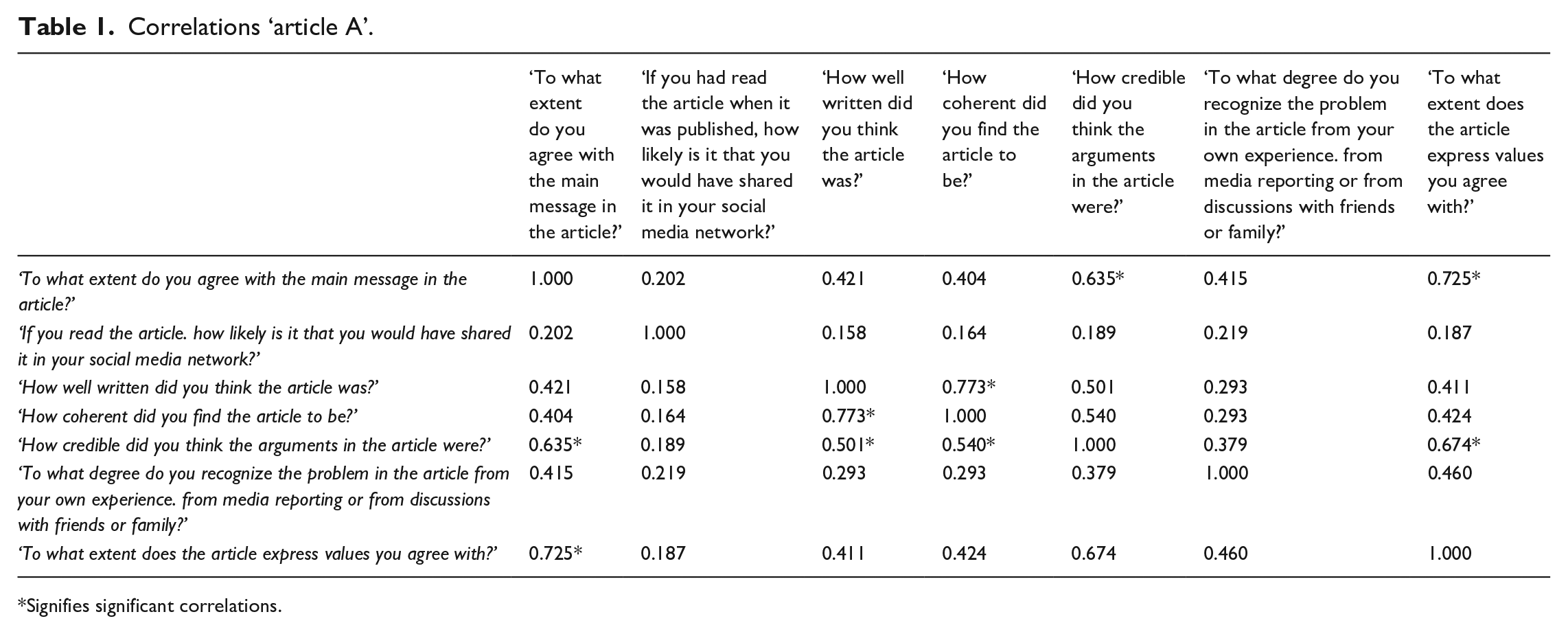
As discussed above, we measured narrative probability (X1) using three main questions: ‘How well-written did you think the article was?’; ‘How coherent did you find the article?’; and ‘How credible did you find the arguments in the article?’ Articles B and C did not generate any statistically significant results for this parameter. This section is therefore primarily dedicated to the results from article A (see Table 1). A few correlations were established. The respondents who found the argument(s) in the article more credible were also more inclined to agree with the article’s core message (a correlation of 0.635). These respondents were also in agreement with the ‘values’ implied in the article (a correlation of 0.674). However, the second indicator of persuasiveness – respondents’ willingness to share the article on social media – did not yield any significant correlations. We return to this below.
Correlations ‘article A’.
Signifies significant correlations.
In regard to coherency, there was an overall trend for respondents who found the article more coherent to also find the article to be better written (a correlation of 0.773); and respondents who found the article better written also considered the arguments in the text more compelling and credible (a correlation of 0.501). Respondents who agreed with the main value(s) of the article also agreed with the perceived ‘core message’ (a correlation of 0.725); and respondents who found the article more coherent also found the arguments in the article more credible (a correlation of 0.540). However, these correlations add little to our research puzzle.
Furthermore, we asked the respondents whether they had reacted primarily to the content of the article, or to the style in which it was written. While 40 percent of the respondents when confronted with article B answered that they reacted primarily to the style, only 17 per cent did so with regard to article C and only 15 percent when reading article A. There were similar tendencies in other areas. Among those who were asked to judge how well written the articles were, 34 percent of respondents did not find article B well written, while the corresponding percentages were 11 percent for article A and 10 percent for article C. There were also correlating patterns and proportions with regard to those who found the articles incoherent: 29 percent for article B, 12 percent for article A and 20 percent for article C. The structure of article B was particularly noteworthy because of its low probability. However, this seemed to have little bearing on the ‘persuasiveness’ of the article. The perceived degree of incoherence did not make the article either more or less persuasive in the eyes of the respondents.
Narrative fidelity
As noted above, narrative fidelity is about whether ‘the story rings true with what they [the respondents] know to be true in their lives’ (Fisher, 1984: 8). We explored this aspect of the narrative paradigm by asking the respondents about the degree to which they recognized ‘the problem’ described in the article from their own experience, media reporting or discussions with friends and family. Here, however, no clear significant results or correlations could be derived from the respondents’ answers. In other words, no relationship could be observed.
Another relevant finding surfaced once we had conducted a test of reliability – Cronbach’s alpha – to test the internal consistency and reliability of the answers provided. Cronbach’s alpha coefficient was 0.630 but acceptable reliability requires a value of somewhere between 0.7 and 0.8. In sum, a relatable personal experience was not a requirement in order to be persuaded by the articles.
Hypotheses evaluation
H1 hypothesized that narratives that possess ‘narrative probability’ are more persuasive than incoherent ones. In our view, the results do not provide sufficient support for H1. However, it is worth noting that respondents who found the narrative more coherent, better written and to have credible arguments were more inclined to agree with the core message of the narrative. Yet, there was no desire indicated to share the narrative on social media platforms. Moreover, these results were only found in article A. The empirical findings for articles B and C did not indicate that coherent narratives are more persuasive than other narratives. Thus, we reject H1.
H2 concerns narrative fidelity – that ‘narratives which ring true to the respondents’ experiences – including previous values and emotions – will be more persuasive than narratives which do not ring true.’ Due to the lack of internal consistency between persuasiveness and personal experience (Cronbach’s alpha), however, there is also no support for H2 from our empirical findings, and we therefore reject H2.
Discussion
Our analysis found no support for H1. On a large scale across articles and groups/demographics, there was no strong or conclusive evidence to indicate that narratives with perceived ‘probability’ were more compelling than others. In some instances (particularly in relation to article A), respondents who found the article coherent, well argued and well written appeared more compelled by the narrative than the respondents who did not share these sentiments and analysis of the article.
If the empirical support for the notion of ‘narrative probability’ was weak, support for the notion of ‘narrative fidelity’ was non-existent. Our findings, especially alongside our test for internal consistency, indicate that respondents can agree with a narrative’s core message and be compelled by it without having ‘personal experience’ (including from the media) of the subject matter. There is thus no support for ‘narrative fidelity’ being a component that increases the compelling nature of a narrative.
When asserting this, however, it is necessary to acknowledge the diffuse and abstract nature of this particular concept. 4 It is possible to interpret narrative fidelity – or what Fisher refers to as a ‘constant habit of testing narrative fidelity, whether the stories they [the people exposed to the narratives] experience ring true with the stories they know to be true in their lives’ (Fisher, 1984: 7–8) – in various ways. We do not reject the notion that narratives that ring true with personal experience can be more persuasive than those that are completely alien. We can show, however, that narrative fidelity conceptualized as ‘personal experiences, from media reporting, or from discussions with family, friends or acquaintances’ does not play a role in the persuasiveness of narratives.
In conclusion, in contrast to Li et al. (2019), who found that narrative coherence and narrative fidelity are positively related to what the authors call ‘intentions to adopt’ (the narrative message), we found no convincing evidence of such a relationship. On the basis of this empirical evidence and the lack of support for our hypotheses, we question the foundation of the fourth component of Fisher’s ‘narrative paradigm’. Through this experiment survey, we have thus helped to clarify a elusive concept.
Concluding remarks and suggestions for future research
Our results demonstrate that people can be persuaded by a narrative without having ‘personal experience’ of the topic, and despite regarding the text as incoherent. We found no solid support for Fisher’s argument that a story needs to ‘hang together’ and ring true to previous life experience to be persuasive. According to our findings, narratives need not possess either ‘probability’ or ‘fidelity’ in order to compel an audience. This indicates that information influence projected through strategic narratives can be effective regardless of the form of the message and even when introducing unfamiliar ideas to the audience. This is an interesting addition to the findings in previous studies that source awareness does not negatively affect the effectiveness of Russian narratives (Fisher, 2020). Together, these findings indicate that a narrative does not need to be probable, relatable or hide its source to be potentially persuasive.
Nevertheless, scrutinizing our own findings more closely, we were able to identify a few statistically significant differences among age groups and depending on gender. Men, for example, viewed article A (on military drills) as more coherent and better written, could relate to it more easily than women to personal experiences, and were more prone to share it on social media and agree with its core message. In this case, it must be questioned whether agreement with the content was due to the narrative’s compelling structure. Most Swedish men over the age of 40 will have generally been in the armed forces, as was required by law until 2010. This could explain the difference between men and women in relation to article A, as the interest in and experience of men regarding the armed forces could be assumed to be greater. It might therefore be the case that fidelity was more important here than probability. However, the results were contradictory and inconsistent and did not provide a basis for deriving strong conclusions.
Nevertheless, these results can be related to Edenborg’s (2021) recent study, which presented Sputnik news narratives to focus group participants in Norway, Denmark and Sweden. In all three countries, respondents in groups with men above 40 years tended to focus directly on the message, taking what was presented at face value. In contrast, younger women were more aware of style and form, and actively commented on and critically reflected on the text, for example, its tone, bias or genre. These findings should be taken into account when designing future studies. It might be that women and younger people are generally more sensitive to the probability (the coherence, style and form) of strategic narratives. Alternatively, Edenborg’s results might signify that news consumers are more likely to react to tone and style when critical of the content of the message. Additional research taking demographics into account will be required to resolve this question.
The primary limitation of the present study is that it is unclear whether the narratives actually persuaded people. It could be the case that the respondents ‘agreed with the core message’ because they held the opinions in question beforehand. Second, sharing articles on social media does not automatically entail that the respondent is compelled by the argument. People are also likely to share articles online if they are infuriated by the content. That said, this article does address the problem of representation and vocal minorities mentioned in Crilley et al.’s (2022) article. Unlike comment sections on social media, which filter out the opinions of people who watch or read but do not participate in online discussion, this study acquired answers from all consumers across the board. Most of the respondents who answered the optional question ‘What was the primary reason for sharing the article’ (69 for article A; 75 for article B; 39 for article C) reported that they shared because their views were aligned with the narrative, for example by stating ‘others need to know about this’ or ‘I agree’. Some, however, stated that they shared the article because they disputed the article’s message, or gave reasons that were not clear indications of alignment, such as ‘interesting topic’. However, this limitation is not as detrimental as it initially appears. Returning to the realm of security studies, it is useful to note that narratives of this nature can also serve a purpose. Provocative narratives can divide and stir up conflict regardless of whether the people who distribute the narrative agree with it.
Then again, it should perhaps not be surprising that narrative probability and narrative fidelity are less significant in the process of persuasion than expected. If we consider, for example, Donald Trump’s successful presidential campaign in 2016, his narratives were to a large extent incoherent. Moreover, some issues and components were works of fiction, to which it appeared impossible to have a relation (Anderson, 2020). Nonetheless, these narratives managed to mobilize almost half of the voting population of the United States behind him. As politicians and practitioners increasingly worry about illegitimate influencing that can sow domestic division and sway election results, it is important to explore other forces at play. Fisher (2020) highlights the centrality of perceptions of history, biography, culture and character. This is in line with IR and media scholars who argue that, for narratives to be successful, they must resonate with collective identity and/or shared myths (Archetti, 2015; Hudson, 2015; Khaldarova, 2021; Schmitt, 2018). In this context, Schmitt’s (2018) theories on how narratives need to resonate with ‘national political myths’ become more salient. People may not have experienced these myths personally – not least because they are myths – but they still have significant influence over political collectives.
In addition, emotional response/engagement and identification appear to be common denominators in much of the previous research on the effectiveness of strategic narratives. This can be linked to people’s emotional attachments to their own experiences, to collective belonging and myths, to characters in the narrative, or to a nation’s history, among other things. In explaining emotional engagement, scholars often refer to the psychological mechanisms of identification with and emotional connection to characters in a narrative as well as to the mechanism of transportation which causes an intense experience (Shen et al., 2017: 167–169). Future research should take these and other psychological mechanisms into account when trying to understand individual processes of narration at a deeper level (Bilandzic and Busselle, 2013: 215). Future research will also need to study mediating factors, such as demographics and cognitive disposition, for understanding the persuasiveness of information influencing through narratives. Most existing research has focused on the reception of false information (Guess et al., 2019; Hjort and Adler-Nissen, 2019; Schaewitz et al., 2020) and not on the skewed, but not necessarily false, broadcasting envisaged in this article.
In sum, through our experiment survey, we have rejected two of the three hypotheses we derived from Fisher’s narrative paradigm. It appears that narrative probability and narrative fidelity are less significant in the process of persuasion than expected. Instead, there seem to be other forces at play that determine the persuasiveness of narrative communication in IR. Nevertheless, we wish to end by underscoring that Szostek’s (2018) and Archetti’s (2015) arguments on the need for strategic narratives to resonate with personal experience cannot be fully refuted on the basis of our findings. Future research should continue the examination of media consumers’ sense-making processes and the relationship between personal narrative and media narratives. It might be that it is not enough for a narrative to be merely ‘relatable’ in order to be persuasive. It might also need to resonate with previous experiences that are in some way important to the individual, such as a mirroring experience that has shaped – or is shaping – the life of the individual or of his/her family in a critical way.
Footnotes
Acknowledgements
The authors would like to thank the anonmyous reviewers and Maria Hellman for very helpful comments and Torsten Blad for excellent research assistance.
Funding
The author(s) disclosed receipt of the following financial support for the research, authorship, and/or publication of this article: This research was partly funded by a research grant from the Swedish Civil Contingencies Agency.
