




Abstract
The Spanish far-right party – Vox – articulates several ideological components in public discourse, among which nativism and anti-feminism stand out. Anti-feminism is being central in the digital discourse of Vox female leaders, Carla Toscano and Rocío de Meer, and of the former Congress deputy, Macarena Olona. With the aim of deepening the analysis of the discursive representation of women in Vox, this research employs the approach and methodology of critical discourse analysis with the corpus, consisting of 6753 tweets from the accounts of these three leaders, taking into account three of the representation that they (re)produce. The results show the imaginary of the Spanish and Catholic-woman. The discourse of racial Spanishness is initiated through mystified historical events. This occurs with the representation of the Mother-woman, which reinforces the device of patriarchal femininity and the frame of the demographic change based on nativism. The representation of the Tormentor-woman is used to deny both the specificity of gender violence and the need for gender equality policies. These three frames are used to justify the anti-feminist discourse and to explain its modulations. The results show that we need to pay attention to gender in order to understand the discursive strategies of the far-right parties, with special care to the femonationalism strategy, as well as to observe its mobilizing and agglutinating capacity.
Introduction
Along with nativism, neonationalism, and anti-immigration discourses, gender has become a central topic for the political projects of the radical right at the globe in recent years. Indeed, it is a disputed subject that has allowed such projects to position themselves with a unique discourse in cultural wars against powerful social movements, such as feminism or the rights of LGTBIQ+ people since the late 20th century. The antifeminist ideology and the strategy of femonationalism are promoted by varied far-right parties including the Rassemblement National in France, the ultraconservative wing of the Republican Party in America, the German Alternative für Deutschland, or Vox. These have a common denominator: a unique vision for handling the situation of women in Western societies and the proposition of models in dispute with those proposed by current feminism. In the Spanish case, Vox has made antifeminism a central element of its agenda (Alabao, 2020), intertwining it ‘with ultra-nationalism, anti-immigration discourse, the defense of traditional values and everything that calls into question the territorial, identity and ideological unity of their “being” Spanish’ (Álvarez-Benavides and Jiménez Aguilar, 2021: 2). The far-right party tries to wrest the flag of women's interests from the feminist movement to claim a discourse that does not renounce representing their interests and in which the party’s leaders are playing a very prominent role. With this calculated strategy, they dispute over the term ‘feminism’ and also seek to appeal to women as voters, an area in which the party had evident shortcomings in its origins (Iglesias et al., 2021).
In the tension between their neoconservative anti-contemporariness and the need to respond to the mandates of late neoliberal capitalism, the far-right maintains a contradictory discourse; they do not say that women should return home and isolate themselves in the private sphere, but rather they play with the ambiguity of ambivalent models of femininity that ultimately are unattainable for the vast majority of them (Polo-Artal and Camargo Fernández, 2023). However, the antifeminist discourse of the leaders of the Spanish far-right has had a double effect and some success. On the one hand, it has managed to implement the idea that parties and social movements linked to the left of the political spectrum consider women as vulnerable beings, while Vox sees them as strong. Another successful idea from their antifeminist discourse lays in the notion that men are not the main beneficiaries of the patriarchal system, but rather victims of the excesses of a radicalized feminism. In addition to attracting the vote of men offended by the advances of feminism (Kimmel, 2015), presenting Spanish men as victims leaves a gap in the explanation of the existence of violence against the women. Instead, Vox points out to immigrants, especially Maghribs, as main perpetrators of violence against women. Such argument is based on the idea that they come from a more macho and less developed country. This Islamophobic, xenophobic, and Eurocentric discourse underpins the femonationalist theses (Farris, 2017) also present in Vox's discourse, which constructs racial Spanishness too (Polo-Artal, 2023; Polo-Artal, 2024).
To understand how the ideal of Spanish far right’s idea of women is articulated – attending to some of the representation that it (re)produces – this article is based on a corpus of 6753 tweets from three of its main representatives, Macarena Olona, Carla Toscano, and Rocío de Meer and it studies the role played by the leaders of this ideological and political sphere. It also analyzes the ambivalences in their discourse and their own praxis, due to possible contradictions between the reproduction of the feminine device and the update in the construction of the feminine imaginary, as well as the holding of public voice as female leaders with a political-discursive performance as successful as that of their male colleagues (Camargo Fernández, 2023). For this, the discursive representation of women around three frames of representation is examined: the Spanish and Catholic-woman, the Mother-woman, and the Tormenter-woman, through which the leaders of the far-right reproduce the gender and racial order, building nativist Spanishness through the racialization of sexism and the manifestation of the aggrieved rights of Spanish men.
Theoretical Framework
The Updating of National Catholicism
According to Labrador and Gaupp (2020), ‘what we today call “right-wing populisms” are nothing more than the old state nationalisms in the process of technopolitically rearticulating themselves [. . .]. The ways of making propaganda change, but not their mobilizing and affective core’ (p. 130). One of the fundamental axes of Vox’s ideology, also projected by its female leaders, is indeed National Catholicism, 1 a key element of its idearium that the far-right organization recovers discursively by making use of the nostalgic selection of past events updated in its crusade against ‘the enemies of Spain’. Doctrine and practice of the Spanish Catholic Church during Franco’s regime, this idearium was characterized by its close relationship with the State and its control of education, culture, and other areas of social life, especially women’s lives. The version of National Catholicism updated by Vox is manifested in various ways, but appears in its discourse especially linked to the exaltation of a territorial, linguistic, and religious unity of Spain. These axes go back to the history of the nineteenth-century ideas of Marcelino Menéndez Pelayo and their subsequent revitalization in the second stage of Francoism (Fernández Riquelme, 2022). According to Menéndez Pelayo, whoever stands outside or against these beliefs becomes the ‘anti-Spain’, a fundamental concept in the discourse of the rebel side in the Spanish Civil War and, later, during Francoism, which has been recovered by Vox (Sanahuja and López Burian, 2023).
Vox’s National Catholicism also finds reflection in an essentialist idea of the ‘Spanish nation’ in the sense formulated by Rafael Bardají, who was one of the party’s ideological reference on international issues, an idea completely detached from contemporary academic interpretations that understand the nation as a cultural construction (Ballester Rodríguez, 2021). However, Bardají has been losing power in the party while it is Jorge Buxadé, the leader of the Vox Delegation at the European Parliament, who is determining its ideological path. The revisionism of history and the exaltation of a supposed past of national excellence leads this political formation, on the one hand, to the rejection of any initiative in favor of the recovery of historical memory about what happened to the losers of the Civil War and, on the other hand, to a neo-Francoist claim of the ‘36 coup as a crucial event for the ‘salvation of Spain’. All this has allowed Vox to connect with ultraconservative sectors to the right of the Popular Party (PP), following the strategy of occupying the electoral space of sociological Francoism (Urbán, 2019). This discourse of fascist components, more violent towards scapegoats, has a more presence in the party’s events due to the internal power struggle, where the most radicalized sector, headed by the aforementioned Jorge Buxadé, seems to be gaining more influence.
The representation of the Spanish and Catholic-woman draws specifically from the sources of the National Catholic idearium disseminated by the Falangist Women’s Section during the dictatorship to support the Francoist state’s pronatalist project, giving rise to the stereotype of woman as wife and mother (Cenarro, 2017). This idearium reduced women to a submissive and procreative function, in which marriage and motherhood were their main, and only, sources of fulfillment. In this traditionalist idearium, the myth of the progenitor woman who links her fate to that of her nation, the ‘patriotic mother’, projects the obligation that the woman, above all, must be a ‘good mother’, an idealized mother to whom pure love is demanded, refusing any manifestation of rejection toward her children; a maternal love that is presented as perfect and that is very close to divine love (Badinter, 1981). Thus, both the frame of representation of the Spanish and Catholic-woman and that of the Mother-woman, which will be seen next, index qualities in which neoconservative values associated with female figures in National Catholicism stand out, such as patriotism, kindness and generosity in raising children and faith in God. However, as Marugán Pintos (2022) explains, it is important to remember that during the Franco dictatorship, institutional violence was imposed on women, especially those who were married, in a patriarchal and androcentric state where a male gender system prevailed with a profound impact on social relations; as well as a patriarchal family model in which the state was in charge of monitoring and controlling women. Through legislation and the Civil Code, women were treated as minors and the husband held marital power over the woman, who had the obligation to obey him.
Repronormativity and nativism
The role of women in the constitution of nation-states and nationalisms has been addressed by various academic studies, highlighting the construction of gendered nation (Yuval-Davis, 1997) and the social expropriation directed at women’s bodies and reproductive knowledge (Federici, 2004). These have been complemented by studies on the formation of the racial regime and the intersection of gender-race in the construction of the otherness necessary for the maintenance of national borders which are at the basis of the ideology of racial European/Western identity (Fassim, 2012; Goldberg, 2006; Kuhar and Paternotte, 2017) and in the replacement theories that are activating the far-right parties and movements. For their development, they resort to discourses that legitimize white hegemony and racial and gender semiotic borders, especially when triggering the Muslim question (Bracke and Hernández, 2022) which is combined with the control of women’s sexual and reproductive rights. The control of women’s bodies is implicitly carried out through the conceptualization of birth as a first-order demographic problem, hence it is especially important to advance in research that takes into account the representation of mother-women, understanding this representation as a device of repronormativity. This concept, linked to nativism, cannot be understood if it is not from the gender-race matrix, since it aims at the normalization of sexuality understood from the imperative of reproduction. Therefore, it requires the control of women’s bodies, the essentialization and mythification of motherhood, necropolitical practices on the bodies of non-western migrant men, and the exaltation of heteronormativity. In this way, heterosexuality becomes necessary and is legitimized over other sexual practices and desires to produce biological reproduction and national reproduction, reinforcing the model of the heteropatriarchal family as the basic unit of social order. However, there are hardly any empirical studies on how these discourses are constructed in the Spanish context, as well as their implications.
In the analysis, the representation that the Spanish far-right makes of motherhood is shown from the biopolitics perspective, a Foucaultian concept that would explain how from political action the maxim of ‘make life, let die’ is constructed, that is, how it promotes policies aimed at nativist birth. While it is true that various investigations reveal a decrease in the fertility rate in Spain (Valero, 1997), the Spanish far-right, following the topos 2 of the numbers game (Wodak and Meyer, 2001), resorts to statistics to construct the frames of the social issue. These data, although they reveal lower rates, would not necessarily imply a ‘demographic winter’, a concept used by radical right-wing parties along with that of ‘demographic emergency’, turned into a hashtag in Twitter. Both phrases activate the ‘Great replacement theory’ which, although not new, became more popular since the publication of the work Le grand remplacament written by the French writer Renaud Camus, and the novel Soumission by Michel Houellebecq, especially among far-right groups, reaching the political discourses of the Le Pen family and the political party of Zemour in France. This theory has also theoretically nourished the terrorists Anders Breivik in Norway and Brenton Tarrant in New Zealand. From this theory, which combines nativism with natalism, the ‘replacement elites’ are denounced, who would be benefiting from demographic and cultural replacement, both electorally and economically, through the inclusion of cheap labor in nation-states that competes with native workers suffering social grievances.
The wicked woman and denial of gender violence
Among the frames of representation of women activated in the antifeminist discourse of the Spanish far-right, the Woman-executioner stands out for its opposition to the aspects that index the previous frames. Through this representation, Vox projects an image of women far from being vulnerable and weak, but rather as violent toward men, abusive toward their children, and even potential murderers of both. This same framing line that demonizes women, at the expense, moreover, of distorting history, is put in place by Vox with the attack of Ortega Smith, when he held the position of General Secretary of Vox, on the Thirteen Roses, 13 young women, some of whom were members of the Socialist Youth, who were arrested, tortured, and subjected to summary court-martial, followed by their execution on August 5, 1939. Ortega Smith accused the Thirteen Roses, in an interview with Spanish Television in October 2019, of being ‘women who tortured, killed and vilely raped’. In a projection of the far-right ideology conceptualized from the idea of threat, the attack on the Thirteen Roses transforms history through the ‘principle of transposition’ characteristic of Goebbels’ propaganda system (1933–1945), while serving as an argument to substantiate Vox’s historical revisionism regarding events in Spain during and after the Civil War. It also represents, as Rivas Venegas (2021) accurately describes (p. 72), an example of how Vox seeks to ‘assemble a narrative in which, again, progressive women are criminalized for their ideas as were, in a similar rhetorical exercise, the “committees of harlots,” the “disheveled,” the “wenches” of the discourse and politicized literature of the Civil War and Francoism’.
But also, with the tormentor-women frame, one of the central elements of the antifeminist ideology is activated: the denial of gender violence that has penetrated Parliament through the speeches of the far-right party (Alcaide Lara, 2022). This denial is condensed in one of the slogans most frequently used by Vox’s leaders to talk about this issue: ‘violence has no sex’, 3 also included in our corpus in the form of a hashtag, as well as in the term ‘intrafamily violence’ which is used where they already co-govern with the Popular Party, as is the case in Castilla y León. As a topos, Vox claims that ‘sex’ does not influence violence (for them, ‘gender’ does not exist), because men and women can be aggressive, violent, and kill equally. However, they clearly link male gender to violence when it comes to migrants (Camargo Fernández, 2021), especially those from the Maghreb, as observed in the frame with Islamophobic echoes of the ‘woman-victim of racialized sexism’ (Polo-Artal and Camargo Fernández, 2023). It could be concluded that Vox understands that violence is not associated to gender, rather it is linked to nationality. The tormentor-women representation is especially useful to the party’s leaders to reinforce a projection of the woman as a vile being and as violent as the male, not deserving, therefore, of policies to alleviate her historical inequality with respect to men. This frame ultimately serves to implicitly communicate the denial of male violence and, ultimately, the existence of patriarchy as a system of domination.
Methodology
This research builds on a previous work (Polo-Artal and Camargo Fernández, 2023) that aimed to describe the representation of women shaped by the Spanish far-right through the digital discourse analysis of three of its main female leaders: Rocío de Meer, Carla Toscano, and Macarena Olona. The results showed the predominance of six representations of women: 1) Anti-feminist Woman, 2) Wonder-woman, 3) Victim-Woman, 4) Mother-Woman, 5) Spanish and Catholic-Woman, 6) Tomentor-Woman (Figure 1), of which the first three were analyzed in Polo-Artal and Camargo Fernández (2023).
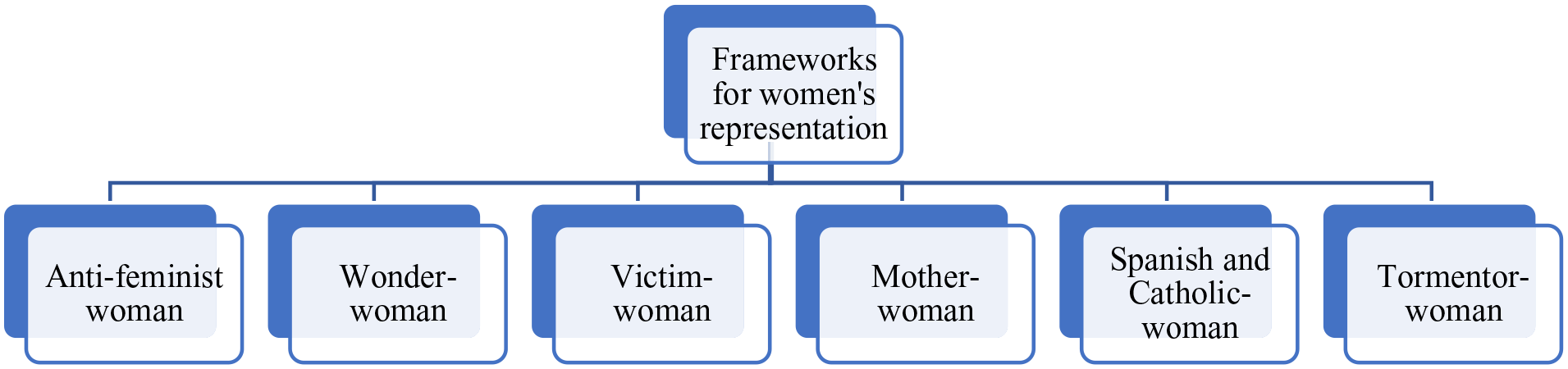
Frameworks for the representation of women.
The first two representations are used to construct arguments against public feminist policies, as well as to mask their sexism and legitimize the patriarchy. This strategy also contributes to the strengthening of their positive aspects and the negative aspects of what they have configured as an exogroup, following the logic of ideological polarization (Van Dijk, 2006; Wodak and Meyer, 2001). The representation of the Victim-woman serves an argumentative function for the other ideological matrix of far-right parties: racism and immigration control proposals. However, the construction of these useful models for the far-right argumentation needs to rely on the other three representations, as the images of the Mother-woman and the Tormentor-woman are activated to deny the specificity of gender violence, for the biopolitical reproduction of the nation and body control, as well as to activate other theories that impact securitization, anti-immigration and the denial of sexual and reproductive rights, as happens with the theory of the ‘Great replacement’. This latter is also activated through the representation of the Spanish and Catholic-woman, through narratives based on Hispanic myths that strengthen imaginaries of not only national, but also racial superiority by activating cultural and religious racism with the opposition Christianity/Islam.
This research delves into the objective of analyzing the discursive representation of women in the tweets of the main party leaders, analyzing abductively and qualitatively 6753 tweets from the accounts of two Vox deputies in Congress, Carla Toscano (@eledhmel) and Rocío de Meer (@MeerRocio), as well as the former party leader, Macarena Olona (@Macarena_Olona), published between January 21, 2021, and November 9, 2022. The analysis is approached from multimodality conceived as an anchor for identity construction (Van Leeuwen, 2021), and attention is paid to both the text and the image, as well as the hyperlinks that accompany it, amplifying the illocutionary force of the message. The number of tweets corresponding to each account is distributed as shown in Table 1.
Corpus of tweets.
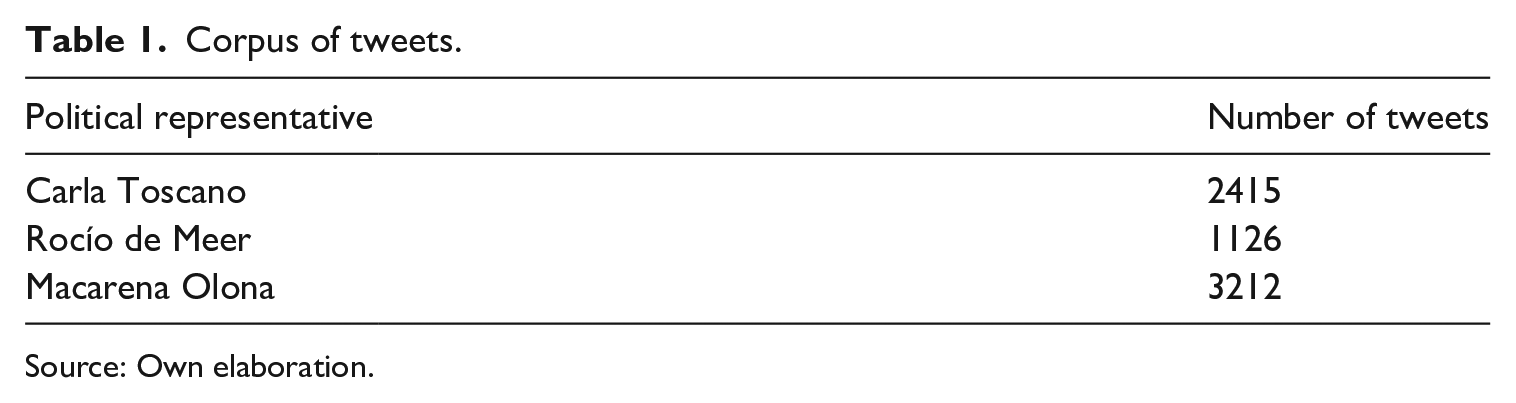
Source: Own elaboration.
Vox leaders play a crucial role in the party’s communication strategy, especially in speeches where gender is a central axis. This is also explained by the functions they perform in the Congress of Deputies. Carla Toscano is a spokesperson in the Equality Commission, a member of the Work, Inclusion, Social Security, and Migration Commission, a deputy spokesperson in the International Cooperation for Development Commission, and a spokesperson for the Commission for Monitoring and Evaluation of the Agreements of the State Pact on Gender Violence. The discursive topics resulting from these positions are transferred to her Twitter account under the framework of denying the specificity of gender violence and the reinforcement of the idea that only the maternal gap exists, as we will see later. Rocío de Meer, on the other hand, is a member of the Equality Commission, spokesperson for the Commission on Labor, Inclusion, Social Security and Migrations, spokesperson for the Commission on Social Rights and Comprehensive Disability Policies, and a member of the Commission on Childhood and Adolescence. Hence, on her account, we find speeches aimed especially at the youth, formed by an ethno-nationalist in-group that relies on the strategy of racializing sexism (Mann and Selva, 1979) to construct their imagined community (Anderson, 1983). The congresswoman reproduces the racist, and particularly Islamophobic argumentation, constructed from the framework of the clash of civilizations and religions. Therefore, from her position and public speeches, she reproduces a facet of Catholic Spanishness.
In the case of Macarena Olona, before leaving her position as a congresswoman in the Parliament of Andalusia after the 2022 elections, where Vox fell short of its expectations, she held the positions of member of the Permanent Deputation, deputy spokesperson of the Board of Spokespersons, spokesperson for the Interior Commission, member of the Commission on Territorial Policy and Public Function, and spokesperson for the Joint Commission on National Security. On July 29, 2022, Olona announced her withdrawal from politics and is currently outside the ranks of Vox, initiating a new project, the Ibero-American Equality Foundation, presented in early November 2022 and focused on collecting signatures for a Popular Legislative Initiative also centered on the denial of gender violence. Her inclusion in the research is justified, as in Polo-Artal and Camargo Fernández (2023), by her positions in Vox, by her significant role within the radical right-wing party, by her strong media presence, and by the discursive emphasis on the representation of violence as equally exerted by men and women.
The treatment of the corpus has been as follows: to analyze the linguistic part of the multimodal corpus, we first resort to the Sketch Engine software. With this program, we obtain a list of words and keywords to track the thematic focuses of their accounts. After this, we determine the relevant terms attending to the three frames of women’s representation. The following image shows the keywords that have the most presence in the corpus and are linked to the mentioned axes (Figure 2):
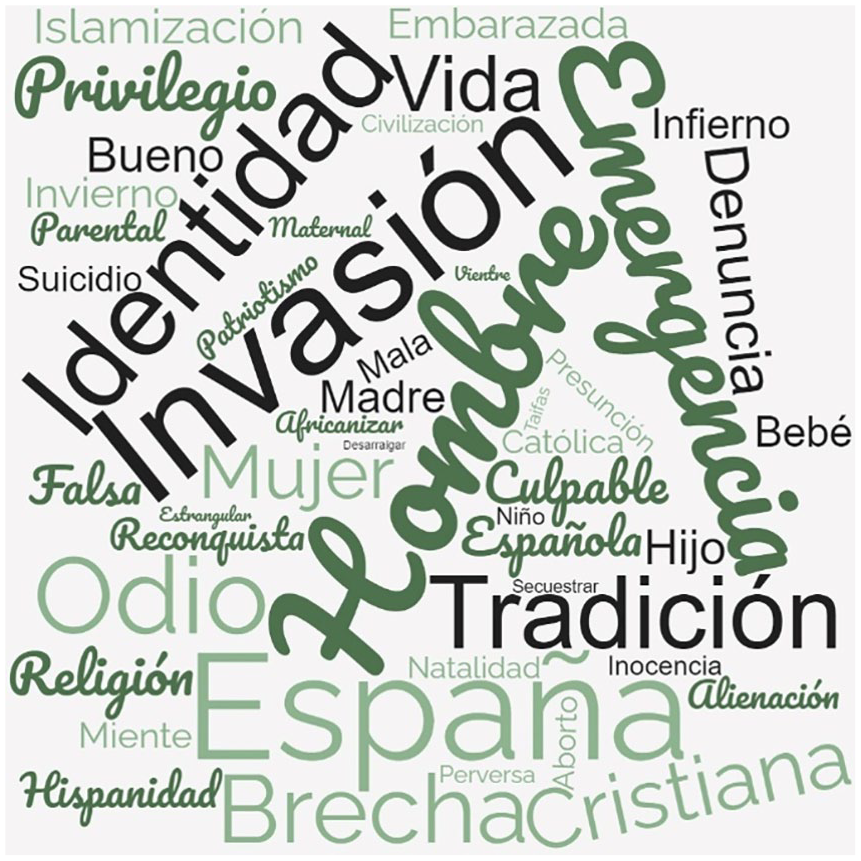
Keywords of the three frames of women’s representation in the corpus.
After establishing the relevant terms attending to the three frames of representation, a search is performed taking into account the obtained keywords to get the most recurrent collocations that accompany them and the tweets where these collocations appear. It should be noted that terms without lexical value are not taken into account. The last phase consists of applying Critical Discourse Analysis to the most significant tweets of each woman’s representation (Van Dijk, 2008; Wodak and Meyer, 2001).
Results
The representation of Spanish and Catholic women: the imprint of National Catholicism
In the ideology of Vox ‘The Spanish nation is not only a framework of institutions and laws, but a subject with its own soul and life, a subject whose existence extends to Don Pelayo and Covadonga’ (Altozano and Llorente, 2019: 108). In this statement we can observe a mystifying and confusing fixation with respect to the so-called Reconquista, recalled and celebrated in a habitual way by the leaders of the far-right party, as in the following tweet by Olona. In it, the Capitulations of Santa Fe are evoked as the ‘cradle of Hispanity’ and the fundamental role of the Catholic Monarchs, especially that of the female figure of Isabel La Católica, usually activated as one of the historical references of Vox women, and extolled with the hashtag #GloriousIsabel 4
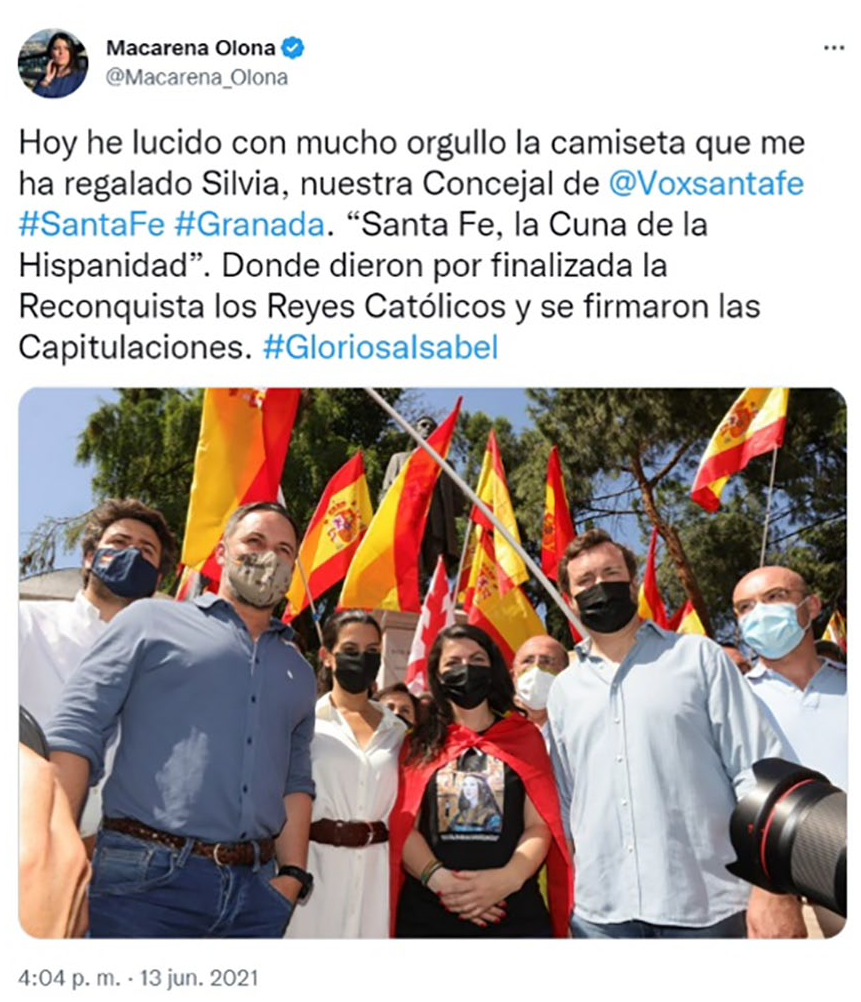
From the account of @Macarena_Olona: the Reconquest and the Catholic Monarchs.
The symbolic value of the conquest of Granada by the Catholic Monarchs, celebrated by Olona in the following tweet, connects with the idea defended by the far-right party on the ‘invasion of radical Islamism’ and the need to not consider the milestone of the Reconquest of a Spain taken from Christianity as concluded. There is an identification here of historical Islam with modern fundamentalism, within a project that the party presents as one of national salvation (Ballester Rodríguez, 2021: 5).
Macarena Olona: [@Macarena_Olona] (2/1/2022). Today we celebrate the triumph of our Christian identity and the end of the Muslim occupation, with the fall of the Nasrid kingdom. Granada. Where it all began. #TheCaptureOfGranada #GranadaIsNotTouched.
5
On the other hand, the current president of the Republic of Italy, Giorgia Meloni, is a source of inspiration for the women of Vox, especially for Macarena Olona, who counted on her presence as a guest figure at a rally in Marbella during the Andalusian election campaign. At that event, Meloni delivered a particularly aggressive speech that surprised even the party’s own leaders, in which she harshly charged against the LGTBIQ+ collective and spoke out in defense of the ‘natural family’. In the following tweet, the former deputy celebrates Meloni's electoral victory in the Italian elections by recalling her now famous attributive enumeration in the first person, in which she defines herself as ‘woman, mother, Italian and Christian’ and, from an essentialist vision of gender roles and identities, exalts the patriarchal vision of women (Aguiló, 2022): Macarena Olona: [@Macarena_Olona] (24/7/2022). ‘Giorgia, sei ispirazione’. Woman to woman. ‘I am Giorgia. I am a woman, I am a mother, I am Italian, I am Christian. You are not going to take it away from me’. You did it, @GiorgiaMeloni. The love of the Italian people has been stronger.
6
For the leaders of the far-right party, the identification with National Catholicism is also done by imitating the discourse of Giorgia Meloni. Olona also uses an attributive enumeration in which she highlights being ‘Spanish’ and ‘Christian’, in addition to ‘woman’ and ‘mother’, as essential elements of her identity and writes a syncretic tweet through nouns that show the way in which she constructs the category woman: Macarena Olona. [@Macarena_Olona]. (30/3/2022). Spanish. Christian. Woman. Mother. My identity. Our battle.
7
The former Vox deputy accompanies the text with a Tiktok video featuring Meloni, who, at the time of the speech, was a candidate for the presidency of the Republic of Italy. Meloni and Olona’s electoral performance is based on a masculinized aesthetic, an aspect amplified by the claim of political voice. Two women are shown enjoying the achievements obtained through the feminist struggle, combining their self-representation with traditional and nationalist values: Spanish or Italian, Christian and mother. In both cases, we are dealing with women who move between exceptionality and complementarity since, following the patriarchal ideology of their respective parties, only a few women reach such high levels of power through meritocracy, but being there allows them to present themselves as pro-egalitarian. This exceptionality must be combined with the complementarity of the sexes, hence we find combined gender performance and discourses that (re)produce the devices of femininity. This liminal movement is not new in the Spanish historical context, but we can trace it for the case of the Falangist woman. According to Cenarro (2017), women who participated in the Women’s Section of the Spanish Falange accessed a space of power, but also gender discrimination, so the gendered construction was crossed by tensions and contradictions.
It should also be noted that as a Vox candidate for the presidency of the Junta, Olona had to incorporate to the attributive enumeration constitutive of her identity to be ‘Andalusian’, as well as ‘Spanish’. Faced with the lack of credibility and the discredit of her sudden registration in Salobreña (Granada) to run in these elections, she had to redefine herself by appealing to and exaggerating the Andalusian roots of her maternal family, which in the end did not have positive consequences for the results of the party.
Macarena Olona. [@Macarena_Olona]. (28/2/2022). FREE, SPANISH, WOMAN, MOTHER, DAUGHTER, SISTER, ANDALUSIAN, SPANISH.
8
It has already been pointed out that this discourse is linked to the ideology and slogans of the national-syndicalism of the Women’s Section of the Spanish Falange, which had among its primary objectives ‘the affirmation of the political, economic and social superiority of men through a series of social programs and periodical publications’ (Prestigiacomo, 2019: 269). These programs and publications exacerbate the clichés of the image of women that Franco's regime aspires to implant: ‘a woman, housewife, Catholic, but also sporty, modern, who dresses fashionably and is surrounded by comforts’ (Pinilla García, 2006: 153). The similarities of the elements that the Women’s Section advocates for the new feminine identity with the frameworks of representation in the discourse of the leaders of Vox, such as the anti-feminist woman, the mother and Catholic woman, or the Wonder Woman, are striking (Polo-Artal and Camargo Fernández, 2023).
For her part, Carla Toscano likewise echoes her status as a woman defender of the Catholic Church, as seen in the tweets below, denouncing, on the one hand, her persecution by a regime she calls ‘left-wing dictatorial’, and justifying, on the other hand, the denial of her support for people who suffered abuse by members of the Church: Carla Toscano. [@eledhmel] (12/8/2022). Little is said about the persecution being suffered by the Catholic Church in Nicaragua by a dictatorial leftist regime. Ask yourselves why. Carla Toscano. [@eledhmel] (10/3/2022). If the sexual abuse of minors by some members of the Catholic Church you want to be investigated, but if in the face of sexual abuse of minors under the guardianship of your own, you look the other way. You don’t give a damn about minors.
9
Finally, Rocío de Meer celebrates Holy Week in the following tweet, affirming her respect and support for ‘all Catholic expressions’ as part of the identity and values that Vox defends, something that is surprising given the support that this celebration also has on the part of political parties of the left.
Rocío de Meer [@MeerRocio] (14/4/2022).  We wish all Catholics and brotherhoods to live Easter Week and its parades with emotion. ES All Catholic expressions that will be celebrated these days are part of our identity and values and have all our respect and support. #VOXSupportsHolyWeek.
10
We wish all Catholics and brotherhoods to live Easter Week and its parades with emotion. ES All Catholic expressions that will be celebrated these days are part of our identity and values and have all our respect and support. #VOXSupportsHolyWeek.
10
The representation of the Mother-woman: The mystique of motherhood and the ‘maternal gap’
In the corpus analyzed we find the noun ‘mother’ mainly in four contexts: on the one hand, linked to the ‘maternal gap’; to the ‘demographic winter’; to the denial of the specificity of gender violence; finally, to sexual and reproductive rights. Both the party and its deputies, including Macarena Olona when she was still a militant in Vox, have established as a political objective to address the issue of motherhood from the approach of neoliberal public policies and conservative moral values. Motherhood is depoliticized and they advocate explicit familization policies. The party proposes a plan to promote a ‘national birth rate’ under the idea that population growth will produce economic growth. In this way, it links replacement theory, nativism and natalism through tweets in which the noun ‘mother’ is nuclear. Vox proposes progressive economic and tax benefits for families with offspring, as well as policies to facilitate access to housing and tax exemption for large families. However, this does not imply that Vox reduces women to their role as full-time mothers. Aware of the social consensus on women’s access to the labor sphere, as well as the current economic precariousness, the party does not limit the salary to a single provider, but extends it to both. Therefore, we find speeches that appeal to working mothers exalting their effort, dedication, and sacrifice, in line with what has already been explained. Co-responsibility, reflection on the ethics of care or on the role of masculinities do not appear in their tweets. In the corpus we find the denial of specific labor discrimination against women and, in fact, this only appears when it is linked to motherhood, in terms of the ‘maternal gap’, a concept that they have not yet clearly defined and that, for the moment, they link to the low value that society gives to mothers and the lack of recognition of jobs linked to child-rearing. The leaders propose a modification of the framework: the non-existence of the gender gap and the social analysis from the maternal gap. In this sense, Carla Toscano and Macarena Olona state the following: Carla Toscano. [@eledhmel] (3/26/2021). The gender gap doesn’t exist, because people don’t have gender; what there is is a maternal gap, that’s why @vox_es wants protection for all mothers, whatever children they have. Macarena Olona. [@Macarena_Olona]. (15/5/2022). @vox_es wants it to be a real lottery for a company to have a woman who becomes pregnant in its workforce. Our goal is to put an end to the MATERNAL GAP.
11
Likewise, Olona criticizes the work of the government in relation to the birth rate. For her and for the party, anti-natalist policies based on the ‘culture of death’ are being applied as a consequence of the crisis of values caused by the ‘gender ideology’: Macarena Olona. [@Macarena_Olona] (2/2/2022). VOX has asked in Congress what measures the Government is going to take to promote the birth rate. The left answers that none because promoting Spanish women to be mothers means ‘perpetuating gender stereotypes’.
12
The party, through its visible female heads, is disputing the votes of women who are mothers or want to become mothers. As has been said, this ‘maternal gap’ appears linked to the ‘demographic winter’, a concept with which they intend to frame the analysis and policy responses. Radical right-wing parties are addressing the demographic issue through moral and demographic panics, the shock doctrine, as well as fear narratives (Wodak, 2015): Carla Toscano. [@edelhmel] (8/17/2022). 18500 illegals so far this year. And birth rate at lowest level since 1941. Some in Davos, or in New York, smile, like this, as sideways. All agree on their #Agenda2030 and their climate fanaticism. Don’t have children because of the climate; accept illegal immigrants because of the climate. Rocío De Meer [@MeerRocio] (17/8/2022). The real dramatic change Spain is facing and about which no one is turning off shop windows or suffering eco-anxiety is demographic suicide. That is to say, the end of Spaniards. #DemographicEmergency.
13
The Mother-woman also appears linked to the denial of the specificity of gender violence, in this case the noun mother is next to ‘wickedness’ and violence. In this way, it is intended to neutralize the role of patriarchal masculinity in the analysis of violence through the representation of mothers who exercise violence. Carla Toscano tweets as follows: Carla Toscano. [@edelhmel] (11/6/2021). VIOLENCE HAS NO SEX. Evil has no sex. Today it’s 2 innocent girls killed by their father, but most of the time many children are killed by their mothers.
14
Toscano discursively introduces the tormentor-mother, the abusers, whom she considers that they cannot be good mothers. This analysis of violence and upbringing, which the feminist movement has put on the table, is not applied when the perpetrator of the violence is the man. In this case, it resorts to the strategy of the presumption of innocence and the victimhood of men. We are faced with the configuration of a specific topos in the argumentation, that of victimhood and the aggrieved right, which is very common in nationalist identity-based political rhetoric (Camargo Fernández and Urbán, 2022). Finally, mothers are also linked to abortion. Vox’s position on this issue coincides with that of ultraconservative sectors, although it is true that they adapt their discourse to the context: on some occasions they frame it in the logic that it is a traumatic process whose access should be avoided and, on others, they focus on the prohibition of the voluntary interruption of pregnancy, conceptualized from the ‘culture of death’ and crime, as we read in the following tweet: Carla Toscano. [@edelhmel] (9/30/2021). @IreneMontero: those numbers you give so coldly are not appendicitis operations, they are murdered babies. And whether performed in a public or private facility, abortion is a crime.
15
As mentioned above, in a significant number of tweets the nouns ‘mother’ and ‘abortion’ appear. The deputies, by speaking of ‘mother-abortion’ instead of ‘woman-abortion’, start from the assumption that life begins with fertilization, a position congruent with the Catholic values of the party: Rocio de Meer [@MeerRocio] (9/7/2021). The greatest threat to peace today is abortion, because abortion is making war on the child, the innocent child who dies at the hands of its own mother. If we accept that a mother can kill her own child, how can we tell others not to kill themselves?
16
The corpus analyzed shows, in short, how women are defined through motherhood, hence it has been relevant to observe the issues with which mothers are linked. The ‘maternal gap’, the ‘demographic winter’ and abortion allow us to construct the representation of women aware of the difficulties of motherhood in today’s Spanish society but, at the same time, they do not make a structural critique of the system of gender discrimination in the workplace.
The representation of the Tormentor-woman and the denial of gender violence
The Tormentor-woman represents the antithesis of all the gender mandates towards women put in place by the far-right in its revival of traditionalist values and is linked in a double way, reinforcing it, with the framework of the Antifeminist-woman (Polo-Artal and Camargo Fernández, 2023). On the one hand, this representation offers an image of women as perverse toward men, manipulative and capable of exercising violence against their own children. Through the allusion to the parental alienation syndrome, an issue on which Vox presented a Proposición no de ley in Congress in 2021, Carla Toscano equates women and men in the possibility of exercising manipulation and psychological violence. On the other hand, while discrediting the Minister of Equality Irene Montero, a frequent target of her attacks and often represented by Vox as a woman-victim of both men and women, with the deformed denomination of ‘Commissioner of Inequality’, she summarizes through the hashtag #ViolenceHasNoSex (#LaViolenciaNoTieneSexo) the denialism of gender violence typical of Vox's ideology: Carla Toscano. [@edelhmel] (7/6/2021). Here is the Commissioner of Inequality acting as judge, interfering in Justice and refusing to recognize a reality as it is that women can also act badly, exercise violence and manipulate children. Parental alienation exists. #ViolenceHasNoSex
17
This denial of the specificity of gender-based violence and the role played by traditional hegemonic masculinity has undergone a process of sloganization by Macarena Olona, who turns a speech of hers in the Congress of Deputies into a tweet reiterated on numerous occasions in our corpus (‘Men do not rape, a rapist rapes. A man does not kill, a murderer kills. Man does not mistreat, mistreats an abuser. And man does not humiliate, humiliates a coward’ @Macarena_Olona: 25/5/2022 18 ), as well as in a form of retromerchandising through T-shirts with slogans (Figure 4):
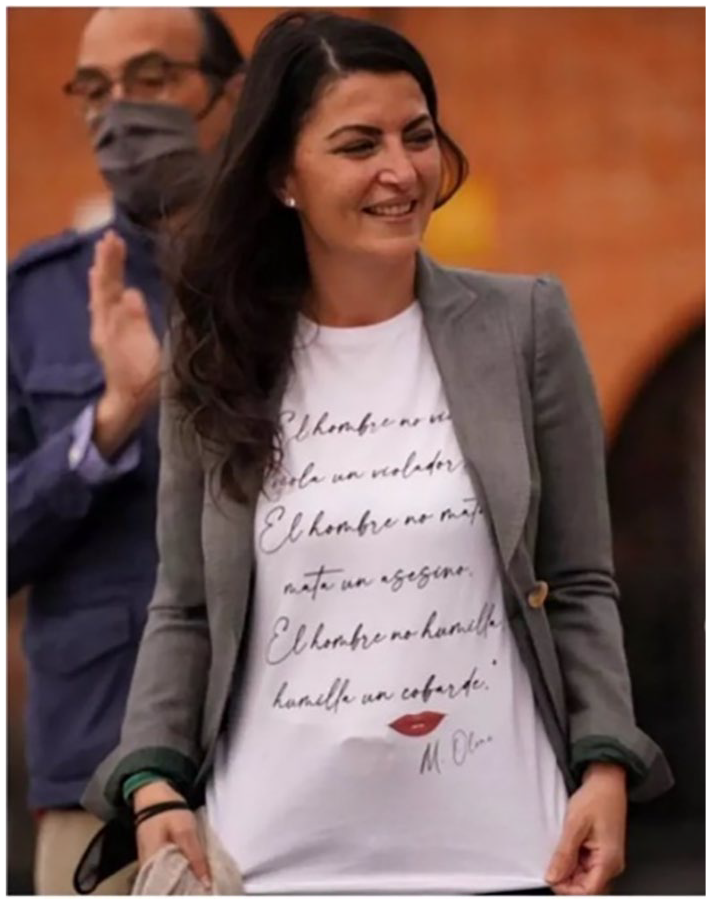
Macarena Olona’s T-shirt in the Congress of Deputies.
From this framework of representation, women cannot be deserving of policies that favor their equality with men, since the latter are presented as victims of false denunciations or abuse. Indeed, Vox leaders often resort to the issue of false denunciations that ‘destroy a man’s life’, as in Toscano’s tweet below. In this way, they try to equate the ability to exercise violence by men and women in order to attack the latter and offer a distorted representation of them. Behind all this also hides an electioneering strategy to capture the vote of offended males, through an underdog effect, by making them feel attacked by feminists as potential harassers or aggressors: Carla Toscano. [@edelhmel] (6/24/2021). False allegations exist. Women can lie, assault, and manipulate their children to wreck a man’s life. Violence and evil have no gender.
19
The male victim of the Victim-woman is represented in this frame as suffering from a hell for which the Minister of Equality and the feminist movement are held responsible, from an openly anti-feminist discourse. In a game of inversion of frames, it is the Gender Violence Law that is responsible for men suffering violence at the hands of women and, for this reason, it should be repealed: Carla Toscano. [@edelhmel] (19/5/2022). More and more men are suffering this hell. Thanks to Irene Montero, feminists and the infamous Gender Violence Law, perverse women can kill innocent men in life. We will repeal it.
20
It is striking the repetition in the following Toscano’s tweets of the negative polarity collocation ‘not being a being of light’ applied to the noun woman. This expression was popularized by several well-known television and show business personalities, but especially by Rocío Carrasco, alleged victim of gender violence by her ex-partner and whose children, allegedly, were also victims of vicarious violence: Carla Toscano. [@edelhmel] (20/5/2021). Man is not violent by nature. Woman is not a being of light. Evil can be in anyone regardless of gender, age or sexual orientation. Children can be victims of their father or their mother. Violence has no sex Carla Toscano. [@edelhmel] (5/18/2021). Are there any men in the room? Because I can accuse him of assault or rape and you guys would have to believe me, because I’m saying it. Because for this supremacist, delusional feminism, women are beings of light who never lie. #ViolenceHasNoSex.
21
Finally, Olona echoes in the following tweet the polarization of Vox against the rest of the political forces in Congress in the case of Juana Rivas, the woman from Granada who fled her home with her children and was denounced and put in search and capture. Juana Rivas is represented by Vox as a woman who kidnapped her children within this same framework of demonization of women mothers: Macarena Olona. [@Macarena_Olona]. (16/12/2021). All political parties, except VOX, supported a mother convicted of kidnapping her children.
22
As Bracke and Paternotte (2018) explain, the ‘gender ideology’ that moves in the realm of the far-right creates a strong ‘us-them’ polarization, so that its political leaders warn citizens of the existence of a threat and the need to fight against a common enemy. This also serves to generate moral panics that fuel the need for greater security, for a return to the past that guarantees the restoration of the ‘natural order of things’. 23 The representation of the woman-executioner stands, for all that has been explained, as an outstanding element that sustains and gives strength to this narrative in which feminism and women index violence, manipulation, and perversion.
Conclusions
Gender has become a central issue in the ideology of the far-right parties of which Vox is a part, a mobilizing and binding element of the neoconservative agendas that allows these political sectors to generate discourses, narratives and frameworks of representation that are proving decisive for the configuration of the imaginaries, desires, and expectations of contemporary subjects. But, in addition, gender is an axis of enormous strength because these formations have their own vision in relation to it, which is in dispute. The analysis carried out has shown how, through its female spokespersons, the Spanish far-right uses the gender discourse to disseminate its political ideology on issues that go far beyond gender, disputing even the signifier ‘feminism’ to the left and, in particular, to the Minister of Equality, Irene Montero. In fact, as its spokespersons often declare, Vox considers that the left has activated the war of the sexes because it has lost the class struggle and, like Trump in the United States, they defend the Eurocentrism rhetoric of bikinis instead of burkas that was initiated by the German AfD (Rivas Venegas, 2021: 72).
As we have seen, the digital discourse of the Vox deputies, Carla Toscano and Rocío de Meer, and of the former deputy, Macarena Olona, allows the Spanish far-right to reproduce, in the first place, the imaginary of the Spanish and Catholic-woman, which recovers a traditional version of femininity by activating historical referents from the mythical and mystified past that Vox articulates. The importance of its female referents within this framework has been highlighted, such as Isabel La Católica in the general historical context of the Reconquista, also a model of woman for the Sección Femenina; and in the present, such as Giorgia Meloni, current President of the Republic of Italy (§ 4.1) to whom Olona copies her campaign slogan. The image of women linked to nativism, a central element in Vox’s discourse, is reinforced through the frame of representation of the Mother-woman (§ 4.2) which serves to activate the device of repronormativity that situates motherhood for Spanish women as an imperative in the face of the threats of the ‘great replacement theory’ and the ‘demographic winter’. Finally, through the representation of the Tormentor-woman, a vision of women as violent and manipulative and an image of men or their children as their victims is offered, all of which is used to deny equality policies and the specificity of gender violence (§ 4.3).
Currently, the question remains open as to what path the far-right party will take in relation to its discourse on gender, but as was seen in Polo-Artal and Camargo Fernández (2023) and has been exposed in this analysis, for now Vox discursively combines two strategies: either to appropriate feminism, diverting it toward its interests in order to reconvert it into an ‘identity feminism’ that exalts Western societies because these give rights to women in the face of others that are presented as backward and oppressive (via femonationalist); or discredit it and do away with it, encouraging the message that feminism takes women as weak and puts ideological corsets on them (‘feminism’s losers’), while victimizing men as aggrieved so that, jointly, both women and men rebel against it (anti-feminist way). It is possible that this second path is the one that finally triumphs, although it is certain that currently, as we have seen in this research, they appear in combination. For this reason, it is important to continue to pay attention to all this in the future, delving deeper into the frameworks of representation of women deployed by the far-right parties, especially those articulated in the discourse of their female leaders.
Footnotes
Declaration of conflicting interests
The author(s) declared no potential conflicts of interest with respect to the research, authorship, and/or publication of this article.
Funding
The author(s) received no financial support for the research, authorship, and/or publication of this article.