




Abstract
Newer forms of racism in the context of right-wing extremism are characterised by an apparent distancing from overt racist devaluations. In addition or even beyond biological features, it is now cultural characteristics attributed to social groups which serve as grounds for practices of othering and social exclusion. This paper analyses racist discourse in the comment sections of the influential far-right blog pi-news.com where these practices can be observed in detail. With reference to discourse analytical approaches to racism and using corpus-linguistic, data-driven methods, especially word embeddings and collocations, it is shown how racism is linguistically and discursively expressed. Next to both overt and more implicit racist nominations and predications, the notion of Heimat (‘homeland’) is analysed; it is used to draw racist demarcations without relying on overtly racialising terms.
Introduction
This paper deals with racist discourse in the digital media using the example of the German far-right blog pi-news.com. Racist remarks are often considered one of the most virulent forms of hate speech in digital media and have therefore attracted particular attention from scholars (cf. the overview in Matamoros-Fernández and Farkas, 2021). Although it is not surprising to find racist positions in a far-right blog, it is instructive to examine how racism is expressed in times when, at least in the German-speaking countries, there is a growing awareness of and critical stance towards everyday racism (Essed, 1991) and structural racism (Hasters, 2019) in public discourse. However, this growing awareness is accompanied by an increasing influence of right-wing political actors, such as in Germany the party Alternative für Deutschland (AfD; Wildt, 2017), and an corresponding normalisation of xenophobic and even racist positions (Spieß, 2022). But as research on recent forms of right-wing extremism has long shown (Aftenberger, 2007; Bruns et al., 2017), its racism has changed in such a way that it no longer stands in such an open contradiction to the civic norms underlying the mainstream antiracist movement to which recent forms of right-wing extremism meta-discursively respond (Meier-Vieracker, 2020). Nevertheless, the boundaries between traditional, often biologically underpinned racism and renewed cultural racism are fluid. For that reason, both traditional and renewed forms of racism and their manifestations in the comment sections of the far-right blog pi-news.com, a highly frequented forum and resonance chamber for right-wing positions, are the focus of this paper.
To analyse them, I will use data-driven, corpus linguistic methods centred around the calculation of word embeddings (Kozlowski et al., 2019) and collocations (Evert, 2009) to capture discourse-specific meanings as demonstrated by Bubenhofer et al. (2019), and apply them to a large corpus of user comments. This methodological approach will make it possible to explore the semantic space of far-right discourse as represented in the comment sections of pi-news.com, and to examine its characteristic linguistic and discursive manifestations of racism.
In the following, I will first discuss the notion of racism from a discourse analytic perspective and will then give some background information on recent forms of right-wing extremism, its ideology and its media infrastructures in the German-speaking countries. Afterwards, I will present my data and methodology. The results will be presented in two subsections. First, I will discuss racist nominations and predications on the basis of a clustering of a word embeddings model that will reveal the transitions between traditional and renewed forms of racism. Second, I will go into more detail and show how the concept of Heimat is profiled in the comments sections and how it is used to draw racist demarcations without relying on overtly racialising terms.
Discourse and racism
This paper follows a discourse analytical approach to racism. Wodak and Reisigl describe the relations between discourse and racism as follows: Discourse plays a crucial role in the creation and reproduction of racism. Racism, as both social practice and ideology, manifests itself discursively. [. . .] racist attitudes and beliefs are produced and promoted by means of discourse, and discriminatory practices are prepared, promulgated, and legitimated through discourse. (Wodak and Reisigl, 2015: 576)
Although human races in the genetic-biological sense do not exist in the real world, the notion of race as a discursive construct is real and has real consequences. In line with the discursive nature of ‘race’, racism is no longer defined as discrimination because of racial properties but as discrimination ‘based on practices of racialisation, that is, semiotic practices that construct social relations in terms of race categories’ (Wodak and Reisigl, 2015: 577).
Wodak and Reisigl (2015: 578) identify four discursive practices and processes of racism:
– Both natural and cultural differences are marked and stereotypically generalised and polarised in order to construct homogenous groups or communities.
– These two types of differences are connected via the naturalisation of cultural differences. Fictitious or real, usually visible features which are presented as unchangeable are linked with social, cultural or mental characteristics.
– Along with this, the naturalising social construction is hierarchised, leading to a negative evaluation of the racialised Other.
– Naturalised hierarchisation and negative evaluation then serve to justify and legitimise power differences and various practices of social and political exclusion.
Racism is thus not only understood as an attitudinal characteristic of individuals that leads to hatred and discrimination but rather as a discursive practice which, from an in-group perspective, legitimises group-based inequality (Zick et al., 2008: 366).
These discursive practices and processes of racism can be analysed with respect to nominational and predicational strategies according to the discourse-historical approach (Reisigl and Wodak, 2009), the first of which ‘construct and identify social actors [. . .] via membership categorization devices’ (Wodak and Reisigl, 2015: 585) including metaphorical references and the second depict these actors by stereotypical attributions. Note that this is an analytical distinction and nominational and predicational strategies can merge into one as in the word Terror-Muslim, which both constructs and characterises a group. Moreover, argumentational strategies are used to legitimise the discriminatory practices, and intensifying strategies can ‘qualify and modify the illocutionary force of racist [. . .] utterances’ (Reisigl and Wodak, 2009: 585) for example through stylistic means like mocking neologisms such as Affrikaner as a contamination of Affe (‘ape’) and Afrikaner (‘African’; Scharloth, 2021: 160). Due to the lemma-oriented methodological approach (see section 5 below), this paper will deal primarily with nominations and predications, while also include the stylistic dimension.
A somewhat similar approach has been proposed by Hoffmann (2020) in his analysis of the language of racism. According to Hoffmann, racism starts with the splitting of society into groups through acts of stereotyping which leads to de-individualisation and polarisation between ‘us’ and ‘them’ in a process of Othering (Coupland, 2010). This separation is grounded in so-called anchor features. Supposedly unchangeable features, both visible like body features and invisible like origin and ancestry, serve as indicators for the construction of groups and the allocation of individuals to these groups. These anchor features are then linked to epistemically ascribed dispositions and practices. In the case of the they-group, these are negatively evaluated dispositions like aggression, laziness, lack of intelligence and so on, while positive dispositions like diligence and self-control are ascribed to the we-group. Socially deviant behaviours are judged as individual deviations in the we-group, whereas deviant behaviours in the they-group are judged as symptomatic or even revealing the ‘true’ nature of the group (Bourhis and Maass, 2005: 1597). These diverging evaluations will then provide motivations and legitimisations for hegemonic practices, verbal and physical violence and, finally, social exclusion of the out-group as a whole (Hall, 1989: 913).
Hoffmann notes that the anchor features often lack empirical evidence, and in a process of what he calls conversion, other items like religion and culture can take their place. As already stated by Wodak and Reisigl (2015), these cultural differences become naturalised and appear to indicate essential and unchangeable features of the respective groups. These forms of racism, which refrain from the very concept of race, have been termed ‘racism without race’ or ‘cultural racism’ (Balibar, 2008). They pretend to target ultimately innocent cultural differences but are in fact a violent, harmful and exclusionary practice. In recent forms of right-wing extremism, this ideology of cultural racism becomes particularly virulent.
Recent forms of right-wing extremism: Ideology and media infrastructures
Recent forms of right-wing extremism in the German-speaking countries, on which this paper focuses, have in common a strong nationalism on the one hand and a distanced attitude towards National Socialism and neo-Nazism on the other (Pfahl-Traughber, 2019). They include the New Right in the narrow sense, an intellectual current of right-wing extremism that finds its model in the French Nouvelle Droite and maintains think tanks like the Institut für Staatspolitik (Salzborn, 2016). Moreover, also other far-right (collective) actors in the German-speaking, ranging from right-wing populist parties like the AfD to social movements like the Identitäre Bewegung or the racist Pegida share some characteristics with the New Right. They all incorporate elements of right-wing extremist ideology as the rejection of a multicultural society in favour of a strong national end even ethnic (völkisch) identity and the disparagement of the promotion of sexual diversity. These ideological elements are combined with new strategies of popularisation (Bruns et al., 2017: 84) through visual (Hornuff, 2019) and linguistic means (Beckers et al., 2014) in order to gain cultural hegemony (Salzborn, 2016). To this end, recent forms of right-wing extremism typically distances itself from explicit devaluations of out-groups, for example through outspoken racism (Sieber, 2016: 370). At the same time, however, it insists on the existence of ethnic groups as homogeneous social collectives that have an ancestral and yet unchangeable cultural identity. Moreover, this identity must be preserved in its original purity against any mixing of cultures (Bruns et al., 2017: 87). Thus, it is a case in point of what Hoffmann (2020: 41) calls conversion since the supposed homogeneous groups are defined by cultural features rather than biological ones.
These ideological components are merged in the notion of ethnopluralism which originally emerged in the New Right, but has since been adapted by other right-wing actors as well (Pfahl-Traughber, 2019). According to ethnopluralism there is a plurality of cultures and every culture is valuable in itself. However, every culture is bound to its ancestral place and should keep its distance to others: Ethnopluralism thus refers to political concepts of the New Right that guarantee the natural distances and an orderly coexistence of peoples in order to enable development according to the respective ethnic specificity. (Aftenberger, 2007: 159, my translation)
As a consequence, migration and any form of cultural assimilation are regarded as a threat to the cultural identity of the hosting society and its members (Goetz and Winkler, 2017: 70f.). Ethnopluralism and the corresponding concept of cultural identity thus promote distancing between ethnic groups and support the call for a most rigid migration politics and legitimises social demarcation and exclusion of supposed ethnic out-groups.
In about the last ten years, this form of right-wing extremism has established its own discourse universe with its own alternative public. Besides the activities of the publishing house Antaios with a broad range of publications representing the intellectual side of the New Right, internet-based communication plays a major role. For example, the Identitäre Bewegung, the already mentioned far-right youth organisation, makes extensive use of social media (Sieber, 2016: 365f.). Moreover, there are some wide-reaching blogs acting as alternative news media in order to give voice to a counter-public in distinction to a supposed mainstream. One of these blogs is pi-news.com, known as one of the most influential political blogs beyond conventional mass media (Bundeszentrale für politische Bildung, 2021), which I will analyse in the following sections.
‘pi’ is an acronym for ‘politically incorrect’. The blog, which repeatedly emphasises proximity to the actors and the concerns of the New Right, for example, by placing ads for the publishing house Antaios, positions itself as a resistance to the mainstream discourse supposedly dominated by the ‘subtle dictates of political correctness’ (https://www.pi-news.net/leitlinien/). It thus prototypically represents the far-right’s subversion of the concept of political correctness as a stigma word to defame emancipatory positions like anti-racism as censorship and authoritarian language policing (Auer, 2002). 1 In spite of its decided anti-Islam position, the blog professes itself to the German constitution (Grundgesetz) and the Human Rights, supposedly promoting the idea of ‘tolerance towards foreign cultures’ as long as they remain at a distance and do not force the domestic society ‘to abandon its own culture’. Although classified as right-wing extremist by the German Office for the Protection of the Constitution (Verfassungsschutz), the blog itself neglects any connections to right-wing extremism.
The blog articles typically report in a journalistic-like manner on current events like (supposed) criminal cases with migrant involvement (Dreesen, 2019). Moreover, the blog provides a highly frequented comment section. Although the blog’s guidelines claim to delete comments that refer or link to right-wing extremist websites and that make use of ‘verbal vandalism against humans’, it is in fact not regulated in any way. It is likely that these comment sections play a decisive role in the (meta-)political strategy also known by the New Right, since they function as resonance chambers in which the still cautious right-wing positions in the blog articles are responded to and reinforced with outspoken hate and enmity. In particular because of the comment sections, pi-news.com was characterised as a place of boundless hate (Schiffer, 2010) and in my analyses, I will therefore focus on the comments. In comparison to the intellectually oriented strands of New Right’s discourse, the distinctly cruder tone of pi-news.com’s comment sections can illuminate precisely the transitions between classical and renewed forms of racism.
Corpus data
The corpus on which the following analyses are based consists of 1,028,400 comments posted under 9098 articles of pi-news.com from 2006 – 2018 that were tagged with the keywords ‘migration’ and ‘Islam’ and are therefore likely to deal with presumed ethnic out-groups. The comments as in-group communication thus represent what van Dijk (2004: 352) calls racist discourse ‘addressed towards other dominant group members and is about ethnic or ‘racial’ Others’.
The corpus was compiled in May 2018 by scraping the HTML source code and processing it as an XML format. The corpus was lemmatised and part-of-speech tagged with the standard software TreeTagger (Schmid, 2003). After tokenisation, the corpus contains 78,908,735 tokens.
Methodology: Collocations and word embeddings 2
Methodologically, this study is at the interface of corpus linguistics and discourse analysis. Following a corpus pragmatic approach (Aijmer and Rühlemann, 2014), it is focussed on the analysis of linguistic patterns which are interpreted as traces of recurrent and socially situated speech actions and seeks to explore the form, meaning and function of these patterns as indices of their social contexts (Knuchel and Bubenhofer, 2023). From the range of corpus linguistic methods, collocation analysis and the calculation of word embeddings are particularly relevant here.
Collocation analysis is a widely used method in corpus linguistics and discourse analysis to study the usage profiles of words as semantic profiles (Xiao, 2015). As an empirical approach to discourse semantics, collocation analysis is grounded in the idea that the meaning of words can be grasped by an analysis of their typical contexts (Evert, 2009: 1213). Words that are associated with the word under study form the so-called collocation profile as a representation of its semantics. For discourse-analytical purposes, the (contrastive) calculation of collocation profiles on the basis of specialised corpora, which reflect the particular and discursively shaped semantics of words within a discursive domain, is particularly interesting.
The contextualist approach to semantics unites collocation analysis with the calculation of word embeddings (Kozlowski et al., 2019; Mikolov et al., 2013) which builds on a systematic comparison of collocation profiles and has already been shown to be a promising approach for discourse-analytical purposes (Bubenhofer et al., 2019; Knuchel and Bubenhofer, 2023). It is based on the machine learning-based construction of a language model which represents the relationships between words in a corpus, that is, their contextual embeddedness in a high-dimensional vector space by assigning every word to a word vector based on its typical contexts or collocates (Lenci, 2018: 153). The language model can then be queried for so called nearest neighbours of a given vector which represent words that share similar contexts within the corpus it was trained on and which thus will have similar meanings. For example, the word embeddings model trained on the pi-news corpus outputs the following words as the ten nearest neighbours of schrecklich (‘terrible’) in ascending similarity:
While these words can be regarded as synonyms valid across contexts, in other cases the nearest neighbours reflect domain-specific (Fankhauser and Kupietz, 2019) as well as (maybe ideologically shaped) discourse-specific meanings (Bubenhofer et al., 2019). To give another example from the model trained on the pi-news corpus, the word Meer (‘sea’) has the following nearest neighbours:
Next to words from the semantic field of waters like ocean or river we also find words like row boat or inflatable dinghy which still have something to do with water but in a very special sense. This is due to the fact that in the corpus used for training the model, that is a far-right blog, the sea is mentioned first and foremost with reference to people fleeing across the (Mediterranean) sea, too often with unsafe and far too small boats. Semantic similarities in terms of distances in the semantic vector space can thus be read as traces of discourse-specific, perspectivised and maybe idiosyncratic ways of referring to and thereby constructing the world.
The word embeddings model can be queried by looking for the nearest neighbours of specific words as demonstrated above. Moreover, the whole vector space can be clustered (Bubenhofer, 2020) in order to find ‘areas’ in the space where words are located around a presumed cluster centre. For this paper, 1000 clusters with 20 words each were calculated using the k-Means-algorithm. All clusters represent lists of semantically similar words which do not have to co-occur but share similar contexts in the corpus. The list of clusters, therefore, allows a fully data-driven exploration of the far-right semantic space in which, as the following sections will show, racism and racist positions play a decisive role.
Results
Racist nominations and predications
Following Wodak and Reisigl (2015) approach to analysing racist discourse through the analysis of nominational and predicational strategies (see section 2), I start by manually extracting those clusters from the clustering of the word embeddings model which can be interpreted as lexical means for racist nominations and predications. First, some clusters containing the most drastic ethnic slurs, representing explicit racism, catch the eye. #212 Negerfrauen, Zuchtbulle, Geschlechtsgenosse, Neechern, Schnalle, Kindchen, Bahnhofsklatscherinnen
3
, Fusselbärten, Araberhengst, Primitivling, Rüde, Stechern, Schürzenjäger, Bimbos, Ostafrikanern, Rothaarige, Deckhengst, Schwarzköpfe, Besamer, Teufelin
Negro women, breeding bull, sex stud, negro, bitch, kiddie, station clappers, fuzzy beard, Arabian stallion, primitive, male dog, stallion, philanderer, negro, east African, redhead, stud, black-head, inseminator, she-devil
Next to ethnic slurs referring to black people, there are also various de-humanising animal designations which all focus on aspects of (the male side of) reproduction. The cluster thus represents the racist stereotype of the lust-controlled and even raping Arabs
4
or Africans whose mere presence constitutes a threat to the local, especially the female population. One example, which refers to the far-right narrative that the former German chancellor Angela Merkel is the main responsible for the mass immigration mainly of Arabs and Africans, reads as follows: (1) [. . .] Die rotblonde Merkel haßt sich selbst, Deutsche u. Deutschland. Daher lockt sie, mit ihren Selfies mit ausländischen dunklen Männern (Oder hat sie etwa Schmuse-Selfies mit jungen Araberinnen u. Negerinnen gemacht?), Millionen fremdkulturelle Deckhengste her, die mit deutschen Frauen Mischlingskinder machen u. zudem später ihre Sippschaft aus Islamien u. Schwarzafrika nachholen sollen.
The red-blonde Merkel hates herself, Germans and Germany. Therefore, with her selfies with foreign dark men (or did she take cuddly selfies with young female Arabs and negroes?), she lures millions of foreign-culture studs here, who are to have mixed-breed children with German women and later bring their kin from Islam and Black Africa.
The physical feature of ‘dark’ skin together with foreign origin is linked to the mental and physical disposition of libidinousness which is essentialised and presented as the sole defining characteristic through the term stud. The attribute foreign-culture insinuates that this disposition is constitutive of the foreign culture as a whole. Moreover, the talk of ‘mixed-breed children’ as the descendants of ‘dark men’ with ‘German women’ points to an even biological concept of race and racial purity of the German population.
Besides these outright biologistic-racist nominations of immigrants, there are others that focus on alleged illegal immigration and places immigrants under general suspicion of fraud. An example is the following cluster: #192 Asylbetrüger, Scheinasylante, Sozialschmarotzer, Asylschmarotzer, Illegale, Glücksritter, Invasoren, Asylforderer, Wirtschaftsflüchtling, Sozialtouristen, Wirtschaftsmigranten, Asylante, Armutsflüchtling, Asyl-Invasoren, Abenteurer, Lampedusa-Neger, Flüchtilanten, Flutlinge, Sozialbetrüger, INVASOREN
asylum impostor, fake asylee, welfare scrounger, illegals, soldiers of fortune, invaders, asylum demander, economic refugee, social tourist, economic migrant, poverty refugee, asylum invader, adventurers, Lampedusa negroes, refugees, benefit cheat, invaders
By the blanket accusation of refugees and asylum seekers fleeing for base and dishonest motives, primarily for personal enrichment, criminal dispositions are ascribed to them across the board. Moreover, immigration is equated with invasion and is thus framed as an act of aggression. Special mention should be made of the expression Sozialtouristen (‘social tourists’). This term, which alludes to Sozialleistungen (‘social benefits’) and is by no means limited to the far-right, suggests that fleeing is for recreation and pleasure, and completely ignores the real plight of the people fleeing. One comment complains about tausende von Sozialtouristen, die nichts anderes tun als Krankheiten, Dummheit und Verbrechen einzuführen (‘thousands of social tourists who do nothing but import disease, stupidity and crime’) and thereby explicates the devaluating associations of this expression and links it with racist stereotypes. Also remarkable are the word formations Flüchtilanten, a ridiculing and thus disparaging contamination of Flüchtling (‘refugee’) and Asylant (‘asylum seeker’; Scharloth, 2021: 75), and Flutling as a variant of Flüchtling deriving from the word Flut (‘flood’), which grounds in the long traditional water metaphor and frames immigration as a natural disaster (Porto, 2022). Finally, the expression Lampedusa-Neger catches the eye, occurring frequently with 200 hits in the corpus. Italy’s southernmost island of Lampedusa, where many refugee boats arrive from the African continent, has become a cipher for migration to Europe as a whole, as reflected in this racist slur. In this compound, the toponym Lampedusa does not so much refer to place as to the overall rejection of ‘illegal’ immigration which is seen as primarily an African problem.
While the two clusters discussed so far contain terms for (groups of) immigrants or refugees, other clusters contain terms which – often metaphorically (Wodak and Reisigl, 2015: 585) – refer to the migration process as a whole. But they also paint a picture of violence and threat. #512 Masseninvasion, Überflutung, Massenmigration, Bevölkerungsaustausch, Massen-immigration, Massenzuwanderung, Infiltration, ISlamisierung, forciert, ungebremsten, Invasion, Kolonisierung, Import, Ausplünderung, Massenflutung, Steuerung, Massen-ansiedlung, Siedlungspolitik, Umvolkung, Asylflut
mass invasion, flooding, mass migration, exchange of population, mass immigration, infiltration, ISlamisation, unrestrained, invasion, colonisation, import, predation, mass flooding, steering, mass settlement, ethnic replacement, asylum flood
Besides the notions of migration as invasion and as flood already stated above, we also find traces of conspiracy theories. Europe is said to be colonised and plundered by masses of migrants. The talk of import however suggests that this is a purposeful process steered and controlled by unspecified actors who import migrants like economic goods. Moreover, we find the conspiracy theory key terms Bevölkerungsaustausch (‘exchange of population’), a term most prevalent in the New Right (Weiß, 2017), and Umvolkung (‘ethnic replacement’). They refer to the narrative that the cultural traditions of ‘white’ Europe shall be replaced through systematic settlement of ‘foreign-cultural’ migrants and that this is deliberate on the part of the German government (Römer and Stumpf, 2019). One commentator warns against a vollständig ungefilterten Import von islamischen Gewalttätern (‘completely unfiltered import of islamic violent criminals’) and thereby reduces migrants to their predisposition to violence. The metaphor of ‘filtering’ also depicts migrants as particles of dirt.
Another important enemy stereotype is, of course, Islam, as it is already reflected in pi-news.com’s main thematic categories which lists Islam at the top level of structure. In the comment sections, it is portrayed in the most distorted way. The following cluster gives an impression of this: #649 Gewaltkult, Polit-Ideologie, Herrschaftsideologie, Eroberungsideologie, Mörderideologie, Mordkult, Herrenmenschen-Ideologie, expansionistisch, Scheinreligion, Psychosekte, Todes-ideologie, Gewaltsystem, Götzenkult, frühmittelalterlich, freiheitsfeindlichen, Religions-Ideo-logie, satanistischen, Menschenverachtende, Unterdrückungsideologie
cult of violence, politic ideology, ideology of domination, ideology of conquest, ideology of murder, cult of murder, master race ideology, expansionistic, fake religion, psycho sect, ideology of death, system of violence, idolatry, medieval, anti-freedom, religious ideology, ideology of violence, satanistic, inhuman, ideology of oppression
Although the term Islam itself is not part of the cluster, the textual evidence in the corpus clearly shows that these terms do refer to Islam. It is seen as a violent, inhumane, oppressive political ideology rather than a religious system of belief (cf. Kalwa, 2013: 170–175, showing that in German anti-Islamic discourses the propensity for violence and oppression is constructed as an essential characteristic of Islam). As noted in section 2, Hoffmann (2020) shows how in newer forms of racism, in an act of conversion, religion takes the place of the former physical anchor features, based on which the act of Othering is achieved and legitimised. The following excerpt shows how this works in detail: (2) Die arabische Welt ist dank der Hass und Unterdrückungsideologie Islam verdorrte Anti-Zivilisation, die Gegenthese zu Aufklärung, Entwicklung, Fortschritt, aber auch zu Zweifel und konstruktiven Konflikten. [. . .] Diese Welt millionenfach hierher zu importieren wird auch Europa zu einem Shithole werden lassen. Um das bestätigt zu bekommen, muss ich nur aus dem Fenster schauen. Die islamische Anti-Zivilisation ist längst hier.
The Arab world is a withered anti-civilisation thanks to the hate and oppression ideology of Islam, the antithesis to enlightenment, development, progress, but also to doubt and constructive conflict. [. . .] Importing this world here by the millions will also turn Europe into a shithole.
5
To have this confirmed, I only have to look out of the window. The Islamic anti-civilisation has been here for a long time.
In a most generalising way, the complete Arab world as Islam’s ancestral place is seen as the totally Other, the antithesis of the central values of European culture. In implicit contrast to the long traditional metaphor of flourishing cultures, the Arab world is considered as withered because of Islam. And even more, the immigration of people from this ‘world’ would destroy Europe, too, a process which, according to the commentator, has already begun.
To sum up so far, we find various racist nominations and predications in the corpus, and the clustering of the word embeddings model is a suitable way to explore them. Corresponding to the discourse analytical approaches to racism, the nomination and predication patterns together with intensifying stylistic means like contaminating neologisms construct homogeneous groups through the stereotypic generalisation of differences, where cultural differences become naturalised and hierarchised through negative evaluation. They legitimise the devaluation and exclusion of the out-group which, as in (2), may even appear as a defence of moral values (Meier-Vieracker, 2020). However, the patterns analysed so far are rather explicit forms of racism. In the following section, I will therefore focus on another topic where racist discourse manifests itself in a not so obvious way, that is the concept of Heimat.
The concept of Heimat
In the cluster list, we find the following cluster centred around the term Heimat, which can be roughly translated as ‘home’ or ‘homeland’: # 526 Heimatland, Heimat, Herkunftsland, Ursprungsland, Land, Nachbarland, Kriegsgebiet, Heymat, Gefilde, Nachbarstaat, Krisengebiet, Siedlungsgebiet, Auffanglager, Gastland, Breitengrad, Landesteil, Zielland, Kulturraum
homeland, home, country of origin, country, neighbour country, war zone, realm, homeland, neighbour state, crisis area, settlement area, reception camp, host country, latitude, country part, target country, cultural space
Although this cluster seems to point to the theme of migration, it is still unclear how the concept of home is semantically profiled, so it is worth taking a closer look at it.
History of concepts has argued that Heimat is a very German and yet untranslatable concept (Blickle, 2004). Heimat brings together two strands of meaning (Bastian, 1995). First, it refers to the place of origin, and second, to the place of subjectively and even emotionally perceived belonging (Antonsich, 2010: 646) which also includes social belonging to a community and is an important element of personal identity. Like other broad concepts as, for example, nation (De Cillia et al., 1999), Heimat and the values attached to it is a social and discursive construct: Heimat is a fantasy and value construct, more memory, imagination and magic than perceived presence, more longing, hope and utopia than experienced reality and predictable future. (Winter, 1996: 13)
In right-wing ideologies, the concept of Heimat plays a decisive role but is sharpened in certain ways (Weidacher, 2020). Heimat is intrinsically linked to territory and the essentialised and unchangeable culture of the territory’s people. To put it in a formula, Heimat is considered as a matter of fate. Although Heimat has ever since been a point of reference for conservative and right-wing world views (Bastian, 1995: 123), it has become very prominent in recent forms of right-wing extremism, too. It fits with the notion of ethnopluralism, according to which the people and its cultural identity is inseparably linked to its territory. Martin Sellner, leader of the far-right youth organisation Identitäre Bewegung, writes in his autobiography: ‘All peoples have a right to their Heimat and their ethnocultural identity – including ours’ (Sellner, 2017: 17). He adds that mass immigration in Europe is about to replace the ‘autochtonous people’ (Sellner, 2017: 17) which is equated with a loss of Heimat and identity. This clearly shows the exclusionary implications of the concept of Heimat (Weidacher, 2020: 235), as the territory which may be called Heimat shall be reserved for the ancestral population. It is precisely because of these anti-migration implications that the far-right Nationaldemokratische Partei Deutschlands (NPD) recently renamed itself ‘Die Heimat’.
In order to see how the concept of Heimat is profiled in the pi-news.com’s comments, a collocation analysis is useful. Table 1 shows the top 20 collocates of Heimat on lemmatised basis using the association measure log likelihood ratio.
Collocations of Heimat..
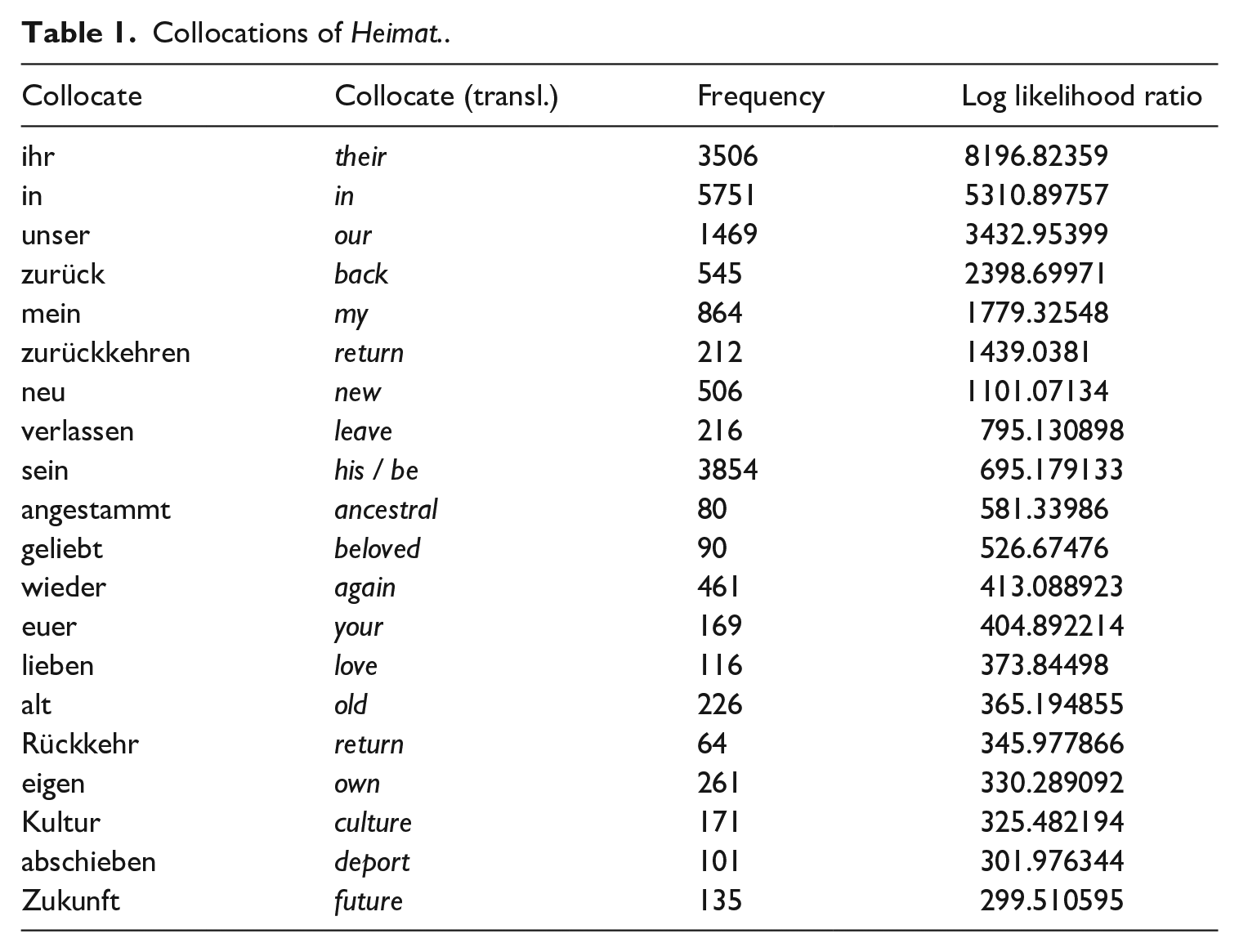
Most noticeable are the highly significant possessive pronouns ihr (‘their’) and unser (‘our’). Extending collocation analysis to these possessive constructions (Table 2 and 3), it becomes clear that Heimat is profiled differently depending on the collective in focus. Unsere Heimat is associated with culture, tradition and identity but is also seen as the object of Islamisation, alienation and destruction:
To give an example from the corpus:
Collocations of unsere Heimat (excluding some function words).
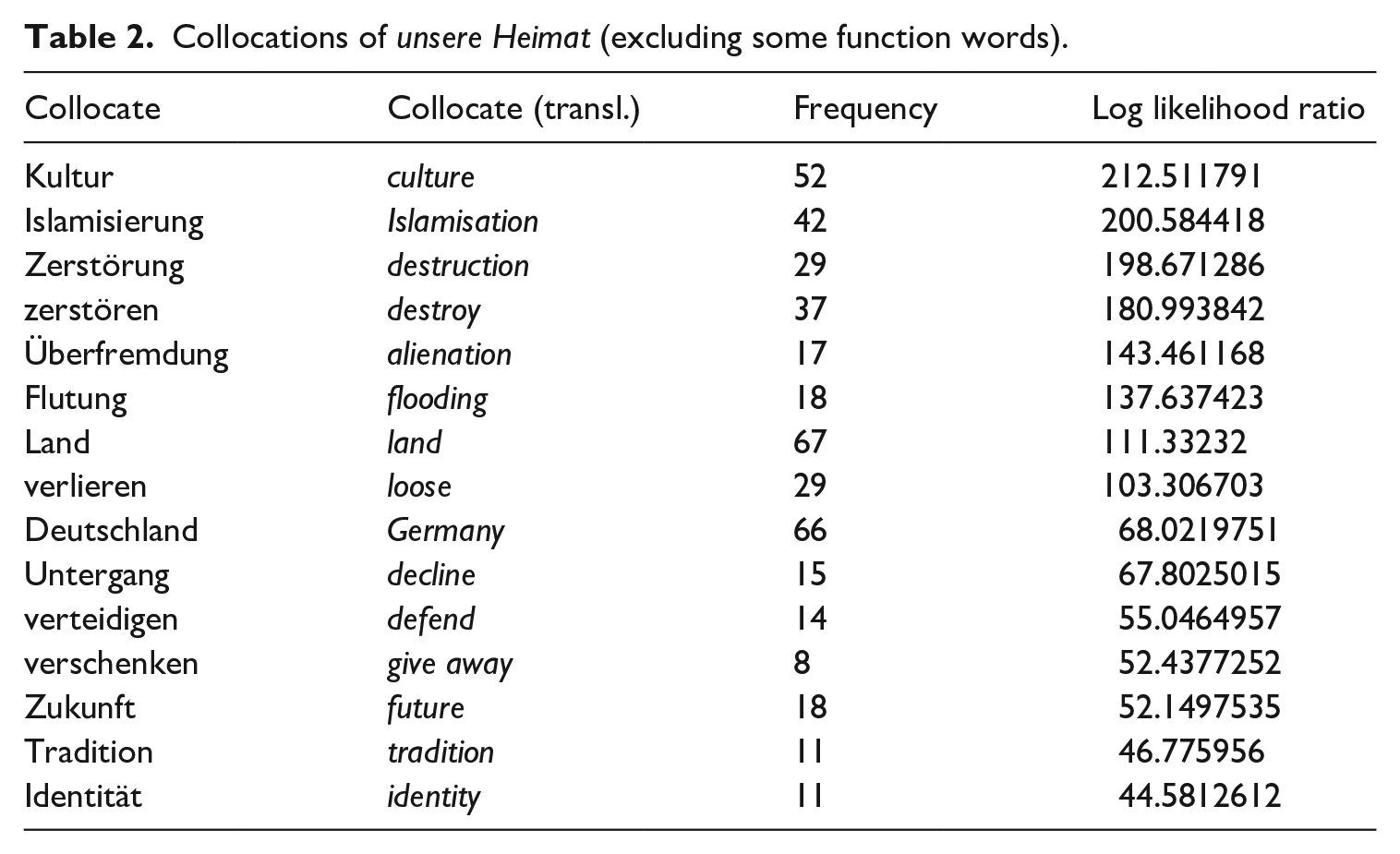
(3) Schluß mit der Einwanderung, ansonsten werden wir Deutsche unsere Heimat an solche aggressiven Immigranten verlieren.
Stop immigration, otherwise we Germans will lose our Heimat to such aggressive immigrants.
Similar to the other examples quoted above, the migrants are judged as being generally aggressive and the loss of Heimat is an immediate effect of this aggression.
On the contrary, the collocations of ihre Heimat, which mostly refers to migrants, point in another direction. From the commentators’ perspective, Heimat is a reference for migrants, too, but they leave no doubt that the migrants’ Heimat is and will always be at another place where they should return or be deported to. The following excerpt even shows that in contrast to the own Heimat, the migrants’ Heimat is associated with ‘unculture’ which appears as a natural and inescapable disposition to terrorism:
Collocations of ihre Heimat (excluding some function words).
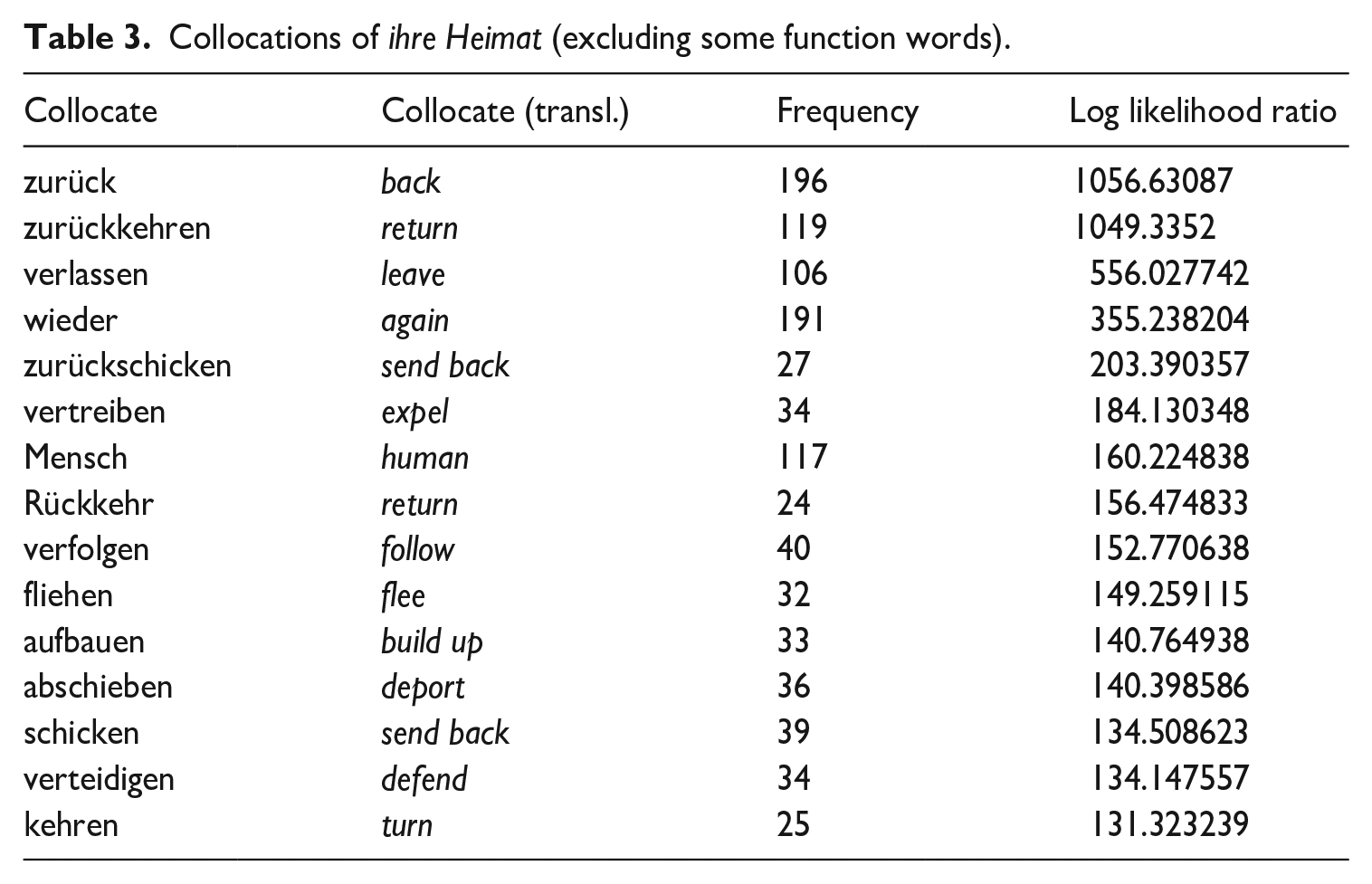
(4) Schickt diese armen Menschen wieder in ihre Heimat, wo sie in ihrer Unkultur verhaftet ihren Terrorkrieg weiterführen können
Send these poor people back to their Heimat, where they can continue their war of terror, entrenched in their unculture.
Note also the striking double voicing in speaking of ‘these poor people’, an ironic expression of pity that seems all the more degrading when combined with the attribution of ‘unculture’.
To return to the word embeddings cluster containing the word Heimat, a noticeable graphemic variation of Heimat, that is, Heymat, should be mentioned. Since the character <y> is not part of the German morpho-graphemic system apart from loanwords, it may be interpreted as foreign. The corpus evidence clearly shows that Heymat is a code word for the foreign Heimat, especially of Muslims. Heymat is considered as the place where Muslims should return. Moreover, Heymat can refer to a dystopian variant of one’s own Heimat as the result of alienation (Überfremdung). In the following example, which refers to this dystopian Germany as the neue Heymat (‘new Heymat’), it is even complemented by the parallel graphemic variation die neuen Deytschen (‘the new Germans’) – the graphemic variation thus proves to be a subtle but effective linguistic strategy of Othering. (5) [Name]
6
die an der Hybrid-Identität Deutschlands arbeitet und langfristig die neuen Deytschen hier haben will, und eine neue Heymat. [Name] who is working on Germany’s hybrid identity and wants to have the new Deytsche here in the long term, and a new Heymat.
In this world view, the own Heimat has to be kept clean against foreign influences, and the mere presence of people from other cultures is perceived as a threat. In the following example, which insinuates the mentioned conspiracy theory of the exchange of population by the phrase neue Gesellschaft (‘new society’), the commentator claims that Germans shall lose their identity and roots, and our Heimat will be charged with the migrants’ culture and identity. (6) Die Deutschen Europäer sollen in der neuen Gesellschaft bei 0 beginnen, ohne Identität und Wurzeln, während die neuen BRD-Bürger unsere Heimat mit ihrer "Kultur", "Religion" und Identität aufladen. [. . .] Europa ist nicht Lampedusa. Europa ist unsere Kultur!
The German Europeans are supposed to start from scratch in the new society, without identity and roots, while the new FRG citizens charge our Heimat with their "culture", "religion" and identity. [. . .] Europe is not Lampedusa. Europe is our culture!
The scare quotes around the terms Kultur and Religion show that the commentator does not respect them as equal to their own culture and religion. The clear opposition between our Heimat and their ‘culture’ shows in a most condensed manner the both derogatory and exclusionary implications of this concept of Heimat.
With Identität and Kultur, two other key concepts of right-wing discourse are found in this excerpt, which can fill the gap when racism does without the concept of race (Bruns et al., 2017: 88). The nearest neighbours of Identität in the word embeddings model give an impression: Staatsangehörigkeit, Herkunft, Nationalität, Ethnie, Eigenständigkeit, Kultur, Idendität, Volkstum, Staatsvolk, Abstammung, Identiät, Souveränität, Wurzel, Eigenheit, Staatsbürgerschaft, Wert, Pass, Eigenart, Nationalstaat, Rasse, Volkszugehörigkeit, Ausweispapier, Besonderheit, Staatsgebiet, Ausweis, Personalpapier, Legitimität, Integrität, Identifikation, Homogenität
nationality, origin, ethnicity, autonomy, culture, people, nation, descent, sovereignty, root, peculiarity, citizenship, value, passport, peculiarity, nation-state, race, ethnicity, national territory, identity card, identity document, legitimacy, integrity, identification, homogeneity
Like Kultur and Heimat, Identität is also framed as a matter of fate, as a homogeneous and stable entity that has to be kept free from foreign influences and is going to be destroyed by immigration. In the following example, Identität is part of a coordinating possessive construction together with the national socialist marked term Lebensraum (‘habitat’), both of which have to be defended: (7) Käme auch nur jeder fünfte oder zehnte junge Afrikaner zu uns, würde unsere angestammte Bevölkerung ethnologisch in einer Generation nicht mehr wahrnehmbar sein. Wir haben das Recht, unseren Lebensraum und unsere Identität zu verteidigen und zu bewahren.
If even one in five or ten young Africans were to come to us, our ancestral population would become ethnologically imperceptible in a generation. We have the right to defend and preserve our habitat and our identity.
However, this only holds true for the phrase our identity. While their identity is frequent, too, it mostly refers to personal identity which asylum seekers are accused to disguise or that has to be determined by the police. For this reason, words like passport or identity card are listed as nearest neighbours of Identität. (8) In Wahrheit dürften es inklusive abgetauchter Ausländer mittlerweile 1-2 Millionen Ausländer sein die illegal in Deutschland eingedrungen sind, ihre Identität verschleiern und daher hier nichts zu suchen haben.
In reality, including foreigners who have absconded, there are probably 1-2 million foreigners who have entered Germany illegally, conceal their identity and therefore have no business being here.
This detail shows once again how the confession to a plurality of cultural identities, which is also at the heart of the ideology of ethnopluralism, is inverted into unequal treatment and discrimination.
Conclusion
In this paper, I have discussed forms of racist discourse in the comment sections of a far-right blog. Using corpus linguistic, data-driven methods, I have explored the semantic space representing the far-right discourse universe where racist discourse is ubiquitous. Besides the overt forms of devaluation and derogation by, for example, ethnic slurs, there are also more implicit ones. These forms can be described as results of conversion processes in the sense of Hoffmann (2020). Supposed racial features are replaced by cultural or religious features which, however, are still conceived as essential and natural features of ethnic groups. I have argued for viewing this process as a discursive one, reflected among other things in the discourse-specific meanings as they can be examined by means of a word embeddings model. Based on a clustering of such a model, I explored nominational and predicational strategies and stylistic means related to racist discourse. As a case in point, I have discussed the concept of Heimat which is framed as a fateful place that has to be preserved against foreign influences and thus allows to draw racist demarcations without relying on overtly racialising terms. These forms of cultural racism (Balibar, 2008) build a solid bridge through which the inhuman ideology of racism can enter mainstream political discourse, for example, by right-wing populist and even extreme right parties echoing the far-right discourse without coming cross as extreme (Meier-Vieracker, 2022).
However, compared to the self-representations of leading right-wing extremist actors who profess ethnopluralism, such as Martin Sellner, the underlying pejorative and exclusionary implications cannot be hidden in the comment sections analysed here. The alleged equality of cultures can’t disguise the underlying ‘ideology of inequality that considers some social groups as unequal in value’ (Zick et al., 2008: 364). A look at the comments as potent echo chambers is therefore particularly important for debunking ethnopluralism, the invocation of cultural identity and the like as racism and verbal violence. Still, the data-driven approach, which allows to deal with large amounts of data and to explore it inductively, also draws attention to more implicit and more subtle linguistic strategies of devaluation beyond racial slurs like, for example, graphemic variation as a strategy of Othering. Their violent and exclusionary implications only become apparent at a second glance, so that a more qualitative analysis is indispensable, which in the context of this paper I have only been able to provide in a rudimentary way. But I have shown how a data-driven approach can focus attention to a broad range of linguistic features worth investigating and place them in their discursive contexts shaping their sometimes more, sometimes less overt racist implications.
Footnotes
Declaration of conflicting interests
The author declared no potential conflicts of interest with respect to the research, authorship, and/or publication of this article.
Funding
The author received no financial support for the research, authorship, and/or publication of this article.
