




Abstract
Although there is widespread agreement in the literature that the media play an instrumental role in furthering or limiting the spread of right-wing populism, there are few studies that examine the micro-mechanisms at play that facilitate the normalisation of the far right in and by the media. This contribution seeks to redress that gap. Focussing in particular on the Netherlands, we trace the ways in which the media have accommodated populist radical right politicians and their parties in the run-up to the 2021 Dutch general elections, thereby discursively shifting the boundaries of what is considered appropriate or ‘normal’. We do so by concentrating on the far-right political newcomer, Thierry Baudet, who is the leader of the Forum voor Democratie (Forum for Democracy or FvD, also referred to as Forum). Using discourse-conceptual analysis of Dutch newspaper articles, the article provides illustrative evidence that Dutch mainstream media outlets adopted an accommodative stance towards Baudet and his party in the run-up to the elections. The findings suggest that this media strategy contributed to the normalisation of the far right in the Dutch public sphere.
Keywords
Introduction
There is a broad consensus in the scholarly literature that the media play an important role in the rise and spread of populism (Ekström et al., 2020; Mazzoleni, 2008; Patrona, 2020). Over the past decades, changes in our media landscapes have facilitated the mediatisation of politics (i.e. the increasing influence of the media on political actors, institutions and processes), which, in turn, has contributed to the electoral advance of (right-wing) populist parties (Kübler and Kriesi, 2017). The relationship between the media and the populist radical right is symbiotic (Ellinas, 2010): commercial pressures incentivise the media to feature flamboyant political actors with lively personalities, while populist politicians depend on the media to spread their message in order to rally support. This dynamic has contributed to the mainstreaming of the far right (Mudde, 2019). Indeed, persistent media coverage can highlight their political significance, thereby pushing far-right ideas and discourses from the margins into ‘the mainstream’ (Ellinas, 2010: 33). 1 This can help remove the ‘stigma of extremism’ that far-right actors tend to carry, notably by granting them authority as legitimate political players (Ellinas, 2018: 273). By doing so, the media contribute to the normalisation of the far right (see Mondon and Winter, 2020; Wodak, 2020).
While the term ‘normalisation’ is widely used, the exact process remains elusive. In general, it refers to the various ways in which certain ideas, expressions and behaviours that were once ruled out as illegitimate have become salonfähig or socially acceptable by the general public (Ekström et al., 2020). More specifically, it is a non-linear process (Brown et al., 2021) that involves ‘the introduction of new norms and the (gradual) eradication of old ones, through the legitimisation of a new normative order, down to acceptance of what was once deemed “unacceptable” or “deviant” as acceptable patterns and ways of doing and thinking’ (Krzyżanowski, 2020a: 510). While the slow evolution of ‘mainstream’ norms, values and beliefs over time can happen organically, the rapid normalisation of far-right ideas and discourses over the past years is not a ‘natural’ process (Miller-Idriss, 2020); elites (notably mainstream politicians) as well as the media play a central role in shifting the boundaries of normality (de Jonge, 2021). This process is crucial to the growth of far-right movements because it helps them recruit followers and mobilise support whilst minimising the likelihood that the public will sound the alarm bells (Miller-Idriss, 2020: 46).
There is a burgeoning literature on the role of mainstream parties in the electoral advances of right-wing populist movements (e.g. Heinze, 2018; Minkenberg, 2001). By contrast, empirical research on the role of the media and the ensuing normalisation of far right discourses and ideologies remains relatively scant. Indeed, there are few studies that examine the micro-mechanisms at play that facilitate the normalisation of the far right in and by the media. This contribution seeks to redress that gap. Focussing in particular on the Netherlands, we trace the ways in which the media have accommodated populist radical right politicians and their parties in the run-up to the 2021 Dutch general elections, thereby discursively shifting the boundaries of what is considered appropriate or ‘normal’ (see Krzyżanowski, 2020b). We do so by concentrating on the far-right political newcomer, Thierry Baudet, who is the leader of the Forum voor Democratie (Forum for Democracy or FvD, also referred to as Forum). We show that in the run-up to the elections, mainstream media outlets adopted an accommodative stance towards Baudet and his party. Our main argument is that this media strategy contributed to the normalisation of the far right in the Dutch public sphere.
The article proceeds as follows: The next section introduces the theoretical framework that underpins this article by theorising the ways in which media practitioners can respond to the populist radical right. The third section presents relevant background information for our case study. The fourth section introduces the research design and methodology. The fifth section presents the findings. The conclusion reflects on the broader implications of these findings and discusses potential lessons for media practitioners.
Theoretical framework
Just like mainstream parties, media practitioners are faced with a fundamental choice when dealing with right-wing populist contenders: they can either disengage or engage (see Downs, 2001). Disengagement involves systematically excluding right-wing populist challengers from the media sphere, whereas engagement refers to various ways of including them. From a purely theoretical perspective, three media strategies can be discerned, ranging from (1) demarcation to (2) confrontation and (3) accommodation (de Jonge, 2019). The first one is a disengagement strategy, while the latter two fall under the realm of engagement strategies (see Figure 1).
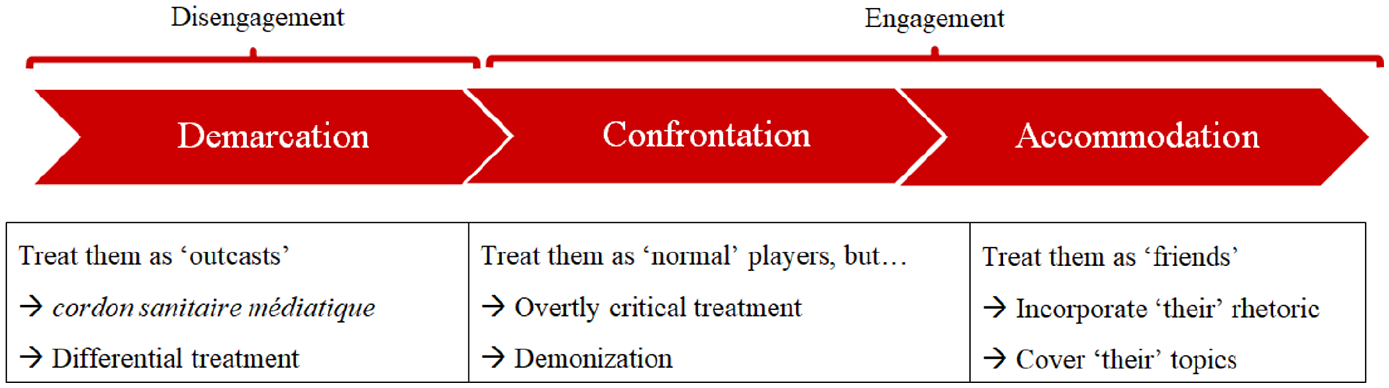
Theorising media responses to the populist radical right.
First, media practitioners can opt to isolate the populist radical right through what Minkenberg (2001) has referred to as ‘demarcation’ (or Abgrenzung in German). For instance, media practitioners may opt to deny access to politicians who are associated with the populist radical right by treating them as pariahs, or by means of a cordon sanitaire médiatique. In the medical world, a cordon sanitaire is a barrier or a guarded line that is set up to stop the spread of infectious diseases. In the media sphere, it is a measure designed to block the populist radical right from gaining direct (i.e. unmediated) access to media platforms. It is crucial to note that the aim of the cordon sanitaire is not to ignore right-wing populist parties (and the issues they bring up), but to isolate them by categorically keeping them offside (Damen, 2001). In brief, demarcation implies ‘differential treatment’ of right-wing populist parties. The demarcation strategy can effectively be likened to Fairclough’s naturalisation hypothesis, whereby discarding or silencing non-dominant discourses allows the gradual naturalisation of dominant discursive positions (Krzyżanowski, 2020b). In other words, by disavowing racist and xenophobic rhetoric from the pages of a newspaper, far-right rhetoric is not normalised as a part of an official or legitimate discourse.
Second, media practitioners might choose to engage with right-wing populist parties by assuming a confrontational stance. This strategy bears resemblance to the demarcation approach described above; however, it is different in that right-wing populist challengers are not treated as pariahs. Instead, they are considered ‘normal’ political contenders. In other words, they are not categorically excluded from participating in the media sphere. Confrontation comes under different guises. For instance, media practitioners might assume an overtly critical or adversarial stance towards the populist radical right, for instance by demonising or stigmatising them, or by openly distancing themselves from far-right actors. Similarly, journalists might seek to ‘expose’ them by showing their ‘true face’ (ontmaskeren in Dutch), or they can delegitimise these parties (and their policies) through unfavourable news coverage. This approach is more in line with the Foucaldian view of normalisation, where stigmatising or over-emphasising social actors can also eventually lead to normalisation (Krzyżanowski, 2020b). Incidentally, the confrontational stance often implies a difficult balancing act for journalists. While journalists might intend to ‘unmask’ far-right actors by directly quoting them (thereby exposing their radical ideas), this practice can actually result in amplifying hate speech (thereby inadvertently accommodating them by reinforcing existing prejudices) (see Banda and Mawadza, 2015).
Third, media practitioners can engage with the populist radical right by accommodating them. In essence, this strategy involves offering a platform to right-wing populist politicians, thereby allowing them to spread their views. This may be done by granting direct and unmediated media access, for instance by inviting them to a live television programme or asking them to write an op-ed. Media practitioners may also legitimise these parties (and their policies) through favourable news coverage. In practice, however, accommodation is often much more subtle; for example, media practitioners might echo the style of right-wing populist politicians; incorporate their ideas into their news coverage; feature long, direct quotations that amplify their radical (and often discriminatory) ideas; post direct hyperlinks into news articles, thereby leading readers to far-right online channels; or pay excessive attention to the alleged ‘silent majority’ by featuring ‘vox pops’ with far-right views (see Beckers, 2019). In a similar vein, media practitioners can accommodate the far right by focussing extensively on issues that are ‘owned’ by these parties, notably issues pertaining to nationalism, immigration and crime-related topics (see Boomgaarden and Vliegenthart, 2007). Crucially, accommodation can also occur when journalists blindly adhere to the ‘objectivity paradigm’, which is implies embracing longstanding journalistic norms, including detachment, nonpartisanship and balance, under which reporters refrain from revealing their personal point of view, provide informed assertions based on knowledge and experience, or cast doubt on depicted viewpoints without appealing to a contravening source (Parks, 2019: 1165). The accommodation strategy is broadly in-line with Wodak’s interpretation of normalisation, where populist radical right actors are allowed to gradually push the boundaries of what is deemed acceptable by employing discursive strategies such as scapegoating and fearmongering (Krzyżanowski, 2020b).
Having theorised the various ways in which journalists might approach the far-right actors, the following section introduces the case study and describes how the Dutch media have dealt with the populist radical right in general and with the FvD in particular.
The Netherlands as a case study
Once known for its progressivism and social tolerance, the Netherlands long seemed ‘immune’ to the rise of the far right (Oudenampsen, 2020). However, since the turn of the 21st century, the country has witnessed the rise of several influential right-wing populist parties, including the Lijst Pim Fortuyn (List Pim Fortuyn or LPF), Geert Wilders’s Partij voor de Vrijheid (Freedom Party or PVV) and, more recently, the FvD, led by Thierry Baudet.
Founded as a Eurosceptic think tank in 2015, the FvD first entered parliament in 2017 after winning 1.8% of the vote in the general elections, thereby claiming two of the 150 seats in the Dutch Parliament. In 2019, the FvD became the largest party in the Senate after winning nearly 15% of the vote in the regional elections. In the run-up to the 2021 general elections, the FvD launched a Trump-like campaign by touring through Dutch towns in a ‘freedom caravan’, with which it claimed to set the Netherlands free from what it perceived to be oppressive measures to combat the COVID-19 pandemic. By doing so, the party managed to mobilise anti-lockdown supporters from across the political spectrum (NOS, 2021). The FvD eventually won 5% of the vote and became the largest ‘net winner’ by quadrupling its parliamentary seats from 2 to 8. However, in May 2021, just 8 weeks after the elections, three FvD representatives split off to form a new party, which reduced the FvD’s number of seats from 8 to 5.
Despite the internal turmoil, it seems fair to state that the electoral rise of the FvD initiated a new phase in the history of right-wing populism in the Netherlands, characterised by the normalisation of the far right. In ideological terms, Baudet is more radical than any of his predecessors (including Pim Fortuyn and Geert Wilders) in the sense that he has openly flirted with right-wing extremist and racist ideas. In 2015, for instance, Baudet expressed his wish for a ‘predominantly white Europe’ (Oudenampsen, 2020: 208), and in 2017, he warned about the alleged ‘homoeopathic dilution of the Dutch population’ with people from other cultures, thereby popularising the extreme-right Great Replacement conspiracy theory (Couperus and Tortola, 2019: 113).
The media played an important role in the rise of the Dutch far right (de Jonge, 2021; Koopmans and Muis, 2009). In the 1980s and 1990s, Dutch journalists (alongside mainstream politicians and civil society organisations) adhered to strict demarcation by showing zero ‘tolerance for the intolerant’. Over the past two decades, however, the positioning of Dutch media practitioners vis-à-vis the populist radical right shifted from demarcation to confrontation and accommodation (de Jonge, 2019). In particular after the sudden electoral rise of Pim Fortuyn in the early 2000s, the Dutch media sought to (over)compensate for the alleged past lack of attention given to the concerns of ‘common people’ by giving disproportionate attention to the populist radical right. This trend was reinforced by the Brexit vote and, above all, the election of Donald Trump in 2016, after which media practitioners concluded that they were to remain ‘neutral’ commentators, and that their role consisted primarily of collecting facts and passing them on to society (de Jonge, 2021). In other words, the ‘objectivity paradigm’ became dominant.
This positioning can help explain how the Dutch media have dealt with the FvD. From its inception, the party maintained a strong media presence. This was mainly thanks to Baudet, who regularly drew attention through scandalous social media posts or controversial comments (see van Raalte et al., 2021). Despite (or perhaps because of) the radical and, at times, extremist messages broadcast by the party leader, the FvD benefitted from considerable media attention (Aalberts, 2020: 64). For instance, Sanders et al. (2021) found that in the run-up to the 2021 elections (1 February until 16 March 2021), Baudet appeared 65 times on television programmes. While this is admittedly less than Prime Minister (PM) Mark Rutte, who recorded 214 on-screen appearances, it is considerably more than Labour Party (PvdA) leader Lilianne Ploumen (55), or the Party for the Animals (PvdD) leader Esther Ouwehand (35). This is noteworthy because at the time, the PvdA and the PvdD held more seats in parliament (9 and 5 respectively) than the FvD (2), which suggests that Baudet received disproportionate media attention.
More importantly, during his television appearances, Baudet was often given a free platform to disseminate his far-right views and spread misinformation about the coronavirus. The most obvious incident occurred on 10 January 2021, when Baudet was invited to Op1, a popular late-night talk show, where he falsely stated (among other things) that more than 98% of the people infected with the coronavirus barely experience symptoms. Following public criticism for the lack of pushback from the talk-show host, the editor-in-chief responded by explaining that this was actually strategy: ‘Baudet is very good at positing. That is why it was decided not to increase the resistance from the hosts, but to ensure a balanced table’ (Huisjes, 2021). Thus, in line with the objectivity paradigm, the public broadcaster was primarily concerned with being ‘balanced’, to a point where it facilitated fake news being spread on prime-time television. We argue that this accommodative stance has facilitated the normalisation of the far right. How does this dynamic manifest itself in the print media?
Research design and methodology
In order to test the normalisation hypothesis, we conducted a discourse-conceptual analysis (Krzyżanowski, 2019) of newspaper articles from five major Dutch newspapers: Algemeen Dagblad (AD) (n = 143), Trouw (n = 31), NRC (n = 151), De Telegraaf (n = 58) and de Volkskrant (n = 112). The articles were gathered in July 2021. We restricted the data collection period to the active phase of electoral campaigning (1 January 2021–17 March 2021). Using the NexisUni database, we created a text corpus based on search terms ‘FvD’ and ‘Baudet’. This yielded a database of 495 newspaper articles, which we edited manually to exclude any reprints and duplications. We included both op-eds and newspaper editorials. The articles were combined into a text corpus of 364,365 total words and 21,301 unique word forms. The corpus was then processed through Voyant Tools software, which enabled us to create word clouds based on word frequencies. We modified visualisation by filtering out so-called ‘stop words’ (e.g. numbers as well as different modal verbs, prepositions, pronouns, etc).
The most frequent words (see Figure 2) that occurred in the corpus were the following: baudet (1882); partij [party] (1143); fvd (967); we [we] (902); mensen [people] (805); forum (743); zegt [says] (734); rutte (716); vvd (674); thierry (619); media (604); tweede [second] (580); jaar [year] (571); wilders (570); pvv (558); wil [want(s) to] (538); cda (521); democratie [democracy] (507); partijen [parties] (504); kamer [chamber] (488). Given the size of our corpus, we decided to concentrate on three word clusters or ‘nodes’ that achieved the highest frequency in the corpus. These nodes form semantic fields accumulated discursively around Baudet and his party, thereby providing insights into the rhetoric associated with the FvD. The software identified the following semantic fields: (1) Baudet, which was linked to FvD, forum, ‘leider’ (leader) and Wilders; (2) ‘mensen’ (people), which was linked to FvD, ‘partij’ (party), Baudet and ‘we’ (we); and (3) Rutte, which was linked to VVD (i.e. Rutte’s party), ‘premier’ (PM), Baudet and Wilders. It is important to note, however, that the connection between Baudet and other search terms should not be overemphasised, since the former was one of the key search terms for compiling our corpus. After compiling our corpus, we engaged in close reading of the articles surrounding these three nodes and sought to discern whether there was any evidence of demarcation, confrontation or accommodation. Any references to direct or indirect quotations originally in Dutch were translated into English by the authors.
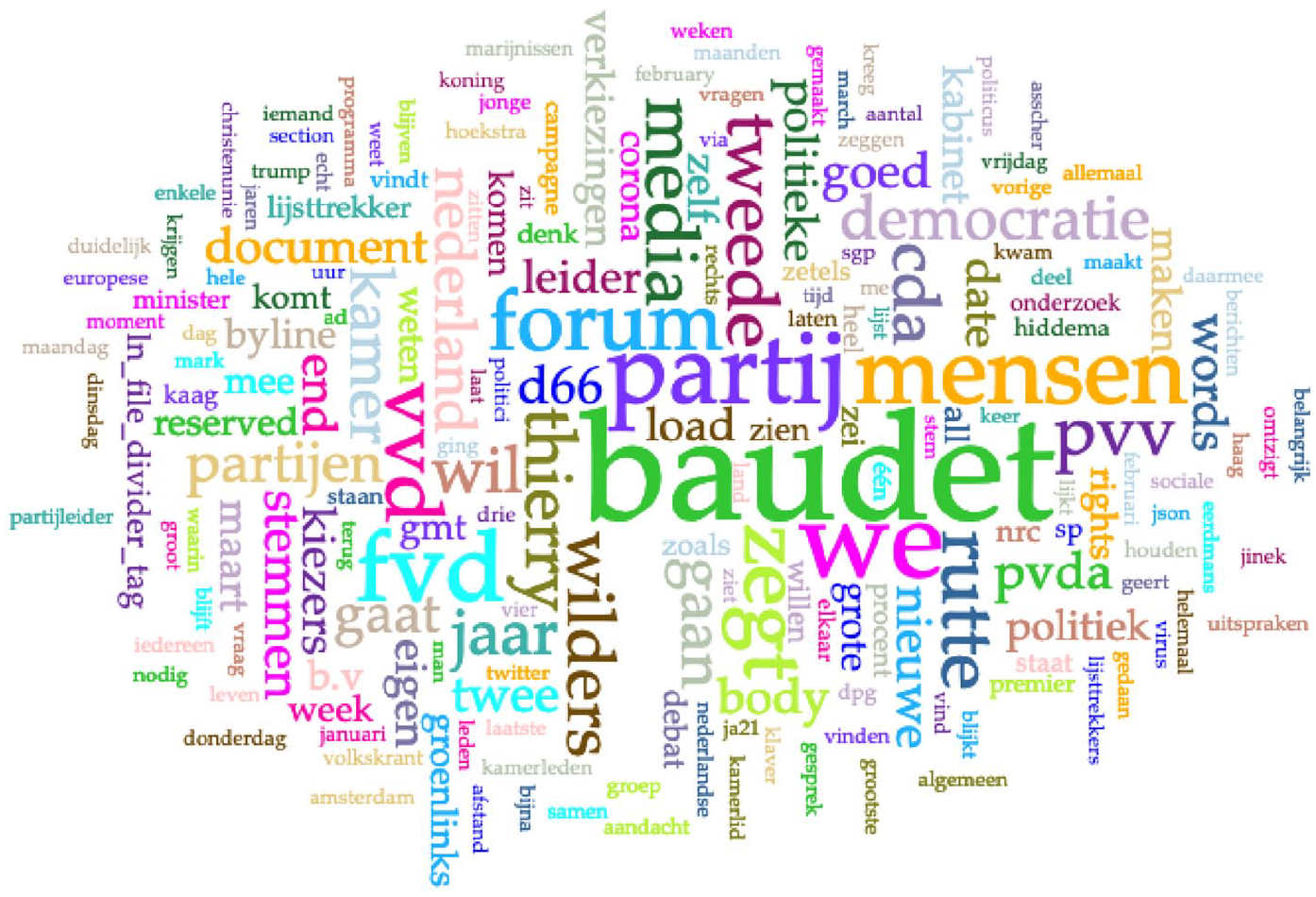
Word cloud of most frequently used words in the media corpus.
Analysis
Baudet cluster
From Figure 3, it is visible that Baudet was often mentioned in relation to Geert Wilders, who has been a longtime fixture in Dutch politics. It seems plausible that Wilders provided the FvD with some legitimacy; indeed, both the LPF and the PVV helped pave the way for the rise of the FvD (de Jonge, 2021).
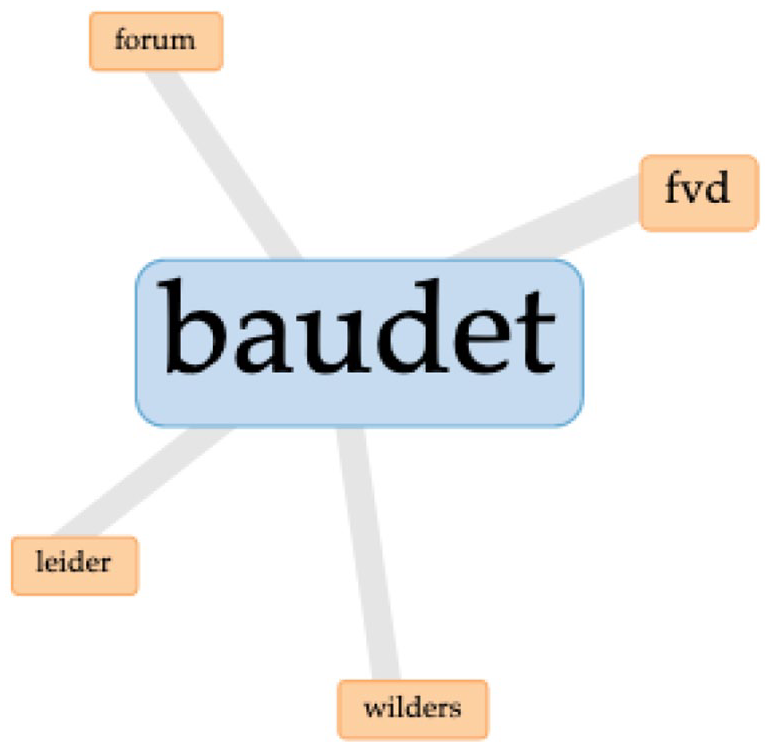
Baudet cluster.
A close-reading of the Baudet cluster revealed that Baudet was also repeatedly associated with and compared to Donald Trump. One of the reasons is the ideological proximity between Baudet and Trump. In particular after the storming of the US Capitol in January 2021, we found some evidence of newspapers adopting a more confrontational stance. For instance, just before the Dutch elections, the Volkskrant analysed the online behaviour of Dutch far-right Twitter users, and noticed that their bios often contain terms such as ‘Trump’, ‘PVV’ and ‘FvD’. The newspaper pointed out that these users had a strong tendency to spread ‘demonstrable nonsense and conspiracy theories’ (Volkskrant 6 March 2021). Similarly, in an op-ed published in January, parallels were drawn between the storming of the Capitol and the policies and potential of the FvD (Volkskrant 14 January 2021).
A major, recurring theme in our corpus was the COVID-19 pandemic. The Telegraaf occasionally characterised Baudet’s rhetoric as harmful and dangerous, while also drawing discursive connections to Trump (De Telegraaf 29 January 2021). By contrast, the AD often left some of Baudet’s outlandish, conspiratorial and false statements on the pandemic stand uncritically and without any rectification (AD 9 March 2021). For instance, the newspaper chose to directly cite Baudet’s comments on Twitter’s decision to block Donald Trump from the platform:
The removal of President Trump’s Twitter account has not gone unnoticed [. . .]. Even outside the US, self-proclaimed ‘promoters of free speech’ are already seeing the social media storm. Such as the FvD-leader Thierry Baudet, who announced via Twitter to ‘anticipate other ways to communicate’, so that his messages can be received ‘unfiltered’ via Telegram (AD 9 January, 2021).
This type of coverage obscures Twitter’s motivation behind the block and presents Baudet’s point of view as ‘the other side’ of the story without offering any pushback. Specifically, the newspaper did not point out the obvious motivation behind Baudet’s desire to be ‘unfiltered’, which was due to the conspiratorial and racist nature of his rhetoric. By doing so, the AD engaged in ‘bothsideism’, which is emblematic of the ‘objectivity paradigm’, thereby accommodating the populist radical right.
Similarly, when anti-lockdown demonstrations turned violent in January 2021, the Telegraaf directly quoted Baudet’s tweet that criticism of the curfew is not a call for violence, simply noting that Baudet and other far-right politicians were taking a page out of Trump’s book (De Telegraaf 25 January 2021). By doing so, they failed to point out what kind of implications Baudet’s position might carry for democratic institutions. In a similar vein, the NRC reported on the FvD’s infighting and subsequent split with JA21 as a regular incident, without mentioning the far-right positions that both parties stand for (NRC 19 January 2021).
The Volkskrant also downplayed the far-right threat on various occasions. For instance, in an article describing the clothing style of Dutch (and American) politicians, Baudet was described as wanting to expose his ‘inner trucker’, thereby treating him as a any other politician with ‘normal’ opinions: ‘Where Lilian Marijnissen appears increasingly polished, Thierry Baudet frees his inner trucker by travelling with a party baseball hat and an FvD-puffer jacket in his “freedom caravan” to small people in Purmer-Noord and Sittard’ (Volkskrant 8 March 2021). Further evidence of the Volkskrant’s accommodating stance can be found in innocently describing Baudet’s behaviour as ‘silly antics’ (malle fratsen) (Volkskrant 4 January 2021).
A final point worth mentioning is that although Baudet was often accompanied in the corpus by his far-right nemesis, Geert Wilders, there was a notable split between the two after the US Capitol attack, when Wilders called on Trump to recognise the results of the elections, while Baudet was (uncritically) quoted to be standing by Trump (De Telegraaf 6 January 2021). By doing so, Baudet managed to push the limits of what is deemed acceptable in the Dutch public sphere further to the right, to a point where Wilders came to be perceived as a ‘moderate’ competitor, thus confirming Vaughan’s (1996) idea of opening ‘normative boundaries’ that would accept more deviance (i.e. Baudet) while solidifying old deviance (i.e. Wilders) as the norm. One example of this can be seen in the way in which the Dutch broadcasting organisation presented the PVV’s election manifesto: ‘The PVV argues in its election program for the return of the traditional Dutch conviviality [oer-hollandse gezelligheid]’ (NOS 9 January 2021). By failing to mention the far-right content of the election manifesto, this type of news coverage contributed to the normalisation of the far right.
Mensen (people) cluster
As expected, the discursive node around the term ‘people’ was related to the Baudet’s populist rhetoric, where he juxtaposed conspiratorial and antisemitic dogwhistles to ‘regular people’ (gewone mensen) (see Figure 4). For instance, in a report by the AD (9 March 2021), Baudet’s conspiracy theories were directly quoted without any pushback or correction. The following passage illustrates this accommodative behaviour:
According to Baudet, people who claim that corona is serious have an interest in this [i.e. his freedom caravan]. ‘It is globalists like Bill Gates, the European Union or the United Nations who want more power. The pharmaceutical industry is also very important. The common people who are afraid are intoxicated by the mass hysteria’.
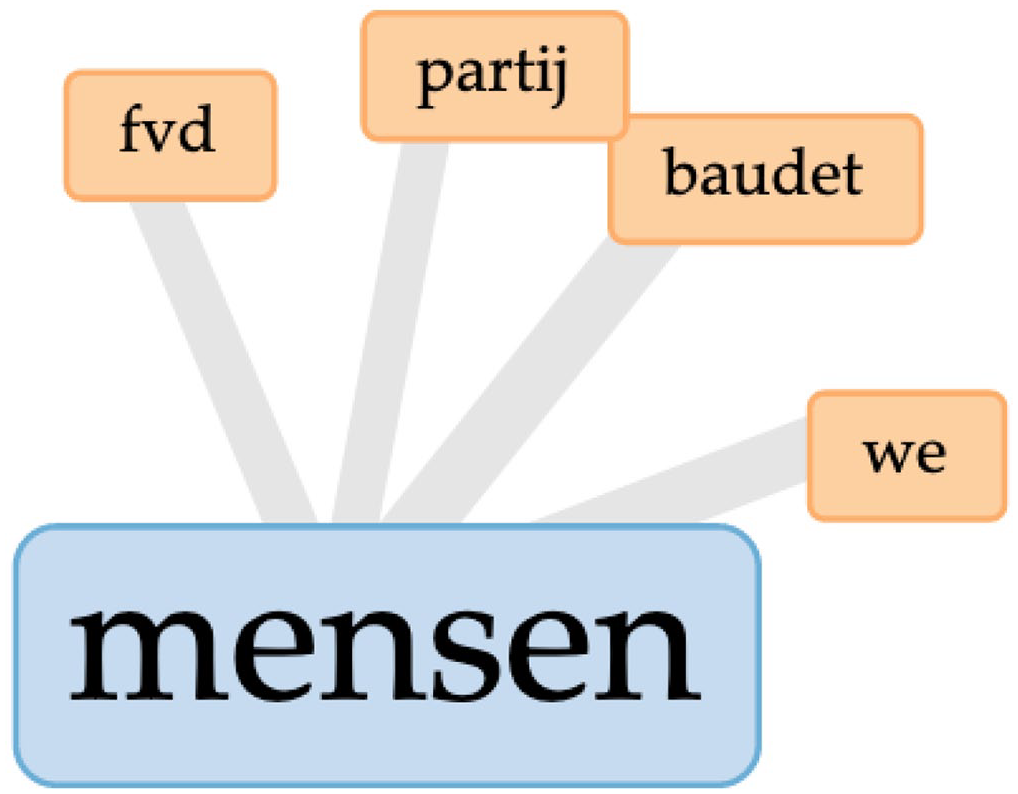
Mensen cluster.
A similar pattern could be observed in De Telegraaf’s reporting of the above-mentioned ‘freedom caravan’. In fact, on the day of the elections, the newspaper published a frontpage story on the FvD’s campaign, including a photograph of Baudet (De Telegraaf 17 March 2021).
Another reason the term ‘people’ was featured prominently in the cluster was related to the scandal around the leaked FvD chat messages that revealed a range of racist and xenophobic exchanges among the FvD members and Baudet specifically. In these messages, FvD members discussed false and racist data on the supposedly higher IQ of white people compared to IQ of the people of colour. Most newspapers chose to directly feature Baudet’s quotes, and some even placed them in the headlines (AD 9 February 2021; AD 11 February 2021; De Telegraaf 9 February 2021; De Telegraaf 11 February 2021; NRC 10 February 2021; Trouw 9 February 2021; Trouw 12 February 2021; Volkskrant 9 February 2021).
It seems reasonable to assume that by directly quoting these passages, journalists supposedly hoped to expose the racist ideology that Forum members have, without ‘translating’ them into a more mainstream type of rhetoric like US journalists did with Trump (see Parks, 2019). At the same time, however, by providing extensive quotes and some of the eugenic justifications without criticising the underlying racism (which actually would have been in line with the objectivity paradigm), the reports ended up disseminating the FvD’s racist rhetoric (AD 6 February 2021).
Finally, ‘people’ also came up in the many discussions around the COVID-19 measures, where Baudet tried to push false information using antisemitic rhetoric. The AD (25 February 2021) juxtaposed the quotes by Baudet with statements from the Dutch Jewish community, but the coverage focussed on ‘regular people’ who did not receive help from the government during the pandemic or were tired of the measures and therefore did not trust the government anymore. At least when it came to Baudet’s misleading COVID-19 statements, most newspapers regularly brought in experts to push back. For instance, the AD (11 January 2021) did not provide any extensive quotes from Baudet downplaying the severity of the virus, but instead chose to quote an epidemiologist.
Rutte cluster
Figure 5 shows a strong link between Rutte and Baudet. While this connection should not be overemphasised (as Mark Rutte was the PM of the Netherlands at the time, and the corpus was built around ‘Baudet’ as a search term), it confirms that the Dutch media did not implement a cordon sanitaire around Baudet and his party and covered him on par with the PM and his party (VVD). Moreover, given that Rutte was leading the government through the pandemic, Baudet was in an opportune position to criticise him and his measures. For instance, the imposed curfew was covered extensively by the media, for which Rutte was opposed by both Baudet and Wilders. De Telegraaf (16 February 2021) proceeded to directly cite their objections. Another connection between Rutte and Baudet was related to the above-mentioned racist chat scandal, which Rutte condemned as ‘disgusting, homophobic and racist’ (De Telegraaf 11 February 2021). The main reason why Rutte was a prominent fixture in the Baudet corpus, however, was due to the election coverage. In most cases, Baudet was mentioned as one of the politicians who were participating in the election campaign and often as the only one to provide an effective counterweight to Rutte’s policies. By portraying the election as a neck-and-neck race between two main rivals, Baudet was portrayed as the sole legitimate oppositional force to Rutte. This effectively amplified his media presence.
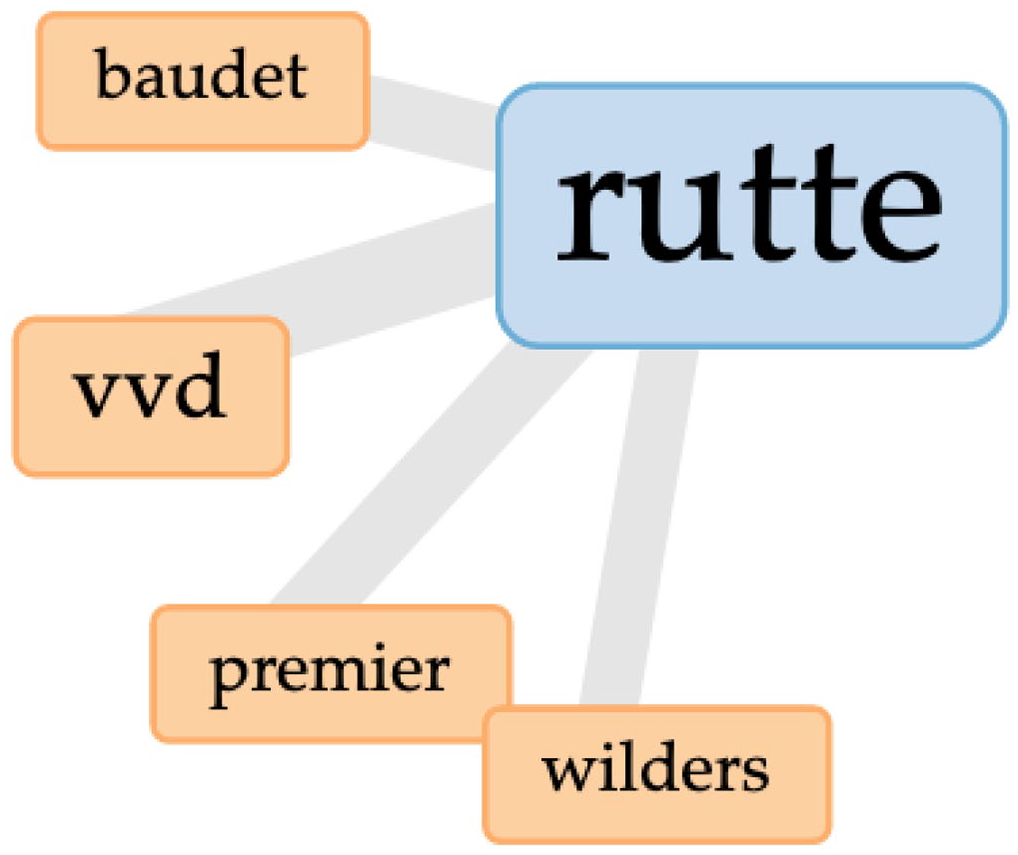
Rutte cluster.
Conclusion
Existing research has demonstrated that the Dutch media have gradually become more accommodative towards right-wing populist parties (de Jonge, 2019). This contribution analysed the ways in which the media have accommodated populist radical right politicians and their parties in the run-up to the 2021 Dutch general elections. The findings illustrate how the media can contribute to discursively shifting the boundaries of what is considered appropriate or ‘normal’ (see also Krzyżanowski, 2020a). Focussing particularly on the print media, we found illustrative evidence that in the run-up to the elections, Dutch media practitioners seemed concerned with being ‘balanced’, thereby embracing the American objectivity paradigm. The societal risks associated with the objectivity paradigm are well-documented in the academic literature. For instance, Cushion and Lewis (2017) analysed the BBC’s coverage of the Brexit referendum and found that when media practitioners engage in bothsideism by giving equal weight to two opposing viewpoints, they run the risk of distorting coverage, notably by failing to scrutinise the veracity or weight of these opposing arguments. In line with these findings, our study suggests that in the campaign leading up to the 2021 general elections, Dutch news outlets covering Thierry Baudet often either published direct quotations of his conspiratorial and racist statements without providing any pushback, or offered his views as the main counterpoint to the ruling coalition’s rhetoric. Given that Baudet (alongside Wilders) was arguably the most vocal critic of Mark Rutte’s government, Baudet’s ideas were commonly featured as having equal weight as the views of mainstream politicians, thereby ultimately playing into the hands of the populist radical right.
Based on the analysis presented above, it is evident that the Dutch media largely pursued a strategy of accommodation. While there were several instances in which the news sources criticised the racist statements that Baudet and his party members made, their critical commentary was often juxtaposed with direct, long quotes from FvD members containing hate speech and white supremacist rhetoric. In some cases, journalists tried to contrast FvD statements by giving a platform to its targets (e.g. representatives of the Jewish community). However, providing equal space to both the FvD and its targets begs the question whether this kind of ‘balance’ is appropriate.
While we found some evidence of confrontation, we found little to no evidence of the demarcation strategy. Interestingly, after the elections, when the FvD crossed various other lines (e.g. by publishing a poster linking WWII to the anti-coronavirus measures or by threatening other MPs with ‘tribunals’), some newspapers proceeded to opt for demarcation. For instance, a prominent NRC commentator discussed the tastelessness of the incident by referring to ‘MP B’. (kamerlid B.), so without mentioning Baudet’s name (Meeus, 2021). Similarly, in November 2021, a talk show host announced that politicians who threaten others (thereby clearly alluding to FvD politicians) were no longer welcome at his table (AD 18 November 2021). While there is no evidence of an official media cordon against Baudet and his party in the Dutch media, these responses suggest that the tide may be turning. However, it is questionable whether it is still possible to counteract or reverse the normalisation of the far right.
Footnotes
Declaration of conflicting interests
The author(s) declared no potential conflicts of interest with respect to the research, authorship, and/or publication of this article.
Funding
The author(s) received no financial support for the research, authorship, and/or publication of this article.