



Abstract
Applying a Multimodal Discourse Analysis framework, this study focuses on university websites to explore how organizational legitimacy is constructed through discursive strategies. Our findings show that under authoritative administrative logic and market logic, universities construct two organizational identities: policy followers and product/service suppliers, and use exemplification and authorization strategies respectively through visual discourse to legitimate the identities. To avoid potential conflicts between the legitimacy claims associated with these two identities, universities apply a decoupling strategy to isolate the two identities, along with both explicit and implicit expressions, through the intertextuality between visual and verbal discourses. The constitutive characteristics of universities’ website discourse reveal the complexity of Chinese institutional context in higher education field and the constitutive influence of the institutional background on organizational discourse and legitimation strategies.
Keywords
Introduction
Over the last three decades, a marketization process in higher education took place across the globe, when New Public Management Movement and globalization have brought about overwhelming changes to all arenas of public sector (Agyemang and Broadbent, 2015; Chandler et al., 2002; Mok, 1997). This process entails an increasing presence and acceptance of neoliberalism ideology in higher education sector, such as the pursue of efficiency and market competition (Wedlin, 2008). Meanwhile, multiple institutional logics are coexisting in higher education field, including administrative, market, and academic logic (Etzkowitz et al., 2000; Greenwood et al., 2011; Mok, 2005). However, as Meyer and Höllerer (2010: 1251) pointed out, ‘Logics may peacefully coexist, compete, supersede each other, blend or hybridize, or reach a temporary ‘truce’.’ For example, market logic emphasizes the commodification of higher education and knowledge, requiring universities to become consumer demand-oriented suppliers of ‘marketable’ products (Molesworth et al., 2009); administrative logic, by contrast, emphasizes on the universities’ utilities and the economic potential of their knowledge production and technological innovation functions, requiring universities to work as government’s affiliates and serve the government policy as their primary goal (Etzkowitz et al., 2000; Wedlin, 2008). Therefore, universities undergoing market-oriented reforms often need to meet multiple, even conflicting, legitimacy requirements simultaneously (Reay and Hinings, 2009), in order to attract the support of resource-provider audiences and acquire the key resources which are necessary for their survival and development (Suchman, 1995). However, ‘the adoption of a policy or practice that sends a favorable message to one audience may simultaneously send an offensive message to another (Heimer, 1999: 18).’ How can universities undergoing marketization reforms construct legitimacy under multiple institutional logics? This question begs for answers.
Although legitimacy has been an important theme in several streams of organization studies (Deephouse et al., 2017), exploration efforts focusing on the legitimation process are still limited, which made the constructing process of legitimacy largely a black box waiting to be opened (Peng and Lu, 2014), and even a major void in our collective understanding of the relationship between organizations and institutions’ (Kraatz and Block, 2008: 246). Therefore, our study aims to adopt a discursive theoretical perspective to investigate the universities’ micro-level discursive strategies in legitimation (Kodeih and Greenwood, 2014).
Based on discourse theory perspective, as ‘a sedimentation of meanings and a crystallization of meanings in objective forms’ (Berger and Kellner, 1981: 31), institutions rely on discourse, which is the ‘social construction of reality’ (Berger and Luckmann, 1967). The construction, maintenance, and reproduction of core institutional structures and processes such as legitimacy (Deephouse et al., 2017) and organizational identity (Glynn, 2017) also rely on discourse (Jones et al., 2017). Therefore, through the analysis of relevant discourse, we can gain insights into how universities construct legitimacy under multiple institutional logics, and understand the constitutive features of discourse in legitimation. For example, Teo and Ren (2019) reveal how Chinese universities use both ‘bureaucratic discourse’ and ‘conversational discourse’ to negotiate the politic and market ideology simultaneously, through the interdiscursive analysis of university president’s message on its website. In addition, although Critical Discourse Analysis (CDA) considers verbal language as the core discourse practice, visual and other modes are also emphasized in legitimation (Fairclough, 2003, 2005; Meyer et al., 2013). In fact, different modes have totally distinct potentials for constructing meaning and social reality (Kress, 2010). Due to its unique affordance features, visual mode has unique advantages in constructing legitimacy that are different from verbal mode (Jones et al., 2017). With the development of the Internet and the rise of digital media, multimodal discourse plays an important role in organization communication (Bell et al., 2013). Therefore, the narrow focus on verbal mode hinders the understanding of how legitimacy is being pursued in today’s world. Aiming to respond to recent calls for multimodal analysis in management and organization studies (Puyou and Quattrone, 2018; Shao and Janssens, 2022), this study includes the visual mode of discourse on universities’ website to explore the multimodal discursive strategies in legitimation.
In summary, our study aims to advance understanding of how universities construct legitimacy under multiple institutional logics by multimodal discursive strategies. This article is structured as follows. First, we review studies on organization discourse and legitimacy. This is followed by an introduction to the empirical material and discourse analysis perspective. Then, the multimodal discursive legitimation strategies used by universities are elaborated in data analysis and findings. The discussion explains the institutional contexts shaping discursive strategies. Finally, theoretical contributions and limitations of the study are provided.
Literature review
Discourse and organization legitimacy
Organizational legitimacy is defined as ‘the perceived appropriateness of an organization to a social system in terms of rules, values, norms, and definitions’ (Bitektine, 2011; Deephouse et al., 2017; Suchman, 1995). Legitimacy is not only the fundamental basis for organization’s survival, but also an important cultural resource for organizations to attract the support of resource-provider audiences and acquire the key resources which are necessary for further development (Lounsbury and Glynn, 2001; Zimmerman and Zeitz, 2002). Early institutional researchers treat legitimacy as a set of constitutive beliefs that originate from an organization’s adherence to social systems of law, tradition, convention and norms, defining how organizations should act (Meyer and Rowan, 1977; Weber, 1978). In contrast, strategic legitimacy researchers depict legitimacy as an operational resource that organizations extract from their cultural environment and that they employ in pursuit of their goals (Deephouse and Suchman, 2008; Suchman, 1995), which depends on the audiences’ subjective perception of whether organizations meet their legitimacy evaluation criteria.
Legitimate organizations can gain recognition and support from resource-provider audiences, thereby obtaining critical resources necessary for their survival and development (Choi and Shepherd, 2005). Therefore, organizations should actively construct legitimacy for their own. In strategic management research, Lounsbury and Glynn’s (2001) seminal work offered an identity-based approach that addresses how organizations use identity and other cultural resources to influence audiences’ legitimacy assessments (Whetten and Mackey, 2002). Organizational identity can be envisaged as the constellation of claims about ‘who we are’ and ‘what we do’ (Navis and Glynn, 2011). Organizations can construct specific identities to declare their belonging to a particular social category, thereby influencing their audience’s legitimacy assessments (Fisher et al., 2016; Kreiner, 2011). Although existing studies have promoted understanding of organizational legitimacy, little attention is paid on the micro-level legitimation process and practice, which directly shapes the audience’s perception of organizational legitimacy (Vaara, 2014; Vaara et al., 2006).
Although traditional organizational analyses have focused on the cognitive and normative bases of legitimacy (Scott, 1995; Suchman, 1995), with the ‘linguistic turn’ in social sciences (Alvesson and Karreman, 2000), a growing number of organizational studies have taken the discursive perspective of legitimacy and legitimation (Deephouse et al., 2017; Phillips and Malhotra, 2017). As a social practice with highly cognitive, discursive, and constructive nature, legitimacy has a natural connection with discourse, which is one of the most important components in social symbol system (Lu and Peng, 2012; Meyer and Rowan, 1977). On one hand, discourse provides audiences with a frame for understanding organizational legitimacy and giving meaning to it; on the other hand, legitimacy is constructed or reconstructed in the production and consumption of discourse (Fiss and Hirsch, 2005; Peng and Lu, 2014). This can be found in previous studies. For example, organizations often use discursive practices such as public statements and advertising to manage impressions in the face of controversy and stigmatization (Durand and Vergne, 2015; van Halderen et al., 2016). As a kind of persuasive language, rhetorical and narrative strategies play a central role in the legitimation of organizational and institutional change (Harmon et al., 2015; Phillips et al., 2004; Suddaby and Greenwood, 2005). Vaara and his colleagues (Vaara and Tienar, 2008; Vaara et al., 2006; Vaara and Tienari, 2011) distinguished and analyzed several different discursive legitimation strategies used in the legitimation of MCNs’ mergers and acquisitions, such as authorization, rationalization, moralization, exemplification, and naturalization. These studies reveal the relationship between discourse, symbols, and power, and deepen the close connection between discourse and organizational legitimacy. However, most of them just focus on the impact of discourse on legitimation, rather than micro-level discourse practices and strategies used to construct legitimacy, which are necessary to understand the ‘complex, ambiguous, and contradictory process of meaning construction’ in organizations. Therefore, how discourse constructs legitimacy cognitively is still a key question that we know little about (Peng and Lu, 2014).
The affordance of visual discourse and visual grammar framework
With the rapid development of the Internet and digital media technology, images have become an indispensable medium for organizational communication (Bell et al., 2013). According to the perspective of social semiotics (Kress and Van Leeuwen, 2006; Meyer et al., 2013), as a symbol resource constructed by social and cultural environment and used to construct meaning, visual mode has a unique potential to give meaning and construct social reality different from other modes. That is, what Gibson (1986) called ‘affordance.’ This potential potentiates the ability of visual mode to establish a specific connection between communicators and audiences, thereby enabling or constraining the latter’s cognition and action (Alcadipani and Islam, 2017). In other words, the meaning conveyed by organizational discourse is regarded as not fixed or determined, but depends on the specific connections constructed by affordance (Gibson, 1986).
The seminal work of Meyer et al. (2018) has greatly contributed to the understanding of the affordance features of the visual mode of organizational discourse. They discussed four main affordances of visual mode, which are different from other modes’ and give unique advantages to visual mode in legitimation. Firstly, immediacy. Before consciously interpreting the content of visuals and making legitimacy assessment, audiences will first perceive the emotional and esthetic appeal of visuals (Jones et al., 2017; Mitchell, 1984). Therefore, the feature of immediacy endows visuals with the potential to attract audience rapidly (Bloch, 1995) and evoke their emotional reactions (Phillips, 2000; Schill, 2012). Secondly, polysemy. Based on the simultaneous signification and holistic nature, visuals can express and convey multiple information (Eco, 1995; Höllerer et al., 2018; Jones et al., 2017), merge divergent or contradictory viewpoints together inconspicuously (Halgin et al., 2018), and package information that could trigger audiences alertness and resistance to meet different legitimacy expectations simultaneously, even creating ‘legitimacy spillovers’ from socially shared values and ideologies to the new and potentially problematic (Benford and Snow, 2000; Haack et al., 2014). Thirdly, implicitness. Visuals enable an ability to allude without providing grounds or logical conjunctions and consequently to influence audiences’ perception of their content and meaning by suggestion (Meyer et al., 2018; Zamparini and Lurati, 2017). That is, this affordance enables visuals to convey and express information that is unable to express by linear logic and verbal mode solely (McQuarrie and Phillips, 2005; Rämö, 2011), making them particularly suitable for use when organizations find it difficult to explicitly express certain legitimacy claims. Fourthly, facticity. Due to the inherent ‘fact-like’ quality (Graves et al., 1996), visuals can easily shape the content they describe into self-evident and taken-for-granted truth (Mitchell, 1984). Existing studies have pointed out that modern society generally holds misconceptions about visuals, tending to regard them as accurate and reliable records of facts and reality (Jancsary et al., 2016). However, in fact, visuals may hide persuasive statements behind their objective and neutral ‘veil’ (Jones et al., 2017; Kress and Van Leeuwen, 2006).
In addition to the affordance of visual mode, the visual grammar framework proposed by Kress and Van Leeuwen (2006) provides an important operational basis for organization visual analysis. The framework analyzes the visual grammar used in images from three dimensions: ideational meaning, interpersonal meaning, and compositional meaning. Firstly, the ideational meaning of images includes two patterns, namely the narrative patterns and the conceptual patterns. The former serves to present ‘unfolding actions and events, processes of change, transitory spatial arrangements’ (p. 59), through vector interactions between image participants (such as eye contact and movements). The latter represents ‘the generalized, stable and timeless essence of participants, and their class, structure and meaning’ (p. 59), through the attributes, categories, and characteristics of image participants. Secondly, the interpersonal meaning of images mainly includes three elements: (1) gaze, which establishes an imaginary interaction between the constructed image participants and the audiences through the line of sight; (2) social distance, which establishes the psychological and social distance between the image participants and the audiences through the length of the lens; (3) point of view, which establishes the status and relationship between the image participants and the audiences through the angle of the lens. Furthermore, the compositional meaning of images is related to two elements: information value and salience. As for the information value, ‘the placement of image elements (participants and syntagms that relate them to each other and to the viewer) endows them with the specific informational values attached to the various ‘zones’ of images’ (p. 177). Salience refers to the attraction of image elements to audiences attention, which is realized by factors such as placement in the foreground or background, relative size, contrasts in color, and so on.
Visual discourse in organization legitimation
Although most research on legitimation acknowledges that organization discourse should include multiple modes (e.g. Suddaby and Greenwood, 2005; Vaara and Monin, 2010), few scholars have gone beyond verbal mode and include visual rhetorics in discursive legitimation (Jones et al., 2017). For example, Höllerer et al. (2013) found that corporations construct legitimacy visually by showcasing the evaluations of prominent stakeholders in their CSR communication, providing evidence for their legitimacy claims. Drori et al. (2016) found that universities in the marketization trend embed their identity narrative of entrepreneurial university into their cultural institutions through university icon, which is the visual self-representations of organization identity. Moreover, they construct legitimacy by demonstrating branding efforts in external communication. Höllerer et al. (2018) found that after the outbreak of the 2008 financial crisis, commercial media such as the Financial Times tried to shape the financial crisis into a routine historical phenomenon through the potential of visual mode to create legitimacy spillovers between new phenomena with familiar and institutionalized meaning system, aiming to reconstruct the legitimacy of financial industry. These studies suggest the significant role of visuals in sustaining legitimation strategies, but research on this topic is still scarce, which leads to a huge gap between ‘this most visually rich era in history’ (Bell and Davison, 2013) and the existing research. Therefore, many organization scholars have called for further research on multimodal discourse (Lefsrud et al., 2020; Puyou and Quattrone, 2018; Santos, 2023; Shao and Janssens, 2022).
The research questions are as follows: (1) How are multimodal discourses articulated in legitimation of universities? (2) How do universities under multiple institutional logics construct legitimacy through multimodal discursive strategies?
Methods
Critical discourse analysis
This article applies CDA to analyze the universities website’s discourse, aiming to explore how universities under multiple institutional logics construct legitimacy through multimodal discursive strategies. As a typical cross-disciplinary discourse-analytic methodology, CDA is proposed and developed by Fairclough (1992, 1993, 1995), which can be defined as a discourse-analytic methodology that examines the role played by language in the construction of power relationships and social reality. Unlike traditional linguistic analysis methods that focus on the internal rules of language, such as morphology, syntax, and grammar, CDA emphasizes the constitutive effect of language in social contexts. That is, how people use discourse, how they shape the social significance of discourse, and how they use the interaction between discourse and other social practices to construct power relationships. Furthermore, CDA does not adopt an objective and neutral stance toward discourse practices, it instead involves a built-in critical stance, aiming to reveal the relationships between discourse, ideology, and power (Fairclough, 2003; Van Dijk, 1998), and to deconstruct the taken-for-granted power relations and domination structures in social, political, and economic fields (Vaara et al., 2006).
From a methodological perspective, Fairclough (1995, 2001) provides a three-dimensional analytic framework which is sensitive to the social/cultural contexts of discourse (see Figure 1). The first dimension is text, which refers to the language features at the micro-level, such as morphology, syntax, and grammar. The second dimension is discursive practices, which concerns the production and interpretation of the text, including intertextuality, interdiscursivity, and the specific strategies for mapping discursive resources. The third dimension is social practice, which refers to the institutional and socio-cultural practice and the institutional contexts behind. The three dimensions are progressive in relation to each other, with the latter serving as the basis for analyzing the former.
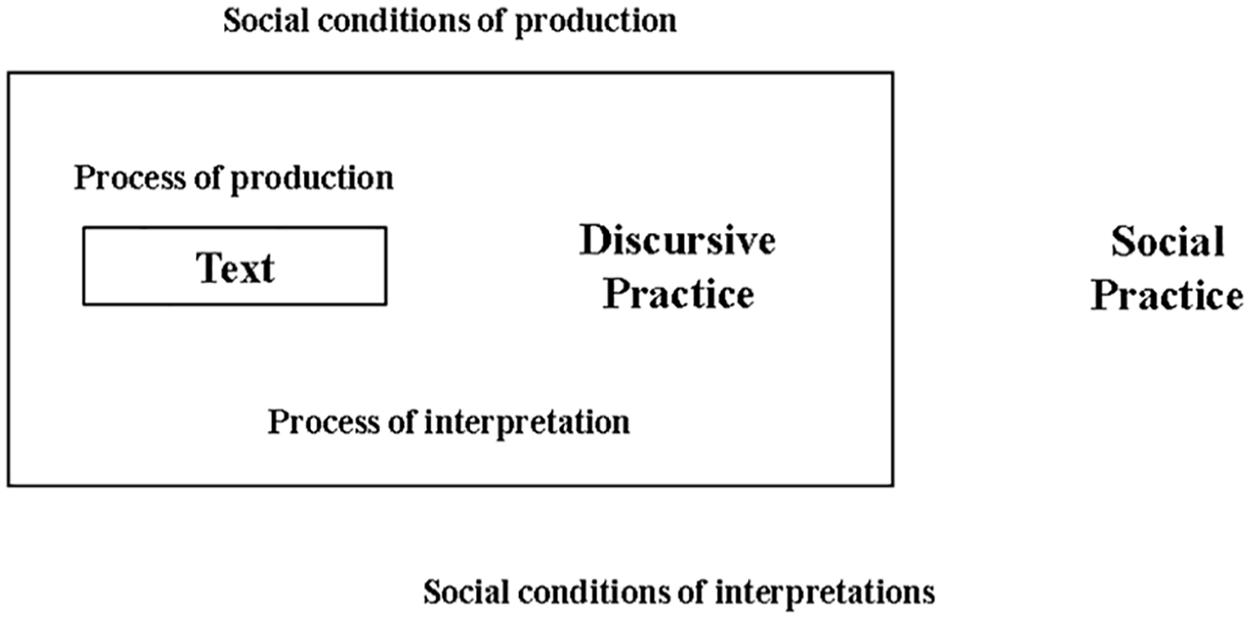
Fairclough’s three-dimensional model (Fairclough, 2001: 21).
Case selection
Based on purposive sampling principle (Yin, 2009), six Chinese business schools were selected as the research objects due to the theoretical relevance in accordance with the goals and context of this research: Tsinghua University School of Economics and Management, Peking University’s Guanghua School of Management, Renmin Business School (Renmin University of China), School of Management at Fudan University, Antai College of Economics and Management (Shanghai Jiao Tong University), and School of Management at Zhejiang University. 1 The main selection criteria were followed as below:
Firstly, the selected cases must be universities under multiple institutional logics such as market and administration. On the one hand, the six business schools are all affiliated with public comprehensive universities and need to undertake policy tasks of Chinese public education system, facing legitimacy requirements of government audience and administrative logic; on the other hand, influenced by the disciplinary attributes and teaching programs, business schools often directly interact with the market and industries, facing more market pressure than other faculties. Therefore, they can be regarded as an epitome of universities as a whole, providing a glimpse of the legitimacy construction strategy of Chinese universities under multiple institutional logics. Secondly, the six case business schools have similar influence in terms of subjects ranking or international certification (e.g. they have all passed the three international certifications of AACSB, EQUIS, AMBA, and started to get the certifications earlier than other business schools), and all of them are in the leading group in Chinese business schools, thus having appropriate representativeness. In addition, the unique political, economic, and cultural traditions in China have made the institutional complexity in higher education field quite different from the Western context (Qin and Wang, 2015). Therefore, choosing these six business schools as the research object can help us understand the particularity of Chinese context, and explore the unique identity construction strategies and discourse features of Chinese universities.
Secondly, the cases should have provided full accessibility of data. As websites have the ability to express multimodal information, they are becoming the core carrier and medium for organizational discourse in nowadays. These six business schools all have complete and rapidly updated official websites, covering multimodal information such as text, images, and videos, which can provide rich original discourse materials for our research.
Data collection
With the development of Internet and the rise of digital media, multimodal discourse (especially visuals) is gradually becoming the mainstream choice for organizational communication (Bell et al., 2013). As a native platform medium of the internet era, benefiting from its multimodal attributes and huge information payload, website plays an important role in communication between organizations and internal and external audiences (Barros, 2014; Pablo and Hardy, 2009), which is highly related to organization legitimization (Santos, 2023). Therefore, we choose the official websites of theses six case business schools as the main data source. First, by comparing their official websites, five columns shared by all of them are selected as data sources, including ‘Home,’ ‘About Us,’ ‘Programs,’ ‘Faculty & Research,’ and ‘International/Global.’ Then according to study purposes, only pages that contain both verbal and visual discourse are selected for analysis, and finally, 53 pages with a total of 80 images are screened (Table 1).
Data collected from websites.
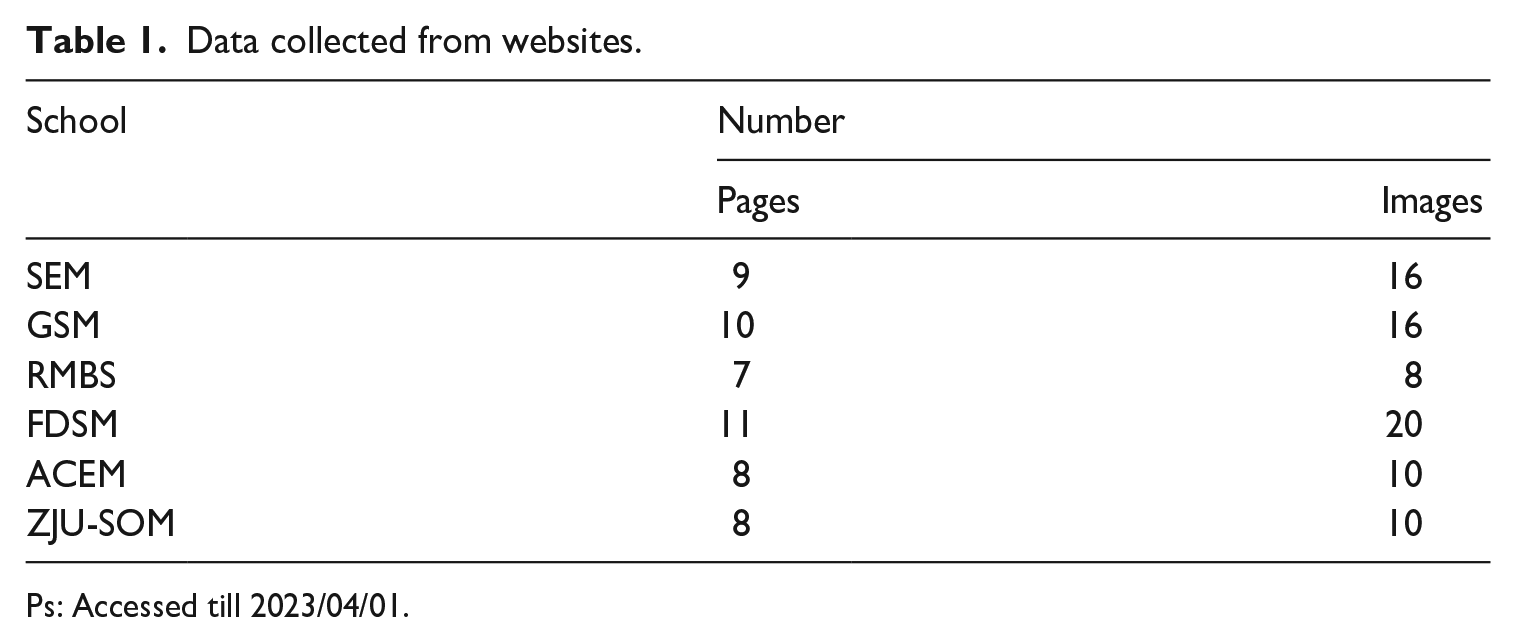
Ps: Accessed till 2023/04/01.
Data analysis
CDA is abductive in analyzing data. That is, ‘a constant movement back and forth between theory and empirical data is necessary’ (Wodak, 2004: 200). Accordingly, we have conducted increasingly focused empirical analyses while refining the theoretical ideas concerning discursive legitimation. However, this cycle analytical logic makes it difficult for us to report all the rereading and reinterpretation steps. Corresponding to Fairclough’s proposed three-dimensional framework, our data analysis process can mainly be divided into three stages:
Firstly, the descriptive analysis is conducted, which corresponds to the text dimension. This stage focuses on the grammatical features of visual discourse. With the help of the visual grammar framework proposed by Kress and Van Leeuwen (2006), we describe and interprets the ideational meaning, interpersonal meaning, and compositional meaning of visuals on the six case business schools’ websites.
The interpretative analysis is conducted as the second stage, which corresponds to the discursive practice dimension. This stage focuses on the production and consumption of visual discourse, that is, interpreting the explicit dimensions of the image (i.e. the content of the image, such as ‘Being invited to participate in an international conference’) and implicit dimensions (i.e. the connotation and symbolism of the image, such as ‘professional spirit’) (Höllerer et al., 2013). Then, we also identify the legitimacy claims, core ideas, legitimation strategies, and organizational identities constructed by visual discourse, as well as the intertextuality between visual and verbal discourse.
In the end, an explanative analysis is conducted, which corresponds to the social practice dimension. This stage focuses on the origins of specific discourse features and strategies of the organization, underlying institutional and socio-cultural background in organization filed. We discuss the institutional complexity in Chinese higher education field, which drives universities in market-oriented reforms to balance administrative and market logics, as well as the constitutive influence of this institutional background on universities discourse practices.
Findings
Visuals, organization identity, and legitimation strategies
The legitimation strategies of case business schools are embedded in their identity construction, which is based on the claims of ‘who we are’ and ‘what we do.’ To meet the legitimacy expectations of two main audience groups, namely government and potential students, the studied business schools respectively construct two organizational identities: ‘policy follower’ and ‘product supplier.’ Meanwhile, they use exemplification and authorization strategies to legitimize the identities (Vaara et al., 2006). The ‘policy follower’ mainly emphasizes the school’s instrumental role in serving the government’s ‘Double First-Class’ initiative, which is an important national strategy in China higher education filed (Han, 2014; Xiong, 2012). While the ‘product supplier’ mainly responds to the demands of consumers (particularly potential students) in higher education market by emphasizing the consistency of the school’s education services with market standards.
‘Policy follower’ and exemplification strategy
Research findings show that the website discourse of studied business schools incorporate the core goals of the ‘Double First-Class’ initiative, ‘Chinese characteristics, World-class’, 2 into their identity narratives and thus construct the core identity as a policy follower, expressing through the intertextuality between verbal and visual discourses.
When constructing this identity, case business schools mainly use the exemplification strategy, that is, citing specific examples to claim legitimacy (Vaara and Monin, 2010). The underlying logic is to provide evidences, so the authenticity of the visuals is crucial. Figure 2 presents examples illustrating the development of the analysis of legitimation claims, the central ideas of those claims, organizational identity and visual discursive legitimation strategy. The images presented were selected based on the principle of typicality, and other visual empirical instances related to this strategy are included in Appendix 2. Images 1–4 demonstrate the relevant practices and recognition obtained by case business schools in following the ‘Double First-Class’ initiative. Images 1–4 provide particular gazes on the four themes of ‘Chinese Local Practice,’ ‘Internationalization Practice,’ ‘Internationalization Achievements,’ and ‘Government Authority’s Recognition.’
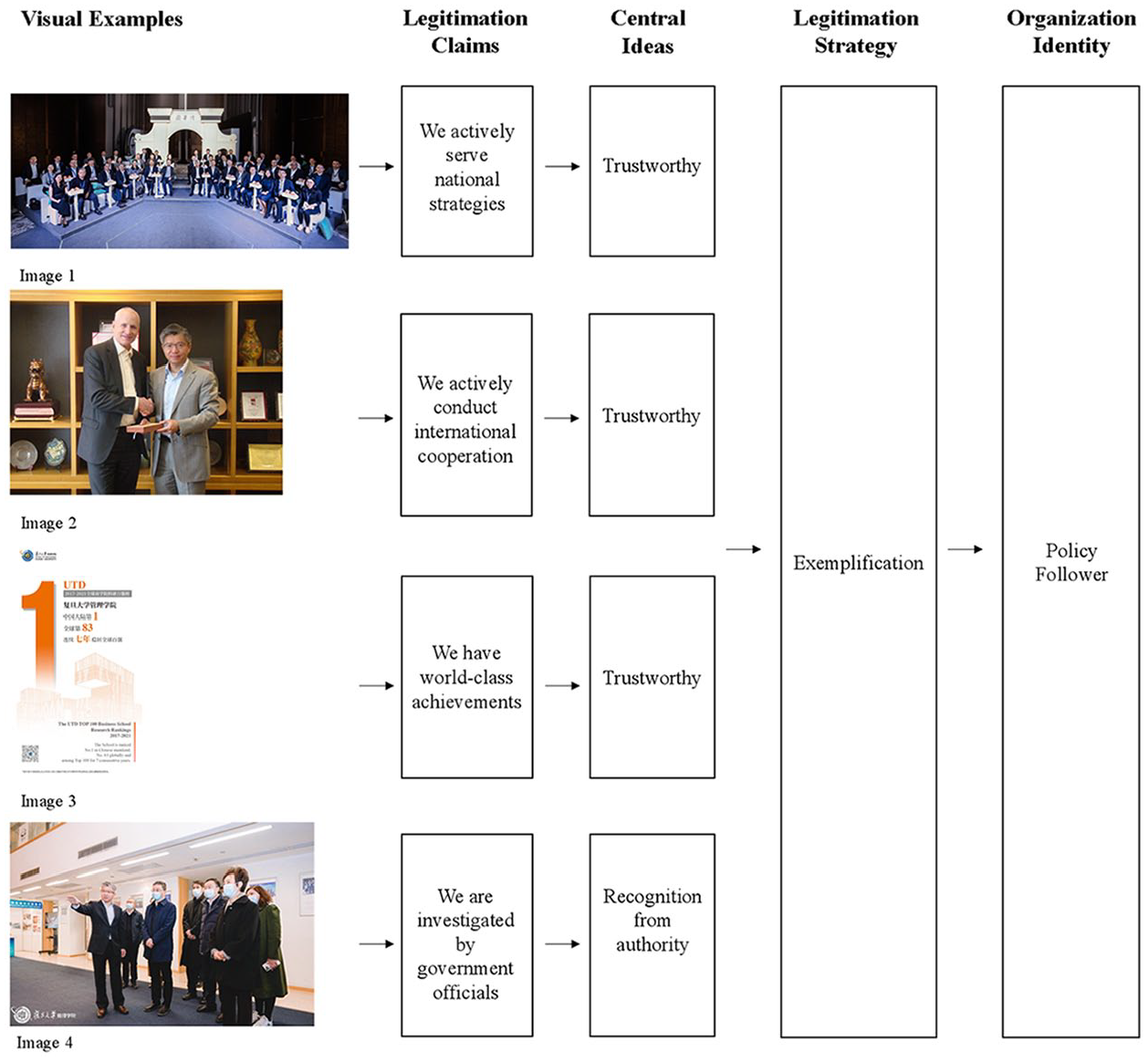
Data structure of ‘policy follower’ and the legitimation strategy of exemplification.
To follow the two core goals of the ‘Double First-Class’ initiative, ‘Chinese characteristics’ and ‘World-class,’ Image 1 and Image 2 respectively illustrate the relevant practices of the case business schools. Image 1 depicts the scene of the ‘中国碳索家 (ECO Explorer)’ project launched by SEM (Tsinghua University School of Economics and Management). There are 50 entrepreneurs sitting together and looking at the lens, who are all pursuing carbon peaking and carbon neutrality goals. A short text (see Appendix 1) elaborates on its content (the launch of the ‘中国碳索家 (ECO Explorer)’ project) and purpose (‘the project’s original intention is to serve the national double carbon strategy and call on industry and enterprise to take action’). It aims to prove and emphasize that the case business schools are rooted in Chinese local practice and actively serving national strategies. Image 2 provides an instance that case business schools actively conduct international cooperation. It depicts the scene that the dean warmly received the dean of the Yale School of Management (see Appendix 1) and took a handshake photo together. It aims to prove and demonstrate that the case business schools actively working toward internationalization and developing partnership with world leading international business schools.
Image 3 shows the international subject ranking of FDSM (School of Management at Fudan University), aiming to provide solid evidences (especially with quantitative data) for its ‘World-class’ achievements (Yunxia, 2000; Zhang, 2017). To highlight the main information and attract audience’s attention, case business schools all choose to embed the ranking information into the images and use size, color, layout, and other composition techniques to enrich its expression. For example, in Image 3, the specific ranking (Number ‘1’) is placed in the ‘Given’ position on the upper left side of the image, as referred to by Kress and Van Leeuwen (2006: 181). This arrangement aims to present the specific ranking as ‘self-evident’ and ‘common sense’ information, so that the audience can recognize the ranking result without an awareness of the cognitive processing (Meyer et al., 2018). The larger and bolded orange font also give it higher salience to quickly attract audience’s attention. Other information is placed in the ‘New’ position on the right side, presented as information that the audience is not yet aware of and needs special attention. In addition, the main building of FDSM outlined by the orange line is placed at the bottom of the ranking information, even the whole image, which is regarded as the ‘realm of real’ by Kress and Van Leeuwen (2006: 186). The building is a symbol of reality and material basis that bear the commitment to the ‘World-class’ achievements. Image 3 aims to enhance the credibility and immediacy of the case business school’s international achievements.
Image 4 depicts the scene of government officials conducting a survey of the case business school, with a brief text explaining its explicit content (see Appendix 1). Due to the political characteristics of Chinese public universities, visits and surveys by higher-level government officials are usually regarded as a kind of endorsement from the government, representing their recognition of the university’s achievement (Zhang, 2017). In Image 4, the participants in the picture can be clearly divided into two groups. The speaker stands at the forefront of the crowd, with eyes looking forward, arm pointing to the same direction. And his body faces the audiences on the right, with a relaxed and humble active posture. The right audiences’ gaze and body are directed toward the direction indicated by the speaker. Their hands crossed in front of body, presenting a solemn and authoritative passive posture. The vector formed by the gaze and actions of both parties indicates their different positions. The speaker (the dean of case business school) is in a subordinate position, actively introducing something to the officials in front of them. The right audiences are in a dominant position of ‘being served,’ seemingly scrutinizing and evaluating the content of the speaker’s presentation. This arrangement highlights the authoritative identity of the audiences on the right. In addition, none of the people in Image 4 make eye contact with the lens. This arrangement eliminates the presence of the photographer and enhance the credibility of the content, which is regarded as ‘fly on the wall’ image (Kress and Van Leeuwen, 2006: 180).
With the help of the special gaze provided by Images 1–4, case business schools construct the three legitimacy claims of ‘actively serving national strategies,’ ‘actively conducting international cooperation and achieving world-class achievements,’ and ‘being investigated by government officials’ as a fact. Relied on exemplification strategy, case business schools concretize their legitimacy claims into artifacts and scenes in reality to provide comprehensibility required for legitimacy. This not only greatly enhances the claims’ credibility but also deepens and expands their meanings (Santos, 2023).
Furthermore, in the exemplification strategy, case business schools use a ‘ego wall’ discourse. The visual instances mainly include group photos at the end of events, rankings on different lists, international certifications and so on, while rarely mentioning the substantive efforts and practices made to achieve these results. This discursive strategy shows the attempts of highlighting organizational achievements. They define their organizational identities by showing the static ‘having’ rather than the dynamic ‘being’ mode (Molesworth et al., 2009). For example, Images 1–4 respectively show the typical achievements and recognition in ‘Double First-Class’ construction: the inauguration of ‘中国碳索家 (ECO Explorer)’ project, the scene of shaking hands with the visiting dean of the Yale School of Management, placement on the ‘UTD top 100 business school research rankings,’ and the scene of survey by officials from the Ministry of Education. Other visual instances in Appendix 2 show similar discursive characteristic. This ‘ego wall’ discursive strategy aims to prove to government authority audiences that the case business schools have met their legitimacy expectations. This also suggests that the legitimacy evaluation criteria of government audience are more focused on final results rather than the gains and changes during the process (Xiang, 2021). At the same time, by hiding specific efforts and practices in process and focusing on the static final results, the case business schools can ‘naturalize’ their various achievements. That is, implying that the process of meeting the legitimacy evaluation criteria of government audiences is effortless (Vaara and Monin, 2010). While enhancing the credibility of legitimacy claims, this strategy also creates an unquestionable sense to their ability to meet standards.
‘Product supplier’ and authorization strategy
Existing studies have discussed the penetration of market ideology and values into the higher education field (e.g. Askehave, 2007; Osman, 2008; Zhang, 2017; Zhang and O’Halloran, 2013). In this process, a series of commercial discourses originating from corporate practices, such as ‘customer orientation,’ ‘strategic planning,’ ‘performance management’ etc., have become prevalent in universities’ discourse system. This trend shapes universities as suppliers of educational services and knowledge commodities and students as consumers with the power of choice. China is no exception, but the school funding of Chinese public universities mainly comes from government appropriations, and their admission is mainly based on scores in the National College Entrance Examination. So they undertake less market pressure than most Western universities. However, business schools are unique. The existence of market-oriented education programs such as MBA and EMBA subjects them to greater market pressure than other faculties, which leads to an obvious market orientation in their identity discourse.
When constructing the ‘product supplier’ identity, studied business schools primarily use authorization strategy, emphasizing that their competence and attitudes meet the standards of the education market and the expectations of consumers. The underlying logic of this strategy is to demonstrate the conformity of institutional authority. Figure 3 shows typical visual instances and analysis process about this identity. Additional visual materials are included in Appendix 3.
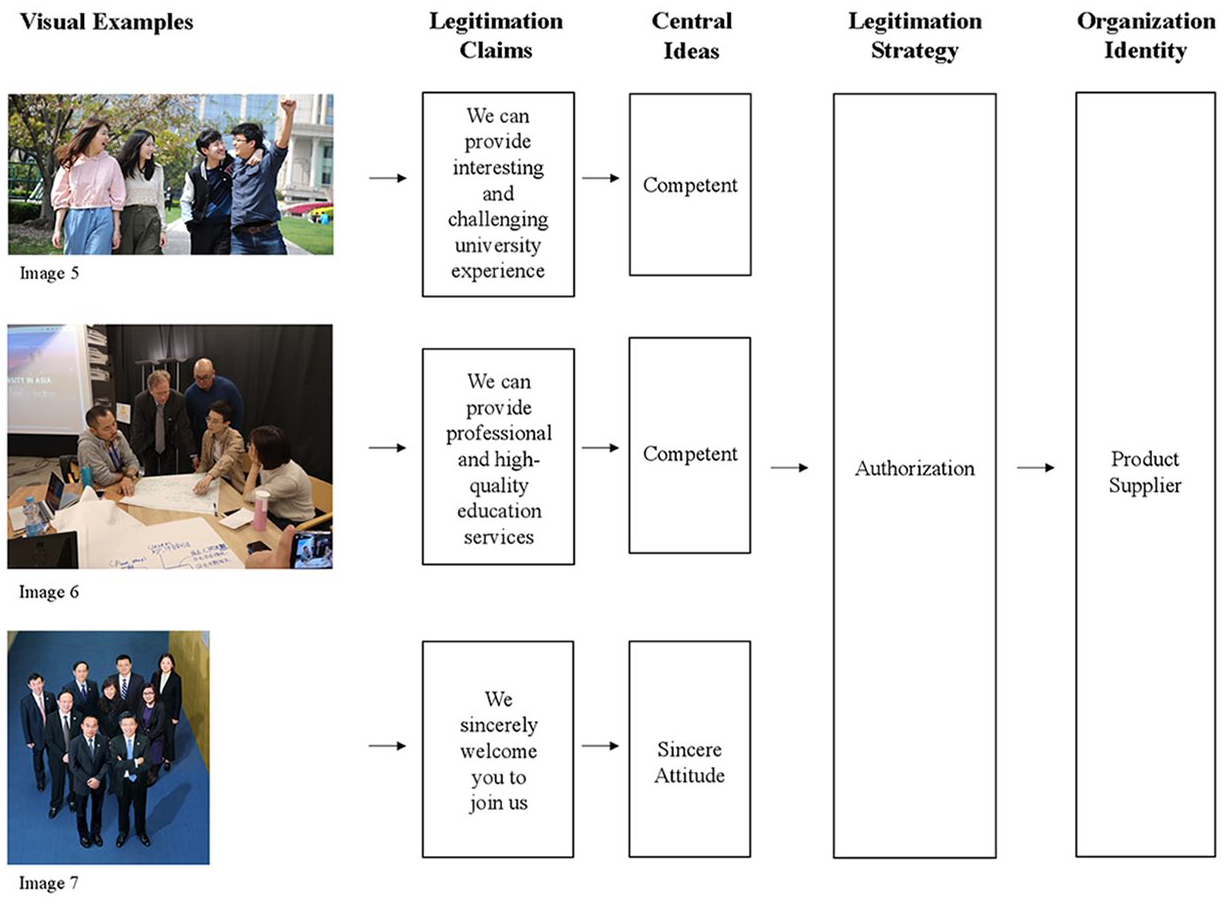
Data structure of ‘product supplier’ and the legitimation strategy of authorization.
Image 5 shows the campus life scene. Four students in casual clothes are walking side by side, with the rightmost male student raising his arms high. They smile at each other, full of youthful energy. The background is blooming trees and lush green lawns, with a light blue glass curtain wall in the distance. The overall tone of the picture is bright, rendering a joyful and energetic atmosphere. From the gaze provided by the image, none of the four students have direct eye contact with the lens. This arrangement helps to dissolve the presence of the photographer and indicates that this scene is not an intentional perform. In addition, the lens uses a horizontal viewpoint and places the four students in a close shot, which helps to establish a close connection with the audiences and transport them to the scene. Image 5 aims to imply that the case business school has the ability to provide students with an interesting and challenging university experience, meeting the expectations of picky students who are ‘spoiled by choice’ (Askehave, 2007).
Image 6 shows a scene of teacher and students in class. A foreign teacher in formal attire stands by the table with both hands supporting it in a thoughtful posture. He is looking in the direction pointed by a student sitting beside, and listening to the student’s explanation of the content on the paper. There are many paper filled with text and several computers on the table. A short text explains that this is the classroom scene of the MBA Digital Innovation Program in the case business school. Image 6 aims to imply that the case business school has the competence to provide professional teaching services, to meet students’ expectations for acquiring knowledge and professional skills.
Image 7 shows the leadership teams of FDSM, and audience can have a comprehensive view of all key members in this photograph. As the sole focus of observation, the participants in image 7 are all dressed in formal attire, fully exposing their faces and bodies to affirm their authentic attitude. From the gaze provided by the image, all the participants face the lens and have direct eye contact with the audience. Kress and Van Leeuwen (2006) called this kind of image a ‘demand.’ They said that ‘the participant’s gaze demands something from the viewer, demands that the viewer enter into some kind of imaginary relation with him or her’ (p. 118). The participants in image 7 all have smiles on their faces, seemingly inviting the audience to establish a friendly relationship with them. In addition, image 7 adopts a bird’s-eye view angle, and the participants all look up at the lens, which gives the audience a higher interactive status. This arrangement aims to imply the sincerity of their service attitude through the ‘face-redressing politeness strategies,’ which is consistent with the strategy commonly used in commercial advertising to construct a customer-oriented corporate image (Zhang, 2017). Moreover, all the participants are in the medium shot, maintaining a certain distance from the lens. Through this arrangement, the case business school can retain the authority to avoid being underestimated by the audience due to a too humble attitude, while establishing a close relationship.
Through the interpersonal meaning of images 5–7, case business schools connote three legitimacy claims to the audience: ‘We can provide interesting and challenging university experience,’ ‘We can provide professional and high-quality education services,’ and ‘We sincerely welcome you to join us.’ These images demonstrate their competence and attitude to meet the standards of higher education market and the expectations of the audience. Authoritative strategy is used to construct legitimacy for this market identity.
Identity decoupling: Interdiscursivity between verbal and visual mode
It is noteworthy that in constructing the above two organizational identities, investigated business schools all adopt a decoupling strategy. They keep the two identities separate through the intertextuality between verbal and visual mode of discourse. The legitimacy claims related to ‘policy follower’ were directly expressed in verbal language, while visuals are mainly used to prove and deepen the connotations of the verbal language. The legitimacy claims related to ‘product suppliers’ are not explicitly mentioned in verbal language, but are implied to the audience through the implicitness and interpersonal meaning of the visuals.
Firstly, case business schools all integrate the goals of ‘Chinese characteristics and world-class’ into their legitimacy claims, which are expressed explicitly. By doing so they make the construction of ‘policy follower’ the core of the verbal language. For example: Tsinghua University School of Economics and Management has a mission ‘to advance knowledge and cultivate leaders for China and the world’; aspires ‘to be a world-class school of economics and management’; and holds ‘integrity, dedication and respect’ as its core values. For 38 years, Tsinghua SEM has led the nation in talent training, scientific research, social influence and international exchange, and strove to become a world-class school of economics and management. (Tsinghua SEM)
3
Since its reestablishment in 1985, School of Management at Fudan University has grown along with the historic process of reform and opening-up in China. Driven by our School’s noble mission of ‘setting roots in China in its progress, dedicating itself to innovative research, and cultivating academic specialists, business elites and social leaders with global perspectives and local insights,’ all the faculty and staff at FDSM have spared no effort to not only enhance our teaching and research competences in an all-round manner but also cultivate large numbers of outstanding management talent for China’s prosperous economic development in the future. (FDSM)
4
As the only tangible evidence related to organizational practices that the audience can obtain from the websites, images 1–4 concretized the three legitimacy claims of ‘We actively serve national strategies,’ ‘We actively carrying out international cooperation,’ ‘We have got world-class achievements,’ and ‘We have been surveyed by government officials.’ They provide more details and enrich the forms of meaning expression in addition to providing evidence for verbal language, increasing the comprehensibility of legitimacy claims for audience. The ideational meaning and interpersonal meaning play important roles in this process, that is, all the information conveyed by visuals exists in their explicit dimension, and there is no implicit meaning for the audience to interpretation.
In contrary, the ‘product supplier’ is rarely mentioned in verbal language, instead mainly constructed by visual discourses. Images 5–7 convey three legitimacy statements of ‘We can provide interesting and challenging university experience,’ ‘We can provide professional teaching services,’ and ‘We sincerely welcome you to join us’ in implicit manner, aiming to demonstrate the consistency of their competence and attitude with market standards and audience expectations. Due to the lack of verbal logical conjunctions and linear argumentation (Santos, 2023), the information conveyed by the visuals mainly exists in their implicit dimension. Therefore, audiences have to rely on their subjective interpretation of the interpersonal meaning of the images to understand. In addition, the visuals associated with this identity are only displayed on specific pages (such as ‘Programs’ and ‘Internationalization/Globalization’ pages). This arrangement also keeps it isolated from the ‘policy follower’ identity.
The decoupling strategy reveals the subtle attitude of case business schools toward the two identities and their audiences. First, there is a potential conflict between the two identities and their corresponding legitimacy claims, so they cannot be displayed at the same time. Instead, the mismatch between verbal and visual language is used to ensure that the two identities are isolated, preventing the ‘front-stage performance’ of case business schools from being disrupted (Goffman, 1978). Furthermore, this implies that there are irreconcilable differences between the legitimacy evaluation standards of the government and market audiences. But the two audience groups both can provide key resources which are needed for the survival and development of case business schools. So they can only be balanced in such a decoupled manner. Secondly, the legitimacy expectation of ‘policy follower’ is more prominent, so it can be clearly expressed and dominate in both verbal and visual language. While ‘product supplier’ has a subordinate status, so it is only implied through the implicitness of visuals, and the relevant visuals are also limited to specific pages to prevent them from threatening the legitimacy performance of the former (Goffman, 1978). This arrangement shows that studied business schools are more responding to legitimacy expectations from government than to market audience. Furthermore, this means that in the eyes of business schools, governmental supports and resources are more important, scarce, or irreplaceable.
Discussion and conclusion
Based on the analysis of multimodal discourse from university websites, our study examined organizational discursive strategies in legitimation under multiple institutional logics. Our research shows that in response to legitimacy expectations from two major audience groups, the government and prospective students, universities construct two identities respectively: ‘policy follower’ and ‘educational product supplier.’ They legitimate the identities through exemplification strategy and authorization strategy, based on the facticity and implicitness of visuals. To be more specific, in a CDA lens, the descriptive analysis suggests that case business schools demonstrate their active practices in following the ‘Double First-Class’ initiative and imply their conformity with the standards and expectations of higher education market, with the help of ideational, interpersonal, and compositional meaning of visuals.
Based on interpretative analysis, the legitimacy claims, two main organizational identities, and corresponding legitimation strategies used by studied business schools have been identified. In addition, our studies also find that case business schools have adopted a decoupling strategy in constructing their legitimacy identities – the ‘policy follower’ identity is mainly constructed in verbal language, while visuals serve as supplementary and corroborative evidence; the ‘product supplier,’ on the other hand, is rarely mentioned in verbal language but is mainly implied through visuals. This strategy suggests the significant difference in the attentions that case business schools pay to the two identities and the corresponding audiences.
Based on the recent discussions on the issues of administration and marketization in Chinese universities (Hu, 2019a, 2019b; Zhang, 2020; Zhang and Zhang, 2018a), we further explore the institutional background of higher education field and its constitutive effects on the legitimation discursive strategy based on existing literature. It attempts to deconstruct the ‘unspoken’ social and power relations in the discourse (Fairclough, 2003). This part focuses on the social practice dimension of CDA.
The imitative marker-driven governance mode under dual institutional logics
China has unique political, economic, and cultural traditions and has long implemented a centralized bureaucratic control in higher education field since its foundation (Hu, 2019a; Mok, 1997). Under this institutional background, universities exist as affiliated institutions of the government, and government hold the decision-making authority on major issues such as personnel, finance, and teaching. The responsibility of universities is to implement the government’s decisions and work under the guidance of policy documents (Hu, 2019a). 5 Then with the economic reform from 1978 and the construction of socialist market economy system, the market logic that advocates competition and efficiency had a huge impact on the governance system of higher education. In line with the economic reform, central government initiated decentralization policies in educational realm, with goals of transforming government functions and expanding the autonomy of universities. 6 Specifically, government began to introduce market competition into higher education field, formulate market competition rules, and create a higher education competition market. The government aims to expand the autonomy of universities and transform universities from affiliated institutions of the government into market competition subjects with independent school-running rights (Zhang, 2020; Zhang and Zhang, 2018a, 2018b). Under the dual institutional logics, the higher education field in China has gradually formed a ‘imitative marker-driven governance mode.’ In this governance mode, the government’s administrative logic is dominant, market logic is secondary, and administrative logic absorbs market logic (Ren and Liu, 2021; Zhang and Zhang, 2018a). Unlike the mixed mechanism of government and market, in the ‘imitative marker-driven governance,’ ‘the government-led administrative system and administrative resource allocation mechanism occupy a dominant position, determining whether to introduce market competition in higher education and to what extent and in which areas to introduce and apply market mechanisms’ (Zhang and Zhang, 2018a: 6). Although market forces such as enterprises and potential students have become stakeholders in higher education field, they only occupy a secondary position.
According to the above institutional background, the social and power relations and structures behind the legitimation discursive strategies are revealed. Firstly, although the market competition mechanism has been introduced, the competition among universities is still mainly limited to the project system, which is designed and promoted by the government (Yan, 2012; Zhou, 2009). Such as the ‘211 Project,’ ‘985 Project,’ and ‘Double First-Class’ initiative in higher education field. Its fundamental logic is that the government designs projects with specific rules and requirements, and provides projects funds as supports. Then universities compete based on the projects’ requirements to obtain corresponding funds and resources. In this process, in the one side, the government plays a dominant and multiple roles as rule designer, regulator, and evaluator of the competition among universities; while in the other side, Chinese universities play the subordinate role of policy followers. In other words, as administrative logic absorbs market logic, universities do not compete to meet the needs of society and the market, but to compete for educational resources, policy support, social status, and reputation from the government. Secondly, in recent years, the funding sources of universities have become more diverse, and the gap between government funding, educational revenue, and donation income is gradually narrowing. But the government still holds resources that market forces cannot provide, such as personnel appointments and removals, policy support, and education authorization (Hu, 2019a), which give it a legitimacy authority higher than that of the market audience. Therefore, in the process of identity construction and legitimization, universities will inevitably prioritize meeting the legitimacy expectations of the government, and then try to accommodate the market audience as much as possible. At the same time, to prevent the conflicts between the identity of ‘product suppliers’ and the legitimacy evaluation criterion of the government audience, universities adopt the decoupling strategy. With the help of the implicitness of visuals and the mismatch between verbal and visual language, they create an isolation between the two organizational identities in the interweaving of explicit expression and implied meanings.
In addition, due to the dominance of the government-led administrative system and administrative resource allocation mechanism, higher education evaluation system under the ‘imitative marker-driven governance’ has gradually become a top-down government evaluation. The government is the judge of evaluation. Meanwhile, since the government tends to use evaluation results as the basis for financial appropriations to universities, school management authorization, and even measuring the political achievements of university leaders, universities have lost their role as important participants in higher education governance system. In other words, the standards and values followed by universities are all produced from top to bottom and from outside to inside. It means that government-led higher education evaluation has become an evaluation of whether universities implement government policies and the level of policy implementation. Universities must inevitably attach great importance to the requirements of government, even ‘doing what needs to be evaluated urgently, and putting aside things that do not need to be evaluated’ (Zhang and Zhang, 2018a). Thus, the legitimacy of universities almost entirely depends on the ‘Althusserian recognition,’ that is, the recognition of the institution and authority. The legitimacy mainly comes from demonstrating their identity as ‘policy followers’ and the achievements of implementing government policies, and proving their effective ‘standardization ability,’ rather than exchanging and sharing their innovation and exploration and discovering methods for further improvement in equal, open, and cyclical communication with their audience (Xiang, 2021). In addition, with the emergence of the trend of technological governance in higher education field, the evaluation technology and indicator system become more refined and industrialized. And the achievements that are more easily to quantify are far more suitable for this evaluation system than other indicators filled with complexity and ambiguity. This trend is consistent with Fromm (2013) that the ‘having’ mode replace ‘being’ mode. In conclusion, this is the fundamental reason why universities widely use the ‘ego wall’ strategy. It is necessary to be wary that this evaluation system and power relationship may lead to opportunism and speculation by universities, which is the so-called ‘evaluation alienation’ (Zhang and Zhang, 2018a).
Theoretical contributions, limitations, and future research
Our research contributes to knowledge in three ways: First, it responds to the call for multimodal discourse analyses on organizational legitimacy research (Lefsrud et al., 2020; Puyou and Quattrone, 2018; Santos, 2019, 2023) and explores how the affordance, the ideational, interpersonal, and compositional meaning sustain legitimation strategies. Second, by adapting CDA, it investigates how universities use micro-level discursive strategies to construct legitimacy, filling the gap in previous research that ‘only focuses on the utility of discourse for organizational legitimation, and ignores how discourse constructs legitimacy cognitively’ (Peng and Lu, 2014: 153). Third, it explores how universities under multiple institutional logics construct their legitimacy from an empirical level, which is consistent with the research calls of Fisher et al. (2017) and Deephouse et al. (2017) on the relationship between diversity of audiences and their legitimacy requirements and organizational legitimation. And we provide empirical evidence for understanding the institutional complexity in Chinese higher education field (Feng, 2019; Han, 2014; Zhang, 2017).
As an exploratory study, this research also has limitations. First, only six universities’ websites with 80 visuals are selected as the source of language corpus, future research can improve the robustness and generalizability of investigation. Moreover, due to the limitations of data acquisition ability, the visual empirical instances selected in this article are all of cross-sectional nature. Longitudinal analysis of the historical discourse and legitimation strategies of university websites in the process of Chinese neoliberalism reform has not been considered, nor have horizontal comparisons of university discourse in different social system environments been made. These limitations suggest the directions of future research.
Footnotes
Appendix
Author’s Note
Zhang Xu is also affiliated with Business School, Central University of Finance and Economics.
Declaration of conflicting interests
The author(s) declared no potential conflicts of interest with respect to the research, authorship, and/or publication of this article.
Funding
The author(s) received no financial support for the research, authorship, and/or publication of this article.