



Abstract
In this paper, we study on the ways the Intergovernmental Panel on Climate Change (IPCC) communicates scientific knowledge on climate change to policymakers in the Summary for Policymakers of the Fifth Assessment Report (AR5); the most recent Assessment Report issued by the IPCC. We investigate implicit argumentation with a special focus on the ways the summary may direct the orientation of the discourse towards the evasion of climate action while appearing to be pro-action on the surface. The results of a systematic analysis of polyphonic constructions in the language of the text indicate that implicit argumentation represents climate action inevitably subordinate to economic goals. In a number of constructions, the discourse reconstructs pro-economic-growth-based frames in contrast to prioritising environmental values when encouraging political action in the context of climate change. Through such language use, the discourses mediated by an institution of such high societal importance and authority as the IPCC arguably have a considerable impact in maintaining conservative climate policies and delaying, even hindering, a transition into a carbon-neutral society. Thus, we conclude that even the most authoritative climate-science-policy institutions should reconsider their use of linguistic representations in terms of implicit argumentation in their communication in order to encourage climate action in a more straightforward manner. As long as the most authoritative actors in science-policy discourse on climate change continue to reinforce cognitive frames evading urgent action to mitigate climate change, it is questionable whether we can expect the policymakers to have the courage to take ambitious action even if the figures in the natural-scientific evidence sections of the reports were demonstrating clear worsening trends.
Keywords
Introduction: Beyond denial
While there is a widespread scientific agreement on most aspects of climate change, climate policy remains a debated topic due to the influence of dominant political and economic interests. The need for consistency in the advocacy for climate action is particularly important as several interest groups deliberately aim to keep climate change off the political agenda. The role of language as a medium for constructing social and political realities is key in this process of evasion as linguistic representations in fact construe frames (i.e. culturally embedded cognitive models on perceptions of reality – cf. Goffman, 1974; Lakoff, 2004; Tannen, 1993; Tversky and Kahneman, 1986) of climate change. In contexts of policy formation, frames of climate change become institutionalised, and they serve as cornerstones of the ways climate change is politicised. Thus, through the maintenance and creation of frames, linguistic structures in institutional discourses on climate change have an essential role in changing or maintaining the ways social and political actors operate regarding this issue in terms of, for example, the related social responsibility, the need for action and the access to social, political and economic resources. Due to the abovementioned role of language, the discourse of climate change functions as a (public) sphere that provides a platform for competing discourses on the subject by representatives of various political and economic interests. The existence of such competing discourses is well-reflected in the mismatch between the scientific understanding of climate change and the ways it is often communicated to various audiences. Such a mismatch provides good grounds for climate change sceptics to frame scientific knowledge on climate change as self-contradictory, even unreliable. There have been several wide disinformation projects on climate science involving conservative think tank associates, public relations professionals and fossil fuel lobbyists (see e.g. Dunlap and Jacques, 2013; Dunlap and McCright, 2011; Michaels, 2008). The key discursive strategy in these projects is based on manufacturing uncertainty (vs direct denial) through producing claims on scientific evidence being insufficient to support policy regulations (Oreskes and Conway, 2010). To counter these anti-climate movements with strong lobbying power and vast economic resources, climate science needs to communicate in a way that is both unambiguous and convincing. This is even more important in messages aimed at policymakers as the communicative strategies concerning the issue of climate change play a crucial role in determining the degree to which policy experts succeed in challenging the groups of political denial, that is, succeed in facing the issue of climate change and mitigating action towards it.
Previous research has shown that communicating on climate change is a challenging endeavour (e.g. Antilla, 2005; Boykoff, 2007a; Boykoff and Boykoff, 2004). Past experiences have manifested various ways in which the communication efforts can fail to deliver the message needed for ambitious climate action. While earlier findings show that complete climate science denial has had access to major discourses in the past, currently the challenge in communicating climate change is shifting from having to face sheer denial to the avoidance of responsibility. In practice, this has been realised in more subtle differences of opinion having become the dominant factor of slowing down mitigation efforts making direct climate science denial play a rather marginal role. Therefore, we argue that research on climate communication should adjust to this new situation by focusing on those discursive constructions that contribute to conservative climate action through dispersion (vs denial). We maintain that an essential target of such research is to investigate the ways in which ambiguous argumentation plays a key role in slowing down mitigation efforts. Discursive techniques utilising ambivalence, such as the ones that operate with possible ambiguous interpretations of debated topics (cf. Wodak, 2003), in our view, are harmful both when contributing to delayed climate action without the author’s intention, and also, when used deliberately to legitimate delayed action. Hence, we should set out to tackle discouragement of climate action beyond direct denial and implicit argumentation rather than having a focus solely on explicit statements. This approach presumes that discourses of pro-science and also of pro- climate action voices should be subjected to scholarly investigation as they can just as well contribute to the discouragement of climate action via ambiguous argumentation.
Arguably the most reclaimed authority of climate change science is the Intergovernmental Panel on Climate Change (IPCC). Several experts consider the panel an objective authority with the best practices in climate change communication (e.g. Gasper et al., 2013). We share the view that the IPCC’s work on communicating scientific knowledge and especially informing wider audiences on the human-induced nature of climate change has been invaluable. However, it has also been argued that even the IPCC cannot avoid subjectivity, stance-taking and the influence of values on its work (e.g. Boykoff, 2007a). Furthermore, formal knowledge-based discourse in general is nowadays considered an intersubjective and persuasive venture (Hyland, 2005: 175). As the construction and presentation of facts is also partly argumentative, the present study takes a critical stance on the complete objectivity of the panel and we aim to investigate the way in which the communication by the IPCC goes beyond scientific reporting of facts, and how the IPCC simultaneously engages in an argumentative endeavour reflected in its language use. More importantly, this paper sets out to explore whether the panel communicates in a way that efficiently encourages readers to take action required on the basis of current climate science.
The IPCC publication we focus on is the Summary for Policymakers of the Synthesis Report belonging to the Fifth Assessment Report (AR5); the most recent Assessment Report issued by the IPCC. It is a condensed, integrated version of the full reports by the three working groups of AR5, which is primarily targeted at decision makers. The name of the document addresses the decision makers of the world to familiarise with its contents in order to learn the most important aspects of the scientific information compiled by the IPCC. Due to its title and its brevity compared to the full assessment reports, it is more accessible to policymakers who wish to get a thorough overview of the information when preparing for negotiations, conferences or meetings. This implies that the Summary has a more direct influence on decision making than the full report, since negotiations, conferences and meetings are among the key social practices of formulating climate policy. They represent events where climate decision making is done, where treaties are made and agreements are signed. The Summary provides an overview of the latest science to policymakers preparing for these social practices of climate decision making, and is thus also one of the major sources contributing to the ways in which they interpret the current climate knowledge. Therefore, the language of the Summary for Policymakers not only plays an important role in shaping the outcomes of the social practices of local, national and international climate decision making but is also a vehicle for social maintenance and change.
In contrast to the general belief, the IPCC Summaries for Policymakers are subject to political influence during the process of their production. Indeed, representatives of member countries are invited to the Plenary Sessions in which the final content of the Summary for Policymakers document is decided. Moreover, each report is formally accepted by government representatives. Beyond this direct participation of governments, consensual procedures of the IPCC have been argued to cause conservative bias in the reports (Brysse et al., 2013; Hansen, 2007). Biases influencing the production of the report could have an impact at the processes of reception of the Summary as well by (re)producing particular frames of climate change in the readers of the Summary as the valid ones. By targeting decision makers, this influence is directly linked to policy formation and climate action. Building on these claims, our goal is to assess how biases may be reconstructed via language through means of implicit argumentation in the Summary for Policymakers. Due to the technical language of the report, the potential bias in the Summary could not be analysed by using similar methods as for analysing bias in media discourse, for instance. Moreover, the IPCC aims at a consensual message without explicit argumentation and evaluative language, which necessitates that we use special methodology targeted at implicit argumentation. Thus, the approach chosen for the present study is designed to first expose implicit argumentation in the data to then assess its effect on the overall argumentative orientation of the document. The methodology used for exposing implicit argumentation has its theoretical basis in the notion of linguistic polyphony (depicting the capacity of the linguistic form to incorporate several viewpoints in a single utterance), which will be discussed in more detail below.
The more specific research questions for the present study are as follows:
Can implicit argumentation between contrasted points of view be detected in the Summary for Policymakers, and if yes, what kind of points of view are contrasted through implicit polyphony? What themes are they concerned with?
How do the implicit points of view orient the discourse argumentatively in relation to the core themes of climate change science and climate decision making? Do they emphasise aspects supporting or undermining commitments to climate action?
On the one hand, how may the practices of report production explain the absence/presence and argumentative orientation of implicit argumentation, and, on the other hand, what implications may this potential implicit argumentation in the data have on the reception of the discourse by the target audience, and consequently on the social and political processes of climate decision-making and societal change?
Climate change discourse and the institutional context of the summary for policymakers
The following section will provide an overview of research previously conducted on climate change discourse in the media as well as in policy reports. This is followed by a synopsis of the institutional context of the production of the IPCC reports in order to highlight the importance of the impact of the production of the report and the communicative practices of the IPCC on patterns of implicit argumentation.
Climate change discourse and the communicative practices of the IPCC
Climate change communication has been studied since the 1990s (Fløttum, 2016: 2) and research has addressed the various challenges in effectively communicating on this global issue (Nerlich et al., 2010: 2). Several studies have demonstrated the media’s tendency to highlight uncertainties relating to the scientific knowledge on climate change rather than reporting on the clear consensus about the needed mitigation efforts (e.g. Antilla, 2005: 350; Boykoff, 2007a: 481; Boykoff and Boykoff, 2004: 125). Hence, it has been argued that the bias in the media coverage on the issue has led to a remarkable divergence between climate change science and the public understanding of the phenomenon (Boykoff and Boykoff, 2004).
In contrast to these earlier findings, diachronic studies comparing current discourse to that of previous years highlight the increasing accuracy in the representation of the scientific certainty of anthropogenic climate change in the media (Boykoff, 2007b; Schmid-Petri et al., 2015). Indeed, Boykoff (2007b) found an evolutionary shift in the press coverage of anthropogenic climate change in the United States from 2003 to 2006. Other studies have also demonstrated evolutionary aspects in the way in which media reports on climate change. In their quantitative content analysis of US print media, Schmid-Petri et al. (2015) found a change in the form of scepticism compared to the findings of previous studies. There was no longer fundamental scepticism, that is, denial of the existence of climate change or its human-induced nature. In contrast, there was an increase in impact scepticism, which involves arguments for avoiding binding policy regulations through reference to adverse effects of climate policy, such as harmful implications for the economy, and positive effects of climate change (Schmid-Petri et al., 2015: 9). These findings inspired the research design of the present study in which we are focusing on more subtle forms of argumentation which may discourage further action to combat climate change.
As stated above, climate change communication by the IPCC has been criticised for various reasons. At the same time, a number of scholars refer to the IPCC as the highest scientific authority in the field (Fløttum, 2013: 282) and as a model example of how to communicate on climate change science (e.g. Gasper et al., 2013: 38). Due to the IPCC’s authoritative role in the discourse around the topic, several studies focused on the effectiveness of the language use in IPCC reports (e.g. Barkemeyer et al., 2015; Bell, 1994; Bowman et al., 2009; Hulme, 2009). The IPCC’s use of formal likelihood scales to communicate various levels of uncertainty have been a particularly debated topic. The likelihood scale consists of ten verbal expressions: virtually certain, extremely likely, very likely, likely, more likely than not, about as likely as not, unlikely, very unlikely, exceptionally unlikely and extremely unlikely. Research points to the direction that non-scientific audiences interpret these statements as conveying more uncertainty. For instance, Budescu et al. (2009) have found that people’s interpretations of these scalar terms have varied individually and lead to a higher level of imprecision in the interpretations than what had been meant by the IPCC.
These studies on the communicative challenges related to the formal scalar system for indicating uncertainty used by the IPCC are crucial in order to suggest better ways to communicate to audiences in future reports. However, we argue that concentrating merely on the formal scalar expressions does not provide a thorough enough an idea on the level of uncertainty conveyed to the readers. A systematic analysis of implicit argumentation and the level of consistency within this argumentation – as targeted by the present paper – is equally important. Moreover, it is possible to read the report without paying much attention to the scalar expressions of which many are in brackets in the end of a claim. Therefore, the actual content of the claims and argumentation between them may even play a more integral role in the message conveyed to the readers.
Besides research on the effectiveness of communication in IPCC reports, another focus of studies on the matter investigated various aspects of communicative practices of the IPCC (e.g. Barkemeyer et al., 2015; Fløttum, 2013; Fløttum and Dahl, 2014). In a more recent article, Fløttum et al. (2016) analyse topics, emphases, frames and absences in all four Summaries for Policymakers of the Fifth Assessment Report, including the Summary for Policymakers of the Synthesis Report that is the primary data of the present study. They apply various tools of lexical and discourse analysis, focusing on quantitative investigation of word frequencies and statistical measures combined with qualitative contextual analysis, followed by identification of main topics and frames in the data. Their findings demonstrate differences between the three Working Group Summaries for Policymakers in terms of main topics, while the Summary for Policymakers of the Synthesis Report integrates different topics.
Moreover, they find linguistic means in the Synthesis summary which they claim strengthen the message on the dangerous consequences of climate change. In this context, they refer, on an individual basis, to a polyphonic construction with but in which emphasis is on the warning of risks related to climate change (Fløttum et al., 2016: 127). However, they do not systematically analyse how the emphasis works for argumentation in other polyphonic constructions in the Summary for Policymakers. The present study continues where Fløttum, Gasper and St. Clair left off and provides more information on the effect of polyphonic constructions for the overall argumentation in the Summary for Policymakers of the Synthesis Report.
The institutional context of the summary for policymakers
The IPCC defines itself as ‘the international body for assessing the science related to climate change’ and it has played a crucial role in the emergence of global awareness of climate change (IPCC, 2013). To be exact, instead of a purely scientific body, the panel should rather be characterised as a hybrid organisation, as it operates on the boundaries of science, politics and the public (Hulme, 2009: 96). The IPCC reports are some of the most-cited documents for natural-scientific insights into climate change and the panel has been characterised as ‘the most important scientific actor in the climate debate’ (Fløttum, 2013: 282). However, a certain degree of uncertainty remains concerning the status of the panel’s publications. Indeed, according to Hulme (2009: 92) ‘[y]et exactly what the IPCC is, how it is governed, what sort of knowledge it produces, and with what authority its knowledge is endowed are all matters of some ambiguity’. And while the IPCC has received a great deal of criticism (cf. Bjurström and Polk, 2011; Broome, 2014; Godal, 2003; Grundmann and Krishnamurthy, 2010; Hiramatsu et al., 2008; Yearley, 2009), little of it has dealt with the language of the reports. This may, to a great extent, be explained by the fact that there is little proof of value statements, explicit bias, or argumentation that would be easily distinguishable from the reporting of scientific facts. On the surface, the IPCC seems to be restricted by the genre to an extent which, at the first glance, does not allow much linguistic choice. Hyland (2005: 175) claims that the genres of journalism and politics ‘tend to offer writers far more freedom to position themselves interpersonally than academic genres’. While not an academic text, the IPCC texts can be characterised as a written knowledge-based discourse similar to academic texts. However, we adopt the view that no text is neutral, unbiased or free from argumentation. This view is similar to that of Hyland (2005: 173) who states that even academic discourse previously considered as objective and impersonal, is now perceived as ‘a persuasive endeavour involving interaction between writers and readers’.
Hulme (2009: 97) argues that ‘limitations to consensus knowledge must be openly acknowledged’, including the fact that consensus is not the ultimate truth, and that it tends to produce conservative outcomes. Brysse et al. (2013: 332) further argue that external pressures for avoiding extreme statements guide scientists towards the same direction as the internal rules of science, by which they mean the interpretation of objectivity as downplaying dramatic findings. Therefore, both external pressures from, for example governments and industries and the scientific code of conduct may cause further bias in the IPCC texts. The IPCC authors are much more under pressure from external sources than authors of purely scientific publications such as research articles due to the quasi-political nature of the panel and the involvement of governments in the process. We therefore argue that it is even more challenging, but also even more important to gain more scholarly knowledge on the communicative practices of the panel. Thus, the present study will aim to shed light on the argumentation in the language use of the IPCC. In particular, we set out to provide insights into whether external pressures are reflected at the level of argumentation in the IPCC report by discussing the findings in relation to the influence of the above-mentioned factors: limitations of consensus and external as well as internal pressures.
Methods: Linguistic polyphony as a tool for uncovering implicit argumentation
The data of the present study does not contain explicit argumentation or stance-taking, neither does it include direct quotations or even indirect reporting. Rather, it is characterised by an impression of neutrality due to its technical style, lack of evaluative expressions and the likelihood scale applied in the text. Therefore, to access the negotiation between different viewpoints behind the text, it is necessary to be able to identify the implicit voices. We are aware that multiple viewpoints are involved in the process of production of the IPCC reports and that climate change debate in general is characterised by a great number of stakeholders with differing, often contrasting, interests. In practical terms, the Summary for Policymakers is based on thousands of scientific research articles assessed by the IPCC, which already implies incorporation of multiple viewpoints. The present study will apply a theory of linguistic polyphony in order to analyse the implicit traces of the multiple voices participating in the discussion. The analysis of polyphony will allow a critical investigation of the perspectives included and the effect which their inclusion has on the overall argumentative orientation of the Summary for Policymakers.
The Scandinavian Theory of Linguistic Polyphony, (La théorie scandinave de polyphonie linguistique) is a theoretical framework originating from the idea of a fundamentally dialogic nature of language (Fløttum and Dahl, 2011: 215; Nølke et al., 2004). While we agree with Ducrot (2004: 4) that not all constructions of linguistic argumentation present direct evidence of rhetoric argumentation, that is, they do not necessarily indicate an intention to persuade, constructions of linguistic polyphony have the capacity to contribute to a particular argumentative orientation of the text. In other words, polyphonic constructions demonstrate the intrinsic argumentativity of language. Therefore, polyphony, intersubjectivity and argumentativity can be seen as parallel phenomena, in which many of the notions are essentially the same fundamental insights described in different terms.
Nølke et al. (2004) formalise the polyphonic construction with but as p but q, where p represents the concession and q the argument that the speaker identifies with. The propositions p and q are viewed as points of view (pov). Each concessive construction of the form p but q can be linguistically analysed through the presentation of four points of view. Adapted from Fløttum and Dahl (2011: 216), these four points of view are illustrated below:
pov1: proposition p
pov2: pov1 is an argument in favour of the conclusion r 1
pov3: proposition q
pov4: pov3 is an argument in favour of the conclusion non-r
Thus, polyphonic constructions include four points of view, of which two (pov1 and pov3) represent what is expressed in the language, that is, the so called propositional content (a statement proposed based on a claim considered true by the authors) of the clauses p and q. The meaning of the other two points of view (pov2 and pov4) is codified in the concessive but connecting two clauses into one unit of meaning. This implies that, by the usage of the conjunction but in a concessive role, the propositional contents of the two clauses lead to contrastive conclusions (r and non-r). The following example from the IPCC Summary for Policymakers illustrates this model: ‘Aggregate economic losses accelerate with increasing temperature (limited evidence, high agreement), but global economic impacts from climate change are currently difficult to estimate’. In this construction, the polyphonic configuration could be illustrated as below:
pov1 (clause 1): ‘aggregate economic losses accelerate with increasing temperature (limited evidence, high agreement)’
pov2 (triggered by the use of but subsequent to clause 1): pov1 is an argument in favour of the conclusion r
pov3 (clause 2): ‘global economic impacts from climate change are currently difficult to estimate’
pov4 (triggered by the use of but prior to clause 2): pov3 is an argument in favour of the conclusion non-r
Following Fløttum and Dahl (2011: 216), informal translation of this analysis could be that the writer admits that increased temperature is bad for the economy, which orients the discourse towards a conclusion (r) that economic arguments can be used to motivate climate action. In contrast, the connective but puts the emphasis on the claim that the economic impacts of climate change cannot be accurately estimated, with an implicit conclusion (non-r) that economic arguments cannot be credibly used to inspire audiences to take climate action and that, from the economic points of view, the need for climate action is unclear.
Fløttum and Dahl (2011) argue that in a construction such as this, the speaker identifies and is more concerned with the proposition introduced by but, that is, pov 3. This principle of the Scandinavian Theory of Linguistic Polyphony corresponds to the general pragmatic view of but. Pragmatically speaking, p (pov 1) is functionally subordinate to q (pov 3), even if this subordination is not reflected structurally in the grammar (NB but is viewed as a coordinative conjunction in grammar). In other words, ‘[p]ragmatically, the truth of q overrides, or plays down, the relevance of a true p’ (Fretheim and Vaskó, 2004: 1). This pragmatic view corresponds to the view of the function of but in the Scandinavian Theory of Linguistic Polyphony. Nevertheless, we suggest that it is important to avoid too strict an interpretation concerning the supremacy of q (i.e. pov 3), as p (pov 1) has an important role in contextualising q. Therefore, we take the contextual role of proposition p into consideration as well. In addition, we combine Fløttum and Dahl’s framework with a critical discourse analytic approach in order to uncover ideological meanings expressed implicitly through polyphonic constructions. To do so, we trace the combined meanings of implicit argumentative structures between the different points of view in polyphonic constructions. For this purpose, our methodology is developed and systematised through the application of thematic categories and classes of argumentative orientations applied systematically for all polyphonic constructions analysed.
The present study focused on the Summary for Policymakers of the Synthesis Report, a 30-page document summarising the thousands of pages in the most recent IPCC Assessment Reports. In this data, we found 23 instances of constructions with the polyphonic marker but. Rather than conducting a quantitative assessment, our qualitative analysis focused on the capacity of each of these instances to (mis)inform the political action on climate change in irreversible ways. Considering the authoritative status of the text among climate decision makers as well as among wider audiences in democratic societies, the text may be argued to have an important discursive role in the decision making processes. It is debatable whether it is possible to remain neutral when using concessive structures in a context where the assessments are oriented towards political choices. Each occurrence of but in the report was investigated in terms of (the) polyphonic constructions that they were traces of (cf. Dahl and Fløttum, 2014: 406). As such, the existence of polyphonic constructions in a text is not a demonstration of bias, but rather the detailed analysis of these constructions can reveal the ways in which different propositions are contrasted in favour of values that either encourage or discourage climate action.
The second step in the analysis was the identification of main thematic categories based on the close-reading of all the 23 instances of contrastive polyphonic constructions with but, in order to facilitate the interpretation process and enable a more structured discussion of the findings. A more specific theme was assigned to each of the polyphonic constructions on the basis of their textual contents. The themes that appeared in these constructions were (a) discussion of the different methods and tools available for climate change mitigation and adaptation (b) urgency of climate action in the light of current scientific knowledge, and (c) discussion of potential adverse effects of climate change mitigation to society or specific sectors of society.
Results
All of the 23 polyphonic constructions were focused on one of these three broad themes. The most frequent theme in the polyphonic constructions was ability to respond with twelve instances (12). This theme includes statements related to the assessment of the methods and tools available to take climate action (i.e. broad theme a). Negotiating urgency was the second most common theme with nine (9) instances. Naturally, this theme includes all examples evaluating the severity of climate change and the need for ambitious action (i.e. broad theme b). Finally, the two (2) instances that could be classified as relating to neither of these two themes were associated with the potential adverse effects of mitigation (i.e. broad theme c). These examples do not take a stance on the urgency of climate change, neither are they concerned with the ability to take climate action, but they rather present counter-arguments to action in the first place.
In the following, we illustrate each thematic category with examples of polyphonic constructions from the data. The example below belonging to the category of ability to respond concerns different methods to assist decision-making: (1) Methods of valuation from economic, social and ethical analysis are available to assist decision-making. These methods can take account of a wide range of possible impacts, including low-probability outcomes with large consequences.
Conclusion r: We can make well-informed policies based on the methods available.
Conclusion non-r: We cannot make well-informed policies based on the methods available.
Here, the connective but, interestingly, starts a new phrase. Contextual analysis demonstrates that the sentence boundary is between p and q to indicate that p extends over two phrases instead of one. Nevertheless, the sentence boundary does not affect the argumentative function of but, that is, assuming contrastive implicit conclusions for the two parts p and q and highlighting the relevance of the latter. In terms of their content, the former may be described as a positive characterisation of the methods available, whereas the latter is rather a negative characterisation of them. The negative characterisation following but is represented as more relevant due to its placement. Therefore, the linguistic choices of structuring information in this polyphonic construction orient the discourse towards
The following example is another instance of a polyphonic construction in which our ability to respond is negotiated, with a conclusion non-r that orients the discourse towards discouragement: (2) Increasing efforts to mitigate and adapt to climate change imply an increasing complexity of interactions, particularly at the intersections among water, energy, land use and biodiversity,
Conclusion r: Policy planning can be enhanced by the current understanding of the complexity of intersections.
Conclusion non-r: Our current understanding of the complexity of intersections is inadequate to properly support policy planning.
In this example, the two voices orient the discourse towards different conclusions about the current knowledge and its usefulness for the policy planning process. With the polyphonic marker but, the statement concerning lack of knowledge is marked as the more relevant claim in this context. This can be understood as discouraging immediate action, especially in the light of policy-makers as the target audience.
Adding to the complexity, the following construction with but indicates differences between regions and sectors: (3) Adaptation options exist in all sectors, but their context for implementation and potential to reduce climate-related risks differs across sectors and regions. (p. 26)
Conclusion r: Planning of adaptation policy is simple regardless of the sector.
Conclusion non-r: Planning adaptation policy is complicated and sector-specific challenges exist.
The theme of ability to respond is first described in positive terms of availability of options, thus encouraging engagement in adaptation measures, and then in more complex terms of sectoral and regional differences, thus placing emphasis on the difficulty of planning adaptation policy. As with the preceding example, the conclusion non-r can be described as a negative characterisation of the potential of adaptation options. Contextualised by conclusion r, the outcome is a representation that emphasises the limitations of ability to respond. Hence, example (3) is more positive than example (1) and (2). In example (1) implicit argumentation discourages action as conclusion non-r implies that well-informed policies are not possible to make. By communicating our current understanding of problems through conclusion non-r, example (2) discourages immediate action (NB. the phrase ‘remain limited’ in the data). In contrast to this, example (3), q (pov 3) does not centre that much on indicating the lack of knowledge, but rather it is targeted at contextual differences between sectors. Therefore example (3) operates by leaving space for more optimism for future understanding and hence efficient response than the two previous examples. Thus, despite their differences in terms of the possibility of future action, both example (1) and (2) communicate that the current understanding of the problems do not make an immediate efficient response available. In contrast to this, example (3) keeps the possibility open for immediate response as the limitations it poses via conclusion non-r only concern a unified, that is, sector independent solution. However, by emphasising ability to respond as being limited, example (3) is all in all still stronger oriented towards discouraging climate action than encouraging it. Not least because, as we will discuss in the conclusion section, policymakers tend to take action at the stage when there are clear, unambiguous recommendation and knowledge to guide the implementation of the policies.
There were also two instances in the category of ability to respond classified as having a positive, encouraging orientation in terms of climate action. Both instances are concerned with international cooperation in relation to adaptation to climate change. In one of these two instances, (4) exemplified below, the latter clause clearly implies a positive and encouraging attitude towards climate action, in arguing for the benefits of international cooperation. The emphasis is on the ability of current methods to support efficient action and, therefore, orients the argumentation towards encouragement for climate action.
(4) International cooperation for supporting adaptation planning and implementation has received less attention historically than mitigation
Conclusion r: Adaptation planning is restricted to the local and national levels.
Conclusion non-r: Adaptation planning is not restricted to the local and national levels but can be enhanced through international cooperation.
Having discussed the category of ability to respond above, the category of urgency is exemplified in the construction below in which the proposition expressing uncertainty is given an emphasis by placing it in the but-clause.
(5) Abrupt and irreversible ice loss from the Antarctic ice sheet is possible,
Conclusion r: We have evidence that climate action can be motivated by saving the Antarctic ice sheet.
Conclusion non-r: The evidence on the ice loss from the Antarctic ice sheet is insufficient to be a motivation to take climate action.
The contrastive argumentative orientation of these implicit conclusions is clear: the former illustrates one of the large-scale consequences of climate change, thus contributing to the expression of urgency, while the latter questions the current evidence on these consequences. The uncertainty is expressed by the proposition q. In addition, the proposition p already establishes a context of vagueness by including an indicator of uncertainty, a modal expression, the adjective possible, and this uncertainty then is further emphasised in the proposition q. As uncertainty is expressed in this construction, the argumentation orients the discourse towards inaction.
The following example from the category of urgency concerns the economic impacts of climate change: (6) Aggregate economic losses accelerate with increasing temperature (limited evidence, high agreement),
Conclusion r: From the economic perspective, it is clear that we should act on climate change.
Conclusion non-r: From the economic perspective, it is unclear whether we should act on climate change.
In this case, the negotiation of potential impacts is done with reference to economic factors. The proposition p already includes a formal scalar expression ‘limited evidence, high agreement’, which indicates the level of uncertainty associated with the contents of the proposition. However, the uncertainty is given further emphasis as the proposition q is marked as more important. Thus, conclusion non-r orients the discourse towards uncertainty.
In contrast, in the following example the concession expresses complexity, while the latter proposition orients the discourse towards support for
(7) Mitigation involves some level of co-benefits and of risks due to adverse side effects,
Conclusion r: We should be careful with committing to mitigation efforts.
Conclusion non-r: We should commit to mitigation efforts without hesitation.
Two instances were categorised in the third thematic category, the category of adverse effects of mitigation. The following example was classified into this category, as it is concerned with the costs of mitigation.
(8) Estimates of the aggregate economic costs of mitigation vary widely depending on methodologies and assumption,
Conclusion r: Economic arguments cannot be used to discourage mitigation.
Conclusion non-r: Economic arguments can be used to discourage mitigation.
The uncertainty or variation in terms of estimates of the costs of mitigation is expressed in the concession, the proposition p, while the proposition q states directly and without hedging that stringent mitigation is associated with increased costs. The author marks the statement on correlation between mitigation and increased costs as more important in the context. Therefore, this example contributes to the discouragement, based on its
Table 1 summarises the basic meanings or ideas expressed by the conclusions non-r, demonstrating the way in which the meanings lead instances to be classified into encouragement or discouragement categories.
Meanings associated with encouragement and discouragement.
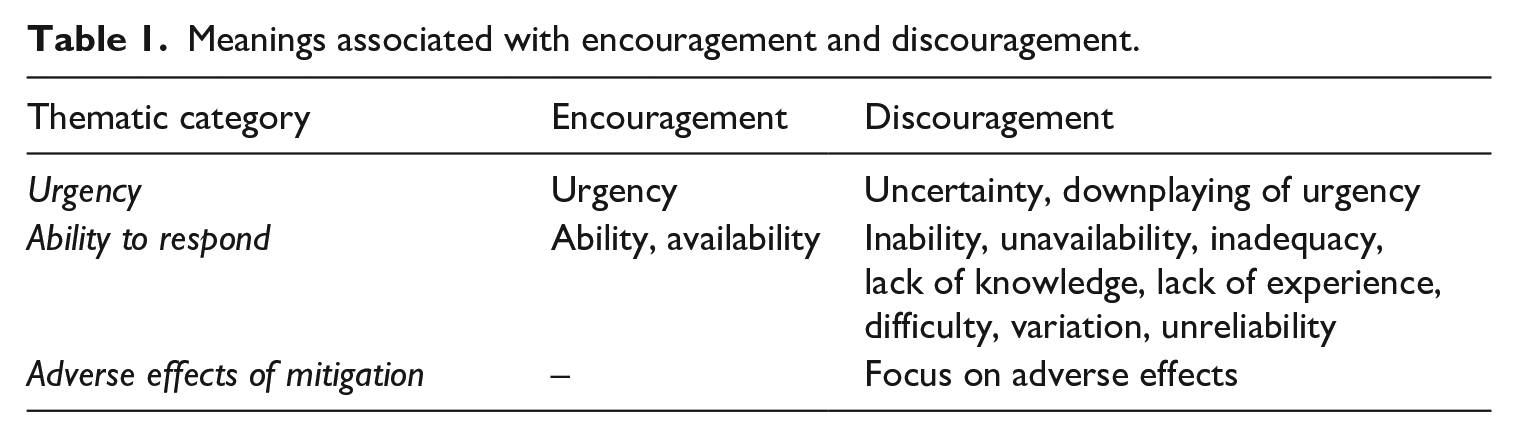
As demonstrated in Table 1 below, constructions in the thematic category of urgency categorised as contributing to encouragement were those that placed emphasis on the claim communicating
In the thematic category of ability to respond, optimistic evaluations of the tools and methods available for the planning and realisation of climate policy were considered as encouraging factors in the argumentation. These included the meanings of
Finally, floor given to the discussion of the potential adverse effects of mitigation can be considered as discouragement of action, as it justifies arguments to postpone mitigation. Neither of the examples in these categories denied or undermined the relevance of these adverse effects for policymaking in the emphasised but-clause. Instead, one of the examples reinforced the message of potential negative effects in the emphasised clause, and it was therefore characterised with the label
Table 2 below summarises the findings with an indication of number of occurrences in each thematic category as well as their argumentative orientation.
Argumentative orientation of instances – in numbers.
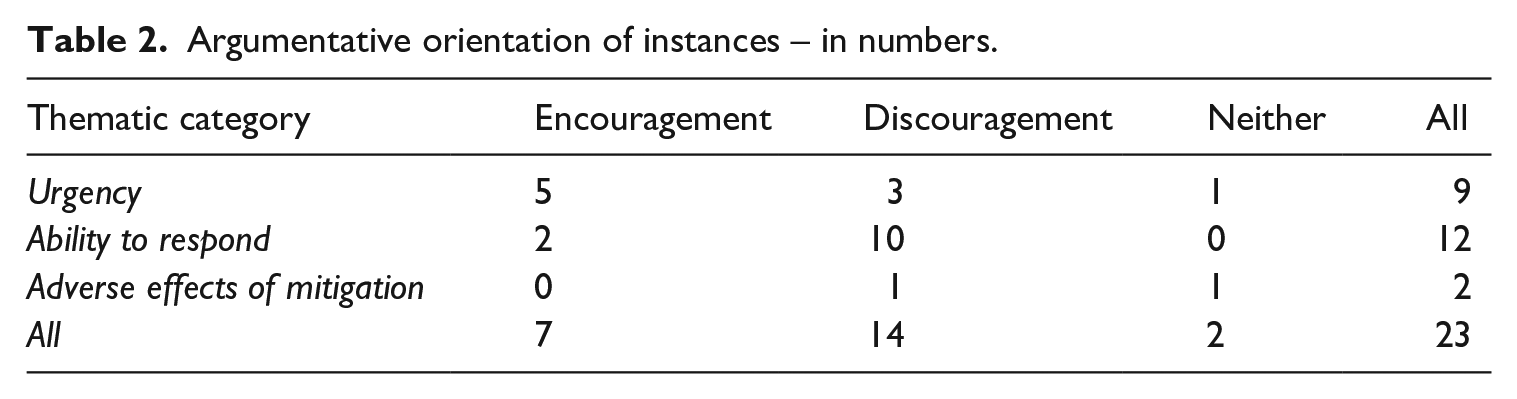
To summarise the findings, the instances demonstrate a rather inconsistent application of emphasis in the implicit contrastive argumentation in the Summary for Policymakers. Firstly, 10 out of 12 instances concerning our ability to respond to climate change place emphasis on the pessimistic view of the methods and tools available for climate action. Therefore, the majority of examples in this thematic category can be seen as orienting the argumentation towards discouragement for the policymakers to commit to climate action.
Similarly, contrastive polyphonic constructions with the polyphonic marker but do not contribute to a consistent message on the urgency of climate change. While five out of nine instances emphasise a conclusion associated with encouragement for climate action, three instances still place focus on the uncertainties in the current knowledge concerning the urgency of climate change or on the sufficiency of current level of ambition. Thus, they discourage more ambitious climate action. In the latter examples, the but-clause cancels or limits the argumentative force of the statement of urgency in the preceding clause. Therefore, the urgency is debated through polyphonic constructions with a subtle dominance of the constructions with an emphasis on the urgency of climate action. Nevertheless, almost as frequent are constructions in which an orientation towards uncertainties overrides the messages of urgency. Therefore, there is a lack of unanimous and clear emphasis on the urgency of climate change among these polyphonic constructions.
Similarly, the third thematic category of adverse effects of mitigation with two instances is divided between an instance with emphasis on the argument for the adverse effects of mitigation and an instance in which the emphasis is on the clause indicating uncertainty or variation in the negative impacts of mitigation. The findings will be discussed in more detail and in terms of their causes and consequences in the following section.
Concluding Discussion
The findings were interpreted in terms of their explanations and potential implications for future climate action. Possible explanations for the findings include the pursuit of external consensus, the pressures to maintain political credibility and the overarching influence of economic interest and pro-growth frames. Consensus approaches tend to lead to conservative outcomes (e.g. Hulme, 2009: 97) and the IPCC Summaries for Policymakers are produced under the influence of government representatives. Moreover, the overarching influence of growth economics may explain why uncertainties in the current knowledge, economic consequences and risks of mitigation receive the emphasis in many polyphonic constructions.
Regarding the implications of the findings, the argumentative structure of the polyphonic constructions may further contribute to impact scepticism (cf. Schmid-Petriet al., 2015) and offer policymakers strategies for avoidance of responsibility and delaying action. The communication of uncertainty in science advice may be used for political manipulation (cf. Stirling, 2010: 1029). This may be especially effective in supporting some of the discursive strategies used by populist parties – for example, Wodak (2003: 142) has introduced the term calculated ambivalence to describe the populist discursive strategy of discussing debated topics ‘in a way that allows for possible ambiguous interpretations and is open for at least two opposite meanings’. For such strategies, ambiguity in policy advice could be used as a resource. Furthermore, the inconsistency of the polyphonic argumentation has potential implications to both the credibility of the IPCC as an institution (ethos) and the rational part of its argument (logos).
The argumentative orientation of the majority of the polyphonic constructions to discouragement is likely to decrease the strength of message conveyed to policymakers concerning the precautionary principle and the need for urgent action. Furthermore, as policymakers are known to be biased towards avoidance of binding regulations prior to reading the Summary for Policymakers, the constructions are likely to assist in justifying this avoidance. Moreover, the polyphonic constructions can be demonstrated to legitimise the pursuit of infinite economic growth, and the associated prioritisation of economic goals over precautionary action to mitigate climate change. Claims about uncertainties in the current knowledge concerning the needed level of climate action are relevant arguments against precautionary mitigation efforts only if one evaluates the need for climate action on the basis of its costs. Thus, emphasis on the uncertainties over urgency helps to legitimate delays in action on the basis of economic arguments and therefore reinforces pro-growth frames on climate change as the socially valid ones.
IPCC’s discourse may, thus, be contributing to the maintaining of impact scepticism. In the end, it seems that the bias and excessive attention given to the uncertainties in the media and public discourse, demonstrated by previous research, may very well derive from the procedures and communicative practices of the knowledge assessment organisations such as the IPCC. Indeed, the findings of the present study correlate with the phenomena earlier detected in newspaper discourse and lobbyist campaigns, such as emphasising the conclusions based on the uncertainties and negative consequences of climate action (cf. Antilla, 2005; Boykoff and Boykoff, 2004; Oreskes and Conway, 2010).
One of the main conclusions of the discussion is that it is impossible for a text to be completely based on an objective presentation of facts. This is in line with Fiske (1994) and the main tenets in functional linguistics (e.g. Halliday and Matthiessen, 2014) and critical linguistics (e.g. van Dijk, 2015) on any instance of language not being neutral, thus language use always being political. In other words, regardless of the medium and the genre, the review procedures and consensual practices, there is always a level of subjectivity in play in any text. What is more, this subjectivity does reflect and reconstruct various types of interests being at play at the production (and consumption) of any text. For the analyst, such subjectivity can reveal values and ideological influences in the production stage of the text such as economic interests in the present case. The subjectivity of the IPCC report is partly due to the nature of the task it was produced for since whether we should invest in climate action based on uncertain future risks is a decision always subject to value judgement. From a critical discourse analytic point of view, every act of implying that we should not invest in climate action is denying future generations the opportunities to live rich and fulfilling lives in order to benefit those who are currently in power. Thus, implying that not investing would be the relevant argument for valid action in this context supports the current status quo and helps to benefit hegemonic groups who gain advantage of overproduction, overconsumption and global capitalism. Therefore, emphasising points of view undermining implicit conclusions of encouragement for action are inherently based on values of political and economic elites even though such discouragement is implicit and the values are not perhaps internalised explicitly by the IPCC.
In order to gain an even more thorough understanding of the way in which argumentativity in language contributes to the strength of the message in explicitly consensual reports and the reception of this message by policymakers, we suggest that future studies include multidisciplinary approaches combining linguistics, social sciences and psychology. The aspect of reception particularly requires contribution from psychological sciences. The present study has provided a starting point for such a multidisciplinary investigation by demonstrating the relationship between the linguistic marker but, its effect on the hierarchy of claims, as well as the themes and specific types of meaning communicated by these claims.
While there has clearly been progress in terms of communicating information about climate change to the publics, the present study has shown that orientation towards uncertainties in constructions of implicit polyphony in reporting about climate change continues to affect the argumentation of the most important authority delivering guidance to policymakers on the climate change issue. While the IPCC has historically had a major positive influence on the admittance of the anthropogenic character of climate change by decision makers and the publics around the world, its communication is still constrained by its dependency on governments’ recognition and cooperation. This influence will continue to be necessary in order to maintain the authority in the eyes of the policymakers. Nevertheless, increased disciplinary balance of the assessments, transparency of communicative practices, and acknowledgement of conservative bias can narrow the gap between the constrained, conventional and political role of the IPCC and its perceived status as a neutral, purely scientific and value-free organisation in the future.
Footnotes
Declaration of conflicting interests
The author(s) declared no potential conflicts of interest with respect to the research, authorship, and/or publication of this article.
Funding
The author(s) received no financial support for the research, authorship, and/or publication of this article.