



Abstract
Biodiverse ecosystems play a key role in maintaining life on earth. In response to rapid declines in biodiversity throughout the world, the UN Biodiversity Summit 2020 brought together world leaders to discuss potential solutions. We draw on cognitive linguistics, critical discourse analysis and ecolinguistics in analysing the summit contributions. All speakers blended vocabulary from the fields of BUSINESS and NATURE; in doing so, they were able to advocate solving biodiversity loss by implementing approaches commonly found in business. In addition, three main ‘moves’ were employed in these speeches: (i) the state of nature was lamented, (ii) the interdependent relationship between humans and nature was mentioned and (iii) a call to action was given. It is argued that relying on the BUSINESS–NATURE blend for solutions to environmental problems serves to maintain the status quo and may obscure pathways to transformational change. Linguistic strategies for more effective environmental communication are suggested.
Introduction
Human activity is increasingly driving significant biodiversity loss. Habitat destruction and land-use change are causing many species to occupy increasingly restricted ranges, causing ‘annihilation’ of many species and placing us in the midst of a sixth major extinction event (Ceballos et al., 2017; Jones et al., 2018; Mace et al., 2012). These losses have a negative impact on the functioning of the ecosystems in which they occur (Hooper et al., 2012)the long term effects of which are unlikely to be positive for the organisms themselves or the human societies which depend on them (Mace et al., 2012). Given the interconnected nature of socio-ecological systems, we need transformational change to reverse these losses in the natural world (McAlpine et al., 2015).
Transformational change requires more than tweaking of existing embedded systems, structures and policies. Given that the issue of biodiversity loss is closely linked to climate change (Bellard et al., 2012), it seems reasonable to hold current human systems and structures responsible. As such, both biodiversity loss and climate change can be considered ‘wicked problems’, that is, complex and interconnected problems to which there is no simple (or indeed no one) solution (Rittel and Webber, 1973). Instead, transformational adaptation is deep, irreversible change to the ‘paradigms and structural constraints [that] impede widespread and deep social reform’ (Pelling et al., 2015: 24). Such societal change is required to overcome the common view that humans should act in their individual interests rather than viewing themselves as part of an interconnected society and biosphere (McAlpine et al., 2015). Change is required at many levels, from events and behavioural patterns, to the underlying systemic structures and, indeed, the mental models which underpin our constructions of reality (Maani and Cavana, 2000). In order to enact widespread change, many of our ingrained notions about how the world works need to be challenged. In this respect, important insights can come from the fields of both cognitive science and communication (Aron, 2019).
Mental models in the form of frames play a role in determining how we think (Lakoff, 2010). They are schematic cognitive structures which represent all areas of human experience and are part of our conceptual structure. At a rudimentary level, words activate semantic frames, with their embedded structure of roles and relations, which people draw on in creating meaning (Fillmore, 2008). For example, the word ‘business’ elicits a ‘commerce scenario’ where a seller sells a product – a good or service – to a buyer in exchange for money (FrameNet Data, n.d.). However, lexical choice can activate different frames for the same situation, or within one frame, lexis can serve to construe that situation differently by profiling (highlighting) different elements (Langacker, 2008).
Where attention is directed within a frame can depend on the grammatical choices made in text or talk. Two of the most frequently discussed grammatical choices are nominalization and passivization: choices that can ‘mystify’ or remove the agent responsible for a particular action. For example, the nominalization ‘destruction’ indirectly conveys the role of an actor participant (the destroyer) acting on a receiver participant (the destroyed) (Fairclough, 2003; Stibbe, 2015). Similarly, passivization removes the do-er of an action from the sentence, or at least moves them from the sentence subject to a prepositional phrase (Hodge and Kress, 1993; Verhagen, 2012). As such, the stylistic choice to nominalize or passivize a particular construction may serve to reproduce a particular ideology (Hodge and Kress, 1993; Van Dijk, 2008).
A given frame may consist of several sources. Conceptual blending involves the linking and integration of temporary, on-line cognitive constructions that are created as we think or engage in language to produce meaning in a blended space (Fauconnier, 1997). As represented in Figure 1, this process takes elements of the initial or ‘input’ spaces, and combines them via a generic space – an abstract structure which formulates the common ground between the input spaces – to produce a new, emergent structure, the blend (Fauconnier and Turner, 2002). In ‘completing’ the blend, ‘background knowledge and structure’ are recruited from our long-term memory, but this information is selectively projected onto the blend (i.e. not all information from each input space is totally or equally represented). Therefore, the blend has emergent structure and properties which may not be present in either of the input spaces. Although input spaces are short-term constructions operating in working memory, blends can become entrenched over time, meaning that they can be drawn on in speech by members of a community (Fauconnier and Turner, 2002; Hart, 2008).
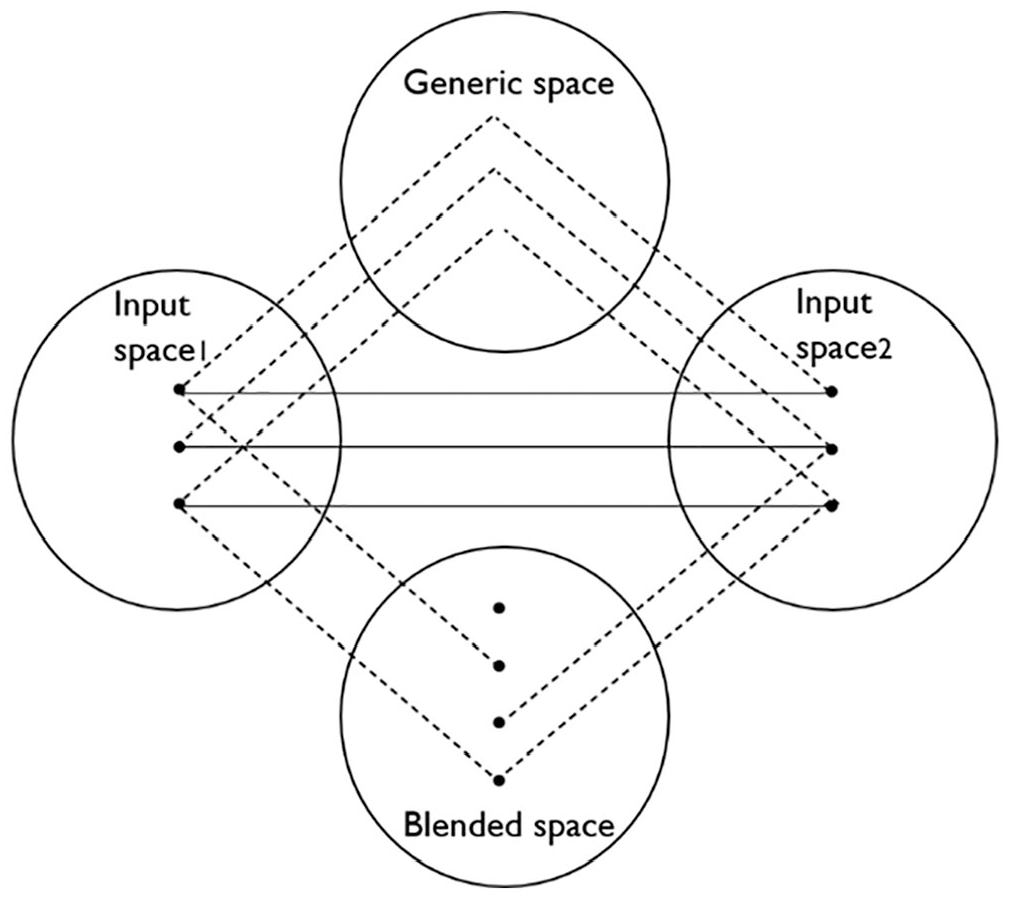
Representation of a basic integration network (adapted from Fauconnier and Turner, 2002: 46). The input spaces represent different frames from experience, while the generic space contains abstract concepts that are common to both inputs. The blended space is the emergent result of the combination of the inputs. Dots refer to concepts within the frame space, solid lines are mappings between the inputs, and dashed lines indicate the connection between concepts in the inputs and the generic and blended spaces.
In this paper, we describe and show evidence for a BUSINESS-ECOLOGY blend that has become entrenched in our conceptual structure and which could govern how we think about our relationship with the natural world. We propose that the model in Figure 2 accounts for this blend. The input spaces involve the domains of BUSINESS SYSTEMS and NATURAL SYSTEMS, and the generic space is structured by characteristics of systems in general (Meadows, 2008). These connectors (e.g. stocks, flows, feedbacks) are present in systems, but differ considerably between business and natural systems; however, the blend of the two systems is well represented in environmental economics literature (e.g. Kraev, 2002), models (e.g. Dafermos et al., 2017) and policy (Shaw and Nerlich, 2015). The conceptual blending of BUSINESS SYSTEMS and NATURAL SYSTEMS encourages us to treat natural entities as commodities to be utilized to achieve economic goals.
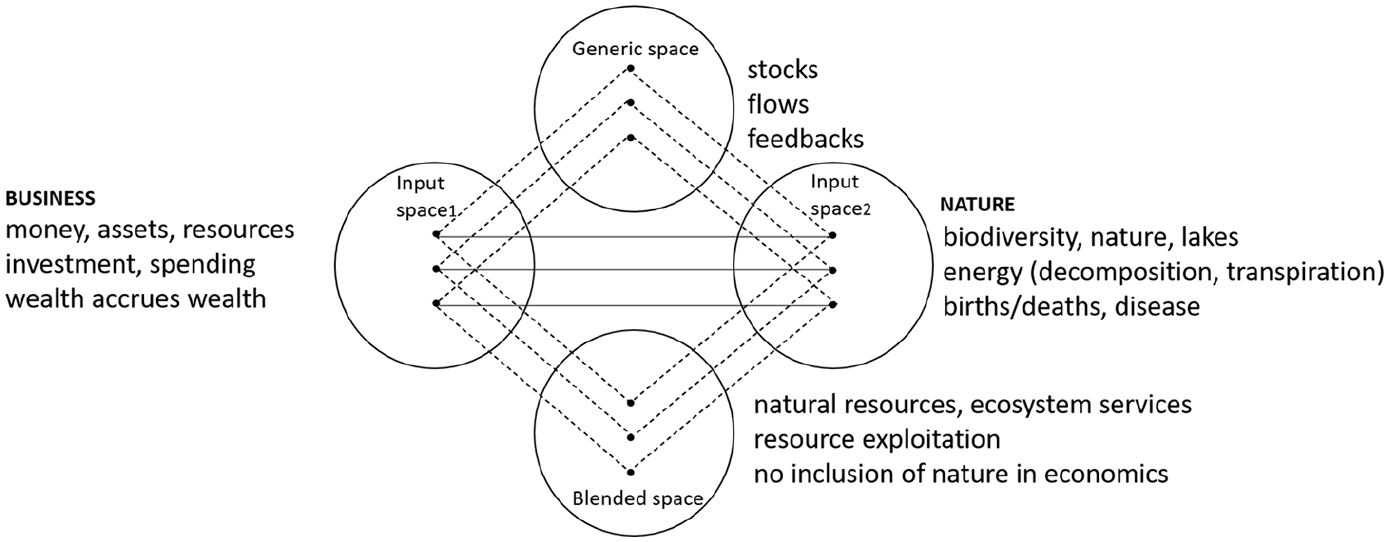
Representation of the blend of natural systems and business systems.
Previous work has considered elements of this blend in terms of metaphor. An often used term in ecological and environmental economics is natural capital, that is, NATURAL ENTITIES ARE ECONOMIC CAPITAL (Missemer, 2018). The metaphor has been criticized as ‘not hav[ing] rigorous foundations in economic theory and [not being able to] provide adequate economic measurements of what are supposed to be “nature’s assets”’ (Nadal, 2016: 79). Further confusion arises as the metaphor could be taken to refer to the income derived from or costs associated with a natural ‘asset’, or its substitutability for other assets as in the case of carbon or biodiversity offsetting (Sullivan, 2017). Use of this metaphor reinforces the anthropocentric ideology and disabuses the notion that nature has an intrinsic value (McCauley, 2006). By putting a price and therefore a monetary value on nature, we enable large companies to accumulate natural ‘assets’ in the form of land and/or resources, which is likely to result in displacement or destitution of indigenous and other economically poor communities. Despite being an imperfect metaphor, the term ‘natural capital’ is widely used in both policy making and business, and provides an example of the destructive potential of the BUSINESS-ECOLOGY blend.
The aims of this paper are to investigate: (i) the extent to which the BUSINESS-ECOLOGY blend introduced above influences the discourse of world leaders at the UN Biodiversity Summit 2020, and (ii) how current discourses surrounding nature and change are reproduced. We use research in cognitive linguistics, critical discourse analysis and ecolinguistics to analyse the discourses present. As language plays an important role in constructing social reality, this paper evaluates the current international discourse around biodiversity with a view to facilitating transformational change in thinking about biodiversity and nature in general. Suggestions for alternative framings in the discourse around biodiversity are made.
Methodology
Approach
This paper takes an approach which combines the fields of cognitive linguistics and critical discourse analysis (CDA). CDA investigates the ‘social structures of inequality [that] are produced in and through language and discourse’ (Lin, 2014: 214). The two fields have been frequently combined in the past, for example, in immigration and political discourse studies (Hart, 2011; Wang, 2019). Within cognitive linguistic approaches to CDA, metaphor studies have frequently been employed (e.g. Charteris-Black, 2006; Ezeifeka, 2013; Musolff, 2012), and recently, Hart (2008, 2011) has also applied theories of force dynamics (Talmy, 1988), and conceptual blending (Fauconnier and Turner, 2002) to CDA studies.
Given that this current research focuses to a large extent on environmental discourses, research from ecolinguistics is also particularly relevant. One branch of ecolinguistics studies the socio-ecological use of language in spreading stories that may be harmful or beneficial to the natural world and humankind’s place within it (see Stibbe, 2015). CDA has been used to a large extent in ecolinguistic research and is a useful tool for ‘questioning the stories that underpin our current unsustainable civilisation. . . . These are . . . discourses, frames, metaphors and, . . . clusters of linguistic features that come together to convey particular worldviews’. (Stibbe, 2014a: 117). By investigating the use of frames and micro-level linguistic features within the texts, it is hoped that the discourses and the ideologies which underpin them can be identified.
Data: The UN biodiversity summit
The UN Biodiversity Summit 2020, held on 30th September, represented an attempt to highlight:
the connections between biodiversity, societies and economies. . . [;] the opportunities and priorities for action to tackle the causes of biodiversity loss and for integrating action on biodiversity for sustainable development into key sectors. . . [; and] ways and means to support accelerated biodiversity action, including through harnessing science, technology and innovation, strengthening capacity-building, and enhancing access and benefit-sharing, financing and partnerships for biodiversity. (UN, 2020)
A sample of the texts and speeches from this conference formed the basis of our analysis in terms of a corpus. This summit was chosen as the subject of our analysis because it represented, at the time of the research, the most recent conversations that were ongoing between the most influential world leaders on this topic.
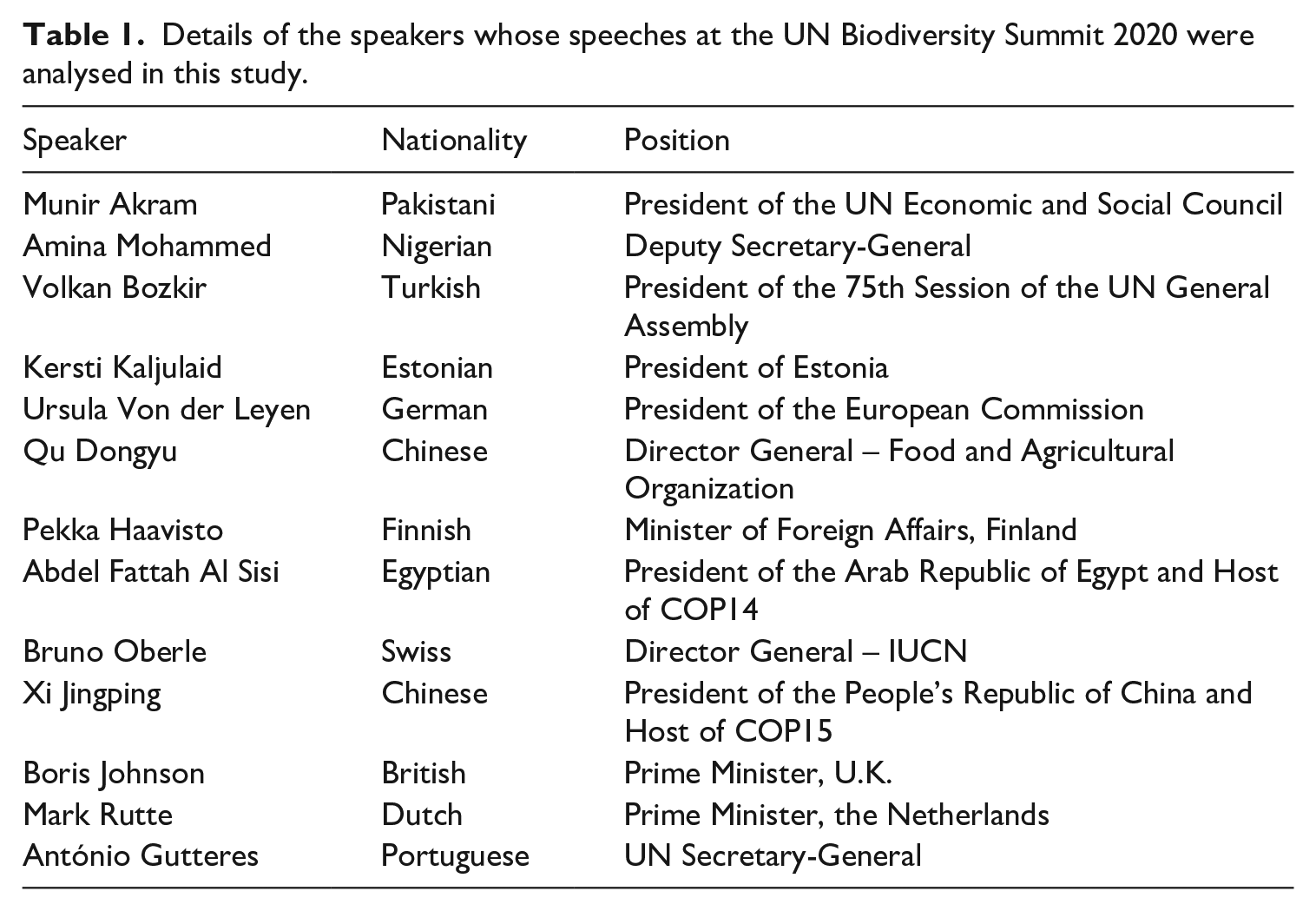
The following texts were analysed: (i) the information about the conference on the UN website (UN, 2020) (ii) 13 speeches by world leaders as shown in Table 1 and (iii) the final summary report of the conference. These 13 speeches were accessed by entering ‘UN Biodiversity Summit 2020 speech’ into Google. A range of speakers from different countries and organizations was represented in the analysis. The 13 speeches were transcribed (where no transcription was available) and, along with the other two texts, entered into MAXQDA (VERBI software, 2019).
Details of the speakers whose speeches at the UN Biodiversity Summit 2020 were analysed in this study.
Data analysis
Two distinct coding processes were employed. In the first, each sentence that included lexis from the domains of NATURE ONLY (e.g. nature, biodiversity, animal and plant species), BUSINESS ONLY (e.g. negotiations, finance mechanisms) and the BUSINESS-ECOLOGY blend (e.g. ecosystem services, nature-based solutions) was coded by the first author, and the total numbers of each sentence type were summed. The speeches were then coded blind by the second author for the same categories, and any differences between the two (these were minimal) were discussed and resolved. The aim of this step was to standardise the coding lexical items from NATURE and BUSINESS. Sentences were categorized as NATURE ONLY if they did not include lexical items from the field of business, and vice versa. Sentences which included lexis from both domains were categorized as BUSINESS-ECOLOGY. As much research in CDA has discussed the use of nominalizations in removing the main actor in a sentence and as such changing the element of the sentence that is highlighted (Hodge and Kress, 1993; Kazemian and Hashemi, 2014), all nominalized verb and adjective forms were counted.
In the second coding process, all texts were inductively coded for construal of nature and the environment following a grounded theoretical approach (Bryman, 2016). This involved coding and recoding the 13 speech texts multiple times based on their content, and iteratively recoding and updating the codes until the analysis was ‘saturated’ – no new codes came to light. The introductory information on the website and the final summary report were then coded in the same way. Examples of some of the codes used during this portion of the analysis were: ‘nature is a resource’, nature needs human intervention in order to prosper’ and ‘nature is a business commodity’. At this point, micro-level linguistic analysis of the texts was performed, taking a ‘bottom-up’ approach based on the linguistic checklist for stylistic analysis proposed by Leech and Short (2007; Ch 3). Linguistic features (e.g. complexity, abstractness, etc. in lexical and grammatical categories) that corresponded with the coded categories were recorded throughout all the texts.
Results and discussion
The BUSINESS–ECOLOGY blend
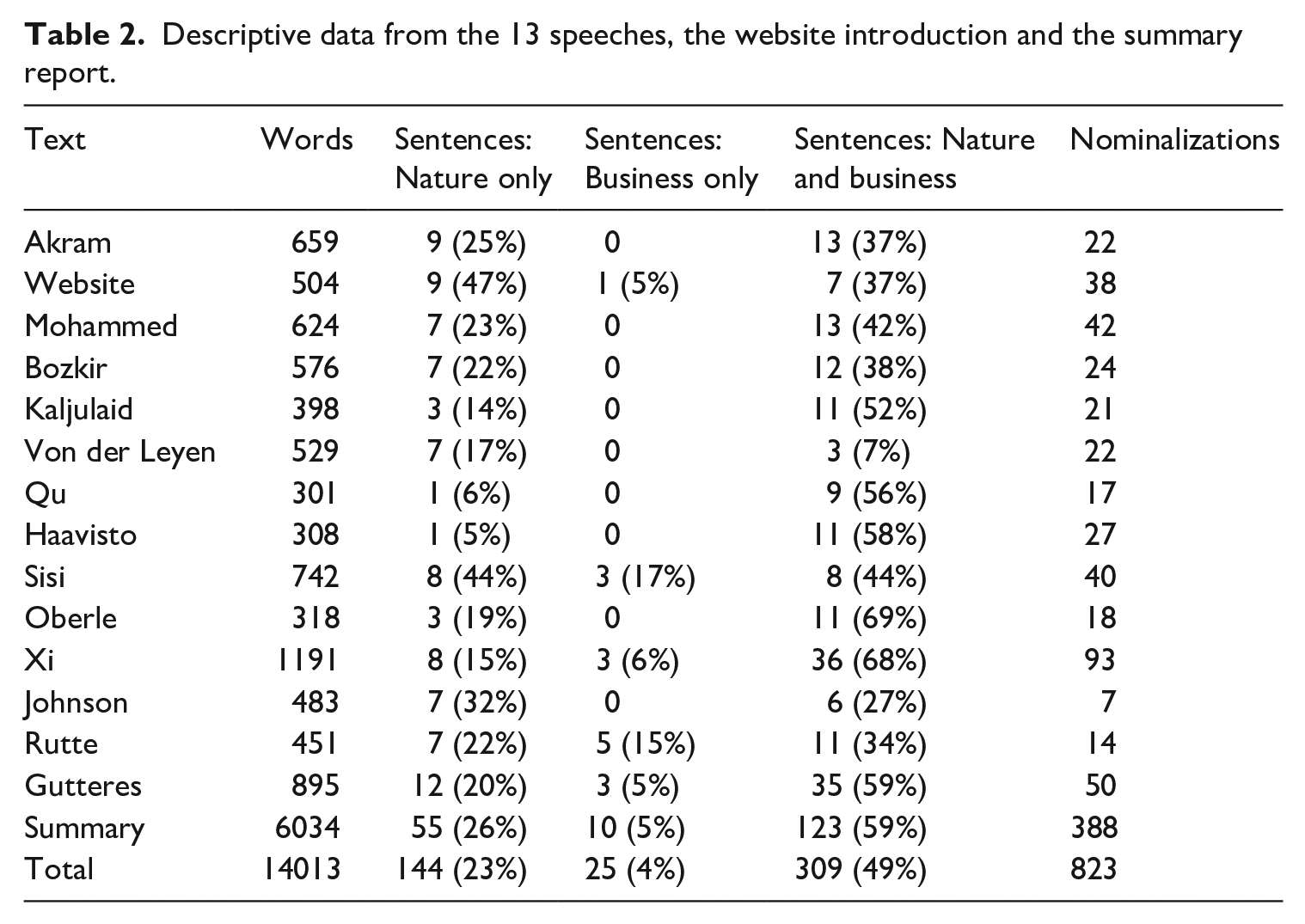
Vocabulary from the domains of BUSINESS and NATURE frequently occurred within the same sentence in the website text, speeches and summary (cf.Table 2). Twenty-two percent of the sentences on the website, speeches and summary report contained NATURE ONLY lexis, 2% contained BUSINESS ONLY lexis and 46% contained lexis from both the domains of NATURE and BUSINESS (i.e. the BUSINESS-ECOLOGY blend).
Descriptive data from the 13 speeches, the website introduction and the summary report.
In order to demonstrate the existence of the blend, it is first necessary to show that speakers are drawing on the source domains introduced above: BUSINESS and NATURAL systems. Table 3 shows examples of sentences from each speaker in which lexis from both domains is present, but the concepts are clearly separated. Many of these speakers separate lexis from BUSINESS and NATURE into different clauses or phrases; others combine them using the conjunction ‘and’ to indicate that they are viewed as separate entities.
Examples of how each speaker separates the concepts of BUSINESS and NATURE within sentences where both concepts are present. Some phrase-level blends are presented here (e.g. managing nature, nature-based solutions), but not explicitly highlighted in this section.
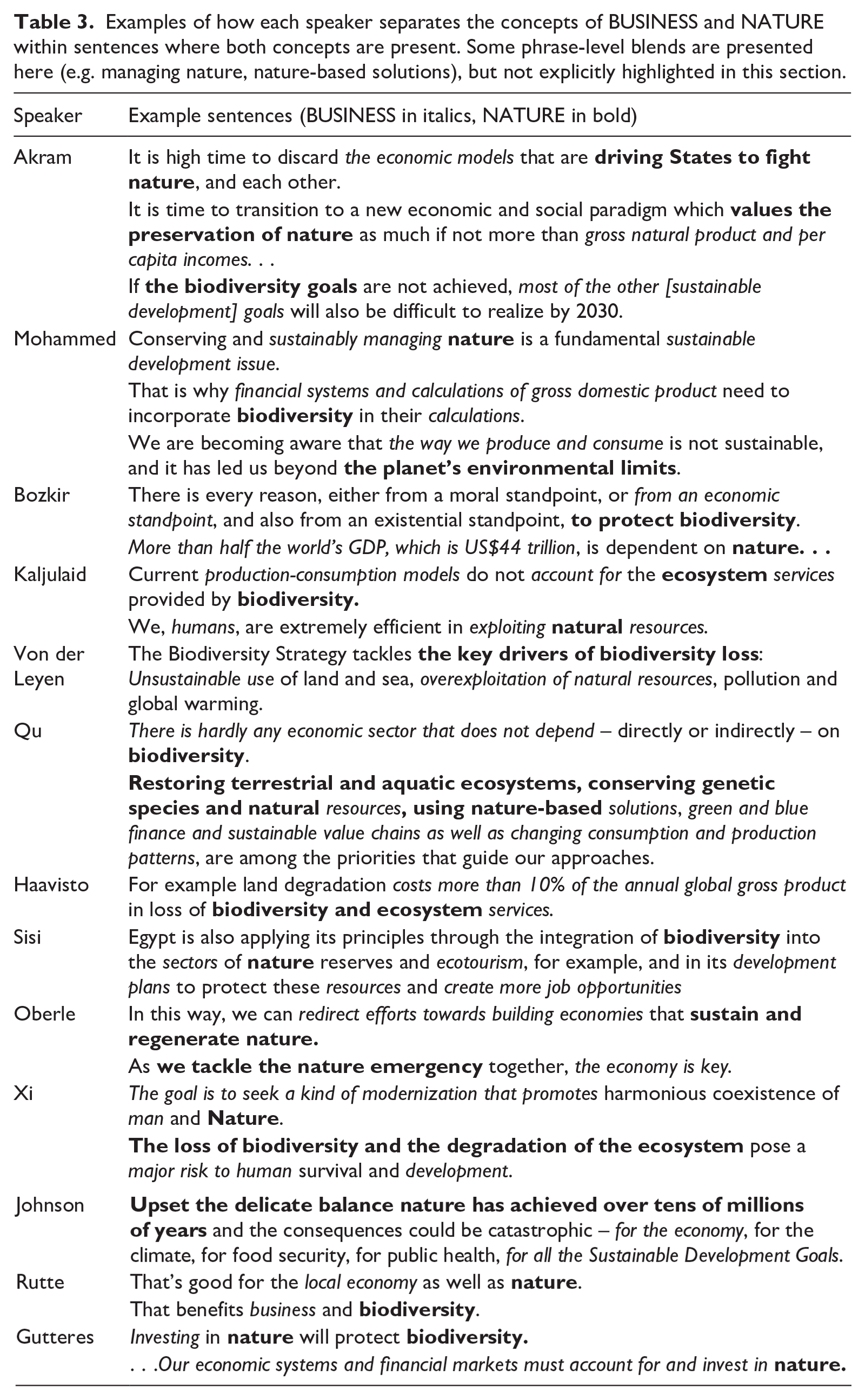
Despite all speakers recognizing the distinctness of BUSINESS and NATURE, the combination of lexis from both domains was apparent at both the sentence and the clause levels, for example (BUSINESS is represented in italics, NATURE in bold):
(1) More than half the world’s GDP, which is US$44 trillion, is dependent on (2) As we tackle (3) We need to . . . coordinate economic development and (4) In the Netherlands, [the financial] sector is developing ways to measure the impact of investment in
In (1), nature is related to GDP, an economic term, which is explicitly given a dollar value. In (2), nature and the economy are separated in different clauses, but mention of the ‘nature emergency’ is included in the subordinate clause whereas ‘the economy’ is the subject of the independent clause. In addition, ‘the economy is key’ occupies the stress position in the sentence, enhancing its salience. In (3), ‘ecological protection’ and ‘economic development’ are aligned in one clause, while in the second clause, the words ‘work’, ‘build’ and ‘prosperous’ from the domain of BUSINESS are prerequisites of a ‘clean and beautiful world’. (4) discusses the financial sector, and uses words such as ‘developing’, ‘measure the impact’ and ‘investment’ in the context of ‘biodiversity’.
Nature and business were also combined at the phrase level to form concepts which emerged from the BUSINESS-ECOLOGY blend. Such noun phrases included: ‘nature-based solutions’ (22 mentions), ‘ecosystem services’ (8 mentions), ‘Biodiversity Framework’ (28 mentions) and ‘biodiversity targets’ (10 mentions). Resources were mentioned 21 times in a non-financial context; these were ‘natural’, marine’ and ‘genetic’. In addition, one speaker even mentioned the ‘net gain’ of ‘biodiversity’ (Oberle). Overall, nature-related nouns (and their adjective forms) were combined with a wider variety of lexical items from BUSINESS – including verbs (e.g. invest, account for, disclose, charge for), nouns (e.g. targets, the bottom line, subsidies, solutions), and adjectives (e.g. measurable, financial, industrial), among others.
Discourses around nature and change
From the second, inductive coding process, three main ‘moves’ were identified in the texts: (i) lamenting the state of nature, (ii) stating what nature can do for us (i.e. giving reasons to protect and preserve nature), and (iii) invoking action frames which consisted of either what has been/will be done, or what ‘must’ be done. All three moves were present in almost all texts (with the exception that one text did not contain move (i), and one text did not contain move (ii)).
Lamenting the state of nature
Environmental issues are mentioned in all texts, but these were mostly nominalized (e.g. biodiversity loss, soil/land/ecosystem degradation, deforestation, climate change, species extinction). Indeed, 6% of all words were nominalizations. There are many reasons as to why nominalized forms may be used (see Van Dijk, 2008 for a detailed overview), explaining many of the nominalizations here (e.g. the nominalized form is the ‘preferred’ form as in ‘extinction’ and ‘climate change’). One reason is the desire ‘to hide or downgrade the responsible negative agency of ingroup agents’ (p. 827). Human activity is the driver behind much ‘loss of biodiversity’ or ‘ecosystem degradation’ in the form of agricultural intensification, habitat fragmentation and economic inequality (Krauss et al., 2010; Marques et al., 2019; Mikkelson et al., 2007), and many government and inter-governmental policies (e.g. subsidies for agriculture and destructive industries such as fossil fuel companies, relaxing of environmental regulations, prioritization of economic growth over wellbeing) have contributed to promoting such activity (Asafu-Adjaye, 2003). The use of nominalized forms would serve to remove human and indeed governmental agency from many environmental issues. Indeed, the agents responsible for environmentally destructive activities were frequently represented as process nouns (e.g. overconsumption, overfishing, habitat destruction). In some cases, humans were positioned as senser, distinct from the phenomenon unfolding, as in (5) and (6). In (7), even the human senser is removed in the passivization of the structure. This suggests that we are observers rather than the direct (and indirect) causes of this ‘decline’ (NB from this point on, bold face is added for emphasis):
(6) Climate change and biodiversity loss are happening (7) Such impacts of biodiversity loss and degradation
Only one text – the UN summit website – used verbs rather than nominalizations to describe biodiversity: ‘. . . when we destroy and degrade biodiversity, we undermine the web of life. . .’, thus directly attributing responsibility to humans for our actions.
Verb use also had the effect of removing human agency from environmental issues. Progressive aspect is used to state that X is happening, often without attribution, as in (6) and 8–12. (12) even uses passive voice, further removing human agency from the action.
(8) . . .climate disruption, from devastating wildfires to record floods, (9) Biodiversity (10) . . .the natural life that so enriches our planet today (11) Wildlife populations (12) Biodiversity is invaluable, and it
Other speakers used present simple (active or passive) (13–15) or low modality forms (i.e. hedging) (16) to express the same concepts.
(13) Every year, 13 million hectares of forest (14) The loss of biodiversity (15) At present, there (16) climate change
All of these forms remove human responsibility from the process of environmental ‘degradation’ and destruction by erasing the responsible agent (Stibbe, 2015: 149).
‘Nature-based solutions’ were framed as ‘tools in our fight to solve the climate crisis’ (Gutteres). Here, the use of the possessive ‘our’ as a determiner for ‘fight’, but ‘the’ for ‘climate crisis’, distances humanity from climate change, viewing it as an adversary, but not one of our own making.
Stating what nature can do for us
A common theme that recurred throughout almost all texts is the interdependent relationship between humans and nature. In general, this relationship was constructed as being troubled and in need of ‘repair’ although there was some variation in the exact positioning of the relationship. The degree of connection between humans and nature varied, ranging from interdependence to interconnection:

Our dependence on nature was indexed using a variety of lexis. Indeed, the stem depend* was mentioned 21 times, of which the majority (19 mentions) referred to dependence of humans and human systems on nature and biodiversity of various types (e.g. sentences 17–20). The phrase ‘intimately linked’ used in (17) and (18) constructs a close relationship between humans and nature/biodiversity.
(17) Our societies are (18) Our societies are (19) There is (20) COVID-19 reminds us of the
This interdependence was also indexed using words such as essential, interconnection, to rely on, reliance, to need and to affect, although each occurred less frequently than depend*. Language in the summary report was graded to reflect more of a connected but not necessarily dependent relationship. For example, the words link and connection were used more frequently to describe the relationship between humans and nature in the report than the speeches. Despite this, depend* was mentioned five times in the report in the ‘we depend on nature’ context.
Several speakers mentioned that nature is dependent on humans. This was framed in light of the finance and/or political will that ‘biodiversity’ or ‘nature’ needed in order to survive. This was sometimes directly stated (e.g. ‘
Dependence was also invoked indirectly by stating the need for biodiversity targets, frameworks, or goals (all terms from the business domain discussed above). Sentences (21) and (22) demonstrate this phenomenon.
(22) Third, we must secure
Sentence (21) uses vocabulary normally associated with the business domain, mentioning ‘investment’ and the need to ‘leverage the achievement of biodiversity targets’ alongside ‘economic benefits’. A similarly unspecific phrase is ‘secure the most ambitious policies and targets’, used in (22). This operates on the assumption that implementing policies and targets is sufficient for preventing further widespread destruction of habitats. However, other speakers state that this approach has not been effective (sentences 23 and 24), a position backed up by the literature (e.g. Díaz et al., 2019).
(23) Despite ambitious targets and agreements made at the global and regional levels since the Rio Convention,
These conflicting positions reveal that there is a great deal of uncertainty about how best to aid restoration of habitats and by extension, biodiversity, assuming of course, that biodiversity restoration is the actual goal of the speakers, and not merely a political soundbite. This forms the basis for the third ‘move’.
Invoking action frames
The call to action by the speakers centred around several core themes. First and foremost, nature would be applied and incorporated into existing business models. Emergent concepts in the blend such as ‘green development’, ‘green recovery’ and ‘nature-based solutions’ were commonly used to index this position. Indeed, the adjective green was commonly used in a business context (17 mentions). The words behaviour and reset were the only non-business collocates with green in the speeches and the summary report. The word sustainable was used more frequently (75 mentions), and also collocated with many terms from the domain of business, such as value chains, economy, development and management practices (see Figure 3 for full details of collocations).
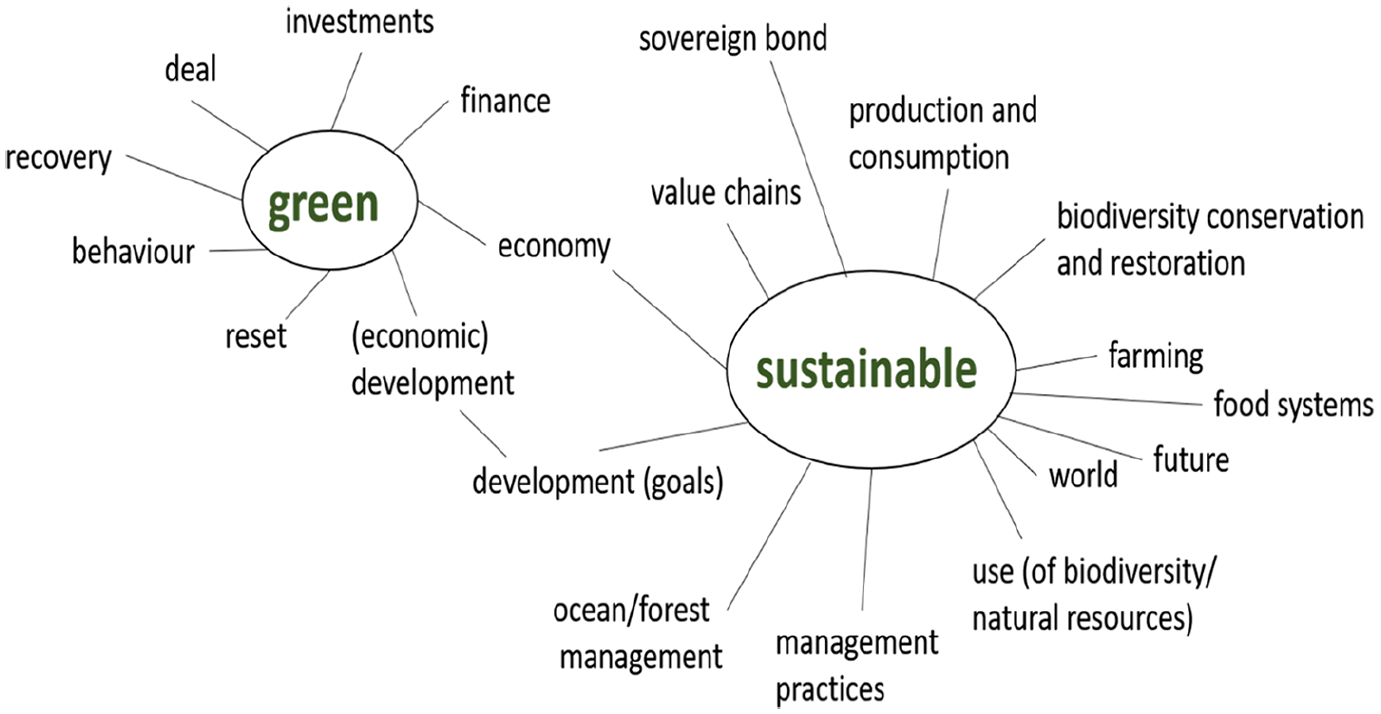
Collocations of the words green and sustainable in the analysed texts.
Yanarella et al. (2009) distinguish between the terms green and sustainable. They claim that green is used somewhat superficially to describe ‘practices [that] are ideologically safe [and] that do not fundamentally disturb the driving forces of economic growth and corporate profit-making’ (p. 296); on the other hand, sustainable is said to represent a more thorough rethinking of the systems, behaviours and processes involved in maintaining ‘triple bottom line’ of environment, economy and society (Yanarella et al., 2009). Our data suggest that there is certainly some overlap between the current usages of both words in this current discourse in describing business systems and processes (Figure 3). By adopting the BUSINESS–ECOLOGY blend discussed above, both words are used predominantly in ‘ideologically safe’ (p. 296) ways that do not seriously challenge the status quo. After all, whether green or sustainable, economic development presupposes existing economic models rather than reimagining the systems in which these models operate.
However, some speakers did refer to a different type of change: transformation. The stem transform* was mentioned 11 times in total, including twice in the website introduction, and three times in the summary report. Mohammed and Guterres both mentioned transforming our relationship with nature, while two speakers went one step further:
(26) It is high time to discard the economic models that are driving States to fight nature, and each other.
Qu (25) uses the pronoun ‘we’ to give humans agency in the transformation. He then uses the emotive adverb ‘radically’ to describe the type of transformation needed, and by mentioning both ‘economies and behaviours’, it is suggested that this change should be both top-down and bottom-up.
Akram (26) calls for complete change of the current economic system. While not using the word transformation, he instead uses transition, a somewhat weaker term, to describe a change in paradigm. Despite the use of BUSINESS-ECOLOGY blended vocabulary (e.g. ‘. . . values preservation of nature’, ‘gross national product’, ‘per capita incomes’), business as usual is given equal or less weight than nature preservation. It is also important to note that Akram was speaking in his role as President of the UN Economic and Social Council, a position which oversees the organization’s economic policy recommendations to member states. By challenging the dominant economic paradigm, Akram opens up discussion of other economic models which could replace current globalized capitalism.
The third theme was ‘working together’. This was invoked on many levels – international, national, societal and human with nature, by drawing on lexis from business and politics such as targets, frameworks and multilateral cooperation. The need to live ‘in harmony with nature’ was mentioned 14 times, the bulk of these by Xi and the summary report. Other lexis which indexed ‘working together’ was cooperation (10 mentions), multilateralism (14 mentions), join (7 mentions), coalition (7 mentions) collaboration (2 mentions) and together (14 mentions).
(28) It falls to all of us to
For example, sentences (27) and (28) highlight use of the word together to underline that the issues facing life on earth are impossible to solve alone. Interestingly, leaders of more developed countries (e.g. the U.K., the Netherlands), while mentioning international cooperation and working together, emphasized the concrete actions that they had taken. On the other hand, leaders of developing countries (e.g. China, Egypt) spoke in more depth about ‘differentiated responsibilities’ based on current levels of development.
Restoration and conservation of ecosystems was the final theme represented by many speakers. However, there was considerable overlap between ecosystem restoration and the benefits business could derive from increased biodiversity. This overlap stems from the BUSINESS-ECOLOGY blended space discussed above and highlights the dangers of employing market-based logic in environmental problem solving (Gómez-Baggethun et al., 2010). McCauley (2006) suggests that putting a price on nature is disingenuous because markets move in response to demand; therefore, a commodity can lose value if demand decreases or if a technological solution to an issue can prove to be cheaper than the value of the ecological ‘resource’. As such, the market would then decide on the necessity for conserving or restoring a given ecosystem, thereby reducing the fate of natural systems to financial decisions. It has become apparent that large scale conservation requires ‘interventionist’ governments to counter market-driven reductions in natural ‘resource’ value, which also runs against neoliberal economic ideology (Adams et al., 2014).
General discussion
In general, speakers and texts at the conference used a limited range of constructions to reduce human responsibility and agency in construing the current situation regarding biodiversity. Nominalization has been frequently discussed as playing a role in removing agency (e.g. Fairclough, 2003; Stibbe, 2015), and indeed, most speakers used this strategy in lamenting the state of the environment. However, a less studied form, the present progressive, was also used in this sense. Treating biodiversity as a singular entity enabled speakers to treat the decline or extinction of species as a single event (i.e. biodiversity is decreasing vs many species are dying). This has the effect of simplifying a complex situation; after all, a wide variety of human activities are responsible for reducing biodiversity, from intentional destruction such as deforestation or land clearing for agriculture, through the indirect ‘externalities’ of mining or oil extraction, to unintentional consequences such as climate change-mediated coral extinction. It is impossible to fully represent the complexities involved in large-scale, anthropogenic species extinction, but using present progressive in an iterative rather than a singular form draws more attention to its repeated nature (de Wit and Brisard, 2013). We suggest that framing biodiversity as a plural noun (e.g. animals, organisms, species) would enable the use of the iterative present progressive and might give people more perceived agency in preventing its decline. After all, the perception of exercising control over a situation has been shown to be a predictor of behavioural change (Ajzen, 1991; van Valkengoed and Steg, 2019). In addition, Stibbe (2014b) argues that the use of the word ‘biodiversity’ is in fact a hypernym for natural organisms, and its use involves the erasure of the organisms themselves. Indeed, as ‘biodiversity’ is a super-ordinate category, use of more basic-level category words (i.e. naming animal species) may be more effective in evoking frames or mental image schemas (Rosch et al., 1976). A more concrete representation of a natural entity may evoke more vivid image schemas which in turn may promote action on environmental issues.
We draw on a variety of frames in every communicative interaction, and as such, the frame that we use can play a role in structuring how we perceive and respond to a particular situation. Framing nature and biodiversity in terms of the economic benefits that humans can derive from them could have ethical implications. For example, the term ‘ecosystem services’, ‘frames the relation between humans and nature as an economic exchange relation, implying the equivalence and substitutability of services that are of similar value for people’ (Opdam et al., 2015: 224). As market-based capitalist systems are based on efficiency, there is the danger that if an artificial solution to a problem currently being solved by biodiversity becomes available for a lower cost than current conservation measures, the political will to protect a particular area or habitat may vanish (Luck et al., 2012). Commodifying nature in such a way emphasizes the monetary value rather than the intrinsic value of an organism or an ecosystem (McCauley, 2006). However, Sandifer et al. (2015) have shown that having a strong connection with nature can significantly benefit human health. As the human-nature relationship is important for our health and well-being, commodification, which undermines the unique essence of this relationship, only serves to distance humans emotionally from nature (Luck et al., 2012).
Recommendations
Of course the goal of a given speaker may also determine the linguistic choices that they make. Many leaders may actually advocate implementing the nature-business blend because this fits in with their political agendas. However, the recommendations below aim to promote discourse around biodiversity that extends beyond shallow environmentalism, or environmentalism only when a business case can be made, that is so common in international communication on the issue. These recommendations are:
(i) Lexis from the domain of BUSINESS should be avoided when describing natural processes and solutions to environmental problems. Within this, forming compounds using words from both domains (e.g. ‘ecosystem services’, ‘nature-based solutions’, ‘green finance’) should not be promoted.
(ii) Active verbs and nouns should be used instead of passives and nominalizations where possible. In doing so, the do-er of an action can be placed in the subject position in active sentences. If the do-er has been erased in the source sentence, they can be added through the process of re-minding (Stibbe, 2014b).
(iii) When referring to ongoing actions, a plural noun can be used as the subject where possible, and the use of the word ‘biodiversity’ minimized.
For example: Biodiversity is declining > The number of animal 1 species is declining > Animal species are declining > Many animals are dying out > Human actions are killing many species of animals > We are killing many species of animals, from bees to bears.
In the above example, the abstract nominalization ‘biodiversity’ is replaced by the hyponyms ‘animals’, and then ‘bees’ and ‘bears’. The abstract ‘declining’ is changed to ‘dying out’ and then ‘killing’ as human agency is increased by adding a human subject. With this, the verb changes from an intransitive verb to a transitive form, and the direct object of the action becomes explicit (Andrews, 1985). While these sentences basically represent the same idea, the phrasing and detail of the ‘end-product’ give a more complete and accurate account of the processes that are occurring. Further research will investigate the effects of these changes in phrasing on conceptualization of nature and behaviour.
Conclusion
In conclusion, the discourse of the UN Biodiversity summit 2020 centred around a conceptual blend of BUSINESS SYSTEMS and NATURAL SYSTEMS. This blend was present in all summit contributions analysed in this study, and contributed to the ideological basis of proposed solutions. Three main moves were present in nearly all texts analysed. First, leaders lamented the state of nature, biodiversity and ecosystems worldwide; however, they did so whilst using nominalized forms which served to avoid attributing human responsibility for the destruction. The second move involved stating what nature can do for us. The relationship between humans and nature was clearly portrayed as one of dependence and interconnection. The function of this move seemed to be to convince those watching of the need for change. However, the mechanisms proposed in move three were mostly tweaks to business as usual, albeit with some mention of transformational change, and as such, most leaders fell short of recognizing the real scope of the issue. Move three frequently drew on the NATURE–BUSINESS blend in presenting these solutions; the emphasis of many leaders on market-based solutions, albeit with a hint of ‘nature added’, risks grounding the conversation in incremental rather than transformational solutions.
In blending BUSINESS SYSTEMS and NATURAL SYSTEMS, we entrench the position that the market is able to adequately determine the fate of all organisms. It is unclear what happens to those organisms who do not contribute to ‘ecosystem services’, or indeed act against human interests. Given that great efforts are put into eliminating insects or plants that we deem to be pests or weeds, the outlook for such species is far from optimal. De-emphasizing the BUSINESS-ECOLOGY blend so prevalent in such discourse would enable a more ecocentric perspective in communication. We can employ linguistic strategies which focus on choosing appropriate lexis, using active verbs and other techniques which increase human agency in combating ecological disasters. Incorporating such strategies within communicative output should become a priority for the environmental movement and world leaders alike.
Footnotes
Acknowledgements
The authors would like to thank Prof. John Hoeks and Dr. João Graça for their comments on the initial manuscript.
Declaration of conflicting interests
The author(s) declared no potential conflicts of interest with respect to the research, authorship, and/or publication of this article.
Funding
The author(s) received no financial support for the research, authorship, and/or publication of this article.
Notes
Author biographies
The lead author,