



Abstract
Populist leaders and their radical policies attract the interest of the media across borders. The aim of the current article is to uncover whether interviews centered on one populist leader, but involving interviewers located in different European countries, lead to the same production of populist equivocation across the EU. In addition, two types of journalistic elements that can explain potential differences are investigated: the broad interactions between the media and politicians in a given country, or the reporters belonging to a specific media segment such as the tabloid press or public broadcasters. The research is based on interviews given by Viktor Orbán during the 2019 EU election campaign. Critical discourse analysis is carried out to investigate the equivocal populist narratives produced.
Introduction
The analysis of political interviews has helped us to grasp situations of equivocation, meaning forms of communication characterized by contradictory, ambiguous, and even evasive content (Bavelas et al., 1990). These situations can occur during communication conflicts, where any answer to a question can have negative impacts for the respondent and his or her allies. It supposes an attitude on the part of reporters potentially keen to be adversarial, and a greater or lesser ability or willingness on the part of politicians to offer answers protecting themselves, their parties, and significant others (Bull, 2008). The professional norms of political journalism potentially leading to this equivocation have been researched from an international perspective (Kleis Nielsen and Kuhn, 2014), sometimes with a focus on the reporters’ attitudes toward populist politicians (Hanitzsch, 2011). Populism is an ideology, a political style, and a genre of discourse, the structural aspect of which involves contrasting a negative, internationalized, and conspiring elite on the one hand, and on the other, a positive, national/regional, and sovereign people threatened by the policy of this elite and multiple others, such as minority groups or international public bodies (Rovira Kaltwasser et al., 2017). Reporters might have been keen to interview populist leaders based abroad, because of the sensationalist dimension of their answers and their attitudes toward international public bodies, which can also include the state authorities where journalists are based. This was especially the case in Europe during the EU elections.
What can a comparative analysis of interviews between a populist leader and reporters targeting different national audiences tell us about the construction of equivocation by populist politicians in Europe? We are not fully aware whether there are a relatively homogeneous set of questions on given topics that lead to an equivalent set of equivocal answers produced by populist stakeholders. We do not know if the traditional division of commercial and tabloid media (viewed as relatively open to populist ideas) versus public and elite media (relatively critical of these ideas), leads to some structuring differences when populist leaders are interviewed at the EU scale. It is suggested that interviews involving one populist leader and reporters located in different European states will give rise to multiple equivocal populist discourses; differences expressing the intertwined and institutionalized relationships between journalism and politics within a given nation state where the reporters are located. Following a review of the literature on political interviews, equivocation and populism in the media – with a focus on European trends – the argument, the methodology, and the case study are detailed. The results are structured in two parts, revealing the main distinctions concerning the narratives produced during interviews with Viktor Orbán, the Hungarian prime minister and leading figure of European right-wing populism, during the 2019 EU parliamentary election campaign.
Populism in the media: Trends and the interactional processes in Europe
The narrative and rhetoric used by interviewers display two attitudes in tension: neutrality and adversarialness (Heritage and Clayman, 2010). This neutrality is generally based on the use of third-party sources (often termed as ‘footing’), and on the avoidance of linguistic tokens suggesting a preference. However, neutrality is usually balanced by a certain degree of antagonism toward the interviewee. This oppositional attitude has been increasing over recent decades (Kleis Nielsen and Kuhn, 2014). The changing attitude of reporters can lead to what some scholars have termed ‘corrosive journalism’, responsible for the ‘erosion of the democratic process’ (Montgomery, 2007: 211). The key component of antagonism is the replacement of the structure of questions and answers by assertions and counter-assertions (Hutchby, 2017; Montgomery, 2007). The adversarial attitude of reporters is expressed through the interruption of interviewees, follow-up questions starting with the disjuncts ‘but’ or ‘how’, and the use of negative presuppositions (Clayman and Heritage, 2002). This creates a situational context favoring the equivocation of politicians eager to protect themselves (Bavelas et al., 1990; Clayman and Heritage, 2002) and especially keen on preserving their image, and that of their party and of other significant allies (Bull, 2008). This equivocation can have four dimensions (Bavelas et al., 1990): first, the sender (at the level of the personal views of politicians in their answers); second, the receiver (the importance of the interviewer as the addressee of answers); third, the content (the clarity of the answers); and fourth, the context (the relevance of the answers). Interacting reporters and politicians can also use similar terms, but their meaning can differ depending on the sentence they are used in, for instance the pronoun ‘we’, which can be inclusive or exclusive depending on the context (Bull and Fetzer, 2006).
The research on political journalism has often been based on a potential differentiation between the type of media (public and elite versus commercial and popular) and the countries within which these media are embedded. The regional and conceptual typology of the European media system proposed by Hallin and Mancini (2004) is one of the most discussed comparative analyses. This typology is still of interest today to categorize the journalistic field in spite of shorter-term variations revealing the adaptation of reporters to a given context (Hallin and Mancini, 2017). It consists of defining three ideal types that the media system in individual democratic countries can align with. The type of linkages between the media and the political field is central to qualify each model. The polarized pluralist model (Mediterranean) is characterized by a relatively weak media profession, subsided by the state and paying strong attention to political life, the milieu of which is defined around ideological conflicts. The democratic corporatist type (North and Central Europe) is shaped around a strongly organized journalistic group, recognized press freedom, and relatively consensual party politics. Lastly, the liberal model (UK and Ireland) is determined by a journalistic profession the independence of which is more pressured by commercial imperatives than political ones, with reporters developing information-seeking rather than editorial articles.
Analyses on political journalism have often included (to differing degrees) populism defined as an antagonistic discourse contrasting pure people, a corrupt elite, and threatening ‘others’ (Rovira Kaltwasser et al., 2017) at different spatial scales including the cross-border one (Lamour, 2020; Lamour and Varga, 2020; Mazzoleni and Mueller, 2017; Biancalana and Mazzoleni, 2020). Political journalism has been considered as directly or indirectly instrumental in the success of populist parties and leaders in the public sphere (Hanitzsch, 2011). The commercial media and tabloid press are generally viewed as more supportive of populist ideas than the public media and quality press. First, this is due to the willingness of commercial/tabloid media to broaden their audience – sold to advertisers – with sensationalist and antagonistic ideas and style. Second, it has been explained by the position of commercial/tabloid media outside of the political and journalistic ‘establishment’; a marginal position favoring the support for people-centrism (Mazzoleni, 2008) even if it does not mean necessarily a support for populist parties and ideologies (Lamour, 2018, 2019a, 2019b).
European democracies have become progressively intertwined with European institutions, such as the EU parliament. In these contexts, EU election campaigns have been a key arena for populist parties to diffuse their antagonistic and Eurosceptic discourse. However, virtually no comparative analysis has been carried out regarding European electoral campaign interviews involving populist leaders elected in one country, and reporters whose questions are structured for a citizenry embedded in multiple nation-states. This type of analysis could help us to investigate the equivocal populist discourses constructed across state borders.
Argument, methodology, and case study
It is argued that the interview of a populist leader by reporters based in different EU states can lead to different conflictual situations favoring the circulation of multiple equivocal populist discourses in Europe. This variety is expected to be based on the differentiated adversarial attitude of reporters, determined by the broader interactional system linking journalists and politicians within each state (Hallin and Mancini, 2004). Furthermore, as populist leaders shape their narratives on ‘people’ versus ‘elite’ antagonism, we can expect the four dimensions of equivocation (Bavelas et al., 1990) will integrate this opposition to some extent. Equivocation is a face saving strategy (Bull, 2008) for any politician eager to avoid the alienation of a proportion of the electorate. In the case of populist politicians, we can expect that equivocation is a strategy in this regard based on the representation of the alienation of and threat to the ‘people’ and their representatives by different segments of the dominant elite and associated ‘others’.
The methodology in the current article is based on the complementary use of two qualitative analyses. First, the scope is to investigate the narratives of interviewers in terms of content and style, in which regard special attention is paid to the use of techniques indicating journalists being adversarial and favoring situations of equivocation (Clayman and Heritage, 2002). Second, critical discourse analysis (CDA) is used to analyze the equivocation of the populist leader. CDA is aimed at investigating how ‘social power abuse, dominance, and inequality are enacted, reproduced, and resisted by text and talk in the social and political context’ (Van Dijk, 2001: 352). It enables us to look at what constitute the narratives and rhetoric of power dominance expressed in the interviews of populist stakeholders, and especially the definition of in-groups as opposed to out-groups by populist agents (De Cillia et al., 2013; Van Dijk, 2013). The following aspects of populist discursive strategies detailed by Richardson and Wodak (2013) are searched: the nomination (the construction of groups), the predication (labeling groups with positive or negative attributes), the argumentation (justifying this labeling), the perspectivation (the involvement and position of populist speakers), and the intensification/mitigation (the evolving epistemic status of propositions). For each selected quote by the politician chosen, the most central dimension of the discursive strategy is investigated (nomination, predication, argumentation, perspectivation, or intensification/mitigation).
The case study is based on a series of interviews given by Viktor Orbán, the Hungarian Prime Minister and one of the most visible figures of right-wing populism in Europe, alongside Matteo Salvini, Nigel Farage, and Marine Le Pen. Viktor Orbán, a previous anarcho-liberal, then liberal and pro-European, became the election-wining champion of Hungarian populism, ethno-nationalism, illiberalism, and Euroscepticism in the 2010s; notably through stigmatizing extra-European migrants and securitizing borders, tactics that are a common denominator among right-wing populist leaders in the EU (Fekete, 2016; Palonen, 2018; Waterbury, 2006; Wodak, 2015). The interviews he gave during the six months preceding the 2019 EU parliamentary election and the month following it have been considered. The transcripts of these interviews are available in English on the website of the Hungarian prime minister, which regroups most of his public communication. In total, 18 interviews were collected, a third of which were with foreign media (Table 1).
Interviews given by Orbán to European media during the 2019 EU elections.
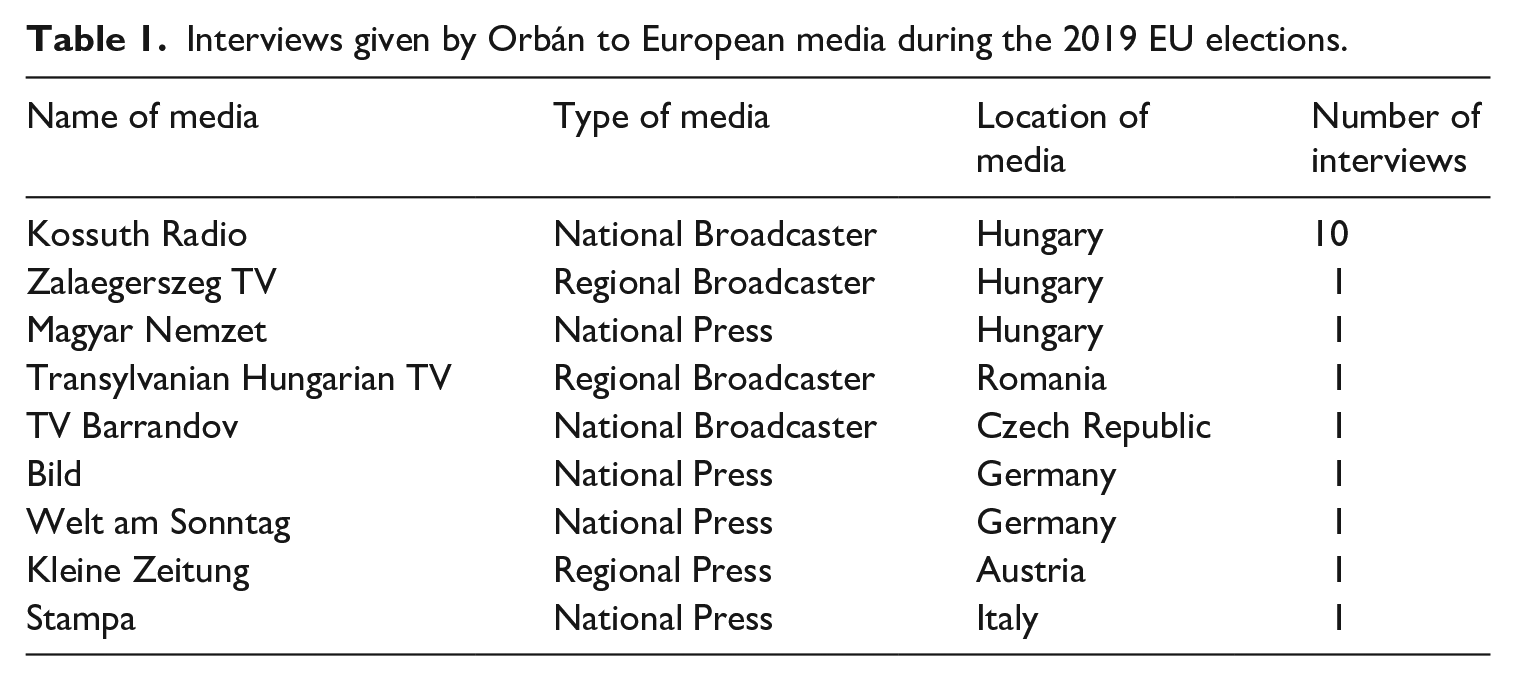
These interviews reveal the strategic selectivity of the populist leader. Orbán accepted to be questioned by the European media with three characteristics. First, a right-wing Western audience (Welt am Sonntag, Bild, Kleine Zeitung, and Stampa). Second, a favorable audience of Central European Hungarian diaspora, who were given Hungarian citizenship and social rights by Orbán (Transylvanian Hungarian Television). Third, Central European media outlets controlled directly or indirectly by a right-wing power: TV Barrandov (operated by the Czech millionaire, media mogul, and populist activist Jaromír Soukup), Magyar Nemzet, Zalaegerszeg TV, and Kossuth Radio (one of the most listened to in Hungary).
The interviews are structured around different antagonistic issues detailed in the research. Following a broad analysis of all reporters’ attitudes in terms of neutrality or antagonism, potentially leading to equivocal answers by Orbán, the research is based on a series of representative ‘Interviewer-Orbán’ interactions, helping us to approach in greater depth the reporters’ adversarial attitude and the production of equivocation.
Interviewing a right-wing populist leader: Journalism and Orbanism at the EU scale
Different types of equivocal populist discourses involving Orbán are produced during the interviews. First, there is a discourse circulated for a Western European audience embedded in different nation states, and following questions revealing the professional journalistic models detailed by Hallin and Mancini (2004). This combines a balance of neutrality and antagonism, which is justified as it is aimed at making Orbán accountable for his policies and positions in Europe, and leads to specific equivocation on his part. By contrast, the Central European media selected by Orbán are characterized by their strict neutrality (the television stations targeting Hungarians in Transylvania) or often their strict antagonism, which is directed at the accountability of liberal EU policies in Europe. This second attitude helps Orbán to enrich an antagonistic discourse initiated by reporters embedded in an illiberal model to be added to the list defined by Hallin and Mancini (2004). The Western and Central European interviews with Orbán are successively analyzed.
The antagonism of reporters in Western Europe and the challenged Orbán
Each journalist in Western European countries has their own style of interviewing Viktor Orbán, and they do not deploy the same level of neutrality and antagonism toward the Hungarian leader. However, they all expose the difficult, ambivalent, and paradoxical position of a leader combining party and executive leadership functions in Europe: (1) a leader portrayed as a man who develops links with other strong, radical-right leaders, whose policies can be contradictory to his own, and (2) a leader whose illiberal policies put at stake the balance of party politics in the EU parliament, the value of democratic freedom in Europe, or the decency and relevance of political campaign argumentation.
The commercial and tabloid press are viewed as more keen than the elite press and public broadcasters to be promoters of populist ideas (Mazzoleni, 2008). Nevertheless, the Western tabloid press can show a somewhat adversarial attitude toward Orbán, as revealed by the questions put by the German Bild reporters to the Hungarian leader concerning the press freedom in his country (see Extract 1). These reporters use the byline ‘Reporters without Borders’ (lines 6–7) to source their comments and make negative assumptions and use follow-up questions starting with ‘but’, and expressions such as ‘are you saying’ (line 12), which can be interpreted as a mark of doubt concerning the veracity of the interviewee’s answer on the press freedom in Hungary as proved in other analysis of journalistic interviews (Clayman and Heritage, 2002; Montgomery, 2007). The accountability of Orbán to the popular right-wing audience of the German tabloid Bild is embedded in the German Democratic Corporatist context (Hallin and Mancini, 2004), where press freedom is a central issue for the strongly organized journalistic corporation. The use of critical discourse analysis to investigate the responses of Orbán to the adversarial Bild shows that his equivocal answers in Western Europe to preserve his face (Bull, 2008), consist of defining particular in-groups contrasted with specific out-groups; a strategy characteristic of populist agents (De Cillia et al., 2013; Van Dijk, 2013). His narratives express more precisely a David versus Goliath power dominance, with the presence of out-groups labelled as ‘largest’ (lines 3–5) and in-groups presented explicitly or implicitly as smaller. His argumentation includes a particular form of ‘we’, an exclusionary in-group (Bull and Fetzer, 2006) that can contain Hungarians opposed to other Europeans (Germans, Italians, etc.) or Europeans opposed to non-Europeans. It is less a ‘people’ versus ‘elite’ and more a mingling of in-groups versus out-groups involving contrasted European elites, people, nations, and their representatives that is produced by Orbán when the four dimensions of equivocation are considered (Bavelas et al., 1990). As a sender of a message, he protects himself by mobilizing the whole community of Hungarian people rejecting the allegation of the Bild (‘people in Hungary’, line 2). When the context of his answer is considered, we see that his equivocation consists of reversing the potential image-threatening allegation of the Bild by putting forward his personal victimization and damage by the media (lines 2–5, lines 9–11). The content of his answers and the qualification of the receiver show that Orbán carries on nationalizing the issue. Orbán, the representative of the Hungarian people, is the alienated leader unable to influence the dominant private media sector partly in ‘German hands’ (line 15), while the receivers of his answers, the Bild reporters, are questioned indirectly as members of the dominant German nation (‘do you really believe’, lines 15–16). This is a specific perspectivation (Richardson and Wodak, 2013), participating in the populist vision of national in-groups and foreign out-groups, with the figure of a leader attacked by multiple others having a noted foreign provenance.
Extract 1
area of the media. [. . .] These are some of the outlets that support the opposition: RTL, the largest Commercial TV channel; ATV, the largest TV news channel; Népszava, the largest daily newspaper; HVG, the largest political weekly; and Blikk, the largest tabloid newspaper.
Borders’ criticise you for press freedom in Hungary being limited, and for the media being forced to
toe the line?
from every direction. The five major weeklies came out yesterday, and again this week three of them are fiercely attacking me.
job?
influence. Indeed Hungary’s most popular television channel is in German hands. Do you really believe that there they’d fire journalists for criticising me? Source: Hungarian Government (2019a).
The journalist from the Italian newspaper La Stampa provides a long portrait-style introduction of Orbán, who is definitively presented as a strong and down-to-earth man (Hungarian Government, 2019b). However, the interview is not without risk for Orbán, who is notably asked to give his position concerning the two key figures of Italian populism he is connected with, and with whom his relationships are not always good (Berlusconi and Salvini). He is also asked to state his stance on the migrant issue, which contradicts that of Salvini (in favor of an EU-wide redistribution of migrants) and requires a new rule of law in Europe that the journalist pushes Orbán to clarify. The migrant issue addressed by La Stampa shows again that the Western media makes Orbán accountable to an audience of nationalized European citizens embedded in a liberal democratic order; a liberal European Union with a future based on multilateral agreements and shared regulations, and not simply pure anti-European rhetoric. The journalistic professionalism of La Stampa is based on antagonism, putting forward the potentially conflictual dimension of populist political alliances. La Stampa rescales at the European level (but for its audience of Northern Italians) one key dimension of the Italian press associated with the Mediterranean, polarized pluralist model as defined by Hallin and Mancini (2004); that is, a strong focus on an ideologically-tensed political life. The potential tension between Orbán and Salvini illustrated by La Stampa mirrors in some ways to the love-hate relationship existing between Berlusconi and Salvini in Italian politics, which is frequently mentioned in the Italian media. The Italian reporter reveals his adversarial attitude by using different discursive technics: the use of ‘but’, negative presuppositions, and the repeated ‘how’ questions indicating some doubts about the quality of the answer. Orbán responsively reprocesses the equivocal answers given to the Bild’s reporters, consisting of positioning himself (as a sender of information) in an exclusionary European ‘we’ (Bull and Fetzer, 2006), rejecting both migrants and the liberal institution of the European Union (Commission and European Parliament). As with the previous example, Orbán’s answers to the adversarial reporter lead him to develop a David versus Goliath power dynamics argumentation. The populist leader is included in a ‘fewer’ European ‘us’, dangerously overwhelmed by foreign migrants coming from Africa (Hungarian Government, 2019b).
The two last Western media outlets (the German elite newspaper Welt am Sonntag and the Austrian regional newspaper Kleine Zeitung) are among the countries characterized by the democratic corporatist model of journalism (Hallin and Mancini, 2004). Their reporters will be the most antagonistic ones toward Orbán (Hungarian Government, 2019c, 2019d). The strong adversialness of the Welt am Sonntag journalist is expressed by negative comments included in questions, personal positioning of the reporter in questions (‘I’, line 1), and follow-ups revealing contestation of Orbán’s answers (see Extract 2). The interactions between the reporter from the Welt and Orbán about Georges Soros shows the willingness of the journalist to expose to its German right-wing readership both the contradictive nature of European politics exhibited by Orbán and one unbearable attitude in a European liberal democratic order: the use of negative political publicity with racist or anti-Semitic undertones.
The critical discourse analysis of Orbán’s answers to the Welt concerning Soros helps us to investigate the four typical argumentations of equivocal right-wing populist stakeholders ready to preserve their faces when questioned about anti-Semitism (Wodak, 2018): (1) denial (‘no one looking at such a poster thinks of anti-Semitism’, lines 3–4), (2) the use of disclaimers (‘We regard Hungarians of Jewish origin as being first and foremost Hungarians’, line 4, ‘We are pursuing a consistently pro-Israel foreign policy’, line 9), (3) a mitigation strategy (‘Anti-Semitism existed in the Christian right in Hungary but [. . .] hostility against Jews and Israel is now being brought into our societies by migration’, lines 9–11), and (4) negative attributes anti-Semitic activists will associate with Jews (‘Soros [. . .] embodies the worst face of globalism’, line 16). The populist aspect of Orbán’s equivocal answers can be perceived in the four dimensions of equivocation defined by Bavelas et al. (1990): first, the sender (Orbán generally expresses himself in the name of the Hungarian people rather than using his own name); second, the receiver (Orbán qualifies the interviewer by his belonging to a national out-group, line 3); third, the content (the reporter asks about the anti-Semitic undertone of the poster and Orbán produces an ambivalent answer about the anti-Semitic interpretation of posters as a ‘German’ problem, line 5); and fourth, the context (the reporter focuses on the poster and Orbán answers by mentioning his support for Israel, plus the risk posed by migrants – another out-group – to European Jews, lines 9 and 11): Extract 2
seen in history books. The style of representation and context carry anti-Semitic undertones.
of anti-Semitism. We regard Hungarians of Jewish origin as being first and foremost Hungarians rather than Jews. [. . .] To me this seems to be a German problem.
claim that we are being directed by Soros. In Germany these accusations come from the far Right, who
also cite your anti-Soros campaign.
existed on the Christian right in Hungary also, but we have rolled it back. Nowadays anti-Semitism has a new character: hostility against Jews and Israel is now being brought into our societies by migration. This is why anti-Semitism in Western Europe is now on the rise, while in Central Europe it continues to decline. So far Europe has formulated no concept for how to combat this, although it should do so.
solely a matter for the Good Lord. But in Hungary, it is Soros who embodies the worst face of globalism. Source: Hungarian Government (2019c).
The attack of liberal Europe and the three-course serving of ‘Goulash Orbanism’
The interviews given by Orbán in Central Europe are of a different nature. First, it is important to distinguish the interview given by Orbán to Transylvanian Hungarian Television, which comprises three neutral questions and no follow-ups (Hungarian Government, 2019e). The interactions with the other Central European media, especially the Czech TV Barrandov and Hungarian public broadcaster Kossuth Radio, are different. Orbán collaborates with these reporters to circulate to a Hungarian audience (and also a Czech one) what can be named ‘Orbanism’ (Wodak and Krzyżanowski, 2017: 471), and more precisely a ‘Goulash Orbanism’, which is based on three types of complementary narratives. First, there are the positive self-appreciations of intertwined socioeconomic liberal/public interventionist Hungarian policies having some similarities with those of the ‘Goulash communism’ era (Benczes, 2016: 146). Second, there is a proclaimed illiberal democratic and cultural order consisting of opposing (1) liberal democracy, EU institutions, the elite, left-wing parties, foreign liberal countries and leaders, NGOs, migrants, and (2) a homogeneous, Christian, and conservative Hungarian people united around traditional family values and hard work. Third, a leadership associating a ‘behind doors’ knowledge of international politics (the ‘cunning man’), an evasive reflexivity on party politics, and a grass-rootedness is constructed.
In a liberal media system, conflictual interviews are characterized by the replacement of the structure of questions and answers with assertions and counter-assertions (Hutchby, 2017; Montgomery, 2007), whereas the current analysis shows that in a populist-controlled media system, questions and answers are replaced by shared equivocal assertions supporting the political power in charge. It can be considered as the key aspect of a fourth journalistic model to be added to the list of Hallin and Mancini (2004): The illiberal one defined by the presence of reporters losing their independence due to institutionalized pressure from a populist executive power controlling the state’s laws; a pressure reinforced in Hungary during the COVID-19 pandemic (Mudde, 2020). Adversarialness exists in this model, but it is directed by interviewers and interviewees toward stakeholders absent from the studio (the left, the European institutions, NGOs, etc.).
The interview between Orbán and Jaromír Soukup – the Czech media mogul – concerning George Soros helps us to appreciate the difference between this interview and the one carried out by the German reporter from the Welt in terms of equivocation (see Extract 3). In contrast to the German interviewer, the Czech one provides equivocal questions, within which his support for Orbán is perceivable (‘one can sense that energy in you’, line 1; ‘I assume. . .’, line 3). As Orbán is not directly challenged by the reporter, he produces a different equivocation if we consider the four dimensions of Bavelas et al. (1990): (1) sender (Orbán does not bother to hide behind the in-group of Hungarian people to avoid presenting his opinion. He simply has to describe – through the details – the conspiracy of Soros, symbolizing the negative elite as an immanent truth with an unchallenged anti-Semitic undertone, in which Soros is a speculator controlling global networks, lines 5–9); (2) receiver (Orbán does not bother answering the interviewer directly. His discourse could be replicated on any occasion for an audience of populist supporters, all lines); (3) content (Orbán is asked about the maintenance of the legislation against Soros and the right of Soros to intervene in politics, but he focuses on scapegoating Soros, lines 5–9, and the way to discover his conspiracy, lines 15–18. It is totally unclear if the ‘Lex Soros’ and Soros’ right to intervene in Hungarian politics are to be preserved, because there is only ‘one chance’ to discover the Soros conspiracy and it is not by law, but through case-by-case investigation. The threat of Soros will never go away); (4) context (the detailed conspiracy of Soros is irrelevant if we consider the questions asked by Soukup on the law and rights, but it is relevant if we consider conspiracy as a structuring argumentation of populism and a source of the claimed alienation of the people and their representatives by the elite).
Extract 3
criticised is the legislation relating to NGOs which support migration; the law has been referred to as
Lex Soros, after George Soros, the American philanthropist of Hungarian origin. You’ve been
strongly criticised on that score. I assume you’ll stand by the legislation.
amount of money from speculating on the financial markets, and is able to skilfully organise matters in line with his intentions. He has created an impressive network across the whole of Central Europe, comprising paid political activists posing as representatives of civil society, casting their web across several countries as they conduct their work. [. . .] But there is a red line that not even Mr. Soros [. . .] not even paid civil rights activists are allowed to cross: that red line is national security. This has become an acute question in Hungary, because migration is an issue of national security. [. . .]
How is it possible for these people to claim the right to engage in politics and to acquire political power
– power in particular – without standing for election, and with foreign financial backing? [. . .]
systematically uncover who they are, who pays them, why they receive funding, what networks they form part of and what causes they act in favour of; and to reveal this information to Hungarian or Czech voters [. . .] Source: Hungarian Government (2019f).
The three dimensions of the Goulash Orbanism is best displayed in the routinized interviews (at least once a month) given by Orbán to the ‘Good Morning, Hungary’ program on the public Kossuth Radio. The reporter from this radio station uses the same complementary assertion as Jaromír Soukup in the Czech Republic to emphasize the excellent Hungarian socioeconomic policy, the sense of leadership of the Hungarian Prime Minister and the antagonism between Orbán (representing Hungarian interests) and a series of adversaries whose main character is aggressiveness and/or conspiratorial objectives. As shown in the following selected part, the reporter is not simply an agent of ‘Orbanian’ propaganda. She put seemingly adversarial questions to Orbán (‘Why not?’ line 4; ‘Don’t we need to take these seriously either then?’ lines 23–24), helping her to take a position in the field of journalism, although an illiberal one. However, the questions are always equivocal in terms of content, and based on the same antagonism between in-groups (‘we’ Hungarians) versus out-groups (the European Parliament) that is also used by Orbán. The first question notably shows this equivocal journalistic content. It is not the policy of Orbán that is condemned by the EU, but the evasive ‘situation in Hungary’ (line 2), a process of condemnation mastered by a singularized person (Judith Sargentini, line 2), without mentioning her function, her report on Orbán’s illiberal policies, or the entire democratic process that led to the condemnation of Orbán in the European Parliament. The Hungarian Prime Minister is not really pressurized by the journalist. However, his answers are equivocal if we consider their contextual dimension. Orbán replies first by saying how courageous a leader he is (Orbán vs 400 pro-migration MEPs, lines 5–9) and second, by refocusing the exchange on a Soros conspiracy when the journalist asks him why the government is not defending Hungary.
Extract 4
‘the situation in Hungary’ will once again be on the agenda. Judith Sargentini managed to achieve this
[. . .] however, we heard that on this occasion the Hungarian government will not be represented at the
debate. Why not? [. . .]
Hungarian people need to be fought for. After all, this is part of a Prime Minister’s job, and I’m not afraid of my own shadow. More than once I’ve had three or four hundred pro-immigration MEPs trying to shout me down at the top of their voices. In the course of Hungarian history we’ve faced worse odds when we’ve needed to fight. One accepts that if one is Hungarian, this is one’s fate. [. . .] But on this occasion the upcoming debate is a campaign event. [. . .] This one will be a séance summoning up the spirit of Soros, a kind of election rally [. . .]. The wording of their verdict will be in alignment with the Soros-style ‘open society’[. . .]
Hungary related to the ‘Stop Soros’ legislative package have been moved into a new phase by
European Commission.
evidence of this is that the lead candidate of the Left – which is the main force supporting immigration in both the European Parliament and the Commission – is a Dutchman called Frans Timmermans. There’s no point beating around the bush: he is George Soros’s man. [. . .] So with regard to the advancement of the infringement proceedings against Hungary, we must recognise that George Soros has a huge level of influence. [. . .]
But nevertheless it is making decisions and issuing directives. Don’t we need to take these seriously
either then? [. . .]
decisions that run counter to Hungary’s interests. [. . .] One decision was to enable Soros NGOs to receive three times as much funding as they have received up until now. [. . .] Source: Hungarian Government (2019g).
Concluding discussion: Corroding and corrosive populism beyond state borders in the EU
The current article shows that adversarial attitude of journalists and the equivocal answers provided by a populist respondent lead to the circulation of multiple populist discourses in the EU. The critical attitude of the Western European media to Orbán (even by the most powerful continental tabloid, the German Bild), which is justified, given his role in the gradual destruction of liberal democracy in Hungary, puts the Prime Minister on the defensive. It obliges him to concentrate his equivocal discourse on the nomination, labelling, and justification of antagonism involving dominance processes between threatened in-groups (different representations of ‘people’: Hungarians, Europeans, and himself as their representative) and threatening out-groups (multiple segments of the elite, migrants, and Soros as their representative). Orbán cannot really develop his leadership capacity in favor of the Hungarian people or boast about his socioeconomic initiatives; two types of narratives strongly emphasized in central European interviews thanks to reporters not challenging him. Challenging reporters can exist in Central Europe, but Orbán chooses media part of an illiberal model, which is spreading in populist-controlled countries such as Hungary and Poland (Bajomi-Lázár, 2015; Mudde, 2020). This illiberal model needs to be further investigated and added to the three journalistic models defined in Europe by Hallin and Mancini (2004, 2017) at the turn of the century.
The growing journalistic antagonism during political interviews has been viewed as a source of corrosion of liberal democracy (Montgomery, 2007). The current research shows that the interview of populist leaders can mean different things for the corrosion of liberal democracy. The interviews of Orbán in Western Europe are not structurally corroding liberal democracy. Instead, it questions the right-wing populist ideology within a European liberal democracy by offering Western European citizens a debate on Hungarian press freedom, the unacceptable racist and anti-Semitic undertones in political campaigning, and the less than cohesive collaboration between right-wing populist parties in the EU. The interviews given by Orbán to the controlled populist media of central Europe show that both Orbán and the reporters tend to share a common adversarial attitude toward European liberal democracy. This coalescent antagonism (involving the public and commercial media) is of course more corrosive for European liberal democracy. It is a context spectrum, helping Orbán to circulate more deeply and without opposition a populist ideology – presently termed ‘Goulash Orbanism’ – in Central Europe. This ideology has proved effective as Orbán’s Fidesz party was successful in the 2019 EU election. Populist leaders circulate their messages across state borders in the EU liberal democracy in the making (the EU parliamentary election campaign), but the strength and orientation of those messages will depend on the institutionalized dominance of the populist ideology in each state-bordered media system.
Footnotes
Declaration of conflicting interests
The author declared no potential conflicts of interest with respect to the research, authorship, and/or publication of this article.
Funding
The author disclosed receipt of the following financial support for the research, authorship, and/or publication of this article: This work was supported by the Luxembourg National Research Fund (INTER/SNF/18/12618900/CROSS-POP).