




Abstract
By drawing on a Critical Discourse Studies perspective, we analyze language and discursive strategies used by 36 Italian populist right-wing politicians in constructing the narration of immigration during the covid-19 period on their Facebook pages, combining Corpus Linguistics and the analysis of the discursive argumentation. The main aim is to verify a potential discursive construction between immigration and the spread of the virus also considering the change of the government and the role assumed by different parties. Results suggest that the connection between migration and pandemic has not been traduced in a discourse able to systematically blame migrants as vehicles for the virus, rather politicians operated a re-contextualization of past discursive strategies based on the ‘us’ versus ‘them’ dichotomy. Moreover, lexicon and argumentative analysis identified interesting differences between parties especially with the change of government and the new conformation of the alliance. The article shows elements of continuity concerning the political discourse on immigration, but it also stressed important outputs concerning the politicization process showing that pandemic constitutes a critical ‘politicizing moment’ that operated as a mechanism of further normalization of anti-immigration discourse.
Keywords
Introduction
During the pandemic crisis the political sphere has created new opportunities for legitimizing discrimination against the ‘others’, increasing the rationalization of migrant’ people (Meer et al., 2021; Triandafyllidou, 2020), and introducing novel examples of the multidimensional nature of racism (Elias et al., 2021). The outbreak provoked by virus SARS-CoV-2 coronavirus, become also a discursive tool for political communication that enables to re-contextualize the ‘spectacle of the border’ (De Genova, 2013), reinforcing scapegoats, and strengthening the so-called ‘politics of fear’ in many EU countries (Wodak, 2015). Indeed, some governments instrumentalized the crisis expanding authoritarian migration policies confirming the suspension of humanitarian activities which are part of a continuum of border externalization and migration criminalization (Triandafyllidou, 2020; Wodak, 2021a). For example, due to the spread of the pandemic, in April 2020 the Italian government closed ports impeding the arrival of migrants while refugees and asylum seekers already in the country were largely excluded from health protection (Carlotti, 2020).
Within the last decade, Italy represented one of the main European countries of landing within the so-called European refugee crisis. The latter catalyzed a rising wave of anti-immigrant sentiments that have been considered a driving factor behind the vote for the Italian right-wing populist parties (from now on RWPP) in the 2018 national election (Combei and Giannetti, 2020). Indeed, with the Conte I government, Italy applied strong exclusionary migration policies through the Salvini’ security decrees (see par. 3). After Conte II and Draghi government, the Meloni government was formed in October 2022 representing the maximum expression of the right-wing alliance that reached the highest level of electoral support with the success of Fratelli d’Italia (Brothers of Italy) followed by Lega (League) and Forza Italia (Go Italy) (see par. 3).
Starting from this backdrop, we aim to analyze the Italian RWPP’s discourse on immigration during the pandemic. Specifically, the case study focuses on the relation between pandemic and immigration at different levels, identifying which party debate most the issue and how they discuss it, also considering the change of the government and the role played by each party in the Italian social-political context. Indeed, during the pandemic Fratelli d’Italia has maintained its opposition’ role, while Lega and Forza Italia have changed their political stance by becoming part of the government’s majority. Thus, the diversity of the leaderships to be investigated offers the opportunity to hypothesize that during the pandemic: (H.1) when in opposition, parties capitalize on immigration issue by linking it with the threat of infectious diseases, using de-humanizing metaphors that assign to migrants the role of the threat for health’ population (Hart, 2010; Musolff, 2012; Sontag, 1989). Instead, (H.2) when part of the government in office, parties would tend to softening the discourse related to immigration, adopting a more neutral tone toward the issue in order to maintain a stable intra- and inter-party agreement. Thus, the aim is to understand how discursive practices are intertwined with past discourses on migration, nation, and alterity (Krzyżanowski et al., 2018), how they are recontextualized, and in which party is it possible to identify the major discursive changes. By drawing on a Critical Discourse Studies perspective, we analyze language and discursive strategies used by 36 politicians in constructing the narration of immigration on their Facebook pages, combining Corpus Linguistics and the analysis of the discursive argumentation.
The study contributes both to the existing research on political communication about immigration and to the RWPP discourse in times of crisis. Italy represents a crucial case for studying the post-refugee crisis in Europe and for the normalization of right-wing anti-immigration discourse. The pandemic scenario could reveal the legitimation strategies able to reinforce, reproduce or change the main frames that construct the political representation of migration and normalize radical and extreme-right attitudes and opinions (Krzyżanowski, 2016). The article proceeds as follows: in the first two paragraphs we introduce some basic elements of the populist anti-immigration discourse through the lens of the Critical Discourse Studies, and the context of the refugee crisis compared with the pandemic scenario. In paragraph 3 we define the Italian right-wing alliance and a brief socio-political context, while in paragraph 4 we present the case study and the methodology adopted. In paragraphs 5 we present the outputs of linguistic analysis together with the main argumentative structures comparing them during the periods considered. In conclusion we summarize the main results, discussing the discursive changes of each parties, highlighting elements of continuity-discontinuity in the political representation of migration together with the risk of normalization of the anti-immigration discourse.
The right-wing populist parties and the anti-immigration discourse: The Critical Discourse Studies approach
The most basic definition of populism describes it as a movement promoting a reified ‘will of the people’ against the ‘global conspiring elites’ where the first is pure and the second corrupt (see e.g. Mudde, 2004; Mudde and Kaltwasser, 2017). In the last decades, populism has been interpreted as both a thin ideology 1 (see e.g. Albertazzi and McDonnell, 2008; Mudde, 2004; Mudde and Kaltwasser, 2017) and a communication style (Bracciale and Martella, 2017; Bracciale et al., 2021; Ernst et al., 2019; Moffitt, 2016).
However, as stated by Wodak and Krzyżanowski (2017), defining the RWPPs means discussing an extremely elusive phenomenon that places itself at the intersection of a range of both traditional and new forms of political action and political behavior. Although each national variant of right wing populism must be approached in a distinct and context dependent way (Wodak and Krzyżanowski, 2017), it is widely recognized that RWPPs share an anti-migration position based on xenophobia, criminalization of migration and migrants, exclusionary politics, demand for border protection, and measures of securitization (see e.g. Ruzza, 2018; Wodak, 2015; Wodak and Krzyżanowski, 2017).
Within Critical Discourse Studies (CDS), Ruth Wodak identified specific features of the modern populist parties and movements: nationalism/nativism/anti-pluralism; anti-elitism; authoritarianism; and conservatism (see e.g. Wodak, 2015). At the communicative level, the author discussed their micro-politics which includes strategies of calculated ambivalence and provocation used to create and deescalate intentionally provoked scandals and the subsequent dynamic of victimization, conspiracy theories, denials and lies, and ambivalent apologies (Wodak, 2015; Wodak and Krzyżanowski, 2017). These micro-politics converge in the notion of ‘dramatization’ as «the need to generate tension in order to build up support for the party [. . .] by denouncing the tragedies that would befall the community if it were to be deprived of its defenses» (Albertazzi, 2007: 335). Thus, boundaries between the real and the fictional, the informative and the entertaining become always more blurred (Wodak, 2011) encouraging the so-called ‘Shameless normalization of impoliteness’ as part of the far-right populist agenda (Wodak et al., 2021).
Moreover, there is a vast agreement on the ability of the RWPP to reduce complex phenomena into simple dichotomies of ‘us’ versus ‘them’ (see e.g. Mudde, 2004; Mudde and Kaltwasser, 2017; Wodak and Meyer, 2001), counterpose the ‘people’ and the ‘élite’ via discursive strategies of blaming the ‘other’ or political enemies through negative campaigning (Hameleers et al., 2017; Plasser and Ulram, 2003).
In this context, the mediatization of politics (Mazzoleni, 2014) represents a key concept that allows looking at how media are used by right-wing leaders in gaining political capital via anti-immigration rhetoric (see e.g. Krzyżanowski et al., 2018; Krzyżanowski and Ledin, 2017). In the last years, several studies have identified social media as a favorable channel for the spread of populist ideology (see e.g. Bracciale et al., 2021; Engesser et al., 2017; Ernst et al., 2017) facilitating processes of personalization, disintermediation and simplification of political communication also in the Italian context (see e.g. Ceccobelli et al., 2020; Mazzoleni and Bracciale, 2018; Rega and Bracciale, 2018). However, social media did not have a causal effect on the shift to right-wing populism, but they have created a fertile space of growth for affective politics that is, the age of prioritizing feelings over facts (KhosraviNik, 2017). Moreover, social media re-configuring the relation between discourse and power establishing new challenges to theories in CDS (KhosraviNik and Unger, 2015). Traditionally, the field tended to target powerful texts produced by elites and institutions, such as journalism and political speeches, with a view to revealing the kinds of discourses used to maintain power and sustain existing social relations (see e.g. Fairclough, 1989, 1995; Fairclough and Wodak, 1997; van Dijk, 1987; Wodak and Meyer, 2001). Popular topics in CDS such as nationalism, racism, and right-wing populism are not only still relevant within the communicative dynamic of social media, but they reveal a mix of powerful-institutional and ordinary-individuals texts (KhosraviNik and Unger, 2015). In more recent times, the field discussed the rise of uncivil society, in particular on the web, and in its ‘borderline discourse’ that «progressively ‘normalized’ the anti-pluralist views across many European public spheres on a par with nativist, xeno-ethnic, and exclusionary views now widely propagated by RWPPs in Europe and beyond» (Krzyżanowski and Ledin, 2017: 1). Thus, these discourses have progressively moved from marginal online spaces to mainstream media and institutionalized politics allowing the anti-immigration rhetoric being legitimized or prelegitimize (Krzyżanowski et al., 2021; Krzyżanowski and Ledin, 2017; Wodak, 2021b).
From the ‘Refugee crisis’ to the pandemic
As recently stated by Wodak, «Each crisis contributes to both new and old threat scenarios, as could be observed with respect to the financial crisis, the Euro crisis, the SARS crisis, and the so-called ‘refugee crisis’. Not surprisingly, the COVID-19 pandemic also follows this pattern» (Wodak, 2021a: 333). Indeed, crisis, as one of the most widely debated concepts in social and political sciences (Krzyżanowski, 2019; Krzyżanowski and Krzyżanowska, 2022), allows to highlight the relation between the migration phenomena that interested European countries in the last years and the pandemic provoked by virus Covid-19.
The so-called ‘refugee crisis’ represented a humanitarian and political phenomenon which has strengthened polarization, radicalization, and politicization across the EU (Krzyżanowski et al., 2018; van der Brug et al., 2015). Precisely, with politicization we refer to the process of «expansion of the scope of conflict within the political system’ characterized by the salience of the topic and the polarization of the issue» (Hutter and Grande, 2014: 1003).
Pandemic and migration intersect and influence each other because both are characterized by the ‘emergency frame’ and the ‘securitarization frame’ (Buzan et al., 1998) which allow politicians to frame events into a coherent narration (Battistelli and Galantino, 2020). This happens especially at a national level highlighting a re/nationalizing tendency in leaders’ public speeches and political proposals (Wodak, 2021a). Wodak reported the example of the Italian Prime Minister Giuseppe Conte speech in which the appeal to the Italian people was reputedly evoked with the inclusive pronouns ‘our’ and ‘we’. In other words, both pandemic and immigration issues are confronted with national biopolitics and body politics (Musolff, 2010; Wodak, 2019a, 2021a, 2021b) and with a national identity politics that necessarily imply positive self and negative other presentations (Wodak, 2021a).
Traditionally, immigration and the pandemic also share similar metaphors used by media and politicians able to emphasize new and old threat scenarios. As noted in relation to AIDS (Sontag, 1989), also the coronavirus personifies the role of the enemy offering a collection of unique analogies and associations in the definition of the state of crisis. Alongside the war metaphor (Battistelli and Galantino, 2020; Wodak, 2021a), the discourses around pandemics have nurtured Western-centric racism with the need to make a dreaded disease foreign (Sontag, 1989). Albeit migrants have not been major drivers in outbreaks and their movement has not been associated with significant spread of infections to host populations (Greenaway and Gushulak, 2017), «epidemic diseases usually elicit a call to ban the entry of foreigners, immigration» (Sontag, 1989: 147), fostering xenophobic behaviors within the health emergency (Pastore, 2021). Indeed, with the spread of the virus, we assist in the effort to protect the in-group and national sovereignty from the ‘outsiders’ showing national borders becoming more visible and less permeable (Triandafyllidou, 2020).
Moreover, as recently stated by Casaglia and Coletti (2021) the ‘migration crisis’ and the pandemic are articulated in the populist discourses through the same process: while the first served to advance anti-immigrant discourses in defense of national interests and against supranational institutions, the pandemic was presented as the crucial and final reason for adopting defensive and bordering measures (Casaglia and Coletti, 2021). For the authors, both crisis share several distinctive features including: «the identification of threats; their ‘territorialization’; the fueling of fear and the mobilization of national identities; the promotion of a strongly territorial understanding of identity and politics; the nurturing of a sense of common belonging; and the channeling of frustration and discontent by pointing to common enemies who come from ‘outside’» (Casaglia and Coletti, 2021: 2). Finally, Krzyżanowski and Krzyżanowska (2022) recently stated that the discourse about the pandemic has increasingly acquired a modified, argumentative function: it marks a new approach to ‘crisis’ in the normalization of far-right populist politics using pro-democratic arguments while ‘flipsiding’ them in favor of far-right arguments and pre-legitimizing their own undemocratic politics of control and exclusion (Krzyżanowski and Krzyżanowska, 2022). As the article will show, the ‘certainty’ about the presence of the crisis and its ‘factuality’ are strategically used by the RWPP leaders in order to pre-legitimize outright attacks on political opponents (Krzyżanowski and Krzyżanowska, 2022).
The Italian right-wing alliance and the covid-19 scenario: a brief socio-political context
Between the 2018 and the 2022 Italian national elections, four governments succeeded each other. The Conte I government 2 (June. 2018–Sept. 2019) was mainly composed of the anti-establishment Movimento 5 Stelle (five Stars Movement) and the radical right party Lega and it is remembered for the strict exclusionary migration policies led by Lega leader Matteo Salvini. Nevertheless the latter was responsible for the fall of the government, from which was born the Conte II (Sept. 2019−Feb. 2021) composed by the Movimento 5 Stelle, Partito Democratico (Democratic Party) and other small center-left parties, while the RWPP alliance composed the opposition.
With the resignation of the Conte II government, the President of the Republic summoned Mario Draghi, economist and former President of the European Central Bank, to the Quirinale to give him the task of forming a new government in February 2021. The Draghi government (Feb. 2021–Oct. 2022) was formed by a wide majority of the Italian Parliament 3 except the right-wing party Fratelli d’Italia and the small leftist party Sinistra Italiana (Italian Left) and it has been engaged in the ongoing organization of the mass vaccination and the elaboration of the National Plan for Recovery and Resilience. The increasingly critical attitude of Movimento 5 Stelle toward the Draghi government decreed its fall and the early elections in September 2022.
Our case study focuses on Conte II government that faced the initial and central part of the pandemic and on the Draghi government that faced the final part of the emergency. Regarding the immigration issue, Conte II government passed a new law that abolished Salvini’s Security Decrees and the Draghi government maintained the line with the same Interior Minister Luciana Lamorgese.
Finally, ‘Meloni Government’ was formed in October 2022 representing the maximum expression of the right-wing alliance reaching the highest level of electoral support with the success of Fratelli d’Italia, followed by Lega and Forza Italia. Although from the ‘90s to 2022’, the Italian right-wing alliance continued to enjoy a stable level of electoral support (Albertazzi et al., 2021), the new Italian government has been defined as the most right-leaning among all governments ever formed in post-war Western Europe (Garzia, 2023): Fratelli d’Italia and Lega, as two populist radical right parties, are in control of about 80% of the votes cast in favor of the governing coalition. After a minimal reconstruction of the last Italian governments, we introduce more details of each party that composed the RWPPs alliance.
Until 2013 Lega Nord was defined as a regionalist populist party advocating autonomy for northern Italian regions. When Matteo Salvini became the leader in 2013, the Lega has undergone a process of ideological transformation turning it into a national party that has combined Euroscepticism and anti-immigration position, representing an archetypal radical right party that put nativism and authoritarianism at the center of its discourse (Albertazzi et al., 2018). Indeed, Salvini is recognized as the figure responsible for the upscaling of the Lega to the national stage in the last decade (Casaglia and Coletti, 2021). The party fought the 2018 election campaign mainly on the immigration issue focusing on the nativist slogan ‘Italians first’ (Albertazzi and Zulianello, 2021). During the Conte I Government the popularity of the party guided by Salvini reached a peak in the polls (Dennison and Geddes, 2022). In 2019, with two ‘Security Decrees’, Salvini introduced increasing restrictions on the activities of NGOs involved in search and rescue operations in the South Mediterranean together with limitations in accessing migrants to the services of the SPRAR (Newell, 2019). In the summer, Salvini was responsible for the fall of the Conte I government from which gave birth to the Conte II with the transition of the party to the opposition. Lega returns to being part of the majority in the Draghi government and in 2022 national election, the party reached the second place with 8.8% of valid votes, which represented a massive drop when compared to the 34% gained in 2019 at the European Parliament elections (Garzia, 2023).
Following Lega’s unsuccessful attempt to bring down the Movimento 5 Stelle-Lega coalition in summer 2019, Fratelli d’Italia saw a growth in its support (Dennison and Geddes, 2022). The party was founded in 2012 by some parliamentarians critic of Berlusconi combines Forza Italia’ Christian democrat and liberal roots with ‘post-fascist’ tendencies from Movimento Sociale Italiano/Alleanza Nazionale (Dennison and Geddes, 2022). Under Giorgia Meloni’s leadership, Fratelli d’Italia developed a clear ‘populist radical right’ profile (Zulianello, 2020) characterized by radical right ideological position after 2017 based on a combination of nationalism, sovereignism, authoritarianism, and Euro-scepticism shared with Salvini’s Lega (Albertazzi et al., 2021). The party has enjoyed uninterrupted growth in national polls and it represented the main opposition to the Draghi’ government. In the 2022 national election, Fratelli d’Italia became the most voted party and Giorgia Meloni represents the first woman Prime Minister in Italian history. Fratelli d’Italia began the legislature by commanding an absolute majority of votes (and seats) within the center-right coalition (Garzia, 2023).
Finally, Forza Italia represented the typical center-right party, despite its populistic or ‘personal party’ character guided by the undisputed leader Silvio Berlusconi. However, his electoral appeal has considerably diminished since the end of his last government in 2011. During the last years, Forza Italia tried to present itself as a more moderate and pro-EU party leaving populism and Euroscepticism positions to its allies (Albertazzi et al., 2021). In 2022, with just 8.1% of votes in the national election, Forza Italia obtained the worst result ever, which condemned the party to third place in the center-right coalition that Berlusconi founded back in 1994 (Garzia, 2023). The party will face an uncertain future following the death of leader-founder Silvio Berlusconi on 12/06/2023.
During the last decade, the ‘danger of immigration’ has become a fundamental symbolic resource for the storytelling of the Italian RWPP alliance (Nicolosi, 2019). Recent empirical studies agreed on a ‘monopolization of the debate’ by Salvini and Meloni as ‘issue-owners’ (see e.g. Casaglia and Coletti, 2021; Cavallaro and Pregliasco, 2021; Combei and Giannetti, 2020; Mazzoleni and Bracciale, 2018; Milazzo, 2020; Pirro, 2022) increasing their electoral support due to their anti-immigration stance both when they were in opposition and when they were part of the government.
Regarding the context of the pandemic, we briefly recall that Italy was one of the countries most affected by the virus, especially in its early stages, reaching high peaks of contagion before other European countries. The Conte II government, then in office had implemented restrictive policies since the first wave such as lockdown and social distancing. RWPP assumed distinctive and conflicting responses to the pandemic. In 2020, during the Conte II government Lega and Fratelli d’Italia represented the most vocal critic having the chance to politicize different aspects linked to the consequences of the pandemic itself including that of immigration (Zanotti and Meléndez, 2023). From the beginning of 2021, with the Draghi government, have been emerged contrasting positions in facing the pandemic: Forza Italia reinvented itself as a moderate, pro-EU party, (Albertazzi et al., 2021), the Lega become part of the government, while Fratelli d’Italia the only party excluded. As note by Pietrucci (2023), this split influenced the public perception of the three parties in the year leading up to the national election in 2022. According to Zanotti and Meléndez (2023) the different roles played by the parties in 2021 allowed Fratelli d’Italia to be able to «challenge the government’s actions and to depict itself as the only party acting in the people’s interest, opposing the elite» (Zanotti and Meléndez, 2023: 93). Finally, a growing literature is focusing on political communication concerning the immigration during the pandemic (see e.g. Albertazzi et al., 2021; Casaglia and Coletti, 2021; Milazzo, 2020; Pirro, 2022). Although the journalistic field observed a reduction of interest in the issue (Associazione Carta di Roma, 2020, 2021), the latter remained at the core of the agenda of Lega and Fratelli d’Italia leaders gathering the highest volume of their interaction on social media (Cavallaro and Pregliasco, 2021; Milazzo, 2020). However, there is a lack of analysis about how the right-wing politicians’ discourse on immigration changed and re-contextualized itself during the pandemic and due to the government change.
Case study and the construction of the corpus
The case study focuses on the analysis of Facebook public pages of Italian right-wing politicians. While is widely recognized that populist leaders show their ability in reaching their public through social media communication (Bracciale et al., 2021; Ceccobelli et al., 2020; Engesser et al., 2017; Ernst et al., 2017), Facebook has been described as the social media still preferred by Italian populist actors more able than others in fostering ‘likes’ and shares among their followers (Bracciale et al., 2021; Ceccobelli et al., 2020). For the definition of the corpus, we used CrowdTangle an online software owned by Facebook that allows to insert keywords and search for specific contents within the selected public pages. 4 Regarding the selection of politicians, we started from the 60 Facebook profiles with the highest number of followers, 5 creating an initial list in CrowdTangle composed by 20 politicians per each party Then, we selected a list of keywords related to immigration derived from the literature and after an exploratory analysis of the corpus. Specifically, we referred to the keywords used by ‘Associazione Carta di Roma’ which annually monitors the narration of migration in Italian newspapers and television. 6 After the processes of searching and scraping contents by CrowdTangle, we downloaded the corpus, ordinated it in a CSV file in order to obtain a general distribution of posts per each party and by each politician. From the initial 20 politicians per each party, we selected the first 12 members with the higher numbers of followers who talked about migration between the 1st March 2020 and the 1st October 2021. We found 12 politicians as the minimum common number among all members of each party who spoke about immigration during the reporting period. 7 Subsequently, we divided the period considered into two further time periods: that of the Conte II government (1st March 2020–26th January 2021) and the subsequent Draghi government (27th January 2021–1st October 2021) in order to find out differences and convergences in lexicon and discursive terms between parties and their roles with the change of government.
After constructing the research corpus, the case study consists of 36 right-wing politicians who produced 4516 posts regarding immigration which composed the initial database of our analysis. Table 1 shows that during the overall period considered, Lega is the Italian RWPP that talked most about immigration, monopolizing the debate in terms of posts, confirming its role of ‘owner-issue’ (Cavallaro and Pregliasco, 2021; Combei and Giannetti, 2020; Milazzo, 2020). Precisely, the 12 politicians from Lega published 71.28% of the total posts, Fratelli d’Italia reach 25.04% of the total posts, while the 12 Forza Italia’s politicians were mostly excluded from the narration with only 3.68% of the overall posts. Table 1 presents an overview of the distribution of posts per each party and period of time
Distribution of Facebook posts and its percentage per each party and during the two periods.
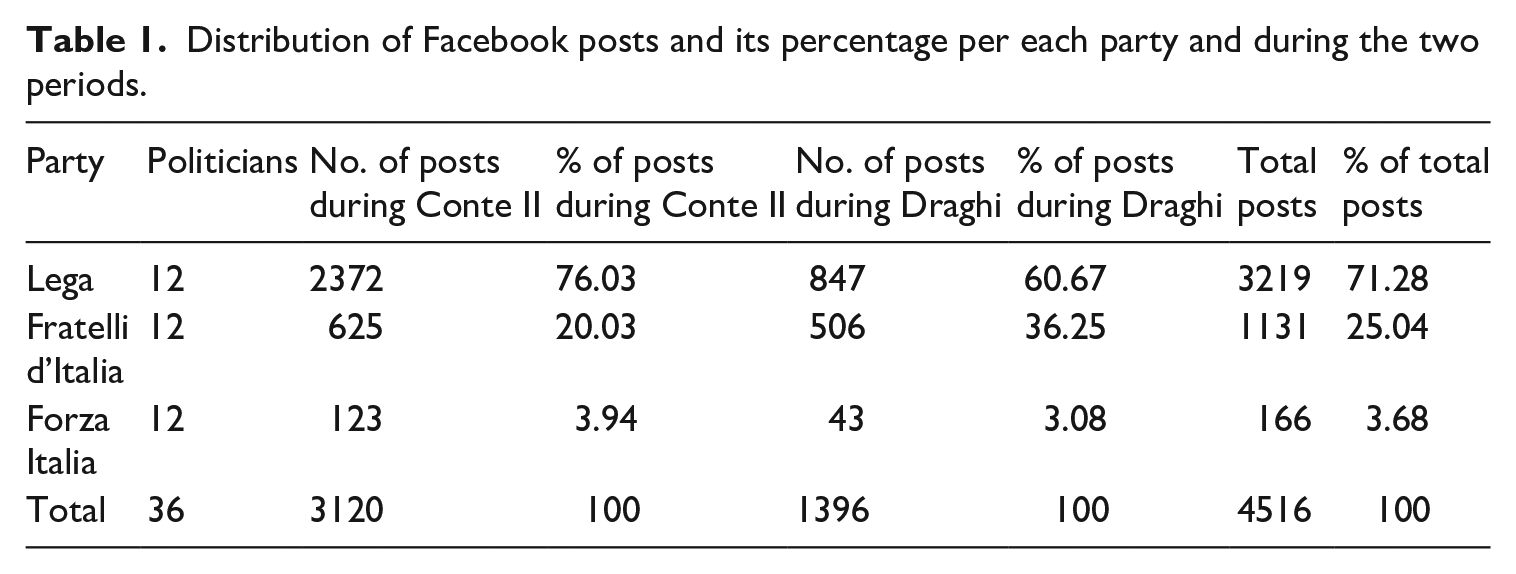
Table 1 also shows that the three parties posted a higher number of immigration-related posts during Conte II (N = 3120) when all parties in the alliance were in opposition, while they record a significant decrease in the number of posts during the Draghi government period (N = 1396). However, it should also be noted that, the issue of immigration suffered a general decline in media and political agendas during the Draghi government, which may have influenced this decrease (Associazione Carta di Roma, 2021). Moreover, we need to consider that the time selected during the Conte II government was 11 months, while the Draghi government was in office for 9 months. More generally, data on the frequency of immigration related post are always influenced by the degree of activism of politicians on the platform, thus by the number of posts produced daily by each one. Finally, Table 1 shows that the Lega is the party that in percentage terms has had the greatest decrease in posts published with the change of government from Conte II to Draghi, while Forza Italia (that publishes the lowest value of posts on immigration) shows a slight decrease in the percentage of posts between the change of the government. Fratelli d’Italia, remained in opposition, is the only one that, in percentage terms, increases its attention on the immigration issue between the two periods.
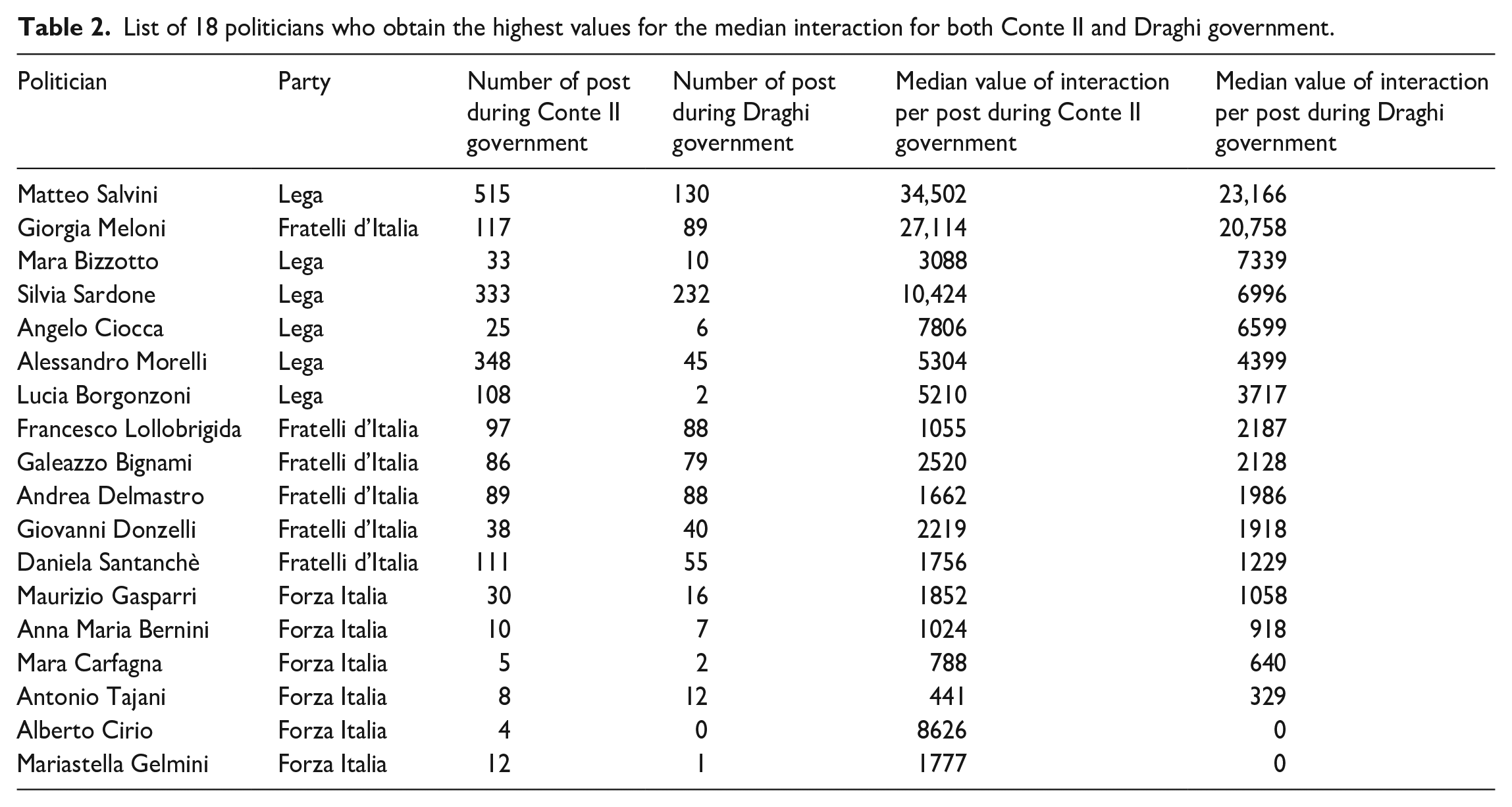
Then, we look at the metrics of single politician taking into account the amount of post published and the median value of engagement for each leader during Conte II and Draghi governments. We choose this approach in order to obtain a more homogeneous coverage of politicians while also considering the potential pool of followers they are addressing. Due the space issue, in Table 2 we included the six politicians per each party with the highest metrics values per each period considered. Table 2 shows that the leaders of the Lega and Fratelli d’Italia, namely Matteo Salvini and Giorgia Meloni, obtained significantly highest values of number of post published and median interaction per post in both periods. Considering the median value of engagement during Conte II, Meloni reaches more than 27,000 interactions while Salvini more than 34,000 interactions per post. Then Silvia Sardone who has a median of just over 10,000 interactions per post followed by Angelo Ciocca, Alessandro Morelli and Lucia Borgonzoni, all members of the Lega. Other politicians from Fratelli d’Italia have significantly lower median values that remain between 2000 and 1000 interactions per post while Forza Italia members do not reach 2000 interactions per post. During the Draghi government, Salvini and Meloni maintain their leadership in terms of interactions generated, but the distance between the two leaders decreases significantly (23,166−20,758 interactions) as does their overall median values. Moreover, Table 2 shows that during Draghi government, only in three cases (Mara Bizzotto from Lega, Francesco Lollobrigida and Andrea Delmastro from Fratelli d’Italia) the median values increase compared to the previous period.
List of 18 politicians who obtain the highest values for the median interaction for both Conte II and Draghi government.
Once divided the different sub-corpora, they were analyzed following a combination of Corpus Linguistics (CL) and argumentation strategies derived from CDS. Specifically, CL provided the identification of statistically frequent linguistic units as a starting point for more qualitative analyses (Baker et al., 2008). The corpus was processed through #LancsBox 8 software, which quantifies the relative frequency of main words of the corpus together with their collocations in order to identify meanings of and relationships between lexical items, and consequently of identifying patterns within a given discourse type.
For what concerns the analysis of the political discourse, in paragraphs 5.3 and 5.4, we focused on argumentative structures of Facebook posts considering those politicians which obtained the highest median value of engagement in their post during Conte II and Draghi government (Table 2). Within the different CDA approaches, we follow the ‘Discourse-Historical Approach’ (DHA) for which the argumentation analysis is a constitutive element of a discourse (Reisigl and Wodak, 2017). Precisely, we referred to the topoi scheme (Table 3) based on Wodak and Meyer (2001), integrated with Hart (2013) topoi scheme and used in many studies (see e.g. Hart, 2010; Wodak, 2015).
lists of recurring topoi based on Wodak and Meyer (2001) and Hart (2013).
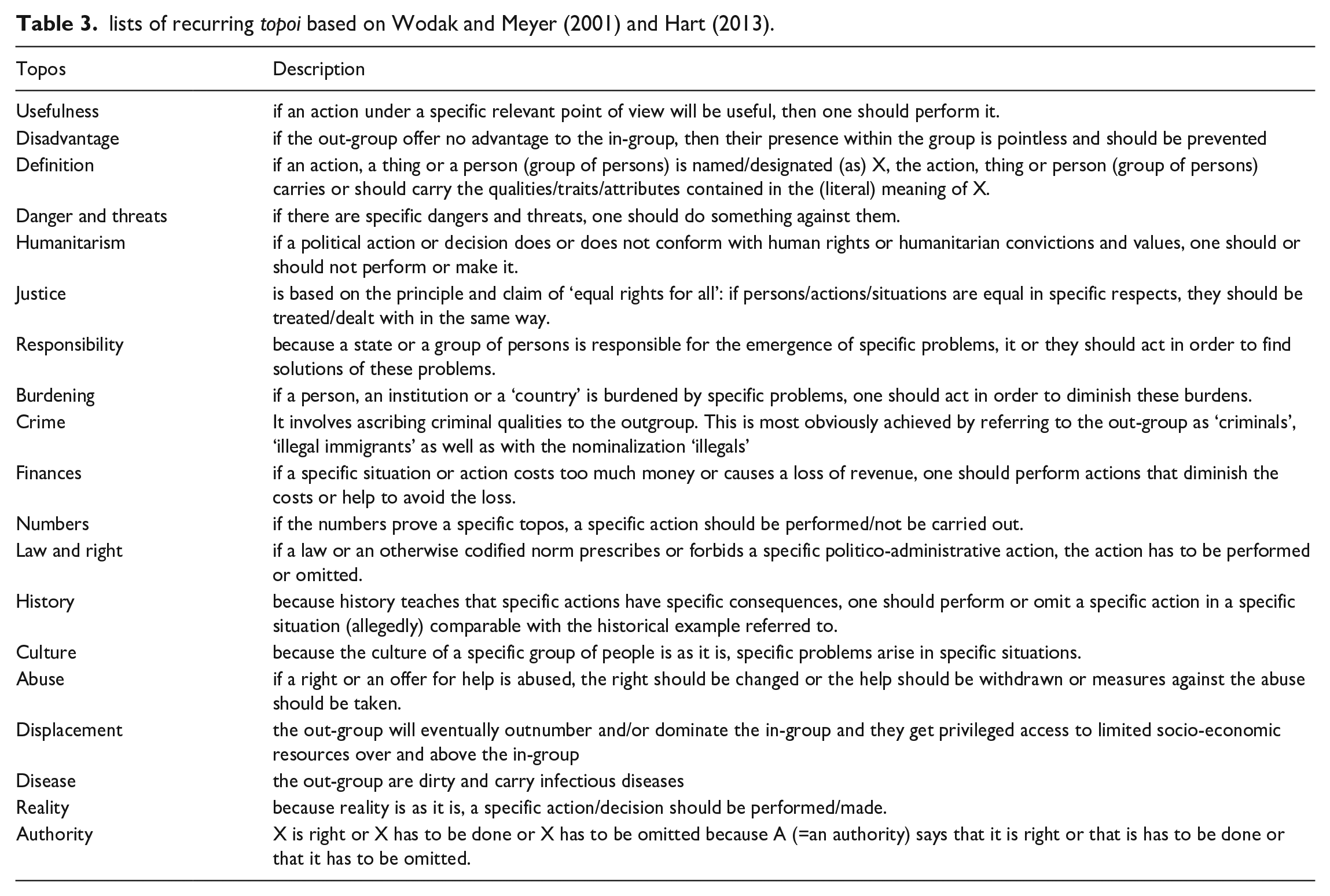
Topoi refer to argumentative schemes employed to persuade the audience with respect to the validity of the views presented. As described by Wodak and Meyer (2001), each topos can be characterized by a conditional scheme or a conclusion rule that may be invoked in discourse interpretation, as reported in Table 3. They provide an opportunity for a systematic analysis of the strategies that ensure the transition from argument to conclusion which often is not specified, but it is implicit in the argument (Wodak, 2015). By ‘strategy’ it is meant as a more or less intentional plan of discourse practices of using language, which serve to achieve particular social, political, psychological, or linguistic effects (Reisigl and Wodak, 2001). For each post selected, we identified the main topoi that characterizes the argumentation and suggests a conditional scheme or a conclusion.
Results
From data presented in paragraph 4 (Tables 1 and 2) has been emerged that immigration was a topic discussed more during Conte II government, in the first part of the pandemic, while it registered a decrease with the change of the government. Although in absolute values Lega publishes the higher number of posts about immigration, in percentage terms it is the party that has had the greatest decrease in posts published with the change of government. These initial data would tend to confirm our starting hypothesis that Lega, joining the Draghi government, has pushed the partie’s members to put less attention on the immigration trying to adopt more cautious positions about it. Forza Italia remains substantially stable with a slight decrease in the percentage of posts between the Conte II and Draghi government. Contrary to the Lega, we can hypothesize that joining the Draghi government did not affect the attention that the party’s members devoted to the issue of immigration, which remains low compared to the other parties of the alliance. Finally, Fratelli d’Italia, in percentage terms, increases its attention about immigration between the two periods, maintaining the opposition and thus being able to exploit the immigration issue.
However, a mere description of the frequency of posts does not provide sufficient evidence to confirm our starting hypothesis. These data must be complemented by those related to the immigration-pandemic relationship (par. 5.1 and 5.2). Although RWPP discuss more about immigration during the Conte II government when all parties in the alliance were in opposition, lexicon and the discourse analysis do not show a systematic connection between migration and the virus. In next pages we connect some lexicon data with the argumentative structures of the RWPP discourse during the two periods analyzed highlighting the major differences between parties.
The immigration lexicon of the right-wing alliance
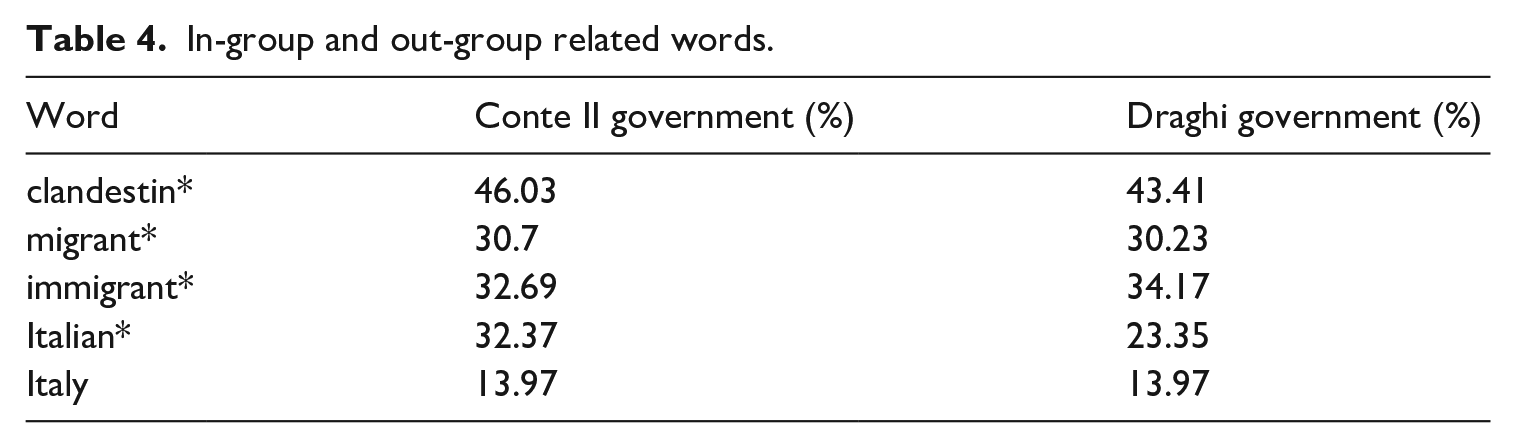
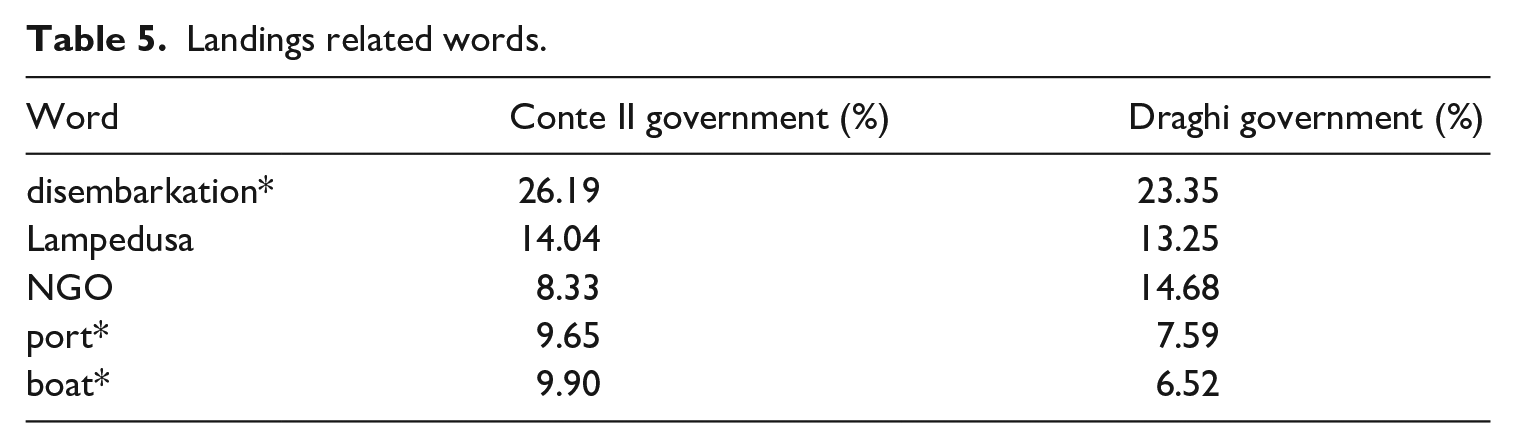
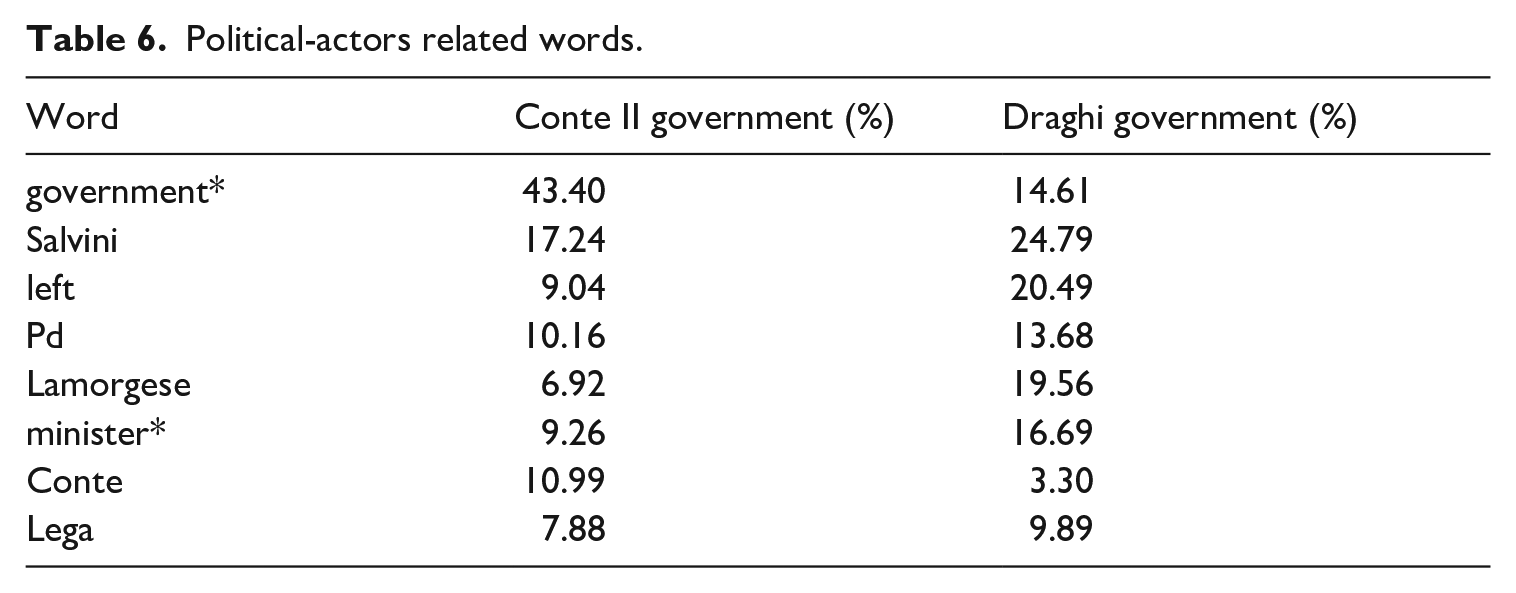
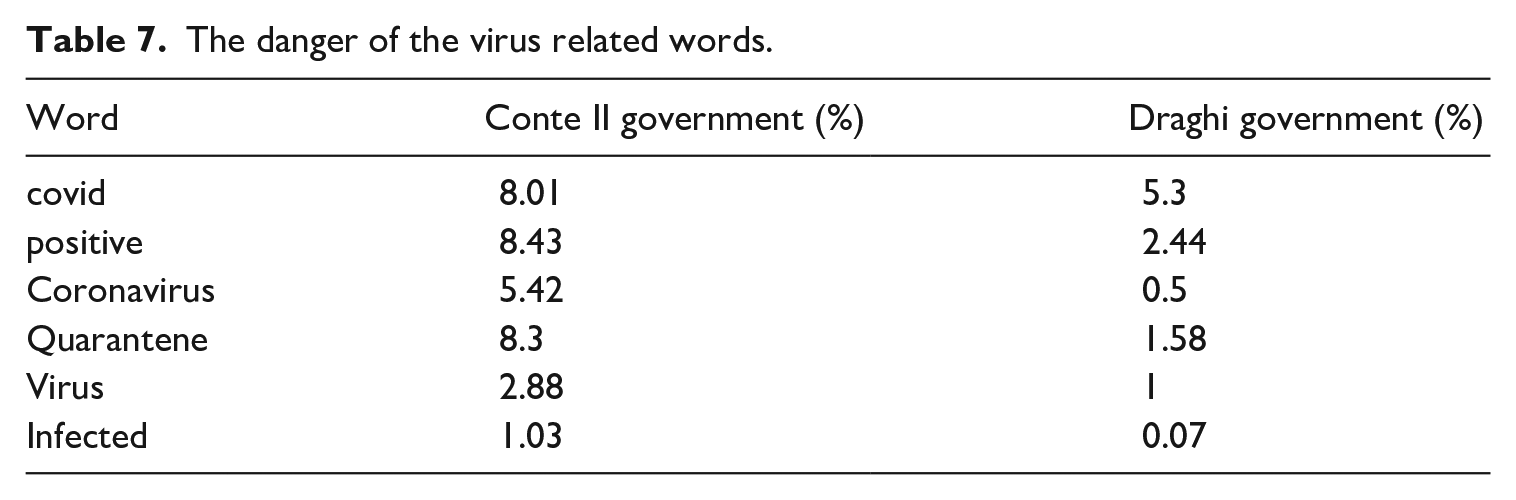
The first evidence is given by the identification of the most frequent linguistic units within the main corpus composed by 4516 Facebook posts about immigration created by Italian RWPPs. We focused on the 25 most frequent content words and proper names used by politicians of the three parties 9 and we divide them into four semantic groups of words. Tables 4–7 summarize the lexicon used considering the percentages of words during the Conte II period (No. of post 3120) and Draghi period (No. of post 1396).
In-group and out-group: words referring to ‘us’ represented by Italians and ‘them’ represented by migrants (Table 4);
Landings: words referring to places, names or actors associated with migrants arrivals (Table 5);
Political actors: words referring to single politicians, parties or institutions (Table 6);
The danger of the virus: words referring to the pandemic (Table 7).
In-group and out-group related words.
Landings related words.
Political-actors related words.
The danger of the virus related words.
Regarding the overall lexicon used, the four groups of words appear rather stable across the three parties, however, it is possible to consider some interesting differences if we look at the lexicon used during the two different periods considered. As Table 4 shows, during the Conte II government, the lemma ‘clandestin*’ is the most frequent, present in 46% of the alliance’s posts, followed by the word ‘government’ at 43%. With the transition to the Draghi government, ‘clandestin*’ remains the most frequent lemma used, while the word ‘government’ drops significantly from 43% to 14% of overall post.
Concerning the initial hypothesis, the group of words related to the virus (Table 7) is more present during the Conte II government when parties were in opposition and when the pandemic emergency reached its highest peaks. However, the most used word within this group is ‘positive’ which does not reach 9% of the posts, while it decreases to 2.44% during the Draghi government. The word ‘covid’ decreases from 8% to 5%, while the word ‘infected’ is only present in 1% of the posts during Conte II and disappears thereafter along with other terms. Instead, during Draghi we note also the grows by 10% of the lemma ‘landing*’ together with then Minister of the Interior ‘Lamorgese’, word that increases from 6% to 19% likewise the word ‘NGO’ which increase from 8% to 14%. Finally, we noted a lexical novelty in the form of the slogan ‘Naval blockade now’ usually carried by Fratelli d’Italia (see par. 5.3.3).
These general indications regarding the lexicon show that the already low frequency of the semantic set of the virus during the Conte II government decreases until it almost disappears during the months of the Draghi government. At the same time, during the latter, the attention seems to return to a number of immigration-related topics such as landings and the port closure highly common before the pandemic in the Italian political and journalistic scenario (see e.g. Binotto, 2020; Binotto et al., 2016; Combei and Giannetti, 2020).
In the next sections we present the collections of the four groups of words connecting them with the main argumentative structures that we analyzed during the two periods, revealing how discursive strategies are re-contextualized and adapted in relation to the role of each party. Specifically, we selected posts from different politicians that have received the highest values in terms of median interaction (Table 2) in order to highlight a type of argumentative structure that became particularly shared during the periods considered. 10 The analyses mainly focus on posts of Lega and Fratelli d’Italia as they are more consistent from a quantitative point of view.
RWPP immigration discourse during Conte II government
Defining in-group and out-group
The first group of words refers to the semantic field of the definition of out-group and in-group. The former group is marked by the preference of the negative lemma ‘clandestin*’ as the most frequent word in the data set (Table 4). In terms of identity and representation, ‘clandestine’ clearly delegitimizes the legal status of the asylum seekers (Taylor, 2009) in respect to ‘migrant*’ and ‘immigrant*’. The word ‘clandenstine’, during the Conte II government, is most often found in combination with the in-group such as ‘Italians’ and ‘Italy’ (the binomial ‘clandestine-italians’ is one of the most frequent collocation of the corpus), re-producing the common ‘us’ versus ‘them’ dichotomy frequently used in the political discourse about migration (Mudde and Kaltwasser, 2017; Wodak, 2015). The relevance of the mentioned words’ collocations is evident in Figure 1 with Salvini’s post (on the left) and Meloni’s post (on the right). The argumentation is placed on the contraposition between the migrant’ and Italians’ situation during Covid-19 pandemic, relying upon a language of division organized and re-proposed along the dichotomy ‘us-them’ that is constructed on the alleged imbalance between ‘migrants-favored’ and ‘Italian-disadvantaged’. However, the dichotomy is not presented through the well-known positive-self presentation versus negative-other presentation (Hart, 2010; Reisigl and Wodak, 2001), but reclaiming a status of inequality that the two groups are facing during the pandemic crisis.
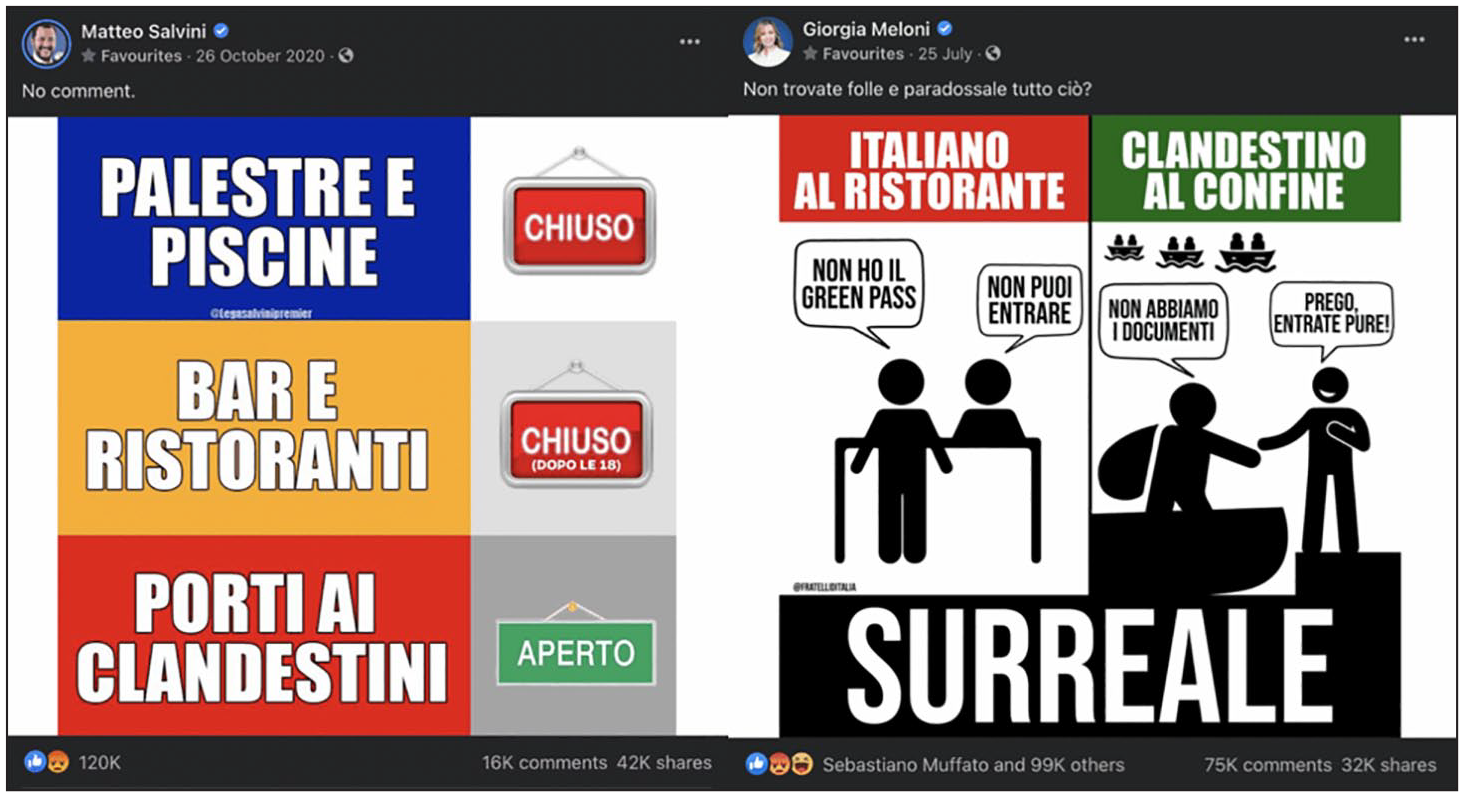
Salvini’ post 26/10/2020 and Meloni’s post 25/07/2021.
Salvini’s post is composed by a simple style of the vignettes which do not present any visual representations of migrants, landings, boats or other visual devices able to construct migrants’ representation. Rather, the image states: ‘Gyms and swimming pools, closed; Bar and restaurant, closed; Ports to clandestine, open’. The mentions to the ‘closed’ business activities are related to the ‘us disadvantaged’, while ‘Them’, presented as ‘clandestine’, can benefit from the open ports. Similarly, in Meloni’ post ‘Italians’ are represented by a vignette that shows a stylized man who is denied access to the restaurant because he does not have the green pass (the conversation in the vignette reads: ‘I don’t have the green pass’ ‘you can not enter’). ‘Them’ is represented as ‘migrants-favored’, also in this case called ‘clandestine’, who are allowed to pass the border without documents (the conversation in the vignette reads: ‘we do not have documents’ ‘Please come in!’). Words such as ‘ports’ and ‘border’ are part of the landings-border-related terminology (Table 5) which is evoked in Figure 1.
From the argumentation point of view, the discourse seems based on the topos of displacement (Hart, 2013) in which immigrants and asylum seekers are predicated as having privileged access not only to socio-economic resources ahead of the in-group (Hart, 2013), but in terms of freedom. This topos it may be related to the topos of justice (Wodak, 2001) and it can be expressed as follows: «if a situation leads to certain individuals being privileged over other individuals, action should be taken to redress this imbalance» (Hart, 2013: 200). When contextualized into the pandemic, the topos of displacement causes stronger indignation maximizing the presumed inequality intended to characterize society according to a ‘struggle-frame’ (Albertazzi et al., 2021). However, from a lexical and argumentative point of view, the discourse is not firmly anchored to the pandemic-immigration binomial, nor so much as migrants as carrier of the virus.
Political actors and their responsibility
During Conte II government, one of the main argumentations used to support the alleged imbalance between ‘us versus them’ is referring to the political opposition through the group of words concerning political actors and in particular the word ‘government’ (Table 6). The lexicon shows several binomials such as ‘government-clandestine’, ‘government-italians’ referred to in-group and out-group and other related to the government attributes ‘government-immigrationist’, ‘government-incompetent’, ‘government-left’. These collocation suggest a specific dimension of the politicization of immigration debate (Hutter and Kriesi, 2019, 2022), exploiting the issue of immigration in order to attack the government’s handling of the pandemic, as shown by Silvia Sardone from Lega in Figure 2.
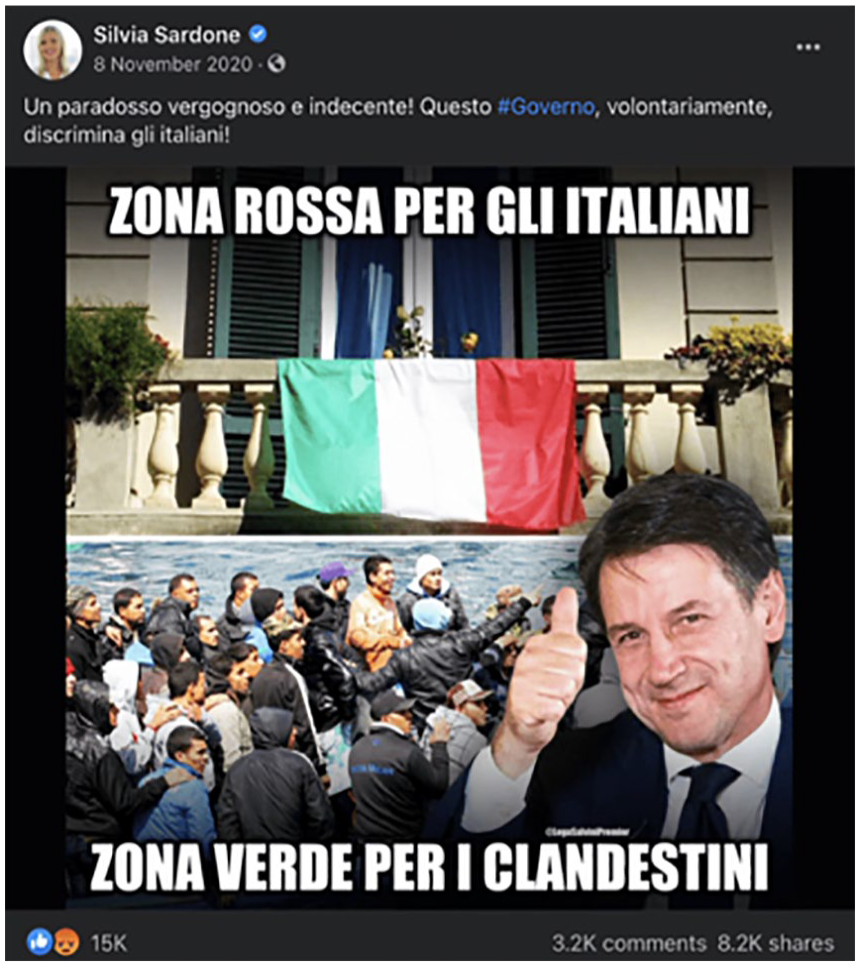
Sardone’ posts 13/11/2020.
Like in previous posts, Figure 2 shows another simplistic argumentations based on an image reporting the ‘us versus them’ distinction that allows to construct the outrage: Italians (represented by a picture of the national flag on the top of the image) are in disadvantage conditions (‘in the red zone’), while ‘clandestines’ (at the bottom of the image) are described as favored in ‘green zone’. The post’ text (‘A shameful and indecent paradox! This #government discriminates Italians on purpose’) emphasizes the ‘us’ victimized placing the attention on political sphere with the topos of responsibility that establishes the government (used as a hashtag in order to give visibility to the word) as the responsible for the inequality and thus de-legitimating it because its inability to manage the migration phenomenon and for allowing sea crossings by would-be migrants to increase (Albertazzi et al., 2021). In line with the part of the image representing migrants is placed a picture of the ex-Premier Giuseppe Conte recontextualized as a scapegoat into the inequality discourse.
As seen in Table 5, the word ‘Conte’ is frequent in 10% of the posts during his government. Indeed, criticism against Prime Minister resulted in a demonstration organized by Fratelli d’Italia the 3rd December 2020. In his Facebook live Galeazzo Bignami (Figure 3) stated: ‘CONTE RESIGN!!! We are demonstrating unitedly in front of Palazzo Chigi to demand the resignation of Giuseppe Conte. . .’ The protest is constructed on the topos of displacement analyzed in the previously posts (‘. . .Giuseppe Conte, who is forcing Italians to stay at home armored, businesses to stay closed while in the Chamber of Deputies the red yellows amend the Security Decrees to open the ports and let in illegal immigrants and migrants. . .Here are their government priorities!!! ’.
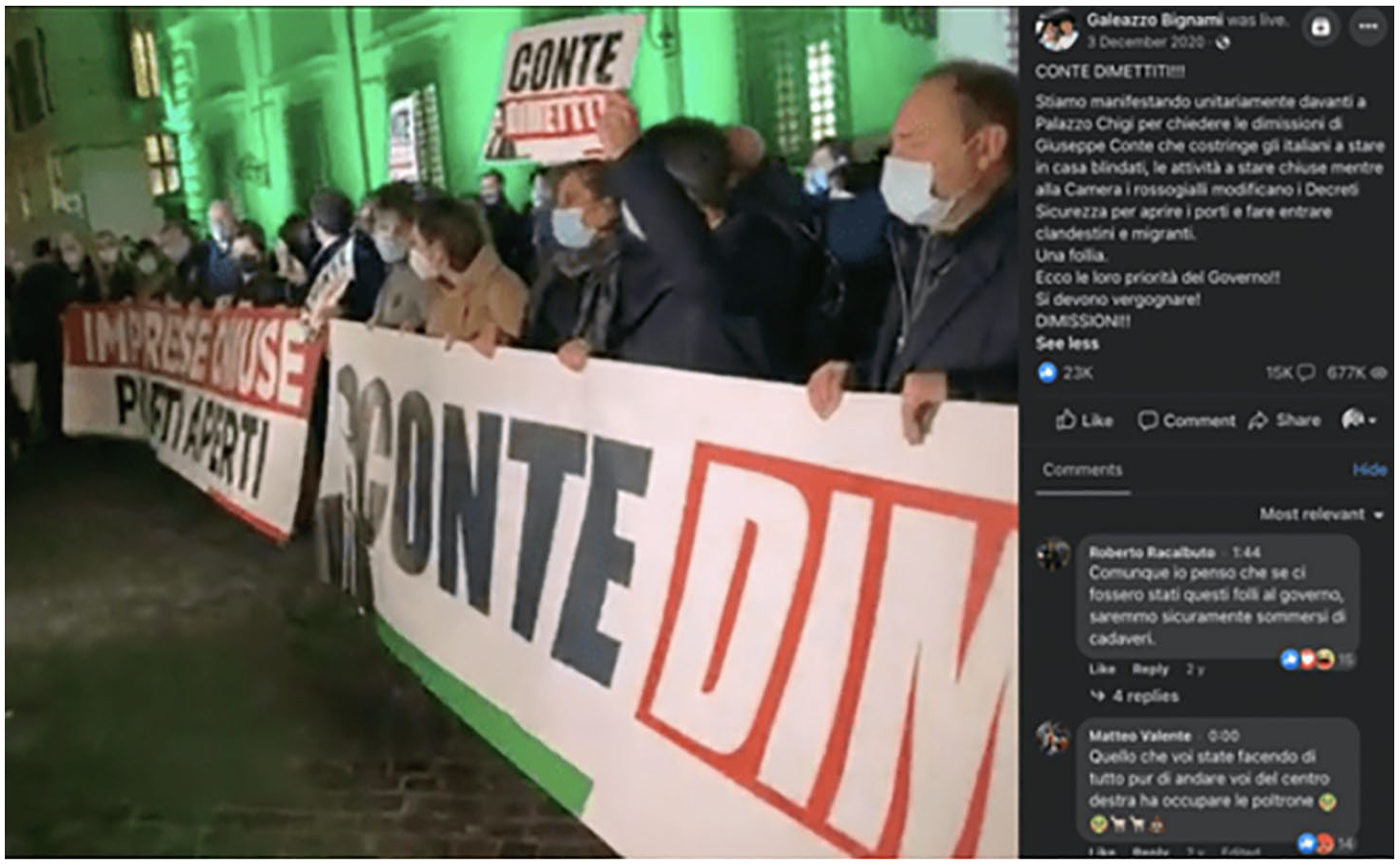
Galeazzo Bignami’ post 03/12/2020.
In this case, the traditional populist discourse built on the opposition ‘us’ versus ‘them’ is brought into play in which ‘them’ is represented by the ruling political elite who force Italians to stay at home, keep their businesses closed while abolishing the security decrees in order to open the ports and thus favor migrants. Once again, the latter do not appear as directly represented as the enemy but indirectly addressed through the attack against the government.
The danger of the virus
The third group of words focuses on the danger of the virus (Table 7). During the Conte II government, the most frequent collocates of the word ‘positive’ are ‘covid’, ‘migrants’, and ‘immigrants’. However, it should be emphasized that these collocations do not reach particularly high frequency values, reiterating that the migrant-virus association exists but is not the main characteristic of the right-wing discourse during Conte II government. Although the linguistic analysis didn’t reveal a systematic reproduction of de-humanizing metaphors, we wanted to highlight some of the posts in which the discursive argumentation was explicitly based on the connection between immigration and infections. Although not particularly frequent, these posts achieved high value in terms of user interactions. Moreover, it is important to note that during the summer of 2020 this argumentation reaches its peak, as the number of landings increases during the summer months. 11 The next posts were created again by Giorgia Meloni and Matteo Salvini. The Meloni’ post (Figure 4) is composed of an image with a four steps circuit showing the alleged hypocrisy that drove the Italian government to manage the migratory phenomena during the pandemic.
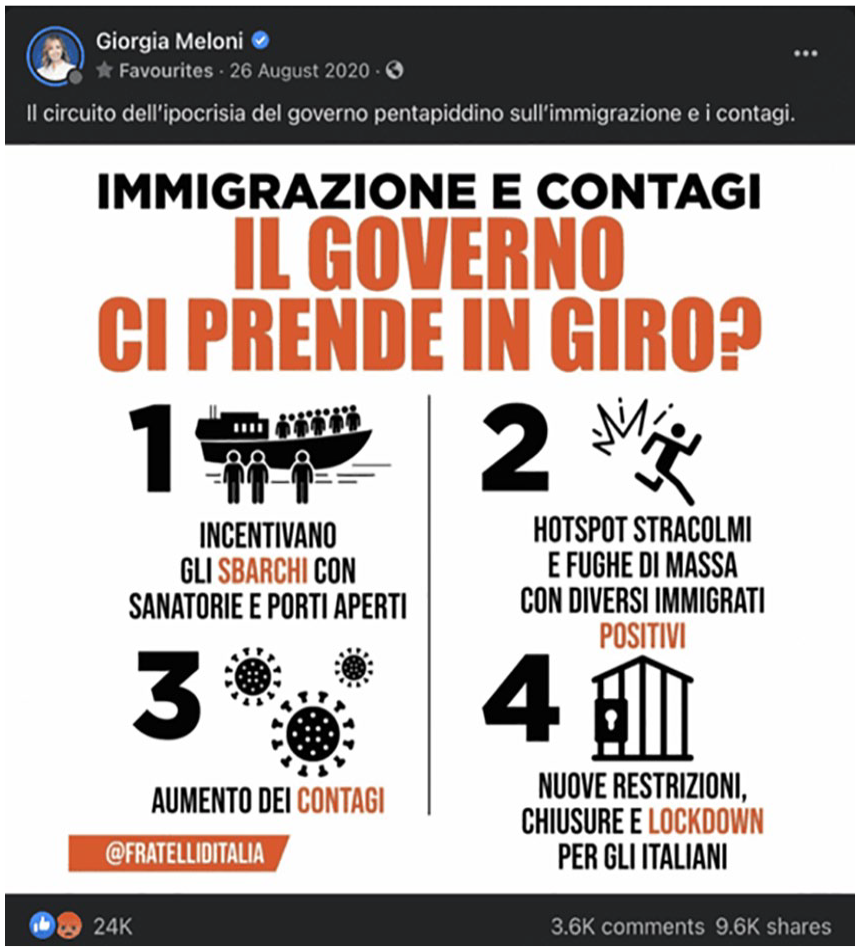
Meloni’s post 26/08/2020.
The image states ‘immigration and contagions. Is the government making fun of us?’: (1) ‘Government encourages landings with open ports and amnesty for migrants’; (2) Migrant’ ‘hotspots are full to the brim and there are mass escapes of immigrants positive to the virus’; (3) ‘Rise of contagions’; (4) ‘New restrictions, closures, and lockdowns for Italians’. In each step, one word is highlighted: ‘landings’, ‘positives, ‘contagions’, ‘lockdown’ in order to give a sense of causality that explicits a simple equation: more landings mean more contagions that will damage (exclusively) Italians with more restrictions. Also in this post the word government represents the group of words concerning political actors, while the group of border-related terminology is recalled with ‘landings’ and ‘ports’ (Table 5). Thus, this causal argumentation connects previous elements such as ‘landings’, ‘migrants-favored versus Italians disadvantaged’ and the responsibility of the Italian government mixed with the danger of ‘positive’ migrants. In other words, Meloni post shows the ability to integrate the danger of the virus into past and consolidated argumentations. Indeed, the topos of contagion is more invoked by the premise and, in turn, facilitates the inferential step toward the presupposed conclusion (Hart, 2013): «if a political action or decision bears specific dangerous, threatening consequences, one should not perform it» (Wodak, 2001: 75).
In Figure 5, Salvini uses explicit and dehumanizing rhetoric in order to connect migrants with the virus.
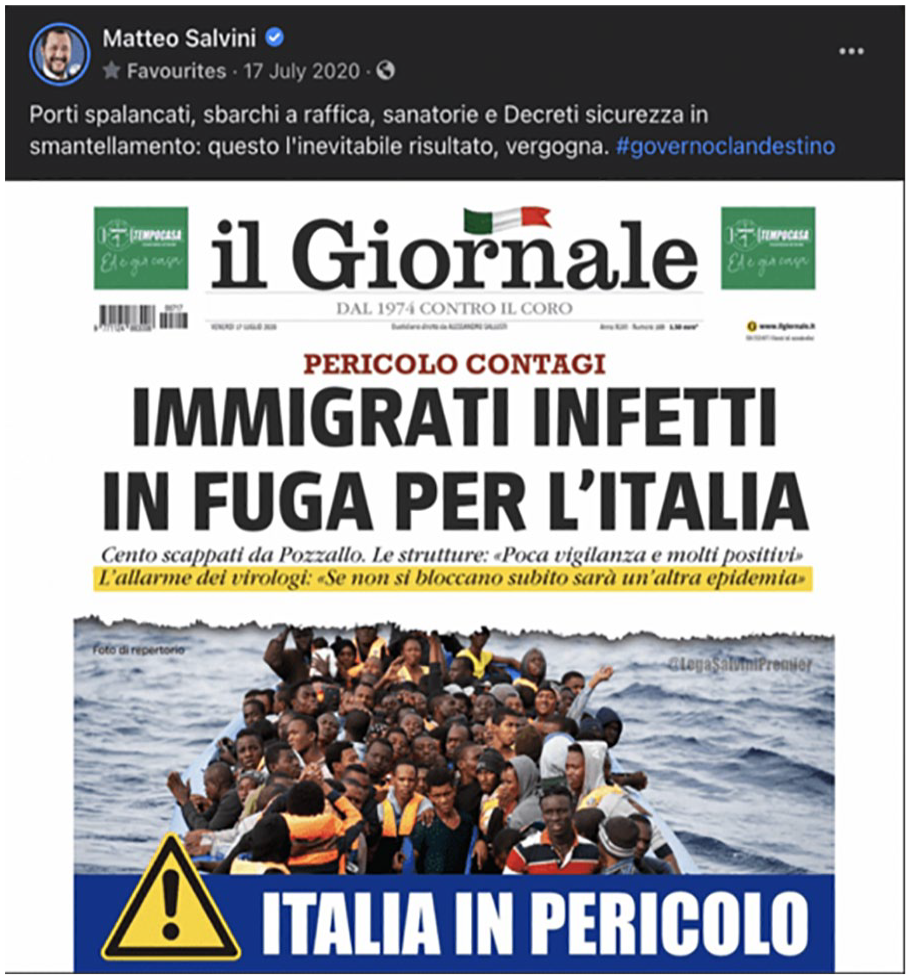
Salvini’ post 17/07/2020.
The post is introduced by the following text: ‘wide-open ports, landings in flurry, amnesties and Security Decrees demolished: this is the inevitable result, shame. #clandestinegovernment’. In this case, Salvini depicts the Conte II government as an illegitimate executive which with its politics have led to the danger of contagion. This argumentation is legitimized by combining discursive forms of authorities and moral stance justifying the exclusion of migrants in terms of health (Rheindorf and Wodak, 2018). The first form of authority is the impersonal authority (van Leeuwen and Wodak, 1999) of the journalism: the post shares the newspaper front page of ‘Il Giornale’ (right-wing newspaper) which titles ‘Danger contagion. Infected immigrants escaping in Italy’. The image draws a boat full of men followed by a caption that says ‘ITALY IN DANGER’ explicitly combining the topos of danger with the topos of disease. The latter appeals to innate fears of physical harm, loss of territorial control and cultural identity, and infection from transmittable diseases (Hart, 2010). We assist here to an explicit de-humanizing narration that aims to exclude the alterity basing the argumentation on the disease, evoking the danger for the public hygiene, and the purity transforming the out-group in microbe, virus, and pestilence. In this case, even if landings-border-related terminology are not present in the text, the visual component of the post depicts the traditional image of immigration in Italian media since the 80s and 90s (Pogliano, 2011): a boat full of indistinct men as ‘desperate people’ that reinforce the narrative of immigrants and refugees as ‘Them’.
Furthermore, the highlighted subtitle (‘Virologists alarm: «if we do not block them now it will be another epidemic»’) shows a legitimation based on a personal authority (van Leeuwen and Wodak, 1999) personify by the virologists the legitimize the topos of urgency: blocking the arrival is the only way to maintain the control and avoid the danger. In this case, the discourse is not only considering real risks and dangers for the people, but also a constructivist social process that considers supposed risks that are based on the presentation and anticipation of potential future disasters. In other words, the relation between migration and the pandemic combines past argumentations, the present health crisis and the projection of the past into the future and this pattern is deployed strategically to pre-legitimize outright attacks on one’s political opponents (Krzyżanowski and Krzyżanowska, 2022). Moreover, in both posts, through the use of these topoi, we are facing a form of re-contextualization of the ‘moralization of borders’ (Vollmer and Karakayali, 2018) based on the balancing act of excluding migrants but at the same time standing on a high moral ground for which the EU and its Member States stand for during the pandemic. In other words, the appeal to ‘safety’ and ‘health’ as universal and superordinate values relates to a dehumanizing rhetoric that legitimizes the rejection of migrants in paradoxical defense of liberal values (Rheindorf and Wodak, 2018). Thus, as happens with other emergencies or crisis, the outbreak risks further legitimizes securitarization and border politics (Ferrández-Ferrer, 2021) constructing national state as bodies that have to be protected from invasion, penetration, infection, or disease (Musolff, 2004).
RWPP immigration discourse during Draghi government
Immigration, neglect, and crime
In 2021, when Lega and Forza Italia became part of the Draghi government, we see significant changes in the immigration-pandemic discourse, together with a weakened in this relationship. Precisely, in the lexicon of these parties, the common opposition between ‘migrants-privileged’ and ‘Italians-privileged’ is missing. Another novelty with respect to the Conte II government, is the return of widely known themes that characterize the political and the journalistic discourse on immigration in Italy that had been sidelined during the initial period of the pandemic. Due the space issue, we highlight the term ‘degradation’ practically absent during Conte II and present in 9% of posts during the Draghi government. The return of this theme it be traced back to a gradual opening from social restrictions in the summer months of 2021 after the acute phase of the virus. The Lega member Silvia Sardone is particularly active in cultivating this narrative as shown by her post in Figure 6 which is characterized by the well-known topos of crime.
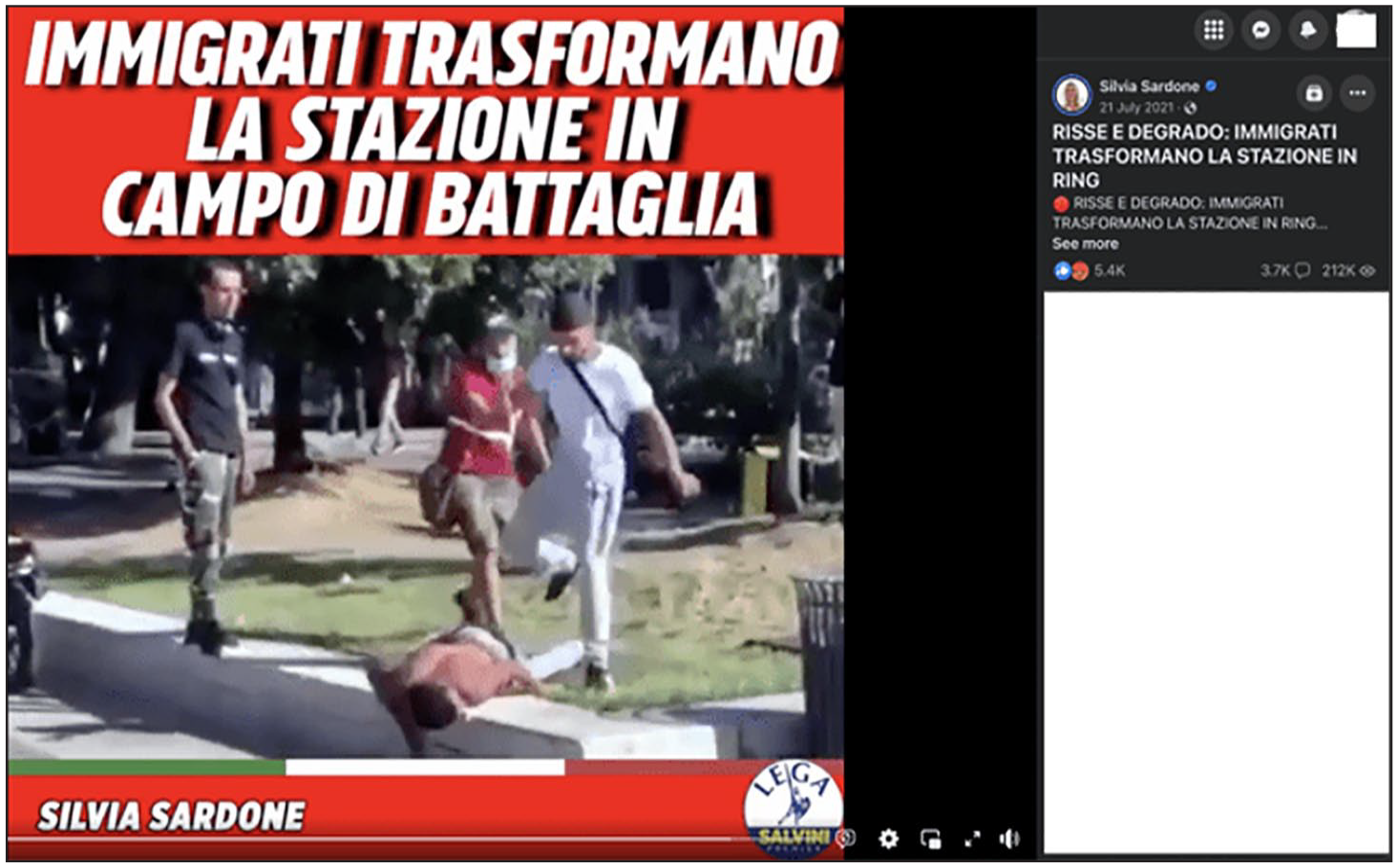
Sardone’ post 21/7/2021.
From an argumentative point of view, the topos of crime attributes to the out-group negative characteristics and behaviors: ‘endless degradation and squalor: violence between clandestines (many of them drug dealers)’ which are narrated as systematic phenomena in the city of Milan (‘is a daily occurrence’). Immigrants are blamed of ‘turn the station into a ring’, underlining the deteriorating impact of their presence. Also this discourse is accompanied by the search for those responsible, namely the leftist city’s mayor Giuseppe Sala (‘in the silence of Mayor Sala!’), reinforcing the discourse that links immigration-insecurity and political responsibility. The topos of crime leads back to the discourse on security on which the notion of moral panic is built. As recalled by Maneri (2001), the moral panic about immigration in Italy is constructed in terms of discourse and practices on urban ‘security’ and ‘insecurity’. Indeed in the above cases, we are dealing with a case of moral panic built around local events and protests (Maneri, 2001, 2018; Pogliano, 2016) and specifically, placed in proximity to the elections when politicians and media, form a circuit of reciprocal pressures that identified immigration as the principal threat to security (Maneri, 2018).
Attacking old enemies
The attack on the political enemy remains a central feature also in the immigration discourse during the Draghi government. However, in contrast to Conte II, Political-actors related words (Table 6) are not characterized by the word ‘government’ which drops from 43.40% to 14.61%. This is particularly true for Lega and Forza Italia (Figure 7) that attack opponents through the direct delegitimisation of the center-left parties at government, together with personalities from outside politics, such as the activist Luca Casarini. What must be emphasized here is that, contrary to previous period, the issue around the attack do not concern the pandemic, but well-known topics such as the criminalization of NGOs and Ius Soli.
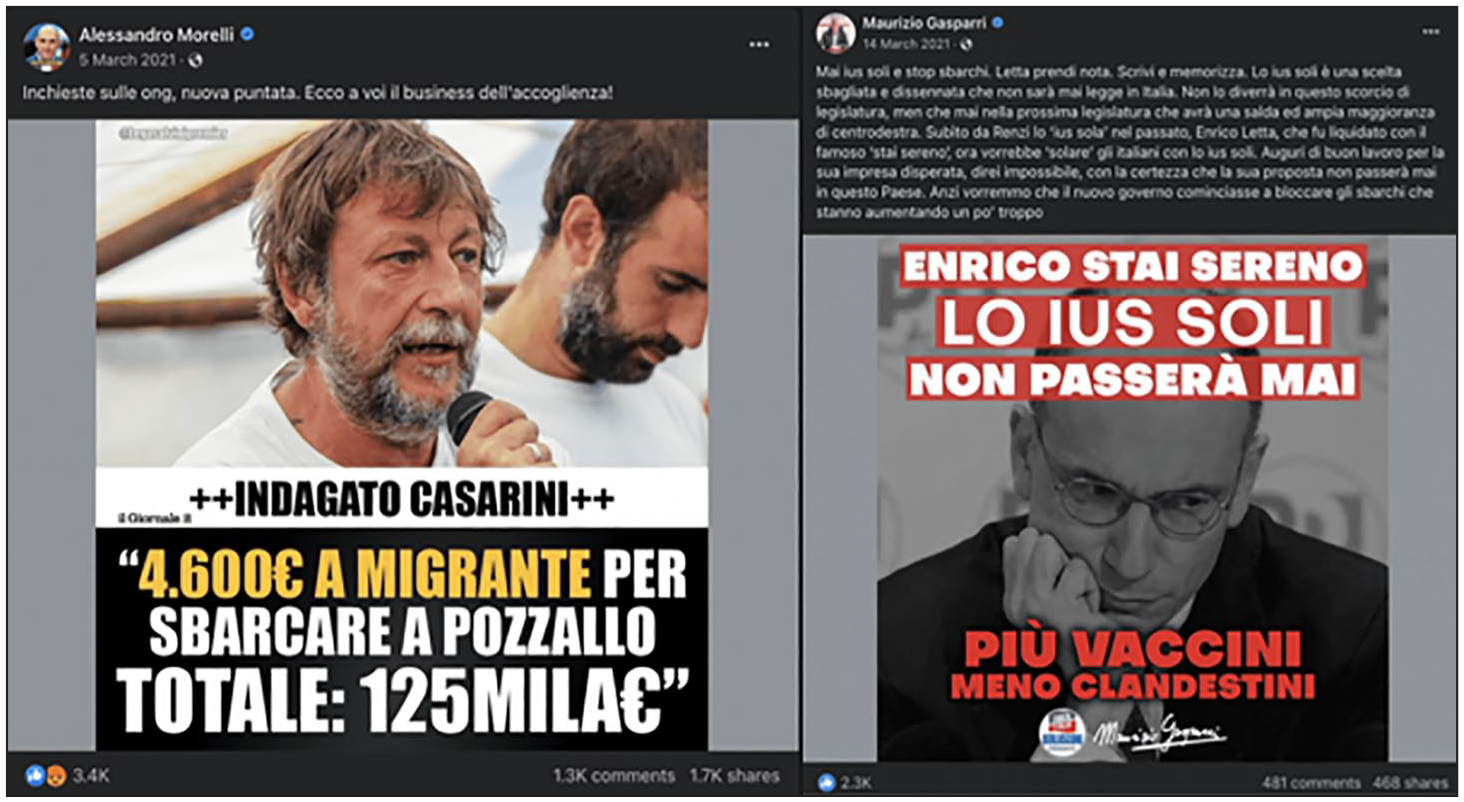
Morelli’ post 5/3/2021 and Gasparri’ post 14/3/2021.
In his post Alessandro Morelli from Lega states: ‘Investigations on NGOs, new episode. Here is the hospitality business! Casarini investigated. 4600 Euro per each migrant for landing in Pozzallo. Total: 125,000 Euro’. In recent years, NGOs involved in saving lives in Mediterranean Sea, were accused of make profit from the rescues and do business with the smugglers then favor illegal immigration. The effectiveness of such argumentations is built on the topos of finance which shows the illicit gain of NGOs that should force legal action to indict them, proving their criminal intents (Cerase and Lucchesi, 2022). The use of the ‘finance’ proves the argument that NGOs are guilty of doing business with immigration and therefore justifies the adoption of specific actions against them. Not only immigration is portrayed as a traditionally burdensome phenomenon for the host population (Wodak and Meyer, 2001), but non-governmental and supranational actors are accused to make money illicitly by dealing with the immigration beyond national laws.
Interestingly, although members of the Lega and Forza Italia were part of the Draghi government together with the Partito Democratico, they continued to attack the latter likewise in the previous period. This is evident by Maurizio Gasparri’ post (Forza Italia), which attacks the secretary of Partito Democratico Enrico Letta in relation to the Ius soli topic, depicting him as thoughtful and downcast looking, being mocked and de-legitimized with the joke ‘Enrico be quiet’. Siding against Ius soli, means denying the acquisition of the nationality of a given country as a consequence of the legal fact of being born on its territory, regardless of the nationality of one’s parents. This denial passes through legitimation strategies thus legitimize the exclusion of migrants (e.g. Rojo-Martin and Van Dijk, 1997) using abstract moral values such as justice and culture (van Leeuwen and Wodak, 1999: ‘Ius soli is a wrong and foolish choice that will never become law in Italy. . . his proposal will never pass in this country’ accompanied by an indication of the direction to take ‘On the contrary, we would like the new government to start stopping the landings that are increasing a bit too much’. Finally, decontextualized from the topic of Ius soli, we find the only sentence that refers to the pandemic and specifically to vaccines: ‘More vaccines less clandestines’.
The Fratelli d’Italia discourse as the only opposition party
If we look at the lexicon and the discourse of Fratelli d’Italia during the Draghi goverment, when party remained at the opposition, we notice the biggest differences within the RWPP’s immigration discourse. Contrary to Lega and Forza Italia, the word ‘government’ continues to play a central role especially together with its collocations such as: ‘government-left’, ‘government-landings’, ‘government-Draghi’. Also references to landings are frequent such as ‘landings-stop’, ‘landings-lampedusa’, ‘landings-illegal’, ‘landings-block’ likewise the slogan ‘Naval blockade now’. Moreover, in contrast to Lega and Forza Italia, the 'immigration-pandemic' relationship remained in the Fratelli d’Italia discourse with arguments similar to those of Conte II. Specifically, Figure 8 groups 3 posts by the party in which we identified: (i) the general contraposition between the migrant’ and Italians’ situation during the pandemic with the well-known argument ‘Italy closed, ports wide open’ by Giorgia Meloni; (ii) The ‘green pass paradox’ by Francesco Lollobrigida ‘While Italians without a green pass will not be able to sit in bars and restaurants, there will be illegal immigrants disembarking undisturbed on our shores, without any right to stay there’; and finally (iii) migrants positive to virus by Galeazzo Bignami: ‘The already precarious health situation risks worsening due to the continuous landings on our coasts and the poor control caused by the continuous arrival of illegal immigrants. Defending borders also means defending the health of Italians’.
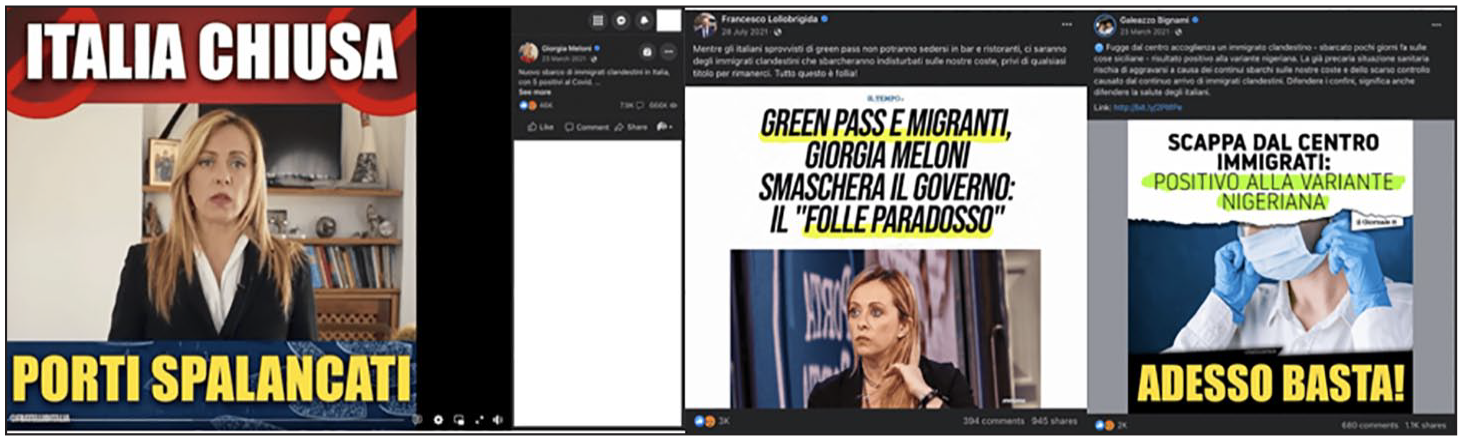
Meloni’ post 23/3/2021, Lollobrigida’ post 28/7/2021, and Bignami’ post 23/3/2021.
The border defense discourse has always played a key role in RWPPs (Basile and Mazzoleni, 2020; Rheindorf and Wodak, 2018; Wodak, 2015). During the Draghi government, this is summed up in the Frattelli d’Italia slogan ‘naval blockade now’ which intends to show the strategies adopted by the party to stop the landings. Posts by Francesco Lollobrigida and Galeazzo Bignami (Figure 9) share a communication strategy based on very short slogans written above an image depicting boats full of people, recalling the well-known metaphor of invasion and the topos of danger. Above these images are written in large letters the slogans: ‘Let’s stop the immigration business’.., ‘No more landings. No more enriching the smugglers and the immigrant NGOs’, ‘Let us defend our borders. Stop illegal immigration. Immediate naval blockade’.
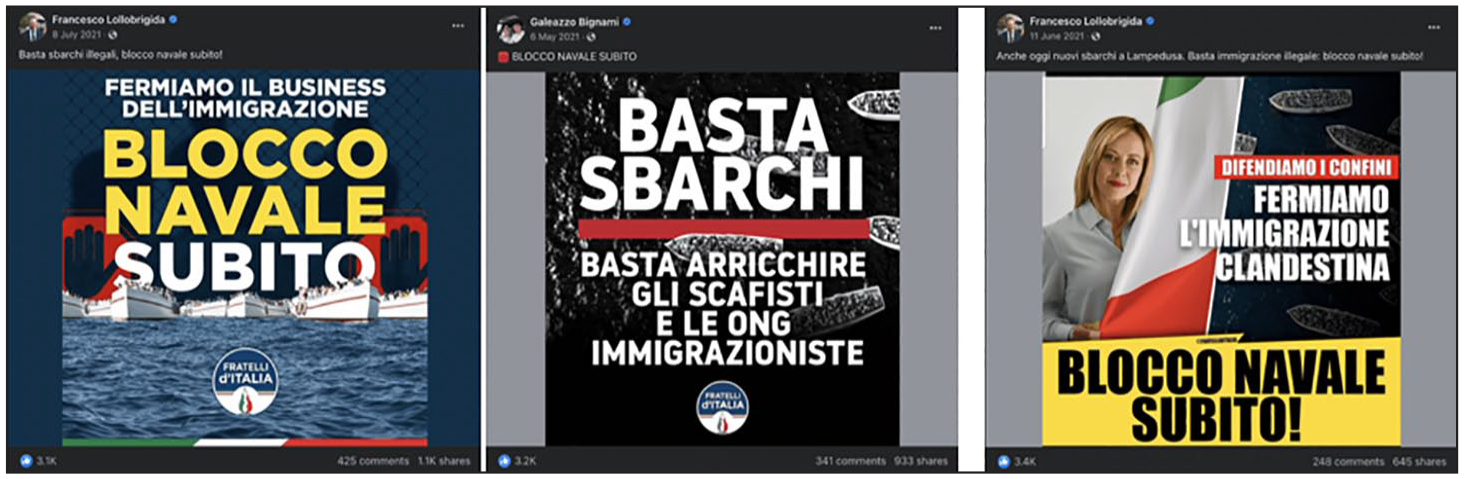
Lollobrigida’ posts 8/7/2021, 11/6/2021, and Bignami’ post 23/3/2021.
Also in this case, we see that the ‘naval blockade’ slogan is not necessarily and explicitly connected to the pandemic theme and, likewise the well-know Salvini’ argument of #Closingports, is rather addressed to the NGOs (Cerase and Lucchesi, 2022). Indeed, both slogans represent a way to regain control over national sovereignty (Basile and Mazzoleni, 2020) as a core theme of the Italian RWPP discourse and as an act of re-territorializing the State power, in other words, restore the authority into the place and national community by which politics stems its legitimacy (Basile and Mazzoleni, 2020; Wodak, 2015). Moreover, both slogans are legitimized by instrumental rationalization (van Leeuwen and Wodak, 1999), affirming the usefulness of blocking the NGO boats on the ground of expected or presumed benefits: once the naval blockade is activated, boats departures will end. Finally, it should be noted that this slogan was also widely used in the subsequent 2022 election campaign, which resulted in Fratelli d’Italia being the most voted party.
Conclusions
In the last 30 years, the political communication about migration in Italy has been adapted in relation to specific moments of crisis shaping a xenophobic discourse against refugees and asylum seekers (see e.g. Cavallaro and Pregliasco, 2021; Dal Lago, 2012; Maneri, 2001; Milazzo, 2020). Facing the pandemic crisis, it would be legit to expect a clear radicalization of the RWPP’ discourse based on the connection between the virus and immigration in terms of de-humanizing rhetorics. On the contrary, as noted by a recent study, the pandemic does not seem to have furthered the radicalization against immigrants (Genova and Lello, 2021), which seems to remain ‘frozen’ as stated by different authors in recent years (Binotto, 2020; Binotto et al., 2016).
Indeed, our analysis showed that the connection between immigration and the virus represented a small portion of the overall discourse about immigration not confirming our first hypothesis (H.1). This output can be found out at different levels of analysis. Firstly, although the migration-pandemic relation has been discussed mainly in the first period of the pandemic, when the three parties were at the opposition, the lexicon analysis did not show a systematic use of linguistic forms able to blame migrants as vehicles for the virus. Similarly, selecting posts with the highest volume of users engagement and analyzing their argumentative structures, the topos of disease did not assume the main discursive strategy to confer causality between migration and contagion.
Instead, during the pandemic, likewise the ‘refugee crisis’, we faced a recontextualization of previous patterns of talking about migration and otherness (Krzyżanowski et al., 2018): RWPPs constructed their discourse through a re-articulation of the ‘us versus them’, dichotomy claiming victimhood of ‘us’, lamenting the situation of Italians locked at home respecting the quarantine with that of ‘them’ as ‘clandestine’ who were ‘free to reach the country’ and to move freely throughout Italy. The argumentative analysis made it possible to identify the topos of displacement as the most frequently used which, during the pandemic, it is not referred to socio-economic resources destined to the out-group ahead of the in-group (Hart, 2013), but in terms of freedom and right of movement as central themes that affected the entire population.
Exploring these discursive dynamics allows making clear the changes in the perception and ‘classification’ of social actors and groups that are involved in this discursive shift (Krzyżanowski, 2020). Indeed, the other key transversal aspect of the RWPPs discourse was the systematic delegitimization of political opponents for their supposed failures of handling of the pandemic. In other words, the tendencies in reporting negative implications for the in-group, do not consider only migrants (Triandafyllidou, 2020), but it is articulated toward political actors and their policies to govern the phenomenon. What we want to emphasize is that during the overall period considered, the centrality of political confrontation has moves the attention from an explicit de-humanized rhetoric against migrants to the field of political conflict.
This allows to consider our second hypothesis (H.2). In the wake of other recent studies interested in the Italian context (Urso, 2018; Zanotti and Meléndez, 2023), we hypothesized that being in Draghi government would play a crucial role in ‘softening’ the way Lega and Forza Italia discuss the immigration issue. When RWPPs were in opposition the discourse on immigration was unanimously and consistently reproduced by the alliance which emphasized the government’s management incapacity and ‘unfair’ maneuvers against Italians. Once in government, Lega and Forza Italia no longer reproduced the migration-pandemic relationship. On one hand, they stop to reproduce the dichotomy ‘Italians victimized-migrant privileged’ as they found themselves in a role of responsibility in which they could intervene through pragmatic maneuvers to administer the migration phenomenon. On the other hand, during the Draghi government, Lega and Forza Italia maintained their discriminatory language toward migrants, re-proposing traditional themes on which the anti-immigration discourse is based such as degradation, violence, illegality, and criminality that have extirpated the immigration-pandemic relationship. In other words, our analysis showed that Lega and Forza Italia started to talk less and differently about immigration, without modified or softened their discourse given their position in the government. Thus, our second hypothesis has only partially confirmed.
Differently, during the two governments, Fratelli d’Italia continued to exploit the full potential of the immigration-pandemic relationship as a dimension on which criticize the work of both governments and affirming its slogans. Being the only party in opposition allowed to maintain its own radical right political discourse depicting itself as the only party acting in the people’s interest, opposing the elite, thus increasing its electoral support while Lega and Forza Italia declined (Donà, 2022; Zanotti and Meléndez, 2023).
However, the data collected from the analyses must take into account certain limitations of our study. As mentioned, from a quantitative point of view, the frequency of publishing content about immigration should be related to each politician’s general use of the platform and according to his or her role and position. Furthermore, the selection of posts for the discourse analysis took into account the median values of engagement and this criterion could lead to ignoring discursive characteristics of posts that achieved lower engagement levels than those considered. Thus, the approach adopted may lead to over-representing some leaders’ contents. Finally, the division between the two periods must also take into account the general newsworthiness of immigration, which during the months of the Draghi government suffered a drop in interest (Associazione Carta di Roma, 2021). Therefore, further studies would be needed to confirm our data and enrich our hypotheses.
Despite the limits, our work has made it possible to highlight the forms of celebration of vilification of political opponents that are part of delegitimization and incivility. In line with the approach proposed by Bentivegna and Rega (2022), we think that this incivility cannot be conceived as mere unpoliteness composed by disrespectful and offenses tones and language used by politicians, but we intend political incivility as a communications strategy. Specifically, we found that the ‘individual delegitimization’, which includes the delegitimizing of other political subjects or groups (Bentivegna and Rega, 2022), has been a key factor in RWPPs discourse during the pandemic. In our case study, this incivility provided as symbolic field on which to talk about immigration and it was used as a tool to prove the government’s inability to administer the pandemic, perpetuating the difference in treatment between immigrants and Italians.
Finally, in the face of these discursive characteristics, it remains central the step of normalization (Krzyżanowski, 2020; Krzyżanowski and Ledin, 2017): although on the level of political communication the pandemic seems does not create new symbolic resources that enrich the anti-immigration discourse, covid-19 crisis has not reduced the existing xenophobic instances, but rather normalized them into discursive strategies within the ‘legitimate’ political confrontation between parties. As has been shown in the course of the analysis, RWPPs show «elements of conscious, well-designed, opportunistic political communication strategies which allow for the spread of ideas and ideologies» (Krzyżanowski, 2020: 523) in order to obscuring migrants’ voices and the solidarity toward them, fostering their depersonalization and, thus, reproducing the typical feature of the legitimacy of the contemporary racism.
Footnotes
Declaration of conflicting interests
The authors declared no potential conflicts of interest with respect to the research, authorship, and/or publication of this article.
Funding
The authors received no financial support for the research, authorship, and/or publication of this article.