




Abstract
In Hungary, the decline of traditional peasant culture and its heritage has prompted urban revivals, leading to the acceptance of traditional Hungarian folk singing as a performing arts genre. Drawing from a series of in-depth interviews, this study shows how contemporary Hungarian folk singers navigate (define, learn, police) different forms of authenticity within the field of folk music. While we find that objectified authenticity – heritagized classification systems – is the dominant form of symbolic capital, the broader symbolic economy of authenticity is complicated by competing definitions of folk singing as, variously, culture, heritage, and art. Third-person authenticity is more highly regarded, but it is more difficult for contemporary urban folk singers to achieve because they were not socialized in peasant communities. Therefore, they use objectified authenticity such as ‘original recordings’ as a proxy for learning about living folk culture. Although objectified authenticity constrains the agency of artistic expression, it affords discriminatory creativity (choosing one’s own repertoire) and rationalized creativity (adapting traditional material to external values and contexts).
Keywords
Introduction
Beginning in the late 19th century and continuing through the turmoil of the 20th century, Hungarian folk singing has gone through waves of heritagization that have transformed it from a mode of cultural expression of Hungary’s rural peasant population to an urban artistic practice. This article integrates insights from heritage studies, ethnomusicology, and cultural sociology to investigate how participants in the field of Hungarian folk singing draw on folk music – as a way of life, as heritage, and as art – to navigate authenticities. We draw insights from qualitative in-depth interviews to answer the research question: How do contemporary Hungarian folk singers navigate (define, learn, police) different authenticities?
This study makes several contributions. First and foremost, it expands the ongoing sociological dialogue on authenticity. By building on previous work concerning the symbolic economy of authenticity (Grazian, 2003; Schwarz, 2016), our research demonstrates how different authenticities provide symbolic capital in a field of cultural production. In contrast to previous studies, we also explore the relationships between various authenticities by examining how they are defined, policed, and learned. We show how heritage practitioners prioritize specific forms and definitions of authenticity over others, thereby illustrating and offering further theoretical insights into Bohlman’s (1988) claim concerning the interdependence of representation and creativity. However, we also consider how such hierarchical ordering both constrains and affords creativity. Second, this article synthesizes two literatures: heritage studies – specifically, work on heritagization (Kirschenblatt-Gimblett, 1998, 2004; Naguib, 2013) – and cultural sociology – specifically, that related to artistic legitimation and, to a lesser extent, field theory (Baumann, 2001, 2007). This approach allows for a more nuanced understanding of how traditional elements of heritage gain a ‘new life’ on stage in urban settings. Third, the Hungarian folk revival is arguably the largest and most important folk movement to emerge in the former Eastern Bloc, and yet the English language literature on this topic is sparse, especially in cultural sociology. Our analysis serves as a reference point for future investigations into how 21st-century revival movements relate to the origins, safeguarding and contemporary (re)presentations of their practice.
Drawing on heritage studies, we will first discuss the changing position of folk singing from a way of life to heritage. Next, we bring insights from cultural sociology to bear on the secondary literature to argue that folk singing has recently undergone a process of artistic legitimation. We will then theorize how various authenticities might be used as symbolic capital in the field of Hungarian folk singing. After explaining the data and methods, the results will be discussed in terms of how authenticities are defined, learned, and policed. Finally, we will answer our research question, address the contributions this study has made and suggest avenues for future research.
Heritagization: From Culture to Heritage
We draw on heritage studies to understand the heritagization of Hungarian folk singing (Kirshenblatt-Gimblett, 1998, 2004; Sárosi, 1973). Culture is a way of life where cultural expressions, such as singing, are the manifestation of an internal desire to voice the emotions of individuals, groups, and communities (see testimonials in Berecz, 2004). These living cultural expressions are thus deeply rooted in their sociocultural environment, inherently linked to and inseparable from them (Kirshenblatt-Gimblett, 2004: 60). Folk singing and its various elements – for example lyrics, melody, embellishments – gradually change through repetition, forgetting, consolidation, substitution and addition as they are passed on through oral transmission, from generation to generation (Bohlman, 1988: 20–25). The repertoire therefore flourishes or dwindles, depending on: (1) its functional and symbolic utility for individuals and the community (Kurin, 2004: 74), (2) the community’s ability to pass down their culture between generations (Sárosi, 1973: 138) and (3) the stability of the community’s sociocultural world (Kirshenblatt-Gimblett, 2004: 60). Heritage practitioners socialized in this ‘original’ sociocultural context are often referred to as ‘tradition bearers’ (hagyományőrzők) or ‘survival artists’ (Lajtha, 1992: 149).
Processes of modernization, industrialization, urbanization, and globalization have led to the transformation of local cultural communities (e.g. Greenwood, 1989). To counterbalance the resulting cultural loss and homogenization, heritagization in general and safeguarding practices in particular are called into action (Kirshenblatt-Gimblett, 1998; Naguib, 2013; Sárosi, 1973). In this sense, ‘heritage is not lost and found, stolen and reclaimed. It is a mode of cultural production in the present that has recourse to the past’ (Kirshenblatt-Gimblett, 1998: 150). Viewing heritage not as an intrinsic characteristic of cultural practices but – in line with the ‘dialogical paradigm’ – as a process, raises questions of construction, negotiation, and alternative interpretations (Naguib, 2013: 2179). Kirshenblatt-Gimblett has described the process of heritagization as ‘… the transvaluation of the obsolete, the mistaken, the outmoded, the dead and the defunct. Heritage is created through the process of exhibition (as knowledge, as performance, as museum display). Exhibition endows heritage thus conceived with a second life’ (1988: 149).
Classical approaches to the safeguarding of intangible heritage are often criticized because they focus on the cultural product, for example, through the documentation (e.g. recording, notation) of the cultural practices that live on in remote areas, through research that imposes classifications, and through institutionalization and museumification. In contrast, contemporary approaches to safeguarding, such as revivals and initiatives to support tradition bearers, are oriented to the cultural producer. Those who learn folk singing through these sources in a contemporary urban setting, and who must practise it away from its original context and function, are called ‘revival artists’ (Lajtha, 1992: 149; Sárosi, 1973: 12). Heritagization leads to the multiplication of coexisting contexts in which culture is practised – as a way of life and as heritage. In the case of Hungarian folk singing, this coincides with the emergence of the dichotomy of urban revivals and surviving rural heritage practices. Revival movements, as they ‘strive to “restore” a musical system believed to be disappearing or completely relegated to the past for the benefit of contemporary society’ (Livingston, 1999: 66), and as forms of authentication (Bohlman, 1988: 130–131), are especially important for urban heritage practice in the Hungarian case.
Heritigization and safeguarding are inextricable from questions of politics and power concerning ‘who decides what is worth being conferred upon the status of heritage, what is not heritage and why’ (Naguib, 2013: 2178). The Hungarian case of folk singing is no exception: numerous cultural and political factors have strongly influenced its safeguarding and practice. In Hungary, safeguarding first started in the 1830s, and was linked with efforts to develop a national culture during a time of nation-state building (Taylor, 2008: 39). With the institutionalization of ethnographic research and the development of recording technology, Béla Vikár began recording the music of the peasantry in 1895, and was the first in Europe to do so (Taylor, 2008: 42). Subsequent approaches to folk singing in the 20th century can be classified into at least two prevalent and divergent trends: ‘invention’ and revival (Taylor, 2008).
Efforts to resolve the perceived conflict between the expressions of peasant culture and the cultural tastes of urban audiences can be seen as an ‘invention’ oriented approach, in which 19th- and 20th-century composers ‘freely borrowed from peasant motifs’ (Taylor, 2008: 9) to integrate them into their own compositions. Through stylizing, staging, and composing new choir pieces, the primarily monophonic folk songs were merged with or used as inspiration for ‘high’ art (Frigyesi, 1996: 67; Taylor, 2008: 50). At the same time, popular genres were also ‘invented’, including the verbunkos and csárdás (instrumental dance music associated with Gypsy bands), and the folk-song-like art songs known as magyar nóta (Taylor, 2008: 156; Frigyesi, 1996: 62–63).
These tendencies continued into the interwar period, leading to the first revival movement of folk culture, the so-called Gyöngyösbokréta (Bouquet of Pearls), which began in 1931 (Taylor, 2008: 50). During this time, efforts were made to place ethnographers in the lead of revival practice, but it was debatable whether they were more successful in ensuring its ‘authenticity’ (Taylor, 2008: 57). While peasant music was not a school subject before the Second World War, simplified folk songs became a mandatory element of school curricula following the Soviet occupation of Hungary (Frigyesi, 1996: 64). Most students had no previous exposure to ‘authentic’ peasant music or songs, and the mandatory lessons mostly had the effect of extinguishing any interest in folk singing, as they ‘purified’ folk culture, by presenting it in socialist-approved formats (Hooker: 2015: 128), or in ways that reflected socialist ideologies (Siklós, 1977: 121). At this time, music for folk dancing (practised mostly by professional dancers and regarded as belonging exclusively on stage) was provided mostly by Gypsy bands and symphonic orchestras (Siklós, 1977: 124–125). Their music, however, was deemed inherently ‘inauthentic’ by the intellectuals of the large-scale folk movement emerging in the late 1960s. 1 Named after the traditional recreational event of the Táncház (Dance-House), the Táncház movement spread from the capital and into some larger cities. By questioning previous practices and establishing new standards, the movement helped bring ‘authentic’ folk singing into the spotlight (for an overview, see Frigyesi, 1996; Jávorszky, 2015).
Artistic Legitimation: From Heritage to Art
In the past few decades, traditional folk singing has become an art form, a shift which heritage studies scholars have not fully addressed thus far. Therefore, we draw on cultural sociology in general, and the theory of artistic legitimation in particular, to demonstrate how folk singing, in particular circumstances, might be considered art. Artistic legitimation is the process through which ‘cultural products are repositioned … from merely entertainment, commerce, fad, or cultural experimentation or randomness to culture that is legitimately artistic, whether that be popular or high art’ (Baumann, 2007: 48–49). In the case of the Táncház movement, three ingredients foster such artistic legitimation: (1) opportunity space, (2) framing processes, and (3) resource mobilization (see Berkers and Schaap, 2018).
First, changes in opportunity space are brought about by social factors outside a particular field (Baumann, 2001). In this case, two major factors should be considered. Thawing communist cultural policies in the late 1960s (Taylor, 2008) allowed, or at least tolerated, self-exploration and community organization through various artistic developments such as beat culture (Siklós, 1977: 131) and avant-garde art (Frigyesi, 1996). 2 The second factor to consider is that baby boomers came of age. Theirs was an educated urban generation, born in the 1950s, to parents who fled the rural countryside they were raised in because it held no future prospects for them (Ronström, 1997). With increased leisure time and spending power at their disposal, their gaze fell upon the culture of their grandparents, not only as an answer to their search for their cultural identity, but also as a source for a genre of music and dance with strong community-building potential. While the movement prided itself on the diversity of its participants, it was this group of highly educated youth who stood at the core of its initiation. (Kósa, 2007 [1974]; Taylor, 2008: 140–154). This demonstrates how a cultural product’s association with a high-status audience – and its leaders – can help to legitimate a practice as art (Baumann, 2001).
Second, legitimation needs argumentation, a discursive frame. The revival movement became increasingly framed around its efforts to ‘return to the pure source’ (see for example Marosi, 2007 [1974]), that is, its authenticity (hitelesség). Struggles to define what authenticity means within the revival tradition gave rise to questions regarding content and presentation. Arguably, when considering content, ethnomusicologists have laid the foundations for future folk movements long ago, through safeguarding, research, folk song classification, and canonization, 3 for example distinguishing between old-style folk songs, new-style folk songs, and folk-song-like art song (nóta), among others. As already mentioned, questions concerning folk heritage as a staged art form and its relationship to authenticity have been debated at least since the Gyöngyösbokréta movement (Kósa, 2007 [1974]), adapting specific terms such as style to refer to the ‘unique folk way of presentation’ (Györffy as quoted by Siklós, 1977: 117). However, the influence of the educated members of the Táncház movement had a decisive impact on the framing of revival practice. Their aesthetic awareness and intellectualization of authenticity guided choices in performing folk culture and determined the discourse around the meaning of style, and ultimately resulted in defining ‘authentic’ folk singing as art (Frigyesi, 1996: 55). Agreed-upon conventions of presentation included the need for emotionless and unexaggerated performance and understanding of the regional style of the song, alongside mandatory cultural knowledge to provide context (Marosi, 2007 [1974]). Most importantly, then, the revival movement strove ‘both to define and codify authentic practices and to attach them to authentic owners and territories’ (Taylor, 2009: 48). It also redefined peasant music as, or similar to, high art (Frigyesi, 1996; Hooker, 2007).
The third ingredient for successful legitimation concerns the power that resides within a field to successfully mobilize tangible and intangible resources (Baumann, 2007). The institutionalization of the movement began in the 1970s (e.g. through the establishment of titles such as Young Master of Folk Art), and gained momentum in the 1980s with the founding of the Táncháztalálkozó (Táncház Meeting), organized yearly, and the formation of its organizing body, the Táncház Chamber in 1987 (Taylor, 2008: 163–172). Following the regime change of 1989, Táncház events continued to be widespread, though the movement became increasingly associated with right-leaning politics and nationalism (Taylor, 2008). The institutionalization of the movement continued after the turn of the century, with the establishment of government-funded organizations such as the Hagyományok Háza (Heritage House in 2001), and the introduction of the Bachelors and Masters programmes in folk singing at the Liszt Ferenc Academy of Music in Budapest in 2008. The folk culture competition television programme Fölszállott a Páva (2012) – which succeeded Röpülj Páva (1969) 4 – has popularized folk music, singing, and dance, while a growing number of articles, interviews, and projects on folk culture indicate increased journalistic and academic interest (see Jávorszky, 2015). The movement has gained significant international prestige as well; in 2011 the Táncház method was registered on UNESCO’s Intangible Cultural Heritage list, and in 2013 the Smithsonian Institute devoted the main programme of its annual Folklife Festival to Hungarian heritage and revival. 5
The artistic legitimation of folk singing poses a challenge for contemporary folk singers: how should they navigate authenticities given that folk singing is arguably culture, heritage, and/or art? We will now consider how different authenticity claims function as symbolic capital in the field of folk music.
Authenticity in the Field of Folk Music
A field of cultural production consists of all the actors involved in the material and symbolic production of culture, struggling over the authority to classify artists and/or their works (Bourdieu, 1993). The relative autonomy of each field ‘can be measured by its power to define its own criteria for the production and evaluation of its products’ (Bourdieu, 1985: 17). This struggle often takes place between those in power and newcomers to this cultural field who attempt to overturn existing standards in their favour (Ardery, 1997: 330). A typical strategy involves newcomers accusing dominant field actors of becoming too ‘commercial’ (heterodoxy), and cultivating their own amateurism and economic disinterestedness (Bourdieu, 1983). Expressed disinterest towards economic capital and the simultaneous valorization of symbolic capital contribute to the production of belief (Bourdieu, 1983). By linking field theory to the legitimation process described earlier, these criteria of production, the unwritten ‘rules of the game’ or doxa (Bourdieu 1980, 1983), can be viewed as the solidification of an artistic movement’s discourse and ideologies (Ardery, 1997).
Within fields, actors struggle over who defines the dominant evaluation criteria of authenticity (Grazian, 2003). Previous studies suggest that ‘authentic’ music arguably shuns economic imperatives much like high art, whereas ‘world music’ is classified as ‘inauthentic’ as it often embraces western popular musical solutions (Hooker, 2007). 6 Thus, the field of Hungarian folk music can be defined as a symbolic economy of authenticity (Grazian, 2003; Schwarz, 2016). Generally, authenticity is a socially constructed ‘claim that is made by or for someone, thing, or performance’ and that is ‘either accepted or rejected by relevant others’ (Peterson, 2005: 1086). Yet, for participants, authenticity is often meaningful and is in many ways ‘real’ (Grazian, 2003: 16). Moreover, authenticity claims are always situational. Social actors draw on various resources to create particular authenticities (Peterson, 1997), emphasizing ‘certain categories within a normative cluster of conditions that govern authenticity, while downplaying others’ (Harkness, 2012: 288). Indeed, in a contemporary urban context, we find three authenticity claims, which loosely draw on folk singing as culture, heritage, and art, respectively: (1) staged third-person authenticity, (2) objectified authenticity, and (3) artistic first-person authenticity (see Schwarz, 2016).
First, staged third-person authenticity refers to the individual performer’s ability to mediate and represent the ethos of a social group, a shared feeling of ‘we’, of community, of belonging, and tradition (Moore, 2002: 214–218). In theory, authenticity here consists of deeply embedded and embodied dispositions about who one ‘really’ is as a result of socialization within a particular group (Schwarz, 2016: 9); it is similar to what Bourdieu has referred to as habitus. In this study however, we focus on revival, instead of survival, artists. 7 Therefore, these dispositions imply a staged authenticity (Chhabra et al., 2003). When experiencing any staged presentation of culture, audiences validate the production through its ability to achieve an imagined and nostalgic feeling of community (Grazian, 2003: 24). However, not all elements of the presentation need be authentic as long as their combination succeeds in conveying this feeling of nostalgia (Chhabra et al., 2003: 705).
Second, the safeguarding of folk songs through documentation leads to considerations of objectified authenticity, which presupposes the existence of a benchmark measurement for the originality of a cultural product. This concept is subject to negotiation. It is the measurement of what constitutes heritage: that which at a certain point in time is considered ‘objectively’ authentic is then constructed through the negotiation process of canon formation, thereby stabilizing change and fixing the boundaries of authentic practice through analysis and categorization (Bohlman, 1988: 30–52). ‘Authenticity in this sense can be defined as the consistent representation of the origins of a piece (or a style or a genre) in subsequent versions or at later moments in the tradition’s chronology’ (Bohlman, 1988: 10). In other words, the evaluation of authenticity here is conceptualized as faithfulness to objectified discursive categories or classification systems (Schwarz, 2016: 9) that result from processes of heritagization.
Third, the artistic first-person authenticity directs attention to the ability of the singer to convincingly convey honesty and directness towards the audience (Moore, 2002: 211–214). It is the effort of the presenter in transmitting the message of their presentation and in achieving the impression of integrity and truthfulness to oneself, which is evaluated by viewers. Authenticity here is ‘conceptualized as a Weberian orientation, in which reflexive introspection motivates action’ (Schwarz, 2016: 8). Hence, authentic folk music is about individual agency in general, and artistic creativity and the charismatic ideology (Bourdieu, 1993) in particular, rather than ‘passive’ consumption in Frith’s (1981) sense.
By examining how folk singers navigate these authenticities, we aim to shed light on how the symbolic economy of authenticity works in practice. We will explore how authenticities are defined, learned, and policed, and how they relate to each other.
Data and Methods
In order to gain an understanding of the current field of Hungarian folk singing, 14 in-depth semi-structured interviews were carried out in Budapest, Hungary, in March and April 2015. This method was selected because it is suitable for investigating opinions, values and beliefs and exploring relevant themes, as well as allowing for interviewees to express their opinion in their own words and in detail (Barriball and While, 1994).
Targeted sampling was used as a primary method for locating interviewees (Heckathorn, 1997). As the population of contemporary Hungarian folk singers has not been catalogued before, performing spaces, events, awards, institutions, and publications were investigated, alongside several exploratory consultations with singers and heritage professionals. Based on this initial mapping, several criteria were used to identify suitable respondents. First, interviewees had to sing ‘authentic’ folk music. We follow Lena and Peterson (2008: 698) in defining genres as particular sets of expectations and conventions that bind together an industry, performers, critics, and fans in making what they identify as a distinctive sort of music. As such, interviewees had to be self- and peer-defined (Jeffri, 2004) as folk singers. Second, our selection aimed to ‘reflect’ – as well as possible – the field of ‘authentic’ folk singing in terms of gender (accounting for the over-representation of female singers), career stage (both early-career singers as well as acclaimed professionals), and education (including current students of the Liszt Ferenc Music Academy, alumni, teachers, and singers who studied independently).
Singers were approached at the 2015 Táncháztalálkozó, the annual Táncház Meeting discussed earlier, which took place in Budapest from 26 March to 29 March. Singers who performed on stage were invited to participate in the study. In addition, Author 1 used her social network within the field of folk music to identify singers who were attending as audience members. Interviewees were also recruited by visiting the Folk Singing department of the Liszt Ferenc Academy during teaching hours. We used snowballing as a secondary method for increasing the number of interviewees within the (target) sample (Heckathorn, 1997), by asking the participants to refer us to yet more singers. Our interview sample consists of 4 men and 10 women. Seven of our respondents attended the Liszt Academy. The majority were born after 1980, which means they entered the field after its institutionalization began. All singers interviewed occupy numerous overlapping roles within the field: studying, teaching, competing and adjudicating at different levels of competitions, performing, and working in heritage or research institutions. More information about the anonymized interviewees can be found in the Appendix.
The interviews, which lasted between 60 and 90 minutes, were digitally recorded, transcribed verbatim, and translated into English. We attempted to retain as much meaning from the interviews as possible through careful translation. The transcripts were subsequently printed and coded manually in line with the codes-to-theory model; initiating coding produced codes, categories, and themes from the data that were then refined through a more detailed and pattern-oriented second cycle of coding (Saldana, 2009). The interview scheme was divided into four sections: (a) the interviewee’s background and career; (b) tradition bearing as a profession; (c) transmission as safeguarding; and (d) positioning tradition bearing in contemporary society.
Navigating Authenticity
Before discussing in detail how authenticities are defined, learnt, and policed, we must note two key aspects of the contemporary field of folk singing. First, the interviews revealed that singers think about their practice as an art form. ‘Folk singing is a style, with stylistic boundaries, just like all other genres’ (András). Or, as Klára put it: ‘… as soon as it was put on stage it had to meet certain requirements so that it can be enjoyable and complex as a concert experience as well’. Moreover, respondents agreed that the emphasis should be on the art itself, instead of on the artist. Singers who put themselves before their art are often referred to as a ‘sell out’ or a ‘folk diva’. 8 This situation of ‘art without artists’ could result from the autonomous logic of this field, and the dominance of ‘objectified’ authenticity compared to other authenticities, as we will explain later. Second, while its exact boundaries are often difficult to pinpoint, singers drew strict lines between themselves and singers experimenting with ‘inventive’ musical solutions: ‘… the biggest difference, the biggest dividing line, between singers who sing only authentically … and those who sing some sort of adaptation, which points more towards world music’ (Eszter). This contrast with the field of indie folk music is striking; recent research found that highly educated (young) adults define authenticity in terms of innovation within genres (Van Poecke, 2017). In the case of contemporary Hungarian folk singing, authenticity is primarily defined of as faithfulness to (objectified) heritage categories. However, as we discuss in the next section, other authenticities are also put to work in different ways.
Defining Authenticity
When authenticity was raised in discussions of the material itself and how it should be sung, it was defined by interviewees as being true to the style of the region or village from where it had been collected. Placing objectified authenticity at the nucleus of style implies measurable authenticity based on technical and aesthetic considerations, such as singing from the throat, intonation, and the selection of songs and lyrics, as the following respondent put it: For those who are in it [the field of folk culture] there absolutely is [such a thing as measurable authenticity] … And we are also always confronted with, and are fighting to remain, more true to the style, to catch the flavour that we hear in the recordings. (Kincső)
Interviewees also agreed about the elements at play within the style, as is the necessity to not only copy, but also to continue the tradition, within the bounds of maintaining authenticity. Thus, a focus on objectified authenticity also seems an indirect way to achieve third-person authenticity. Through the recordings, singers can connect to communal dispositions.
Flipping the coin of reproduction from authenticity to creativity in Bohlman’s sense (1988: 78–80) provides insight into how much deviation from original materials is allowed without compromising accurate presentation, and how singers define first-person authenticity through their artistic expression. As the most radical interviewees maintained, any divergence from the original recordings is unacceptable: ‘Well yes … authentic … it’s important that we reflect exactly the same thing, that we don’t put any elements into it that aren’t there’ (Gréta); or ‘… some people are real supporters of authenticity who believe that if she [the singer on the original recording] takes a breath there in the middle of a line, then you should also take a breath there …’ (Júlia). Bohlman (1988: 78) explains the logic driving this regulated creativity: ‘knowing how to effect faithful reproduction predicates conscious awareness of how and where departure from tradition takes place’. However, this dogmatic view was, more often than not, rejected on the basis that recordings only preserve a single version of a song that can have many versions. For example, this can take the form of agency in selecting lyrics that express their own feelings, and pairing them with melodies of their choosing – all of course from the same region, or even the same village. Bohlman (1988: 78–79) refers to this as ‘discriminatory creativity’ (choosing one’s own repertoire) and ‘rationalized creativity’ (the ability to adapt traditional material to external values and contexts).
The emphasis on these forms of creativity originates from what can only be described as a demand for first-person authenticity. ‘So the singer should not be simply copying, but should let the song pass through himself/herself. But one should be able to hear the original recording within it. But it shouldn’t be idiotically copied. The style, however, absolutely has to be adhered to’ (Nefelejcs). An illustrative analogy can be found with language. Just as it is impossible to invent new words in the Latin language, it is also impossible to write new lyrics or melodies within folk singing, without being considered inauthentic. As an interviewee explained, this means that: ‘Certain things, the spirit, the mentality of this modern world cannot be formulated in the terms of these songs’ (Boglárka). However, when using existing Latin words, it is possible to compose sentences that were never documented as formulations. Similarly, the creative use of existing lyrics and melodies can be used to express the feelings and issues of the modern day singer: ‘Human emotions are much the same today. And those can be expressed through these songs’ (Boglárka). In short, while objectified authenticity limits ubiquitous creativity, ‘a process whereby wilful departure from traditional constraints is the rule rather than the exception’ (Bohlman, 1988: 78), it also affords different creativities. In contrast to the young country artists described by Peterson (1997: 230), contemporary Hungarian folk singers do not define themselves in opposition to folk culture and heritage, but through a (constrained) dialogue with it.
Learning Authenticity
The discourse and practices around transmission have developed rapidly, and expectations concerning them are considered the basis for acquiring the ‘right’ style. According to the interviewees, singers are expected to be able to navigate among and within recordings – indeed between objectified authenticity and creativity – and find the elements that are typical of the style. This necessitates long years of in-depth learning. The cult of the amateur (Ardery, 1997) does not apply to the case of Hungarian folk singing; even though institutionalized education is deemed unnecessary, practitioners are still expected to acquire the heritage from other practitioners. All singers agreed that the study of traditional folk singing should ideally be accomplished through the mediation of (1) material culture (recordings, notes, notations), (2) institutions (private lessons and music schools), and (3) people (survival artists and revival artists). 9 We will address each in turn.
Singers agreed that there are two steps involved in acquiring the capability to speak the musical mother tongue of a region without an accent – in its style – through the use of original recordings. The first step is to learn how to imitate the original recordings precisely while also learning each song in its different variations. After learning myriad song variations, the next step is to develop the capability to creatively navigate within the style. This use of original recordings has been advocated by movement members since the 1970s and has now achieved an undisputed canonic status: ‘A recording is a recording of a certain moment, the fixing of a given moment. It’s a canned preserve. Right? Beside the stylistic elements that should be learned, the given document, recording, also includes a row of other auditory elements which are not a part of the style’ (András). Again, this demonstrates the importance of objectified authenticity.
Looking at the role of institutionalized education within this process, specifically higher education, it can be discerned that its importance has grown, despite the unwillingness of some singers to admit this is the case. Singers consistently maintained that one need not attend the Liszt Academy to be a good folk singer, with the exception of singers intending to pursue a career in teaching. However, among the younger generation of singers within our sample, only one has become well established without having attended the programme. Paradoxically, her lack of institutionalized education greatly influenced her self-definition as a folk singer: ‘I don’t have a degree in folk singing, therefore I can’t say I am a folk singer by profession, however I am still a folk singer and am still considered one because of the awards and the bands I’ve sung in, and the amount of time I’ve been doing it’ (Klára). These mixed responses to institutionalized education might indicate an attempt to balance artistic first-person authenticity and staged third-person authenticity: professionalization can be pursued without losing the (staged) connection to the peasant origin of the genre.
The firm rootedness of heritage in its original geographical and historical context demands that singers claiming third-person authenticity bridge the gap between past and present, as well as between rural and urban sociocultural surroundings (see Peterson, 1997: 218–219). Achieving this requires connecting with tradition bearers, and increases the importance of collecting from them for several reasons (see Taylor, 2008: 154). When implementing a safeguarding method oriented to the cultural product (e.g. recording or noting), many nuances of the heritage performance are lost: ‘the noted folksong is like a well preserved corpse’ (Sárosi, 1973: 153). Therefore, mannerisms and modes of presentation are neglected if one does not observe tradition bearers in their original socio-cultural environment. As one singer explained: ‘The more elements we can document the better. But still, passing on the tradition is best done face-to-face, because the human brain can register a phenomenon in such a complex manner, that if we break it down to its elements it becomes difficult to put them together again’ (Sebestyén). Moreover, singers expressed a deeper emotional attachment to songs they learnt from tradition bearers. ‘Obviously I sing her songs completely differently than I sing the songs of a woman from Moldova, whom I’ve never met because I’ve never been to Moldova’ (Zsófia).
The importance of safeguarding was often referred to as the folk singer’s moral responsibility. However, some singers mentioned that as a performing artist they are no longer tradition bearers. They also disagreed about whether performers could continue a tradition with the same degree of integrity as tradition bearers. An important aspect of this is re-recording, when songs recorded from tradition bearers are recorded again years later. This is done in order to analyse and document how songs and regional styles change.
10
The final reason collecting was deemed one of the most important methods of transmission and a fundamental part of being able to achieve and maintain staged third-person authenticity, was the need for understanding the cultural background of heritage. As one singer put it: Folk music, if we only focus on folk singing, remains hollow. We can’t understand a lot of things in them. From the lyrics, and especially not the way of thinking behind it. You can only understand it if you understand the person who sang the song. (Nefelejcs)
In short, contemporary folk singers aim to attain the same level of third-person authenticity as the singers in the original context who exemplify the ‘pure style’, the ‘real colours’ and the ‘pure source’ (Marosi, 2007 [1974]).
Policing Authenticity
Interviewees largely agreed that no official channels, or forums of critique and dialogue, have emerged yet for enforcing standards of production. Only a few platforms exist which are devoted to folk-movement matters, such as folkMAGazin and FolkRádió, and it is rare that a singer’s new releases or specific performances are addressed in their pages. In the light of such low levels of institutionalization (see also Miller, 2014), interviewees mentioned several sources of feedback and evaluation. Competitions and peers were identified as the most important, but they also mentioned audience response, awards, contracts, and invitations to perform.
Competitions were considered the most explicit and open forum for field members to establish and evaluate cultural productions (see McCormick, 2015). Because interviewees felt uncomfortable evaluating other singers openly, most singers agreed that folk singing competitions are inappropriate, ‘threatening’ the inner values of the genre; they were seen to violate the nature of ‘art for heritage’s sake’ by placing the significance of the performer before the art form. However, they agreed that competitions are important events and can even be considered a pillar supporting a career in folk singing, as they bring together the unestablished singers with gatekeepers (for example, experienced singers, teachers, musicians, and ethnographers). Competitors may gain early access into the field through participation, and the events function as a place to define and reinforce the criteria of production and evaluation.
Objectified authenticity is predominantly navigated through feedback from movement peers. ‘Discussion happens, though not in written form, but, for example, if a new release enters the market then the professional elite is sure to talk’(Zsolt). This may take the form of direct face-to-face discussions or speaking without the singer present, often considered talking behind their back. ‘There are no official things. (S)he comes over to me, and tells me his/her opinion, whether (s)he thought I sang this well and that not so much … Basically everyone decides for themselves whose opinions matter to them, whose words they trust’ (Klára).
Peer feedback, however, goes beyond giving opinions and creating hierarchies; it is the most dominant form of negotiating the boundaries of the field of authenticity, through, what singers called ‘folk policing.’ The term is commonly used in the cautionary expression ‘Be careful, the folk police will come and get you!’ (e.g. Sebestyén, Sára, Nefelejcs, Klára), and refers to the playful acknowledgement of fuzzy boundaries between authenticity and inauthenticity. Interpretations of the folk police vary slightly but remain in the same vein: ‘The folk police is no one, but it is present everywhere’ (Sára). ‘It’s this professional thing, that immediately starts whispering, saying that’s not the way it’s supposed to be’ (Sára). The folk police are not particular individuals or a cultural elite, but certain types of remarks and attitudes regarding authenticity. These comments can come from anyone: a fellow singer, a movement member, or just an individual from the general audience. Its function in both practice and theory is to ensure the maintenance of authenticity, allowing singers to control each other through criticism, review and evaluation, and to provide a basis for including or excluding singers from the field. This makes authenticity a situated, interactional achievement, resulting from power struggles (see François, 2005). Some singers link the folk police directly to the power of communities to shape culture as a way of life. ‘It’s a little bit like ‘the village will speak’. So its function is very similar’ (Nefelejcs). Folk policing, then, fulfils a similar function in contemporary urban revival practice as social control did in the original rural context.
However, the communal control of authenticity through folk policing is not only the main mode of reinforcing boundaries: it is also a modern way of safeguarding. As one singer put it: ‘Our masters will disappear, and then only we by ourselves will remain. Therefore, there’s this inner fear in this whole community, which motivates us to stay authentic’ (Júlia). Folk policing plays a larger role in reinforcing the imagined purity of a genre of music, while also ensuring that its practitioners produce and transmit the socially constructed authentic heritage element: But of course it’s their [singers] job to maintain the expectation of authenticity … It’s important that it is safeguarded in its original form, that we always know what we’re basing our practice on. Because if these become blurred, then there won’t be any rules after a while, and there aren’t any musical genres without rules. (Klára)
Conclusion and Discussion
This study set out to investigate how contemporary Hungarian folk singers navigate (define, learn, police) different authenticities within the context of a cultural practice that has been repositioned from a way of life to heritage and later to art. On one level, we find that authenticity in general – and objectified authenticity in particular – is considered the main source of heavily policed symbolic capital in the field of Hungarian folk singing. The ‘pure source’ as heritagized in the 1970s’ Táncház movement and its subsequent objectified classification systems remain the touchstone of the contemporary revival movement. However, on another level, it is clear that concepts of authenticity have become increasingly layered, laden with seeming contradictions, which continuously require negotiation and renegotiation. First, objectified authenticity often functioned as a proxy for (hardly achievable) third-person authenticity as contemporary urban practices became disconnected from rural communal ones. As such, contemporary folk singers defined and learned what is ‘authentic’ based on the heritagized material culture of recordings. However, non-staged third-person authenticity was ranked more authentic than objectified authenticity as here culture takes place in situ of the village life. For this reason, urban folk singers go on collecting trips to rural regions, drawing on traditional culture as a renewable resource (Peterson, 1997). Second, while objectified authenticity clearly constrains the agency of artistic expression, it affords creativities, or what Bohlman (1988) refers to as discriminatory and rationalized creativity. As such, this study contributes to previous research on the symbolic economy of authenticity by demonstrating (1) how field actors ‘do’ authenticity in the practices of defining, learning, and policing, and (2) how various authenticities are actively related in terms of hierarchy.
Moreover, combining insights from heritage studies and cultural sociology, we found that the contemporary field of Hungarian folk singing includes elements of culture, heritage and art. On the one hand, practitioners maintain a façade of economic disinterestedness, hoping to strengthen their claims of being an authentic folk singer who is indirectly and directly connected to its (heritagized) peasant tradition. On the other hand, the survival of the genre depends on artistic legitimation and subsequent ways of generating income. This forces practitioners to encourage the development of folk singing into a fully professional artistic practice (to become an artist oriented towards restricted production) and/or turn outwards towards potential consumers (to become a pop musician oriented towards mass production). In an increasingly globalized world, it is imperative that the relationship between ‘authentic’ heritage practice and reinterpretative practice is understood. Retreating into objectified authenticity is necessarily exclusionary, though important for the safeguarding of tradition. At the same time, singers also recognized that reinterpretative renderings of the folk style, which fuse in with modern musical solutions may reach wider audiences and speak to current generations in a more comprehensible manner. While it can be argued that these new directions constitute the folk songs of contemporary society, they may also facilitate loss of heritage. As Boglárka, an interviewee, eloquently put it: ‘It’s important that there are people who stick with the original, authentic form, and people who sing in only a stylized manner, and that there are singers who move away from it completely. The tradition lives on in its diversity!’
Using the Hungarian case of traditional folk singing has been instructive, as the revival movement in Hungary is relatively advanced, with a third generation of members raised in what can only be described as a revival tradition. While opportunities to observe heritage as a way of life are occasionally possible, they are mere remnants of a vanishing world. With the progression of time it will be illuminating to do further research on the emergence of the revival tradition and its ability to safeguard and pass on tradition, the genre’s development as an art form with its own market, and the role of national policies in its survival. Room for future research is virtually limitless as heritage continues to be adapted as an urban phenomenon, art form, and modern practice, and attention widens from only considering old traditions to including new practices as well.
Footnotes
Appendix
List of interviewees. All names have been changed to ensure anonymity.
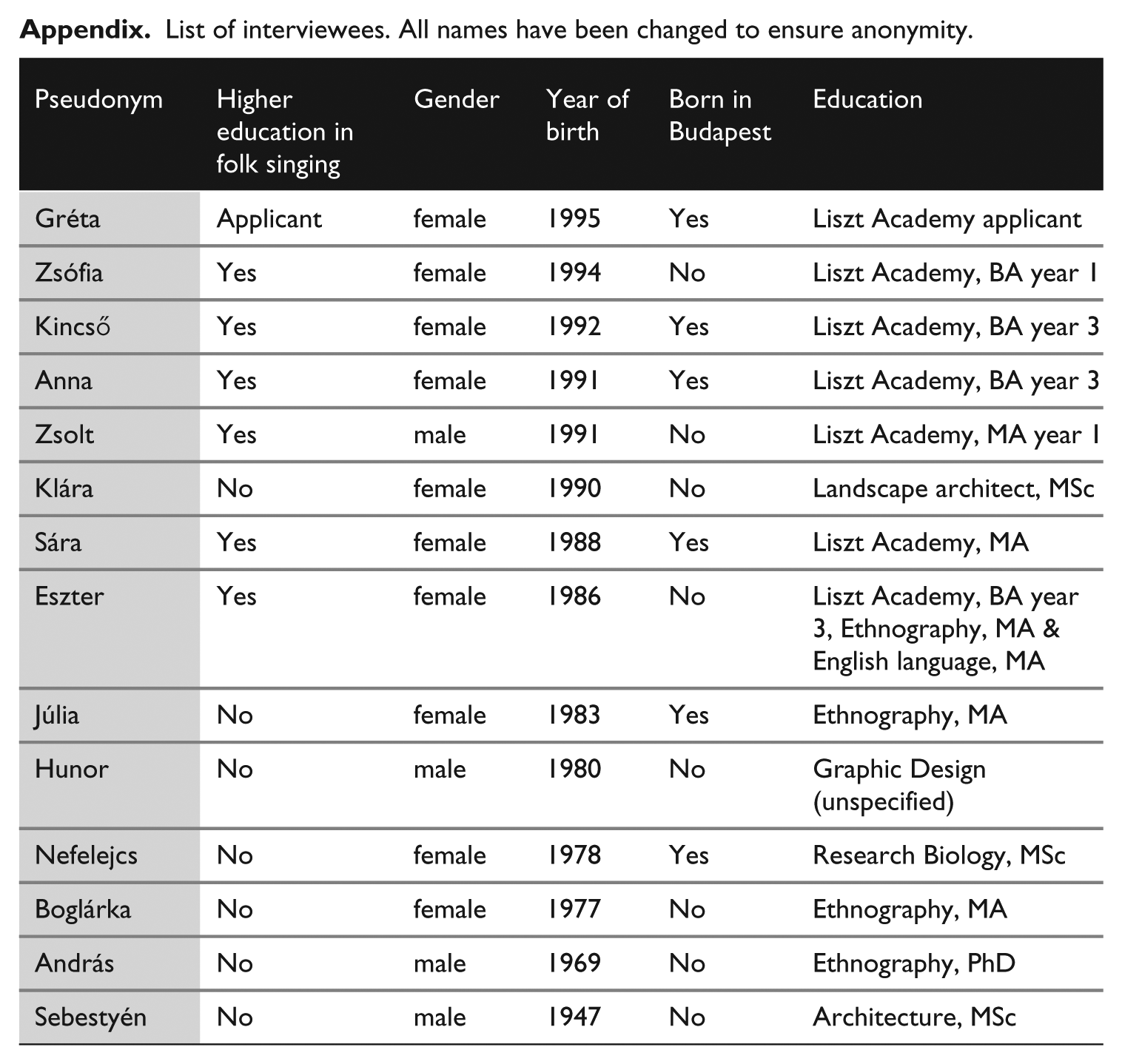
| Pseudonym | Higher education in folk singing | Gender | Year of birth | Born in Budapest | Education |
|---|---|---|---|---|---|
| Gréta | Applicant | female | 1995 | Yes | Liszt Academy applicant |
| Zsófia | Yes | female | 1994 | No | Liszt Academy, BA year 1 |
| Kincső | Yes | female | 1992 | Yes | Liszt Academy, BA year 3 |
| Anna | Yes | female | 1991 | Yes | Liszt Academy, BA year 3 |
| Zsolt | Yes | male | 1991 | No | Liszt Academy, MA year 1 |
| Klára | No | female | 1990 | No | Landscape architect, MSc |
| Sára | Yes | female | 1988 | Yes | Liszt Academy, MA |
| Eszter | Yes | female | 1986 | No | Liszt Academy, BA year 3, Ethnography, MA & English language, MA |
| Júlia | No | female | 1983 | Yes | Ethnography, MA |
| Hunor | No | male | 1980 | No | Graphic Design (unspecified) |
| Nefelejcs | No | female | 1978 | Yes | Research Biology, MSc |
| Boglárka | No | female | 1977 | No | Ethnography, MA |
| András | No | male | 1969 | No | Ethnography, PhD |
| Sebestyén | No | male | 1947 | No | Architecture, MSc |
Acknowledgements
We would like to thank the journal editors – particularly Lisa McCormick – for extensive feedback, the reviewers for helpful comments, and the organizers and participants of the conferences ‘Popular music in communist and post-communist Europe’ (Olomouc, 2017) and ‘Communicating music scenes’ (Budapest, 2017), where we presented earlier versions of this article.
Funding
The author(s) received no financial support for the research, authorship, and/or publication of this article.