




Abstract
In contrast to the infrastructural properties of Western media platforms aiming at market power expansion, the digital platform model in China is designed and developed with a techno-nationalist media agenda. In the case of Hong Kong, we look into how exactly the platformisation process restructures and interacts with its surrounding cultural, economic, political and social activities. This article contributes to the Creative Labour Studies by analysing the intricate linkages between the city’s unique socio-historical, technological and political trajectories and the lived dynamics of television work. Through in-depth interviews with Hong Kong TV workers, we reinstitute the techno-political to the analytical lens of Creative Labour Studies. We posit that the ebb and flow of Hong Kong’s TV industry and its creative labour process are not just guided by economic considerations under global media platformisation, but also uniquely entangled with its historical legacies, socio-technical contexts, and political and ideological framework. Our empirics show how the conflicting strategies directed by both the platformised business models and an unprecedented techno-nationalist media agenda generate ambiguity and inconsistency in daily TV operations. The elevated self-censorship and loss of editorial autonomy alongside the rapid media platformisation reinforce a normative ‘moralist regime’ creating specific forms of precarity and dissatisfaction among Hong Kong TV workers, undermining the development of the creative industry and a creative career. But the changing techno-political conditions also alter TV workers’ perceived nature, functionality and value of creative work, enacting a self-governed ‘ethical regime’ in their professional practices, and open up new creative opportunities.
Keywords
Introduction
As a sub-field of cultural studies, Creative Labour Studies (CLS) has primarily focussed on the Western creative workers located in cosmopolitan cities (e.g. Banks et al., 2017; Campbell et al., 2019; Gill and Pratt, 2008; Hermes, 2015; Hesmondhalgh and Baker, 2011; Sandoval, 2018; Umney, 2015; Ursell, 2000). These studies tended to depict the universalised features that characterise the economic, symbolic and social problems facing creative work, such as work precarity, low-pay, self-exploitation, work flexibilisation, declining creative autonomy, neoliberal work ethics, diminishing prestige and professionalism, increasing sociality at work and the lack of trade unions for negotiating worker benefits with employers and organising collective activism. There have also been emerging debates on how digitalisation and platformisation accelerate the creative production, labour and consumption processes (e.g. Hesmondhalgh, 2019; Moe et al., 2016; Poell, 2020). However, little attention has been paid to how socio-technical and political conditions together co-configure the nature, functionality and value of creative work in divergent contexts, in return undermining the development, viability and sustainability of the creative industry and a creative career. Amid the alleged global process of creative work precarisation and media platformisation, this article adopts an ‘ex-centric perspective’ (Alacovska and Gill, 2019) as a starting point, which challenges a universal logic about and provincialises some entrenched ‘Eurocentric’ notions in CLS. However, we are also aware of the potential problem of parochialism in an ‘ex-centric’ approach (Chow and de Kloet, 2014). Instead of presuming the complete irrelevance of ‘Western theory’ or ‘essentialising places, histories and people’ (Chow and de Kloet, 2014: 11), this article aims to refine the debates on the economic and social consequences of platformisation prevailing in the Euro-American public discourse (Helmond, 2015). In doing so, the notion of ‘context’ is interpreted as a relational rather than a fixated one, especially in the case of Hong Kong – a non-Western city with intricate socio-historical, economic and cultural ties to the West.
By focussing on television work in Hong Kong rather than lumping all creative sub-sectors together, we ‘ground a more realistic and complex understanding of creative labour within the political economy of particular creative industries’ (Thompson et al., 2015: 317). For instance, while existing studies show how the television sector aligns its professional practices with the state’s political-economic agenda, many portray a neoliberal-socialist dichotomy: Western TV companies’ creative production and publicity (such as BBC World’s) are typically characterised as serving the state’s neoliberal nation branding measures and aiming at economic globalisation (e.g. Bolin and Miazhevich, 2018), also ‘attract[ing] capital, tourists, investors, and trade’ (Del Percio, 2016: S3), whereas Chinese television companies’ (such as CCTV-4 and Phoenix TV) primary concern about promoting the state socialist ideology through their programming is underscored as a non-neoliberal nation building strategy (e.g. Wu and Ng, 2011). Against the backdrop of its British (post)colonial history, hybrid culture and recent political changes, we will elucidate Hong Kong TV industry’s changing politico-economic role and its mixed impacts on television work.
In the following, we first contextualise the development of the television industry in Hong Kong’s unique socio-historical, political and economic trajectories since the 1950s. We then elaborate on the recent calls for de-westernising (or de-centring) CLS (Alacovska and Gill, 2019; de Kloet et al., 2020). Next, we review the key debates on how media platformisation impacts creative work and also discuss their potential limitations in analysing the cases that do not squarely match with the infrastructural properties of Western media platforms and their primary aim at market power expansion (e.g. Budnitsky and Jia, 2018; Chan, 2017; Plantin and de Seta, 2019; Qiu, 2010). Finally, we theorise how the following three forces – (1) the Western-capitalist-driven infrastructural platformisation, (2) the HK government’s gradual appropriation of China’s techno-nationalist media regulations in TV licensing under a non-neoliberal logic and (3) a controversial re-centralisation of ‘political-neutrality’ in creative outputs within the media organisational setting and daily work practices – have coalesced to form Hong Kong TV workers’ sense of precarity and creative dissatisfaction, and also lead to the increasingly politicised conceptions and criticisms of TV creativity in social discourse.
From 2016 to 2021, we conducted 88 interviews with Hong Kong’s creative workers, including 17 of them working in the television industry. Our empirical findings show how Hong Kong’s increasingly platformised TV industry and its sub-sector-specific mode of production and consumption characterise the subjectivity and sense-making process of TV workers. We also analyse how the reported ambiguity and inconsistency in the TV operations are interlinked with the diverging strategies directed by both the platformised business models and an unprecedented techno-nationalist agenda. This analytical perspective helps readers recognise how the two interlaced macro changes (socio-technical and political) constitute new forms of editorial control, legalised media regulations and self-censorship with which TV workers now constantly negotiate. Importantly, we argue that the new techno-political imperative derives dual impact: while it situates Hong Kong’s TV industry in a challenging position, hinders its development and undermines TV workers’ wellbeing, creative fulfilment and career progression, it also enables TV workers to reinvent new meanings and values for their creative work. All these will be elucidated in detail in our data analysis.
Why Hong Kong?
This article presents how the British (post-)colonial city’s unique socio-historical and socio-political trajectories intricately link with the peculiar work challenges and identity crisis of Hong Kong TV workers in their daily work. Contrasting the infrastructural properties of Western media platforms aiming at market power expansion, we argue that it is problematic to analyse the platformisation of media work simply by focussing on its economic imperative. For example, infrastructural and media platformisation in China not only serves economic goals, but also specific diplomatic and political goals (Budnitsky and Jia, 2018; Plantin and de Seta, 2019). By recentring the techno-political in the analytical lens of CLS, we contend that the evolution of Hong Kong’s TV industry and its creative labour process are not just guided by economic considerations or an ‘entrepreneurial agenda’, but are entangled with other structural contextual factors – including its historical legacies, socio-technical changes and political and ideological framework, which render the nature and impact of its platformisation rather different from other typical ‘metropolitan creative hubs’ like London, Paris, New York or Tokyo. In fact, Hong Kong provides a case of creative and cultural industries ‘straddling both the Western and Eastern worlds’ and exemplifies an ‘unfinished experiment and a laboratory of globalisation’ (Leung, 2019: 6).
Hong Kong’s social history and television industry development
The peculiar development of Hong Kong’s television industry – since its inception in 1957 – was a result of its British colonial history and the social, political, economic and cultural changes (Hampton, 2011). In the 1950s, the city experienced a drastic population growth generated by waves of Chinese emigration and sojourn movements between Hong Kong and Guangdong province and a post-war baby boom. By 1960 the population had reached 4 million, and by 1966 it expanded again to 5 million: one-third were refugees who emigrated from Mainland China after the communist take-over. While the local birth-rate was persistently high, by the mid-1960s, 43 percent of the population fell into the 10–35 age-group, and the proportion of the locally born population surpassed 50 percent for the first time (Hampton, 2011: 306–307). These altogether created a critical mass of potential TV audiences (Chik, 2010).
Since the 1950s, the colonial government embraced the doctrine of laissez-faireism and was extremely careful about not cultivating a sense of Chinese national identity in the Anglicised educational system. The economic value of Hong Kong as a middleman in Sino-British trade was the only emphasis, whereas ‘Chinese-ness’ was neither linked to contemporary China nor the local Hong Kong landscape. A majority of Hong Kong Chinese was being trained to speak both English and Cantonese-Chinese, yet without any strong identification with either country. Especially, the social riots in 1956, 1966 and 1967 had led the British colonial government to use various educational and entertainment tools, including television, to control, tame and distract the ‘rebellious youths’ (Ma, 1999).
Meanwhile, the socioeconomic upgrading derived from modernisation and industrialisation in the 1960s and 1970s (Jarvie, 1977) and the upsurge of consumerism and cultural globalisation (Ng, 2003) encouraged the increasingly well-off Hong Kongers to seek enjoyment out of their work time, and television instantly became a major mass entertainment. When compared with other post-war British colonies, television came rather early to Hong Kong, indicating ‘the Colony’s prosperity and its status as a regional media capital’ (Hampton, 2011: 306). Run by the British commercial company Rediffusion (RDF), Rediffusion Television (RTV), established on 29 May 1957, was the first wired domestic television service epitomising the birth of Hong Kong’s television industry (Hampton, 2011). At the beginning, the 1500 audience members for RTV’s one channel (primarily broadcast in English and some Chinese), black and white, 4-hour daily TV programming were mainly British. In the 1950s, more than 98 percent of the locals were Chinese, and most could not afford both the wired television set and the monthly subscription fees. Hence television was then criticised as the ‘special enjoyment of the elites’ (Ng, 2003).
For almost a decade, RTV maintained its monopoly position in Hong Kong’s television market. Until 1965, however, the Hong Kong government offered the new over-the-air (OTA) TV broadcast licence (15-year patent). The British-American invested Television Broadcasts Limited 1 (TVB) successfully bid for the licence (Hampton, 2011: 308) and became the major commercial rival against RTV (Ng, 2003). As the first commercial terrestrial television in Hong Kong operating on two channels, the Jade (Cantonese) and the Pearl (English), TVB represented the official emergence of a domestic mass (Chinese) television market right after the riots and civic disturbances of the same year, signifying the coming of age of the locally born generation (Ma, 1999). As early as 1976, Hong Kong had achieved a 90 percent television penetration of all homes. In 1977, all three Hong Kong TV stations (TVB, RTV and the short-lived Commercial TV) produced and broadcast approximately 65 hours of TV programmes per day, reaching an estimated 3.2 million audience (Wong and Yu, 1978: 7). In the 1990s, which was the ‘golden era’ of Hong Kong TV industry entertaining audiences across Asia and other Chinese societies around the world, the total number of Hong Kong’s TV drama productions per year added up to 1470 episodes (Ng, 2003).
Apart from the commercial broadcasting service, Hong Kong also has its own public broadcasting service Radio Television Hong Kong 2 (RTHK). There are also several other key wired and satellite TV networks in Hong Kong’s television history, comprising Cable TV, Phoenix TV, Now TV, Hong Kong Television Network (HKTV), ViuTV and Fantastic TV. As the major incumbent player in TV, the business of TVB has nevertheless been going downhill since the mid-2000s. To strengthen and further expand its share in the rapidly surging mainland Chinese market, in 2015 the company was sold to Chinese businessmen, when Charles Chan Kwok-keung became the new chairman of TVB and Chinese media magnate Li Ruigan, nicknamed the ‘Chinese Murdoch’, joined the board of directors and became the largest shareholder holding about a 20 percent stake (Leung, 2019: 13), alongside the increasing pro-establishment ownership which occurred after the Hong Kong handover in different sectors of the Hong Kong media industry (Luqiu, 2017).
Since 2010, there have been mounting calls for the government to issue more free TV licences for two main reasons: the perceived deteriorating quality of free TV production and the ageing industry’s neglect of changing public taste and interest. This also triggered the renowned telecom and media entrepreneur Ricky Wong Wai-Kay to found HKTV by headhunting and hiring hundreds of TV industry personnel and producing television programmes since 2010. However, in October 2013 the Hong Kong government officially rejected HKTV’s licence application (Leung, 2015); the decision was widely criticised by the general public as a political one. While Wong subsequently announced an immediate cut of 320 jobs, instead of expressing resentment towards their short-lived employer, HKTV employees (including those dismissed) staged a public demonstration against the Government’s draconian decision. As Leung (2015) argued, this incident triggered the online protests by thousands of netizens and other concern groups against the Government’s denial of the people’s right to TV choices as well as the perceived blatant injustice. In 2013, the Government also granted initial approval for new licences to two companies headed by businessmen who apparently have strong connections to mainland China. In 2016 and 2017, HKTVE (commonly known as ViuTV) and Fantastic Television Limited – two new TV industry players/digital broadcasters – officially launched their operations.
In recent years, Hong Kong commercial and public TV broadcasters have progressively distributed their content through popular social media platforms (e.g. YouTube) and/or their self-developed pay digital platforms. Over-the-top (OTT) video’s contribution to the total entertainment and media (E&M) revenue in Hong Kong is on the rise (PricewaterhouseCoopers, 2020), reflecting the importance of platformisation in the Hong Kong’s TV industry. The intertwined forces of the platformised business model and a ‘techno-nationalist media agenda’ (Qiu, 2010) constitute a new analytical approach in studying creative labour in Hong Kong’s TV industry.
De-westernising CLS
CLS have been centred on Euro-American contexts and focussed on the examination of middle-class, white, male and urban workers (Alacovska and Gill, 2019). Despite more recent studies turning their investigation into ‘peripheral’ regions, the theorisation resulting from these Western studies is still grounded in the global North experience. Alacovska and Gill (2019) assert that the de-westernisation of CLS can bridge the existing conceptual gaps by examining the specialties and distinctiveness of the ex-centric or global South creative workers and their labour process. For instance, in Iqani’s (2019) study of South African social media brand influencers, she elucidates the informal value creation through the celebritisation of the influencers and their role-modelling as an aspirational consumer, reflecting a distinctive consumer culture in the global South. In contrast, Leung and Cossu (2019) argue, the new work experiences offered by the digital entrepreneurship in Taiwan and Thailand are not only shaped by the neoliberal ideology, but are also constituted by context-specific forms of intergenerational solidarity and close-knit community help, which involve a new class of entrepreneurial elites which counter the political and economic limits of the two countries. Both Iqani’s and Leung and Cossu’s studies offer alternative ex-centric lens in CLS to break through the global North-South binary conceptualisation. While previous studies show how ‘the influences of the evolving economies, including the growing emphasis on global markets, the tightening of budgets, structural economic downturns and other changing economic conditions’ negatively impacted Hong Kong advertising workers’ creative identities (Chan, 2017: 327), in this study, we illuminate a more holistic conceptual approach beyond a neoliberal understanding of creative industry and career by factoring in the socio-historical, socio-technical and political dynamics in Hong Kong’s TV industry, highlighting the linkages between digital media platformisation and an emerging techno-nationalist agenda in the (post-)colonial city, in addition to the distinctive forms of work precarity, moral depositions at work (Alacovska and Gill, 2019), distinctive TV consumer culture (Iqani, 2019) and modes of digital entrepreneurship (Leung and Cossu, 2019) derived from the context-specific techno-political forces.
Media platformisation and the techno-nationalist agenda through TV media
Responding to the popularity of Western social media platforms (e.g. YouTube, Facebook, Instagram) and online streaming entertainment services (e.g. Netflix, HBO, Spotify), platformisation has become essential to media corporations and media workers in their cultural content production, distribution and monetisation (Poell, 2020) in addition to reinforcing media concentration. The leading corporations integrate across the business lines vertically and horizontally, from content production to media intermediaries, data analytics to content distribution. In particular, digital media has become a powerful tool for nationalistic promotion within and without the nation state. Techno-nationalist agenda can be defined as ‘the pursuit for the technological prowess of a nation, which is culturally rooted in the traditions of nationalism and institutionally expressed through concrete political economy structures and processes’ (Qiu, 2010: 287). The fulfilment of techno-nationalism relies on a ‘diverse collection of government agencies rather than a central government office’ in implementing high-tech policies (Qiu, 2010: 188). In China’s case, the infrastructural platform model of WeChat (a dominating multi-purpose messaging, social media and mobile payment app in China) is designed to meet both the nationalist agenda guided by the Chinese government and the commercial objectives of the Internet company (Plantin and de Seta, 2019). Under China’s political economy, the two seem to work seamlessly with each other. WeChat not only includes properties of infrastructure in terms of a scale, ubiquity and criticality of use. The infrastructurisation of a digital media platform shaped by both techno-nationalist media regulations and an overt cyber sovereignty agenda (Hao, 2017; Qiu, 2010) realises national security and interests through entrepreneurial-governmental collaboration on technological development. The closed environment of the WeChat official account and mini programmes are ‘nested apps’ that prevent the information outlinking to the Internet and facilitate national control of its massive user base (Plantin and de Seta, 2019). The WeChat example attests that the ‘public-private partnership’ between media and the China state depends on the state’s national political and information system (Budnitsky and Jia, 2018).
While the existing non-Western (Plantin and de Seta, 2019) and East-East/China-Russia (Budnitsky and Jia, 2018) studies of platformisation and techno-nationalist media regulations offer an alternative perspective in understanding digital media other than a purely market- and algorithmic-driven viewpoint, such a techno-nationalist media agenda could manifest itself differently in other socio-political contexts. In other words, the techno-nationalist media agenda is not always a poreless matrix completely controlling the industry development and worker practices. In the case of Hong Kong, Wu and Ng (2011) observed that major TV broadcasters who built rapport with the Chinese government used to strike a good balance between the nationalist agenda on soft-power building and commercial interest. Phoenix TV, founded in 1986 and a Hong Kong–based private Mandarin Chinese TV network, provides free information flow and entertainment across the Greater China region. Phoenix TV’s news programmes, on one hand, targeted the overseas Chinese audience for ‘cultivating and propagating a sense of Chinese cultural identity and recognition’ (Wu and Ng, 2011: 76). On the other hand, the broadcaster embraced the market-oriented corporate value in its strategic development of news and current affairs programmes for advertising dollars. There was also room for the small, independent media outlets in Hong Kong (such as InMedia and House News) to deviate from the mainstream TV broadcasters’ official tone and offer the public alternative news that were not necessarily congruent with the rhetoric of the government and the Chinese state. Rather than merely looking into how TV production is aligned with a techno-nationalist agenda (Budnitsky and Jia, 2018; Plantin and de Seta, 2019; Wu and Ng, 2011), we take a further step to discuss how this new ideological and regulatory structure impacts the working experience and triggers subsequent reactions from TV workers amid Hong Kong’s recent drastic socio-political changes.
Methodology
This article draws on data derived from two broader research projects on Hong Kong creative workers’ situated experiences of new opportunities and challenges under the growing influence of platformisation in shifting modes of production and consumption. From 2016 to 2021, we conducted semi-structured interviews with 88 Hong Kong creative workers using a snowball sampling method. With prior work experiences in advertising, public relations (PR), television and print media, we exploited our own (as well as the research assistants’) professional and personal networks to seek informants located in the aforementioned creative sub-sectors. In the subsequent round of snowball sampling, we relied on the recruited informants to introduce other potential interviewees, especially those working in the television industry. The sample contained a mix of seniorities, ranging from new entrants to executives with over 20 years of experience in both local and international media and creative companies. This article focuses on 17 in-depth interviews with TV industry workers (see Table 1 for a summary of respondents’ profiles). The 11 female and 6 male informants occupied junior and senior positions across a variety of TV functions, including financial news, political news, entertainment news, lifestyle and drama in the English and Chinese channels of both commercial and public TV broadcasters.
Interview respondents: summary of pseudonyms and occupation.
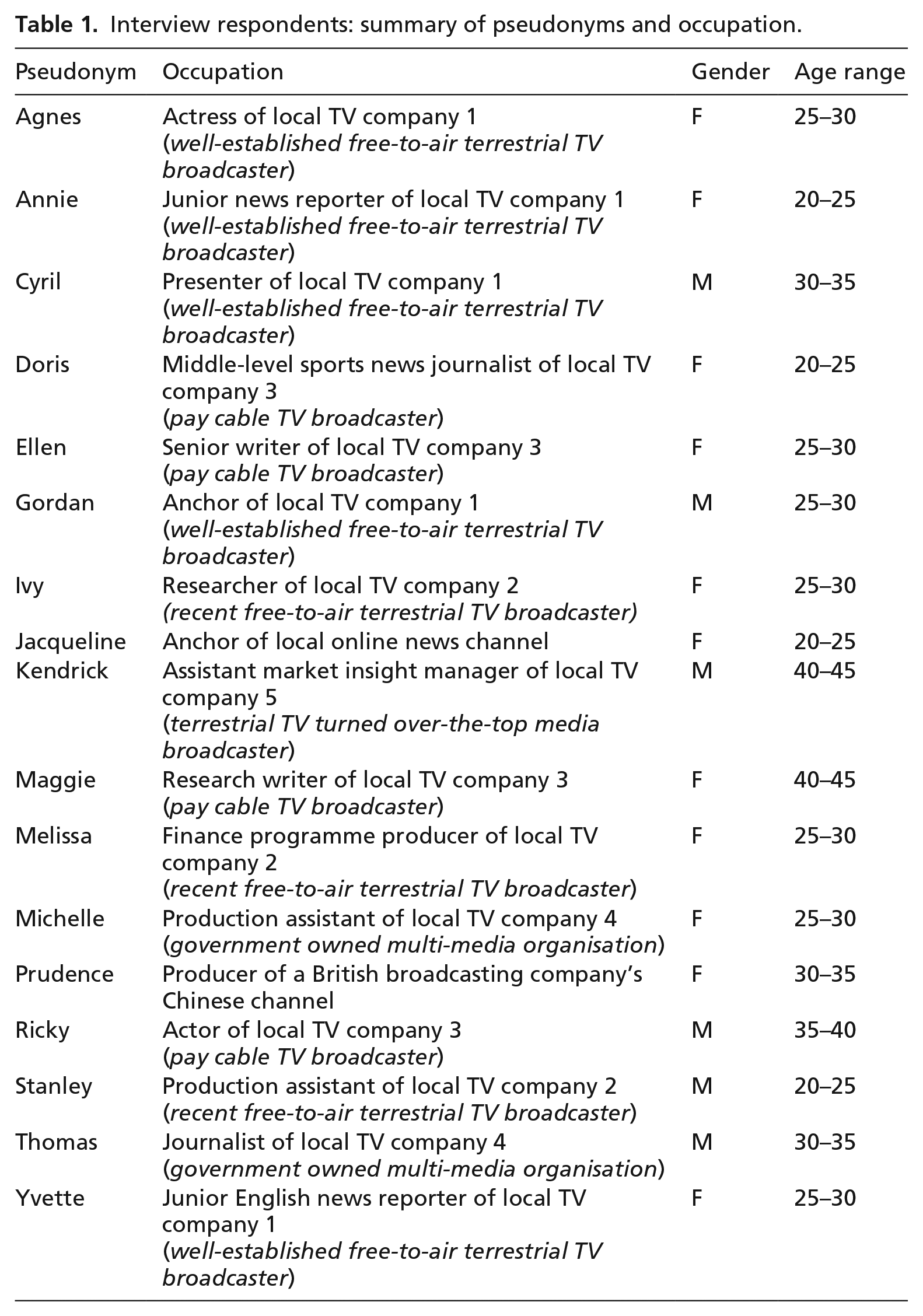
We developed an interview guide based on reports in local and international mainstream media and in the cultural and creative industry literature. During interviews, the primary focus was to document and dissect creative labourers’ daily work experiences and social lives, creative achievements and social communication with co-workers. The questions covered personal, organisational, sector-related, local, global and other external factors, such as economic, socio-technical and cultural ones, in addition to views about work-related government policies. All interviews (in Cantonese or English) were recorded, fully transcribed and translated into English. Using an inductive approach and a constant comparison method (Strauss, 1987), a long list of open codes was identified (for details, see Table 2). The research team further discussed and reflected on the possible linkages among these codes, then identified and agreed on a short list of axial and selective codes. These codes indicate key overarching themes and interlaced factors routinely shaping different aspects of job precarity, work demand, constraints and responses. Due to the 2019 Anti–Extradition Law Amendment Bill movement 3 and the subsequent implementation of the National Security Law (NSL), 4 the research team also conducted follow-up phone interviews in 2021 with five interviewees who had participated in one of our primary research studies and accepted our invitation for the follow-up session. The follow-up interview questions particularly focused on three selective codes: ‘platformised TV work and precarity’, ‘de-politicised creativity’ and ‘reinventing professional identity’.
Coding scheme.
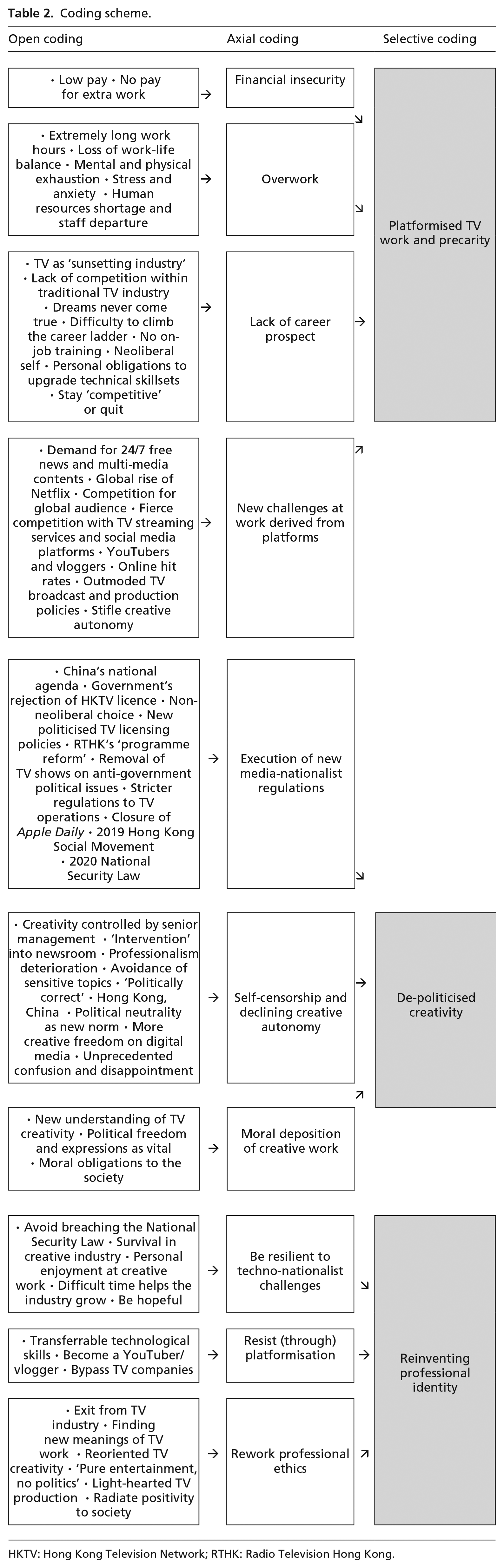
HKTV: Hong Kong Television Network; RTHK: Radio Television Hong Kong.
To approach CLS from an ex-centric perspective, we contextualise the emerging challenges for TV workers uniquely shaped by Hong Kong’s socio-political and developmental history. While some of these emerging challenges involving media platformisation are universally pertinent (e.g. the upsurge of web media and digital/citizen journalism), the others are more specifically derived from or intersected with Hong Kong’s particular socio-historical and socio-political trajectories. The global transformation of media platformisation interlaces the techno-nationalist agenda through media platforms, reinforcing creative worker’s subjective sense of precarity and anxiety. In the following, three salient selective themes which emerged are selected to be discussed: (1) how the increased media platformisation in Hong Kong shapes TV workers’ experiences of precarity and creative work; (2) how TV workers experience HK government’s gradual appropriation of China’s techno-nationalist media regulations and a re-centralisation of ‘political-neutrality’ in creative outputs in daily work practices; and (3) how TV workers negotiate new forms of editorial control and self-censorship and derive new creative work meanings and values within the emerging techno-political framework.
Data analysis
How media platformisation in Hong Kong reshapes TV workers’ experiences of precarity and the nature, functionality and value of creative work
We can watch TV anytime, anywhere now – A smartphone is a television. (Ellen, Senior writer of local TV company 3)
Echoing the existing literature on media platformisation’s impact on cultural production, distribution and monetisation (Poell, 2020), our interview responses illuminate how platformisation reshapes TV workers’ nature, functions and value of creative work, escalating a specific sense of job precarity. In social discourse, the demand for timely, round-the-clock yet free news and multi-media content has become commonplace. As our interviewees repeatedly describe, only the major TV networks in the United States, the United Kingdom, Spain, Japan, South Korea and China can afford the opportunities offered by media platformisation to produce and distribute competitive TV programmes through global algorithmic TV networks (e.g. Netflix). They also perceive their creative career as not as free as the individual YouTubers and vloggers, who tend to produce low-budget yet highly creative videos on their own without the operational and procedural constraints in a typical corporate setting. For TV workers situated in traditional TV organisations, while striving to catch up with such a fast-paced cultural production and distribution cycle, they are trapped between the shrinking financial resources and the rigid workflow and mode of collaboration. Even for those who already work in Hong Kong’s major TV networks, they perceive their long-term career prospects as precarious and gloomy as the ‘sunsetting industry’ itself. Work hours in TV industry, similar to other creative sub-sectors such as advertising (Chan, 2017), have become extremely long, exceeding most workers’ physical and mental capacity, while they are also required to take night shifts regularly without extra pay. Such prolonged work schedules exhausted TV workers both physically and psychologically, depriving them of most social activities and the familial support they deem important to maintain their wellbeing: [W]hen you work non-stop for 15, 16 hours, perhaps from night shift to day shift, like 2 or 3am till 6am, and then keep working for the day shift right after that [for another 9 to 10 hours]. It seems to be flexible, that you can leave when you finish . . . presuming you could actually finish your work by any chance! (Melissa, Finance programme producer of local TV company 2)
An emerging trend in creating and updating multi-media contents across broadcast, online and social media platforms in addition to monitoring the ‘datalogic’ media consumption metrics is observed (Shapiro, 2020). When it comes to the mounting tasks beyond traditional TV work, the ad hoc cross-media projects, and continuous human resources shortages and staff departures, rather than relying on the TV organisation’s better human resource management, TV workers are increasingly expected to embrace their neoliberal self: they are responsible for being flexible and resilient enough to stretch their work hours, forgo their non-work endeavours and personal obligations to upgrade their technical skillsets and fulfil their media organisations’ commercial goals. These unprecedented job duties further escalate their workload, stress and anxiety, generating a vicious work cycle. What they perceive as a solution to the escalating exploitation is either quitting or to stay ‘competitive’ in the market: I think the immense workload and lack of human resources is the main reason for me to think of leaving the company . . . till a point when I felt it affected my health . . . so tense, no time to rest, no time to think . . . our content [TV scripts] is highly confidential, you can’t take things away and work from home . . . it’s not at all about my physical well-being, but mental . . . I was so depressed . . . no time to rest nor to refresh yourself . . . always multitasking . . . everything is urgent, just so stressed. (Ivy, Researcher of local TV company 2)
Competition for the global audience is a universal phenomenon in the age of algorithmic television and large-scale customisation (Shapiro, 2020), as also shown in Hong Kong’s case. Such competition is not just among the regional TV broadcasters, but also includes the global social media platforms, OTT live-streaming entertainment services as well as millions of YouTubers, social influencers and ‘media produsers’ worldwide (Bruns, 2008). Ellen, senior writer of a local pay cable TV broadcaster, realises that the edge of Hong Kong TV since the 1980s – as a unique platform in mediating cultures and information between the East and the West - has lost its lustre. In the platform age, Hong Kong TV programmes’ once-renowned aesthetic styles and colloquial narratives have become disenchanted while facing audiences with an increasingly global taste and competing against the unlimited options of news, entertainment or even educational content. This socio-technical shift radically reshapes the consumption patterns, preference and expectation of TV audiences (Iqani, 2019). Such intensified global competition also raises emotional anxiety and disappointment among TV workers, as they strive for high hit rates in a volatile digital world while being constrained by rigid organisational policies and regulations in Hong Kong: The style of how people are watching TV has changed undeniably. I don’t even watch [local TV company 1], but Netflix. And, talking about the production value, [local TV company 1] hasn’t shown much improvement, producing same style TV dramas. Those props have been used for twenty years. We also have CGI, but it is worse than those from Youtubers, isn’t it? (Cyril, Presenter of local TV company 1)
The interviewed TV workers also often compare their creative work with the video contents launched in online media platforms. They find the rigid TV broadcast and production policies and outmoded creative procedures impeding the TV industry development and stifling their creative autonomy, artistic expressions and critical thinking – which they deem more important than money and time. All these aggravate their work-identity crisis as the newest, yet most ‘unproud’ generation of Hong Kong TV workers: There is no restriction on the internet . . . But this doesn’t apply on TV. There are so many limitations . . . from regulations, products, advertisements, almost everything, will affect the content of a TV program . . .. those audiences will keep going away, because what you have done is far from what they expect. (Ricky, Actor of local TV company 3)
Apparently, the forementioned experiences of work precarity mostly align with Hesmondhalgh’s argument that ‘digital labour in general is strongly associated with exploitation and poor working conditions’ (Hesmondhalgh, 2019: 11). However, Hesmondhalgh (2019) emphasises that such deteriorating working conditions are caused by a neoliberal ‘marketisation’ (p. 7) in the West, where governments open up and push the digital media markets for national and international competition. In Hong Kong’s case, although the force of market-driven platformisation is discerned, other techno-political factors play an even more significant role in shaping the precarisation of TV work and TV workers’ divergent responses, as will be further deliberated in the following two sections.
Politically neutral production to follow the techno-nationalist agenda
In mainland China, the realisation of the techno-nationalist agenda stipulated relies on cooperation between the central government and the giant private high-tech and media enterprises. In the case of Hong Kong, as our interviewees describe, the techno-nationalist ideology has also gradually infiltrated the TV industry. In the platform era, Hong Kong’s TV organisations consciously strive for a balance between the pursuit of market-oriented monetary return (e.g. Netflix or YouTube in Western countries) and compliance with the nationalist agenda (e.g. the infrastructurisation of WeChat in mainland China). The two interwoven yet contradictory objectives create a context-specific techno-nationalist agenda in the Hong Kong TV industry, rendering many interviewed workers unprecedentedly confused and disappointed at work. Such techno-politically driven work dissatisfactions are also largely distinct from those discussed in previous study of Western (e.g. Hesmondhalgh, 2019; Hesmondhalgh and Baker, 2011) and non-Western (e.g. Alacovska and Gill, 2019; Iqani, 2019; Leung and Cossu, 2019) media and cultural work.
Dating back to 2013, the Hong Kong Special Administrative Region (SAR) government’s refusal to grant a free-to-air TV licence to HKTV exemplifies its legislative bias over the neoliberalist TV production (Leung, 2015). The founder of HKTV, Wong Wai-Ki who has been seen as a pro-democratic figure in Hong Kong, had invested heavily on talent recruitment, technological upgrading and publicity when he filed his application for the TV licence (Leung, 2015). Ahead of most local TV broadcasters, HKTV even started producing and broadcasting TV drama series on its online platform while awaiting the prolonged licence confirmation. Many TV workers once believed that the new TV licence granted to HKTV could offer more job vacancies, attract creative talents entering or staying in the industry, and enhance the quality and diversity of TV production for cross-media global competition: Putting aside his capability in running a TV station, as an entrepreneur, he [Wong Wai-Ki] invested hundreds of millions dollars on HKTV. I think [HKTV] could attract talented workers to their company if they got the license . . . the whole [TV] market could be more competitive. (Maggie, Research writer of local TV company 3)
Most interviewees perceive the rejection of HKTV’s licence application as a non-neoliberal choice, as ‘government’s decision is politicised and targeted at HKTV’ (Leung, 2015: 427). The hope of TV workers to obtain better jobs and create a ‘more healthy vibe’ in the TV industry was smashed. The immediate dismissal of over three hundred employees by HKTV in late 2013 also escalated into public resentment and HKTV employees’ demonstration against the government rather than the employer: I entered this industry in 2012. The licensing incident was in 2013. I told myself I had to join (HKTV), it’s a historic event [if it were successfully launched] . . . if you ask whether it’s related to politics, I’d say definitely yes. Even we don’t talk about politics, how many people lost their job after [the government] didn’t grant the license . . . Only two free TV stations and two pay TV stations, how could they absorb all those dismissed employees [from HKTV]? (Ivy, Researcher of local TV company 2)
After the 2014 Umbrella Movement
5
, Chinese capital started infiltrating Hong Kong’s local media system; both traditional and digital media companies were acquired to compete against the alternative digital media corporations and counter their ‘dissenting voices’ (Luqiu, 2017). Hung (2020) argued the subsequent imposition of NSL in Hong Kong in 2020 further ‘stifle[s] the remaining freedom and autonomy of the region’ (p. 25) across different social spheres, including traditional and digital media. According to the Important Note: Internet Freedom and Regulation in Selected Places, [The] Hong Kong Bill of Rights Ordinance specifies that the freedom of expression applies regardless of frontiers or media, and that it may only be subject to restrictions which are provided by law and necessary for . . . or (b) the protection of national security or of public order, public health or morals. (Research Office Legislative Council Secretariat, HKSAR, 2020: article 2.1)
Shortly following the enactment of NSL, the government authority blocked public access to various local online news platforms (such as HKChronicles) due to their advocacy of or engagement in anti-government movements in Hong Kong, which may violate the new law (Yau and Leung, 2021). Along with Hong Kong’s unique socio-historical background and television industry development, such unprecedented socio-political and legislative changes continuously reshape the nature, functions and values of television work.
The actualisation of the techno-nationalist agenda is not limited to the control of TV licensing and the imposition of NSL in monitoring online news on the macro-level; it also penetrates into the micro-level programme production and management decisions in individual TV channels. Today internal censorship is more commonly imposed to regulate politically or culturally sensitive TV content, according to our interviewees. Being ‘politically neutral’ has now become the new norm in Hong Kong’s TV production superseding pure economic concerns. In both news reporting and entertainment programmes, such regulations are often not explicitly established, rendering them more difficult for TV workers to follow. A salient example is the only local public broadcaster RTHK’s recent ‘programme reform’. The broadcaster has announced the removal of their past TV shows – many related to the city’s social and political issues – from their YouTube channels and Facebook pages. Public concerns are raised that the valuable archival content of RTHK, including the programmes that reported on Hong Kong’s political protests since 2019 and the NSL, would no longer be available for public viewing (Cheng, 2021). Some interviewees specifically tell us how internal censorship has been obscurely implemented on news programming: I did propose the topic about the anniversary of Hong Kong National Security Law for our documentary series. I was advised not to propose this topic because it had to be approved by the editorial board, and someone at my workplace said this could prevent other teams’ ‘intervention’ into the newsroom. It’s an excuse to me. As a journalist, we have the responsibility to explore new stories. We can persuade and explain to anyone who wants to thwart our proposal. It’s just a normal practice in doing news. (Thomas, Journalist of local TV company 4) There is now a lower degree of autonomy, especially on ‘sensitive’ topics. It means those news regarding politics and government . . . or related to China. China-Hong Kong relation . . . now you must follow their [assignment editor] instruction. (Annie, Junior news reporter of local TV company 1)
Even when producing the supposedly less political-oriented programmes, sports news journalist Doris mentioned about the TV broadcaster’s becoming highly sensitive of anything being ‘politically incorrect’: [W]hen I commented on the [2020 Tokyo] Olympic Games, they [the show producer] told me that they would show ‘Hong Kong, China’ as subtitles, but I had the flexibility to mention Hong Kong or Hong Kong, China. (Doris, Sports news journalist of local TV company 3)
The self-censored, de-politicised creative environment is perceived by many to undermine work morale and keep these workers from pushing their creative limits. In some cases, it is viewed as contradicting the TV workers’ ‘ethical visions of being a media worker’ as well as their faith in the long-term growth of TV industry as a creative sub-sector. It has become more common for Hong Kong’s TV workers to exit the industry completely, or even move to other countries (e.g. the United Kingdom, Canada, Taiwan), which they believe provide more press freedom for their creative pursuits (Grundy, 2021; Ming Pao, 2021): I’m considering staying in this industry or not . . . How could we uphold our media ethics? After the legal prosecution of Bao Choy [on her documentary production at RTHK] and the closure of Apple Daily, my optimism has faded away within a year. (Thomas, Journalist of local TV company 4)
New, clashing perceptions of TV work’s function and value have emerged: the ‘moralist regime’ (top-down, institutional, normative) versus ‘ethical regime’ (bottom-up, individual, self-governing). While the creative work environment has been tightly monitored and de-politicised through the legislative and organisational processes, TV creativity is now understood, however, as even more closely associated with TV workers’ freedom of engaging in socio-political discussions and expressing their political views. Rather than relating to its artistic, affective and intellectual expressions or commercial success, the ethos of democratic expressivism has become the new ‘moral deposition’ of creative work (Alacovska and Gill, 2019). Alongside the rapid TV platformisation, the new nationalist media regulations have imposed multiple layers of anxiety and dissatisfaction upon TV workers. While some workers are determined to leave the TV industry, others try to actively negotiate with this new techno-political situation and explore alternative meanings and values of TV work.
Workers’ reinvention of professional identity amid media platformisation and the techno-nationalist media agenda
Against the negative outlook of Hong Kong’s TV industry development in general, many interviewees reinvent their functions and meanings of TV work, accelerating the new ethical regime. While frustrated with the increasingly de-politicised creative process under the normative moralist regime, they still reiterate their ethical obligations to the society (e.g. TV news reporting, documentary production). Through an active meaning-making process, some TV workers refocus on their personal enjoyment at creative work and stress their continuous passion in acquiring transferable technical skills (e.g. TV production, video-editing, creative storytelling). With their TV creativity increasingly constrained by the trends of platformisation and censored by the implicit nationalist agenda, some interviewees strongly believe there are new opportunities for quality TV production deriving from platformisation. Interestingly, for some of the TV workers, platformisation itself also affords their creative and political resistance. They leave the traditional TV organisational setting, launch their own online channel and/or social media account (e.g. Instagram, YouTube), enlarge their online audience base, bypass the TV companies and directly draw the attention of potential local advertisers or global TV steaming platforms. To reinvent their professional identity as a platform worker or ‘digital entrepreneur’ (Leung and Cossu, 2019) is increasingly regarded as a favourable option to safeguard their creative-political autonomy and ethical obligation, and also for envisioning the future of TV: Because of the outbreak of COVID-19, I set up a YouTube channel . . . I made videos and put them online. A former DJ from a local radio station set up an online platform and they invited me to be their podcaster . . . I have shifted to work mainly on online media. (Ricky, Actor of local TV company 3)
Despite the higher autonomy in broadcasting creative work via personal online accounts, the interviewees admit that the bandwagon of political-neutrality and a heightened self-censorship still prevail across all media, indicating ongoing tensions between the two regimes of TV work. Even without restrictions imposed by the TV organisation or work supervisor, our interviewees confess they have now become more cautious in topic selection and word usage to avoid breaching NSL. Interestingly, this ‘creative challenge’ is reinterpreted as a ‘creative opportunity’ for the recovery of TV industry. Avoiding explicit political topics, an interviewee foresees pure entertainment shows would become a main trend, whose de-politicised contents can still appeal to the general public and serve to create positive societal impact. While this anticipated trend of TV creativity seems to come full circle since the industry’s launch in 1957 – ‘pure entertainment, no politics’ – the redirection has a political undertone. Manoeuvring through the two diverging forces of media platformisation and techno-nationalist agenda, the reoriented TV creativity and creative approaches provide TV workers new meanings for their TV work: a chance to rejuvenate themselves, a challenge to recraft their professional ethics and political views in a de-politicised manner and a buffer to persevere through a socio-politically repressive epoch: In the upcoming future, I believe light-hearted production will become a trend . . . you can no longer talk about the police, triad society and politics . . . people in the [TV] industry always look for a better world . . . if you want to survive in this industry, you have to deliver your ‘message’ in a clever, subtle way . . . I don’t think the TV industry would shrink. The difficult time may help the entertainment industry grow. I believe the ‘pure’ entertainment allows the creators to create under lower pressure, and entertainment is the necessity during such a hard time for the whole society. (Ricky, Actor of local TV company 3)
While being discouraged by the existing techno-political circumstances, many TV workers uphold their resilience at work and recraft their professional ethics. They are still determined to find ways to resist challenges derived from platformisation and political censorship, rework their logic of TV creativity, recreate their professional career on digital platforms, as well as reinvent their professional identity.
Discussions and conclusions
Adopting an ex-centric approach in CLS (Alacovska and Gill, 2019), this article focuses on the techno-political dynamics that shape the creative labour process of Hong Kong’s television sector. Our study shows that the precarisation of Hong Kong TV workers is not simply derived from economic exploitation and a neoliberal logic of platformisation, but also characterised by the industry’s entanglement with Hong Kong’s socio-historical, technological and political trajectories since the 1950s. The nature, functions and values of Hong Kong television work have evolved through four stages of techno-political changes: from a Western, new, imperialist technological tool and ‘cultural narcotic’ to tame the rebellious youths (1950s–1970s) to an indigenised, egalitarian and glorious platform to serve the public’s need for mass entertainment and mediate Chinese cultures between the East and the West/the world (1970s–1990s); from a reinvented, globalising media instrument to detach post-colonial Hong Kongers’ emotional bonding with the Great Britain and re-establish their cultural identification with the Chinese state (1990s–2010s) to an increasingly platformised, politicised yet controversial arena for containing and mediating anti-China sentiments and various cultural and political resistances (2010s–now). The last stage, which we conceptualise as the ‘moralist regime’ of TV work, is accelerated by both the rapidly changing socio-technical and political conditions of Hong Kong over the past decade leading to a progressively platformised TV industry (Shapiro, 2020) and the implementation of China’s techno-nationalist media regulations (Parks, 2020; Plantin and de Seta, 2019; Qiu, 2010).
However, our analysis presents a somewhat different state-media-consumer relationship in Hong Kong’s peculiar socio-political context when compared with both Western cases and other studies of media and creative work in the global South (e.g. Budnitsky and Jia, 2018; Plantin and de Seta, 2019; Wu and Ng, 2011). The intertwining of socio-technical and political forces constitutes non-neoliberal forms of editorial control, legalised media regulations and self-censorship, rendering new anxiety and discontent among TV workers. On the one hand, major TV companies in Hong Kong aspire to adopt the platformised business model in its media operations, accelerating work stress and compromising workers’ physical and psychological wellbeing. On the other, both the government and TV organisations incept non-neoliberal political goals in the industry development as well as its programming directions. This normative moralist regime suppresses independent media outlets and their dissenting voices (Hung, 2020; Luqiu, 2017), imposes unprecedented limits on TV workers’ creative freedom and reinforces the essence of political-neutrality in their creative outputs. These transformations altogether undermine creative workers’ sense of pride, fulfilment and job security in their profession and the industry’s long-term development, viability and sustainability. Nonetheless, rather than being a completely passive subject, our research shows how Hong Kong’s TV workers enact a new ‘ethical regime’ at work by increasingly upholding their local cultural identity in their professional role and politically invested work subjectivity, an unprecedented shift in Hong Kong’s TV history. We also discern how TV workers engage in an active sense-making process to negotiate with the techno-nationalist media agenda and exert their agency: they see themselves not only as creative workers, but also as political subjects who perceive their creative production as a means to promote social justice, actualise freedom of thought, expression, assembly and association, and also counter top-down ideological control. Amid the new regulatory and organisational constraints, they reinvent new meanings of their creative work and their professional identity through experimenting with digital platform entrepreneurship beyond the traditional TV organisational setting, re-establishing producer-consumer relationships on social and digital platforms outside the ‘supra-individual datalogic profile’ (Shapiro, 2020), and strategising creative expressions with a political undertone amid an emerging media regulatory regime. In short, the juxtaposition of neoliberal platformisation with techno-nationalism renders unique techno-political encounters and responses in Hong Kong’ television work. This context-specific phenomenon offers an alternative, ex-centric analytical lens to CLS.
While the findings seem to portray a pessimistic picture of Hong Kong’s TV industry development – that TV work has become more demanding, dispiriting and precarious under Hong Kong’s peculiar socio-political conditions, workers still actively reinvent their role as a creative professionals and the ways they produce, distribute and make sense of their creative outputs. When new technologies are adopted as an ideological apparatus to control the masses (Williams, 1974) or as a means to extract surplus values, they continue to offer opportunities for innovative forms of political expression, cultural resistance, social resilience and meaning-making.
Footnotes
Acknowledgements
I would like to express my gratitude to the EJCS editor and two anonymous reviewers for their time and effort in providing constructive comments through the revision process. I am also thankful to Lik Sam Chan, Joke Hermes, Misha Kavka, Johana Kotisova, Maggy Lee, Vanessa Ossa, Toni Pape, Diego Semerene, Chris Smith, Rik Spanjers and Markus Stauff for their critical comments on an earlier version of this article; to Yiu-Fai Chow, Anthony Fung, David Hesmondhalgh and Sylvia Martin for providing me with further insights into understanding British and Hong Kong creative work conditions at the HKU Faculty of Social Science Public Policy Forum (March 2017); to Anne Peirson-Smith, Joey Chan, Grey Liu, Emily Wong and Alan Yau for their great assistance through the research process.
Funding
The author(s) disclosed receipt of the following financial support for the research, authorship and/or publication of this article: This study was funded by the Public Policy Research Funding Scheme (Project Numbers: 2015.A8.035.16A & SR2020.A8.028) from the Central Policy Unit of the Hong Kong Special Administrative Region Government. It was also in part supported by the Seed Funding for Basic Research programme (Project Number: 201511159032) from the University of Hong Kong.
